Monthly Archives: Oct 2023

Thrity Umrigar’s Space Between Us

Thrity Umrigar, The Space Between Us (©2005, Harper Perennial 2007)

Bhima is a domestic servant in Mumbai – or Bombay, as she calls it. She has been with the same Parsi family for decades. She can’t sit on the family’s furniture, and physical contact is avoided, but she and the woman of the house – Sera, whom Bhima cannot think of without the respectful suffix ‘-bai’ – have formed close bonds. Bhima is the only person in whom Sera has been able to confide about her husband’s violence, and Sera has paid for the education of Bhima’s granddaughter, Maya.

When the novel opens, Bhima is living with teenage Maya in a hut in the slums. We gradually learn that Maya’s parents died of AIDS when she was seven years old, that Bhima’s husband left her decades ago in tragic circumstances, that Sera’s husband has recently died. In the present, Sera’s daughter is pregnant and her relationship with her charming husband is a bright spot in everyone’s lives. To Bhima’s shame and fury, Maya is also pregnant, and the action in the novel’s present revolves around the father’s identity.

It’s Thrity Umrigar’s tribute to ‘the real Bhima’, who was a servant in her wealthy Parsi childhood home in Mumbai. But having established the bonds of affection and mutuality between the two families, the book turns, and becomes a brilliant study of the way relationships can be close and strong but in the end tragically vulnerable to social norms and structures.

I read this book after The Secrets Between Us, a sequel published 13 years later. This isn’t something I’d recommend. On the one hand it was interesting to see passing mention of Parvati, a major character in the second book, to have the stories of Bhima’s husband and daughter dramatically realised, and to come to a fuller understanding of the ending of the second novel. But the major thunderclap reveal of the identity of the man who got Maya pregnant comes as no surprise, and it was odd to know better than all the characters when there was very little foreshadowing.

A strong point in both books is the way they enact the fine detail of changing culture. Sera, like Thrity Umrigar, is Parsi, and the book’s version of traditional Parsi culture probably didn’t win it any friends among older Parsis. In one of the book’s many flashbacks, soon after Sera marries, she and her new husband move in with his parents, and what follows is a classic mother-in-law nightmare. Banu Dubash, the mother-in-law, insists on traditional Parsi practices, specifically those built around the idea that a woman is impure when he has her periods. Reluctantly, Sera accepts that she must eat meals in her room until her periods are over. Although she is Parsi herself, she has no idea of the extent of her assumed impurity, and walks through the room where Banu is praying, provoking a deafening shriek and a torrent of abuse. Freddy, Sera’s kindly father-in-law, comes running in from the dining room. This is on page 76:

‘Oh, Freddy, thank God you are here,’ Banu said dramatically. ‘help me, darling, help me.’
Freddy looked distraught. ‘Banu, what is it, will you speak? Is it your heart?’
‘No, no, nothing like that. Just that this whole house will have to be purified now. Sera walked across the room while I was praying and she is having her monthly cycle, you see. Still, without any consideration, she interfered with my prayers.’
Sera blushed. Before she could speak, Freddy raised his voice. ‘You and your superstitious vhems and dhakharas. Crazy woman, you are. Harassing this poor child, scaring her for no good reason.’ He grew even more angry. ‘And worst of all, you’ve ruined my enjoyment of my music. A new Mozart record I’d just bought, and now your hysterical faras has made me miss the best part.’ He flung a sympathetic look at Sera and then stomped out of the room.
Banu narrowed her eyes and flashed Sera a look that made her heart stop. ‘See what you’ve done, getting my Freddy all upset?’ she said, careful to lower her voice so that it didn’t carry into the next room. ‘Is that why you entered my house, to create friction between my husband and me?’
Sera felt dizzy, as if she had drunk four beers one after the other. She took a step toward Banu and reached out to touch her hand. ‘Banu mamma, I don’t know what happened–’
‘She touched me,’ Banu screamed. ‘Deliberately, on purpose, she touched me with her impure hands. ‘Oh, God, what kind of daakan has entered my house, to make me miserable in my old age?’
This time, Gulab, the Dubashes’ servant, came into the living room. She took one look at the situation and pushed Sera toward her bedroom. ‘Baby, you go in your room for a while,’ she said authoritatively. ‘Go on, I will calm Mummy down.’

I love the way the non-English words are given without italics or explanation. I couldn’t find ‘vhem’, ‘dhakara’ or ‘faras’ with a quick web search, and I’m happy to have them be untranslatable – or rather to be left to make my own rough translations: ‘panics’, ‘idiocies’ and ‘ruckus’, perhaps? And I love the way that each of the four people in this scene are in a different relationship to traditional religious practice. The pragmatic Gulab is probably, like Bhima, Hindu. Freddy is European in his musical tastes. Sera is part of the modern world and completely unprepared for Banu’s fanatical attachment to – in her understanding – antiquated practices. But mostly what I love is the vividly realised drama of the moment, the brilliant use of dialogue.

I came across these books thanks to the Emerging Artist’s practice of plucking books with non-Anglo author names from the shelves of our local library. It’s a life-enriching practice

Claire Keegan’s Small Things Like These

Claire Keegan, Small Things Like These (Faber & Faber 2021)

I first became aware of Claire Keegan through The Quiet Girl (An Cailín Ciúin), an Irish-language film based on her short story ‘Foster’. I saw the film at the 2022 Sydney Film Festival, and was blown away by its portrayal of a small girl’s escape from a terrible situation. The final moment, which I won’t describe because of spoilerphobia except to say that a single, ambiguous word is spoken, is one of the most powerfully moving I’ve seen. The acting (especially Catherine Clinch as the girl), the cinematography (Kate McCullough), the direction (Colm Bairéad) and the script (by Colm Bairéad, closely following Claire Keegan’s prose) are all brilliant. I still haven’t read ‘Foster’ but I was delighted to be given Small Things Like These on Father’s Day.

It’s a tiny book – just 117 pages. It’s set in a small Irish village. Its action takes place over a few days in late December in the time not so long ago when the Catholic Church dominated the lives of most Irish people. Bill Furlong, the coal and timber merchant, is being run off his feet in the pre-Christmas rush. The son of an unmarried woman, he and his mother were able to thrive in spite of the stigma thanks to the patronage of a wealthy Protestant woman – a situation that has uncanny echoes in the Thrity Umrigar books The Space Between Us (which I’m currently reading) and The Secrets Between Us (my blog post here). He is devoted to his wife and five daughters.

A shadow is cast over this benign scene by two pages that precede the beginning of the text proper. First there is the dedication: ‘to the women and children who suffered time in Ireland’s mother and baby homes and Magdalen laundries’. Then, on a page to itself, there is an excerpt from The Proclamation of the Irish Republic, 1916, which declares that the republic resolves, among other things, to cherish ‘all of the children of the nation equally’. Having a rough knowledge of the Magdalen laundries (Wikipedia entry here if you need to look it up), I was prepared for a little book of horrors.

Claire Keegan is a finer writer than that. There is horror, but not the jump-scare, demon-rising-from-the-grave kind, or even the Hanya Yanagihara A Little Life kind. Just outside the village there’s a ‘training school’ for girls of low character and an associated laundry, which ‘had a good reputation’. When Bill delivers a load of coal there on Christmas Eve, he comes upon a young woman who is obviously being abused, and he isn’t reassured by the nuns’ attempts to, well, gaslight him. It’s a small village, and the whispers say that no one can challenge the Church. Aware that his own mother could have found herself in the young woman’s situation, Bill faces a dilemma.

So the book hinges on a small chance encounter, a small crisis of conscience for an ordinary man, who many would say is leading a small life. The title can be read as the beginning of a sentence: Small things like these … pose big moral challenges / … can change the way you see the world / … can disrupt oppressive institutions / …

This blog generally looks at page 76. I might have preferred to talk about the page when Bill sits down to a cup of tea with the Mother Superior, or one of the pages where the abused girl talks to him. But page 76, it turns out, illustrates beautifully the way Claire Keegan tells her story.

It occurs at about the three-quarter point. We have been told very little of what’s happening in Bill’s mind. He doesn’t talk about what he has seen. Perhaps he can’t – he’s a working class Irishman of his era. But his wife, Eileen, can tell he’s ‘out of sorts’. The family go to Mass on Christmas morning. Bill stays back near the door when Eileen and their daughters walk down the aisle and slide into a pew, ‘as they’d been taught’. We’re not told if Bill usually stays by the door, or if this is a sign of new alienation. What follows could easily be a simple description of Irish villagers arriving for Mass in a past era (not all that dissimilar to Mass in the North Queensland town where I was a child in the 1950s):

Some women with headscarves were saying the rosary under their breath, their thumbs worrying through the beads. Members of big farming families and business people passed by in wool and tweed, wafts of soap and perfume, striding up to the front and letting down the hinges of the kneelers. Older men slipped in, taking their caps off and making the sign of the cross, deftly, with a finger. A young, freshly married man walked red-faced to sit with his new wife in the middle of the chapel. Gossipers stayed down on the edge of the aisle to get a good gawk, watching for a new jacket or haircut, a limp, anything out of the ordinary. When Doherty the vet passed by with his arm in a sling, there was some elbowing and whispers then more when the postmistress who’d had the triplets passed by wearing a green, velvet hat. Small children were given keys to play with, to amuse themselves, and soothers. A baby was taken out, sobbing in heaves, struggling to get loose from his mother’s hold.

This may feel like an exercise in nostalgia. But it’s not like, for example, the moment in Robert Dessaix’s Arabesques where he ‘realises’ that the lives of simple Portuguese women at Mass ‘had been redeemed, not by understanding, not by seeing Truth face to Face, but by being gathered up into the Church’ (my blog post here). Neither Bill Furlong not Claire Keegan, observing this gathering, projects visions of redemption onto it. This is an insider’s view. We are told people’s names. We can guess why the freshly-married man is red-faced, we recognise that different people make the sign of the cross differently (I love ‘deftly, with a finger’), there are class differences, children and babies need to be dealt with. It’s a picture of a community coming together that anyone of a certain age with an Irish-influenced Catholic childhood will recognise.

But it’s a critical insider’s view. Bill has a fresh distance because of his moral dilemma, Claire and the reader have perspective created by the seismic shifts in Irish culture since the time of the novel. This is a picture of a surveillance state, benign enough you’d think, but any small divergence from the normal – a sling, a new hat – is noted. It’s characteristic of Keegan’s writing that none of the divergences noted by the gossipers has any moral weight attached to it – we’re left to imagine for ourselves how that would go. We haven’t been told in so many words (this isn’t a Hollywood movie, after all) that Bill is mulling over what to do or not do, but as he looks over this scene, we feel with him the coercive pressure to conform, to accept the authority of the Church, not to rock the boat. The baby, ‘sobbing in heaves’, has to be removed – his mother’s hold is unescapable. Small things like these accumulate so that we understand the pressure Bill faces.

The whole book is a marvel.

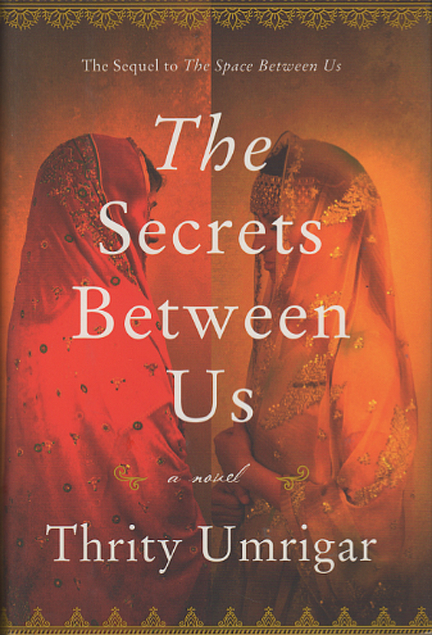
Thrity Umrigar’s Secrets Between Us and the Book Club

For years, I’ve been part of a Book Club where no one can spend more than 30 seconds talking about any book. We would eat, return books borrowed at previous meetings, each offer three books which we describe and score out of 10, then – in an order determined by a card draw – borrow up to three books each.

Over time, as most of the Club’s six members made the move to electronic books, the original idea of lending books we had enjoyed got muddied. We struggled on, meeting less frequently, two thirds of us buying books specifically so as to offer them at the Book Club.

At last we bit the bullet and agreed to try all reading the same book and discussing it. Our first title is:

Thrity Umrigar, The Secrets Between Us (HarperCollins 2018)

Thrity Umrigar emigrated from India to the USA when she was 21 years old. Since then, among other things, she has written a number of novels in English. The Secrets Between Us revisits characters from her second novel, The Space Between Us, which was published 12 years earlier, in 2006. I’m writing this without having read more than a couple of pages of the earlier novel (I managed to get hold of a copy, but it arrived too late for the meeting). Though the second novel makes frequent reference to events from the first, I didn’t feel I was missing anything.

Before the meeting: Other demands on my time mean that this has to be brief.

It’s a terrific novel set mainly in the slums of Mumbai, featuring a brilliant gallery of women characters. It begins with Bhima, who is living with her granddaughter in a hovel in the slums. For many years she was employed in a Parsi household, virtually a member of the family, but expelled when she, correctly and necessarily, accused one of the family members of wrongdoing. She has been abandoned by her husband, and her daughter and son-in-law have died of AIDS. She makes a precarious living and enables her granddaughter to attend college by finding domestic work with a number of wealthy women.

In the course of the novel, Bhima’s life is transformed by two unlikely friendships. One is with Parvati, a woman who is even poorer than she is, who was sold into prostitution as a girl but now, as an old woman, is hideously disfigured by a growth under her chin and survives by buying and selling half a dozen shrivelled heads of cauliflower each day and sleeping on a mat outside a nephew’s apartment door, for which she pays rent. The other is with Chitra, a young Australian woman, the lover of one of Bhima’s employers, who was born in India but cheerfully disregards the rigid requirements class, caste and heteronormativity.

At the risk of reducing the book to a single paragraph, the significance of the title is spelled out in an exchange between Bhima and Pavarti. Bhima was initially shocked when she realised that Chitra and her lover aren’t just good friends, but as she comes to know them and appreciate Chitra’s generosity of spirit, she is then shocked when neighbours call them ‘a very bad name’. Here’s a quote from the conversation that happens after Bhima learns about Parvati’s background as a sexual slave, and meets her former employer who tells her how she suffers from lying about Bhima’s revelations. The lump that’s mentioned is the unsightly growth under Parvati’s chin:

‘Why do we aIl walk around like this, hiding from one another?’
Parvati’s thumb circles the lump in a fast motion as she ponders the question. ‘It isn’t the words we speak that make us who we are. Or even the deeds we do. It is the secrets buried in our hearts.’ She looks sharply at Bhima. ‘People think that the ocean is made up of waves and things that float on top. But they forget – the ocean is also what lies at the bottom, all the broken things stuck in the sand. That, too, is the ocean.’

(page 243)

The book’s story could be seen as a process of bringing those broken things to the light, and at least sometimes making them whole again.

After the meeting: We were a bit tentative about the Book Club’s new MO. We ate a pleasant dinner first, with barely a mention of the book until we moved to comfortable chairs. Conversation started out a little stiffly. Someone actually read out the questions for book groups at the back of her e-book, but we realised we absolutely didn’t want to go down that route.

The main question that got tossed around was how seriously to take the pair of books. The second book (which is the one I’ve read) has some extremely improbable benign elements, including – spoiler alert – a happy ending which may be the set-up for a third book, or not. The relative ease with which characters transcend the rigid barriers of class and custom, one person felt strongly, moves the book into the genre of fantasy, or perhaps mark it as prettified for the US mass market.

Not everyone agreed. Sure, things happen that are extremely unlikely, but they are within the realms of possibility, and the good fortune of the main characters allows the situation from which they (or at least some of them) escape to be seen more clearly by contrast. There’s no pretence, for example, that Lesbians are universally embraced by Hindu society, or that there is any kind of safety net for the poor.

Whether it’s an airport novel or a serious work of art, we all enjoyed it. All except me had read and enjoyed both books. I’m now well under way with the first one, and it’s a curious experience reading some of the harsh judgements expressed in its opening scenes, knowing that they’re based on wrong assumptions.

We agreed to carry on as a Book Discussion Club.

Andrey Kurkov’s Grey Bees at the Book Group

Andrey Kurkov, Grey Bees (2018, translation by Boris Dralyuk, MacLehose Press 2020, 2022)

Before the meeting: I hadn’t heard of Andrey Kurkov before this book was nominated for the Book Group. He’s a Ukrainian novelist, children’s writer, essayist and broadcaster. In an interview on PBS early last year he said that, though he is ethnically Russian and writes in the Russian language, Putin’s invasion has made him ashamed to be Russian, and he is now considering writing only in Ukrainian. He finds it impossible to write fiction in the current situation, but he continues to write and broadcast about the war – his series of broadcasts for the BBC, ‘Letter from Ukraine’, is available online.

Grey Bees, originally written in Russian, was first published in 2018. Russia had annexed Crimea, and there was armed conflict with Russian separatists in two breakaway ‘people’s republics’ in the Donbas region in the eastern part of Ukraine. The novel is set in a time when the front between those forces stretched for about 450 kilometres (it’s now closer to three thousand). The area between the fronts is known as the ‘grey zone’. In his useful Preface to the 2020 English edition, the author explains:

Most of the inhabitants of the villages and towns in the grey zone left at the very start of the conflict, abandoning their flats and houses, their orchards and farms. Some fled to Russia, others moved to the peaceful part of Ukraine, and others still joined the separatists. But here and there, a few stubborn residents refused to budge. … No one knows exactly how many people remain in the grey zone, inside the war. Their only visitors are Ukrainian soldiers and militant separatists, who enter either in search of the enemy, or simply out of curiosity – to check whether anyone’s still alive. And the locals, whose chief aim is to survive, treat both sides with the highest degree of diplomacy and humble bonhomie.

(Page 12–13)

Sergey Sergeyich, the hero of Grey Bees, lives in a tiny village in the grey zone, one of two cantankerous old men who have refused to leave. The electricity has been cut off. He has to trek to the next village to buy food. He depends on a charity’s annual delivery of coal for heating through the savage winter. He is a beekeeper, whose emotional life focuses on the wellbeing of the beehives that spend the winter in his garden shed. His wife and daughter are long gone, and he has never really got along with Pashka, the other remainer.

The opening scenes reminded me of Czech comedies in the 1960s like The Firemen’s Ball. There, people’s lives were miserable under the Soviet regime and the comedy was subversive as well as desperately funny. Here the enemy is the war itself, and the quiet desperation of the characters is made tolerable to the reader by their comic focus on tiny issues – like the way the two men hide from each other whatever good food they’ve managed to get hold of (where good food can include a block of lard!), or Sergey’s decision to swap the street signs so he no longer lives in Lenin Street. There’s a touch of Waiting for Godot: how can anything happen so long as they are trapped in this place?

Then, as the days warm up and the buzzing of his bees becomes more demanding, Sergey decides to take them to a place that hasn’t been laid waste by the war, and we follow him on a journey south, to environments that are more friendly to him as well as his bees. He meets with kindness, and is kind in return. He sets out to visit a Tatar beekeeper he met at a conference years before, and arrives in a tiny village in Crimea that is occupied by the Russians. In the process of getting there he has to pass through Russian checkpoints, and he is looked at with suspicion on all sides: coming from Donbas, is he a separatist or a loyal Ukrainian? He’s attacked on suspicion of being one and harassed when he is assumed to be the other. An Orthodox man, he falls foul of the Russian authorities when he befriends a Muslim family.

Though terrible things happen, what shines through is Sergey’s unassuming human kindness. The background buzzing of the bees is warmly reassuring: they go about their work, and can be counted on to produce honey, which is universally welcomed.

Towards the end, when the Russian authorities meddle with one of the hives, Sergey has dreams that the bees of that hive have turned monstrously grey, and the allegorical role of the bees, which is a quiet undercurrent for most of the book, comes front and centre in some splendidly surrealistic passages.

To give you a taste of the writing, here’s a little from page 76, when Sergey is still in the village. Spring is on the way:

The sun had spread even more of its yellowness through the yard. The trampled snow had turned yellow, as had the fence, and the grey walls of the shed and the garage.
It wasn’t that Sergeyich didn’t like it – on the contrary. But he felt that the sun’s unexpected playfulness, as appealing as it may be, disrupted the usual order of things. And so, in his thoughts, he reproached the celestial object, as if it could, like a person, acknowledge that it had acted improperly.
The artillery was whooping somewhere far, far away. Sergeyich could only hear it if he wished to hear it. And as soon as he went back to his thoughts, turning into Michurin Lane, its whooping melted away, blending into the silence.

In his preface to the 2020 edition, Andrey Kurkov says that on his visits to the grey zone he ‘witnessed the population’s fear of war and possibly death gradually transform into apathy’. Sergey’s dislike of disruption, even by warmth and playfulness, and the way he can be deaf to the whoops of the artillery, are ways of showing that apathy. It’s a terrific achievement of this book that it brings tremendous energy and compassion to bear on the person lost in apathy, and never loses sight of his enduring humanity.

After the meeting: It turned out this was an excellent choice for the group – someone awarded the Chooser two gold koalas, which must come from a children’s show I’ve missed out on.

Conversation looped around the Russian invasion of Ukraine, to other terrible events of recent days in the local and international scenes, sometimes becoming heated, but not acrimonious, and kept coming back to the book. I think it was Kurkov’s insistence on keeping close to the humanity of his characters, especially Sergey, focusing on what could be benign between people, even while not mitigating the horrors of the war. The father of one group member was Ukrainian, but always identified as Russian. He himself has never learned either language but he could speak a little of how the book stirred memories of his father. The rest of us lacked such a direct connection, but I think the general feel was that we came away from the book with a much more solid grasp of the depth and reach of the current war, and the centuries of Ukraine–Russia relations that preceded it.

I got blank stares when I mentioned The Firemen’s Ball.

Journal Catch-up 21

Just two Heats in this catch-up.


Alexandra Christie (editor), Heat Series 3 Nº 9 (Giramondo 2023)

There are five items in this Heat, and I loved three of them. (The other two are pretty good as well.)

Bonny Cassidy’s ‘Memory Book’ is a poignant memoir of dealing with the shifting sands of her father’s dementia. ‘No one is responding in the way I thought they would.’

Ender Başkan has three poems whose energy and flow make me want to hear him perform them: ‘funk n wagnalls, collect the set’ is, among other things, a comic reflection on an immigrant family’s valuing of education; in ‘family holiday’ the poem’s speaker travels on the Spirit of Tasmania with small children; ‘erotics of bookselling’ is a fabulously unerotic string of phrases from the day of a bookshop employee.

The stand-out item is the late Antigone Kefala’s ‘Last Journals’, the third instalment in her series of journals. The first two were full-length books – Sydney Journals (2008) and Late Journals (2022, my blog post here). Unlike the entries in Late Journals, the entries here are dated, from 5 January to 19 September 2022. Antigone Kefala received the Patrick White Literary Award earlier in that September – ‘Everything comes in its own time,’ she writes, ‘but not in yours.’ She died on 3 December, less that 11 weeks after the final entry, which ends, ‘Drifting … Not an an ounce of focused energy …’

My blog custom is to single out page 76 for a closer reading. As happens surprisingly often, page 76 of this Heat is a useful lens through which to see the whole of Antigone Kefala’s piece. The page has three entries – for 3, 11 and 17 April – and they reflect a mind actively engaged with the world even while burdened with a sense that the end is near. There are acerbic comments on politics (‘Everyone knocking out Morrison … his own people, a pity they did not do it before’) and the weather (‘It will take some time to dry out, but the rain will start again soon’). She celebrates the publication of Late Journals, is visited by her publishers, and anxiously hopes for a mention in the press. She starts casting about for a new project (‘Looking about for a book to start translating something – this should give me a direction’). She mentions talking to a friend on the phone, ‘using the mobile so we could see our faces’, and comments, ‘These terrible transformations … who wants to see one’s face when talking on the phone …’

What emerges is a picture of a writer, committed to her work, immersed in a community, who faces the difficulties of ageing and the approach of death, not with calm or resignation but with something more like weary annoyance. Her entry for Monday 11 April ends:

Living is problematic, but dying is problematic too.


Alexandra Christie (editor), Heat Series 3 Nº 10 (Giramondo 2023)

This issue kicks off with ‘Life’s Work’ by Isabella Trimboli, a terrific, multi-faceted article on journals that ranges from her own practice to a five-hour cut of a movie diary. She’s specifically interested in ‘diaries from women who were not writers by vocation, that had never known true recognition, that wrote about themselves obsessively and with self-scrutiny’.

I confess that the rest of the journal didn’t sing to me.

One piece begins:

Simón entered my room and gave me a look.
Unconsciously, and then consciously, I pressed my body into a pose, breasts forward, ass to one side, and lifted the sheet, an invitation that suggested this was how I always lay before 10 a.m., like a steamed clam.

(Ellena Savage, ‘Bare Life’)

What follows isn’t terrible, but sexual intrigue in a shared house with a smattering of philosophy about Covid shutdowns isn’t my cup of tea. And I know it’s a lost cause, but that ‘ass’ – along with a ‘diaper’ elsewhere in the journal – gets my back up. It’s an Australian literary journal, do we have to use US language?

Another:

Someone did give birth to me. Why remains unclear. Maybe they wanted to be loved, or it just sort of happened.

(Harold Voetmann, ‘Common Room Rocking Horse’, translated by Johanne Sorgenti Ottosen)

Sorry, but I find that hard to take seriously, and it’s not funny.

Then there’s this:

The house had bricks the colour of runny shit and a linoleum floor that was so thin you could scrape a hole in it by pushing back your chair.

(Kat Capel, ‘Sightseeing’)

As you might almost guess, this turns out to be a story of unconventional sexual compulsions set mainly in a share house. I’m too old.

And then this:

This looking at myself, touching myself, it all started a long time ago. In nursery school, in fact, when I was five or six years old.

(Lin Bai, ‘The Light in the Mirror’, translated by Nicky Harman)

That’s the inauspicious opening of what turns out to be an extract from Lin Bai’s 1994 novel, A War of One’s Own, which, according the brief author bio (on page 76), ‘was an instant success and established her as a pioneer of women’s literature in China’. The Wikipedia entry on the novel doesn’t mention translation, so this may be the first time this writing has been translated into English. If so, hats off to Heat and Nicky Harman. But, quite apart from my distaste for extracts from longer works, I won’t pretend to have enjoyed it.

Mick Herron’s Standing by the Wall

Mick Herron, Standing by the Wall: A Slough House Interlude (Baskerville 2022)

This is one of those tiny books designed for display at the check-out of a books-and-mortar bookshop, to be bought on impulse as a small gift for, say, Mother’s Day, or for someone you know to be a fan of Mick Herron’s Slough House novels.

It probably found its way into our house as such a gift. I haven’t read any of the novels, but I love the TV series based on them (and I’m glad to learn that a third season is due to drop in December). For me, this book was a chance to get a taste of how it all works on the page. All the main characters are there: irascible and malodorous Lamb, obnoxious IT wiz Roddy, our hero River, salt-of-the-earth dry drunk Catherine and mistress of the archives Molly. Not much happens: River drops in on the station after extended leave to recover from being poisoned; Lamb has Roddy alter a photograph from the archives; Catherine has a moment of almost human conversation with Lamb, in which he says ‘I don’t do memories’; and most of the reject spies who work at Slough House go out for Christmas drinks. That’s it.

‘Ho!’

The name wasn’t so much dropped as thrown from the top of Slough House, and like a snowball finding its target struck Roddy Ho, two floors down, on the back of his neck. He looked up from his screen, senses quivering. He was needed.

The opening is horrendously over-written, and it goes on in that vein for a couple of pages. I was about to lay the book aside, giving quiet thanks for the wit and nuance of the TV series, when I realised that the over-writing was deliberate, allowing us a taste of Roddy Ho’s self-heroising perception of the world. The irony became clear, the prose settled down, and I was amused and gripped.

Page 47 (I can’t talk about page 76 because this is a very small book) features another piece of mock-heroics:

There was no one to flinch when, with surprising suddenness, Lamb swung his shoeless feet to the floor and went barrelling out of the room, entering Catherine’s office like a Viking on manoeuvres. Flakes of plaster fell from the ceiling when the door slammed against the wall; more drifted free as he pillaged desk drawers with the kind of controlled fury that this room alone, of all Slough House, generally provided sanctuary from. Most of what he found he dropped to the floor – reels of sticky labels, cellophane folders, account books, boxes of Biros, treasury tags; all this junk from another era, as if he were trashing a museum installation – littering the carpet with a mess of ancient stationery.

It comes as no surprise that all this furious pillaging turns out to be just Lamb looking for an envelope. Mick Herron is having a good time, and so is the reader.

The book is a fun chance to see the characters in action on the page. It may be laying the grounds for big events later in the series, or harking back in a way that will delight long-term readers, but whether or not it’s either of those things, it’s an enjoyable confection that entertained me on a train trip from Central to Parramatta and back.