Category Archives: Book Club

The Loneliness of Sonia and Sunny, Kiran Desai, the book club and November verse 5

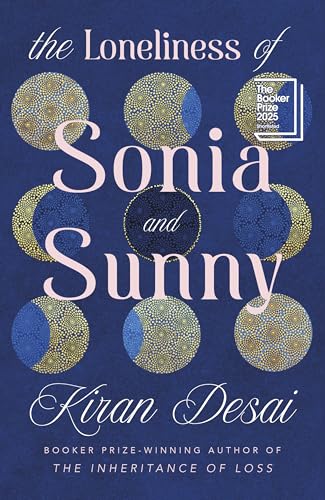
Kiran Desai, The Loneliness of Sonia and Sunny (Penguin 2025)

Before the meeting: This is a massive family saga that spans three continents, a romance, an Indian–US comedy of manners, and a magic-realist tale (though Sonia, a writer, is critical of that term).

All of the principal characters are caught, one way or another, in a tangle of Indian and US culture. The central difference, gestured towards in the book’s title, is the contrast between US individualism and Indian sense of belonging to a family and a community: loneliness and embeddedness, self-determination and obligation. When this plays out in comic mode, it works brilliantly. In the Indian scenes, again and again, someone is asked in shocked tones why they are alone.

As you’d expect from the title, the central narrative strand is a romance. True to the form of the romcom (no spoiler really) the protagonists Sonia and Sunny have sex at almost exactly the midpoint and then are separated, seemingly irretrievably. Integral to the romcom are family intrigue, corruption, violent murder, and a dispersed conversation about arranged marriage. I loved all that.

There’s another story jostling for the centre. This begins with an unconvincing episode of coercive control and develops into a kind of ghost story that more or less centres on a mystic talisman that Sonia has inherited from her grandfather. A European painter who has held Sonia in his thrall steals the talisman and makes it central to his art (yes, appropriation!). I found this strand unconvincing at the level of character, but there’s an interesting reflexivity to it as the artist keeps telling Sonia, an aspiring novelist, what she should and should not write: we are clearly being invited to read this book as a repudiation of his advice.

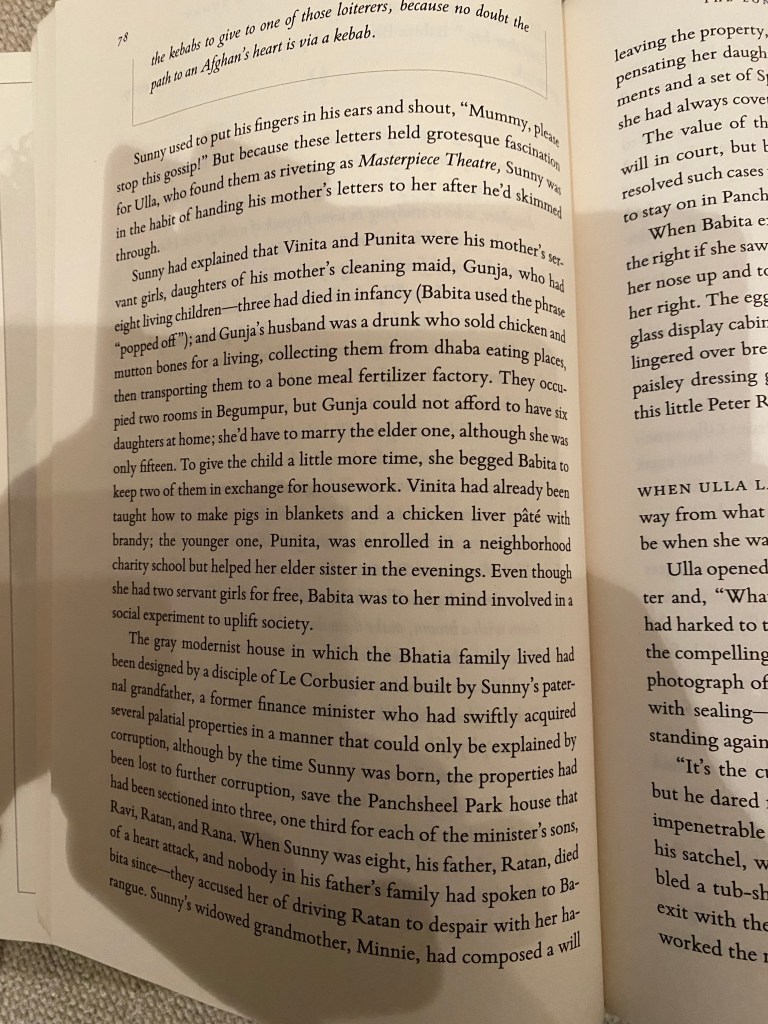
Page 78* is early in the book, part of Sunny’s narrative. He is a young man living in New York City in the late 1990s with Ulla, a white US woman. He’s intent on making it in the USA as a journalist, and embarrassed by his mother’s insistent claims on him. He can barely read her long letters (‘Mummy, please stop this gossip!’), and on this page he explains the context of one of them to Ulla (and, incidentally, to the reader):

One tiny thing I’ll mention in passing. The bottom paragraph describes Sunny’s family home as a ‘gray modernist house … designed by a disciple of Le Corbusier’. So much information is conveyed in those few words. First, the family comes from wealth. Second, they are to some degree westernised – their house is modernist. Third, the fact that the architect was a disciple rather than Le Corbusier himself suggests something about the limitations on the aspirations of colonised elites. And fourth, ‘gray’ is an example of the the North American spelling conventions used throughout (‘neighborhood’ later in the paragraph is another): that these spellings persist in the UK edition is not a mistake, but an enactment at the micro level of the way US culture has come to dominate the book’s westernised Indian characters.

Before that, there’s a paragraph of raw exposition:

Sunny had explained that Vinita and Punita were his mother’s servant girls, daughters of his mother’s cleaning maid, Gunja, who had eight living children – three had died in infancy (Babita used the phrase “popped off”); and Gunja’s husband was a drunk who sold chicken and mutton bones for a living, collecting them from dhaba eating places, then transporting them to a bone meal fertilizer tactory. They occupied two rooms in Begumpur, but Gunja could not afford to have six daughters at home; she’d have to marry the elder one, although she was only fifteen. To give the child a little more time, she begged Babita to keep two of them in exchange for housework. <snip> Even though she had two servant girls for free, Babita was to her mind involved in a social experiment to uplift society.

The fate of Vinita and Punita, known collectively as Vini-Puti, is to be significant much later in the book. But because it’s November*, rather than discuss further, here’s a little verse:

November verse 5:
So much in his mother's letter
needs to be explained. Just who
is Vini-Puti? Who is Ratty?
What's this kebab how-de-do?
Gunja, mother of six daughters,
trains two up to follow orders,
flee the confines of the slum,
work for free for Sunny's mum,
cook liver pâté soaked in brandy.
This is tragic seen up close:
the mum's small gain, the girls' great loss.
But this ain't Hamlet, this is Sunny.
Vini-Puti serve their turn
like Rosencrantz and Guildenstern.

After the meeting: We discussed The Loneliness of Sonia and Sunny along with Arundhati Roy’s Mother Mary Comes to Me. I was astonished when the discussion of this book kicked off with one person saying she hated it and gave up at the 40 percent mark (she’s a Kindle reader). Nothing happened, she said. And that included Sonia’s harrowing emotional enthralment to the bizarrely irrational western artist. Probably needless to say, others disagreed.

Of the three of us (out of five) who had read the whole book, I liked it the best. For all three of us the first 40 percent (I make that about 260 pages) was what we enjoyed most. We had different versions of why it became less enjoyable: perhaps there’s a forced assertion of Indian ways of story-telling, a cultural repudiation of the western mode of the earlier parts; perhaps the talismanic object is too sketchily realised to carry as much narrative weight as seems to be intended; perhaps the book is just too long.

I persist in my opinion, shared by one other Clubbie, that it was a good idea to pair this with Mother Mary Comes to Me. Both books have domineering, eccentric mothers. The protagonists in both are secular Indians appalled at the rise of Hindu nationalism and the BJP – the Demolition of the Babri Masjid mosque looms in the background. Both explore myriad ways in which cultural differences can be negotiated by people from a globally non-dominant culture. Both have main female characters steeped in classic English literature.

We had an excellent dinner, including a dessert that fell flat on the floor when it was taken from the oven, but was delicious anyhow.


The group met on the land of Gadigal of the Eora Nation, and I have written this blog post on the land of Gadigal and Wangal. I acknowledge Elders past and present of all those clans, and welcome any First Nations readers.


My blogging practice is to focus on the page that coincides with my age, currently 78, and in November I write fourteen 14-line stanzas in the month. which means incorporating one into most blog posts.

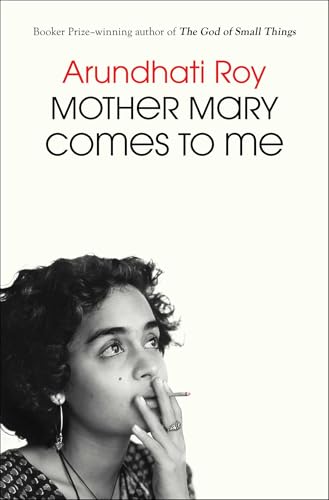
Mother Mary Comes to me, Arundhati Roy and the Book Club

Before the meeting: Mary Roy (1933–2022) was an extraordinary woman. She successfully challenged an inheritance law in the Indian state of Kerala so that women were able to inherit property, and she founded a ground-breaking school. That school, Pallikoodam, has a photo of her on its home page, accompanied by a vision statement:

Pallikoodam is born of the vision of Mrs Mary Roy. For fifty plus years she worked on moulding an extraordinary school that imparts a creative and all-round education that produces happy, confident children, aware of their talents as well as their limitations, unafraid of pursuing their dreams and living life to its fullest. Today, every one of us in Pallikoodam works to realise and forge ahead with her dream.

Mary Roy was also the mother of writer Arundhati Roy. In this memoir, she emerges as a formidable woman who did brilliant things, earning the admiration and cult-like devotion of many while challenging patriarchal institutions, and was at the same time a tyrannical, unpredictable, terrifyingly self-centred mother. Near the end of the book, Arundhati Roy describes a moment in 2022 when she was having dinner with three male friends, including her close friend Sanjay. She received a message on her phone:

It was from my mother. They, all men, each of them, including Sanjay, beloved by their besotted mothers, must have noticed the blood drain from my face and wondered what had happened. How could I explain to them that what had scared me was that I had got a message from my mother saying that she loved me.

It says a lot that readers understand perfectly why the message is terrifying, and that we also understand the intense moral, emotional and intellectual complexities involved in Roy sending a positive reply.

I love this book. It’s the story of the intertwined lives of two brilliant women, with the last half century of Indian history as an often intrusive backdrop. The genesis of Arundhati Roy’s writing is vividly told: her two novels The God of Small Things and The Ministry of Utmost Happiness, as well as her non-fiction, ‘activist’ writing, opposing the construction of a big dam that would displace millions of people, exposing the suffering of the people of Kashmir, reporting on time spent in a jungle with communist (‘Naxalite’) guerrillas, opposing Narendra Modi’s regime, and more.

I can imagine the book being portrayed as a misery memoir in which a famous writer complains about her wretched childhood, or as an exposé of a monster generally regarded as a saint. But that would be to misrepresent it. Mrs Roy’s personality was no secret. Her most loyal adherents were aware of her rages, her indulgences (she was always accompanied by an attendant bearing her asthma medication and, later in life, a supply of jujubes). And though Arundhati and her brother suffered terribly at their mother’s hands, she was a powerful force for good in their lives. There are any number of quotable lines to illustrate this complexity. Here’s just one from page 61, when the daughter was fifteen years old:

Between her bouts of rage and increasing physical violence, Mrs Roy told her daughter that if she put her mind to it, she could be anything she wanted to be. To her daughter those words were a life raft that tided her over pitch-darkness, wild currents and a deadly undertow.

There’s so much to enjoy. Arundhati has a friendship with the legendary John Berger, which gives us the unforgettable image of him as an elephant fanning her with his flapping ears. Hollywood actor John Cusack makes a cameo appearance as a witness of the mother–daughter relationship.

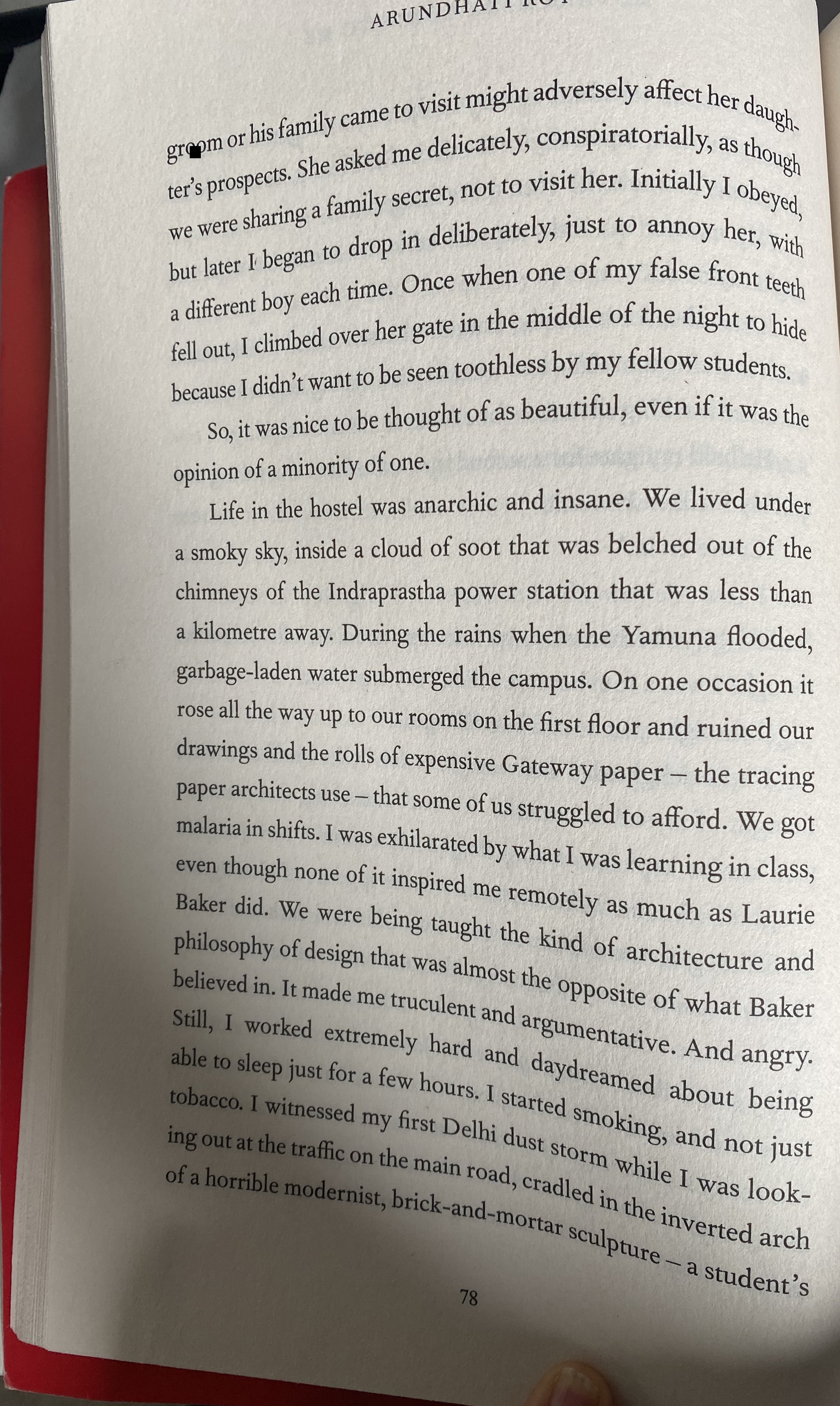
A look at page 78* makes it clear that the book is at least as much about the ‘me’ of the song as it is about ‘Mother Mary’. Young Arundhati is at the Delhi School of Planning and Architecture, free for the first time of Mrs Roy’s overwhelming presence. She has re-encountered the young man she calls JC – her first meeting with him when she was nearly fifteen and he was nineteen had been the first time she understood what sexual desire was: ‘My brain, my heart, my soul – all parked themselves in my groin.’ Back then, she had tried to be invisible. But on page 77, he tells her that he had thought she was a beautiful girl:

I was delighted. I had never, not for half of half a second, thought of myself as beautiful. <snip> I was the opposite of what Syrian Christian girls were meant to be. I was thin and dark and risky.

Such is the power of the writing that one hardly stops to question how the stunningly beauty the young Arundhati Roy that we see in photos could ever have felt that way.

On page 78 – after a paragraph about the Delhi family connection, Mrs Joseph, who disapproves of her – Arundhati is still absorbing that first delight:

So, it was nice to be thought of as beautiful, even if it was the opinion of a minority of one.

The rest of the page evokes grungy student life at the School of Planning and Architecture in new Delhi.

Laurie Baker (Wikipedia page here) is named as standing for the opposite of what was taught at the school. He was a pioneer of sustainable, organic architecture who designed Mrs Roy’s Pallikoodam school. He had inspired Arundhati to veer away from her earliest ambition, to be a writer, and leave home to study architecture. Though Arundhati did go on to be a writer, it was at the School of Planning and Architecture that some of her most important, enduring relationships were formed. As much as anything else the book celebrates these friendships.


After the meeting: Everyone loved this book and we loved discussing it. Someone threw a small grenade, saying that she didn’t see that Mrs Roy was such a terrible parent, that really Arundhati Roy had unfairly demonised her. The catalogue of physical and emotional violence, the fact that Arundhati’s brother shared her view, the way independent witnesses described Mrs Roy as ‘your mad mother’ and laughed at the terror on Arundhati’s face when she had to deal with her: none of this made a dent in her view. We could agree that Arundhati didn’t stay victim – she saw her mother as a model of being powerful in the world, and eventually came to recognise that in her way she loved her, and had given her the wherewithal to build a big life for herself, even if that meant rebelling against her.

We all learned things. For some it was about Indian politics, in particular about Karachi. For all of us, the impact of winning the Booker Prize was a revelation. We all had our ignorance about the Syrian Christians of India slightly decreased (the Roys are Syrian Christians – in Modi’s India, not Indian enough).

We read and discussed the book along with Kiran Desai’s The Loneleiness of Sonia and Sunny. Both books feature complex mother-daughter relationships, both have rich insights into the cultural and political relationships between India and the West, a number of historical events feature in both. But no one was much interested in a compare-and-contrast discussions.


Because it’s November*, I will now burst into rhyme:

November verse 4: Student days
Are student days always anarchic,
smoke-filled, garbage-racked, insane,
angry at the hierarchic
lectures that would tame the brain
with wisdom that's received as certain?
Always the time that lifts the burden
from the backs of those who bear
the yoke of old beliefs? Time where
new songs are sung and new words spoken,
daughters, sons beyond command
(don’t even try to understand),
first loves formed and hearts first broken,
new ways found with fork and knife,
friendships made that last for life?

The group met on the land of Gadigal of the Eora Nation, and I have written this blog post on the land of Gadigal and Wangal. I acknowledge Elders past and present of all those clans, and welcome any First Nations readers.


My blogging practice is to focus on the page that coincides with my age, currently 78, and in November I write fourteen 14-line stanzas in the month. which means incorporating one into most blog posts.

Bookblog #51: Book Club Xmas presents

[This was originally posted in my now defunct blog Family Life, on 14 January 2009. I’m retrieving it today because it includes some comments on Christos Tsiolkas’ The Slap, which recently came in at number 37 in Radio National’s Top 100 Books of the 21st Century.]

Kate Grenville, The Lieutenant (Text Publishing 2008)
Christos Tsiolkas, The Slap (Allen & Unwin 2008)

These were Penny’s and my presents from the Book Club Secret Santa/Kris Kringle in December. They’re both novels we’d been planning to read, both much praised in the press.

lieutenant

The Lieutenant was mine, and I was delighted to receive it. My interest had been piqued by hearing Kate Grenville talk charmingly – and passionately – about it at Gleebooks and then again on the Book Show. I think, though, that when I came to read it, I suffered from having heard too much, and the story remained for too long something I was being told about rather than something that was happening for me as I read. I was disorientated by the policy of renaming historical characters. I suppose the reason for this was to avoid being taken to task by grumpy old historians. You know, if someone were to say, ‘But the evidence is clear that Arthur Phillip was not an authoritarian, culturally blinkered careerist,’ the novelist could reply, ‘But this is a fictional first Governor of New South Wales called Gilbert, not the historical Phillip at all.’ The trouble is, given that the pithy core of the book is an actual document, which Kate Grenville has been careful to tell us provides every word of the conversation between her lieutenant hero and the young Aboriginal woman who befriends him, the novel is clearly meant to be an imagining of the actual early colony, and such arguments would be so much blown smoke.

The result is a kind of roman à clef effect: is Silk actually Watkin Tench? which of the Aboriginal men is Bennelong? etc. Now that I’m dropping in bits of French, I might as well say that there’s also something of the roman à thèse about the book, in the sense that one feels that the characters are there not so much for their own sake as for what they can show us about the meeting of cultures in Port Jackson in 1788. When I wrote in this blog about Kate Grenville’s previous book, I used the word ‘bodiless’. There’s something un-fleshed about this one too. All the same, it’s about one of the most interesting subjects I can imagine: the meeting of two mutually uncomprehending cultures in the form of two people establishing a delicate intimacy, against the odds and ephemeral. That it is tightly based on Lieutenant Dawes’s actual notebook on the Gadigal language gives it enormous moral force. By the end I was weeping.

slap

As I mentioned earlier, The Slap accounted for exactly half of the books in the Secret Santa/Kris Kringle. Clearly, sight unseen, we’d all decided it was worth a read. It would be hard to imagine a greater contrast to The Lieutenant. While we are told that Kate Grenville’s hero has an active sex life, it happens discreetly offstage. The Slap treats us in great detail to any number of sexual encounters, or perhaps I should say events, since ‘encounter’ implies a meeting of some kind. (Actually the sex in this book reminded me my childhood curiosity about characters in books going to the toilet. It’s as if this book decides it’s going to show the sexual things that are usually glossed over, but the result is mostly unconvincing.)

I read the first third or so aloud to Penny on three longish car trips. At a certain point she refused to have me read any more, not just because of the sex and the tediously undifferentiated obscenity of much of the dialogue, but because she just didn’t want to go where the plot was signalling its intention of taking us. I read on, mostly out of a sense of duty, and it turned out the signals were misleading. I can’t say it was a pleasant read, but in the end it was an impressive one.

In case anyone reading this doesn’t know, the story deals with an interwoven group of family and friends in suburban Melbourne. A man slaps a child at a barbecue: the man is Greek, the child’s parents are ‘Skip’ and embedded in victim identities. Though the back cover blurb says that the book is about ‘the slap and its consequences’, I read it more as using the slap as a device that provided a slender unifying narrative thread to the novel’s eight parts, each of which is told from the point of view of a different person who was at the fateful barbecue. A young girl gets plastered with her friends at an end-of-school party; an old man confronts his own mortality at the funeral of an old friend; several marriages are revealed as built on compromise – variously generous, self-sacrificing, resentful. There are lies about sex, half-truthful confessions of infidelity, a shocking betrayal of trust. For me, perhaps the finest thing is the tender–tough revelation of what drives the neurotic and vicious mother of the child who is slapped, so that we move from loathing and despising her to recognising her tragedy. The writing is pretty rough at times, and I think that people who say it’s wonderful to have a book with such a compelling plot for a change haven’t read much children’s or young adult writing.

I’m not rushing out to find all Christos’ other books, but my sense of what it is to be alive, human and suburban Australian has been expanded.

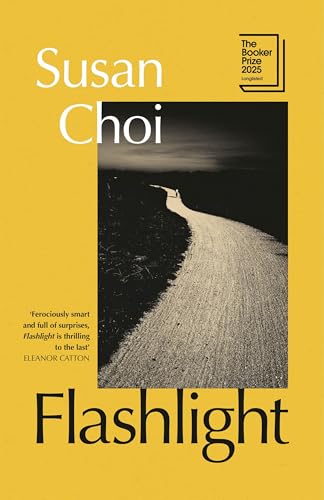
Susan Choi’s Flashlight at the Book Club

Susan Choi, Flashlight (Jonathan Cape 2025)

Be warned: the back cover blurb of this novel reveals something that the novel itself only begins to hint at at about the midpoint. Luckily I didn’t read the blurb until after I’d reached that hint – but thanks a lot, Jonathan Cape!

Before the meeting: I’ll avoid spoilers here, and just say the novel becomes something quite different from what you might expect from the first hundred pages or so. But when you go back and reread the start, you find that the writer has played fair. Sharper and better-informed minds than mine may well have understood the broad shape of the story from the beginning.

As in many novels these days, each chapter takes up the story from the point of view of a different character.

There’s Louisa, whom we first meet as an intelligent, uncooperative child in a therapy session: she has lost her father, presumed drowned, a loss that hangs over the whole book.

Seok, Louisa’s father, was born in Japan just before World War 2 to Korean parents. When the war ends he is shocked to discover that he isn’t in fact Japanese. His parents emigrate to North Korea, but he refuses to join them and goes instead to the USA where, now known as Serk, he gets a job at a provincial college, marries, has a daughter (Louisa) and lives as much of the American dream as is allowed to a Korean green card holder in the 1960s and 1970s.

Serk’s white wife, Anne, escapes from the thrall of a charismatic religious leader, garners an education by doing secretarial work for a literary scholar, and marries Serk. She’s dramatically unhappy in the marriage, especially when she accompanies him on a temporary posting in Japan. By the time of his disappearance at the beach, she is almost completely disabled by alienation from Japanese society and what turns out to be multiple sclerosis.

As well as those three main characters, there’s Tobias, Anne’s child by the charismatic religious leader, whom she gave up to be adopted at birth. He comes back into her life as a troubled teenager and continues to play a role over the decades. And one other character, a South Korean named Ji-hoon, has a chapter to himself late in the book.

So it’s a family story, and the family is fractious. Mother and daughter don’t have a single conversation over the decades that remains affectionate or even cordial for more than a minute. Before he disappears, Seok/Serk is abrasive both to his family and to pretty much anyone who tries to get close to him, especially other Koreans. Tobias is charming and kind, but loopy. And, the miracle of it, we like and care about them all as one small family being crushed under the weight of geopolitics.

Page 78* is in one of Serk’s chapters.

A lot is happening on this page. Serk meditates on his connection with his daughter, on her brilliance and creativity. He briefly acknowledges to himself that his bursts of rage are beyond his control.

Only five and six years old when she’d created these things; her mind was always at work, it amazed him. He was trying to make her a present as well, and nights he didn’t feel compelled to leave the house, blown on a gust that he couldn’t control, he worked on the gift in their basement, and entered a rare sort of peace from using only his hands, not his mind.

And he tackles correspondence with his sister Soonja, the only family member who has stayed in Japan. In a typically tangential way the narrative acknowledges the racism in the background of the action that happens in the USA (there is racism in Japan too, similarly backgrounded for the most part).

He had a letter in progress that he extracted, as well as the series of received letters. It bothered him that their glaringly foreign airmail sheets, outweighed by their numerous conspicuous stamps, arrived so often at his office, despite such exoticism being, as he knew, almost expected of him, as the only foreigner on the permanent teaching staff. That he was using his college letterhead and not an airmail sheet himself was pure vanity for which he’d pay with the stamps.

Then we are shown a little of the content of the correspondence. Here, late at night and alone, he is able to engage with his Korean life, of which his US family and colleagues are completely unaware.

Running his eyes over his characters, he read, where he’d left off, ‘I cannot even begin to consider this without having confirmation in hand,’ and then he had to go back to the most recent letter to refamiliarise himself with Soonja’s latest equivocation. Or perhaps it was confusion, or ill-founded conviction, or just a function of her wretched written Japanese, arrested at the level of a child; she’d never had a scientific mind in the first place, her emotionalism often caused her to misrepresent supposition as fact, and being obliged to write him in her poor Japanese because his written Korean was undeniably worse likely added resentment to the other counterfactual tendencies in her personality; they might have last seen each other almost twenty years before, but he was still her elder brother. He still remembered all her shortcomings.

‘The permits are certain, the time is not certain, it cannot be made certain until you because for just a short length so you are the problem as I said in my letter before. Should I tell our parents you say NO?’

If that doesn’t make sense to you out of context, be reassured. It’s close to incomprehensible when you do have the full context. Later, Serk meets up with Soonja in person, but we never get a clear idea of what she is asking of him. What we know is that Seok, now Serk, feels a tremendous gravitational pull of eldest-son responsibility for his family, and that he resists this pull. We can’t tell what it is that they want from him. Around about this page, I started to wonder if he didn’t drown a year or so after this scene, but somehow deserted his beloved Louisa to go to North Korea. (That’s not a spoiler, I’m not saying if I was right, just that there’s a growing sense of unease about what happened.)

After the meeting: We all enjoyed this novel. Its acknowledgements list fifteen books about Koreans in Japan and the historical events that impinge on Serk and his families. Some of us had never heard of these events (I’m in that group). Others knew of them, and so weren’t completely surprised by the revelation that arrives soon after the halfway mark. One person thought they were urban myths but she was reassured when we looked up Wikipedia.

The discussion brought to light a feature of the book that I hadn’t focused on: many narrative strands are simply not resolved. For instance, there is one other Asian staff member at Serk’s college, known as Tom. He is also Korean, though Serk does his best to keep him at arm’s length and at one stage has a blazing row with him when he believes, wrongly, that he is a North Korean sympathiser. Tom disappears and soon after so does his distraught wife. We never learn what happened to them. For another instance, Louisa as a young adult marries a young man she meets on a bus – he is unwashed and smelly, and we understand that she finds this comforting because in that way he is similar to her older half-brother Tobias who was kind to her after Serk’s disappearance. She marries him, and then he pretty much disappears from the story except as an offstage character – wealthy, entitled and abusive (though we don’t learn any details). Another: when she’s old and living as a grumpy isolate in a community of old people, Anne develops a relationship with a man named Walter. The beginnings of this connection are beautifully realised as Walter is cheerfully unfazed by Anne’s prickliness. But then, as years pass with the turn of a page, he’s not there any more. As someone pointed out, given that the book’s central event is a disappearance, it’s only right that there are many subsidiary vanishings.

Perhaps related to that, one person felt that the shift of narrative focus with each new chapter was frustrating. Balls were left in the air and by the time we came back to that person the balls had landed and the person’s life had moved on. I certainly felt a kind of whiplash, especially in the final third, when time passes quickly, but I wasn’t frustrated so much as energised.

We discussed this book along with Michelle Johnston’s The Revisionists. Both books deal with significant historical events of the past half century. Reading The Revisionists I felt like a FIFO western observer. Flashlight is more like a deeply intimate conversation.


The group met on the land of Gadigal and Wangal of the Eora Nation, where I have also written this blog post. I was born on MaMu land, and spent formative years on the Gundungurra and D’harawal land. I acknowledge Elders past and present of all those clans, and welcome any First Nations readers.


My blogging practice is to focus on the page that coincides with my age, currently 78.

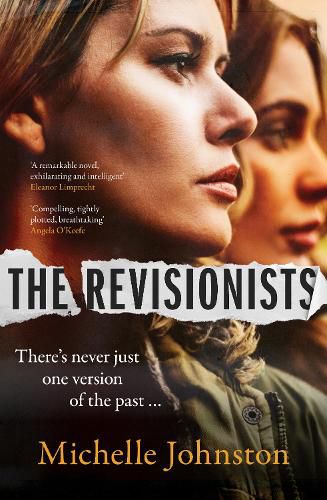
Michelle Johnston’s Revisionists and the Book Club

Michelle Johnston, The Revisionists (Fourth Estate 2025)

Before the meeting: Michelle Johnston’s day job is in emergency medicine. According to a 2023 interview on ABC Perth, she had written a draft of this novel when she decided that she had to go to Dagestan, a small republic in south of Russia where most of the novel’s action takes place, because ‘if you’re going to write somebody else’s story, you’ve got to respect it by going there and trying to understand it from the ground level up’. It was risky – DFAT advised against going and the Smart Traveller website warned of possible terrorist attacks – but she went out of dedication to the integrity of her writing, and in fact ‘had the most beautiful trip’.

The novel’s main character, Christine Campbell, doesn’t have such a beautiful trip, though the book captures the physical beauty of the place and the wonderful hospitality of its people. Christine is a journalist. Disenchanted with what Western Australia has to offer including an implausible level of sexism in Perth’s newsroom, she decides to travel to Dagestan to join Frankie, her best friend from schooldays who is a doctor working in a clinic in a tiny village there. Christine is there to help – she organises supplies and teaches first aid to local women – but she harbours an ambition to publish a groundbreaking piece of journalism about the possible outbreak of war.

It’s an odd set-up. We know from the beginning that Christine’s ambitions outstrip her abilities, and that her journalistic ethics are shaky. She intuits that the women of the village know that war is coming, but she can’t get them to say it outright. In fact everyone knows there’s a serious risk of war. It’s 1999: the war in neighbouring Chechnya ended in 1996, armed Islamist groups are forming everywhere, Russia is determined to fight them off, and the place, as Christine keeps saying, is a ‘tinderbox’. But she’s determined to write a feminist-leaning piece in which she gives voice to the women of the village saying what she just knows they would say if only they would say it. Her article will be titled ‘The Cassandras of the Caucasus’, because she believes the classical allusion will lend it class. (And the samples we see of her over-egged writing are consonant with that kind of thinking.) Frankie hints that she might expose the women to the danger of reprisals. She meets a famous journalist who gives her some Journalism 101 advice that seems to be news to her: if you’re out to get information from people, tell them up front that you’re a journalist.

The book opens in Manhattan 25 years later, in 2023, with Christine watching a TV documentary about herself and the one article that made her famous. A little later, Frankie turns up at her door, and challenges her about the untruths she told in the documentary and in the famous article. As the book proceeds, alternating between the two time periods, we learn the full story of how the article came to be written, and the fate of the Dagestan village. Revelation follows revelation. Christine’s ethics are a lot worse than shaky.

The book tackles important subjects: journalist ethics, the nature of memory, the role of ‘helpful’ but insensitive Westerners, the question of who owns a story. There’s a strong sense of place, not only in the austere beauty of Dagestan, but also in London where Christine and her friends have a brief respite, and Manhattan where she spends more than two decades in guilt, luxury and inertia.There’s a tumultuous affair with a man that we know is up to something, and a painfully real portrait of an unhappy marriage

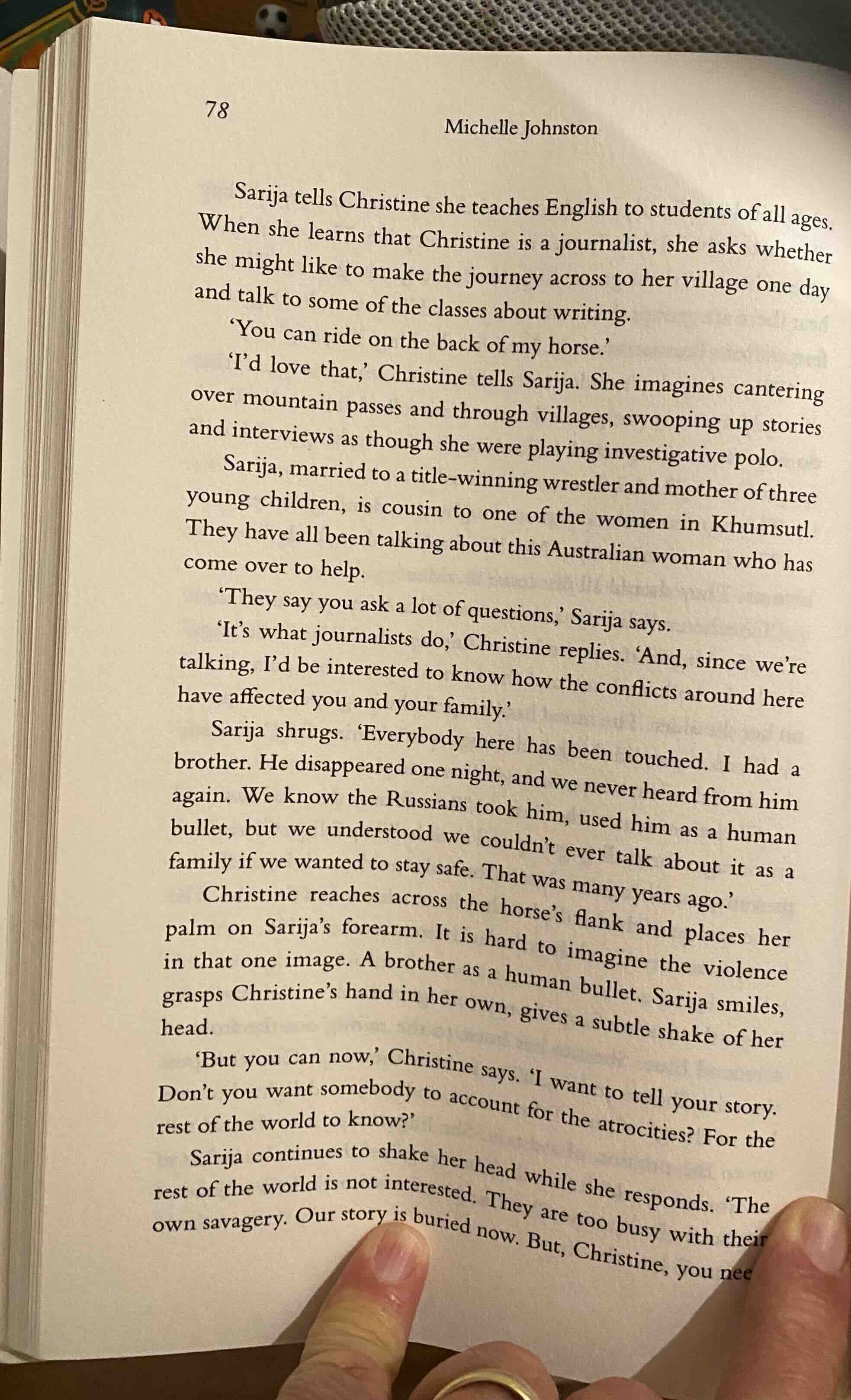
On the strength of all that, you’d think I would have been engrossed. But I struggled with it, and it’s not easy to say why. It turns out that a close-ish look at page 78* suggests a possible reason.

Sarija is a teacher of English from a nearby village who has attended Christine’s first-aid classes, and even acted as her assistant. Here, the two women are chatting, leaning against the dusty haunches of Sarija’s horse. Sarija suggests that Christine might visit her village to talk to her students about writing:

‘You can ride on the back of my horse.’
‘I’d love that,’ Christine tells Sarija. She imagines cantering over mountain passes and through villages, swooping up stories and interviews as though she were playing investigative polo.

This is an example of many similar moments. I would have said it hits a false note: why would Christine, formerly Crystal from the WA wheat belt, think of polo? Surely the forced simile is an awkward writerly intrusion? On rereading, I see it differently. What’s happening is that the narrative voice, while technically telling the story from Christine’s point of view, looking over her shoulder as it were, actually undermines her, mocks her as callow, exploitative, self-serving, in effect accusing Christine of thinking of her journalistic quest as a jolly sporting venture.

There are more examples even in this one page of dialogue.

‘They say you ask a lot of questions,’ Sarija says.
‘It’s what journalists do,’ Christine replies. ‘And, since we’re talking, I’d be interested to know how the conflicts around here have affected you and your family.’

This is a woman who has been uncomplainingly lugging boxes around the clinic, winning the trust of the local women as she teaches them first aid. As soon as she thinks of herself as a journalist she becomes patronising (‘It’s what journalists do’) and would-be exploitative (‘Since we’re talking…’).

Sarija opens up to her anyway. Again, Christine makes a small gesture of sympathy, but her mind goes to the juicy turn of phrase:

It is hard to imagine the violence in that one image. A brother as a human bullet.

‘I want to tell your story. Don’t you want somebody to account for the atrocities? For the rest of the world to know?’
Sarija continues to shake her head while she responds. ‘The rest of the world is not interested. They are too busy with their own savagery. Our story is buried now. But, Christine, you need to know this: you don’t find answers here by asking questions.’ She pauses. ‘You find the answers by being quiet.’

To which this reader, led by the narrative voice, wants to shout, ‘Yair, Christine. Be quiet.’

Later, when Christine is frustrated at the lack of usable quotes from the women, she thinks back to this conversation and sees Sarija as her likeliest source of good copy. There may be some truth to this portrait of journalism in the field, but when she’s being a journalist Christine is almost completely unlikeable. Later, when she manages an interview with a self-styled warlord, she castigates herself for doing something terrible with what she has been told. The narrative voice holds back from condemning her, so even when she’s hard on herself, she is seen to be missing the point. She does commit one major journalistic sin, and in that case goes from self-deception about the gravity of her offence to wallowing in shame and remorse.

Though Christine goes on to make amends in some respects, I get the impression that Michelle Johnston doesn’t like her main character – and that makes a book hard to read.

Other people like this book a lot more than I do. Lisa Hill’s review is definitely worth reading.

Just before the meeting: We read two books at each meeting of the Book Club. The Revisionists was paired with Susan Choi’s Flashlight, and the comparison wasn’t kind to The Revisionists. For just one thing, both books deal with terrible historical events. In her acknowledgements, Susan Choi lists fifteen books of fiction and non-fiction about her subject so the reader can check how closely her fiction sticks to known facts. Michelle Johnston tells us nothing about her sources. This might not have mattered, but when there is an unreliable central character, it would be good to know if two atrocities in particular were invented for the horror of it or were documented events.

After the meeting: We were pretty unanimous in not caring for this book. Not everyone agreed that the author didn’t like her central character – what I saw as criticism of her as callow and exploitative, others saw as ironic highlighting of her naivety. But none of us much liked her anyway. One person went so far as to say the book shouldn’t have been published. Someone who has visited New York City quite a lot was exasperated that when Christine decides to sell a Rothko that has come into her possession, she takes it to a local gallery. ‘I’m sorry,’ she said, ‘if you have a Rothko to sell you go uptown to Christie’s or Sotheby’s.’ Rookie error, I guess.

We pondered the meaning of the book’s title. Perhaps it refers to the way Christine altered some key facts in her famous article. Perhaps it highlights an otherwise inconsequential moment in the last pages when Frankie and Christine realise they have completely different memories of how Christine came to be in Dagestan. We also pondered the meaning of the cover image: two women in profile, both with the abstracted air of models. None of us could see how it related to the actual novel.

On the other hand we had culturally eclectic creations from Tokyo Lamington for dessert, and Flashlight (blog post to come) is an excellent book that provoked interesting conversation.


The group met on the land of Gadigal and Wangal of the Eora Nation, where I have also written this blog post. The days are getting longer, and warmer, and I’ve been encountering a beautiful, satiny crow near my home. I acknowledge Elders past and present, and welcome any First Nations readers.


My blogging practice is to focus on the page that coincides with my age, currently 78.

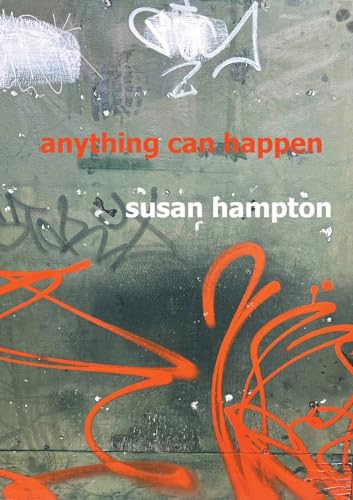
Anything Can Happen with Susan Hampton at the Book Club

Susan Hampton, Anything Can Happen (Puncher and Wattmann 2024)

We decided on this book before checking on availability. All was good for the Kindle readers, but there was a long queue at the library and it was out of stock in Sydney bookshops, pending reprint. Nor did we have any luck at Avid Reader in Brisbane on our travels. In the end, the Emerging Artist bought it for the Kindle app and we read the book to each other.

So that is how I experienced Anything Can Happen: being read to or reading it aloud on beaches, in cafes, under the benign tropical winter sun. I recommend it.

Before the meeting: Susan Hampton is a poet. She has ghost written a celebrated memoir with a First Nations person, and The Kindly Ones, a novel in verse, but this book is the first long prose work of her own making. It’s not an autobiography, but memoir. She makes that distinction in the first pages:

Whereas in autobiography ‘everything’ is told, often in chronological order, the memoir is partial, with the capacity for time loops … The scenes of your childhood, the river, the back lane, the silo, rise up to replace your mother’s arm. That dissolves and you find you’re hearing or in fact making up a conversation.

Anything Can Happen isn’t in chronological order, and it doesn’t attempt to tell everything. It gives us accounts of key relationships: Hampton’s Slovenian husband, Joe, whom she left after a very few years but who was an important part of her life until his death in Slovenia decades later; her mother and grandmother; her son Ben; Tommy, a woman in her thirties on whom she had a crush when she was a teenager and who stayed in her life until Tommy died in her 80s, by then a close friend of the Susan’s mother; a number of romantic and/or toxic entanglements and other friendships with women.

There are glimpses of a working-class childhood in the Hunter region; of life as an academic single mother in the Inner West of Sydney (she and I had children at different schools in the same suburb in the 1980s); of a number of years living in a rural area and becoming a kind of hub for a Lesbian community; of later married life in the beautiful mid-north coast of New South Wales (she married her partner Charlotte in the British embassy in Canberra before same-sex marriage became legal in Australia).

And there’s an impressionistic account of her development as a writer. A main thread of this account is a novel project, which remains on the go for decades and still exists only as a series of unsatisfactory drafts and many books full of notes. One of the many pleasures of this book is the dawning realisation that it is an extended piece of prose from a writer who says she is incapable of writing such a thing.

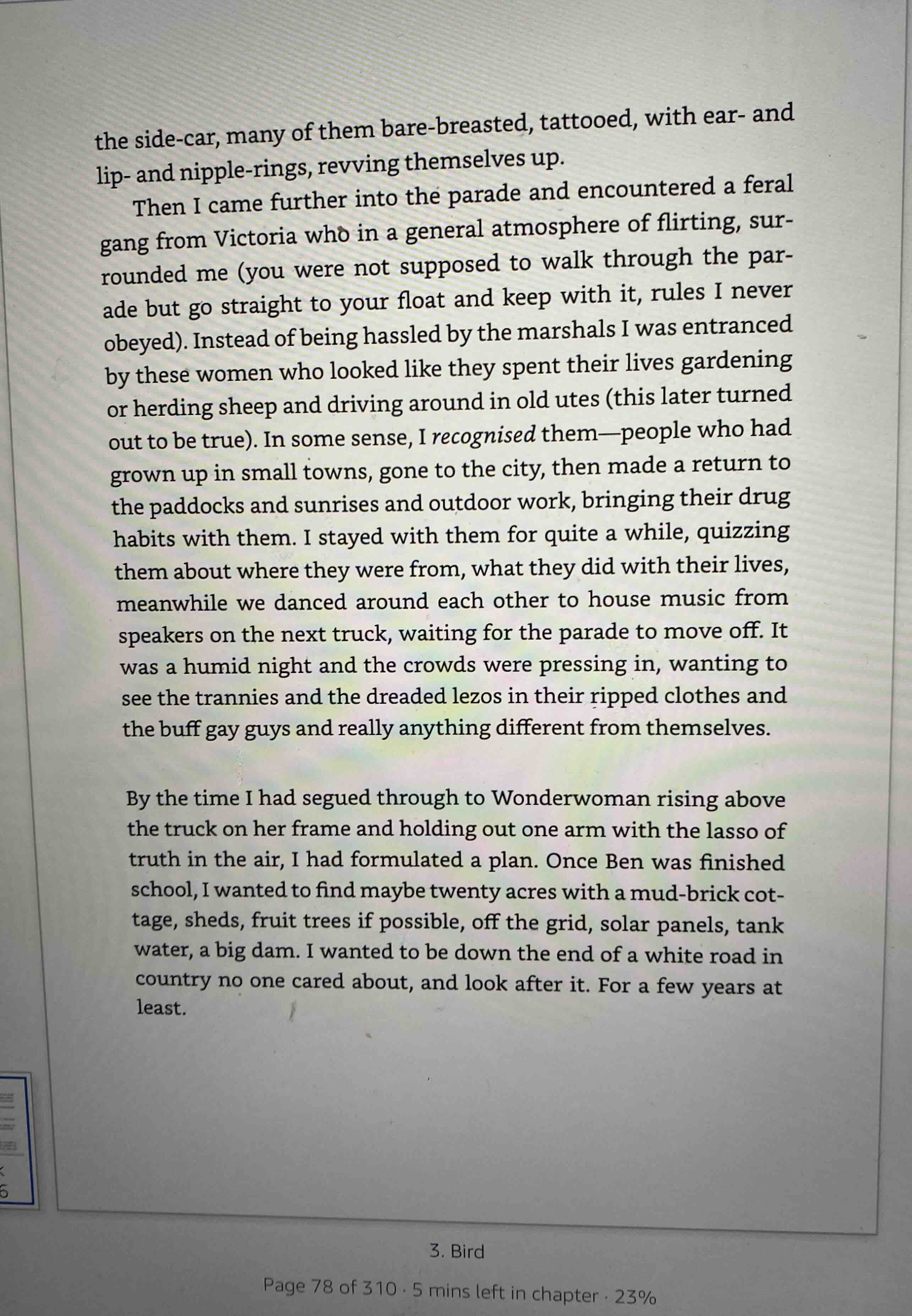
In a memoir of a life that has seen so many wildly different phases, you could open up any page and get a different sense of what kind of book it is. At page 78, Susan joins the Gay and Lesbian Mardi Gras. She walks alone among the Dykes on Bikes. One or two women sat on each bike, and often one of the side-car:

Then I came further into the parade and encountered a feral gang from Victoria who in a general atmosphere of flirting, surrounded me (you were not supposed to walk through the parade but go straight to your float and keep with it, rules I never obeyed). Instead of being hassled by the marshals I was entranced by these women who looked like they spent their lives gardening or herding sheep and driving around in old utes (this later turned out to be true). In some sense, I recognised them – people who had grown up in small towns, gone to the city, then made a return to the paddocks and sunrises and outdoor work, bringing their drug habits with them. I stayed with them for quite a while, quizzing them about where they were from, what they did with their lives, meanwhile we danced around each other to house music from speakers on the next truck, waiting for the parade to move off.

Just a few pages earlier, Hampton has reflected that her autobiographical writing is ‘partially confected, altered, made more symbolic, exaggerated, even invented’ because after all, ‘you wanted the reader to be swept along in the story, to turn the page’. I don’t at all doubt the truthfulness of this paragraph, but it’s also a nice example of detail being selected in order to serve the longer story. The Dykes on Bikes are colourful context, but the ‘feral gang from Victoria’ are there to foreshadow the years in which Hampton was to own a small property in rural Victoria and, even while she did scholarly and poetic work indoors, became one of just such a feral gang. And there’s recurring motif of Hampton ignoring rules – here she disobeys the Mardi Gras rule; elsewhere she climbs fences into private property, snoops in people’s bedrooms, even pilfers personal items. These details may be ‘partially confected’, or they may be part of a ruthless honesty about her own failings – either way they do keep us turning the pages (or swiping the screen).

Then there’s this sentence, easy to miss among all the colour and movement:

It was a humid night and the crowds were pressing in, wanting to see the trannies and the dreaded lezos in their ripped clothes and the buff gay guys and really anything different from themselves.

There’s a gentle challenge to the reader here. The Gay and Lesbian Mardi Gras parade is an event primarily for the LGBTQI+ community (a term Hampton doesn’t use) but it’s also a spectacle enjoyed by the mainstream, possibly voyeuristically she suggests. Could something similar happen with this book? Unlike, say, Kerryn Higgs’s excellent novel All That False Instruction, this book doesn’t set out to ‘explain’ Lesbian experience to mainstream readers. If anything, the author is seeking to understand her own story, of which Lesnianism is a major part but not the whole. But, she suggests indirectly here, some readers may be here for the inside story on ‘the dreaded lezos’ – as at the Mardi Gras, they may not be unwelcome, but they are on the outside pressing in.

By the time I had segued through to Wonderwoman rising above the truck on her frame and holding out one arm with the lasso of truth in the air, I had formulated a plan. Once Ben was finished school, I wanted to find maybe twenty acres with a mud-brick cottage, sheds, fruit trees if possible, off the grid, solar panels, tank water, a big dam. I wanted to be down the end of a white road in country no one cared about, and look after it. For a few years at least.

And that is more or less where the story soon goes.

We read this book along with Debra Oswald’s 100 Years of Betty. Where that book feels as if it grew from a treatment for a TV series, and never quite shook off its origins, this one may well have started out as a collection of prose poems, and has kept some of the compressed, elliptical, elements of that beginning.

After the meeting: We met in a pub, and had a lot of catching up to do. Two of the five of us had met Susan Hampton, one just briefly, and one for some time when they both lived in Canberra (where in the book she says she made a number of good friends). So our book conversation was a little more gossipy than usual – though not at all nasty or juicy. I had hoped someone would know the identities of the women known as the Gardener and the Radiographer with whom Hampton had an unsettling relationship, but that wasn’t to be.

We all enjoyed the book, partly because so many of its places were familiar to at least some of us, and it was pleasurable to have them described from a different point of view. One person felt that there was an almost sociological tone to the chapters about Hampton’s family background, and that seemed to spread in some way to a kind of distance or detachment in the telling as a whole. (I don’t know what I think about that.It didn’t strike me that way, but I don’t think it’s wrong.) We noted that there are gaps in the story, but realise they may have been necessary to protect other people’s privacy.

One of the many rules of the Book Club has been ‘No Lesbian novels unless the Lesbianism is incidental to the plot.’ The club’s membership is majority Lesbian, and the rule was there because (I’m told) novels about Lesbianism tend to be badly written. With The Safekeep and Anything Can Happen, the prohibition has gone the way of Mardi Gras rules on page 78.


We read Anything Can Happen to each other on Wulgurukaba land, beneath an intense blue sky on the island of Yunbenun. The Book Club met on Gadigal Wangal country, which is where I have written the blog post. I acknowledge the Elders past and present of those Nations, and welcome any First Nations readers of this blog.

My blogging practice is to focus on the page that coincides with my age, currently 78.

Debra Oswald’s 100 Years of Betty and the Book Club

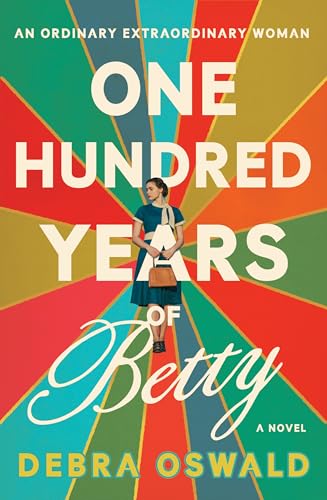
Debra Oswald, One Hundred Years of Betty (Allen & Unwin 2025)

Long before the meeting: If not for the Book Club, I would have put this book aside at page 14. Betty is the seventh child in a desperately poor family in South London. Her Catholic mother dies soon after giving birth to a tenth live child. As Betty and her Protestant father emerge from church they pass the two priests who have said the funeral Mass, one ‘in a creamy chasuble with scarlet embellishments, the other sporting a gold-embroidered number’. Betty’s father delivers a tirade:

Tell my daughter Betty the truth on this day we’re burying her poor Catholic mother. Tell her that it’s all a lie and that you two – with your fancy clothes and your Latin gibberish and your snouts in the trough – you know it’s a lie. Your religion is a pack of fairy stories to bamboozle poor people and keep us in line. Tell her.

I don’t mind a bit of anti-Catholic vitriol. In my devout childhood I was intrigued by mockery of the saints in a Walter Scott novel, and as a 17-year old trainee religious I was thrilled by Dostoevsky’s Grand Inquisitor. BUT this just gets too much wrong. Two priests saying Mass for a poor person’s funeral? Not likely! Even one priest standing at the door of the church still wearing his vestments? Also not likely! And even a quick google would have told the author (or certainly her editors) that priests wore black chasubles at funerals – never cream or (gasp!) scarlet.

But what the Book Club wants …


Before the meeting: I did persevere. It’s not a terrible book, and there were no other moments that felt so wrong.

Betty works in a factory, emigrates to Australia, falls in love and makes two lasting friendships on the ship, marries a rich man who becomes abusive then kills himself leaving her destitute. She has two children each of whom is problematic, protests against the Vietnam War, joins Women’s Liberation, spends some time living in Mexico where she loves swimming in cenotes, comes back to Australia for her daughter’s wedding, works in television where she eventually becomes a writer, has her heart broken a number of times, helps out in an AIDS ward, has a severe depressive episode, develops breast cancer, finds happiness when reunited with her first love, sees friends die. Oh, and there’s a daughter she gave out for adoption before leaving England. As she moves through the phases of her life her name changes: Betty, Beth, Elizabeth, Lizzie, Liz, and finally back to Betty. Sometimes I cared and was engaged, sometimes not so much. I did laugh a number of times.

I never got a feel for the narrative voice – the voice of 100-year-old Betty. There are self-conscious moments when Betty warns us (mostly disingenuously) that things won’t turn out as they do in novels, or expects us to be surprised at her earthiness, but these don’t create the sense of an actual person telling the story.

The penny dropped for me in Chapter 16, when a friend urges 63-year-old Betty to pitch a long-held idea for a show to a TV channel. Betty realises she no longer has ‘the stamina to deal with the machinery of TV drama, the muscle spasms of hope and dejection, the delicate calculations of conciliation and obstinacy required of you’. That night in bed, her husband suggests that she could put the idea into novel form, and Betty’s career as a novelist is launched.

Ah! I thought. One Hundred Years of Betty is really the treatment for a TV show. When it makes it to the screen, which is very likely, I’ll be happy to watch it.

I’m sorry to be so negative. I may have come to the book with inappropriate expectations. Maybe I was wanting the story of an individual life told in the context of world events in the manner of Annie Ernaux’s The Years, Alan Hollinghead’s Our Evenings, or Ian McEwan’s The Lesson. Maybe I expected a fictionalised treatment of Debra Oswald’s mother’s generation, something probing and compassionate. This isn’t one of those books, and nor does it need to be.

After the meeting: Unusually, we met in a pub. As always with the Book Club, we had two books on our agenda. The other one, Susan Hampton’s Anything Can Happen, took up most of the discussion.

One of the other Catholics said she registered the problems with the post-funeral scene that so irritated me, but it hadn’t disturbed her. One of the non-Catholics said the scene felt very Anglican to her rather than Catholic.

A couple of people felt there was a box-ticking element: the songs, devices, events more or listed as a way of marking the different eras. Others felt that was a feature rather than a bug. Betty’s life touches on major events of her times, is sometimes significantly changed by them, without their ever becoming her central passionate concerns.

Someone described the book as an excellent summer beach read, engaging enough to keep you entertained without making big demands. She said it a lot better than that, and I think we all agreed.


The Book Club met, and I wrote this blog post, on land of Gadigal and Wangal of the Eora nation. I acknowledge their Elders past present and emerging, and gratefully acknowledge their care for this land for millennia. I welcome any First Nations readers of this blog.
Ferdia Lennon’s Glorious Exploits at the Book Club

Ferdia Lennon, Glorious Exploits (Fig Tree 2024)

Before the Book Club meeting: I’ve recently been reading a lot by Irish writers who travel beyond their native shores. What Happened to Nina? by Dervla McTiernan is set in Vermont. The Narrow Land of Christine Dwyer Hickey’s novel is Cape Cod, Massachusetts in the 1950s. Sean Whiteside’s eminently readable translation made Wolfram Eilenbecker’s The Visionaries available to English readers from 1930s Germany. Now Ferdia Lennon’s Glorious Exploits goes even further afield in space and time. It’s set in Sicily in the fifth century BCE, during the Peloponnesian War.

Athens has invaded Sicily and been soundly defeated. A large number of Athenians are imprisoned in a quarry outside the city of Syracuse (this really happened). Some of the prisoners are given slightly better conditions if they can quote lines from Euripides (this also really happened). Two unemployed potters, Lampo and Gelon, stage a double bill of two Euripides tragedies, Medea and The Trojan Women, performed in the quarry by Athenian prisoners (this is made up). The Syracusans, including Lampo the natrrator, have Irish accents (why not?).

The novel, Ferdia Lennon’s first, has been a big success. You can read the Observer review here, and Kirkus Reviews here. Apart from saying that I enjoyed it, laughed out loud a number of times, was shocked at the shocking moments and came to like and care about the characters, I’ll stick to page 78*, whose action is neither at the quarry with the Athenian actor-prisoners, nor at the pub with the Syracusans, but at the docks.

On this page Lampo meets the collector, a man of great wealth that is almost certainly ill-gotten. Gelon has gone alone to the collector’s ship to negotiate a deal on a pile of armour stripped from Athenian corpses. At the start of page 78 Lampo has told the collector’s piratical crew that he’s there to see his friend, and that he’s unarmed.

They pat me down all the same, and the bastards are rough and thorough. Still, it’s true what I said. I’ve got nothing on me, and, satisfied, the fella nods, goes to a hatch on the floor with an iron ring, and pulls it open.
‘Down there,’ he says. ‘Your mate’s down there. I’ll show you.’
Straight away, there’s a whiffy heft to the air. Sickly sweet, but with something sour beneath it. Your man walks on ahead.

There’s no attempt at faux-antique or heroic-Greek prose here. It’s straight into the ‘bastards’, ‘fellas’, ‘mates’ and ‘your mans’ of contemporary Irish vernacular. And, as everywhere in this novel, there’s a lot to smell. I don’t know if a specific source of the smell is being suggested, but there’s a clear metaphor: the collector, as we are about to see, is urbane and courteous, but with something ominous beneath the urbanity. At the end of the page, his teeth provide another metaphor:

The collector looks over at me and smiles. His teeth are ridiculously white and arrow-straight, yet there’s an animal feel to them. Like they belong in the maw of something larger in the woods, and not a merchant nibbling grapes.

If I’d set out to write a plot summary, I might easily not have mentioned the collector. He has a function in the plot – I don’t think it’s a spoiler to say that he provides financial backing for the production, and later a potential means of escape for some characters. But there are at least two other things to notice.

First, he has a sadistic, ghoulish quality. There’s the bloodstained armour he’s buying from our heroes. Then on this page Lampo recognises him as ‘the fella who tried to buy the homeless bastard’s rope’ – referring back to a homeless man’s story of a threadbare length of rope he treasures as his only memento of childhood, which he refuses to sell it a vast sum to a stranger we now know to be the collector. (The rope later turns up on the collector’s wall, leaving the reader to deduce that it was taken from its owner by force.) So his involvement highlights the macabre dimension of Gelon and Lampo’s project. Gelon’s desire to stage plays by the great Euripides is surely a good thing, fuelled by his passionate love of high Greek culture, and the potters and their performers develop relationships of mutual respect and even affection. Their art gives them respite from the horrors of their situation. But for the other Athenian prisoners that situation is unchanged, and even for the performers there is only the briefest respite.

There’s another thing. The collector’s name is later revealed to be Tuireann, a name he shares with a figure from Celtic mythology. At a literal level this might suggest that he has come to Sicily from far-off Ireland. But I think it’s a little authorial joke. If the language of the book is Irish, why not give one of the characters an Irish name?

I had to do a web search on “Tuireann” to get that joke (if it is one). It’s the kind of book where there are plenty of things to look up if the spirit moves you. The Peloponnesian War and the two plays by Euripides are the big ones. Did it add to my enjoyment that I saw an amateur production of The Trojan Women in Darlinghurst four decades ago? Probably. Would I have felt the lack if I hadn’t? I doubt it.


After the meeting: We discussed this book alongside Han Kang’s We Do Not Part and apart from the person who had read only 10 percent of it, we all enjoyed it a lot more. The ten-percenter said she had stopped reading because of time constraints, but I wouldn’t be surprised if some readers put the book aside after the terrible brutality that comes in the first couple of pages.

One of us had been to Syracuse and visited the quarry, though the guide didn’t talk about the imprisoned Athenians. None of us had felt the need to read up on Ancient History – the book doesn’t depend on specialist background knowledge. Two of us had heard Ferdia Lennon speak at the Sydney Writers’ Festival, so could add a little bit of news about him and what went into the making of the book.

I can’t talk about the way the book ends, but it’s probably OK to say that it’s with a kind of coda. When someone said she loved the ending, two of us thought she meant the bitter-sweet, though mostly bitter, conclusion of the main narrative. Once we were reminded of the actual final moments of the book, we agreed. The other person who had got that far disagreed. She thought it was unnecessary and a bit of a stretch. ‘The whole book is a stretch’, three of us replied in unison.


The Book Club met in Gadigal land, close to the great harbour Warrane. I wrote this blog post beneath a cloudless sky on land of Gadigal and Wangal of the Eora nation. I acknowledge their Elders past present and emerging, and gratefully acknowledge their care for this land for millennia. I welcome any First Nations readers of this blog.

* My blogging practice is focus arbitrarily on the page of a book that coincides with my age, currently page 78.

We Do Not Part with Han Kang at the Book Club

Han Kang, We Do Not Part (2021, translated e. yaewon & Paige Aniyah Morris, Hamish Hamilton 2025)

Before the Book Club meeting: Han Kang was awarded the 2024 Nobel Prize in Literature, so her most recent book to be translated into English seemed a good choice for the Book Club.

The book falls into at least three parts. (Spoilers ahead.)

Part One: The narrator, who is experiencing suicidal depression, receives an urgent request from a friend, Inseon, to come to her in hospital. When she arrives, she finds Inseon has done a terrible injury to her hand and is receiving frequent, excruciatingly painful treatment, graphic descriptions of which are interspersed with a history of their friendship and their artistic collaborations. Inseon asks the narrator to go to her house on the remote island of P– and feed her pet bird, who will otherwise die.

Pat Two: The narrator makes the arduous journey to Inseon’s house, the final stage of it on foot through a blizzard. When she arrives, the bird is dead. Though she herself has barely survived her ordeal, she immediately buries the bird out in the snow.

Part Three: While the ghost of the bird casts flittering shadows around the walls, Inseon turns up, with an uninjured hand. Evidently she is some kind of supernatural projection of the living person still back there in the hospital, though the narrator suspects at one stage that both she and Inseon are actually dead. Anyhow, Inseon guides the narrator through a number of documents that record a terrible massacre committed during the Korean War, apparently with US connivance, and the decades-long attempt by surviving relatives to have the massacre acknowledged.

At the level of narrative, I didn’t understand the book. When the exhausted narrator goes back out into the snow to bury the bird without even putting on warm clothes, I nearly stopped reading, and from then on my disbelief remained unsuspended. But as the story of the massacres emerged from the piles of documents, I was glad to be learning about a part of history I’d been completely ignorant of. On the other hand, given that the information is embedded in an unabashedly unrealistic narrative, I’m left not knowing how much of the massacre story is itself fiction. In effect, then, the book is a signpost pointing its readers to the need for further research.

WIkipedia has a minimalist entry about the Sancheong–Hamyang massacre of 7 February 1951, in which 705 civilians were killed, 85% of them women, children and elderly people. The files concerning the massacre, Wikipedia confirms, were not found until February 2006. That is the emotional heart of this novel: I have no idea how the story of the injury, the blizzard and the dead bird fit together with it.


The meeting:

I wasn’t the only one perplexed by this book. We were pretty well unanimous that we wouldn’t recommend it to friends, even though there is some beautiful writing in it. We were divided on the question of whether we would want to read anything else by Han Kang,

The narrator’s ordeal in the blizzard, we all agreed, is compelling.

One valiant soul found rich metaphor in the account of Inseon’s injury and treatment: her severed fingers represent the divided state of Korea and the painful injection every three minutes suggests that the process of reunion will involve sustained, painful work. My literal-mindedness at first rebelled at such a reading, but maybe it’s there for readers with a Korean cultural background, who I expect are also better equipped for the ghost-not-ghost parts of the narrative.

I wasn’t the only one who had done some research into the history that is the subject of the book’s final movement. Whereas I had looked up a single Wikipedia entry, S– had read a number of articles on the Korean War – but, she said, she ended up more confused than when she started

We discussed this book along with Ferdia Lennon’s Glorious Exploits. Both books build fictions around historical events, but no one felt compelled by Glorious Exploits to study up on the Peloponnesian War.


The Book Club met on Gadigal land. I wrote the blog post on Wangal and Gadigal land where just now the sun is shining from a cloudless sky and the wind has died down. I gratefully acknowledge the Elders past and present who have cared for this beautiful country for millennia.

Richard Russo’s Everybody’s Fool at the Book Club

Richard Russo, Everybody’s Fool (Allen & Unwin 2017)

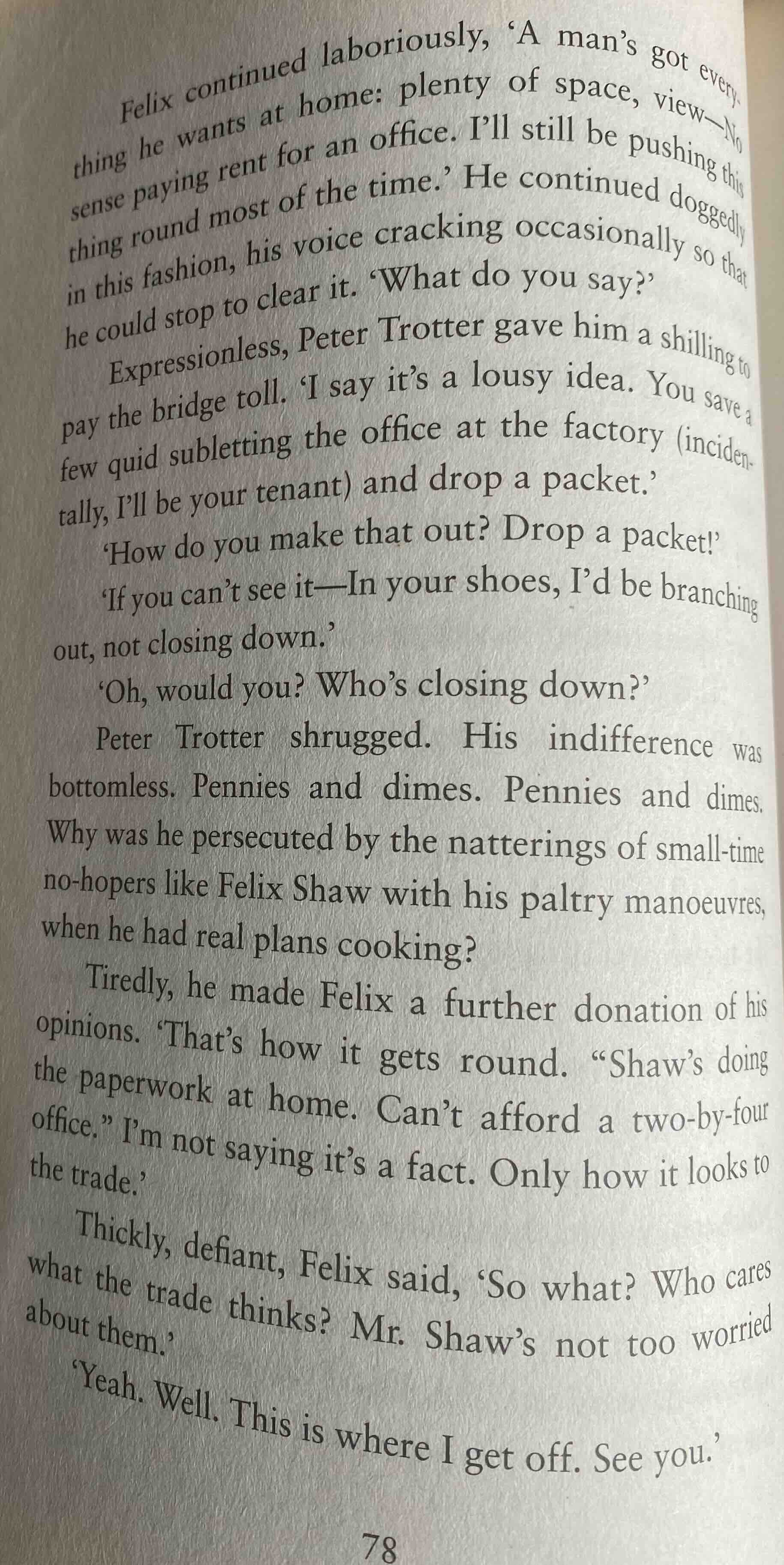
Before the meeting: This is the second book in Richard Russo’s trilogy set in the dead-end town of North Bath in rural New York: it was preceded by Nobody’s Fool (1993) and followed by Somebody’s Fool (2023). I read it as a stand-alone. At about page 80 I went to Wikipedia for a synopsis of Nobody’s Fool, and really I needn’t have. (I also watched a trailer for Robert Benton’s 1994 movie, which was probably a mistake, as the image of Paul Newman as the character Sully was seriously different from the one I’d built up for myself, even allowing for the fact that Sully has aged 20 years since the first book.)

All the same, even for those who haven’t read about the characters’ earlier lives, it’s clear that they are living in various aftermaths. It begins with a burial and returns to the cemetery again and again. One man has been given a year to live, another is stuck in grief for his wife who died in the act of leaving him, a third has been released from jail and proclaims unconvincingly that he has turned over a new leaf. One couple remain affectionate though their affair is long since over, another deal with a long history of mental illness. Friendships endure in spite of mutual irritation, enmities are maintained in spite of deep-seated fellow-feeling. It’s complex, sometimes laugh-out-loud funny, sometimes wretchedly painful, abounding in situational ironies. There are two violent deaths that we don’t witness, and one shockingly violent scene that we do. There are two villains, three if you count the out-of-town dealer in snakes and drugs. There’s a disgustingly incontinent dog. A couple of characters from the first book make cameo appearances, for no obvious reason apart from letting longterm readers know what they’re up to.

Class is ever-present. Most of the book’s characters know they have been excluded from the good things of life. They’re rough with each other, but there’s also kindness and integrity and a strong sense of belonging. At one point Sully, who has the strongest claim to be the main character, reflects that he has made sure ‘that his destination at the end of the day was a barstool among men who had chosen to be faithful to what they took to be their own natures, when instead they might have been faithful to their families or to convention or even to their own early promise’ (page 448). It’s an attitude that elsewhere might be called quiet despair, but here it includes an assertion of connection.

I enjoyed it a lot. It deals with serious themes, but it’s a lot of fun in all sorts of ways.

On page 78*, nobody is being nice to anyone, but nobody’s going anywhere. The scene is Harriet’s diner, one of the three eating and drinking establishments in the town. The characters are Ruth, owner of Harriet’s; her daughter Janey who has just come in complaining about a scene in her bathroom; Carl, a failing developer whose post-prostate-surgery incontinence (which everyone knows about) is responsibe for the bathroom scene; Roy, Janey’s violent ex-husband, fresh out of jail and claiming to have turned over a new leaf, who has just left; and Sully, one-time lover of Ruth, who now hangs around every day to be generally helpful and has just picked a fight with Roy. Ruth is speaking to Janey:

‘Sorry about the bathroom,’ she said, ‘but Carl had an accident.’ She emphasised the name ever so slightly. Remember? she seemed to be saying. What I told you about Carl?
‘Oh, right.’ Janey shrugged. ‘I guess that makes it okay.’
‘That was my thought,’ Ruth said. ‘I’m glad you agree.’
Janey rolled her eyes to show that she most certainly did not agree but wasn’t going to go to the mat over it, either. ‘Was that my idiot ex-husband’s voice I heard earlier?’ Ruth apparently took this to be a rhetorical question, because she didn’t bother answering. ‘He’s taking that restraining order real serious.’
… ‘He hasn’t caused any trouble so far, or even tried to,’ Ruth said, glancing at Sully. ‘Unlike some people.’
‘That’s the thing about Roy,’ Janey said, putting her now-empty mug into a plastic busing tub. ‘He won’t, until he does. But when he does, it’ll be my jaw that gets broke, like always.’
‘He breaks your jaw because you’re always mouthing off.’
‘No, he breaks it because he enjoys breaking it.’
‘Like you enjoy mouthing off,’ Ruth said as Janey brushed past her.
‘Well, jeez,’ Janey mused, pausing in the doorway to her apartment. ‘Let’s think a minute. Where the fuck do I get that from?’

I could probably have picked any page in the book and found similarly alive dialogue, and a similar complexity of relationships. Notice that Sully doesn’t say a word. Ruth’s glance in his direction comes from a woman you don’t want to cross. Likewise, we know that Janey is right about her ‘idiot ex-husband’, but Ruth isn’t gong to back down meekly. It’s no spoiler to say that Ruth’s attributing Roy’s violence to Janey’s mouthiness is rich with narrative irony: what she says in the heat of mother-daughter irritation is a standard blame-shifting rationale used by perpetrators of family violence. That irony goes deep in the light of events yet to come, but my lips are sealed.

After the meeting: We read this along with Christine Dwyer Hicks’s The Narrow Land (yesterday’s blog post here).

They’re very different books, and though I tried in my post on The Narrow Land to note things they had in common, no one else was much interested in such attempts. I’d say that a couple of us enjoyed this book much more than the other, but others not so much. One got to about 20 percent (this is how Kindle readers talk) and then went no further, another read about four percent. The first, probably being polite to those of us who enjoyed it, said that while she could see that the writing was very good, she had no desire to spend any more time in the depressing world of the novel.

Two of us talked about the human warmth and humour. I fond myself laughing helplessly as I recounted one of the more macabre episodes. Others remained stony-faced. The other person who found the book funny said it was like Carl Hiaasen’s work (‘Without alligators,’ I agreed). She also made a cogent argument for the book’s acknowledgement of class in a way that isn’t common in novels from the USA. Similarly civil but unconvinced response.

When I said I could imagine a movie adaptation directed by the Cohen brothers that seemed to bridge the chasm a little.

As I’m about to hit ‘Publish’, I realise that nowhere in my ‘Before the meeting’ section did I mention the wonderful comedic energy of the writing: the book opens with a bravura description of the North Bar cemetery; the town doesn’t have alligators, but it is terrorised by a king cobra; there are terrible smells; a building collapses like something out of a Buster Keaton movie. All of this seems to have passed most of the other club members by. Maybe you have to have to temporarily suspend solemn empathy as well as disbelief.


The Book Club on the land of the Bidjigal and Gadigal clans of the Eora nation, overlooking the ocean. I wrote the blog post on Wangal and Gadigal land as rain poured down. I gratefully acknowledge the Elders past and present who have cared for this beautiful country for millennia.


My blogging practice is focus arbitrarily on the page of a book that coincides with my age, currently 78.