Before the meeting: As my regular readers probably know, I belong to two book groups – the Book Group and the Book Club. The Book Club read this book in November, and I blogged about it, here. For this Book Group meeting, I reread as much as I had time for, which wasn’t much. I enjoyed the writing even more this time, but will let that earlier blog post stand as my ‘before the meeting’ notes.
After the meeting: It was a long time since we’d met. One man had had major heart surgery; another had spent months in India; there were stories of surgery on larynx and eyes; terrible things had happened in Sydney and around the world; Christmas had been and gone … Our host had prepared a delicious meal from recipes in the Kerala section of Madhur Jaffrey’s Indian Cookery, supplemented by riata, palak paneer, naan and choctop icecreams brought by others.
We had all enjoyed the book. One man said it was pretty much the best book he’s every read. Another (or perhaps the same one?) read it in a single sitting on a Sydney to Melbourne train trip. Our host said that he usually loves books that create a strong sense of place but loved this one in spite of its not doing that, and referred us by way of contrast to Madhur Jaffrey’s description of Kerala in her cookbook.
We tended to focus on the political dimensions of the book. Someone said that he had found first third of the book self-indulgent (not a view widely shared), but then it got interesting as Arundhati became more politically engaged. The picture that emerges of Narendra Modi was particularly striking – the man who had spent time in India said that his negative sense of Modi had been modified by conversations with educated, affluent Indians who saw his impact as largely benign; this book left him bemused. He was also able to tell us interesting bits about the antiquity Syrian Christians. (Founded by St Thomas in the first century CE. ‘I doubt that,’ said someone, then realised he’d made a Biblical joke.)
And inevitably we got to the paradox that a mother could be so horrible to her children, so beloved of people just outside her immediate family, and also a foundation for her daughter’s enormous success.
It looks as if our next book will be Arundhati Roy’s The God of Small Things.
We met on the land of Gadigal of the Eora Nation, and I have written this blog post closer to the river, on the land of Gadigal and Wangal. I acknowledge Elders past and present of those clans, and welcome any First Nations readers.
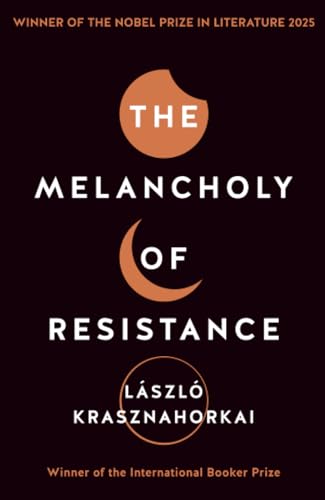
László Krasznahorkai, The Melancholy of Resistance (1989, translated by George Szirtes, published by Tuskar Rocks Press 2000)
Before the meeting: László Krasznahorkai won the 2025 Nobel Prize in Literature. The Melancholy of Resistance (Hungarian title Az ellenállás melankóliája) was his second novel. Written as the Communist regime was collapsing in Hungary in 1989, it centres around an outbreak of senseless mass violence in a small Hungarian town. In real life, happily, the transition from Communism to a version of democracy was peaceful, but the book’s nightmarish vision and weird allegorical tale resonate far beyond its immediate political context.
One thing was clear to me as I read: this book, with its absence of paragraph breaks, long internal monologues about, for example, esoteric musicology, a key character who remains unseen and unheard except for weird chirping sounds, and many story lines that peter out or are resolved with a throwaway comment in the middle of something else, could never be made into a film. I was wrong. In 2000 (the year this translation was published), Béla Tarr adapted it in Werckmeister Harmonies, which has been called ‘one of the major achievements of twenty-first-century cinema’ (an impressive accolade, even if it was written in the YouTube comments section).
I haven’t seen the film, but I can’t think of a better way to convey the feel of the book than to show you its trailer:
There you have it: the young, naive idealist who may well be the idiot people think he is; the old, disillusioned musicologist; the corpse of a huge whale wheeled into town; the ominously silent crowds of men; the awful mob violence; the invading military (though I don’t remember a helicopter in the book). Some elements are missing, though I expect they’re in the movie itself: a mysterious character known as the Prince, two children caught in the crossfire, and the key roles of two women. Nor do the streets of the movie seem quite as covered in frozen garbage as those of the novel.
The book’s most striking feature is absence of paragraph breaks and the predominance of long sentences. The sight of page after page of uninterrupted text is intimidating at first, and it’s annoying having to hunt around if you lose your place, but the effect on the page, as I imagine it is on the screen, is a dreamlike flow. And George Szirtes’ has translated the Hungarian into extraordinarily smooth English that enhances that effect. This isn’t Proust, where the sentences turn in on themselves, clauses nesting within clauses, with a hypnotic, introspective effect. Here the effect is more propulsive – the long sentences sweep you on. And they work brilliantly in a book where characters are always in motion (even if sometimes the motion is mental). They walk, stumble, run errands, occasionally waddle, stalk, pursue, flee, but always move.
It’s as if the characters can’t stop for breath, so the text has to hold out for as long as it can without a full stop, and even longer for a bit of white space.
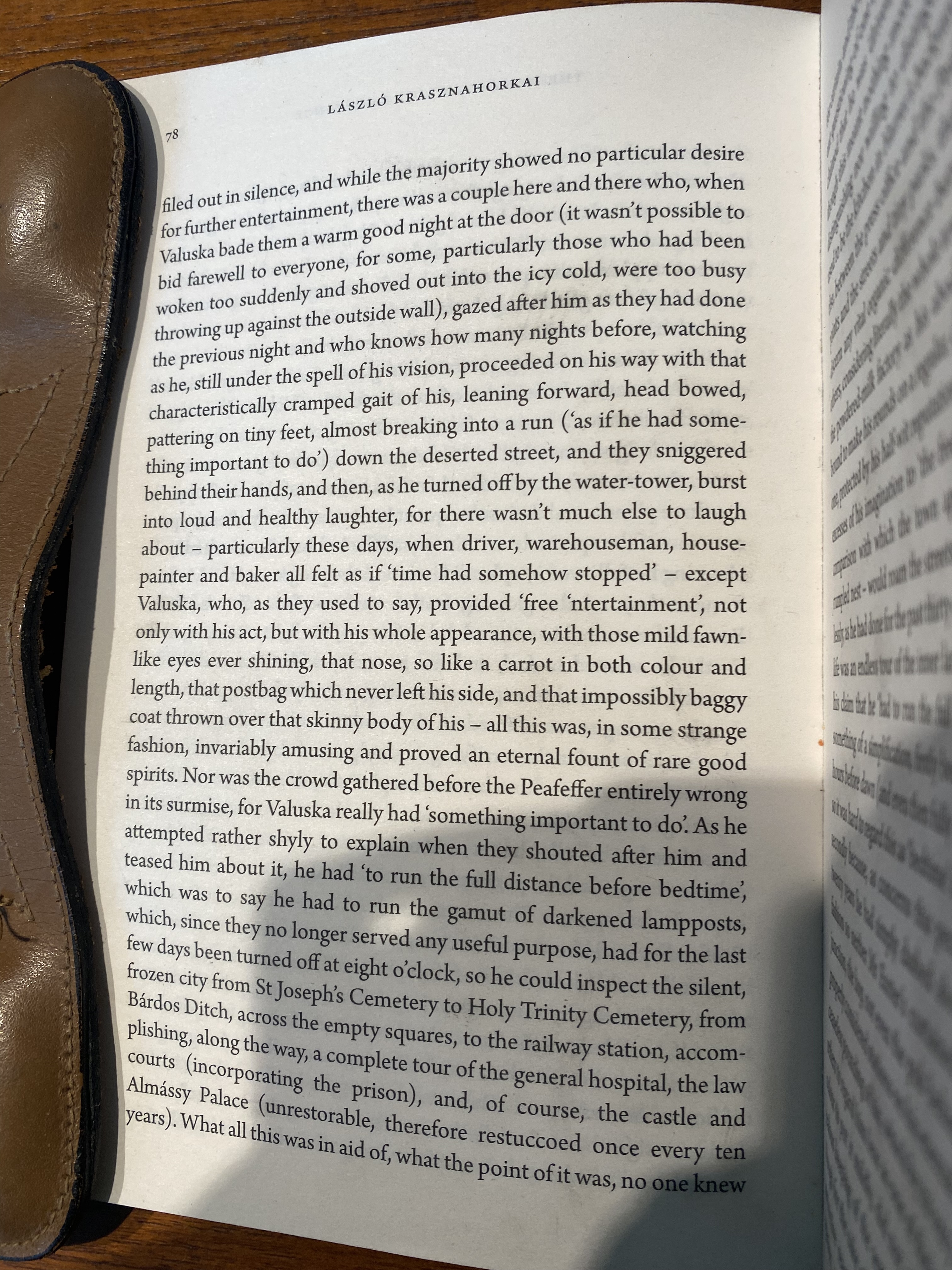
Page 78* occurs partway through the third paragraph/section, which unfolds from the point of view of Valuska, a kind of holy idiot and easily the book’s most sympathetic character. Valuska has been introduced doing his nightly routine at closing time in the Peafeffer tavern, in which he demonstrates the mechanics of a solar eclipse, deploying three paralytic drunks to represent the sun, the moon and the earth. His attempt to communicate the awe-inspiring order of the cosmos is tolerated by the drinkers as a way to delay closing time. At the top of this page, the evening is over and they walk out into the cold night:
The first thing to note about this page is that, counting the sentence that started on the previous page, there are just three sentences. The middle one is quite short: at 20 words it may be the shortest in the book, but is otherwise unremarkable. The others are typical of the book.
It would please my inner 11-year old Queenslander to analyse one of them – identify the main clause and the subsidiary clauses, and the nature of the subsidiary clauses. It probably wouldn’t be very entertaining for my readers, so I’ll limit myself to noting that the basic structure of this:
So they filed out in silence, and while the majority showed no particular desire for further entertainment, there was a couple here and there who, when Valuska bade them a warm good night at the door (it wasn’t possible to bid farewell to everyone, for some, particularly those who had been woken too suddenly and shoved out into the icy cold, were too busy throwing up against the outside wall), gazed after him as they had done the previous night and who knows how many nights before watching as he, still under the spell of his vision, proceeded on his way with that characteristically cramped gait of his, leaning forward, head bowed, puttering on tiny feet, almost breaking into a run (‘as if he had something important to do’) down the deserted street, and they sniggered behind their hands, and then, as he turned of by the water-tower, burst into loud and healthy laughter, for there wasn’t much else to laugh about – particularly these days, when driver, warehouseman, house-painter and baker all felt as if ‘time had somehow stopped’ – except Valuska, who, as they used to say, provided ‘free ’ntertainment’, not only with his act, but with his whole appearance, with those mild fawn-like eyes ever shining, that nose, so like a carrot in both colour and length, that postbag which never left his side, and that impossibly baggy coat thrown over that skinny body of his – all this was, in some strange fashion, invariably amusing and proved an eternal fount of rare good spirits
is five linked principal clauses:
So they filed out, and a couple gazed after him, and they sniggered, and then burst into laughter, for there wasn’t much else to laugh about.
That skeleton is adorned with images of the bitter cold, vaguely comic drinkers throwing up, descriptions of Valuska, an explanation of what they found amusing about him, and a reminder of the drinkers’ wider context – ‘driver, warehouseman, house painter and baker’.
Valuska stands out: time has ‘somehow stopped’ for the town in general, but he is fascinated by the continuous movement of the heavenly bodies and is himself always on the move. That stopped-ness comes into focus in chilling scenes in which the town square is full of motionless men, all as if waiting for something. And when they move, the effect is shocking, violent.
I don’t know that I’d recommend the book, but I enjoyed it, and it has stayed hauntingly in my mind. It makes many other books feel like plodding reportage.
After the meeting: This was one of the best meetings of the book group ever. We exchanged gifts – everyone was supposed to bring a book from their shelves, though the book I received (a Gary Disher title) is in suspiciously mint condition. Some of us read poems – by Adrian Mitchell, Mary Oliver, Simon Armitage and Robert Gray. We reminisced about the group’s history and argued about how firmly fixed our list of dates for the year should be. We shared stories of courage and shame. We ate well. We enjoyed the early summer evening. And we had a wonderfully animated discussion of the book.
Three out of eight of us had read the whole thing. A number of others were well under way and intend to finish it. Everyone had something to say. Here are some of my highlights.
I was reading Mrs Dalloway a couple of pages a day alongside of The Melancholy of Resistance, and felt strongly that the books spoke to each other but couldn’t say how. When someone mentioned the way the narrative focus transfers from one character to the next at the end of each section, I realised this is one of the similarities: where Virginia Woolf’s narrator slips from one character’s mind to another sometimes several times on a single page, Krasznahorkai’s narrator does a similar thing, but on a much wider arc.
One man read the book not realising it was more than 30 years old, and the political dimensions of it seemed right up to date. I don’t know if he mentioned the MAGA riots in January 2020, but they certainly seemed relevant.
Someone said it was hard to resist a book where a character spends four pages trying to work out the physics of hammering a nail while repeatedly hitting himself on the thumb. And then, having solved the problem by acting without thinking about it, he is told by his cleaning lady that he’s done it all wrong. Our group member who has been studying philosophy told us that this is even funnier when you know that one of Heidegger’s most famous passages involves a hammer. (That person’s favourite moment is Mr Eszter’s seemingly interminable rumination about the pointlessness of the diatonic scale (at least that’s what I think it’s about) – which was my second least favourite moment.)
Contrary to my own response, one man felt the book was intensely cinematic. And as we talked it was clear that it’s full of memorable scenes. We reminded each other of the scene where Valuska demonstrates the mechanics of an eclipse, the interrogation scene, the force with which Mrs Eszter’s hand comes down on Valuska’s shoulder to stop him from speaking, the horriific scene where the mob runs riot in the hospital, the brilliantly evoked streets full of frozen garbage, and more.
At heart, one man said, it’s a love story between Mr Eszter, an intellectual who has given up any hope that thinking could be of value, and naive, well-meaning Valuska.
And that’s a wrap for the Book Group for 2025.
The Book Group met on Gadigal land, and I have written this blog post on the land of Gadigal and Wangal of the Eora nation. I acknowledge Elders past and present of those clans, and welcome any First Nations readers.
* My blogging practice is to focus on the page that coincides with my age, currently 78.
Before the meeting: we had enjoyed Robbie Arnott’s previous novel, Limberlost, so Dusk was a promising choice.
It’s set in a place very like nineteenth century Tasmania. Iris and Floyd Renshaw, the twin children of notorious outlaws, travel to the highlands and aim to kill a puma named Dusk that has been ravaging the region, killing livestock and people. A bounty has been offered by the graziers, and the twins see it as a chance to move away from their life at the margins. The story of their encounters with graziers and other hunters, and with a community of people who lived there before the settlers arrived, is full of elegant twists and moral dilemmas. There are moments of sheer horror, and moments of great tenderness. The writing is consistently vivid – you can tell that Robbie Arnott has visited the landscape even while he adds surreal elements like giant bones protruding from the ground; and the twins’ physical ordeals are viscerally real.
Even as I recognised all these qualities, I had trouble engaging. From about page 100, when the twins and their companions come close to Dusk, I started to care, and where a couple of pages are blacked out after a dramatic moment, what might have seemed a bit of cleverdickery had me on the edge of my seat. But then I got lost again and the final pages left me, as the song says, wondering why.
At page 78*, the twins have just arrived in a small town full of men who are hunting the killer beast. She – Dusk, the puma – has killed the son of a wealthy grazier, whom the twins have encountered grieving extravagantly in the street. For the first time since they came to the highlands, Iris finds herself confronting what they may be up against, ‘the probability of being ripped into death, faster than blinking’. Now, ‘starkly aware of the softness of her flesh, the smallness of her body, the stumbling clumsiness of her humanity’, she encounters for the second time Patrick Lees, a man who stands out from the crowd of hunters. On page 77 he has proposed that the twins join him to help track down the beast. Floyd, characteristically, stays more or less silent.
‘So you are chasing the bounty,’ said Iris, annoyance bending her voice. Lees contemplated his pipe before slipping it back between his lips and speaking around it. ‘Maybe I’m just endlessly curious.’ Iris clenched her teeth, holding her irritation in. Floyd kept rubbing his chin, seeming to take in Lees’ words without making any effort to respond. All of it was maddening to Iris – Floyd’s stupid performance, the sudden appearance of Patrick Lees, the unmoored feeling she had while being near him, his casual offer, his playful duplicity – and she wanted to get away from both of them and from herself, so she tugged at the collar of her coat and touched her hat. ‘We’ll think about it.’ Lees nodded. ‘Of course.’ He indicated a lemon-gold building that rose above the stable. ‘I’m staying at the inn. I’ll be leaving at first light.’ Another little smile. ‘I hope to see you then.’
They left Patrick Lees breathing smoke at the plains and walked back through the stable to the street.
The main thing on display in this passage is Robbie Arnott’s deft use of tropes from romance novels. Iris is irritated by a suave, superior man, while having an ‘unmoored feeling’ while she’s near him. It’s no spoiler that Iris can’t resist the offer to go on the hunt with him, or that they do spend a night together. But as in the romance genre, there is every indication here that Lees is a cad: his little smile is surely a red flag, and while Iris may be uneasy, the reader can be reasonably certain that someone who breathes smoke is dangerous. You leave this page with a subliminal sense that Lees may not be just a romance-genre cad, but a horror-genre monster.
There’s a lot to admire in this book. There’s a lot to discuss. The surreal elements of the landscape read as both hamfisted metaphor and strategy for including First Nations characters who won’t be mistaken for actual palawa. But I was unconvinced. Even the basic set-up didn’t work for me, even if someone were to tell me that pumas were once introduced to Tasmania / lutruwita. I enjoyed some parts but never got on its wavelength
After the meeting: I couldn’t go to this meeting, and though I missed the people, I wasn’t sorry not to discuss the book. The WhatsApp report painted a picture of a very convivial evening, where everyone liked the book, some more than others. Evidently one person liked it more as the evening wore on – maybe I would have joined him in that movement. Maybe not.
I have written this blog post near what was once luxuriant wetland, in Gadigal and Wangal country. I acknowledge Elders past and present of those clans, and welcome any First Nations readers.
* My blogging practice is to focus on the page that coincides with my age, currently 78.
Before the meeting: As a boy I read a lot of British crime fiction. When I was 13, I put a brown paper cover on the conveniently-sized novel I had to read for school (Booran by M. J. Unwin – trigger warning for 1950s colonialist attitudes), then transferred the cover to book after book by Agatha Christie and Ngaio Marsh over the course of the year. My parents were impressed that I appeared to read Booran so many times. For my father’s birthday in April, I gave him a pile of ten pre-read paperbacks, and for Christmas another twenty. It didn’t occur to me that my pretence might be transparent.
This means that on the cusp of teenagehood I read enough ‘cosy mysteries’ to last a lifetime. I can still enjoy the odd Agatha Christie on TV or at the movies, but I have no desire to reread the books. Not even The Murder of Roger Ackroyd.
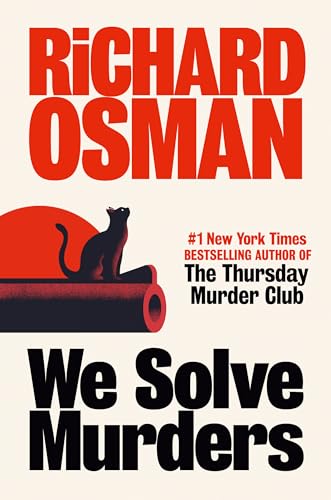
Reading We Solve Murders felt like an enforced return to that territory. It’s a cosy mystery mixed with a comedy action thriller, written with amiable wit in elegant prose, with a plot that features many exotic locales, influencers being murdered and a villain who uses generative AI to disguise their identity. (Incidentally, it’s a bold move in a genre novel written in the style of a friendly English gentleman to have the villain’s chapters preceded by a Chat GPT prompt to render text ‘in the style of a friendly English gentleman’. I can’t be the only one to think Richard Osman is having a little joke at his own expense.)
This is explicitly intended to be the first book in a series, like Osman’s first series The Thursday Murder Club, and we can probably expect a TV movie, hopefully less mediocre than the recent TMC movie. There are moments where I would laugh if I saw them on screen. Just one example, from page 244. Amy, the hard-boiled heroine is talking to Nelson, who may be about to kill her:
‘It’s just you don’t seem like an assassin?’ says Amy. ‘And I know a lot of assassins.’ ‘I am not an assassin,’ says Nelson, his tone very reasonable. ‘I’m just, you know, a regular criminal and politician.’
Boom tish!
The story rattles along at a good pace. The characters are an amusingly diverse bunch of types. There are twists and turns and plenty of travel. It is what it is and it’s terrific at it. I was entertained, but it took many more hours than a movie would.
After the meeting: It was a small group, not for lack of interest in the book but because of family birthdays, travel commitments, viruses – and our current policy of sticking to our designated dates no matter what. Not for us the practice of that group who don’t decide on a date until everyone has read the book. Still, the four of us enjoyed each other’s company until well after my watch announced it was my bedtime. Among many things, including the colourful career of one us, we did talk about the book.
One chap put it nicely: Richard Osman works in popular entertainment, having devised and presented a number of successful game shows. He knows what works with audiences and has brought that knowledge to the new (to him) field of novel writing. I’m pretty sure someone said that there’s a big overlap between his target readership and people who go on cruises. (We had an interesting digression into the sociology of cruise ships.)
When it was observed that when Australian comics try to replicate those British game shows they don’t always come up with a winner, we realised that their Englishness is at the heart of their charm. And that is also true of this book. Our one English-born and bred group member spoke eloquently on this point. There’s a character who can be relied on to give details of which roads he takes to get from one village to another: this, our group member assured us, has the ring of authenticity. The book is firmly rooted in a particular place – a village in the New Forest. Another chap who lived for some time in an English village testified that, just as in the book, in a two-pub village most pub-goers were loyal to one establishment and wouldn’t dream of visiting the other. What I read as cosiness is also a celebration of something distinctively English. And they did say ‘English’, not ‘British’.
Someone asked, ‘Did you laugh?’ No one said yes. On the page, the book is often funny but not laugh-out-loud. We shared stories of books that did make us laugh out loud – a Georgette Heyer regency romance and the The Traveller’s Tool by Sir Les Patterson were mentioned. (There was another interesting digression about Barrie Humphries.) But we had a sense that a movie, or preferably a TV series, might be on the way.
One of the non-attendees summed it up well in a WhatsApp post: ‘No thinking, just chorkling. The goodies win / the baddies get their come-uppence. Very English.’
The Book Group met, and I wrote this blog post, on the land of Gadigal and Wangal of the Eora Nation as the days are growing suddenly warmer. I acknowledge Elders past and present, and welcome any First Nations readers.
Before the meeting: The Book Group’s designated chooser defied recent practice and chose a long book – 624 pages in my edition. I doggedly put in the time, and had read the book well before the meeting, only to realise that I was away from home on the night and couldn’t be there.
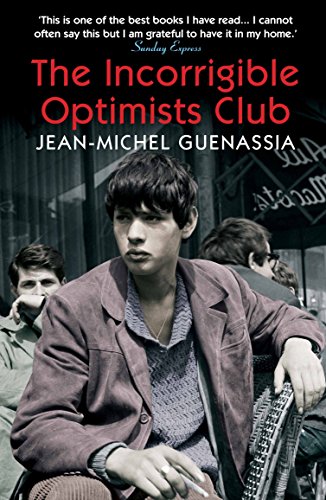
The club of the title is a group of exiles in 1950s Paris who meet in the back room of a bistro, mostly to play chess but also to share news of their homelands, and to argue fiercely about love, politics and life in general. One of the two main strands of the book is made up of their stories. Mostly they are without ID, even stateless refugees or defectors from the Soviet Union. One has actually been a friend of Stalin’s, who defected for love but remains faithful to the Soviet cause. The rest are dissidents or men (they are all men) who were in the wrong place at the wrong time. Jean-Paul Sartre is a member and kind of patron, though after a riveting scene in which he registers news of Camus’ death, he pretty much fades from the narrative.
We see the club and its members through the eyes of Michel Marini, a schoolboy who first visits the cafe to play desktop football (whose French name, ‘baby-foot’, trand). His coming of age story, against the backdrop of the Algerian War of Independence, is the other main narrative strand. Michel befriends Cécile, the girlfriend of his older brother, Frank. Frank bunks off to fight in Algeria, then disappears, only to reappear as a fugitive. Cécile calls Michel ‘little bro’, and neither she nor he realise that he is completely in love with her. Meanwhile, Michel’s parents’ marriage goes through tumultuous times.
It’s never dull, richly political and just as rich in its focus on the storms of adolescence. Yet the blurb describes it as a debut novel. Could this possibly be the work of a young person? I went looking and found that it’s not. According to Wikipedia, Jean-Michel Guenassia is almost as old as me, and was 59 when the book was published. He had in fact previously published one novel, and three TV screenplays and some plays had been produced. The Incorrigible Optimists Club is another example of an overnight sensation that was years in the making.
Euan Cameron’s English version is smooth, lively and engrossing.
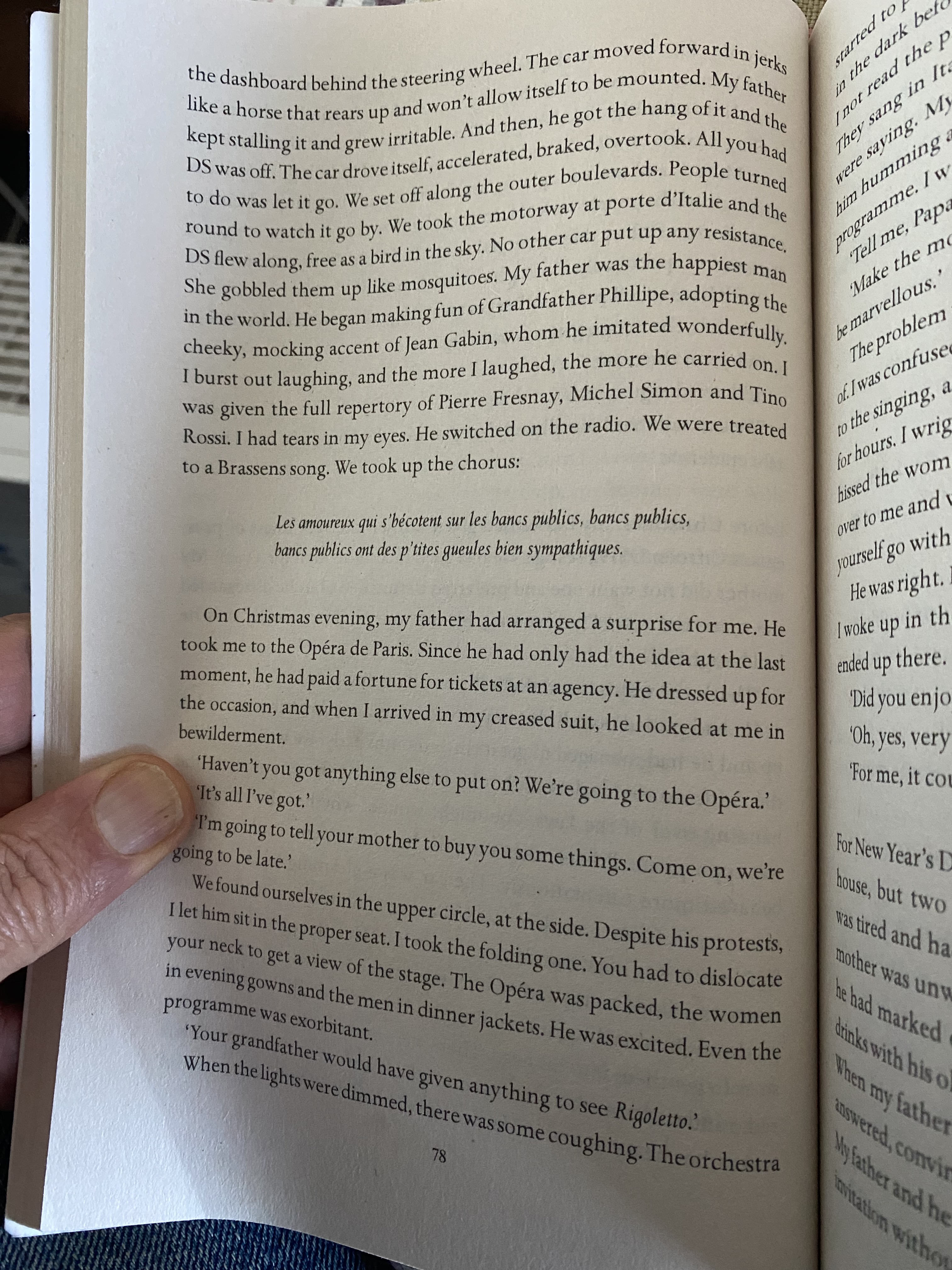
Page 78* highlights elements of the book that didn’t feature in that quick overview. But they’re qualities that are important to the way the book draws the reader into the warm embrace of its imagined time and place.
We’re still getting to know Michel before he becomes involved with the Incorrigible Optimists, before the realities of the Algerian War intrude into his life, before his parents’ relationship becomes fully hostile. His father, a small businessman, has just bought a flash car – a DS 19 – and takes it for a spin with Michel in the passenger seat:
After a rough start, the car behaves like a midlife-crisis dream come true. We’ve been told that Michel’s father loves to impersonate the cool screen actors of the day, and that he is more or less despised by his wife’s upper-class parents, including Grandfather Philippe mentioned here. This paragraph reminds us of that tension, shows him having fun with his son, and at the same time fleshes out the soundtrack of the era. This kind of detail is what brings the narrative alive, even for readers (like me) who have vague to nonexistent knowledge of he singers and actors mentioned:
My father was the happiest man in the world. He began making fun of Grandfather Philippe, adopting the cheeky, mocking accent of Jean Gabin, whom he imitated wonderfully. I burst out laughing, and the more I laughed, the more he carried on. I was given the full repertory of Pierre Fresnay, Michel Simon and Tino Rossi. I had tears in my eyes. He switched on the radio. We were treated to a Brassens song. We took up the chorus: _ Les amoureux qui s’bécotent sur les bancs publics, bancs publics, _ bancs publics ont des p’tites gueules bien sympathiques.
Jean Gabin played Maigret in 1958. Pierre Fresnay was the suave Frenchman in La Grande Illusion. Michel Simon was described by Charlie Chaplin as the greatest actor in the world. Tino Rossi, like the others that Michel’s father impersonates, was feted as a film actor who supported the Resistance. Even without all the googling, you can tell that this is a moment when father and son are enjoying each other and loving life, singing together, and celebrating an anti-Fascist strand of French culture.
Here’s a YouTube of George Brassens singing ‘Les amoureux des bancs publiques’. The words don’t really matter, but they translate as ‘The lovers who kiss on public benches, public benches, public benches, have very friendly little mouths.’
Then there’s this:
On Christmas evening, my father had arranged a surprise for me. He took me to the Opéra de Paris. Since he had only had the idea at the las moment, he had paid a fortune for tickets at an agency. He dressed up for the occasion, and when I arrived in my creased suit, he looked at me in bewilderment. ‘Haven’t you got anything else to put on? We’re going to the Opéra.’ “It’s all I’ve got.’ ‘I’m going to tell your mother to buy you some things. Come on, we’re going to be late.’ We found ourselves in the upper circle, at the side. Despite his protests, I let him sit in the proper seat. I took the folding one. You had to dislocate your neck to get a view of the stage. The Opéra was packed, the women in evening gowns and the men in dinner jackets. He was excited. Even the programme was exorbitant. ‘Your grandfather would have given anything to see Rigoletto.’
This time Michel doesn’t share his father’s enthusiasm. The tiny incident, especially coming on the heels of the singing together with Georges Brassens, shows us the mutual affecrtion between father and son, as well as the distance that is growing between the generations, both of which become hugely important when the father disapproves of things done by Michel’s brother Frank but makes enormous sacrifices for him.
After the meeting: Sadly, I wasn’t there.
I wrote this blog post on Wulgurukaba land, the luxuriant island of Yunbenun, where cockatoos screech during the day and curlews serenade the night. I acknowledge the Elders past and present, and welcome any First Nations readers.
* My blogging practice is to focus on the page that coincides with my age, currently 78.
Alphonse Duchesne, who ran a small cafe/grocery in Normandy with his wife, died in 1967, two months after his daughter Annie Ernaux qualified as a school teacher, marking a transition in the family’s class status. On the train journey home from the funeral, Ernaux writes:
I tried to keep my son entertained so that he would behave himself. People travelling first-class have no time for noise and restless children. I suddenly realised with astonishment, ‘Now I really am bourgeois,’ and ‘It’s too late.’ (Page 18)
Later that summer, she thought to herself, ‘One day I shall have to explain all this,’ meaning she needed to write about her father and the distance that had come between them during her adolescence: ‘Although it had something to do with class, it was different, indefinable. Like fractured love.’
This short book – just 64 pages – is a rigorous, spare and unsparing, attempt to rise to that need. In 1982, having already written three novels, Ernaux set out to write a fourth one, about her father. But, she writes:
I realise now that a novel is out of the question. In order to tell the story of a life governed by necessity, I have no right to adopt an artistic approach, or attempt to produce something ‘moving’ or ‘gripping’. I shall collate my father’s words, tastes and mannerisms, the main events of his life, all the external evidence of his existence, an existence which I too shared.
The book tells two stories: the life story of Ernaux’s father and – always in the present tense as if allowing us to look over her shoulder as she types – the self-reflexive story of the writing of the book.
The father was from a peasant background. His own father was illiterate, and he worked first as a farm hand, then as a factory worker and finally, along with his wife, ran the small grocery shop and café. He bickered with his wife, spoke a rustic version of French, never set foot in a museum, voted for reactionary politicians ‘for a lark, but without conviction’, was intensely proud of his daughter’s success in moving into the middle class but didn’t make any part of the transition with her.
Every now and then, Ernaux steps directly into the frame to say how long she has now been writing, explain that it is a slow process because she is avoiding her own emotional memories in order to focus on her father’s story. It’s not that she doesn’t draw on memory – as for example when she describes a photo of her father taken at her wedding reception, and recalls her sense of him at the moment it was taken, ‘certain that he wasn’t enjoying himself’. And through it all, told in flat unemotive language, the terrible undertow of the daughter moving away into a different world:
One day he said, ‘Books and music are all right for you. I don’t need them to live.’
This was the first of Annie Ernaux’s ‘autobiosociological’ books. It’s the fourth I’ve read, and with each one I become more grateful to the Nobel committee for drawing her to my attention. The others (with links to my blog posts) are:
After the meeting: I was a little apprehensive about this meeting, as I had picked the book. The job was sprung on me at the last meeting, it had to be a short book, and this was on my TBR list, so I named it on the spot without due consideration.
It turned out that, quite apart from the big plus of brevity, the book was generally much liked, and we had a discussion that made me glad all over again to be in the book group. At times the discussion was personal: one man honed in on the early part of the narrative when the family’s life was disrupted terribly by the bombing of Normandy in World War Two (a part of the narrative that had passed me by); a number of us drew parallels with the trajectories of our own lives – as the first generation in our families to go to university; and the conversation wandered, seemingly off-topic, to our relationships to our parents, and various ways in which the stories of different parents had been discovered and even published.
We had a wonderful difference of opinion. One man, call him K–, himself a recently retired small businessman, said that Annie Ernaux had completely failed to get that her father, as a small businessman, had made a life for himself that he was completely happy with: when Ernaux portrays him as ashamed of his lack of ‘culture’, that is complete projection. I must be just a little bit in love with Annie Ernaux because my defensive hackles went up, and I disagreed that the father was portrayed as anything other than happy with his life!
The back cover blurb of the Ftzcarraldo edition says that ‘Ernaux reveals the shame that haunted him throughout his life’. So K– isn’t alone in reading the book that way. I still disagree. But I’ve been reflecting for days, and while I still think K– was wrong, I believe he put his finger on something at the heart of the book.
There’s no doubt that Annie the character believed that she had a better life than her parents, that they were proud she had made the transition, that a gulf of mutual incomprehension developed between the generations. The father certainly feels shame in some social situations – not understanding what a school teacher means by ‘town clothes’, not being able to spell when filling out a form. It’s explicit that the people of the daughter’s world look on people like her father with scorn. But I don’t read Ernaux or her father as sharing their judgement. She lays out the detail of his world, and is pretty clear about her own ‘bourgeois’ perspective. When she mentions in passing that he votes for a reactionary politician ‘for a lark’, it’s clear that she disapproves, but her disapproval isn’t the point.
K– went hunting for passages to support his reading. His case doesn’t stand or fall by one tiny sample, but what he came up with was this, from when the 20-something Annie is visiting her parents:
As soon as I plugged in the bedside lamp, the wire blackened, sparks flew and the bulb went out. The lamp was in the shape of a ball resting on a marble base, with a brass rabbit standing upright, its front paws sicking out at its sides. I had once thought it very beautiful. It must have been broken for ages. Indifferent to things, they never got anything mended at home.
K– read the tone of that last sentence as something close to contempt: ‘These people are barely human, they care so little for their environment.’ I read it as more two-edged: ‘As the kind of person who travels first-class, I expect my things to function well and to meet certain aesthetic standards. My parents have different priorities, a much greater tolerance for imperfection.’
I’m going to reread the book.
The Book Group met on the land of Gadigal of the Eora nation. I wrote this blog post on Wangal and Gadigal land. I gratefully acknowledge the many generations of Elders past and present who have cared for this beautiful country.
Before the meeting: It’s unlikely that the group would have read The Visionaries if we chose books by consensus. But The Chooser has spoken and we’re out of our comfort zones.
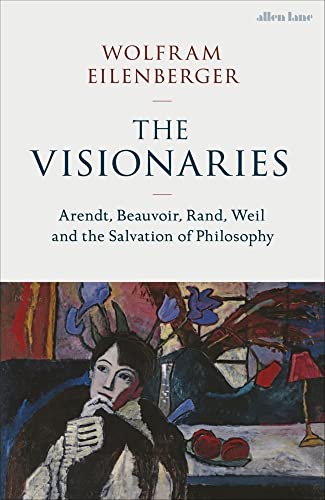
It’s a hard book to describe. Without anything by way of preamble or general argument, it plunges straight into its story. The first chapter, ‘Sparks: 1943’, introduces the book’s four subjects: four quite different women writers, each heroic in her own way, poised to take a major leap forward In the midst of the horrors of the Second World War. As with each of the book’s eight chapters and Coda, the chapter is subtitled:
Beauvoir is in the mood, Weil in a trance, Rand in a fury, and Arendt in a nightmare.
And the four philosophers are introduced:
Simone de Beauvoir, aged 35, is in occupied France in her famously unconventional ‘family’ with Jean-Paul Sartre, with ‘better things to do than worry about the judgment of that petit-bourgeois fascist’ (that is, Adolf Hitler): she is on the brink of ‘a new definition of man (sic!) as an acting creature. And one that was neither empty of content, as in Sartre’s latest work, nor bound to remain absurd, as in Camus’s writing.’
Simone Weil, 34, is in London, desperately ill and in pain, but lobbying for the creation of ‘a special unit of French nurses at the front who would be deployed only in the most dangerous places, to provide first aid in the middle of battle’. She would head this unit personally, in what looks awfully like a plan to commit suicide by altruism. De Gaulle dismisses the proposal out of hand: ‘She is mad!’ Instead she writes urgently and copiously, including ‘a 300-page redesign of the cultural existence of humanity in the modern age’ before collapsing in exhaustion.
After ten years as a freelance writer in New York City, Ayn Rand, 37, sees the publication of her 700-page novel, The Fountainhead, and launches her passionate espousal of independence, her worldview that saw altruism as the great destructive force.
Hannah Arendt, 36, also in New York, has been driven out of Hitler’s Germany, and is now finding in herself the courage to face the reality of the industrialised murder of millions of Jews. What mattered was ‘to be entirely present’, or, as paraphrased by Eilenberger, ‘to philosophise’.
In the following chapters, Eilenberger tells us the story of the life and work of each of these four women over the preceding decade. It’s left to the reader to discern any unifying theme or concern. In my reading, the closest he comes to articulating a central theme is on page 69:
The philosophising person seems to be essentially a pariah of deviant insights, the prophet of a life lived rightly, whose traces can be found and deciphered even in the deepest falsity. At least this is one way to understand the role that Ayn Rand as well as her contemporaries Weil, Arendt and Beauvoir assumed with ever greater confidence. Not that they had expressly made a choice. They simply experienced themselves as having been placed fundamentally differently in the world from how other people had been. And deep inside they remained certain of who or what the problem needing treatment was: not themselves, but the Others. Possibly, in fact – all the Others.
If one were to pursue that view, the actual impulse of astonishment at the beginning of all philosophising is not the surprise that there is ‘something and not nothing’, but rather, honest bafflement that other people live as they do.
If I understand this correctly, part of what he is saying is that whereas their male colleagues were interested in the individual human being in relation to the world, these four women were interested in human beings in relationship to each other.
It may be that what you find in any book depends on what you bring to it. A reader well-versed in 20th century philosophy would read this one differently from me: it seems that each of these women was pushed to the margins of political and philosophical thinking, and this book is part of a movement to rectify that. But I’m not that well-versed reader. I haven’t read a whole work by any of them, but I’ve known about all four in a general way.
In my mental landscape, Simone Weil is a weirdly saintly figure who embraced suffering (and loved one of my own favourite poems, as I blogged recently), a Jew who was lived her own intense version of non-Church Christianity; Ayn Rand is a demonic figure who celebrated and justified libertarian capitalism; Simone de Beauvoir is Jean-Paul Sartre’s devoted lover who wrote The Second Sex, a key text of second-wave feminism; and Hannah Arendt is a woman of extraordinary integrity who coined the phrase ‘the banality of evil’ and wrote about totalitarianism.
This book leaves those thumbnail sketches pretty much in place, but I now have a much richer understanding of the people and their works. I didn’t know, for instance, that Simone Weil had worked as a trade union organiser and had brilliant political insights, that Simone de Beauvoir had such a complex set of intimate relationships, that Ayn Rand was married and counted on her husband Frank O’Connor while she wrote fiercely about independence (and that ‘Ayn’ rhymes with ‘fine’), or that Hannah Arendt was quite so marvellous a human being as she appears in these pages.
Their stories are told independently, but Eilenberger makes occasional telling comparisons, and sometimes the women’s paths cross. I love the meeting between the two Simones on page 55, quoted from Simone de Beauvoir’s Memoirs of a Dutiful Daughter:
I managed to get near her one day. I don’t know how the conversation got started; she declared in no uncertain tones that only one thing mattered in the world: the revolution which would feed all the starving people of the earth. I retorted, no less peremptorily, that the problem was not to make men happy, but to find the reason for their existence. She looked me up and down: ‘It’s easy to see you’ve never been hungry,’ she snapped. Our relations ended right there.
And on page 190, the moment that has stayed with me as a piece of wisdom to live by – far from the self-abnegation of Simone Weil or the grand existentialist abstraction of de Beauvoir. Hannah Arendt, Eilenberger writes, is ‘laying the foundation of her own ethics of true self-determination in the face of the Other’:
Gratitude, for the existence of other people in the world, and active concern, for their always given vulnerability, are for Arendt the two true sources of our moral life. And it is no coincidence … that these two predispositions are the very ones that are essentially alien to Ayn Rand’s superhuman ideal figure, Howard Roark.
Amid all the egotism, altruism, self-sacrifice, angst, ambition, bitterness, sweetness, ruthlessness, pain, of those brilliant young adult lives, the notion that gratitude and concern are central went straight to my heart.
After the meeting: Usually, we spend quite a bit of time chatting before turning to the book of the night, but this time we were into it before we even sat down. The food was, as always, excellent. Our host had done a huge tray of roast vegetables and the contributions of the other five of us, with minimal advance coordination, worked well. He Who Usually Brings Dessert was on the other side of the continent, but it was someone’s birthday, and we had cake.
Though the book took us well outside our collective comfort zone, I think we were all glad to have read it. Most enjoyed it for the history, and tended to skip the philosophy. One of us is doing a philosophy course with the University of the Third Age, and had read Wolfram Eilenberger’s previous book, Time of the Magicians, about four male 20th century philosophers. He gave a couple of mini-lectures that cast light, gratefully received, on some of our dark places.
We had three different readings of ‘the Salvation of philosophy’ in the subtitle: these four women were saved by philosophy in times of extreme hardship; they saved philosophy from the dried-up mainstream by focusing on the connections among people; in the terrible time of the Second World War and Nazi atrocities, they kept the flame of philosophical thinking alive. Maybe all three are correct. (I’ve just seen the subtitle of the original is Die Rettung der Philosophie in finsteren Zeiten (1933-1943), literally The Salvation of Philosophy in Dark Times (1933–1943). And the title itself is Feuer der Freiheit – Fire of Freedom. It’s kind of intriguing that the four woman aren’t named, and there’s not even a hint that the book focuses on particular women. I wonder how much that change of packaging influences out reading.)
A couple of guys took against Simone de Beauvoir. I tried to defend her, and was supported by someone drawing a comparison between her and one of the participants in Australian Survivor that was as obscure to me as the extracts from Simone Weil’s journals. Incidentally, I now know how to pronounce Weil (it’s VAY).
We were in awe at how young the four women were in the years covered by the book. Some were pretty sure that Simone de Beauvoir’s entanglement with a student would get her fired and publicly shamed these days. It was a revelation that for de Beauvoir the war at times barely disturbed her way of life (someone had been to see the Anne Dangar exhibition in Canberra and had a similar revelation – ‘Oh yes, Hitler’s doing all that stuff,’ the artists in France said to each other, ‘but cubism is so interesting.’) It was pointed out that two of the four women were novelists rather than philosophers as such. Someone thought Hannah Arendt was a bit dull (I was shocked). Some were surprised to find themselves feeling sympathy for Ayn Rand (I was ashamed).
We barely talked about Donald Trump. I hope he noticed the lack of attention.
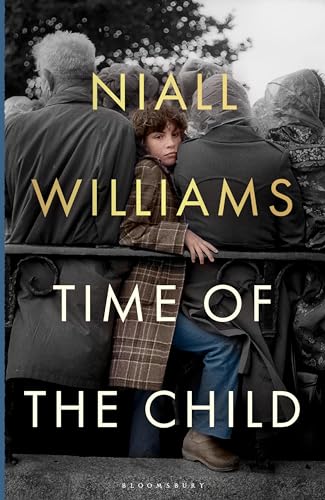
Before the meeting: As I was reading the first couple of chapters of this book, I had ringing in my ears something that a Book Group member had said about a different book, perhaps one of Niall Williams’s earlier novels, A History of the Rain or This Is Happiness: ‘It’s a beautifully written Irish novel, but I’m not sure the world needs yet another beautifully written Irish novel.’
The first chapters, in fact almost the first half of the book, are brilliant descriptions of life in 1962 in the fictional West Ireland village of Faha, the village we know from those previous books. The rain is still incessant and the village still slowly sinking into the river. The heart broken in This Is Happiness is still broken. Life is still dominated by the Catholic Church. Gossip is still the lifeblood of the community. Most houses now have electricity.
The first chapter begins with a wonderful setpiece, a parish Mass where the beloved parish priest stalls mid-sermon in the first major sign of dementia. Things are seen from the point of view of Jack Troy, the village’s general practitioner whose face and manner give away nothing of his inner feelings as his role in the community means he must always be available, including to people who will never ask for a doctor’s attention on their own behalf. After Sunday Mass he is regularly approached by people who indicate with a nod and a wink that his services are needed at such and such a house.
The second chapter revolves around another magnificent setpiece: the Christmas fair in which farmers bring their cattle to town to sell, and hawkers and traders come from elsewhere. Here, twelve-year-old Jude Quinlan, son of a drunkard farmer, carries the narrative burden.
Through both of these chapters, we are teased by hints that something big is going to happen. It’s as if the narrator is saying to his readers, ‘Yes yes, I know you’re here for a story, but first let me tell you about the place it happened in and the people who live there.’ At the end of the second chapter, more than a third of the way into the narrative, there’s this:
But it was here, at the back wall of the church in the village of Faha, on the night of the Christmas Fair 1962, that Jude Quinlan found the child.
Ah! The titular child has arrived! Then the third chapter continues to tease us. It takes us back a couple of days in the life of Ronnie Troy, Jack’s long-suffering dutiful daughter. After 16 pages in which we come to know and (speaking at least for myself) love her, she responds to a late-night knock on the door and at last the story begins.
Given that it happens so late in the book, I’m reluctant to say much more about it, except that though my Group member may be right that the world doesn’t need another book like this, I certainly do. Maybe it’s because I spent my 1950s childhood as part of the Irish diaspora in north Queensland, and I respond with little gasps of recognition to little throwaway lines about the Sacred Heart, the ‘Hail Holy Queen’, the smiling pope, or to the way the priest says Mass with his back to the church while the congregation’s more or less devout members goes about their own business. That is to say, maybe there’s a hefty dose of nostalgia in my response to the book. But if so, that nostalgia serves a serious purpose.
This is a time and place when the Church dominated Irish society. It was the time of the Magdalen laundries, covered-up clerical sexual abuse of children, pitiless laws against abortion and condemnation of most forms of birth control. None of this is foregrounded in the book, but oppressive Church–State authority looms large, mostly unspoken, over the second half of the book. On the one hand, a handful of people sinking to their knees to say the Rosary can be an exhilarating manifestation of something fine beyond words (though Niall Williams finds the words); on the other a priest with a form letter mouths deadly phrases like ‘For his own good’ and ‘Preserving his dignity’.
Just as much as, say, Sebastian Barry’s Old God’s Time or Claire Keegan’s Small Things Like These, this book is about decent humanity – individuals and communities – resisting the monolithic, repressive authority of Church and State. Like them, it revels in musical language. More than them it’s funny. I did cry, twice, but I laughed a lot.
Page 77* includes a micro example of the resistance. In the absence of a fairground, Faha’s monthly fair is a chaotic mess, and the church gates, ‘with their splayed look of welcome in the centre of the village’, are a main centre of trade. The curate, Father Coffey, representing the Church’s authority, asks the farmers not to stand their cattle there:
As it happened, the curate’s appeal fell on deaf ears, but he took some satisfaction when he was able to negotiate a treaty whereby Mick Lynch promised a rope corridor to let the daily Mass-goers through. As a goodwill gesture, Lynch said, the farmers would take their dung with them when they left, which Father Coffey reported back to the Canon, unaware it was a joke until the older priest put the hand across his laugh to stop his teeth flying.
With such jokes, in which the older priest colludes, the people of Faha keep the authority of the Church in its place.
Most of page 77 is taken up wth one of Niall Williams’s bravura character sketches:
Mick Lynch had the walk of a man who owned his own bull. Short and broad, he carried a blackthorn, wore a frieze coat and low hat with red feather in the band. That hat never came off his head outside of church. He wore it at the counter in Ryan’s, in the spartan confines of his iron bed, and when he went to wring the necks of geese. From victories in cards or trade, Lynch took a deal of pleasure. With a contrary nature, his cheeks were where the most of his hair grew, furred sideburns made key-shaped by the shaving of his chin which gave him a jailor’s look. Lynch had the reputation of being what Faha called a right cool man, a designation that pre-dated refrigeration, meant he could not be hurried or ruffled, and once, when asked by a dealer, ‘What are you looking for in a horse, boss?’ had delivered the incontestable answer, ‘Leg in each corner.’ He had not married. For women he hadn’t the handbook, he said, and children nothing but hosts to headlice and worms.
Remember, nothing has really happened in this book so far. That is, we’re a quarter of the way into it but we haven’t yet had what the movies call the inciting incident. But the narrator refuses to be hurried. There is too much to enjoy at any moment in the life of Faha, so though this is Mick Lynch’s only appearance, we’re going to take a moment, just for the fun of it, to savour him. I especially like that ‘outside of church’: whatever else he may be or do, it wouldn’t occur to Mick Lynch to defy the custom of men going bare-headed in church.
After the meeting: Unusually, this book was the subject of quite a lot of WhatsApp discussion before the meeting, mainly from people who couldn’t make it on the night. A number of us had wept, prompting one to ask whether we were ‘silly old men getting emotional about a baby and family relationships’. He who had made the remark about beautifully written Irish novels confounded my expectations by loving tis one, and wrote a thoughtful email on the theme of ‘the soul’. Another sounded a mildly dissenting note, having read only 80 percent and found it slow going; he reacted against the religion’s hold on people, and used the word ‘silly’ about a main character’s attempt to take charge of the situation (all of which are completely reasonable responses). Yet another quoted a number of favourite passages, and said he loved the way Catholicism co-existed with pishogues, which he noted was an excellent new word to him (as it is to me – definition at this link if you’re interested).
On the night there were just five of us. Among other things, we ate baked potatoes. Almost as soon as we arrived, those of us with Catholic backgrounds – a slim majority – were reminiscing about, of all things, our Confirmations. Not directly on topic, but certainly book-adjacent. We had an animated discussion. More than one said that the book took its own sweet time to get to the point – one said he almost stopped reading, but others (me included) thought it was a feature rather than a bug. Someone quoted a passage to the effect that Irish story-telling never goes in a straight line.
Someone said, on WhatsApp and then again on the night, that the book was an Irish Catholic equivalent to Marilynne Robinson’s Home. I don’t quite see that, though it’s an interesting thought. I had a go at articulating some of what I see the book as saying about Catholicism in Ireland then and now – which I won’t go into here because it would be spoilerish.
Interestingly, no one thought to say out loud that this is a Christmas story, even a kind of second-coming story. And, though someone had looked up Niall Williams on the internet, no one wondered aloud if he became a grandfather somewhere on the way to writing this book.
As for the rest of the conversation, I can’t do better than quote (with permission) from one chap’s report on WhatsApp. Conversation ranged, he wrote:
from John Cage and the Necks to motor bike accidents, playing golf, Parkinson’s disease and then the realities of being Bilbo Baggins.
I wrote this blog post on land of the Gadigal and Wangal clans of the Eora Nation. I was born in MaMu country, though as a small child I was confused about whether I lived there or in ‘Erin’s green valleys’. I acknowledge the Elders past and present of both countries, never ceded.
* My blogging practice is focus arbitrarily on the page of a book that coincides with my age, currently page 77.
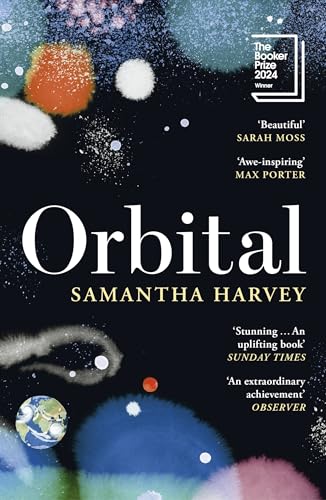
Before the meeting: We picked this book as our next title the day before it won the Booker Prize. Smart us!
Four men and two women on a space station orbit the Earth sixteen times in twenty-four hours. They eat, they monitor experiments with plants and mice, they do strenuous exercise to counteract the bodily effects of living in low-gravity, they maintain their environment and monitor their own vital signs, they report back to ground control, they exchange messages and images with their loved ones at home, they occasionally have weirdly unreal conversations with complete strangers on Earth, and they look out with wonder at the planet below them and at the vastness of space.
That’s the plot.
A writer less sure of herself might have developed a plot where the relationships among the travellers create conflict or titillation. There would be plenty of possibilities in the crew consisting of two Russian men, an Irish woman, a Japanese woman, a Christian man from the USA, and a Latino man with connections in the Philippines. But the subject of this novel is the humans’ relationship to the planet, and beyond that to the universe, from a perspective that makes the conflicts that dominate human life in general seem absurd.
At the front of the book there’s a diagram showing the pathway of the spacecraft’s orbit over the day. The craft flies / falls in a straight line, but the rotation of the planet beneath it means that it crisscrosses the land and ocean below. I kept flipping back to the diagram as chapter by chapter, one for each of the sixteen Earth orbits in the day, describes in lyrical language what can be seen below.
This book is ideal for my blogging practice of singling out a particular page, currently page 77, because though there is a narrative of sorts it’s not the kind that means one has to be wary about spoilers. Part of what makes this book a worthy winner of the Booker is its brilliance at the sentence level.
Page 77 is in the chapter ‘Orbit 8, ascending’. Though the craft is over the south-west of the USA, the narrative departs, as it does occasionally, from what lies below to describe what is happening on the other side of the planet:
Over there, in tomorrow, the typhoon summons winds of a hundred and eighty miles per hour. It’s rampaging through the Mariana Islands. The sea levels off the islands’ coasts have already risen with the expansion of the warmer water, and now, where the winds push the sea toward the westward edges of its basin, the sea rises more and a five-metre storm surge engulfs the inlands of Tinian and Saipan. It’s as though the islands are hit with cluster bombs – windows blown out, walls buckling, furniture flying, trees splicing.
There follows a little more description of the typhoon from a meteorological perspective. Its growth is the book’s one central narrative thread. In later chapters, the crew see it as spectacle – contrasted with the terrifying reality on land, especially as it affects a poor family who once offered hospitality to one of them.
But for now, the daily routine asserts itself:
The crew go on with the last of their tasks. Anton eats an energy bar to fight off late afternoon drowsiness. Shaun removes the four fasteners on the bracket of the smoke detector that needs replacing. Chie inspects the bacteria filters. Their path now ups and overs and exits America where the Atlantic is ancient, the placid silver-grey of a dug-up brooch. Calm suffuses this hemisphere. And with no ceremony they complete another lap of the lonely planet. They top out some three hundred miles off the Irish coast.
And then there’s this:
ln passing through the lab, Nell looks out and sees the promise of Europe on the watery horizon. She feels somehow speechless. Speechless at the fact of her loved ones being down there on that stately and resplendent sphere, as if she’s just discovered they’ve been living all along in the palace of a king or queen. People live there, she thinks. I live there. This seems improbable to her today.
This intermingling of more or less objective observations of the Earth as seen from orbit, the daily routines of life in the space station, moments of lyrical reflection is maintained, with miraculous poise, through the whole book.
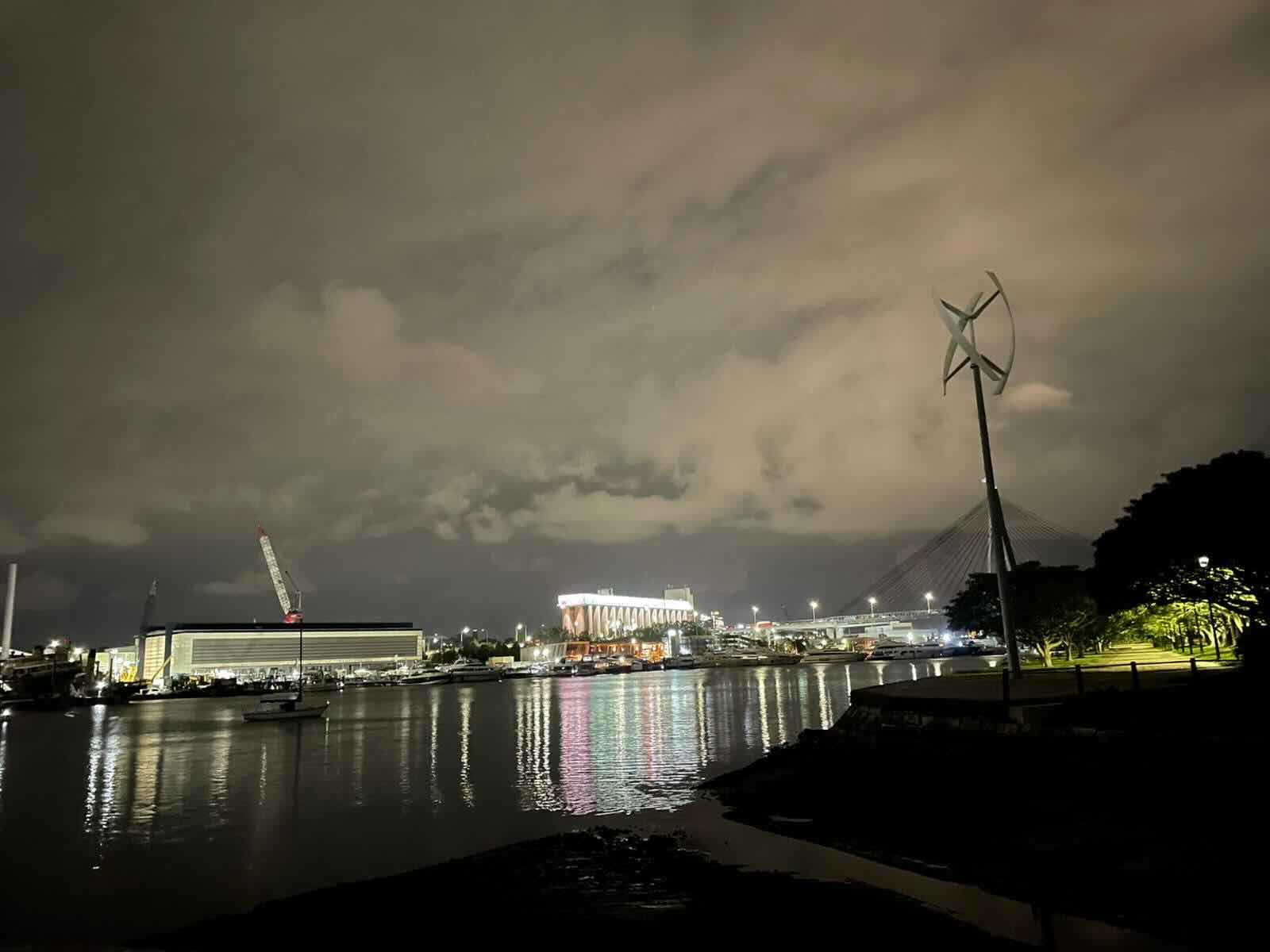
The meeting: We’ve been calling our bring-a-plate meetings gentlemen’s picnics. This one was an actual picnic, in Bicentennial Park on the shores of Blackwattle Bay, Gadigal land. Pavlova, quiche, dumplings, barbecued sausages eaten to a backdrop of birdsong and practising dragon boats beneath a three-quarter moon. We were interrupted briefly by what seemed to be a gay bashing – eight men of certain ages tried to look imposing as we lumbered towards the scene, but it seemed to vanish before we reached it. We conferred with a couple of men who were dossing down in the Esther Abrahams pavilion, and with a cluster of hefty teenage boys, and decided there was nothing further any of us could do.
It was our final meeting for the year, so we swapped gift-wrapped books (I scored a Zadie Smith) and most of us read a poem: David Malouf, Robert Frost, me and John Levy (it was unclear whether I’d broken a rule by reading one of my own, but it was excused because my poem was there to illuminate John’s), Brecht, James Baldwin.
In the middle of this mostly joyous occasion, we managed to talk about the book. The first thing said could have been a paraphrase of my fourth paragraph above: what a relief that Samantha Harvey didn’t go down the track of having big conflicts among the crew. My sense is that everyone enjoyed the book a lot.
We reminded each other of ‘good bits’: the lab mice learning to live in low gravity, the tear drop that has to be caught and disposed of because free-floating liquid can’t be tolerated, the nose pressed against a stomach as two characters squeeze past each other … Someone mentioned what should have been obvious: though the crew sees sixteen sunrises, they all happen on the same day – I took that in my stride while reading the book, but when it’s put like that it leaves me gasping.
One person found a lot of the book tedious and repetitive, but later, driving in the car, he realised that the repetition was partly the point, these people were caught in a continuous loop.
The closest we came to disagreement was when someone said the absence of ordinary, everyday irritations and conflicts among the crew strained his credulity. In real life, people living together in such close quarters would inevitably grate on each other at best. Two arguments were offered to counter this view. First, on the level of verisimilitude, the crew are disciplined – they can live with an itch in a space suit for hours without scratching, surely they can put personal irritations aside. Second, yes it’s unrealistic, but to pay attention to such matters would have cluttered the book or even taken it to a different, less interesting place. (One of us has spent some months in a hut in the Antarctic, so could vouch for the likelihood of conflict – though he was the one who argued most strongly that these are disciplined space travellers.)
My Book Group met this week to discuss Kairos, Jenny Erpenbeck’s novelset in East Berlin in the lead up to the fall of the Berlin Wall. I blogged about the book when I read it for my Book Club – link here – so I won’t repeat myself.
It was a terrific evening. Once we’d eaten we had a slide show of one chap’s recent trip to Germany. This led to a shared moment of reflection about what it must have meant for East Germans to be taken over by the West in ‘Unification’.
Having edged up on the book in that way, we then encountered what someone later on WhatsApp called a hurricane. The book has inspired one of us to unmitigated rage. It was an insult to older men, he said, hackneyed, mean spirited and at key moments completely implausible.
No one disagreed with his substantive points, though no one quite shared his rage. Some had been unable to finish the book. Some, me included, found the account of East–West relations in 1980s Germany interestingly nuanced, though oddly unrelated to the central story of a toxic sexual relationship.
Then we had birthday cake for the youngest man present.
It was, as someone said in WhatsApp later, a classic book club conversation. Which gave me my first line.
Verse 7: A classic book club conversation
A classic book club conversation –
classic chat, not classic book.
We're not averse to Tolstoy, Austen.
Nobel winners get a look,
but we choose trash as well as treasures,
low as well as highbrow pleasures.
We've read comics, Sci-Fi, crime,
and don't pick winners every time.
It’s our collaborative readings
makes the conversation soar.
A dozen lenses brought to bear
light up a text, set fire to endings.
We disagree but seldom fight,
and when there's heat there’s always light.




 Me fail? I fly!