Category Archives: Book Group

The Book Group and Peter Temple’s Truth

Peter Temple, Truth (Text Publishing 2009)
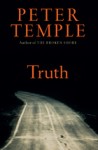
The Book Group decided we wanted a page turner for this meeting, and a couple of people were keen on Peter Temple’s Truth, the second of his detective novels. So Truth it was. Attempts to get it from the library made it pretty clear that other people were keen on it as well, and at least one of us, it turned out, had to go to the airport to buy a copy.

Here’s the first sentence:

On the Westgate Bridge, behind them a flat in Altona, a dead woman, a girl really, dirty hair, dyed red, pale roots, she was stabbed too many times to count, stomach, chest, back, face.

It takes a bit of work to figure out the internal relationships in this congeries of phrases. You may go down dead ends in which the flat in Altona is on the Westgate Bridge, or the girl was stabbed too many times to stomach, but once you’ve done the work the meaning is unambiguous:

[They were] on the Westgate Bridge. Behind them [in] a flat in Altona [was] a dead woman, a girl really, [her] dirty hair dyed red [with] pale roots[.] She was stabbed too many times to count, [in the] stomach, [the] chest, [the] back, [the] face.

In effect, then, the sentence gives fair warning that this won’t be a lazy read – there will be many sentences requiring at least a little backtracking if their meaning is to be extracted. But the difficulty is not arbitrary, representing as it does a particular laconic spoken English, the kind spoken by almost all the male characters and one or two of the females. The sentence also gives fair warning, amplified by the reference a couple of paragraphs later to the 1970 collapse of the Westgate bridge, that non-Melburnians and people who don’t know their Melbourne may have extra work to do in the comprehension stakes.

Having said that, Peter Temple’s Villani belongs to that distinguished international fraternity of ageing homicide detectives committed to bringing criminals to justice, at odds with their superiors, and in trouble with what’s left of their families: Rebus, Montalbano, Zen, Wallander, and now Villani, with his own distinctive line in introspective self-blame and self-criticism beneath a hardboiled surface, his own reluctant corruption. I enjoyed the book, much as I enjoy very good TV detective shows – I’d place it at the level of Silent Witness or NYPD Blue rather than up there with The Wire. On the whole, though, I think I prefer my television on the screen rather than in novel form, even when it’s as well written as this unarguably is.

My main difficulty was related to elliptical language. Not that it was difficult, because the difficulty, such as it was, was fun. But the speech patterns of most of the male characters tended to be indistinguishable from each other, so the characters themselves tended to blur. This didn’t matter very much until the perpetrators of the various crimes were revealed and the effect (for me at least) wasn’t much more specific than: ‘One of the characters did this crime, another did that one, and their reasons had to do with revenge or corruption or something of the sort.’ I’m happy to report that there was plenty to hold my interest on the way to that unsatisfactory destination: Villani’s relationships with his wife, his daughters, his father and brothers are as complex as anyone could wish – and if it wasn’t for the demands of the policier genre they might have been fleshed out to become fully three-dimensional; the language is full of delights as well as provocations; there are plenty of richly detailed observations of street life and the life of the mind (‘These thoughts had begun to come to Villani in the small moments of his life – at the traffic lights, in the haunted space before sleep, in the wet womb of the shower’ is a nice instance).

Just as I finished reading the book the long list for the Miles Franklin Award was announced. I’ll be surprised if Truth wins the award, but I haven’t read any of the other contenders.

I wrote the preceding paragraphs before the group met last night. There were only four of us. I don’t think it was lack of enthusiasm for the book that brought the numbers down – one man had a lecture, another’s plane from Brisbane was late, and so on. We had a pleasant discussion, mainly swapping Bits We’d Liked – one guy had jotted down clever bits of dialogue, and often as not someone else would be able to say what the next line was. We agreed there were longueurs. We agreed that it was a fine bit of genre writing (more confined by the requirements of genre than Shane Maloney’s novels, one guy thought). We reflected that none of us saw Melbourne as quite as grim as the book, though one guy told us of a Sydney experience involving four big policemen running onto the street in front of his car and pointing guns at the driver of the car next to him. We resonated with the awkwardness of the male characters in attempting to give and receive whatever it is one gives and receives in moments of great pain (though as I write that, I realise that I appreciated those moments cerebrally rather than responding to them emotionally).

And we talked about Djan Djan, Reinventing Knowledge, Mawson’s huts, the excellent food, how a career as an assistant director in the movies affects one’s reading habits, regulations for backyard ponds, etc etc etc.
My Book Group Is Illuminated

Jonathan Safran Foer, Everything Is Illuminated (2002, Penguin Australia 2008)

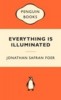
I read five pages of this when it was freshly published, and decided it was not for me. It’s rare for me to dismiss a book like that, so I dipped ahead reading a page here, a page there, and found absolutely nothing to change my mind. Then at the December meeting of my Book Group, a number of people were keen to put it on our agenda, and they won the day. So, eventually, I bought a cheap copy (all the libraries’ copies were out) and set to work. By the time the group met last night, I’d finished it, though I did skim the last 20 pages so I’d have time to cook the dinner. There are some very strong bits, as it turns out to be a story of a small Ukrainian village whose entire Jewish population was murdered by German soldiers, counterpointed by a ludic tale of the Jonathan Safran Foer’s forebears’ lives in that village.  I can see why the book received such acclaim, but pretty much the first half is taken up with ha-ha-I’m-being-funny humour and an awful lot of the shtetl story that felt contrived, inconsistent and disrespectful, like Isaaac Bashevis Singer off the rails; the thesaurus-driven voice of the Ukrainian Alex, who narrates the modern-day quest for the village, eventually toned down as it got to the point, but by that time I had endured too much that was weary, stale, flat and unprofitable. My moment-by-moment irritation robbed the narrative of almost all momentum. In the hope that mine was a minority response, I came to the group resolved to listen and learn.

The book found no stout defenders among us. Roughly half hadn’t managed more than 20 pages or so. The man who’d liked it most – we think he was the one who proposed it – had seen and enjoyed the film, and admitted that when he read the book he skimmed the bits that weren’t in the film, which meant all the shtetl stories, all the clever literary bits (some would say these were darlings that should have been murdered), and the worst excesses of the mangled-English narration.

The reason we’d chosen this book is that we wanted to see how it went if we watched a movie of the book under discussion. So after dinner we watched Liev Schreiber’s Everything Is Illuminated. All O knew of the movie beforehand was from glimpses seen in Operation Filmmaker, the achingly funny documentary about an Iraqi intern on the shoot, in which Liev Shreiber and others came across as humane, generous and admirable people who clearly believed in their project. I don’t know that I liked the film all that much: the Elijah Wood character (‘Jonathan Safran Foer’) was too weird, and there were some awful saggy bits. It was fascinating to watch it so soon after reading the book. The ancestral story – roughly half the book – was sheared off. The second of the two revelations at the end was replaced with something much less interesting, less morally complex. A climactic action that almost made sense in the book made no sense at all in the film. And the upbeat ending was despair-inducing. Paradoxically, the film made me appreciate the book much more.

A pleasant evening was had by all, even the two dogs, who managed to bully someone into throwing a ball for them more than once. Next month, not Franny and Zooey or Arctic Dreams or The History of Knowledge or Wildlife, but Peter Temple’s Truth. We wanted a page-turner.

The Book Group’s Revenge of the Lawn

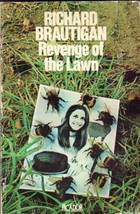
Richard Brautigan, Revenge of the Lawn (1972, Picador 1974 – with British spelling!)

BrautiganA Book Group member was given a copy of this book by his son, and thought it would be a good quick read for our December meeting, when there are so many competing demands on our time. None of the nearby libraries had copies, and I may have got the last one listed in Australia at AbeBooks. Other members of the Group made do with PDFs. So I was feeling pleased with myself when I opened my slightly stained book, formerly the possession of one Kerry Thomson. That pleasure had pretty much evaporated 50 pages later. It was only corps d’esprit that kept me going: if David and Keith had persevered with the Coetzee book in spite of finding nothing there to interest or please them, surely I could hack another hundred or so pages of underdeveloped twaddle – reminiscence, dream fragments, quirky observations – snapped up by a publisher confident it would sell on the coattails of Trout Fishing in America, published about a decade earlier. That was my state of mind after reading 12 of the book’s 62 pieces.

Things improved at about page 60. It was probably the piercing nostalgia for childhood games in ‘The Ghost Children of Tacoma’ that dispelled my irritated boredom. After that, I was drawn in mainly by pieces capturing (or perhaps re-imagining) moments from his childhood: ‘Blackberry Motorist’, in which he discovers an abandoned car under a high tangle of blackberries; ‘The Post Offices of Eastern Oregon’, a kind of Lake Wobegon horror story; ‘One Afternoon in 1939’, in which he tells a story his little daughter loves to hear, and ends beautifully, ‘I think she uses this story as a Christopher Columbus door to the discovery of her father when he was a child and her contemporary’; ‘A Complete History of German and Japan’, which would be great without the nudging of the terrible title.

After another 50 pages or so, the whimsical observations of life in San Francisco bars, buses, streets, bedrooms and bookshops became the dominant mode, and I lost interest again.

I came across a thoroughgoing web site devoted to all things Brautigan, and found a page giving the place of first publication of these stories. A good number first appeared in Rolling Stone and I’m sure they sat comfortably with the dope and psychedelia of its pages. Mostly they haven’t travelled well. And I haven’t even mentioned the casual sexism.
—–
I wrote that a couple of weeks ago when I’d just read the book. Tonight the Group met, at a very expensive Japanese restaurant, where we managed to have an interesting conversation about the book before ranging off in a hundred other directions. There was genral agreement that the quality was patchy, but my impression is that other people enjoyed the book as a whole much more than I did. One guy had read it in the 70s, so this reading was partly an exercise in nostalgia. The frequent quirky similes, which irritated me, gave delight to others. One comment was that the prose generally left a lot of room for the reader to fill out the picture, in contrast to a lot of recent writing that corrals your response leaving you nowhere to go but where the writer decides. I didn’t understand what he meant until he said that the reading made him think back to his own childhood – and I realised that for me that was a good part of the childhood stories’ the appeal: some of them, at least, triggered a mood of reminiscence, of reflection on my own childhood with a kind of openness to wonder. And of course it was worth ploughing through a fair amount of unaffecting stuff to have that.

Summertime, Boyhood and the book group

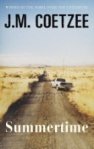
J M Koetzee, Summertime (Knopf 2009)
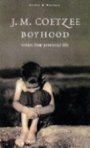
—-, Boyhood (Secker & Warburg 1997)

I wasn’t there when Summertime was chosen for the Book Group1846553180, and might well have argued against it. I’d read some bemused discussion about its mixing of truth and fiction and multiple perspectives that made it sound like the kind of clever writing that disappears up its own whatsit – you know, technically challenging but otherwise as gripping as batshit.

It turned out I loved it, and put in orders at the library for the two previous volumes in Coetzee’s Scenes from Provincial Life series, Boyhood and Youth. It’s autobiographical writing, covering the years when Coetzee was teaching at school and university in Cape Town and writing his first novels. It’s not straightforward autobiography, though. The John Coetzee character is dead, so who knows in what other respects the narrative here differs from the factual record? The book consists mainly of transcripts of recorded conversations between an (almost certainly invented) academic biographer and a handful of people. I have no idea what relationship any of the interviewees have to actual people, but I am persuaded that there’s a genuine project here on Coetzee’s part of imagining how he was seen by a number of key people in his life at that time. ‘Coetzee’ doesn’t exactly emerge covered in glory. In fact, if this had been told in straightforward narrative, even in third person, some of it would have been cringingly embarrassing; and some of it, removed from the realm of hints and suspicions, might have laid the author open to criminal investigation. Coming mainly from women who had, or in one case (if she is to be believed) didn’t have, sexual liaisons with him, it’s funny, and for me at least very engaging. I’m in awe of Coetzee’s feat of creating self-portrait from the point of view of people he’d had unsatisfactory intimate relationships with, most of them much more interested in themselves than in him. It’s an act of great imagination and unsparing self scrutiny.

BoyhoodAt the risk of appearing excessively diligent, I managed to read Boyhood before the Group met. At least on the surface, it’s a much more conventional piece of work, a possibly fictionalised memoir of the author’s childhood told in the third person. (We don’t learn that the boy’s name is John until about the halfway point.) Unlike the unreliable interviewees of Summertime, the narrator appears to be omniscient, though he reports the young John’s understanding of things without signalling to the reader when the boy has got it wrong. This sometimes results in a straightforward irony, as in matters of reproductive physiology. Elsewhere, as the boy struggles to make sense of his relationships to his parents, of the English, the Afrikaans, the Coloureds and the Africans, of South African history, of religion and his own preadolescent stirrings, the narrator leaves us alone with the boy’s painful sense of his own peculiarity. The effect, for me at least, rang very true to what childhood is like, stripped of the gloss of nostalgia and self-preserving sentiment. An unexpected bonus from having read the book out of order was the poignant discovery that the father for whom ‘John’ cares in Summertime was an object of his contempt and intense dislike in Boyhood.

Tonight we discussed Summertime in the book group. There were ten of us, fairly evenly divided between those who loved the book and those for whom it did nothing except perhaps induce sleep. A couple of guys turned up with their books bristling with sticky yellow papers, and argued for particular ways of reading the book. Over melon and prosciutto and then strawberries, the conversation tended to take the form of them what enjoyed the book telling them what didn’t about what had given them pleasure or illumination. One man talked about the theme of embodiment – that the struggle of the character was to find a way of being in the body, of having a voice, and the structure with its multiple filters and distancing devices fitted the theme brilliantly. Another read it as an extended build-up to the passage towards the end where a woman says of the John Coetzee character that people may be interested in him because he’s won the Nobel Prize and is seen as a brilliant writer, but to her he is just a man, and not a very interesting one (though others saw that passage as a bit of almost mechanical rounding out of things). Yet another was interested in it as a portrait of a man whose masculinity was under attack. And so on. It was a terrific evening; the book is perfect for that kind of free-ranging discussion.

Landscape of Farewell

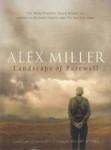
Alex Miller, Landscape of Farewell (Allen & Unwin 2007)

It pains me to say it, but the best thing about this book as far as I am concerned is that it’s short. I read it in a day.

In the first couple of pages, it seemed to hit wrong note after wrong note. Just two examples, tiny in themselves, but part of a cumulative effect that left me simply not believing in the characters: an elderly German professor, meditating on the notion of honour, remembers that somewhere in the bible, probably in the New Testament, we are told to honour our father and our mother; a young Australian History professor asks that same man what his father did in the war, and when he reacts with shock says it was just a piece of Australian humour. Just what planet do you have to be an academic on not to know the Ten Commandments, or that Germans of a certain age might not like to be asked by complete strangers about their family’s relationship to Nazism.

In spite of encountering some fine prose and being invited to confront difficult realities, I never recovered from the blow my trust received in those first pages. The book’s centrepiece is a powerful account of a meticulously planned massacre of white settlers in North Queensland by Aboriginal men in reprisal for the unwitting violation of a sacred site. Everything else seems to be there to justify this piece of writing. It didn’t work for this little white duck. I was left with an uneasy feeling that some kind of equivalence was being proposed between the Aboriginal action and unnamed actions taken by German operatives during the Second World War. I’m sorry, but my response, in a word, is ‘Ewww!’

My Book Group is to discuss this book at our next meeting. Since the meeting is on the evening of the day I get home from a month in France, I may not make it. If I do, I’ll let you know what other people thought.

The train has left the station

Leo Tolstoy, Anna Karenin (1873-1877, translated by Rosemary Edmonds 1957, 1978)

anna002 What with cleaning the house, travel, conference, broken computer and jet lag, this has taken me longer to read than it normally would have. It’s wonderful wonderful – funny, confronting, deeply instructive. At times I felt as if Tolstoy wrote the book to explain the society of his time to readers who wouldn’t be born for at least 70 years (the situation of women, the conditions of the peasants …). I knew in advance that this was a book about a woman who throws herself under a train, and expected it to have a bit of A Doll’s House about it. I didn’t expect it to have elements of P G Wodehouse twittiness at one extreme and almost Joycean internal monologue at another. And is there a bit of proto-Wittgenstein (‘Whereof one cannot speak, thereof one must remain silent’ ) in Levin’s decision to renounce argument in the last chapter? And how about those similes! (Just in case you’re reading this and haven’t read the book: maybe half a dozen times, at intense moments in the narrative, a character’s mental state is explained through a simile, and each time it’s just brilliant.)

Why didn’t anyone tell me? I may have to set aside time for War and Peace sooner than I’d planned. (I’ve been told I should have read it first, because it’s not as grim. Oh well …)

Middle aged men talk about Anna K

anna002Last night my men’s group book group met to talk about Anna Karenina (Anna Karenin, as she’s called in the second hand copy I bought on Monday), and an excellent evening it was. We had Russian-themed food, largely bought from the venerable Cyril’s delicatessen, and unlike other books this one had us talking from the moment we arrived until suddenly, after a couple of hours, we moved on to fierce debate about what to read next.

Having been distracted by Other Things, I’d only managed to read a little more than 100 pages. But that didn’t stop me from joining in. In fact, as people talked about their favourite bits, I was able to remind them that almost all of those bits were foreshadowed in the early chapters. Another guy, who’d grown a Leninesque beard for the occasion, had read about half as much as I had (pushing out hairs on the chin clearly saps the reading power). Undeterred, he became a technical consultant for the evening, reading passages of exegesis or commentary from the essays up the back of the uni library copy someone had brought: why an adulterous woman in Russia at that time would lose her children, Tolstoy’s quasi-pointilliste method (not at all the mimesis it first seems – and we did have to chat a little about that word mimesis), the way Levin and Anna were two quite different ways of seeking, um, transcendence …

Sadly, if the way Anna dies hadn’t been the one thing I knew for sure about the book, it would certainly have been spoiled for me. No one bothered, in the manner of Mark Kermode discussing the latest Harry Potter, to refer to ‘the unhappy event’. I guess Anna’s suicide isn’t the big surprise that  Dumbledore’s death is.

What a wonderful book! As someone said, it’s a page-turner, yet it had us talking about spirituality, sexism, the industrial revolution, deep moral dilemmas, the uses of fiction, Tolstoy’s journey, the fascinating architecture of the book, excellent university moments from bygone days (two people remembered with awe Peter Shrubb‘s lecture on the first paragraph of Emma), the perils of translation (three translations in the room, three versions of the famous opening sentence) and much more. ‘I don’t read classics,’ one man said, ‘I don’t want to read stuff that someone thinks is good for me – but this was terrific.’ Now I’ve got a week to finish it.

Erotica: the morning after

Having done a “before” post, I now feel obliged to do an “after”.

As it turned out we were all white, middle-aged, heterosexual and in long-term relationships. No one had much interest in discussing Anaïs Nin – most hadn’t been interested enough in Delta of Venus to read the whole thing, though one chap had read a second, similar collection of her dollar-a-page pieces, and another had read some of her diaries. Someone went to the trouble of saying he found some of it offensive. We decided she belonged to another era, and moved on. (Is there something of hers that you, dear reader, would recommend?)

It turned out that if I am timidly vanilla in my taste for erotica I was in a room of similarly minded souls. I did read the Kathryn Lomer poem, and people liked it. One of our number had assiduously ransacked his memory, the web (by googling “erotic poetry”) and the bookshelves at an auction down the road, and shared some gems he’s found. He read us a steamy encounter between Elizabeth Bennett and Darcy in Pride and Promiscuity : The Lost Sex Scenes of Jane Austen – we agreed that that’s probably a perfect read-aloud book for consenting adults. He played recordings of two marvellous poems, one from ancient Egypt and another incorporating a Native American story about a winged penis. He read, with some apologies, Charles Bukowski’s “Like a Flower in the Rain” (warning, that link includes anatomically correct four-letter words), in which one can only marvel at how one word can transform a poem. Someone mentioned the bath scene in The Reader. We talked a little about the early scenes in Silk.

We kept asking each other what makes something erotic rather than pornographic. Clearly our collective taste veered to the non-pornographic end of erotica. We agreed we like our erotica with a bit of wit, a lack of emphasis on the plumbing (though no aversion to it being named), a context, and a sense of minds being engaged.

Next meeting, Anna Karenina.

Erotica

Anaïs Nin, A Spy in the House of Love (©1954, Penguin 2001)
—-, Delta of Venus (©1969, Penguin 1978)
Alessandro Baricco, Silk (translated by Guido Waldman, The Harvill Press 1997)

Tonight at my book group (this is the all male one) we turn our collective attention to erotica. (Welcome everyone who found this entry via a google search.) A number of us had heard of Anaïs Nin, so we decided to go with a couple of her books, though there was an invitation to bring along a passage to read aloud from anywhere else. I’m posting this before the meeting.

810Of A Spy in the House of Love, the less said by me the better: not so much erotica as neurotica. The long, ecstatic paragraph near the start that ended ‘but only that one ritual, a joyous, joyous, joyous impaling of woman on a man’s sensual mast’ had me thinking that if that was erotica I’d happily do without it. Thankfully there were no recurrences.

Maybe I’m showing my age, but I can’t say I warmed to Delta of Venus, either, 0140184708which had lots of impaling. The most interesting thing about the book is probably the introductory pages, excerpts from Anaïs Nin’s 1940 diaries describing the way she and a swathe of her literary friends churned out erotica for a mysterious ‘Collector’ for a dollar a page.

Back in 1970 or so, there was a lot of anti-censorship activity in Sydney, including the publication of pornographic editions of student newspapers and “Porn Fests”, at which distinguished academics and undistinguished enthusiasts read rude bits from Henry Miller, Sam Shepard, John Wilmot second earl of Rochester, the Marquis de Sade and so on to crowded lecture theatres. It was all in a good cause – blows struck in the struggle for free speech – and some of it was funny, but overall it was squirm-making. Delta of Venus seems to me to belong in that context: it does contain some characters and narrative, but the ‘dirty bits’ are its raison d’être. Already dated in 1976 when Anaïs Nin decided to publish it, it reads as totally quaint now, quaint and vicious in its playing with paedophilia, incest, rape and so on. However, I did read it from cover to cover, so it clearly has titillation value. What I’ve realised is that if writing is to work as erotica for me, it needs to arise from a complex, recognisably human reality. Maybe we should have agreed to read Anaïs Nin’s diaries, where presumably she talks about more than who is doing what to whom with what.

1860462588I went to the theatre on Sunday with another group member, who was similarly unenthused by the Anaïs Nin books. Someone had recommended Silk to him, and he lent it to me with his recommendation. It’s a very short book, something of a fable about love and passion. Most of it is taken up with a slow-building sexual charge. Then there are a couple of explicit, erotic pages – which work because they’ve had 80 pages of build-up. Then the tale ends with a bitter-sweet twist that makes one want to re-read the erotic pages again …

At the moment I’m tossing up what read-aloud to take tonight: A D Hope’s ‘The Countess of Pembroke’s Dream’ perhaps, or Kathryn Lomer’s ‘Tentative love poem’, which begins:

Snow comes late; only the air
between our mouths is warm,
a microclimate in which whispered words
are storms building. Our skins catch

what little light is cast – mine reflects,
yours absorbs.