Category Archives: Page 7x/47/7

Marian Wilkinson vs Woodside vs the Planet

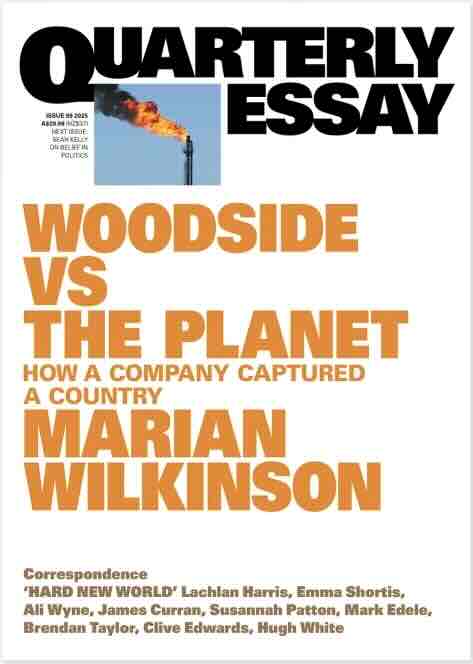
Marian Wilkinson, Woodside vs the Planet: How a Company Captured a Country (Quarterly Essay 99, 2025)
– plus correspondence in Quarterly Essay 100

Marian Wilkinson has a formidable CV as an investigative reporter. This substantial survey of the politics around the activities of Woodside Energy adds one more jewel to her crown.

The essay’s title and subtitle provide an excellent summary. Expanding it slightly: Woodside is expanding its gas extraction and export activities in a way that will contribute to global warming to an alarmingly dangerous extent, and they have gained the wholehearted support for this from successive Western Australian governments and Australian federal governments.

Three things aren’t included in that summary: first, the well organised, courageous and well informed opposition movement; second, the potentially disastrous impact of Woodside’s current and expanding activity on ancient petroglyphs on the Burrup Peninsula in Western Australia; third, the fact that fossil fuel industries have a limited life ahead of them.

A couple of years ago I visited the standing stones near Évora in Portugal. Our guide said that if the stones were in Spain they would be treated as a national treasure, but in Portugal they remained virtually unprotected in someone’s field. Well, if they were in Australia, and tens of thousands of years older, with infinitely more to tell us about human history, they would be left exposed to whatever pollution fallout might be created by a major industrial site nearby while scientists employed by the responsible corporation argued that there isn’t sufficient evidence of harm.

Marian Wilkinson is a journalist, not an advocate. But she is not in thrall to that concept of balance where you present any situation as a debate between two points of view, with no fact-checking or conclusion. Among the many people she interviewed for the essay is Meg O’Neill, CEO of Woodside, whom she quotes as saying that gas produces less greenhouse effect than coal, and that some gas is necessary as the world transitions to renewable sources of energy. But she doesn’t leave that as one equal side of an argument for and against. What emerges is an understanding that yes, gas will play a role in the transition to renewables, but Woodside and its supporters (or possibly dupes) in government and the media massively overstate how much gas will be needed. The profit motive overrides any concern for the common good.

I came to the essay with a heavy heart. In my mind Woodside was already a climate villain, Western Australia was a state that had been captured by the fossil fuel industry (or was even a virtual branch of it), and Woodside’s impact on the petroglyphs of the Burrup Peninsula was a slow-motion version of the blowing up of the Juukan Gorge by Rio Tinto. Nothing in the essay made me change my mind. Instead, it put paid to my lingering hope that the Albanese Labor government would make use of its large majority to face down the mining companies and their allies in the press. And it gave me a much greater understanding of what Wilkinson calls ‘the disruptors’: Disrupt Burrup Hub activists, some Indigenous traditional owners, and more.

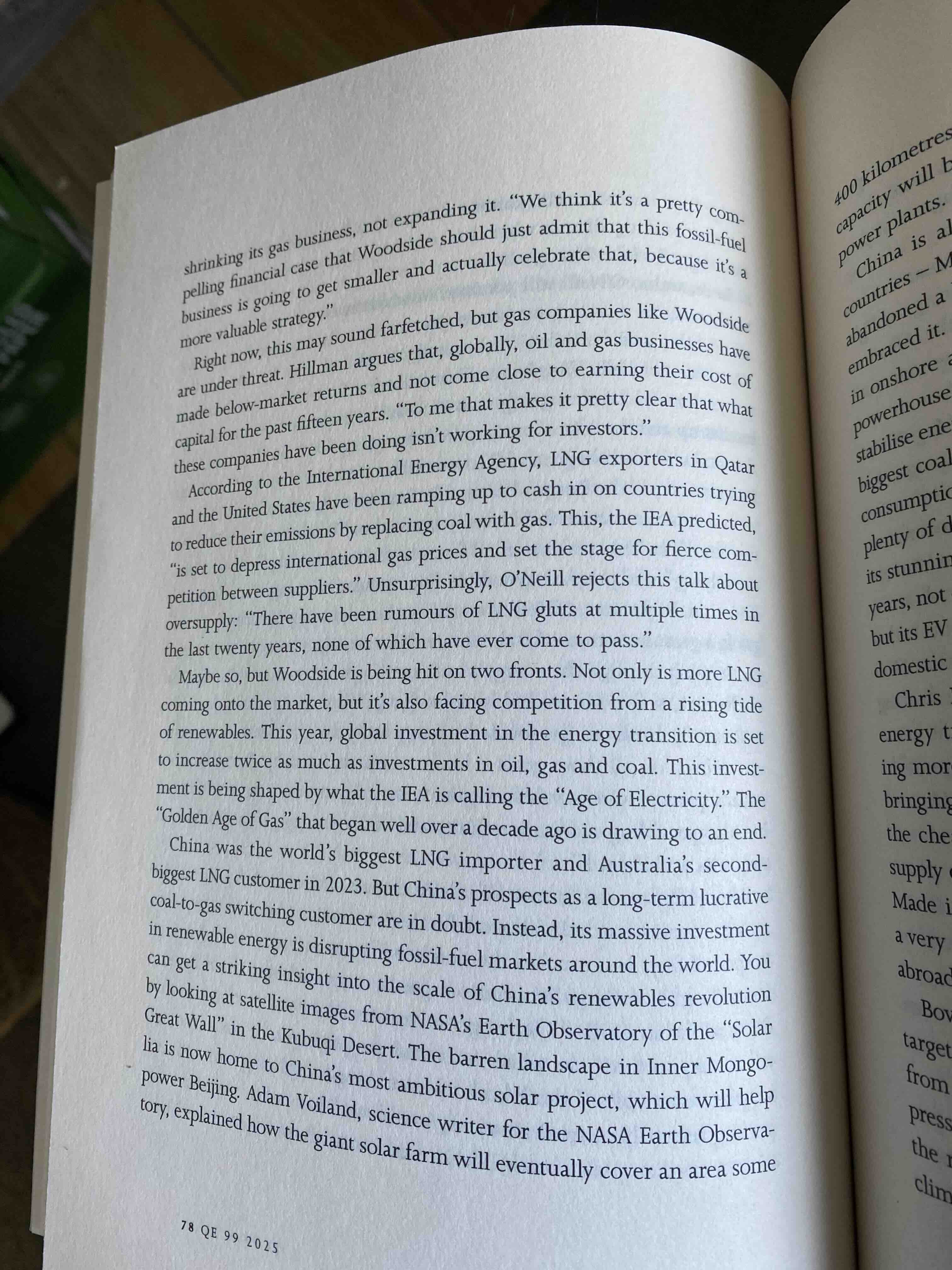
Page 78* is in the eighth and final section of the essay. Earlier sections have dealt with Meg O’Neill’s career, the growth of Woodside, the way Woodside has come to have such tremendous influence on government policy, the disruptors, the struggle over the petroglyphs, and the vision of ‘gas-fired futures’ shared by Woodside and governments. This final section – ‘Woodside in the Age of Accountability’ – introduces an element of hope, and urgency. It lists the tangible results of global warming so far, and quotes eminent scientists as saying that ‘the next three years will be crucial in stopping this seemingly inexorable rising of emissions’. On page 78, the full absurdity of Woodside’s favoured activities come to light:

[Alex Hillman, former Woodside climate adviser turned shareholder activist] said Woodside needs to think about shrinking its gas business, not expanding it. ‘We think it’s a pretty compelling financial case that Woodside should just admit that this fossil-fuel business is going to get smaller and actually celebrate that, because it’s a more valuable strategy.’
 Right now, this may sound farfetched, but gas companies like Woodside are under threat. Hillman argues that, globally, oil and gas businesses have made below-market returns and not come close to earning their cost of capital for the past fifteen years. ‘To me that makes it pretty clear that what these companies have been doing isn’t working for investors.’

So even from a purely capitalist perspective, Woodside’s expansion makes no sense. The fact that now the Trump administration is backing a huge Woodside project in mainland USA, as the essay mentions, only underlines that point. Short term gain, long term disaster all round.

Woodside is being hit on two fronts. Not only is more LNG [liquefied natural gas] coming onto the market, but it’s also facing competition from a rising tide of renewables. This year, global investment in the energy transition is set to increase twice as much as investments in oil, gas and coal. This investment is being shaped by what the IEA [International Energy Agency] is calling the ‘Age of Electricity’. The ‘Golden Age of Gas’ that began well over a decade ago is drawing to an end.
China was the world’s biggest LNG importer and Australia’s second-biggest LNG customer in 2023. But China’s prospects as a long-term lucrative coal-to-gas switching customer are in doubt. Instead, its massive investment in renewable energy is disrupting fossil-fuel markets around the world. You can get a striking insight into the scale of China’s renewables revolution by looking at satellite images from NASA’s Earth Observatory of the ‘Solar Great Wall’ in the Kubuqi Desert.

But CEO Meg O’Nell sticks to her guns.


Correspondence in Quarterly Essay 100 (The Good Fight by Sean Kelly) mostly reinforces Wilkinson’s argument. The world is not decarbonising fast enough to avoid dire consequences. Woodside’ activities aren’t helping. Peter Garrett discusses the politics. David Ritter focuses on Scott Reef, an extraordinary marine habitat that is under threat. Shane Watson and Kate Wylie from Doctors for the Environmental Australia describe the difficulties of appealing to existing laws to defend the environment.

Wilkinson says in her response to correspondents that ‘the gulf in thinking between the fossil-fuel industry and the climate movement in Australia was as wide as ever’. I had a brief moment of hope for a robust debate between these two perspectives when I saw that there was a contribution from Glen Gill whose bio says he ‘has over forty years of global experience in the petroleum and electricity industries, including in technical, commercial, regulatory and pubic policy areas’. Sadly, Gill manages to shout a lot. His first paragraphs refer to ‘wild, uninformed statements from activists’, describe the essay as ‘ridiculous’, ‘misleading’ and full of ‘fear, ignorance and hatred’. Marian Wilkinson doesn’t really bother to engage, except to say that the science he claims to rely on is ‘alas not climate science’.

Things are crook, but I’m glad there are people like Marian Wilkinson who are willing to look steadily around them and communicate what they see in clear, uncompromising prose.


I wrote the blog post on the land of Gadigal and Wangal of the Eora Nation. I acknowledge Elders past and present, and welcome any First Nations readers.


My blogging practice is to focus on the page that coincides with my age, currently 78.
The Melancholy of Resistance at the Book Group

László Krasznahorkai, The Melancholy of Resistance (1989, translated by George Szirtes, published by Tuskar Rocks Press 2000)

Before the meeting: László Krasznahorkai won the 2025 Nobel Prize in Literature. The Melancholy of Resistance (Hungarian title Az ellenállás melankóliája) was his second novel. Written as the Communist regime was collapsing in Hungary in 1989, it centres around an outbreak of senseless mass violence in a small Hungarian town. In real life, happily, the transition from Communism to a version of democracy was peaceful, but the book’s nightmarish vision and weird allegorical tale resonate far beyond its immediate political context.

One thing was clear to me as I read: this book, with its absence of paragraph breaks, long internal monologues about, for example, esoteric musicology, a key character who remains unseen and unheard except for weird chirping sounds, and many story lines that peter out or are resolved with a throwaway comment in the middle of something else, could never be made into a film. I was wrong. In 2000 (the year this translation was published), Béla Tarr adapted it in Werckmeister Harmonies, which has been called ‘one of the major achievements of twenty-first-century cinema’ (an impressive accolade, even if it was written in the YouTube comments section).

I haven’t seen the film, but I can’t think of a better way to convey the feel of the book than to show you its trailer:

There you have it: the young, naive idealist who may well be the idiot people think he is; the old, disillusioned musicologist; the corpse of a huge whale wheeled into town; the ominously silent crowds of men; the awful mob violence; the invading military (though I don’t remember a helicopter in the book). Some elements are missing, though I expect they’re in the movie itself: a mysterious character known as the Prince, two children caught in the crossfire, and the key roles of two women. Nor do the streets of the movie seem quite as covered in frozen garbage as those of the novel.

The book’s most striking feature is absence of paragraph breaks and the predominance of long sentences. The sight of page after page of uninterrupted text is intimidating at first, and it’s annoying having to hunt around if you lose your place, but the effect on the page, as I imagine it is on the screen, is a dreamlike flow. And George Szirtes’ has translated the Hungarian into extraordinarily smooth English that enhances that effect. This isn’t Proust, where the sentences turn in on themselves, clauses nesting within clauses, with a hypnotic, introspective effect. Here the effect is more propulsive – the long sentences sweep you on. And they work brilliantly in a book where characters are always in motion (even if sometimes the motion is mental). They walk, stumble, run errands, occasionally waddle, stalk, pursue, flee, but always move.

It’s as if the characters can’t stop for breath, so the text has to hold out for as long as it can without a full stop, and even longer for a bit of white space.

Page 78* occurs partway through the third paragraph/section, which unfolds from the point of view of Valuska, a kind of holy idiot and easily the book’s most sympathetic character. Valuska has been introduced doing his nightly routine at closing time in the Peafeffer tavern, in which he demonstrates the mechanics of a solar eclipse, deploying three paralytic drunks to represent the sun, the moon and the earth. His attempt to communicate the awe-inspiring order of the cosmos is tolerated by the drinkers as a way to delay closing time. At the top of this page, the evening is over and they walk out into the cold night:

The first thing to note about this page is that, counting the sentence that started on the previous page, there are just three sentences. The middle one is quite short: at 20 words it may be the shortest in the book, but is otherwise unremarkable. The others are typical of the book.

It would please my inner 11-year old Queenslander to analyse one of them – identify the main clause and the subsidiary clauses, and the nature of the subsidiary clauses. It probably wouldn’t be very entertaining for my readers, so I’ll limit myself to noting that the basic structure of this:

So they filed out in silence, and while the majority showed no particular desire for further entertainment, there was a couple here and there who, when Valuska bade them a warm good night at the door (it wasn’t possible to bid farewell to everyone, for some, particularly those who had been woken too suddenly and shoved out into the icy cold, were too busy throwing up against the outside wall), gazed after him as they had done the previous night and who knows how many nights before watching as he, still under the spell of his vision, proceeded on his way with that characteristically cramped gait of his, leaning forward, head bowed, puttering on tiny feet, almost breaking into a run (‘as if he had something important to do’) down the deserted street, and they sniggered behind their hands, and then, as he turned of by the water-tower, burst into loud and healthy laughter, for there wasn’t much else to laugh about – particularly these days, when driver, warehouseman, house-painter and baker all felt as if ‘time had somehow stopped’ – except Valuska, who, as they used to say, provided ‘free ’ntertainment’, not only with his act, but with his whole appearance, with those mild fawn-like eyes ever shining, that nose, so like a carrot in both colour and length, that postbag which never left his side, and that impossibly baggy coat thrown over that skinny body of his – all this was, in some strange fashion, invariably amusing and proved an eternal fount of rare good spirits

is five linked principal clauses:

So they filed out, and a couple gazed after him, and they sniggered, and then burst into laughter, for there wasn’t much else to laugh about.

That skeleton is adorned with images of the bitter cold, vaguely comic drinkers throwing up, descriptions of Valuska, an explanation of what they found amusing about him, and a reminder of the drinkers’ wider context – ‘driver, warehouseman, house painter and baker’.

Valuska stands out: time has ‘somehow stopped’ for the town in general, but he is fascinated by the continuous movement of the heavenly bodies and is himself always on the move. That stopped-ness comes into focus in chilling scenes in which the town square is full of motionless men, all as if waiting for something. And when they move, the effect is shocking, violent.

I don’t know that I’d recommend the book, but I enjoyed it, and it has stayed hauntingly in my mind. It makes many other books feel like plodding reportage.

After the meeting: This was one of the best meetings of the book group ever. We exchanged gifts – everyone was supposed to bring a book from their shelves, though the book I received (a Gary Disher title) is in suspiciously mint condition. Some of us read poems – by Adrian Mitchell, Mary Oliver, Simon Armitage and Robert Gray. We reminisced about the group’s history and argued about how firmly fixed our list of dates for the year should be. We shared stories of courage and shame. We ate well. We enjoyed the early summer evening. And we had a wonderfully animated discussion of the book.

Three out of eight of us had read the whole thing. A number of others were well under way and intend to finish it. Everyone had something to say. Here are some of my highlights.

I was reading Mrs Dalloway a couple of pages a day alongside of The Melancholy of Resistance, and felt strongly that the books spoke to each other but couldn’t say how. When someone mentioned the way the narrative focus transfers from one character to the next at the end of each section, I realised this is one of the similarities: where Virginia Woolf’s narrator slips from one character’s mind to another sometimes several times on a single page, Krasznahorkai’s narrator does a similar thing, but on a much wider arc.

One man read the book not realising it was more than 30 years old, and the political dimensions of it seemed right up to date. I don’t know if he mentioned the MAGA riots in January 2020, but they certainly seemed relevant.

Someone said it was hard to resist a book where a character spends four pages trying to work out the physics of hammering a nail while repeatedly hitting himself on the thumb. And then, having solved the problem by acting without thinking about it, he is told by his cleaning lady that he’s done it all wrong. Our group member who has been studying philosophy told us that this is even funnier when you know that one of Heidegger’s most famous passages involves a hammer. (That person’s favourite moment is Mr Eszter’s seemingly interminable rumination about the pointlessness of the diatonic scale (at least that’s what I think it’s about) – which was my second least favourite moment.)

Contrary to my own response, one man felt the book was intensely cinematic. And as we talked it was clear that it’s full of memorable scenes. We reminded each other of the scene where Valuska demonstrates the mechanics of an eclipse, the interrogation scene, the force with which Mrs Eszter’s hand comes down on Valuska’s shoulder to stop him from speaking, the horriific scene where the mob runs riot in the hospital, the brilliantly evoked streets full of frozen garbage, and more.

At heart, one man said, it’s a love story between Mr Eszter, an intellectual who has given up any hope that thinking could be of value, and naive, well-meaning Valuska.

And that’s a wrap for the Book Group for 2025.


The Book Group met on Gadigal land, and I have written this blog post on the land of Gadigal and Wangal of the Eora nation. I acknowledge Elders past and present of those clans, and welcome any First Nations readers.


My blogging practice is to focus on the page that coincides with my age, currently 78.
Tug Dumbly’s Tadpoems

Tug Dumbly, Tadpoems: 400 Shorts (Flying Island Books 2024)

Most poetry books are at least a little intimidating to most people. Tadpoems is not one of them.

In an introductory note, Tug Dumbly (offstage name Geoff Forrester) calls the poems ‘little squibs’ and explains that many of them were born on walks, his mind ‘conversing with whatever it passes at the moment … or maybe just playing with words’. Most of them first appeared on Facebook. ‘A few,’ the note continues, ‘are shameless life-support systems for dad jokes’. It’s rare for a book of poetry to include such a clear and unassuming account of itself.

In addition to the 400 tiny poems, there are more than 40 photos, many of water scenes around Sydney, and close-ups of insects, birds and plants. The book is not only accessible fun, it’s also gorgeous.

It’s a book to be dipped into, enjoyed a moment at a time.

Many of the poems nudge the dad joke genre towards something satirical of even at times profound. One of my favourites:

After too much talk in the cultural hub
it's good to wing home over a bay
of beautiful banality.

I like this too:

Recycle.
Be re-astounded
by the same dear things.

Page 78* is a striking photo of a dead seagull among fallen jacaranda blossoms – a very Sydney image, and not at all typical of the abundant life in most of the book’s images. There are four ‘tadpoems’ opposite:

The poems include a throwaway, bitter criticism of the commodification of everything, ending with a mildly erudite reference to Arthur Sullivan’s song ‘The Lost Chord’:

Plus they found the Lost Chord.
(You can't play it. It's owned by Sony.)

There’s a not-quite-successful joke about changeable weather, and a pun on lit crit terminology. I wouldn’t mind seeing the movie Narrative Ark

And a bit of wordplay that is exactly the kind of thing you can imagine happening in a wordy person’s mind as they go walking:

Went shopping 
when chopping
wench hopping
in the shopping centre.
Unexpected item
in the brain area.

It’s silly and makes no claims for itself, but something sticks. The last two lines could refer back to the first three. A paraphrase would be, ‘That discovery of homophones that just popped into my head is unexpected.’ A humourless discussion of the poem might use terms like metapoetic or recursive. One nerdy person might see a reference to shopping malls as pickup locales (I just googled “shopping mall pickup” and sure enough it’s a porn trope). Another might see the poem as enacting an important non-linear mode of mental activity. I think they’d be right, but I’d be too busy moving on to the next ‘squib’ to join the conversation.

It’s a friendly, unpretentious book. Reading it is a bit like going for a walk with someone who points out interesting things in the environment, and who shares his thought bubbles. He’s good company.


I have written this blog post on the land of Gadigal and Wangal of the Eora nation. I acknowledge Elders past and present of all those clans, and welcome any First Nations readers.


My blogging practice is to focus on the page that coincides with my age, currently 78.
David Adès’ Heart’s Lush Gardens

David Adès, The Heart’s Lush Gardens (Flying Island Books 2024)

Apart from being a poet, David Adès is a podcaster. On Poets’ Corner, described on YouTube as ‘WestWords’ monthly encounter with celebrated Australian poets’, he has presented more than 50 poets, from Ali Cobby Eckermann to Mark Tredinnick. I could have linked to his conversation with Nathanael O’Reilly when I recently blogged about O’Reilly’s Separation Blues.

The Heart’s Lush Gardens, part of the Pocket Poets Series edited by Christopher (Kit) Kelen, is his fourth book. An introductory note dedicates it to the men in his men’s group, which has been meeting since 1992. ‘These Are the Men’, the title poem of the second of the book’s three sections, echoes that dedication:

Into their hearts' lush gardens
they took me,
gardens of unexpected flowerings
amid bracken and tangles of vines,
gardens where the soil had been laid bare
and seeds planted,
where I am welcome to roam and return.

That so resonates with the joy I remember feeling in my first consciousness-raising group (that’s what we called them in 1976).

This is not the only appearance of the men’s group, and masculine identity and the experience of being a man are broached in many other poems. ‘Slingshot’ imagines David facing Goliath without that weapon; ‘Small Man’ grapples with male entitlement (‘I am a small man in the house of my white skin, the skin of privilege’). The first poem in the book, ‘From Which I Must Always Wake’, is a complex, raw seven pages on heterosexual desire and relationship.

There’s a lot more. I’ll just mention ‘Ripples’, which a note tells us was inspired by a water-damaged original copy of someone’s thesis and poetry manuscript that Adès spotted abandoned on the footpath. The poem’s speaker addresses the writer of the lost work:

This is what you do not know:
who picks up the petal

you have dropped into the Grand Canyon,
who looks upon it in wonder

as if upon the first petal

My arbitrary practice of looking at page 78* has borne fruit once again. The fine poem ‘Bacha Posh’, which starts on that page, has an interesting take on gender.

According to its Wikipedia entry, bacha posh is a practice in Afghanistan in which, often motivated by poverty, some families will pick a daughter to grow up as a boy. I probably didn’t need to look that up to understand the poem – but it’s good to know that it refers to an actual practice.

I don’t know David Adès, but I’m assuming he’s a cis man, and so likely to be regarded with suspicion if he enters the current public conversation about gender, and in particular trans issues. The practice of bacha posh gives him a way of letting his mind play over aspects of gender, and gender non-conformity, and invite readers to join him. Here, the non-conformity is imposed on the child rather than arising from an inner motivation such as gender incongruence.

This is a terrific example of a poem doing something that would be hard to do in a prose essay. It’s not arguing a case or offering an opinion. You could say it makes music from the language of gender. A handful of words and phrases repeat, almost like chiming bells. I don’t know how well this will work on the screen, but here is a nerdy look at how the gendered words and verbs of being and becoming occur in the poem.

I am daughter
of parents who needed a son,
who needed someone to go out
into the world, to work
and support,
to be a man.

I was a girl who dressed as a boy,
who learned the freedom of a boy,
to be outside, unconfined,
to be able to play under the sky.

I became a woman,
blood between my legs,
breasts I tried to hide,
but I could not
become a woman,
confined indoors to a woman's life.

I became a woman
with the strength of a man
and the heart of a woman,
with a man's thoughts and dreams,
with
a woman's courage.

I am a woman
who is more than a woman
and less than a woman,
a woman who dresses as a man
but is less than a man.

I am a woman
who does not avert her gaze,
who lives in the world outside,
without children or
husband,
without the life of a a woman.

I am my father's son,
a woman called Uncle,
a woman who goes where women cannot go,
who does what
women cannot do.

Out of necessity,
I became more and I became less,
I became half and half, outcast
yet respected, choosing one life
so as not to live another.

I didn’t notice until I did that exercise that the final stanza no longer has any gendered words, an eloquent absence. In addition, it repeats the phrase ‘I became’, the phrase of transition, three times. And, in contrast to the first stanza where the poem’s speaker has no agency (‘I am daughter / of parents who needed a son’), here he/she is engaged in a dynamic continuous act of choosing.

Having done that little erasure experiment, I now see that there are other bells in this chime. Active verbs are scattered throughout, appearing more densely towards the end (‘goes’, ‘go’, does’, ‘do’, ‘live’); and the prepositions ‘with’ and ‘without’ have a sort of call and response between stanzas 4 and 6.

Apologies for the nerdiness of this, but if you’ve got this far I hope you’ve enjoyed looking with me. I hope it, and the poem, make a small contribution to Trans Awareness Week, 13–19 November.


I have written this blog post on the land of Gadigal and Wangal of the Eora nation. I acknowledge Elders past and present of those clans, and welcome any First Nations readers.


My blogging practice is to focus on the page that coincides with my age, currently 78.
The Loneliness of Sonia and Sunny, Kiran Desai, the book club and November verse 5

Kiran Desai, The Loneliness of Sonia and Sunny (Penguin 2025)

Before the meeting: This is a massive family saga that spans three continents, a romance, an Indian–US comedy of manners, and a magic-realist tale (though Sonia, a writer, is critical of that term).

All of the principal characters are caught, one way or another, in a tangle of Indian and US culture. The central difference, gestured towards in the book’s title, is the contrast between US individualism and Indian sense of belonging to a family and a community: loneliness and embeddedness, self-determination and obligation. When this plays out in comic mode, it works brilliantly. In the Indian scenes, again and again, someone is asked in shocked tones why they are alone.

As you’d expect from the title, the central narrative strand is a romance. True to the form of the romcom (no spoiler really) the protagonists Sonia and Sunny have sex at almost exactly the midpoint and then are separated, seemingly irretrievably. Integral to the romcom are family intrigue, corruption, violent murder, and a dispersed conversation about arranged marriage. I loved all that.

There’s another story jostling for the centre. This begins with an unconvincing episode of coercive control and develops into a kind of ghost story that more or less centres on a mystic talisman that Sonia has inherited from her grandfather. A European painter who has held Sonia in his thrall steals the talisman and makes it central to his art (yes, appropriation!). I found this strand unconvincing at the level of character, but there’s an interesting reflexivity to it as the artist keeps telling Sonia, an aspiring novelist, what she should and should not write: we are clearly being invited to read this book as a repudiation of his advice.

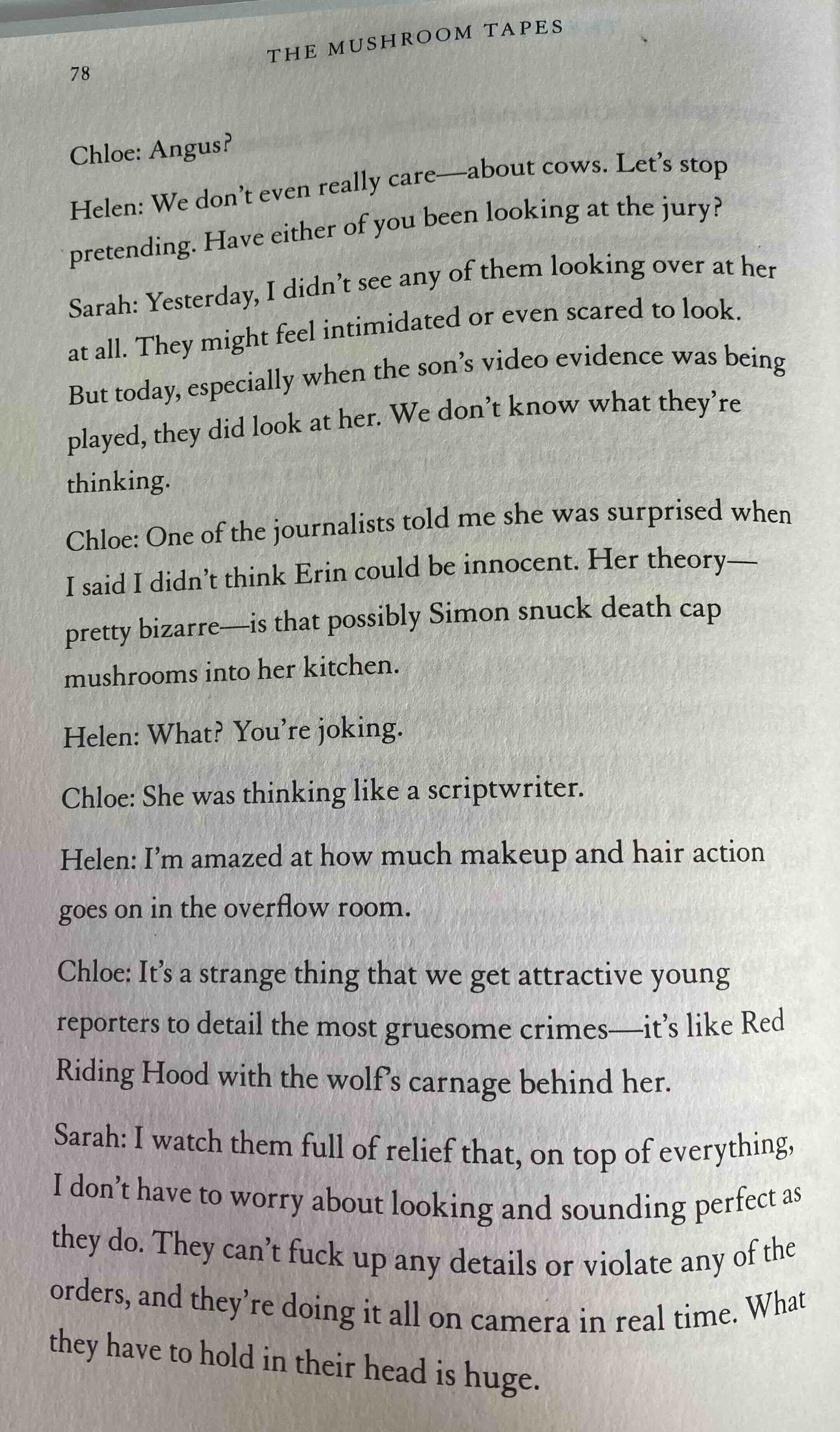
Page 78* is early in the book, part of Sunny’s narrative. He is a young man living in New York City in the late 1990s with Ulla, a white US woman. He’s intent on making it in the USA as a journalist, and embarrassed by his mother’s insistent claims on him. He can barely read her long letters (‘Mummy, please stop this gossip!’), and on this page he explains the context of one of them to Ulla (and, incidentally, to the reader):

One tiny thing I’ll mention in passing. The bottom paragraph describes Sunny’s family home as a ‘gray modernist house … designed by a disciple of Le Corbusier’. So much information is conveyed in those few words. First, the family comes from wealth. Second, they are to some degree westernised – their house is modernist. Third, the fact that the architect was a disciple rather than Le Corbusier himself suggests something about the limitations on the aspirations of colonised elites. And fourth, ‘gray’ is an example of the the North American spelling conventions used throughout (‘neighborhood’ later in the paragraph is another): that these spellings persist in the UK edition is not a mistake, but an enactment at the micro level of the way US culture has come to dominate the book’s westernised Indian characters.

Before that, there’s a paragraph of raw exposition:

Sunny had explained that Vinita and Punita were his mother’s servant girls, daughters of his mother’s cleaning maid, Gunja, who had eight living children – three had died in infancy (Babita used the phrase “popped off”); and Gunja’s husband was a drunk who sold chicken and mutton bones for a living, collecting them from dhaba eating places, then transporting them to a bone meal fertilizer tactory. They occupied two rooms in Begumpur, but Gunja could not afford to have six daughters at home; she’d have to marry the elder one, although she was only fifteen. To give the child a little more time, she begged Babita to keep two of them in exchange for housework. <snip> Even though she had two servant girls for free, Babita was to her mind involved in a social experiment to uplift society.

The fate of Vinita and Punita, known collectively as Vini-Puti, is to be significant much later in the book. But because it’s November*, rather than discuss further, here’s a little verse:

November verse 5:
So much in his mother's letter
needs to be explained. Just who
is Vini-Puti? Who is Ratty?
What's this kebab how-de-do?
Gunja, mother of six daughters,
trains two up to follow orders,
flee the confines of the slum,
work for free for Sunny's mum,
cook liver pâté soaked in brandy.
This is tragic seen up close:
the mum's small gain, the girls' great loss.
But this ain't Hamlet, this is Sunny.
Vini-Puti serve their turn
like Rosencrantz and Guildenstern.

After the meeting: We discussed The Loneliness of Sonia and Sunny along with Arundhati Roy’s Mother Mary Comes to Me. I was astonished when the discussion of this book kicked off with one person saying she hated it and gave up at the 40 percent mark (she’s a Kindle reader). Nothing happened, she said. And that included Sonia’s harrowing emotional enthralment to the bizarrely irrational western artist. Probably needless to say, others disagreed.

Of the three of us (out of five) who had read the whole book, I liked it the best. For all three of us the first 40 percent (I make that about 260 pages) was what we enjoyed most. We had different versions of why it became less enjoyable: perhaps there’s a forced assertion of Indian ways of story-telling, a cultural repudiation of the western mode of the earlier parts; perhaps the talismanic object is too sketchily realised to carry as much narrative weight as seems to be intended; perhaps the book is just too long.

I persist in my opinion, shared by one other Clubbie, that it was a good idea to pair this with Mother Mary Comes to Me. Both books have domineering, eccentric mothers. The protagonists in both are secular Indians appalled at the rise of Hindu nationalism and the BJP – the Demolition of the Babri Masjid mosque looms in the background. Both explore myriad ways in which cultural differences can be negotiated by people from a globally non-dominant culture. Both have main female characters steeped in classic English literature.

We had an excellent dinner, including a dessert that fell flat on the floor when it was taken from the oven, but was delicious anyhow.


The group met on the land of Gadigal of the Eora Nation, and I have written this blog post on the land of Gadigal and Wangal. I acknowledge Elders past and present of all those clans, and welcome any First Nations readers.


My blogging practice is to focus on the page that coincides with my age, currently 78, and in November I write fourteen 14-line stanzas in the month. which means incorporating one into most blog posts.

Mother Mary Comes to me, Arundhati Roy and the Book Club

Before the meeting: Mary Roy (1933–2022) was an extraordinary woman. She successfully challenged an inheritance law in the Indian state of Kerala so that women were able to inherit property, and she founded a ground-breaking school. That school, Pallikoodam, has a photo of her on its home page, accompanied by a vision statement:

Pallikoodam is born of the vision of Mrs Mary Roy. For fifty plus years she worked on moulding an extraordinary school that imparts a creative and all-round education that produces happy, confident children, aware of their talents as well as their limitations, unafraid of pursuing their dreams and living life to its fullest. Today, every one of us in Pallikoodam works to realise and forge ahead with her dream.

Mary Roy was also the mother of writer Arundhati Roy. In this memoir, she emerges as a formidable woman who did brilliant things, earning the admiration and cult-like devotion of many while challenging patriarchal institutions, and was at the same time a tyrannical, unpredictable, terrifyingly self-centred mother. Near the end of the book, Arundhati Roy describes a moment in 2022 when she was having dinner with three male friends, including her close friend Sanjay. She received a message on her phone:

It was from my mother. They, all men, each of them, including Sanjay, beloved by their besotted mothers, must have noticed the blood drain from my face and wondered what had happened. How could I explain to them that what had scared me was that I had got a message from my mother saying that she loved me.

It says a lot that readers understand perfectly why the message is terrifying, and that we also understand the intense moral, emotional and intellectual complexities involved in Roy sending a positive reply.

I love this book. It’s the story of the intertwined lives of two brilliant women, with the last half century of Indian history as an often intrusive backdrop. The genesis of Arundhati Roy’s writing is vividly told: her two novels The God of Small Things and The Ministry of Utmost Happiness, as well as her non-fiction, ‘activist’ writing, opposing the construction of a big dam that would displace millions of people, exposing the suffering of the people of Kashmir, reporting on time spent in a jungle with communist (‘Naxalite’) guerrillas, opposing Narendra Modi’s regime, and more.

I can imagine the book being portrayed as a misery memoir in which a famous writer complains about her wretched childhood, or as an exposé of a monster generally regarded as a saint. But that would be to misrepresent it. Mrs Roy’s personality was no secret. Her most loyal adherents were aware of her rages, her indulgences (she was always accompanied by an attendant bearing her asthma medication and, later in life, a supply of jujubes). And though Arundhati and her brother suffered terribly at their mother’s hands, she was a powerful force for good in their lives. There are any number of quotable lines to illustrate this complexity. Here’s just one from page 61, when the daughter was fifteen years old:

Between her bouts of rage and increasing physical violence, Mrs Roy told her daughter that if she put her mind to it, she could be anything she wanted to be. To her daughter those words were a life raft that tided her over pitch-darkness, wild currents and a deadly undertow.

There’s so much to enjoy. Arundhati has a friendship with the legendary John Berger, which gives us the unforgettable image of him as an elephant fanning her with his flapping ears. Hollywood actor John Cusack makes a cameo appearance as a witness of the mother–daughter relationship.

A look at page 78* makes it clear that the book is at least as much about the ‘me’ of the song as it is about ‘Mother Mary’. Young Arundhati is at the Delhi School of Planning and Architecture, free for the first time of Mrs Roy’s overwhelming presence. She has re-encountered the young man she calls JC – her first meeting with him when she was nearly fifteen and he was nineteen had been the first time she understood what sexual desire was: ‘My brain, my heart, my soul – all parked themselves in my groin.’ Back then, she had tried to be invisible. But on page 77, he tells her that he had thought she was a beautiful girl:

I was delighted. I had never, not for half of half a second, thought of myself as beautiful. <snip> I was the opposite of what Syrian Christian girls were meant to be. I was thin and dark and risky.

Such is the power of the writing that one hardly stops to question how the stunningly beauty the young Arundhati Roy that we see in photos could ever have felt that way.

On page 78 – after a paragraph about the Delhi family connection, Mrs Joseph, who disapproves of her – Arundhati is still absorbing that first delight:

So, it was nice to be thought of as beautiful, even if it was the opinion of a minority of one.

The rest of the page evokes grungy student life at the School of Planning and Architecture in new Delhi.

Laurie Baker (Wikipedia page here) is named as standing for the opposite of what was taught at the school. He was a pioneer of sustainable, organic architecture who designed Mrs Roy’s Pallikoodam school. He had inspired Arundhati to veer away from her earliest ambition, to be a writer, and leave home to study architecture. Though Arundhati did go on to be a writer, it was at the School of Planning and Architecture that some of her most important, enduring relationships were formed. As much as anything else the book celebrates these friendships.


After the meeting: Everyone loved this book and we loved discussing it. Someone threw a small grenade, saying that she didn’t see that Mrs Roy was such a terrible parent, that really Arundhati Roy had unfairly demonised her. The catalogue of physical and emotional violence, the fact that Arundhati’s brother shared her view, the way independent witnesses described Mrs Roy as ‘your mad mother’ and laughed at the terror on Arundhati’s face when she had to deal with her: none of this made a dent in her view. We could agree that Arundhati didn’t stay victim – she saw her mother as a model of being powerful in the world, and eventually came to recognise that in her way she loved her, and had given her the wherewithal to build a big life for herself, even if that meant rebelling against her.

We all learned things. For some it was about Indian politics, in particular about Karachi. For all of us, the impact of winning the Booker Prize was a revelation. We all had our ignorance about the Syrian Christians of India slightly decreased (the Roys are Syrian Christians – in Modi’s India, not Indian enough).

We read and discussed the book along with Kiran Desai’s The Loneleiness of Sonia and Sunny. Both books feature complex mother-daughter relationships, both have rich insights into the cultural and political relationships between India and the West, a number of historical events feature in both. But no one was much interested in a compare-and-contrast discussions.


Because it’s November*, I will now burst into rhyme:

November verse 4: Student days
Are student days always anarchic,
smoke-filled, garbage-racked, insane,
angry at the hierarchic
lectures that would tame the brain
with wisdom that's received as certain?
Always the time that lifts the burden
from the backs of those who bear
the yoke of old beliefs? Time where
new songs are sung and new words spoken,
daughters, sons beyond command
(don’t even try to understand),
first loves formed and hearts first broken,
new ways found with fork and knife,
friendships made that last for life?

The group met on the land of Gadigal of the Eora Nation, and I have written this blog post on the land of Gadigal and Wangal. I acknowledge Elders past and present of all those clans, and welcome any First Nations readers.


My blogging practice is to focus on the page that coincides with my age, currently 78, and in November I write fourteen 14-line stanzas in the month. which means incorporating one into most blog posts.

Robbie Arnott’s Dusk and (not) the book group

Robbie Arnott, Dusk (Picador 2024)

Before the meeting: we had enjoyed Robbie Arnott’s previous novel, Limberlost, so Dusk was a promising choice.

It’s set in a place very like nineteenth century Tasmania. Iris and Floyd Renshaw, the twin children of notorious outlaws, travel to the highlands and aim to kill a puma named Dusk that has been ravaging the region, killing livestock and people. A bounty has been offered by the graziers, and the twins see it as a chance to move away from their life at the margins. The story of their encounters with graziers and other hunters, and with a community of people who lived there before the settlers arrived, is full of elegant twists and moral dilemmas. There are moments of sheer horror, and moments of great tenderness. The writing is consistently vivid – you can tell that Robbie Arnott has visited the landscape even while he adds surreal elements like giant bones protruding from the ground; and the twins’ physical ordeals are viscerally real.

Even as I recognised all these qualities, I had trouble engaging. From about page 100, when the twins and their companions come close to Dusk, I started to care, and where a couple of pages are blacked out after a dramatic moment, what might have seemed a bit of cleverdickery had me on the edge of my seat. But then I got lost again and the final pages left me, as the song says, wondering why.

At page 78*, the twins have just arrived in a small town full of men who are hunting the killer beast. She – Dusk, the puma – has killed the son of a wealthy grazier, whom the twins have encountered grieving extravagantly in the street. For the first time since they came to the highlands, Iris finds herself confronting what they may be up against, ‘the probability of being ripped into death, faster than blinking’. Now, ‘starkly aware of the softness of her flesh, the smallness of her body, the stumbling clumsiness of her humanity’, she encounters for the second time Patrick Lees, a man who stands out from the crowd of hunters. On page 77 he has proposed that the twins join him to help track down the beast. Floyd, characteristically, stays more or less silent.

‘So you are chasing the bounty,’ said Iris, annoyance bending her voice.
Lees contemplated his pipe before slipping it back between his lips and speaking around it. ‘Maybe I’m just endlessly curious.’
 Iris clenched her teeth, holding her irritation in. Floyd kept rubbing his chin, seeming to take in Lees’ words without making any effort to respond. All of it was maddening to Iris – Floyd’s stupid performance, the sudden appearance of Patrick Lees, the unmoored feeling she had while being near him, his casual offer, his playful duplicity – and she wanted to get away from both of them and from herself, so she tugged at the collar of her coat and touched her hat. ‘We’ll think about it.’
  Lees nodded. ‘Of course.’ He indicated a lemon-gold building that rose above the stable. ‘I’m staying at the inn. I’ll be leaving at first light.’ Another little smile. ‘I hope to see you then.’

They left Patrick Lees breathing smoke at the plains and walked back through the stable to the street.

The main thing on display in this passage is Robbie Arnott’s deft use of tropes from romance novels. Iris is irritated by a suave, superior man, while having an ‘unmoored feeling’ while she’s near him. It’s no spoiler that Iris can’t resist the offer to go on the hunt with him, or that they do spend a night together. But as in the romance genre, there is every indication here that Lees is a cad: his little smile is surely a red flag, and while Iris may be uneasy, the reader can be reasonably certain that someone who breathes smoke is dangerous. You leave this page with a subliminal sense that Lees may not be just a romance-genre cad, but a horror-genre monster.

There’s a lot to admire in this book. There’s a lot to discuss. The surreal elements of the landscape read as both hamfisted metaphor and strategy for including First Nations characters who won’t be mistaken for actual palawa. But I was unconvinced. Even the basic set-up didn’t work for me, even if someone were to tell me that pumas were once introduced to Tasmania / lutruwita. I enjoyed some parts but never got on its wavelength


After the meeting: I couldn’t go to this meeting, and though I missed the people, I wasn’t sorry not to discuss the book. The WhatsApp report painted a picture of a very convivial evening, where everyone liked the book, some more than others. Evidently one person liked it more as the evening wore on – maybe I would have joined him in that movement. Maybe not.


I have written this blog post near what was once luxuriant wetland, in Gadigal and Wangal country. I acknowledge Elders past and present of those clans, and welcome any First Nations readers.


My blogging practice is to focus on the page that coincides with my age, currently 78.
Nathanael O’Reilly’s Separation Blues

Nathanael O’Reilly, Separation Blues: Poems 1994–2024 (Flying Island Poets 2024)

Separation Blues is a selection of poems from Nathanael O’Reilly’s nine previous books, published over 30 years. Each of those books had its own coherence of theme and manner, but this book mostly hangs together beautifully. There’s a bit of whiplash when eight Covid lockdown poems from boulevard (Downingfield Press 2024) are followed by four from Selected Poems of Ned Kelly (also Downingfield Press 2024), which mimic the semi-literate style of the famous Jerilderie letter. But I’m not complaining.

I’m currently reading Arundhati Roy’s memoir, Mother Mary Comes to Me. Something she writes (on page 53) seems relevant to these poems:

Maybe it’s best to leave some things un-understood, mysterious. I’m all for the unclimbed mountain. The unconquered moon. I’m weary of endless theories and explanations. I think I have begun to prefer descriptions.

Most of the poems in this collection avoid theories and explanations, or overt expressions of emotion. Most of them describe. Many are structured as lists – of things, people and thoughts encountered while travelling; youthful escapades; political events witnessed. There are a couple of dramatic narratives – a poem’s speaker faints at a service station, and in a different poem he catches fire at a backyard barbecue – but they too have a laconic descriptive air. Even the love poems and elegies, of which there are quite a few, mostly leave their emotional heft to be implied, hovering in the silence around the poem.

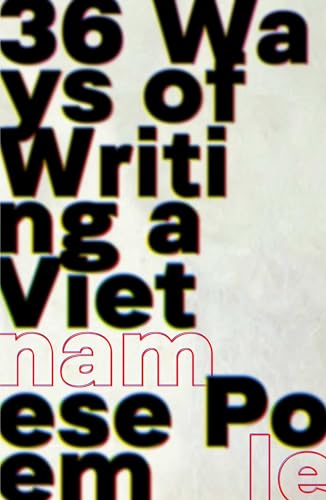
Page 78* is the second page of the poem ‘Greek Summer’.

This is one of five poems in the book with the dedication To Tricia. Some of the others are travel poems featuring ‘we’. ‘Côte dAzur (1905)’, for example, begins ‘During our last childless summer / we lay on the beach at Eze’. In ‘Greek Summer’ the poet travels alone. The first two stanzas on page 77 begin, respectively, ‘On the road from Patras to Corinth’ and ‘In Delphi’, and in the third he is again in Delphi. In those stanzas, he eats, drinks ouzo, performs bodily functions, chats with the locals, notices things – including the strong Australian accents of some taxi drivers, and American college kids who ‘grind on each other’. He ends the third stanza pondering his ageing soul. It’s an impressionistic travel diary.

On Page 78 our solitary poet visits two more islands, and arrives at Athens on the mainland.

First there’s Aegina:

On Aegina I rent a Vespa, 
gorge myself on olives,
tempt fate in board shorts.
At Sarpas, Athena unleashes
her hair, bares brown breasts,
knocks back another Mythos,
submerges in the Saronic.

More eating and drinking and mild intercultural discomfort – are board shorts acceptable? At Sarpas Beach, there’s a little poetic playfulness: this is the land of the Ancient Olympians, so when a woman goes topless on the beach, he imagines her as an avatar of Athena, the virgin goddess of wisdom, and suggests (punning on Mythos, the name of a local beer) that by letting down her hair and baring her breasts she’s knocking back the myth that she, Athena, is aloof, dignified and virginal. He’s enacting the male gaze all right, but not full-on lasciviously. He doesn’t imagine the woman as Aphrodite goddess of love, and the detail of her breasts being brown suggests that his interest is at least partly sociological: this is her usual behaviour at the beach. His gaze is detached, touristic, the erotic element quietly backgrounded.

On to the next stanza and the next island:

On Hydra I drink ouzo 
with the ghosts of Johnston,
Clift and Cohen, walk
in Winton's footsteps,
follow donkeys through alleys,
fantasize about checking out,
staying on to write novels.

More drinking. Here, he is a literary tourist, wearing his Australianness on his sleeve. Australian writers Charmian Clift and George Johnston famously did a lot of writing, drinking and fighting on Hydra in the 1960s, some of it in the company of young Leonard Cohen. Tim Winton’s novel The Riders has a sequence on Hydra, in which, if I remember correctly, he rides a donkey on a winding hillside path searching for his wife who has done a runner (and whom he never finds).

As a matter of nerdy interest, this poem appeared in O’Reilly’s 2017 book, Preparations for Departure (UAP Press), before the current resurgence of interest in Charmian Clift and the time Leonard Cohen spent on Hydra. See Nick Broomfield’s Marianne and Leonard: Words of Love (2019), the 2024 Norwegian TV series So Long, Marianne, Nadia Wheatley’s selection of Charmian Clift’s newspaper columns, Sneaky Little Revolutions, or Suzanne Chick’s memoir, Searching for Charmian.

The poet’s fantasy of checking out ‘to write novels’ has the same detached feel as his gaze at ‘Athena’ earlier.

The tourist narrative continues:

Drinking before dawn 
on a Plaka rooftop
with new friends
ten years younger

Without breaking a sweat, threads come together. He’s in the Plaka, a neighbourhood near the Parthenon, the ruined temple of Athena, who is now an abstraction, no longer topless with her hair down. Earlier he has watched young people and felt his age, he now drinks through the night with them, but his mention of the age difference here reinforces rather than contradicts his sense of having an ‘ageing soul’.

I miss your presence, 
wish you could share
the view, the wine, my bed.

And boom! The poem reveals itself to be a love poem. It’s not a travel diary after all, but a letter home. The details that make up his narrative have been selected with the letter’s addressee in mind. I see young people grinding (and I think of you). I see Athena letting her hair down at the beach (and I think of you). I think of George and Charmian’s relationship (and I think of you), of The Riders (and I think of you).

Many of the poems in this book have similarly unflashy appearances. I don’t know if they all repay close, careful reading as much as this one. I do know that some made me cry. One or two made me gasp. More than one left me pondering a surprising word.

I was searching for a way to finish this blog post, when I came across Anne Casey’s speech launching the book, in the Rochford Street Review (at this link), which includes this:

Here, you will learn of his great loves – gained, lost, and those most closely held. There are elegant elegies – to cherished friends, family, places and times; hymns to eroding ecology and loss of innocence; casually dropped epiphanies; and searing sociopolitical commentary. Small moments provide windows into worlds, slipping through the decades of Nat’s life and his many travels. In this book, he also visits with ghosts of Australia’s troubled settler history.

All true, especially the bit about small moments providing windows into worlds.


I wrote this blog post on the land of Gadigal and Wangal of the Eora Nation, where I saw two sleek crows enjoying the brilliant sunlight this morning. I acknowledge Elders past and present of all those clans, and welcome any First Nations readers.


My blogging practice is to focus on the page that coincides with my age, currently 78.
Susan Choi’s Flashlight at the Book Club

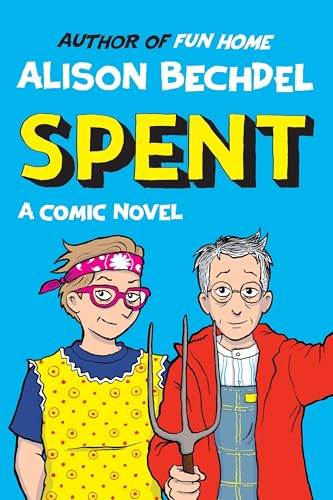
Susan Choi, Flashlight (Jonathan Cape 2025)

Be warned: the back cover blurb of this novel reveals something that the novel itself only begins to hint at at about the midpoint. Luckily I didn’t read the blurb until after I’d reached that hint – but thanks a lot, Jonathan Cape!

Before the meeting: I’ll avoid spoilers here, and just say the novel becomes something quite different from what you might expect from the first hundred pages or so. But when you go back and reread the start, you find that the writer has played fair. Sharper and better-informed minds than mine may well have understood the broad shape of the story from the beginning.

As in many novels these days, each chapter takes up the story from the point of view of a different character.

There’s Louisa, whom we first meet as an intelligent, uncooperative child in a therapy session: she has lost her father, presumed drowned, a loss that hangs over the whole book.

Seok, Louisa’s father, was born in Japan just before World War 2 to Korean parents. When the war ends he is shocked to discover that he isn’t in fact Japanese. His parents emigrate to North Korea, but he refuses to join them and goes instead to the USA where, now known as Serk, he gets a job at a provincial college, marries, has a daughter (Louisa) and lives as much of the American dream as is allowed to a Korean green card holder in the 1960s and 1970s.

Serk’s white wife, Anne, escapes from the thrall of a charismatic religious leader, garners an education by doing secretarial work for a literary scholar, and marries Serk. She’s dramatically unhappy in the marriage, especially when she accompanies him on a temporary posting in Japan. By the time of his disappearance at the beach, she is almost completely disabled by alienation from Japanese society and what turns out to be multiple sclerosis.

As well as those three main characters, there’s Tobias, Anne’s child by the charismatic religious leader, whom she gave up to be adopted at birth. He comes back into her life as a troubled teenager and continues to play a role over the decades. And one other character, a South Korean named Ji-hoon, has a chapter to himself late in the book.

So it’s a family story, and the family is fractious. Mother and daughter don’t have a single conversation over the decades that remains affectionate or even cordial for more than a minute. Before he disappears, Seok/Serk is abrasive both to his family and to pretty much anyone who tries to get close to him, especially other Koreans. Tobias is charming and kind, but loopy. And, the miracle of it, we like and care about them all as one small family being crushed under the weight of geopolitics.

Page 78* is in one of Serk’s chapters.

A lot is happening on this page. Serk meditates on his connection with his daughter, on her brilliance and creativity. He briefly acknowledges to himself that his bursts of rage are beyond his control.

Only five and six years old when she’d created these things; her mind was always at work, it amazed him. He was trying to make her a present as well, and nights he didn’t feel compelled to leave the house, blown on a gust that he couldn’t control, he worked on the gift in their basement, and entered a rare sort of peace from using only his hands, not his mind.

And he tackles correspondence with his sister Soonja, the only family member who has stayed in Japan. In a typically tangential way the narrative acknowledges the racism in the background of the action that happens in the USA (there is racism in Japan too, similarly backgrounded for the most part).

He had a letter in progress that he extracted, as well as the series of received letters. It bothered him that their glaringly foreign airmail sheets, outweighed by their numerous conspicuous stamps, arrived so often at his office, despite such exoticism being, as he knew, almost expected of him, as the only foreigner on the permanent teaching staff. That he was using his college letterhead and not an airmail sheet himself was pure vanity for which he’d pay with the stamps.

Then we are shown a little of the content of the correspondence. Here, late at night and alone, he is able to engage with his Korean life, of which his US family and colleagues are completely unaware.

Running his eyes over his characters, he read, where he’d left off, ‘I cannot even begin to consider this without having confirmation in hand,’ and then he had to go back to the most recent letter to refamiliarise himself with Soonja’s latest equivocation. Or perhaps it was confusion, or ill-founded conviction, or just a function of her wretched written Japanese, arrested at the level of a child; she’d never had a scientific mind in the first place, her emotionalism often caused her to misrepresent supposition as fact, and being obliged to write him in her poor Japanese because his written Korean was undeniably worse likely added resentment to the other counterfactual tendencies in her personality; they might have last seen each other almost twenty years before, but he was still her elder brother. He still remembered all her shortcomings.

‘The permits are certain, the time is not certain, it cannot be made certain until you because for just a short length so you are the problem as I said in my letter before. Should I tell our parents you say NO?’

If that doesn’t make sense to you out of context, be reassured. It’s close to incomprehensible when you do have the full context. Later, Serk meets up with Soonja in person, but we never get a clear idea of what she is asking of him. What we know is that Seok, now Serk, feels a tremendous gravitational pull of eldest-son responsibility for his family, and that he resists this pull. We can’t tell what it is that they want from him. Around about this page, I started to wonder if he didn’t drown a year or so after this scene, but somehow deserted his beloved Louisa to go to North Korea. (That’s not a spoiler, I’m not saying if I was right, just that there’s a growing sense of unease about what happened.)

After the meeting: We all enjoyed this novel. Its acknowledgements list fifteen books about Koreans in Japan and the historical events that impinge on Serk and his families. Some of us had never heard of these events (I’m in that group). Others knew of them, and so weren’t completely surprised by the revelation that arrives soon after the halfway mark. One person thought they were urban myths but she was reassured when we looked up Wikipedia.

The discussion brought to light a feature of the book that I hadn’t focused on: many narrative strands are simply not resolved. For instance, there is one other Asian staff member at Serk’s college, known as Tom. He is also Korean, though Serk does his best to keep him at arm’s length and at one stage has a blazing row with him when he believes, wrongly, that he is a North Korean sympathiser. Tom disappears and soon after so does his distraught wife. We never learn what happened to them. For another instance, Louisa as a young adult marries a young man she meets on a bus – he is unwashed and smelly, and we understand that she finds this comforting because in that way he is similar to her older half-brother Tobias who was kind to her after Serk’s disappearance. She marries him, and then he pretty much disappears from the story except as an offstage character – wealthy, entitled and abusive (though we don’t learn any details). Another: when she’s old and living as a grumpy isolate in a community of old people, Anne develops a relationship with a man named Walter. The beginnings of this connection are beautifully realised as Walter is cheerfully unfazed by Anne’s prickliness. But then, as years pass with the turn of a page, he’s not there any more. As someone pointed out, given that the book’s central event is a disappearance, it’s only right that there are many subsidiary vanishings.

Perhaps related to that, one person felt that the shift of narrative focus with each new chapter was frustrating. Balls were left in the air and by the time we came back to that person the balls had landed and the person’s life had moved on. I certainly felt a kind of whiplash, especially in the final third, when time passes quickly, but I wasn’t frustrated so much as energised.

We discussed this book along with Michelle Johnston’s The Revisionists. Both books deal with significant historical events of the past half century. Reading The Revisionists I felt like a FIFO western observer. Flashlight is more like a deeply intimate conversation.


The group met on the land of Gadigal and Wangal of the Eora Nation, where I have also written this blog post. I was born on MaMu land, and spent formative years on the Gundungurra and D’harawal land. I acknowledge Elders past and present of all those clans, and welcome any First Nations readers.


My blogging practice is to focus on the page that coincides with my age, currently 78.
Michelle Johnston’s Revisionists and the Book Club

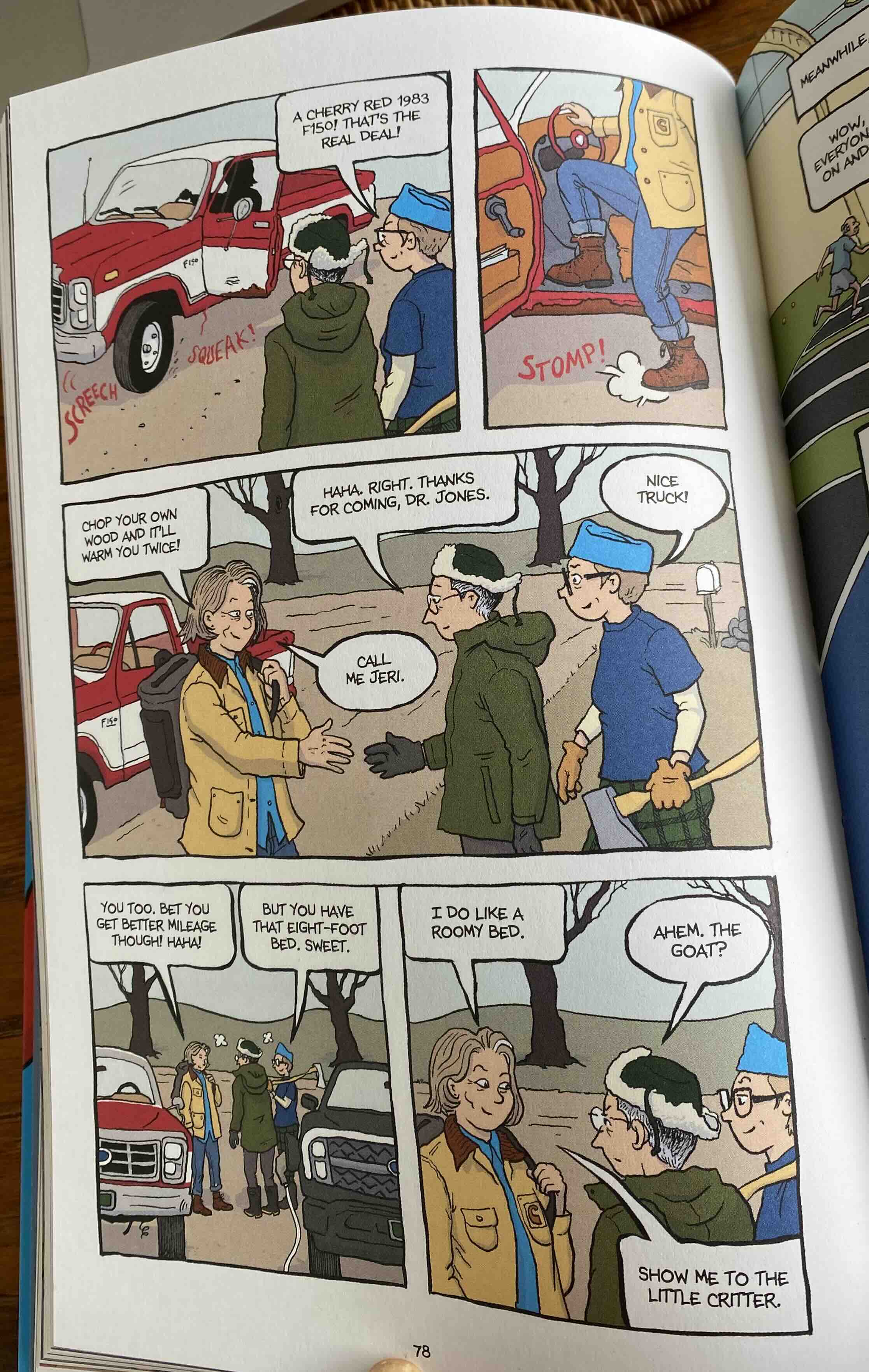
Michelle Johnston, The Revisionists (Fourth Estate 2025)

Before the meeting: Michelle Johnston’s day job is in emergency medicine. According to a 2023 interview on ABC Perth, she had written a draft of this novel when she decided that she had to go to Dagestan, a small republic in south of Russia where most of the novel’s action takes place, because ‘if you’re going to write somebody else’s story, you’ve got to respect it by going there and trying to understand it from the ground level up’. It was risky – DFAT advised against going and the Smart Traveller website warned of possible terrorist attacks – but she went out of dedication to the integrity of her writing, and in fact ‘had the most beautiful trip’.

The novel’s main character, Christine Campbell, doesn’t have such a beautiful trip, though the book captures the physical beauty of the place and the wonderful hospitality of its people. Christine is a journalist. Disenchanted with what Western Australia has to offer including an implausible level of sexism in Perth’s newsroom, she decides to travel to Dagestan to join Frankie, her best friend from schooldays who is a doctor working in a clinic in a tiny village there. Christine is there to help – she organises supplies and teaches first aid to local women – but she harbours an ambition to publish a groundbreaking piece of journalism about the possible outbreak of war.

It’s an odd set-up. We know from the beginning that Christine’s ambitions outstrip her abilities, and that her journalistic ethics are shaky. She intuits that the women of the village know that war is coming, but she can’t get them to say it outright. In fact everyone knows there’s a serious risk of war. It’s 1999: the war in neighbouring Chechnya ended in 1996, armed Islamist groups are forming everywhere, Russia is determined to fight them off, and the place, as Christine keeps saying, is a ‘tinderbox’. But she’s determined to write a feminist-leaning piece in which she gives voice to the women of the village saying what she just knows they would say if only they would say it. Her article will be titled ‘The Cassandras of the Caucasus’, because she believes the classical allusion will lend it class. (And the samples we see of her over-egged writing are consonant with that kind of thinking.) Frankie hints that she might expose the women to the danger of reprisals. She meets a famous journalist who gives her some Journalism 101 advice that seems to be news to her: if you’re out to get information from people, tell them up front that you’re a journalist.

The book opens in Manhattan 25 years later, in 2023, with Christine watching a TV documentary about herself and the one article that made her famous. A little later, Frankie turns up at her door, and challenges her about the untruths she told in the documentary and in the famous article. As the book proceeds, alternating between the two time periods, we learn the full story of how the article came to be written, and the fate of the Dagestan village. Revelation follows revelation. Christine’s ethics are a lot worse than shaky.

The book tackles important subjects: journalist ethics, the nature of memory, the role of ‘helpful’ but insensitive Westerners, the question of who owns a story. There’s a strong sense of place, not only in the austere beauty of Dagestan, but also in London where Christine and her friends have a brief respite, and Manhattan where she spends more than two decades in guilt, luxury and inertia.There’s a tumultuous affair with a man that we know is up to something, and a painfully real portrait of an unhappy marriage

On the strength of all that, you’d think I would have been engrossed. But I struggled with it, and it’s not easy to say why. It turns out that a close-ish look at page 78* suggests a possible reason.

Sarija is a teacher of English from a nearby village who has attended Christine’s first-aid classes, and even acted as her assistant. Here, the two women are chatting, leaning against the dusty haunches of Sarija’s horse. Sarija suggests that Christine might visit her village to talk to her students about writing:

‘You can ride on the back of my horse.’
‘I’d love that,’ Christine tells Sarija. She imagines cantering over mountain passes and through villages, swooping up stories and interviews as though she were playing investigative polo.

This is an example of many similar moments. I would have said it hits a false note: why would Christine, formerly Crystal from the WA wheat belt, think of polo? Surely the forced simile is an awkward writerly intrusion? On rereading, I see it differently. What’s happening is that the narrative voice, while technically telling the story from Christine’s point of view, looking over her shoulder as it were, actually undermines her, mocks her as callow, exploitative, self-serving, in effect accusing Christine of thinking of her journalistic quest as a jolly sporting venture.

There are more examples even in this one page of dialogue.

‘They say you ask a lot of questions,’ Sarija says.
‘It’s what journalists do,’ Christine replies. ‘And, since we’re talking, I’d be interested to know how the conflicts around here have affected you and your family.’

This is a woman who has been uncomplainingly lugging boxes around the clinic, winning the trust of the local women as she teaches them first aid. As soon as she thinks of herself as a journalist she becomes patronising (‘It’s what journalists do’) and would-be exploitative (‘Since we’re talking…’).

Sarija opens up to her anyway. Again, Christine makes a small gesture of sympathy, but her mind goes to the juicy turn of phrase:

It is hard to imagine the violence in that one image. A brother as a human bullet.

‘I want to tell your story. Don’t you want somebody to account for the atrocities? For the rest of the world to know?’
Sarija continues to shake her head while she responds. ‘The rest of the world is not interested. They are too busy with their own savagery. Our story is buried now. But, Christine, you need to know this: you don’t find answers here by asking questions.’ She pauses. ‘You find the answers by being quiet.’

To which this reader, led by the narrative voice, wants to shout, ‘Yair, Christine. Be quiet.’

Later, when Christine is frustrated at the lack of usable quotes from the women, she thinks back to this conversation and sees Sarija as her likeliest source of good copy. There may be some truth to this portrait of journalism in the field, but when she’s being a journalist Christine is almost completely unlikeable. Later, when she manages an interview with a self-styled warlord, she castigates herself for doing something terrible with what she has been told. The narrative voice holds back from condemning her, so even when she’s hard on herself, she is seen to be missing the point. She does commit one major journalistic sin, and in that case goes from self-deception about the gravity of her offence to wallowing in shame and remorse.

Though Christine goes on to make amends in some respects, I get the impression that Michelle Johnston doesn’t like her main character – and that makes a book hard to read.

Other people like this book a lot more than I do. Lisa Hill’s review is definitely worth reading.

Just before the meeting: We read two books at each meeting of the Book Club. The Revisionists was paired with Susan Choi’s Flashlight, and the comparison wasn’t kind to The Revisionists. For just one thing, both books deal with terrible historical events. In her acknowledgements, Susan Choi lists fifteen books of fiction and non-fiction about her subject so the reader can check how closely her fiction sticks to known facts. Michelle Johnston tells us nothing about her sources. This might not have mattered, but when there is an unreliable central character, it would be good to know if two atrocities in particular were invented for the horror of it or were documented events.

After the meeting: We were pretty unanimous in not caring for this book. Not everyone agreed that the author didn’t like her central character – what I saw as criticism of her as callow and exploitative, others saw as ironic highlighting of her naivety. But none of us much liked her anyway. One person went so far as to say the book shouldn’t have been published. Someone who has visited New York City quite a lot was exasperated that when Christine decides to sell a Rothko that has come into her possession, she takes it to a local gallery. ‘I’m sorry,’ she said, ‘if you have a Rothko to sell you go uptown to Christie’s or Sotheby’s.’ Rookie error, I guess.

We pondered the meaning of the book’s title. Perhaps it refers to the way Christine altered some key facts in her famous article. Perhaps it highlights an otherwise inconsequential moment in the last pages when Frankie and Christine realise they have completely different memories of how Christine came to be in Dagestan. We also pondered the meaning of the cover image: two women in profile, both with the abstracted air of models. None of us could see how it related to the actual novel.

On the other hand we had culturally eclectic creations from Tokyo Lamington for dessert, and Flashlight (blog post to come) is an excellent book that provoked interesting conversation.


The group met on the land of Gadigal and Wangal of the Eora Nation, where I have also written this blog post. The days are getting longer, and warmer, and I’ve been encountering a beautiful, satiny crow near my home. I acknowledge Elders past and present, and welcome any First Nations readers.


My blogging practice is to focus on the page that coincides with my age, currently 78.