Category Archives: Page 7x/47/7

Nam Le’s 36 ways of Writing a Vietnamese Poem

Nam Le, 36 ways of Writing a Vietnamese Poem (2023)
I know that I’ve read and enjoyed Nam Le’s first book, The Boat, but I don’t seem to have blogged about it. In one of its early stories, a character who fled from Vietnam with his family as a young child in a dangerously overcrowded boat is now an emerging writer. He resists pressure from all sides to write from within the Vietnamese refugee identity. After several other stories, the book ends with ‘The Boat’, a version of the story the character has been hassled to write. Resist as you may, the collection as a whole seems to say, in the end you will write the kind of thing that people demand from you.

This book of poetry plays with the same dilemma. Interestingly enough, in the acknowledgements, Nam Le thanks Nick Feik, ‘who for years gave my poems a home in The Monthly‘ and goes on, ‘Those poems are not in this book, but they paved the way for these.’ That is to say, Nam Le has not been condemned to write only ‘Vietnamese poems’. He has chosen this task. The poems explores identity, history (including colonial history), autobiography, family relationships. They are full of painful exploration and playful, formal adventure.

Each poem is numbered and named for its ‘way of writing’, beginning with ‘[1. Diasporic]’ and including poems named for their poetic form such as ‘[3. Ekphrastic]’, for their subject matter ‘[12. Communist]’, with puns on their content ‘[Dire critical]’, and so on. Many titles include the word ‘Violence’.

I can’t say that I found all the poems accessible. But I understood and enjoyed more of them than Nam Le’s session at the 2024 Sydney Writers’ Festival led me to expect (my blog post here). I love what J. M. Coetzee says on the back cover. To quote a little:

There is wit aplenty, of a dancing, ironic kind, but the fury and the bitterness that underlie 36 Ways come without disguise, as do its moments of aching love and loss.

The poem on page 47*, is ‘[26. Erasive]’. Normally, I’d photograph the spread where the poem appears and quote at least some of it, but in this case I’ll attempt a description instead.

Beneath the poem’s title is a subtitle in smaller all-caps type, ‘[ERASURE RHYMES WITH ASIA]‘. The rest of the spread consists of what appears to be 46 lines of prose, 23 on each page, that have been almost completely redacted – that is, the pages consist visually of two sets of 23 thick black lines.

There are 25 patches of un-erased text, each consisting of either a single letter or a pair of letters. They can be laboriously piece together to make two sentences:

Left-hand page: N o ar ch iv e is sa fe  
Right-hand page: Bu t is t h i s a l l t h er e is to i t.

The hunt through the archives turns up something, but leaves so much unknown.

This is powerfully evocative – especially just now, when the US Department of Justice has released hundreds of pages of the Epstein files completely blacked out. History is written by the victors, and the archives are controlled by those in power.

In the book I hold in my hand, the erased text on the left hand page is just legible. At least, to my eyes it hovers on the threshold of legibility. With a little help and a lot of squinting, I can tell you that the deleted script begins:

Newspaper Articles Almanacs Treatises (Scientific, Political,
Anthropological. Ethnological), Expedition Reports Ships Logs
Royal Proclamations Acts of Parliament Papal Bulls and Breves
Vatican Decrees Edicts Encyclicals Jesuit Relations

and – I’m leaving out the intervening lines – ends:

White Papers Green Papers Letters Patent Land Grants Titles
Medical Records Inventories Accounts Patents Estimates
of Expense Reports Settlement Proposals Petitions Notice
Dictionaries (Bilingual, Trilingual) Treaties Confessions Poems

I’ve bolded the only letters in those lines that are left un-erased.

Many (most?) erasure poems work on a given text to comment on it in some way – like ‘Sacrificed on Altar of Vice’ by Brittany Bentley in a recent Meanjin, or my own little exercise in my blog post on David Adès’s The Heart’s Lush Gardens. That’s not what’s happening here.

Here the underlying text is a list, composed as part of the poem, of the kinds of documents one finds in an archive. The poem enacts the process of sifting through the archives to find information, encountering colonialist-bureaucratic ways of seeing, from property documentation to papal bulls (the infamous Doctrine of Discovery comes to mind). Then, just as one might be feeling a little smug because, after all, I am the kind of person who reads poems, the last almost-erased word is ‘Poems’. Nam Le does not exclude himself from complicity.

That’s the first page. On the second page the erased text is completely illegible. Erasure is complete: we can never know what is hidden from history.

The more I looked (literally) into this poem, the more I appreciated its ingenuity. More importantly, the more I fond myself responding to its emotional and intellectual charge: ‘Erasure rhymes with Asia.


I wrote this blog post on the land of Gadigal and Wangal of the Eora Nation. I acknowledge Elders past and present, and welcome any First Nations readers.


My blogging practice is to focus on the page that coincides with my age, currently 78. When, as here, a book has fewer than 78 pages, I focus on page 47 (I was born in 1947).
Alison Bechdel’s Spent

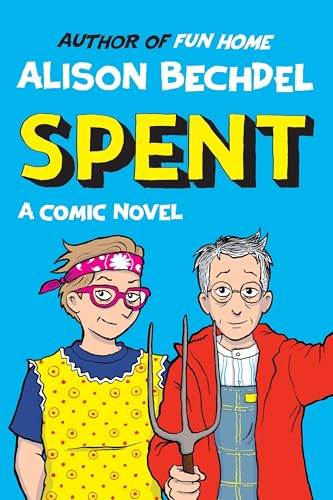
Alison Bechdel, Spent: A Comic Novel (Jonathan Cape 2025)

This is the fourth ‘graphic novel’ by Alison Bechdel. I use quote marks because they aren’t all novels. The first, Fun Home (2006), the only other one I’ve read, includes fictional elements, but is actually a memoir about her relationship with her father. I believe her second and third, Are You My Mother? (2012) and The Secret to Superhuman Strength (2021) are also predominantly memoirs. 

Even though this book describes itself as ‘a comic novel’, it too feels as if it’s taken from Bechdel’s actual life. The main character, ‘Alison Bechdel’, is a cartoonist whose graphic memoir about her father (here called Death and Taxidermy), became a best seller. The project she is currently working on has striking similarities to book we are reading. In the acknowledgements, the author thanks her ‘stellar agent, Heloise C. Bland Sydelle Kramer’ – the struck-through name belongs to the book’s fictional agent. And so on.

We’re not meant to read the book as describing the actual lives and loves of Bechdel and her ‘annoying, tenderhearted, and utterly luminous friends’. I don’t know if Bechdel has a goat farm IRL, or if her empty-nest neighbours are experimenting with polyamory (‘Indeed, they give “sandwich generation” a whole new meaning’). But the concerns and preoccupations of the characters are definitely taken from life.

This is a book about the members of a haven for leftist LGBTQI+ people in the era of Trump, MAGA, the climate emergency and rampant late-stage capitalism. They write letters, organise, lobby, have ‘Black Lives Matter’ placards on their lawns, argue about gender politics, suffer at the way television adaptation mangles and betrays Alison’s first book. And they are funny.

An early caption (page 14) sums up the mood: ‘How she rues the decades she spent fretting that the country was on the verge of fascism. Now it really is, and she’s worn out.’

Hence one meaning for the book’s title: spent, worn out, depleted. The title also refers to the way Alison and friends are incorporated into consumerism – the ‘S’ in ‘spent’ could have been a dollar sign, as in fictional Alison’s project, $um. The characters are constantly receiving packages from Amazon, and Alison agonises over whether to accept an offer from Megalopub (aka the Murdoch empire?) for her work in progress.

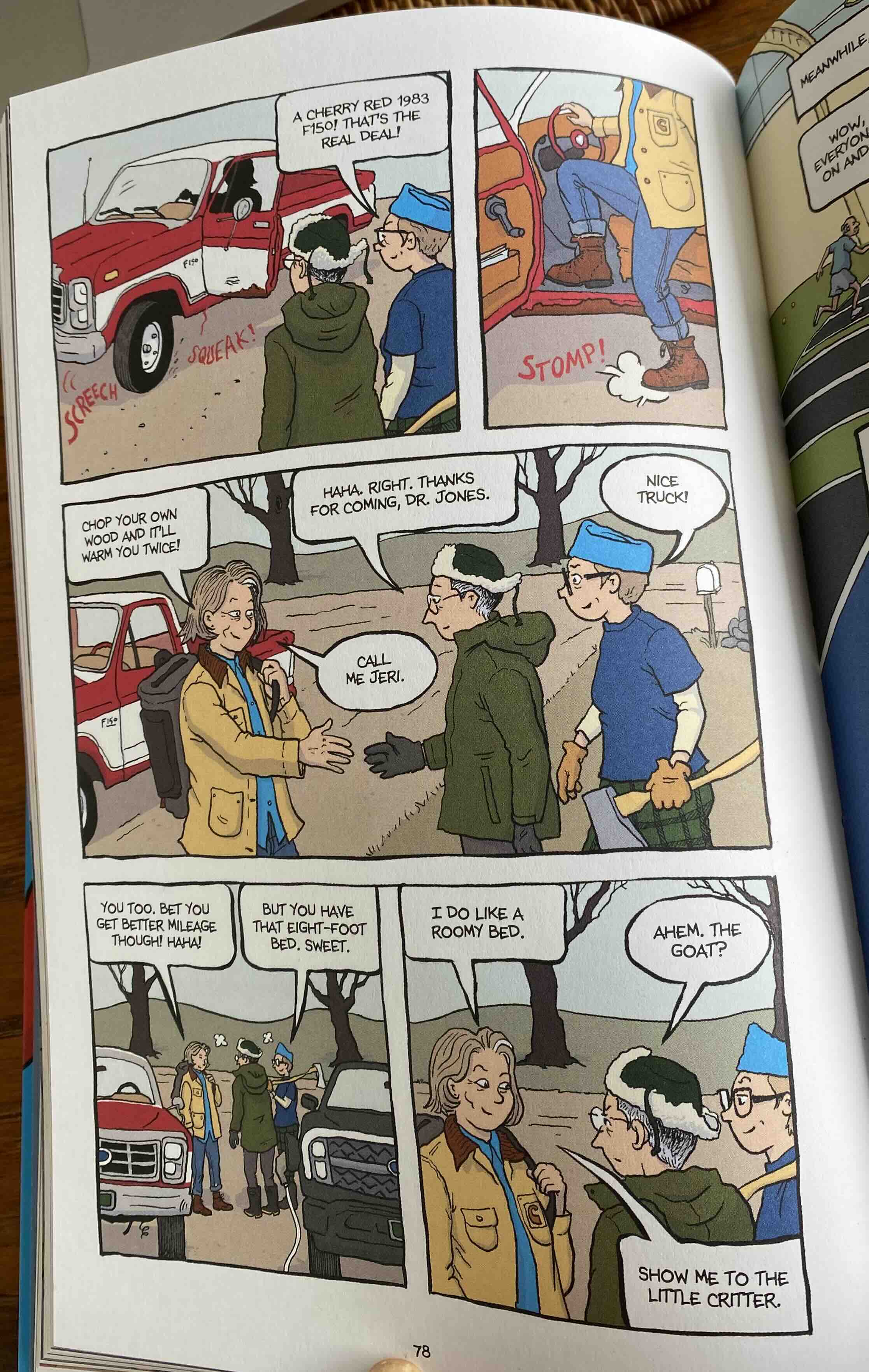
Page 78* gives you an idea of the art, and the general playfulness. A couple of pages earlier Alison and Holly have been startled out of their sauna by a goat thumping about on its roof – and have stood naked in the snow, rude bits discreetly hidden. A couple of pages later their neighbours are playing at the local pickleball palace and have a zing moment when hands touch that is the beginning of the polyamory thread. Page 78 is a quiet page: no nakedness, and just a couple of flirty double entendres.

Holly, in the blue cap, has been chopping wood while Alison films her for Holly’s Instagram account, which is about to go viral. ‘It’s the new vet,’ says Alison. ‘Whoa! What a beauty!’ says Holly. We turn the page and see that Holly is looking at the vet’s truck, not the vet herself.

But the original ambiguity continues. The flirty stuff between Holly and the vet will persist, making Alison a little nervous.

I notice two things about the page.

First, same-sex attraction is the norm in the world of this book, no big deal. One character is a trans man, but no one even mentions it – somewhere along the line he is shirtless and discreet scars from top surgery are revealed. The one cis-het man in the friendship group has fantasies of being a Lesbian. Even the women of the younger generation who identify as asexual are asexual with other women. Heterosexuality is, um, rampant among the miniature goats, which leads to some good-humoured comedy.

Second, there’s a tiny detail in the bottom left frame. No verbal cues given (unless that’s what the vet means about mileage), the car on the right is being charged. Of course, you think, these right-on environmentalist vegans would have an EV. It’s one of the pleasures of the book that such tiny moments abound. A random flick through the pages gives someone commenting at the communal non-Jewish shabbat, ‘I don’t think I’ve ever seen a man light the candles before.’ Or there’s the young gender-non-conforming character Badger wearing a T-shirt that proclaims, ‘Neurodivergent AF’. Monitor screens and floating strips of text regularly bring news from Mar-a-Lago and the disasters of the wider world.

Of my recent reading, the book this most chimes with is Susan Hampton’s memoir, Anything Can Happen. They are both excellent books. This one doesn’t have the Sydney Gay and Lesbian Mardi Gras, but it’s funnier.


I wrote this blog post on the land of Gadigal and Wangal, where the wind is cool and rain is pending. I acknowledge their Elders past and present and welcome any First Nations readers of the blog.


That’s my age. When blogging about a book, I focus on page 78 to see what it shows about the book as a whole.

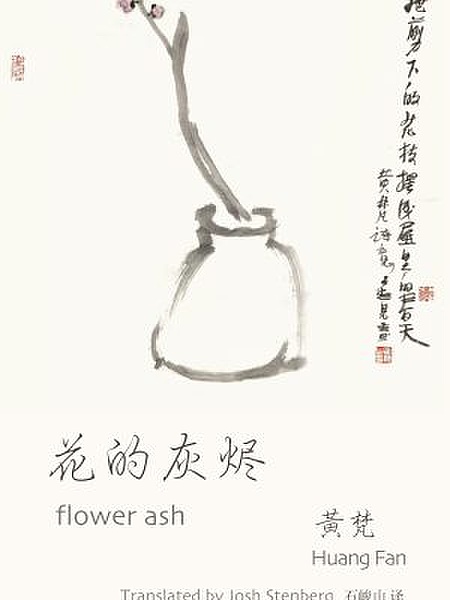
Huang Fan’s Flower Ash

Huang Fan, Flower Ash (translated by Josh Stenberg, Flying Island Books 2024)

Huang Fan is a Nanjing-based poet and novelist who has received many awards and prizes in his homeland, and has been described as the Chinese mainland poet of most interest to Taiwanese readers. His work has been widely translated, including into English. Flower Ash is a wonderfully accessible introduction to his work.

The Flying Islands website (at this link) quotes US novelist Phillip Lopate::

In these powerful, exquisite poems, Huang Fan, a major Chinese poet, takes stock of his life from the vantage point of middle age, finding deep connections with nature, but also rueful solitude, memories of lostness, and a lingering sense of missed opportunities. These translations beautifully capture a threnody of wonder and sadness which is the poet’s singular achievement.

It’s a bilingual book. On each spread, Josh Stenberg’s English version is on the left and Huang Fan’s original Chinese on the right. Perhaps partly because of this, I was always aware, as I read, that the real poem, over there on the right, was inaccessible to me. (A bilingual reader would of course have a very different experience.)

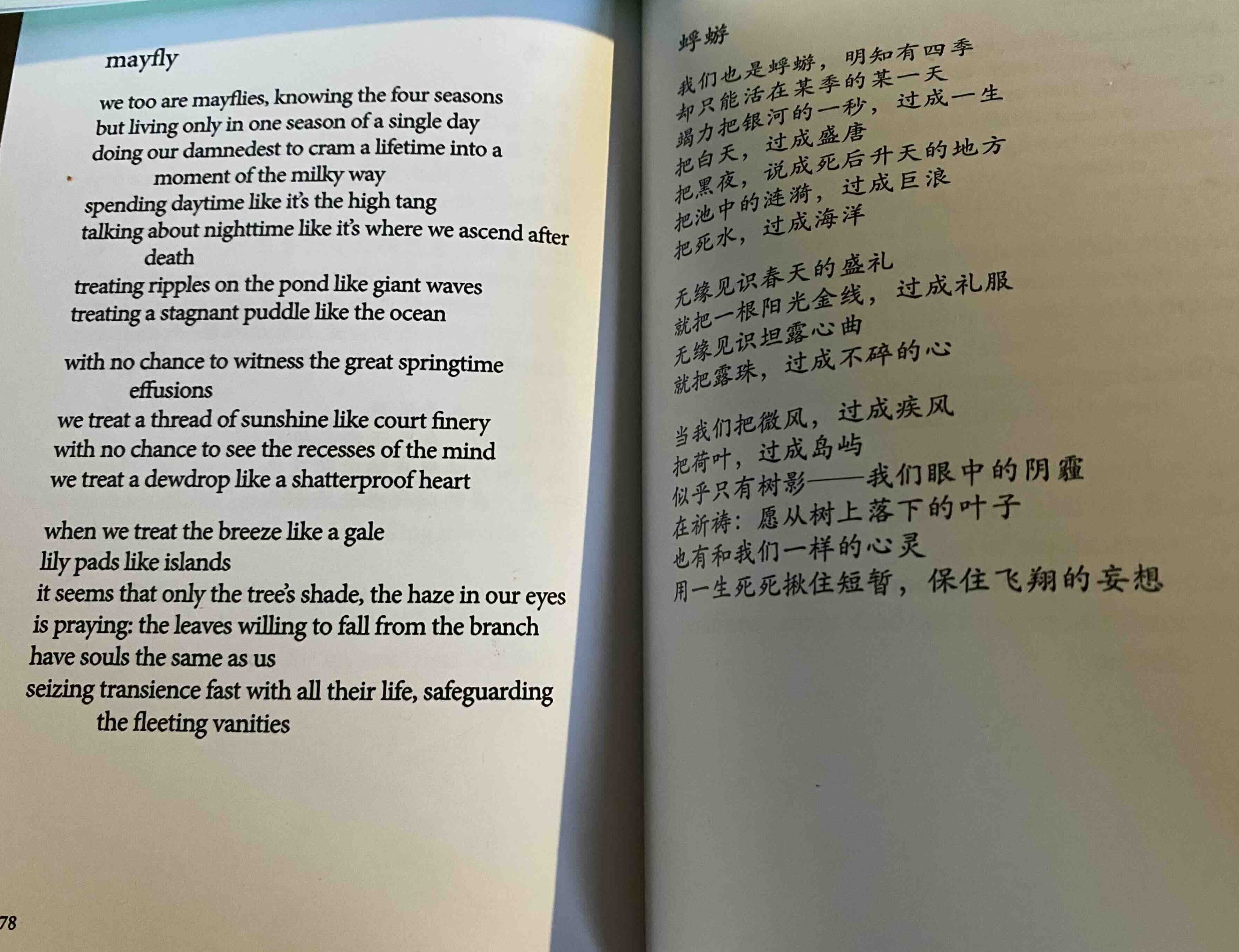
The poem ‘Mayfly’ on pages 78* and 79 is a good example:

Don’t you just wish you could read those beautiful lines of characters on the right-hand page?

The English, by contrast, feels unadorned. The first two lines lay out the poem’s central idea:

we too are mayflies, knowing the four seasons 
but living only in one season of a single day

Mayflies live for a single day. From some perspectives, our lives are similarly short.

The following lines present different images to represent the same idea: a lifetime is ‘a moment of the milky way’, the High Tang period (the eighth century CE, a golden age of Chinese poetry) is just a day, what we see as an ocean is just a stagnant puddle. And so on. It’s hard to see that anything much is happening that isn’t already there in the first lines.

I think the problem is translation. Not that Josh Stenberg’s translation is inadequate, on the contrary. But translation itself is problematic. I suspect the music of the original, and the visual play that’s happening in the ideograms, are simply untranslatable, and what we get is like a musical score, or a choreographer’s notes.

But even given all that, the poem takes an interesting turn:

with no chance to see the recesses of the mind 
we treat a dewdrop like a shatterproof heart

The imagery is no longer straightforward illustration of a straightforward idea. These lines open out to something deeper, less easily paraphrased. It’s no longer the perspective of deep time or deep space that is being evoked but the depths of the mind and the complexities of human emotion. If it mistaken to think of the dewdrop as a shatterproof heart, is there an implied heartbreak, an unfathomable sorrow – even ‘a threnody of wonder and sadness’?

After briefly returning to a catalogue of oppositions – breeze/gale, lily pads/islands – the poem lands on this:

it seems that only the trees shade, the haze in our eyes 
is praying: the leaves willing to fall from the branch
have souls the same as us
seizing transience fast with all their life, safeguarding
------- the fleeting vanities

This doesn’t yield coherence easily. I confess I got some help – I went to Google translate, and found this:

It seems that there is only the shadow of the tree - the haze in our eyes 
is praying: may the leaves falling from the trees
have the same heart as us
Use your life to hold on to the short-lived and keep
------- the delusion of flying

Again, the Chinese text is a closed book to me, but to my ignorant eye, and to my astonishment, the robot makes better sense than the award-winning human translator. Instead of ‘only the trees shade’, which makes no easy sense, the mechanical translation has ‘there is only the shadow of the tree’ – that is, we don’t see the real world, but something like the shadows in Plato’s cave. Instead of the leaves ‘willing to fall’, it is the speaker who wills –’may the leaves falling’: it’s not a description but a prayer (which follows on from ‘praying’ at the start of the line). And in the last line it’s no longer the leaves ‘seizing transience’, but the reader being urged to do so. What we experience may be ‘fleeting vanities’ (much more resonant than ‘delusions of flying’, even though the latter fits the idea of falling leaves better), but it’s what we have, and we (‘you’ in the robot’s translation, ‘the leaves’ in the human’s) need to seize it fast / hold onto it.

I didn’t set out to do this, but I seem to have taken a single poem and demonstrated that reading poems in translation is fraught.

I did enjoy the book, and am glad that Flying Islands regularly include Chinese–English bilingual books.


I wrote this blog post on the land of Gadigal and Wangal. I acknowledge Elders past and present of those clans, and welcome any First Nations readers.


My blogging practice is to focus on the page that coincides with my age, currently 78.

Staples and Vaughan’s Saga volume 12

Fiona Staples and Brian K. Vaughan, Saga, Volume 12 (Image 2025)

Saga, with words by Brian K. Vaughan and images by Fiona Staples, is a space opera that has been running for nearly 15 years. Seventy-two individual comics have come out on a monthly basis, with a couple of substantial hiatuses. Volume 12 collects comics number 27 to 72.

In the middle of a forever war between a winged species and a horned one, a bi-racial child is born, and this is her story. Many forces are out to destroy the girl and her family. Hazel is her name, and she’s now 12, working in a circus and worried about the hair growing in unexpected places. Oh, and the galaxy-wide war continues.

There’s a lot going on.

I’ve blogged about the previous 11 volumes: volume 1, 2 & 3 here, 4 here, 5 here, 6 here, volume 7 here, 8 & 9 here, 10 here and 11 here. For volume 12, I’ll stick to page 78*.

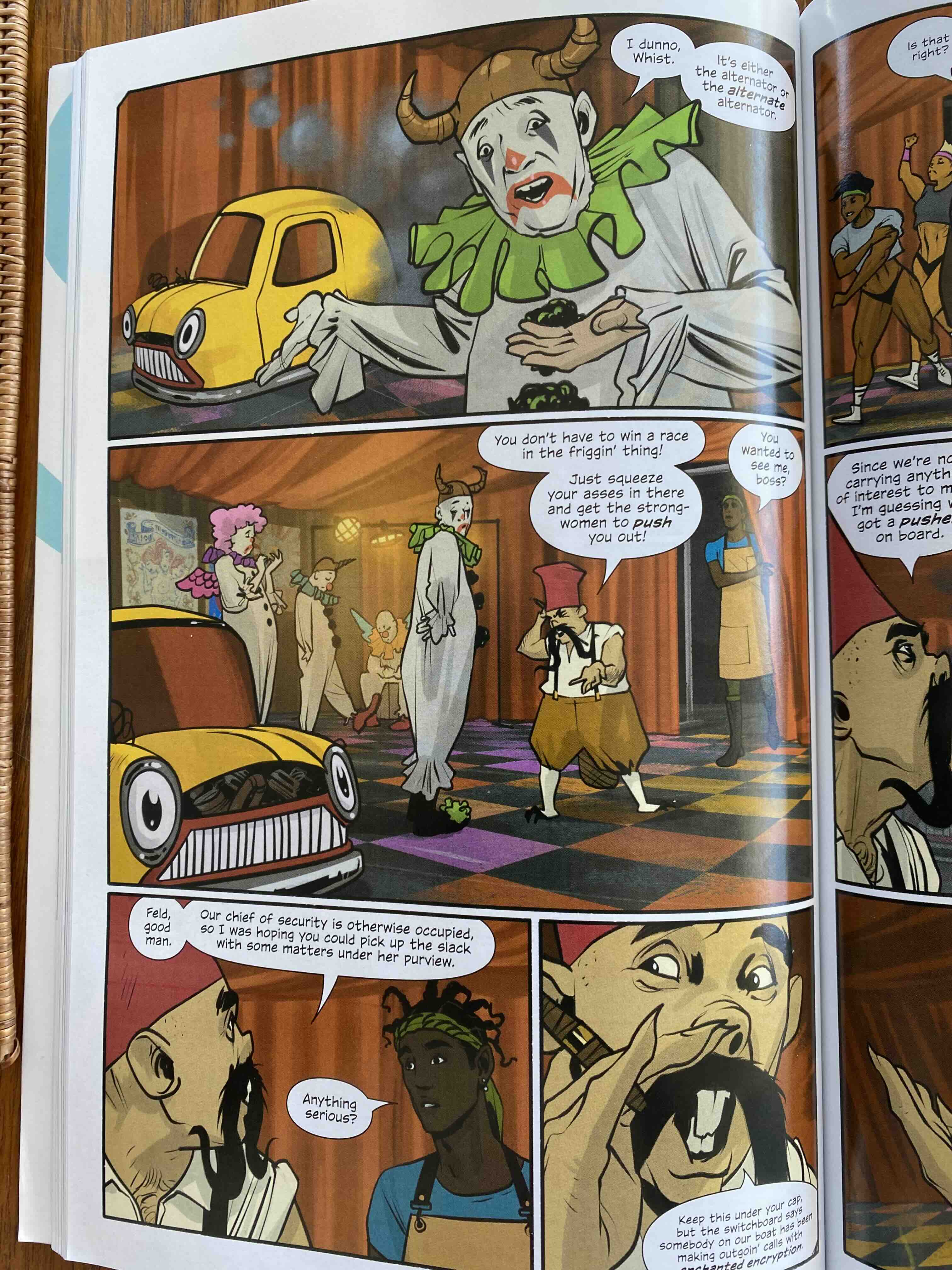
Sadly, I don’t get to show you Hazel as a 12 year old, or her bad-ass mother Alana (that’s her in the cover illustration in her role of head of security for the circus), or her television-monitor headed brother. There’s no sex on this page, no violence, no cute aliens, and none of Hazel’s deliciously multivalent narrative. But you can get an idea of Fiona Staples’s visual style.

The three characters here are an obnoxious clown; Whist, the circus manager who belongs to some kind of rodent species; and Feld, a stunningly good looking circus employee.

The top two frames are a bit of silliness, a glimpse of the way the circus – a huge tent-shaped space station – is always on the edge of chaos, though the broken-down clown car is nothing compared to the land-based dolphin on earlier pages who has diarrhoea when he has to perform. The mention of the ‘strong-women’ is a set-up for an image on the very next page where two musclebound women stuff clowns into the car and push it off through the curtains into the bright lights of the circus ring. But while the reader’s attention is on this comedic dimension, grounds are being laid for a later dramatic moment featuring Whist and the clown, about which I’ll say no more.

The bottom two frames are rich with irony. Someone at the circus has been seeking a bounty from people who are hunting Hazel and her family, and Whist, we learn here, knows some skulduggery is going on. The reader has reason to believe that sweet-talking Feld is the informant, so this moment is full of tension. There are, of course, a few twists to this part of the story before the volume ends. It’s not really a spoiler to say that Hazel Alana and family manage to escape – and that the war continues.

I used to wonder where it was all leading, but now I think it might just go on forever, and continue to be engrossing fun until Hazel dies of old age as a grand matriarch in volume 90. Anyhow, it looks as if we may have entered another ‘hiatus’ and it will be some time before the next episode hits this blog.


I  wrote this blog post on the land of Bidjigal and Gadigal of the Eora nation. I acknowledge their Elders past and present, and welcome any First Nations readers.


* That’s my age. When blogging about a book, I focus on page 78 to see what it shows about the book as a whole.

Journal Catch-up 32: Meanjin Autumn 2025

Esther Anatolitis (editor), Meanjin Vol 84 Nº 1 (Autumn 2025)
(links are to the Meanjin website: I believe that they are now all accessible to non-subscribers)

Unless Melbourne University Publishing’s recent decision to shut Meanjin down ‘on purely financial grounds’ is reversed, this is the fourth-last issue of Australia’s third-longest-lived literary magazine. (The New South Wales School Magazine, a literary magazine for children, is the longest lived. Southerly comes second.) The two part-time employees responsible for the journal have lost their jobs. Even given the long list of other people whose work goes into each issue, it’s astonishing that this extraordinary publication has been produced by so few paid workers.

The cover design is weirdly prophetic. It represents the predictive results for a web search for “the work of”. Early this year, readers would hardly have noticed the battery icon in the top right showing a dangerously low charge, a speck of red on a mostly black page. Now, thanks to what has been correctly described as outrageous cultural vandalism, the battery is dead flat. But that’s the only sign of imminent demise. The rest of the issue – more than 200 pages of text and image – is as lively, varied and thought-provoking as you could wish.

There are the regular features:

  • Even before the contents page, there’s The Meanjin Paper, an essay by a First Nations writer: ‘Different Plants for Different Meanings‘ by Anyume John Kemarre Cavanagh with Gabriel Curtin reads like poetry
  • State of the Nation: topical essays, this time it’s Sisonke Msimang, Andrew Lemon and Rachel Withers on the Voice referendum, gambling and the housing crisis respectively, each with a twist
  • Australia in three books‘: Sarah Walker writes about Ethel Turner’s classic children’s book Seven Little Australians, Jessie Cole’s Desire (2022) and Helen Garner’s Yellow Notebook (the first volume of her published diaries), all of them dealing with girls or women who ‘are trapped in the great looping flood’ of their feelings
  • Interview: It’s Winnie Dunn, author of the novel Dirt Poor Islanders and mover and shaker in the Western Sydney’s rich literary scene, and it makes very interesting reading
  • The Year In … : The year in Yellowface. Jacqueline Lo focuses on the web trailer for a ballet production at the 2024 Adelaide Festival, which she argues represents a persistence in Australian culture of attitudes to Asian characters and actors that are no longer tolerated where Blackness/Blakness is the issue.

There are short fictions, memoir, essays, book reviews and poetry. I’ll name just one or two of each.

In the short story ‘The farmer‘ by Suzanne McCourt, the title character is a woman of a certain age searching for a calf that has gone missing, presumed stolen by her neighbour. There’s a lot there for any reader to like, but because I spent a lot of time with cattle when I was young, I particularly loved the way the story captured the intimate bond between human and cows and their calves, including the delicate process of adoption.

Of the four pieces labelled ‘Memoir’, Jess Lilley’s ‘My pregnant life‘ stands out. It begins with the author’s first pregnancy when she was nineteen and dealing with the legal and social hurdles to abortion. I don’t think it’s a spoiler to quote the essay’s last words:

When I lay with his tiny body in my arms, I knew this signalled the end of my pregnant life. Nine pregnancies across 25 years. A quarter of a century of having my  world rocked over and over and over by my own bodily forces.

minganydhu ngindhumubang / What am I without you?’ by Tracy Ryan is a generous bilingual essay in a class of its own that challenges readers to deconstruct our assumptions and practices around language – much of it is written in Wiradyuri language, first transliterated then translated: ‘my soul wants to decolonise language but that would make this work nearly incomprehensible to an English-dominant culture.’

Architect Naomi Stead’s essay ‘Wheatscape with Cathedral‘ deals with the extraordinary Stick Shed in Murtoa, rural Victoria. The author’s full-page photo of the shed’s interior cries out for an explanation of the extraordinary vision, and the article more than satisfies.

Of poetry, I’ll mention just ‘Sacrificed on Altar of Vice’ an erasure poem by Brittany Bentley. If you click on the link, you’ll see the image of two columns of newspaper copy most of which has been redacted in red. The words that are still legible constitute the poem. The hard-copy Meanjin includes a link to the unredacted article. The poem stands on its own feet but read in conjunction with the original article its power is greatly amplified. Most of the poem’s title comes from the redacted text.

The three book reviews tend to be in rarefied scholarly language. Here’s a sentence from ‘Queer perforations‘, a review by Dylan Rowen of Blackouts, an experimental work of fiction by Justin Torres:

Determined to free the queer subject from the realm of the symbolic and to give voice to those erased from history, this text critically fabulates – to borrow Saidiya Hartman’s term – a history gleaned from the redacted bits of what little was left in the records.

Mercifully, this kind of insider language is mainly restricted to the book reviews.

With any luck, by the time I’ve read the final issue, in who knows how many months’ time, Meanjin, like Heat before it, will manage some kind of resurrection, in spite of Melbourne University’s reported refusal to entertain many offers of financial support from other institutions.


I  finished this blog post on the land of Bidjigal and Gadigal of the Eora nation. I acknowledge their Elders past and present, and welcome any First Nations readers.

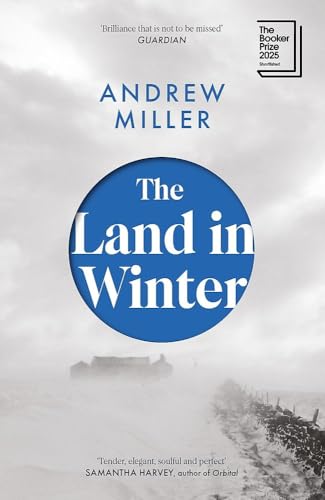
Andrew Miller’s Land in Winter at the Book Group

Andrew Miller, The Land in Winter (Sceptre 2024)

Before the meeting: The Land in Winter was shortlisted for the 2025 Booker Prize. The judges described it like this:

In the depths of Britain’s coldest winter, two neighbouring women forge a friendship in the countryside. It’s 1962 and they have both just become pregnant. Around them, the men are struggling <snip>. As a winter storm wreaks havoc on their lives, these characters become pivotal figures in a community precariously balanced between history and future <snip>. In beautifully atmospheric prose, Andrew Miller brings suspense and mystery to this seemingly inconsequential chapter in British history.

For me the one word that stands out from that is ‘inconsequential’. I never got on the book’s wavelength. I couldn’t find any reason to be interested in the characters, and couldn’t tell why the author was interested in them. Adultery, mental illness, patriarchy, the lingering effects of World War Two, the shady world of strip clubs and escort agencies, organised crime lurking in the background, a nuanced play of class, a solid evocation of a snowbound English countryside: there’s plenty there, but I mostly failed to care or be amused. Nobody is happy, everybody has a complicated past, terrible things happen to each of the main characters, some expected, some self-inflicted, some as arbitrary as a car accident. The prose is fine, but I would describe it as functional rather than atmospheric. The book doesn’t sing.

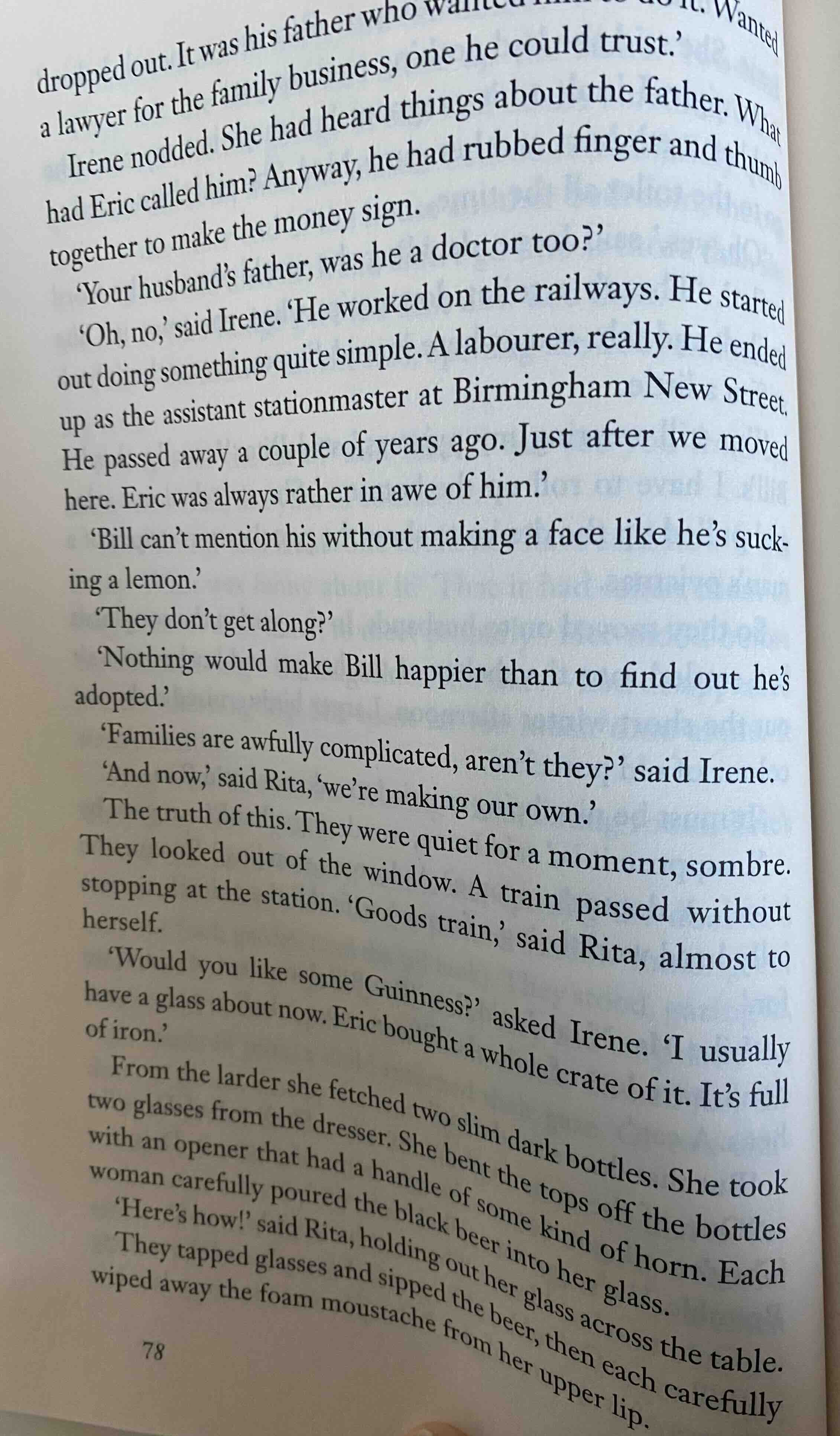
Page 78* occurs in chapter 7. The ‘two neighbouring women’, Rita and Irene, have met for the first time when Rita has brought eggs from her farm as a gift to Irene, the doctor’s wife.

As the women converse, they fill each other in on their husbands’ backgrounds. That is to say, this is mainly a page of exposition. But then, a lot of the book feels to me like exposition.

‘Bill was at Oxford,’ said Rita, as if that explained the naming of cows after queens of the Nile. ‘He was studying law but dropped out. It was his father who wanted him to do it. Wanted a lawyer for the family business, one he could trust.’
Irene nodded. She had heard things about the father. What had Eric called him? Anyway, he had rubbed finger and thumb together to make the money sign.
<snip>
‘Bill can’t mention his [father] without making a face like he’s sucking a lemon.’
‘They don’t get along?’
‘Nothing would make Bill happier than to find out he’s adopted.’

In the midst of that background briefing, one detail stands out. Irene’s doctor husband ‘had rubbed finger and thumb together to make a money sign’. So Bill’s father, we understand, is a Jew. There’s more about that later when we meet Bill’s family, but the antisemitism of Eric’s remembered gesture never leads to anything. This did make me wonder if the narrative was seeded with many such signals that I missed. A character will see an unexplained light in the distance, and there are moments of surreal weirdness, but the narrative closes over them and it’s as if they were never there.

After their expository chat, the two women – both newly pregnant – move on.

‘Would you like some Guinness?’ asked Irene. ‘I usually have a glass about now. Eric bought a whole crate of it. It’s full of iron.’
From the larder she fetched two slim dark bottles. She took two glasses from the dresser. She bent the tops off the bottles with an opener that had a handle of some kind of horn. Each woman carefully poured the black beer into her glass.
‘Here’s how!’ said Rita, holding out her glass across the table.
They tapped glasses and sipped the beer, then each carefully wiped away the foam moustache from her upper lip.

Ah, thinks the reader, Andrew Miller has done his research. Way back then in 1962, not only did women drink alcohol when they were pregnant, but doctors as likely as not recommended that they drink stout as an iron supplement. It may be that the horn handle of the bottle opener and the slim bottles are period details. That would explain the slightly laboured feel of the writing, detail apparently for detail’s sake.

You might think that page 78 is unrepresentative of the book as a whole. Or it might whet your appetite for more. But to my mind it’s dull, expository, laboured, and as such typical of the whole book.

For Andrew Miller’s sake, I’m glad that my view seems to be in the minority.


After the meeting: My view was broadly shared by the entire Book Group. After exchanging end-of-year book gifts (I scored Clear by Carys Davies), and enjoying the first parts of an excellent meal in a Manly restaurant, we had a generally unenthusiastic conversation about the book. The most memorable contribution came from someone who said she hadn’t reached the good bits. “What?’ someone said, ‘you didn’t read the whole thing?’ ‘Yes, I did,’ she said, ‘but when I said how boring it was S– told me it got better, and I was still waiting for tht to happen when I reached the end.’

We all agreed that the bitter winter was brillintly evoked. Someone thought the quality of the prose was a kind of correlative of that confining weather. We hunted around for why it has been so well received by critics. Maybe you had to be English, someone said. Maybe there’s a lot of subtlety, especially about class, that went right over our collective head.

There was so much else to talk about. So we did, and enjoyed the rest of our meal.


The Book Group met on Gayamagal land, and I have written this blog post on the land of Gadigal and Wangal of the Eora nation. I acknowledge Elders past and present of those clans, and welcome any First Nations readers.


My blogging practice is to focus on the page that coincides with my age, currently 78.

Marian Wilkinson vs Woodside vs the Planet

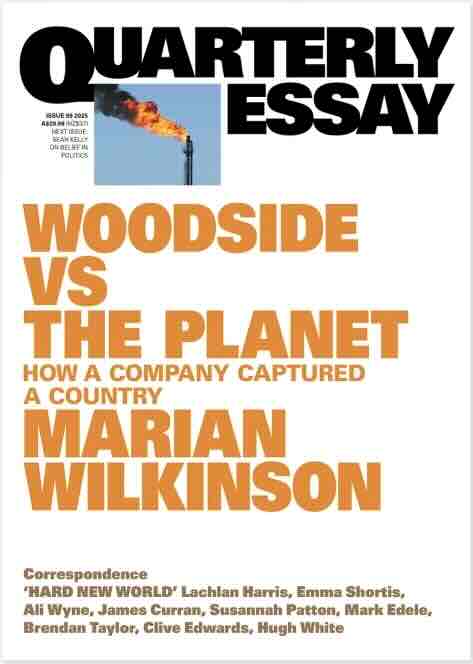
Marian Wilkinson, Woodside vs the Planet: How a Company Captured a Country (Quarterly Essay 99, 2025)
– plus correspondence in Quarterly Essay 100

Marian Wilkinson has a formidable CV as an investigative reporter. This substantial survey of the politics around the activities of Woodside Energy adds one more jewel to her crown.

The essay’s title and subtitle provide an excellent summary. Expanding it slightly: Woodside is expanding its gas extraction and export activities in a way that will contribute to global warming to an alarmingly dangerous extent, and they have gained the wholehearted support for this from successive Western Australian governments and Australian federal governments.

Three things aren’t included in that summary: first, the well organised, courageous and well informed opposition movement; second, the potentially disastrous impact of Woodside’s current and expanding activity on ancient petroglyphs on the Burrup Peninsula in Western Australia; third, the fact that fossil fuel industries have a limited life ahead of them.

A couple of years ago I visited the standing stones near Évora in Portugal. Our guide said that if the stones were in Spain they would be treated as a national treasure, but in Portugal they remained virtually unprotected in someone’s field. Well, if they were in Australia, and tens of thousands of years older, with infinitely more to tell us about human history, they would be left exposed to whatever pollution fallout might be created by a major industrial site nearby while scientists employed by the responsible corporation argued that there isn’t sufficient evidence of harm.

Marian Wilkinson is a journalist, not an advocate. But she is not in thrall to that concept of balance where you present any situation as a debate between two points of view, with no fact-checking or conclusion. Among the many people she interviewed for the essay is Meg O’Neill, CEO of Woodside, whom she quotes as saying that gas produces less greenhouse effect than coal, and that some gas is necessary as the world transitions to renewable sources of energy. But she doesn’t leave that as one equal side of an argument for and against. What emerges is an understanding that yes, gas will play a role in the transition to renewables, but Woodside and its supporters (or possibly dupes) in government and the media massively overstate how much gas will be needed. The profit motive overrides any concern for the common good.

I came to the essay with a heavy heart. In my mind Woodside was already a climate villain, Western Australia was a state that had been captured by the fossil fuel industry (or was even a virtual branch of it), and Woodside’s impact on the petroglyphs of the Burrup Peninsula was a slow-motion version of the blowing up of the Juukan Gorge by Rio Tinto. Nothing in the essay made me change my mind. Instead, it put paid to my lingering hope that the Albanese Labor government would make use of its large majority to face down the mining companies and their allies in the press. And it gave me a much greater understanding of what Wilkinson calls ‘the disruptors’: Disrupt Burrup Hub activists, some Indigenous traditional owners, and more.

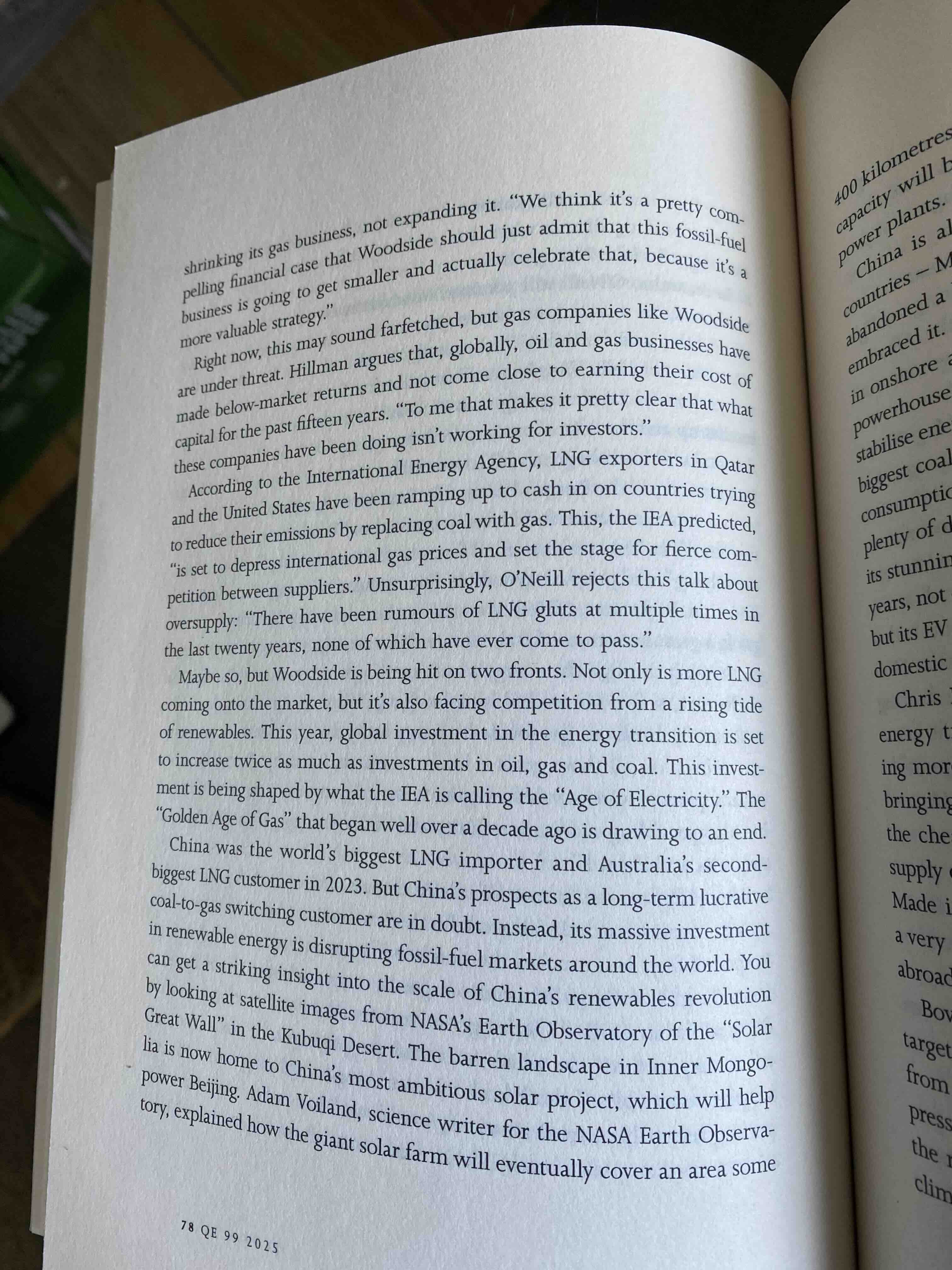
Page 78* is in the eighth and final section of the essay. Earlier sections have dealt with Meg O’Neill’s career, the growth of Woodside, the way Woodside has come to have such tremendous influence on government policy, the disruptors, the struggle over the petroglyphs, and the vision of ‘gas-fired futures’ shared by Woodside and governments. This final section – ‘Woodside in the Age of Accountability’ – introduces an element of hope, and urgency. It lists the tangible results of global warming so far, and quotes eminent scientists as saying that ‘the next three years will be crucial in stopping this seemingly inexorable rising of emissions’. On page 78, the full absurdity of Woodside’s favoured activities come to light:

[Alex Hillman, former Woodside climate adviser turned shareholder activist] said Woodside needs to think about shrinking its gas business, not expanding it. ‘We think it’s a pretty compelling financial case that Woodside should just admit that this fossil-fuel business is going to get smaller and actually celebrate that, because it’s a more valuable strategy.’
 Right now, this may sound farfetched, but gas companies like Woodside are under threat. Hillman argues that, globally, oil and gas businesses have made below-market returns and not come close to earning their cost of capital for the past fifteen years. ‘To me that makes it pretty clear that what these companies have been doing isn’t working for investors.’

So even from a purely capitalist perspective, Woodside’s expansion makes no sense. The fact that now the Trump administration is backing a huge Woodside project in mainland USA, as the essay mentions, only underlines that point. Short term gain, long term disaster all round.

Woodside is being hit on two fronts. Not only is more LNG [liquefied natural gas] coming onto the market, but it’s also facing competition from a rising tide of renewables. This year, global investment in the energy transition is set to increase twice as much as investments in oil, gas and coal. This investment is being shaped by what the IEA [International Energy Agency] is calling the ‘Age of Electricity’. The ‘Golden Age of Gas’ that began well over a decade ago is drawing to an end.
China was the world’s biggest LNG importer and Australia’s second-biggest LNG customer in 2023. But China’s prospects as a long-term lucrative coal-to-gas switching customer are in doubt. Instead, its massive investment in renewable energy is disrupting fossil-fuel markets around the world. You can get a striking insight into the scale of China’s renewables revolution by looking at satellite images from NASA’s Earth Observatory of the ‘Solar Great Wall’ in the Kubuqi Desert.

But CEO Meg O’Nell sticks to her guns.


Correspondence in Quarterly Essay 100 (The Good Fight by Sean Kelly) mostly reinforces Wilkinson’s argument. The world is not decarbonising fast enough to avoid dire consequences. Woodside’ activities aren’t helping. Peter Garrett discusses the politics. David Ritter focuses on Scott Reef, an extraordinary marine habitat that is under threat. Shane Watson and Kate Wylie from Doctors for the Environmental Australia describe the difficulties of appealing to existing laws to defend the environment.

Wilkinson says in her response to correspondents that ‘the gulf in thinking between the fossil-fuel industry and the climate movement in Australia was as wide as ever’. I had a brief moment of hope for a robust debate between these two perspectives when I saw that there was a contribution from Glen Gill whose bio says he ‘has over forty years of global experience in the petroleum and electricity industries, including in technical, commercial, regulatory and pubic policy areas’. Sadly, Gill manages to shout a lot. His first paragraphs refer to ‘wild, uninformed statements from activists’, describe the essay as ‘ridiculous’, ‘misleading’ and full of ‘fear, ignorance and hatred’. Marian Wilkinson doesn’t really bother to engage, except to say that the science he claims to rely on is ‘alas not climate science’.

Things are crook, but I’m glad there are people like Marian Wilkinson who are willing to look steadily around them and communicate what they see in clear, uncompromising prose.


I wrote the blog post on the land of Gadigal and Wangal of the Eora Nation. I acknowledge Elders past and present, and welcome any First Nations readers.


My blogging practice is to focus on the page that coincides with my age, currently 78.

The Melancholy of Resistance at the Book Group

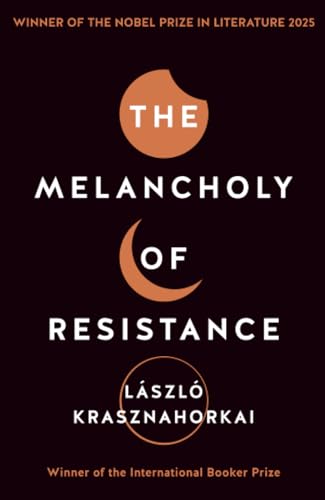
László Krasznahorkai, The Melancholy of Resistance (1989, translated by George Szirtes, published by Tuskar Rocks Press 2000)

Before the meeting: László Krasznahorkai won the 2025 Nobel Prize in Literature. The Melancholy of Resistance (Hungarian title Az ellenállás melankóliája) was his second novel. Written as the Communist regime was collapsing in Hungary in 1989, it centres around an outbreak of senseless mass violence in a small Hungarian town. In real life, happily, the transition from Communism to a version of democracy was peaceful, but the book’s nightmarish vision and weird allegorical tale resonate far beyond its immediate political context.

One thing was clear to me as I read: this book, with its absence of paragraph breaks, long internal monologues about, for example, esoteric musicology, a key character who remains unseen and unheard except for weird chirping sounds, and many story lines that peter out or are resolved with a throwaway comment in the middle of something else, could never be made into a film. I was wrong. In 2000 (the year this translation was published), Béla Tarr adapted it in Werckmeister Harmonies, which has been called ‘one of the major achievements of twenty-first-century cinema’ (an impressive accolade, even if it was written in the YouTube comments section).

I haven’t seen the film, but I can’t think of a better way to convey the feel of the book than to show you its trailer:

There you have it: the young, naive idealist who may well be the idiot people think he is; the old, disillusioned musicologist; the corpse of a huge whale wheeled into town; the ominously silent crowds of men; the awful mob violence; the invading military (though I don’t remember a helicopter in the book). Some elements are missing, though I expect they’re in the movie itself: a mysterious character known as the Prince, two children caught in the crossfire, and the key roles of two women. Nor do the streets of the movie seem quite as covered in frozen garbage as those of the novel.

The book’s most striking feature is absence of paragraph breaks and the predominance of long sentences. The sight of page after page of uninterrupted text is intimidating at first, and it’s annoying having to hunt around if you lose your place, but the effect on the page, as I imagine it is on the screen, is a dreamlike flow. And George Szirtes’ has translated the Hungarian into extraordinarily smooth English that enhances that effect. This isn’t Proust, where the sentences turn in on themselves, clauses nesting within clauses, with a hypnotic, introspective effect. Here the effect is more propulsive – the long sentences sweep you on. And they work brilliantly in a book where characters are always in motion (even if sometimes the motion is mental). They walk, stumble, run errands, occasionally waddle, stalk, pursue, flee, but always move.

It’s as if the characters can’t stop for breath, so the text has to hold out for as long as it can without a full stop, and even longer for a bit of white space.

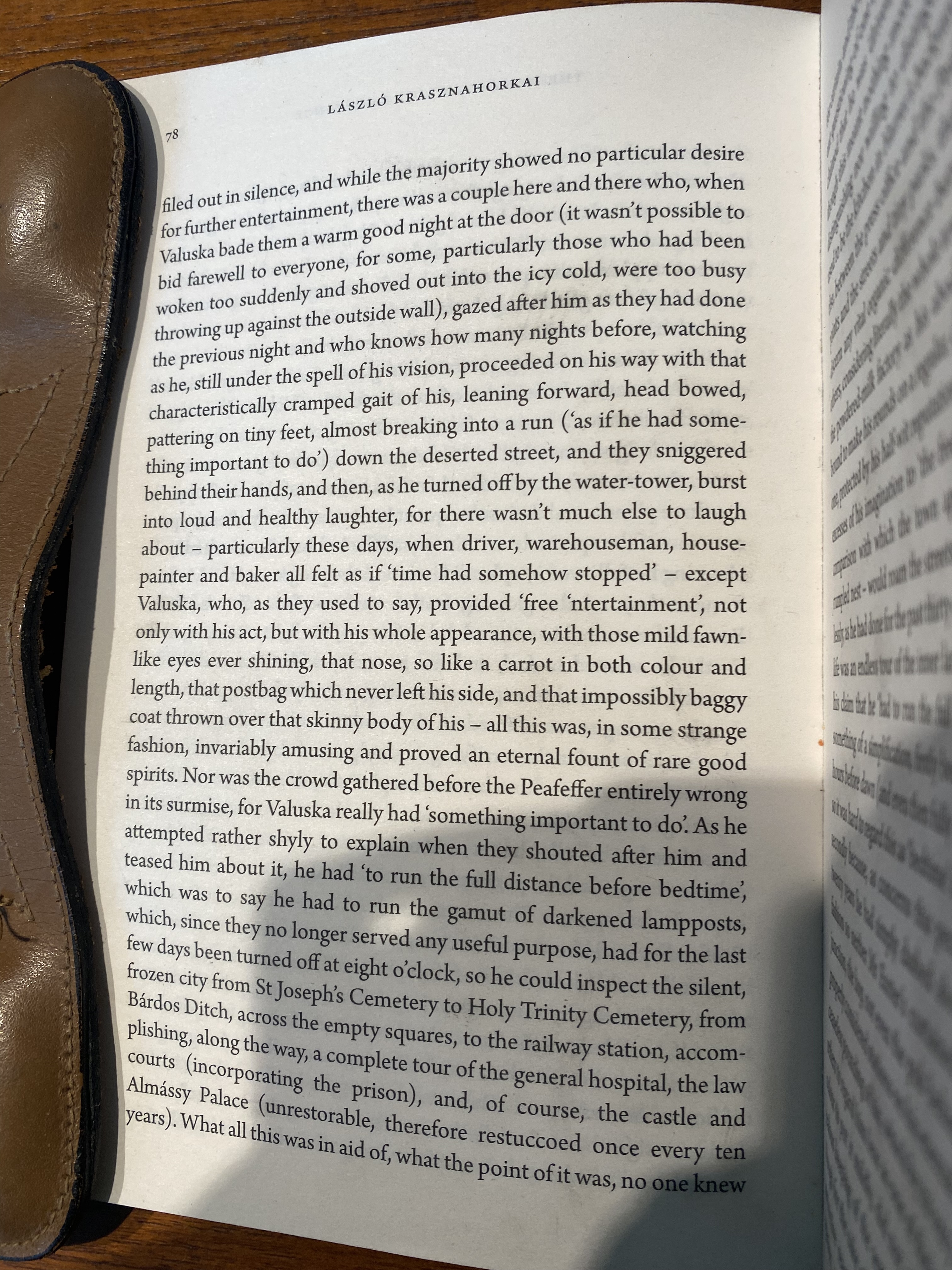
Page 78* occurs partway through the third paragraph/section, which unfolds from the point of view of Valuska, a kind of holy idiot and easily the book’s most sympathetic character. Valuska has been introduced doing his nightly routine at closing time in the Peafeffer tavern, in which he demonstrates the mechanics of a solar eclipse, deploying three paralytic drunks to represent the sun, the moon and the earth. His attempt to communicate the awe-inspiring order of the cosmos is tolerated by the drinkers as a way to delay closing time. At the top of this page, the evening is over and they walk out into the cold night:

The first thing to note about this page is that, counting the sentence that started on the previous page, there are just three sentences. The middle one is quite short: at 20 words it may be the shortest in the book, but is otherwise unremarkable. The others are typical of the book.

It would please my inner 11-year old Queenslander to analyse one of them – identify the main clause and the subsidiary clauses, and the nature of the subsidiary clauses. It probably wouldn’t be very entertaining for my readers, so I’ll limit myself to noting that the basic structure of this:

So they filed out in silence, and while the majority showed no particular desire for further entertainment, there was a couple here and there who, when Valuska bade them a warm good night at the door (it wasn’t possible to bid farewell to everyone, for some, particularly those who had been woken too suddenly and shoved out into the icy cold, were too busy throwing up against the outside wall), gazed after him as they had done the previous night and who knows how many nights before watching as he, still under the spell of his vision, proceeded on his way with that characteristically cramped gait of his, leaning forward, head bowed, puttering on tiny feet, almost breaking into a run (‘as if he had something important to do’) down the deserted street, and they sniggered behind their hands, and then, as he turned of by the water-tower, burst into loud and healthy laughter, for there wasn’t much else to laugh about – particularly these days, when driver, warehouseman, house-painter and baker all felt as if ‘time had somehow stopped’ – except Valuska, who, as they used to say, provided ‘free ’ntertainment’, not only with his act, but with his whole appearance, with those mild fawn-like eyes ever shining, that nose, so like a carrot in both colour and length, that postbag which never left his side, and that impossibly baggy coat thrown over that skinny body of his – all this was, in some strange fashion, invariably amusing and proved an eternal fount of rare good spirits

is five linked principal clauses:

So they filed out, and a couple gazed after him, and they sniggered, and then burst into laughter, for there wasn’t much else to laugh about.

That skeleton is adorned with images of the bitter cold, vaguely comic drinkers throwing up, descriptions of Valuska, an explanation of what they found amusing about him, and a reminder of the drinkers’ wider context – ‘driver, warehouseman, house painter and baker’.

Valuska stands out: time has ‘somehow stopped’ for the town in general, but he is fascinated by the continuous movement of the heavenly bodies and is himself always on the move. That stopped-ness comes into focus in chilling scenes in which the town square is full of motionless men, all as if waiting for something. And when they move, the effect is shocking, violent.

I don’t know that I’d recommend the book, but I enjoyed it, and it has stayed hauntingly in my mind. It makes many other books feel like plodding reportage.

After the meeting: This was one of the best meetings of the book group ever. We exchanged gifts – everyone was supposed to bring a book from their shelves, though the book I received (a Gary Disher title) is in suspiciously mint condition. Some of us read poems – by Adrian Mitchell, Mary Oliver, Simon Armitage and Robert Gray. We reminisced about the group’s history and argued about how firmly fixed our list of dates for the year should be. We shared stories of courage and shame. We ate well. We enjoyed the early summer evening. And we had a wonderfully animated discussion of the book.

Three out of eight of us had read the whole thing. A number of others were well under way and intend to finish it. Everyone had something to say. Here are some of my highlights.

I was reading Mrs Dalloway a couple of pages a day alongside of The Melancholy of Resistance, and felt strongly that the books spoke to each other but couldn’t say how. When someone mentioned the way the narrative focus transfers from one character to the next at the end of each section, I realised this is one of the similarities: where Virginia Woolf’s narrator slips from one character’s mind to another sometimes several times on a single page, Krasznahorkai’s narrator does a similar thing, but on a much wider arc.

One man read the book not realising it was more than 30 years old, and the political dimensions of it seemed right up to date. I don’t know if he mentioned the MAGA riots in January 2020, but they certainly seemed relevant.

Someone said it was hard to resist a book where a character spends four pages trying to work out the physics of hammering a nail while repeatedly hitting himself on the thumb. And then, having solved the problem by acting without thinking about it, he is told by his cleaning lady that he’s done it all wrong. Our group member who has been studying philosophy told us that this is even funnier when you know that one of Heidegger’s most famous passages involves a hammer. (That person’s favourite moment is Mr Eszter’s seemingly interminable rumination about the pointlessness of the diatonic scale (at least that’s what I think it’s about) – which was my second least favourite moment.)

Contrary to my own response, one man felt the book was intensely cinematic. And as we talked it was clear that it’s full of memorable scenes. We reminded each other of the scene where Valuska demonstrates the mechanics of an eclipse, the interrogation scene, the force with which Mrs Eszter’s hand comes down on Valuska’s shoulder to stop him from speaking, the horriific scene where the mob runs riot in the hospital, the brilliantly evoked streets full of frozen garbage, and more.

At heart, one man said, it’s a love story between Mr Eszter, an intellectual who has given up any hope that thinking could be of value, and naive, well-meaning Valuska.

And that’s a wrap for the Book Group for 2025.


The Book Group met on Gadigal land, and I have written this blog post on the land of Gadigal and Wangal of the Eora nation. I acknowledge Elders past and present of those clans, and welcome any First Nations readers.


My blogging practice is to focus on the page that coincides with my age, currently 78.

Tug Dumbly’s Tadpoems

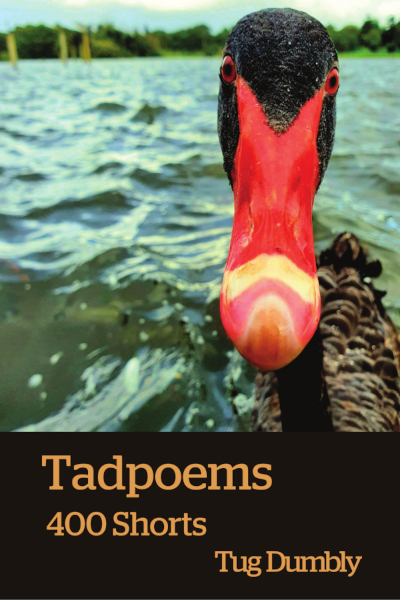
Tug Dumbly, Tadpoems: 400 Shorts (Flying Island Books 2024)

Most poetry books are at least a little intimidating to most people. Tadpoems is not one of them.

In an introductory note, Tug Dumbly (offstage name Geoff Forrester) calls the poems ‘little squibs’ and explains that many of them were born on walks, his mind ‘conversing with whatever it passes at the moment … or maybe just playing with words’. Most of them first appeared on Facebook. ‘A few,’ the note continues, ‘are shameless life-support systems for dad jokes’. It’s rare for a book of poetry to include such a clear and unassuming account of itself.

In addition to the 400 tiny poems, there are more than 40 photos, many of water scenes around Sydney, and close-ups of insects, birds and plants. The book is not only accessible fun, it’s also gorgeous.

It’s a book to be dipped into, enjoyed a moment at a time.

Many of the poems nudge the dad joke genre towards something satirical of even at times profound. One of my favourites:

After too much talk in the cultural hub
it's good to wing home over a bay
of beautiful banality.

I like this too:

Recycle.
Be re-astounded
by the same dear things.

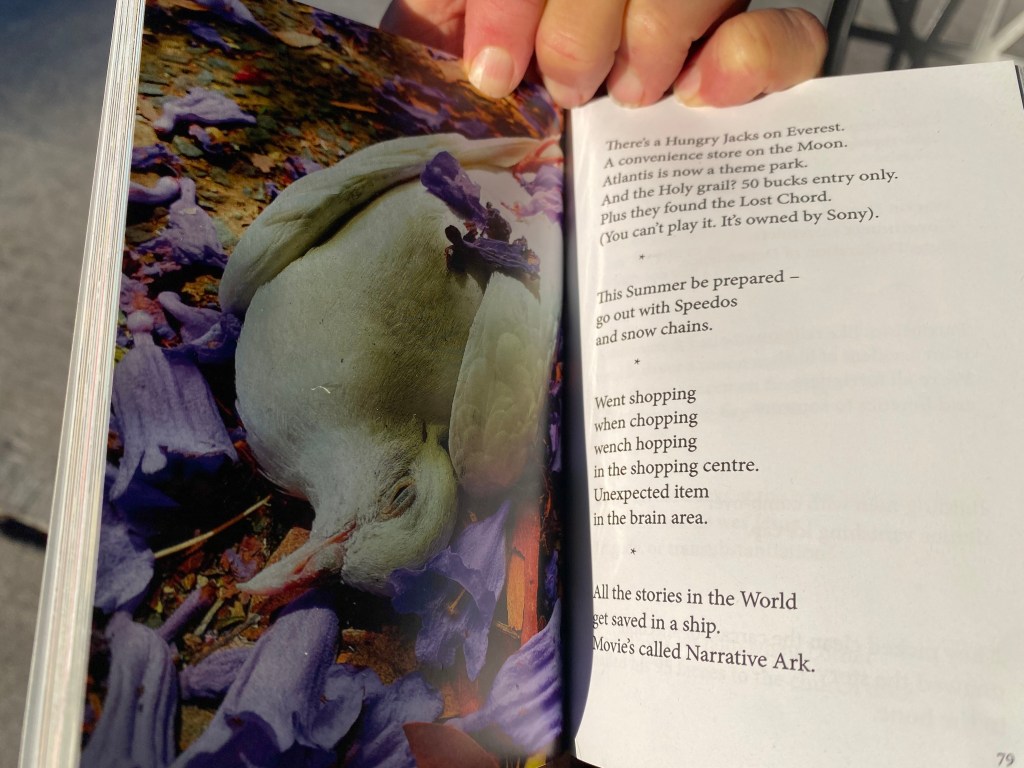
Page 78* is a striking photo of a dead seagull among fallen jacaranda blossoms – a very Sydney image, and not at all typical of the abundant life in most of the book’s images. There are four ‘tadpoems’ opposite:

The poems include a throwaway, bitter criticism of the commodification of everything, ending with a mildly erudite reference to Arthur Sullivan’s song ‘The Lost Chord’:

Plus they found the Lost Chord.
(You can't play it. It's owned by Sony.)

There’s a not-quite-successful joke about changeable weather, and a pun on lit crit terminology. I wouldn’t mind seeing the movie Narrative Ark

And a bit of wordplay that is exactly the kind of thing you can imagine happening in a wordy person’s mind as they go walking:

Went shopping 
when chopping
wench hopping
in the shopping centre.
Unexpected item
in the brain area.

It’s silly and makes no claims for itself, but something sticks. The last two lines could refer back to the first three. A paraphrase would be, ‘That discovery of homophones that just popped into my head is unexpected.’ A humourless discussion of the poem might use terms like metapoetic or recursive. One nerdy person might see a reference to shopping malls as pickup locales (I just googled “shopping mall pickup” and sure enough it’s a porn trope). Another might see the poem as enacting an important non-linear mode of mental activity. I think they’d be right, but I’d be too busy moving on to the next ‘squib’ to join the conversation.

It’s a friendly, unpretentious book. Reading it is a bit like going for a walk with someone who points out interesting things in the environment, and who shares his thought bubbles. He’s good company.


I have written this blog post on the land of Gadigal and Wangal of the Eora nation. I acknowledge Elders past and present of all those clans, and welcome any First Nations readers.


My blogging practice is to focus on the page that coincides with my age, currently 78.

David Adès’ Heart’s Lush Gardens

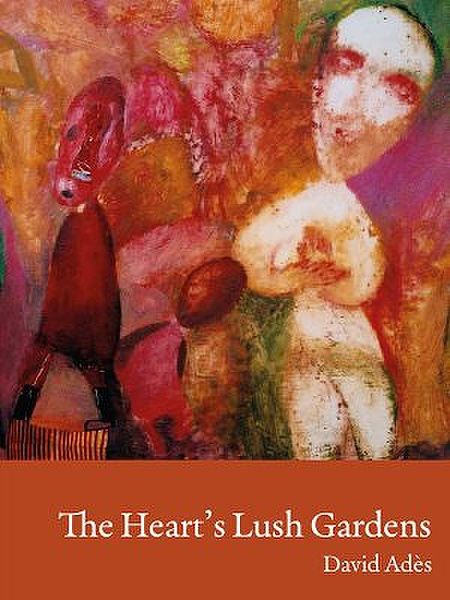
David Adès, The Heart’s Lush Gardens (Flying Island Books 2024)

Apart from being a poet, David Adès is a podcaster. On Poets’ Corner, described on YouTube as ‘WestWords’ monthly encounter with celebrated Australian poets’, he has presented more than 50 poets, from Ali Cobby Eckermann to Mark Tredinnick. I could have linked to his conversation with Nathanael O’Reilly when I recently blogged about O’Reilly’s Separation Blues.

The Heart’s Lush Gardens, part of the Pocket Poets Series edited by Christopher (Kit) Kelen, is his fourth book. An introductory note dedicates it to the men in his men’s group, which has been meeting since 1992. ‘These Are the Men’, the title poem of the second of the book’s three sections, echoes that dedication:

Into their hearts' lush gardens
they took me,
gardens of unexpected flowerings
amid bracken and tangles of vines,
gardens where the soil had been laid bare
and seeds planted,
where I am welcome to roam and return.

That so resonates with the joy I remember feeling in my first consciousness-raising group (that’s what we called them in 1976).

This is not the only appearance of the men’s group, and masculine identity and the experience of being a man are broached in many other poems. ‘Slingshot’ imagines David facing Goliath without that weapon; ‘Small Man’ grapples with male entitlement (‘I am a small man in the house of my white skin, the skin of privilege’). The first poem in the book, ‘From Which I Must Always Wake’, is a complex, raw seven pages on heterosexual desire and relationship.

There’s a lot more. I’ll just mention ‘Ripples’, which a note tells us was inspired by a water-damaged original copy of someone’s thesis and poetry manuscript that Adès spotted abandoned on the footpath. The poem’s speaker addresses the writer of the lost work:

This is what you do not know:
who picks up the petal

you have dropped into the Grand Canyon,
who looks upon it in wonder

as if upon the first petal

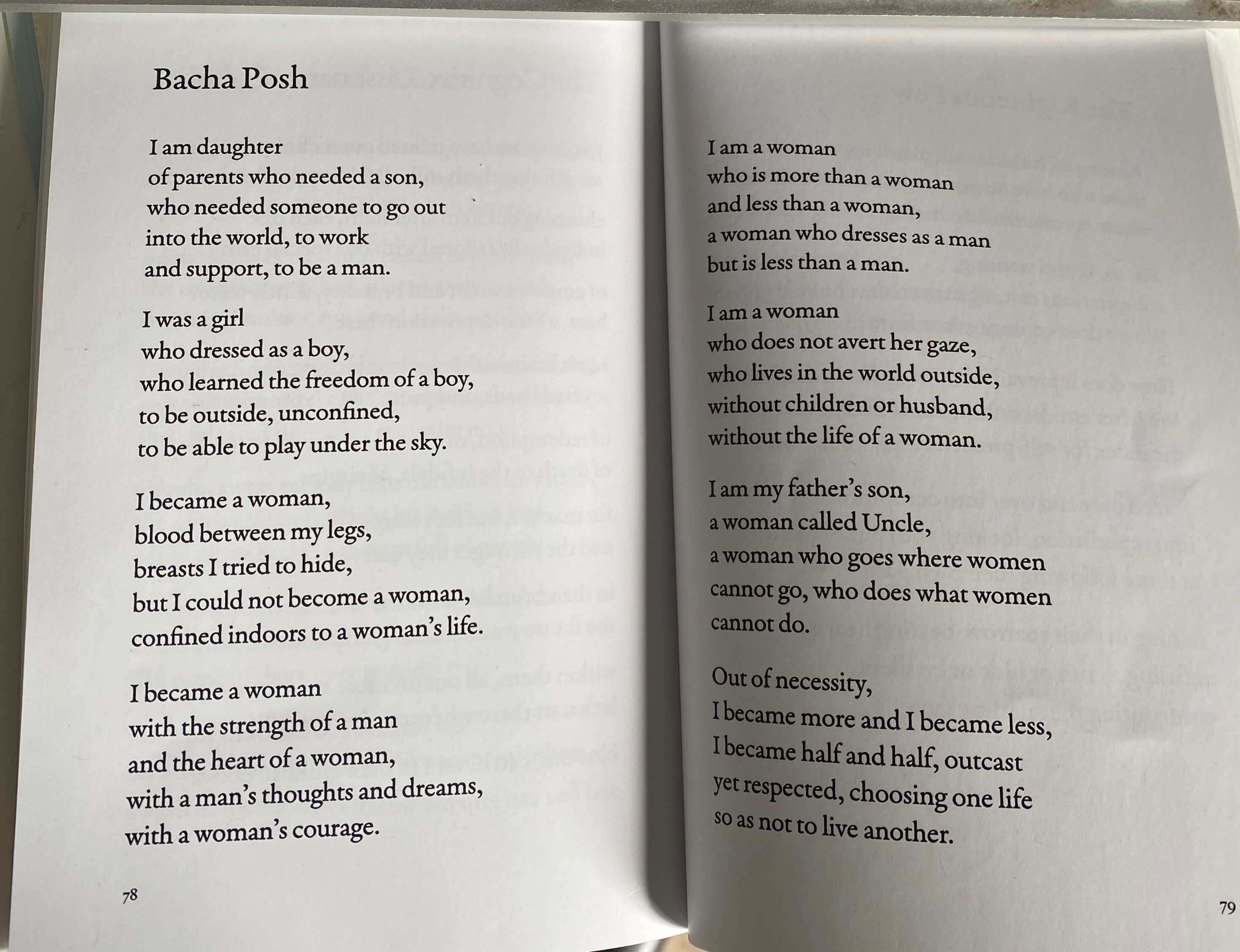
My arbitrary practice of looking at page 78* has borne fruit once again. The fine poem ‘Bacha Posh’, which starts on that page, has an interesting take on gender.

According to its Wikipedia entry, bacha posh is a practice in Afghanistan in which, often motivated by poverty, some families will pick a daughter to grow up as a boy. I probably didn’t need to look that up to understand the poem – but it’s good to know that it refers to an actual practice.

I don’t know David Adès, but I’m assuming he’s a cis man, and so likely to be regarded with suspicion if he enters the current public conversation about gender, and in particular trans issues. The practice of bacha posh gives him a way of letting his mind play over aspects of gender, and gender non-conformity, and invite readers to join him. Here, the non-conformity is imposed on the child rather than arising from an inner motivation such as gender incongruence.

This is a terrific example of a poem doing something that would be hard to do in a prose essay. It’s not arguing a case or offering an opinion. You could say it makes music from the language of gender. A handful of words and phrases repeat, almost like chiming bells. I don’t know how well this will work on the screen, but here is a nerdy look at how the gendered words and verbs of being and becoming occur in the poem.

I am daughter
of parents who needed a son,
who needed someone to go out
into the world, to work
and support,
to be a man.

I was a girl who dressed as a boy,
who learned the freedom of a boy,
to be outside, unconfined,
to be able to play under the sky.

I became a woman,
blood between my legs,
breasts I tried to hide,
but I could not
become a woman,
confined indoors to a woman's life.

I became a woman
with the strength of a man
and the heart of a woman,
with a man's thoughts and dreams,
with
a woman's courage.

I am a woman
who is more than a woman
and less than a woman,
a woman who dresses as a man
but is less than a man.

I am a woman
who does not avert her gaze,
who lives in the world outside,
without children or
husband,
without the life of a a woman.

I am my father's son,
a woman called Uncle,
a woman who goes where women cannot go,
who does what
women cannot do.

Out of necessity,
I became more and I became less,
I became half and half, outcast
yet respected, choosing one life
so as not to live another.

I didn’t notice until I did that exercise that the final stanza no longer has any gendered words, an eloquent absence. In addition, it repeats the phrase ‘I became’, the phrase of transition, three times. And, in contrast to the first stanza where the poem’s speaker has no agency (‘I am daughter / of parents who needed a son’), here he/she is engaged in a dynamic continuous act of choosing.

Having done that little erasure experiment, I now see that there are other bells in this chime. Active verbs are scattered throughout, appearing more densely towards the end (‘goes’, ‘go’, does’, ‘do’, ‘live’); and the prepositions ‘with’ and ‘without’ have a sort of call and response between stanzas 4 and 6.

Apologies for the nerdiness of this, but if you’ve got this far I hope you’ve enjoyed looking with me. I hope it, and the poem, make a small contribution to Trans Awareness Week, 13–19 November.


I have written this blog post on the land of Gadigal and Wangal of the Eora nation. I acknowledge Elders past and present of those clans, and welcome any First Nations readers.


My blogging practice is to focus on the page that coincides with my age, currently 78.