Category Archives: Page 7x/47/7

Staples and Vaughan’s Saga 11

Fiona Staples and Brian K. Vaughan, Saga, Volume11 (Image 2023)

On Christmas morning, I found my granddaughter lying on the bedroom floor exercising her new reading skills on this book, a gift to me from her father.

‘Um,’ I said, ‘that book is really for grown-ups, not for kids.’ She took the hint, and went out to play with her tiny beads and figurines.

I did a quick check for any of the grossness that occasionally featured in the previous ten volumes. The elliptical text of the first chapter would bemuse any newcomer to the world of Saga, however practised at reading, and the one obscenity is tucked away discreetly at the bottom of a page. So far so good! And there was mostly no cause for alarm: conversations among odd-looking people (horns, TV screen faces, wings, a beak, a pig-snout, that kind of thing), a green cat, stars and planets, sundry science-fiction paraphernalia. But oh dear: a full-page nightmare figure with a horned skull and a hole blown through his chest; a naked man and woman side by side on a bed, the woman full frontal, the man face down, then more images of the woman as she gets up and dresses.

I don’t expect any lasting damage was done, but the Saga series is not for small children.

On the other hand, if you’re an ex-child looking for an introduction to the joys of comics/graphic novels, this series would be a great place to start. (Not if you’re looking for evidence that the comic form can be deeply serious. For that, you could try Art Spiegelman’s Maus, or Joe Sacco’s Palestine. Saga does have serious themes, but mostly I read it for fun. Even those moral-panicky images in the first chapter turn out to serve a comic narrative – the nightmare image really is someone’s nightmare, and the naked couple are about to be sprung by a young person who scathingly disapproves of their hooking up.)

Don’t start with this volume. The series has been going for more than a decade, over 66 single issue magazines. What started out as a kind of space-operatic interspecies Romeo and Juliet story, as narrated by Hazel, the daughter of the forbidden union, has expanded to include a vast gallery of weird characters, and at least half a dozen locales and plot lines that progress in parallel. This volume doesn’t bother with a Story So Far. I did remember major plot points such as the death of a main character and the destruction of a home, and I recognised most of the characters, including Hazel herself and her immediate family, the cute but lethal Ghüs, and the dangerous green cat that calls out any lie. Before I read Volume 12 (may it come soon), I’ll make a point of reading all the preceding volumes. But Hazel’s narrative voice is strong, and the sense of her jeopardy keeps me emotionally engaged in the midst of all the bewildering complexity, the occasional violent spectacle, and by this time almost safe-for-work sexual scenes.

Brian K Vaughan is a brilliant storyteller, and Fiona Staples, who does all the art (pencils as well as inks and lettering), is equally brilliant.

The pages aren’t numbered, but here’s what I take to be page 76*.

There’s a lot that’s not on this page: no Hazel, who is now a teenager, and none of her laconic, hand-lettered commentary; none of Hazel’s immediate family; none of the TV-faced characters whose screens reveal their true thoughts and desires if they’re not careful; no sex and only the implied threat of violence; no spectacular space vistas.

It’s the second page of chapter 64. You can see how it moves the story along: the dark-winged character, clearly some kind of vampire, is hunting for Alana, Hazel’s mother. Though we don’t learn for sure that the smart-mouthed frog is who the winged man thinks he is, Fiona Staples’s creation of the characters is so distinctive, and for that matter so is Brian K Vaughan’s dialogue, that we can be confident that he is lying when he denies being him. He’s one of the good guys, one of the many creatures who have Hazel’s wellbeing at heart. We guess, correctly, that his yarn about ‘the other guy’ will lead somewhere interesting.

There’s something fabulous about a frog complaining about racism, and Saga as a whole can be read as a fable about racism: Horns and Wings must not mix. It’s not one of those comics that panders to the readers who complain when there’s a Black character in Star Wars or Captain America is a woman, any more than it kowtows to the moral guardians who clutch their pearls at the sight of a naked penis.

And look at that glorious artwork. First we’re inside a diner out of 50s US television, then the outside ‘shot’ has us back in the space opera. The setting doesn’t distract from the action, but roots it in a particular place. There are details that raise narrative questions. For instance, whose is the backpack and almost empty plate opposite the frog, and why is there a trunk under the table? One of those questions is answered two pages later.

Saga may not be suitable for six-year-olds, but I recommend it for anyone at least three times that age.


* That’s my age. when blogging about a book, I sometimes focus on page 76 to see what it shows about the book as a whole.
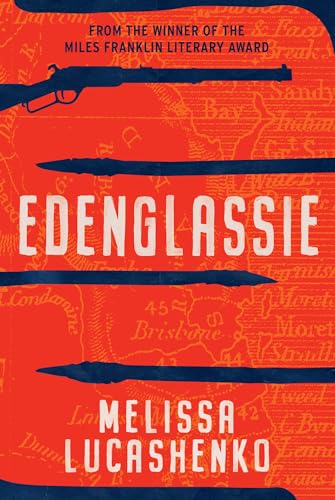
Melissa Lucashenko’s Edenglassie, page 76

Melissa Lucashenko, Edenglassie (University of Queensland Press 2023)

If you’ve been paying attention, you know that Edenglassie, a portmanteau of Edinburgh and Glasgow, was briefly the name for part of what is now Brisbane, and this book is a historical fiction set there in the 1850s, when First Nations people outnumbered settlers along the Brisbane River, a time of armed resistance to colonisation, and a time of genocidal atrocities including those committed by the notorious Native Police.

My blogging practice of focusing on page 76 (my age) comes up with a passage that at first seems a long way from that subject. For a start it’s set in Brisbane in 2024, the bicentenary of John Oxley’s sail up the Brisbane River, and begins with a genial picture of a weekend market that could be in any western city:

Winona weaved a path through the many bodies at the market. The young and the elderly; the able-bodied and the infirm; the slender hipsters; the defiantly fat, the tattooed, the pierced, the dull suburban middle-class and the fabulously wealthy. All these met in the mecca of the inner south, held there in the tight Kurilpa loop of the river which, having embraced you, was mighty slow to let you go.

The market is complex and inclusive, or at least tolerant. ‘Kurilpa’ tells you, if you have a web browser handy, that the city is Brisbane: the Kurilpa precinct borders on South Bank, and what was once the Tank Street Bridge is now the Kurilpa Bridge. The way the narrator uses the word suggests that it is more than a simple place-name, hinting at an Indigenous perspective: the river has agency, embracing and slow to let go.

As the paragraph continues, a character moves through the scene:

Winona wasn’t much interested in the crowd; she’d been caught instead by a steady pulse, thrumming from afar. She followed the sound of the didgeridoo dragging her to the far edge of the park, eager to see if she knew the fella playing, and discover what other Blak mob were around. Hopefully, Winona thought, she’d find a little oasis of Goories there to replenish her spirit, weakened from the hours she’d spent lately in the soul-sucking hospital.

‘Blak’ and ‘Goorie’ make it clear where we are, though readers from outside Australia may need their pocket browser here too. ‘Blak’ is a self-description currently used by many urban First Nations people as a way of ‘taking on the colonisers’ language and flipping it on its head’ (the quote is from an article on artist Destiny Deacon, at this link). Winona is a young, politically aware Indigenous woman. The narrative cleaves mostly to her point of view, but it’s interesting to notice that here they part ways briefly: the narrator sees and enjoys the crowd, and virtually tells us in so many words that the ancient Kurilpa embraces that various crowd as well; Winona is committed to an ‘us and them’ perspective. The non-Indigenous crowd is like a desert to her.

I won’t quote the rest of the page. Suffice to say that when she finds the didgeridoo player, he’s a white hippy who claims to be Indigenous – a coloniser, a thieving dagai, as Winona sees it – and her violent outrage lasts for several richly comic pages.

Once I got past my initial sense that this page wasn’t from the interesting, historical narrative, I realised that many of the novel’s key themes are suggested in it.

Winona is the central character in the near future part of the novel, where the main narrative thread is her budding romance with Doctor Johnny, a man of questionable indigeneity (though less questionable than the didge player’s). Her grandmother, whom she has been visiting in hospital, is leveraging her claim to be Queensland’s oldest Aboriginal to secure a major role in Brisbane’s bicentenary celebrations – and an apartment. So there’s romcom tension, trickster play, and a generally comic tone. At the same time, the narrative is firmly embedded in an Indigenous perspective – or perspectives, really, as Grannie Eddie and her ancient friends see things differently from the militant Winona, and Johnny, a child of the stolen generations, brings yet another point of view. Winona’s rage at the hippy didge player is a contrast to her almost flirtatious hostility to Johnny. Her indifference to the complex everyday crowd plays off against Granny Eddie’s generously inclusive concept of Aboriginal sovereignty.

It’s especially interesting to note the way these paragraphs are linked to the historical story. Words that in 2024 feel like cultural reclamation or perhaps remnants of lost language – dagai, Kurilpa – are part of ordinary speech in 1854. Just as the hippy claims an Indigenous identity, a white man back then – Tom Petrie, grandson of a pre-eminent settler in Brisbane, and in the process of taking on a sheep property in his own right – claims the status of an initiated man: it’s not an exact parallel, as Tom’s claim, like that of the real-life Tom Petrie, has the approval of elders. But as he invites his ‘brothers’ to work for him a tremendous unease develops: certainly I spent a good deal of the book dreading that he would betray his close friends, his initiated ‘brothers’. It would be spoiling to tell you if he does.

Like the 21st century story, the historical narrative centres on a romance between two First Nations people with very different relationships to traditional culture. Mulanyin is a traditionally raised young man who is in Kurilpa as a guest of an established family. In the early parts of the book, he goes naked around town – he only starts wearing trousers to protect his fertility when he starts riding horses. Nita has been taken as a servant to the prestigious Petrie family, who are relatively decent in their relationships to the local people. Nita is a Christian, always modestly dressed, and attuned to her employers’ desires and expectations.

The river is a powerful presence in both stories. The apparent throwaway line about how ‘having embraced you, [it] was mighty slow to let you go’ rings a lot of bells. It’s crossed by bridges and features the bicentennial celebrations in 2025; it’s a source of food and site of dramatic events in 1854. It remains the same river.

As I write this, I’ve read about half of David Marr’s Killing for Country, an unsparing account of frontier violence in eastern Australia, focusing in part on the Native Police and quoting extensively from breathtakingly brutal contemporary settler writing. The Native Police are a threatening presence in Edenglassie, and there’s devastating genocidal violence, but it happens offstage. Even a scene where Mulanyin intervenes in the humiliation of another man is reported by a character rather than told to us directly by the narrator. Where David Marr conveys the horror of our history, Melissa Lucashenko does the herculean task of imagining what it was to live with a strong connection to country, tradition and community while the horrors were multiplying all around, and up close.

We discussed this book along with Debra Dank’s We Come With This Place at my Other Book Club – the one that used to be just for swapping books with minimal discussion. Not everyone was as moved by it as I was. Unfortunately, or fortunately, I can’t tell you how the unimpressed readers saw it because I’m so dazzled by its achievements.

Lauren Groff’s Vaster Wilds

Laurn Groff, The Vaster Wilds (Hutchinson Heinemann 2023)

If you picked this book up in a shop or the library and turned to page 76, these are the first two paragraphs you’d see:

By now, the twilight had begun to thicken, however; and she had to find some shelter before thick night came on full of its roving predators. She sensed that it would be a very cold night as well.
When she stood, she found she had a hard time moving swiftly; she was so stiff and sore from her long walk.

You might gather that this was a story about a woman alone in a wilderness. You might notice a couple of quirks in the language: ‘twilight had begun to thicken’ with its awkward echo of Lady Macbeth’s ‘Light thickens, and the crow makes wing to the rooky wood’; the slightly archaic feel of ‘roving predators’ and ‘swiftly’. You might surmise that the action of the novel takes place in the not very recent past.

By the end of the page, the character has found shelter, ‘a little black space carved out of the rock wall of a ridge’. The cave exhales ‘a strange and musty warmth’:

Something in her said to her that she must be cautious, and she made herself go slowly and silently. But soon the coldness of the night oncoming frightened her more than the cave with all its menacing unknowns. She ducked low into the black space and felt instantly that it would be warm enough and out of the melting wet at least. It smelled dank and thick in there. The darkness welled and seemed to pulse at the back of the cave.

More of the archaic feeling in the language, not so much in the vocabulary as in the cadence and word order: ‘Something in her said to her’, ‘the night oncoming’, ‘the melting wet’. And the surmised threat of roving predators of the first paragraph has become more immediate, though still intangible, in the dank, thick, pulsing darkness. On the strength of this page you might expect something like a novel equivalent of the TV series Alone. And you’d be mostly right.

The novel begins with a character, known only as ‘the girl’ for the first hundred pages or so, running through forest in what we come to understand is the North American continent in the late sixteenth century. She has been brought from england (the book spells all places and nationalities without initial capital letters) as a servant, and we learn that she has committed some great crime and is running to escape retribution.

A number of questions are raised early: what was the girl’s crime? will she escape her pursuers and avoid whatever attackers, human and otherwise, she might encounter (see cave above)? what are we to make of her assumption that the ‘people of this place’ are savages to be feared? will her Christian world view be affected by her experiences in the wilderness? will she find the safety, even the ‘saviour’, she hopes for? These questions create a forward impetus, and the girl’s gradually revealed back story fleshes out her character, but it’s the narration’s attention to the detail of her life in the wild that most engaged my attention.

It took me maybe a hundred pages to get over my irritation with the olde worlde language: I was going to say there are too many untos, then realised there was probably only one, but that is too many. Your mileage may vary. I was uneasy with the treatment of the Native Americans on the periphery of the narrative, but that unease was elegantly dealt with, first with humour when in a rare departure from the girl’s point of view a couple of Native children see her and fall abut laughing at her incompetence in their environment; and more sombrely in the final movement as she reflects on her possible misunderstanding of near-encounters.

I’m not a fan of the individual-against-the-wilderness genre, so I’m not really part of this book’s intended readership. I did finish it, partly because I was reading it for my Book Club and felt obliged. I can see that it’s a very good book, and I especially appreciate the way it uses the genre to probe at the roots of the genocidal encounters of colonisation, without having the heroine be adopted by a Native tribe. We’ve come a long way since Booran by M J Unwin, which I studied at school in 1962, or Patrick White’s A Fringe of Leaves.

The Book Club I read it for is the one that formerly banned any book-discussion that lasted more than 30 seconds, but has now become more conventional. It was paired with Melissa Lucashenko’s Edenglassie. We had animated discussion of both books.

Debra Dank’s We Come With This Place at the book group

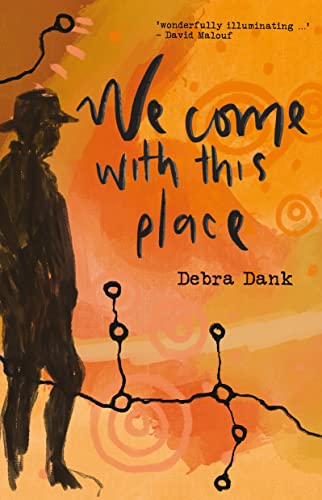
Debra Dank, We Come with This Place (Echo Publishing 2022)

Before the meeting: We Come With This Place won an amazing four prizes at the NSW Premier’s Literary Awards this year, including Book of the Year: you can read the judges’ comments here and here. They include this:

This sensational memoir is an unheralded reflection on what it is to be First Nations in Australia, and on the very deepest meanings of family and belonging.

In one of her modest acceptance speeches at the awards ceremony, Debra Dank mentioned that the book started out as part of her PhD study. In the Preface, she elaborates:

I wanted to show how story works in my community and how it has contributed to our living with country for so long. It seemed to me imperative to talk about those voices, both human and non-human, who guided Gudanji for centuries before anyone else stepped onto this land.

(page viii)

The weeks after the referendum on the Voice failed seemed a perfect time to read this book. The Uluṟu Statement from the Heart’s call for Voice, Truth, Treaty has been rejected at the political level: it’s a relief to listen to the voices of First Nations writers like Debra Dank, and participate in this form of truth-telling.

It’s a terrific book: an intimate portrait of family life, placed in the context of ancestral stories, a deep sense of connection to Country, and resilience in the face of the horrors of colonialism. The family lived ‘under the Act’ in Queensland, and managed ingeniously to hide little Debra when the Welfare came looking for light-skinned children; her father worked on a number of rural properties, where sometimes he was treated with great respect, other times not so much. She helps her father work on a windmill. There is a tactfully written scene where she stands up against family violence, and magical moments with her grandfather, and with her children and grandchildren. I love the pages where Dank’s white surfie husband (he’s saltwater, she’s dust) struggles to learn how to read the bush, to see the things that are glaringly obvious to his Aboriginal children.

Dank identifies as belonging to dry country, and she makes brilliant use of images of dust. On the very first page, ‘vague images try to speak to [her] through dust motes rising from the thick pale pages’ of a 400-year-old edition of a book by Aristotle, and a few pages later, she tells us that the stories of her people – the Gudanji kujiga – ‘grow from the fine dirt that plays around your feet and makes the dust that rolls over the the vast Gudanji and Wakaja country’. As a child she is fascinated by the way a drop of blood from a foot caught on barbed wire blends into the soil. Dust rises from the heels of a family group in the not so distant past running in terror from armed men on horseback. It memorably obliterates the Country-scarring road in the passage I versified the other day (here).

I don’t want to give the impression that the book is written in high metaphorical mode. Here’s a little passage from page 76 (for those who came in late, I like to have a closer look at that page because it’s my age). The family are driving from one place of employment to another, and appropriately enough the page starts with dust:

The wind brought dust in with it, but it was the Dry and the road wasn’t too bad. The caravan happily kicked up dust into frothing red feathers that followed us for a bit, then settled back onto the road. Long stalks of tall yellow grass formed a guard of honour as we traveled across the plains. We played games of spot the turkey and several times tried desperately to convince Dad to stop for the goannas that would run across the road and then lie still and flat in the shelter of the yellow grass and amber shadows, but we needed to get there so he didn’t stop. Besides, Mum said she refused to turn up at the new station with a dead gonna in the car.

You see what I mean: if you’re not alert to the dust motif, those frothing red feathers that follow and settle are a nice piece of decoration; if you’ve picked up on it, they’re a reassuring presence of Country. And this tiny moment embodies the way the family manages to live successfully in two worlds: goannas would be great, but not when you’re about to meet a new white boss.

After the meeting: It was our end-of-year meeting, so as well as discussing the book, we exchanged gifts – of books chosen from our bookshelves. I gave Diana Athill’s wonderful memoir, Somewhere Towards the End, and scored J M Coetzee’s 1986 novel, Foe. We also, in a three-year tradition, each brought a poem to read to the group: poems represented included Seamus Heaney, Oodgeroo Noonuccal writing as Kath Walker, Adrian Wiggins, J Drew Lanham, Rosda Hayes, and Sean Hughes.

There were seven of us. Two hadn’t read the book – it’s a busy time of year. One was ‘at about 55 percent’ on his device. One said he had read seven other books since so had difficulty recalling it with any clarity. We were in a pub rather than our usual domestic setting. None of that stopped the conversation from delving into the book, ranging widely and then finding its way back to the page. Those of us who had read it celebrated the way it presented the history from inside an First Nations point of view: even Kim Scott’s brilliant novel That Deadman Dance didn’t get to the inside story as completely as this; and it has a calm assurance that, say, Julie Janson’s Benevolence lacks, for all its other strengths (the second of these comparison came up in conversation in the car ride home).

One Covid-ed absentee emailed in some cogent comments – noting that there seemed to be a number of voices, and that the passages dealing with the author’s personal experience worked better than the narration of ancient stories. He loved, and others agreed, the bits of bushcraft such as reading shadows and catching fish with your hands in the desert, the cultural landscape connections.

I went on a bit about dust.

There was a lot of reflection on personal experiences the book reminded people of. There was also, as usual, much excellent conversation about unrelated matters, including Anna Funder’s Wifedom; the recent blockade in Newcastle and a similar one nearly 20 years ago which provoked a very different response from the police and the press; philosophy and poetry groups in a small town; behind the scenes stories from a fascinating film project; travellers’ tales.

And that’s a wrap for the Book Group for 2023.

Kim Cheng Boey’s Singer

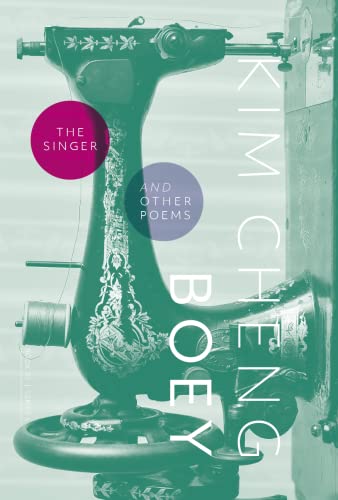
Kim Cheng Boey, The Singer (Cordite Press 2022)

There’s so much to love in this book.

I was inclined to love it sight unseen. I’ve been delighted by Kim Cheng Boey’s readings in past years when the Sydney Writers’ Festival had room for local poets. He co-edited (with Michelle Cahill and Adam Aitken) the excellent 2013 anthology, Contemporary Asian Australian Poets. He has written insightful reviews of one of my favourite poets, Eileen Chong, and had a walk-on role in one of her poems. This is the first of his books that I have read.

When I got my copy direct from Cordite Press – I tried at least three bookshops – I loved it for the cover alone. You expect the title The Singer to refer to the poet, perhaps in an attention-seeking way, but then you tilt the book and see the cover image clearly: it’s a Singer sewing machine. (My mother didn’t call her labour-saving devices the washing machine, the vacuum cleaner or the sewing machine, but the Hoover, the Electrolux and the Singer.) It’s a brilliant title: yes, poetry is like song, but it’s also craft.

And page by page, I kept on falling in love. There’s a Preface in which Kim Cheng writes of the different ‘weight’ of his poetry-making over time:

When I was younger, poetry carried me posthaste, high on the fuel of experience and freshness of thought, from initial impulse to final form. In middle age the roles are reversed – I am the mule, the porter, learning the weight and heft of the poem so I can carry it long-distance – over months and often years.

‘Perhaps,’ he continues, ‘the change occurred the moment I became a migrant.’ He migrated to Australia from his native Singapore in his early 30s, in 1997. Since then he has continued to take part in Singapore’s literary and cultural life as well as that of his adopted home. The book’s three parts can be read as tracing this geographical movement over time. The first, ‘Little India Dreaming’, has five long prose poems full of the smells and sights and sounds of a remembered Singapore childhood, including the title poem. Here’s a small extract to give you a feel for it:

You almost pray to the Singer, its dark cast-iron hull, to 
carry your mother's song. You pray for the treadle to 
stir, for the finished dress to be unstitched, its seams 
unpicked so the dress can materialise again from the 
chalk outline. You take the birthday outfit out of the 
wardrobe of forgetting and become the five-year-old 
wearing your mother's love.

The second section, ‘The Middle Distance’, is introduced with a quote from Louis Mac Neice, ‘This middle stretch / Of life is bad for poets.’ Each of its five poems is set in places other than Asia or Australia., and it’s tempting to see an unsettled, midlife quality to them.

The seven poems of the third section, ‘Sydney Dreaming’ – to simplify appallingly – lay claim to Australia as a place that can be called home.

My arbitrary blogging practice of looking at page 76 has once again given me a gift. That page occurs near the end of the book, in ‘Sydney Dreaming’, the title poem of the third section.

I love this poem (I know I’m using that word a lot, but it can’t be helped). In it the speaker walks around inner suburbs of Sydney, haunted by the tales and memories of other cities and ghosts of Sydney past. If it was terrible, banal rubbish, I might still have loved it because I have walked every step that the poem follows. I too lament the disappearance of second-hand book shops in Pitt Street. I know the painted up man with the didgeridoo in the Central tunnel, as well as the old Chinese man ‘scraping a dirge on his erdu’. Chinatown, Broadway, Glebe Point Road, Gleebooks, all lovingly named and recognisable. Then Darlinghurst Road, the wall, the Holocaust Museum, Macleay Street. The poem made me want to go for a long walk.

And it’s a terrific poem. Here are a couple of stanzas from page 76 – the walk down to Woolloomooloo from Kings Cross:

You follow the bend and the view opens to the ivory cusps 
of the Opera House and the dark arch of the bridge over the silver-glazed
azure scroll of the harbour, the sky burnished gold in the last exhalations of the sun.

Soon the flying fox formations will rise from hangars of Moreton Bay figs
in the Botanic Garden, and weave arabesques around the halo 
of the spanning arches of the Coathanger. You remember seeing this even
before you arrived, memory in the image, image in memory,

the sky and the harbour dyed incarnadine in the first postcard 
you ever received from a childhood friend settled in a new life

Notice that it’s in the second person: ‘You follow the bend.’ The poem’s speaker isn’t just telling the reader about a walk he has taken, he is inviting us to walk with him – which is especially effective for readers who have in fact walked in those places. The long lines have a leisurely, strolling feel: no hurry, no need to reach any rhyming points or keep to any metric timetable. The conversational tone and language creates a companionable feel.

Then the register shifts, as the poem enters its final movement.

You follow the bend and the language opens to ‘ivory cusps’ and ‘silver-glazed azure’ and ‘burnished gold’ and ‘exhalations of the sun’. That’s such a Sydney moment – any Sydneysider arriving at Circular Quay train station will have had their phone-absorption interrupted by the exclamations of tourists seeing the Bridge–Harbour–Opera House scene for the first time. Rounding that bend in Woolloomooloo has a similar breathtaking effect, and the language responds.

Then two things happen. First, the speaker asserts that he belongs here by looking forward in time: he knows that the flying foxes will soon fill the sky and enjoys anticipating the spectacle (still with the elevated language, ‘arabesques’ and ‘spanning arches’). Second, he knows that he hasn’t always belonged, and memory asserts itself. He had seen this sight in a postcard long before seeing the actual thing. I’m reminded of those passages in Proust about how the reality inevitably falls short of the anticipated image. That’s not how it is here, but there’s a strange unreality nonetheless – ‘memory in the image, image in memory’ – the present moment is a palimpsest. The whole poem revolves around that interplay of past, present, anticipated future and imagination. The whole walk is experienced as a palimpsest.

I’m restraining myself from quoting the lines that come next, because it’s getting close to the poem’s stunning conclusion, and even with poetry spoilers are an issue. Enough to say that the Bridge is transformed effortlessly from that spectacular postcard image to a terrific metaphor for the poet’s status in the midst of an ever-changing life of exile, belonging, and longing.

As a footnote: the title ‘Sydney Dreaming’ might be a worry. I don’t read it as claiming any of the First Nations meaning of the word ‘Dreaming’. In the course of his walk, the poet-flâneur passes a number of First Nations people: the man in the Central tunnel, and a real or imagined group of dancers in Woolloomooloo. The latter are mentioned after the speaker has been lost ‘in a dream of home, almost’: his dream is definitely lower case, and carefully distinct from that other, deeper, ancestral Dreaming.

The Singer won the Kenneth Slessor Prize for Poetry earlier this year (click here for the judges’ comments). Maybe it’s so hard to find in the bookshops because it sells out as soon as it hits the shelves. I hope so. Anyhow, especially but not only if you live in Sydney or are part of a Chinese diaspora, see if you can get hold of it. Did I mention that I love it?

Thrity Umrigar’s Space Between Us

Thrity Umrigar, The Space Between Us (©2005, Harper Perennial 2007)

Bhima is a domestic servant in Mumbai – or Bombay, as she calls it. She has been with the same Parsi family for decades. She can’t sit on the family’s furniture, and physical contact is avoided, but she and the woman of the house – Sera, whom Bhima cannot think of without the respectful suffix ‘-bai’ – have formed close bonds. Bhima is the only person in whom Sera has been able to confide about her husband’s violence, and Sera has paid for the education of Bhima’s granddaughter, Maya.

When the novel opens, Bhima is living with teenage Maya in a hut in the slums. We gradually learn that Maya’s parents died of AIDS when she was seven years old, that Bhima’s husband left her decades ago in tragic circumstances, that Sera’s husband has recently died. In the present, Sera’s daughter is pregnant and her relationship with her charming husband is a bright spot in everyone’s lives. To Bhima’s shame and fury, Maya is also pregnant, and the action in the novel’s present revolves around the father’s identity.

It’s Thrity Umrigar’s tribute to ‘the real Bhima’, who was a servant in her wealthy Parsi childhood home in Mumbai. But having established the bonds of affection and mutuality between the two families, the book turns, and becomes a brilliant study of the way relationships can be close and strong but in the end tragically vulnerable to social norms and structures.

I read this book after The Secrets Between Us, a sequel published 13 years later. This isn’t something I’d recommend. On the one hand it was interesting to see passing mention of Parvati, a major character in the second book, to have the stories of Bhima’s husband and daughter dramatically realised, and to come to a fuller understanding of the ending of the second novel. But the major thunderclap reveal of the identity of the man who got Maya pregnant comes as no surprise, and it was odd to know better than all the characters when there was very little foreshadowing.

A strong point in both books is the way they enact the fine detail of changing culture. Sera, like Thrity Umrigar, is Parsi, and the book’s version of traditional Parsi culture probably didn’t win it any friends among older Parsis. In one of the book’s many flashbacks, soon after Sera marries, she and her new husband move in with his parents, and what follows is a classic mother-in-law nightmare. Banu Dubash, the mother-in-law, insists on traditional Parsi practices, specifically those built around the idea that a woman is impure when he has her periods. Reluctantly, Sera accepts that she must eat meals in her room until her periods are over. Although she is Parsi herself, she has no idea of the extent of her assumed impurity, and walks through the room where Banu is praying, provoking a deafening shriek and a torrent of abuse. Freddy, Sera’s kindly father-in-law, comes running in from the dining room. This is on page 76:

‘Oh, Freddy, thank God you are here,’ Banu said dramatically. ‘help me, darling, help me.’
Freddy looked distraught. ‘Banu, what is it, will you speak? Is it your heart?’
‘No, no, nothing like that. Just that this whole house will have to be purified now. Sera walked across the room while I was praying and she is having her monthly cycle, you see. Still, without any consideration, she interfered with my prayers.’
Sera blushed. Before she could speak, Freddy raised his voice. ‘You and your superstitious vhems and dhakharas. Crazy woman, you are. Harassing this poor child, scaring her for no good reason.’ He grew even more angry. ‘And worst of all, you’ve ruined my enjoyment of my music. A new Mozart record I’d just bought, and now your hysterical faras has made me miss the best part.’ He flung a sympathetic look at Sera and then stomped out of the room.
Banu narrowed her eyes and flashed Sera a look that made her heart stop. ‘See what you’ve done, getting my Freddy all upset?’ she said, careful to lower her voice so that it didn’t carry into the next room. ‘Is that why you entered my house, to create friction between my husband and me?’
Sera felt dizzy, as if she had drunk four beers one after the other. She took a step toward Banu and reached out to touch her hand. ‘Banu mamma, I don’t know what happened–’
‘She touched me,’ Banu screamed. ‘Deliberately, on purpose, she touched me with her impure hands. ‘Oh, God, what kind of daakan has entered my house, to make me miserable in my old age?’
This time, Gulab, the Dubashes’ servant, came into the living room. She took one look at the situation and pushed Sera toward her bedroom. ‘Baby, you go in your room for a while,’ she said authoritatively. ‘Go on, I will calm Mummy down.’

I love the way the non-English words are given without italics or explanation. I couldn’t find ‘vhem’, ‘dhakara’ or ‘faras’ with a quick web search, and I’m happy to have them be untranslatable – or rather to be left to make my own rough translations: ‘panics’, ‘idiocies’ and ‘ruckus’, perhaps? And I love the way that each of the four people in this scene are in a different relationship to traditional religious practice. The pragmatic Gulab is probably, like Bhima, Hindu. Freddy is European in his musical tastes. Sera is part of the modern world and completely unprepared for Banu’s fanatical attachment to – in her understanding – antiquated practices. But mostly what I love is the vividly realised drama of the moment, the brilliant use of dialogue.

I came across these books thanks to the Emerging Artist’s practice of plucking books with non-Anglo author names from the shelves of our local library. It’s a life-enriching practice

Claire Keegan’s Small Things Like These

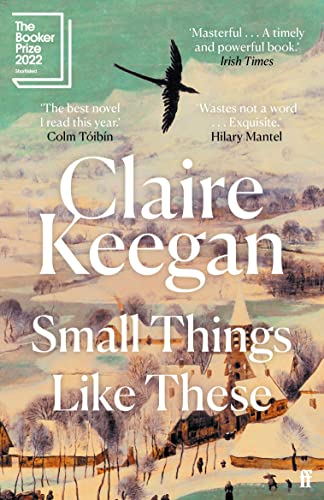
Claire Keegan, Small Things Like These (Faber & Faber 2021)

I first became aware of Claire Keegan through The Quiet Girl (An Cailín Ciúin), an Irish-language film based on her short story ‘Foster’. I saw the film at the 2022 Sydney Film Festival, and was blown away by its portrayal of a small girl’s escape from a terrible situation. The final moment, which I won’t describe because of spoilerphobia except to say that a single, ambiguous word is spoken, is one of the most powerfully moving I’ve seen. The acting (especially Catherine Clinch as the girl), the cinematography (Kate McCullough), the direction (Colm Bairéad) and the script (by Colm Bairéad, closely following Claire Keegan’s prose) are all brilliant. I still haven’t read ‘Foster’ but I was delighted to be given Small Things Like These on Father’s Day.

It’s a tiny book – just 117 pages. It’s set in a small Irish village. Its action takes place over a few days in late December in the time not so long ago when the Catholic Church dominated the lives of most Irish people. Bill Furlong, the coal and timber merchant, is being run off his feet in the pre-Christmas rush. The son of an unmarried woman, he and his mother were able to thrive in spite of the stigma thanks to the patronage of a wealthy Protestant woman – a situation that has uncanny echoes in the Thrity Umrigar books The Space Between Us (which I’m currently reading) and The Secrets Between Us (my blog post here). He is devoted to his wife and five daughters.

A shadow is cast over this benign scene by two pages that precede the beginning of the text proper. First there is the dedication: ‘to the women and children who suffered time in Ireland’s mother and baby homes and Magdalen laundries’. Then, on a page to itself, there is an excerpt from The Proclamation of the Irish Republic, 1916, which declares that the republic resolves, among other things, to cherish ‘all of the children of the nation equally’. Having a rough knowledge of the Magdalen laundries (Wikipedia entry here if you need to look it up), I was prepared for a little book of horrors.

Claire Keegan is a finer writer than that. There is horror, but not the jump-scare, demon-rising-from-the-grave kind, or even the Hanya Yanagihara A Little Life kind. Just outside the village there’s a ‘training school’ for girls of low character and an associated laundry, which ‘had a good reputation’. When Bill delivers a load of coal there on Christmas Eve, he comes upon a young woman who is obviously being abused, and he isn’t reassured by the nuns’ attempts to, well, gaslight him. It’s a small village, and the whispers say that no one can challenge the Church. Aware that his own mother could have found herself in the young woman’s situation, Bill faces a dilemma.

So the book hinges on a small chance encounter, a small crisis of conscience for an ordinary man, who many would say is leading a small life. The title can be read as the beginning of a sentence: Small things like these … pose big moral challenges / … can change the way you see the world / … can disrupt oppressive institutions / …

This blog generally looks at page 76. I might have preferred to talk about the page when Bill sits down to a cup of tea with the Mother Superior, or one of the pages where the abused girl talks to him. But page 76, it turns out, illustrates beautifully the way Claire Keegan tells her story.

It occurs at about the three-quarter point. We have been told very little of what’s happening in Bill’s mind. He doesn’t talk about what he has seen. Perhaps he can’t – he’s a working class Irishman of his era. But his wife, Eileen, can tell he’s ‘out of sorts’. The family go to Mass on Christmas morning. Bill stays back near the door when Eileen and their daughters walk down the aisle and slide into a pew, ‘as they’d been taught’. We’re not told if Bill usually stays by the door, or if this is a sign of new alienation. What follows could easily be a simple description of Irish villagers arriving for Mass in a past era (not all that dissimilar to Mass in the North Queensland town where I was a child in the 1950s):

Some women with headscarves were saying the rosary under their breath, their thumbs worrying through the beads. Members of big farming families and business people passed by in wool and tweed, wafts of soap and perfume, striding up to the front and letting down the hinges of the kneelers. Older men slipped in, taking their caps off and making the sign of the cross, deftly, with a finger. A young, freshly married man walked red-faced to sit with his new wife in the middle of the chapel. Gossipers stayed down on the edge of the aisle to get a good gawk, watching for a new jacket or haircut, a limp, anything out of the ordinary. When Doherty the vet passed by with his arm in a sling, there was some elbowing and whispers then more when the postmistress who’d had the triplets passed by wearing a green, velvet hat. Small children were given keys to play with, to amuse themselves, and soothers. A baby was taken out, sobbing in heaves, struggling to get loose from his mother’s hold.

This may feel like an exercise in nostalgia. But it’s not like, for example, the moment in Robert Dessaix’s Arabesques where he ‘realises’ that the lives of simple Portuguese women at Mass ‘had been redeemed, not by understanding, not by seeing Truth face to Face, but by being gathered up into the Church’ (my blog post here). Neither Bill Furlong not Claire Keegan, observing this gathering, projects visions of redemption onto it. This is an insider’s view. We are told people’s names. We can guess why the freshly-married man is red-faced, we recognise that different people make the sign of the cross differently (I love ‘deftly, with a finger’), there are class differences, children and babies need to be dealt with. It’s a picture of a community coming together that anyone of a certain age with an Irish-influenced Catholic childhood will recognise.

But it’s a critical insider’s view. Bill has a fresh distance because of his moral dilemma, Claire and the reader have perspective created by the seismic shifts in Irish culture since the time of the novel. This is a picture of a surveillance state, benign enough you’d think, but any small divergence from the normal – a sling, a new hat – is noted. It’s characteristic of Keegan’s writing that none of the divergences noted by the gossipers has any moral weight attached to it – we’re left to imagine for ourselves how that would go. We haven’t been told in so many words (this isn’t a Hollywood movie, after all) that Bill is mulling over what to do or not do, but as he looks over this scene, we feel with him the coercive pressure to conform, to accept the authority of the Church, not to rock the boat. The baby, ‘sobbing in heaves’, has to be removed – his mother’s hold is unescapable. Small things like these accumulate so that we understand the pressure Bill faces.

The whole book is a marvel.

Andrey Kurkov’s Grey Bees at the Book Group

Andrey Kurkov, Grey Bees (2018, translation by Boris Dralyuk, MacLehose Press 2020, 2022)

Before the meeting: I hadn’t heard of Andrey Kurkov before this book was nominated for the Book Group. He’s a Ukrainian novelist, children’s writer, essayist and broadcaster. In an interview on PBS early last year he said that, though he is ethnically Russian and writes in the Russian language, Putin’s invasion has made him ashamed to be Russian, and he is now considering writing only in Ukrainian. He finds it impossible to write fiction in the current situation, but he continues to write and broadcast about the war – his series of broadcasts for the BBC, ‘Letter from Ukraine’, is available online.

Grey Bees, originally written in Russian, was first published in 2018. Russia had annexed Crimea, and there was armed conflict with Russian separatists in two breakaway ‘people’s republics’ in the Donbas region in the eastern part of Ukraine. The novel is set in a time when the front between those forces stretched for about 450 kilometres (it’s now closer to three thousand). The area between the fronts is known as the ‘grey zone’. In his useful Preface to the 2020 English edition, the author explains:

Most of the inhabitants of the villages and towns in the grey zone left at the very start of the conflict, abandoning their flats and houses, their orchards and farms. Some fled to Russia, others moved to the peaceful part of Ukraine, and others still joined the separatists. But here and there, a few stubborn residents refused to budge. … No one knows exactly how many people remain in the grey zone, inside the war. Their only visitors are Ukrainian soldiers and militant separatists, who enter either in search of the enemy, or simply out of curiosity – to check whether anyone’s still alive. And the locals, whose chief aim is to survive, treat both sides with the highest degree of diplomacy and humble bonhomie.

(Page 12–13)

Sergey Sergeyich, the hero of Grey Bees, lives in a tiny village in the grey zone, one of two cantankerous old men who have refused to leave. The electricity has been cut off. He has to trek to the next village to buy food. He depends on a charity’s annual delivery of coal for heating through the savage winter. He is a beekeeper, whose emotional life focuses on the wellbeing of the beehives that spend the winter in his garden shed. His wife and daughter are long gone, and he has never really got along with Pashka, the other remainer.

The opening scenes reminded me of Czech comedies in the 1960s like The Firemen’s Ball. There, people’s lives were miserable under the Soviet regime and the comedy was subversive as well as desperately funny. Here the enemy is the war itself, and the quiet desperation of the characters is made tolerable to the reader by their comic focus on tiny issues – like the way the two men hide from each other whatever good food they’ve managed to get hold of (where good food can include a block of lard!), or Sergey’s decision to swap the street signs so he no longer lives in Lenin Street. There’s a touch of Waiting for Godot: how can anything happen so long as they are trapped in this place?

Then, as the days warm up and the buzzing of his bees becomes more demanding, Sergey decides to take them to a place that hasn’t been laid waste by the war, and we follow him on a journey south, to environments that are more friendly to him as well as his bees. He meets with kindness, and is kind in return. He sets out to visit a Tatar beekeeper he met at a conference years before, and arrives in a tiny village in Crimea that is occupied by the Russians. In the process of getting there he has to pass through Russian checkpoints, and he is looked at with suspicion on all sides: coming from Donbas, is he a separatist or a loyal Ukrainian? He’s attacked on suspicion of being one and harassed when he is assumed to be the other. An Orthodox man, he falls foul of the Russian authorities when he befriends a Muslim family.

Though terrible things happen, what shines through is Sergey’s unassuming human kindness. The background buzzing of the bees is warmly reassuring: they go about their work, and can be counted on to produce honey, which is universally welcomed.

Towards the end, when the Russian authorities meddle with one of the hives, Sergey has dreams that the bees of that hive have turned monstrously grey, and the allegorical role of the bees, which is a quiet undercurrent for most of the book, comes front and centre in some splendidly surrealistic passages.

To give you a taste of the writing, here’s a little from page 76, when Sergey is still in the village. Spring is on the way:

The sun had spread even more of its yellowness through the yard. The trampled snow had turned yellow, as had the fence, and the grey walls of the shed and the garage.
It wasn’t that Sergeyich didn’t like it – on the contrary. But he felt that the sun’s unexpected playfulness, as appealing as it may be, disrupted the usual order of things. And so, in his thoughts, he reproached the celestial object, as if it could, like a person, acknowledge that it had acted improperly.
The artillery was whooping somewhere far, far away. Sergeyich could only hear it if he wished to hear it. And as soon as he went back to his thoughts, turning into Michurin Lane, its whooping melted away, blending into the silence.

In his preface to the 2020 edition, Andrey Kurkov says that on his visits to the grey zone he ‘witnessed the population’s fear of war and possibly death gradually transform into apathy’. Sergey’s dislike of disruption, even by warmth and playfulness, and the way he can be deaf to the whoops of the artillery, are ways of showing that apathy. It’s a terrific achievement of this book that it brings tremendous energy and compassion to bear on the person lost in apathy, and never loses sight of his enduring humanity.

After the meeting: It turned out this was an excellent choice for the group – someone awarded the Chooser two gold koalas, which must come from a children’s show I’ve missed out on.

Conversation looped around the Russian invasion of Ukraine, to other terrible events of recent days in the local and international scenes, sometimes becoming heated, but not acrimonious, and kept coming back to the book. I think it was Kurkov’s insistence on keeping close to the humanity of his characters, especially Sergey, focusing on what could be benign between people, even while not mitigating the horrors of the war. The father of one group member was Ukrainian, but always identified as Russian. He himself has never learned either language but he could speak a little of how the book stirred memories of his father. The rest of us lacked such a direct connection, but I think the general feel was that we came away from the book with a much more solid grasp of the depth and reach of the current war, and the centuries of Ukraine–Russia relations that preceded it.

I got blank stares when I mentioned The Firemen’s Ball.

Journal Catch-up 21

Just two Heats in this catch-up.


Alexandra Christie (editor), Heat Series 3 Nº 9 (Giramondo 2023)

There are five items in this Heat, and I loved three of them. (The other two are pretty good as well.)

Bonny Cassidy’s ‘Memory Book’ is a poignant memoir of dealing with the shifting sands of her father’s dementia. ‘No one is responding in the way I thought they would.’

Ender Başkan has three poems whose energy and flow make me want to hear him perform them: ‘funk n wagnalls, collect the set’ is, among other things, a comic reflection on an immigrant family’s valuing of education; in ‘family holiday’ the poem’s speaker travels on the Spirit of Tasmania with small children; ‘erotics of bookselling’ is a fabulously unerotic string of phrases from the day of a bookshop employee.

The stand-out item is the late Antigone Kefala’s ‘Last Journals’, the third instalment in her series of journals. The first two were full-length books – Sydney Journals (2008) and Late Journals (2022, my blog post here). Unlike the entries in Late Journals, the entries here are dated, from 5 January to 19 September 2022. Antigone Kefala received the Patrick White Literary Award earlier in that September – ‘Everything comes in its own time,’ she writes, ‘but not in yours.’ She died on 3 December, less that 11 weeks after the final entry, which ends, ‘Drifting … Not an an ounce of focused energy …’

My blog custom is to single out page 76 for a closer reading. As happens surprisingly often, page 76 of this Heat is a useful lens through which to see the whole of Antigone Kefala’s piece. The page has three entries – for 3, 11 and 17 April – and they reflect a mind actively engaged with the world even while burdened with a sense that the end is near. There are acerbic comments on politics (‘Everyone knocking out Morrison … his own people, a pity they did not do it before’) and the weather (‘It will take some time to dry out, but the rain will start again soon’). She celebrates the publication of Late Journals, is visited by her publishers, and anxiously hopes for a mention in the press. She starts casting about for a new project (‘Looking about for a book to start translating something – this should give me a direction’). She mentions talking to a friend on the phone, ‘using the mobile so we could see our faces’, and comments, ‘These terrible transformations … who wants to see one’s face when talking on the phone …’

What emerges is a picture of a writer, committed to her work, immersed in a community, who faces the difficulties of ageing and the approach of death, not with calm or resignation but with something more like weary annoyance. Her entry for Monday 11 April ends:

Living is problematic, but dying is problematic too.


Alexandra Christie (editor), Heat Series 3 Nº 10 (Giramondo 2023)

This issue kicks off with ‘Life’s Work’ by Isabella Trimboli, a terrific, multi-faceted article on journals that ranges from her own practice to a five-hour cut of a movie diary. She’s specifically interested in ‘diaries from women who were not writers by vocation, that had never known true recognition, that wrote about themselves obsessively and with self-scrutiny’.

I confess that the rest of the journal didn’t sing to me.

One piece begins:

Simón entered my room and gave me a look.
Unconsciously, and then consciously, I pressed my body into a pose, breasts forward, ass to one side, and lifted the sheet, an invitation that suggested this was how I always lay before 10 a.m., like a steamed clam.

(Ellena Savage, ‘Bare Life’)

What follows isn’t terrible, but sexual intrigue in a shared house with a smattering of philosophy about Covid shutdowns isn’t my cup of tea. And I know it’s a lost cause, but that ‘ass’ – along with a ‘diaper’ elsewhere in the journal – gets my back up. It’s an Australian literary journal, do we have to use US language?

Another:

Someone did give birth to me. Why remains unclear. Maybe they wanted to be loved, or it just sort of happened.

(Harold Voetmann, ‘Common Room Rocking Horse’, translated by Johanne Sorgenti Ottosen)

Sorry, but I find that hard to take seriously, and it’s not funny.

Then there’s this:

The house had bricks the colour of runny shit and a linoleum floor that was so thin you could scrape a hole in it by pushing back your chair.

(Kat Capel, ‘Sightseeing’)

As you might almost guess, this turns out to be a story of unconventional sexual compulsions set mainly in a share house. I’m too old.

And then this:

This looking at myself, touching myself, it all started a long time ago. In nursery school, in fact, when I was five or six years old.

(Lin Bai, ‘The Light in the Mirror’, translated by Nicky Harman)

That’s the inauspicious opening of what turns out to be an extract from Lin Bai’s 1994 novel, A War of One’s Own, which, according the brief author bio (on page 76), ‘was an instant success and established her as a pioneer of women’s literature in China’. The Wikipedia entry on the novel doesn’t mention translation, so this may be the first time this writing has been translated into English. If so, hats off to Heat and Nicky Harman. But, quite apart from my distaste for extracts from longer works, I won’t pretend to have enjoyed it.

Mick Herron’s Standing by the Wall

Mick Herron, Standing by the Wall: A Slough House Interlude (Baskerville 2022)

This is one of those tiny books designed for display at the check-out of a books-and-mortar bookshop, to be bought on impulse as a small gift for, say, Mother’s Day, or for someone you know to be a fan of Mick Herron’s Slough House novels.

It probably found its way into our house as such a gift. I haven’t read any of the novels, but I love the TV series based on them (and I’m glad to learn that a third season is due to drop in December). For me, this book was a chance to get a taste of how it all works on the page. All the main characters are there: irascible and malodorous Lamb, obnoxious IT wiz Roddy, our hero River, salt-of-the-earth dry drunk Catherine and mistress of the archives Molly. Not much happens: River drops in on the station after extended leave to recover from being poisoned; Lamb has Roddy alter a photograph from the archives; Catherine has a moment of almost human conversation with Lamb, in which he says ‘I don’t do memories’; and most of the reject spies who work at Slough House go out for Christmas drinks. That’s it.

‘Ho!’

The name wasn’t so much dropped as thrown from the top of Slough House, and like a snowball finding its target struck Roddy Ho, two floors down, on the back of his neck. He looked up from his screen, senses quivering. He was needed.

The opening is horrendously over-written, and it goes on in that vein for a couple of pages. I was about to lay the book aside, giving quiet thanks for the wit and nuance of the TV series, when I realised that the over-writing was deliberate, allowing us a taste of Roddy Ho’s self-heroising perception of the world. The irony became clear, the prose settled down, and I was amused and gripped.

Page 47 (I can’t talk about page 76 because this is a very small book) features another piece of mock-heroics:

There was no one to flinch when, with surprising suddenness, Lamb swung his shoeless feet to the floor and went barrelling out of the room, entering Catherine’s office like a Viking on manoeuvres. Flakes of plaster fell from the ceiling when the door slammed against the wall; more drifted free as he pillaged desk drawers with the kind of controlled fury that this room alone, of all Slough House, generally provided sanctuary from. Most of what he found he dropped to the floor – reels of sticky labels, cellophane folders, account books, boxes of Biros, treasury tags; all this junk from another era, as if he were trashing a museum installation – littering the carpet with a mess of ancient stationery.

It comes as no surprise that all this furious pillaging turns out to be just Lamb looking for an envelope. Mick Herron is having a good time, and so is the reader.

The book is a fun chance to see the characters in action on the page. It may be laying the grounds for big events later in the series, or harking back in a way that will delight long-term readers, but whether or not it’s either of those things, it’s an enjoyable confection that entertained me on a train trip from Central to Parramatta and back.