Category Archives: Page 7x/47/7

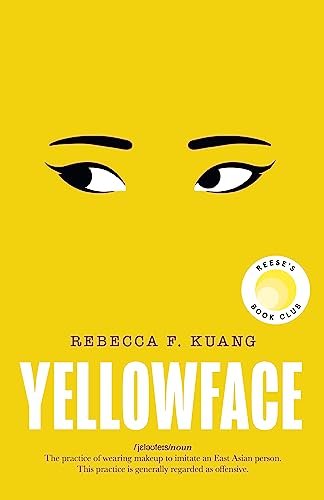
Rebecca F. Kuang’s Yellowface and the book group

Rebecca F. Kuang, Yellowface (The Borough Press 2023)
Before the meeting: It’s a thing: books – and movies – that deal with questions of authorship. The protagonist of Siri Hustvedt’s The Blazing World (2014) presents a young male artist as the creator of her sculptures. In Cord Jefferson’s movie American Fiction (2023, based on Percival Everett’s Erasure (2001), which I haven’t read), an African-American novelist writes a trashy novel full of the stereotypes he despises, and presents its author as a fugitive from justice. I won’t do a spoiler on Björn Runge’s movie The Wife (2017, based on a 2003 novel by Meg Wolitzer). In Caledonian Road, Campbell Flynn knocks off a self-help book for men and has a photogenic young actor pose as the author. And that’s just some relatively recent ones that come to mind.

Yellowface is an entertaining addition to that list.

June Hayward, a young white woman whose first novel has done poorly, has an uneasy friendship with Chinese-American Athena Liu, a fabulously successful one-book novelist. When Athena dies suddenly with June as the only witness, June gets hold of her unfinished manuscript, which deals with aspects of Chinese immigrant life in North America. She sets about editing the manuscript and completing the story, telling herself that she is doing it to honour Athena. She gradually comes to think of the novel as primarily her own work and sends it to her agent over her name.

The novel is a publishing sensation and, without actually claiming Chinese heritage, June allows herself to be seen as Chinese. Her Hippie parents had given her ‘Song’ as a middle name, so – she rationalises – it’s not actually lying when she adopts the Chinese-sounding pen name of June Song and lets people make their own assumptions. Anyhow, Athena’s research consisted of extracting stories from other people, so they were already stolen property. And other rationalisations.

Needless to say, things go very wrong. Right up until the last movement I was having a great time. There’s a marvellous scene where June is invited to do a reading to a local Chinese community, where her hosts – including one elderly man whose experiences are similar to those narrated in the novel – are genuinely shocked when they realise she is not Chinese, but remain icily courteous. Social media users are infinitely less restrained.

We see it all from June’s point of view. We sorta-kinda believe the stories she tells herself, and even when she crosses the line into outright deception, we sympathise – until we don’t. June may acknowledge that she hasn’t been completely honest, but she continues to see herself as the victim of unfair attacks until the end of the book. But somewhere along the line, and I imagine the precise point differs from reader to reader, she loses our allegiance. So at the end, where she comes up with a way to redeem herself in the eyes of the publishing and reading world, we are led to believe that it will probably work, but are disgusted by a world where that is the case.

It’s cleverly done. The introduction of some unconvincing horror tropes spoiled the big climax, but I can forgive that.

Page 77* is a nice example of one of the strengths of the book. If you’re going to write a satire of identity politics in the publishing industry, you’d better make your version of the industry seem real. Kuang does that. June’s conversations with her agent and editor, her meeting with the marketing executives, the closing of ranks among authors, followed by the shunning once the scandal becomes too much: all feel real. The description of publication day on page 77 is surely taken from life:

Months become weeks become days, and then the book is out.
Last time, I learned the hard way that for most writers, the day your book goes on sale is a day of abject disappointment. The week beforehand feels like it should be the countdown to something grand, that there will be fanfare and immediate critical acclaim, that your book will skyrocket to the top of all the sales rankings and stay there. But in truth, it’s all a massive letdown. It’s fun to walk into bookstores and see your name on the shelves, that’s true (unless you’re not a major front-list release, and your book is buried in between other titles without so much as a face out, or even worse, not even carried by most stores). But other than that, there’s no immediate feedback. The people who bought the book haven’t had time to finish reading it yet. Most sales happen in preorders, so there’s no real movement on Amazon or Goodreads or any of the other sites you’ve been checking like a maniac the whole month prior.

According to Wikipedia, Rebecca F. Kuang’s first novel, The Poppy War, was a big success, but I am pretty confident that its 22-year-old author had exactly such a ‘day of abject disappointment’.

After the meeting: As usual, our meeting was convivial, and people had a range of responses. I was a bit of an outlier in feeling generally positive about the book, but I wasn’t the only one to derive at least mild enjoyment from the meta stuff: the Asian woman writing in the first person as a white woman pretending to be Asian. Someone wondered out loud how James would have been received if the author was revealed to be white, Helen Demidenko/Darville/Dale and The Hand the Signed the Paper was mentioned. But I don’t think anyone else just enjoyed Yellowface as a light satirical tale.

At least one other chap couldn’t for the life of him see what there was to enjoy. From memory, he was something like, ‘Yes, I get what you’re saying about identity politics and the publishing industry, and maybe even that there’s satire happening, but it’s not funny, there are no real characters, and nothing interesting happens. June, the protagonist, doesn’t develop and we don’t learn anything about her beyond the superficial.’

There were a number of positions in between. The extreme implausibility of the big climactic scene was something we could all agree on. Someone said that the effect staged there would have taken the resources of a Taylor Swift concert to pull off. I couldn’t disagree.

But we had an excellent time together, enjoyed the food and the fleeting visit from a teenager who lives in the flat, shared stories (including some tales of school reunions, of which the outstanding one was the 40th reunion of a former Australian Prime Minister who had been bullied at school and continued to be bullied 40 years later), laughed a lot, had peanut-flavoured ice cream, and didn’t feel at all competitive with (something I found out about recently) the all-male Book Group that has been meeting for 25 years in Melbourne.


I pressed ‘Publish’ for this blog post on Gundungurra land, where the creeks are flowing and the air grows cold as soon as the sun goes down. I read the book on Gadigal Wangal land, and brooded on it in Yidinji country and the many lands I have flown over or driven through in the meantime. I acknowledge the Elders past and present who have cared for these lands for millennia, and continue to do so.


My blogging practice is to focus on the page of a book or journal that coincides with my age, which currently is 77.
Anastasia Radievska’s City of the Sun

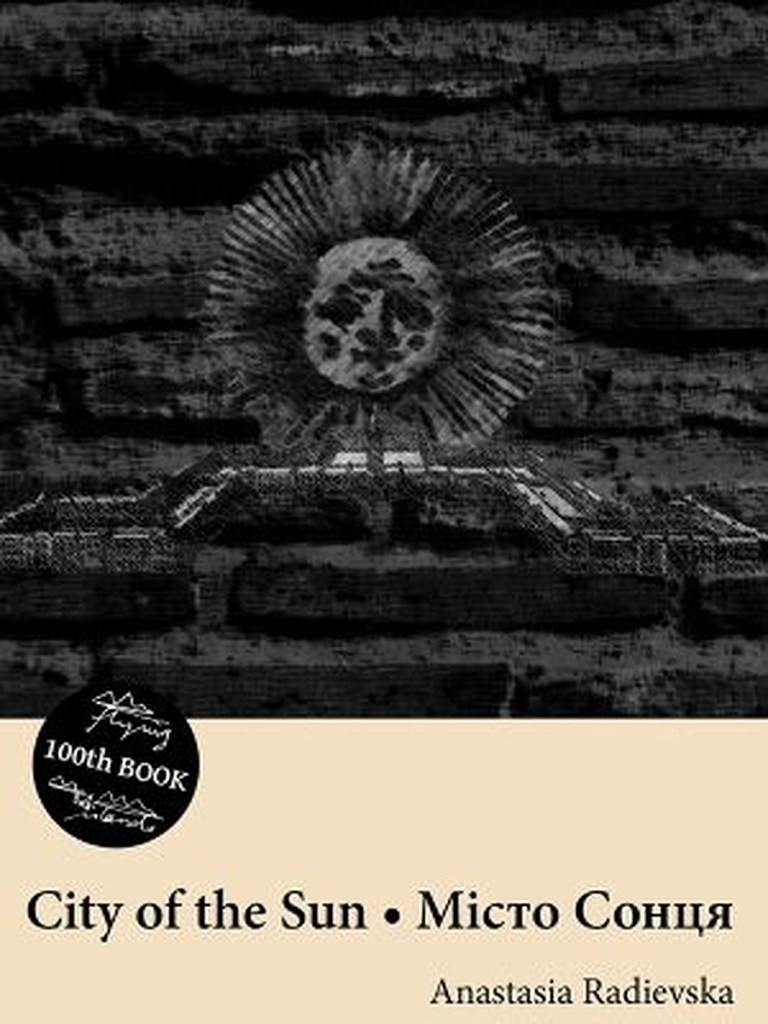
Anastasia Radievska, City of the Sun / Місто Сонця (Flying Island Books 2024)

This is Ukrainian-Australian poet and artist Anastasia Radievska’s first book of poems. It’s a rich, complex creation.

There are poems in English and Ukrainian, which means that almost half the book’s contents remain enigmatic and even unpronounceable to readers like me who can’t read Ukrainian script – but beautiful to look at.

The book takes its title from The City of the Sun, an early 17th century philosophical work by Tommaso Campanella, which according to Wikipedia is an important early Utopian work. Campanella’s city is protected by a series of walls, and this book’s sections are named for six of those walls. Each section is introduced with what I assume to be a quote from Campanella describing the images painted on its wall – followed by a double-spread illustration, a semi-abstract painting that mostly relates to that description.

For example, ‘The Fifth Wall’ is introduced by this paragraph:

On the fifth interior they have all the larger animals of the earth, as many in number as would astonish you. We indeed know not the thousandth part of them, for on the exterior wall also a great many of immense size are also portrayed.

For a casual reader like me, this framing has a pleasingly decorative effect, but as with the beautiful characters of the Ukrainian alphabet I expect that a more serious approach would make the reading experience much richer. More serious readers, please speak to us in the comments.

Page 77* includes neither Ukrainian text, quotation from Campanella, nor illustration. It’s ‘instructions for lunchtime’, one of six English poems in the ‘The Fifth Wall’ (which also includes six Ukrainian poems). As you would expect from the section’s introduction above, the poem features some of ‘the larger animals of the earth’.

instructions for lunchtime

always remember
dogs are beautiful for having been engineered
and well-loved
to engineer us back

the gaze turned inward
towards something worthy –
finally – of looking back at

and an entire piece of ginger in the mouth
doesn't say otherwise

but thinks of course
of racing horses
with ginger in the sacrum
a culinary cruelty
somebody's paying to have
done to them

and on a Monday
I would too if hadn't thrown away
a fortune on tom kha soup
in little brown bowls
and a seat by the window

watching the dog wag its tail at the Lime bike
like it might be relevant to it
as a conspirator or fellow thing
to answer our doubts with –
throw in the river
– price – chase
at fleece rabbits –
does it not breed, breed, breed?

As with Radievska’s poems generally, part of the pleasure here lies in the poem’s difficulty. It’s not that there’s a puzzle to be deciphered; what the poem asks for is a little patience – understanding will come.

The poem starts with an abstract consideration about dogs, goes to the sensation of ginger in the mouth, then to a memory of cruelty to horses. Only at about the fifteenth line, you get to see some coherence. As advised in the title, it’s a lunch poem: the speaker is having her customary tom kha soup in a Thai eatery. Just as she sees a dog in the street outside the window wagging its tail at a hire bike, she finds she has put a whole piece of ginger into her mouth and her mind wanders to something she has heard about a use of ginger in horse-racing. Her attention returns from the ginger and horses to what she is seeing in the street, and she indulges some fanciful imaginings about the dog and the bike.

That’s the narrative.

There’s a lot else happening. The opening injunction, ‘Always remember…’, is a nice reminder of something we all know: we find dogs beautiful because we have bred (‘engineered’) them to be that way, but they have their own subjectivity and have changed us in turn. It’s not the standard joke about how dogs have made us their servants – bringing them food, throwing balls for them, cleaning up their messes, etc. It something about the dogs’ gaze: meeting a dog’s eyes can make you feel (‘finally’) that you are worth looking at (unlike the often indifferent or critical gaze of other human beings).

The piece of ginger in the mouth introduces a different human–animal relationship – a piece of ‘culinary cruelty’ in the racing industry. I don’t know what ‘ginger in the sacrum’ is and couldn’t find anything in a quick online search, but I’ll trust the poem that it’s a thing.

someone is paying 
to have done to them

The cruelty to horses is a comparatively malevolent, profit-driven parallel to the engineering of dogs.

But this isn’t a poem of indignation or protest:

and on a Monday
I would too

At first glance this seems to be condoning cruelty to racehorses, but it’s worth spending time on the convoluted syntax to realise that it’s actually a little joke, playing perhaps on the ambiguity of ‘them’ in the previous line – callous about the horses, perhaps, but only because not keeping them in mind. A paraphrase might be: ‘When I have to drag myself to work on a Monday, I’d happily pay someone to do something similar to me …’

I would too if hadn’t thrown away
a fortune on tom kha soup

And with this mock-lament at having spent money on soup rather than self-torture, we’re back by the restaurant window, or in the reader’s case, realising for the first time that that’s where we are, watching with idle amusement as a dog confronts a hire bike (Lime bikes are everywhere in my part of town).

The thoughts projected onto the dog pick up on the poem’s opening lines: dogs are bred to please us but they look back and have an effect on us. Can a bike do the same? The answer isn’t as obvious as we’d like. Sure, a bike can be thrown in the river, the cash transaction is front and centre, and (we know, even if the dog doesn’t) that a bike won’t play with a soft toy. But the final line introduces some doubt:

does it not breed, breed, breed? 

On the surface, this is a version of the joke about the discarded hire bikes that litter some parts of our cities – they’re breeding like rabbits. The dog asks if that’s literally so. But there are further possibilities: there may be something about capitalism as a creature that has got out of hand, but what strikes me is a suggestion that as artificial intelligence develops, perhaps objects like this bike will, like dogs, develop agency of their own, and if they haven’t already changed the way we see ourselves (with ‘the gaze turned inward’), that may be just a few generations of breeding/engineering away. Dogs and horses are among the ‘larger animals’; the poem asks if bicycles also belong in that category, or will some day.

Not bad for a poem that presents as capturing the idle play of mind during a lunch break.


I finished writing this blog post on Gadigal Wangal country, where the days are growing longer, and some wattle trees are in exuberant flower. I acknowledge Elders past, present and emerging for their continuing custodianship of this land.


My blogging practice, especially with books of poetry, is to focus on the page that coincides with my age, currently 77.

Mark Mahemoff’s Beautiful Flames

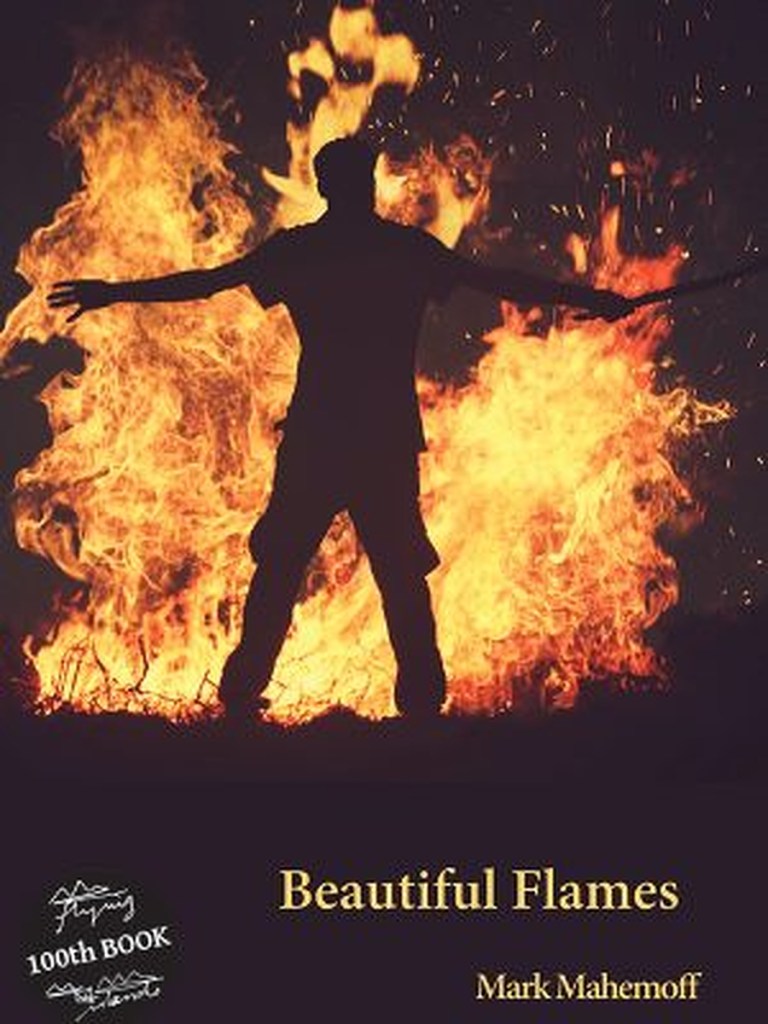
Mark Mahemoff, Beautiful Flames (Flying Island Books 2024)

This is another pocket-sized book I took with me on my recent trip to North Queensland. It’s Mark Mahemoff’s sixth book, a modest, user-friendly poetry collection in four sections.

The first section, ‘Chronicles’, mostly includes brief stories taken from life – family events, losses, a school reunion, the process of leaving home. From ‘Leaving’ (page 20):

Because childhood is a country
no one escapes unscathed
we haul it like a suitcase
stuffed full of unwashed clothes.

The second section, ‘Observations’ is what it says on the lid, observations on life’s passing parade. The titles of its poems generally tell you what to expect: ‘Kookaburras’, ‘Night Train’, ‘A Mediation’, ‘Bar Sport’, ‘Professional Development’.

The main pleasure of these first two sections is like what can get from a photograph of something ordinary – not claiming that it’s anything other than ordinary, but inviting us to pay attention to it for a moment. I generally try not to quote the final lines of poems – it’s too much like revealing the punchline of a joke – but the last stanza of ‘Nasturtiums’ (page 53) is too good an example of what I mean. Having described the large patch of these flowers on a lawn ‘somewhere in Haberfield’, and wondered whether they count as ‘weeds, food or flours’, the poem concludes:

But just devour them with your eyes
and you'll find that's enough
when you're walking beside someone
or alone
in sunlight.

That might seem banal but there’s some subtle, even self-effacing complexity. Mahemoff isn’t just talking about his own walk, but gently and elliptically inviting us to go on a walk of our own, to see for ourselves, and the last two line breaks create an unsettling effect. (What if it’s an overcast day, will it be enough then? If not, is it because the flowers look drab without the sun on them? Or is the sunlight a kind of companion?) The poem isn’t tied off in a neat bow.

The third section, ‘Travelogue’, comprises six poems in the form of notes from visits to, respectively, Western Australia, New Zealand, Melbourne, two unnamed places (one of which has a river and the other cactus plants), and Texas. The last-mentioned (‘Dallas in January’, page 84) forms a nice companion piece to Andrew O’Hagan’s essay ‘The American Dream of Lee Harvey Oswald’ in The Atlantic Ocean, which I read a couple of weeks ago: O’Hagan and Mahemoff describe the same museum, and have similar responses.

Page 77* contains two of the nine short poems that make up ‘New Zealand Snaps’.

The first is ‘Lower Shotover’:

Lower Shotover
Cool in the shade.
Singeing in the sun.
'The ozone layer is thinner here,'
she said.
You watch washing flap
while jets cruise past mountains.
How does one manage
this surfeit of beauty?
A bee falters
from flower to flower.

I had to look Lower Shotover up, but even without seeing images online (here are some if you’re interested), I knew from the poem the kind of place it is. And that’s without any of the kind of writing you might find in a tourist brochure or a poem that trusted its readers less.

It’s a thing in some contemporary poetry to plonk one thing down after another – an image, a quote, an aphorism – and call on readers to make their own connections. The poem becomes a collaboration between writer and reader. ‘Lower Shotover’ does a version of that, giving us a two-line observation about the temperature, a snippet of dialogue, images of washing on a line and jets in the sky, an abstract question, an image of a bee. We’re not left entirely to our own devices. We know from the title that the disparate items all refer to a place, but it’s up to us, for example, to imagine who speaks the third line (I think it’s the host at a tourism spot, but you might think it’s a visiting climate scientist), or whose washing flaps in the fifth line. But what is definitely there is the way the poem moves from bodily sensations in the first lines, to human connection in the third and fourth, to attention first to things seen and heard in close-up and then things seen and heard heard far-off . Only then, in the seventh and eight lines, is there an oblique reference to the reason the poem exists: the beauty of the place. But instead of trying to describe the beauty, the poem in effect confesses itself inadequate to the task. The image of the bee in the last two lines brings a nice meta touch – the poem itself has been faltering from one thing to another.

The second poem, unlike most of the poems in this book has a strict form. Each of its stanzas consists of 17 syllables – 5 in the first and third lines and 7 in the middle line. Yes, they are haiku, as we have come to understand that form in the English-speaking world.

Fox Glacier
Mountains demand awe.
We whisper in their presence,
take snapshots, and leave.

It rains ceaselessly.
A single set of headlights
burns through the distance.

Haiku, like sonnets, have a turn. In these examples, the turn has a visual quality: in the first, our gaze rotates (literally turns!) from the mountains to the tourists; in the second, there’s a change of focus from wide to narrow. I’m not sure that the rules of haiku, strictly speaking, allow words like ‘I’ and ‘we’, but the point of this ‘we’ here is that the human presence is tiny, and temporary, barely there at all.

Having written that, I have just read in Mark Mahemoff’s bio at the back of the book that his poetry

is chiefly concerned with framing, reimagining and memorialising commonplace moments, primarily in an urban setting.

Which makes me notice one more thing about these haiku: the Fox Glacier is about as far from an ‘urban setting’ as you can get, yet both haiku have industrial elements – snapshots and headlights – that make their (momentarily puny) demands on our attention.


I finished writing this blog post on Gadigal Wangal country, where I’ve noticed leaf-curling spiders waiting patiently in their rain-spangled webs. I acknowledge Elders past, present and emerging for their continuing custodianship of this land.


My blogging practice is to focus on the page of a book that coincides with my age, currently 77.

Carl Walsh’s Tarp Green Light, page 77

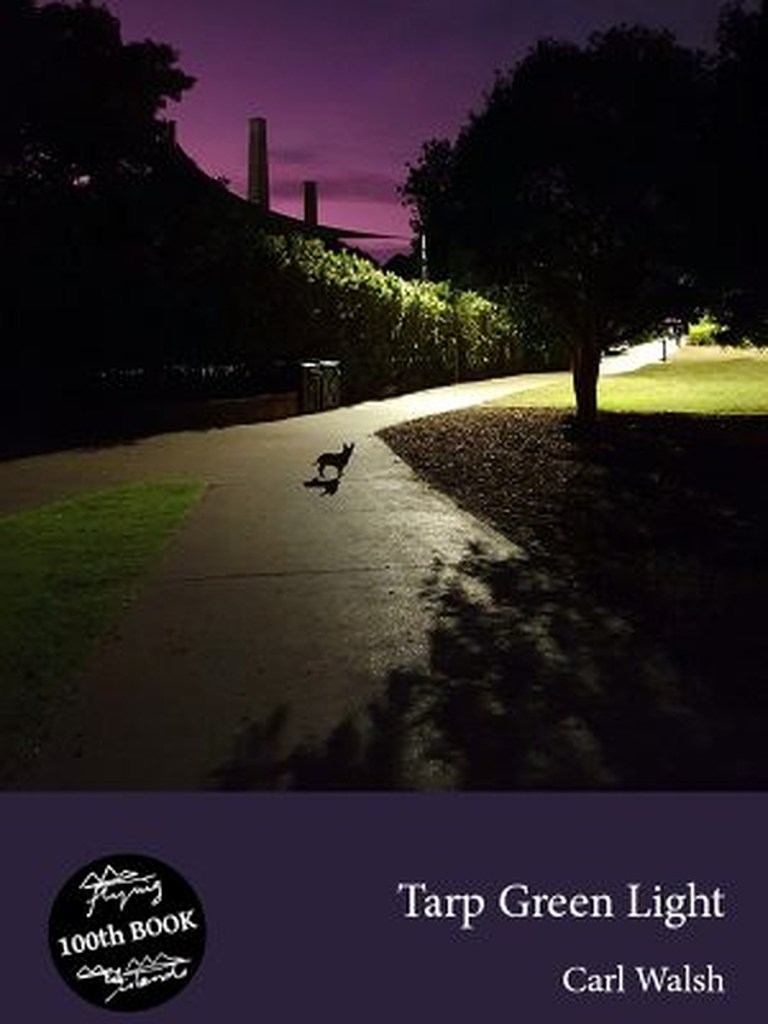
Carl Walsh, Tarp Green Light (Flying Island Books 2023)

Of recent years the emerging Artist and I have travelled north for a couple of weeks each winter. In last year’s fortnight on Yunbenun (Magnetic Island) I read and subsequently blogged about nine books, eight of which were in Flying Island’s Pocket Poets series.

This year we have come further north, and I’ve read a lot less. Tarp Green Light is the first of four Pocket Poets I’ve read.

The Note on the Author tells us:

Originally a tradie, Carl snuck into uni in his mid-twenties, after two years volunteering in PNG. He’s almost always written poetry – some poems in this book had their genesis in notebooks while backpacking in 1997.

Those backpacking notebooks have borne wonderful fruit. There are fine poems on other subjects – Linnaean categories, the Old Norse alphabet (I think), childhood memories, family history, and more. But it’s the poems that evoke particular places that create the strongest impression. The places include Papua New Guinea, Ireland, rural Australia, a number of European countries, and Japan.

The book’s title comes from one of the PNG poems, ‘Sepik Wara’. The poem is hard to quote from, as it’s laid out with text on either side of a broad winding river of white space, but here’s an attempt:

_________________________ _____________ we eye
rush of black clouds____________ __ _ pooling
in the sky; unfold ______________plastic tarps
to array over_______________________ our heads
as rain sheets________________ down we breathe
the close_______________ air and laugh at each
other__________________ in the tarp green light

At least one poem, ‘Idiot Fruit’, visits the Daintree, where I have recently spent a day:

Is it cassowary plums that lay 
as blue/grey eggs on the ground?

My blogging practice is to focus on page 77 (at least until I turn 78). In books like this, the practice saves me the impossible task of choosing one poem to represent them all. ‘Niseko miso’, on this book’s page 77, is one of the very few prose poems in the book, but in other ways is a fine example of how Carl Walsh can evoke a place::

Niseko miso
The cloudiness of my miso is reflected in
afternoon sky with dark seaweed stretches of
kombu cloud and strips of white tofu. But this sky
is perforated with peaks. Active in their inactivity
– three thousand years just a nap. How old I
am in their years? My head hurts at the maths.
Perhaps I should get Isabelle to calculate it? Some
are wild for ten thousand years. Even resting,
prone to throwing unexpected parties. I glance
at Mt Yōtei, its dark bulk everywhere. Hope it's
content with its sleeping. That Kagu-tsuchi-no-
kami
, the fire-spirit, is happy. I stir my miso – and
the clouds burst with rain.

Like many travel poems, this becomes more enjoyable when you know something about the places it names. A quick bit of browsing told me that Niseko is a ski resort area in Hokkaido; kombu is the kind of seaweed you might find floating in a bowl of miso soup; Mt Yōtei is a volcano, one of the hundred famous mountains of Japan, and popular for backcountry skiing expeditions; and Kagu-tsuchi-no-kami is, as the poem implies, a fire spirit whose rages are to be feared. Mt Yōtei last erupted about 3000 years ago but it is still active.

The poem deftly conjures up a situation: the speaker is drinking miso soup one afternoon in the foothills of Mt Yōtei, probably at a resort of some kind (his mind goes to wild parties as a synonym for volcanic eruption). He may be alone while drinking soup and composing the poem, but he has a female companion, Isabelle, who is probably travelling with him, certainly within easy communication distance.

The speaker idly/playfully notices a similarity between the appearance of the sky and that of his soup: clouds and seaweed allow sky and soup to be synonyms for each other.

Then there’s a but, a word I’m coming to love in poetry as signifying a turn of some kind. Here the speaker notices the major flaw in his synonym: the soup has no equivalent to the mountain peaks that pierce the clouds. The mountains dominate the rest of the poem, prompting thoughts about geological time. The tone is still playful – volcanic activity is described as wild partying, prolonged or brief and unexpected – but there are quiet hints of awe in the presence of the sublime.

In the two sentences before the last one, another dimension of the place of the poem comes into play. These mountains have had stories told about them for millennia. The speaker acknowledges this, by naming the fire spirit Kagu-tsuchi-no-kami, at the same time expressing anxiety about a potential eruption. (Maybe it’s just me but that seems to be a very Australian response, given how very extinct our volcanoes seem to be.)

Then in the last sentence, the poem comes down to earth, and attention returns to the soup and the clouds. There’s a hint of sympathetic magic – did stirring the soup make the rain come? – but the main effect is to pull back from vast, fearsome, mythological thoughts to the present moment, the place where the poem started.


I read this book near the mountains of Yidinji land and finished writing the blog post on Gadigal–Wangal land, where the sky is brilliant blue and the wind is chill. I acknowledge the Elders past and present of both peoples.

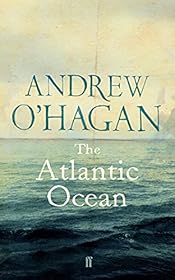
Andrew O’Hagan’s Atlantic Ocean

Andrew O’Hagan, The Atlantic Ocean: Essays on Britain and America (Faber 2008)

This book was my gift in a Book Group Kris Kringle years ago, and has been languishing on my top shelf ever since. I was prompted to read it by Caledonian Road, Andrew O’Hagan’s most recent novel – which I’ve just read for my other Book Club (blog post to come after the next meeting).

These 23 essays were first published between March 1993 (‘The Killing of James Bulger’) and February 2008 (‘Brothers’). That’s not so long ago, but the book feels as if it comes from another, ancient era. Michael Jackson was alive. 9/11 (and England’s 7/7), the Iraq War, Hurricane Katrina and George W. Bush were in the headlines. Donald J Trump was barely a reality TV star; Brexit wasn’t a cloud on the horizon; a global pandemic was predicted, but with no sense of urgency.

Most of the essays were first published in the London Review of Books, many of them as book reviews. We are told the month and year of first publication, but not the details, or sometimes even the name, of the books being reviewed. We’re invited to read them as stand-alone essays, and for the most part they succeed – as memoir, literary journalism, social commentary, a general reflections on literature. There are pieces of serious long-form journalism, like ‘On Begging’ (November 1993), in which 25-year-old O’Hagan joins the beggars of London with a tape recorder in his pocket, or ‘Brothers’, the book’s final essay, in which he visits the people left behind by the deaths of two servicemen in the Iraq War, one from each of England and the USA.

Three essays illustrate the range of O’Hagan’s subject matter and the variety of his approaches:

‘The Killing of James Bulger’. In the north of England in 1993, two 10-year-old boys abducted, tortured and killed two-year-old James Bulger. The great Gitta Sereny wrote about the murder, probing the boys’ motives and challenging the vengefulness of the press, the courts, and the crowds that gathered to demand the death sentence. O’Hagan’s essay has a similar impetus but, strikingly, his starting point is to identify with the killers. He describes in unsettling detail the way, as a child in Glasgow, he and a girl friend mistreated a much younger child, and expands from there to the general normalisation of cruelty in his part of Scotland. (Shades of Douglas Sewart’s Shuggie Bain or Jimmy Barnes’s memoir Working CLass Boy. It’s a challengingly personal essay that is shamefully relevant to the place I’m in just now, as Queensland’s Liberal National Party is pushing an ‘Adult crime, adult time’ policy.

‘On the End of British Farming’ (March 2001), one of the longest essays, is a brilliant piece of investigative journalism. O’Hagan visits a number of small farmers, and gives shocking statistics on the economic pressures they are up against. Most shockingly, perhaps, is what happens when he follows up a claim by a Sainsbury representative that the retail chain has an excellent relationship with a dairy farm in Devon. On visiting the ‘farm’, he finds that in order to survive (and then thrive), the couple who run it have got rid of all their cows. Their enterprise is now is in effect a yoghurt and ice cream factory, buying milk at just above the unsustainable going rate from neighbouring farms. The essay sees the source of the problem in the subsidy policies after the Second World War. There is some discussion of the role of the EU (real, but not major, he argues). It’s one of the many moments when I would love to see an update: did Brexit improve things?

‘After Hurricane Katrina’ (October 2005). O’Hagan saw online that two men from another state were driving to New Orleans to help in the aftermath of Hurricane Katrina. He contacted them and asked to travel with them. The essay is a literary equivalent of a fly on the wall documentary: the writer is all but invisible, making no overt judgement, authorial comment or explanation, but allowing the story to unfold mainly through the dialogue of the two men. They are rowdy, spectacularly sexist, uncareful about racism (one of them is African-American), and a weird combination of generosity and self-absorption. It reads a bit like a Carl Hiaasen novel. I could only wish that Caledonian Road had as much exuberant life.

Page 77 occurs in ‘Tony and the Queen’ (November 2006), which is part a reflection on the Stephen Frears/Peter Morgan Movie, The Queen – long since superseded in our minds by the TV series The Crown (also largely written by Peter Morgan). The page happens to include one of the passages where O’Hagan notes the influence of US culture on Britain’s. He is discussing the moment in the film and in real life when the Queen was slow to grieve publically after the death of Lady Diana:

Obviously, the elder royals and their familiars had completely missed out on the Oprah-isation of the universe. If they hadn’t, they might have learned the new first rule of successful leadership: enjoy your inscrutability if you must, but don’t ever stand in the way of a confessional heroine. If stopping Diana was something of a thankless task while she was alive, the effort would come to seem suicidal for the British monarchy in the summer of 1997, after Diana died in that Paris tunnel. William Shakespeare himself could scarcely have imagined, in the days after the crash, a royal household with more out-of-touch advisers than the Windsors had on twenty-four-hour call, each of them sharing a gigantic unawareness of the difference between a pest and a mass phenomenon. But it is said that much of the intransigence was coming from the Queen herself, who, despite all her experience, disported herself that summer like a person lumbering in a dark cave. She was somehow unable to see what the infants and the dogs in the street could see, that the old style was unsuited to the virulent new mood – and that if something had to give, or someone, it was most likely going to be the woman whose head appears ready-severed on Britain’s postage stamps.

An astute observation at the time, and probably accurate about the changing times, but it fails to imagine – and how could it – the powerful impact of the image of that same inscrutable queen sitting alone at the funeral of her husband. Inscrutability itself, evidently, can find favour in the ‘virulent new mood’, and O’Hagan’s ominous hints of decapitation to come (inspired no doubt by Scottish wishful thinking) fell very wide of the mark.


I finished writing this blog post in Ma:Mu country. My father, my siblings and I were born on this country, and I’m very happy to belatedly acknowledge the Ma:Mu Elders past and present who have cared for this prodigally beautiful land for millennia, and continue to do so..


* My blogging practice for some time has been to focus arbitrarily on the page of a book or journal that coincides with my age, which currently is 77.
Journal Catch-up 24

As I have mentioned before, I once had a substantial collection of Meanjins. I parted company with them in the course of moving house, probably forty years ago or so, and I haven’t kept up with Meanjin‘s changing identity since. In 2021 I toyed with the idea of resubscribing, but I may have been daunted by the sheer size of each issue. I have now bitten the bullet.


Esther Anatolitis (ediitor), Meanjin Vol 83 Nº 1 (Autumn 2024)
(links are to the Meanjin website: some but not all of them are available to non-subscribers)

This issue is a doozie!

It’s as engaged with current social and political issues as Overland. There are a number of essays on aspects of the Israeli invasion of Gaza, including Sarah M Saleh’s brilliant argument for the importance of Palestinian solidarity movements to the political wellbeing of Australia as a whole. There’s a concise summary article by father and daughter team Stephen Charles and Lucy Hamilton on the role of lies and disinformation in the Voice referendum. There’s a portrait by Jack Nicholls of eco-warrior CoCo Violet. There’s Amy Remeikis on the significance of the (first) Bruce Lehrmann rape case. And more.

It’s as culturally diverse as Heat in its heyday. Editor Esther Anatolitis (Σταθία Ανατολίτη) interviews Peter Polites. André Dao gives the 2023 State of the (Writing) Nation Oration. And more.

It’s as academically challenging as Southerly. See Dan Disney’s esoteric discussion of a Korean verse form and the fraughtness (impossibility?) of translating it, or imitating it, without subsuming it into the linguistic dominance of the English language; or Ianto Ware’s account of the challenges he fac ed in writing about his mother’s life and death.

First Nations writing has a strong presence. Among other things, ‘Ilkakelheme akngakelheme—resisting assimilation‘, a powerful essay by Theresa Penangke Alice, has pride of place before the contents page, and the new poetry editor is Wiradjuri woman Janine Leane.

I learned a lot – from Renata Grossi about the law concerning wills and what happens when they are contested; from Tom Doig about the long shadow of the 2014 Hazelwood disaster; from Marcus Westbury about the possibilities of something like a Universal Basic Income.

There are memoirs, including a brief snippet by Clare Wright, which starts out from an elaborate piece of costumery in the Powerhouse Museum and takes the reader to an unexpected ugly teenage encounter.

There are book reviews, and poetry. I was delighted to read, ‘Thread‘ a new poem by Eileen Chong. Two very different poems, ‘Oomarri—coming home‘ by Traudl Tan with Kwini Elder Ambrose Mungala Chalarimeri, and ‘Dreaming in Bourke‘ Paul Magee, talk to each other across the pages about the importance of country for First Nations people.

I picked up a couple of new words. My favourite is::

  • pipikism, a term coined by Philip Roth, who defined it as ‘the antitragic force that deconsequentalises everything – farcicalises everything, trivialises everything, superficialises everything’. Naomi Klein revisits the term in Doppelganger, her book reviewed in this Meanjin by Sam Elkin.

I’ll give the last word of this post to Peter Polities, whose words on page 77* in some ways speak to the journal as a whole:

I remember when I was in art school … this guy said to me: ‘I’m not political.’ And I was like: What did you say?!?’ I was just so shocked the first time I heard it, but then by the second time, I was so sarcastic: I said, ‘Yeah, what’s political about making goods for a luxury market?’ So this is what these kids wanted to be: to create work that you hang above a fucking couch for rich people. My interest in art is as a site for intervention, a site for politics, and culture is one of the most political things that we have.


I finished writing this blog post in stunningly beautiful Kuku Yalanji country, to the tune of parrots, curlews and the calls of other birds I don’t recognise.


* My blogging practice for some time has been to focus arbitrarily on the page of a book or journal that coincides with my age.

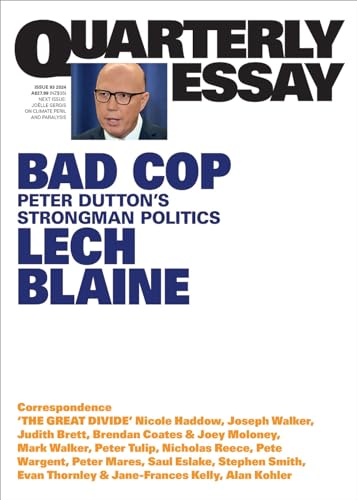
Lech Blaine’s Bad Cop

Lech Blaine, Bad Cop: Peter Dutton’s Strong Man Tactics (Quarterly Essay 93, 2024) – plus correspondence in Quarterly Essay 94

Peter Dutton eats bleeding-heart lefties for breakfast. He is tall and bald, with a resting death stare. His eyes – two brown beads – see evil so that the weak can be blind. His lips are allergic to political correctness. Peter preaches the gospel of John Howard with the fanaticism of Paul Keating. He wants to do the Labor Party slowly, slowly, slowly, and defeat the woe-is-me heroism of identity politics.

That’s the start of this Quarterly Essay, and it was nearly enough for me. Life’s too short and the times are too perilous, I thought, to indulge in another witty hatchet job on a dangerous politician. And I was grumpy with a heavy cold.

But I persevered, partly out of a QE completist compulsion but also because I’d heard Lech Blaine talking to Richard Fidler on the Conversations podcast (link here), where he said some interestingly complex things about Dutton.

Much of the essay, it turns out, is a slog. It follows the ins and outs of Dutton’s life and career, along with the vicissitudes of the Liberal Party and Queensland’s Liberal National Party and the internecine leadership struggles on that side of Parliament over the last 40 years or so, with occasional glimpses at what’s happening in the ALP. Blaine has done a shedload of research, including many interviews with key players and interested observers. There’s far too much going on to enable a coherent narrative, and that’s not counting the brief look at Dutton’s squatter ancestors who were in the tiny minority of their class who stood up for First Nations in Queensland.

The reader is never left in any doubt that Blaine doesn’t like Dutton or his politics – and Dutton has thoughtfully provided a steady stream of pithy quotes to justify those dislikes.

In Blaine’s account, everything Dutton says and does is calculated for its electoral usefulness, but at least some of his outrage has a germ of personal truth to it. His projected identity as a Queensland copper, unlike Scott Morrison’s ‘ScoMo’ persona, is based in actual experience, specifically his nine formative years in the Queensland police force. He was genuinely affronted when someone on Twitter called him a rape apologist, as his dealing with horrific instances of rape as a policeman had been a major formative experience. It’s not just a matter of convenience that he doesn’t spruik his subsequent decades as a property wheeler and dealer, even though that experience, that unacknowledged identity, lies at the back of many of his policy positions.


The correspondence in Quarterly Essay 94 kicks off with a brief, resounding endorsement from Niki Savva, the Queen of Liberal Party Coverage. Encapsulating much of Blaine’s essay, she says, ‘I call Abbott Terminator One and and Dutton Terminator Two.’ Thomas Mayo underlines Dutton’s role in defeating the Voice referendum, quoting Noel Pearson: ‘A heartless thing to do – but easy.’ Other correspondents join the argument about Dutton’s strategy to become the next Prime Minister – interesting, but largely ‘inside baseball’ discussion.

Paul Strangio, an emeritus professor in politics who is currently working on a study of ‘Australia’s best prime ministers’, add some interesting perspectives. He reminds us of that other Queensland copper who was leader of the Federal Opposition, Bill Hayden:

Despite the similarities in their back stories, the differences between Hayden and Dutton could hardly be starker. Arguably, the contrast is a disturbing marker of the degeneration of the political class across generations, of the retreat from a milieu of enlightened social-democratic optimism to irrational conservative populist pessimism, and of the decline of a political sensibility of compassion and empathy to one of stony-heartedness.

Strangio reminds us that Dutton’s strong man approach to politics is part of a planet-wide phenomenon. And he puts his finger on the thing that I experienced as a vague discontent with the essay. Blaine’s view of Dutton, summed up in his final words – ‘Tall and strong at first glance, but when you watch him for a long time, you can see that the man is small and scared’ – isn’t strongly substantiated. The reader is left with the suspicion that it ‘springs as much as anything from a distaste for his subject, a distaste that he struggles to disguise’.

I agree. This essay works brilliantly as a reminder of the many ways Peter Dutton has shown himself as the ‘strong man’ of the Australian parliamentary right-wing, there are hints of how he got to where he is, and a persuasive account of his current campaign to become prime minister, but Dutton the breathing, feeling man remains a mystery.

Journal Catch-up 23

Two more journals in my endless attempt to keep up to date!


Evelyn Araluen and Jonathan Dunk (editors), Overland 252 (Spring 2023)
(Some of the content is online at the Overland website – I’ve included links)

This Overland‘s editorial describes itself as a ‘second run’. The first run had reflected on the Voice referendum, but as publication came closer – in October last year – ‘the temptation to linger on the politics of symbolic recognition and constitutional reform seems a luxury in the face of escalating violence against Palestinians in Gaza and the West Bank’. With feet and throats sore from a solidarity march, the editors draw attention to an essay by Palestinian-Australian writer and historian Micaela Sahhar, ‘which reminds [them] of Overland‘s historic role in indexing Palestine’s survival and resistance’.

Quite apart from its serendipitous relevance, the essay, ‘An idiosyncratic archive: Overland 169 & the Wolstonecroft years‘, is a joy to read, as Sahhar revisits two copies of Overland she acquired in 2002 and 2004. She compares her reading of them then and now, talks of her relationships to people who appeared in them, and generally takes us on a journey into her mind. I love this passage – and so, I assume, do the editors:

As a journal at odds with the mainstream, Overland offered a younger version of me an intellectual place where radical thinking could reside, and a dawning awareness of a community I could take a place in. In this sense, Overland was the tangible expression of a counter to the indifference and invisibility of a young Palestinian woman, the significance of whose identity was rewritten just as she came of age at the time of a catastrophic intellectual nadir represented in 9/11; and a place of refusal against socio-political disengagement and apathy which have been the horsemen of these neo-liberal times.

The other stand-out essay is ‘The Disappearance of a.k.a. Victor Mature‘ by Vivian Blaxell, which ranges far and wide, high and low, into memoir and poetry appreciation, circling the subject of beauty. It’s a great read, from which I can’t resist quoting what may be the silliest paragraph, but one that made me laugh:

Australian English is wanton with beautiful. Beauty pops up in not the usual beautiful places there, thereby revealing the radical contingency of beauty itself, probably unintentionally: beautiful, Australians might say of a pork sausage, which seems a surprise at first until you realise that beauty does not exist before we say it exists, for beauty relies entirely on disclosure for its existence. That lucky sausage.

Other essays are a discussion by Peter D Mathews of Sophie Cunningham’s 2004 novel Geography and an idiosyncratic but fascinating essay by πO on concrete poetry in Australia and related matters.

There are five pieces of fiction and nine poems.

Of the poetry, ‘Balloch’ by Eileen Chong stands out for me. An apparently simple poem about a visit to a Scottish loch, it leaves an uncanny aftertaste that only gets richer with further readings.

The fiction covers a wide range, from a celebration of Rotuman culture (I had to look it up) by Dorell Ben to a fantasy of a catastrophic world post climate emergency by Jodie How, with a little social realism by Chloe Hillary and other pieces in between.


Alexandra Christie (editor), Heat Series 3 Nº 12 (Giramondo 2023)

This may be my last issue of Heat before my subscription expires. Despite having a selection of poems from Nam Le’s 36 Ways of Writing a Vietnamese Poem, a book I’m looking forward to, the journal is a bit of a fizzer for me, though the dominating US presence I’ve complained of in earlier issues is absent, and only one member of Heat‘s editorial advisory board gets a guernsey.

  • You can read Paddy O’Reilly’s ‘Redundant‘ on the Heat website. It’s an experimental prose piece in which the experiment seems to consist of not finishing sentences. See what you think.
  • Jordi Infeld’s ‘Poet’s Pocket’ would and indeed does pass for a short essay on sewing and related matters – just a footnote identifying one of its otherwise unremarkable phrases as a quote from Gertrude Stein’s Tender Buttons suggests deeper undercurrents.
  • ‘The Phoenix Apartment’ by Bella Li feels to me like notes towards a larger project.

Items from beyond the Anglosphere are ‘We Shall Be Monsters’, a meditation on Mary Shelley’s Frankenstein by Argentinian writer Esther Cross, translated by Alice Whitmore, and six terrific short poems by Iranian Maryam Nazarian, translated by Malaysia-based Arash Kohshsafa. Here’s the first and shortest of the poems, which does wonderful things with an echo of William Carlos Williams’s poem about the plums:

One
I've set the breakfast, the kisses, and the keys on the table.
Please, forgive me
if I find freedom more pleasant than your love.

The most interesting piece is Stephanie Radok’s ‘Inventory 2020’, an impressionistic chronicle of a working artist’s life, made up of mostly very short entries. It reminded me of the late Antigone Kefala’s journals in the way it combined observations of the passing moment with considered reflections and descriptions of the artist’s process. As 2020 was a year when the even tenor of our lives was disrupted by Covid, a narrative emerges. Here’s the entry for 23 February, on page 77*:

23. What you thought was passing/casual was your life. And a particular red purple near a blue hillside that seemed to reflect you.

As for Nam Le’s poems, they seem to be part of a larger whole. I’ll wait for the book.


* My blogging practice for some time has been to focus arbitrarily on the page of a book or journal that coincides with my age.

William Gibson’s Peripheral

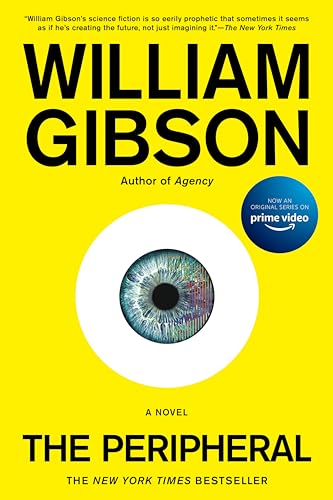
William Gibson, The Peripheral (Berkly 2014)

I picked up The Peripheral in a street library soon after I finished reading and blogging about its sequel, Agency, nearly four years ago. Since then, it has been my TBR shelf as a treat for a rainy day. Its time has now come.

There’s a peculiar challenge in writing about it. Possibly the main thing I enjoyed about it is that a lot of the time the reader has no idea what’s actually happening. You’re not even sure what some words mean, or what the characters are not saying. Explanations do come, eventually, but there’s a delicious disorientation as AI devices and other technical marvels multiply, we only half-see crucial incidents, cultural events are described from the point of view of someone who knows a lot more about the background than the reader does. The action takes place in two unspecified future time periods that interpenetrate in often unclear ways. However serious the issues may be – and there’s a plausible version of how the global emergency will develop – there’s a pervasive sense of play. If I summarise the plot, or even the set-up, I’ll be depriving you of that experience.

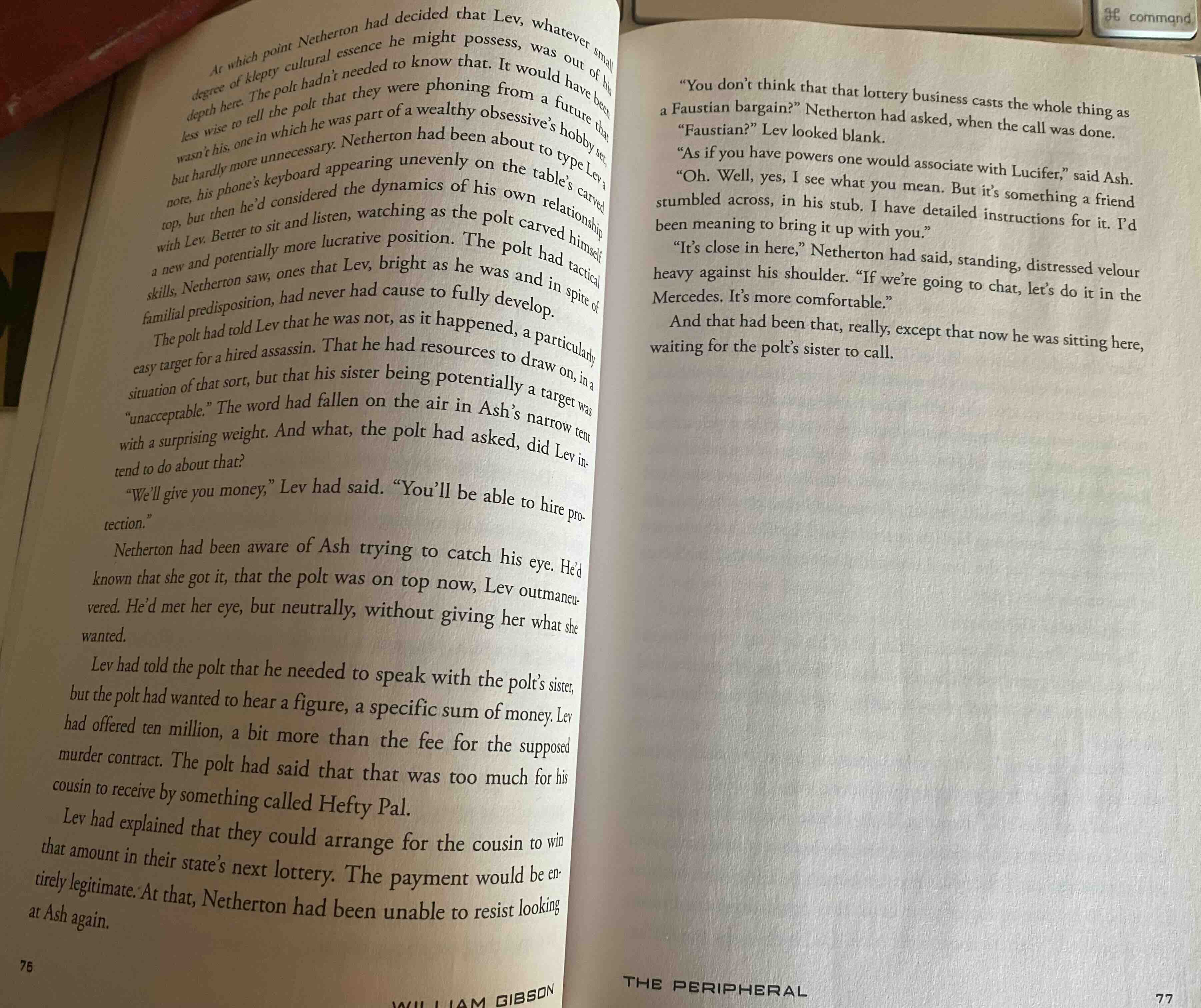
My first idea was to write about first two short chapters – all the chapters are short – but then I thought, oh what the heck, I’ll skip straight to page 77* to give you a taste, and let the spoilers fall where they will.

Lev had told the polt that he needed to speak with the polt’s sister, but the polt had wanted to hear a figure, a specific sum of money. Lev had offered ten million, a bit more than the fee for the supposed murder contract. The polt had said that that was too much for his cousin to receive by something called Hefty Pal.
Lev had explained that they could arrange for the cousin to win that amount in their state’s next lottery. The payment would be entirely legitimate.

Gibson has a gift for coining terms. ‘Cyberspace’ is his invention. Of The Peripheral‘s many coinages, three appear in this short passage: ‘polt’, ‘Hefty Pal’ and ‘stub’. They each have the virtue of suggesting their origins if not their precise meanings. A polt, derived from poltergeist, is a person who is bodily in one place and/or time, but is somehow seeing and acting in another time. (A peripheral is a human-looking artefact, that can be the host to a polt.) Hefty is a mega corporation of which Hefty Pal, as in PayPal, is a subsidiary. A ‘stub’, known more formally as a ‘continuum’, is a key invention of the book, something that readers and half the characters come to understand only gradually. All I’ll say here is that it is something that results from people going back to an earlier time and changing that time’s future.

There are three characters in this scene: Lev, the son of a fabulously wealthy Russian gangster capitalist, whose hobby involves mucking about with the past (stubs/continua are his playthings); Ash, a tech wiz who makes it happen for him (among other distinguishing features, she has tattoos of animals that move around on her skin, often glimpsed running for cover when someone tries to look at them); and Wilf Netterton, put-upon publicist, from whose point of view the story is told in alternate chapters. Page 77 is at the end of a Wilf chapter.

Three more characters are referred to. ‘The polt’ is Burton, a battered veteran in Netterton’s past / our future (though that way of describing things isn’t quite accurate). ‘The polt’s sister’ is Flynne, a gamer in a small US town who is the focus of the non-Wilf chapters. Burton and – on one fateful occasion – Flynne have been employed as polts by Lev under the impression they were testing a computer game. The main narrative is set in motion by Flynne’s witnessing what may be a murder. ‘The cousin’ is Leon, one of their tribe of loyal family members.

At that, Netherton had been unable to resist looking at Ash again.
‘You don’t think that that lottery business casts the whole thing as a Faustian bargain?’ Netherton had asked, when the call was done.
‘Faustian?’ Lev looked blank.
‘As if you have powers one would associate with Lucifer,’ said Ash.
‘Oh. Well, yes, I see what you mean. But it’s something a friend stumbled across, in his stub. I have detailed instructions for it. I’d been meaning to bring it up with you.’

Tiny moments like this give the book its rich texture. There’s the complicity between WIlf and Ash, two underlings who have cultural memories, unlike their rich and powerful employer. (Similarly in the earlier paragraph, it’s fun that Hefty Pal is something in the reader’s future and Flynne’s present that has been forgotten in Wilf’s time.) Like the implied reference to poltergeists, the mention of Faust reminds us that even though the narrative is presented as a tale of high tech, AI and nanotechnology, it often has the feel of demonic possession and fairytale magic. (If you’ve read Gibson’s Sprawl trilogy – Neuromancer (1984), Count Zero (1986) and Mona Lisa Overdrive (1988) – you’ll remember the prominence there of the legba of Voodoo.)

And that had been that, really, except that now he was sitting there, waiting for the polt’s sister to call

That’s the first hint of the almost-romance that is to almost-blossom between these characters who can only spend time together by means of weird time travel mediated by a peripheral in one direction and an odd little children’s toy in the other.

Now I’m tempted to reread Agency. I remember that it was also gleefully inventive and similarly had two interrelating times. I’m pretty sure that some of the distant future characters are in both books, but my memory is dim. William Gibson is anything but dim.


I wrote this blog post on the unceded land of the Gadigal and Wangal clans of the Eora Nation, not far from where what we now call the Cooks River has been cared for by Elders for many millennia. The weather has just turned cold, but spider webs are still proliferating.


* My blogging practice is to focus arbitrarily on the page of a book that coincides with my age, currently page 77. For The Peripheral, I’ve included a little from page 76 as well.

Ivy Ireland’s Tide

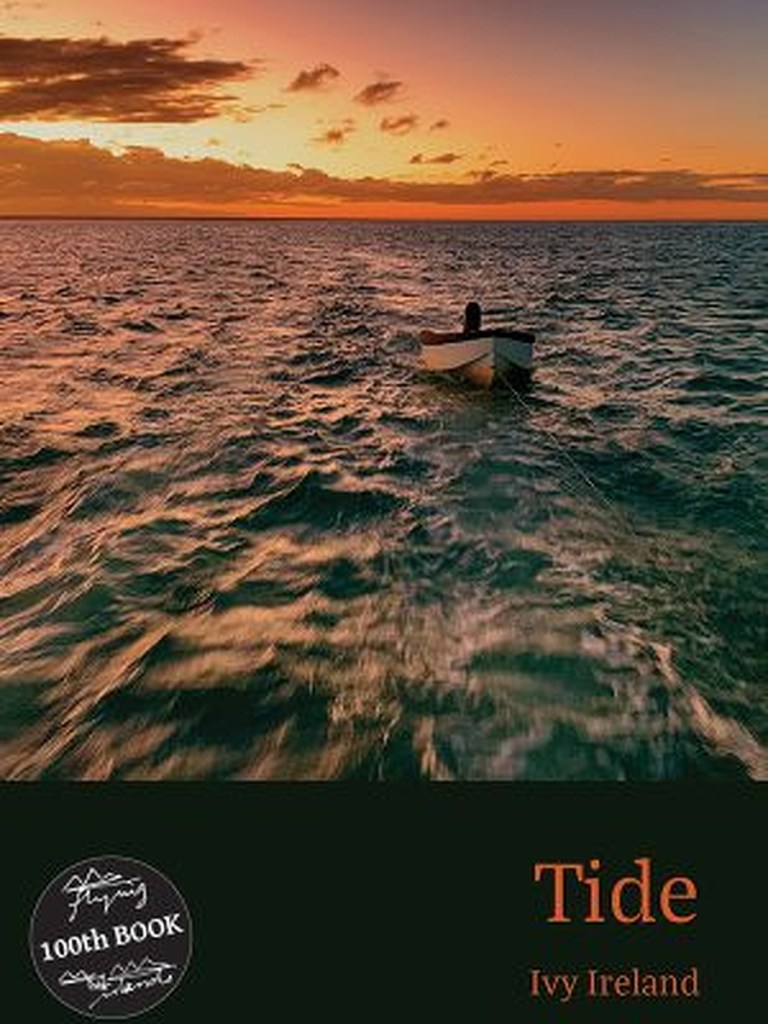
Ivy Ireland, Tide (Flying Island Books 2024)

Tide may seem like a quietly generic title for a book, especially one that has a number of poems about the sea, but a laconic note on sources suggests a dark subtext:

The title of this book, Tide, and the title of the poem, ‘A Shallow Boat’, are both taken from Alfred, Lord Tennyson’s poem ‘The Lady of Shalott’ (1832) with the necessary reverence.

I decided to read the Tennyson poem. I’m pretty sure I hadn’t read it before, but many of its lines (‘the mirror cracked from side to side’, ‘The curse is come upon me’) were familiar, probably from young Dorothy Hewett’s romanticism as recorded in her autobiography, Wild Card. Certainly Ivy Ireland’s compressed, science-related poems, with close observations of the real world, are not at all like Tennyson’s flowery, relentlessly rhyming lines. The word ‘tide’ occurs only once:

For ere she reach'd upon the tide
The first house by the water-side,
Singing in her song she died,
The Lady of Shalott.

The note on sources, then, leads one to expect something death-related: the tide is metaphorical, bearing us inexorably away. The book only partly meets that expectation. There’s a lot of life here, and not much death.

The book is divided into four sections of unequal length named for tidal phases: ‘Ebb’, ‘Low’, ‘Flood’, and ‘High’. If I had to pick favourites, I’d say I enjoyed the poems in ‘Low’ most: in ‘Lake Poet’, in the context of the climate emergency (not explicitly named, but definitely there in my mind) the lake is less a thing of sublime beauty than a place that will hold the poet to account, as opposed to the city, where ‘nobody has to answer for anything; in ‘Cane Toad’, the poet and her young daughter encounter some teenagers on Valentine’s Day:

She asks me,
of all people,
if they are going to marry,
those beatified ones,
out decking each other in posies
in the quiet toilet paper aisle.

‘Killing Plovers’ is a yarn about family life that takes on a fable-like quality about humans’ relations to other animals; ‘The Birth of the Universe’ is a wonderful poem about a) the Big Bang and b) giving birth.

The section ‘Flood’ comprises six prose poems, including ‘I Am John Is Dead’, long enough to be called a short story, about a young woman’s encounter with a New Age guru in the outback, which accurately describes itself as ‘like a Jim Jarmusch film’.

Page 47* is the title page for the book’s final section, ‘High’. The section includes just one poem, ‘A Shallow Boat’, in which the narrator with one other person goes sailing off the Queensland coast. Since the note on sources mentions this poem, I looked at the Tennyson poem again, and found:

In the stormy east-wind straining,
The pale yellow woods were waning,
The broad stream in his banks complaining,
Heavily the low sky raining
Over tower'd Camelot;
Outside the isle a shallow boat
Beneath a willow lay afloat,
Below the carven stern she wrote,
The Lady of Shalott.

This is the boat on which the Lady of Shalott floated to her doom.

Happily, the speaker of Ivy Ireland’s sailing excursion survives, having had a very nice time, even if it is sometimes scary and perhaps humiliating as she feels her incompetence.

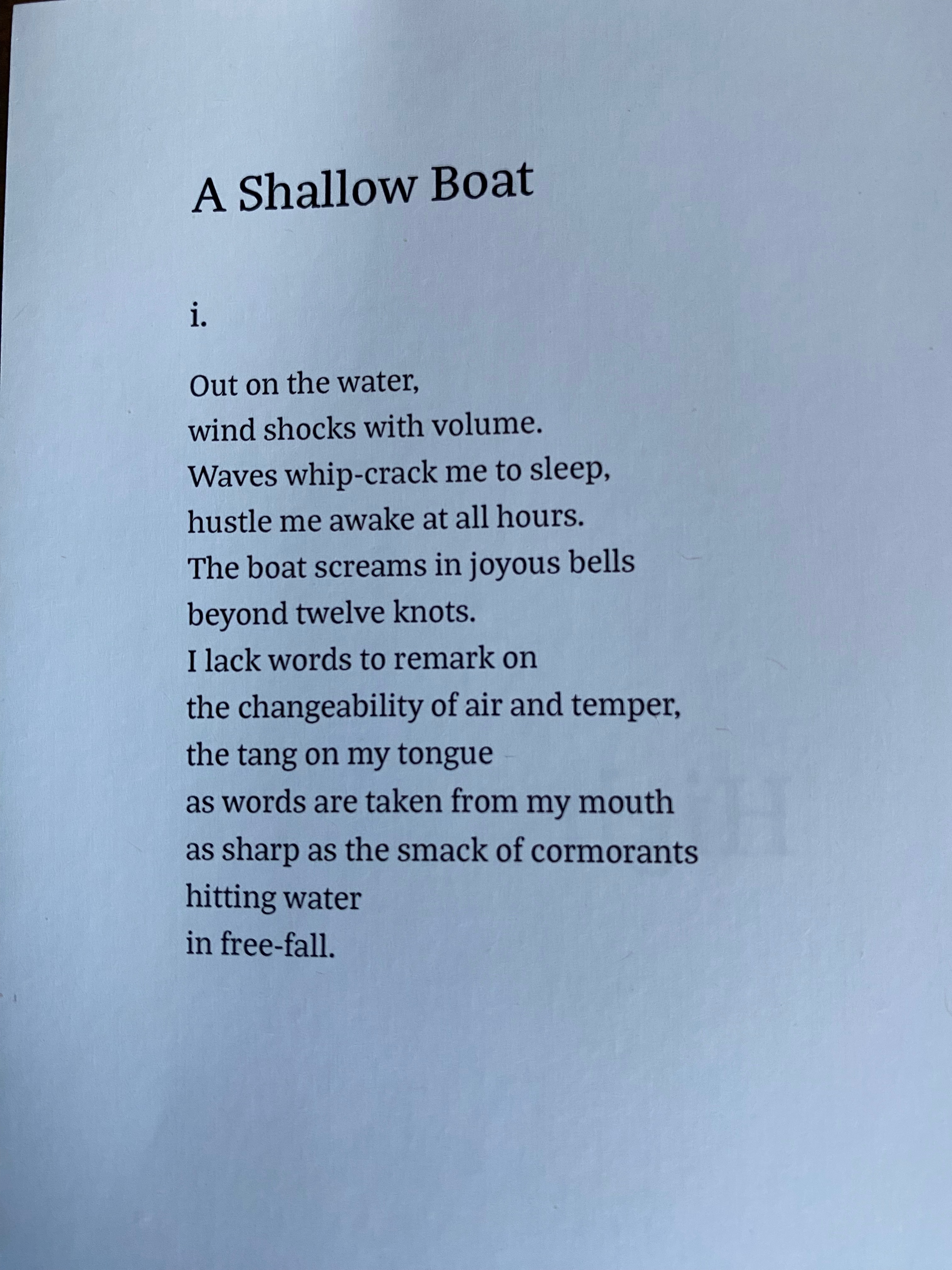
Here’s the first of the poem’s 12 parts, from page 48:

A Shallow Boat

1.

Out on the water,
wind shocks with volume.
Waves whip-crack me to sleep,
hustle me awake at all hours.
The boat screams in joyous bells
beyond twelve knots.
I lack words to remark on
the changeability of air and temper,
the tang on my tongue
as words are taken from my mouth
as sharp as the smack of cormorants
hitting water
in free-fall.

All I really want to say about this is that I love it. I have no desire to go sailing. I breathe a guilty sigh of relief when I realise that the Emerging Artist gets seasick very easily, so is unlikely to be urging me to do it. But I love it as evoked in this poem.

The poem is almost a sonnet. The first six lines describe the wind, the waves, the sounds of the boat. Then there’s a turn, and in the next five lines the poet tries and fails to articulate a response. Then there’s a three-line equivalent to a sonnet’s final couplet – rather than a witty encapsulation of what has gone before, here it’s the cormorants, ostensibly a metaphor for the poet’s speechlessness but actually just there, smacking the water.

Every verb, every adjective, every noun is carrying its share of the meaning-load, and the sound design is wonderful. The echoing Ws bind the lines together, with a little respite for Ts (‘temper’, ‘tang’, ‘tongue’, ‘taken’, and then ‘cormorants’) in lines 8 to 11. Back to W and then the Fs in the last line introduce a new, final sound.

The Tennysonian hints of doom may be realised in later parts of the poem, as in these chillingly succinct lines from part viii:

There's a point 
where climate emergency,
once witnessed,
ticks over from
possible to inevitable;
anything else is inconceivable.

But that’s context rather than substance. The joy in this poem, as in the whole book, is in celebrating engagement with the natural world, vulnerable, dangerous, fragile, awesome, beautiful, breathtaking (sometimes literally). From section ix:

Orange shifts over the horizon, and here we are: 
alive, while countless others are not.
Who am I to deserve daybreak. This happening here,
sea eagle fishing beside the boat,
sea turtle snorting to the surface. What's it for,
to be so honoured.

I wrote this blog post on land of the Gadigal and Wangal clans of the Eora Nation. I’m posting it on a day that has shifted from bright blue sky to heavy downpour within hours. From my window I can see wet gum leaves reflecting the afternoon sunlight as they have been witnessed by First nations peoples here for tens of thousands of years.


* My blogging practice for some time has been to focus arbitrarily on the page of a book that coincides with my age. A focus on just one page seems to me to be almost necessary with books of poetry, where the parts are so often greater than the whole. As Tide has fewer than 77 pages, so I’m focusing instead on my birth year, ’47.