Category Archives: Books

Julius Lester’s Falling Pieces

[This is a post from 22 July 2008, which I’ve retrieved from the ‘Private’ category because Julius Lester’s name has cropped up in relation to my current reading. I’ve just learned on Wikipedia that he died in 2018, and discovered a lot more about his life. He was committed to telling the truth as he saw it, whatever the personal cost. Judging from my brief contacts with him, he was also a really nice guy.]

Julius Lester, Falling Pieces of the Broken Sky (Arcade Publishing 1990)
falling.jpg

Since I’ve started making  notes here about every book I read, I’ve been tempted to feel ashamed of the chaotic omnivorousness of my reading habits. I read books because they are on offer at the Book Club, because they happen to catch my eye at an airport, because I’ve received them as gifts, because they’re part of the canon and I should read them, because I need to get an insistent friend off my back, because I’ve run out of cereal packets to read at breakfast …

At first blush, it would seem that I’ve read Julius Lester’s collection of essays for a purely random reason – because I won it in a little competition he ran. But I wouldn’t have won it if I wasn’t a regular reader of Julius’s blog, and I wouldn’t read his blog regularly if— And it struck me, perhaps because I started reading this book just after spending two days reading a friend’s novel-in-typsecript, that one whole category of my reading is Books Written By Friends. I’m probably using ‘friend’ in a slightly idiosyncratic way here since I know Julius only through his writing – a handful of his books (Sam and the Tigers: A new telling of Little Black SamboJohn HenryWhen Dad Killed Mom), his contributions to an E-List I once belonged to, his blog and a very few emails.

I’m expect that very few people in Australia have read this book of essays, published in 1990 and now out of print. And that’s a shame because each of its three sections is full of good stuff. The first, ‘Writers and Writing’, makes unlikely bedfellows of Henry Miller, Thomas Merton, Aldous Huxley and James Baldwin, and among other bracing delights includes an essay that begins, ‘I am grateful that among the indignities inflicted on me in childhood I escaped The Adventures of Huckleberry Finn.’ There are also a couple of pieces about his own writing, one of which begins:

I have always loved books. Medical science has learned that infants suck their thumbs in the womb. I read. I love books as much for their sheer physicality as for what I may learn and experience through the words on their pages. I love to touch books, to hold them. They are my security blanket, and whether I am happy or depressed, I go to bookstores to orient myself to the world, to feel myself enclosed, almost womblike, by books on all sides. I need books, almost as an alcoholic needs liquor. When I was in college, I always carried a book with me on dates, not sure that any girl could be as interesting or involving as a book. My wife wonders if I’ve changed.

The second section is titled ‘Race’. If there’s a binding thread to the book, it’s the responsibility of the writer to be truthful – to write the truth as he or she sees it, regardless of the demands of collectives of whatever kind. In this section Julius argues again and again for a deeply human perspective, rather than one determined by identity politics. He was part of the Civil Rights Movement, and laments the separatism and advocacy of violence that followed the assassination of Martin Luther King Jr, as well as the coming to dominance of victimhood and the shucking of responsibility. As a convert to Judaism, he has pungent things to say about anti-semitism among US Black leaders, and the tolerance of it among Black and other intellectuals.

The third section, ‘Falling Pieces of the Broken Sky’, draws its title from Seneca, ‘Of all the generations, it is we who have been designated to merit this fate, to be crushed by the falling pieces of the broken sky.’ The section consists mostly of short pieces that read as blog-entries before the existence of blogs – they were written to be read on the radio. I don’t think the title means to suggest that the reader will be crushed by them. On the contrary, I found myself thinking of the Judaic concept of Tikkun Olam, repair of the world, as if these small pieces are helping to piece the sky back together. Many of them are serio-whimsical – objecting to the term ‘Safe Sex’, for instance, because sex always has an edge of emotional or spiritual risk, so to ‘lead the young to believe that sex is safe may one day deprive them of love itself’. There’s a brilliant essay in defence of ‘the canon’ against those who urge educational institutions to introduce students primarily to writing that reflects their own experience, including this:

It is reprehensible that those who have suffered because they are different should now be the ones using difference as a weapon against others. Doing so denies that we are bound to each other by the simple fact that we all laugh and cry and suffer and rejoice about the same experiences or in the same ways. What matters is that we find the humanity within ourselves to delight in the laughter of others, even if we are not amused; that we feel a twinge of pain upon noticing someone weeping, though our own eyes remain dry; that our hearts pause in the presence of another person’s suffering; and that we exult when someone else rejoices, even when we do not understand the occasion for the joy.

The final essay is a mediation on the Holocaust and a brief account of his conversion to Judaism, which makes me want to read his memoir on the subject, Lovesong.
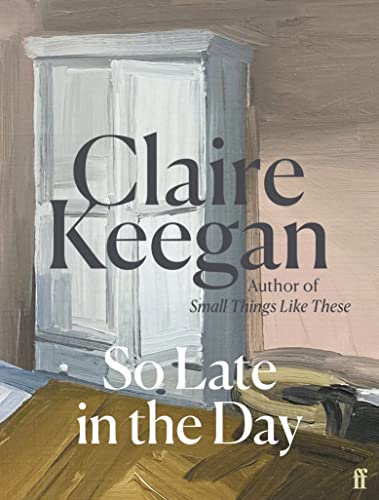
Claire Keegan’s So late in the day

Claire Keegan, So Late in the Day (Faber & Faber 2023)

This book consists of a single short story by Claire Keegan. The story appeared in The New Yorker in February 2020. It was one of four short stories that made up the collection So Late in the Day: Stories of Women and Men (February 2022). Keegan’s French publisher first issued it in standalone form in May 2022 under the title Misogynie. Faber followed suit in 2023 with this attractive little front-counter hardback, perfect for a small gift – and it came into my possession as such a gift.

The story follows its protagonist, Cathal, through a lacklustre afternoon at work in an office in Dublin, the bus journey home, and an evening alone (not counting the cat) with his thoughts and memories, or avoiding them, in front of whatever happens to be on the television (mainly a documentary on Diana Spencer), eating whatever happens to be in the fridge. It’s a picture of desolation, the cause of which gradually emerges. It’s a self-inflicted disaster brought on by habitual and socially endorsed – not a spoiler because the French title gives it away – misogyny.

This isn’t the only fiction created by a woman that purports take us inside the head of a man behaves in ways that enrage women, but few can have done it so elegantly. Claire Keegan does a brilliant job of leaving her own rage out of the picture. (‘The first rule of writing fiction,’ Sebastian Barry said at the Sydney Writers’ Festival on the weekend, ‘is don’t write angry.’) Even the rage of the main female character is left to be deduced from what Cathal remembers of conversations with her. He catches a fleeting glimpse of where he has gone wrong, and even surmises how things might have been different back in his teenage years. Whether that glimpse and that surmise will lead anywhere or sink back into the deadly routine of work and television is a question the story doesn’t go into.

On page 7*:

Cathal is on his way home from work in a bus and all we’ve had is hints that he’s not happy. He sits next to a large woman who slides closer to the window to give him room. She’s on for a chat about the weather, opening brightly, ‘Wasn’t that some day.’ On second reading we know how painful that sentence is for Cathal, but all we get on the surface is, ‘ “Yeah,” Cathal said.’ Each for their own reason, neither Cathal not Claire Keegan needs to spell out the undercurrents.

Further down the page:

‘How about you?’ she said. ‘Any plans for the long weekend?’
‘I’m just going to take it easy,’ Cathal said, threading the speech into a corner, where it might go no further.

He’s civil, and well versed in avoiding real communication. And the unobtrusive metaphor sewing metaphor reminds us that the narrator is seeing more here than the character is showing. The story is full of such quiet, sharply observed moments.

You can hear Claire Keegan reading the story on the New Yorker website. Click here if you’re interested. She reads it beautifully, and it only takes 45 minutes.


I wrote this post on the unceded land of Gadigal and Wangal of the Eora Nation, finishing it on a day when the lorikeets in the gums nearby are still rowdily celebrating the dawn at 8 o’clock in the morning.


My arbitrary blogging practice is to focus on the page of a book that coincides with my age, currently page 77, or for books with fewer pages than that, on the year of my birth, 47. This book ends on page 47 and it would be a bit bad to give away the last lines, so I’m picking page 7.

Sydney Writers’ Festival 2024: My day three, evening

Saturday 7.30 pm: Sebastian Barry: Old God’s Time

If I’ve realised that Sebastian Barry was appearing by video link I might not have booked for this session, but that would have been a mistake. A tiny Kate Evans sat on the stage in front of a huge Sebastian Barry speaking to us from early morning in Ireland in the room where, he said, he had written the book they were discussing, Old God’s Time (link is to my blog post).

Whether it was because Barry was speaking to us from the safety of his own house, or because of a paradoxical effect of long-distance communicating, or whether it might have happened anyhow, this session had a wonderful intimacy about it. Almost everything he said enriched my understanding and enjoyment of the book.

When Kate Evans asked about the physical setting of the book, Barry answered straightforwardly and then went on to talk about the novel’s seed being planted in a brief period of his childhood when he lived in that building. I don’t know anything of his life story, but he may have been hinting that the book child’s situation – he and his mother are in hiding from his abusive father – in some way echoes his own experience.

My highlight of this session, and of the whole festival, came when Kate Evans, referring to a tirade against the Catholic Church delivered by the character Tom Kettle, asked if Tom’s rage was also Sebastian’s. (Someone read this passage out at my book group meeting – it’s a stunningly passionate piece of writing, and Evans’s question is inevitable.) Barry asked Evans if she would read the passage, and when she apparently didn’t hear his request but read out a couple of isolated phrases, he paused, as if deciding how honestly to respond and then gave a complex answer:

A) The first rule of novel writing, he said, is not to write in anger. He spoke a little about the mysterious nature of novels. The writer sits in a room and puts words on paper. After a number of processes involving many other people, someone sits in their usual reading place and reads the words. The characters who have been imagined by the novelist are imagined all over again by the reader.

B) Though Tom is an imaginary character, his anger is like that of real-life survivors. It gives voice to things that need saying, and when you make the effort of listening to it, you are receiving a gift. Barry felt that he was receiving such a gift from Tom.

C) He didn’t stop there. There was a moment in 1960, he said, when Archbishop McQuaid (a historical personage mentioned in the novel) was given evidence of child sexual abuse committed by a priest in his archdiocese. He consulted an Auxiliary Bishop, Patrick Dunne, asking him if he considered that the crime was a crimen pessimum (a crime of the worst kind). Dunne said he thought it was. McQuaid responded that he would keep it quiet anyway, because it would cause a scandal that would do great harm to the church. That moment of decision ruined the lives of thousands of children, and this was the object of Tom’s rage.

But for Barry, there is another twist: Patrick Dunne was his cousin, closely related to a man who appears honourably in one of Barry’s novels. On realising that this man was present when the decision was made, Barry felt that his own DNA had been in the room. Irrational as it may be, he felt complicit. I understood him to be speaking a difficult personal truth but also – though he didn’t spell this out – making a point about fiction-writing: clickbait outrage is easy but it doesn’t make for great fiction. Tom the character can be outraged, but the person who creates him needs to be wary of claiming the moral high ground.

Astonishingly, but necessarily, Kate Evans then moved on to the next question, and Sebastian Barry moved on with her, leaving me – and surely I wasn’t the only one – in awe at what had just been given me.

The session ended with a reading, in which Barry was transformed into Tom Kettle and his glorious language filled the room. In the passage, Tom is listening to a new friend playing Kol Nidrei, Op. 47 by Max Bruch on the cello (link is to a performance by the Frankfurt Radio Symphony Orchestra). We were then treated to a performance of the piece arranged for cello and piano, performed by Melissa Barnard and Lee Dionne from the Australian Chamber Orchestra.

Sydney Writers’ Festival 2024: My day three, afternoon

Sue from Whispering Gums respectfully suggested that I not try to squeeze a whole day of the SWF into one blog post. Day Two’s post was a marathon to write but hadn’t realised it was imposing a burden on readers as well. So, even though none of my subsequent days were as loaded as Friday, I’m taking her advice. Here are the first two of Saturday’s three sessions.


Saturday 25 May

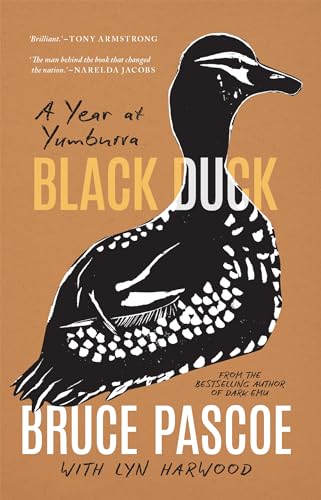
1 pm: Bruce Pascoe and Lyn Harwood: Black Duck: A Year at Yumburra

This session is a variation on my standard session: two people talking about one book with one other person.

Bruce Pascoe’s most recent book, Black Duck: A Year at Yumburra, shares authorship with his wife, Lyn Harwood. They chatted with veteran journalist Kerry O’Brien about their project at Yumburra, their relationship, the devastating bushfires of 2019–2020, the impact of Pascoe’s book Dark Emu (my blog post here) and the subsequent backlash, and related matters.

After Dark Emu‘s success, Pascoe decided to put his newfound wealth to good use. Aware of a new enthusiasm for native foods –  he didn’t use the phrase ‘bush tucker’ – he was concerned that there was little consideration for benefit to Aboriginal people. So he bought the farm at Yumburra to grow food, employ Aboriginal people and make a declaration of Aboriginal sovereignty.

I didn’t get a clear sense of the book Black Duck, but I gather it’s in effect a diary of a year spent at the farm. Lyn Harwood spoke eloquently about the effect of writing things down. You spend most of the time dealing with things as they arise, just doing the work. it’s not until you stop to write it down that life, ‘especially the sensuousness of life’, is properly imprinted. The process of writing the diaries was a way of attending to what was happening on the land – not just the work, but the effects of the changing seasons.

Kerry O’Brien, excellent journalist that he is, gave Pascoe opportunities to address the various fronts on which he has been attacked.

On this subject of his Aboriginal identity, he described some of the cultural work he had to do. There was an occasion when he said something stupid and an Aunty said, ‘You know nothing. You know nothing. You go back to the library.’ She may have been speaking metaphorically, but he took her literally and went back to the library to research the history he had got wrong. His Aboriginal identity is contentious among some people, but not among his local mob. ‘I have a very small connection and I admit to it,’ he said. But I identify with it.’ These questions of identity, he said, are a distraction from what matters: when he offered a non-Aboriginal shopkeeper some vanilla lily bulbs he had grown on the farm, her first response was not to consider the possibilities being offered to her but to as, ‘What proportion Aboriginal are you?’ The gasps from the audience demonstrated that he had made his point.

On the validity of the argument of Black Emu, he cited the work of archaeologist Michael Westaway: with the assistance of the Gorringe family, he set out to test Dark Emu‘s hypothesis about pre-settlement history in Mithaka country in Queensland, and found ample evidence that here had been substantial ‘town life’ there.

My main takeaway from the session was the reiteration of the key message of Dark Emu: Aboriginal and non-Aboriginal people have a shared history. One of Pascoe’s mentors, commenting on Dark Emu, said: ‘If I’m going to keep my culture, I have to give it away.’ If non-Aboriginal people aren’t invited in, they (we) remain angry, unsettled spirits. Over millennia, Aboriginal people had a continent where there were no wars over land: each group has responsibility for their own Country. If your neighbour is weak or in trouble, you can help them out, but you cannot take their land.

Pascoe says that, in spite of the Referendum result, he thinks there’s a big change coming, as people come to realise that the future of Aboriginal people is the future of all Australians. Just as his work at Yuburra is offering possibilities for agriculture, a future is being offered to us in many ways as a gift with an embrace.


3 pm: Bringing the Past to Life

Ah! A proper panel: three people talking about one book each to one other person. The writers were Francesca de Tores (Saltblood), Mirandi Riwoe (Sunbirds) and Abraham Verghese (The Covenant of Water). Abraham Verghese had Covid, so appeared on a giant screen behind the others. The fourth person was Kate Evans of the ABC’s Bookshelf. The session was most satisfactory.

I hadn’t read any of the books, though I had read Mirandi Riwoe’s earlier novel Stone Sky Gold Mountain (link is to my blog post).

Kate Evans ruled with a rod of iron, asking a series of questions, and making sure that the writers had roughly equal amount of time in response to each question: setting, characters, plots, dark matter. No butting in or dominating. (I’m embarrassed to say it, but perhaps it helped that the only man was a person of colour.) As a result, even without being read to, we got a good sense of each of the novels.

Saltblood is set in the Caribbean in the 1720s, towards the end of the golden age of piracy, and is based on the historical women Mary Read and Anne Bonny. De Tores said that she was happy to call Mary Read a woman, although her gender identity was complex – she was raised as a boy and spent most of her life as a pirate dressed as a man. There’s an early book about pirates – I didn’t catch its name but it is evidently the main if not the only source of everything we think we know about pirates from that time. In that book, the lurid potential of women pirates was played up, and in its second edition the illustrations showed them swashbuckling with breasts exposed. Saltblood sounds like fun, but focuses on more interesting things than bare boobs.

Sunbirds features an Indonesian family in Western Java in 1941. The family and their servants deal with issues related to Dutch colonisation and nationalist resistance, and imminent invasion by Japan. A Dutch pilot is wooing the daughter of the family, who is torn between loyalty to her family and the attractions of life in the Netherlands. Meanwhile a servant of the family has a brother who is part of the resistance. Miranda Riwoe described herself as Eurasian, and so drawn to the plight of the daughter.

The Covenant of Water draws on Abraham Verghese’s own family background in Kerala (he was born and raised in South Arica, but Kerala was always in the background). The story covers three generations in the first half of the 20th century. There is a child bride. Verghese said he was playing against stereotype by giving her a happy marriage. He is a doctor specialising in infectious disease (he pointed out the irony that he was attending on screen because of a coronavirus), and the novel pays attention to advances made in medical science in the period it covers.

So, three interesting books for the TBR shelf.

Journal Catch-up 23

Two more journals in my endless attempt to keep up to date!


Evelyn Araluen and Jonathan Dunk (editors), Overland 252 (Spring 2023)
(Some of the content is online at the Overland website – I’ve included links)

This Overland‘s editorial describes itself as a ‘second run’. The first run had reflected on the Voice referendum, but as publication came closer – in October last year – ‘the temptation to linger on the politics of symbolic recognition and constitutional reform seems a luxury in the face of escalating violence against Palestinians in Gaza and the West Bank’. With feet and throats sore from a solidarity march, the editors draw attention to an essay by Palestinian-Australian writer and historian Micaela Sahhar, ‘which reminds [them] of Overland‘s historic role in indexing Palestine’s survival and resistance’.

Quite apart from its serendipitous relevance, the essay, ‘An idiosyncratic archive: Overland 169 & the Wolstonecroft years‘, is a joy to read, as Sahhar revisits two copies of Overland she acquired in 2002 and 2004. She compares her reading of them then and now, talks of her relationships to people who appeared in them, and generally takes us on a journey into her mind. I love this passage – and so, I assume, do the editors:

As a journal at odds with the mainstream, Overland offered a younger version of me an intellectual place where radical thinking could reside, and a dawning awareness of a community I could take a place in. In this sense, Overland was the tangible expression of a counter to the indifference and invisibility of a young Palestinian woman, the significance of whose identity was rewritten just as she came of age at the time of a catastrophic intellectual nadir represented in 9/11; and a place of refusal against socio-political disengagement and apathy which have been the horsemen of these neo-liberal times.

The other stand-out essay is ‘The Disappearance of a.k.a. Victor Mature‘ by Vivian Blaxell, which ranges far and wide, high and low, into memoir and poetry appreciation, circling the subject of beauty. It’s a great read, from which I can’t resist quoting what may be the silliest paragraph, but one that made me laugh:

Australian English is wanton with beautiful. Beauty pops up in not the usual beautiful places there, thereby revealing the radical contingency of beauty itself, probably unintentionally: beautiful, Australians might say of a pork sausage, which seems a surprise at first until you realise that beauty does not exist before we say it exists, for beauty relies entirely on disclosure for its existence. That lucky sausage.

Other essays are a discussion by Peter D Mathews of Sophie Cunningham’s 2004 novel Geography and an idiosyncratic but fascinating essay by πO on concrete poetry in Australia and related matters.

There are five pieces of fiction and nine poems.

Of the poetry, ‘Balloch’ by Eileen Chong stands out for me. An apparently simple poem about a visit to a Scottish loch, it leaves an uncanny aftertaste that only gets richer with further readings.

The fiction covers a wide range, from a celebration of Rotuman culture (I had to look it up) by Dorell Ben to a fantasy of a catastrophic world post climate emergency by Jodie How, with a little social realism by Chloe Hillary and other pieces in between.


Alexandra Christie (editor), Heat Series 3 Nº 12 (Giramondo 2023)

This may be my last issue of Heat before my subscription expires. Despite having a selection of poems from Nam Le’s 36 Ways of Writing a Vietnamese Poem, a book I’m looking forward to, the journal is a bit of a fizzer for me, though the dominating US presence I’ve complained of in earlier issues is absent, and only one member of Heat‘s editorial advisory board gets a guernsey.

  • You can read Paddy O’Reilly’s ‘Redundant‘ on the Heat website. It’s an experimental prose piece in which the experiment seems to consist of not finishing sentences. See what you think.
  • Jordi Infeld’s ‘Poet’s Pocket’ would and indeed does pass for a short essay on sewing and related matters – just a footnote identifying one of its otherwise unremarkable phrases as a quote from Gertrude Stein’s Tender Buttons suggests deeper undercurrents.
  • ‘The Phoenix Apartment’ by Bella Li feels to me like notes towards a larger project.

Items from beyond the Anglosphere are ‘We Shall Be Monsters’, a meditation on Mary Shelley’s Frankenstein by Argentinian writer Esther Cross, translated by Alice Whitmore, and six terrific short poems by Iranian Maryam Nazarian, translated by Malaysia-based Arash Kohshsafa. Here’s the first and shortest of the poems, which does wonderful things with an echo of William Carlos Williams’s poem about the plums:

One
I've set the breakfast, the kisses, and the keys on the table.
Please, forgive me
if I find freedom more pleasant than your love.

The most interesting piece is Stephanie Radok’s ‘Inventory 2020’, an impressionistic chronicle of a working artist’s life, made up of mostly very short entries. It reminded me of the late Antigone Kefala’s journals in the way it combined observations of the passing moment with considered reflections and descriptions of the artist’s process. As 2020 was a year when the even tenor of our lives was disrupted by Covid, a narrative emerges. Here’s the entry for 23 February, on page 77*:

23. What you thought was passing/casual was your life. And a particular red purple near a blue hillside that seemed to reflect you.

As for Nam Le’s poems, they seem to be part of a larger whole. I’ll wait for the book.


* My blogging practice for some time has been to focus arbitrarily on the page of a book or journal that coincides with my age.

Sydney Writers’ Festival 2024: My day one

The Sydney Writers’ Festival is always one of my annual highlights. I’m off to a very quiet start this year, just one session today in the smallish Gallery Room at the State Library. And then nothing until Friday.

12.30: And the Award Goes To …

The Festival website invites us to:

be among the first to hear from some of the winners of the 2024 NSW Premier’s Literary Awards, in a discussion covering the impact that awards can have on a writer’s career.

We did get to hear from three of the winners: Ali Cobby Eckermann (She Is the Earth), Helena Fox (The Quiet and the Loud) and Christine Keneally (Ghosts of the Orphanage). But the conversation wasn’t about the awards’ impacts. From my point of view, it was a lot more interesting than that. What follows is the best I can glean from my mostly illegible notes aided by my unreliable memory.

Bernadette Brennan, senior judge of the awards, kicked off the conversation by saying that though the three award-winning books were in different genres – a verse novel, a thoroughly researched piece of non-fiction, and a novel – they all dealt with intergenerational trauma with an emphasis on the vulnerability of children, and they all found ways of pointing to healing. That set the agenda for what followed.

Ali Cobby Eckermann spoke first, and did her best to follow the brief of the program notes. Her first verse novel, Ruby Moonlight, was written in the context of the Howard government’s Intervention in he Northern Territory. The awards it received enabled her to leave her home with her Yankunytjatjara family, go south and buy a house which she set up as a writers’ retreat. When she unexpectedly received a Windham-Campbell Literature Prize (link is to the Wikipedia entry on that prize) her life was turned upside down again. When she came to write She Is the Earth, she was very alone. But she drew on her Yankunytjatjara grannies – though they had passed, she imagined them as creating a safe place for her to create.

Helena Fox spoke in fairly abstract terms of having endured trauma as a child and an adult, and said she saw herself as opening a space where her young readers could see that it is possible to speak of hard things. Among the loud things like abuse, you have a right to be alone, quiet, to ground yourself.

Christine Keneally’s book is about terrible things done to children, focusing on the testimony of survivors from an orphanage in Vermont. Its seed was planted when she ‘wandered into a room’ at a conference in Brisbane where people were talking about the extreme difficulty of finding any record of their early childhood. She discovered the unfolding story of abuse in orphanages in Australia. She reasoned that similar things must have happened in the USA. She discovered that indeed they had, but there the only redress survivors had was through litigation, which was often a damaging process in itself. As she found and interviewed survivors, she saw what a powerful antidote talking is. She realised the importance of bearing witness – and that is what the book seeks to do.

Some snippets from the conversation that followed:

Ali Cobby Eckermann:
‘It shits me that you have to forgive everyone to heal yourself.
‘Poetry can change the dialogue about trauma away from trauma itself to something like regeneration or repair. It can turn something painful into beauty.’

Helene Fox:
How can you heal if you can’t share?

Christine Keneally:
I spoke to people who had been married for 30 years but hadn’t told their spouses about their lives. Sometimes I was the first person they told their story to.

There was a time for questions, but no one raised their hand. I’d love to know what contact Christine Keneally has had with the Lost Generations people in Australia. If I wasn’t so shy and needing to get home, I would have stopped to ask if she knew about Bryan Hartas’s autobiography Hard As (link to my blog post) and the work people like my niece Edwina Shaw have been doing helping members of the Lost Generations to tell their stories.

On my way out I heard one of the few men in the audience mutter to another, ‘What a miserable lot!’ That’s not at all how I saw it, but I guess there weren’t a lot of laughs.

I bought a copy of She Is the Earth.

2024 NSW Premier’s Literary Awards night

The NSW Premier’s Literary Awards, as we are often reminded, are Australia’s richest and longest running state-based literary awards. This year, in a break with tradition, I didn’t do a blog post when the shortlist was announced. I was happy to read a consolidated list on Lisa Hill’s blog at this link.

At that time, had read two of the Christina Stead Prize contenders. I’d seen two of the plays shortlisted for the Nick Enright Prize. I did better on the Betty Roland Prize, having seen seen three of the movies. I had read none of the poetry, none of the children’s or young people’s books, none of the non-fiction. And it turns out I have read or seen none of the winners.

Last night, the awards ceremony was live streamed. I was busy with family, so tuned in late. It’s all on YouTube and you can even watch it here, The actual video begins at 8 minutes, 40 seconds with the Welcome to Country by Uncle Brendan Kerin from the Metropolitan Lands Council, who reminds us that we have a shared history, and manages to make comedy out of his experience as a member of the Stolen Generations. After introductory speeches from librarians and the Minister for Arts, the presentation of awards by the senior judge, Bernadette Brennan, begins at 40 minutes. The video is worth watching as – in the midst of much charming humility and gratitude – person after person refers to the unfolding disaster in Gaza, explicitly or implicitly responding to recent media attacks on the judging panel.

The winners (with links to the judges’ comments):

UTS Glenda Adam’s Award for New Writing (at 40 minutes)

Anam, André Dao

Multicultural NSW Award (at 43 minutes)

Stay for Dinner, Sandhya Parappukkaaran and Michelle Pereira

Indigenous Writers’ Prize (at 48 minutes)

She Is the Earth, Ali Cobby Eckermann

Nick Enright Prize for Playwriting (at 52 minutes)

Sex Magick, Nicholas Brown (Griffin Theatre Company & Currency Press)

Betty Roland Prize for Scriptwriting (at 56 minutes)

Safe Home, Episode 1, Anna Barnes

NSW Premier’s Translation Prize (at minutes)

Patricia Wrightson Prize for Children’s Literature (at 60 minutes)

Paradise Sands: A Story of Enchantment, Levi Pinfold

Ethel Turner Prize for Young People’s Literature (at 1 hour, 2 minutes)

The Quiet and the Loud, Helena Fox

Kenneth Slessor Prize for Poetry (at 1 hour, 6 minutes)

Riverbed Sky Songs, Tae Rose Wae

Douglas Stewart Prize for Non-fiction (at 1 hour, 10 minutes)

Ghosts of the Orphanage: A Story of Mysterious Deaths, A Conspiracy of Silence, and a Search for Justice, Christine Keneally

Christina Stead Prize for Fiction (at 1 hour, 13 minutes)

    The Sitter, Angela O’Keeffe

    The People’s Choice Award (at 1 hour, 16 minutes)

    The God of No Good, Sita Walker

    Book of the Year (at 1 hour, 20 minutes)

    She Is the Earth, Ali Cobby Eckermann

    The presentations ended, as they began, with eloquent words about the lasting impact of the Stolen Generations.

    There was no special award this year.

    William Gibson’s Peripheral

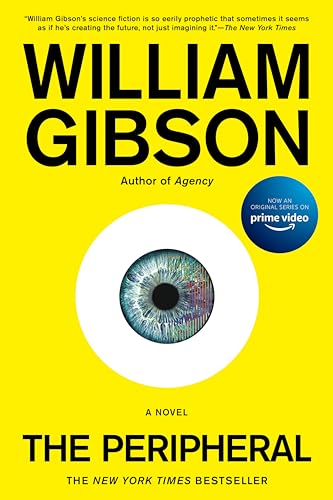
    William Gibson, The Peripheral (Berkly 2014)

    I picked up The Peripheral in a street library soon after I finished reading and blogging about its sequel, Agency, nearly four years ago. Since then, it has been my TBR shelf as a treat for a rainy day. Its time has now come.

    There’s a peculiar challenge in writing about it. Possibly the main thing I enjoyed about it is that a lot of the time the reader has no idea what’s actually happening. You’re not even sure what some words mean, or what the characters are not saying. Explanations do come, eventually, but there’s a delicious disorientation as AI devices and other technical marvels multiply, we only half-see crucial incidents, cultural events are described from the point of view of someone who knows a lot more about the background than the reader does. The action takes place in two unspecified future time periods that interpenetrate in often unclear ways. However serious the issues may be – and there’s a plausible version of how the global emergency will develop – there’s a pervasive sense of play. If I summarise the plot, or even the set-up, I’ll be depriving you of that experience.

    My first idea was to write about first two short chapters – all the chapters are short – but then I thought, oh what the heck, I’ll skip straight to page 77* to give you a taste, and let the spoilers fall where they will.

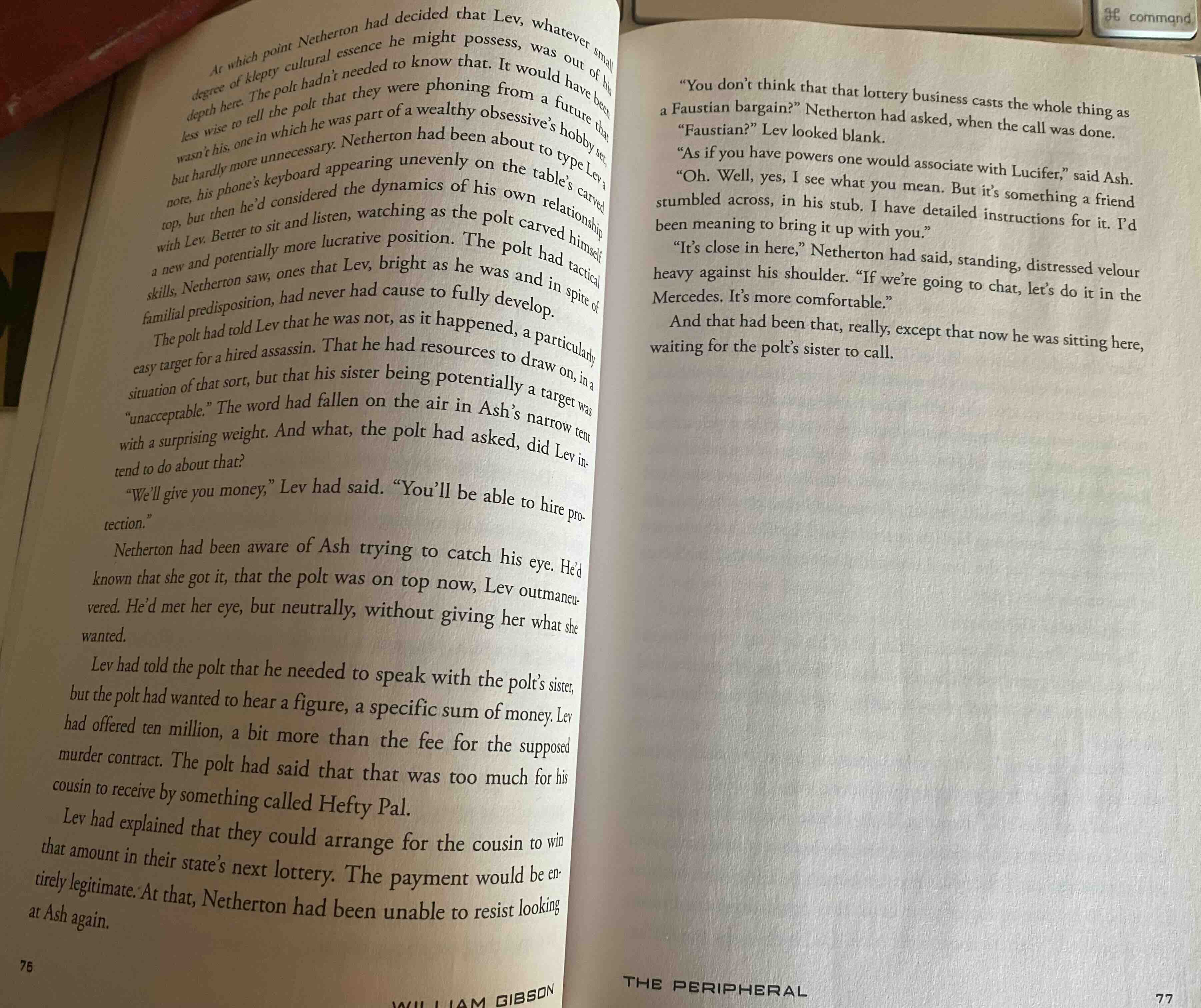
    Lev had told the polt that he needed to speak with the polt’s sister, but the polt had wanted to hear a figure, a specific sum of money. Lev had offered ten million, a bit more than the fee for the supposed murder contract. The polt had said that that was too much for his cousin to receive by something called Hefty Pal.
    Lev had explained that they could arrange for the cousin to win that amount in their state’s next lottery. The payment would be entirely legitimate.

    Gibson has a gift for coining terms. ‘Cyberspace’ is his invention. Of The Peripheral‘s many coinages, three appear in this short passage: ‘polt’, ‘Hefty Pal’ and ‘stub’. They each have the virtue of suggesting their origins if not their precise meanings. A polt, derived from poltergeist, is a person who is bodily in one place and/or time, but is somehow seeing and acting in another time. (A peripheral is a human-looking artefact, that can be the host to a polt.) Hefty is a mega corporation of which Hefty Pal, as in PayPal, is a subsidiary. A ‘stub’, known more formally as a ‘continuum’, is a key invention of the book, something that readers and half the characters come to understand only gradually. All I’ll say here is that it is something that results from people going back to an earlier time and changing that time’s future.

    There are three characters in this scene: Lev, the son of a fabulously wealthy Russian gangster capitalist, whose hobby involves mucking about with the past (stubs/continua are his playthings); Ash, a tech wiz who makes it happen for him (among other distinguishing features, she has tattoos of animals that move around on her skin, often glimpsed running for cover when someone tries to look at them); and Wilf Netterton, put-upon publicist, from whose point of view the story is told in alternate chapters. Page 77 is at the end of a Wilf chapter.

    Three more characters are referred to. ‘The polt’ is Burton, a battered veteran in Netterton’s past / our future (though that way of describing things isn’t quite accurate). ‘The polt’s sister’ is Flynne, a gamer in a small US town who is the focus of the non-Wilf chapters. Burton and – on one fateful occasion – Flynne have been employed as polts by Lev under the impression they were testing a computer game. The main narrative is set in motion by Flynne’s witnessing what may be a murder. ‘The cousin’ is Leon, one of their tribe of loyal family members.

    At that, Netherton had been unable to resist looking at Ash again.
    ‘You don’t think that that lottery business casts the whole thing as a Faustian bargain?’ Netherton had asked, when the call was done.
    ‘Faustian?’ Lev looked blank.
    ‘As if you have powers one would associate with Lucifer,’ said Ash.
    ‘Oh. Well, yes, I see what you mean. But it’s something a friend stumbled across, in his stub. I have detailed instructions for it. I’d been meaning to bring it up with you.’

    Tiny moments like this give the book its rich texture. There’s the complicity between WIlf and Ash, two underlings who have cultural memories, unlike their rich and powerful employer. (Similarly in the earlier paragraph, it’s fun that Hefty Pal is something in the reader’s future and Flynne’s present that has been forgotten in Wilf’s time.) Like the implied reference to poltergeists, the mention of Faust reminds us that even though the narrative is presented as a tale of high tech, AI and nanotechnology, it often has the feel of demonic possession and fairytale magic. (If you’ve read Gibson’s Sprawl trilogy – Neuromancer (1984), Count Zero (1986) and Mona Lisa Overdrive (1988) – you’ll remember the prominence there of the legba of Voodoo.)

    And that had been that, really, except that now he was sitting there, waiting for the polt’s sister to call

    That’s the first hint of the almost-romance that is to almost-blossom between these characters who can only spend time together by means of weird time travel mediated by a peripheral in one direction and an odd little children’s toy in the other.

    Now I’m tempted to reread Agency. I remember that it was also gleefully inventive and similarly had two interrelating times. I’m pretty sure that some of the distant future characters are in both books, but my memory is dim. William Gibson is anything but dim.


    I wrote this blog post on the unceded land of the Gadigal and Wangal clans of the Eora Nation, not far from where what we now call the Cooks River has been cared for by Elders for many millennia. The weather has just turned cold, but spider webs are still proliferating.


    * My blogging practice is to focus arbitrarily on the page of a book that coincides with my age, currently page 77. For The Peripheral, I’ve included a little from page 76 as well.

    Ivy Ireland’s Tide

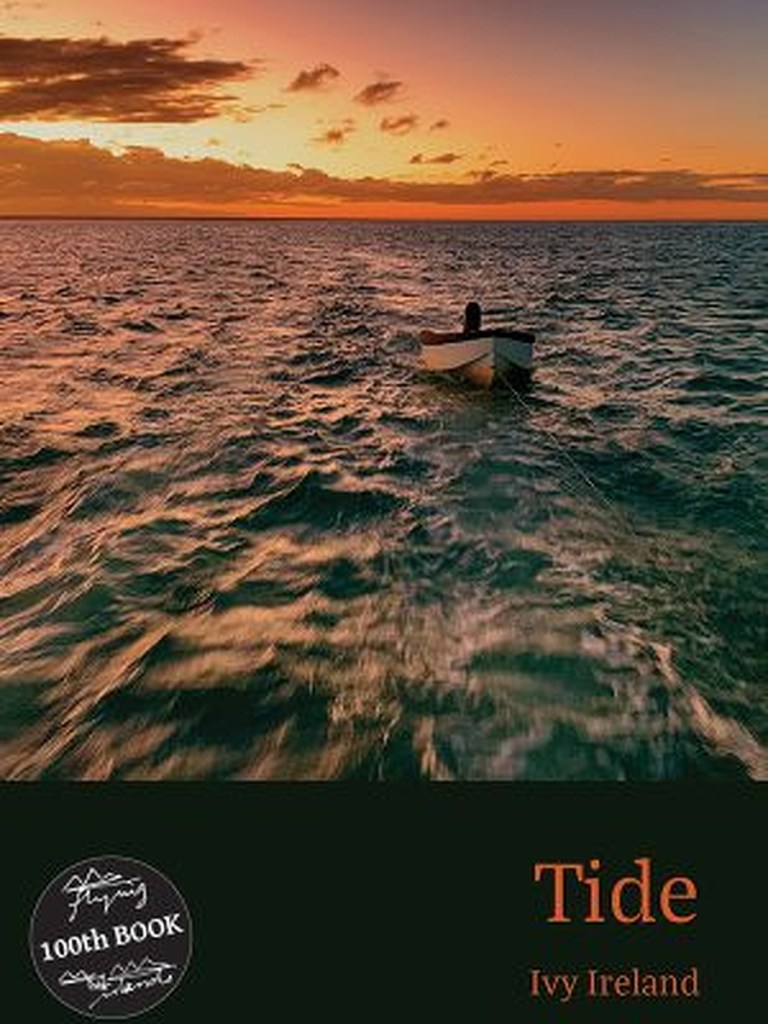
    Ivy Ireland, Tide (Flying Island Books 2024)

    Tide may seem like a quietly generic title for a book, especially one that has a number of poems about the sea, but a laconic note on sources suggests a dark subtext:

    The title of this book, Tide, and the title of the poem, ‘A Shallow Boat’, are both taken from Alfred, Lord Tennyson’s poem ‘The Lady of Shalott’ (1832) with the necessary reverence.

    I decided to read the Tennyson poem. I’m pretty sure I hadn’t read it before, but many of its lines (‘the mirror cracked from side to side’, ‘The curse is come upon me’) were familiar, probably from young Dorothy Hewett’s romanticism as recorded in her autobiography, Wild Card. Certainly Ivy Ireland’s compressed, science-related poems, with close observations of the real world, are not at all like Tennyson’s flowery, relentlessly rhyming lines. The word ‘tide’ occurs only once:

    For ere she reach'd upon the tide
    The first house by the water-side,
    Singing in her song she died,
    The Lady of Shalott.

    The note on sources, then, leads one to expect something death-related: the tide is metaphorical, bearing us inexorably away. The book only partly meets that expectation. There’s a lot of life here, and not much death.

    The book is divided into four sections of unequal length named for tidal phases: ‘Ebb’, ‘Low’, ‘Flood’, and ‘High’. If I had to pick favourites, I’d say I enjoyed the poems in ‘Low’ most: in ‘Lake Poet’, in the context of the climate emergency (not explicitly named, but definitely there in my mind) the lake is less a thing of sublime beauty than a place that will hold the poet to account, as opposed to the city, where ‘nobody has to answer for anything; in ‘Cane Toad’, the poet and her young daughter encounter some teenagers on Valentine’s Day:

    She asks me,
    of all people,
    if they are going to marry,
    those beatified ones,
    out decking each other in posies
    in the quiet toilet paper aisle.

    ‘Killing Plovers’ is a yarn about family life that takes on a fable-like quality about humans’ relations to other animals; ‘The Birth of the Universe’ is a wonderful poem about a) the Big Bang and b) giving birth.

    The section ‘Flood’ comprises six prose poems, including ‘I Am John Is Dead’, long enough to be called a short story, about a young woman’s encounter with a New Age guru in the outback, which accurately describes itself as ‘like a Jim Jarmusch film’.

    Page 47* is the title page for the book’s final section, ‘High’. The section includes just one poem, ‘A Shallow Boat’, in which the narrator with one other person goes sailing off the Queensland coast. Since the note on sources mentions this poem, I looked at the Tennyson poem again, and found:

    In the stormy east-wind straining,
    The pale yellow woods were waning,
    The broad stream in his banks complaining,
    Heavily the low sky raining
    Over tower'd Camelot;
    Outside the isle a shallow boat
    Beneath a willow lay afloat,
    Below the carven stern she wrote,
    The Lady of Shalott.

    This is the boat on which the Lady of Shalott floated to her doom.

    Happily, the speaker of Ivy Ireland’s sailing excursion survives, having had a very nice time, even if it is sometimes scary and perhaps humiliating as she feels her incompetence.

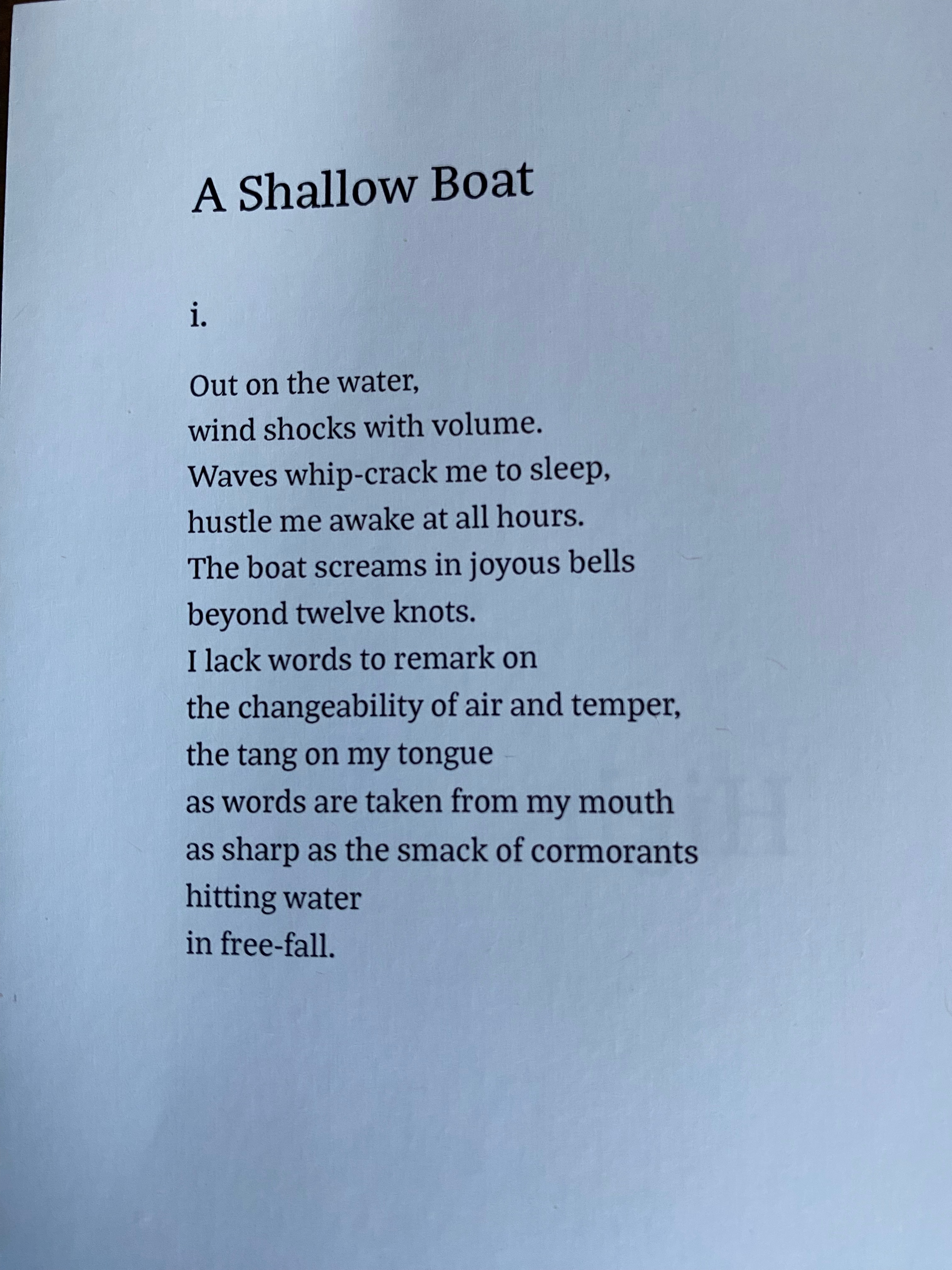
    Here’s the first of the poem’s 12 parts, from page 48:

    A Shallow Boat

    1.

    Out on the water,
    wind shocks with volume.
    Waves whip-crack me to sleep,
    hustle me awake at all hours.
    The boat screams in joyous bells
    beyond twelve knots.
    I lack words to remark on
    the changeability of air and temper,
    the tang on my tongue
    as words are taken from my mouth
    as sharp as the smack of cormorants
    hitting water
    in free-fall.

    All I really want to say about this is that I love it. I have no desire to go sailing. I breathe a guilty sigh of relief when I realise that the Emerging Artist gets seasick very easily, so is unlikely to be urging me to do it. But I love it as evoked in this poem.

    The poem is almost a sonnet. The first six lines describe the wind, the waves, the sounds of the boat. Then there’s a turn, and in the next five lines the poet tries and fails to articulate a response. Then there’s a three-line equivalent to a sonnet’s final couplet – rather than a witty encapsulation of what has gone before, here it’s the cormorants, ostensibly a metaphor for the poet’s speechlessness but actually just there, smacking the water.

    Every verb, every adjective, every noun is carrying its share of the meaning-load, and the sound design is wonderful. The echoing Ws bind the lines together, with a little respite for Ts (‘temper’, ‘tang’, ‘tongue’, ‘taken’, and then ‘cormorants’) in lines 8 to 11. Back to W and then the Fs in the last line introduce a new, final sound.

    The Tennysonian hints of doom may be realised in later parts of the poem, as in these chillingly succinct lines from part viii:

    There's a point 
    where climate emergency,
    once witnessed,
    ticks over from
    possible to inevitable;
    anything else is inconceivable.

    But that’s context rather than substance. The joy in this poem, as in the whole book, is in celebrating engagement with the natural world, vulnerable, dangerous, fragile, awesome, beautiful, breathtaking (sometimes literally). From section ix:

    Orange shifts over the horizon, and here we are: 
    alive, while countless others are not.
    Who am I to deserve daybreak. This happening here,
    sea eagle fishing beside the boat,
    sea turtle snorting to the surface. What's it for,
    to be so honoured.

    I wrote this blog post on land of the Gadigal and Wangal clans of the Eora Nation. I’m posting it on a day that has shifted from bright blue sky to heavy downpour within hours. From my window I can see wet gum leaves reflecting the afternoon sunlight as they have been witnessed by First nations peoples here for tens of thousands of years.


    * My blogging practice for some time has been to focus arbitrarily on the page of a book that coincides with my age. A focus on just one page seems to me to be almost necessary with books of poetry, where the parts are so often greater than the whole. As Tide has fewer than 77 pages, so I’m focusing instead on my birth year, ’47.

    The Essays of Montaigne, progress report 2

    Michel de Montaigne, The Complete Essays (Penguin Classics 1991, translated by M. A. Screech) Book 1, from part way through Essay 26, ‘On educating children’, to Essay 41, ‘On not sharing one’s fame’

    I’m enjoying my morning read of Montaigne, now at the end of my second month.

    As expected, his name has cropped up elsewhere. The time I noticed was on Waleed Aly and Scott Stephens’s podcast The Minefield, when talking about the recent stabbings in Sydney. Scott referred to the essay that M. A. Screech translates as ‘On Affectionate Relationships’ to illustrate something he was saying about grief.

    That essay was one I read this month. Though its discussion of grief is wonderful, the thing that stands out for me in it is his exalted notion of friendship. The meeting of souls that these days tends to be identified, hopefully, as part of romantic love he sees as quite distinct, and separate, from the love of spouse (he says ‘wife’) or children. Revisiting them now, I see that the paragraphs on grief are wonderful. For example:

    I drag wearily on. The very pleasures which are proffered me do not console me: they redouble my sorrow at his loss. In everything we were halves: I feel I am stealing his share from him. (Page 217)

    The essays I have just read are ‘Reflections upon Cicero’ and ‘On not sharing one’s fame’. I wish my Latin teachers could have told me about the Cicero one in high school: it would have made it much more fun to study that ‘Cui bono?’ speech if I’d known how Montaigne despised its author. Speaking of Cicero and Pliny the Younger, he writes:

    What surpasses all vulgarity of mind in people of such rank is to have sought to extract some major glory from chatter and verbiage, using to that end even private letters written to their friends; when some of their letters could not be sent as the occasion for them had lapsed they published them all the same, with the worthy excuse that they did not want to waste their long nights of toil! How becoming in two Roman consuls, sovereign governors of the commonwealth which was mistress of the world, to use their leisure to construct and nicely clap together some fair missive or other, in order to gain from it the reputation of having thoroughly mastered the language of their nanny! (Page 279)

    Then, wonderfully, two pages later in ‘On not sharing one’s fame’, in discussing the way ‘concern for reputation and glory’ is the most accepted and most universal of ‘all the lunacies in this world’ he writes this, without a trace of his earlier disparagement:

    For, as Cicero says, even those who fight it still want their books against it to bear their names in the title and hope to become famous for despising fame.

    But then, he regularly says that he has a poor memory.

    The very last thing I read this morning is a wonderful example of how Montaigne can surprise and delight (though it’s also an example of the violence that permeates Montaigne’s world). He has been piling on examples of people (all male) who have acted to enhance someone else’s fame and glory, often to the detriment of their own. Then, in the last couple of sentences he swerves off into a comic non sequitur:

    Somebody in my own time was criticised by the King for ‘laying hands on a clergyman’; he strongly and firmly denied it: all he had done was to thrash him and trample on him. (Page 289)


    This blog post, like most of mine, was written on Gadigal-Wangal land as the days grow shorter and spiderwebs multiply, even in the heavy rain. I acknowledge the Elders past, present and emerging of those Nations.