Category Archives: Books

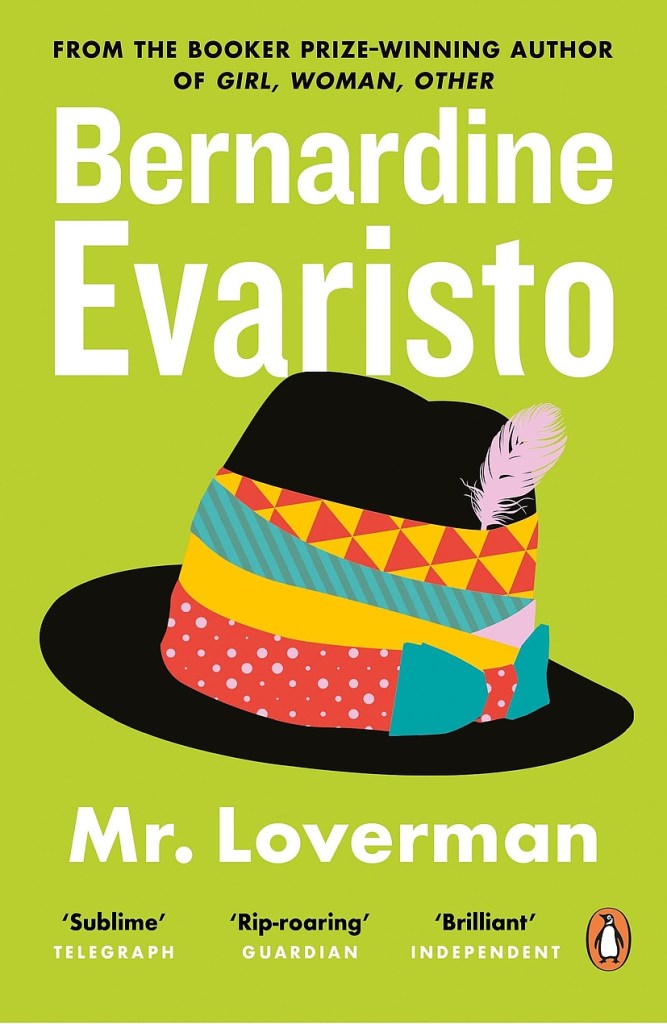
Bernadine Evaristo’s Mr Loverman

Bernadine Evaristo, Mr Loverman (Penguin 2013)

Bernadine Evaristo won the 2019 Booker Prize for her novel Girl, Woman, Other. Mr Loverman doesn’t have such a weighty status, but it’s wonderful. The narrator, Barrington Jedidiah Walker is seventy-four (same age as me, which may be why the book was insistently recommended to me), living unhappily married in London. It’s 2010 and he has been in love with his friend Morris since they were children, and having an active, clandestine sexual relationship with him.

He’s a great character, and the story of his coming out – a term he dislikes – is told with enormous charm and energy, in language inflected with the rhythms of his native Antigua and filled with sparkling wordplay.

While our sympathies are firmly with Barry, the book doesn’t let us forget how badly his deception has affected his wife and daughters. The ending is almost Shakespearean in the way it ties off everything in neat bows. Speaking of Shakespeare, the largely self-educated Barry loves to quote the Bard, to terrific effect and in my case a serendipitous similarity to the last novel I read, also by an English of African heritage.


No reflection on the books, but my blog posts for the next couple of weeks will be short and – hopefully – to the point. I don’t imagine an explanation is needed but it’s summer-time, my extended family are in Christmas–New Year mode, the Emerging Artist and I will soon be crossing state borders to spend a couple of weeks away, and on top of all that I’ve got a very painful hamstring (don’t ask!) and a non-Covid coronavirus infection.

Lech Blaine’s Top Blokes

Lech Blaine, Top Blokes: The larrikin myth, class and power (Quarterly Essay 83, 2021)
– plus correspondence in Quarterly Essay 84

About the time this Quarterly Essay was published (13 September 2021), two other books appeared on Scott Morrison: The Accidental Prime Minister (15 September 2021), a biography by Annika Smethurst; and The Game (1 November 2021) by Sean Kelly. Given that Quarterly Essay 79, The End of Certainty (September 2020) by Katharine Murphy, was in part a portrait of Morrison, no one could say Scott Morrison has avoided scrutiny. Judith Brett has a brief, elegant piece in the November issue of Australian Book Review discussing all four publications. It features on the ABR podcast, at this link.

The main thrust of this essay, as I read it, is that whereas in earlier times the ALP and unions were powerful voices to defend and promote the rights of working class people, they no longer serve that function, and working class voices in Australia – the voices of people involved in direct production and basic service work – have been marginalised. Instead, members of the political class take on cultural signifiers of working-class culture: there’s symbolic representation rather than participation. Memorably, the essay describes Matt Canavan’s selfies in soot-covered face and yellow jacket as the class equivalent of blackface. The argument is important, and urgent in its implications for the resistance to climate change action among mine workers: people who have the most at stake in the short term are unlikely to be persuaded by high moral argument, or even arguments about intergenerational justice, from people whose livelihoods and lifestyles aren’t obviously at immediate risk.

That argument is graphically presented in a history of Australian parliamentary politics since Howard, interspersed with commentary from Blaine’s unreconstructed working-class friends and family on both sides of politics.

The issue is muddied by the whole larrikin thing. It’s one thing to describes Scott Morrison’s construction of an artificial persona that would appeal to a certain part of the electorate: ditching his love of Rugby Union and becoming a League fan, having his photo taken with a meat pie and a beer, etc. It’s quite another to say that this is larrikinism: on the contrary, the ‘daggy dad’, ‘ordinary bloke’ persona smacks of suburban conformity rather than nose-thumbing disruptiveness, which I would have thought was a defining feature of larrikinism.

I went back through the essay looking for Blaine’s definition of the term. I found this:

In the beginning, larrikins sinned on the streets of Australian cities. They lusted not after power but for moral condemnation from coppers. The capitalist class was trolled for sport. That didn’t mean the larrikin was impervious to the seduction of money and media spectacle. Life revolved around get-rich-quick schemes and dreams of widespread notoriety. ‘The term “larrikin” was used as a handy way for journalists and the authorities to label any apparently lowborn young person … who engaged in uncouth behaviour,’ wrote Melissa Ballanta in Larrikins: A History. ‘At all times larrikinism had a profound connection to unskilled labour.’

(page 13)

That seems clear enough, but once the essay moves away from definitions, the word seems to be applied to any person, usually a man, who is solidly working class, and possibly raised in poverty. The essay discusses a wide range of individuals as exemplifying aspects of the larrikin, real and fake, including: Melissa Lucashenko’s father, an itinerant Russian migrant who was ‘extremely violent’; John Willey, who grew up in an orphanage, fought in World War II, was a solid unionist and helped build the Railways Rugby League Club in Ipswich; Anthony Albanese, at least in his early life, who was raised in public housing by a single mother on a disability pension; Bruce, a FIFO electrician on a gas mine; movie-star and tax evader Paul Hogan; First Nations senator Lidia Thorpe; poet Omar Sakr; artist Abdul Abdullah; Indigenous All Stars captain Joel Thompson. The term becomes wide enough to embrace anyone who is anti-authoritarian: Grace Tame, Behrouz Boochani and Adam Goodes. That is to say, the word becomes close to meaningless.

The muddled larrikinism discussion aside, the essay offers important insights into the One-Nation-voting working people who feel themselves, with justice, to be ignored and silenced by the mainstream media and politicians.


Six of the eight correspondents in Quarterly Essay 84 – Jess Hill’s The Reckoning – are women.

Rachel Nolan, a former Queensland MP, notes that Lech Blaine identifies strongly with his family’s Ipswich connections, and she gives a brief, fascinating political history of the town.

Bri Lee amplifies the essay’s description of the way people with university degrees condescend to those who don’t, the way some people on the left believe in ‘the stupidity and wholesale inferiority of the right’.

Economist Alison Pennington does a sterling job of outlining the origins of larrikinism in the success of enormous struggles by working people, and having done some of the work that was missing from the essay, she gives credit where it’s due, calling it ‘one of the most engaging analyses I’ve read of Australian contemporary class relations’.

Of the men, literary critic Shannon Burns offers some fascinating reflections on ‘authenticity’, and somehow includes a description of Bogan Bingo, an entertainment in which white-collar workers have fun pretending to be ‘bogans’. [She] He draws attention to an element of larrikinism that is missing from Blaine’s account: ‘He knows how to have fun and invites you along for the ride. A larrikin is playful when she is serious and serious when she is playful.’

Historian David Hunt challenges the essay’s identification of solid unionists with larrikins – historically the two groups have loathed each other.

Lech Blaine’s response to the correspondence is brilliantly un-defensive – a textbook example of how to respond to disagreement and criticism. He writes:

Flicking somewhat flippantly between historical scenes was meant to convey the mess of Australian national identity, and the way we frequently use the same descriptions and categories for people who are spiritually and politically opposed. I definitely should have provided a more succinct definition of what it means to be a larrikin, then and now, especially in a positive sense.

(Quarterly Essay 84, page 106)

Abdulrazak Gurnah’s Gravel Heart

Abdulrazak Gurnah, Gravel Heart (Bloomsbury 2017)

Abdulrazak Gurnah won the 2021 Nobel Prize for Literature, ‘for his uncompromising and compassionate penetration of the effects of colonialism and the fate of the refugee in the gulf between cultures and continents.’ He was born in Tanzania in 1948 and has lived in the United Kingdom most of his life. Gravel Heart is his ninth novel, and the only one available in my local library. It’s not singled out in any of the biographical outlines I’ve read, but it’s a wonderful novel. Here’s how it starts:

My father did not want me. I came to that knowledge when I was quite young, even before I understood what I was being deprived of and a long time before I could guess the reason for it. In some ways not understanding was a mercy. If this knowledge had come to me when I was older, I might have known how to live with it better but that would probably have been by pretending, and hating.

Not to be too spoilerish: when I read the last page of the novel, I immediately flipped back to those sentences. It’s hard to imagine an introduction to the story that follows that is more misleading, and yet at the same time true to the story.

The narrator, born in Zanzibar, travels to England when he finishes school, with the support of a wealthy uncle, leaving his father who is eking out a miserable existence on the margins of their town, and his mother who is having a liaison with a powerful man in the government. After decades, in which he leads a fairly aimless life in the UK, he goes back home for a visit. His mother has died and he spends a substantial amount of time with his father.

I approached the book tentatively – these Nobel Laureates can be tough going. But I’m happy to recommend the book as a completely absorbing read. I felt the young man’s painful yearning for home and his mother, and his difficulty in communicating in letters across the widening cultural gulf was so intimately real to me that I had to keep reminding myself of the vast difference between his life experience and mine. (I was sent off to a prestigious boarding school a thousand miles from home at age 14 and had no idea what to write in my mandatory weekly letter home.) Mostly in England he associates with other non-White people, though some of his amorous liaisons might be white. There’s only one moment of explicit, vile racism, and though the reader sees it coming the young man is caught completely, devastatingly off guard.

The real thrill of the book for me is in the final chapters where the naturalistic mode of storytelling is stretched to its limit as the father tells his son the story of his life over two long nights. But you decide to accept the manifestly artificial set-up because the story is so powerful, and fleshes out the tantalising hints that have been there from that first paragraph. Then, stretching verisimilitude just a bit further, the son realises that his father’s story is a variation on Shakespeare’s Measure for Measure. (The book’s title is a phrase from that play, though I still don’t know what it means.) I can’t say how or why, but I found that moment deeply moving: something in my understanding of the world, of colonisation and racism, moved deep inside my head.

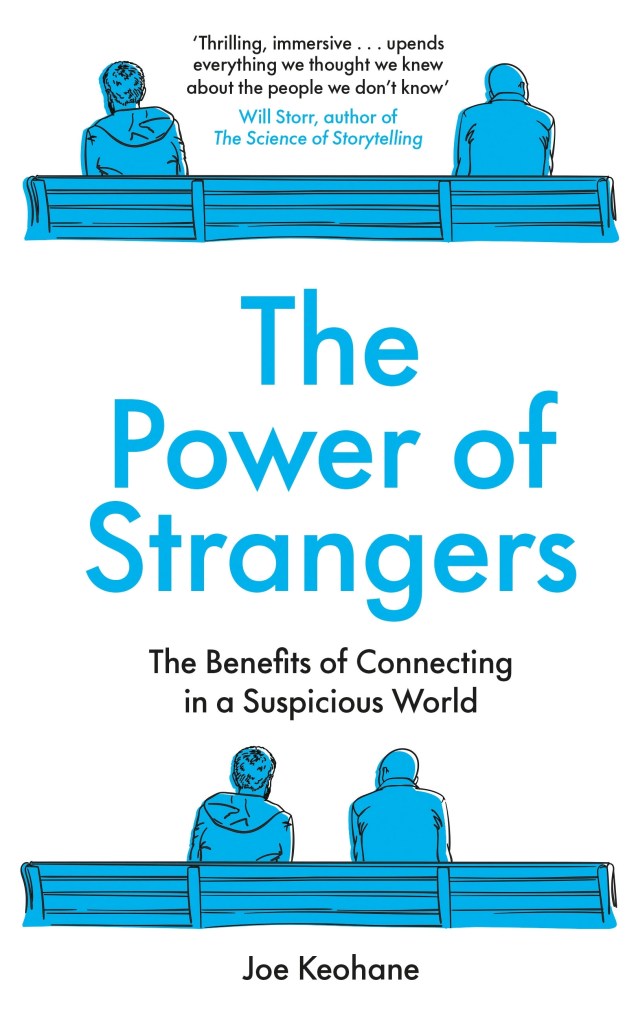
Joe Keohane’s the Power of Strangers

Joe Keohane, The Power of Strangers: The Benefits of Connecting in a Suspicious World (Viking 2021)

If I hadn’t already embarked on my 500 people project before I read this book, I would have started on it now. It’s a terrific book, of which the fabulous Ayad Akhtar (my blog post on his Homeland Elegies here) says on the back cover:

Rare is the book that delivers on the promise of a big answer to an even bigger question, but Joe Keohane’s The Power of Strangers does just that. This lively, searching work makes the case that welcoming ‘others’ isn’t just the bedrock of civilisation, it’s the surest path to the best of what life has to offer.

I can’t say it any better.

Joe Keohane is a journalist, used to talking to strangers as part of his job, with the aim of extracting newsworthy information and quotes. This book is about a different kind of talk, the reciprocal kind that is an essential part of being human, but which has been much neglected in recent decades.

Keohane draws on studies in primatology, archaeology, psychology and sociology. He describes the behaviour of ferociously territorial chimps and sweet-natured bonobos. He quotes philosophers, political scientists, novelists and historians. He interviews activists and takes part in classes, reporting on his successes and his embarrassments. He peppers his arguments with witty and moving anecdotes. He comes across as charming, intelligent, generous, and persuasive.

One of the user-friendlty feature of the book is that every now and then Keohane gives a little summary of the Book So Far. Here’s one from about the midpoint:

All right. So what do we know? We know that interdependence made hunter-gatherer groups more sociable among themselves and eventually with other groups. We know that greeting rituals in hospitality were evolved to reconcile the threat strangers pose with the opportunities that present… We know that we’re wired to favour our groups, but also that our definition of our group is flexible. We know that we’re predisposed to like people with whom we have something in common, even if we have no idea who they are and even if it consists of little more than wearing the same baseball cap. We know that cities can bring us together with countless strangers, but they can also create social norms that keep us apart. We know that talking across group boundaries can make us anxious, and we know that the relentless messaging about stranger danger that several generations were clobbered with has warped our sense of threat and possibly harmed our ability to trust.

(Page 166)

I won’t summarise the arguments for how talking to strangers was crucial to human survival in prehistoric times, or how rituals were devised to make it safe. I won’t do more than mention the experiments that show people’s sense of wellbeing increasing noticeably after they talk to a stranger, or even greet them with a wave and a smile. I won’t go into the fascinating findings that in places with high levels of generalised trust people tend not to be friendly to strangers, and vice versa, Australia being a rare, even possibly unique, exception: evidently we’re both trusting and friendly. I’ll skip over the lesser minds problem, that is, the common practical assumption that strangers aren’t fully human; and the self-explanatory phenomenon of absent presence. I’ll refrain from relaying the story of the viene-vienes in Mexico City (you can read about them here).

I will give you a surprisingly long list of projects that set out to encourage and enable people to talk to strangers. Most of them are in the USA – Keohane is a New Yorker – but while the ills they address may have a different flavour in other countries, I doubt if any place is free of them. In the order of appearance:

  1. Trigger Conversations: ‘a London-based “human connection organisation” that hosts social events aimed at facilitating meaningful conversations among strangers’, founded in 2016. Keohane spends a lot of time on what he learned at classes run by its founder, Georgie Nightingall
  2. Chatty Cafés: more than 900 pubs and cafés in the UK ‘set up specially marked tables where strangers can chat’
  3. Crossing Divides, a BBC series, which instituted a ‘chatty bus’ day, ‘during which riders were encouraged to talk to one another’
  4. Talk to Me, founded in 2012, a group that ‘distributed “Talk to Me” buttons to signal a willingness to talk in public, and set up “talk bars” in public spaces’
  5. Conversations New York (CNY) ‘holds regular, free group conversations, largely among strangers’. Forty to eighty people turn up at a college or in a park, are divided into groups and then talk for 90 minutes, ‘working from a list of topical or philosophical questions’
  6. Urban Confessional, which ‘encourages people to make their own crudely drawn cardboard signs [saying something like Free Listening] and stand in heavily trafficked locations offering themselves up as listeners to anyone who wants to talk’. The volunteers work in pairs to make the experience less intimidatingly intense for all parties
  7. The League of Creative Interventionists, a Californian organisation that has a number of projects, including Fear Doctor, in which someone sets up a booth in a public place that looks like Lucy’s psychiatrist booth in the Peanuts strip; and the Neighbourhood Postcard Project, in which the organisation’s founder Hunter Franks collected positive stories from the residents of a neighbourhood with a bad reputation, written on postcards, and then mailed them to people in different neighbourhoods
  8. An Instagram account called Subway Book Review that, among other things, sells tote bags that read, ‘Ask Me About the Book I’m Reading’
  9. Feasts of Strangers, hosted by the Oxford Muse Foundation, ‘dinners in which stranger are paired up and given a “menu” of intense personal questions’. The dinners last for two hours and have taken place in 15 countries
  10. Some fascinating individual projects: a young man named Judah Berger set up a table in Washington Square park in Manhattan with a sign reading, ‘Where Are You Going?’; Thomas Knox, an African-American, took a table and two chairs down to a New York subway platform to try to get people to talk to him – and succeeded amazingly; Danielle Allen, author of Talking to strangers: Anxieties of Citizenship Since Brown v. Board of Education (2004), has made a practice of talking to strangers and sees it as ‘gift giving’
  11. Braver Angels (originally called Better Angels) organises huge workshops where everyone wears a lanyard identifying them as either Republican or Democrat, and in a series of carefully structured events learn how to talk to each other – with remarkable success, even in post-Trump USA

This book was recommended to me by Jim Kable, frequent commenter on this blog. I’m hugely grateful for the recommendation.

The Book Group and The GrandMasters #Sh*tf*ckery

The Book Group had our end of year meeting last night. I wasn’t going to blog about it as there was no book to discuss, but things happened to change my mind.

We had our now-traditional ‘gentlemen’s picnic’ – which is to say, everyone brought food. We had dumplings, barbecued prawns, delicious roast potatoes with rosemary and garlic, Portuguese chicken, plus a bowl of peas so we’d have some greens, followed by a fruit platter, pastéis de nata and mince pies, all accompanied by excellent conversation and much laughter.

Then down to work. Instead of a book, in what may become a tradition, we each brought a poem and read it aloud. The poems ranged from Les Murray’s ‘An Absolutely Ordinary Rainbow‘, read to us beautifully by a man to whom Les Murray had read it as a student audience of one, to a completely foul Rodney Rude limerick. Between those extremes were Janet Frame, David Malouf, Barbara Vernon (the fabulous opening stage direction to her 1957 play The Multicoloured Umbrella), Raymond Carver, Adrian Wiggins, anonymous children’s versifiers, and Naomi Shihab Nye. Readings were punctuated by wonderful anecdotes about complex intimacies, the sound of rain on an iron roof, 9th century Japanese poetics, student life in times past, father–son connections and more.

Finally, the Kris Kringle. We each brought a book from our shelves, suitably wrapped and given out at random. Once the books were unwrapped we all looked happy with what we’d got, though the one who’d scored three folded pieces of waxed cloth looked a little mystified and his happy appearance may have been a little strained. (He found out later in the evening that the giver had brought the wrong one of two identically wrapped parcels from home, and will get the book to him soon.) I’m delighted by my book, and because it’s a very quick read, I get to do this blog post:

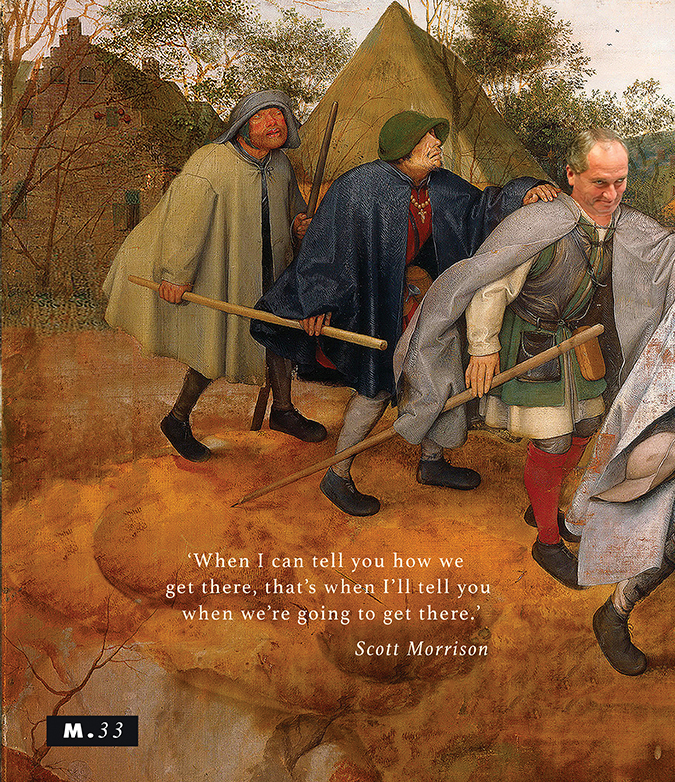
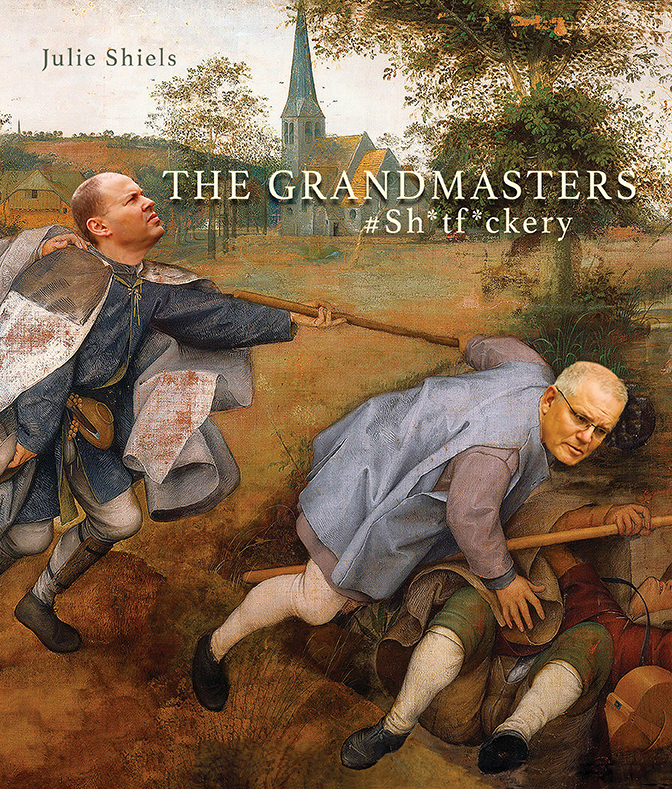
Julie Shiels, The GrandMasters #Sh*tf*ckery (M.33 2021)

Julie Shiels is a Melbourne artist who created a series of digital collages, starting during the Great Covid–19 Lockdown of 2020. She took a number of paintings by old masters, gave some of their personages the faces of contemporary Australian political leaders, and added pointed captions. For example, the dustjacket (left) has The Parable of the Blind Leading the Blind by Pieter Bruegel the Elder featuring Scott Morrison, Josh Frydenberg and Barnaby Joyce. The satirical point would be clear enough, but then there’s the caption, a quote from the Prime Minister: ‘When I can tell you how we get there, that’s when I’ll tell you when we’re going to get there.’

The book simmers with rage, as it covers Robodebt, the federal government’s handling of the vaccine rollout, the scandal around Christian Porter, the Britney Higgins matter, climate change, Peter Dutton deciding to smile, Karen Andrews describing herself as compassionate, the abandonment of Australia’s Afghan friends, and so on.

I laughed out loud at the title page, which has a smirking Morrison standing by the woman’s corpse in Jerome Preudhomme’s The Death of Lucretia, while Michaelia Cash and Marise Payne play other roles – the caption: ‘Blokes don’t get it right all the time.’ Other pages – including but not limited to variations on the rape of Lucretia – are too horrible to be funny, but horrible in a bracing way. Some images land only in the general vicinity of their targets, and some – such as Scott Morrison as Aeneas carrying his ailing father in Pompeo Bartoni’s Aeneas Fleeing from Troy, saying ‘We are all Melburnians now’, or Dan Tehan as Rubens’ Saturn Devouring His Son – hit the bullseye.

This is an art book. The quality of the reproductions is excellent. The face-changes are mostly convincing, and where they’re not the effect is comic rather than shambolic (Julie Shiels must have trawled through millions of photographs to get the heads at just the right angle, the faces with just the right expression).

I recommend it as a gift for a politics-junkie friend who is into art. According to the M.33 website, only 300 copies were published, so you may need to be quick if you want one. The collages, being digital creations in the first place, can be see on Julie Shiels’s website at this link.


The GrandMasters #Sh*tf*ckery is the 15th book I’ve read for the Australian Women Writers Challenge 2021.

Journal Blitz 11

I’m constantly in catchup mode with my reading of literary journals. I tend to start each one with a sense of taking on a burdensome duty – after all, these journals are invariably dancing on the edge of the precipice of financial ruin. By about the third page I’m usually engrossed and remember why they’re worth supporting.


Evelyn Araluen and Jonathan Dunk (editors), Overland 241 (Summer 2020)
(The content is online at overland.org.au, and I’ve included links)

Each issue of Overland currently (that is to say, a year ago, which is where I’m up to) is a three-parter.

Taking up the first two thirds is the articles section, a platform for marginalised voices and for arguments from outside the Overton window. The stand-out article in this issue is ‘No longer malleable stuff‘ by Jeanine Leane, an uncompromising contribution to the current conversation about who has the right to tell whose stories:

Australian fictionists may and most likely will still fossick over the stolen lands of the nation but we – First Nations peoples, Peoples of Colour – are no longer the ‘malleable stuff’ of the unchecked settler imagination. Perhaps there wouldn’t be a point in talking about an author’s identity if they were all the same. But this is no longer the case. We’re not dead. And, we’re not white. We write. Our identities matter.

Also in this issue, Mammad Aidani, whose writings have been banned in his native Iran, argues that it would be wrong of him to allow his writing to be published there (‘300 words for truth‘); Sam Altman sketches the ‘wholesale collapse of Earth’s planetary systems that sustain life as we know it’ (‘Prepare for collapse‘); Lisa Stefanoff promotes the movie In My Blood it Runs (‘The Australian government is not listening: education justice and remote Indigenous futures‘); Jinghua Qian and Liz Crash promote their virtual multimedia tour of the Melbourne suburb of Footscray (‘Underfoot: history from below‘); Angelita Biscotti reflects on her work as a nude photographic model, which she has come to see as sex work, and quotes the book I haven’t read whose ideas fascinate me most, The Managed Heart by Arlie Russell Hochschild (‘On the fantasy work that makes life bearable‘).

Second, there’s the 12-page poetry section, edited by Toby Fitch. From a strong and varied field, it’s again a first Nations voice that grabs me: ‘Mnemonic 2020‘ by Yeena Kirkbright walks us in 13 sections, each named for a colour, through the rough year that has just been (this issue was published at the end of 2020). Here’s section 8:

8. _______Purple
After the Jacaranda blooms we go into lockdown.
We are locked in together on Gadigal land. 
I work from my bedroom and feel more trapped than ever.
A manager tells me she heard an Aboriginal woman 
on Sky News say blak breathlessness isn't a problem. 
Not in Australia.
I am livid. I can't argue. I need to pay bills.

Third, the fiction section, edited by Claire Corbett, comprises four short stories, all terrific. ‘Frog song‘ by Magdalena McGuire has a mother and small child in sweltering Darwin weather: ‘It shocks them to discover the sun is not a thing of beauty.’ In ‘Smoke and mirrors‘, poet Samuel Wagan Watson tells a story of loss and grief with a (spoiler alert) twist I didn’t see coming. ‘The white sea‘ by Alistair Kitchen is an unsettling fable in which the sea turns white ‘in the way milk is white – thick and full and opaque’. With Jane Turner Goldsmith’s ‘Smoke road‘, we’re back in naturalistic mode with a taut, understated tale of leaving an abusive relationship.

It looks as if the print edition of Overland no longer publishes the results of the literary competitions listed on the website. This seems to have resulted in a cleaner through-line for each issue. The absence of regular columns has a similar effect, but I do miss the cameo appearances of Alison Croggon, Tony Birch, Giovanni Tiso et al.


Stuart Barnes & Claire Gaskin (guest editors), Australian Poetry Journal Volume 11, Number 1: local, attention (2021)

As promised, this issue of APJ includes a further instalment of Jacinta LePlastrier’s ‘New Series’, which pairs poems with commentary. But first there are 60 pages of poems that reflect the theme ‘local, attention’. The guest editors’ Foreword quotes Mary Oliver: ‘Attention is the beginning of devotion.’ They’re suggesting, perhaps that this collection of poems that pay attention to the local in as many ways as there are poems might be seen as a post-religious devotional book.

It’s a nice thought, and I can’t tell you it’s wrong.

I turned down the corners of four pages. This doesn’t mean the poems on those pages are somehow superior to the others or even that they struck me more strongly – it’s just that I remembered to mark them at the moment of first reading them. They are:

‘Falling’ by Gavin Yuan Gao, which starts out observing that

____+++++++___ despite years of dogged 
____++practice, English is still the slick
winged serpent the dull flute of my tongue
has failed to charm

and develops, by way of a consideration of the use of ‘fall’ when ‘you mean to say you’re in or out of love’, into a celebration of first love.

‘Quantum Vacuum Noise’ by Alicia Sometimes, in which life with small children in lockdown is seen as problematic for quantum computers (I think):

We have been creating in this space
forts on top of desks on top of kitchens

the fluctuating energy of us laughing would
distort any signals or information encoded

I probably marked ‘Slowly, Here in Esssaouira’ by Matt Hetherington because it’s pretty much a sonnet. It evokes a state of lassitude which, the title informs me via DuckDuckGo, is happening in a town in Tangiers:

a peace is descending upon me
the noisy children don't bother me so much
and things get done, one at a time

‘The Ibises’ by Greg Page won me because I’m fond of those birds and quietly resent their ‘bin chicken’ nickname. Greg Page is a First Nations man, and the poem’s serious turn is a delightful surprise:

Hated, like us Kooris
Told they don't belong
Moved on from their homes
Making do on the fringe

There are eight poem–commentary pairs in the ‘New Series’ section. Though every pairing is interesting and instructive, I was especially interested in two where the commentator is the English translator. Both Dong Li (on Song Lin’s ‘Near) and Stephanie Smee (on Joseph Ponthus’ ’31. from “Part two”, On the line’) shed brilliant light on a translator’s relationship to the original work and its author.


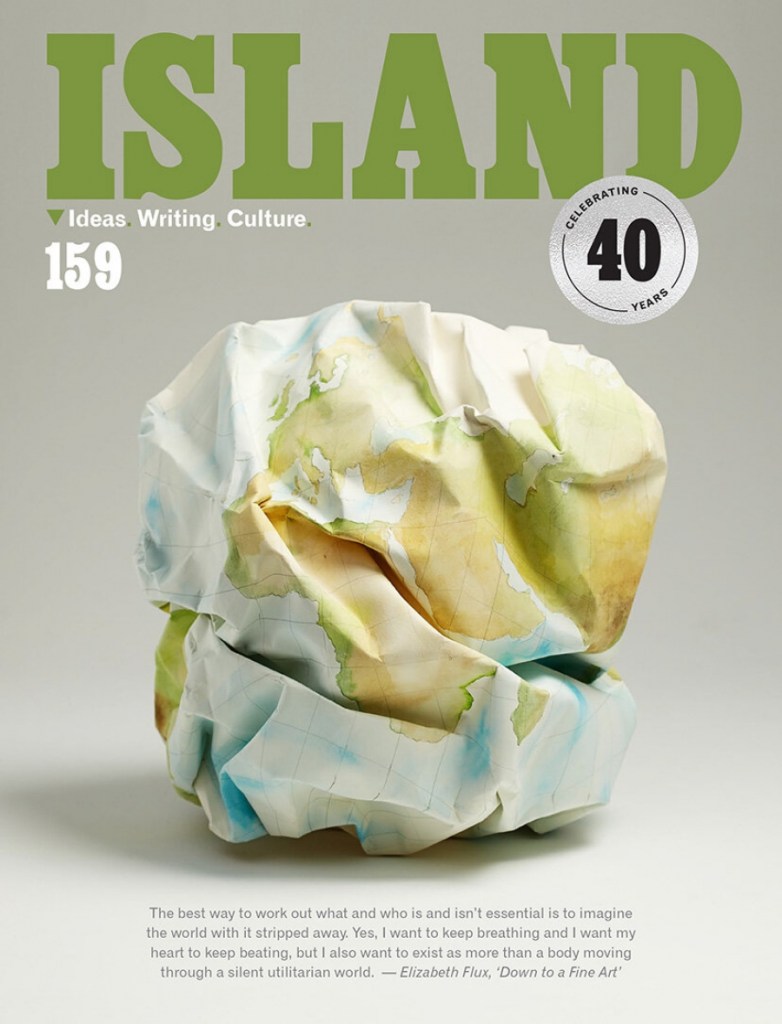
Vern Field (editor) Island 159 (2019)

This issue of Island is upfront about financial difficulties. In 2019, according note from Geoff Heriot, Chair of the Island Board, the journal managed three issues instead of the usual four – but it ended the year in the black so they managed ‘to keep the doors open’.

Elsewhere, the sense of struggle recedes. There are four interweaving elements: nonfiction edited by Anna Spargo-Ryan, fiction edited by Ben Walter, poetry edited by Lisa Gorton, and arts features edited by Judith Abell.

The arts features are beautifully illustrated essays on works by three Tasmanian artists – Lucienne Rickard’s Extinction Studies, Julie Gough’s Tense Past and Selena de Carvalho’s Beware of Imposters (the secret life of flowers) – that bear witness to the island’s vital art scene.

Ten poems are interspersed among the other contents. The poem that spoke most directly to me is ‘Ash in Sydney‘ by Jake Goetz. It’s a wonderful evocation of the experience of being in Sydney during the bushfires of summer 2019–2020, which begins:

ash in falling on the Lidcombe line
on Carriageworks and Regents Park
it's falling on planes of closed-up houses 
where Greg thinks his summer's fucked 
and it's blowing in from morning westerlies 
and it's blown back by arvo southerlies

You can read it and a number of other poems from this issue on the Island website at this link.

There are five pieces of fiction whose subjects range from international adultery to futuristic crime thriller. If I have to single out one, it’s Pip Smith’s ‘Starter Culture’, in which the 70-year-old narrator endures the slights that come her way from her granddaughters and other young women, and eventually wreaks satisfying vengeance (no young people being harmed in the making of said vengeance).

Among the excellent nonfiction pieces, it speaks volumes of Katerina Cosgrove’s ‘Death in the Garden‘, that I found its account of grief and resilience powerful even after it said that Epicurus ‘founded a school of thought championing the pursuit of hedonism’, which would have made my high school Latin teacher apoplectic. In ‘Principles of Permaculture‘ Sam George-Allen reflects on six months living alone on ‘a quarter-acre oblong island in a sea of golden grass, wedged between two improbable paddocks on the edge of a rundown country town’, and – though she doesn’t claim it for herself – describes a kind of solitary engagement with the earth that, through her beautiful writing about it, becomes a form of activism.


I interrupted the writing of that last paragraph to collect my mail. Sure enough, there was another literary journal hot off the press.

It’s like painting the Harbour Bridge.

The Iliad: Progress report 1

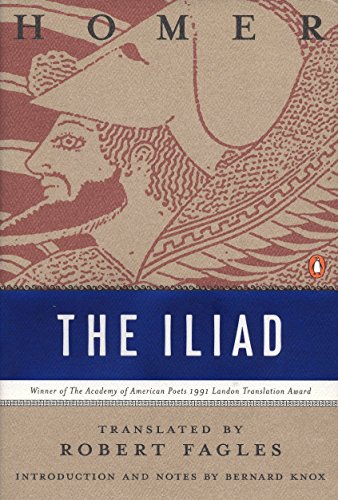
Homer, The Iliad (translated by Robert Fagles, with notes and an introduction by Bernard Knox, ©1990, Penguin 1998), from beginning to Book 3 line 190

My partner, known on this blog as the Emerging Artist, asked why I was reading The Iliad, which is surely all about men killing each other. I didn’t have a coherent answer beyond, ‘Because it’s there.’

Anyhow, after one month I’m half way through Book 3, and only one person has been killed. Apart from four or five mornings’ worth of roll call of the Greek troops and then the Trojan defenders, I’m riveted. Achilles has had a big row with Agammemnon and withdrawn from combat. The gods keep intervening in fascinating ways, including making promises they have no intention to keep. Now, as the vast armies are lined up against each other, it looks as if the war is about to be called off and replaced with a two-man fight to the death between Paris, the strikingly handsome man who abducted Helen, and Menelaus the wronged husband. I’m on the edge of my seat: I know the plan isn’t going to work, but I can’t see how.

I’m not going to do this in every monthly progress report, but I want to compare some translations. Here’s the very first death in Robert Fagles’s translation:

The veteran Protesilaus had led those troops
while he still lived, but now for many years 
the arms of the black earth had held him fast
and his wife was left behind, alone in Phylace,
both cheeks torn in grief, their house half-built. 
Just as he vaulted off his ship a Dardan killed him, 
first by far of the Argives slaughtered on the beaches.
(Book 2, lines 796–802)

Compare Alexander Pope’s translation of the same passage, published in 1715. Pope sacrificed literal translation in order to render the poem into rhyming couplets – heroic couplets. He also renders the ancient practice of tearing one’s cheeks into the more familiar breast beating.

These own’d, as chief, Protesilas the brave,
Who now lay silent in the gloomy grave:
The first who boldly touch’d the Trojan shore,
And dyed a Phrygian lance with Grecian gore;
There lies, far distant from his native plain;
Unfinish’d his proud palaces remain,
And his sad consort beats her breast in vain.
(Book 2, Lines 853–859)

Alice Oswald’s version emphasises the pathos of the moment. It’s not a literal translation, though you could argue that it feels closer to Fagles than to Pope. As she says in her introduction to Memorial (faber & faber 2011), ‘Instead of carrying the [Greek] words over into English, I use them as openings through which to see what Homer was looking at.’ This passage includes material from earlier and later lines:

The first to die was PROTESILAUS
A focused man who hurried to darkness
With forty black ships leaving the land behind
Men sailed with him from those flower-lit cliffs
Where the grass gives growth to everything 
Pyrasus   Iton    Pteleus   antron
He died in mid-air jumping to be first ashore
There was his house half-built
His wife rushed out clawing her face 
Podarcus his altogether less impressive brother 
Took over command but that was long ago
He's been in the black earth now for thousands of years

Melissa Ashley’s Bee and the Orange Tree, plus November Verse 13

Melissa Ashley, The Bee and the Orange Tree (Affirm Press 2019)

Most people know that the story of Cinderella has been told in myriad ways in many cultures, and that the version most commonly told to children in the west these days – the source of the Disney version – was written by Charles Perrault, a late 17th century Parisian. But did you know that he was part of a thriving fairy-tale publishing scene in France between 1690 and 1725, and that most of the many authors of original fairy tales of that time were women? And had you even heard of the Baroness Marie Catherine d’Aulnoy, the woman who coined the term ‘fairy tale’ (conte de fée).

Melissa Hay’s novel The Bee and the Orange Tree, set in 1699, takes place in that gap in our collective knowledge. It’s main characters are Marie Catherine, old, racked with arthritic pain and about to publish her second collection of tales; Angelina, a largely fictional character based on Marie Catherine’s youngest daughter; and Mme Nicola Tiquet, a friend of Marie Catherine who is accused of conspiracy to murder her abusive husband. Chapters are narrated from the point of view of each of these three characters in turn. The struggle to save Nicola from execution is a main narrative thread, secrets from Marie Catherine’s past are revealed, Angelina falls in love, and both Angelina and Marie Catherine reach turning points in their writing careers.

It’s a historical romance, even a bodice ripper, though rather than any bodice being ripped there’s a revelation of bound breasts and, at the novel’s steamiest, a lustful eye is cast at a décolletage. Paris of the time is vividly evoked, from the salons where ladies read their fairy tales to the huge public festive horror of an execution. Men tend to be peripheral to the story, except possibly for him of the bound breasts.

The novel has an agenda to retrieve some lost literary history, and some history of women and gender non-conforming people, and it achieves that interestingly, though I wasn’t completely convinced by the portrayal of the salons, and didn’t believe in the fairy tales included in the book. On the other hand, the sexual intrigues and the various plot revelations are pretty much determined by the genre – serviceable rather than engaging.

The part that worked best for me is the account of the execution as a public event that people feel compelled to witness, whether as sympathisers, as ghoulish entertainment seekers, or as participants. (It’s not a spoiler to tell you there is an execution – the threat of it hangs over more than one character.)


And now, because it’s November:

November verse 13: 
Three thousand sombre people gathered,
candles lit, when Ron Ryan* hanged.
By needle, bullet, stones, gas pellet,
rope, electric chair or sword,
Iran, Iraq, South Sudan, China,
Texas to South Carolina,
state killing still goes on today.
Polite, we turn our heads away
where once it was a great occasion:
come and see a life cut short,
come see how great the power of courts,
see how we'll kill, for God or nation.

Wise though we others claim to be
we'd still watch, glued to the TV.

* Ronald Ryan was the last man hanged in Australia. It was 8 am on Friday February 3 1967 in Melbourne’s Pentridge Prison. He refused a sedative so that he could write a note to his daughters. The note ended, ‘Goodbye, my darlings … Lovingly yours, Dad.’


The Bee and the Orange Tree is the 14th book I’ve read for the Australian Women Writers Challenge 2021.

Walk Like a Cow with Brendan Ryan, plus November verse 4

Brendan Ryan, Walk Like a Cow: A memoir (Walleah Press 2021)

I take Brendan Ryan’s poetry personally. His childhood and mine didn’t have a huge amount in common, but his poetry about cattle – working with them, observing them, even loving them – and about growing up Catholic resonate hugely for me. There were only five children in my family, as opposed to his 10. I spent my childhood on a sugar farm in tropical North Queensland, hard to imagine a climate further removed from his western Victoria. We had just a few cows, of which two were milked by hand in the mornings, rather than a hundred that had to be milked by machine day and night. And I left the farm behind me when I went to boarding school aged 13, whereas he kept working on the farm, much harder than I ever did, into young adulthood. But I recognise so much of what he writes about, and am grateful that he has done the work of wrangling his experiences and observations into words.

This book is a welcome backgrounder on the poetry, and it’s very interesting in its own right. It’s a collection of memoir essays: a version of one of them, ‘Ash Wednesday: A memorial’, published in Heat in 2010, first introduced me to Brendan Ryan’s writing, and I have read versions of several others in Heat and Southerly since. It’s good to see them brought together to form a narrative: his parents’ story, his childhood on the farm, Catholic school and then work away from home in late teenage years, the move to Melbourne, shared houses, pub music scene, odd jobs, and the beginnings of his lifelong relationship. Through it all there is his appreciation of cows, his learning from them how to walk the country (as opposed to Henry David Thoreau’s advice to learn to walk like a camel), and his development as a poet.

There’s a moving account of his relationship with poet John Forbes, who was a mentor. The life with cows and then living in the city with a paddock in his head, so vividly rendered in his poetry, are described here at fascinating length. It’s delightful to read that the first publication of a poet who is so rooted in place, so earthy and so accessible, was a self-published limited edition of 14 copies, bound in paperbark from the trees of St Kilda and selling for $50 each.

Here’s a taste of his writing about cows:

While a cow walks in a straight line, not moving from side to side, it also walks a deviating line. This line seems to be closely linked to two elements a cow encounters each day: the geography of a paddock and habit. Due to their physical size, cows will walk across a hill rather than down the steepest incline. Being a herd animal, a cow will mostly follow other cows along the track they walked the day before. Their cow tracks meander around bumps and ridges in the dirt, ands so the tracks suggest the intimate knowledge the cows have of each paddock. Each day the cows walk along these tracks, perhaps for security, most likely because the tracks have a more practical basis. When viewed from a distance the cow tracks describe the routine of a cow’s day. One track will lead straight to the water trough. Another track will fork off toward shelter on the boundary fence, while other tracks converge like veins around a heart at the paddock’s gate.

‘Walk Like a Cow’, page 202

Because it’s November, inspired by Brendan Ryan, here’s a little verse tribute from me to the Jersey cow that led our herd of mostly Australian Illawarra Shorthorns, with a couple of Friesians:

November verse 4: Cows I have known
For Brendan Ryan
Beauty was our herd's true leader.
Bulls might think they'd be obeyed,
but all the herd would turn to read her
every move, and move her way.
Bony ancient, grey as morning,
with no need for roughhouse horning,
queenlike, she assumed her rank
and strolled from shade to water tank.
Bullocks, calves and springing heifers, 
roan, and black and white, and red,
chewing, calling to be fed,
crumpled horned, with swinging udders,
lifting tails to drop their loads –
they all followed. Beauty led. 

Starting the Iliad

Homer, The Iliad (Translated by Robert Fagles, with notes and an introduction by Bernard Knox, ©1990, Penguin 1998)

It’s more than a week since I finished reading The Prelude, and I’m already missing reading a couple of pages from a classic text first thing every morning. I’ve decided to take on Homer’s Iliad, which definitely fits the definition of a classic as a book that you can’t read for the first time. My copy of Robert Fagles’s translation was a Christmas gift a while back and has been begging for attention from my sagging To Be Read shelf ever since.

This is my first crack at the actual Iliad, but I have read many fragments, versions and variations of it. Here’s a list of the ones I remember:

  • Kingsley’s Heroes, the Argonauts Club and the Queensland School Readers – from my parents, the ABC and primary school respectively – all told stories of Achilles, and almost certainly some parts of the Iliad
  • The Classics Illustrated comic some time in the 1950s
  • Book 2 of The Aeneid, Virgil’s account of the fall of Troy, which I studied in high school
  • Alice Oswald’s Memorial, subtitled ‘an excavation of The Iliad‘, which presents only the deaths from Homer’s poem (here’s a link to my blog post)
  • The 28 minute version in Natalie Haynes Stands Up for the Classics (link to the podcast)
  • Pat Barker’s Silence of the Girls, which tells the story from the point of view of a captured woman (link to my blog post)
  • David Malouf’s Ransom, which I’m pretty sure I haven’t read, but I feel as if I know it intimately from reading and hearing about it.

I made a start on it this morning. So far I’ve read the translator’s note and I’m part way through the learned Introduction by Bernard Knox. Getting excited already. I’ll report back in a month.