A friend emailed me this photo. It’s not the work of fabulous Marrickville mattress poet C.L. It lacks her (I’m convinced the MMP is a woman) world-weary generosity of spirit and may stray a little into vulgarity, but it’s heartening to see that someone in Newtown is keeping the flame of mattress poetry alive:
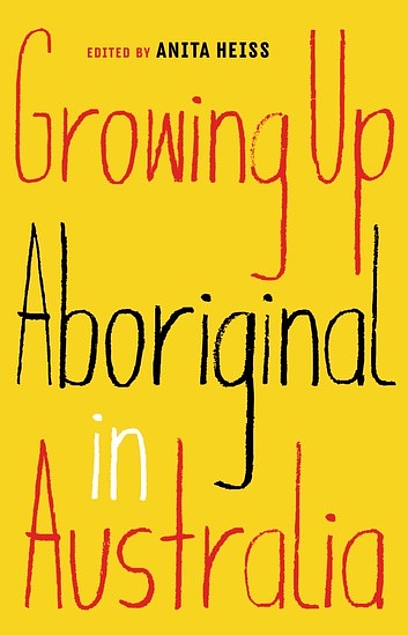
I’m coming to this book late, but it’s a book that will remain fresh for a long time yet.
It contains 52 essays from First Nations people of Australia. The range of contributors is huge: people from all parts of Australia, urban and remote, from Cape York to the Western Australian wheat belt; some who are household names, some who should be, and some who live quiet lives far from the limelight; people who were strongly connected to culture and community as children and people who discovered they were Aboriginal only in adulthood; old (several contributors were born the same year as me, 1947) and young (one was 13 at the time of publication); sports stars, poets, novelists, classical musicians, prisoners.
Anita Heiss writes in her introduction:
There is no single or simple way to define what it means to grow up Aboriginal in Australia, but this anthology is an attempt to showcase as many of the diverse voices, experiences and stories together as possible.
The attempt succeeds admirably.
I was struck by the sheer number of almost identical incidents in which someone challenges a young person’s Aboriginal identity. Here’s one of them, as told by Keira Jenkins, a Gamilaroi woman from Moree in New South Wales:
I was six years old, sitting cross-legged on the floor in my checked dress, which was slightly too long for me, looking eagerly up at Miss Brown – at least I think that was her name – the first time I had a blow to my sense of identity. We were learning about Aboriginal people and I piped up very proudly.
‘I’m Aboriginal.’ I waved my hand in the air.
‘No, you’re not,’ my friend Alison said. ‘You’re too white to be Aboriginal.’
I don’t remember what happened after that; I just remember feeling ashamed.
(Pages 119–120)
The challenger isn’t always another child. Sometimes it’s an adult in authority, sometimes even another Aboriginal person, but the confident refusal to accept that a child with fair skin can be Aboriginal occurs again and again in almost exactly the same words, never without impact on the child. No wonder Andrew Bolt was taken to court over his 2009 slur against ‘light-skinned people who identified as Aboriginal’ (news story here if you don’t know about that): the people bringing the case must have been desperately sick of that pernicious stuff.
The sameness of attacks stands in striking contrast to the tremendous variety of the life stories. I loved reading how eleven-year-old Miranda Tapsell refused to go to an event as Scary Spice just because Scary Spice was brown like her, and risked the ire of her non-Indigenous friend by going as their shared favourite, Baby Spice; how Adam Goodes disobeyed a teacher on a zoo excursion and stared at a gorilla; how Karen Davis, a Mamu–Kuku Yalanji woman who grew up n Far North Queensland in the 1970s and 80s sang songs on long car trips with her family pretty much the way I did with mine in the 1950s.
Some of the stories defy belief. William Russell, who describes himself as ‘a black, fair ex-serviceman with PTSD, blind and with a severe hearing impediment, and a long list of other physical problems from military service’, is a case in point. He tells of a time when his mother, with a babe in arms and four-year-old WIlliam by her side, faced a crowd of drunk, angry white men in the tiny town in Victoria where they had just come to live as the only Aboriginal family. Her grandfather stepped out of the shadows to save the day, naked ‘as always’, painted up in ochre and kaolin, and discharging a shotgun. This was in the 1950s. Hm!
There are tragic stories of the damage done by of colonisation to individuals and communities,featuring alcoholism and addiction; diabetes and diagnoses of mental illness; family violence and dysfunction; premature death. And there are stories of heroic resilience. Tony Birch’s story of his father is a beautifully told study in reversing fortunes. After years of violence and anger, followed by years of medication, electric shock treatment and institutionalisation, he ‘is saved’:
The Aboriginal community of Fitzroy gather around and care for him: men and women who had known him when he was a kid, during the years before any of them were ravaged by the force of racism and exclusion. He moves to the countryside and begins working with young blackfellas in schools. The experience is life-changing, for both my father and his family. I discover, a little to my own surprise, that I love him.
(Page 35)
My copy of Growing Up Aboriginal in Australia is a loan from my Book(-lending) Club. I consider it belongs in the Australian Women Writers Challenge 2021: it’s edited by a woman, and more than half the contributors are also women. So I’m counting it as the eleventh book I’ve read for the challenge.
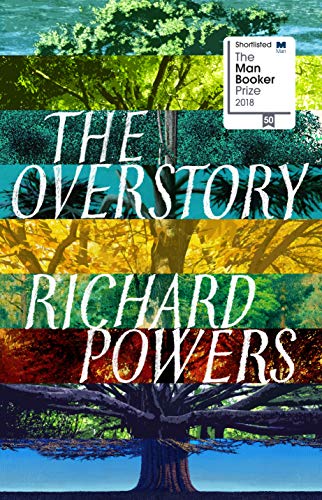
Richard Powers, The Overstory (William Heinemann 2018)
To be human is to confuse a satisfying story with a meaningful one, and to mistake life for something huge with two legs. No: life is mobilised on a vastly larger scale, and the world is failing precisely because no novel can make the contest for the world seem as compelling as the struggles between a few lost people.
(The Overstory, page 385)
That’s the challenge Richard Powers has taken on: to write a compelling novel about the contest for the world. While I was reading it, the Australian Commonwealth Government was trumpeting the virtues of coal even while the memory of last year’s devastating fires was still fresh and temperatures in Canada reached staggering new heights. You don’t have to be particularly radical or visionary to realise that the climate emergency is upon us and decisive action is needed; but most of us go on, with occasional breaks for demonstrations or lockdowns, more or less business as usual. The Overstory resolutely turns its gaze on the crisis currently facing humanity, focusing on the world’s forests, attempts to protect them, and the catastrophic scale of destruction.
The opening section, ‘Roots’, reads like eight short stories, each more or less complete in itself, and with no obvious similarities or connections between them. It turns out that we are being introduced to the nine main human characters, and the role trees have played in each of their lives. A boy lives on a farm where his great-grandfather, his grandfather, and his father, have photographed a particular chestnut tree once a month for a century, so that he has a stack of photographs that can be flicked through to show the tree’s growth over that long time. Another boy becomes an early computer nerd, whose life changes dramatically when he falls from high in a tree. A girl is fascinated by what turns out to be a priceless scroll her father has somehow smuggled out of China when he left as a refugee.
In the second and longest section, ‘Trunk’, the main narrative is played out. One character develops a hugely popular and lucrative computer game. Another, who Wikipedia says is modelled on Canadian scientist Suzanne Simard, makes world-changing discoveries about how trees communicate with each other. But the dominant thread is about five characters who become part of the ecological movement of the last quarter of the 20th century. There are brilliantly powerful accounts of front-line protests to save the forests of north west USA (of the kind that still continue today, as in Sally Ingleton’s 2020 doco, Wild Things. Avoiding extreme spoilers, I’ll just say that their activism doesn’t end well, and that it ends spectacularly.
The third section, ‘Crown’, is pretty much aftermath. That is, the sense of anticlimax never quite dissipates. Life continues. The activists build new lives. The computer game becomes more complex, more successful, and ultimately less satisfying to its creator. The scientist, whose work was initially ridiculed, is now validated and in demand.
In the fourth, shortest section, ‘Seeds’, the novel’s big question comes into focus. So much damage has been done, such a huge proportion of the earth’s forests has been destroyed, and attempts to prevent further destruction have failed. The damage is either irreparable will need more time to be repaired than we have left: where can we go from here? A number of possibilities are raised – seeds for the future, not all of them including human thriving – but I’m glad to report that the book’s final pages are neither glibly optimistic nor glibly despairing. There is no saying which of the seeds will take root or bear fruit. Trees will survive, but will humanity?
If, like me, you know intellectually how serious the climate emergency is but have trouble really holding that knowledge in your mind and heart, then reading this book will probably bring you closer to facing up to the reality. It is full of passionate love for trees, and for their interconnectedness in forests. I’m not a tree scientist, but my impression is that Richard Powers has immersed himself in the research, then produced his own lyrical, impassioned version, nudging it slightly towards science fiction/fantasy – at times crossing over to mystical communication between trees and humans – but still true to the spirit of the science. Likewise, when Nick and Olivia, now calling themselves Watchman and Maidenhair, spend a year on a platform high up in a threatened redwood, I read it as beautifully realised fiction, but trust that the fiction has solid roots in the realities of those ecological protests.
The Overstory is brimful of ideas: about computer technology, tree science, political organising, the function of art. It’s full of history – in particular of the destruction of the forests of North America by disease and rapacious capitalism in the late 19th and 20th centuries; and of US environmental law, environmental protest movements and, less overtly, land art. It also has nuanced, complex relationships among humans and moments of visceral violence. There are moments of devastating wit, not least the moment towards the end when a Native American perspective is sharply introduced. And all the way through, it rhapsodises about trees, and this, for me, is the engine that keeps the book alive when the plot sometimes loses momentum. Here’s the moment when Nick and Olivia first drive into the redwood forest:
The redwoods knock all words out of them. Nick drives in silence. Even the young trunks are like angels. And when, after a few miles, they pass a monster, sprouting a first upward-sweeping branch forty feet in the air, as thick as most eastern trees, he knows: the word tree must grow up, get real. It’s not the size that throws him, or not just the size. It’s the grooved Doric perfection of the red-brown columns, shooting upward from the shoulder-high ferns to the most-swarmed floor – straight up, with no taper, like a russet, leathery apotheosis. And when the columns do start to crown, it happens so high, so removed from the pillars’ base, that it might as well be a second world up there, up nearer eternity.
(Page 211)
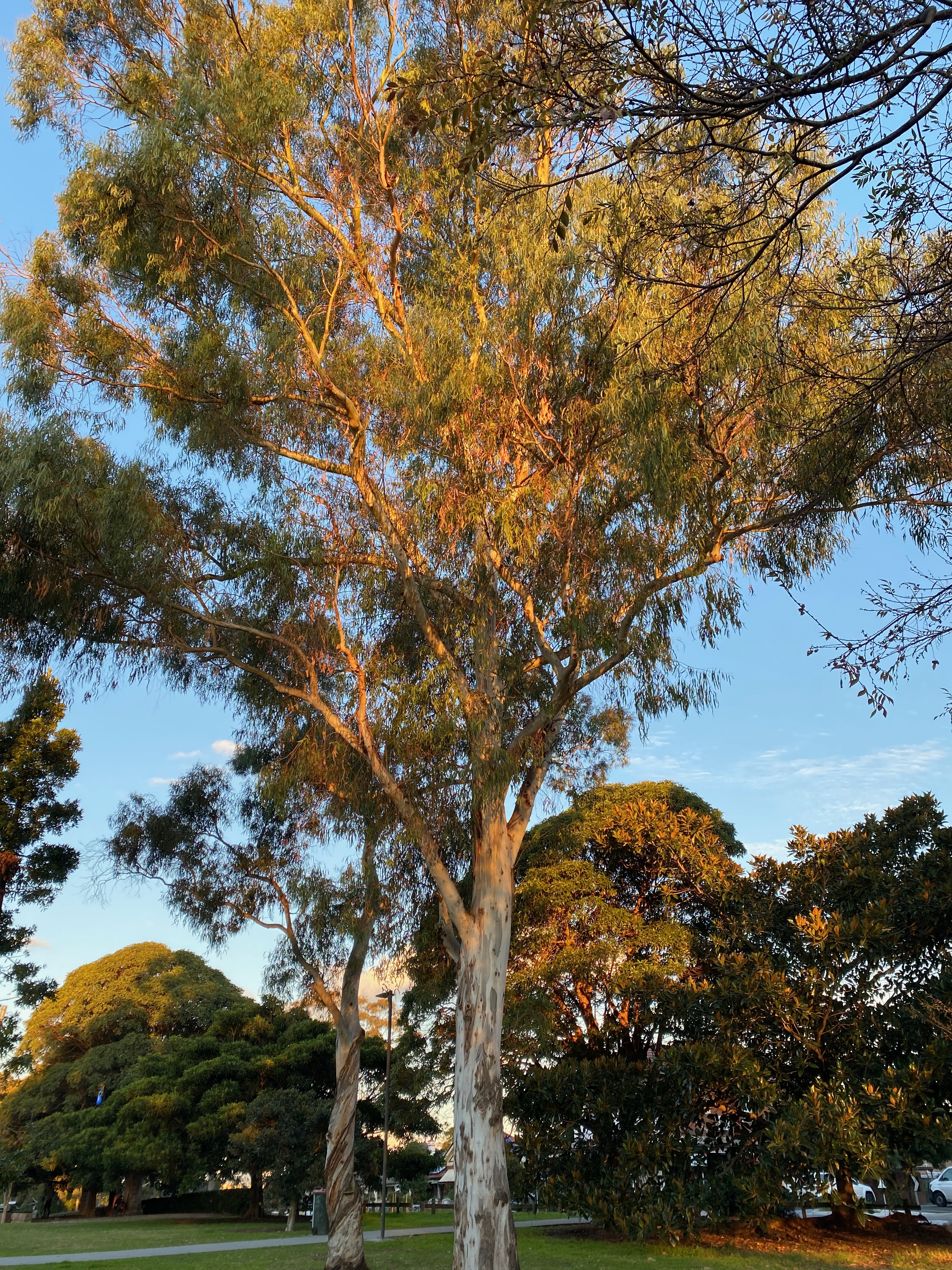
When I’d hit Publish on this I went for a walk and as I passed the trees in the park near our place and in the surrounding streets, I realised that the main joy of The Overstory for me was that it reminded me of how much I love trees. There was a time in my early days in Sydney when I couldn’t talk about the trees near my home in North Queensland without tearing up. More recently, when we left our house for an apartment, it was the guava tree and the cumquat tree that I missed most. Again and again in this book, Richard Powers as narrator or through one of his characters gives unabashed expression to what I suppose should be called dendrophilia.
Here’s a eucalypt catching the afternoon light in our park just now, and some of its tree neighbours.
I’m chronically behind in reading the journals I subscribe to. I’ve had seven goes at dragging myself up to date by blogging about a batch in one post. But blog entries get unwieldy when they deal with several very different publications, and I wouldn’t blame my readers fro giving up after the first screen or so. So this time, there’s just the one journal:
At the 2019 Melbourne Writers Festival, poets Ellen van Neerven, David McCooey, Felicity Plunkett and Eunice Andrada met with Jacinta Le Plastrier, publisher of the Australian Poetry Journal, on a panel called The Heart Bent for a discussion on ‘the ethics of elegy and writing on and from love’. Jacinta suggested that the panel members put together an issue of the APJ on the theme, and this excellent publication is the result. No one could have guessed that a pandemic would come along to make the theme of elegy – a formal lament for the dead – bitingly relevant.
The journal is divided into four main sections, each wth a foreword by a different editor, a brilliant solution to the question of how to co-edit.
Each of the forewords ruminates on the nature of elegy. Ellen van Neerven invokes the context of the terrible happenings of 2020 – the ravages of country, Indigenous culture and First Nations people in Australia and around the world, and the rising up against racism that followed the deaths of George Floyd and David Dungay. In the thirteen poems she has selected, she says she feels ‘the energies of these pieces and the futures these poet don’t wish to mourn’. David McCooey writes, ‘We all live elegiac lives. Loss is endless, and the things we lose pile up like the debris in the wings of Walter Benjamin’s Angel of History.’ Felicity Plunkett starts from Denise Riley’s Say something back (2016), a book of poems that centres around the death of the poet’s son, and writes, ‘The question of what the elegy – and, more broadly, the elegiac mode – can and can’t do is one the poems in this anthology approach from different angles, counterpoints in an extensive song.’ Eunice Andrada hopes ‘that through engaging with these elegies, we can widen our collective vocabularies when attempting to offer language to our loss’.
Behrouz Boochani has a special place. His ‘Forgive me my love’, hand-written in Farsi and translated by Moones Mansoubi, stands alone before all four sections. Even if it was drivel it would have justified its place, given his heroic history as a beyond-marginalised Australian writer. But it’s not drivel:
Forgive me, my angel!
I am not able to caress your gentle skin with my fingertips.
But I have a lifelong friendship with sea zephyrs
and those zephyrs strum my nude skin here, in this green hell!
What follows is extraordinarily rich and diverse. Well established writers have beautiful work here: Jennifer Maiden (‘Meteors’, since published in Biological Necessity), Eileen Chong (‘Cycle’, in A Thousand Crimson Blooms), Evelyn Araluen (‘FOR POWER FOR PRAYER FOR PROMISE FOR PEACE’, in Dropbear), Toby Fitch (‘Spleen 2’ in Sydney Spleen, which is on my TBR shelf), Andy Jackson, Sam Wagan Watson, Jordie Albiston, Tricia Dearborn, and more.
There must be something in this collection for all tastes and moods. I want to mention three poems by poets who are new to me.
Winnie Dunn’s ‘God in the Margins’ dramatises three episodes from a young woman’s life involving menstruation, contraception and herpes. They are told in straightforward vernacular, but with footnotes that link to texts from Hebrew, Christian and Muslim scripture. The effect is stunning: hard to demonstrate by quotation, because the thrill of the poem lies in the way the footnotes create a kind of cosmic miasma around the scenes of demotic Western Sydney life.
Merlinda Bobis’s ‘Air: For my parents and all who passed (2018–2020)’ starts with a school music teacher telling students, ‘Open your lungs when you sing’ and contrasts it to her dying parents’ difficulty breathing on their deathbeds. Here’s the poem’s turning point:
Death gags us, or swallows
all the air and never ever
gives it back, but today
walking in Haig Park,

under the cedars, I chance
upon a Chinese woman,

alone she sings with the beat
of a tambourine I hear
before I see, we're trees and trees
apart, socially distanced
but what amplitude her air,
its rise and fall of notes

giving back, giving me back
a song I cannot understand
except that it's lament
Perhaps I responded strongly to Elena Gomez’s ‘Death and all his friends’, because I read it just after hearing a review of the movie Fast and Furious 9, but it’s a terrific poem even if you’ve never heard of the franchise. it enacts the way emotions evoked by movies and TV shows – in this case a Fast and Furious movie, an episode of Gray’s Anatomy, and Jurassic Park – can be a vehicle for grief that has nothing to do with the movie. I desperately want to quote the poem’s surprising, brilliant and devastating last four lines, but that really would be a spoiler.
Tucked away at the back of the journal are two related sections: ‘Meditations in an Emergency’ – five poems from an event at the 2019 Melbourne Writers’ Festival (not all by Melbourne poets); and ‘Introducing the Tagelied, the Dawn Song’, a brief essay by Nathan Curnow followed by six poems – by poets including Cate Kennedy and Bella Li – that are either examples of the form or relate to it somehow.
So poetry is thriving in Australia. I’m pretty sure copies of this journal are still available for AustraliaPoetry.
If you go to my Publications page, you’ll see a new book of poetry has been added to my list of publications. It’s None of Us Alone, featuring a cover photo of one of the thousands of ceramic hearts created as part of the Emerging Artist’s Connecting Hearts Project.
Unlike my previous books, this one is not self-published. It’s part of Ginninderra Press’s Picaro Poets series edited by Brenda Eldridge. It’s a thing of beauty, a chapbook, containing just 24 poems.
You can buy a copy for just $6 inclusive of postage and handling – just click the button:
Alternatively you can buy a copy direct from Ginninderra Press website, at this link (and you can browse the rest of the series while you’re there). Buyers from outside Australia can’t purchase from Ginninderra Press.
When the current lockdown is over, perhaps I’ll manage a launch event of some sort, and invite you all.
Now that I’ve finished reading À la recherche du temps perdu, there’s an odd gap in my mornings. (I am aware of the irony of having Proust as part of a daily habit, given how much he had to say about the opposition between habit and full consciousness, but reading a couple of pages of his work was a habit all the same.) I want to take on something else.
A conversation last week with a 40ish friend helped me to think about criteria for the next reading project. My friend was raised without religious instruction and, realising that this had left a huge gap in his cultural knowledge, he had decided to read the Bible. Most of the way through Genesis he was disappointed, not only by the tedious begats, but by what he felt was poor storytelling. He singled out the story of Abraham’s interrupted sacrifice of Isaac as particularly nonsensical. I realised that those stories – Adam and Eve; Noah; Lot’s wife; Abraham, Sara and the angel; Isaac, Leah and Rachel; David dancing naked before the Ark of the Covenant – would seem very different if read cursorily for the first time rather than received with the force of canonicality (if that’s a word) behind them. I want to spend a couple of minutes each morning engaging with a substantial work of literature, not rushing it, not studying it, but letting each small portion settle for a day before I take on the next one.
Homer came to mind: I know people who have spent years reading the Iliad and the Odyssey as a group project. Or James Joyce: all those Bloomsday celebrations can’t be for nothing, and Finnegan’s Wake is at least as daunting as À la recherche. Byron’s Don Juan. The Epic of Gilgamesh. The Aeneid (though I did that, 20 lines a day, in my mid 20s, so it would be a repeat). Middlemarch (another repeat, but why not take it slow?).The Divina Commedia in Italian. Das Kapital (but not in German). It’s a long list of contenders.
Don’t ask me why because I don’t know, but I’ve decided to read Wordsworth’s ‘The Prelude’. In my time at Sydney University, the emphasis was on close reading. I’m grateful for what I learned in that way, but it meant that we got to read an excerpt from this long poem without being told anything about the poem itself, or encouraged to find out about it for ourselves. In fact, I didn’t know until I looked up the Wikipedia entry just now that Wordsworth began working on it in his late 20s and continued to do so all his life; that it was intended as the introduction to an epic, The Recluse, which he never finished. I believe that the version I’m about to read was published posthumously in 1850, the year Wordsworth died. I don’t expect references to it to crop up in movies, other poems, newspaper articles, the way references to Proust have in the last 22 months, and I’m not ruling out the possibility of abandoning ship, but I’ll start tomorrow morning, a page of blank verse a day, and I’ll blog about how it’s going in a month.
Before the meeting: When I was about half way through this book, the following exchange happened on WhatsApp:
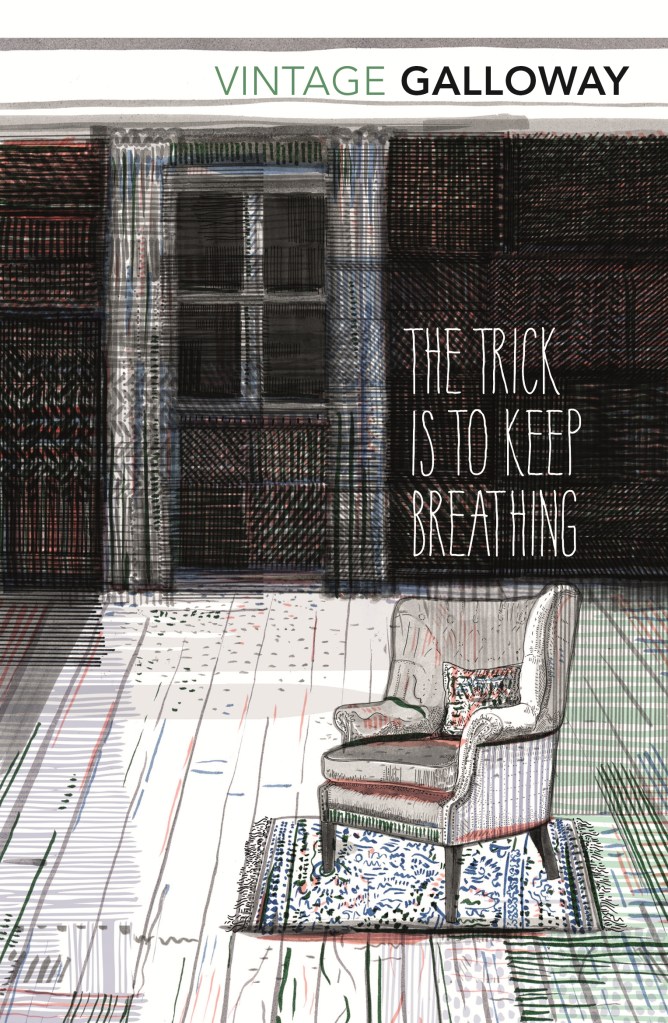
The Trick Is to Keep Breathing is a possibly-brilliant novel that I, for one, hated.
It’s a first person narration by Joy, a woman who has tipped over the edge into extreme depression and mental disorder when her married lover drowns on a holiday in Spain. At first I thought that my copy of the book, in a Penguin Vintage Classics edition, had been poorly reproduced from old film: the type is mostly dark and slightly blurred, though occasionally, apparently at random, a sentence or two is lighter and clear. There are odd blank spaces as if several lines are missing. And every now and then the margin boasts a word or a column of words, perhaps partly obscured by the gutter or running off the edge of the page. It took a while to realise all this was deliberate, a way of physicalising the state of Joy’s mind, on a continuum with the way the width of the column changes every now and then when Joy relays to us a horoscope or an advertisement from a magazine, or the type switches to italics as, bit by bit, the traumatic event in Spain is revealed.
It must be this typographic play that led the New York Times reviewer quoted on the back cover to write: ‘Resembles Tristram Shandy as rewritten by Sylvia Plath.’ I haven’t read Sylvia Plath’s novel, The Bell Jar, but a bit of unconventional typesetting doesn’t make a Tristram Shandy.
The portrayal of Joy’s unrelenting descent into darkness, starvation and disorder must be what led the judges to award it the MIND/Allen Lane Book of the Year for 1990. According to the website of ‘mental health charity’ MIND, ‘this well-established literary prize celebrates writing that heightens understanding of mental health issues in all their forms’. Elsewhere, Fay Weldon, a frequent judge, acknowledges that it is a little-known prize, and that ‘”literature” is not what concerns us here, but effectiveness, accessibility, honesty, optimism and helpfulness’. She wrote that in 2011. The judges’ desires were different in 1990, or they read the book differently from me, because I found very little optimism or helpfulness in it, and while Joy’s experience is vividly realised, I don’t think my understanding of anything is heightened.
The novel is a nightmare account of an experience of grief, anguish, disordered thinking, despair, self-starvation. The men in Joy’s life are generally sexually exploitative and/or clueless about her mental state. Her one woman friend has gone to the USA, and that friend’s well-disposed mother offers baked goods as an optimistic panacea. The doctors she encounters are unable to help, and in some cases, callously, don’t even try. If her account of her time in a mental institution is even half accurate, then the system needed to be burned to the ground: but it’s more of a darkly satirical fantasy, almost certainly with some truth but not something you’d trust as an account of anyone’s actual lived experience. For me, and I may be completely idiosyncratic here, the book came across as a kind of mental-illness porn.
At least one member of the group has signalled in advance that he loved the book. I’m open to persuasion, but only by a crack. I expect there will be discussion of the ending, which may be ambiguous, though I’m fairly clear about how I read it. I’m looking forward to the conversation.
After the meeting: Covid–19 brought restrictions to Sydney again on Wednesday, and though we were only six people and could have met legally in someone’s home, we decided to meet online.
Once we got settled in – ‘Hi, I like your beard’ ‘How did the test turn out?’ ‘Are people wearing masks in your part of town?’ – we moved on to a terrific discussion of the book.
Why it was terrific is that two completely incompatible readings of the book were aired, and the proponents of each could see that the other was coherent and justifiable from the text. It was all in how you read the tone. I guess I was at one extreme, reading the tone as something like that of Truffaut’s movie The Story of Adèle H, unremitting misery: Joy is sunk in grief and depression, goes through the motions of daily life and relationships, keeping up appearances but unable to show anyone – friends, former lovers, current sexual predators, co-workers, doctors – the depth of her despair. The chap putting forward the other extreme read it as grimly comic: through her terrible grief, Joy never loses her sense of herself, holding onto what she can of relationships and keeping with her routines as a way of staying in the world, vulnerable to predators but keeping her core self shielded from them, bantering defiantly with the useless doctors. Others were in different points along a spectrum between the two readings. No one else had read the ending as grimly as I had, and when I read the final paragraph to make my point, my opponent offered a completely valid alternative reading. I say ‘opponent’, and at one stage someone thought we were being a bit intolerant of each other, but I really don’t think that was happening: certainly I was delighted by the difference, and my respect for the book ballooned, give that it could sustain such different readings.
There was some talk about the terrible weather in Glasgow, and how what someone from tropical North Queensland (that is, me) might see as unrelentingly grim, might be seen by others (including possibly Janice Galloway) as dourly amusing. We’re reading another Scottish book for our next meeting to put that theory to the test.
Having read a little of À la recherche du temps perdu first thing most mornings for the last 22 months, I’ve reached the end. My copy of the book has suffered: not only has the print on its covers worn way as in the image to the left, but the back cover has broken free, taking the last four pages with it.
I probably should have something brilliantly perceptive to say, but nah! I’m enjoying Patrick Alexander’s translation of the whole work one tweet at a time at @ProustTweet, and seeing how much I missed by reading it with my inadequate French; and I’ll probably read Alain de Botton’s How Proust Can Change Your Life sometime soon, but if my life has been changed I can’t tell (yet).
In the final 70 pages, Marcel continues his detailed account and analysis of the currents and undercurrents of high society, of the toll taken by time on his A-listers as seen at his last matinée. When he meets Gilberte’s daughter, he realises that this young woman is like a place in a forest where many roads meet (‘les «étoiles» des carrefours‘) – so many threads of his life, so many relationships converge in her person, and through her he is able to see how different parts of his story interconnect.
But then, with hardly so much as a paragraph break, he moves on to contemplating the huge project he is about to embark on – namely this book. There are wonderful passages about his plans and expectations. Having long since lost his fear of death, he now fears it again, but now he fears it for the sake of his work, not for himself. He will write all through the night, perhaps for a thousand nights, but cannot know whether his destiny will, like Scheherazade’s sultan, allow him to live another day in order to hear the rest of a story:
Et je vivrais dans l’anxiété de ne pas savoir si le Maître de ma destinée, moins indulgent que le sultan Sheriar, le matin quand j’interromprais mon récit, voudrait bien surseoir à mon arrêt de mort et me permettrait de reprendre la suite le prochain soir.
And there’s this, about what it would mean to take on the project:
[L’écrivain] devrait préparer son livre, minutieusement, avec de perpétuels regroupements de forces, comme une offensive, le supporter comme une fatigue, l’accepter comme une règle, le construire comme une église, le suivre comme un régime, le vaincre comme un obstacle, le conquérir comme une amitié, le suralimenter comme un enfant, le créer comme un monde sans laisser de côté ces mystères qui n’ont probablement leur explication que dans d’autres mondes et dont le pressentiment est ce qui nous émeut le plus dans la vie et dans l’art.
In English:
[The writer] would have to prepare his book with meticulous care, perpetually regrouping his forces as for an offensive, to bear it as a load, to accept it as a discipline, to build it like a church, to follow it like a fitness routine, to overcome it like an obstacle, to win it like a friendship, to feed it like a child, to create it like a world, bearing in mind those mysteries which probably only have their explanation in other worlds, the sense of which is what moves us the most in life and in art.
Later, typically, he undercuts this heroic tone, saying that the project is less like building a cathedral and more like sewing a dress. He says that Françoise, his barely literate housekeeper, understands the nature of the work better than many educated, literary people.
The prospect of death hangs over the closing pages, and the knowledge that his anxiety was well founded – this volume and the preceding one were published after Proust died – intensifies the poignancy. Having lived with this book for nearly two years, if only for a couple of minutes a day, I’m now surprised to find I have an urge to start all over again. Here’s the last sentence:
Aussi, si elle m’était laissée assez longtemps pour accomplir mon œuvre, ne manquerais-je pas d’abord d’y décrire les hommes, cela dût-il les faire ressembler à des êtres monstrueux, comme occupant une place si considérable, à côté de celle si restreinte qui leur est réservée dans l’espace, une place au contraire prolongée sans mesure puisqu’ils touchent simultanément, comme des géants plongés dans les années à des époques, vécues par eux si distantes, entre lesquelles tant de jours sont venus se placer – dans le Temps.
I had serious trouble translating that, and when I looked up Stephen Hudson’s translation (here) I got the impression that he had trouble too. Here’s his (the ‘…’ in the first bit marks the omission of several phrases that aren’t in the edition I’m reading):
If at least, time enough were allotted to me to accomplish my work, I would not fail to … therein describe men, if need be, as monsters occupying a place in Time infinitely more important than the restricted one reserved for them in space, a place, on the contrary, prolonged immeasurably since, simultaneously touching widely separated years and the distant periods they have lived through—between which so many days have ranged themselves—they stand like giants immersed in Time.
I don’t think mine’s any better, but here it is:
So, if a long enough time was left to me to accomplish my work, first of all I would not fail to describe men in it, making them resemble monstrous beings that occupy a place so much more substantial than the restricted one reserved for them in space – a place, rather, that extends immeasurably because, like giants immersed in the years, they simultaneously touch all the distant periods they have lived through, between which so many days have been placed – a place in Time.
That ‘longtemps‘ at the start of this sentence reaches all the way back to the first sentence of the first novel:
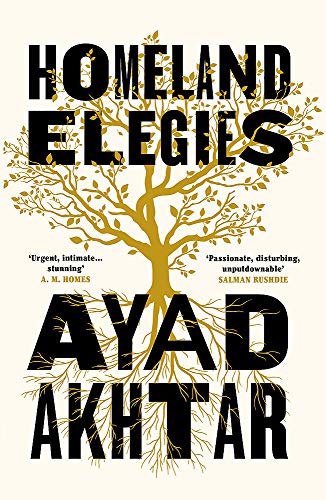
The Emerging Artist has been urging this terrific book on everyone who will listen (it was her insistence that made it jump my To Be Read queue). It’s a novel that manages to include mini-essays about politics, economics, religion, cancel culture and the art of war while telling a deeply personal story about an immigrant Pakistani Muslim family in the USA, particularly after the 11 September attacks and during the Trump era. The author has described it as literary reality TV, by which I think he means that while it follows the author’s life closely and is populated by recognisable characters from his real story, and so reads like memoir, it’s actually carefully structured fiction. The epigraph, from Alison Bechdel, gives fair warning:
I only make things up about things that have already happened …
Ayad Akhtar is a Pulitzer winning dramatist. His play Disgraced was put on by the Sydney Theatre Company in 2016, so some of my readers may know his work, but this book is my introduction. It has made me a fan.
Like Philip Roth’s The Human Stain, Homeland Elegies starts with current presidential scandals – for Roth it was Clinton’s sexual misdemeanours, for Akhtar it’s Trump’s all-round egregiousness. But where Roth forgot about Clinton and moved on to his protagonist’s own misdemeanours, Akhtar stays with Trump, or at least with his (or the narrator’s) father’s infatuation with him, and Trump remains at least an ominous background presence for the duration. In the end, the book is an exploration of the state of the US nation under Trump. I read it as a kind of elegy for the USA that has been ailing for decades and been given what may be its death blow by Trumpism (it was published before the 2020 election, but hasn’t been defanged by Biden’s election). It also includes an earlier immigrant generation’s lament for a lost homeland – hence the plural elegies of the title.
In the first pages, in a section named ‘Overture: To America’, the narrator’s university mentor remarks ‘almost offhandedly’, long before the advent of Trump or even the Tea Party, that
America had begun as a colony and that a colony it remained, that is, a place still defined by its plunder, where enrichment is paramount and civil order an afterthought. The fatherland in whose name – and for whose benefit – the predation continued was no longer a physical fatherland but a spiritual one: the American Self.
The rest of the book can be read as the narrator’s process of discovering what that means.
I may be making it sound dull and programmatic. It’s anything but. Its arguments are complex and compelling, and given to Proust-like reversals. Its characters, especially the narrator’s father, leap off the page. At the sentence level it’s alive and engaging. Take this brilliant passage about the early part of Trump’s ascendancy:
The national mood was Hobbesian: nasty, brutish, nihilistic – and no one embodied all this better than Donald Trump. Trump was no aberration or idiosyncrasy, as Mike saw it, but a reflection, a human mirror image in which to see all we’d allowed ourselves to become. Sure, you could read the man for metaphors – an unapologetically racist real estate magnate embodying the rise of white property rights; a self-absorbed idiot epitomising the rampant social self-obsession and narcissism that was making us all stupider by the day; greed and corruption so naked and endemic it could only be made sense of as the outsize expression of our own deepest desires – yes, you could read the man as if he were a symbol to be deciphered, but Mike thought it was much simpler than all that. Trump had just felt the national mood, and his particular genius was a need for attention so craven, so unrelenting, he was willing to don any and every shade of our moment’s ugliness, consequences be damned.
(page 242)
‘What oft was thought but ne’er so well expressed.’ That is, the characterisation of Donald J Trump may not be startlingly original, but this is beautifully put, and there’s a lot more of it in context. No sooner have you stopped cheering (if you’re me) for this passionate statement of a vital truth, than the narrator takes us into the sleepless night that his friend Mike’s tirade has brought on. And just in case the reader wants to cheer for Mike, it turns out that Mike makes a logical – or at least logical to him – leap to arguing that it makes sense to vote Republican. This is a book that never falls in love with its own rhetorical power. It avoids cheap shots and easy answers. In a short final section, the narrator is to give a talk at a university. At first the Muslim student organisation calls for his invitation to be rescinded because his work is ‘offensive and demeaning’, but then when someone puts up posters accusing him of being pro-terrorist, the Muslims rally to back him. He’s not implying the bogus argument, ‘I’m being attacked from both sides, so I must be right,’ but holding out for complexity, for thoughtful reading. The book as a whole repays thoughtful reading in spades.
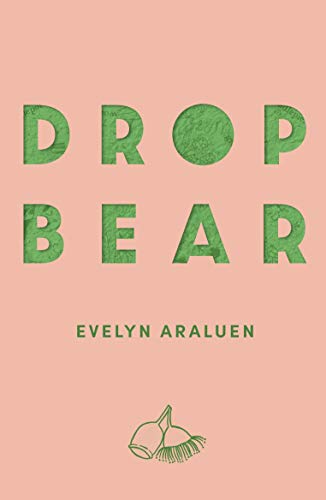
Evelyn Araluen, Dropbear (University of Queensland Press 2021)
This is a formidable book. I’d heard Evelyn Araluen read some of its poems, which she always does with a slight, dangerous smile, and was looking forward to reading them. The smile is mostly still in evidence, but the danger doesn’t feel slight. What’s endangered is any hope of emerging with Australian settler colonialist assumptions intact, or at least untroubled. In the book’s generous notes, Araluen spells out her understanding
that the material and political reality of the colonial past which Indigenous peoples inherit is also a literary one. Our resistance, therefore, must also be literary.
(page 99)
What looks like an elegantly designed slim volume of poems is actually a piece of incendiary resistance to colonial attempts at genocide and erasure, from May Gibbs’s cute bush creatures to perfunctory or self-serving acknowledgements of country, by way of a whole gallery of settler-Australian poets and poetic tropes. There are rage-fuelled mash-ups taken from widely read, familiar texts; poems whose ideal readers have PhDs in critical theory or contemporary poetics; and longer prose poems that could just as easily be categorised as essays and short stories. There are poems that turn their gaze away from the colonisers and dwell on family and the natural world.
In her conversation with Tony Birch at the Sydney Writers’ Festival My blog post is at this link), Araluen said. ‘This is not a cancel culture book.’ And that’s an important point to make. ‘For the parents’, one of the longer pieces, is in part an expression of gratitude and appreciation for her parents who read May Gibbs to her and her siblings, which when she first ‘discovered theory’ she thought meant they were ‘losing to the settlers’:
While my siblings and I consumed those stories, we were
never taught to settle for them. My parents ever pretended
these books could truly know country or culture or
me – but they had both come from circumstances in which
literacy and the access it affords was never a given. They just
wanted me to be able to read.
The acts of resistance in this book are not rants against an easily demonised foe. They involve the poet’s own inner wrestles, and bring a finely tuned, disciplined intelligence to bear on issues that lie at the heart of Australian culture. The book isn’t an easy read, especially for old white men, but it’s not hostile. Speaking as an old white man I felt it as a bracing invitation and a forthright offer of guidance and even help.
Added later: There’s an excellent discussion of Dropbear by Jeanine Leane in Sydney Review of Books, at this link. Here’s a taste:
Dropbear is blunt, biting and beautifully crafted. Although it is those things, it is more than the sum of those things. It’s a radical and timely affront to the history, the myths, the gossip and the stereotypes that still confront us all as the Country’s First Peoples.












 Me fail? I fly!