When Raimond Gaita wrote about his parents in Romulus My Father (1998), he brought his finely honed philosophical mind to the task. In Biff Ward’s long experience as a feminist activist permeates her exploration of her parents’ story, In My Mother’s Hands (Allen & Unwin 2014). The parts of Rozanna Lilley’s Do Oysters Get Bored? (UWA Publishing 2018) that deal with her famously tell-all parents can focus on her own experience, with their lives pretty much reduced to back story. Lee Whitmore, filmmaker, told the story of her grandmother in a sweeping visual drama, the comic Ada Louise: A life imagined (Susan Lane Studio 2016).
Nadia Wheatley is a historian: her The Life and Myth of Charmian Clift (HarperCollins Australia 2002) has been described as ‘one of the greatest Australian biographies’. She is also a children’s writer: her collaboration with Donna Rawlins, My Place (Walker Books 1988) was an instant classic. Her Mother’s Daughter is a work of history, and some of its key moments are told from a child’s point of view.
Neen Wheatley, nee Watkin, died in October 1958, when her only daughter Nadia was nine years old. Nadia had clear memories of her as a loving mother who became unhappy and sick, caught for too long in a painful relationship with her husband John. Though Nadia loved her mother and feared her father, she grew up being told she was like her father, and was told once, when she took a political stand that her mother’s relatives disapproved of, that her mother would have hated her. The book, as its title suggests, is an act of reclaiming her allegiance to her mother, and her deep affinity with her.
It’s a work of history. At any given moment, the reader knows the source of the story that’s being told: Nadia’s own childhood memories of her parents; things that were said about them by their family members and the family Nadia lived with after her mother’s death; interviews with women who were Neen’s friends before she married (‘the Girls’); interviews with Neen’s family, including her much loved youngest brother, whom Nadia didn’t meet until he was 89; interviews with John’s surviving relatives; Neen’s wartime correspondence, and a detailed journal of her time working for the UNRRA after the war; official records of the displaced persons camps in Germany where John and Neen had positions of great responsibility, and where they met and fell in love; Neen’s medical records from her final years.
This historical discipline is at the service of a passionate quest to reclaim her mother from oblivion. When Wheatley discovers that Neen, whom she had been told was bitterly anti-Communist, used to go to shows at the left-wing New Theatre when young, her joy at the discovery is only partly that of a historian finding evidence of a counter-narrative; it’s also the joy of getting her mother back. Likewise, when she finds evidence that her father behaved unethically during his early years as a doctor in England, it comes as confirmation of what she knows of him from the domestic experience.
The book is in four sections with self-explanatory titles.: ‘Neen’, ‘Nina and John’, ‘Nina, John and Nadia’, and ‘Nadia’. Wheatley’s craft as a writer for children shines in the third part and in a brief prologue. In both of these the young Nadia has conversations with both her parents separately, and is used as a pawn in her father’s relentless undermining of her mother. The little girl’s passionate attachment to her mother, her helpless yielding to her father’s manipulations, her bewilderment at her mother’s death are all captured with great poignancy. The father’s repeated question when he is showing her hideous images of human suffering, ‘Do you understand, Nadia?’ is as horrific as any fairytale witch’s incantation.
I found this book deeply affecting. I learned a lot about the role Australians played in post-war Europe. I was reminded how resistant to evidence sexist assumptions can be – in this case in the medical profession. I remembered my own enjoyment of the Tintookies, a puppet show that I saw in North Queensland and Nadia in Sydney. I had my eyes opened to just how inexplicably vile adults can be to small children. I am in awe of the discipline that could wrangle such pain and loss and love into such an effective narrative.
Her Mother’s Daughter is the twenty-sixth book I’ve read for the 2019 Australian Women Writers Challenge.
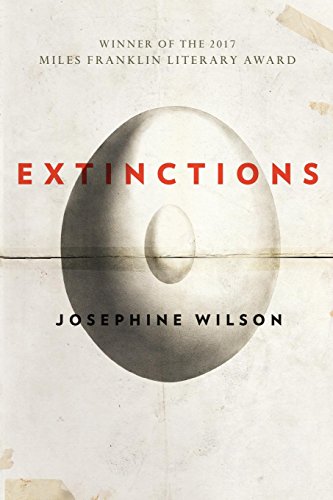
Before the meeting:Extinctions won the 2017 Miles Franklin Award, and has been widely well received. I hated it.
I realised how much I was hating it when on page 16 the main character, grumpy and defensive seventyish white man Frederick Lothian, describes a piece of knitting as ‘abandoned in medias res‘: my inner pedant came out all guns blazing. That’s syntactically incorrect, it shouted: in medias res doesn’t mean ‘in the middle of things’, as Frederick (who has been studying Latin) and presumably the author think, but ‘into the middle of things’ – you can’t abandon something into something. I was being unfair: it’s a genuinely trivial matter and anyhow English usage has long since left the Latin behind. If I’d been enjoying the book, even moderately, I wouldn’t have noticed.
Out of respect for the Book Group, the Miles Franklin judges (though we shouldn’t forget The Hand That Signed the Paper), and otherwise trustworthy bloggers (see here for Whispering Gums, here for ANZ LitLovers, and here for The Resident Judge of Port Phillip), I persisted.
There are a lovely couple of sentences on page 164:
Some young lads were tossing a Frisbee, diving after it and landing heavily in the sand. They came up laughing and dusting off their legs, A thin, stringy boy with a head of dark hair and a little nub of fluff under his lip leapt sideways and missed. He met the ground not as you would meet an adversary – hardened and eager to hurt – but like a member of the family who had been gone just a little too long: a quick embrace, an easier release.
And in the final movement there’s a scene of genuine power in which a father slaps his tiny son.
I mention those moments for two reasons: first to prove that I did read on, and second to demonstrate that I wasn’t committed to hating the book. But committed or not, I did hate it. I really I don’t want to spend time spelling out why, though a number of my friends have put up with rants and readings-aloud. enough to say that it seemed to me at one stage that you could pick a passage at random and I’d hate something in the content or the expression. If you want to know more about the book, I recommend any of the blogs I’ve linked to above. They’re not written by defensive and grumpy old white men and may be more dependable than mine.
At the meeting: I arrived intending to keep my mouth shut because there’s nothing worse than having someone spraying vitriol at a book you’ve just read and loved, and I was trying to be open to the possibility that the book is actually OK, but just sparked/triggered something in me. (Another chap from the book had told me a couple of weeks before the meeting that he too had hated the book – it had made him unaccountably angry. Being morally superior to me, he reread it. I was looking forward to what he had to say at the meeting.)
We did spend an unusual amount of time discussing the food (which was excellent – everyone had bought something), the recent election result, and the rights and wrongs of a Sydney multi-millionaire sporting celebrity who broke a contractual undertaking not to speak ill of LGBTQI people and lost his job because of it. But we also had a spirited, amiable and enlightening conversation about the book.
I didn’t succeed in keeping my mouth shut for long, and my friend who had been made unaccountably angry didn’t say much more than that the book didn’t make him angry the second time. A couple of people had enjoyed it a lot (though one who had really loved it couldn’t be there, alas). No one hated it as much as I did, and I did get called a grumpy old man in a tone that suggested I identified defensively with Frederick (a charge I don’t absolutely deny).
The architects and modernist design aficionados among us enjoyed the presence of those elements, including the illustrations scattered throughout. No one could tell me what these photos added, except that they pleasantly broke up the pages of text. Clearly, though, the book had stuck a chord in some, as a number of members spoke in a heartfelt way of how adoption, old-people’s homes, work-family balance had figured in their lives. Oddly, I felt that the plot tensions were satisfactorily resolved in the final stages, whereas some people who liked the book were left dissatisfied. I was the only one who read out a passage – the one quoted above – though one chap read out a number of phrases that he considered beautifully turned (I didn’t, but there’s no point arguing about such things).
Extinctions is the twenty-fifth book I’ve read for the 2019 Australian Women Writers Challenge. My copy was a library book.
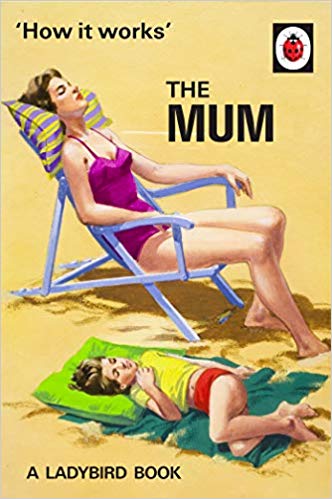
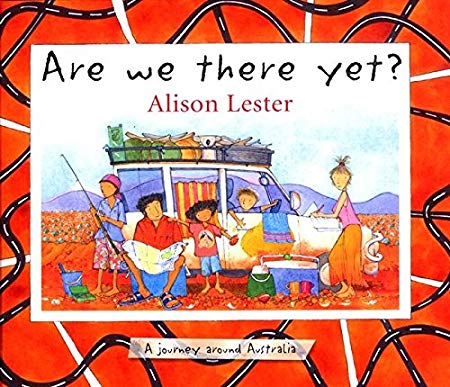
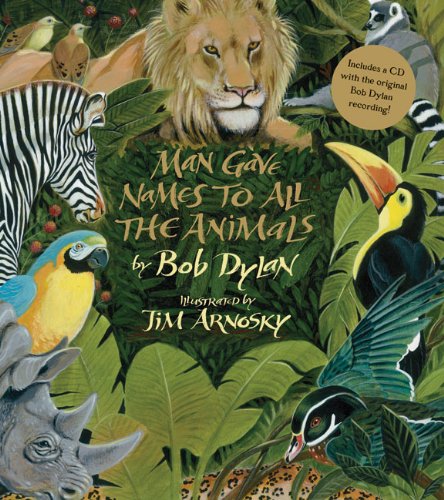
On the weekend I went to a family gathering – not a reunion, but a first-time gathering of the descendants of three Shaw brothers who came to Australia from Yorkshire in the 1860s and 70s. The event itself was fun and interesting, with at least one revelation that led to much hilarity, but what’s relevant to this blog is that I stayed with a niece, mother of two small girls. Here’s a) a book I read while stickybeaking on her bookshelves, and b) two books that were requested at bedtime. You’ll be able to tell which is which.
This is one of those books that sit on the front counters of bookshops inviting you to buy them as gifts. It’s a parody of a Little Golden Book (or Ladybird Book in the US UK (see Robert Day’s comment) edition as pictured here), using illustrations from 1960s children’s books and affecting a childlike tone in the text, but with an adult sting in the tail. This one is funny rather than cynical, wry rather than bitter. My niece’s favourite page is the one where the mum has an interview for a job but can’t get the theme tune from The Octonauts out of her head. Mine is the last page, where the mum rides her bike to work after an exhausting night and when she hears other mothers speak of their children’s exemplary behaviour is fortunately too tired to kill them.
At the end, there’s a sweet acknowledgement of the pleasure the authors derived from the original books, which reads as a sincere tribute rather than a legal requirement. The artists are listed, but I didn’t make a note of their names.
A family of five go on a trip around Australia in 32 pages. The refrain ‘Are we there yet?’ is irregular enough not to be annoying, but frequent enough that my seven year old great-niece could join me in saying it each time.
Regular readers will know that my main contact with children’s books these days is thanks to my 18 month old granddaughter. This book is a reminder of past reading pleasures and a sweet harbinger of things to come. Alison Lester’s images are completely beguiling.
This is a rare thing, a picture book with Bob Dylan lyrics as the text. The song is from the 1979 album Slow Train Coming, from BD’s born-again Christian era. It was hard to tell if my young relatives (who were not only sleepy but also slightly anxious at being read to by a virtual stranger) enjoyed it very much. But the illustrations are gorgeous, every page crowded with splendid animals, many more than are mentioned in the song. The book comes with a CD attached – our copy was from the library, and the CD-less.
I may be a feminist Climate Crisis prig, but front and centre for me was the title’s erasure of female humans and its assertion of human separateness from ‘all the animals’, both of which made it hard for me to love the book or the song.
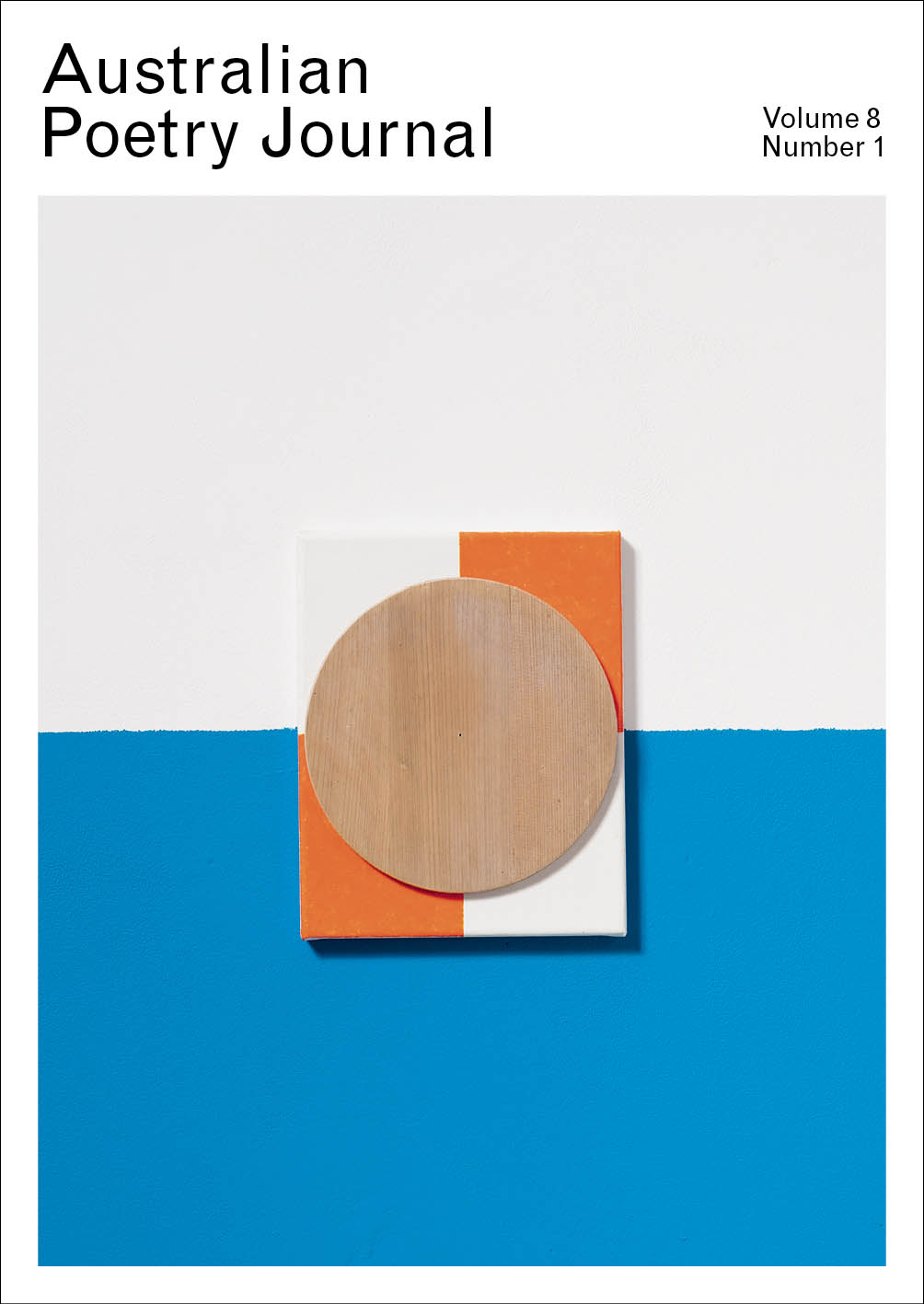
I just realised with something like horror that my To Be Read shelf contains at least a year’s worth of unread journals. So here goes with what I intend to be the first of several catch-up posts, each following a catch-up reading binge.
In her Foreword to this issue of APJ, guest editor Gig Ryan, herself a formidable poet, writes:
No poems here can be straitjacketed entirely into any one category, as each poem, being its own summation, is also necessarily an experiment, an exploration, kicking towards the impossible.
The same is true of the journal as a whole. It’s not a directory, a survey or a sampler; there are no thematically labelled sections, or indicators of hierarchy. It reads like a mildly chaotic conversation among more than fifty word users, which the reader is invited to enter.
There are many excellent poems, some by poets I already know and love, some by people who are new to me. I’ll just mention one that has stuck with me: Andy Jackson’s ‘No Lament’, which is a response to Judith Beveridge’s sonnet, ‘Quasimodo’s Lament’. The latter poem looks at Quasimodo (‘The Hunchback of Notre Dame’) from the point of view of an able-bodied person, the former from that of someone with a physical ‘deformity’. Each line of Jackson’s poem begins with the first word of the equivalent line in the Beveridge’s. It’s not a calling out, but a ‘departure’, and the effect is to open up a profound dialogue between the two points of view. Here are the first four lines of each:
From Judith Beveridge’s poem:
Crazed carillonneur, will you ever stop hauling
yourself into the cathedral’s dim vaults?
Will you ever stop imagining Esmeralda’s hands
running along the canted bones of your spine
(from 'Quasimodo's Lament', Meanjin 2017, on the web here)
From Andy Jackson’s ‘No Lament’:
Crazed? – only the mob in us deserves that word.
Your self, your body, calm and attentive at the rope,
will always draw out those strong and slanted notes
running across every imperfect surface.
There are half a dozen essays, including an interview by Matthew Hall with the editors of Lionel Fogarty Selected Poems1980–2017 (re.press 2017), which is surely of interest to anyone who cares about contemporary Aboriginal poetry. There’s also an essay by Duncan Hose on John Forbes, marking the 20th anniversary of his death, which includes some close reading; and a discussion of rhyme by Dennis Haskell.
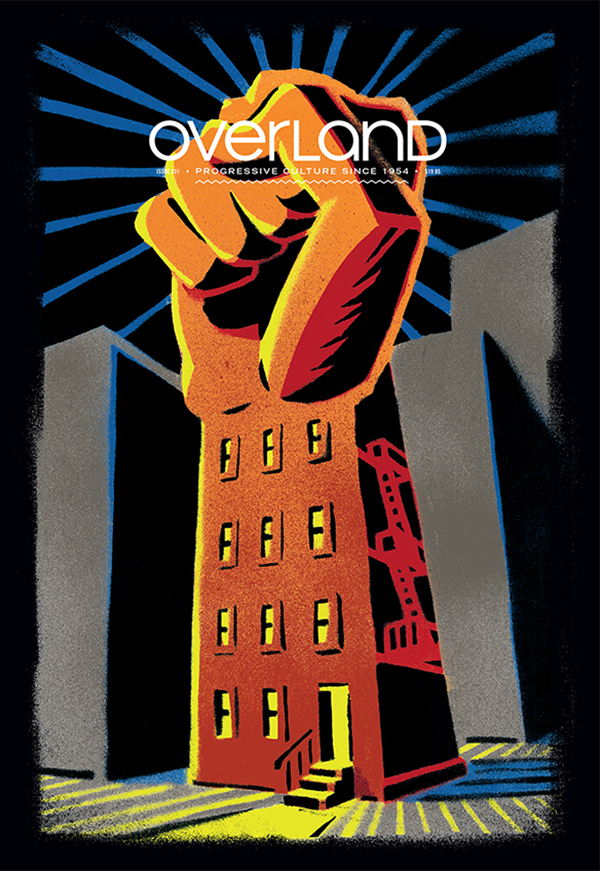
I read this Overland selectively, skipping articles that looked at first blush to be about where the universities are getting it wrong, or arguing that, say, the marriage equality Yes movement wasn’t radical enough. So who knows what I have missed?
Here are some wonderful things I didn’t miss:
In ‘On Jack Charles‘, Tony Birch writes that for Aboriginal people, ‘sovereignty – an imposed colonial concept – is a complex and contradictory notion’, and as a way to understanding what Aboriginal sovereignty might mean quotes Jack Charles as saying that ‘he could not walk by a person in need – any person in need – as an Aboriginal man claiming the right to Country’. It’s not often you stumble across such profundity.
I wouldn’t want to skip the regular columns by Alison Croggon (On seeing in this issue starts from her extreme myopia and goes to surprising places) and Giovanni Tiso (On writing while foreign: ‘the effortless travel of our writings across the global marketplace of late capitalism is the grotesque mirror image of the hardening of the boundaries between nations and people’).
Overland always includes the result of a literary competition. In this one, it’s the Nakata Brophy Prize for young Indigenous writers. The first prize, ‘haunted house‘ by Raelee Lancaster, counterposes two traditions (European and Indigenous) of ghost stories in a way that creates vertiginous depths beneath an apparently simple surface.
There are other excellent poems, including Allotment #10, by Laurie Duggan, an addition a long-running series.
Decades ago, a flatmate of mine had a poster on his wall that compared the situation of Aboriginal people living in remote communities with that of Palestinians. ‘So much like home‘ by Chris Graham spells out the parallels: things have not improved markedly for either group. ‘Israel,’ Graham writes, ‘ has built a blunt, overt system of apartheid; Australia has built a polite, covert system of apartheid.’
Of the four short stories, the two that most claimed my attention both dealt with the ethical questions that arise when you mistakenly give something you have no right to. Baggage claim by Paddy O’Reilly and Tea ceremony by Michelle Aung Thin both this murky area, the former with youthful corruptibility in its sights, the latter with something more nuanced but no less grim.
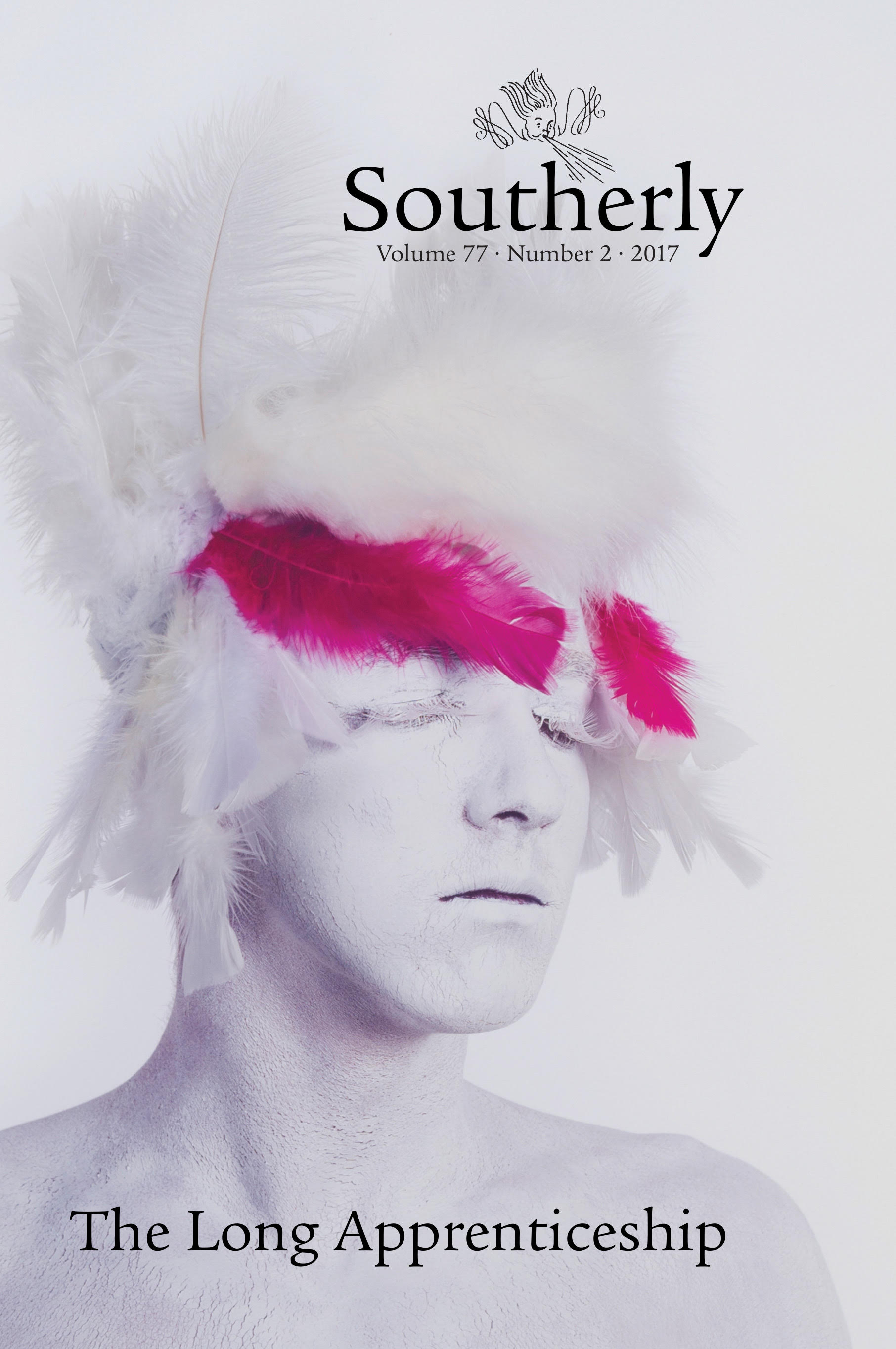
Southerly is the journal of the English Association, Sydney, which means it’s formally tied to EngLit academia. Given that, and the title of this issue it’s no surprise that there are a number of essays and fictions here about the long haul of learning to write, or just the long haul of life:
Desmond O’Grady on Muriel Spark’s nurturing times in Tuscany as a young woman
Elizabeth Hanscombe on how her writing career has been spent exploring events from the past that ‘appear to have a beginning and an end’ (‘They do not’)
Carol Lefevre on the nature writer J A Baker and his influence on her own career, quoting Richard Jefferies somewhere on the way, ‘The earth is all in all to me, but I am nothing to the earth: it is bitter to know this before you are dead’
James Bedford’s touching memoir of his father, with beautifully deployed family snapshots.
There are works from people at the start of their creative careers. The striking cover is a detail from My Contemporary Tribe, created by Phoebe Martyr when she was a high school student in 2016 (you can see the whole work here). There are three short stories by students at the Sydney Story Factory.
There’s a glorious wealth of poetry and short fiction, including some in translation. George Toseki’s ‘Finger Bun’, in which baklava is deployed to great effect as a peacemaker among factory workers from a range of ethnic backgrounds, gets my guernsey for the most fun. Invidious though it is, I’ll mention just one poem, joanne burns’s ‘lemon aid’ for the fabulous word comatoastie.
Of the reviews, I’d pick Lachlan Brown’s of Melanie Cheng, Australia Day (2017), which places the book in the context of ‘the contemporary succession of engaging and innovative collections of short stories by Australian writers from diverse backgrounds’.
The most challenging article for me is John Kinsella’s ‘Reading and (non) Compliance: Re-approaching the Text’, which – to attempt a crude summary – urges EngLit teachers to always incorporate creative writing into any teaching of poetry, by encouraging what he calls non-compliant reading. Not being part of the EngLit academy, I can’t tell whether his proposal is as radical as he appears to be claiming, or commonplace, or way out in the top paddock. One paragraph, though, came to me like a clarion call, an urgent challenge for me as a blogger about texts. I’ll give it the last word in this blog post:
A text is a living entity and should be teated as existing contingently and contiguously within and with a vulnerable ecology that is under threat, a biosphere that is collapsing due in no small part to human behaviours – especially corporate and state exploitations of the fragile, remaining ‘natural’ habitats. No text, whatever it is, can be read outside this context of damage.
Last week I in bed with a fever and had the great pleasure of hearing in the next rook the Emerging Artist and the Granddaughter enjoy Rosie’s Walk together, maybe ten times in a row. So much squeaking and screaming and sheer exuberance! (Note to the Ramsey Centre: please consider Rosie’s Walk for your curriculum. It is one of the great achievements of Western Civilisation.) But that book has had its moment in this blog. Here are some new books, all of which were read to us at the library’s Rhyme Time:
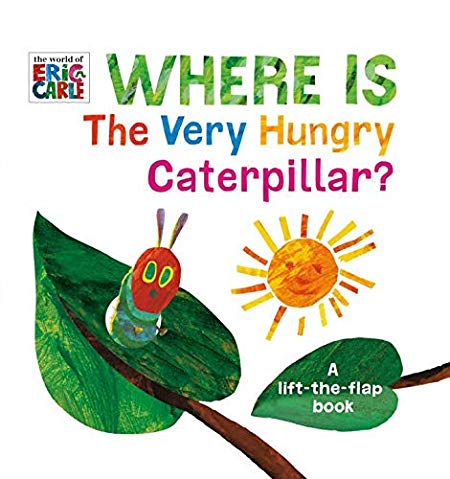
The Very Hungry Caterpillar, it turns out, isn’t so much a book as a commercial phenomenon. These books, read to us on separate occasions, have a comfortingly familiar feel. Sadly, though, the existence of these and (I gather from the internet) other sequels/spin-offs somehow takes the shne off the original book (my blog post here).
Though the cover of this book announces that it is a ‘pop-up book of colour’, I was surprised and delighted by its only pop-up spread. Lucy sees a butterfly in the garden one day, and then it is gone. She spends most of the book discovering other colourful creatures, and in the end, failing to find the butterfly again, lies down and waits. Then, in the book’s final spread, there’s a wonderfully theatrical moment. You can see it for yourself on YouTube (here)
The librarian prefaced her reading of this by saying it was for the parents and grandparents rather than the children. It’s a scatological variation on the theme of Maurice Sendak’s sublime Pierre (my blog post here): the little rabbit replies ‘Poo bum’ to every conversational opening. After surviving a terrible event, he (or she) undergoes a miraculous transformation, conversing with courtesy and a rich vocabulary. There’s a lamentable relapse at the end. The librarian closed the book and sighed, ‘I love a bit of lavatorial humour.’
I was relieved to note that it’s a New Zealand title, so I don’t have to include it in my list of books read for the 2019 Australian Women Writers Challenge.
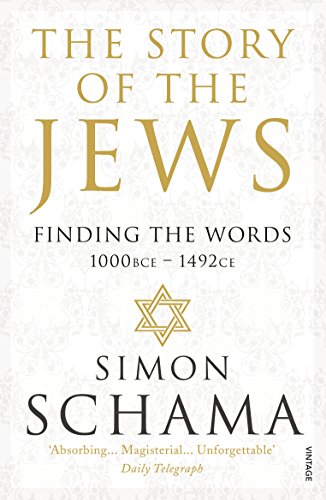
Some decades ago, I borrowed a book called The History of the Jews from a friend, and was disappointed to find that it was little more than a smoothing out of the Biblical stories. As far as its author was concerned, it seemed, you didn’t need to go past the Hebrew Bible (the ‘Old Testament’) to get the history up to the beginning of the current era.
Simon Schama’s book is the one I was hoping for back then. The Hebrew Bible, he writes, is not primarily history, but
the imprint of the Jewish mind, the picture of its imagined origins and ancestry; it is the epic of the YHWH treaty-covenant with Israel, the single formless God moving through history, as well as the original treasure of its spiritual imagination.
(page 7)
Schama’s story doesn’t begin with Abraham leaving Ur, or even with Moses leading his people from Egypt. Schama isn’t confident that the exodus from Egypt even happened. It begins with the documented beginning of ordinary Jews, the earliest Jewish city that archaeologists have been able to reconstruct, on the island of Elephantine in Egypt, in the early 5th century BCE, hundreds of years after the Biblical account of the exodus. And although that city was a military outpost – Jewish soldiers employed by the Syrian empire – the book begins not with a battle or any grand scheme, but with a letter from a father to his soldier son.
Though the book’s title promises ‘The Story’, Schama insists from the beginning that there’s more than one story: the Biblical story and the archaeological story; Jerusalemite stories and stories of communities in exile; stories of those who integrate with their non-Jewish neighbours – Babylonian, Egyptian, Christian, Muslim – and of those who insist on rigorous separateness; stories of brilliant intellectual and spiritual achievement and stories of unimaginable horror (and this book ends in 1492).
I spent my first two decades in an intensely Catholic environment, so the account of Christianity’s transformation from a Jewish sect to a demonically anti-Jewish institution is particularly gripping to me. Cherie R Brown and Amy Leos-Urbel’s Anti-Semitism asserts that religion is not the cause of anti-semitism, but has been used as a tool to foment it. I think that makes sense, but reading how John Chrysostom, revered father of the church, preached vile slander and murderous injunctions against Jews (evidently thinking it was necessary because a lot of Christians in the 380s happily participated in Jewish festivals), tests the proposition. And my childhood image of St Francis preaching to the birds must now be accompanied by that of his Franciscan friars torturing and murdering men, women and children who refused to renounce Judaism, and many who had renounced it but continued to eat their customary food.
But the terrible history of humiliation and massacre is not the main story here. Again and again, Schama gives us stories of brilliant survival. The Talmud and the mishnah – tumultuous documents filled with wisdom, argument and disputation – grew in a state of exile. And before them, the Hebrew Bible itself was an extraordinary creation. A roll call of the people in this book who did great things would be very long: administrators, generals, poets – why haven’t I ever heard of Shmuel ibn Naghrela or Yehuda Halevi?
One small warning: I’m pretty knowledgable about Biblical stuff, have a smattering of mediaeval history, and some knowledge of current Judaic feasts. There were times when I found it hard to keep my bearings in the tumult of this story. So it may not a good place to start. If you don’t know who Moses is, or you’ve never heard of Purim, you might need something more straightforward, and move on to this when you’re ready.
Speaking with Paul Holdengräber at the 2019 Sydney Writers’ Festival, Simon Schama spoke of the heroism of the displaced. I don’t think the phrase occurs in this book, but it could have. His main subject at the SWF was the second volume of this story. You can hear that wonderfully entertaining conversation by clicking here, and my blog report on it here. He is now girding his loins for the third volume, which brings us through the twentieth century up to the present.
Ruby hasn’t been terribly interested in reading for a while, at least when she’s with her grandparents. Too many competing interests, like bubbles, ramps, putting tiny dolls in bags and taking them out again, hunting for kookaburras, people watching … the list goes on. Three of the books in this post have been read to us at library Rhyme Time. Only one has been requested (or, to be more accurate, demanded repeatedly) at home.
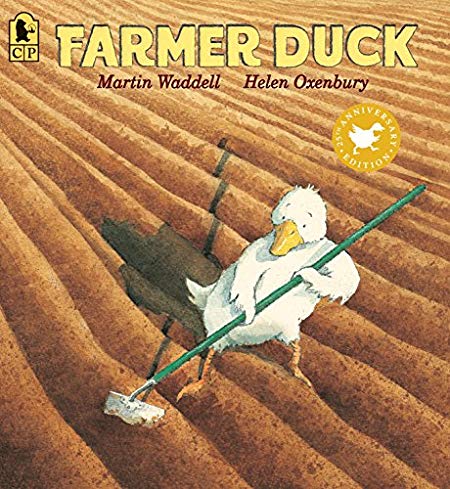
Martin Waddell and Helen Oxenbury, Farmer Duck (Walker Books 1992)
This was read to us, rather poorly if the truth be told, at Rhyme Time at a different library from our usual. The duck works for a lazy farmer, who lies around all day and every now and then asks how the work is going. The poor duck looks up from one of his many tasks and reports that it’s going well. Soon the duck is exhausted. The other animals have a meeting, whose conclusion is ‘Moo’, ‘Oink’, ‘Cluck’. Translated into action, this leads to the ejection of the farmer from his bed and from the farm, and the work being taken over by a collective of animals. This is a cheerfully nonsensical tale of socialist revolution and workers’ control. Text and images triumphantly transcended the circumstances in which we encountered them.
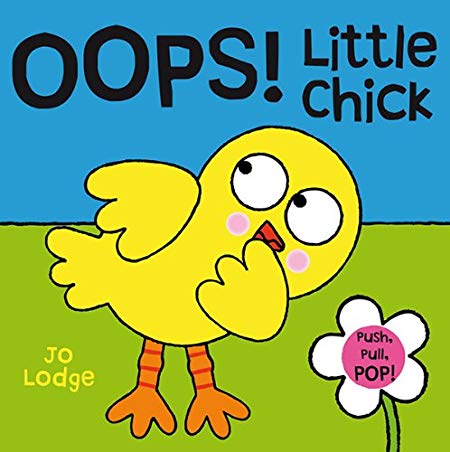
Jo Lodge, Oops! Little Chick (Push, Pull Pop! Books, B E S Publishing 2013)
It’s tempting to say this was the opposite experience: an almost nothing book read to us with enormous charm and enthusiasm. But really, the book is an unassuming but perfect piece of paper engineering. The high point, hinted at in the colour illustration, is the page where you pull a tab and a little splat of yellow business appears on the ground behind the little chick. Our excellent librarian returned to that page a couple of time.
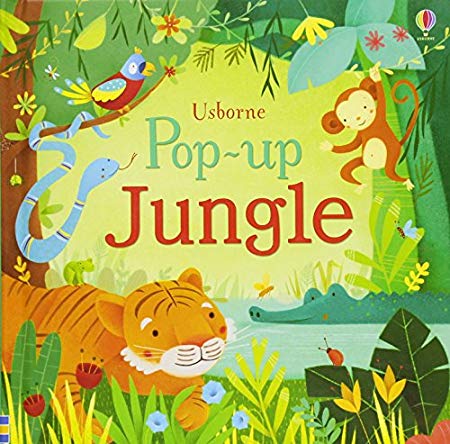
Fiona Watt and Alessandra Psacharopulo, Pop-Up Jungle Book (Usborne 2015)
More paper engineering. This one, which is much more elaborate, goes on a walk through the jungle where tails swish, jaws snap, etc, activated just by turning the page. One small child (the program is for children younger than two) was so enthralled, she wandered from her mother’s lap as if hypnotised to stand almost within touching distance. Speak not too lightly of pop-up book creators, they are the unacknowledged formers of young minds. (There’s a YouTube of this book: here.)
This board book is one of the :Llama Llama series. The other one I know is about Llama Llama Red Pyjama at bed time. In this one the protagonist (I’m avoiding saying ‘he’, because the character could be female) has fourteen pages of vigorous, onomatopoeic activity. Something about it appeals hugely to the almost-eighteen-month-old in my life. Just yesterday she returned to it with a vengeance. And I confess to enjoying its wonderful minimalist storytelling, and finely judged rhyme. I just read on wikipedia that all Anna Dewdney’s Llama Llama Red Pyjama books have been New York Times best sellers. [Added later: The Emerging Artist wants me to acknowledge that she is the definitively preferred reader of this book.]
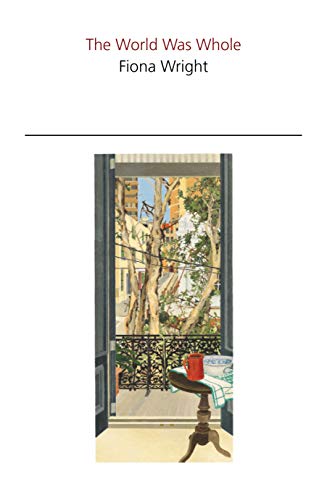
[Added later: If you read only one article on this book, I recommend Ashley Kalagian Blunt’s brilliant essay ‘Comfortable and Comforted: The World Was Whole by Fiona Wright’ in Sydney Review of Books (click here) rather than mine. Of course, I’d be happy for you to read both.]
This is Fiona Wright’s second book of personal essays. At the Sydney Writers’ Festival earlier this year, she said the first book, Small Acts of Disappearance, was about extremes, particularly those brought on by her severe health issues, and this book is about the ordinary, and how the ordinary must be negotiated by someone whose health is (still) fragile. It’s a very good description.
The essays are beautifully written, combining personal detail, literary reference and information about the social and historical contexts. They revolve around three main things.
First is the experience of chronic illness. Fiona Wright lives with a rare and complex digestive disorder, which gave rise to behavioural difficulties. Dealings with dietitians, psychologists, hospitals and the mental health system feature prominently, and there’s a revelatory quality to her recounting of the micro-moments she has to negotiate as a person for whom eating is always problematic. One example at random: in ‘Back to Cronulla’ she has a meal with her family to celebrate her parents’ wedding anniversary, course after course of beautifully plated dishes:
It was beautiful food, truly and terribly wonderful – because for once I actually felt like I was missing out. I was cautious with my meal, aware than any of these dishes might make me throw up, and eventually something did. I left the three-hour-long lunch feeling hungry, and wound tight with anxiety and disappointment. My oldest niece, bored at one point with the meal, had asked her mother, why are we eating so much food for lunch? and all the adults had chuckled, out of the mouths of babes! But oh, I wanted to say, I know exactly what you mean.
(page 41)
The second recurring subject is home, as housing and as locality, home that is never the stable, warm reliable nest of stereotype, but home that is uncomfortable, and sometimes precarious. Born and raised in Sydney’s Western suburbs, Wright now lives in the Inner West, and one of the beauties of the book is the way these places, and others such as Cronulla, come alive on the page. In particular, even while she makes it very clear that she doesn’t feel completely at home in her current suburb of Newtown any more than she did in her childhood suburb, her love for it is tangible, and never more so than in this account of the Newtown Festival:
The street itself was thronged and milling. A beautiful young woman with a shaved head and silver glitter pressed onto her eyelids placed a sticker in the shape of a heart onto my chest. I ran into one of my housemates in the park, an old colleague and then the girlfriend of a woman I used to live with; a little further on, I saw one of the nurses from the hospital, although it took me a moment to place her properly, dressed in denim and wearing jewellery, rather than navy-blue scrubs and a duress alarm.
Later, I met a friend in a café on King Street, and the barista said, we haven’t seen you for a while, and reached for the skim milk before I’d even had a chance to speak. I used to bristle when this happened, when a waiter or bartender asked if (or assumed that) I wanted my usual, it used to embarrass me acutely, because I didn’t want anybody else to recognise how predictable, habitual, routine I could not help but be. It seemed to be a failing and a fault, but in this afternoon, all afternoon, I felt it as a recognition of my place, of my home and my inextricability, almost, within it.
(‘Relaxed, Even Resigned’)
There’s a lot about the joys and tribulations of shared rented houses. ‘Perhaps This One Will Be My Last Share House’ – the title says it all – casts a cool eye on the process of being evicted, finding new housemates and searching for a new house. It’s personal, but it’s worth a hundred newspaper articles about the housing problems facing young people in Sydney (and many other cities).
The third thing, not so much a theme or a subject as a practice, is attention to moments. In the Correspondence section of the current Quarterly Essay, responding to Sebastian Smee’s Net Loss, Fiona Wright has a piece that pretty much starts out:
I am a millennial, and this response will probably seem solipsistic, and it will be fragmentary. It’s not that I can’t help it. It’s not my attention span, my inherent narcissism. I’m just making a point.
A number of the essays here are fragmentary – congeries (a word my high school Latin teacher used to love throwing at us) of moments, observations, eavesdrops, beautifully chosen quotations from other writers. Only an inattentive reader would think they were solipsistic or narcissistic. And they do have a point, though not one that is argued for as if in a debate.
A woman about my age sits at the next café table with someone I take to be her mother, slung beneath a bag as enormous and as orange as a pumpkin. The older woman says to the waitress, I’ve quit sugar so I’ll just have a chocolate croissant.
(‘What It Means for Spring to Come’)
I catch a train into the city, in the late afternoon, and hear a young woman’s voice somewhere behind me: it smells of seaweed in here.
(”The everyday Injuries’)
There are two marvellous travel pieces – Iceland in ‘A Regular Choreography’ and China in ‘Little Heart’ – which combine all three of those features. By its nature, travel imposes extra stress on vulnerable bodies and minds, raises issues of home and belonging, and is disjointed and fragmentary.
The collection’s title, and the title of one of the essays – ‘The world was whole always’ – come from the poem ‘Aubade’ by US poet Louise Glück (click here for the whole poem):
A room with a chair, a window.
A small window, filled with the patterns light makes.
In its emptiness the world

was whole always, not
a chip of something, with
the self at the centre.
I stumbled across another of Glück’s poems, ‘Formaggio’ (on a pdf file here), which includes the book’s title, though without the ‘always’ of the essay. It begins:
The world
was whole because
it shattered. When it shattered,
then we knew what it was.
These lines could have served as an epigraph to the whole book. One way or another, the essays are about being shattered, or its aftermath: precarious housing, chronic illness, life away from the security and predictability of the family of origin. The writing is a way of understanding, of knowing what it is.
The book hit a number of personal spots for me: I live on the edge of Newtown and recognise many of the places mentioned; it’s a while ago but I’ve lived in a number of share houses; there’s a discussion of one of the few Chinese poems I’ve tried to engage with intimately (here if you’re interested); and I’ve recently become aware that though the Intergovernmental Panel on Climate Change has warned that we have 12 years to prevent irreversible and calamitous damage, yet I go on pretty much as before, so I was struck by this:
So much of our lives we cannot control, especially in an environment of unspecified global threat, imminent global disaster, increasing workplace uncertainty, but within the boundaries of a home (four brick walls, a fence) we can fixate on the little things, and we can fix them.
This is also exactly how anorexia works.
(‘To Run Away from Home’)
Oh!
The World Was Whole is the twenty-third book I’ve read for the 2019 Australian Women Writers Challenge. I am grateful to Giramondo for my copy.
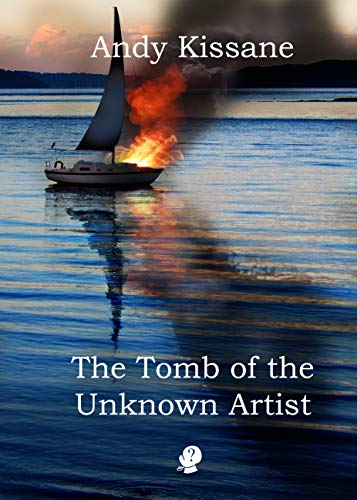
Here I go, blogging about a third book of poetry in a row. But, Dear Poetryphobe Reader, there’s nothing to fear. This one, like the last two I blogged about, is really good. Andy Kissane writes the kind of poetry that allows you to focus happily on the content and leave the poetic stuff to do its work while you’re distracted (like T S Eliot’s burglar tossing meat to the dog*). I think of him as a poet committed to bearing witness.
The book is in four unnamed sections, each with an epigraph suggesting its organising principle.
The first section’s epigraph is from Sharon Olds’s poem about her father’s death, ‘The Race’: ‘all night / I watched him breathe.’ The poems that follow deal with death and loss, and with being alive, though they’re not as abstract as that makes them sound. The poet contemplates his own death. He farewells his father:
------------------------- -----------Somewhere
in my own marrow lies the moment
when you fathered me, that unacknowledged
gift.
('The Last Quarter')
He has a polite encounter with an old lover, and celebrates quiet moments of domesticity and parenthood. Among these poems, almost as if warning the reader not to read the others as directly autobiographical, there are two dramatic monologues, ‘Marriage Material’, spoken by a 19th century bride, and ‘Dressed’, spoken by a young woman of now (‘Desire is pure, as clear as water, and shame – / well, you just don’t feel any’).
The second section is heralded by a quote from Hannah Arendt’s Eichmann in Jerusalem: ‘One man will always be left alive to tell the story.’ Arendt was talking about the impossibility of ‘oblivion’: everything will be remembered by someone. As I read it, the central thread of this section is the idea of witness: to a concert or a movie, to plagiarism, to some of the great horrors of our time including Australia’s offshore prisons, and, closer to home, to a Sydney storm and schoolyard bullying (of which more later).
The third section is a sequence of ten poems set in the US–Vietnam War, all in the voice of an Australian (or possibly US) soldier, introduced by a quote from Tim O’Brien’s 1990 short fiction ‘How to Tell a True War Story’: ‘You can tell a true war story by the way it never seems to end.’ The sequence doesn’t tell a single straightforward story, but a narrative shape emerges from individual scenes involving the narrator and his comrades Dave, Des, Johnno, and Boffa.
Des appears beside you, his thumb
hauling you in the direction of safety.
You hoist your pack & crabwalk
after him, before a monsoon
of mortar shells drop right there –
on the piece of dirt where you were
lying ...
(from 'The Firefight')
It’s in the lineage of The Red Badge of Courage, has all the power and none of the insidious cinematic glamour of many ‘anti-war’ movies. I read somewhere that these poems are part of a verse novel in progress. If so, I’m looking forward to the novel, but this sequence doesn’t leave me with any of the cheated feeling that comes from reading an excerpt. The final poem, the sonnet ‘Back Home’, rounds the sequence off, not with an ending, but as an agonised cry about the lack of comprehension from even sympathetic non-combatants. Perhaps because I went to court as a conscientious objector for the US–Vietnam War, I needed a long walk after reading these poems.
The final section, ushered in with a quote from Michelangelo – ‘I saw the angel in the marble and carved until I set him free’ – deals with visual art and sculpture, referring to work by Cressida Campbell, Grayson Perry (the title poem is a response to Perry’s The Tomb of the Unknown Craftsman, 2011), Degas (spoken in the collective voice of his nudes), Cézanne, Jan Senbergs, and Kissane himself imagined as a painter.
It’s not easy to choose just one poem to discuss from this marvellously varied collection, but my mind keeps going back to ‘Shooting Footage’, from Section 2. It’s longish, but it’s got a story (click on the image to see it in a separate tab, then you may have to click again to see it big):
The Acknowledgements section gives no extra information about this poem, so it’s anyone’s guess whether the incident it describes is a fiction or taken from life. It would be a mistake, either way, to just assume that the speaker is the poet. There’s plenty to make me think that it’s not so, although he may be the poet at one remove – working with images rather than words. (For the sake of discussion, I’m going to assume that he’s male, even though a woman filming in a school playground would generally arouse less suspicion than a man.) It’s a beautifully executed dramatic monologue.
We learn about the narrator through unobtrusive details. We’re not told how he knows Joshua, but he may have given a talk to his class, to be quizzed by him, and he may know him through his daughter who plays hopscotch in stanza 6. He rides on the same bus as the students at the end of the day, but he’s not a teacher.
Having introduced Joshua in cinematic close-up in the first stanza, the poem devotes three stanzas to his being bullied on the bus, showing not telling in best movie style: what his hair looks like, what his classmates say and do. The first authorial comment is almost admiring: ‘It is truly amazing / how far some boys can spit.’ The fourth stanza returns to close-up, this time showing Joshua’s pain, and with the narrator explicitly holding a camera. We don’t know if this is the first the narrator knows of the bullying or if he’s filming because he’s been told about it previously, but in this kind of economic story-telling such specifics don’t matter.
The fifth to seventh stanzas give us a naturalistic narrative: the practicalities (enough of them at least) of how the narrator gets to be in the schoolyard at lunchtime filming, and then the painful specifics of what he sees, with just the one moment of expressed emotion (‘My anger smoulders // like white-hot coals. I can barely contain it.’) Then there’s a curious departure from the narrator’s carefully established point of view in an echo of the earlier close-ups: ‘Joshua’s glasses fog up / so he can’t see.’
Without breaking the narrative surface, the first lines of the eighth stanza comes as a revelation: ‘”Let him eat bacon sandwiches,” / one of them says as they run off’. This isn’t just generalised nerd-persecution. Joshua’s name, his shiny black hair, the steam from the bathroom and the pulling down of his shorts make a pattern. It’s antisemitism. The scene of schoolyard cruelty resonates out into some of the darkest episodes of human history. But here the horror is near at hand, potentially within the narrator’s power to influence.
I film it all in one long take. It's the hardest
thing I've ever had to do, to film this and not
intervene.
The poem is still a narrative about schoolyard bullying. But it’s also a reflection on the role of art: in this case, to record, to show, to bear witness. It’s not that it would have been wrong to intervene, but it might not have been as effective.
The final triplet expresses a hope, in this context well founded, that the work of art, in this case the film, will make a decisive difference. Without making a big point of it, the very last line and a half execute a subtle shift:
----------                     --------And a silence I will end soon –
walls of brick and barbed wire, tumbling, tumbling down.
These lines are no longer talking about film, but about speech, no longer about the schoolyard, but about prisons. I’m tempted to read them as a mini-manifesto: a promise to speak truth about hard things, things that authorities like the Principal deny, with the aim of human liberation.
In an inspired piece of ordering that’s typical of the book, ‘Shooting Footage’ is followed by ‘Beached Dreams’, about the treatment of people who come to Australia by boat seeking asylum.
[Added later:Andy Kissane has emailed me some background on ‘Shooting Footage, which I quote here with his permission:
Its genesis began in a US film, The Bully Project but I don’t think I watched the whole film, just a bit of it. The spitting comes from my own experience of catching the bus to a Christian Brothers school in the 1970s, but the rest is made up. Joshua and the biblical reference at the end comes from a Liz Frencham song I like, ‘Jericho’, but it’s a love song and has nothing to do with bullying really, just gave me the idea for the ending. So essentially it is all made up, riffing off the above sources. I have read it aloud once at Albury and it was a very hard poem to read.]
Embarrassingly, the Biblical reference to Joshua and the walls of Jericho went right past me until I listened to Liz Frencham’s song on YouTube (here).]
This is the fourth book of Andy Kissane’s poetry I’ve read. My blog posts about the others are here (Every Night They Dance, Five Islands Press 2000), here (Out to Lunch, Puncher & Wattman 2009) and here (Radiance, Puncher & Wattmann 2014).
I am grateful to the poet and Puncher & Wattmann for my copy.
*The chief use of the ‘meaning’ of a poem, in the ordinary sense, may be (for here I am speaking of some kinds of poetry and not all) to satisfy one habit of the reader, to keep his mind diverted and quiet, while the poem does its work upon him: much as the imaginary burglar is always provided with a nice bit of meat for the house-dog. (TS Eliot, The Use of Poetry and the Use of Criticism, 1933).
The Emerging Artist warned me that I would lose readers if I blogged about two books of poetry in a row. So, dear Reader, please take that as a challenge and stick around. Also, tl;dr: I love this book. You might too. It’s very accessible, scientific and sexy.
Tricia Dearborn was brought up Catholic, has worked as a biochemist and as an editor, is a member of the GLBTQI community, has done psychotherapy, and has made poetry out of all that. This is her third book of poetry*. My blog posts about the first two are here (Frankenstein’s bathtub, Interactive Press 2001) and here (The ringing world, Puncher & Wattmann 2012). It’s been a long time between drinks, but worth the wait.
Autobiochemistry begins with ‘A chalk outline of the soul’ (online at the Rochford Street Review at this link – you need to scroll down). You don’t have to have had a Catholic education in a certain era to love this account of an early lesson in metaphysics and of the child-speaker’s attention quietly turning elsewhere. It had me, who belong squarely in that demographic, eating out of its hand. This quiet turning away from religious doctrine is a perfect introduction to the book: there’s no talk of souls (no auto-bio-metaphysics) in what follows, and though devotional images and a gruesome line from a hymn do turn up, they belong unequivocally to memories of childhood. Instead of religion, the poems have glorious, deliciously nerdy materiality.
The title section consists of 22 poems, each named for a chemical element, and all suffused with what you’d have to call love for the elements, their properties (‘Carbon’s multivalence, its / chemical conviviality’), their roles in human life, specifically the poet’s (‘Manganese’ – ‘tea is not high in essential nutrients / except for manganese, a “dietary mineral”’), and – sometimes – their potential for metaphor.
The title of the second section, ‘Covalent bonds’, invokes chemistry as a metaphor for relationships. The poems themselves don’t muck around with that kind of metaphor. They are variously erotic, intimate, passionate, neighbourly, elegiac.
Then there’s a suite of poems with a psychotherapy theme: ‘Elephant poems’, as in the elephant in the room. ‘Virginia Woolf’s memoirs’ includes eight short poems about Virginia Woolf, each with an epigraph from her letters or diaries. The fifth and final section, ‘The change: some notes from the field’, has nine poems with ‘Perimenopause’ in the title, my favourite being ‘Perimenopause as a chance to get a few things off my mother’s chest’.
I love this book. I love its love of the material world, its ease with bodies and bodily functions (though I would blush to read aloud some lines in the love poems). I love the way it explores the poet’s personal history with humour and seriousness and the opposite of narcissism. Most of all, I love its championing of connectedness.
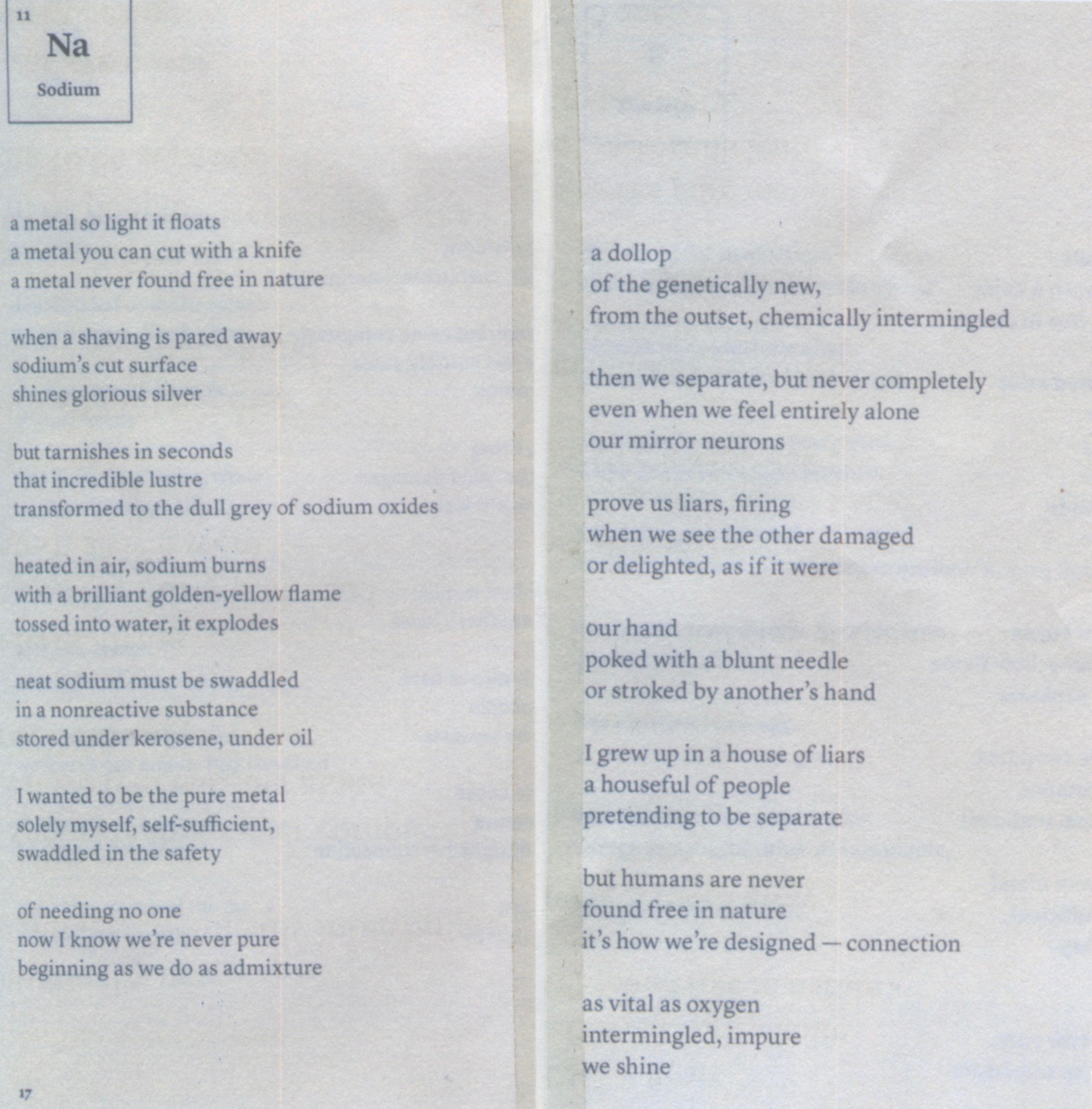
Currently when I blog about a book of poetry, I try to write about just one poem in some detail. Here it has to be one from the title sequence. I’m drawn to ‘Manganese’, a fabulously multifaceted look at tea. But ‘Sodium’ has got my favourite line in the book. Here it is (you can click on the image to see it large):
There’s nothing obscure in this poem (or indeed in the whole book): no cryptic wordplay and no need for a search engine to decipher a reference. The first five triplets set the scene; the next six play; and the final three bring the poem home. It’s like a sonnet, though in place of 14 lines it has 14 triplets – 5, 6, 3.
As in the other element poems, the element is real, acknowledged in its own right with an elegant, matter-of-fact account of its properties. The poem can afford to be matter-of-fact because sodium is so wonderful. These lines take me back to the joys of high school chemistry: the word ‘tossed’ recalls for me the dramatic moment when asthmatic Brother Foley showed us the sodium–water reaction by doing just that – tossing a small chunk into a filled sink, from a safe distance.
Then the poem turns. It could have gone on to musings about table salt and blood pressure, or the difference between swimming in the ocean, creeks and backyard pools. A backyard pool does appear in ‘Chlorine’, but when the poet’s mind reacts with sodium, a metaphor results:
I wanted to be the pure metal
solely myself, self-sufficient
swaddled in the safety

of needing no one
But in taking the behaviour of sodium as a springboard to musing about the speaker’s personal history, the poem doesn’t turn away from science. Instead, it invokes neuroscience. A mirror neuron, according to Wikipedia, is ‘a neuron that fires both when an animal acts and when the animal observes the same action performed by another’. Like sodium, humans (the poem has moved unobtrusively from the singular ‘I wanted’ to the species-general ‘we see’) are in constant interaction with the environment. She doesn’t have to spell out that wanting to be self-sufficient is wanting a very limited existence, the equivalent of sodium being ‘stored under kerosene, under oil’.
Then, the killer lines:
I grew up in a house of liars
a houseful of people
pretending to be separate

but humans are never
found free in nature
it's how we're designed
I just love this. It’s not that it’s a new insight. I think of D W Winnicott’s much quoted ‘There’s no such thing as a baby, there’s only a baby and someone’. And Raimond Gaita riffing on the song ‘Falling in Love Again’, reading ‘I was made that way / Auf Liebe eingestellt’ to say that humans are configured for love. Or Forster’s ‘Only connect’. It’s not new to say that humans are made for connection, however unremitting the messages to the contrary from the neoliberal environment (and the currently dominant side of politics). But ‘I grew up in a house of liars’, which looks at first glance like a condemnation of the speaker’s early family, has a deep compassion just beneath the surface. They were liars, but they were the ones who suffered from the lie, and anyhow they can hardly be blamed for inventing it.
-------------------------------connection

as vital as oxygen
intermingled, impure
we shine
The poem has done a neat trick with its main metaphor/analogy, twisting it into its exact opposite. Sodium in air is still dull, but the analogous grey dullness is what makes humans shine. It wasn’t until I retyped those lines that I realised that ‘Sodium’ can be read as a response to ‘A chalk outline of the soul’: in Sister Pascal’s chalk drawing, God’s sanctifying grace removes all smutchy traces of sin to leave the individual soul pure and shining, here – and in the book in general – it is our smutchy impurity that shines.
Autobiochemistry is the twenty-second book I’ve read for the 2019 Australian Women Writers’ Challenge. My copy is inscribed to a friend who bought it at a launch, so I’ll have to return it to her. I plan to buy a copy for myself.
* She has also written at least one book of science experiments for children, which you can find if you know how to use Duck Duck Go (or search engines that abuse your privacy).









 Me fail? I fly!