
Paul Beatty, The Sellout (©2015, Oneworld 2016)
 This won the 2016 Man Booker Prize, and people from Sarah Silverman to a Penthouse reviewer, four pages of them at the start of the OneWorld edition, have heaped praise on it, so it was a welcome gift at Christmas.
In the prologue the narrator, an African-American man, appears in a US court charged with undoing the gains of the Civil Rights movement by reintroducing slavery.
It’s an intriguingly provocative set-up, but alas I didn’t manage to read more than about about a third of the book.
It’s a story of a boy whose psychologist father home-schooled him, beat him savagely, and replicated famous child-experiments on him, who grows up to become oddly contrarian, fiercely anti-racist but perhaps even more fiercely anti the pieties of Black culture, with a farm in the middle of ghettoised Los Angeles as a key locale. To me it felt contrived and arbitrary, but not sufficiently weird or tumultuous to compel. Of course my failure to persevere may have to do with my mood of the moment, or parochial irritation at the frequent opaque Los Angeles references. So don’t let me put you off.
Here’s a bit from just before I laid it aside. The African-American character speaking is a mediocre academic who has made and lost fame and fortune as a Black voice in the media, largely by stealing other people’s ideas.
‘One night, not long ago,’ Foy said, ‘I tried to read this book, Huckleberry Finn, to my grandchildren, but I couldn’t get past page six because the book is fraught with the “n-word”. And although they are the deepest-thinking, combat-ready eight- and ten-year-olds I know, I knew my babies weren’t ready to comprehend Huckleberry Finn on its own merits. That’s why I took the liberty to rewrite Mark Twain’s masterpiece. Where the repugnant “n-word” occurs, I replaced it with “warrior” and the word “slave” with “dark-skinned volunteer”.’
—–‘That’s right!’ shouted the crowd.
—–‘I also improved Jim’s diction, rejiggered the plotline a bit, and retitled the book The Pejorative Free Adventures and Intellectual and Spiritual Journeys of African-American Jim and His Young Protégé, White Brother Huckleberry Finn, as They Go in Search of the Lost Black Family Unit.’
[…]
—–Foy touched his fingertips together in front of his chest, the universal sign that the smartest person in the room is about to say something. He spoke loudly and quickly, his speech picking up in speed and intensity with every word. ‘I propose that we move to demand the inclusion of my politically respectful edition of Huckleberry Finn into every middle-school reading curriculum,’ he said. ‘Because it is a crime that generations of black folk come of age never having experienced this’ – Foy snuck a peek at the original book’s back cover – ‘this hilariously picturesque American classic.’
That isn’t terrible. Quite apart from the frequent use of the ‘n-word’ by the narrator of this book, I get what’s being mocked, and agree that it needs mocking. When I worked in children’s literature there were authorities who wanted to restrict access to Margaret Mahy’s superb The Man Whose Mother Was a Pirate so as not to trigger children who had been attacked by real pirates. But, like many of the narrator’s satiric riffs, this mockery is too easy. Which is pretty much how I found the narrative as a whole: I think it wants to be a rollicking, take-no-prisoners ride knocking down sacred cows in all directions, but it just doesn’t rollick and instead of sacred cows it burns straw men.
Your mileage may vary.
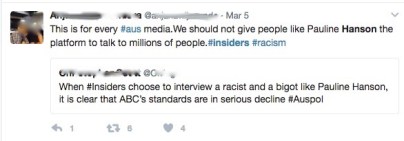
 The essay obliquely acknowledges this dilemma. Marr writes, ‘Most Australians reject everything that Hanson stands for,’ but nevertheless ‘politics has been orbiting around One Nation since the day she returned to Canberra’.
 In the early pages of The Sympathizer the narrator is working for a Vietnamese general in the last days of the US–Vietnam war. A CIA man gives him a book:
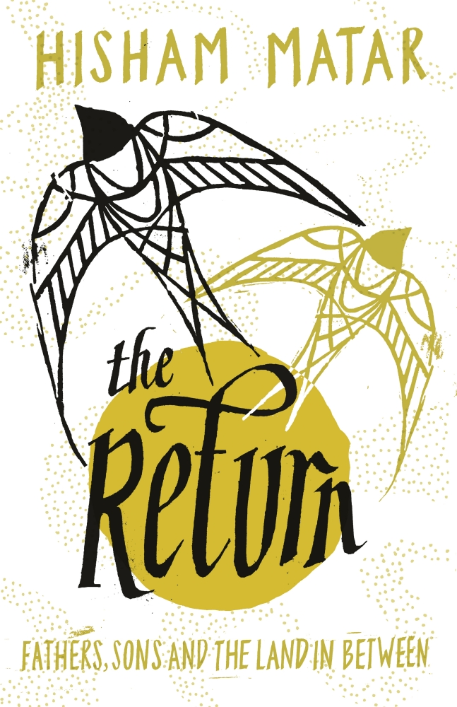 Wikipedia describes Hisham Matar as a Libyan novelist. Actually, it’s more complex than that: he’s a British citizen, born in the USA, who spent six childhood years in Libya before being exiled with his immediate family to Egypt. But despite these complexities he is Libyan, deeply invested in the history, culture and fortune of that country. This wonderful book is built around his return there during the brief window of peace and hope after the overthrow of the Gaddafi regime in 2011. Matar’s father, Jaballa Matar, an influential political dissident, was kidnapped in 1990, never to be seen again by his family. Hisham, 19 years old and studying in London at the time of the kidnap, spent the next two decades trying to find out what happened to his father, and working for the release of his uncle and cousins who had been arrested at the same time.
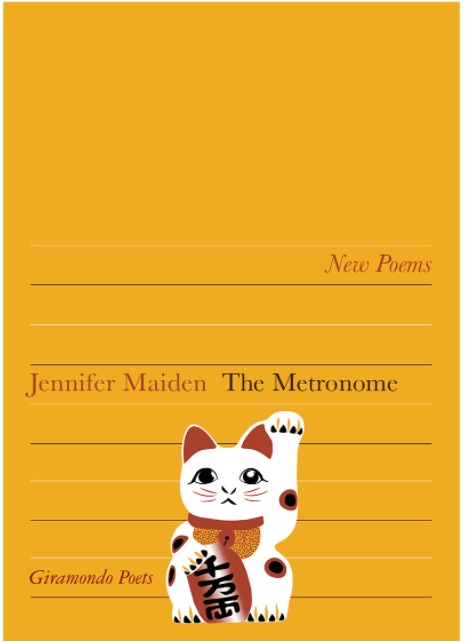 I don’t have anything new to say about The Metronome since I
 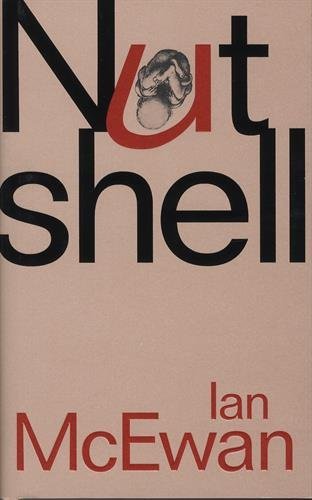 The Meeting: This is the first time I’ve been to a Book group meeting without having read even one page of the book that’s up for discussion. The Emerging Artist asked me what excuse I was going to give. I replied haughtily, and a little disingenuously, that I didn’t need an excuse, because the group is about much more than discussing a book.

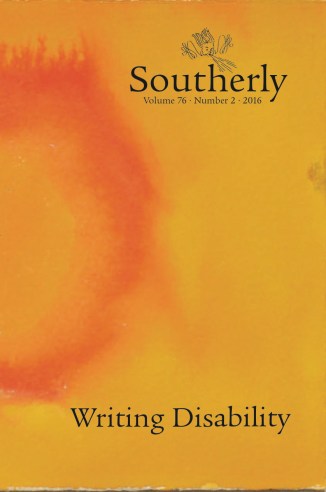 The term ‘disability’ covers a vast range of experience: body shapes that differ from the norm, impaired bodily function, chronic pain, chronic disease, learning difficulties, the autism spectrum, conditions labelled ‘mental illness’, combinations of those and more. Though that’s an important point, it’s also an obvious one, and perhaps only in an academic context would you invoke a French theorist to make it, as in this passage from Andy Jackson and David Brooks’ essay ‘Ramps and the Stair’ in this Southerly:
 Perhaps a novel is just what’s needed after the news cycle has rolled on, to keep our minds and hearts alive to painful issues such as child sexual abuse in religious institutions. That, it seems to me, is the need The Crimes of the Father aims to fill.


 Me fail? I fly!