Category Archives: Books

Jennifer Maiden’s George and Clare and the Grey Hat Hacker

Jennifer Maiden, Play with Knives: Three: George and Clare and the Grey Hat Hacker (Quemar Press 2016)

pwk3

This is the third novel in the Play with Knives series, and like the earlier volumes it’s not the straightforward thriller its title might seem to imply.

As well as the earlier novels, it is preceded by more than a decade of poetry featuring its two main characters. You probably don’t need to have read any of the previous novels or poems to enjoy it – a teasing curiosity about the back-story would be part of the enjoyment, and anyway parts of the history referred to in the text exist only in those references. But just for the record, here’s a chronology (I’ve listed the 25 poems in order of publication at the bottom of this post).

Chronology:

1990: George Jeffreys and Clare Collins first appear as the leads in Jennifer Maiden’s novel Play with Knives. He’s  a probation officer and she’s his client, a young woman who murdered her three younger siblings when she was nine years old. There’s a serial killer on the loose in Western Sydney, George gets involved with Clare in an ethically dubious way, and they begin an apparently endless conversation.

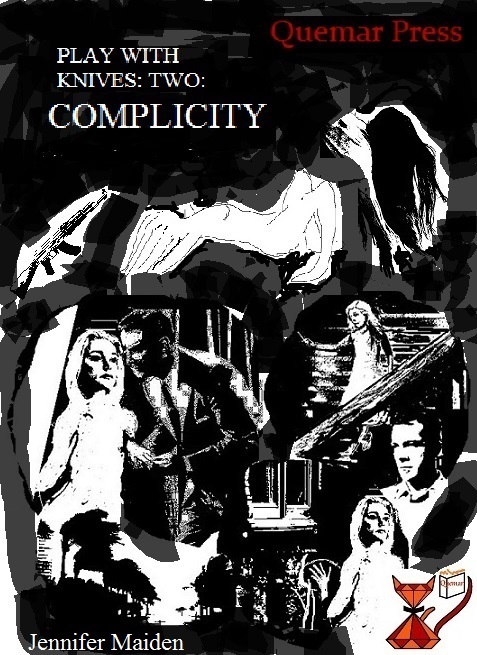
1991: A sequel, Complicity, is written but only excerpts are published in literary magazines. George and Clare’s relationship as lovers and conversers firms up, and there is more violence. (Quemar Press published it as an ebook in 2016.)

2005: After a fourteen-year absence the characters reappear / are resurrected in Friendly Fire (Giramondo). Maiden says in an introduction that soon after 11 September 2001, she thought, ‘What are George and Clare thinking?’ The question begins to be answered in a prose narrative set in Lower Manhattan on 9 September 2001, and then in six ‘George Jeffreys’ poems, each beginning:

George Jeffreys woke up in [xxx].
George Bush Junior was on the TV, obsessed
as usual with Baghdad.

The first four of these poems pretty much sticks to the question of what George is thinking – about post–911 events up to and including the invasion of Iraq. Then, in the fifth and sixth poems, he moves beyond just thinking, to chat with George W Bush (in the White House, in #5) and Saddam Hussein (in Baghdad, in #6).

2010–2016: Another 14 ‘George Jeffreys’ poems appear in Jennifer Maiden’s next five books. There are also four poems named for Clare: ‘Clare and Paris / Manus / Thessaloniki / Nauru’. Both characters make an appearance in ‘The Year of the Ox’ in Liquid Nitrogen (2012) – George watching Obama on TV, Clare in contact with the ghosts of her murdered siblings, both watching Gillard on TV. George w Bush fades from the scene, and so eventually does the TV set.

While George and Clare continue to provide a medium for reflections on world events, they also assert themselves as characters, turning up at hotspots all over the world working for an NGO called Prisoners of Conscience. They are great talkers, to each other of course, but also with political figures ranging from the Master of the Crossroads in Louisiana and a brace of ancient Chinese philosophers to a CIA operative and, in a poem published the day after his electoral victory, Donald Trump.

The poems are embedded in a compelling body of work, only one of a number of conduits for reflections on the constellation of themes in each book – war and violence, ‘ethical security’, government surveillance, Maiden’s version of ‘the problem of evil’, culling of feral animals, and more. Other pairs of characters appear in similar series, including Hillary Clinton and Eleanor Roosevelt in 14 poems, Tony Abbott and Queen Victoria in six. But only George and Clare’s poems develop progressively into more rounded fictions*. There are Hitchcockian shoot-outs in spectacular settings, dramatic rescues of abused women, a spot of arson on Manus Island. People and animals rescued by Clare become part of their domestic life back in Mount Druitt.

2016: It seems a logical progression, almost a response to pressure from the characters themselves, when the novel series comes back to life. Quemar Press reissues Play with Knives, publishes Complicity for the first time, and then Play with Knives Three: George and Clare and the Grey Hat Hacker, all as ebooks in PDF format.

End of chronology.

This third novel in the Play with Knives series differs from the previous two by being mostly in verse. It differs from the poems of the previous decades by having room to focus on the characters’ intimacies (which it does in explicit detail) and space for their conversations to veer off down innumerable byways.

After a brief prose prologue from George (all the prose sections are George speaking in the first person), the first chapter begins in the well-established way, ‘George Jeffreys woke up’: he’s in Thirroul, just south of Sydney, house-sitting with Clare, in a house filled with Gary Shead prints of D H Lawrence and Frieda. (Thirroul is where Lawrence wrote Kangaroo. A number of the prints are lovingly described in the text: you can see images of them on this Pinterest site). As well as Lawrence on the walls, they share the house with a pet rat named Johnny Depp, canaries (Lily and Snape) and a blue tongue lizard (Hello Kitty).

It’s the night of a scheduled execution in Indonesia strikingly similar to the real-world killing by firing squad in April 2015 when of Myuran Sukumaran, Andrew Chan and six others are to be killed by firing squad in Indonesia. Clare and George have (of course) been involved with one of the prisoners and their emotional preparation for and then response to the executions is the central action of the first two chapters, which constitute more than half the book. Seeking distraction and human contact, they have quite a lot of explicitly negotiated and described, not entirely conventional sex, they swap stories about D H Lawrence and Norman Mailer, come close to using Assange as a term for a sexual practice, criticise Freud and de Sade, discuss Trump’s policies, quote A E Housman, Nye Bevan, A J P Taylor, and a lot more. There’s a recurring sentence:

The clock by the bed went round, but it wasn't time.

This is all so absorbing that one hardly notices that some time in the night, they learn by phone that George’s grandson Idris is heading their way from England, where his hacking activities have put him in danger. The next night, still exhausted by events in Indonesia, well past the halfway point of the book, George and Clare go to bed:

They slept there for an hour, then George woke to a noise.
It was like a cat tapping to get out, except that he saw it was
actually his grandson, tapping to get in. He thought: If he
calls me 'Dude', I'll kill him. He unlocked the door quickly,
admonished, 'Don't wake Clare.' Idris hugged him, no different
to his exuberance as a child. George had always been his
favourite male relative. George locked the door. Idris still
hadn't let his arm go, exclaiming, 'Dude, how are you? You
look great.' George hugged him back: 'I'm fine. You seem in
quite good shape, yourself, boy.'

That’s the start of what in a conventional genre novel would be the central action (and the echo from the poems in ‘George woke’ suggests that we are indeed at a new beginning). But, once everyone has said hello and Idris has said he’s being followed by some ‘weird dudes’, everyone goes back to sleep. When Clare wakes in the morning she muses on one of the Shead paintings, remembers a Civil War song, looks at the sleeping George …

Sure, there’s a story to be told, but life is full of moments. Idris’s partner Sophie (whose life Clare saved in Paris years earlier) arrives with baby Florence, and there is a wonderful sequence of extended family domesticity.

In chapters 3 to 4, George picks up the narration in prose, and in what is only slightly less leisurely (there’s still time for a lit-crit discussion of Peter Pan, some wine-snob chat and a brief reflection on infant circumcision), the tension mounts to a climactic shoot-out on the Bulli Pass. That too, as much as the sex and the images on the wall, is the subject of Clare-and-George conversation. Clare asks:

‘How did you shoot that Frenchman?’

‘Apart from using withdrawal symptoms to concentrate? I remembered what you said about empathising. I knew where to aim for in his arm, and I didn’t feel as if my own arm existed. Fortunately, by the time his mate killed him, most of the empathy was over.’ Although I instantly remembered, very accurately, the screaming.

In [redacted to avoid spoiler], her eyes were lightning on rockpools. I thought of my finger in the sea anemone: that temporary sudden small ridge appearing from nowhere after the opening, testing itself against an invader, making the whole map change. She asked, ‘But how did you shoot him?’

I answered, ‘I am descended from the Hanging Judge, you know. It was easy. I just forgot everything I ever knew.’

Some novels are blatantly written with the Hollywood machine in mind. This is not one of them: it ignores the genre rules about structure, and its pleasures are in the detail of relationships – in sex, in play between adults and small children, in the joys of conversation, in the grief and rage of seeing state machinery destroy lives, in engagement on many levels with art, literature and politics. There is a twist at the end, in the last two short chapters, chapter 5 in prose and chapter 6 in verse,  which makes the whole hacker plot seem a little like an elaborate misdirection. The clock by the bed still goes round, but in these final chapters we have a different understanding of what that means.

I won’t spoil things by telling you if Idris escapes safely to Moscow.


Jennifer Maiden poems featuring George Jeffreys and Clare Collins 2005–2016

In Friendly Fire (Giramondo 2005)
George Jeffreys 1: George Jeffreys Woke Up in Kabul
George Jeffreys 2: George Jeffreys Woke Up in Kandahar
George Jeffreys 3: George Jeffreys Woke Up in London
George Jeffreys 4: George Jeffreys Woke Up in Berlin
George Jeffreys 5: George Jeffreys Woke Up in the White House
George Jeffreys 6: George Jeffreys Woke Up in Baghdad

In Pirate Rain (Giramondo 2010)
George Jeffreys 7: George Jeffreys Woke Up in New Orleans
George Jeffreys 8: George Jeffreys Woke Up in Rio
George Jeffreys 9: George Jeffreys Woke Up in Beirut
Clare and Paris
George Jeffreys 10: George Jeffreys Woke Up in a Pirates’ Ship

In Liquid Nitrogen (Giramondo 2012)
The Year of the Ox
George Jeffreys 11: George Jeffreys Woke Up in Langley
George Jeffreys 12: George Jeffreys Woke Up in Oslo
George Jeffreys 13: George Jeffreys Woke Up in Beijing
George Jeffreys 14: George Jeffreys Woke Up in Sharm el Sheikh

In Drones and Phantoms (Giramondo 2014)
George Jeffreys 15: The Fourth Terrace
George Jeffreys 16: George Jeffreys Woke Up in South Iceland
Clare and Manus

In The Fox Petition (Giramondo 2015)
George Jeffreys 17: George and the Holy Holiday
George Jeffreys 18: George Jeffreys Woke Up on Kos
Clare and Thessaloniki

In The Metronome (Quemar 2016, Giramondo 2017)
Clare and Nauru
George Jeffreys 19: George Jeffreys Woke Up in Thredbo
George Jeffreys 20: George Jeffreys Woke Up in Washington

aww2017.jpg

There are more to come, in Appalachian Fall, due out from Quemar in October.
——
George and Clare and the Grey Hat Hacker is the ninth book I’ve read for the 2017 Australian Women Writers Challenge. I obtained it, as you can, as a free download from Quemar Press.
Overland 226

Jacinda Woodhead (editor), Overland 226 (Autumn 2017)

226 cover.inddI’m an issue behind in my Overland reading, but I’m glad I resisted the temptation to skip this one.

Over the dinner table last night, someone complained that the left is obsessed with identity politics. Well, that may true of the left as understood in the mainstream media, but Overland is probably as close as we’ve got to an official organ of the left in Australia, and I can report that identity politics are a long way from dominating this issue. Article after article sheds light and brings precision to areas that are too often discussed in dim and befuddled terms.

All worlds die’ by Angus Reoch is the stand-out piece for me. Responding to what the article’s subtitle calls ‘the politics of despair’, he argues:

Chomsky was correct when he argued that climate change is an unprecedented crisis and that mankind’s potential for destruction is unmatched. Yet culturally, the twenty-first century does not have the luxury of claiming ‘the end of world’ as a unique historical moment. We have no other choice than to fight climate change, but we are not unique in human history to be living in an apocalyptic predicament. Many societies have seen ‘the end of history’. The First World War was only the final gut-wrenching body blow to the old world, upon the corpse of which the Second World War was fought, and the new world order erected. Many of the great writers before these events, from Leo Tolstoy to Natsume Sōseki, directly grappled with the realisation of a passing era, and the decline not only of aristocracy but of the old world itself. These writers were highly aware of the passing of their era and realised that in the modern age of European hegemony there was no choice but to adapt. […]

I recommend the whole article. Here’s the second last paragraph:

Perhaps we should not celebrate the demise of this world, for we do face the very real spectre of barbarism, but we should recognise the brutal and limiting nature of the world in which our societies have flourished. The fall of the neoliberal era is a necessary condition of a more peaceful and prosperous world.

There are at least four other articles that would have justified the price of the journal. And they’re all available on line for free).

In ‘It is still the Balanda way‘, Amy Thomas argues that while some Aboriginal languages such as Wiradjuri and Marra are being retrieved, this does not mean that Aboriginal languages are generally being respected and resourced. On the contrary, living languages are threatened with extinction by Northern Territory government educational policies and the continuing Intervention (aka Stronger Futures).

It is important not to overstate the way that language shapes our worldview. We create language, rather than the other way around. Yet what is lost when a language dies is more than just a linguistic curiosity; a community’s history and ways of viewing the world are lost with it. Losing your mother tongue through the forced imposition of a dominant language is disempowering, at least partly because it is an attempt to reshape your identity to suit someone other than yourself.

C J Chanco, a Filipino/a living in Toronto, addresses the phenomenon of Duterte in ‘Law and order’, in particular the question of how his murderous ‘drug war’ command such widespread support, not just from the churches and the far right, but also from the general population and until recently from the Communist Party of the Philippines.

The quest for primordial whiteness’ by Ramon Glazov exposes the weird theoretical underpinnings of contemporary white supremacist ‘thinking’, beginning with Arthur de Gobineau’s 1853 opus, An Essay on the Inequality of the Human Races, which now reads as outright deranged. Sadly events since this Overland was published have increased this article’s relevance:

How should we respond to the spread of ‘race realist’ arguments? Moral condemnation is not enough; it does not faze alt-righters to be called ‘racist’. Their ideology already assumes that racism is true, so accusing them of it is like accusing a Trot of being unpatriotic. What is more likely to give the ‘redpilled’ pause is the suggestion that they are being naïve, that their newfound politics is just as gullible as the liberal ‘cuck programming’ they have allegedly shed, that race realism is not a suppressed Grand Theory of Everything but a useless red herring

To be a queer teacher’ by Elizabeth Sutherland lays out the enormous burden placed on the shoulders of LGBTQ+ teachers. I guess this could be called ‘identity politics’, but I read it as bringing much-needed specific experience to current debates (though the marriage equality debate was still on a distant horizon when the essay was written).

The regular columnists all shine: Giovanni Tiso laments the way social media mean we can never escape ‘the unbearable closeness of others’; Alison Croggon writes a personal tribute to the late great John Berger; Mel Campbell talks about wanting to be liked as a writer, particularly a female writer; Natalie Harkin offers a dense reflection on kinds of responsibility and accountability at play for Indigenous writers, and – citing Kerry Reed-Gilbert – she  challenges non-Indigenous readers to understand multiple ways of belonging; to act and engage in the political struggle with Indigenous Australians.

Then there’s the literary / creative content, a strong feature of Overland from its beginning.

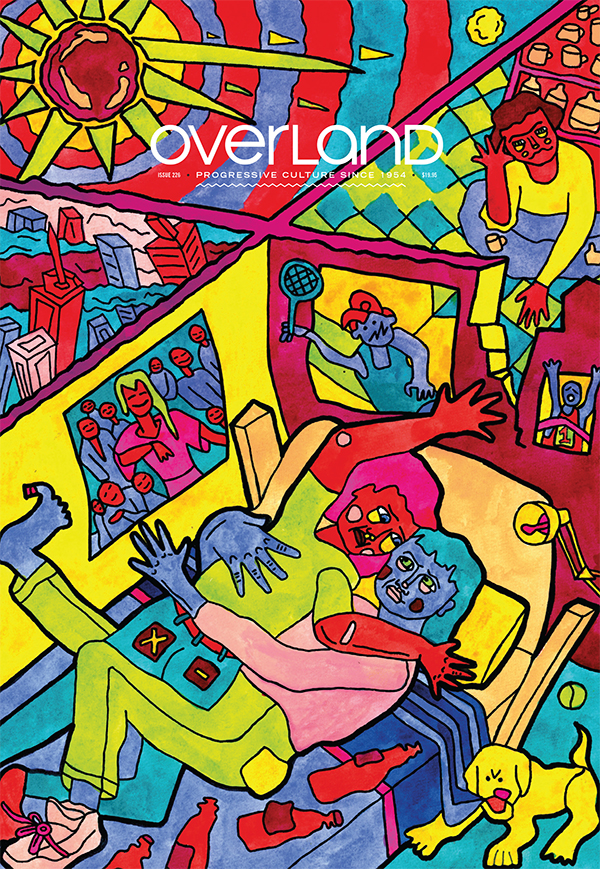
Each issue these days showcases the work of a different guest artist. The striking cover and all the internal artwork of Nº 226, including title pages for each of the fiction pieces, are by comics artist, illustrator and bag designer Nicky Minus (link is to Minus’s website). It’s a pleasure to be introduced to this artist’s work.

Overland sequesters poetry and fiction in separate sections rather than having them punctuate the rest of the journal, and they usually incorporate the results of at least one competition. The ten-page poetry section in #226 features the winner and runners-up of the Judith Wright Poetry Prize, with a judges’ report from Toby Fitch and Jill Jones that’s a bit of a lesson in how to read poetry; and there are some startlingly erotic poems by Omar Sakr. The 22 pages of fiction comprise five short stories, including the winner of the Neilma Sidney Short Story Prize, Katy Warner’s ‘The Trip‘, a which deals with family relations in a way that made me want to cower under the bedcovers, in a good way (the runnersup are online). The other story that stands out for me is Afopefoluwa Ojo’s ‘A consequence of things’, a tale of teenage pregnancy told in Nigerian English, with a twist where what looks like an awkward metaphor becomes a literal reality.

Then at the very end of the journal, as if it’s an afterthought, there’s ‘Through the eyes of a humanist’ by Subhash Jaireth, a discussion of the work of 2015 Nobel Literature Laureate Svetlana Alexievich. Someone in my book club recently proposed that we read one of her books. If I had read this article, I would have been an enthusiastic seconder. Jaireth says:

It can be hard to imagine a book or work of art helping to topple a dictator, stop a war or shield a person from a bullet. But I (perhaps naively) believe that the strong moral imperative driving Alexievich’s work, and the chorus of voices given space to bear witness to human-made tragedy, create what are, effectively, works against war, brutality and tyranny – if only we seize the moment to listen.

Jenny Blackford’s Loyalty of Chickens

Jenny Blackford, The Loyalty of Chickens (Pitt Street Poets 2017)

chickensLike Jenny Blackford’s earlier book, The Duties of a Cat, this is beautifully presented collection of poetry. This one’s bigger – there are more pages and more poems, and it has a broader scope of subject matter and tone.

As in the earlier book, there are sweet celebrations of pet cats (‘All that he asked / was total control’) and a range of animals wild and domestic, including the chickens, which, according to the title poem,

show no loyalty. It seems that any girl
who’ll delve a scoop of free-range mix
is She Who Brings the Grain,
or close enough for these
red-feathered hens
to worship her.

Jenny Blackford’s biography mentions that her work is published regularly in The School Magazine. One of the attractive features of this book is the way poems that are eminently suitable for children are mixed in with poems of mature sensibility, with no sense of incongruity. The lovely imagistic ‘sweeping’ (‘the wind is sweeping / the tide out to sea’), is followed by ‘South Steyne’, which recalls childhood events from an amused adult perspective (‘The South Steyne ferry was heaven / for me, though doubtless hell for parents’), and then by ‘Some slight redemption’, a meditation on Coventry Cathedral as a monument ‘not to war / nor even peace / but to forgiveness’.

It seems inevitable that any collection of poems by a person of a certain age that touches on domestic life will at some point touch on dementia. This collection manages the subject with tenderness and humour in ‘Dipping into that Lake’: ‘There are fairies at the bottom of Mum’s garden now / and butterflies, and owls.’

The poet lets slip at one point that she graduated in Classics from Cambridge, and classical references are scattered through the book, but the erudition is lightly worn. A personal favourite of mine (for reasons that you can easily guess) happens to be an example of this. There’s the whole poem:

Earth-shaker, bed-shaker

According to inscriptions
in a lost Poseidon temple
soon to be discovered
somewhere in southern Greece
Poseidon Earth-shaker is patron
and protector of snoring men.
Without his godly nasal power,
so many men of twenty, forty, sixty
would be discovered (in soft morning silence)
smothered by bed-pillows,
domestic earthquakes
permanently stilled.

The temple vaults hold tributes
from his snoring worshippers:
gilt effigies of elephants,
yellowed tusks of snorting walruses,
and woolly mammoths’ freeze-dried trunks
as fat as anacondas,
all given to the god
by grateful bed-shakers.

I would happily have the poem end there but of course it goes on:

In Aphrodite’s nearby temple of love,
ears of silver, gold and clay
are mounted on the walls
or heaped in shelly stacks,
donated by the snoring men’s
sleep-deprived bedfellows.
May the merciful goddess
muffle our night-time senses
forever and ever. Amen

aww2017.jpg

The Loyalty of Chickens is the eighth book I’ve read for the 2017 Australian Women Writers Challenge. My copy was a gift from Pitt Street Poets and the author, whose work I first met, and published, when I was editor of The School Magazine.

Alan Wearne’s Things Are Real

Alan Wearne, These Things Are Real (Giramondo 2017)

things (1)

Despite the increasing frequency of narrative poems, the work of Alan Wearne is unmatched. Nobody has even begun to approach the complexity of his portraits of life in post-war Australia.

That’s Martin Duwell in 2013 reviewing Alan Wearne’s Prepare the Cabin for Landing. He could have been introducing the five narrative poems that make up the first 70 pages of These Things Are Real. The book’s title doesn’t so much make a claim of non-fiction status for these narratives, as insist that the kinds of stories they tell, stories that don’t make the headlines, and that are unlikely to make it into the history books or best-selling novels, are nevertheless poignantly human.

A widow renews her friendship with a friend from her youth, but they drift apart after some years when she rejects the overtures of her friend’s husband, all in Menzies-voting suburbia. A Ceb (which, as the poem had to spell out for me, is argot for a member of the Church of England Boys Society) tells the story of his multiple coming-out. A young woman, single mother, has a relationship with a musician who turns out to be abusive. A school teacher, a ‘happy-go-usey’ drug addict, struggles with his moral compromises and worse, including an involvement with squalid and murderous criminality. A ‘recently retired femocrat’ recalls the contradictions of her middle-class radical youth.

These are five complex yarns, told in irregular verse that occasionally breaks out into rhyme. There’s a strong sense of an idiosyncratic speaking voice, rough around the edges and often assuming shared knowledge that isn’t always there (not necessarily a problem when Google is at hand). The narratives don’t offer easy resolutions to the uneases and tensions they raise. In fact, mostly they don’t offer resolutions at all. Maybe that’s another meaning of the book’s title – in the real world things stay complex and unresolved.

Just a taste of how the language works, from ‘Anger Management: a South Coast Tale”

His screaming’s recommenced. The kids are home.
And you are bruised, walking-into-a-door bruised,
like you’ve seen enough before except
now it’s his, his bruise and possible fracture.
You saw the good man (if nobody else did)
the one who rolled you your White Ox,
the one who actually wrote songs,
the man you were loving who disguised
so much (no doubt from himself).
Well, it is all out now with a sort of noise
that’s heading to your kid’s guts
to stay for decades. But it’s when
he starts up, ‘Don’t you get it, I love kids,
I love them!’ you grab yours and lock away
the three of you, three hearts deranged
with thumping, with him outside the toilet
howling, whilst you phone your girlfriends.

The remaining 50 pages of poems are grouped under the general heading, ‘The Sarsaparilla Writers Centre’. They range from throwaway couplets (an unkind ‘Elegiac Proposal’ for Cardinal George Pell, a note on being a runner up to Lily Brett in the 1987 Victorian Premier’s Prize, a gleeful skewering of an error in something written by Les Murray), through several songs of praise to AFL personalities and others who remain mysteries to me, to longer rhyming poems about Australian politics, religion and, in particular, poetry: ‘For Chris Wallace-Crabbe at Eighty’, ‘The Ballad of 68 or I Was Dransfield’s Dealer’ and ‘Ode for Johanna Featherstone & Fiona Wright’.

My copy of These Things Are Real was a gift from Giramondo Publishing.

Madeleine Thien and the Book Group Do Not Say We Have Nothing

Madeleine Thien, Do Not Say We Have Nothing (Granta 2016)

1783782668

Before the meeting: This book tells a story of three generations of a Chinese family in the 20th century. It includes a graphic evocation of the horrors of the Cultural Revolution and the purge of ‘Rightists’ that preceded it, and an equally graphic account of the events surrounding Tiananmen Square in 1989, as gleaned by a young woman of the Chinese diaspora who was born and brought up in Canada.

I found the first 50 pages hard going, as the different time periods were introduced, with no clear indication of how they were related. But once the several stories were up and running, I was engrossed.

Of the vast amount that has been written about this period in China, I’ve read Han Suyin’s Wind in the Tower, in which the Cultural Revolution is seen as a brilliant strategy to save the revolution from living death, and William Hinton’s Fanshen (1966) and Shenfan (1984), brilliant accounts of the Great Leap Forward and the Cultural revolution as they played out in a single village (I saw David Hare’s play of the former at the Pram Factory in Melbourne and then at Belvoir in Sydney). I haven’t read any of the famous memoirs such as Li Cunxin’s Mao’s Last Dancer and Jung Chang’s Wild Swans, so I can’t say how this novel compares to them, but I can say that it makes Han Suyin look like a PR spin merchant, and gets horrifyingly deep under the skin of the kind of events William Hinton describes.

It doesn’t come across as anti Communist propaganda; it’s more a terrible tale of a dream betrayed. Even as people’s lives are being destroyed they stay firm in their belief in the revolution. Partly this is a survival mechanism – if you can say the correct slogans with sincerity your chances are greatly improved. Partly, though, it’s also a result of the power of the Maoist dream. The shattering of that dream as the People’s Army turns on the people in 1989 is among the most heartbreaking writing I’ve ever read.

Like any powerful novel, this one doesn’t let the reader imagine that the events it portrays are safely of another time and place. Call-out culture on the internet these days may not be as savage as the criticism sessions in the Cultural Revolution, but it shares some of its structure of feeling. The power of slogans to block complexity is having devastating effects on lives in Australia – or more precisely offshore from Australia – as I write this. The term ‘climate change’ is being expunged from Donald Trump’s US agencies as surely as ‘counter-revolutionary’ knowledge was erased under Mao. [Added next day: not to mention ‘fire and fury and – frankly – power’.]

I cried a lot.

After the meeting: The conversation stayed with the book for most of the evening, and even when it departed it was still tangentially related.

Not everyone loved the book as much as I did, but I came away from the evening with an enriched appreciation for its complexity. I think it’s true to say that everyone had at least one scene or character that had struck them. A couple of us said we found the descriptions of music didn’t work; someone said that these descriptions were clearly important to the characters, but not really to the reader. One chap said he had got out his recording of Glen Gould playing the Goldberg Variations – the same recording as features in the narrative – and put it on it while he read, and that this had worked brilliantly.

So not only is this a terrific novel to read, but judging by our experience it’s also a terrific book club title.


Jennifer Maiden’s Complicity

Jennifer Maiden, Play With Knives: Two: Complicity (Quemar Press 2016)

complicity

This is a sequel to Jennifer Maiden’s Play With Knives (Allen & Unwin 1990), taking up the action maybe ten years later. The manuscript has been circulating  for decades, and excerpts and commentary have appeared in literary journals, but it seemed destined to remain unpublished. Then Quemar Press made a PDF available as a free download last year.

The main characters of the Play With Knives novels (there are two more after Complicity) are George Jeffreys and Clare Collins, who have featured powerfully in at least fifteen of Maiden’s poems in her last half dozen books. The first novel begins with George, the narrator, as a probation officer assigned to Clare’s case, having to decide whether to recommend her release from prison, where she has served time for murdering her siblings when she was a young girl. There’s a plot involving a serial killer in western Sydney, but the heart of the novel is in their developing intimacy, and their almost obsessive questioning of what it means for both of them to live in the long shadow of Clare’s act.

In Complicity they have both moved on. George begins the novel working for an NGO (Prisoners of Conscience) monitoring dubious legal proceedings in third world countries; Clare is living with a journalist and runs a small business. George returns to western Sydney and their mutual probing recommences, along with a couple of lovingly detailed sexual encounters. As before, there are thriller elements: people are dying from poisoned benzodiazepines, and someone assaults Clare a number of times with escalating violence. As before, these elements are secondary to the ebbs and flows of relationships, and to George-as-narrator’s ruminations. The characters return again and again to Clare’s childhood crime and to the climax of the first novel, analysing their meanings and their emotional impacts – much as real people might, rather than like characters in a TV thriller.

Lynda La Plante this isn’t. (I love at least some of Lynda La Plante’s TV shows, but one novel was enough.)

In six books over more than a decade now, Maiden’s George and Clare have been materialising in political hotspots all over the world, encountering characters ranging from Somali pirates to resurrected ancient Chinese nobility, with George W Bush and more recently Donald Trump somewhere in between. In those poems, George and Clare have their own adventures, but they are mainly interesting as lenses through which Jennifer Maiden can look at the wide world. In this book, though George Bush Senior’s Gulf War is a significant backdrop, George and Clare’s relationship is the focus. But we come to understand, perhaps even more than in the first novel, what it is about them that makes them such a useful lens. We see them grappling intensely and honestly with Maiden’s version of ‘the problem of evil’: how people who are not monsters can perpetrate atrocities, and how to live honestly with that reality.

aww2017.jpg

Complicity is the seventh book I’ve read for the 2017 Australian Women Writers Challenge. I obtained it, as you can, as a free download from Quemar Press.

Southerly 76/3

Laetitia Nanquette and Ali Alizadeh (guest editors), Southerly Vol 76 No 3 2016: Persian Passages

southerlypersian

As soon as I finished reading this issue of  Southerly I bought a second copy as a gift for a young Iranian friend who has recently got his permanent residency in Australia. I’ve yet to hear how he fared with the complex language, but I hope the dialogue between Australian and Persian cultures in these pages gives him at least some of the joy it has given me.

The title of the first item (if you don’t count the editorial – I’m sorry, I have an aversion to editorials and haven’t read this one) could be a subtitle for the whole journal: ‘This Is Not a Conversation about Asylum Seekers’. Adele Dumont and Mehdi Habibi met when he attended a writing class she taught in a detention centre for people seeking asylum. True to its title, the article is a dialogue about his writing (and we get to read his ‘Odd Sock’ later in the journal). The rest of the journal likewise focuses, not on the Iran of the Ayatollahs, producer of refugees and Manus or Nauru detainees, stuff of Donald Trump’s rhetoric, but on the rich Persian literary culture and the long and various history of Persians in Australia (whether from Iran, Afghanistan or other places covered by that term)

Zarlasht Sarwari’s ‘Afghan Australian Identities’,  Sanaz Fotouhi’s ‘Writing the Present: Unpacking the Suitcase of the Past’ and Kim Lateef’s ‘Where Are You From?’ each tell stories of diaspora and exile without conforming to the well established forms of such stories. The reader gets to hear these stories fresh and personal.

For me, the heart of the journal is a sustained, complex conversation about the ghazal and the great fourteenth-century poet Hafiz, master of that form (also spelled Hafez and Häfez in this issue – Southerly doesn’t impose narrowly consistent spelling or punctuation).

Paul Smith has been a key translator of Hafiz’s ghazals for decades. In ‘A Life with Hafiz’ he gives some insight into the devotion he has brought to the work. He lays out the formal requirements of the ghazal: a series of couplets, in which the second line end with the same rhyme word throughout the poem; and the poet’s name appears in the final couplet. His article incorporates several of his translations. Given the way poets writing ghazals in English have departed in many ways from these requirements, in ways that are discussed approvingly later in this journal, I was grateful to have them spelled out  so clearly.

Setayesh Nooraninejad’s ‘Poetic Bridges – Spanning Literary Traditions, Politics and Cultures’, an interview with Zahra Taheri (Convenor of the Persian Studies Program at the ANU), again refers to Hafez (her spelling) as a great overarching genius of Persian culture.

What brought the conversation home for me was Darius Sepehri’s ‘Judith Wright’s The Shadow of Fire: Making the Ghazal Appropriate in Australia’. The Shadow of Fire is Judith Wright’s last book , and it consists of ghazals. Sepehri argues that Wright had been reading Häfez (sic) seriously for decades (her short poem ‘To Hafiz of Shiraz’ dates from 1960), and that his ecstatic songs were crucial to the direction taken by her poetry towards the end of her life. Though Wright’s ghazals don’t rhyme, and don’t deal in great metaphysical abstractions in the manner of Häfez, Sepehri makes a subtle, and to me beautifully compelling, argument that they are successful adaptations of the form to the Australian environment, both physical and cultural, in a way that is analogous to the way people in modern Iran will quote lines from Häfez in different contexts so that they take on new meanings.

0207181357

The article bristles with insights into Judith Wright’s and Häfez’s poetry and into the place of Häfez in Persian culture. It sent me off to Judith Wright’s 1996 Collected Poems to read her work from 1974 (which is when the Collected Poems I own was published). In the last decades of her life, as she focused on activism on Aboriginal issues and the environment, her poetry generally became grimly pessimistic, at times seeming to indicate that she had lost faith in the idea of poetry itself. Towards the end, she writes that she has indeed lost faith in rhyme, and now would focus on haiku, almost letting things speak for themselves. But there are no haiku in the Collected. Instead, at the end, there is this handful of exultant, wonderful ghazals. I can imagine no better introduction to them than Sepehri’s article.

There’s plenty more, not all of it on theme:

  •  a number of memorable short stories including Carmel Bird’s ‘The Dead Aviatrix and the Stratemeyer Syndicate’, a possibly autobiographical tale of confused identities, and Claudine Jacques’ ‘Life Sentence’ translated by Patricia Worth, about leprosy in New Caledonia.
  • excellent poems, including eight by contemporary Iranian poet Yadollah Royaee, translated by the journal’s editors
  • reviews – by Evelyn Araluen Corr of Liz Conor’s Skin Deep: Settler Impressions of Aboriginal Women and Simeon Kronenberg of Omar Sakr’s These Wild Houses. 

This Southerly is nominally the third issue for 2016. It would be churlish to complain that it arrived six months late – literary journals aren’t buses, after all, and they take readers to destinations that transcend schedules.

Shevaun Cooley’s Homing

Shevaun Cooley, Homing (Giramondo 2017)

homing.jpg‘Shevaun Cooley,’ says the back cover blurb of Homing, ‘was born and raised in the south-west of Western Australia, but has been drawn ceaselessly to the landscapes of North Wales.’ The two main sections of the book have titles made up of geographic coordinates: 34º24’13.6″S 115º11’43.9″E and 52º45’34.4″N 4º47’11.6″W, with three unlocalised ghazals in between. A quick web search confirms that the two locations are at the south west corner of Western Australia and in North Wales respectively. The poems themselves have a strong sense of place. In particular, there are a number of lovingly observed mountains and mountain-climbing experiences.

My favourite line (from ‘word only becomes at last the word’ in the first section):

The mountain is a cresting wave distracted from its motion.

A number of the poems sent me looking at maps and other reference books. Of these, the one that I found most rewarding was ‘I was no tree walking’, both because it sent me off to discover David Nash’s extraordinary piece of art, Wooden Boulder (do click on the link) and because when I came back to the poem it was much richer than when read in ignorance.

There’s a lot to enjoy here. The ghazals served as an excellent appetiser for the multifaceted discussion of that Persian form in the current Southerly (about which I intend to post soon). Birds and animals flit charmingly through the poems, especially the ones in Welsh settings. Perhaps because, all going well, I’m to become a grandfather at the year’s end, the single that I warmed to most is this:

like an old tree lightened of the snow’s weight

Think of the tree,
who, quiet, might

wait for the starlings
or the last of the red

squirrels, for something
to remind it of how to bear.

Who might not
mind, as much as we

believe, the borers
and scrapings,

the lover’s knife, or
a woodpecker,

the weight of snow
on its leaf-empty branches.

As children we’d
take lightly

the stairs to a
grandfather

we thought asleep
and wake him with

a brass bell, while he hid
fully clothed beneath

the quilt, and carried
laughing the weight

of our small bodies
piled over his.

A note up the back informs us that all the poems take their titles from lines by the Welsh poet R S Thomas. This mild piece of intertextuality was a distraction for this reader, but your mileage may vary – the poems generally hold their own in spite of it.

aww2017.jpg

Homing is the sixth book I’ve read for the 2017 Australian Women Writers Challenge. It’s Shevaun Cooley’s first book, and I am grateful to Giramondo for my copy.

Vincent and Neale’s Unstable Relations

Eve Vincent and Timothy Neale (editors), Unstable Relations: Indigenous People and Environmentalism in Contemporary Australia (UWAP Scholarly 2016)

unstable.jpg

‘Be led!’

Murrawah Johnson, a Wirdi woman, was speaking last November to a mainly non-Indigenous audience in Sydney about the Wangan and Jagalingou Traditional Owners Council’s campaign against the proposed Adani coal mine. ‘You have to learn how to be led by Indigenous people,’ she said, not hiding her frustration at the colonialist attitudes of some (many? most?) conservationists.

In some ways this rich, accessible and multi-layered collection of essays is a response to such expressions of frustration, including widely broadcast ones such as Noel Pearson’s criticism of conservationists during the Wild Rivers Act controversy in Queensland between 2005 and 2014, or Marcia Langton’s 2012 Boyer Lectures, in which she accused the white conservation movement of having for 40 years made deals with state governments ‘to deny Aboriginal people their rights as landowners and citizens of Australia’. The writers, being academics, don’t stoop to reminding us that Langton’s research for those lectures was funded largely by mining companies: they meet evidence with evidence, argument with argument. I find it hard to convey the intense pleasure of reading this kind of sustained, thoughtful, evidence-based writing in the Twitter–Trump Abbott-slogan era.

Not so long ago, the general assumption among white Australians was that there was, in the words of Neale and Vincent’s introductory chapter, ‘an essential affinity between Indigenous interests in and relations to land and water, on the one hand, and environmental objectives on the other’. That has changed. The underlying assumption in this book, however, is not that there is an essential antagonism but that relations between environmentalists and Indigenous people in Australia have ‘long been “unstable”‘, and take on ever more diverse forms. The book seeks ‘to learn more about the current status of environmental–Indigenous relations through the use of specific, empirically grounded case studies’.

Contributors include activists, historians, geographers, anthropologists and one or two people who aren’t easily classified. Though there are plenty of notes and bibliographies, the book is very readable, the kind of academic writing that addresses a readership outside the academy. Though as far as I can tell all but one of the writers are non-Indigenous, or ‘settler-Australian’, many Aboriginal voices are quoted, and most of the writers are explicit in their commitment to the ‘green–black alliance’.

The book embraces complexity. It kicks off with a look behind the headlines of Queensland’s Wild Rivers Act controversy of 2005–2014 by Timothy Neale, and then a fascinating exploration by Jon Altman of the complexities of Kuninjku people’s responses to the huge and environmentally damaging growth in buffalo populations in their part of Arnhem Land.

Richard J Martin and David Trigger travel to the Pungalina on the Gulf of Carpentaria, and describe the kinds of intercultural negotiations that are needed there between Garawa people, cattle station owners, the tourism industry, government agencies and the Australian Wildlife Conservancy (an organisation that has established a wildlife ‘sanctuary’ there).

Jessica Weir tells the story of the Murray Lower Darling Rivers Indigenous Nations’ (MLDRIN) success in bringing an Indigenous perspective to struggles around water in the Murray–Darling system.

Robert Leviticus discusses ‘wilderness’, a problematic term that is too often understood as erasing Indigenous people. He goes on to discuss the views of David Lindner, ‘a practical conservationist who has never been a member of any organisation, but who has worked on the wetlands of the South Alligator River in Kakadu National Park in the Northern Territory since 1972, and lived near or next to them since 1979, shortly after they were included in the newly declared first stage of Kakadu’, a kind of Crocodile Dundee but with less bullshit, and a better articulated respect for Yolngu relationship to the land.

Eve Vincent turns her ethnographic eye on the ‘greenies’ who follow the lead of a Kokatha woman whom she calls Aunty Joan, and manages to be both very funny (often enough at her own expense, as one of the group she is describing) and enlightening about crosscultural issues.

Stephen Muecke discusses Indigenous-Green knowledge collaborations at the James Price Point Dispute 2008–2012. The earlier settler  colonialism, he argues, has been superseded by extraction colonialism, which is even more disengaged  from the region. He quotes Nyikina leader Anne Poelina as saying that ‘we are all being colonised: it is not a black or white question any longer’.

Michaela Spencer looks at two cases of Indigenous people and environmentalists trying to work collaboratively within a neoliberal framework.

In the next three essays, activists speak.

Monica Morgan, Yorta Yorta activist, talks about the campaign to have national parks declared in the Barmah and Millewa river red gum forests  on the Victoria–New South Wales border, in which she was a key leader. She articulates a key challenge in alliances between Indigenous and non-Indigenous people on conservation issues:

One of the things we learnt was that it doesn’t matter how much – and I don’t want to be confronting to you – but however much non-Indigenous people say they are committed, in the long run they are committed to their society. I think it’s ingrained within the education: it’s ingrained with their thought patterns that they concede and they’ll work within a status quo. And I think our rights are seen in that way as well. […]

Always our people were forever saying, ‘Well we don’t recognise your system but we acknowledge it’s there.’ we tried to push the boundaries and lay down, ‘This is who we are and this is what we think, based on our traditional knowledge.’

Whether in the end you are going to agree with it or not, it’s entirely up to you. And of course they never did.

Dave Sweeney, the Australian Conservation Foundation’s nuclear-free campaigner, and Anthony Esposito, who has worked on many environmental organisations and traditional owner organisations, both describe decades of struggle to rise to that challenge in their activism. Sweeney finds ‘profound and convincing sense’ in something  Bruce Pascoe wrote in his book Convincing Ground:

The blacks didn’t die, and the whites aren’t going away.

Tony Birch, novelist, has the final word in the book, arguing that ‘new conversations, framed through humility, are required to shake Western discourses from a sense of arrogance and apathy’. I’ll give the final word in this blog post to Dave Sweeney:

We’re the beneficiaries of crime. So that brings with it the responsibility to actively address that. It also brings with it the requirement to suck up stuff even when it’s unfair, because there’s a bigger picture. At the same time, I don’t reckon it does an individual or a nation or a movement any good to just say ‘sorry’ all the time. Those environmental activists, those who are locking on at Jabiluka, those who are doing stuff to try and actively make a difference, did not poison waterholes. They are the inheritors, they are the beneficiaries, but they didn’t do that stuff. And they are actively, in their life, trying to undo that stuff.

Environmental activists shouldn’t make the mistake of getting burnt, saying sorry, or, the opposite, saying ‘get lost, that’s unfair’ and withdrawing. And on the other side, Aboriginal people are generally are amazingly generous of spirit and continue to slap us around a little bit, continue to jerk the chain, remind us of the power imbalance. But don’t have it set in concrete that you cannot ever be other than a colonial thief. Otherwise we’re in a frozen, no-good zone.

Topical verse

As I’ve been tidying up my old and inaccessible blog, I’ve been reminded that I used to write little rhymes about the political scene. Here are some new ones.

Clerihews

Tony Abbott
is very good at sabot-
age: not so much leaking
as havoc wreaking.

Bill Shorten,
like a rabbit caught in
a spotlight,
keeps his fangs out of sight.

Lee Rhiannon
is no loose cannon.
She’s a principled splitter
and sadly not a quitter.

Double Dactylic

Hooligan Booligan,
Malcolm Bligh Turnbull, an
investment banker who
thinks he’s a wiz,

gave us some hope for a
ratiocinative
turn to our politics.
But he’s a fizz.

Georgy-boy Porgy-boy,
Catholic cardinal
stands on his dignity
under arrest.

Is this the end of the
celibatocracy
bluffing their flocks that they
always know best?

Quatrain

War, drought, famine, global warming:
have the End Times come to town?
Pouting, tweeting hard, barnstorming,
could the Last Trump be this clown?