Category Archives: Books

Subbed In’s first books

Aisyah Shah Idil, The Naming (Subbed In 2017)
Emily Crocker, Girls and Buoyant (Subbed In 2017)

Subbed In, described on its website as ‘a DIY literary organisation based in sydney’, organises poetry readings and other events, often in the East Sydney dress shop Funky Bruiser. Its directors, Dan Hogan, Stacey Teague and Rory Green, aim ‘to provide grassroots support for new and underrepresented voices as well as helping emerging writers to achieve publication or performance’.

subbedinlogo.png

In September they launched three chapbooks – the two I’m blogging about here and Parenthetical Bodies by Allison Gallagher, of which I haven’t bought a copy and haven’t read (sorry Allison!). I’m not sure what ‘DIY’ means in this context. Perhaps it’s just a way of proclaiming a hipster ethos. It certainly doesn’t mean slipshod or amateurish. These books are beautifully designed inside and out, and lovely to hold in the hand. The Subbed In logo manages to make an ibis perched on a garbage bin look elegant. (There is at least one typo – see below – but not as many as turn up in non-DIY poetry books.)

naming

The Naming has an epigraph from the Qur’an – ‘And He taught Adam the names of all things’ – and its poems are rich with reference to Islamic practice, Malaysian folklore, and Arabic and Malay language. They are also rich with feeling and playfulness.

For example, ‘Malay Sketches’ consists of three one-page versions of the same poem. In the first, headed ‘Jiwa’, all the words have been blacked out as if redacted; in the second, ‘Malay’, about a quarter of the words are visible; in the third, ‘English’, nothing has been redacted.

At first, you might tentatively think the subject is censorship – that some things are not allowed to be said in Malaysia. But no. Of the first line, the English has ‘Bobbing heads circle platters of rice’, and only the Malay for heads (‘kepala’) and rice (‘nasi’) remain unredacted; later, only curry (‘kari’) survives from ‘Fingers covered in curry point to the sink’. Surely there’s nothing censorable in this, or in the sweet picture of family domestic life that follows. I read it as enacting the loss of language by a second generation migrant: the poem was composed in English, and the speaker’s attempt to translate into Malay was thwarted by her lack of knowledge. I’m pretty sure the details will yield nuances to readers fluent in both languages: for example, the last line in English, ‘We figure God has seen us in less’ becomes (I think) ‘God has seen us’ in the Malay .

Which raises the question of the completely redacted ‘Jiwa’ version. I guessed that this was a more local language, completely lost to the speaker. But a web search made that seem unlikely. ‘Jiwa’ means ‘a living soul’. Perhaps, then, the blacking out of this section is enacting the impossibility of speaking directly what is in one’s heart.

Then I found the place where the poem was first published, on the Language on the Move website (you can see the whole three-part poem at the link), and there the first version is headed ‘Jawi’ rather than ‘Jiwa’. A Wikipedia describes Jawi as ‘an Arabic alphabet for writing the Malay language … and several other languages in Southeast Asia’, it seems likely that ‘Jiwa’ is a typo, and that the blacking out signifies the speaker’s inability to read the Jawi alphabet.

For once, I’m not just irritated by a typo. This one took me into a deeper reading of the poem: it is about the loss of language, but the metaphorical force of the Jawi/Jiwa typo brings home what a terrible loss that is.

Not all the poems ask for so much research. It helps to know that ‘Pontianak’, about the grief and rage of women, is named for a female vampiric ghost in Malaysian folklore. ‘Laylatul-Qadr’ is named for one of the last days of Ramadan, called the Day of Power in English, but the poem, which celebrates the birth of a baby and laments the murders of Muslims and Muslim defenders, all in the context of Ramadan, works well without that knowledge. ‘Instances of Allahu Akbar’ expects you to recognise ‘Allahu Akbar’ as a common exclamation among Muslims asserting the greatness of God, and possibly offers a corrective to the assumption that it is exclusively or even primarily a war-cry. The first ‘instance’:

My mother, after
a long period of somnolence,
where getting up is only possible
through divine assistance.

And the last one:

a newborn sleeps.

The title of girs&buoyantGirls and Buoyant says a lot. There are no boys in this book, and the girls are doing OK.
The opening line of ‘Smashed’ evokes the milieu of these poems, and the intelligence in them:

Avocado, I didn’t want to settle down anyway.

This is a voice from the generation that’s forever being reprimanded by millionaires and (mainly) conservative politicians. It’s speaking to people who recognise the reference to smashed avocado and it’s speaking with good humour, irony and its own confident point of view: slightly grungy, vegetarian, inner-city inflected.

There are so many lines I’d like to quote. From ‘Aoraki’:

I realise I’m waiting for a way to see the earth
not as a tourist.

From ‘Guyra’, a visiting-the-family-on-the-farm poem:

_________________________________I’m here
for both of us to see what I am made of

or:

My brother loves good men.
Wins meat-raffles like a vegan.

From ‘Uproot’:

_________________________________ Time does not pass
with the quiet awe of a monk. It bustles by,
blows us down, and grumbles when we don’t keep up.

It’s the love poems that hit home most for me. Like ‘Plate’, which begins:

‘Ceremony’ has a dirty taste
but for the way we eat.
The ritual of back and forth
of olives off your pizza.
The potatoes off my plate
when you give me too many
with all intention of
eating them yourself.

Or ‘Covers’, which my partner had to explain to me was about a partner with period pain rather than suicidal depression; or ‘Illawarra’ (roadside scenery seen when driving with a lover); or (spoiler alert, I guess), the ending of ‘Gaps’ , the last poem in the book:

You make me conscious of the void
and how blessedly we inhabit it.
aww2017.jpg

The Naming and Girls and Buoyant are the twelfth and thirteenth books I’ve read for the 2017 Australian Women Writers Challenge.

Boori Monty Prior & Jan Ormerod Shake a Leg

Boori Monty Pryor & Jan Ormerod, Shake a Leg (Allen & Unwin 2010)

shake.jpeg

 Two of the greats of Australian children’s literature join forces in this book. Boori Monty Pryor’s chapter books written with Meme McDonald, My Girragundji and The Binna Binna Man, are wonders of cross-cultural communication. It must be a rare Australian born into a reading family who hasn’t been delighted by Jan Ormerod’s images of small children.

Shake a Leg starts out with three hungry boys hunting for pizza in a Far North Queensland town. They find an excellent pizza maker who gives them a little lesson in Italian (for those who don’t know, there has been a strong Italian presence in some parts of Far North Queensland for well over a hundred years) before mentioning that he is Aboriginal.

'You're ... an Aboriginal?'
'How come you're ...'
'Not standing on one leg, leaning on a spear, looking for emu?
I still do that on holidays but ...
a man's got to make a living
and you boys are hungry.'

As he makes their pizza he tells them traditional stories, and when they’ve eaten he teaches them to dance the stories.

It’s a witty, joyous, generous assertion of the vibrant persistence of Aboriginal culture. Boori Monty Prior has a long history of performing in schools. I would love to be in an audience when he reads / performs this book to a group of children, especially if it evolves into a general dance:

This was once
 our bora ground
 our gathering place
 for warrima.
 Now it's a busy street
 in this town.

Our pizza feeds the soul,
 keeps you dancing strong,
 lifting the dust with your feet,
 listening with eyes, ears and heart
 so our old people can join us
 and together we warrima.
library.jpg

This book came to me by way of the little Street Library we set up a month or so ago. Our aim was to cull our bookshelves, hoping the books we discarded would find good homes. What we didn’t expect was the steady reverse flow of other people’s unwanted treasures. Shake a Leg is one of them.

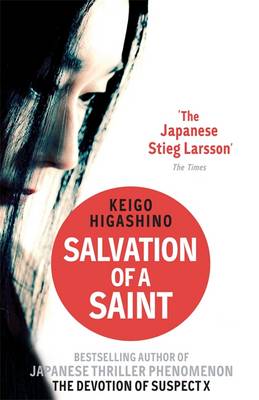
Keigo Higashino’s Salvation of a Saint

Keigo Higashino, Salvation of a Saint (2018, translated by Alexander O Smith, Abacus 2012)

salvationThis is exactly the kind of book I’ve decided not to read any more – the novel equivalent of a run-of-the-mill police detective TV series. But I’d borrowed it from the Book Club, and the cover quoted The Times saying Keigo Higashino is ‘ the Japanese Stieg Larsson’ so I read it.

Evidently it’s part of a series, the second to be translated into English, featuring Tokyo police detective Kusanagi, his retired scientist consultant–friend Professor Yukawa and junior-detective-who-brings-a-woman’s-insight, Utsumi.

It’s pleasant enough, once you get past the very telling writing (as in not showing), like an episode of Jonathan Creek. It pretty much tells you who done it on page 5 before the murder has even happened, and from then on the question is how.

If there’s any wider social observation it’s been lost in translation. I don’t mean that Alexander O Smith has done a bad job. As far as I can tell the translation itself is fine. But if, for example, there are subtle comments about cultural change in modern Japan, they are too subtle to cross the East-West divide. Unless something huge has been lost, the only possible justification for the comparison to Stieg Larsson is that the series is very popular. There is certainly none of Larsson’s politics.

Also: the title doesn’t make sense.

As we say in the Book Club, 2 out of 5.

To Be Honest in Bankstown

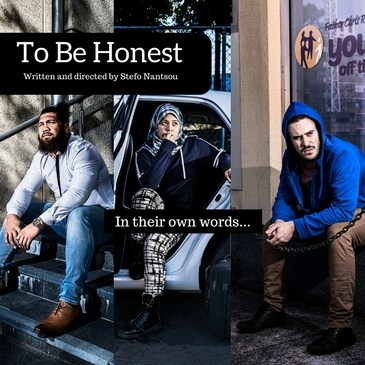
To Be Honest, written and directed by Stefo Nantsou, produced by BYDS (Bankstown Youth Development Service) and YOTS (Youth Off The Streets)

honest.jpg

This is an excellent piece of theatre, on for just five nights, counting the preview on Tuesday. What I write here might make it sound worthy, but if ‘worthy’ sometimes implies ‘dull’ it certainly doesn’t in this case.

This is the sixth theatrical work that Stefo Nantsou, formerly of the Sydney Theatre Company, has produced at the Bankstown Arts Centre (I’ve blogged about two of them, here and here). Amirah Amin, a social worker at Youth Off The Streets in Bankstown recognised that it would be great if Nantsou could create a show from the stories of the disadvantaged young people she saw as clients. Backed by Tim Carroll, CEO of BYDS, with funding from the NSW government’s Stronger Communities program, Nantsou took up the idea, interviewed a number of YOTS clients, and with their permission created To Be Honest from their responses.

Rather than shape his source material into an over-all narrative or a conventional well-made play, Nantsou opted for a verbatim theatre approach – in effect a collection of interwoven monologues, complete with the repetitions, stumbles and unfinished sentences of actual speech, punctuated by finely judged interactive moments. There’s music – background provided by a handful of musicians, and several big musical numbers, including a rap by one of the ‘informants’ appearing as himself.

The stories – of bullying, illness, homelessness, drug addiction, racism, migration, and above all resilience – are not so much showcased as made viscerally present.

Evidently the preview night was attended by a number of the people whose stories the play tells. Someone said the atmosphere that night was electric, whereas last night’s audience was like ordinary theatregoers. Speaking as an ordinary theatregoer, I was pretty electrified. It’s hard to single out individual performances, but hyper Aanisa Vylet, Bilal Hafda (recognisable from the Bankstown Poetry Slam) and rapper Matuse Peace gave riveting performances, and Esana Tanaki’s singing was heart melting.

Stefo Nantsou says, ‘In many ways I think Bankstown is creating work for the whole of Australia.’ He’s right. This evening produced the kind of buzz I remember from the early days of the Nimrod in Sydney or the Pram Factory in Melbourne: voices that need to be heard are being given a space to speak.


The Book Group and China Miéville’s October

China Miéville, October: The story of the Russian Revolution (Verso 2017)

October

Before the meeting: The Book Group was recently immersed in post-revolutionary China with Madeleine Thien’s Do Not Say We Have Nothing. Someone remembered that this year is the centenary of the October Revolution and that China Miéville (whose The City and the City we read a while back) has written a book about it. In a nice piece of symmetry, given that according to the Western calendar the October Revolution happened in November, October is our book for September.

The book is tough going in some ways. The story of Russia from February to October 1917 is bewilderingly complex. A ‘Glossary of Personal Names’ at the back gives brief notes on 55 people who played significant roles. Maps of Petrograd and European Russia offer minimal help with the logistics. The multiplicity of political parties, and factions and committees within those parties, and the ever-shifting relationships between them, have a dizzying effect. Not to mention the fluid allegiances and political positions of the lead players.

But once you realise you don’t have to be on top of every detail, it’s an exhilarating ride. Miéville describes his intention in an introduction:

Though carefully researched – no event or spoken word described here is not recorded in the histories – this book does not attempt to be exhaustive, scholarly or specialist. It is, rather, a short introduction for those curious about an astonishing story, eager to be caught up in the revolution’s rhythms, Because here it is precisely as a story that I have tried to tell it.

He goes on:

The year 1917 was an epic, a concatenation of adventures, hopes, betrayals, unlikely coincidences, war and intrigue; of bravery and cowardice and foolishness, farce, derring-do, tragedy; of epochal ambition and change, of glaring lights, steel, shadows; of tracks and trains.

It would be hard to find a better description of the book than that.

It tells the story in 10 chapters: ‘The Prehistory of 1917’, then a chapter for each month from February to October, and finally ‘Epilogue: After October’. Inevitably, given that structure, there’s a lot of One Damned Thing After Another. Miéville’s chapter titles help to keep one’s bearings. For example, the central theme in Chapter 3, ‘March: “In So Far As”‘, is the playing out of the decision in March that the Soviet (the organisation representing workers, soldiers and peasants set up after the February Revolution) would not take power itself or be part of the Provisional Government, but would support the Provisional Government ‘in so far as’ (postol’ku-postol’ku) its actions met with the Soviet’s approval. The title of Chapter 4, ‘April: The Prodigal’, signals that we are to keep an eye on Lenin, as this who returns from exile in that month.

Miéville has a good eye for the colourful, telling or absurd moment. My favourite occurs in the most intense moments of October, when a group of officials who support the Provisional Government demand that a member of the Red Guard to let them pass or kill them, making them anti-Bolshevik martyrs. He tells them to go home or he’ll spank them.

And though his language is mostly, appropriately, functional, every now and then there’s something to delight. Alexander Kerensky  addresses the troops in March, and is met with testeria. It took a moment, but I realised that a less gender-conscious writer might have said ‘hysteria’, and I had a new word in my vocabulary.

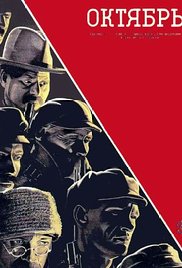
octobermovie.jpgThe book sent me back to Eisenstein’s 1928 film October (on YouTube here). What to a 2017 reader and film-viewer is history, was living memory to the film’s original audience. The book explicates some episodes. The episode of the Red Guard threatening to spank the officials is a good example: in the absence of dialogue (at least in the version I saw), repeated shots of the handsome young soldier calmly shaking his head ‘No’ would have reminded the 1928 audience of the famous line – for us, it does so only if you’re read it elsewhere. On the other hand, because many of the places that feature in the revolution were virtually unchanged in 1928 the film illustrates the book brilliantly. The role of women, which I suspected Miéville had retrieved for modern sensibilities, features prominently in the movie.

The main difference between the two is probably in the tone, especially in the endings. The movie ends with a sense of a triumphant beginning, the book with a lament for how terribly wrong it all went in the following years, and a muted hope that a just, unexploitative society might yet be possible, that the lessons of the Russian Revolution are yet to be learned.

The meeting: There were six of us, and though not everyone loved the book, it generated a terrific conversation.

One group member said that this is not a book to listen to as an audiobook: the stream of Russian names, the absence of the chapter-heading signposts, the impossibility of flicking back and forth in the text make it almost impossible to follow the story. A couple felt that the writing was pedestrian. We all engaged with the content: not so much ‘this is what a revolution looks like’ as ‘ this is how that one happened’. We lamented the fragmentation of society that makes mass actions like those in this book seem almost surreal, and the way technology has speeded up communication so that paradoxically there is less time for thought, for response, for organising.

Is violence necessary for major social change? Was Stalin inevitable? These questions were not answered, either by the book or by us.

Benjamin Law’s Moral Panic 101

Benjamin Law, Moral Panic 101: Equality, acceptance and the Safe Schools scandal (Quarterly Essay 67, 2017)

qe67.jpgIn conversation with David Marr about this Quarterly Essay at the Seymour Centre in Sydney recently, Benjamin Law produced a wad of A4 paper at least 4 centimetres thick printed on both sides. It was a print-out of articles published in the Australian covering, or at least mentioning, the Safe Schools program over a single year, roughly one every two days. The stories, he says in this essay, ‘were at best inadequate or misleading, at worst simply false’.

The essay summarises the Australian‘s campaign and its effects. It attempts to correct the record about the nature of Safe Schools, which was not a vile, child-corrupting Gay Marxist propaganda program, but a well-thought out, minimalist initiative to help schools counter bullying of lesbian, gay, bisexual, transgender, intersex and queer children, launched by the Abbott government in 2014, having been committed to by the Gillard government in its last weeks. The essay lays out much-needed information about where the medical profession and the law in Australian stand in relation to young people who identify as transgender, about queer theory, about the significance of same-sex marriage in combatting the systemic oppression of LGBTIQ people. Perhaps most tellingly, it reports on conversations with some of the young people whose wellbeing Safe Schools sought to protect (and still seeks, though not in all states and without federal funding) – something not done by any of the Australian‘s 200 or more articles.

Moral Panic 101 could be a sequel to Robert Manne’s Quarterly Essay 43, Bad News: Murdoch’s Australian and the Shaping of the Nation (2011), which provided an epigraph for one of its sections:

In these campaigns, [the Australian‘s] assigned journalists appear to begin with their editorially determined conclusion and then seek out evidence to support it.

Here, extracted from Law’s essay, is a dishonour roll of journalists who, either as right-wing culture warriors or as uncritical relayers of the RWCWs’ ‘facts’, contributed to the News Corp’s campaign:

  • Miranda Devine, ‘the Daily Telegraph‘s resident prophet of doom’
  • Rita Panahi, ‘Herald Sun columnist and Twitter firebrand’
  • Natasha Bita, ‘a Walkley Award–winning journalist who has worked across News Corp’s mastheads since the 1990s’
  • the Herald Sun‘s Susie O’Brien
  • The Australian‘s Rebecca Urban, who wrote thirty-one stories and 17 thousand words about Roz Ward and Safe Schools in one year, ‘all of which were critical’
  • Andrew Burrell, who co-wrote at least one of Rebecca Urban’s articles.

No one was surprised when News Corp went after Benjamin Law the week this essay was published. Given that he’s such a sweet presence they had to search, but they found an ugly tweet, misinterpreted it to make it infinitely uglier, and banged on about it for days, to the extent that Lyle Shelton could give him as an example of the ugliness of the Yes campaign (few reasonable people would see the goodlooking, charming, witty and intelligent Mr Law as in any way ugly). The most astonishing moment in the Marr–Law conversation at the Seymour Centre was that both men revealed that they still subscribe to the Australian.

It’s easy to become fascinated by the illogic, hypocrisy and dishonesty of some commentators, journalists and public figures (I don’t follow @realdonaldtrump on Twitter but I regularly go looking to see what he’s tweeted). What Law has done in this essay, in carefully documenting, analysing and refuting the misrepresentations, goes well beyond that fascination, and has earned our gratitude.

We can also be grateful for his discussion of transgender issues, based mainly on interviews with young transgender people and with Dr Elizabeth Riley, who has worked with gender-variant young people for about a decade. Contrary to what some parts of the press might imply, for example, medical experts in Australia will not prescribe irreversible hormone treatment before puberty. And no Australian minor can commence irreversible hormone treatment without a determination from the Family Court that ‘the child had sufficient intellectual sophistication to understand what was involved, and all the possible consequences’.

Few things can trigger emotional responses more than the accusation of harm to children, especially harm that involves sex. It’s an extraordinary achievement of this essay that, while it leaves you in no doubt where it stands, it remains judicious, calm, reasonable and open to complexity. It doesn’t feel like the last word on the subject, but it’s a good one.
—–
A final note. Like  most current or retired editors or proofreaders, I tend to be distracted by my own pedantry. If I hadn’t been a fan of Benjamin Law and editor Chris Feik before, I would have been when I read this sentence, talking about queer theory, which says ‘discomfort’ where far too many people would have ‘discomfit’, thereby depriving us of the other useful, but now dying meaning of ‘discomfit’:

After all, one of its central tenets is that it’s supposed to discomfort people by upending how we perceive norms, and by interrogating the social scaffolding around gender and sexuality we take for granted.

Nicola Knox’s Green Light Running

Nicola Knox, Green Light Running (self published 2012)

glr.jpgThis is not one of those self-published books with a chip on its shoulder about the publishing industry.  It’s much more modest than that – so modest that I can’t find any information about where to buy a copy. Mine was a gift from the author, an honour to which I owe a number of Nicola Knox’s poems having appeared in The School Magazine when I was editor. My impression is that she only ever intended a small, intimate circulation. (Maybe I’m projecting: my own three self-published books of verse are glorified end-of-year greeting cards – though of course I’m delighted whenever someone buys one from Lulu.)

The book is a witness to the value of creativity, of making in response to experience. Where one person might take out a sketch book and pencil or paints, another will reach for pen and notepaper. Poems here have been inspired by travel, by family life, by childhood reminiscence, by works of art, by ancient and modern history. They are the fruits of life lived with an active mind, a mind that it’s a pleasure to spend time with.

Just to give you a taste, here’s a poem that speaks softly but carries a big stick to one of the big issues facing us at the present moment:

Refugee Boat

The heart of Pharaoh
was dry and shrivelled
as an old walnut.

But his daughter
dove gentle
beautiful and kind
was loved as her father
was feared.

On a morning
splashing with court ladies
in the Nile, she did not hide
her pity for the plump infant
found in a coracle
rocking gently
among river reeds.

So the princess
and the alien child
gazed upon each other
and from that moment
all things changed.

A second volume of Nicola Knox’s poetry, Verandah Man, was published by Ginninderra Press in 2016, and is available from the Ginninderra website.

aww2017.jpg

Green Light Running is the eleventh book I’ve read for the 2017 Australian Women Writers Challenge.
Ali Alizadeh’s Last Days of Jeanne d’Arc

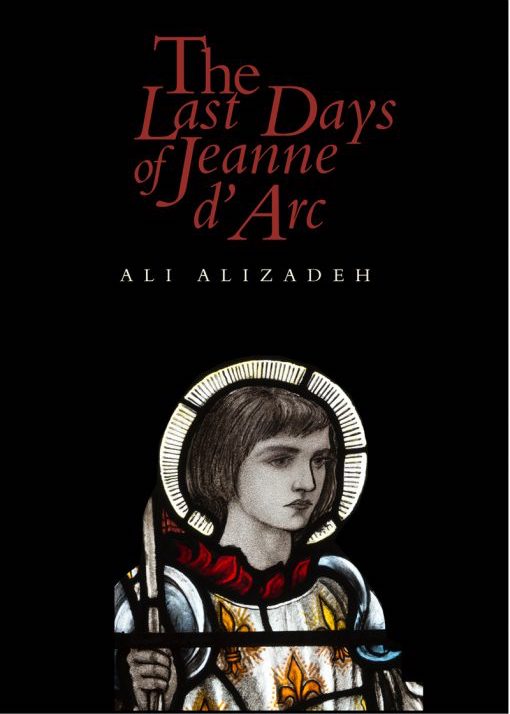
Ali Alizadeh, The Last Days of Jeanne d’Arc (Giramondo 2017)

jeanne.jpgI have a number of St Joans in my head.

Joan of Arc was one of the array of saints who populated my Catholic childhood. She did stand out from the crowd, but I don’t remember being much impressed that she was a cross-dressing, gender-bending, sword-wielding, authority-defying young woman – her armour was no odder than the flowing robes of many male saints, her defiance of authority was mild compared to Jesus’, and even her death was no more terrible than, say, St Laurence roasted on a spit or St Maria Goretti stabbed 14 times when she rejected a young man’s sexual advances.

joan.jpg

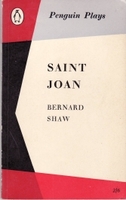
I loved George Bernard Shaw’s Saint Joan (first performed in 1923) which I read as an 11 year old in the Collected Plays I sneaked from the top shelf of the china cabinet. (I also loved Man and Superman, despite its disappointing lack of superheroes.) I was thrilled that a Big Name Writer was acknowledging someone from Our Team – Team Catholic. I probably read it again or saw a performance as a young adult, but I don’t remember any change to my sense of the play. Rereading it just now, I realise that Shaw was actually trying to poach Joan for Team Protestant (or at least Team Proto-Protestant).

In a Sydney University Film Group screening in about 1970 of Carl Dreyer’s The Passion of Joan of Arc (1928), Maria Falconetti’s silent tears as the flames rose  left an indelible imprint. The first (and only?) night of Dorothy Hewett’s musical Joan in Canberra in 1978 was a fabulous feminist event, complete with bonfire:

Mother, I’m rooted
spurred and booted,
fucked, and far from home.

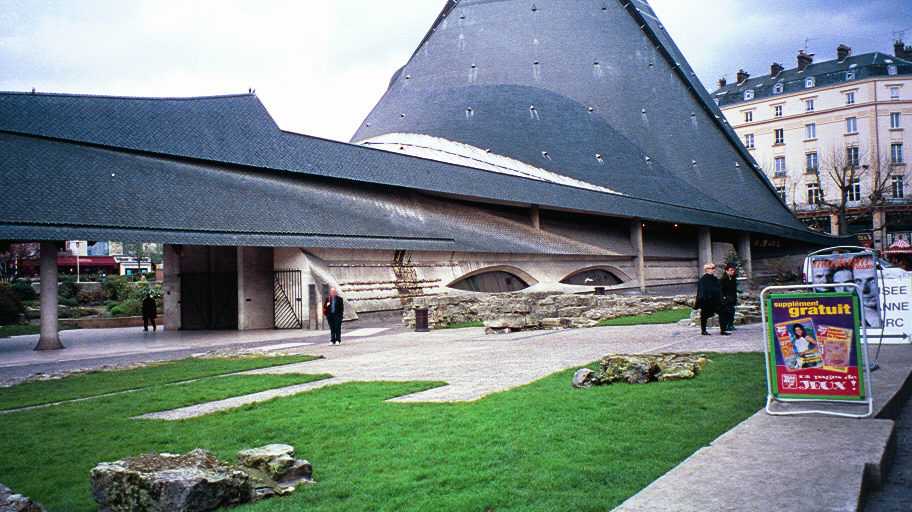
Jeannd'arc.jpgWhen we visited Rouen in 2002 I insisted on being photographed at the Eglise Sainte-Jeanne-d’Arc. I’m the tiny black-clad figure to the left of centre.

So, I’ve got lots of Joans. And I’m not the only one. An essay on the Overland site by Ramon Glazov, ‘The Maid of Orleans, sacred and profane‘, has a wide-ranging survey of Joans, including Shakespeare’s calumny in Henry VI Part I (news to me) and some bizarre French science fiction/fantasy.

When I heard that Ali Alizadeh, raised in a majority Muslim country and a formidable presence in Australia’s poetry scene, had written a Joan novel, my ears pricked up.

The Last Days of Jeanne d’Arc gives us a Joan for the early 21st century.

For a start it acknowledges that it occupies a territory somewhere between known fact and informed invention. It insists on Joan’s historical reality, and her status as a great military leader who changed the history of Europe. A lively sixteen pages recount highlights of hostilities between England and France from 1329 to 1429, when the young peasant girl Jeannette Darc first visited the court of Charles VI and offered to drive the English out of France. At a number of points elsewhere, the narrator reminds us explicitly that historians have been arguing for a long time about aspects of Joan’s story.

Issues that were of little interest to Bernard Shaw – which might be summarised as sex and violence – loom large in our culture now, and Alizadeh’s novel attends to them. It engages with the tactics of war, and doesn’t flinch from the brutality of medieval European warfare: Jeanne has to face the hideous slaughter her idealistic mission unleashes. Her English prison guards are as predatory as the elite footballers who these days regularly make headlines. The book faces the now obvious question of Jeanne’s sexuality, and where lesser hands might have made something tacky or bandwagonish of this, Alizadeh makes something deeply affecting: at the heart of his story is Jeanne’s deep, troubled yearning for intimacy with another woman – sinful in the eyes of the Church, though less unambiguously so according to Jeanne’s Voices. The love story is complex, joyous, devastating, harshly cool-eyed and – in a brilliant final twist that takes us forward in time to the church in the photograph above – supported by evidence.

Another thing that makes the book very much of our time is the language. Here’s a typical passage from the early chapters outlining the back-story:

1413
In England, Henry V succeeds his father, the Lancastrian usurper of the English throne. Twenty-seven years old, a grotesquely scarred face. An extremely devout Christian, not at all the fun-loving, riotous youth of Shakespeare’s future play. Severe and frankly soulless. Muscular. Possibly a psychopath, probably a war criminal. Is never seen to smile. Must prove himself to the English nobility as their new ruler, as a real, mighty man. Or else his dynasty may be toppled just like the dynasty that his father toppled. Is keenly aware of the turmoils in France. Decides that the time has come to renew the claim to the throne of France. Raises an army of ten thousand men and a fleet of 150 ships for the journey across the channel.

It would be hard to find a paragraph in the early part of the book that doesn’t disregard schoolroom rules of syntax in this way. The early pages that deal with Jeanne in her prison cell are similarly syntactically non-conforming (‘Two men enter. Agitated, brusque. Steel helmets and steel kneecaps.’). The effect is unsettling: who knows where the next full stop will fall, or whether there will be a verb in the next sentence? You just can’t skim these pages.

Later, during the love story, there’s a daring device where point of view changes frequently and without warning. There are at least two narrators in these chapters: Joan in her cell telling own story to Piéronne, her absent confidante; and an omniscient narrator who describes events in the present tense, as if creating them in his imagination as he writes. Here’s a taste, from a scene where Jeanne has just had an awkward encounter with a fanatical friar:

I knelt, ate, crossed myself and rose to my feet. She feels tipsy, giddy and a little disoriented. She nearly trips over a pew and falls against the chapel’s arched entrance. She pushes disorderly locks of hair off her face. My hair was getting too long. It almost reaches her shoulders. I wondered if you would cut it for me.

The voices alternate, sometimes just one short sentence each at a time. I found myself experiencing something like vertigo. There’s probably a better technical term for this, but Brechtian is the best I can do. (Perhaps it won’t be so disorientating in the audio book, where I expect there will be at least two readers.) Paradoxically, the effect is to underscore that Jeanne’s story is real, including and perhaps especially the parts that are explicitly invented.

There’s a new Jeanne in my head. None of the others have been damaged, but this one – at least for now – is more recognisable than any of the others as fully human.

Giramondo sent me a review copy of The Last Days of Jeanne d’Arc, and when I lost the bag it was in I spent my own money on a replacement.

Jennifer Maiden’s George and Clare, the Baby and the Bikies

Jennifer Maiden, Play with Knives Four: George and Clare, the Baby and the Bikies (Quemar Press 2017)

pwk4The first page of this short novel –– just over 157 pages – drops the reader in medias res, that is to say into the middle of a long-running story. Arguably that’s what any decent novel does, but in this case you could go back and read a lot of what has gone before. See my post on Play with Knives: Three: George and Clare and the Grey Hat Hacker for one synopsis.

In the first few pages, George Jeffreys and Clare Collins, once Probation Office and convicted child murderer (that is, convicted when nine years old of murdering her three younger siblings), now lovers thirty odd years later, are languishing in a heatwave in Mt Druitt in Sydney’s western suburbs. In a break from working on a report for their NGO employer about Indigenous children in custody in Sydney’s Western Suburbs, they chat about a draconian policy at the Cobham Juvenile Detention Centre (a real place, real policy), and then Clare looks up an extract from William Hazlitt’s Liber Amoris on Project Gutenberg and reads out a passage, which makes them both cry – and which they then discuss in erudite terms, before indulging in some erotic play.

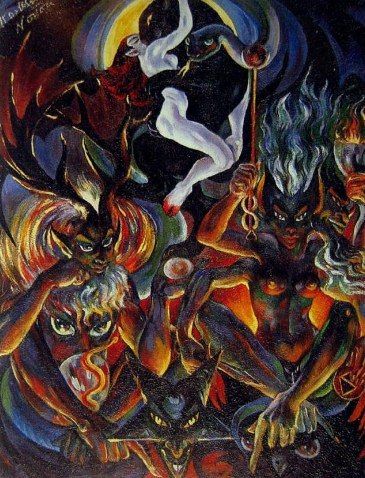
pantherThe book continues as it has begun: whatever else may be happening, George and Clare are always good for a bit of literary chat, some sharing of random information (George refers to his ‘op-shop mind’), commentary on international politics (the Grenfell Tower fire of June 2017 is particularly upsetting), plenty of erotic carry-on (the word ‘foreplay’ features frequently), and lots of mutual introspection. Quotes from poetry and references to visual art abound: in this book, prints from Rosaleen Norton, the ‘Witch of King’s Cross’, play a significant role (there’s an example on the right, and you can click on the image for more). Not everyone would agree with Clare’s description of Roie’s work as mostly sweet and pretty.

The story unfolds in chapters that mostly alternate between prose narrated by George, and third person narration in verse. The baby great granddaughter of their Aboriginal friend Ruth has gone missing, and the quest to find her, alive or dead, involves, among others, a bikie gang (the Warriors of Hell), a super-criminal named Schmidt and his three diverse lovers, a number of George’s former Probation clients, an inmate of the juvenile detention centre (up on the roof, echoing recent real-world headlines), Idris the Grey Hat Hacker from the previous book now in Moscow, and George’s contact in the CIA in Langley. There’s a boxing match between two men who are old enough to know better (in which Jennifer Maiden, through George, reminds us of the second line to Muhammad Ali’s ‘Floats like a butterfly stings like a bee’), a witchcraft ceremony, a fabulously tense shoot-out in the Jenolan Caves, a number of deaths and a birth.

It’s good fun, it sticks to the tropes of the thriller genre, and could make an excellent movie. Some difficulties are solved a little too easily, and some of the connections between events aren’t clear, but I can’t say I mind. It’s full of surprise twists, not in the plot so much as in the telling: you never know where George and Clare’s minds will go next. For just one example, here’s George in the middle of the climactic cave scene, where people are dead and dying and things could hardly be more urgent:

… in front of me was a formation of such irresistible fineness that it stopped everything else in me for a second. The plain clear light was floating on a white inclining bank of intricately furrowed but luminously smooth limestone, with a cluster of long tasseled objects like sea plants embedded in the top. These showed delicate tints from iron, but in the sweet colours of skin, not its usual salty rust.

I remembered Proust writing that one can’t appreciate beauty when in severe sadness, but I wanted to add something about that point in which one is wracked with anxiety, and beauty is the only thing one can experience, perhaps just as those in grief always obsess on details. I wanted to tell that to Clare, and the need to do so reincarnated me – or maybe disincarnated me enough for me to continue.

Through it all, George and Clare’s relationship develops and though it may be a bit prim of me, I’m not going to say how. I will say that the last two short chapters, while completely within the conventions of the genre in having the world back to normal now that the threat has been dealt with, are deeply satisfying in terms of Clare’s long story arc: she can never forget that she killed her younger siblings when she was nine, has never asked forgiveness, but she does seem at last to have found a possible way to move on.

aww2017.jpg

George and Clare, the Baby and the Bikies is the tenth book I’ve read for the 2017 Australian Women Writers Challenge. I obtained it, as you can, as a free download from Quemar Press.
Australian Poetry Journal 7:1, Skin

Ali Cobby Eckermann and Ellen van Neerven (editors),  Australian Poetry Journal, Volume 7, Issue 1: Skin (2016)

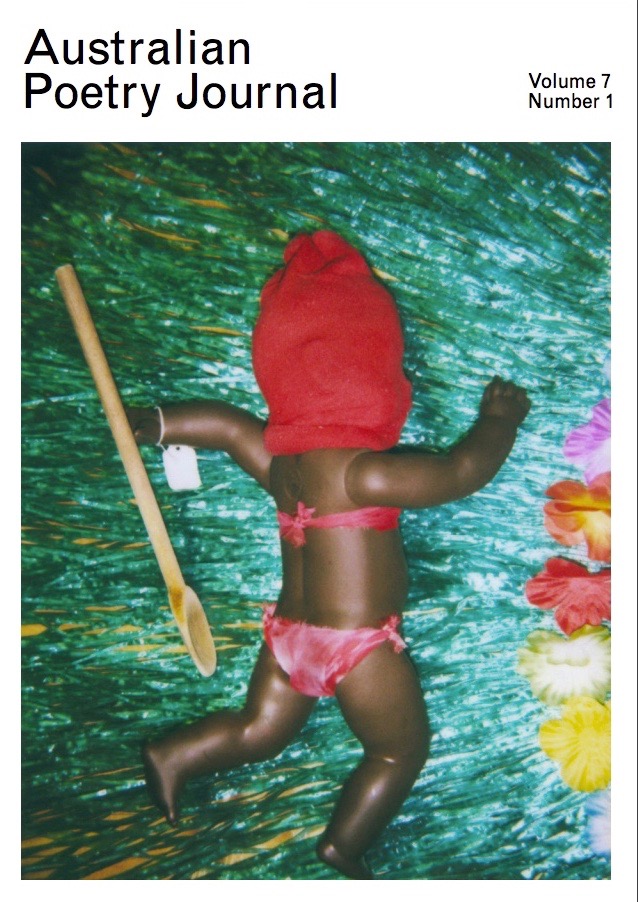
apj71The cover of this issue of Australian Poetry Journal features a brilliantly eye-grabbing Destiny Deacon photograph, Escape from the Whacking Spoon (2007). As the first issue covered by the new policy of having different guest editors for each issue, this one is edited by two leading Aboriginal poets, which ensures that it follows through on the cover’s promise.

There are three sections:

  • Skin 1: 34 poems by 25 Indigenous writers
  • Skin 2: 16 poems by 13 non-Indigenous writers
  • Transforming My Country (edited by Toby Fitch): 12 poems responding to Dorothea Mackellar’s ‘My Country’,

The selection is very rich, for many of the individual poems and for the extraordinarily valuable dialogue created by placing them between one set of covers. I dog-eared the pages with these poems from the first two sections in my copy (your mileage will very – I recommend you get hold of your own copy via Australian Poetry Pty Ltd’s web site):

  • Claire G Coleman, ‘Strawberry Juice’: starting from the image of spots of strawberry juice staining her writing paper, the poet plays with the notion that directions for colonial killings and records of them were written on paper. Ink stains, like blood stains, can’t be removed, and the lines that bring it home:
    _
    __Notice how paper covers rock
    __Covers
    __My country, my people are one
    __Notice how easily paper tears
    _
  • Aunty Kerry Reed-Gilbert, ‘Love comes in many colours’ The poet greets her granddaughter:
    _
    Her blonde hair cool against my black skin her whiteness grabs my heart a new day dawning for this land Australia as we dance to the sounds of the oldest culture in the world. Love comes in many colours.
    _
  • Kate Adler, ‘Sorry’. A non-Indigenous person at a Sorry Camp:
    _
     __Hard to witness wounds like these
    __but love is deeper than skin.

The third section includes work by some heavy hitters of Australian poetry, including brilliant poems by the editors of this issue, Ali Cobby Eckermann and Ellen van Neerven. Eileen Chong (‘My music is wrong – nothing / has been written down right’) and Hani Abdile (‘Opal-hearted country / I’m now one of your unwanted beings / I’ve come to love you sunburnt’) write from immigrant and refugee perspectives. The poem is deconstructed, thesaurised and anagrammatised. Toby Fitch’s introduction describes Lisa Gorton’s conceptually and concretely thrilling poem as an ‘almost-epic’ that ‘explores in microscopic detail the history of the grounds of Royal Park, Melbourne’. I’ll end with some lines from each of the Indigenous takes on the Mackellar poem:

Alison Whittaker (‘A love like Dorothea’s’):

I’m sorry, sweet Mackellar, that it famished all your cows,
y’paddock’s yellow-thirsty-sudden-green; no telling how.
That the gold-hush-rainy-drum hard to your violence and your plow.

Natalie Harkin (‘Heart’s Core Lament’, which is hard to represent accurately here, as it depends on justifying the text on the page, and includes quotes from colonisers’ texts in the margin, but here goes):

harkins.jpeg

Ellen van Neerven (‘My Country’):

my country
is between two rivers

two ribs
two hip bones

Ali Cobby Eckermann (‘Transforming My Country’, which plays with Mackellar’s words to produce radically different meanings):

Who pays back to Earth?

Not she and soft-hearted love
What a hush of her heart, and her
I have her share, her jewel
Though not her land
Your love of my land is tragic

——-

(I won’t repeat my own favourite anecdote about ‘My Country’ and Dame Mary Gilmore, If you’re interested you can read it here.)