Category Archives: Books

Andrew McDonald’s Night Music

Andrew McDonald, Night Music (Arcadia 2017)

nightmusic

As I was ruminating on Andrew McDonald’s Night Music, I kept thinking of Chaucer’s phrase ‘the life so short, the craft so long to learn’ the opening of The Parlement of Foules:

The lyf so short, the craft so long to lerne,
Th’assay so hard, so sharp the conquerynge,
The dredful joye, that alwey slit so yerne

Chaucer is talking about love, but I’m not alone in thinking they apply at least as well to art, specifically to poetry.

Andrew McDonald has quietly persisted with the craft for decades. Night Music is his third book in 40 years. His first, Absence in Strange Countries, was part of UQP’s Paperback Poets series in the 1970s, the series that launched David Malouf as a poet. His second, The One True History, appeared in 1984 (and can now be bought for more that £50 from Amazon). Though his poetic voice hasn’t been completely still since then – poems have appeared in journals and end-of-year anthologies – it’s been a long time between books.

So it’s fitting that the opening poem ‘These words’, can be read as marking a kind of re-entry, moving from a tentative impersonality to a moment of relief and the possibility of a meeting of minds:

these-words.jpg

There’s a strong sense of place in what follows. The inner-western Sydney suburb of Leichhardt features in early poems, notably ‘Ode: Marketown’, which is dedicated to JF, il miglior guida and John-Forbes-ishly yokes images of tatty urban life to erudite allusions:

It’s shaping up as a day for reading cornflakes
packets in the supermarket considered as prolegomenon
to a proper reading of the Purgatorio.

Later, there are places visited – in rural New South Wales, North Queensland, Scotland,  Ireland, the Lake District (I think), an unnamed tropical beach. As an old Innisfail boy, I love ‘In the Rainforest’, one of the longest poems in the book, in which the Daintree National Park takes on metaphorical power:

The trees assemble themselves in their lack of rows or thought,
higgledy-piggledy, overgrown with creepers and vines and palms,
undergrown with mantras of the unnamed, the undiscovered, the unsuspected –
yet all this vast hubbub has, somewhere or other, to stop:
at the sea, at the incision of a road, at the counter-text
of pasture or cane or tea or some other human blankness,
so that the voice of the forest must finally cut short
its ancient murmurings and chatterings, its breath steam up
the pane of some other idea, until it simply ceases.

There are domestic moments. I’m a sucker for a poem about men and babies (see Francis Webb’s ‘Five Days Old‘ (at the link you need to scroll down a bit for the poem) or Galway Kinnell’s ‘After making love we hear footsteps‘). There are two here: ‘Night’, in which the speaker worries that his baby son will stop breathing:

I lean over him long, feeling the small warmth
that rises with his milky breath,
the smell if not the sound of life.

and ‘Cradle Coda’, which reads as written decades later. Here is the whole poem:

cradlecoda.jpg

It’s just a couple of weeks before my own first grandchild is due, so this poem strikes a chord. And I seem to have come back to Chaucer: ‘the lyf so short.’

There’s lots more than this in the book, much to enjoy. A fourth book is on the horizon. I’m glad.

My copy is a gift of the author, who has commented on this blog occasionally but whom I don’t think I’ve met in person.
The Book Group and James Rebanks’ Shepherd’s Life

James Rebanks, The Shepherd’s Life (Penguin 2016)

shepherd.jpegBefore the meeting: A number of the chaps in the group (me included) had been charmed by James Rebanks when they heard him on Australian radio earlier this year. Plus his book is short, always desirable for the Book Group and especially so at this time of year. So this is what we read.

The book is part memoir, part family history, part advocacy for a way of life and a community of people. The early pages frame the conversation neatly: Rebanks tells of teachers who urged him and his fellow students to study hard if they didn’t want to spend the rest of their lives on their family’s tiny farms in the inhospitable fells of England’s Lake District, of a teacher who waxed lyrical about the beauty of that same region from the point of view of Romantic poets and those who followed after them, but seemed to regard her students as incapable of understanding such elevated thoughts:

I wanted to tell that teacher that she had it all wrong – tell her that she didn’t really know this place or its people at all. These thoughts took years to become clear, but in a rough childish form I think they were there from the start. I also knew in a crude way that if books define places, then writing books was important, but that we needed books by us and about us. But in that assembly in 1987 I was dumb and thirteen, so I just made a farting noise on my hand. Everyone laughed. She finished and left the stage fuming.

James Rebanks is no longer dumb and thirteen, and though this book rises from the same impulse as that farting noise, I’d be surprised if, when that teacher reads it, she fumes even the tiniest bit. Millions of people visit the Lake District each year for its beauty and simply don’t see that it is a workplace, or have any sense of the accumulated knowledge and connection to country of the people who work there. To them, in a very real sense, Rebanks and his community are invisible. The book doesn’t reprimand or reproach the visitors for their narrow vision. It sets out to show them – I should say us, even though I haven’t been there –  what we have failed to see, and it succeeds brilliantly.

There’s a lot about sheep, about sheep dogs, about grandfathers, fathers and mothers and sons and daughters, about lambing and tupping and death, about fine ewes and tups (a word I’ve previously only known in the rhyme ‘Thomas a Tattamus took two tees / to tie two tups to two tall trees’), about the qualities of different breeds and the way the seasons run the life of the farms. There’s Wordsworth (not as unaware of the farmers as young Rebanks thought) and Beatrix Potter (not as the cranky child-hater I’d read about elsewhere). And there’s a lot about a way of life that is perhaps more than a thousand years old and has survived the depredations of capitalism more or less intact.

In some editions the book is subtitled ‘Modern dispatches from an ancient landscape’. I think that’s a mistake, because its whole purpose is to claim the land back from the idea of it as ‘landscape’, as something to be looked at. It moves in the direction of what I (dimly) understand of the Aboriginal idea of Country – and it’s no surprise that one section is introduced with a quote from Oodgeroo Noonuccal: ‘Let no one say the past is dead. / The past is all around us and within.’

I’ve sometimes thought that I should start a blog post about a book by mentioning how it connects with other recent reading. This would have been a good one to start with: the scene described in this book when the radioactive cloud from the Chernobyl disaster appears is not as intense as those in Svetlana Alexievich’s Chernobyl Prayer, but it’s definitely in the same peasant universe. The account of the obsessive value that some shepherds place on particular breeds of sheep and the agony caused by government slaughter to prevent the spread of disease is gripping in its own right, but also makes an excellent footnote to Grímur Hákonarson’s great movie, Rams.

I expect the book will resonate with anyone who spent their childhood on a farm, whether they dealt with sheep or not. I’m a thoroughly citified seventy-year-old, but the boy who helped decapitate a stillborn calf and pull it out of its mother, while his father held the mother’s head and crooned reassurance to her – that boy came alive again as I read this book.

After the meeting: It was our end of  year meeting in a restaurant, so conversation was fragmented and only about the book for a comparatively brief time. A show of hands indicated we were unanimous in liking the book. One chap felt it was too long (I don’t agree) and repetitive (yes, but I didn’t mind), poorly edited (hmm, I did notice one or two things), but he didn’t want to put it down: it turned out that like me he was brought up on a farm and had no attraction to the work or the way of life, and his father ran sheep, so in a way the book spoke very directly to him.

There was of course some controversy, but it was about the New South Wales government’s intention of pulling down a sports facility that’s less than 20 years old, and about the media treatment of the latest wave of sexual harassment scandals. There was good news from the group member who has been dealing with aggressive prostate cancer, we had a Kris Kringle or used books, and parted wishing each other good things for the end of the year.

Adam Aitken’s Archipelago

Adam Aitken, Archipelago (Vagabond Press 2017)

archipelago.jpg

Adam Aitken is a Sydney poet whose work often deals with aspects of living, working or travelling overseas. He has written about time spent in Asia, particularly his mother’s birth country, Thailand, in England and Hawaii. Most of the poems in Archipelago have to do with Paris or tiny villages in the south of France.

Aitken has written about his own work (in ‘A poetics of (un)becoming hybridity’, an article in Southerly Nº 73, 2013):

I would say that like many Australian poets who live and work overseas, I write as a temporary sojourner who is acutely aware of the limits of a touristic perspective.

In most of the poems in Archipelago, the voice is that of a temporary sojourner who may at times be a tourist (and part of the pleasure of the book for me is that evokes my own time in the south of France a couple of years ago), but is generally more engaged.  Possibly the closest thing to a simple tourist poem is ‘What (not) to do in St Victor-des-Oules’, in which the (non-)attractions of a tiny village are enumerated with wry humour:

Out of reception we stroll to the recycling depot
through a pall of burning autumn leaves.
A shooter lets off his blunderbuss
in a village with no twin – no cafes, no post office,
no fountain in the square.

Other ‘touristic’ poems are less ironic. In ‘At Maruéjols’, for example, the speaker’s stroll through the town is also a stroll through the centuries, beginning in the 5th Century, and arriving in 2012 with ‘two men on extended leave /around a fire / growing beards in a silk worm attic’.

Mostly, though, the poems engage with their places more intimately, as from the perspective of someone visiting family. Pam Brown told us at the launch of this book that Aitken has visited the south of France regularly because his partner’s parents lived there, but even without that information, that kind of connection is palpable in the poems themselves. ‘Postcard’, for example, which made me laugh out loud, could only be addressed to someone of whose affection you were confident. It starts out ‘Chère Margaret, / Thank you for letting us stay so long’, and goes on to a litany of complaints – not about the hospitality, but about the winter weather:

I am yet to cough up blood.
The other day I found a dead thrush in the letterbox.
I swept a few frozen comrades off the driveway.
Every day they are falling out of the sky.

‘Maruéjols’ (a different poem from ‘At Maruéjols’) captures the eerie process of going through the possessions of someone who has recently died:

Later, coming to empty your house, we felt
the dark matter of your brain
and what came through it.

The poems move beyond touristic engagement with place in other ways as well, mainly by engaging with other writers and artists associated with the place, and with its history.

The book drew me in and held me. I spent time reading around it, looking up the places, artists and poets described, addressed, mentioned or imitated, and then rereading the poems. My copy of the book is now bulked up with printed-off photos of tiny French villages – including Maruéjols-lès-Gardon (population 179 in 2007), Saint-Victor-des-Oules (pop. 254), Notre Dame de la Rouvière (pop. 410), Mareuil (pop. 1130) –  and images created by Alfred Stieglitz, Henri Rousseau, John William Ashton and Charles Méryon. I’ve read or reread work by or about Jean Jacques Rousseau, Roland Barthes, Ezra Pound, Raymond Roussel (including Adam’s blog post, which is a very useful gloss to his poem ‘Rousselesque’), Jules Renard, John Clare, Kenneth Slessor, New Zealand poet Jenny Bornholdt (the poem quoting her being one of the few with no French connection) and Australian Ouyang Yu, among others.

Philip Pullman’s Belle Sauvage

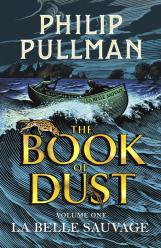
Philip Pullman, The Book of Dust, Volume 1: La Belle Sauvage (2017)

dust1.jpegThis is the first book in a promised trilogy, which is a prequel to Philip Pullman’s masterly His Dark Materials trilogy. If you haven’t read the earlier work I wouldn’t start with this one, there is something incomparably delicious in the way the world is revealed in Northern Lights (1995), and I remember how agonising the wait was for the third volume (The Amber Spyglass) after the cosmic cliffhanger ending of the second (The Subtle Knife).

La Belle Sauvage a big thick book, but a surprisingly quick read. Lyra, the main character of earlier/later trilogy, is a baby in grave danger. There are kind nuns and mean nuns, dangerous daemons and sweet daemons (Pullman’s daemons are one of the great inventions of twentieth century children’s literature), a deeply scary villain, a massive natural upheaval, a magical boat (the eponymous Belle Sauvage), and wonderfully engaging lead characters.

The second half of the book lost some of its charm for me as it turned into a kind of Odyssey-lite. But it might be more accurate to say that in the episodic second half, I became aware that I’m not part of the imagined audience. Given the amount of fruity language, and a sex scene that Malcolm, the young protagonist, sees but doesn’t understand, I’m thinking the book is meant primarily for people in their mid teens.

I was reluctant to embark on this trilogy because my To Be Read Pile is towering. But I’m very glad I did because I was in danger of forgetting what pleasure there could be in a good story. It’s a lot of pleasure.


PS on a tiny thing gave me perverse delight
On page 133 Malcolm is talking to his school friend Eric about spies, and suggests that the music reacher, ‘the shortest-tempered person Malcolm had ever known’, might be one:

Eric thought about it. ‘Maybe,’ he said. ‘But she stands out too much. A real spy’d be less conspicuous. Blend in more.’

On the next page, still in the same conversation, Malcolm suggests that Eric pump his father for information about something.

‘Dunno. I could ask him. But I got to be suitable about it. Can’t just come out with a question.’
‘What do you mean, suitable?’
‘You know. Not obvious.’
‘Oh, right,’ said Malcolm. ‘Subtle’ was the word Eric wanted, probably. And he’d probably meant ‘conspicuous’ earlier.

Well, yes, he probably mean ‘conspicuous’ because that’s what he said. Clearly there’s been an unusual proofreading error. Malcolm’s unvoiced comment only makes sense if Eric used a malaprop earlier (‘A real spy’d be less contiguous,’ perhaps). Someone – I’m guessing a proofreader late in the process – corrected the wrong word and then had a moment’s inattention on the next page. Editorial workers all over the world think, ‘There but for the grace of god …’

The Book Group and Svetlana Alexievich’s Chernobyl Prayer

Svetlana Alexievich, Chernobyl Prayer (1997, trans Anna Gunin & Arch Tait Penguin Classics 2016)

chernobyl.jpegFrom post revolutionary China in Madeleine Thien’s Do Not Say We Have Nothing back to the Russian Revolution in China Miéville’s October, and now forward to post-Soviet Belarus: the book group has lit on a theme.

Before the meeting:
Knowing that Chernobyl Prayer is essentially a series of monologues about the aftermath of the 1986 Chernobyl nuclear disaster, I expected it to be a gruelling read, so I rationed it. I worked out how I would need to read seventeen pages a day to finish the book before the Group met, and set that as a schedule. Of course it didn’t work out like that, but it was a good strategy.

As Studs Terkel’s Working did for working people in the USA, or Wendy Loewenstein’s Weevils in the Flour for the 1930s Depression in Australia, this book provides a platform for scores of witnesses who otherwise would be largely ignored or – as a number of Alexievich’s interviewees tell us – treated as specimens. There are peasants and nuclear physicists, loyal Communists and embittered cynics, ancient women and nine year olds, poets, playwrights and journalists. There’s operatic intensity, fatalistic heroism, jokes that are terrible in both meanings of the word. The cultivated and forested land around Chernobyl is lovingly evoked, along with the invisible horror of nuclear radiation. The monologues that pretty much begin and end the book, each titled ‘A lone human voice’, are long, passionate, heartbreaking stories of love and bereavement, one from the widow of a fireman who was among what we now call the first responders, the other from the widow of a clean-up worker who was conscripted for the job six months later.

Here’s an excerpt from the author’s interview with herself early in the book:

This is not a book on Chernobyl, but on the world of Chernobyl. … what I’m concerned with is what I would call the ‘missing history’, the invisible imprint of our stay on earth and in time. I paint and collect mundane feelings, thoughts and words. I am trying to capture the life of the soul. A day in the life of ordinary people. Here, though, everything was extraordinary: both the event itself and the people, as they settled into the new space. How many times has art rehearsed the apocalypse, offered different technological versions of doomsday? Now, though, we can be assured that life is infinitely more fantastical. … Chernobyl is a mystery that we have yet to unravel. An undeciphered sign. A mystery, perhaps, for the twenty-first century; a challenge for it. What has become clear is that, besides the challenges of Communism, nationalism and nascent religion which we are living with and dealing with, other challenges lie ahead: challenges more fiendish and all-embracing, although still hidden from view. Yet, after Chernobyl, something had cracked open.

I’ve responded to works by other Nobel Prize laureates with a kind of compliant respect, ‘I can see why this person was given the Nobel Prize, and I guess my horizons have been expanded by reading this book.’ In the case of Chernobyl Prayer I am deeply grateful that the Norwegians brought it to my attention (and to the Book Group for prompting me to read it). In illuminating the ‘missing history’ of Chernobyl, it reminds us of the disasters, past and in the making, that we so easily turn our heads away from: Hiroshima, Nagasaki, Maralinga, Fukushima, and the overarching threat of climate change. In this way it is like Maralinga: the An̲angu story by the Yalata Aboriginal Community with Christobel Mattingley, or Yhonnie Scarce’s beautiful and unsettling installation Death Zephyr (click for an image). It would be impossible for a reasonably well informed Australian to read this book, especially the sections dealing with the way political pragmatism trumped the laws of physics, without thinking of the pronouncements on coal from Tony Abbott and his ilk.

The meeting: I hosted the meeting this time. I let people know in advance that I had made an enormous amount of marmalade from our cumquat tree this year. One of the chaps emailed on the weekend, ‘The prospect of marmalade is the only thing getting me through this miserable book!’ Others echoed the sentiment.

It turned out that the conversation was so animated that all thought of marmalade vanished from our minds. It’s a perfect book-club book. There is so much detail that the conversation bounced around from one alarming moment to another, as we reminded each other of what we’d read. We were in awe of the author’s skill in getting such poetry down on the page from her interlocutors’ testimonies.

And now a hasty fourteen lines, written before the group met:

November Verse 3: After reading Svetlana Alexievich’s Chernobyl Prayer
(‘I realise now that terrible things in life happen unspectacularly and naturally‘)
Good Soviets, good peasants trusted
authorities that reassured,
a lifetime’s mental habit rusted
on. To keep that Party Card,
to serve the people, serve the nation,
be not afeared of radiation:
in spring the wood’s still gently green,
roengtens, curies can’t be seen.
We have our own insanity
three decades on: the planet warms,
brings bushfires, catastrophic storms,
but ‘Coal’s good for humanity’
wins votes. With luck in time we’ll learn
so millions more don’t have to burn.

T G H Strehlow’s Journey to Horseshoe Bend & November verse 2

T G H Strehlow, Journey to Horseshoe Bend (©1969, Giramondo 2015)

horseshoe

The name Strehlow may not be quite well enough known to feature in a pub quiz question about whitefellas in Central Australia, but it comes close. Wikipedia describes Carl Strehlow (1871–1922) as a ‘linguist, anthropologist, genealogist, collector of natural history specimens, missionary and translator’ who ‘served on two Lutheran missions in inland Australia from May 1892 to October 1922, a total of thirty years’. T G H (Ted) Strehlow (1908–1978), his son, spent his childhood on the Hermannsburg Mission and achieved fame as an anthropologist and linguist, especially for his Songs of Central Australia, ‘a monumental study of the ceremonial poetry of the Arrernte’ (Wikipedia again).

Journey to Horseshoe Bend is Ted Strehlow’s account of his father’s last days, when Ted was fourteen years old. Written four decades after the event, and now reissued by Giramondo more than four decades after first publication, it’s an extraordinary time machine of a book, consisting of at least four distinct strands:

The main narrative: In October 1922 Carl Strehlow, Lutheran pastor of Hermannsburg Mission in Central Australia, is extremely ill, and the only chance to get desperately needed medical attention is to take him by horse and buggy to the nearest settlement that can be reached by a doctor in a car. He has dropsy (that is, most of his body is painfully swollen with retained fluid) and suffers terribly from the jolting journey in the intense summer heat. It’s no spoiler to say that he reaches the settlement of Horseshoe Bend, but dies before a doctor can reach him, and the burial ceremony is described in painful detail. His wife Frieda travels with him, and Hezekiel, an Arrernte man, drives the buggy. Their son Theo – referred to in the third person throughout – travels separately on a cruder, even joltier wagon driven by the Arrernte man Titus.

Arrernte stories: As the vehicles move through country, we are told the stories (here called ‘myths’) of the ancestral beings who created its features, and some of the pre-settlement history of internecine conflict. It seems unlikely that the fourteen year old Theo would have known all these stories, but he had  grown up among Arrernte people (here called ‘Aranda’ or ‘dark people’) and though he was never initiated he had a deep sense of belonging to the Arrernte and to that country. Certainly the respectful matter of factness of his storytelling has an insider feel to it.

Settler history and anthropology: As the small party travels down the Finke River, they are given hospitality by a number of settlers along the way. Strehlow gives a brief history of each stopping-place, and casts a dispassionate anthropologist’s eye over them, particularly their sexual mores. At least, his tone is dispassionate: it’s hard to imagine that anyone could describe without a quiver of indignation moments like the one where a new white wife arrives and insists that the children who have been born to her new husband by an Arrernte woman should no longer have his name. Some pages aim to reproduce the language of the settler patriarch of Horseshoe Bend, and even though its full-blown colonialism is certainly not endorsed by the book, a trigger warning for its liberal use of the N word wouldn’t be out of place.

The elder Strehlow’s spiritual struggle: There’s quite a bit of Biblical exegesis, particularly of the Book of Job and Christ’s anguished cry, ‘Thy will be done,’ and some bitter reflections on the contrast between institutional religion and the religion of the spirit. Although, as Philip Jones comments in his excellent afterword, Strehlow’s bitter blaming of the Lutheran authorities for his father’s suffering may well be a projection of his own feelings towards his university employers, all the same there’s some profound meditation here.

The younger Strehlow’s coming of age story:  Theo leaves his childhood home for the first time, and his father’s death marks a decisive turning point – he had expected to go to Germany to finish his education, but now he decides he belongs in Australia. In other ways too, the ordeal changes his sense of himself in the world: for the first time he meets with people who are neither Arrernte nor devout European Christian: his journey to Horseshoe Bend is his first encounter with ‘the outside world’. Though the terrible ordeal of the elder Strehlow is made painfully tangible, we are not made privy to the emotional upheaval it must have caused his son. When we are told what is going on in Theo’s mind, it is mostly his response to the country and then in the final pages his decision to stay in Australia.

I don’t suppose anyone would claim that Journey to Horseshoe Bend is a great literary work. Philip Jones’s Afterword describes in some detail how Strehlow resisted his editors’ suggestions on many fronts: the dialogue is generally wooden, the religious reflections repetitive, the recriminations shrill. But I have to say that it has changed – deepened, expanded, transformed – my sense of what it is to be a settler Australian.

I am grateful to Giramondo for my complimentary copy.

[Added later: Lisa Hill has an excellent review of this book at ANZ LItLover’s LitBlog]

And now, because it’s November:

November Verse 2:
(riffing on Journey to Horseshoe Bend pages 262–265) 
Lill had three sons and a daughter.
She was the wife of Gus the boss
of Horseshoe Bend. Well, kinda, sorta.
A wife would not have borne the loss
of stolen fair-skinned daughter Millie.
Her sons would have been heirs – that's Jimmy,
Bert and Sonny, stockman all;
her wife-pride would have had no fall.
But then a girl bride joined the station,
said, 'Lill's sons can't have your name,
so give them hers.' She had no shame.
A decade later, commendation:
'I'd not have coped with life up here
without Lill's help. She's such a dear.'

Felicity Castagna’s No More Boats

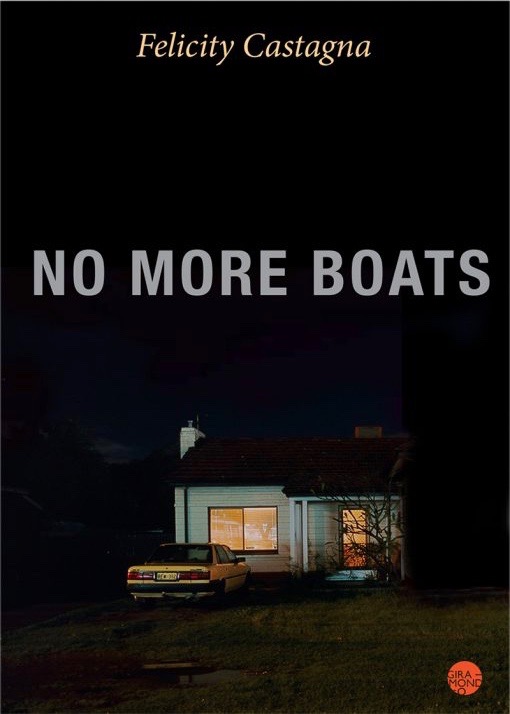
Felicity Castagna, No More Boats (Giramondo 2017)

boats.jpgIt’s 2001. The Tampa is all over Australian television with its burden of asylum seekers saved from drowning, alternating with John Howard’s uttering his infamous cry, ‘We will decide who comes to this country and the circumstances in which they come.’ And one working-class migrant family in Parramatta is coming apart at the seams.

Antonio Martone came to Australia after World War Two and married Rose, an Anglo woman he met in the migrant hostel. In 2001 he is injured in a terrible accident on a building site trying to save his best friend’s dignity, and after decades of skilled labour is forced to retire. Francis, their son who still lives at home, works by day on the same projects as his father, though without the pride of a first-generation migrant, and he knocks around by night with a small group of partying friends. Their daughter, Clare, has lit out for the inner city where she works in a bookshop and aspires to be a writer (though as far as the family is concerned she is still a high-school teacher): ‘She was born to these city streets, even though she wasn’t really born in the city; she was made to be born here and when she walked these streets she told herself that she was.’ And Rose tries to keep it all together as Antonio becomes increasingly bitter and erratic.

The novel’s title may lead you to expect it to be about Australian immigration policy. Well, maybe it is, but the domestic story, the story of Antonio’s deterioration and other people’s responses to it, is at the book’s heart. Here’s Antonio just after discovering that Clare has been lying about keeping her teaching job:

He felt the weight of something pressing against his chest. A memory interrupted his exit from the school: Clare with her pigtails in plaits, standing with a piece of chalk at the blackboard he’d given her for her twelfth birthday, writing down words for a five-year-old Francis to copy onto a sheet of paper.

He wondered who his children were now. This was the hardest thing about being a parent, the thing that no one tells you about. The fact that you grieve for your children from the moment they are born. Not so much because you’ve lost them but because they are always changing and you can’t get back all those different versions of what they once were.

Antonio grapples with many kinds of loss – of the pre-migration life, of youth, of employment, of physical wellbeing, of dignity, and of friends. Flailing around for a way to deal with his wretchedness, he seizes on the issue of immigration: he’s offended by the poor workmanship of the underpaid recent migrants on the worksite, and becomes obsessed with the objects of John Howard’s televised indignation. At a crucial moment he smokes some marijuana from Francis’s secret supply, and creates a spectacular piece anti-boat-people graffiti. The family is suddenly in the headlines, the dramas being played out on the television are much closer to home, and there’s a strong undercurrent suggesting that Antonio’s deterioration may be a metaphor for a similar process in Australian ciivil society.

There are other characters: a Vietnamese former student who surprises Clare by becoming a love interest; a Lesbian next door neighbour who provides respite for Rose; Francis’s mates Jesús and Charbel; a right-wing opportunist who exploits Antonio’s confusion; the ghost of Antonio’s friend who was killed in the accident – and more. It’s a story told at a pace that keeps the pages turning, with compassion for all players (John W Howard – ‘the dull man’ – and right-wing opportunists excepted), and a strong sense of place: the Martone home with its concreted front yard and gap in the fence to the house next door, the streets of Western Sydney and the inner city, the banks of the Parramatta River, this is a book in which you always know where you are.

aww2017.jpgNo More Boats is the fourteenth book I’ve read for the 2017 Australian Women Writers Challenge. I gratefully acknowledge that I received a complimentary copy from Giramondo Books.

Lemire and Nguyen’s Descender continues

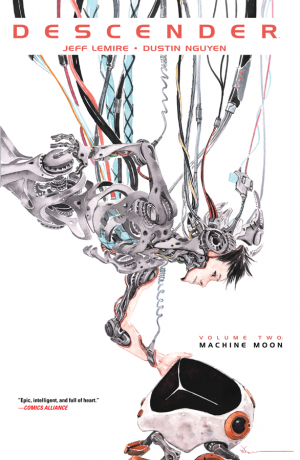
Jeff Lemire, Dustin Nguyen and others, Descender Volume 2: Machine Moon (Image Comics 2016)
––––  Volume 3: Singularities (Image Comics 2016)
——-  Volume 4: Orbital Mechanics (Image Comics 2017)

descender2descender3Descender4

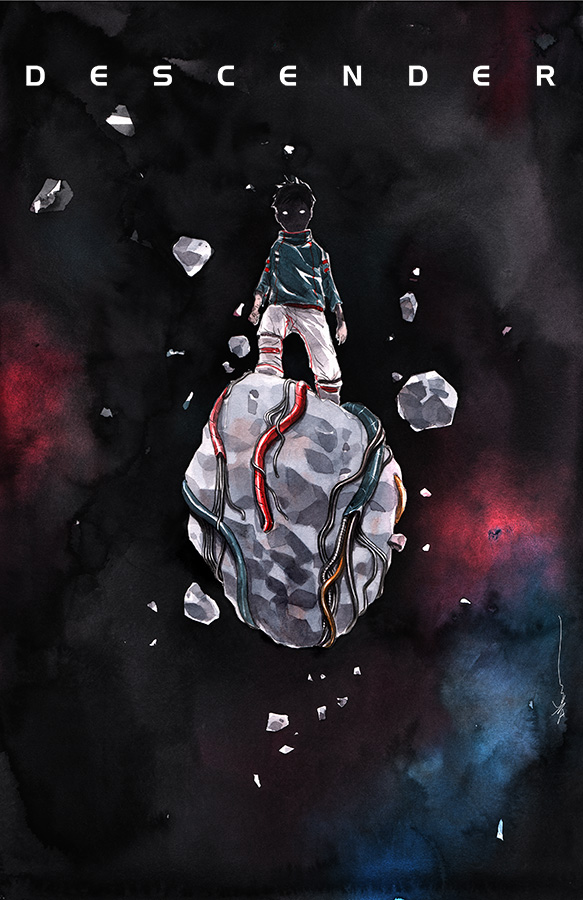
Descender is a space opera in glorious watercolour with a sweet, vulnerable and potentially lethal little boy at its heart.

Two brothers who were torn apart ten years earlier are searching for each other in the context of the build-up to intergalactic war. The catastrophe that separated them involved huge robotic machines called Harvesters, which wrought havoc on the planets governed by United Galactic Council and then disappeared. Since then, the agents of the UGC and others who are simply robot-phobic have been trying to destroy all artificial intelligence machines. Freelance bounty hunters, ‘scrappers’, roam space ferreting out even the most innocent robots, ‘robbies’, including those that are essential to human life on tiny planets. The repugnant inhabitants of the planet Gnish have made a virtual religion of pitching robbies against each other in gladiatorial combat. Meanwhile, the UGC are secretly building their own version of a Harvester, in the hope of securing the software that will make it an invincible weapon; and The Hardwire, an underground robot resistance, is building a huge army and hoping to call on the Harvesters (whom they worship as gods) as allies in a great war to eliminate humans.

All of that is background revealed in the first couple of books as it impinges on the lives of a handful of vividly realised characters.

There are the brothers, Andy and Tim-21, who is not a human brother but a robot created to be Andy’s companion. We learn through a series of flashbacks that they were devoted to each other as small boys, that Andy’s mother treated Tim-21 with kindness and respect for his sentient nature, that Tim-21 developed a capacity for compassion, affection and loyalty. He was in sleep mode when the Harvesters struck and stayed asleep until accidentally woken ten year later. Meanwhile, Andy was filled with vengeful rage and became a scrapper.

The sweet-natured, vulnerable Tim–21 contains within himself the coding that will reveal the secrets of the Harvesters – so he is a sought-after prize by all the big players. He does have allies: Quon, the man who ‘created’ him, Telsa (not Tesla) an officer of the UGC sent by her father to retrieve Tim–21 (she is unaware that her father wants to weaponise his coding); and his brother Andy.

The little band is captured, released, split up, infiltrated. There’s plenty of explosions and bang-crash-pow. But the narrative is kept alive by the complex web of ambivalent relationships and the underlying Blade-Runner-ish question of what it means to be human: Tim–21 has a human ‘brother’ in Andy, and a robot ‘brother’ in Tim–22, both of whom claim his affection and also plan to destroy him; he grieves for his deceased human mother, sees Quon as a kind of father, and is claimed as a son by the leader of the Hardwire; Andy’s ex-wife Effie identifies as part robot since being patched up after an accident, and insists that her name is Queen Between; a barely-intelligent robot named Driller turns out to have deep reserves of remorse for a murderous act of revenge.

The back stories of the characters unfold, full of satisfying twists, as the adventure lurches forward. At the end of Volume 4, things are looking grim: one character is about to drown, the weaponising secrets are about to fall into the wrong hands, one of the little bands of adventurers is about to be wiped out by The Hardware, and the galaxy as we know it may well be about to be destroyed. Then Tim–21 recognises Andy on a screen and cries out, ‘That’s my brother!’ The end of Book Four.

It’s terrific story-telling, with moments of sly satire, as when the Gnishians are crowning a new king: instead of a crown they place on his head an orange hairpiece that is eerily familiar to anyone who follows US presidential politics.

I wasn’t drawn to Dustin Nguyen’s watercolour art in the first volume but either it’s settled down or I’ve settled in, but now I’m loving it. My conversion was completed by a series of spreads early in Volume 4 where three narrative strands play out wordlessly – across the top of each spread, the two Tims are alone on a lunar landscape; across the middle Andy and Effie/Queen Between revive their former mutual passion; in the bottom panels Quon and Telsa fight off a Hardwire guard and search for Tim–21. Each level has its distinctive style, and the sex and the violence are both handled with conviction but without prurience. At a couple of moments it may be hard to tell exactly what’s happening (my complaint about Volume 1), but there is good reason for that: sometimes the reader needs not to know everything.

According to Amazon, volume 5, The Rise of the Robots, will be published in January 2018, and it’s ‘what it has all been building to … as the origins of The Harvesters are finally revealed and the galaxy is thrown into all out war’. But Amazon says nothing of what happens to Tim and Andy. I’ll just have to wait.

The rest of Ed Brubaker’s Velvet

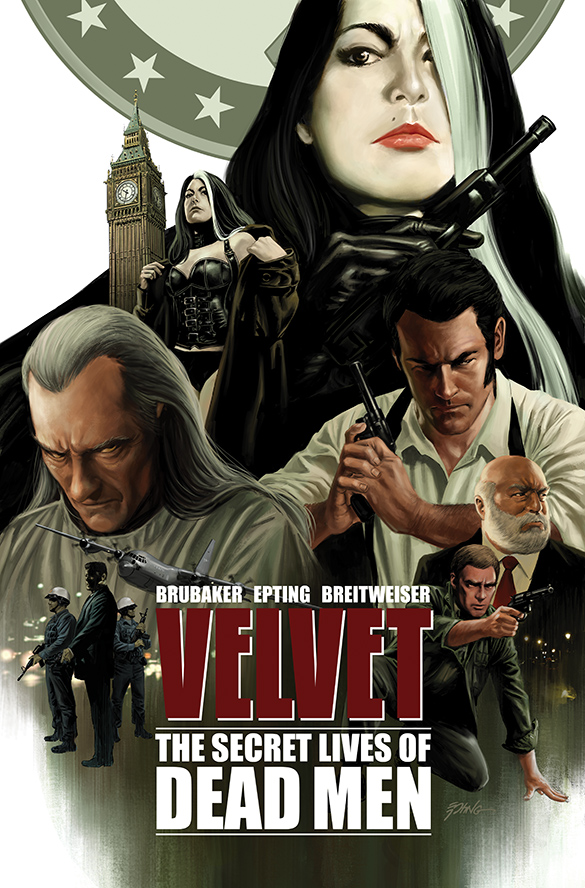
Ed Brubaker & Steve Epting, Velvet Volume 2: The Secret Lives of Dead Men (Image 2014)
——, Velvet Volume 3: The Man Who Stole the World (Image 2016)

velvet2
velvet3

My reliable son lent me the remaining volumes of Velvet in return for walking his dog and picking up a parcel from the post office.

Reading the two books took just a bit longer than the walk to and from the post office with two aged and wilful dogs, and was a much smoother experience. I was glad at times that I wasn’t in a crowded street because a couple of the pages, in which Velvet Templeton allays the suspicions of a man who is betraying her by indulging in intimate acts, are pretty NSFW.

I don’t know if there are any plans for further adventures of Velvet, glamorous super-spy. She came back from a desk job in the first of these books. There’s nothing in principal stopping her coming back at some future time from the beach resort where we leave her at the end of the third volume. But I’d be happy to have this be the end of this elegantly written, drawn, coloured (by Elizabeth Breitweiser) and lettered (by Chris Eliopoulos) series, to have the door close on all these twists and turns, alliances and betrayals, murders and rescues, seductions and rejections.

As my supplier said, it’s popcorn. Not that there’s anything wrong with that.

Velvet and Descender begin

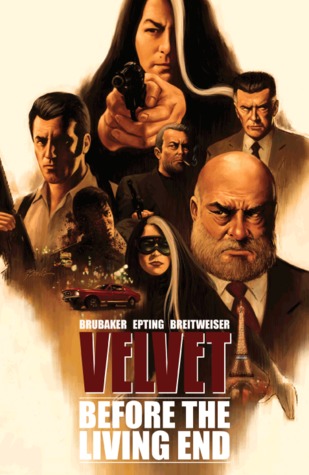
Ed Brubaker, Steve Epting and others, Velvet Volume 1: Before the Living End (Image Comics 2014)
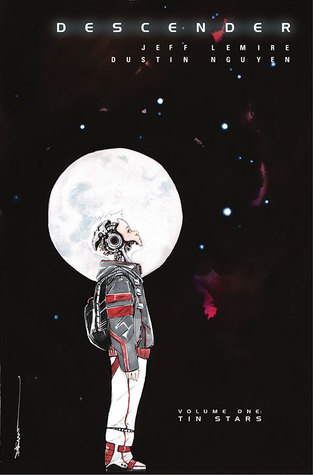
Jeff Lemire, Dustin Nguyen and others, Descender Volume 1: Tin Stars (Image Comics 2015)

These two books, on loan from a son, have been singing their siren song from by TBR pile for months. I lashed myself to the mast of serious reading for a long time, but I’ve finally succumbed – and a good thing too.

velvet1 Velvet is a spy story set in the 1970s, with flashbacks to the 50s. It’s a Bond movie from before those movies started reducing the violence to get PG ratings, with a glamorous woman protagonist who’s in her 40s but would pass for 25. Lots of gore, lots of exposed flesh (but nothing you wouldn’t see at the beach), cool gadgets (including a fabulous ‘stealth suit’) and – as you’d expect from Ed Brubaker, writer of Fatale and The Fade Out – intrigue aplenty.

Before the Living End begins with the violent death of a field agent accompanied by a ‘voice over’ reminiscing about the boss’s glamorous assistant. It ends with that assistant, former field agent Velvet Templeton, on the run, determined to clear herself of suspicion by finding the real killer–mole, and at the same time find out the truth about the terrible events that led to her removal from the field 17 years earlier.

Steve Epting’s artwork is slick and moody, capturing the Bond version of 70s cool perfectly. Colors [sic] by Elizabeth Breitweiser and letters by Chris Eliopoulos are impeccable.

descender1From international espionage to intergalactic AI in a single bound.

Descender takes place in the distant future, on the planets of the United Galactic Council. After a prologue in which enormous humanoid robots attack the eight worlds of the UGC, the main story picks up ten years later with a little boy waking from a long sleep on a small mining colony to find everybody else dead. The boy, it turns out, is a sentient robot named Tim–21 who was a companion to a human child.

A connection between Tim–21 and the gigantic destroyer robots is gradually revealed, and soon he and a band of allies – the scientist who created him, an irritating robot dog, a UGC officer named Telsa (not Tesla), a loyal muscleman, and an ore driller with enough artificial intelligence to be a dumb sidekick – are fleeing and fighting for their lives as any number of criminal and state bodies are out to get him, not always for reasons the reader yet understands. We do know for sure it’s not a case of ‘The enemy of my enemy is my friend’. In the background there is a Dantesque purgatory teeming with the souls of decommissioned robots who look to Tim-21 as their possible saviour.

It’s complex, ripping-yarn fun.

Dustin Nguyen’s watercolour art is beautiful, but not ideal as a story-telling medium: too often it’s too hard to tell what is happening. And Steve Wands’ lettering is sometimes too concerned with the design look, and not enough with legibility. But these are quibbles set alongside the wonderfully poignant images of the vulnerable child at the heart of the story.

As soon as I’d read these books I texted my son–supplier, who has two more volumes of each series. I guess I’ll be writing about them soon.