Category Archives: Books

Kate Middleton, Passage

Kate Middleton, Passage (Giramondo 2017)
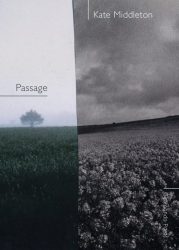
passage.jpg

Most of the poems in Passage are either erasures or centos.

/Explanatory note for the benefit of readers who know even less than I do:/
Cento is defined in my excellent Gepp & Haigh Latin–English dictionary (1888) as ‘a poem or composition made up of scraps from various authors or parts of an author’. A basic, nonsensical nursery-rhyme cento, for example, might be:

The mouse ran up the clock
to fetch a pail of water.
He put in his thumb,
see how they run,
How does your garden grow?

An erasure is created by erasing some or most of another piece of writing. I enjoy making them from newspaper columns that annoy me.  Here’s one based on a recent attack on the #changethedate movement:

erasure005-e1517140699925.jpg

/End explanatory note/

Both forms can be fun, but when, as in Kate Middleton’s work, the source material isn’t well known or readily available, and the poem is longer and more than a fun game, questions arise that I don’t know the answers to.

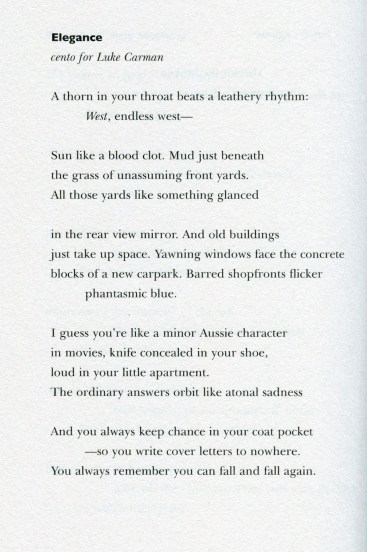
Given my new policy of just talking about a single poem when blogging about poetry books, I was tempted to choose one of Kate Middleton’s fine poems that aren’t centos or erasures or in some other way symbiotic with another text (such as the handful that are responses to episodes of a TV show I’ve never heard of). There are plenty of such fine poems –  but to choose one of them would feel craven. So here’s the cento ‘Elegance’, which I’ve singled out because I’ve read its source text, Luke Carman’s An Elegant Young Man.
elegance006.jpg

It’s possible to read this without any attention to its cento-ness. The opening couplet announces an emotional tone and names a locality. The next two stanzas sketch an unprepossessing urban landscape – this is not the West of movies but western Sydney. Then the poem turns to address the person looking at this landscape, and becomes a portrait of a writer as one who conceals his metaphorical knife in public, is loud alone at home, and struggles to avoid clichés (‘ordinary answers’).

It’s a cento not only from Luke Carman but for him. Writing cover letters to nowhere is a pretty nice description of a writer’s job, and the references to chance and repeated falls are extraordinarily apposite to the way Carman’s writing often mimics an intense distractibility, and so much of it is about his own social awkwardness and other struggles.

It’s a sweet tribute. By the end, one wants to revisit the capitalised ‘West’ from the second line. Carman is a kind of Western hero after all, even though his West is not Monument Valley, but Western Sydney.

So what does it mean that the poem is a cento?

Being by profession a proofread type editor, and by inclination a bit pernickety, I got out my copy of An Elegant Young Man. I didn’t have time to reread it all, but I read enough to find some of the poem’s source text. ‘Barred shopfronts flicker phantasmic blue’ is distilled from ‘shuttered-up Asian supermarkets and squash centres and brick unit blocks with TV flickering a phantasmic blue through the windows’. ‘I guess you’re like a minor Aussie character / in movies’ comes from this: ‘I mostly stood still and tried to seem happy-go-lucky, like those minor Aussie characters in movies like Chopper and  Getting Square’.

So Kate Middleton hasn’t been rigid in quoting the original. As the Emerging Artist said, she’s referencing the text rather than quoting it. In these examples, she leaves out the detail of the shopfronts and the TV, and the happy-go-lucky appearance (which is ironic in its original context anyhow). It’s not just referencing, but also repurposing. She finds in Carman’s text words that describe him in relationship to the milieu that is his subject in ways that he (presumably) wouldn’t think to describe himself. It’s a kind of alchemy.

I still don’t know how the longer centos work, from writers including Siri Hustvedt, Eliot Weinberger and Sir John Mandeville; or erasures that run to several pages. I’m happy to leave that question to better informed readers than I am.
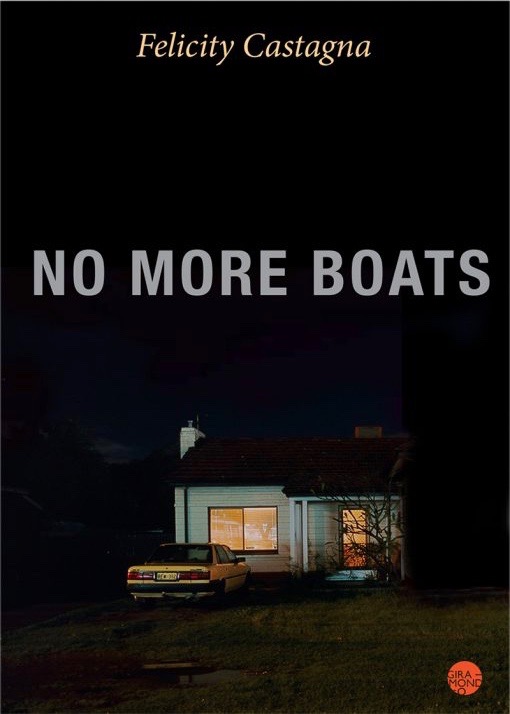
Passage is the third book I’ve read for the 2018 Australian Women Writers Challenge. I was given a complimentary copy by Giramondo, for which horizon-expanding gift I am grateful.
Kim Scott’s Taboo at the Book Group

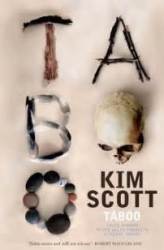
Kim Scott, Taboo (Macmillan Australia 2017)

taboo.jpegBefore the meeting: Regretfully, I’m short of time to write about Taboo. It’s a very different book from Kim Scott’s That Deadman Dance. That earlier novel engages with the early history of Western Australian colonisation with almost superhuman breadth of sympathy and already has classic status. This one is set in the twenty-first century, and follows a group of Noongar people who are returning to the site of a massacre with the hope of making things right – reestablishing contact with the old people, and with culture and language, and making some kid of reconciliation with the descendants of the perpetrators.

Taboo is based squarely in Kim Scott’s experience as an activist in language reclamation in Western Australia. I’ve just watched a video of a talk he gave on the subject at Melbourne University in 2012, in which he speaks about ‘the responsibility and obligations of being a descendant of the people who first created human society in this part of the world and keep that sense of society alive’. He speaks with modesty, charm, humour, and great power. It is a revelatory 50 minutes. I doubt if he had even started writing Taboo at the time of the talk, but he tells a number of stories that are clearly the inspiration for key episodes in the novel.

The novel doesn’t romanticise its Noongar characters: they have been scarred and in some cases corrupted by their history. They struggle with drug and alcohol issues. But awkwardly, shambolically, two-steps-forward-one-step-back, they find hope in what they can piece together of their heritage. The central character, fifteen year old Tilly, has reconnected with her Noongar father only as a teenager, and in the course of the novel is welcomed into her extended family, who see her as important to their project of returning to the massacre site (she was fostered by the farming family of the place when she was a baby). Her claustrophobic response to their embrace is vividly realised.

Maybe it’s just me (I’ll find out at the meeting), but while the novel has vastly expanded my sense of the world, it’s no masterpiece. There are elements of something like magical realism that are weirdly unsatisfactory, many narrative threads that are started up and never resolved, and an ending that feels like a desperate but unsuccessful attempt to make it all come together.

After the meeting, just a hasty note before I go to bed, because time is a bit short just now: This book sustained conversation like few others, and everyone who had read it had something interesting to say about it.

One man said that it wasn’t like a feature film, but more like the beginning of a television series: we were left wondering what would happen next for just about every character. Another said it was about the importance of stories, that it told many stories that didn’t necessarily connect. As readers we are left in an unsettled state of never really knowing the full story. I don’t think he used the word ‘unsettled’, but we did notice that we are all white men of a certain age, and the way the book made us feel had a lot to do with that. Without really leaving the book, we talked about the prospect of a treaty, about the relative value of symbolic acts, about the different meaning of a sense of place for Indigenous and non-Indigenous persons.

Another said that he thought the book was about loss, scarring, grief, dislocation, that there was hope, but built on a fragile and fragmented base. Someone disagreed that it was about loss – that it was more about the power of community in the face of loss.

No one else seemed to find the magic realism elements unsatisfactory, and I was in a minority in disliking the ending. One man said he thought it was the best novel written in Australia so far – precisely because its lack of resolution was a true representation of how things stand in the relationship between Aboriginal people and mainstream Australia.

It was our first meeting for the year. Our host prepared a meal that set the bar high. The book led us to focus our minds on things that matter. We enjoyed each other, laughed a lot, and I think I can say we all came out into the night very glad for the gift that Kim Scott has given us in this book.

B R Dionysius’ Curious Noise

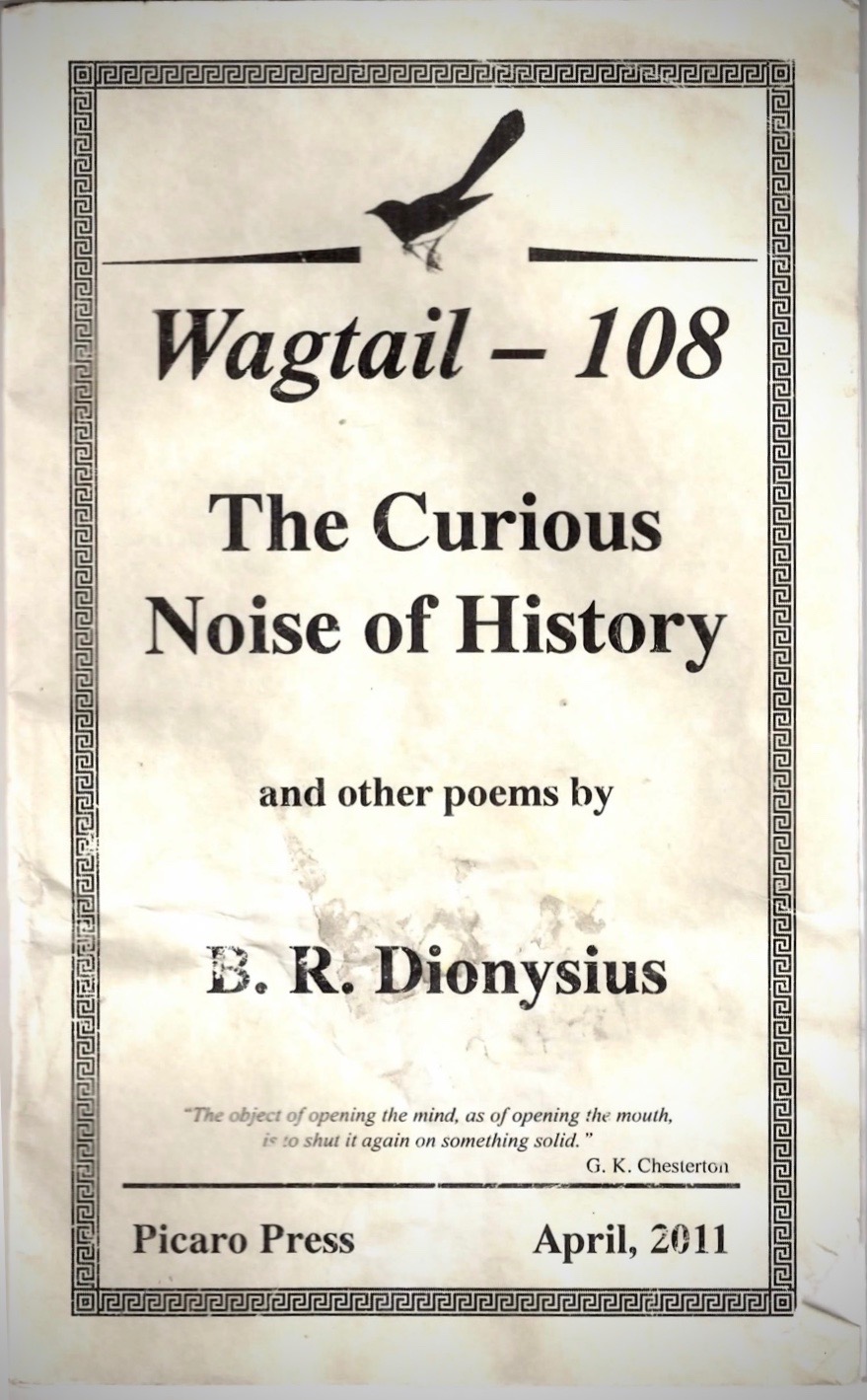
B R Dionysius, Wagtail 108: The Curious Noise of History and other poems (Picaro Press 2011)

noise

I first heard of the Wagtail series a couple of years ago when a member of my book group told us he subscribed: chapbooks, tiny publications each featuring work by a single poet, one arriving in his mailbox eleven times a year. They didn’t cost much, so if you didn’t hit it off with a particular poet you hadn’t wasted a fortune, and if a chord was struck you could go searching for more. More than 120 issues of the series were published by Rob Riel of Picaro Press in Warners Bay, New South Wales, before it finally folded last year. You can see a full list, unnumbered, here (it’s the Ginanderra site – Picaro is hard to find on the web), and an incomplete list with numbers, prices and availability here (at Gleebooks). The best account of the series I could find was this article by Warwick Wynne in Famous Reporter in 2004.

I came to Wagtails more than a day late and a dollar short when I spotted Book 108 among the economics textbooks and salvation tracts in an Erskineville Street Library. B R (Brett) Dionysius is a much published poet. A quick look at his web site, Bitter as the Cud, shows him to be a mover and, especially recently, shaker in the Queensland poetry scene. I’ve previously read poems by him in journals and anthologies and online, most memorably a sonnet sequence about the Brisbane floods, but never a whole book. Taking this 16-pager home seemed like a good step forward, even though it doesn’t send any money his way.

The Curious Noise of History is full of assured poems, mostly about violent or overbearing men, mostly a father who may be drawn from Dionysius’ own life. Possibly all of them appeared in his first book, Fatherlands. In ‘Crossing‘, the poem I want to single out, the man in question is the poem’s speaker. I’m drawn to talk about it because a) it’s probably the simplest poem in the book, and b) it reminds me of the mortification and joy of being a parent to young children.

IMG_2132.jpg

(In case you can’t read it here, it’s on Dionysius’ web site at this link: you need to scroll down quite a way.)

I remember turning into that ogre myself more than once.

The narrative is straightforward, but there’s plenty to linger over. For example, what is ‘it’ in the first line? At first blush, it’s punching the pedestrian button. But the poem is about a different kind of hurting. The man is in a rage for an unspecified reason (what he says to his daughter isn’t necessarily the truth), and aims that rage at his little daughter. The ridiculously hyperbolic image of fairytale monsters captures, with just enough irony, the horror a raging parent feels at his (or possibly her) behaviour. But in this case the child takes a stand – she may be twisting her ring because internally she is terrified, but her words brings perspective to the emotional storm with the mundane adjective ‘grumpy’. So perhaps the first line also refers to the dissipation of the speaker’s rage; the daughter wasn’t hurt by the rage, and her calling him on his poor behaviour didn’t hurt either.

His wrist starts to throb. They hold hands. There is no more talk of monstrous ogres, but it a little man turning from red to green.

The poem is sweet enough, but taken in the context of the other poems in the collection – in which, for example, a father plays a game involving a stock whip and his children’s toes – it is also powerful. In those other poems, Dionysius looks at male domination from the perspective of one who has suffered it. Here, the perspective is that of the man swept up in the compulsion to voice his rage, and one feels a rush of gratitude to that little girl.

Fiona Wright’s Domestic Interior

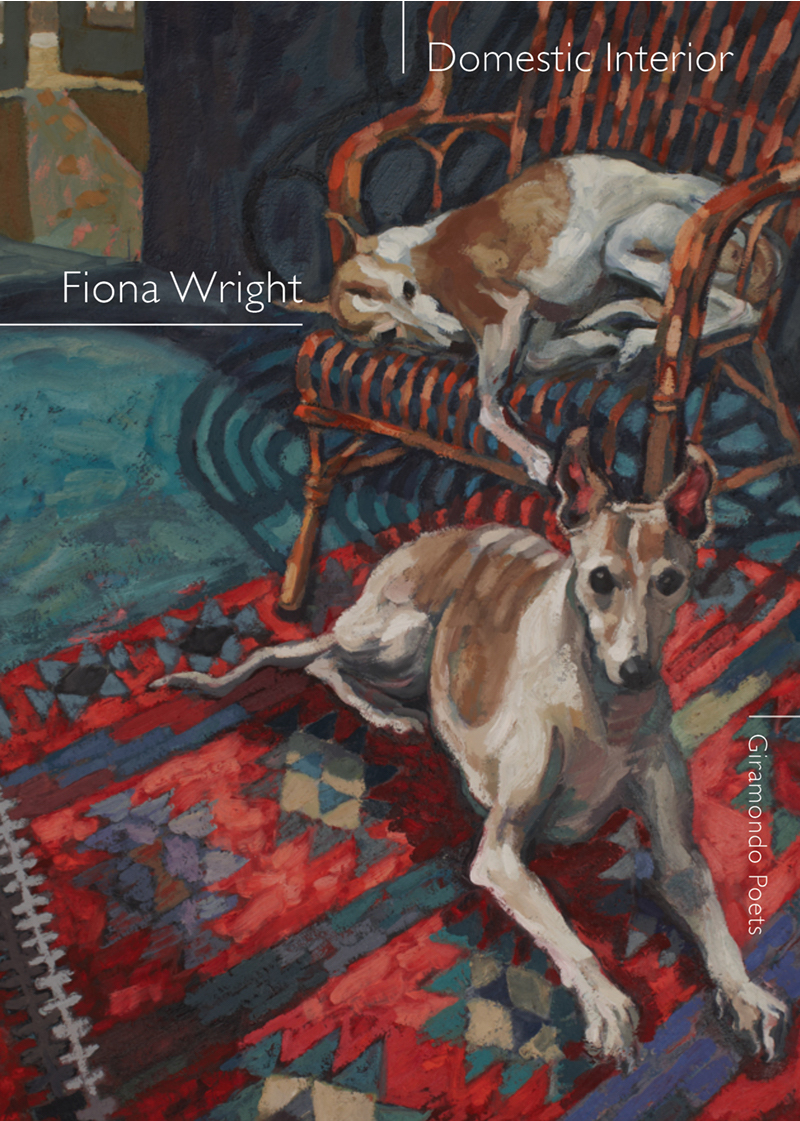
Fiona Wright, Domestic Interior (Giramondo 2017)

Domestic.jpgOne of my New Year resolves for the blog is not to attempt to review every book of poetry I read. I’ll still blog about them, but for each book I’ll focus on one or possibly two poems that resonate with me in some way.

Domestic Interior tests that resolve, because an awful lot of its poems speak to me loud and clear.

I haven’t read Fiona Wright’s first book of poetry, Knuckled (2011), or her collection of essays, Small Acts of Disappearance  (2015), both published by Giramondo, but somehow I’d picked up an expectation that her work would bristle with introspective misery. That expectation, even though endorsed by the back cover’s reference to ‘highly charged moments of emotional extremity’, turned out to be wide of the mark. Even the section titled ‘A Crack on the Skin: On Illness’, there’s much lightness, grace, good humour and a pervasive celebration of friendship. And always, especially for Sydney readers, there’s plenty of recognisable life as we know it or, in a number of poems, as we overhear it.

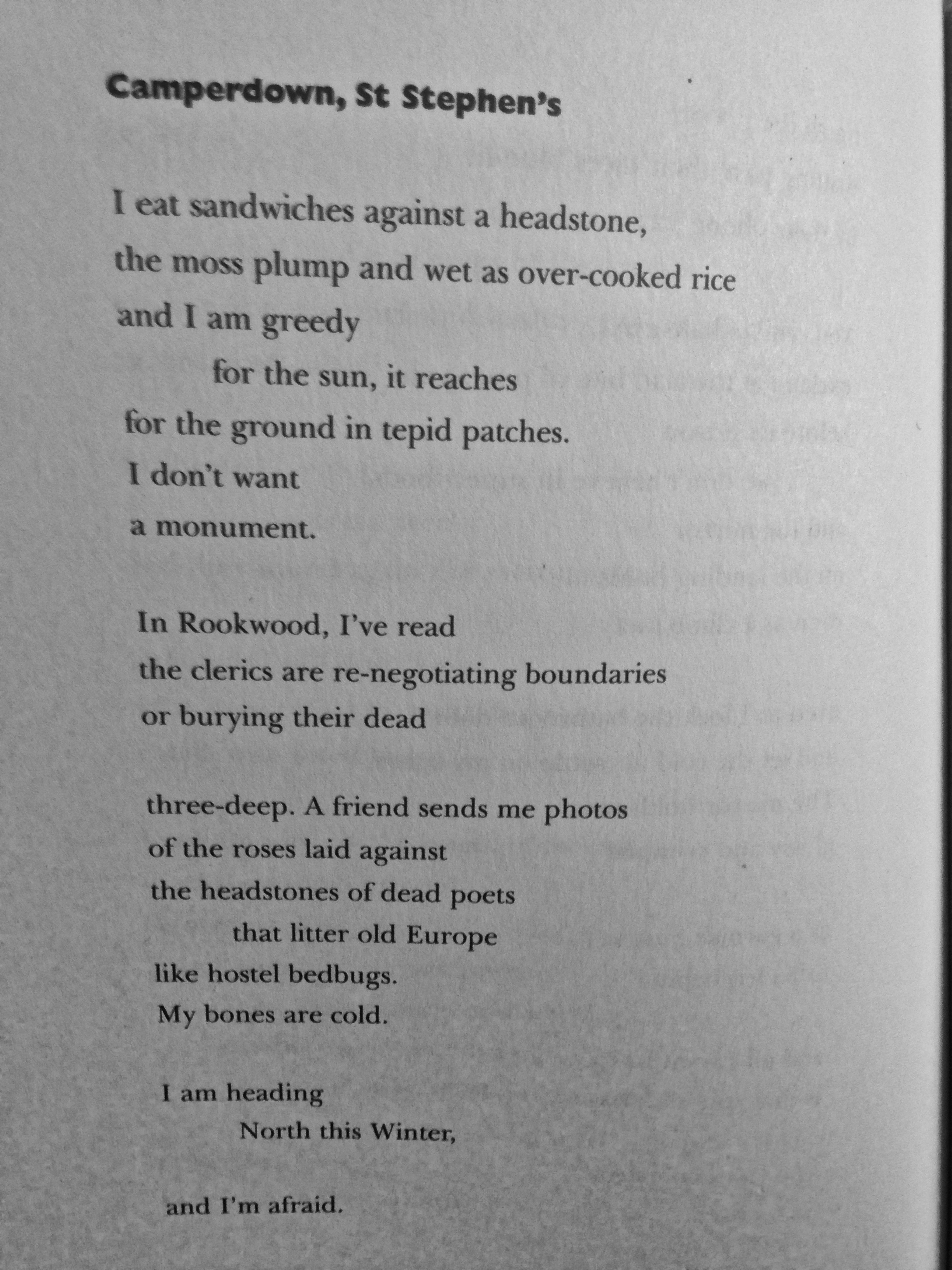
I caught a glimpse of Fiona Wright at a funeral when I was still part way through my first reading of the book, reason enough to choose to blog about ‘Camperdown, St Stephen’s’:

StStephens

For the benefit of non-Sydneysiders: St Stephen’s Anglican Church is the site of the historic Camperdown Cemetery. The Moreton Bay fig that grows there featured in Nadia Wheatley and Donna Rawlins’s classic and totally not-morbid picture book, My Place. It’s a beautiful and almost intimate setting, where it’s not terribly weird or morbid to eat a sandwich leaning against a headstone, so it may take a while for the force of that image to sink for a local reader. Rookwood is a suburb in Sydney’s west whose name is enough to evoke thoughts of mortality in most of Sydney and well beyond: it is home to what Wikipedia calls the ‘largest necropolis in the southern hemisphere’, now facing problems of overcrowding.

From the opening image, in which a stark memento mori lurks beneath a pleasantly mundane lunchtime scene, the poem plays first with the idea of hunger, associated with the sandwiches: the moss is like rice, the speaker is greedy for sun, and the sun for the earth. (It must be autumn, warm enough to have lunch outdoors, but cool enough that patches of sunlight are tepid.) Then, in a neat couple of almost rhyming short lines (‘I don’t want / a monument’), the headstone comes to the fore.

Which leads to Rookwood – yes, it stands in for death on a grand scale, but the lines are rooted in this specific time and place: there really are debates about how to deal with the vast numbers of bodies needing to be buried. Camperdown Cemetery is comfortably historical; Rookwood is today’s news. The dead are named for the first time, slyly rhyming with ‘read’ (maybe she’s reading news on her phone while eating her sandwiches).

Then she thinks of her friend’s photos (received on the same phone?). Roses lie against headstones, just as the poet does in the first stanza. Only now it’s many poets and they are the dead.  No sun no pleasant sandwiches there: the roses laid in homage don’t carry much force – images of litter and bedbugs come to mind, and from this distance perhaps the roses are reduced to something like little bursts of blood on hostel sheets.

‘My bones are cold’: she now identifies with the dead poets. And in the last three lines, the chill of that identification goes deeper: she is heading North, to that Europe littered with dead poets, and she fears that she is about to join them.

Maybe it’s just me, but I laughed. I don’t think the poem or I are trivialising death or the fear of dying. But the poet’s fear here is not the kind that strikes with a diagnosis of stage 4 pancreatic cancer. There’s something fancifully neurotic about it, an edge of mockery that doesn’t trivialise the fear but allows us to breathe around it, to approach it playfully: after all, how seriously can you take the the graves of poets when they are presented as littering Europe like bedbugs in a hostel?

My writing of this blog post was interrupted by an expedition to Manly. After visiting North Head Project at the Manly Art Gallery (open until 18 February and worth the ferry ride), we went up to North Head itself and wandered in one of the three cemeteries connected to the Quarantine Station there. Walking among the graves of mostly young people, I thought of this poem, and realised that for all its lightness of touch, its rootedness in 21st century Sydney and a particular friendship network, it sits squarely in a tradition: ‘and I’m afraid’ echoes the refrain, ‘Timor mortis conturbat me (The fear of death confounds me)’, common in mediaeval European poetry. I went hunting and realised I knew it from William Dunbar’s ‘Lament for the Makers‘. That 16th century poem, of which every stanza ends in the Latin refrain, includes a kind of honour roll of poets who have died, beginning with ‘noble Chaucer’ and continuing with names now long forgotten. Rereading ‘Camperdown, St Stephen’s’ in that context, I like it even more, but you don’t have to have read Dunbar or visited North Head for the poem to work for you.

Domestic Interiors is the second book I’ve read for the 2018 Australian Women Writers Challenge. I received a complimentary copy from Giramondo, for which I am grateful.

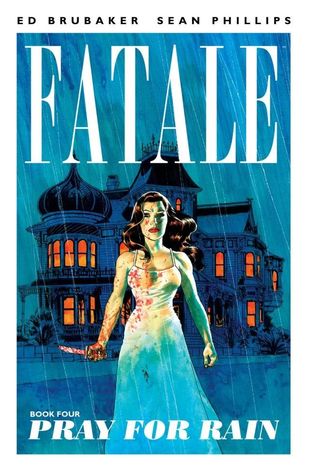
Ed Brubaker’s Fatale

Ed Brubaker and Sean Phillips, colours by Dave Stewart, Fatale Book 1: Death Chases Me (Image 2012)
—- colours by Dave Stewart,  Book 2: The Devil’s Business (Image 2012)
—- 
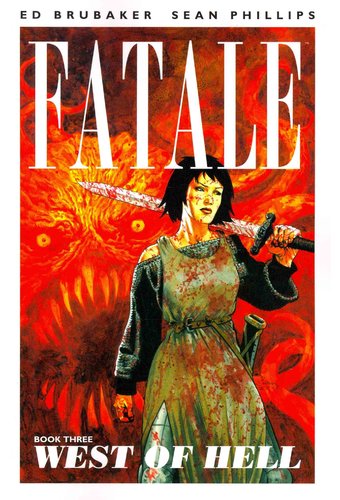
colours by Elizabeth Breitweiser and Dave Stewart, Book 3: West of Hell (Image 2013)
—- colours by Elizabeth Breitweiser, Book 4: Pray for Rain (Image 2014)
—- colours by Elizabeth Breitweiser, Book 5: Curse the Demon (Image 2012)

9781607065630.jpg

I read the Book 1 of Fatale a while back, and was unimpressed. When my son recently offered to lend me all five volumes, I decided to give it another go. I reread Book 1 to refresh my memory, and am embarrassed to say that I had almost no memory of the first reading, and this time I enjoyed it a lot. My blog post from back then describes it pretty accurately:

It’s a detective yarn combined with a Lovecraftian horror story. The telling is satisfyingly complex, shifting back and forth between two time periods and only gradually revealing the nature of the dilemmas facing the the lead characters, but laying out enough hints that when things take a turn for the bizarre there’s a sense of continuity. The artwork is consistently dramatic and serves the story well. Sex scenes are relatively tactful. Gore is over the top without being too realistic and the worst atrocities remain unseen by the reader.

This time I read on.

fatale2

As you’d guess from the covers, the Fatale of the title is preceded by a silent Femme. The central character, Jo (or sometimes Josephine, and in one context Jane) has irresistible power over men. Some she simply bends to her will, others she infatuates so that they not only desire her and forsake all others, but devote their lives to protecting her, killing or dying in the attempt.

fatale3

But not all men. It turns out that her powers have something to do with a cult whose members dress in weird monkish robes and commit ritual mass murders. The leader of the cult, sometimes known as the Bishop, wants Jo for vile purposes of his own and hunts her implacably through the decades (or maybe centuries).

fatale4

Did I say it was a detective yarn? Well, yes, that’s true of the first book. But Jo, or perhaps other women who have been cursed like her with fatal charm and at least partial immortality, has been around for a long time, so she also features in tales of mediaeval witch-hunt, a Nazi interlude, a Bonnie and Clyde yarn, and more.

fatale5

The story-telling is strong, and the art is compelling, but by the end I’d decided that horror isn’t for me. When the Bishop lays out his world view in Book 5, articulating the story’s dark metaphysics (the ‘reality’ behind the world that most people think is real), I was revolted, as I was meant to be, but I also wondered if there was any real pleasure or gain to be had from immersing oneself in someone else’s confected nightmare, however well done.

Jennifer Maiden’s Appalachian Fall

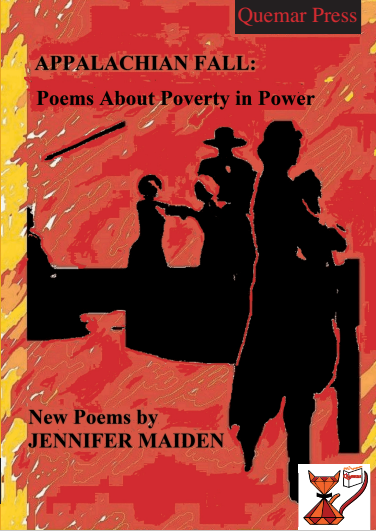
Jennifer Maiden, Appalachian Fall: Poems about Poverty in Power (Quemar Press 2017)

appalachian.pngQuemar Press published the ebook of Jennifer Maiden’s  Metronome the day after the 2017 US presidential election. In its last poem, Maiden’s fictional alter egos George Jeffreys and Clare Collins watch the election results on TV, and chat to Donald Trump on the phone. One insistent strand of Appalachian Fall is a continuation of the Trump theme.

Jimmy Carter chats with his re-awakened distant cousin Sara Carter Bayes at Trump’s inauguration. Jane Austen comments on his rivalry with Kim Jong-Un. Eleanor Roosevelt and Hillary Clinton chat about him.  Trump himself appears with George Jeffreys, with his mother, Mary Anne Macleod, and solo.

Maiden’s lively, questioning intelligence worries away at the double mystery of Trump: who is he and what happened to make him President? The book’s subtitle, ‘Poems of Poverty in Power’, gestures towards her answer to the second question: Jimmy Carter, reflecting on Sara’s music, articulates it:

thought: we knew ourselves when we heard it:
the low gut scream of hunger,
for some food, some pride, for any sort of
civilising action, answered passion, and if all
these people were Trump voters, maybe that in fact
was why he couldn’t despise their desperation.

Maiden addresses the first question –’who is he?’– with something approaching compassion, or at least an attempt to understand the human being, which is a kind of poetic heroism. Just as, years ago, she made poetry from her observations of George W Bush’s nose and Kevin Rudd’s pursed lips, in ‘Wind-rock’ she makes us see Donald Trump’s characteristic walk, and so the man himself, with fresh eyes:

 brace and blend into a finish. Trump’s erratic pace
wind-rocked staggers stubborn with its hunching
at growth and gust in air and no escape.

There’s a lot more than Trump here, but I won’t attempt a proper review. I’ve spent far too long on this blog post already, partly because I keep rereading the poetry – I love the sound of Jennifer Maiden’s voice, even when, occasionally, I don’t get what she’s saying or think she’s way off the mark. And partly because, well, see the next paragraph. For an excellent review, I recommend Magdalena Ball’s at Compulsive Reader.

So this is what took me too much time. There’s an extraordinary wealth of reference in Maiden’s poetry: to the Australian poetry scene past and present, poetry in general, politics in Australia, the US, the UK and Catalonia, art, music, the publishing industry, TV shows, movies, famous and little-known political and cultural figures. I thought it would be interesting to put together a visual representation of the intricate web of associations and connections created in this book, and produced the slide show below, which is still not exhaustive).

Enjoy. And then read the book. Quite a lot of it is up on Quemar’s website as a PDF.

This slideshow requires JavaScript.

Though I read Appalachian Fall last year I’m counting it as my first book  for the 2018 Australian Women Writers Challenge.

Min Jin Lee’s Pachinko

Min Jin Lee, Pachinko (Head of Zeus 2017)

pachinko.jpeg

This novel tells the story of four generations of a Korean family, mainly in Japan, from 1934 to 1989. It’s a painless, pleasurable history lesson. Painless for the reader, that is. The writing is beautifully accessible, the characters eminently ‘relatable’ (even the seducer of the young virgin who sets things going is good at heart), the plot – though predictable in its general shape as family sagas tend to be – furnished with enough interesting twists.

What I’ve taken away from the book is a fleshed-out sense of what it means to be Korean in Japan. You don’t become a Japanese citizen just by being born in Japan. Even if you come from several generations born in Japan, if your parents, grandparents, or further back, came from Korea, you must register as Korean (and choose whether North or South) on your fourteenth birthday. You can be naturalised, but very few manage it. And anti-Korean myths and stereotypes abound. Min Jin Lee explains in a note that the book was thirty years in the making, that she started out with a sense of the Koreans in Japan as ‘historical victims’, but when she had a chance to live in Tokyo for a time (she herself is US born), she found that the reality was much deeper and more complex. The depth and complexity of the identities and experiences of Korean–Japanese are beautifully and instructively rendered in the novel.

Year’s end lists 2017

It’s been quite a year. As it comes to an end the Emerging Artist (now with an MFA) and I have drawn up our Best Of lists.

MOVIES
I saw 64 movies, including a number watched on YouTube such as Godard’s Le mépris and Eisenstein’s October, the EA slightly fewer. It was a year of wonderful movies, as well as a handful of crushing disappointments, but here’s what we managed to single out.

The Emerging Artist’s top five, with her comments:

Manchester by the Sea (Kenneth Lonergan 2016): I liked the slow, meditative build-up to the reveal and the ultimate resolution of the past that allowed the character to keep living.

The Salesman (Asghar Farhadi 2016): Tense, intense and brilliant. The visuals were wonderful, from the woman in shocking red against the grey of usual clothing to the tightness of action carried out in multiple stairwells.
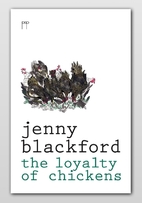
Certain Women (Kelly Reichardt 2016): Many friends didn’t take to this film, and we saw it at a disadvantage on a very small screen. Three interlocking stories each gave small moments of pleasure, especially the last.
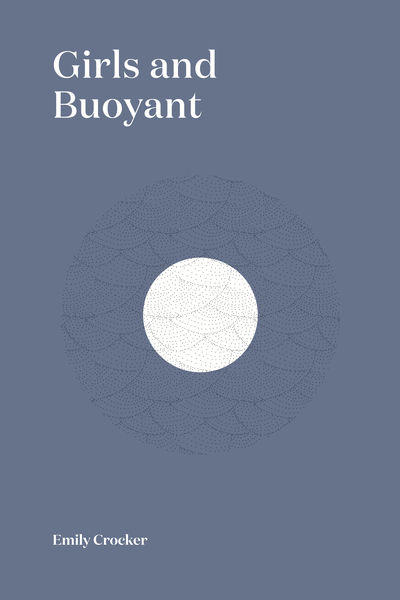
A Man of Integrity (Mohammad Rasoulof 2017): We saw this gripping Iranian film at the Sydney Film Festival. It has a universal theme of how to live a moral life when survival depends on going along with corruption. Deeply human, and also claustrophobically Kafkaesque.

Living/Ikiru (Akira Kurosawa 1952): What a delight this was. We saw it at the SFF. In three long sections the main character explores how to live well. Being a bureaucrat isn’t the answer.

… plus a bonus documentary for the EA

Nowhere to Hide (Zaradasht Ahmed 2016): A visceral look at northern Iraq through one man’s eyes, a paramedic trying to stay in his town as ISIS moves in.

My top five (chosen after the EA chose hers, avoiding duplicates):

Moonlight (Barry Jenkins 2016): Marvellous film, very slow. One of my companions said that it was like a behind the scenes look at The Wire. Three wonderful performances as the boy who becomes a man, perhaps especially Trevante Rhodes who shows the small frightened boy inside the streetwise drug lord.

Denial (Mick Jackson 2016): A very methodical film, written with great clarity by David Hare and featuring an excellent cast, this is a timely look at the importance of evidence-based thinking as opposed to adjusting the fact to accord with one’s political interests.

Silence (Martin Scorsese 2016): An old(ish) man’s deeply felt exploration of his Catholic heritage. Timely to be reminded of the intensities of Catholic belief when the institutional church’s failures around child sexual abuse are being exposed.

 I Am Not Your Negro (Raoul Peck 2016): James Baldwin was brilliant, and this film does him justice. Favourite quote: ‘Not everything that is faced can be changed, but nothing can be changed until it has been faced.’

Blade Runner 2049 (Denis Villeneuve 2017): Is there a word that means ‘bombastic’ but has entirely positive connotations?  That’s the word I want to use about this movie. And as someone asked on Twitter, ‘What happened to Deckard’s dog?’

… and a favourite moment:

In Hope Road (Tom Zubrycki 2017), at one point in his arduous fundraising walk, Zachariah Machiek (one of the ‘lost boys’ of South Sudan) strays onto private property and meets a couple of rough looking types who exude menace worthy of any Hollywood thriller.

Worst film of the year:

We both picked the same one, Sea Sorrow (Vanessa Redgrave 2017). Me: This started out as a fundraiser for unaccompanied child refugees in Europe, in which a number of big name actors did bits from Shakespeare and other turns. Vanessa Redgrave wanted to reach more people with her passionate message of compassion and worked it up into a film. Sadly it’s hardly a film at all. Emerging Artist: I’d have to agree. Though we did see a few really bad films, this one rated as it was so anticipated.

THEATRE

All but two of our theatre outings this year were to the Belvoir. It was a very good year – we only left at interval once. These are our picks:

Ghosts (Henrik Ibsen 1882): Eamon Flack’s director’s program note says this production isn’t set in 1881, but in a room that hasn’t changed since 1881. Like Tony Abbot’s mind. The sarcasm of that note is nowhere to be seen in the production, but it’s accurate anyhow. Pamela Rabe is brilliant in a very strong cast. The set refers to the detail of Ibsen while being quite spare. There’s a marvellous theatrical moment involving ash.

The Rover (Aphra Behn 1677): Aphra Behn was quite a playwright, and Eamon Flack and his physically diverse cast have a lot of fun and give a lot of joy in making it new. At the very end there were a couple of bars of Nino Rota’s film music, and we knew we were all on the same page.

Mark Colvin’s Kidney (Tommy Murphy 2017): Directed by David Berthold with Sarah Peirse and John Howard as the leads and set designed by Michael Hankin, this is a terrific play. I would have gone home happy at the end of the first act, but wasn’t disappointed by the rest. I went in thinking I knew the story and expecting to be mildly engaged, but I was bowled over.

BOOKS

Fiction:

The Emerging Artist’s top three:

Elizabeth Strout, Anything Is Possible: A lovely meditation on life and death and ageing. I read it in hospital after major surgery and it fitted my mood. I loved the interweaving of the characters and the story is excellent.

Michael Chabon, Moonglow: Telegraph Avenue is still my favourite Michael Chabon novel, and I loved this because it had many of the same qualities.

Nicole Krauss, Forest Dark: She’s a very quirky writer who takes the reader into weird places. This book possibly had too much Kafka in it but it was still a very enjoyable expedition.

My top three (linked to my blog posts about them):

Halldór Laxness, Independent People (©1934–1935, translation by James Anderson Thompson 1945, Vintage edition 1997)
Madeleine Thien, Do Not Say We Have Nothing (Granta 2016)
Ali Alizadeh, The Last Days of Jeanne d’Arc (Giramondo 2017)

Non-Fiction

The Emerging Artist’s top three:

Kim Mahood, Position Doubtful: My favourite book for this year, it has all my favourite things in it: art, maps, an attempt to come to terms with the relationship between Aboriginal people and non-Aboriginal people. And it’s respectful of everybody.

Hannah Fink, Bronwyn Oliver: Strange Things: At present Bronwyn Oliver is my favourite Australian artist. This book gives insights into her work, her practice and the tragedy of her life. It looks at the dangers of the artist’s life, in particular the use of toxic materials, which contributed to her early death.

Susan Faludi, In the Dark Room: A wonderful interweaving of the history of Hungary, anti-semitism, male violence, trans politics and a daughter–father relationship. It’s got everything.

My top three (once again, apart from excellent AWW books listed yesterday; linked to my blog posts):

T G H Strehlow, Journey to Horseshoe Bend (©1969, Giramondo 2015)
Svetlana Alexievich, Chernobyl Prayer (1997, trans Anna Gunin & Arch Tait Penguin Classics 2016)
James Rebanks, The Shepherd’s Life ( 2016)

Poetry
(I choose reluctantly, placing it behind most of the AWW poetry books):

Ted Hughes, Tales from Ovid (Faber & Faber 1997). I recommended this enthusiastically at our book swap club. Someone picked it and then rejected it because I’d failed to mention that it was …. poetry.

Comics

Jeff Lemire, Dustin Nguyen and others, Descender Volumes 1–4 (Image Comics 2016, 2017), my blog posts here and here.
——-
Happy New Year, dear reader. May 2018 see #metoo bear marvellous fruit. May the world become less racist, more peaceful and more just. May all the detainees on Manus and Nauru find safety somewhere very soon.

AWW 2017 challenge completed

aww2017.jpg

This is my mandatory round-up post about the Australian Women Writers’ Challenge 2017. I undertook to read 10 books by Australian women writers. I read 14. Here they are. I’ve tried to be clever with the lay-out. My apologies if it shows up on your screen as a jumble (as it certainly will on a phone).

Seven poetry collections:

Four novels, three of them e-books:

Three memoirs:

Not a dud among them!

I’m signing up for the 2018 challenge.

My general gender stats: This year I read 20 books by women and 46 by men.

Shocked at my own gender bias, I can massage the figures:

  • If I don’t count comics, the male-written books come down to 24, or 29 if I count each comics series as a single work
  • If I include journals, add 5 to the women’s score and 3 to the men’s (or 6 and 3 respectively if you count Southerly 76.3, jointly edited by Laetitia Nanquette & Ali Alizadeh)

So, with a bit of creative counting, I have read 26 books by women and 32 by men.

Overland 227 & 228

Jacinda Woodhead (editor), Overland 227 (Winter 2017)
—-, Overland 228 (Spring 2017)

overland227It’s not that I read Overland out of obligation, but I do feel guilty if I leave an issue sitting on my to-be-read pile for too long because – among other things – Overland offers left perspectives that aren’t all that easy to come by elsewhere in the Australian media. So here’s a slightly guilty blog post about the two most recent issues.

The star of the winter issue (No 227) is Evelyn Araluen. The journal kicks off with her article ‘Resisting the Institution: On Colonial Appropriation, which takes recent activism around statues commemorating colonial ‘heroes’ as a starting point, and develops into a (for me at least) powerful introduction to the field of decolonial theory (as opposed to postcolonial theory):

Decolonial theory provides the Indigenous subject with the tools to deconstruct and challenge colonial infiltrations into our worlds and minds, but decolonial practice within the academy is restrained to that which the institution regards as profitable. In other words, it is safely contained within the classroom, in the form of critical frameworks, unsettling questions or creative-thinking asseignments. Outside of the university, I have given late-night workshops on decolonial theory to anywhere between two and 200 people, often squished together in a leaky tent.

Later in the journal her short story Muyum: A Transgression, winner of the Nakata Brophy Prize for Young Indigenous Writers, is equally powerful and challenging.

There are the regular columnists, Giovanni Tiso (on owning and keeping books), Alison Croggon (on kindness as a political act), Tony Birch (on his family history, racism and the Australian constitution) and Mel Campbell (on where writers’ ideas come from –  ‘an idea is a promise, not a commodity’). There are solid articles on the gambling industry (by Dan Dixon), tiny presses that publish poetry in Australia (Kent MacCarter), GLBTQ+ politics in contemporary Singapore (Ng Yi-Sheng), Professor Richard Berry and scientific racism (Helen Macdonald), and how much social transformation we can really expect from technological advances under capitalism (Lizzie O’Shea). ‘Pregnant in Mexico’ by Tina Cartwright is a tiny memoir that feels as if it was carved, to good effect, from a longer piece.

There are two short stories in addition to Evelyn Araluen’s prizewinner. ‘Broken zippers‘ by George Haddad, which could serve as a grim companion piece to SBS’s Struggle Street, stands out for me.

There are fourteen pages of poetry. The two poems that spoke most strongly to me are ‘Crossing Galata, Istanbul‘ by John Upton, a tourist poem acutely aware of the limits of its touristic perspective (that’s a mangled quote from Adam Aitken), which captures the feel of Galata Bridge in Istanbul; and ‘The Apology Day breakfast‘ by Ali Cobby Eckermann, which is what it says on the lid, but with a deep, bitter-sweet twist.

The winter issue features the weird photomedia work of guest artist Yee I-Lann.

overland228Sadly, I hadn’t read all of the spring issue (No 228) before it mysteriously went missing on a trip to the supermarket. as a result my vote  for the outstanding items mightn’t be completely valid. But I recommend this edition for Eileen Chong’s poem ‘The Task’ and Olivier Jutel’s article ‘Paranoia and delusion‘.

The Task‘ (do read it at the link; it’s short) is at first blush a straightforward childhood memory of eating crabs, but it drew me in on a number of levels. First, a splendid moral complexity: the crabs have eyes, so we – and the remembered child – know they’re sentient, so there’s no minimising of what’s involved when they are killed and pulled apart, but at the same time there’s frank enjoyment of eating them. Then the opening – ‘We fished with lines, not nets’ – suggests a whole other, metaphorical reading: so by the time we reach the final couplet there’s a strong sense that we’re not talking about crabs any more, at least not only crabs, but something about Chong’s creative process as well:

I left the claws to the others,

preferring only what I could mine
through my own precise undoings

Olivier Jutel’s article is a formidable intervention into the general conversation about Donald Trump.

Domestically, he has mobilised, however chaotically, the most retrograde forces in American society, who experience through him a carnivalesque transgression in ‘Making America Great Again’ one tweet, post and triggered liberal at a time.

He had me at ‘carnivalesque’. The article goes on to rip into the ‘liberal’ media’s obsession with the Russia connection, seeing in it a revival of Cold War emotions, and argues that the Democratic Party is completely at a loss for an adequate political response to the Trump phenomenon, falling back on, among other things, ‘the libidinal deadlock of politics as comedy’. I can’t claim to have followed the whole argument (Jutel is a PhD candidate who quotes Lacan), but if you feel the need of a gust of fresh air amidst the abundant Trump-based sarcasm and despair, this could be the article for you.

Again the regular columnists are worth reading: On coal by Tony Birch (who quotes Murrawah Johnson, spokesperson for the Wangan and Jagalingou community, ‘We’ve seen the end of the world and we’ve decided not to accept it’); On experimentalism by Mel Campbell; On confusing reason and authority by Alison Croggon. Giovanni Tiso has a full-blown article, ‘Dynamite for the people‘, a lively piece on the European anarchists of the late 19th century, and how they differ from 21st century terrorists.

There are, as always, solid articles: Jessica Whyte on the politics of human rights; Mark Riboldi on virtual reality in fact and fiction; Roqayah Chamseddine on conspiracy theorists, those that are nutty and those that turn out to be right. I lost my copy before I got to Michael Brull on Saudi Arabia and Qatar or Chris di Pasquale on religious freedom under the Soviets: they’re up on line or soon will be, but I have trouble with sustained reading from a screen, so I’m sadly giving them a miss.

I did read the winners of the VU Short Story Prize: the winner, Breeding Season  by Amanda Niehaus, and first runner-up, Wharekaho Beach, 1944 by Allan Drew are both excellent. I missed the discussion between Jennifer Mills and Peter Carey about his short story ‘Crabs’, first published in Overland an amazing 45 years ago. It’s a nice idea for an institution like Overland to revisit past glories – I hope there are more interviews like this in the pipeline.