Category Archives: Diary

Travelling with the Art Student Part 2

This isn’t an account of our travels. It’s just a slightly shell-shocked continuation of the list of artists whose work we’ve seen in New York, Los Angeles and briefly Philadelphia.

First of all, the omissions from the list in part 1: Picasso and George Segal as mentioned in a comment on the earlier post; Object Matter, a big exhibition of Robert Heineken’s photographic work, including a very entertaining talk on his The S. S. Copyright Project: ‘On Photography; two different collections that included paintings from the late 19th and early 20th century big names; a vast exhibition of romantic photographs of nature and people who live close to nature, by Sebastião Salgado; street sculptures by Keith Haring.

And since my last post:

  • Lorraine O’Grady: Art Is …, in which she took picture frames to an African-American celebration in 1983 and photographed people and places being ‘framed’
  • Samara Golden: The Flat Side of the Knife, a huge, disorientating installation of an Escherish house with a mirrored floor that makes it seem to go down and down
  • Zero Tolerance: a huge exhibition at MoMA PS1 in Queens, that Deborah Kelly, met by chance, recommend to us. It included a poster for one of her works, Tank Man Tango. The participating artists are too many to name but they came from all over the world and taken in the aggregate presented an overwhelming image of a world in turmoil: extraordinary footage from just after Ceaucescu’s overthrow in Romania, horrific responses to a heroic Gay Rights demonstration in Romania, a cacophonous room called Democracies, with 20 video screens by Artur Żmijewski showing places of apparently intractable conflict.
  • big rooms full of David Hockney and Pablo Picasso in the same gallery – different sections
  • Ursula von Rydingsvard: Great towering works carved from cedar with a chain saw – new ones in a Chelsea gallery and an older one, in bronze, at a Brooklyn train station
  • Lorenzo Vitturi: photographs, that at first glance look like PhotoShop fantasies, but are actually of sculptures made from leftover fruit from a market in London
  • El Anatsui: a Ghanaian who makes huge, stunning tapestries from the neck-foils of discarded wine bottles – our tour guide was impressed that he started doing this because he couldn’t afford to buy materials and now sells his pieces for 7 figure sums and can employ people to scrounge the foils for him. We saw another of his pieces at the Metropolitam Museum
  • Kay Hassan: big images, mostly portraits but one landscape with football-playing figures which I loved, made by collage from paper scrounged from street posters
  • Eve Hild: lovely stonework ceramics
  • William Wegman: an photographic exhibition called ‘Cubism and other -Isms’ which featured Wegman’s very photogenic and athletic dog posed among and on top of primary colours and mainly stark geometric shapes
  • A number of women ‘sculpting animism’ at the Cavin-Morris Gallery, which quoted Doreen Kartinyeri in its handout (though sadly, no Australians, Indigenous or otherwise, were represented in the stunning ceramics and weaving on display

We went to the Met, where we were so sated we skipped the El Greco, and MoMA for the Matisse cut-outs, where the student fell in love with Cezanne. A trip to Philadelphia with US friends for the Barnes and Philadelphia Museums (more than $100 each in train fares at a Seniors discount, compared to $2.50 each from Sydney to Newcastle and back at home!) included much more Cezanne, far too much Renoir, never enough Monet. We had a fabulous visit with the same friends to the Frick Collection. We trawled once more through the galleries of Chelsea and oh my God I forgot to mention Adrián Villar Rojas’ The Evolution of God and other sculptures on the High Line … so now I’ll stop.

Sonnet No 5: Regulations

One thing about visiting New York is the interesting conversations you have with very brief acquaintances. Today’s exercise in rhyme started out from one of them, and got distracted by the BIG signs in places that serve alcohol advising, among other things, that pregnant women should not drink alcohol, and ubiquitous illustrated instructions in the Heimlich manoeuvre. (After I’d done the first draft I realised that a wall poster in a Pain Quotidien showing how to eat a tartine was possibly meant as a parody of the mandatory Heimlich poster: I’m not alone in seeing a gleam of absurdity, even while recognising that lives may be saved by the posters.)

Sonnet No 5: Regulations
When young he drove a horse and carriage
in Central Park. They were good times,
long before the current barrage
of regulation. Now it’s a crime
to take a horse out into traffic.
Though he don’t claim they were seraphic
no one would have done that then
– the horse would suffer! They were men
who didn’t need to the law to tell ’em
right from wrong. Now everywhere
signs say Must Not, Should, No, Beware.
From Bowling Green to outer Pelham
each cafe, subway, park and lawn
will soon instruct us how to yawn.

Brooklyn Yawp, November poem No 4

Last night – 10 November here – I took the Subway to Brooklyn for an event that had caught my eye in Time Out New York: the Brooklyn Poets Yawp. (For the benefit of those who know even less about poetry than I do, Walt Whitman referred to his poetry as his ‘barbaric yawp’.)

The first hour of the Yawp is a poetry workshop led by Jason Koo, poet and poetry teacher who must be doing it for love because he only charges $5 at the door and various categories aren’t asked to pay at all. The second hour is an open mic.

Typically I piked on the open mic, but I stayed for the whole thing and had a great time.

In the workshop Jason invited us to try our hands at seduction poems. We read poems by Marvell, Donne and two modern ports, listened to a number of versions of ‘My Funny Valentine’ and scribbled for 15 minutes. Even though what I wrote wasn’t a sonnet, and believe it or not my November sonnets generally take a lot longer than 15 minutes to write, I was quite pleased with my seduction poem and now will inflict it on you.

But first, I ought to acknowledge how much I enjoyed the open mic hour, not least for the family feeling among the 30 or so people there and Jason’s smooth, genial, kind but not too kind MCing. Not necessarily the best poem but the most daring was a verbatim reading of the text of a Viagra ad currently showing on New York TV.

No 4: Seduction Poem
When did it happen,
this line on your face,
This deep straight line down your cheek?
Did it just appear one day when we weren’t watching?
Is it a line from some future poem?
An elegy?
Let me trace it with a finger
and my lips.
So much has happened when we weren’t watching,
so many messages from after all.
Lips now thinner, hair turned grey,
and where did the thin me go?

What will have happened next?

But should we care?
How does it happen that each time we touch
it’s all new?

Sonnet No 3: Slam night at the Nuyorican Poets Cafe

Running well behind schedule on the sonnets. Sorry, will do better. Meanwhile, I’m not making this up:

Sonnet No 3: Slam Night at the Nuyorican Poets Cafe
We’re in line with a White IT consultant
who boasts two Matisse cut-out tattoos.
Someone’s shot dead in a car – the resultant
crime scene tape, marks the zone for clues.
In the street cops with Glocks are scoping a murder.
In the line a featured spoken-worder
waits. A Black poet says it’s droll
cops are called when words get out of control
in minority mouths. But speak not lightly
of poets and law. Inside the cafe
with wit and charm and rage they say
unsayable things, and say them nightly.
This may be where a new world starts
as words like bullets pierce our hearts.

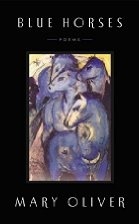
Mary Oliver’s Blue Horses and my No 2 scribble

Mary Oliver, Blue Horses (Penguin 2014)

In his justly-praised eulogy for Gough Whitlam, Noel Pearson repeatedly used the phrase ‘this old man’ as a term of high honour. Like Diana Athill, Dorothy Hewett, Jennifer Maiden and any number of others, Mary Oliver makes me wish passionately that we could say ‘this old woman’ and have it similarly understood to indicate esteem.

This is old-woman poetry. Oliver isn’t out to prove anything. In ‘I don’t want to be demure or respectable’, she says:

I’m not trying to be wise, that would be foolish.
I’m just chattering.

She’s not even out to offer obvious value for money. For $28 you get 78 pages and almost every second page is blank. But every word feels just right. The poems are personal and deeply felt, but nothing personal in a way that would be embarrassing to read on a poster on a bus. Most of them feel as if they have been around forever, or at least should have been. The recurring mode is celebration – of a new love, of connection to living things, of rhyme, of yoga lessons, of life and even of sickness and death, though in their cases it’s more a mature reconciliation than actual celebration. She stops short of being religious, as in ‘Angels’:

I don’t care how many angels can
dance on the head of a pin. It’s
enough to know that for some people
they exist, and that they dance.

Moving on to my own November task, I was struck by the poem ‘The Mangroves’, in which the speaker, who is living ‘in a warm place’ realised she has trouble loving mangroves the way she loves the black oaks and the pines of her cooler home. It’s not Oliver’s doing that oaks and pines are ‘normal’ to mainstream English literature and mangroves are exotic, but the idea of normal is inevitably there, so:

Sonnet No 2: In response to Mary Oliver’s ‘The Mangroves’
It’s fall, November, New York City.
Leaves fall, just like they do in song,
in movies, poems and all those pretty
paintings from Art History. Long
we’ve read bare ruined choirs
follow on bright autumn’s fires.
I’m coming over all Mackellar,
a not-your-field-and-coppice feller.
My heart belongs to smooth angophora,
to leaves that glisten all year round,
to roots four feet above the ground
and messy pneumatophora.
All trees are lovely when you look –
less so those growing by the book.

Travelling with the Art Student

OK, so we’ve been away from home for just over a week, and I don’t think I’ve ever seen so much art in so short a time. Such is life when shared with an Art Student. Here’s a partial list of the artists we’ve seen so far, in Los Angeles and New York, with many more to come.

Continue reading

Sydney Writers’ Festival: My Day 5

Sunday morning gestured vaguely in the direction of imminent winter. The sky was overcast and the breeze was making a stab at being chill. By the middle of the day, we were back in balm once more, but don’t anyone mention climate change. If I was  a truly conscientious blogger I would have managed at least three events, but non-SWF life called, so I’m reporting on only one:

10 am: Real Worlds / Imagined Worlds
This poetry session was chaired by Ivor Indyk, whose Giramondo Press publishes all four poets on the panel. (It also publishes at least two of the #threejerks from yesterday, which says a lot about the diversity of its list.)

Having acknowledged the traditional custodians, Ivor also acknowledged the slipperiness of themes at the SWF. The title and description of the session were what he had come up with for the program, he said, but the poets might well decide  to read something else altogether. The theme, which might or might not hold, was to be travel – either to other places or to other realities. Actually, it’s hard to imagine a poem that can’t be tied to that theme somehow so it was fairly safe.

Judith Beveridge took us to ancient India in readings from her new book, Devadatta’s Poems, written from the point of view of the Buddha’s cousin who tried to kill him three times, and in his voice: many intensely physical images of unpleasant things, delivered in Judith’s cool, self-effacing manner.

Ali Alizadeh ruminated a little about whether the whole idea of travel poem amounted to some kind of commodification, then read a number of what I think were unpublished works, plus ‘Robespierre’ from Ashes in the Air (my blog on which is here).

Kate Middleton’s most recent book, Ephemeral Waters, is a trip down the Colorado River, so she fitted the theme exactly. I especially liked a poem about Monument Valley, bristling with movie references (the Valley and the poem both). My sense is that we got the barest hint of the richness of this book.

Ivor Indyk introduced John Mateer as Australia’s main traveller poet. He read from his most recent book, Unbelievers, or ‘The Moor’ and other places, taking us to mediaeval Spain and Portugal, and then to those modern places.

There was time for questions. Poetry readings always seem to provoke questions that are either profound or silly, or both. Here the first question, something like, ‘What use does poetry have in the West, for us … for me?’ provoked interesting responses. Ali Alizadeh took it as a challenge – ‘You obviously think it doesn’t have any use, from the way you asked the question’ – and went on to argue that poetry is useless: it doesn’t make any money in the novels do, and it doesn’t give information like non-fiction. He then ruined his own argument by telling us he was working on a poem called ‘The Wink’, so that people would never forget what kind of man we have as Prime Minister right now.

The other question was even more profound/silly. ‘How do you work out what words to use when you write poetry?’ As the questioner explained what she meant, it emerged that as someone from a complex cultural background, she was wrestling with how to write when it felt as if she had to choose between languages and cultures. Again, Ali Alizadeh played the enfant terrible: ‘I disagree with you about cultural difference. If someone came here from Mars and looked at us, they’d say, “You all look the same to me. Get over it.”‘

And my Festival was over: three poetry sessions, two movies, one evening of stand-up, no rain; the world as a battlefield, the heart and mind as tools for liberation; a lot of laughter, a quantity of rage, some tears, and one or two gasps of delight. I got to see a fraction of it, but I intend to see more by way of the blogosphere and podcasts as I seek them out or stumble across them. Plus, I’ve got a swag of books either already bought or on my list to buy.

I love this Festival.


Sydney Writers’ Festival: My Day 4

Saturday dawned with yet another clear sky. I finally understood that El Niño and the weather gods are smiling on the Writers’ Festival this year, and my light linen jacket was all the warmth I needed. It was my busiest day at the Festival, even busier for The Art Student, who went in early for The Joy of Art with Betty Churcher, John Armstrong and Alex Monroe. Rachel Kent, director of the MCA, who chaired the session, tried to keep up the SWF tradition of ditching her advertised topic, in this case presumably because joy hasn’t been sufficiently theorised, but according to the Art Student the panellists gave the audience what they’d paid for and kept joy on the agenda.

I arrived at Walsh Bay in time to join the AS in the packed Sydney Theatre for

11.30 am: Reza Aslan: Zealot
There’s a famous clip on YouTube of Reza Aslan being interviewed on Fox News. The Fox person is outraged that Aslan, a Muslim, has written Zealot, a book about Jesus Christ. The implication hangs in the air that this close to a literary equivalent of 9/11. Aslan is the very picture of cool reason, repeating over and over that he is a scholar who studies religion and has a scholarly interest in Jesus. He insists, to the point of being boring, that his primary identity in this context is as a scholar rather than as a Muslim.

I was a little worried that he might be just as one-track boring when not dealing with a terrified fundamentalist, a worry which was intensified by my past experience of interlocutor Steven Gale as somehow impersonal, even mechanical. But my worries were total garbage  – both men were fabulous. Reza Aslan was witty, warm and exuberant as well as scholarly; Steven Gale obviously liked him and revealed a mischievous streak of his own, at one stage slapping his thighs in enjoyment.

Aslan’s book is about the historical Jesus rather than what he calls ‘the Christ of faith’, but he’s not a debunker – not, as he put it one of those biblical scholars who peers as if down a microscope and cries, ‘Ooh, look at all the people believing things!’ Asked what was known with certainty about the historical Jesus, he said that if you brought a hundred biblical scholars onto the stage and asked that question, once the fisticuffs had finished they would come up with a hundred different answers. But they would agree on three things: he was a Jew; he preached something called the kingdom of heaven, though there would be much disagreement about what it was; and the Roman occupiers executed him because of that. All the same, he says there’s nothing particularly new in his book – its aim is to open up the field to a wider audience. Sure, he takes many positions that other scholars will disagree with, but then he lists the disagreers in copious endnotes.

Jesus was almost certainly illiterate. He was one of probably hundreds of self-proclaimed messiahs of the first century of the common era, which Aslan said was the Middle East’s most turbulent period in history (cue gasp from audience!). Every messiah, including Jesus, had a project to free the Jewish people from the oppressive Romans, and when each one failed he was seen not to have been the real messiah. Jesus differed crucially (no pun intended, the cross wasn’t particularly distinctive) in that his disciples reported experiencing him as risen from the dead – something completely novel in the Hebrew context.

The four Gospels, he pointed out uncontroversially, were written after the destruction of the temple in 70 CE. Given that the Jesus movement had been pretty unsuccessful among Jews, the Gospel accounts were tailored to make it more attractive to the Romans. This they did in three ways: they made Jesus’ teachings seem less embedded in Jewish culture, more ‘universal’; they removed the nationalism, translating it into ‘spiritual’ terms; they shifted the blame for his death from the Romans to the Jews (what we know of the historical Pontius Pilate’s extraordinary cruelty makes the Gospels’ account of him reluctantly complying with the High Priests’ demand that he crucify Jesus completely implausible).

Aslan ended on an enigmatic note: in all the gospels, it was women who discovered that Jesus had risen from the dead. This is a stumbling block for historians, because at that time women could not be called as witnesses, so if the gospels were inventing the story they would have picked  someone else as the discoverers. [I immediately decided that Mary Magdalen was the key person who ensured that the Jesus movement survived his death.]

We had an hour for lunch and then were just about the last people to squeeze into the Philharmonia Studio for

1.30: The Changing Face of Indigeneity: Now and Beyond
Wesley Enoch, Anita Heiss and playwright Nakkiah Lui were on a panel chaired beautifully by Lydia Miller. If I understood what Lydia Miller said in her introductory remarks, Native Title legislation of the early 1990s changed the way people in Australia think about indigenous identity, because it led to a diversity of narratives. There is also diversity because of intergenerational differences – I think I heard correctly that 60 percent of Aboriginal Australians are now under 25 years old, and 40 percent of those are under 15.

The panellists, two from the theatre and one novelist, addressed the theme interestingly. Wesley Enoch described himself as a psychological vampire, looking around for young Aboriginal blood for use in the theatre. Anita Heiss told us that there are 60 different pieces of legislation in Australia defining what it is to be Aboriginal, and this obsession on the part of whites with defining Aboriginal identity  was something that Aboriginal artists constantly have to negotiate: ‘We don’t sit around discussing identity with each other all day, you know. We have other things to do, like shopping.’  Nakkiah Lui, who spoke very quickly with the result that she was often incomprehensible to me (more about that later), said she was interested in critiquing the power relationships that were the context of cultural work. All three of them brought both zest and urgency to the question of challenging the dominant culture’s unremitting project of containing Aboriginal and Torres Strait Islander peoples in straitening identities.

[I’m writing this after seeing the wonderful Brothers Wreck at Belvoir Street on Sunday evening. The play reminded me of two other comments: Nakkiah Lui pointed out that there had been two Indigenous productions a year at Belvoir Street for some time now, and that this was building on an established tradition of Aboriginal theatre making. Wesley Enoch said that at the Queensland Theatre Company (of which he is Artistic Director) they find that if the audience is more than 20 percent Aboriginal, the response to Aboriginal theatre is completely different – the white audience members become a lot less uncertain in their responses, more open to the work.]

And then with a rapid change of mindset, to

3 pm: #three jerks,
This is a descendant of Alleyway Honour, a highlight of the 2009 Writers’ Festival. Like that event it is an austerely theatrical reading devised by Michael Mohammed Ahmad and directed by Roslyn Oades. Michael Mohammed Ahmad, Luke Carman and Peter Polites, three of the five readers from the earlier production, here read interlocking first-person stories. My assumption is that each of them wrote his own story.

Opening with an infamous 2006 quote from Sydney Muslim cleric Sheikh Hilaly about where blame should be apportioned for a number of rapes in Western Sydney, the stories play out a key couple of days in the lives of a number of Western Sydney adolescents – a gay Greek boy, a white boy who gets caught up in a petty crime, and Lebanese boys dealing with adolescent sexual politics. Some of it is confronting stuff, but there’s an intelligent reaching for understanding, and a basic decency in all three narratives.

The show is scheduled for a second appearance at the Emerging Writers Festival in Melbourne: at the Wheeler Centre 7 pm Friday 30 May. So if you’re in Melbourne here’s a chance to hear voices direct from Western Sydney, to provide some kind of counterpoint to the constant wailing about Western Sydney in the political commentariat.

[Luke Carman read very quickly, too quickly for me to understand most of it. This being the third time I’ve made such a complaint at this Festival, I have to ask if the problem isn’t with me rather than the rapid speakers. My ever-sympathetic partner is adamant that the problem is not that Melbourne poets, young playwrights and anglophone Western Sydneysiders talk too fast, but that my deafness has passed the point where I need a hearing aid.]

Bickering amiably about my growing disability, we headed up the queue outside the same theatre for the next session:

4.30: Jeremy Scahill: Dirty Wars
Jeremy Scahill, an investigative journalist from the US, chatted for an hour to Australian TV journalist  Mark Davis about his book detailing the extent of the US’s covert military operations, particularly those undertaken by the Joint Security Operations Council.  This was pretty scary stuff: Scahill’s early discoveries were dismissed by a spokesman for the White House as conspiracy fantasy, but the Snowden tapes confirmed that he was right on the money. Denied access to top levels of the military and the government, he has nonetheless built a substantial number of sources at the operational level. Mark Davis repeatedly expressed his astonishment and envy that in the US public employees seem to be willing to speak frankly to the press in a way that is not only illegal in Australia, but also simply not done.

Scahill’s book, Dirty Wars: The World is a Battlefield (subtitle taken from a Dick Cheney memo) is a hefty paperback. We stayed to watch the film of the same name, which follows his investigation into darker and darker territory until it reaches the climax of the killing by drone of a 16 year old boy, a US citizen against whom no charge had every been made. This was by a military unit that was legitimised by Rumsfeld but now operates under Barack Obama’s direct authority.

We walked to the train though the incredible crowds that had turned out for the first Saturday night of the Vivid Festival. The Opera House, the Museum of Contemporary Art, Customs House are all lit spectacularly. Having just come from these revelations of what the government of our special allies are doing in almost complete secrecy it was hard not to think of bread and circuses. Here’s the bit from Juvenal’s 10th Satire (which I found on Wikipedia):

Already long ago, from when we sold our vote to no man, the People have abdicated our duties; for the People who once upon a time handed out military command, high civil office, legions — everything, now restrains itself and anxiously hopes for just two things: bread and circuses.

Sydney Writers’ Festival: My Day 3

20140523-161141-58301843.jpg

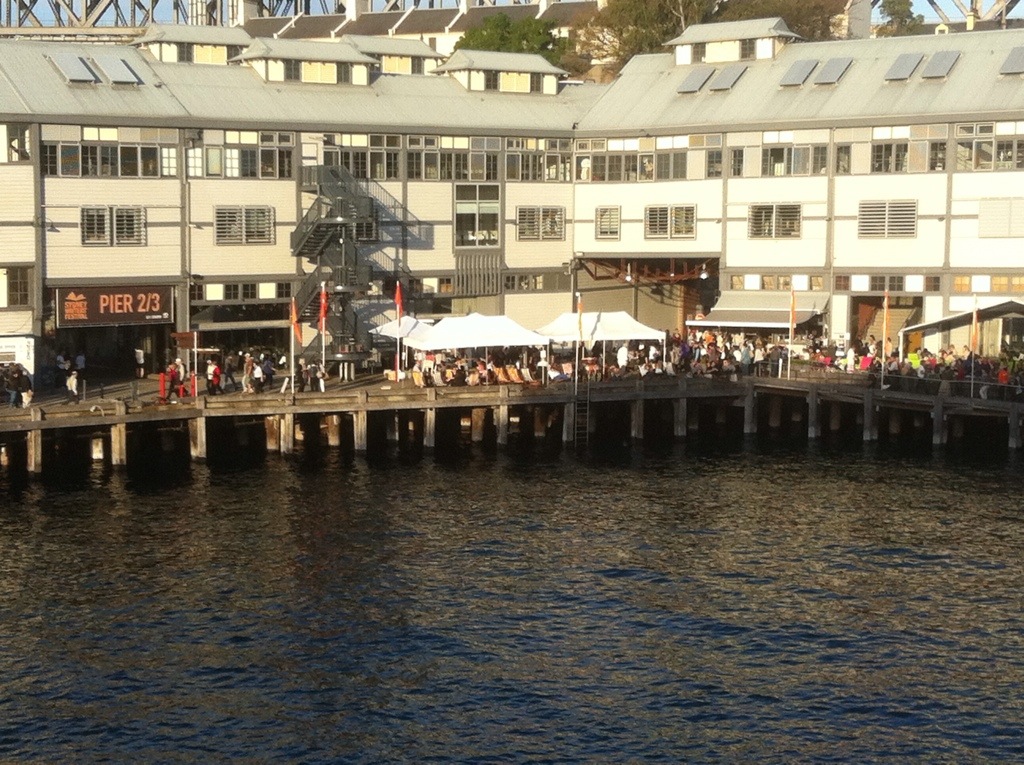
The view from outside the Bar at the End of the Wharf

On Friday the sun was still shining. My only event of the day, in the Wharf Theatre 2, confusingly located on Pier 4, was

4.30: The Big Read

This is story time for a big room full of big people. It’s not quite as comforting as dozing off on your mother’s lap to the sound of a Hans Andersen horror story. Dozing is not unheard of, but the main point, at least for me, is to sample bits from writers who are new to me or who, as with two of this year’s line-up, I’ve developed a prejudice against (I’m not saying which).

But first, the Sydney Morning Herald Best Young Australian Novelist awards were presented by Linda Morris, who writes for the Herald on literary matters. These awards, instigated 18 years ago by Susan Wyndham who was and still is  Herald‘s literary editor, carry no monetary prize – each of four young(ish) people was presented with a certificate and what looked like a bottle of wine. They were: Luke Carman (An Elegant Young Man), who has been appearing in this blog for some years now; Balli Kaur Jaswal (Inheritance); Hannah Kent (Burial Rites); and Fiona McFarlane (whose The Night Guest won a money prize at the NSW Premier’s Awards). They stood in a row looking awkward while we applauded, then politely melted into the darkness to make way for the older writers, introduced with her trademark enthusiasm by Annette Shun Wah.

Lian Hearn, the novelist of mediaeval Japan formerly known as Gillian Rubinstein, author of much loved children’s books such as Space Demons and Beyond the Labyrinth, read to us from her latest Japan novel, The Storyteller and his Three Daughters, a smooth, lucid excerpt that was mainly about writing.

Dara Horn from the US read from A Guide for the Perplexed – her book, not Maimonides’ – giving us an intriguing glimpse of a book in which tales from two different eras explore the idea of having a total record of a life: in one, a character develops software that records everything; in the other a late 19th century scholar discovers a comprehensive trove of documents in a Cairo synagogue that had not been cleaned out for a thousand years.  Such a trove of documents really has been found, and such software isn’t entirely implausible

Alex Miller read from Coal Creek. I’m afraid I didn’t get much sense of the book from this reading. It was largely a mundane recount of a man and a horse called Mother and it went on well over its allotted time so that everyone else had to whip their readings along.

Eimear McBride read from A Girl is a Half-Formed Thing. In the bit she read the character was a 13 year old girl who may or may not have been contemplating suicide by drowning. The uncertainty was in the character’s mind, rather than mine, I think. The precise meaning didn’t matter so much: as Annette Shun Wah commented, it was like listening to jazz with, I would add, a beautiful Irish/Joycean accent. (The ABC has uploaded an earlier session of Eimear McBride in conversation with Michael Cathcart.)

Adam Johnson finished us off with a chilling bit from The Orphan Master’s Son. ‘You won’t understand this,’ he said, ‘because it’s an extract.’ It was the session’s only piece with a clear, strong narrative, and I would have rushed out to buy the book only two of my companions said they had read most of it, thought it was  really wonderful, but couldn’t finish it because it was so unremittingly grim. I still might give it a go …

We were on the train home before the Opera House and Customs House lit up for the Vivid Festival. We’ll look at the lights tonight, after a full day at the festival.

Sydney Writers’ Festival: My Day 2

One of the joys of the Sydney Writers’ Festival is hearing from friends and complete strangers about events you’ve missed. This morning in the coffee queue an older woman, a Millers Point resident currently threatened with eviction (Millers Point residents can look down in the festival from their rear windows) was off to a session on how to kill yourself (though probably phrased less bluntly than that) but was also planning one on enjoying old age. I went in out of the sunshine into the very life affirming

10 am: Marathon Reading: Asia Pacific Poetry

This event, presided over by the genial Michael Brennan of Vagabond Press, more or less continued the launch of that publisher’s new Asia Pacific Poetry Series at Gleebooks on Saturday.

A modest crowd sat around at small tables, while, to quote the Festival web site, a line-up of 10 writers made ‘poetry sing in its many voices across languages and get a little beyond the anglosphere’.

Kyoko Yoshida from Japan kicked off with a surrealist short story from her collection Disorientalism. She said she’d never been to Australia before, but the story was set here, and featured a weird love triangle in which one participant was a kangaroo who was very good at sales.

Violet Cho read a long poem in a Karen language, followed by David Gilbert reading us his English version. It’s fascinating to hear the music of a poem before having any idea of its meaning. And Karen is very musical.

Robert Nery, a Sydneysider, read poems translated from Tagalog: crazy, dangerous street scenes filled with brand names, many immediately recognisable to a Sydney audience – capitalism makes the whole world kin, perhaps.

Elizabeth Allen, one of the two pillars on which Vagabond Press stands, represented the Anglosphere – anglophone Australia is after all part of the Asia Pacific.

Nhã Thuyên fro Vietnam was next. In introducing herself she said she was nervous (and perhaps she had a cold as well), that she was usually more human than she was right then. She read beautifully and musically in Vietnamese, and Liz Allen stepped up to the mike with an english version.

Bella Li, from Melbourne, read in  a dour, uncompromising Melburnian manner.

Mabel Lee, who had been introduced by Michael Brennan as the matriarch of Chinese translation in Australia, read magisterially. ‘There must be as many women writing poetry in China as men,’ she said by way of introduction,  but it’s men who get all the attention in the outside world.’ Her edition of poems by three Chinese writers, two of them women, Poems of Hong Ying, Zhai Yongming & Yang Lian, is Number 6 in the Asia Pacific Poets Series.

Adam Aitken is too young and too mild-mannered to be called the patriarch of anything, but he brought a certain local gravitas with him. He read ‘Ala Moana’, which was published in his chapbook, Tonto’s Revenge, and is the only poem of the session that I’d read previously. Adam described it in his introduction as an anti-touristic touristic poem.

Dinah Roma read last. Her Naming the Ruins is the first book by a Philippine poet living in the Philippines to be published in Australia.

We walked out into the sunlight ‘with fragments of poems like ornaments in our hair’ (to quote a poem a student wrote for me in my brief stint as an Eng Lit tutor in a bygone era).

Usually it rains and is nasty for at least some of the Writers’ Festival. Not so far at this one.

It should be raining

11.30 am: David Malouf: Celebrating 80 Years
David Malouf is probably the most loved public figure in Australia. His novels are justly acclaimed. His poetry too. I was surprised to learn from Tegan Bennett Daylight, his interlocutor in this session, that the recently published A First Place is the first collection of his essays: it seems as if his writing about Brisbane and his Queensland education have been working away on the general consciousness for decades.

This was a wonderful session. Tegan Bennett Daylight mentioned in passing that she had been immersed in Malouf’s work for a couple of months in preparation, and it showed – not in any encyclopaedic knowledge but in a deep appreciation, and in a willingness to risk interpretations.

At one stage David said that in a conversation about a book, the only person who hasn’t read it is likely to be the author. Everyone else is in a position to see things that the author can’t see. (Doesn’t that just cry out for the hashtag #oftwasthoughtbutneersowellexpressed? A lot of his talk does that.) Emboldened, TBD offered her observation that all DM’s novels are about a man who finds himself removed from his usual environment, and in the new environment, seeing things freshly, discovers what it is to be. The example she gave as her test case was from Ransom. DM didn’t respond directly to her thesis, but spoke charmingly at some length about what he was trying to do with that part of the book. A little later almost apologised,  saying that what he had said didn’t in any way contradict her thesis.

The conversation played out like a beautiful piece of theatrical improvisation: no one blocked, every question led somewhere interesting. A couple of times Tegan had to take a moment to process what had just been said to her, while David stayed ready to field whatever she gave him as a result. When she ventured into potentially dangerous waters and asked this eminently private author about being in love when writing one of his books, he managed with extraordinary grace to give no information about his private life while answering the question very interestingly about the book.

The session finished with David reading ‘Night Poem’ from Earth Hour (I would have asked for ‘A Green Miscellany’ or ‘Touching the Earth’), and then, most beautifully, Tegan drew our attention to David’s generosity as an interviewee, in particular his generosity to her. I hope this conversation turns up on the radio. Do listen to it.

I dashed home to walk and feed the dog and generally attend to the rest of life, then back for the next session. In the queue, we heard about a brilliant session with the writers of The Gods of Wheat Street, in which among other things they talked about how tough Jimmy McGovern had been with them when they were working on Redfern Now: ‘Make the characters bleed,’ he would say, and ‘That’s furniture, cut it out.’

4. 30 pm: Alice Walker: Beauty in Truth
This was a  documentary movie by Pratibha Parmar, followed by  Alice Walker, again in conversation with Caroline Baum. It went some way to explaining the awkwardness of the previous evening’s conversation: how could they talk about Alice Walker’s life and times when they knew that the next afternoon many of the people in that audience would be seeing this movie, which is nothing if not the life and times of Alice Walker? The film goes into detail about her work, her activism and how they relate to each other in a way that was frustratingly not there yesterday. Her early life, her participation in the Civil Rights movement, her relationships, the writing of her books, all were in the film, where yesterday had tiptoed around them.

The film also shed light on what I registered as a kind of serene abrasiveness. Alice Walker hasn’t been in the habit of speaking in order to be liked: I knew The Color Purple  had been criticised, but had no idea what a  vehement and sustained attack she had endured. And there has been plenty of nastiness in the press since then, often enough from African and African communities, about her writing about uncomfortable truths as much as about her personal life. She has been on the receiving end of some of the worst of celebrity culture, so a little wary defensiveness is more than understandable.

Also, my companion pointed out, she has fabulous clothes and has created a beautiful living, meditating and working environment for herself.

We didn’t stay for the talk, because we had to eat, catch up and walk up town for our next session. Having just been to a movie, which arguably belonged in the Film Festival rather than the Writers’ Festival, we now went to a stand-up show, which you might think belonged in the Comedy Festival.

8.30: Sandy Toksvig: My Valentine
We knew Sandi Toksvig as one of the occasional women panellists on QI. This show, she said, was her Valentine to Life. It began and ended with bits of Beethoven’s Ninth Symphony; we learned a little Danish which led to a surprisingly poignant pay-off; we found out that Sandy Toksvig has been on British Television for 34 years, and some of the audience vocally remembered her from a children’s show – ‘I see that some of my children have gown up,’ she said). We laughed a lot, and bought one of her books, which turns out to be a female to male cross-dresser who enlisted to fight in the Boer War.