Category Archives: Diary

LoSoRhyMo #9: Deadline

Oh no, I’ve fallen behind schedule even on my fun! If I’m to manage 14 sonnets in November I need to push out one every two days, allowing for a couple of days slippage. It’s now the 21st and I’ve only done eight. Here’s a very quick one.

Sonnet 9: I love to hear them whooshing by
I cannot, will not touch a key
on my computer keyboard now,
although I know it’s time to be
delivering that text. Oh how
I though it would be fun to write –
this guilt by day, this ghost by night,
this task that makes my blood run slow
and gives all else a tempting glow!
St Frank the patron saint of writers
is also patron of the deaf.
That fact’s a whistle from the ref –
don’t listen to the world’s detritus.
Disconnect, log out, ignore
all writing not being writ by Shaw.

OK, now I’m off to have a tomato and cheese sandwich then take my own advice.

LoSoRhyMo #4: Love and cash registers

There are so many possibilities for my fourth November sonnet. I’m resisting the obvious subject, a farewell to our weekend visitor, even though said visitor went so far as to compose a final couplet for me:

And now our Rita’s gone away
the world has gone all flat and grey.

I’m also resisting Sculpture by the Sea. It got a sonnet last year and this year I’m completely intimidated by Richard Tulloch’s beautiful blogging (that’s two separate links) about it.

Instead, here’s one about what we did last night:

Sonnet 4:
The AGNSW is
an auction house this rainy night
for things owned by the late Ann Lewis.
Six hundred people squeezed in tight
to bid on art from all her walls:
kitchen, bathroom, office, halls,
Riley, Kippel, Napagnardis,
Walpidi, Williams, packed like sardies.
This vast, exuberant collection
reduced to ‘dollars on the phone’,
or ‘absentee with me’ – soul’s flown.
That life of passionate connection
(HelicopterRosalie …)
here has its hammered exequy.

We were empowered to bid on two works on behalf of friends. Both were sold for three or four times our maximum. If there has been a slump in the art market recently, there was no sign of it last night. Perhaps people felt that Ann Lewis’s name added value, or perhaps they were being generous as a way of honouring her memory.

LoSoRhyMo #3: Written early Saturday morning

Sonnet 3: In anticipation
Today our Rita comes to town
God willing and the creeks don’t rise
(that is, if fate or Joyce don’t frown
and Qantas don’t forsake the skies).
We’ll meet her plane at ten to ten,
kiss-kiss, collect her bags and then
that welded-on Melburnian
will come with us a-journeyin’ –
White Rabbit, Sculpture by the Sea,
a ferry ride, so many jaunts.
There’s time to tour our local haunts
and if it rains, a cup of tea
at home. Our Rita’s here to stay
the whole weekend. Calooh! Callay,

‘The Second Coming’ it ain’t, but I had to make breakfast.

Not interesting yet …

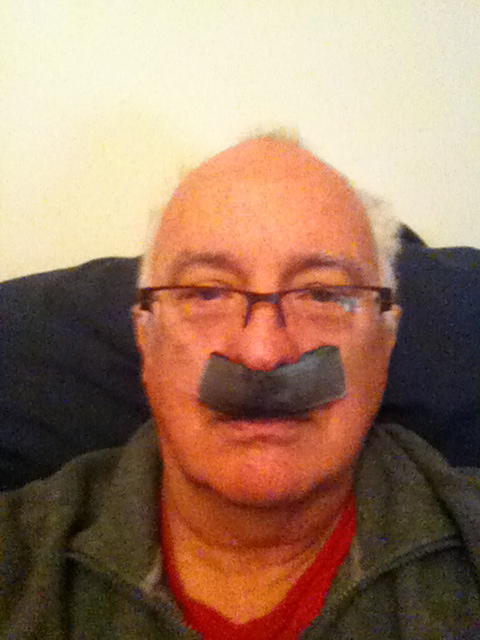
… but just in case it turns out to be a story later, here’s a photo of me last night:

I was home from an outing to the Sydney Day Surgery where very nice ENT surgeon went inside my nose and removed some polyps (which, as seen on a big screen, filmed by fibre-optic telescope, resembled giant slugs that wouldn’t have been out of place in a Doctor Who episode). While he was there, he opened up the entrances to my sinuses (procedure known as Functional Endoscopic Sinus Surgery), straightened my septum, trimmed my turbinates (Seroplasty).

It was a remarkably pleasant experience. Andy, the surgeon, operates on children as well as adults, and his bedside manner couldn’t be better. For example, when I made the decision t0 have the surgery rather than live with recurrent sinus infections and chronic stuffy nose, he said he not only approved the decision, but was personally glad because it’s his favourite procedure. It’s hard to imagine a better way to inspire confidence without undue solemnity.

I had one moment of terror before the event: I heard a male voice introduce himself as ‘the anaesthetist’ to someone in a bed the other side of a curtain from mine, and go on cheerfully, ‘I’ll just wheel you into the other room and give you something to pop you off to sleep and you’ll be right as rain in no time!’ I contemplated calling the whole thing off. But the gods of medicine were smiling on me. A completely different man arrived a little later, introduced himself as John, explained that his colourful headcloth was so as to be less intimidating to the children he’d been anaesthetising earlier, answered my questions about the anaesthetic in a sensible and almost intelligible manner.

The theatre was a cheerful, busy place with plenty of colourful headcloths. I’d been there less than a minute before I became first drowsy and then  … came swimming back into consciousness in another room hearing an interesting conversation about work visas. Then there was an awfully long wait, during which I amused myself composing clerihews of which I remember only one:

Tony Abbott
‘s grab at
being prime minister
is looking more and more sinister.

Some cheese and tomato on biscuits, a glass of lemonade, visits from John and Andy, instructions from the Polish nurse (who was amused rather than offended when I thanked her by saying ‘Spasibo’, which it turns out is Russian, and very different from the Polish ‘Dziekuje’), and the Art Student drove me home.

I have to wash my nose out four times a day, and it’s not all pleasant in there, but so far I haven’t had any pain at all. I’m told my nose will swell up and look horrible in a couple of days. If it’s interesting enough I’ll post another photo.

Normal book blogging will resume shortly.

I once more smell the dew and rain …

… and relish blogging.

Three main things have kept me away from the blog for such a long time, all of them involving earning of money and all of them now done with and money all but in the bank. All of them were interesting, but I’m only going to talk about one: I was a collector for the Census.

The Census Collector’s Sacred Oath of Confidentiality guarantees that I won’t subject you to any gossip of even the most abstract kind, but I can tell you that it was a very interesting and – actually – heartening experience. I was variously hailed as ‘the Census man’, mostly greeted warmly both when dropping off material and when picking them up. The vast majority of the people I had dealings with were either pleased or uncomplainingly willing to be part of the Census: ‘I want them to know I was here.’ Once or twice I thought I was being fobbed off when someone told me to come back ‘on the weekend’ or said they ‘should be able to get it done by Monday’ (this was on a Thursday), but each time I was smilingly proved wrong.

I started out feeling like an intruder in people’s lives: ‘Here are your forms. How many males and how many females will be here next Tuesday night? Just you and your partner? So that would be one of each, or … ?’ I progressed to a sense of myself as a personification of our interconnectedness: ‘Here’s your chance to contribute .’ And then towards the end as I was going back for the fourth or fifth time and finding no one home or forms not yet completed (‘Sorry, mate, we’ve been busy/haven’t got around to it/lost the form’), I realised I was the little man from the government.

I was offered one cup of tea, told two life stories, given three helpful suggestions for improving the census (all involving the need for more questions), reproached once for not knowing the completed form had been left under the mat, attacked by no savage dogs. I walked in on one tragedy, in a  household that gave me a form with good grace. I left my phone number when I didn’t make contact, and had half a dozen calls or text messages that all made life easier. It was a sustained reminder that we are a cooperative species, that Australians, at least on my four blocks, are clear that at least some government agencies are to be trusted.

I’ve handed over my record book and passed in my ID card. There are no longer stacks of blank and filled forms taking up shelf space in the spare bedroom. I’m back to being a private citizen. The pay isn’t great, but I recommend the experience. Keep your eyes peeled for the job ads in 2016.

Still here!

I’m shocked, shocked at how long it is since I last posted. That’s what a bit of paid work and visitors from out of town will do to a blogger’s practice. I’ve signed a confidentiality agreement about at least part of the paid work, but I can blab about the visitors.

Will Owen and his partner Harvey live in North Carolina and are enthusiastic collectors of Aboriginal art. I met Will almost exactly seven years ago when he emailed me after reading my blog post about an exhibition of art from Aurukun, from which he and Harvey had purchased a piece, and we’ve met a number of times in the non-Web world since. Will’s blog, Aboriginal Art and Culture: an American eye, is fabulously erudite, funny, insightful, and broad-ranging. Will in person is all of that and much more ( for example, he can quote slabs of Ezra Pound and knows a lot about Finnegan’s Wake). He and Harvey are in Australia just now, and were in Sydney for nearly a week, flying out this morning. The Art Student and I managed to see quite a bit of them, and it would be hard to imagine two more delightful visitors.

Will gave a brilliant talk about his and Harvey’s collection at the Art Student’s TAFE. We ate at Revolver. We went to Bangarra’s Belonging at the Opera House (Will has already posted a characteristically thoughtful review) and Roxanne McDonald in Windmill Baby at the Belvoir. We ate Italian in Newtown and Lebanese in Surry Hills. We accompanied them to Danks Street where Christopher Hodges of Utopia Gallery took us to the back room and showed us (well, showed Harvey and Will, with the Art Student and I as open-mouthed collateral beneficiaries) more than a score of brilliant work from Papunya Tula artists, rolling the canvases out on the floor. Last night we dragged them off to see Red Dog, a genial outing, though reviews might have warned us that if it’s not a children’s film it could easily pass for one.

After the cold, wet, dull and unprofitable weather of recent weeks, Sydney managed four or five days a deep blue skies and T-shirt weather for their visit (thanks for that, Hughie!). Today it’s grey again.

Talking about looking at painting about bombing Guernica

In my 20s, on my first trip overseas, Picasso’s Guernica and I happened to be in New York at the same time. It had a room to itself in the Museum of Modern Art. I wandered in and admired it with pretty much the same undifferentiated awe as I’d brought to pretty much everything else in MOMA. I suppose I was suffering a kind of low-grade colonial Stendhalism (you know, the condition where visitors to Florence grow faint from exposure to too much beauty). The only other person in the room, a young man about my own age, spoke: ‘I’ve been wanting to see this all my life. Isn’t it amazing?’ I thought he was some kind of weirdo, either that or an art student.

I saw Guernica again in Madrid five years ago, this time in the context of a major Picasso exhibition, and, having read Alice Miller’s essay on Picasso in The Untouched Key, I saw it a little better.

Last night the Art Student and I caught a bus to town to hear a Sydney Ideas talk by Professor Timothy J Clark, art historian from the University of York in England: ‘Looking again at Picasso’s Guernica‘. I came away feeling that when it comes to looking at something like this painting, I’m not much better than a day-old kitten.

As the fast-talking professor who introduced the speaker said, we mostly hear Picasso spoken of in connection with erotic adventures and high auction prices. CJ Clark’s interest lies elsewhere. Guernica, he said, is a history painting, already an anachronism when it was painted in 1937, but a history painting that refuses to die: it crops up again and again in anti-war demonstrations. A tapestry at the United Nations building was covered with black felt at the insistence of Colin Powell when the US was bombing civilians somewhere. How to account for its enduring power?

His stab at answering this question focused on Picasso’s relationship to space. Picasso for him, he said, ‘is a history painter’, and the main history he painted was ‘the end of room space’, that is the traditional subject of paintings – a space built for human habitation, with a roof, walls, furniture and perhaps a window looking out onto external space. That subject would seem to be a long way from Franco’s bombing of the historic Basque town of Guernica. Yet, as far as I could understand the argument, CJ Clarke was saying that the struggle to resolve issues of space – both room space and public space – is at the heart of the painting’s success. The painting was completed in five weeks from its inception, and Picasso spent just 26 days working on the canvas. His ‘muse and lover’ (Wikipedia’s description) Dora Maar took a series of photographs of the work in progress, of which Clarke used slides to take us through his argument: we looked at the way classic motifs were introduced and then obscured, at the importance of the sheer scale of the painting, at the role of geometry, etc etc. We didn’t touch on Alice Miller’s key (she locates the painting’s emotional force in its connection to major childhood trauma) and the erotics of the painting, we were told in an aside, is a story yet to be told.  That is to say, a lot was said about the painting, but there is so many more important things that can be said from so many other valid perspectives, so much more to be discovered in this one painting.

Such close looking may be commonplace for art students – for me it was breathtakingly interesting. I couldn’t see how, or even if, the discussion actually went any way towards explaining the painting’s enduring power, but I’ll leave that to people with better equipped eyes to answer.

Clarke’s next book is Picasso and Truth: From Cubism to Guernica. I expect it will be a good read.

SWF: Saturday

11.30: The Book of Rachael

‘What’s a nice secular Jewish girl like you doing writing a book about Jesus?’

That’s how Irina Dunn kicked off this session in the Bangarra Mezzanine room, swimming in morning light and vibrating to an occasional passing jet ski. Leslie Cannold, the nice secular Jewish girl in question, was there to discuss The Book of Rachael, one of a number of books at the festival to address religious issues from the viewpoint of respectful non-believer.

I’d been keen to attend this session. I love Dory Previn’s song, ‘Did Jesus Have a Baby Sister?’ and a novel about just such a sister has a huge appeal. It turns out that Leslie Cannold has written a number of non-fiction books, to do with abortion and other feminist issues. She was watching a series about the life of Jesus on television, and had a moment when the narrator said that, though Jesus almost certainly had sisters, nothing is known about them. She decided to write an essay bringing those sisters back to history. She headed off, full of resolve, to an institution called something like the Melbourne Theological Library, only to discover that when someone is forgotten it means they are forgotten, that we know nothing about them and never will. She decided to write a novel. Fortunately no one warned her how difficult that would be.

As she was completely ignorant of religion, her research involved reading the entire Bible, both the Hebrew Bible and the Christian Bible, but not too much interpretation of it, though the limited amount she read included daunting texts such as Elisabeth Schüssler-Fiorenza’s In Memory of Her. She drew a parallel with the process in which hints and silences in the official histories must be interpreted to unearth the the histories of subject peoples – ‘women have essentially been a subject people’. The project of telling the story of Jesus’ sister ran into many difficulties, among them being the way Jesus’ story kept drifting into the foreground, as it did a couple of times during the discussion.

Irina Dunn did a lovely job of letting Ms Cannold shine, and supplied a couple of sweet theatrical moments when she tried to discuss elements of the plot, and had to be almost physically restrained. ‘But I never mind if people tell me a book’s plot,’ she said, genuinely astonished that people should object to spoilers. ‘It’s the writing that matters.’

One lovely thing I wrote down:

I love and respect all these characters. I assume they are believers and respect that about them, but I needed to tell their stories in a way that made sense to me, and I don’t believe in miracles.

The book was sold out when I tried to buy itbut I did embarrass myself by approaching Leslie Canold at teh signing table and singing a few bars of Dory Previn to her.

1 pm: The Director’s Notebooks
Former National Gallery of Australia director Betty Churcher chatted with Terence Maloon about her new book about the drawings she did of beloved paintings when she thought ahe was going blind. This was a marvellous session, not least for the unabashed affection these two people showed for each other. To kick things off, Maloon read a passage from early in the book, where Betty describes herself aged eleven being enchanted by a painting (in a serendipitous echo of the spirited intelligence of Leslie Cannold’s Rachael). It was a lovely passage, and when he finished reading, Maloon simply sat and beamed at the writer of it. After a long moment, she said, ‘That was the start of it,’ and the conversation was under way.

4:00: The Big Reading
This is a regular event where a big theatre full of people is read to by an all-star international crew of novelists, with SBS’s Annette Shun Wah as ring mistress.

Kei Miller read from his first novel, The Same Earth. Introducing him, Annette made a teasing reference to the Caribbean accent as impenetrable. In fact he was brilliantly articulated, as much a pleasure for the music of his voice as for the slightly fabulist text.

David Mitchell and Michael Cunningham read from works in progress, the latter explaining that reading published works feels to him like showing a cucumber that won a prize at a county fair several years ago. It didn’t seem to occur to him that this might seem to be disparaging his companions on stage. Still, both WIPs were intriguing.

Téa Obreht, originally from the former Yugoslavia and now living in the US, read from The Tiger’s Wife, a piece that blended vampire elements with tales of the recent Yugoslav wars.

Kader Abdolah, sporting an impressive Mark Twain moustache, was an established novelist in Iran, but now lives in The Netherlands and writes in Dutch. He was the stand out of the session, reading us a short story that was a lightly fictionalised account of his refugee journey – this was both affecting and funny. Then he read the first paragraph from his new book, The House of the Mosque, and held the book up, saying that he had been missing Iran for many years, but had finally been able to go there again, ‘in this book’.

We had an excellent and surprisingly cheap Lebanese meal watching the sunset over Walsh Bay, then walked up George Street to the Town Hall for:

8:00: We (Still) Need to Talk About America
This was the fizzer of the festival for us. Four interesting people on the panel, with an idea that sounded promising: the US sometimes seems scarily incomprehensible from the outside, and this was a chance to hear what it’s like inside. Michael Connelly is a crime novelist who engages with live issues. Téa Obreht is a young novelist who arrived in the US as an immigrant when she was (I think) 12 years old. Daniel Altman is an economist with an interesting résumé. Gail Dines is a sociologist who takes on the influence of porn. It went nowhere. From the front stalls it looked as if Anne Summers mishandled the moderator role, moving doggedly through her list of things that are weird in the US – the cheering of the killing of Bin Laden, the failure to introduce gun laws, disenchantment with Barack Obama, and so on – asking questions that couldn’t help but make the panelists defensive, and jumping in too often to display her knowledge of things USian, in effect clamping on the brakes whenever any momentum seemed to be developing among the panelists. Dines and Altman, sociologist and economist, gamely worked up some edgy sparring, and they both had interesting things to say, but for me the dominant mood was encapsulated in this exchange:

Summers (to Connelly): I saw you smile. You had a thought there.
Connelly: No, I was just waiting for this to pass.

My guess is that the whole thing would have gone better if a moderator had opened with a brief statement to the effect that many things about the US are incomprehensible to outsiders, maybe giving a couple of examples, then having each of the panelists take 5 minutes to respond what it looked like from their vantage point. And trust them to take it somewhere interesting.

Still, we had plenty to talk about in the long wait for a bus.

SWF: Busy Friday

I had tickets for a 10 o’clock session yesterday morning. One of the participants was prevented from being there by the Chinese government, and I was kept away by an act of vandalism (see previous post). There’s a photo of Liao Yiwu on a chair in the Gleebooks shop, but I got my whole body to Walsh Bay in time to spend a little money and queue successfully for

11.30 am: The Fascinator
Delia Falconer, Ashley Hay and Gail Jones have all recently written books set in Sydney. With Jill Eddington in the chair, the three of them – one a lifelong Sydneysider, one here since she was about 20, one a very recent arrival – chatted interestingly. Jill Eddington recommended reading all three in succession because the effect was like three movements in a piece of music. She imagined a movie that might be made of the three of them wandering the Harbour foreshores, going in and out of the Mitchell Library, walking in each other’s footsteps, almost meeting. The conversation that followed was a nice contradiction to the myth that writers are essentially in vicious competition with each other: Ashley Hay, for example, said that when her book was finally with the printer, reading Delia’s, which covered so much of the same territory but from a very different perspective, was like a special reward.

I tore myself away early, just as they were playing with possible readings if the session’s title: were we meant to think of the Harbour as a hat or an evil enchanter from a Margo Lanagan short story, or – the preferred option – both? I left reluctantly so as not to risk missing out on the Francis Webb session at 1 pm. This turned out to be a wise move, and brought a sweet bonus: I was hailed by a friend I hadn’t seen for 40 years, and while I kept one eye on the Webb queue we snatched a quarter of an hour to get reacquainted. When the growing queue vanished into the dark, we promised to follow up on Facebook, and I skedaddled to:

1 pm: The Lost Poetry of Francis Webb
This was in a much bigger venue than other poetry events, and we were told that it could have filled a space twice the size. It was one of a series of events around Australia to celebrate the recent publication of the UWA Collected Poems. The book’s editor, Toby Davidson, has organised and chaired the events, in which local poets read poems by Webb and speak briefly of their connections to him.

Toby D is a young man whose enthusiasm for his subject wouldn’t have shamed a revivalist preacher. He wants us all to read Webb, in solitude and aloud to our friends. He recommends the practice of carrying a book of his poems everywhere with us (which Bob Adamson told us later he actually does). He kicked things off by reading ‘Ball’s Head Again’. He didn’t read badly by any means, but he did demonstrate the difficulty of Webb’s verse and gave us a yardstick by which to judge the other readers.

By any measure they were all brilliant.

Judith Beveridge spoke of the texture of Webb’s language, its compression and richness, and read ‘Images in Winter’ and ‘For My Grandfather’.

Brook Emery quoted a speaker from an earlier session who referred to ‘songs that please the ear and songs that please the heart’ and said he would add ‘songs that please the mind’ – Webb’s poems, he said, are always reaching for meaning. He read ‘Night Swimming’, the first poem by Webb I ever read, when I was 24 or so, and ‘Nessun Dorma’.

Johanna Featherstone, easily the youngest of the poets, struck a blow against the view that Webb is a poet’s poet, read only by scholars and fellow poets. She takes poetry into correctional centres, where prisoners, possibly influenced by knowledge of his time in institutions, believe him. She read ‘The Runner’ and ‘Harry’.

Craig Powell, a psychiatrist in his day job, told a little story of his acquaintance with Webb when in a psych hospital in Melbourne. He read ‘Five Days Old’, prefacing it with the story of its creation: a psychiatrist in England took Webb on an outing, and asked him to hold his little baby for a moment. Powell almost spoiled the moment by asking with a snigger, ‘Who would hand their baby over to a certified chronic schizophrenic?’ But he gave us the poem with sound and heart and head. He also read ‘Hospital Night’.

Robert Adamson talked about the stigma of ‘mental illness’, quoting an eminent poet-critic-media-personality’s description of Webb as ‘the maddy’. When they met, Webb asked Adamson, ‘Are you a Communist?’ ‘Why?’ ‘The long hair.’ He read ‘Bushfire’, ‘Black Cockatoos’ and ‘End of the Picnic’. As a final comment he said that whereas a lot of discussion of Webb’s poetry focuses on his ‘mental illness’, the poetry itself is full of hope and lucidity.

The young Bulgarian woman sitting next to me said she’d loved the poetry, though there were many words she didn’t understand. Me too.

As I was on my way to the next session, I accosted Bob Adamson and said how much I’d loved his reading. He reached into his briefcase and gave me a book! So, dear reader, when someone does something that delights you, make a point of thanking them.

2.30 pm: The Merchants of Doubt
Naomi Oreskes’s eponymous book (can you say that?) is an exploration of the doubt-mongering techniques developed by the Marshall Institute in the US to defend vested interests against the implications of scientific research. They began with the connection between tobacco smoking and cancer, and progressed to a range of environmental issues, reaching some kind of peak with climate change They don’t have to lie (though they do anyway), but they do systematically create disinformation. She was in conversation with Robyn Williams, and they are clearly kindred spirits, science journalists passionately concerned about the current attacks on science.

I won’t try to summarise. Robyn recommended a BBC doco, Science Under Attack. In a neat echo of Adamson’s anecdote, he told of meeting one of the doubt-mongerers at a conference, and being asked of his journalist colleagues, ‘Are they all Communists?’

My main take-home point was that scientists (and, I would add, others) have a deeply held belief that the facts will speak for themselves. But this is manifestly not so on matters with big emotional charges on them.

Not funny, guys! (Updated)

One of my joys in our new house has been to sit at my desk looking out onto the street and observe the reactions of passers-by to Matilda – Matilda being the Art Student’s first ever sculpture, created from copper piping, wire mesh, plaster and ceramic tiles when she was still The Consultant. It was years of work, a joy in the making and a delight to live with. Now, several times a day, I eavesdropped on conversations like, ‘It’s not a real dog, Daddy,’ or  ‘Now we’ll just say hello to Spot and then say hello again on our way back,’ or ‘No, you can’t climb in there with the doggy.’ She has become a small neighbourhood landmark.

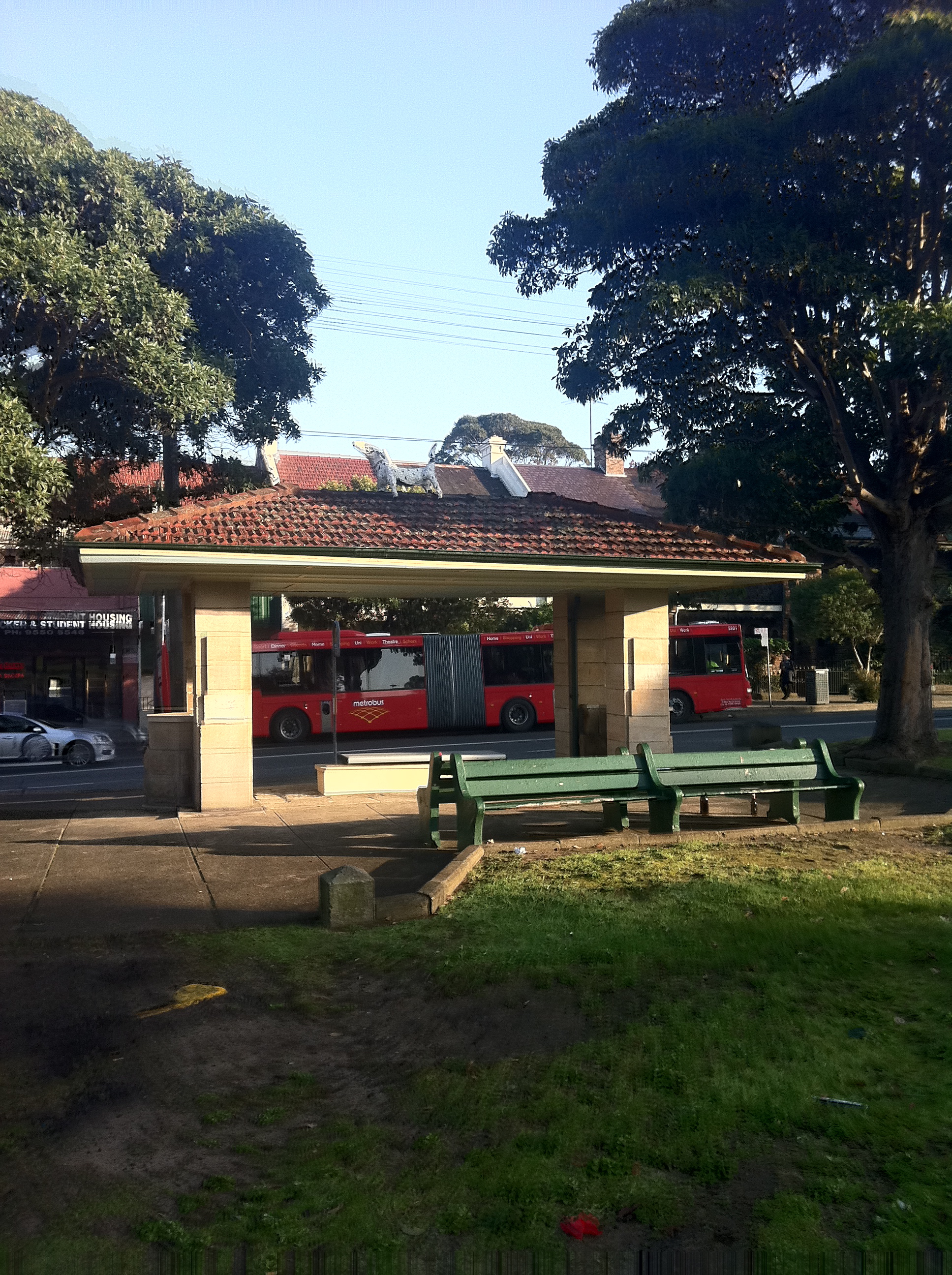
So it was a shock this morning when the Art Student headed off to school  this morning and saw that Matilda was gone. A passerby told her she’s seen ‘the dog’ on top of the bus shelter in Enmore Park. Sure enough, there she was:

It was obviously meant to be funny. It may also have been meant as a kind of compliment: instead of lurking in the bushes in a tiny front yard, Matilda was set free to sniff the wind above the street. It took some ingenuity to get her up there – at least two men and probably a ladder. This was planned. Our neighbour who sleeps in his front room said he hadn’t heard a thing in the night. It was stealthy.

It was also callous. Matilda lost an ear and two of her legs were broken. The Art Student was distraught.

I called the Council, the police and the fire brigade. The Council gave me a number and said they’d get back to me. The police said I could ring 131444 and lodge a complaint of malicious damage (it’s not theft because they didn’t keep it), and if they decided to tie up a police officer’;s time with the incident, fingerprints might be taken. The fire brigade said they’d come out in a couple of hours. Then Peter, the guy who’s been transforming our back yard for us, arrived and said he could do it. I held the ladder while he risked life and limb to manhandle the statue back to firm ground.

She’s now safely back home. I have no idea how much of th damage can be repaired, or whether the Art Student will ever again be quite so free about putting her work in the public eye.

Added in the evening: It’s now clear that the sculpture can’t be repaired. The armature is broken in at least five places. An ear is sheared off. Even if the armature was repairable, we no longer have the tiles that made up the mosaic.

Where the dog once stood there’s now a notice:

We’re not holding our breath.