Category Archives: Diary

My trip to Turkey 10: Istanbul day 4

The thing is, once you start uploading photos, you realise you can save yourself thousands of words. Especially when the Art Student / Photographer is keen to have her work seen. So here goes, with Day 4’s dot points:

  • Breakfast at our new hotel was a bit of a people-watching moment. It may be that breakfast is in two sittings – an early one for guests whose womenfolk veil their faces in public, and a later one for the rest. We arrived at the very start of our allotted time to find meals well under way at two tables. The niqab must come off for breakfasting purposes, and one young woman in a hijab had a huge floppy hat on over it – in the street this would have looked like a slightly awkward way of shading one’s face, but indoors at breakfast it seemed to be more of an identity statement: I wear the hijab but it doesn’t define me.
  • We caught the tram. Each tram is three linked vehicles the size of a Melbourne tram, they come every five minutes or so and are always crowded. A phenomenal number of people are moved around this way. As we moved out of the old city, the demographic changed dramatically – the niqabs that are everywhere in Sultanahbad (the area around the Blue Mosque, Hagia Sophia and Topkapi) almost completely disappeared.
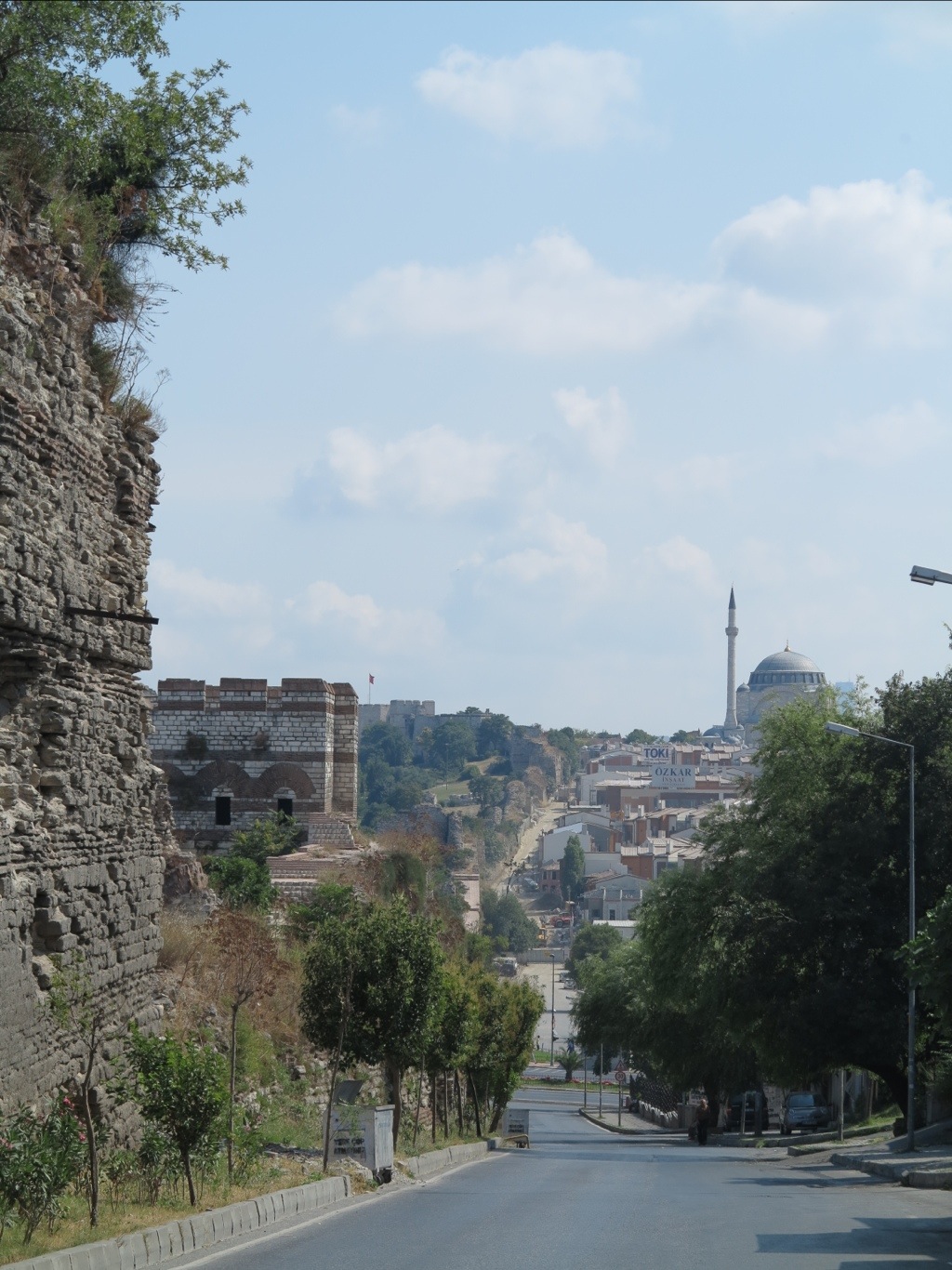
  • We walked the better part of a kilometre along along the Theodosian Walls, originally built at the command of Emperor Theodosius II in the fifth century CE, finally breached by Sultan Mehmet II, Fatih, in 1453, and a now standing reminder of that great triumph.
    the Theodosian walls
  • After bickering over the map and receiving helpful advice from a complete stranger who called out to us from 20 yards away, we reached the Church of St Saviour in Chora, aka the Kariye Camii. From the outside it could be any beautiful old Byzantine church of modest proportions that had been converted into a mosque:
    20120709-175845.jpg
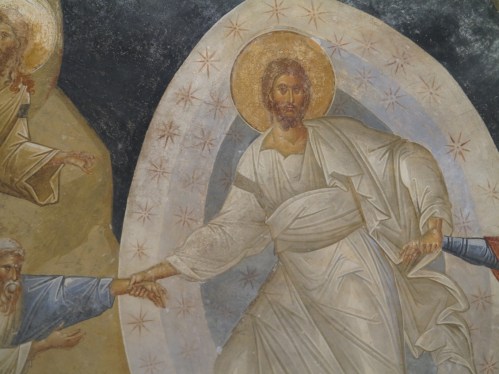
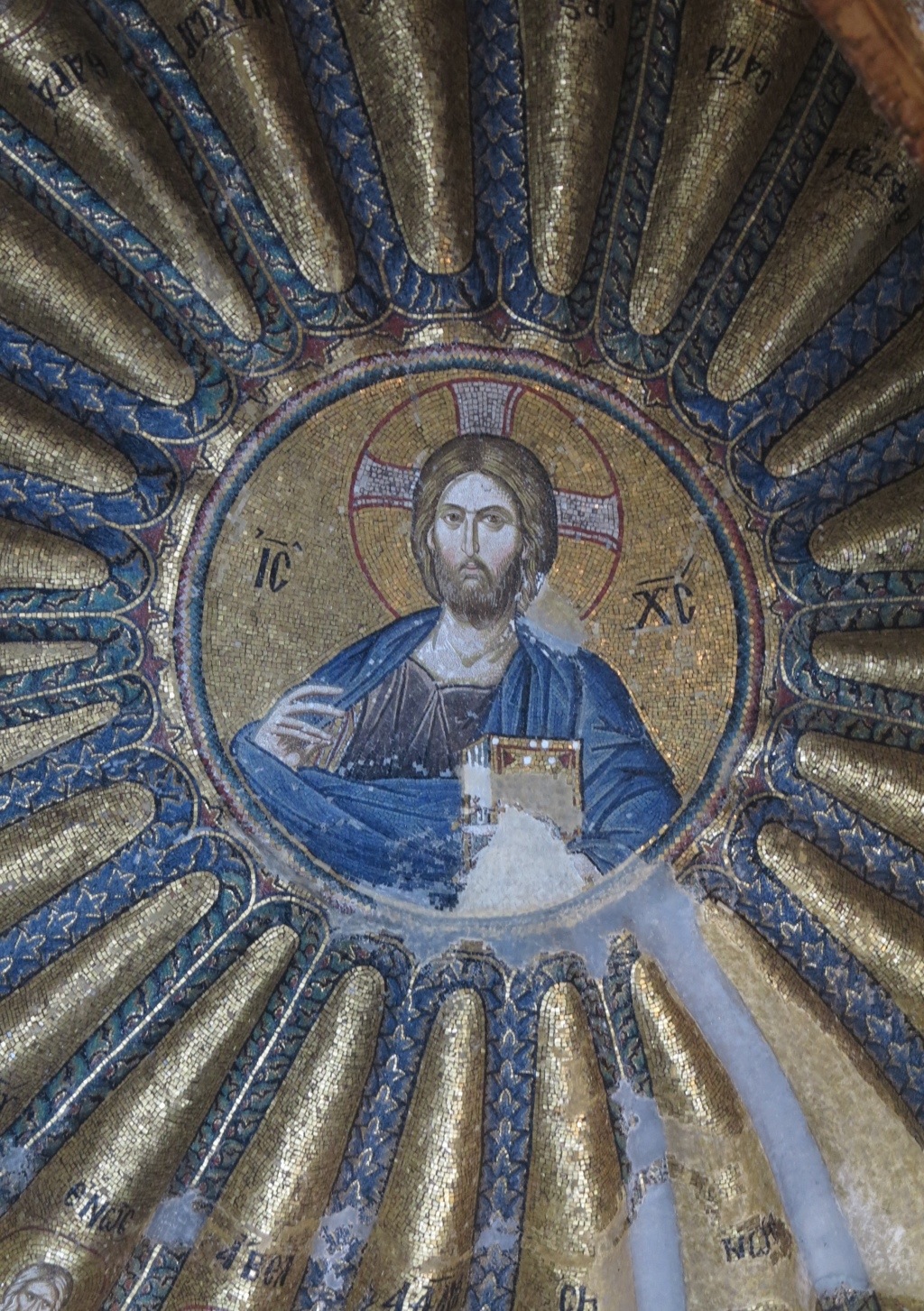
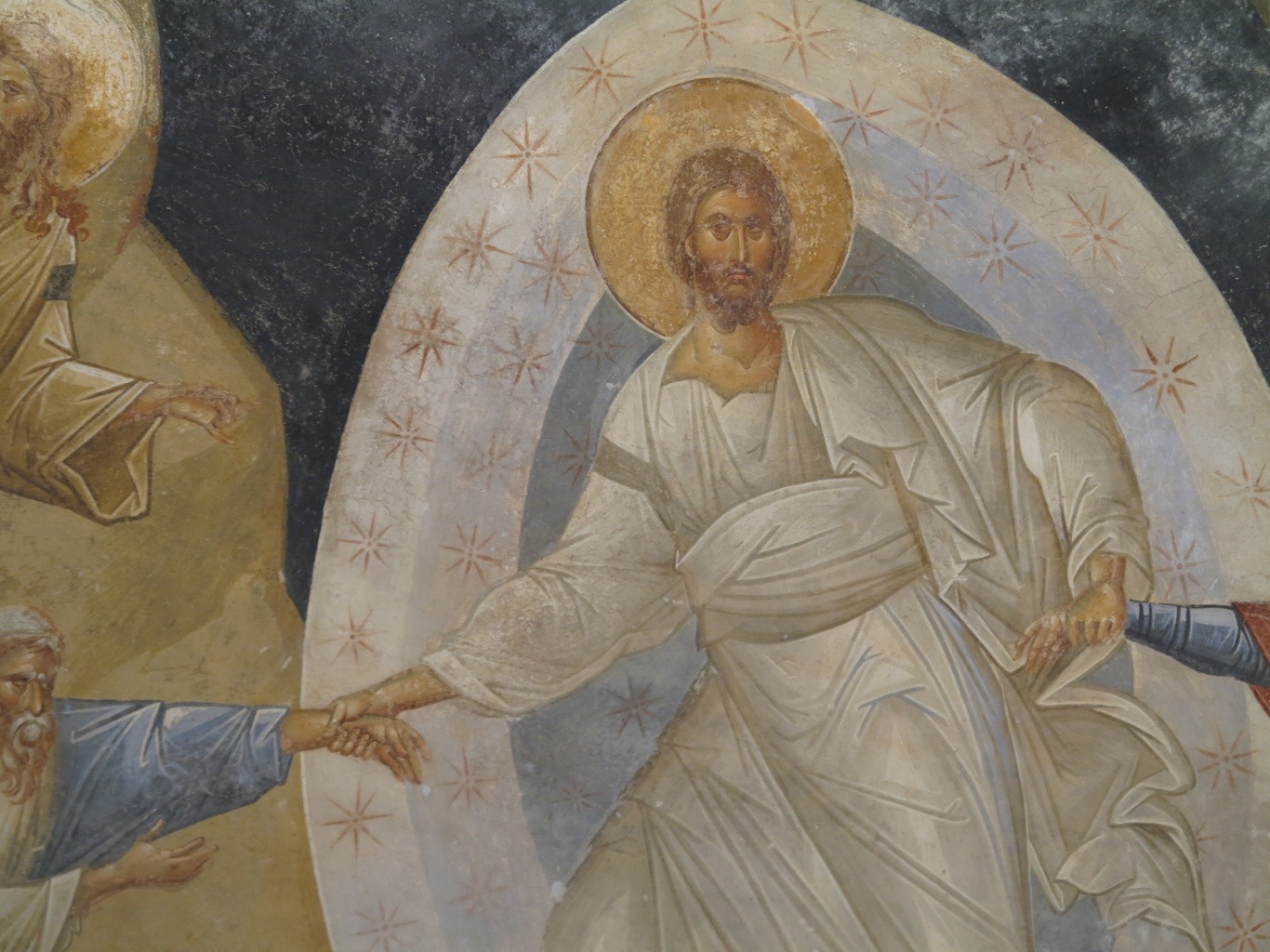
    We bought orange juices at the inevitable café cum souvenir shop, paying seven times as much as we had in Karaköy a couple of days before. Then we went inside to be blown away by what John Freely says are ‘the most important series of Byzantine paintings in the world’. I don’t know anything about important, but these frescoes and mosaics, executed in the 14th century, were covered by plaster rather than scratched out in Islamic times, and the ones that survived earthquakes and other disasters are, well, look:20120709-175631.jpg

    20120709-175659.jpg

    20120709-175750.jpg

    20120709-175816.jpg

    Just look at the tension in Christ’s body as he drags whoever that is out of the tomb.

  • Another long walk, a ferry that turned out to be non-existent, a cheerful scene of families picnicking (it was Sunday) beside the Golden Horn, evidently oblivious if the garbage littering their waterside park, a taksi ride (see how I’m picking up some Turkish vocab?) back to more familiar territory.
  • We tried for a second cultural outing, to the Dolmabahçe Sarayi, but we hadn’t reckoned on the Sunday crowds. The queue was possibly the biggest and slowest-moving I’ve ever seen. Rather than wait in line for at least two hours we caught the tram back to the air conditioning.
That was yesterday. I’ll post about today tomorrow.

My trip to Turkey 9: Istanbul again, days 1 to 3

Here we are back in wonderful Istanbul. No more long bus rides for a while, so I need a different strategy for maintaining what Richard called the travel–blogging balance. I’m giving dot points a go, with photos courtesy of the Art Student (unless otherwise stated).

Day 1:

  • The final, final farewell to our Intrepid group in the late morning soon after we arrived from the airport.
  • A walk in the old city, and a visit to the Basilica Cistern.
    20120708-181942.jpg

    You might think we’d have tired of wonders by now, but this had me in awe – though not so much that I couldn’t enjoy the misjudged name of the little cafe: even in that context, ‘The Cistern Cafe’ is too toiletish for comfort.

  • A quick look in the New Mosque, built in the 17th century, so not so new really. I know, I mustn’t go on and an about mosques, and the Art Student is now reluctant to go into any that are still places of worship because she’s uneasy about gawking where people are praying. But this one, built at the behest of a valide Sultan (the mother of a sultan’s premier wife), or rather a series of them, is sublime.

Day 2:

  • At breakfast, a squizz at the next Intrepid group, and oh they were a lacklustre crew (and yes, I do expect you to attribute that judgement to esprit de touriste corps
  • The purchase of Akbils (electronic public transport tickets) and a ferry trip to the Asian side of Istanbul, to the suburb of Kadiköy, site of ancient Chalcedon, where we enjoyed the view and travelled back from with a huge crowd of commuters (this was a happy mistake – we’d meant to go to Karaköy, a different place altogether).

We visited the Istanbul Modern. We thought we had visited it a fortnight earlier, but the real thing is on the other side of a busy street, and we’d missed its main entrance, which is through a car park. We spent a happy couple of hours there. The things that struck me most (no photographs allowed, but I’ve given links if I could find them) were:

  • Olafur Eliasson’s ‘Red Emotional Globe’, which casts complex shadows suggestive of mosque decorations
  • three projections of writhing trees by Jennifer Steinkamp that were first shown in the Basilica Cistern (what a brilliant space to show art in!)
  • ‘1+1=1’, a video piece by Kutluğ* Ataman in which a Cypriot woman, who is Turkish but living on the Greek part of the island, tells two stories in counterpoint from abutting screens, one of escaping Turkish nationalists and the other of escaping a massacre by the Greeks (it would have been wonderful not to depend on subtitles, but there you go!)
  • ‘Fifty Years of Urban Walls’, a huge exhibition of work by Burhan Doğançay, hundreds of paintings and collages, most simulating walls covered with graffiti, posters, notices, peeling paper, etc, some referring to Arabic calligraphy, some with extraordinary trompe l’oeil, some with passionate political intent, some bestowing a kind of immortality and gravitas on transient wall writings.

Elsewhere we:

  • spotted some transient, Newtown-worthy street art

    20120708-182629.jpg


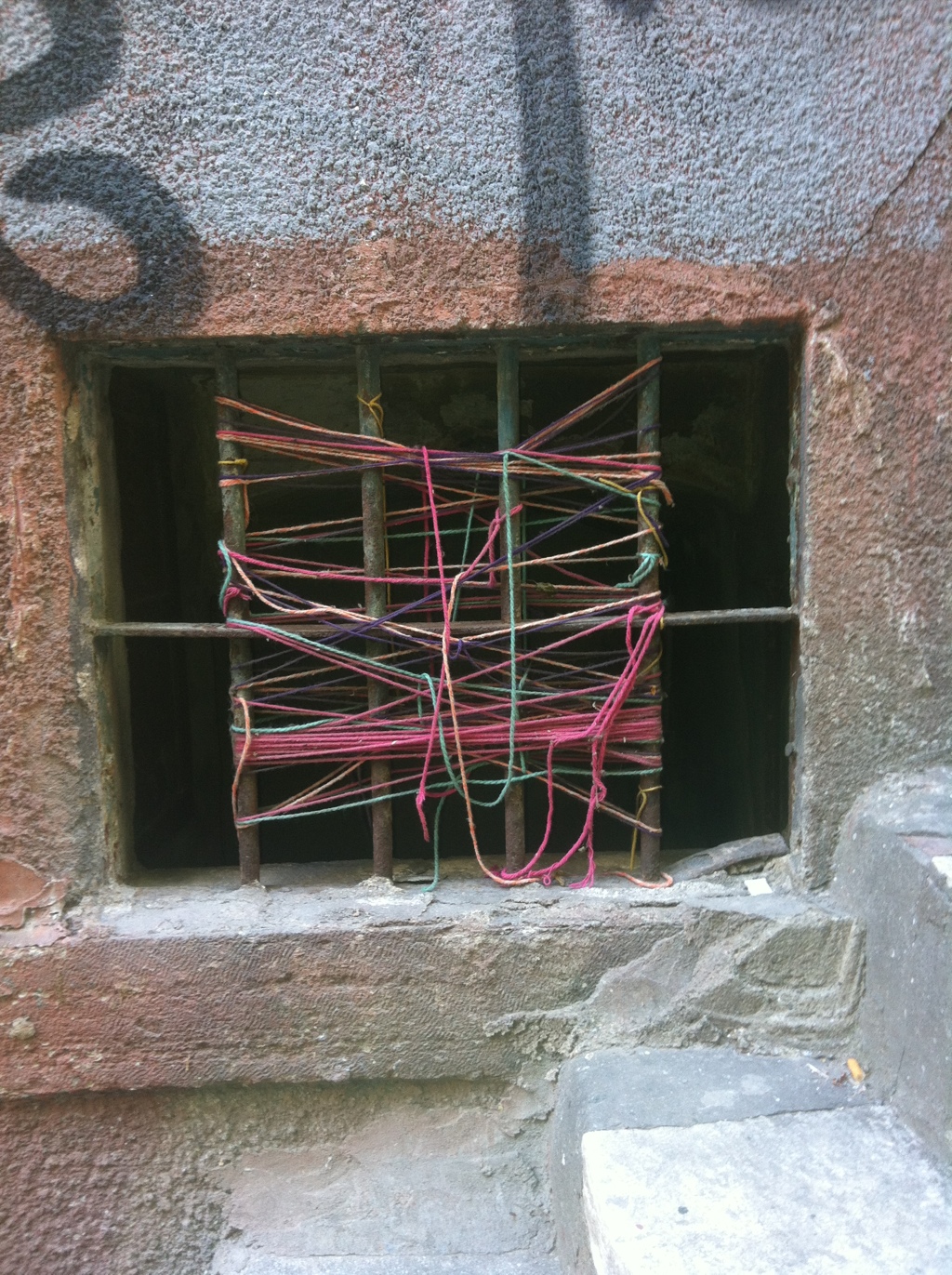
    and some guerrilla weaving (photo by me on my phone):

    20120707-172042.jpg
  • saw an exhibition of work by Sophia Pompéry, including a huge video of an iridescent, reflecting soap bubble being blown, and a fascinating piece where we see a brush dipping in a rectangular puddle of water on a table, creating the illusion that it is painting the images that are actually reflections – I’m not doing too bad, am I, for someone who just hangs around with an Art Student?
  • caught a taxi to our new hotel, discovered that our booking started the next night, but were kindly found a room at a nearby inn (the Lamp, and very nice it was)
  • paid far too much for a pleasant dinner then accidentally tipped the excellent musicians 20 Turkish lira
  • wandered about in Sultanahbad, near the Hippodrome, where a huge crowd was taking the night air – like Macquarie Street on opening night of the Sydney Festival, only not drunk or frenetic
  • had a brief glimpse of a dervish ‘performance’ and were once again grateful to Intrepid Travel for organising our attendance at a real sema ceremony in Bursa, complete with Very Long Incomprehensible Sermon

Day 3

  • We lumped our bags back down the hill to the Aruna Hotel, our home till next Friday, where we’re paying more than we would if we’d known to book across the Golden Horn, but where our room is huge, with two handmade carpets and a spa bath.

    20120708-183311.jpg
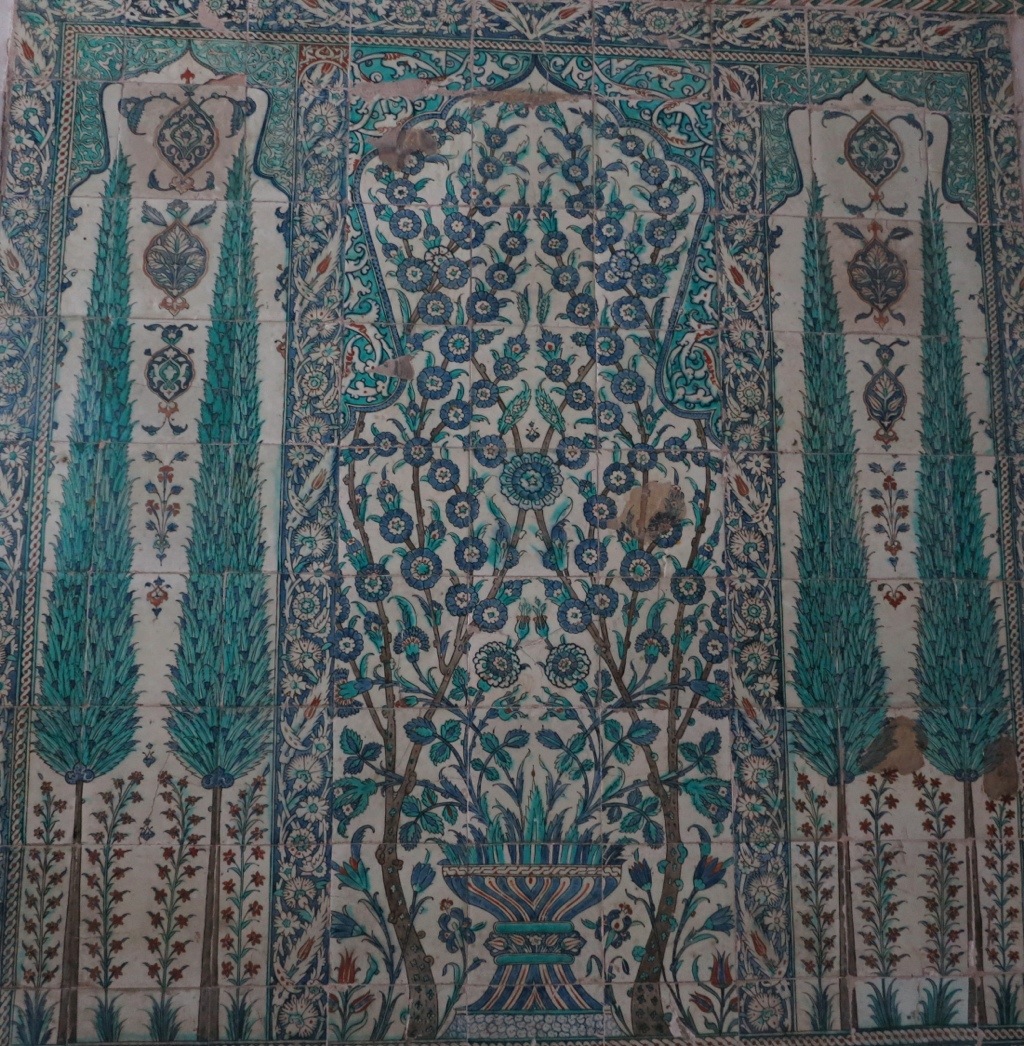
  • We bought a Museum Pass and visited Topkapi Museum, including the Seraglio – such tiling, such opulence, such craftsmanship. Here are some piccies. I cant show you the emeralds as big as eggs or the amazing diamond, because photographs weren’t allowed and the Art Student chose not to go into that section because the back story of oppression and male domination was getting to be a bit much for her. Still someone made these things:
    20120708-185854.jpg

    20120708-185928.jpg

    20120708-190000.jpg

    20120708-190025.jpg

    The last one is from a Sultan’s chamber. It makes our flash hotel room look quite pauperish.

  • We visited the Archaeological Museum: antiquities, antiquities, antiquities, including many beautiful things, such as this huge bust of Sappho, who would have fitted right in as a 1920s flapper, I thought:

    20120708-184934.jpg
  • We went to part of the Istanbul Jazz Festival where we enjoyed a US based combo as part of a huge crowd at the Galata Tower and a young Turkish group, with a much smaller crowd, then wandered home through dark and almost deserted streets, watched weird British television and went to bed after the nearby wedding went quiet.

* See how I managed to get the little diacritical crescent on the g without having to get Apple to provide it? I wish I could say it was by HTML skillful ness, but actually it happened accidentally when I copied and pasted Kutluğ Ataman’s name.

My trip to Turkey 8: Goreme, Cappadocia

Circumstances have conspired against my routine of blogging about one destination on the bus ride to the next. The scheduled bus trip from Goreme to Istanbul was a 12 hour ordeal, not in the original plan but made necessary because the Istanbul railway station burned down and the powers that be decided to replace it with a hotel. The Art Student and I, and two others of our little band, chose to spend a little extra and fly. So no overnight haul for this blogger, no blogging on the road! But here I am, a little late, still on the iPad, but this time in the spaces where the Art Student lingers longer than I do in Istanbul’s many galleries.

Taking up where I left off: a caravanserai is not, as you may think, a collection of ornate, tent-like structures. The one we stopped at, at least, is a fortress-like affair, with high solid walls, room for scores of camels inside its walls, a space for a substantial market, a mescit (a word used these days for the prayer room at an airport, but then for something much grander that served the same purpose). Two huge dogs lay about in the cool, dark rooms, but in response to our touristic invasion moved to the main entrance, where they took up the stance of lion guardians, languishing in the heat.

A little longer in the bus, passing gently undulating summer-golden grassland, and then almost without warning we were in Cappadocia.

panorama

This has to be one of the weirdest places on earth, not just because of the rock formations – resulting, we were told, from three volcanoes filling the space they enclosed with different kinds of lava, so that as the softer rock was eroded, strange, layered cones of harder rock were exposed, to erode in their turn creating what the tourist trade calls ‘fairy chimneys’ and geologists call ‘hoodoos’ – but because of the way the human, built environment and the natural environment accommodate each other.

Sufi rock

We went for a long walk – the Rose Trail – among rocks that have doors and windows carved into them, and everywhere niches that may have held lamps or candles (our guide said not, and there was no sign of blackening, so if it happened it was long enough ago for all traces to have washed away, but what else could they have been for?). In the town of Goreme, where we stayed three nights, there are similar pre-ancient niches, and also some broken Greek pillars, some Ottoman script, and many hotels and restaurants wholly or partly carved out of the rock.

house

Near Goreme is the Open Air Museum, whose rocks contain Christian churches with wonderfully preserved frescoes from the tenth century CE, especially the ‘Dark Church’ which was discovered comparatively recently and so escaped the depredations of devout Muslim visitors who scratched out the faces in many of the other caves.
frescoes

It’s a mesmerising case of the natural environment and the built environment blending, and maintaining the blend over millennia of cultural and technological change.

As well as walking and gawking, which is what this place demands, all 13 of us had dinner in the home of a beaming woman in Turkish headscarf, named Fatma. The home had a blessing in Ottoman script over the main door, and its rooms reached back into the rock. The dinner was delicious home-cooked food, which I realised I had been craving. When Fatma produced a display board of jewellery she had crocheted, she didn’t have to do any hard selling to have a number of the women enjoying themselves thoroughly trying things on and buying.

In Cappadocia we also visited Derinkuyu, an underground city where early Christians and others before them hid from persecution and attack. We dined on our last evening, just the four of us who had taken the plane option, at the Top Deck Cave Restaurant, which is Trip Adviser’s top rated restaurant in Goreme. We could see why.

I didn’t go on a hot air balloon trip, partly because of the expense, partly because I was feeling a bit off and couldn’t face a 4 am rising, and partly, if truth be told because of Les Murray’s mean, class-envy poem about a hot air balloon accident (I don’t remember its name, and I’m embarrassed to be influenced by it). Those of our group who did go said it was marvellous and had spectacular video to show.

We said our final goodbyes in Goreme as the rest of them set off for the bus, then we saw most of them again when we arrived in Istanbul next morning, four hours after them, and said our final, final goodbyes. It was a lovely, exuberant group. Unlike other Intrepid groups I’ve travelled with, more than half were under 30. Of the over 30s, one was a Unitarian minister, who had a similar fascination with Christian theology to mine, though she was more learned than I am. And three of us – the Art Student and I and one other – were friends. One of the young adults was a blogger, though I think we both felt it would be weird to read each other’s blogs during the trip (his is at shootingtravellers.wordpress.com, and I plan to follow it now). It was a great mix. The Art Student and I had a great time, and now we’re on our own for another ten days or so.

(Three of the photos in this post were taken by the Art Student. The fourth was taken by a friend on the Art Student’s fabulous new camera.)

My trip to Turkey 7: Konya

The Kas–Konya leg of our travels was an 11 hour haul. Three and a half hours in a dolmus took us to the Antalya bus station, a vast space where it cost half a Turkish lira for a bottle of water and a whole Turkish lira for a piss. We ate, and attended to other bodily needs. The Art Student, who was under the weather, ate carefully. Then we hopped on a proper bus for close to six hours, stopping a couple of times, one of them at a town famous for its roasted chickpeas. These are said to be good for an upset stomach, so I bought a small packet. The Art Student turned up her nose at them, and when I had a nibble I turned mine up too. Once we reached Konya – the first Selçuk Turk capital and the home of Celalleddin Rumi Mevlana (in Turkey Mevlana, in the West Rumi) – it was just a quick 20 minute ride in another dolmus and we were being greeted with glasses of Turkish fizzy drink at the Mevlana Hotel. (I’m typing this on the next leg of the journey: about 20 minutes on our way, one of us realised she had left her purse back at the hotel; we turned back, but for some reason couldn’t get through; in response to a phone call a man from the hotel brought the purse to us on his bicycle. This isn’t just good service, it’s a whole ethos of hospitality.)

On our first evening, we squeezed in a visit to a felt shop before dinner. Despite my impatient stomach, I was fascinated as the Argentinian owner of the shop demonstrated her techniques. Her Turkish husband had learned the craft from his grandfather, who had learned from his father, and back for generations. The craft had been close to dying out, but they are staging a revival, partly by introducing modern designs. All the same, the most interesting part of the show was the demonstration of how to make the hats worn by dervishes. Characteristically, there was no pressure to buy, though some of us did buy a hanging or a silk and wool scarf.

The fabulous Burak explained at dinner that there are two sides to Konya, the conservative side where women have to cover their shoulders and knees, and the other side. He called them the Allah side and the yalla side, a witticism he sadly had to explain to his ignorant charges (yalla in Arabic means lets go!). We had the option of exploring the yalla side after dinner, and I believe some did, especially as it was the night of the Euro Cup final – though I wouldn’t want to assert that the Allah side of town is indifferent to football. The Art Student and I took her queasy digestive system back to the hotel where we watched some Turkish TV, and an episode or two of things from home on the iPad, including Clarke and Daweon possible solutions to Australia’s asylum seekers stalemate.

Next morning, we visited the Mevlana Museum, which as far as I understand it is the original building where Rumi established the Mevlevi dervish sect. Maybe twenty tiny rooms, perhaps once cells if the Sufis, held objects connected to the sect’s history, but the main attraction was the building itself, which contains the tomb of Rumi and a number of other leaders of the sect. We had visited a Sufi museum in Istanbul and attended a whirling ceremony in Bursa, so we had some background. The tomb is gorgeous, but the room where they whirled is sublime, with a high decorated dome that could bear being looked at for hours. Most impressive of all, though, was the crowd: school holidays are just beginning, and we were there just as the museum opened, but the press of respectfully attentive people – old and young, traditionally dressed and scarved just for the occasion, an all-women coachload, a group of teenage boys and family groups, Turks, Arabs and us – was wondrous, all the more so when the bulk of the objects on display and most of the wall decorations consisted of calligraphy in Arabic, which I’m guessing most of the people there don’t read easily. Among the tiny and enormous illuminated Qurans in the final room, there were a number of poetry books from the seventeenth century, with delicate representational illustrations.

Then we just had time for lunch and we were on our way again. As I type this we are about to stop at a caravanserai – evidently there used to be one every 40 kilometers, because that’s how far a camel can travel in a day. I’ll post again after our adventures in Kapadokya, the land of well-bred horses and fairy chimneys.

My trip to Turkey 6: Kas

Today is a travel day: three hours in a hired bus that took just the 13 of us, then an hour or so in a vast bus station in Antalya and five hours in local transport (to use Intrepid’s language), so ample time to type this up in pages on the iPad, to be uploaded next time we encounter WiFi. You can do lots of things by holding down the iPad’s screen keys, but in Turkish, though you can get ç, ö and ü, you can’t give g a little crescent hat or s a cedilla. So I hope Kas will forgive me for spelling it with a naked s, to rhyme with mass rather than bash.

We arrived in Kas two days ago in the late morning, and had time for a short orientation walk and lunch before heading off on a boat to spend a little more than 24 hours on the water. It’s a friendly town: while a couple of us were hanging about before lunch an almond vendor offered us each a single nut, with no hint of pressure to buy. It’s a culturally diverse town: the midday call to prayer summoned an overflow crowd to the little mosque near the main square where bare-kneed and -shouldered women caused no stir at all; the tiny Greek island of Kastellorizo, known in Turkish as Meis, looks to be within swimming distance, and people from there shop in Kas – I heard a lot of yasou in the street, among Turks. It’s a town that wears its antiquities lightly: a broken Lycian sarcophagus stands catty-corner to a carpet shop on one intersection and the small Lycian theatre a short walk out of town has been restored and, we’re told, is used for performances.

But all but one of us – that one being the Art Student, who is vulnerable to acute motion sickness and chose to enjoy a day of solitude – were out of there before we had time to take in anything much of all that, chugging away from the sweltering land onto the cool, clear Mediterranean.

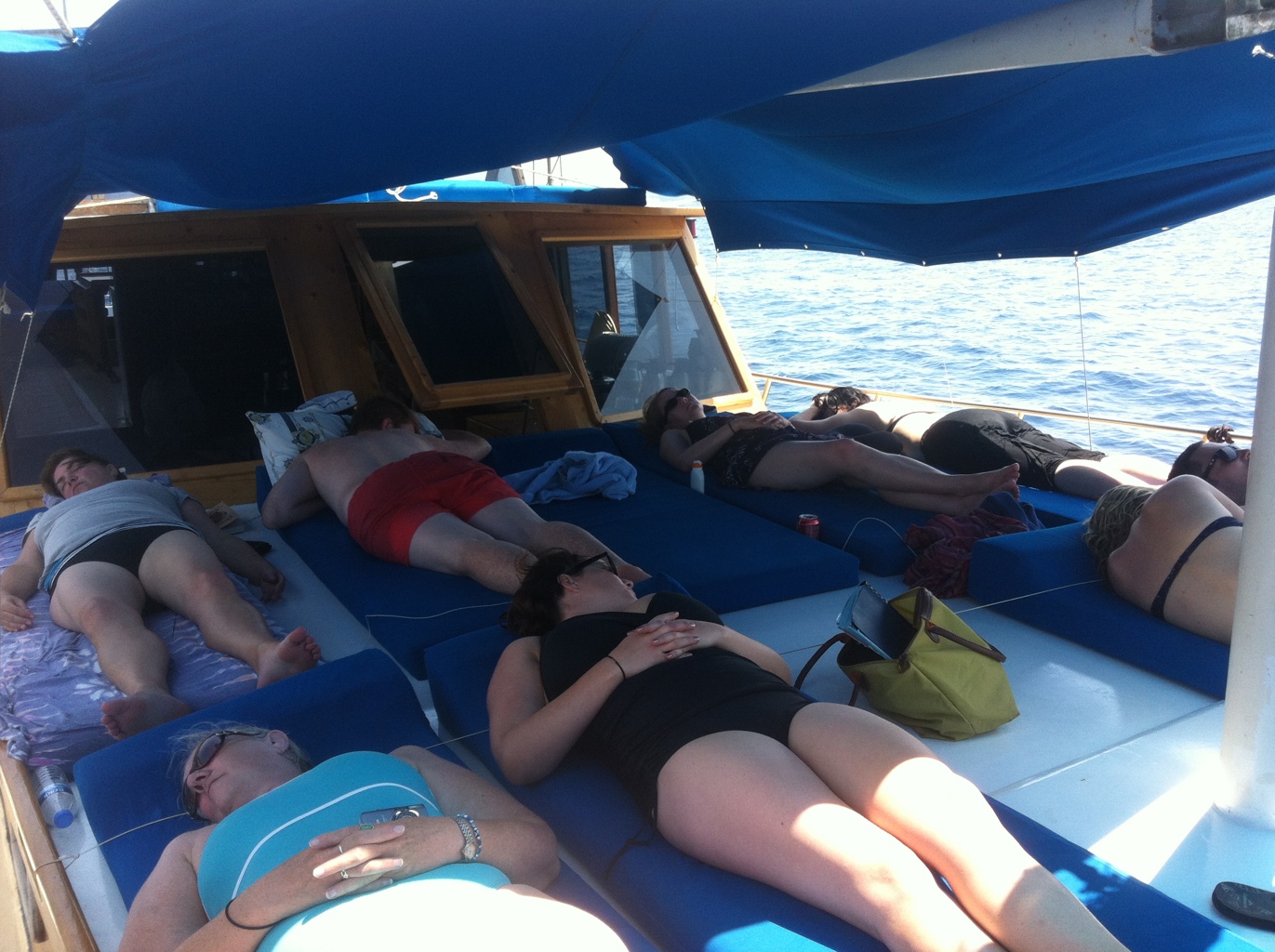
We dropped anchor and swam. We set off again. We lazed around on our day beds. If we used every available space there was just room for the twelve of us, plus the captain and single crew member–cook, to lie down above deck.
20120630-223216.jpg
We visited a shallow cave where people had hidden from pirates in the second century of the current era. We dropped anchor and swam again, in a sheltered area where, according to Burak (our Intrepid Leader) pirates and war fleets had been anchoring for millennia. We had delicious food for dinner. We resisted the captain’s urgings to go to something called the pirate bar, where sometimes hundreds of Aussies sit around drinking. Those of our group who drank were quite happy to do it in our tiny group of mostly-Aussies. The captain went off by himself, slightly crestfallen at his lack of company and, we guessed, lack of commission. We then lay down beneath the stars in the kind of proximity that smacked of childhood sleepovers, ready to be lulled to sleep by the gentle undulations of the sea.

It was not to be. Of the 20 or so boats anchored in this space, ours was the closest to the pirate bar. I had been worried that my snoring would disturb my fellow travellers. In fact, as I was one of perhaps three who managed to go to sleep before the relentless thumping pirate music stopped AT THREE IN THE MORNING, there were plenty of witnesses to my snoring, but no one complained of it. I woke up to a stunningly beautiful sunrise and slipped quietly into the water for a dip, blissfully unaware that just about everyone else was about to greet the day in moods ranging from unmitigated fury to exuberant outrage. My favourite line was, ‘Finally it stopped, and I’d just got to sleep when the f**kin sun started shining in my face!’ of course, the captain had told us he would put up a shade to the east, but either he’d forgotten about that when he climbed back on board (an event many people attested to have heard), or he added to his earlier feats of poor judgement and assumed that anyone who wasn’t interested in the Pirate Bar would obviously want to rise with the day.

We swam, we lazed, we read our books (Jack Kerouak, Jo Nesbo, Jane Austen, Anna Funder, Bruce Beaver), we listened to one another’s wailing and gnashing of teeth, we ate beautiful food for breakfast, we swam again, and the mood generally improved.

Our one landfall was the village of Kaleköy, formerly part of the ancient Lycian city of Simena, where some of us climbed to an castle–museum with a tiny little theatre and a spectacular view, a whole swathe of Lycian sarcophagi, and just outside its gate some excellent ice cream ‘made by Mama’. After a little swim, we chugged across to the facing island of Kekova, where as we approached the scattered rocks on the hillside resolved into the remaining walls of this part of the ancient city. Earthquakes in the third and fifth centuries CE (but don’t quote me) had destroyed the city, sinking most of it.

We anchored one last time, ate delicious food for lunch. One of us let the captain know we were generally unhappy about being parked so close to the noise the previous night, and he seemed to be genuinely surprised. We swam some more, even did a little synchronized swimming and competition diving, and headed for solid land, where the Art Student’s dream of sitting and drawing in blissful solitude had been thwarted by extreme heat (what a difference it makes to be out on the water!) and a lack of a shady place near drawable things.

I don’t know who the Lycians were. Was the unfinished temple at Erice in Sicily theirs? Can Baruk be right that the squabbling relationship between Zeus and Hera in Greek mythology is a vestigial reminder of the long-forgotten uneasy blending of the goddess-centered Lycian and the male-dominated Hellenic cultures? Whatever. It seems like most visitors to this part of their ancient domain just want to drink alcohol and listen to loud music.

My trip to Turkey 5: Kayaköy

We arrived at Kayaköy on a stinking hot afternoon. After a quick orientation walk, we ate and then curled up like pythons in the welcome cool of our guest house / Pansiyon Makri (phone 0252 618 0405), which turned out to be a prime example of Intrepid’s knack of finding accommodation that’s close to interesting things but not in the middle of tourist-trap territory. Our host came from generations of butchers: on our second night we had dinner there. He spent a good bit of the morning taking a cleaver to a large section of lamb, and the results were excellent. (For the record, I had fish, which was also excellent.)

But on the first night, once our wilting spirits had revived, we went by Dolmus over the next hill to the port of Fethiye to photograph some Lycean tombs carved into a cliff face, then dinner at the fish market and a stroll along the esplanade. Fethiya used to be called something else (I cant tell you what because I’m iPadding this on the bus and so depend on my naked mind for facts and figures). It was renamed after a pilot who died in 1914, a martyr in the struggle for a Turkish republic and the end of the Ottoman Empire. There’s a splendid heroic statue of him in goggles and leather helmet with huge angelic wings at his heels. We also saw weirdly cohesive Turkish ice cream being made, and ate some.

Next morning, in slightly cooler weather, we visited the ghost town of Kayaköy, which occupies the hillside above the tourist village: two churches, 14 chapels, two schools, a thousand dwellings, all abandoned in the population exchange of the mid 1920s when everyone who lived there, being identified as Greek in spite of having lived in this place for perhaps a thousand years, was sent ‘back’ to Greece. We were told several times that Louis de Bernières tells the story in his novel Birds without Wings. A while back there was a move to turn Kayaköy into a tourist village, but this was foiled, and it is now a museum dedicated, I read somewhere, to fostering peace between Turkey and Greece.

Kayaköy means stone village, and that’s what’s left of what was the village Levissi: roofless, doorless and windowless stone houses, whose walls have almost all survived upright, stone churches stripped of ornament except some faded colour in the domed ceiling and some red, white and black pebble mosaic floor, narrow stone streets, many of them disrupted by an earthquake in the 1950s. It felt like a memorial to all the people who have been displaced and dispossessed by nationalism, war and colonialism over the last couple of centuries. This forced emigration happened a couple of years before the Coniston massacre, Australia’s last recorded large massacre of Aboriginal people, so there’s no call for moral superiority here. Perhaps the time will come when we’re bighearted enough to have as substantial a memorial as this for the terrible episodes of our history. These solemn ruminations were interrupted by the discovery that, unlike other memorial museums, this one is occasionally put to practical use. I took this snap of the inside of a house near the bottom of the hill:

20120629-123730.jpg

After our first walk in the ghost village, most of our group went on a six kilometre hike along the Lycean Way to Oludeniz Lagoon, which I regretfully bowed out of as the first leg brought me to the brink of an asthma attack and we were warned that the rest of the terrain was steep.

The others returned in mid-afternoon well pleased with themselves. But as I’d used the morning to blog about the Asia Literary Review I wasn’t too unhappy to have missed out.

The Art Student and I caught a dolmus to nearby Gelmeri, a picnic ground at a beach, where we swam in buoyant salt water and lazed beneath a hired umbrella. The were quite a few Turks there, but most people sounded English. Did I mention that everywhere in Kayaköy cafés offer English Breakfast, and gozlemes are advertised as pancakes? We chatted with a couple of bright red Brits who have been coming to Turkey every summer for 20 years. This year for the first time they experienced earthquakes, two of them. Both times they were at the beach, and both times they observed that the Turkish people in their vicinity reached immediately for their phones to text about it. Sounds just like Melbourne.

My trip to Turkey 4: Pamukkale

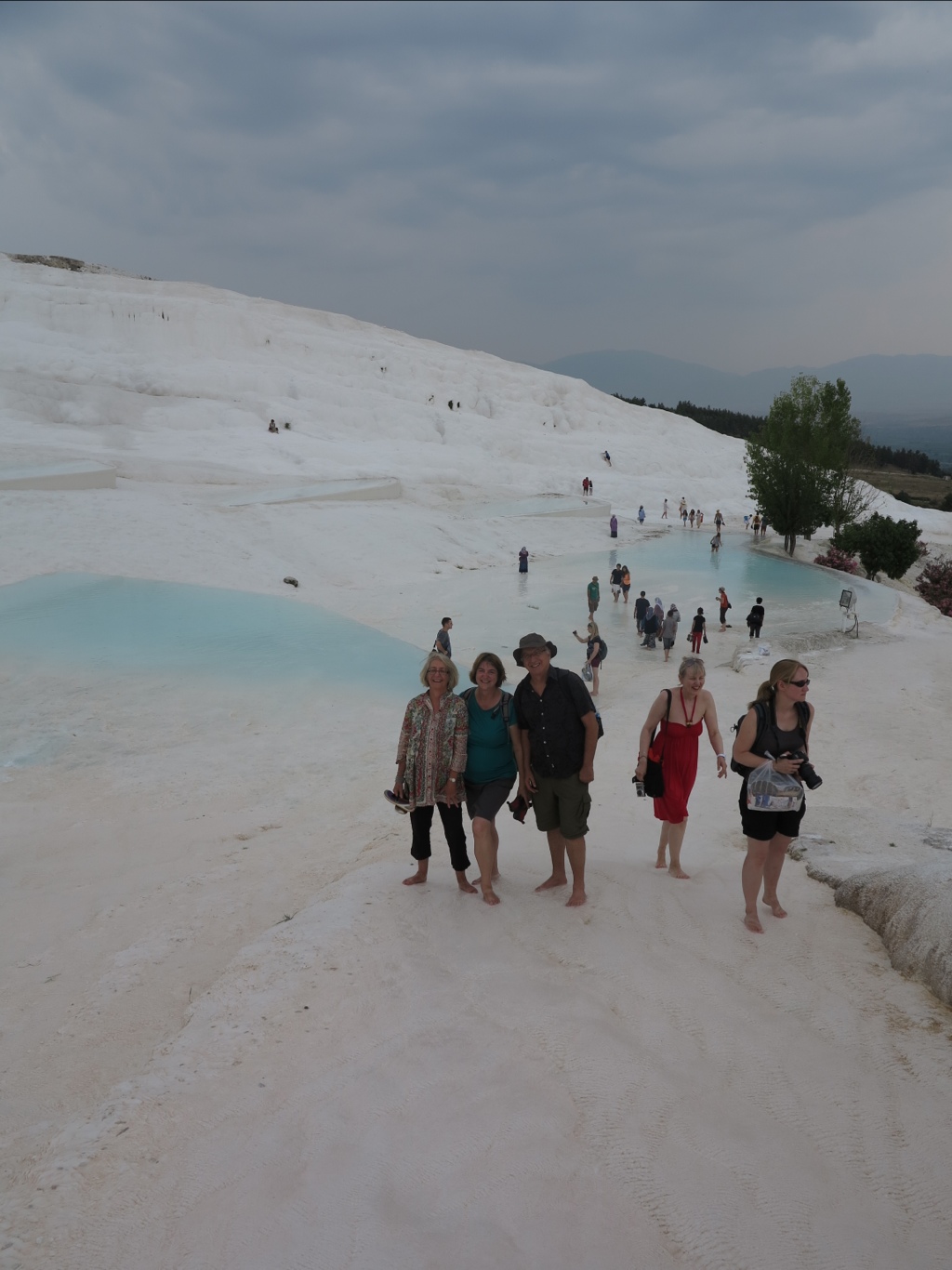
Until yesterday, I thought travertine was a pattern for kitchen benchtops. The little Turkish town of Pamukkale put me right. Its two main attractions are the ruins of the city of Hieropolis on the hill overlooking it and the travertine terraces down the side of the hill. The ruins are interesting enough – a theatre, a small temple, a ‘plutonium’ where oracles entered a volcanic vent and came back with gnomic advice from the Underworld (the plutonium is bricked up except for a small hole, but you can hear the sounds of water if you listen at the hole). It’s the travertine that led one of our group to remark, ‘I can’t go on saying it everyday, but I’ve never seen anything like this.’

Travertine, according to Wikipedia, is a form of limestone deposited by mineral springs, especially hot springs. I understand the process to be similar to what happens in limestone caves. Calcium carbonate deposits, let me tell you, can be magical.

Here’s what it looks like up close. Note the bare foot: even though our body oils have a destructive effect, the potential damage caused by the thousands of tourists is reduced by a no-shoes rule and strict limits on where we are allowed to walk. The surface is completely hard, and the ridges mean it’s not the slightest bit slippery, even when wet, as the path up the hill mostly is.

foot

walking up

The rules weren’t enforced for dogs, and this little pack of strays had a fabulous time as the sun was about to set.

dogs

By the time the terraces looked like this the dogs had sniffed out the chips and bikkies we were eating and had abandoned their frolics to turn a charm offensive on us, with a shameful degree of success.

sunset

My trip to Turkey 3: Selçuk and Ephesus

Ephesus – Efe in Turkish – is pretty much all,about antiquity. We arrived in nearby Selçuk the evening and went for a stroll to a huge field strewn with pediments, capitals and an occasional intact column, with a pool of stagnant water taking up perhaps a third of the area. This was once the Temple of Artemis, one of wonders of the ancient world. A solitary man trailed us, repeatedly offering a Jacob’s ladder of postcards for one Turkish lira. The stroll also took in the fort-like church of St John. The story is that it was here that St John the Evangelist brought the Virgin Mary, and here that her Assumption into Heaven (if you’re a Catholic) or Dormition (if you’re Orthodox) happened. This was all of interest, but my interest, and I don’t think I was the only one of our predominantly Australian group, was more immediately engaged by the storks nesting on pillars and the remains of an ancient aqueduct. We’ve all seen plenty of ruins but storks are fairytale creatures.

A short ride in a van took us to Ephesus early next morning, where we wandered among the best preserved ancient city in Turkey, one group among many being treated to a tourist-rated version of the history. It was odd wandering through these streets, making our way through the roofed and enclosed terrace houses being painstakingly restored by Austrian archaeologists, of what was once an actual town, and realising that this was the local habitation of cultural phenomena that have always been pretty much abstractions to this colonial mind: Diana of Ephesus, the Ephesians of Paul’s epistle, the Amazons, even reputedly the Virgin Mary in old age.

It was incredibly hot among all the marble of Ephesus, and that afternoon we snoozed in our air-conditioned rooms or went to a swimming pool with, I’m told, a fabulous view. I struggled up after a couple of hours to visit the Archaeological Museum, for more wandering among antiquities, among them three statues of the Artemis of Ephesus – that’s the one whose most striking feature is her large number of grapelike breasts, but who also has the signs of the Zodiac around her neck and strings of creatures on her legs. She’s a weird figure, all the weirder for being surrounded by marble statues that are clearly rpresent actual individuals, from a huge head of Emperor Domitian to life-sized busts labelled ‘A man’.

Am I right in thinking that this was the place where the cult of the Virgin Mary had its beginnings? When the Artemis-worshippers arrived here they blended their virginal hunter goddess with the local fertility goddess (Cybele?), so that only here is Artemis /Diana seen as a fertility goddess. Then when Christianity arrived, she transmogrified into the new virgin-mother figure, so the converts to the new religion found ways not to abandon the female principle that had such meaning or them. These are the ruminations of one who was pretty devoted to the Blessed Virgin Mary as a Catholic child in Queensland. Them Ephesians sure cast a long shadow.

Of course I’m not the only one to notice that divine women are big in Ephesus. Here’s a snap of an array of them on a stall next to one selling ‘authentic fake watches’ just outside the city exit:

female deities

That night, in the comparative cool, we drove to the hill town Sirinçe for dinner. This was a Greek village until the mid 20s ‘population exchange’ in which, as part of a peace settlement after Greece invaded Turkey, something like 1.3 million Greeks and half a million Turks were uprooted and (cough!) returned to their own country. So we visited the remains of the Orthodox Church of St John the Baptist, which is in the process of restoration by a US organisation. The current population inherited vineyards and olive orchards and had to learn from scratch how to tend them. They seem to have done brilliantly – copious. olive oil and brightly labelled wine was for sale.

We had a pleasant dinner. Perhaps it was no coincidence that conversation at my end of the table turned to gender studies. And as we rode down the hill in the dark our driver turned the radio up loud for a Turkish version of Whitney Spears singing ‘I will always love you’.

iPadded on the train to our next destination.

My trip to Turkey 2: Bursa

Bursa was besieged by nomadic Turks led by Oman Gazi, founder of the Ottoman lineage, in 1315. Eleven years later the starving city surrendered to Osman’s son, and the Ottoman Empire was born. Our little group of temporary nomads got there yesterday by ferry and bus, and there was very little starving going on, this being the birthplace of Iskender kebab. It was at the end of the Silk Road at one time, and even today there’s a lot of astonishingly cheap ‘100 percent silk’ scarfs on sale in the Silk Markets, which a number of us found irresistible. Also irresistible to most of us was the famous hamam at Çekirge mineral baths, which I’m told is luxurious with marble, very hot and not at all the punishing experience that a bath and massage is in some places.

According to the schedule we were to be guests at a Dervish Lodge in the evening, with the possibility of ‘dinner with our hosts’. Our host turned out to be a flute player from the Lodge, who couldn’t dine with us but instead gave us a long explanation of Sufism that included rich poetry about everything whirling, from subatomic particles to the vastest nebulae, familiar punitive moralism (if you don’t belong to a religion you will pay the bill when you die), and philosophical reflections on the shortness of life, the smallness of human concerns in the immensity of the universe (‘I am nothing’). Wonderfully, he excused himself three times in the course of the talk to answer his mobile phone – when he returned the third time, he turned it into a teachable moment: ‘You see, I think I am very important. It is hard to remember that I am nothing.’

We were mostly a little ambivalent about the talk, and had some misgivings as we followed him out into the evening. But he took us to the back room of a teahouse where some of the locals were singing and playing Turkish folk music. The room was big enough to accommodate around its walls the musicians, the thirteen of us, and four or five others. Glasses of tea were brought, and what followed was an hour, or possibly two, of joy all round. Our flute-playing friend left after playing beautifully for quite a spell. Drummers came and went – a Turkish man on the way home from work who tapped out a basic rhythm, two young men whose finger work was brilliant. Two middle aged men who sang and played the sas (I can’t look it up, it’s like a balalaika with the hole at the bottom rather than under the strings) seemed to be in charge, and enjoyed each other, the other players, and us to a spectacular degree. They sang and played. Four young Japanese men came for a while and left. One by one we were cajoled into dancing. One of our younger women had clearly learned Turkish belly dancing and did herself proud. The five men of our group got up together, shook our hips and bumped shoulders. We joined in singing on a couple of simple refrains. Eventually, the instruments were returned to their hooks on the wall, and after much handshaking and kissing on both cheeks, we filed out, paying one Turkish lira each for the tea. We’d been told that there was no charge for watching dervishes whirl because it was a spiritual practice, not a performance. Perhaps the same could be said of this event.

We dispersed, found dinner where we could – my small group found it in a kebab house that turned out to have a Turkish pop duo drowning out any conversation, but giving a kind of musical completeness to the evening. We reconvened and walked to the Dervish Lodge.

The Lodge’s crowded grounds were dominated by the video image of a bearded man sitting crosslegged and holding forth – the sermon had already started. There was a festive air all the same, not inattentive, but not exactly hushed. We were escorted into a front parlour and offered the now familiar strong black tea. The sermon went on for an hour. This was not fun, though Burak, our leader, took the opportunity to give us his version of Sufism and the origins of whirling: the man known in the West as Rumi had a dear friend and comrade named Shem; when Shem was killed words were not adequate to express the great poet’s yearning for his lost friend and he began to whirl; his followers saw him do it and imitated him.

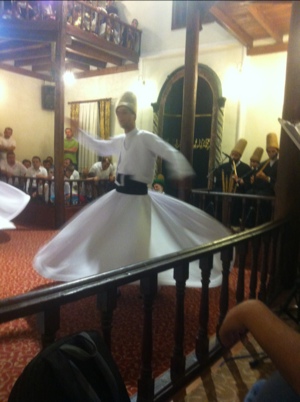
At last the sermon, which had sounded at times like a Downfall soundtrack and had been in part about the evils of Facebook, came to an end, and we were ushered into the crowded viewing areas of the whirling room (click here for a virtual tour), women upstairs, men downstairs and children wherever. The man who had given the sermon sat at one end of the room, the six dervishes in their felt tombstone hats and white skirts came in opposite him, one by one, each bowing solemnly to the one after him, before he began whirling. My guess of the age range is 30 to eight years old. Once they were all started, each in his own space, the music started, hypnotic, vigorous, beautiful. And they whirled for what seemed like forever, both hands raised or one up one down, head at an angle, eyes sometimes closed, progressing around the room and never coming even close to a collision.

20120624-084245.jpg

It was an incredible physical feat, but that was almost beside the point. People in the audience (or should I say congregation?) swayed where they sat, and some wept. After a long time, the bearded man and the man in a black robe who played some kind of leadership role joined in, rotating more slowly, the older man with tears streaming down his face. Then they stopped, stood for a moment, sat upright and motionless on the mat for a long, impassioned call-and-response prayer, sweat dripping from their faces. It must say something about my mental state that I thought the repeated response was habib. (The Art Student assures me it was nothing of the sort.) It was a huge privilege to be a guest here.

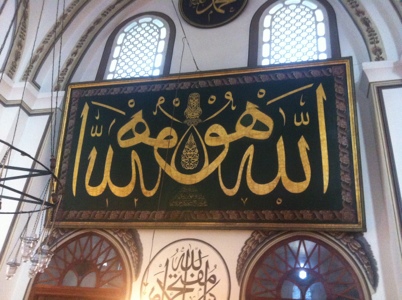
Next morning, we paid a quick visit to the Ulu Cami (High Mosque), which was built for an emperor long before the conquest of Constantinople. The biggest piece of calligraphy was the emperor’s name. There’s a pool for ablutions in the mosque itself, and a very beautiful wooden pulpit made of 66,666 pieces with no nails or glue. Burak explained enough of the calligraphy that I can now recognise the name of Allah, the mystic syllable hu and the character wow (pronounced v) which has mystic significance because it curls back on itself like a foetus or a traditionally buried corpse.

20120624-095407.jpg

I’ve iPadded this almost entirely on the six hour bus ride to Selçuk near Ephesus.

My Trip to Turkey 1: Istanbul

Having a great time in Istanbul. Wish you were here!

I’ll be doing occasional blogs over the next couple of weeks mainly so I have a record of where I’ve been and what I’ve seen. It never feels like I’ll forget things while I’m there but bitter experience has taught me otherwise. For example, I know I’ve been to Fatehpur Sikri in India, but every detail of it that comes to mind turns out in reality to be a memory of the Red Fort in Delhi. So here goes on my couple of days in Istanbul.

As the Turkish Airlines plane touched down at Ataturk Airport there was a round of applause, of the ‘Nice job’ rather than the ‘Thank God’ variety. If this moment of collective grace was a good omen, it was soon followed by another: a young woman in rimless glasses, a stylish black full-length coat and a pale blue scarf over her hair, took a moment from her extraordinarily calm parenting of two very active little boys to wish us – in Turkish – a pleasant trip, and then explain in gestures what she meant.

That was on Wednesday night. We reached our hotel – the excellent two-star Best Town Palace Hotel – close to midnight. On Thursday, after a wonderfully eclectic breakfast (borek, cereal, hardboiled egg, olives and salad meat, meze dips etc) we headed out for a morning of art galleries and other exhibitions. In Singapore we’d seen a Miro, a Warhol and stunning art from Papunya Tula and Yuendemu; in Istanbul it was Leonardo and Goya, but we did also find some contemporary Turkish work. The most interesting show was a photographic exhibition about the Village Institute Program, in which promising young people from poor villages were educated in boarding schools and returned home to spread their learning – a powerful strategy for remedying the endemic rural illiteracy that was the legacy of the Ottoman Empire, and cultivating an informed democracy. (I’ve just found out from Wikipedia that the program was attacked by reactionaries who used the moral panic tactics – the Institutes included girls – and accusations of Communism. The exhibition didn’t do the opposition the honour of mentioning them.)

This morning, our small group tourism experience began in Ernest with a four-hour walk, taking in:

  • the Hippodrome
  • the Blue Mosque, which is extraordinarily beautiful but felt cold and showy to me
  • a tea house, where the eight women of our group were the only women but there didn’t seem to be any awkwardness
  • the Grand Bazaar, which is not, as I expected, a chaotic scene of makeshift stalls filled with the sound of bargaining and a thousand smells, but a vast, orderly shopping arcade, perhaps the world’s oldest mall
  • the Suleymaniye mosque, full of light and air, a totally different experience. It’s the work of the architect Sinan, who seems to have a status in Turkish history not unlike Shakespeare’s in English. His modest türbe (look at me, using Turkish words) is just around the corner
  • the Rustum Pasha mosque, also by Sinan, decorated with fabulous tiles, with a sense of light like the Suleymaniye mosque, but intimate. Even as ignorant as I am, you get a sense of why Sinan is a rockstar.
  • the Spice Bazaar, more what I had expected, only clean. Insert here the olfactory equivalent of spectacular.
  • .

    In true Intrepid Tour style, we were then cut loose for the ret of the day. My little trio had lunch that was like no lamb kebab I’ve ever had, then went to Hagiya Sophia / Aya Sofya. Apart from the sheer awesomeness of the building, there’s a delicious irony in this piece of Christian triumphalism being conquered by a triumphant Islam, and now it’s a museum.

    We’re being called to,our ride to the ferry, so that’s all you get.