Category Archives: Diary

Sydney Writers’ Festival 2025: My day three, part two

My Saturday morning was topped off with a session at noon, then one in the late afternoon.

12 pm: The Wood and the Trees (I’ll add a link to the podcast when/if it is released.)

This was a chat among three non-fiction writers who are passionate about the environment, and especially trees: Sophie Cunningham (This Devastating FeverCity of Trees), Inga Simpson (Where the Trees Were and Understory) and Ashley Hay (Gum). Aashley Hay was there as facilitator and said very little about her own work, though Inga Simpson at one stage acnowledged her as an important influence on her own writing.

The conversation ranged widely over the science and poetry of trees, trees as intimate companions and as culturally significant beings, trees under threat from climate change and capitalist rapacity. Forest bathing was mentioned, but not explained.

Ashley Hay kicked the session off by asking each of the others for her first memory of trees. Their answers were terrific, but I confess that the main effect of the question was to send me ricocheting off to memories of my own: there are at least a dozen individual trees that were important to me as a child, ranging from the solitary pawpaw tree that grew right next to our verandah to the guava tree in the far cow paddock that I felt was my own personal discovery. I did pay attention to what the writers were saying, but what I took from the session was this powerful blast of nostalgia.

There is currently a hunger for information and thinking about trees, we were told, and for trees themselves, perhaps because the climate crisis is threatening them. A list of recent books emerged. I guess I share that hunger as I’ve read at least some of the books. Honourable mention went to Peter Wohlleben’s The Hidden Life of Trees (link to my blog post), Suzanne Zimard’s Finding the Mother Tree (on my TBR shelf), and Richard Powers’ The Overstory (my blog post again). And there’s Sophie Cunningham’s instagram account Sophie’s Tree of the Day, which I would definitely be following if I used Instagram. And the same goes for US poet Ada Limón’s ‘You Are Here‘ project.

The Nutmeg’s Curse by the superb writer Amitav Ghosh was quoted. Leonard Woolf was a tree enthusiast, and one of Virginia’s last diary entries was about his trees. We were told about the miraculous survivor trees of Hiroshima and Nagasaki.

The session ended with someone – I think it was Ashley Hay – reading us the Adrienne Rich poem ‘What Kind of Times are These?’ You can read the whole poem at this link. Here’s the last stanza, rich with implication about why this was an important session to have at a writers’ festival in 2025:

And I won't tell you where it is, so why do I tell you
anything? Because you still listen, because in times like these
to have you listen at all, it's necessary
to talk about trees.

I was reluctant to go out again after a couple of hours in the comfort of home. But duty called, and I dragged myself up the hill to attend possibly the only solo poetry reading of the festival, the only African heritage person to top a bill. It turned out to be THE BEST EVENT OF THE FESTIVAL:

4.30 pm Lemn Sissay: Let the Light Pour In

After a disembodied voice acknowledged that we were on Gadigal land, Lemn Sissay burst onto the stage in a mustard yellow suit to a huge burst of applause – evidently the room was filled with fans, some of whom may have attended workshops he had led earlier. He made a physically huge show of lapping up the applause, and his energy didn’t sag for the whole hour.

What to say about what followed? He began with a comment that any event is open to a number of interpretations – and told us of a moment when another festival guest had assumed he was a taxi driver. Now you might take some meaning out of that, he said (Sissay is Black), but maybe he was just waiting for a taxi. Then, moving on, having raised and disowned the racism interpretation, he muttered cheerfully, ‘I hate him anyway.’

The first poem he performed is a long narrative, ‘Mourning Breaks’, which was accompanied by projections of dramatic stylised drawings. Disarmingly, he stopped after a couple of stanzas – ‘I’m not happy with doing it like that’ – and started over. It’s a gruelling poem in which a man hangs from a branch on the face of a cliff, refusing to let go. Sissay has uploaded a performance, without the images, at this link – if you watch it, stay to the end because it’s got a killer last line.

As we were recovering, he did some fabulous comedy about poetry readings: If you came here with a friend, and were thinking, ‘How much more of this do I have to sit through?’, if you were thinking, ‘I know a bit about poetry readings, and he should have started with something light to warm us up,’ if you came with a friend and were thinking, ‘This relationship is doomed,’ …. all I can say is, ‘I’m sorry.’

The rest of the session focused on his most recent book, Let the Light Pour In (Canongate Books 2023). He has written about trauma, he told us, including a play adaptation of Benjamin Zephaniah’s novel Refugee Boy, and work about his own difficult childhood growing up in care. But this is not a book about trauma. For 13 years, he wrote a poem every morning – they had to have four lines, and the second and fourth had to rhyme. Many of them were crap. This book contains the best of them, and he read us some wonderful ones, interspersed with chat that was a brilliant illustration of the line from Terry Pratchett quoted in an earlier session: ‘The opposite of funny isn’t serious, the opposite of funny is not-funny.’ Lemn Sissay was very funny, and also very serious.

He showed us a photo of one of his short poems taking up the whole of a man’s arm. He showed us the website of a marriage celebrant who featured one of his poems (‘Invisible kisses’, a kind of response to Kipling’s ‘If’). He asked if anyone in the audience had used that poem at their wedding. One person had. He then said he was suing all those people. (In response to a question at the end of the reading, he reassured us that of course he wasn’t suing anyone, and spoke interestingly about the way the internet and AI are changing the nature of copyright and intellectual property.)

Some poems he tossed off. Some, especially one that went right over our heads, he carefully explained (it was a joke poem that hinged on spelling of ‘yacht’). Some he lingered over, performed a number of times to allow them to settle in. One of those, he said, he wrote for young mothers who gave their babies up for adoption (not, he said, ‘abandoned’ but heroically gave the babies a chance of a better life):

Remember you were loved 
I felt your spirit grow
I held on for the love of you
And then for love let go

Then, he told us, a friend of his asked him to read this poem at her wife’s funeral – the poem took on a whole other meaning, still profoundly moving. ‘All poetry,’ he said more than once, ‘is an emotional witness statement.’ He also said, ‘There is no one way to do a poetry reading.’ He could have added, ‘There’s no one way to be a survivor of care, a University Chancellor, a literary prize judge, an OBE.’


The Sydney Writers’ Festival is happening on Gadigal land. I have written this blog post on Gadigal and Wangal land. I acknowledge their Elders past present and emerging. It’s still raining.
Sydney Writers’ Festival 2024: My day three, part one

Saturday 24 May, the weather relented a little. The Emerging Artist and I usually do the Sydney Morning Herald quiz in bed in the morning. Today we went to Carriageworks to do it as a communal affair.


10 am: The Good Weekend quiz

Quizmaster Brian Yatman was interviewed by Benjamin Law about how he goes about creating a quiz. The only tidbit I remember is that any question involving Dolly Parton comes from Yatman’s wife. Then we got down to it, a special literary quiz written especially for this audience, with prizes.

The EA and I resisted instructions to form a team with up to three others, and scored 18 out of 25, a decent score. But the two top scoring teams were at 23 or so – we left during the tie-breaker because we didn’t want to add to a ragged start of our next session. If it had been a more intimate affair I might have queried our score. In response to a question about what four books had in common – the only one I remember is Jane Austen’s Persuasion – we said that each of them was the last one written by its author. The ‘correct’ answer was that they were all published posthumously. The EA insists that our answer was also correct, and I’d be prepared to argue that case. So maybe we scored 19.

But without pause to draw breath:


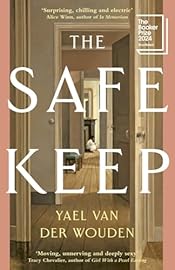
11 am: Yael van der Wouden: The Safekeep

This is another book I’ve read and blogged about (link here). Yael van der Wouden was in conversation with Claire Nichols, presenter of The Book Show on the ABC.

The first thing I have to report is that, if Claire Nichols is to be relied on, the pronunciation of the author’s family name is very close to Fun de Vow-dun. The second thing is that van der Wouden is as much a debut novelist as last night’s panellists. She’s experiencing the first of everything: she’s never been this far from home, she doesn’t know anyone here, she hasn’t talked about herself to rooms full of people before. She’s relieved that she didn’t win the Booker because that would have meant far too much time away from her loved ones.

Apart from that the conversation, or at least my scribbled notes from it, covered four main topics.

First, language. It’s an obvious subject to raise in relation to a book written in English by a Dutch writer. It turns out that English is van der Wouden’s first language. Her mother spoke Hebrew, her father spoke Dutch, and they used English to communicate with each other. She was born in Israel and moved to the Netherlands when she was ten years old. As a result she is ‘proficient in a chaos of three languages’. English is for writing, Dutch is for doing tax returns, etc.

Second, the narrative about World War Two in the Netherlands. In the mainstream version, the Resistance looms large. Only resistance fighters were celebrated on Remembrance Day – it wasn’t until the 1960s that Jews, Roma and other groups were included. The narrative has been changing thanks to the work of many scholars. It’s now generally recognised that the resistance to the Nazis wasn’t as significant as in, say, France, and that seventy-five percent of the Netherlands’ Jews were ‘despatched’, very few returned after the war, and of those many didn’t stay. The novel sits squarely among attempts to retrieve the real story.

Third, sex. In my blog post about the book, I said, ‘At times I felt like averting my eyes, as if I was intruding on intensely intimate moments.’ van der Wouden would have been pleased to read that, as she said that in writing the now famous sex scenes, mainly in Chapter 10, she wanted to make the reader aware that they were a voyeur. When Claire Nichols asked how she did that, she said some interesting things. First, erotic writing only works as a continuation of what has gone before it: in this case the long build up of repressed desire in her main character, Isabelle, at first experienced by her as disgust. The emotional content matters. In writing the sex scenes, she swings between the haptic (things to do with touch), something more abstract, something emotional, then back to the haptic.

Asked about the difference between good and bad sex scenes, she said it’s all about intention. Putting on her hat as creative writing lecturer, she told us that unless the aim is to be funny, the writer needs to commit fully, not lean into comedy or grossness. Surprisingly, she went on to say that it doesn’t work to borrow from your own sexual experience. I think her point was that if you do that you skip the work that needs to happen to take the reader with you. As I don’t have any immediate plans to write erotic scenes, I may not have paid close enough attention to these instructions.

The conversation ended with some reflections about being shortlisted for the Booker Prize, incuding a lovely anecdote about meeting one of her literary heroes at the Booker ceremony and not recognising her. The conversation went like this: ‘Good luck.’ ‘Thank you.’ ‘I’m Sarah.’ ‘Nice to meet you.’ ‘Waters.’ Yael cries.


I went to two more sessions on Saturday. I’ll write about them in my next post.


The Sydney Writers’ Festival is happening on Gadigal land. I have written this blog post on Gadigal and Wangal land, 45 minutes walk away, where the memory of ancient wetlands is currently very strong and the dark is coming earlier every night. I acknowledge their Elders past present and emerging, and welcome any First Nations readers of this blog.

Sydney Writers’ Festival 2025: My day two, part two

By the end of the festival I was suffering from information overload. I plan to blog about every session, but it may take a little longer than I’d like. I’m writing this on Tuesday – about last Friday.


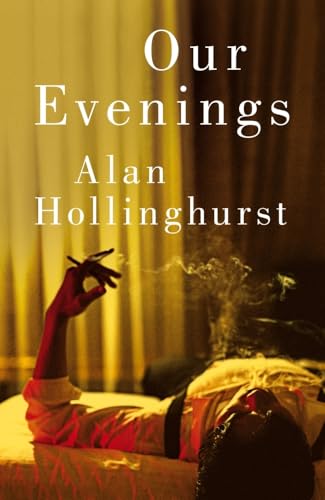
2 pm: Alan Hollinghurst: Our Evenings

Hollinghurst appeared on stage, the very picture of an urbane British novelist, in discussion with British journalist Georgina Godwin. (Georgina’s brother Peter is also a guest at the Festival – I didn’t book for any of his sessions but was enthralled by his conversation with Sarah Kanowski on ABC Radio, which – serendipitously – I listened to while walking home from the festival.)

The conversation focused on Hollinghurst’s novel Our Evenings, which I’ve read and blogged about (at this link). The conversation flowed and Hollinghurst had a lot of interesting things to say. I’ll just mention a couple of them.

GG’s opening question was about first-person narration. After talking about its advantages and limitations as he had found them in his first novels, Hollinghurst said that though he will never write a memoir, he realised that he wanted this book to read like one. He won’t write an actual memoir because he doesn’t really know who he is – and when the audience laughed at that he thanked us for our kindness but said it was true. (I just reread my blog post about Our Evenings and see that our book group felt that one of the main things about its protagonist David Win is that he doesn’t really know who he is. It looks as if we were onto something.)

Hollinghurst wanted a character who was like him but with at least one undisguisable difference. His main character / narrator, David Win, is mixed race Burmese and British. Hollinghurst wouldn’t have dreamt of giving David, say, Caribbean parents, which would have entailed a massive feat of the imagination. As it is, David (or Dave, as I’m pretty sure Hollinghurst called him throughout the conversation) never knew his Burmese father – he is brought up in a completely white environment with just mementoes – a photograph, some items of clothing. He never visits Burma/Myanmar, and knows no more about it than a white English novelist who does some online research. But the difference is real, and perhaps just as much as class and sexuality it’s a driver of the plot.

The other thing I want to mention came up in response to a question. There were no questions from the floor, but Georgina Godwin harvested them from an online platform. Someone asked what it was like to have progressed from being a queer novelist to being a British novelist. Hollinghurst said that probably happened with the Booker Prize for The Line of Beauty. It’s not that he stopped writing on queer themes – there’s plenty of same-sex desire and deed in Our Evenings – but he never wanted to write for a niche audience. He wanted to be part of the general conversation. This interested my partly because of how it chimed with what First Nations poet Jazz Money had said in an earlier session: that as an Indigenous queer woman it was only after her first book was well received that she realised she had the gift of responsibility – in effect, the responsibility to be part of a general conversation.

Oh, he read to us, and it was great to be reminded of how beautifully he puts words and sentences together.


7 pm: Raja Shehadeh: Chronicling Palestine

While we were waiting for this session to begin, with Australian Abbas El-Zein (whose Leave to Remain I blogged about a while back, at this link) sat in darkness on the stage. Curious about the two athletic looking young men sitting next to me, I asked what had attracted them to the session. ‘That’s our dad up there,’ one of them said. ‘And we love Raja Shehadeh,’ the other added, and recommended especially his book, We Could Have Been Friends, My Father and I.

Then the giant screen came alive and Raja Shehadeh was beamed in from his home in Ramallah in the West Bank. He is a lawyer and the founder of the Palestinian human rights organisation Al-Haq. He’s also a prolific writer. In this conversation, Abbas el-Zein asked him about three recent books:

  • We Could Have Been Friends, My Father and I (2023). After his lawyer activist father was murdered, his mother wanted him to deal with the boxes of papers he left behind; when he eventually looked in the boxes he learned a lot. He said, ‘I did what I never did in his lifetime. I came to terms with his suffering.’
  • What Does Israel Fear from Palestine? (2024) This began as a lecture on the Naqba delivered in Japan
  • Forgotten: Searching for Palestine’s Hidden Places and Lost Memorials, due for publication later this year, written with his wife Penny Johnson. Its seed was when they came across a plaque in the west Bank commemorating the death of a group of Egyptian soldiers in the 1967 war. Who knew Egyptian soldiers had been there? he wondered. What other forgotten pieces of the Israel-Palestine story were told in such neglected monuments?

His writing, he said, has been an effort to show what really happened in the past as opposed to the romantic versions accepted by younger generations. Yet, as the settlements are eating up land on the West Bank, there is urgency in the present that he also must address.

The central question in his work is, How can these two nations live together after this? What he means by ‘this’ has grown ever more momentous. But there is no other way. What is happening now is destroying the state of Israel just as surely as it is destroying the lives of so many Palestinians in Gaza.

As at many moments during this Festival, I thought about Kathy Shand , who retired as Chairman of the Festival board just before this year’s program was announced, probably because of concerns over the way Israel-Palestine issues were being platformed. If she got to hear this session, she might have regretted her departure.


8 pm: Big Beginnings (I’ll add a link to the podcast if/when it is released.)

This was a fun session. A dour irishman, an urbane mixed-race Englishwoman and a flamboyant Melbourne man who lives in Athens, each dealing with and perhaps reeling a little from the success of a first novel.

Madeleine Gray (whose own first novel, Green Dot, made a splash last year) chaired the panel with cheerful authority, leading them down a clear path of well-constructed questions: What were the circumstances in which you wrote the novel? What was your path to publication? Where did the idea start? What role does humour play? Who were your big influences, including those you only realised after the book was finished? What’s your research process? What’s the weirdest thing that’s happened since publication?

We learned:

Dominic Amerena (I Want Everything) was earning money while he wrote the book by doing medical trials – the book is partly a revenge for those precarious times. It was a struggle to write but once he submitted it, it was a dream run. The book is an inside-publishing mystery-scandal, and began with Dominic being fascinated by the number of Australian literary hoaxes – he rattled off a list of five from Ern Malley to The Hand that Signed the Paper. What is so Australian about them, he wondered. The Whitlam era features in the novel, and in his research he discovered stories about ‘men’s rights terrorism’ of the time – which he found a way of squeezing in.

Kaliane Bradley (The Ministry of Time) had lost a job in publishing because of Covid and though she got a new one she was working from home, knew no one in the new office and felt very precarious. She submitted the manuscript under a pseudonym because she is known by agents and editors. Once it was accepted, she had to do six rewrites over a year. The seed of the book was a photograph of ‘a sexy dead guy’ – a member of a lost polar expedition of 1845. She wanted to bring him back to life, to amuse herself and her friends. In the rewrites she had to think about literary genre tropes – elements of romcom, sci-fi, spy thriller. The word mash-up came to mind. She won me when she proclaimed her love of Terry Pratchett, and quoted him: ‘The opposite of funny isn’t serious. The opposite of funny is … not funny.’

Ferdia Lennon’s (Glorious Exploits) was teaching at a university near Disneyland in London when Covid gave him time to write the book. He’d long been obsessed with Ancient Greece, and had read a line in an ancient historian saying that Athenian prisoners-of-war kept in appalling conditions in Syracuse would be given extra food if they could produce a quote from Euripides. (I’ve just read the novel, and can tell you that’s pretty much how it starts.) In his research, he tried to suss out what it would have felt like to be there: he visited the quarries where prisoners were held.

We were well entertained for an hour.


The Sydney Writers’ Festival is happening on Gadigal land. I have written this blog post on Gadigal and Wangal land, 45 minutes walk away, where the memory of ancient wetlands is currently very strong and the dark is coming earlier every night. I acknowledge their Elders past present and emerging, and welcome any First Nations readers of this blog.

Sydney Writers’ Festival 2025: My day two, part one

Friday, and there’s a pile of umbrellas just inside the main entry to the Carriageworks.


23 May, 11 am: Songstress Poetica (Link to be added when/if podcast is released)

This was a charming hour with four First Nations women from this continent and a distinguished Emirati poet and scholar. It was in part a master class in relationality as the Indigenous women found many points of warm connection – shared Irish heritage, similar experience with singing, sharing of language, appreciation of each other’s work.

In the chair was Dr Alethea Beetson, a Kabi Kabi/Gubbi Gubbi + Wiradjuri artist who has, she said, many slashes in her work résumé, but works mainly in music.

Aunty Kerry Bulloojeeno Archibald Moran, ‘matriarch and medicine woman of Silver City Aboriginal Reserve – the Mission or Mish – on Anaiwan gooten country, Armidale’, sat in the middle, in splendidly colourful clothes and white ochre face paint. In striking physical contrast next to her was Dr Afra Atiq, an Emirati spoken word poet and scholar, dressed in magisterially flowing black. On the other side were two young writers (note that from my perspective anyone under about 50 is young) – Wiradjuri poet Jazz Money (most recent book mark the dawn) and Gunai woman ‘who rarely stays in her lane’ Kirli Saunders (most recent book Eclipse).

Each of the panellists spoke about her relationship to music. None of them owned up to playing a musical instrument, or even singing well, though Auntie Kerry said she always sang in response to the music of the bush that is always here if you listen. Kirli Saunders quoted her mother , ‘Birds in the bush, Babe, birds in the bush,’ meaning that when one bird needs to pause to draw breath the others will carry the song: it’s not all about individual effort in a choir, or in life.

Speaking about her own work, Aunty Kerry said she was inspired by what she reads in books – she produced two from her tote bag, one of which was Granny Duval by Sue Pickrell. She walks in the shadows of other people, she said, and when she reads when becomes the characters, just as in the bush she becomes the kookaburra, magpie, echidna. She performed a poem based on the story in Granny Duval.

Jazz Money spoke of the tension between the impulse to speak and the need to be heard. When she wrote her first book, she had no thoughts of publication. With her second book, she felt th gift of responsibility. As a queer Aboriginal woman, it was something new to expect her voice to be heard. Before she read her poem, ‘ember‘ (you need to scroll down at the link), she said that it was iportant inwith that responsibility not to focus on struggle: ‘The horrors of colonisation are such a tiny part of our story.’ She aims to be part of legacies of joy.

Kirli Saunders took up that theme, saying that though she writes about the stormy places, it’s often in the moment when the storm has passed and the smell of petrichor is everywhere. She performed ‘In the before time’, a poem/dance from the performance piece she is currently developing.

Afra Atiq reminded us that in her work is not reclaiming anything that has been lost, but is part of a continuing tradition, to which she has responsibilities. She performed a poem from her book, Of Palm Trees and Skies. The poem, whose title as best I could scribble it down was ”Six minutes that may be erased today’, was inspired by an art installation in which a mechanical device drew images and then erased them after six minutes. It’s a breathless poem that ends (the line breaks are my guess):

We write because we must
we erase because we think we should.

After the session, these extraordinary women stayed on the stage and generously posed to have group photos taken by a number of intrepid audience members.


12.30: Q & A with Jeanette Winterson in the Patrons Lounge

Thanks to a generous friend, I was a guest at this bonus event. Jeanette Winterson stood on a tiny stage in the Patrons Lounge and answered questions for a little over half an hour. Though some questions came from the munching and sipping patrons, Radio National’s Kate Evans served as excellent stooge, asking questions that elicited a lively story about the origins of Winterson’s first book, Oranges are Not the Only Fruit, including the role played by Australian Dale Spender; reflections on the influence of the Manchester of her childhood on her prose (evidently in Manchester, people talk to strangers in the street in staccato, irreverent humour); and about the importance of reading to enable people to broaden their horizons past the confines of their one short life, and to learn how to express themselves in ways without which the main alternative would be violence

I had a break for lunch, and am now having a break from blogging. The afternoon will be another post


The Sydney Writers’ Festival is happening on Gadigal land, where on this day the ground was doing its best to soak up a lot of water. I have written this blog post on Gadigal and Wangal land. I acknowledge their Elders past present and emerging, and welcome any First Nations readers of this blog.

Sydney Writers’ Festival 2025: My day one, part two

While I went home after two sessions on Thursday and wrote my first post about the Festival, the Emerging Artist stayed on at Carriageworks for Anne Summers: 50 Years of Damned Whores and God’s Police.

We debriefed over dinner, then were back into the fray for:

22 May 8 pm: Ittay Flescher: The Holy and the Broken

Michael Visontay sat alone on the stage and interviewed a huge image of Ittay Flescher on a screen behind him.

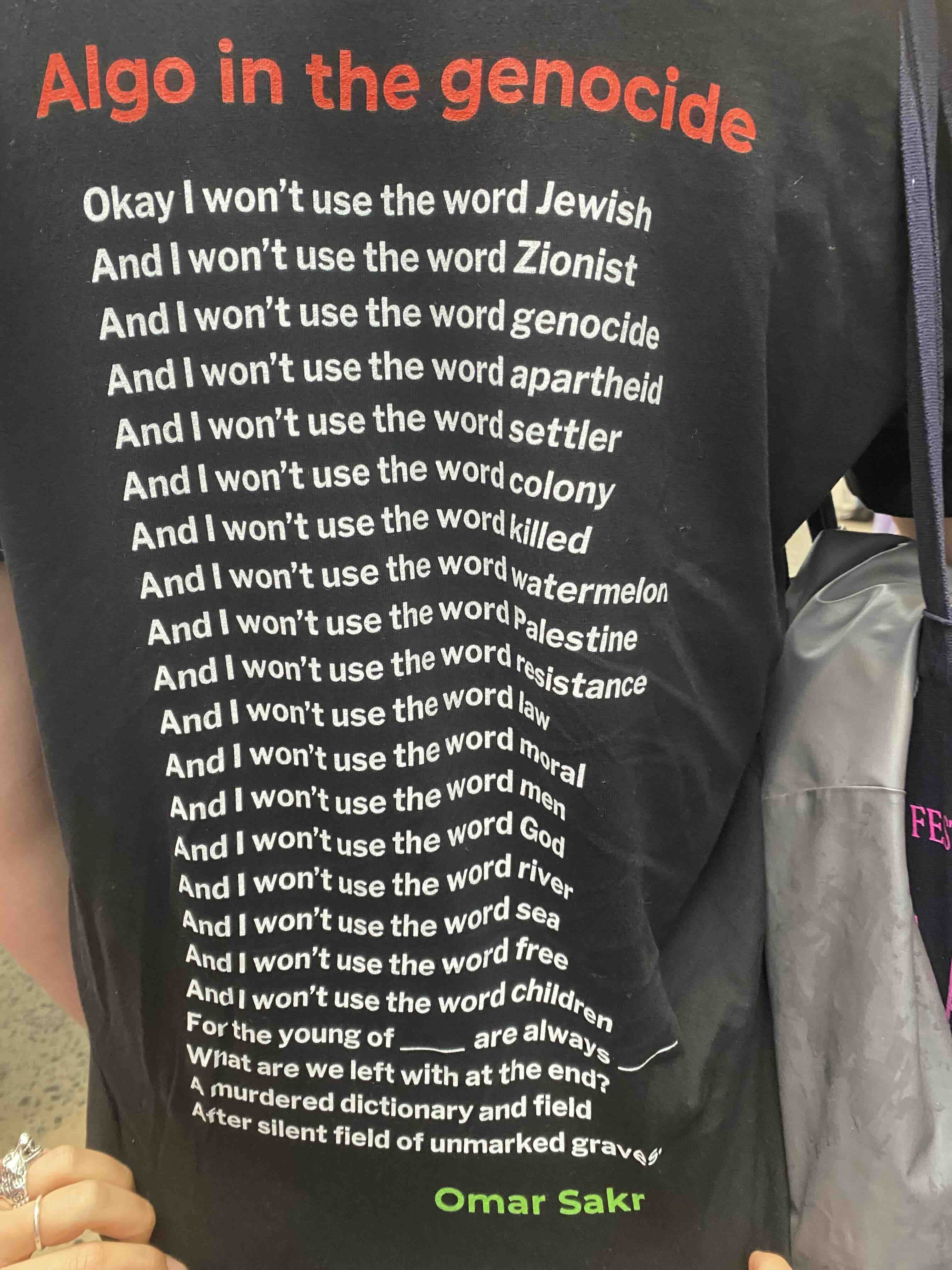
Ittay Flescher is the Education Director at Kids4Peace Jerusalem, described on the Festival website as an interfaith movement that ‘works to build trust and friendship between Israeli and Palestinian teens’. His response to Visontay’s opening question said a lot about his work. The question included the word ‘conflict’. He said that like many words, that one is itself ‘conflicted’: some hear it as implying two more or less equal sides and so denying the reality of genocide. He listed a number of terms that have radically different meanings depending on your point of view: Holocaust, naqba, Zionism, Muslim, Jew, Christian, Palestinian.

Serendipitously, today (Friday) I saw a T-shirt bearing a poem by Sakr Omar that speaks directly to his point from a Palestinian point of view, it’s one of a series of shirts produced by Readers and Writers against Genocide:

Back to Ittay Flescher. ‘I’m not a politician,’ he said. ‘I wrote the book as an educator.’ And he spent his brief hour educating us. Both Jews and Palestinians have a deep sense of having been oppressed, both with good reason. He sees it as absolutely necessary that the ancient terrors and hatreds born of those brutal histories not to be passed on to the next generation. His work is all about countering the dehumanisation of the Other, and helping people to learn to have open-hearted conversations among people from opposite sides of great divides. He asks: ‘What happened in your life to lead you to believe what you believe, to hold the positions you hold?’ Then he shares his own beliefs and the experience that underlie them. A conversation of this sort doesn’t aim to reach agreement but to recognise the humanity of each other.

He has been called pathetic, naive and delusional by a staunch Zionist journalist, and seen as unbelievably one-sided by some Palestinian activists. But he has many emails from people approaching him as a therapist: ‘I am torn. What should I do?’

If you look at the news, not just from Israel–Palestine but from many places in the world, an understandable response is to despair. In his view, despair leads to more violence. It’s necessary to have a sense of possibility, to have some vision for a resolution where both peoples can live in a secure, just peace. (He didn’t mention Rebecca Solnit, but I was reminded of her argument – I’m paraphrasing from memory – that you can never know what your smallest action in a good direction will lead to, there is never a reason not to have a go.) There’s actually an Egyptian peace proposal on the table that he thinks should be taken up.

That’s a crude condensation of what he had to say. Responding to questions, he made it clear that his work, and his organisation, are part of a peace-building community in Israel and Palestine that includes hundred of organisations and thousands of people.

I bought a copy of his book, The Holy and the Broken: A cry for peace from a land that must be shared. I expect I’ll be writing more about it in time.


The Sydney Writers’ Festival is happening on Gadigal land. I have written this blog post on Gadigal and Wangal land. I acknowledge their Elders past present and emerging. Looking ahead a little, a poet from the United Arab emirates said today (Friday) that she was enjoying the rain. This is glorious, wet country.

Sydney Writers’ Festival 2025: My day one, part one

It’s raining in Sydney, but the Writers’ Festival shines on, apostrophe intact.

This year’s theme is ‘In This Together’. The Emerging Artist and I plan to take in about 17 sessions between us, mostly in it together. Given recent attacks elsewhere on speech about the genocide in Gaza, I will be disappointed but not surprised if some of our booked sessions are cancelled, but here’s hoping. 

22 May 1.00: Beyond the Self (link to come when podcast is released)

The Festival website description of this session begins:

Anchored in our human body, our experience of being in the world extends outwards from our sense of self.

Oh well, I thought, the program descriptions don’t usually determine the conversation.

The four panellists have written very different books, and come from very different contexts. What they have in common is that they are all First Nations people. The chair was Bardi Jawi man Bebe Oliver, who first came to prominence as WA Young Australian of the Year for his work as a classical pianist and composer has had several books of poetry published. Other panellists were Bundjalung and Kullilli man Daniel Browning who has worked as a journallist and broadcaster for many years, and has recently published Close to the Subject, a collection of personal essays; Kaurareg Aboriginal and Kalkalgal, Erubamle Torres Strait Islander man Thomas Mayo, who played a huge role in the Voice referendum and whose books, especially Always Was, Always Will Be: The Campaign for Justice and Recognition Continues, reflect his activism; and Yuwaalaraay woman Nardi Simpson, originally half of the singing duo Stiff Gins, and now author of Song of the Crocodile and The Belburd.

Nardi Simpson made a valiant attempt to tie the conversation back to the idea of bodies – go out from my body to yours when I sing for you, and when I write a book, these funny little squiggles on an oblong thing can make other people tingle. But mostly the yarning (as Bebe called it a number of times) ranged freely. All four panellists had interesting things to say, and they connected with each other, but I’m at a loss to summarise.

One theme that emerged for me was to do with aurality. Paradoxically, Daniel Browning said that for years he had sat in climate-controlled studios in the ABC talking to a microphone with little or no sense (and I may have added the ‘little or’ there) that there was anyone listening, whereas when he wrote an essay, he had an immediate sense that he was talking to someone. Spoken words are transient; written-down words have power. Nardi Simpson reported more or less the opposite: when you sing to an audience you’re right there with each other, but who knows what happens with a book? Thomas Mayo, likewise, said that he has come to love speaking to people (he did a lot of that, brilliantly, during the Voice Referendum campaign) – looking them in the eye, and if there’s a disagreement you can see it there. Nardi Simpson made explicit the underlying notion, that First Nations people come from an oral culture, and she and Daniel Browning told moving stories about audio versions of their books reaching people who wouldn’t otherwise have read them.

What all panellists agreed was that we are living in a time in this country when First Nations stories need to be told, and there is an audience for them. ‘If I/we don’t tell the stories, someone will say it didn’t happen.’

There was a brief conversation about the experience about being misunderstood, including very different feelings about the editing process. Nardi Simpson spoke directly to one of my current concerns when she said (and this is not an exact quote): ‘The book is there. Yuwaalaraay will find this in it.Aboriginal people will find this. Allies will find this. People who nothing about me or us will find this.’

2.00: Bringing the Past to Life (link to come when podcast is released)

The incomparable Kate Evans, co-presenter of The Bookshelf on ABC Radio National, did a lovely job managing this conversation about historical fiction with Emily Maguire whose latest book, on my To Be Read Soon list, is the novel Rapture, and Jock Serong, whose urban fairytale Cherrywood sounds terrific – I have seen a narration of its plot hold a seven-year-old spellbound.

Somehow a novel based on the 9th century CE legend of Pope Joan (or is it only a legend?) and one about a hotel in Fitzroy that lifts its skirts and wanders around the city made an excellent pairing. They both, it turns out, deal with institutions that have forgotten what they are here for. The Catholic Church in Maguire’s book is so concerned with its rituals and procedures that it has lost sight of its central mission. The corporate law firm in Cherrywood is hell bent on tracking down the wandering pub, but only one old man whom everyone ignores remembers why.

It was fun.


The Festival is happening on Gadigal land, I have written this on Gadigal and Wangal land. I acknowledge their Elders past present and emerging. As Bebe Oliver said in acknowledging country this afternoon, Always was, always will be Blak land.

November verse 8, 2024, and Standing Together

Last week I went to a meeting where two members of Standing Together spoke. Standing Together is a grassroots movement of Jews and Palestinians in Israel working for peace, equality, and social and climate justice (website here).

At the meeting, organised by the recently formed Sydney Friends of Standing together, Shahd Bishara and Nadav Shofet gave personal accounts of their involvement in the movement. Shahd Bishara, a Palestinian Israeli medical practitioner, said, among other things:

The liberation of Palestine is inextricably intertwined with the security of Israelis. Two peoples both live in the land that both call our homeland. We need to fight for freedom of Palestinians and the safety of the Israeli Jews.

Nadav Shofet, an Israeli Jew, spoke of the absence of an alternative narrative to the genocidal one of perpetual war put forward by the Israeli right. Standing Together aims to fill that vacuum with a narrative that includes hope.

There’s much more to say. Standing Together has been attacked from the right in the USA and Europe, and from the left in Australia. My comments section isn’t open for that debate. The ABC covered the visit here.

Without wanting to in any way trivialise the struggle that was the subject of the meeting, I kept my ears open for an iambic tetrameter that could kick off an Onegin stanza. I got one. Nadav was referring to the narrative vacuum when he used the phrase, ‘In this environment of silence’. I have taken it somewhere else.

(The Emerging Artist says I should give links to W. B. Yeats, ‘Long-Legged Fly’ and Hopkins, ‘The Habit of Perfection’. Sadly I don’t remember the name of the Italian poet who inspired my last line.)

Verse 8: In this environment of silence

In this environment of silence
minds can move like Yeats’s fly
upon the stream, or can with violence
leave democracy to die.
Silence sings if it’s elected.
Silenced hearts by fear inflected
can’t or will not have their say –
stony, look the other way.
Silence thrives when life's unruly –
words as weapons, words as toys,
words as endless streaming noise
leave no room for words that truly
come from hearts that seek to heal
whose uvulas are made of steel.

Sydney Writers’ Festival 2024: My day four

I had just two sessions on the last day of the Festival. The Emerging Artist came down with a heavy cold, but I was ruthless enough to leave her languishing at home today. One pleasant surprise was that, even thugh the SWF website says there is a no-refunds policy they are happy to give a credit – so we have prepaid for three sessions of next year’s festival (she also missed out on Sebastian Barry on Saturday night – rewatching some of Derry Girls from her sickbed.)

Sunday 26 May

12.30: Fragile Democracy

This was one of those panels where I’m interested not so much in the books written by the participants as in what they have to say about the world. As the Festival program put it:

Donald Trump and his attacks on the US electoral system have raised red flags about the strength of American democracy. But in an age of disinformation and civic decline, signs of fragility are visible elsewhere and Australia is no exception.

Former host of ABC’s Insiders Barrie Cassidy chaired this discussion. The formidable participants were:

  • Bruce Wolpe (Trump’s Australia), Senior Fellow at the United States Studies Centre who has worked with the Democrats in Congress during Obama’s first term and on the staff of PM Julia Gillard
  • Rosalind Dixon, Professor of Law at UNSW and co-author of perhaps the least easily spoken title of any book at the Festival, Abusive Constitutional Borrowing Legal Globalization and the Subversion of Liberal Democracy
  • Nick Bryant (When America Stopped Being Great: A History of the Present), who has a 30 year career in journalism, much of it as a foreign correspondent for the BBC.

The panellists were pretty much in furious agreement that there is currently a wold wide battle between autocracy and democracy. Naturally, most of the tie was spent on how this battle is being fought in the USA. ‘The beacon of democracy,’ Nick Bryant said, ‘is looking like a dumpster fire.’

We were reminded that the authoritarian tendency in the USA isn’t new – FDR, correctly seen as progressive and, in US terms, ‘liberal’, was applauded when he said in his inauguration speech: ‘ I may have to bend the rules of the Constitution to what I want to do.’

There was some discussion of the possibility of civil war in the US if Trump loses the election. It wouldn’t be like the last one, but even if there is no civil war, there won’t be civil peace.

All the panellists agreed that Australia’s institutions are strong: compulsory voting, preferential voting, ease of voting (there were some horror stories about how hard it can be to vote in the US), an independent Electoral Commission, and courts that aren’t as subject to political pressure. But we still need to be vigilant: for instance, Peter Dutton recently tried to introduce voter ID processes to make voting harder.

Someone said, ‘Australian democracy is a lot stronger than its politics.’


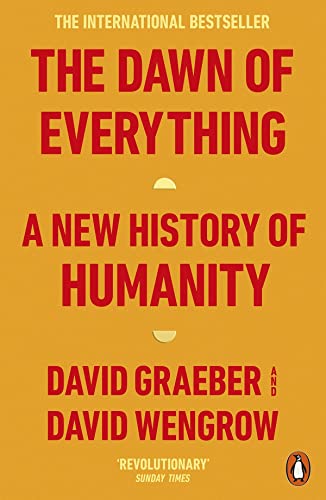
1.30: David Wengrow: The Dawn of Everything

Richard Fidler was in conversation with David Wengrow, co-author with the late David Graeber of The Dawn of Everything: A New History of Humanity (2022). David Graeber was an anthropologist who played a leading role in the Occupy movement. When he and Wengrow, a British archaeologist met during the Occupy movement they had long conversations, not about politics but about archaeology. As Wengrow told him about current state of knowledge of the ancient past, he kept asking, ‘Why don’t I know this? Why isn’t this being taught?’

They decided to write a pamphlet, something without footnotes and scholarly paraphernalia, presenting current knowledge in a readable, integrated form. It turned out that this was harder than they thought, partly because of the extreme specialisation of archaeology: experts in ancient rock art don’t know what experts in ancient stone tools are doing or finding out. In the end, they had to write a substantial book.

The conversation touched on the opposing views of human history put forward by Rousseau (early humans were blissfully innocent, perhaps slightly imbecilic creatures who were corrupted by the formation of societies) and Hobbes (the war of all against all constrained by civilisation). wengrow observed that both these narratives are fantasies in which the early humans aren’t like any humans we know anything about. Likewise, he says archaeological findings disprove the narrative of Sapiens, which he assumed we have all read but I haven’t, and of Steven Pinker.

As to what those findings are: they are rich and complex, much more so than anyone has ever though was the case with early humans.

He argued that the luminaries of the enlightenment – Diderot, Voltaire, Rousseau – were influenced by what they heard from Indigenous people from colonised nations who visited Paris and were sharply critical of teh inequalities and other manifestations of monarchy that they saw there. He spoke respectfully of Bruce Pascoe’s work, but seemed to be unaware that Mungo Man and Mungo Lady were buried with ritual elements tens of thousands of years ago – which as I understand it only reinforces his argument.

This session was recorded for the ABC’s Conversations program. I plan to listen when it’s broadcast as there were a lot of specifics to his argument that I know I’ll get wrong if I try to write them now. [Added later: The Conversations program is already online at this link.]


The festival is over for another year. What little I saw of it was terrific.

The booking system means that there are no longer terrible queues for the sessions with no guarantee of getting through the door.

There is a new approach to questions: you go to a website and put your question there. This has the great advantage of stopping people from getting up to tell their life story or promote their own world view. I think there may have a disadvantage: sometimes if the person on stage can actually see the questioner they can tailor their answer appropriately – as for example if the questioner is a young person.

I do wish there was more than one place selling coffee, as even though I’m not a coffee drinker I was pained to see the apparently permanent size of the queue.

And most of all I wish there was more poetry. Just one whose drawing power depends on his published prose isn’t enough. Surely there is a small room somewhere at Carriageworks that could be devoted to poetry – one where an event doesn’t need a big crowd to justify itself. There are at least half a dozen places in Sydney that organise regular poetry readings, there ar e a number of small publishers who specialise in poetry, and there are any number of fine poets who live locally.

But long live the SWF. I’ve come away with a swag of actual books and a list of others.

Sydney Writers’ Festival 2024: My day three, evening

Saturday 7.30 pm: Sebastian Barry: Old God’s Time

If I’ve realised that Sebastian Barry was appearing by video link I might not have booked for this session, but that would have been a mistake. A tiny Kate Evans sat on the stage in front of a huge Sebastian Barry speaking to us from early morning in Ireland in the room where, he said, he had written the book they were discussing, Old God’s Time (link is to my blog post).

Whether it was because Barry was speaking to us from the safety of his own house, or because of a paradoxical effect of long-distance communicating, or whether it might have happened anyhow, this session had a wonderful intimacy about it. Almost everything he said enriched my understanding and enjoyment of the book.

When Kate Evans asked about the physical setting of the book, Barry answered straightforwardly and then went on to talk about the novel’s seed being planted in a brief period of his childhood when he lived in that building. I don’t know anything of his life story, but he may have been hinting that the book child’s situation – he and his mother are in hiding from his abusive father – in some way echoes his own experience.

My highlight of this session, and of the whole festival, came when Kate Evans, referring to a tirade against the Catholic Church delivered by the character Tom Kettle, asked if Tom’s rage was also Sebastian’s. (Someone read this passage out at my book group meeting – it’s a stunningly passionate piece of writing, and Evans’s question is inevitable.) Barry asked Evans if she would read the passage, and when she apparently didn’t hear his request but read out a couple of isolated phrases, he paused, as if deciding how honestly to respond and then gave a complex answer:

A) The first rule of novel writing, he said, is not to write in anger. He spoke a little about the mysterious nature of novels. The writer sits in a room and puts words on paper. After a number of processes involving many other people, someone sits in their usual reading place and reads the words. The characters who have been imagined by the novelist are imagined all over again by the reader.

B) Though Tom is an imaginary character, his anger is like that of real-life survivors. It gives voice to things that need saying, and when you make the effort of listening to it, you are receiving a gift. Barry felt that he was receiving such a gift from Tom.

C) He didn’t stop there. There was a moment in 1960, he said, when Archbishop McQuaid (a historical personage mentioned in the novel) was given evidence of child sexual abuse committed by a priest in his archdiocese. He consulted an Auxiliary Bishop, Patrick Dunne, asking him if he considered that the crime was a crimen pessimum (a crime of the worst kind). Dunne said he thought it was. McQuaid responded that he would keep it quiet anyway, because it would cause a scandal that would do great harm to the church. That moment of decision ruined the lives of thousands of children, and this was the object of Tom’s rage.

But for Barry, there is another twist: Patrick Dunne was his cousin, closely related to a man who appears honourably in one of Barry’s novels. On realising that this man was present when the decision was made, Barry felt that his own DNA had been in the room. Irrational as it may be, he felt complicit. I understood him to be speaking a difficult personal truth but also – though he didn’t spell this out – making a point about fiction-writing: clickbait outrage is easy but it doesn’t make for great fiction. Tom the character can be outraged, but the person who creates him needs to be wary of claiming the moral high ground.

Astonishingly, but necessarily, Kate Evans then moved on to the next question, and Sebastian Barry moved on with her, leaving me – and surely I wasn’t the only one – in awe at what had just been given me.

The session ended with a reading, in which Barry was transformed into Tom Kettle and his glorious language filled the room. In the passage, Tom is listening to a new friend playing Kol Nidrei, Op. 47 by Max Bruch on the cello (link is to a performance by the Frankfurt Radio Symphony Orchestra). We were then treated to a performance of the piece arranged for cello and piano, performed by Melissa Barnard and Lee Dionne from the Australian Chamber Orchestra.

Sydney Writers’ Festival 2024: My day two

After just one session on Tuesday and nothing on Wednesday or Thursday, Friday was all systems go for me at the SWF, with five sessions, starting at noon and ending just after 7 in the evening. Please excuse the length of this post.


12 pm: The Gift of Greek Myth

I first heard Kate Forsyth talk back in the day when she mainly wrote for children (starting with Dragonclaw in 1997). More recently she has appeared on radio and podcasts as a writer of historical fiction. She has always been good value on fairytales and myth. In this session she chatted with playwright Tom Wright about her most recent book, Psykhe.

If Psykhe is as interesting as this talk, then it’s a brilliant novel. Here are some scraps I gleaned.

Kate Forsyth describes herself as playing in the borderland between myth and history. She is concerned to reclaim ancient stories from their patriarchal interpretations. Fairytales, she says, are myths drained of their sacred meanings, because they are mostly concerned with women’s issues.

In this book, the dividing line between gods and humans is porous. It tells the story of Psyche/Anima and Cupid/Eros/Amor as a historical fiction – Psyche becomes Psykhe and Amor becomes Ambrose.

I’m not sure how much of this is from the original myth and how much from the novel, but here’s a broad plot outline: Venus’ son Ambrose falls in love with Psykhe, a human woman; he keeps her in luxury in his palace, but as a prisoner; he comes to her bed every night, where she is not permitted to see his face. One night as he is sleeping, she looks at him by the light of a candle, and spills wax on him. For the first time he feels pain, and flees. Having broken free of her imprisoned state, she now can love him, and goes searching for him.

Forsyth says this is the only ancient myth that is gynocentric – woman-centred. Whereas in androcentric myths the hero breaks, kills, and conquers (and, I’d add, rescues), in gynocentric myths the female protagonist sets about healing, repair and recovery. This story is about the importance of consent, the transformative potential of pain, the need for love to be more than physical (the reductiveness of that is mine, not Kate Forsyth’s or Tom Wright’s).

Kate Forsyth has a lovely phrase for her creative process. She says she spends a lot of time ‘daydreaming a story to life’. In this talk, she allowed us to witness part of that daydreaming.  


2 pm: Abdulrazak Gurnah: Afterlives

I’ve read and loved two of Abdulrazak Gurnah’s ten novels, Gravel Heart and Afterlives.

This urbane and amiable session focused on Afterlives. Gurnah kicked it off with a reading. Though he read beautifully, it was a strange passage for the occasion as very little happens in it: there is a boat and a harbour town, the sun sets, the main character has trouble sleeping because of unspecified pain. This from a book where there is so much wonderfully dramatic or tender writing he could have picked (see my blog post for an example).

Sisonke Msimang, his interlocutor, asked the pertinent question: why this passage? He said it was the first part of the book that he actually wrote. He knew that Hamza had been wounded and was returning to his childhood home after fighting for the Germans in World War One: what came before and after that was yet to be imagined.

After that insight into the book’s origins, we learned that Gurnah had wanted to write about the German schutztruppe for a long time. (Not quite right to call them ‘the German schutztruppe‘, he said, as only the officers were German, the troops were African.) He had known from his childhood about the ferocity of these soldiers, who fought for the colonisers – his grandfather (or more precisely his mother’s uncle) had been one of them. But when he got to the UK and had access to books, he found that there was nothing written about the way Africans were drawn into the wars between the colonising European nations. He had intended his fourth novel, Paradise (1994), to be on the subject, but he realised then that he didn’t know enough to write about it. It was nearly two decades before the time was right.

A question animating the book is: Why did people join a force that was going to end up dominating them/Why fight in a war that will determining who will be your coloniser? ‘That’s how we put the question now,’ he said. The book offers no simple answer, but a lot of what the two speakers had to say echoed what I have heard and read about the Queensland Native Police: apart from the attraction of being part of a new, powerful force, or various kinds of of coercion, it’s important to remember that people didn’t think of themselves as African, any more than the Germans and French identified each other primarily as fellow-Europeans: many of the African nations had been at war with one another for centuries.

The conversation roamed over the more personal elements of the book. These are the things that Gurnah says he likes writing about most – the everyday, the interior, the domestic, the intimate – and it’s them that gives the book its power as it tackles broader issues. All of this brought the pleasures of the book back to me – I hope it inspires people who haven’t read it to pick it up.

One final question from Sisonke Msimang: Was he expecting the Nobel Prize? Writers don’t work with the hope of winning the Nobel Prize, he said. They’re in for a hard time it they do. And he did a quick impersonation of someone responding to the phone from the Nobel Committee by exclaiming, ‘Well, at last!’


3 pm: Nam Le: 36 Ways of Writing a Vietnamese Poem

This wasn’t a session for the faint-hearted. Felicity Plunkett, herself a poet, set the ball rolling with an opaque quote from ‘On the line’, an essay by Kasim Ali, and things only got more erudite, recondite, convoluted and polysyllabic from there.

When someone at a session later in the day half apologised for the comparatively straightforward terms ‘methodological’ and ‘epistemological’ by adding ‘as we’d say in the academy’, I realised retrospectively that this conversation was being conducted as if in a specialist academic context.

For instance: ‘The line can put things into differences of ordinality … You can have a chiasm … ‘ I managed to note down terms like ‘autofictive’, ‘metafictive’, ‘preambular’, ‘the trauma plot’ (which is ‘too easy’). All of this has meaning, but I found it impossible to keep up.

What emerged is that Nam Le’s poems are ‘destabilising, elliptical, constantly questioning’. ‘How is it possible to say anything at all,’ he asked at one stage,’without being undermined by your own self-consciousness?’

There was a lot of talk of violence, which may or may not have a technical meaning. I think Nam Le was joking when he asked, ‘What is more violent than meiosis?’ (Meiosis is the process by which cells split.)

As a counterbalance, Le read four poems to us – or more accurately he read four parts of what Plunkett said is the long poem that constitutes the book 30 Ways of Writing a Vietnamese Poem. It was wonderful to hear his performances. The one with which he wound up the session, a lullaby with the title ‘Matri-Immigral’, was all anyone could have hoped for.

That broke through my exasperation with the session’s obscurity and recursiveness and convinced me to buy a copy of the book.


4 pm: Feminist Firebrands

Each of the day’s earlier sessions featured one author talking to one other person about one book. This session was a panel of three plus a facilitator.

A panel is a hard gig: you run the risk of only half-hearing each of the participants, and hearing no one’s thinking in depth. If the subject is books, you can get some idea of whose writing you might want to follow up, but this panel barely mentioned the participants’ books. All the same, it worked.

Hannah Ferguson, who is in her late 20s, abandoned her law career soon after graduating and is now a podcaster and person in charge of something on the internet called Cheek. Sisonke Msimang, among other things, writes a regular column in the Guardian offering wisdom about racism and related issues. Jennifer Robinson has offered legal advice in high profile cases of alleged sexual abuse. Jo Dyer, among other things former CEO of the SWF, facilitated.

The conversation revolved around issues raised by the Brittany Higgins and Bruce Lehrmann court cases, the allegations of historic rape against Christian Porter, Grace Tame’s advocacy, a little of Amber Heard’s case against Johnny Depp, and a sulphurous whiff of Donald Trump. That is, the way the criminal justice system here, but also in the USA and Britain, treats women, specifically when they allege sexual abuse or rape. And not just the criminal justice system, but the media and the culture generally.

The first thing that struck me was the stark contrast with Nam Le’s approach. Here there was no uncertainty, no self-undermining, no painful self-consciousness. Everyone spoke forcefully, definitely, and – alas for my note-taking – fast. I couldn’t possibly give a decent summary, but here are some gems:

Jo Dyer on recent news about the Queensland police force: ‘How many bad apples do you have to have before you cut down the f*ing orchard?’

Hannah Ferguson (I think): ‘Men are 230 times more likely to be raped than to be falsely accused of rape.’

Hanna again, on the ‘If you don’t know, say no’ slogan: ‘Everything I do is to fight the notion that you should back off if something is hard.’

Jennifer Robinson: Only 2% of rape cases arrive at a guilty verdict, but the current defamation laws in Australia mean that only those 2% of survivors can talk about their experience without being sued. A not guilty verdict in a rape case does not mean that the woman lied.

All the panellists agreed that it is important to have conversation about these issues. I think it’s right to say they all felt that it was a mistake to pile on Scott Morrison for framing his empathy for sexual assault victims as resulting from his wife asking how he would feel if it was his daughter. The conversation is important, and it doesn’t move things forward to attack imperfect contributions that are still in a good direction.

I learned about the ‘Man or Bear’ meme on Tik-Tok. Women are asked if they would rather be alone in a cave with a man or a bear. A typical witty answer is: ‘The bear, because at least I know what it would do.’ There was some dark humour about how some men have responded – one teenage boy asked (the question I’m embarrassed to say came immediately to my mind), ‘What kind of bear?’


An hour’s break to attend to bodily needs and get from Newtown to the City, and then off to:

6pm: Richard Flanagan and Anna Funder on Writing

Given that Richard Flanagan was scathing about writers’ festivals in Question 7 (a book I didn’t warm to), it’s interesting that he still agrees to appear at them. I came to this session mainly for Anna Funder. The Emerging Artist read quite a lot of Wifedom to me last year.

Clare Wright was in the chair. As a historian, she was interested in the way both books move around in genres, part history, part novel, part memoir, part autofiction. Both writers resisted any attempt to classify, saying they had followed where the books took them. Funder, for example, said she wasn’t writing autofiction in the parts of Wifedom when she wrote about her own life: it was a device to bring the questions about how women were seen in her subject’s time into focus.

Richard Flanagan was entertaining. My impression is that he came armed with a number of set pieces. He told us, for instance, that the history of publishing in Australia differs from the history in Britain and the USA in that key roles have been played by strong, intelligent women. He didn’t mention the fabled Bea Davis, but he named others, including the woman who had edited both books featured in the session: he asked her to stand up to take a round of applause, and though I couldn’t see her from my seat up in the gods she apparently complied, I can only imagine how reluctantly. Later he told his version of the story of being mistaken for a different writer in a signing queue – he duly signed the proffered book as Bryce Courtney.

In the long and interesting conversation, Clare Wright asked Flanagan two questions about Question 7 that touched directly on my issues with the book. Did he introduce Rebecca West as a way of countering the all-male patriarchal narrative of the origins of the atom bomb? Nothing so programmatic, he said, and went on to talk about how remarkable Rebecca West was. Then he reminded us that for the last 20 years or so women’s writing has been front and centre in western literature, so our collective sense of history has changed – so not programmatic, but responding to the zeitgeist. Wright framed the other question by asking him to read a short passage (sadly, this was the only reading in the session) describing the bomb being dropped on Hiroshima. As a historian, she was not interested, as he first thought, in whether he had got the number of people killed right, but the origins of his image of survivors walking the streets calling for their mothers, juxtaposed poignantly with the fact that plane that dropped the bomb, Enola Gay, had been named after a crew member’s mother. He was able to say that both those images came from historical records.

Wifedom has 400 endnotes: ‘If you want to destroy patriarchy you have to have endnotes.’

The patriarchal manifestation she attacks in the book is the erasure from history of George Orwell’s wife, Eileen O’Shaughnessy by Orwell’s many biographers. She had a number of Eileen’s letters and some few other sources, so she had to resort to ‘making shit up’, to use the words Clare Wright put in her mouth. The made-up bits are clearly indicated in the book, being set to a narrower width. Before she made this controversial decision, the writing was flat and dead on the page. Her writing about her own status as wife played a similar role.


And so out into the crowds in George Street, possibly there for the Vivid Festival, to dinner and eventually home.