Category Archives: LoSoRhyMo

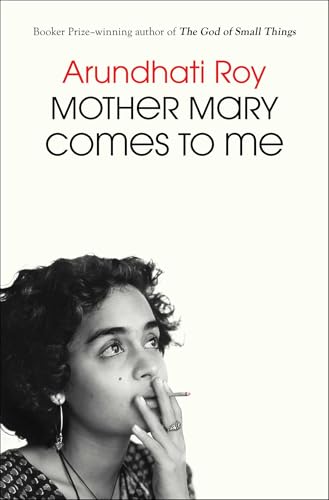
Mother Mary Comes to me, Arundhati Roy and the Book Club

Before the meeting: Mary Roy (1933–2022) was an extraordinary woman. She successfully challenged an inheritance law in the Indian state of Kerala so that women were able to inherit property, and she founded a ground-breaking school. That school, Pallikoodam, has a photo of her on its home page, accompanied by a vision statement:

Pallikoodam is born of the vision of Mrs Mary Roy. For fifty plus years she worked on moulding an extraordinary school that imparts a creative and all-round education that produces happy, confident children, aware of their talents as well as their limitations, unafraid of pursuing their dreams and living life to its fullest. Today, every one of us in Pallikoodam works to realise and forge ahead with her dream.

Mary Roy was also the mother of writer Arundhati Roy. In this memoir, she emerges as a formidable woman who did brilliant things, earning the admiration and cult-like devotion of many while challenging patriarchal institutions, and was at the same time a tyrannical, unpredictable, terrifyingly self-centred mother. Near the end of the book, Arundhati Roy describes a moment in 2022 when she was having dinner with three male friends, including her close friend Sanjay. She received a message on her phone:

It was from my mother. They, all men, each of them, including Sanjay, beloved by their besotted mothers, must have noticed the blood drain from my face and wondered what had happened. How could I explain to them that what had scared me was that I had got a message from my mother saying that she loved me.

It says a lot that readers understand perfectly why the message is terrifying, and that we also understand the intense moral, emotional and intellectual complexities involved in Roy sending a positive reply.

I love this book. It’s the story of the intertwined lives of two brilliant women, with the last half century of Indian history as an often intrusive backdrop. The genesis of Arundhati Roy’s writing is vividly told: her two novels The God of Small Things and The Ministry of Utmost Happiness, as well as her non-fiction, ‘activist’ writing, opposing the construction of a big dam that would displace millions of people, exposing the suffering of the people of Kashmir, reporting on time spent in a jungle with communist (‘Naxalite’) guerrillas, opposing Narendra Modi’s regime, and more.

I can imagine the book being portrayed as a misery memoir in which a famous writer complains about her wretched childhood, or as an exposé of a monster generally regarded as a saint. But that would be to misrepresent it. Mrs Roy’s personality was no secret. Her most loyal adherents were aware of her rages, her indulgences (she was always accompanied by an attendant bearing her asthma medication and, later in life, a supply of jujubes). And though Arundhati and her brother suffered terribly at their mother’s hands, she was a powerful force for good in their lives. There are any number of quotable lines to illustrate this complexity. Here’s just one from page 61, when the daughter was fifteen years old:

Between her bouts of rage and increasing physical violence, Mrs Roy told her daughter that if she put her mind to it, she could be anything she wanted to be. To her daughter those words were a life raft that tided her over pitch-darkness, wild currents and a deadly undertow.

There’s so much to enjoy. Arundhati has a friendship with the legendary John Berger, which gives us the unforgettable image of him as an elephant fanning her with his flapping ears. Hollywood actor John Cusack makes a cameo appearance as a witness of the mother–daughter relationship.

A look at page 78* makes it clear that the book is at least as much about the ‘me’ of the song as it is about ‘Mother Mary’. Young Arundhati is at the Delhi School of Planning and Architecture, free for the first time of Mrs Roy’s overwhelming presence. She has re-encountered the young man she calls JC – her first meeting with him when she was nearly fifteen and he was nineteen had been the first time she understood what sexual desire was: ‘My brain, my heart, my soul – all parked themselves in my groin.’ Back then, she had tried to be invisible. But on page 77, he tells her that he had thought she was a beautiful girl:

I was delighted. I had never, not for half of half a second, thought of myself as beautiful. <snip> I was the opposite of what Syrian Christian girls were meant to be. I was thin and dark and risky.

Such is the power of the writing that one hardly stops to question how the stunningly beauty the young Arundhati Roy that we see in photos could ever have felt that way.

On page 78 – after a paragraph about the Delhi family connection, Mrs Joseph, who disapproves of her – Arundhati is still absorbing that first delight:
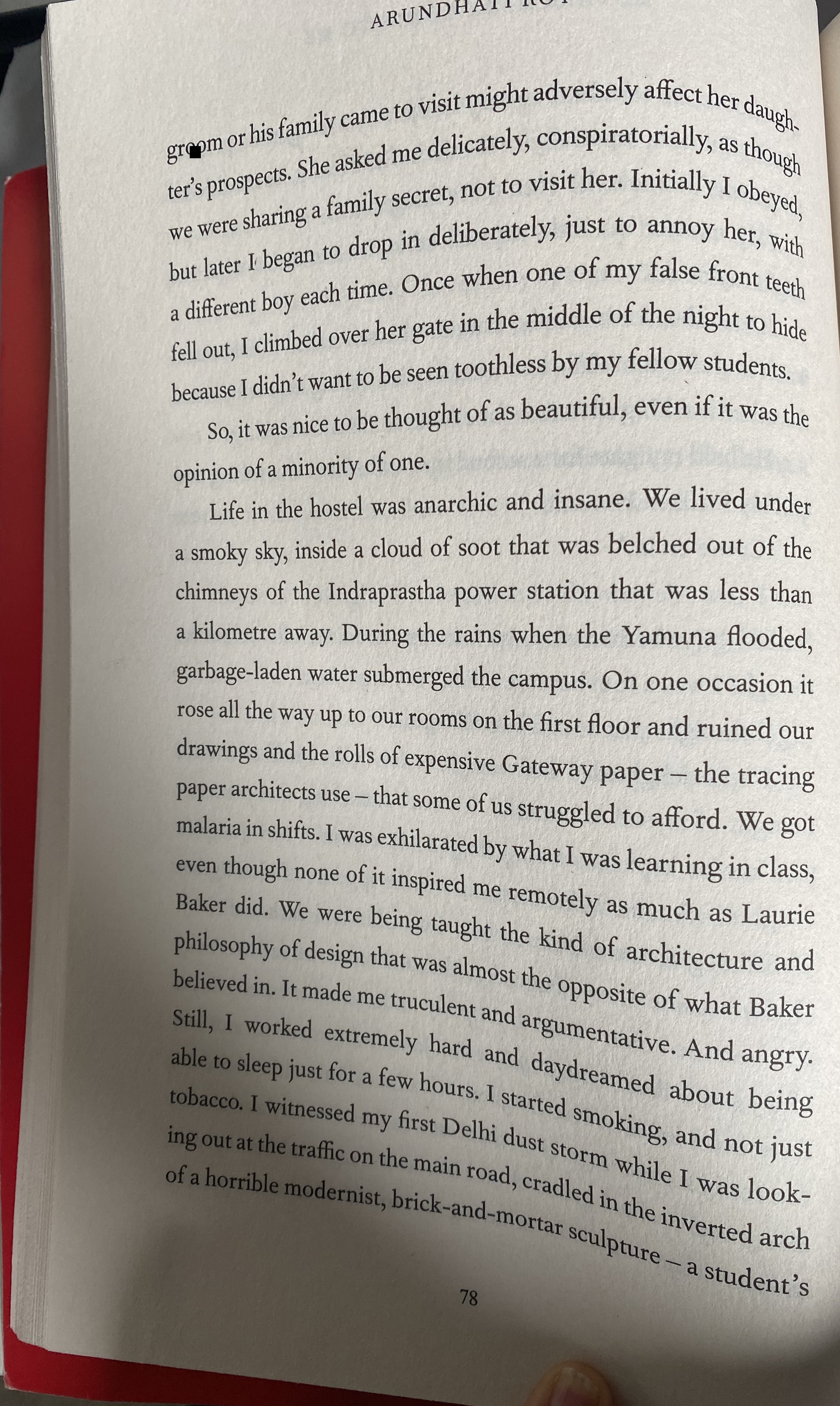
So, it was nice to be thought of as beautiful, even if it was the opinion of a minority of one.

The rest of the page evokes grungy student life at the School of Planning and Architecture in new Delhi.

Laurie Baker (Wikipedia page here) is named as standing for the opposite of what was taught at the school. He was a pioneer of sustainable, organic architecture who designed Mrs Roy’s Pallikoodam school. He had inspired Arundhati to veer away from her earliest ambition, to be a writer, and leave home to study architecture. Though Arundhati did go on to be a writer, it was at the School of Planning and Architecture that some of her most important, enduring relationships were formed. As much as anything else the book celebrates these friendships.


After the meeting: Everyone loved this book and we loved discussing it. Someone threw a small grenade, saying that she didn’t see that Mrs Roy was such a terrible parent, that really Arundhati Roy had unfairly demonised her. The catalogue of physical and emotional violence, the fact that Arundhati’s brother shared her view, the way independent witnesses described Mrs Roy as ‘your mad mother’ and laughed at the terror on Arundhati’s face when she had to deal with her: none of this made a dent in her view. We could agree that Arundhati didn’t stay victim – she saw her mother as a model of being powerful in the world, and eventually came to recognise that in her way she loved her, and had given her the wherewithal to build a big life for herself, even if that meant rebelling against her.

We all learned things. For some it was about Indian politics, in particular about Karachi. For all of us, the impact of winning the Booker Prize was a revelation. We all had our ignorance about the Syrian Christians of India slightly decreased (the Roys are Syrian Christians – in Modi’s India, not Indian enough).

We read and discussed the book along with Kiran Desai’s The Loneleiness of Sonia and Sunny. Both books feature complex mother-daughter relationships, both have rich insights into the cultural and political relationships between India and the West, a number of historical events feature in both. But no one was much interested in a compare-and-contrast discussions.


Because it’s November*, I will now burst into rhyme:

November verse 4: Student days
Are student days always anarchic,
smoke-filled, garbage-racked, insane,
angry at the hierarchic
lectures that would tame the brain
with wisdom that's received as certain?
Always the time that lifts the burden
from the backs of those who bear
the yoke of old beliefs? Time where
new songs are sung and new words spoken,
daughters, sons beyond command
(don’t even try to understand),
first loves formed and hearts first broken,
new ways found with fork and knife,
friendships made that last for life?

The group met on the land of Gadigal of the Eora Nation, and I have written this blog post on the land of Gadigal and Wangal. I acknowledge Elders past and present of all those clans, and welcome any First Nations readers.


My blogging practice is to focus on the page that coincides with my age, currently 78, and in November I write fourteen 14-line stanzas in the month. which means incorporating one into most blog posts.
November verse 3: Breakfast

It’s already the 8th of November and I’ve only got two stanzas written. Here’s a third, knocked together for the deadline but coming from the heart:

November verse 3: Breakfast

It's the same thing every morning –
juice from carrot, granny smith,
ginger, celery stalk, not scorning
beetroot for the colour, with
toast and jam and peanut butter.
That's for me. Because you'd rather
Vegemite, that's what you'll get.
No scrambled eggs or crepe suzette
except on Sundays. Bubbling, dinging,
whirring fill the room with noise
and making breakfast is a joy.
I'm spreading, pouring, scrubbing, singing.
Then we sit, first you, then me.
The day starts. What will be will be.

November verse 2: Overheard

So much happening just now, but I’ve managed to make time for my second November stanza. I don’t have an over-arching theme or strategy this year, so who knows what I’ll end up with.

I’m doing a poetry course currently where we have been invited to eavesdrop shamelessly in cafes, on buses, wherever. Dutifully I put in my hearing aids and tried unsuccessfully to hear a number of conversations, and then hit gold with a young man telling this story to an older man, possibly a co-worker in his new place of employment. To give the speaker his due, he did lower his voice a little for his story’s key word. My asterisks aim to be a visual equivalent.

November verse 2: Overheard

The night’s already far too busy –
too much work, I’m there till two.
A manager gets in a tizzy:
‘Chairs need moving, now, by you.’
That’s two of us and forty heavy
chairs up stairs, looks like I’ll never
make it home, I’m in despair
and jokingly – she’s sitting there –
I say, ‘You fat c**t, move a muscle.’
Just a joke. Amused, she ain’t.
She makes a serious complaint.
Snowflake, woke shit razzle dazzle,
just a dreadful passing row.  
A good man, me. It's over now.

Mrs Dalloway, report 1, and November verse 1

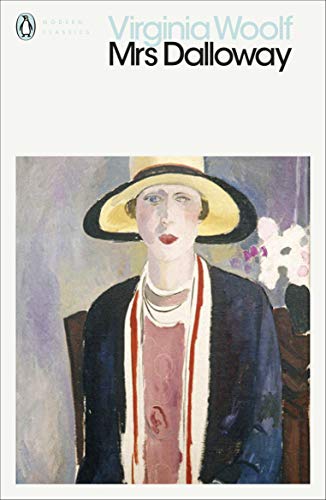
Virginia Woolf, Mrs Dalloway (1925, Penguin Classics 2020)

Since taking nearly two years to read Proust’s À la recherche du temps perdu six years ago, I’ve had a classic slow-read on the go most of the time. When I’ve embarked on one of these slow-reads I regularly come across mentions of the book elsewhere. It’s like that with my current project, Mrs Dalloway.

This month, a friend sent me a link to Zora Simic’s article in The Conversation, Trauma memoirs can help us understand the unthinkable. They can also be art. Here’s an excerpt:

Of all Woolf’s novels, Mrs Dalloway is the one most often read as semi-autobiographical and as a reckoning with unresolved trauma: of England’s in the wake of the first world war, and in the novelist’s own life. <big snip> Woolf has long been a lodestar for writers grappling with trauma – in their lives, and on the page, especially women writers.

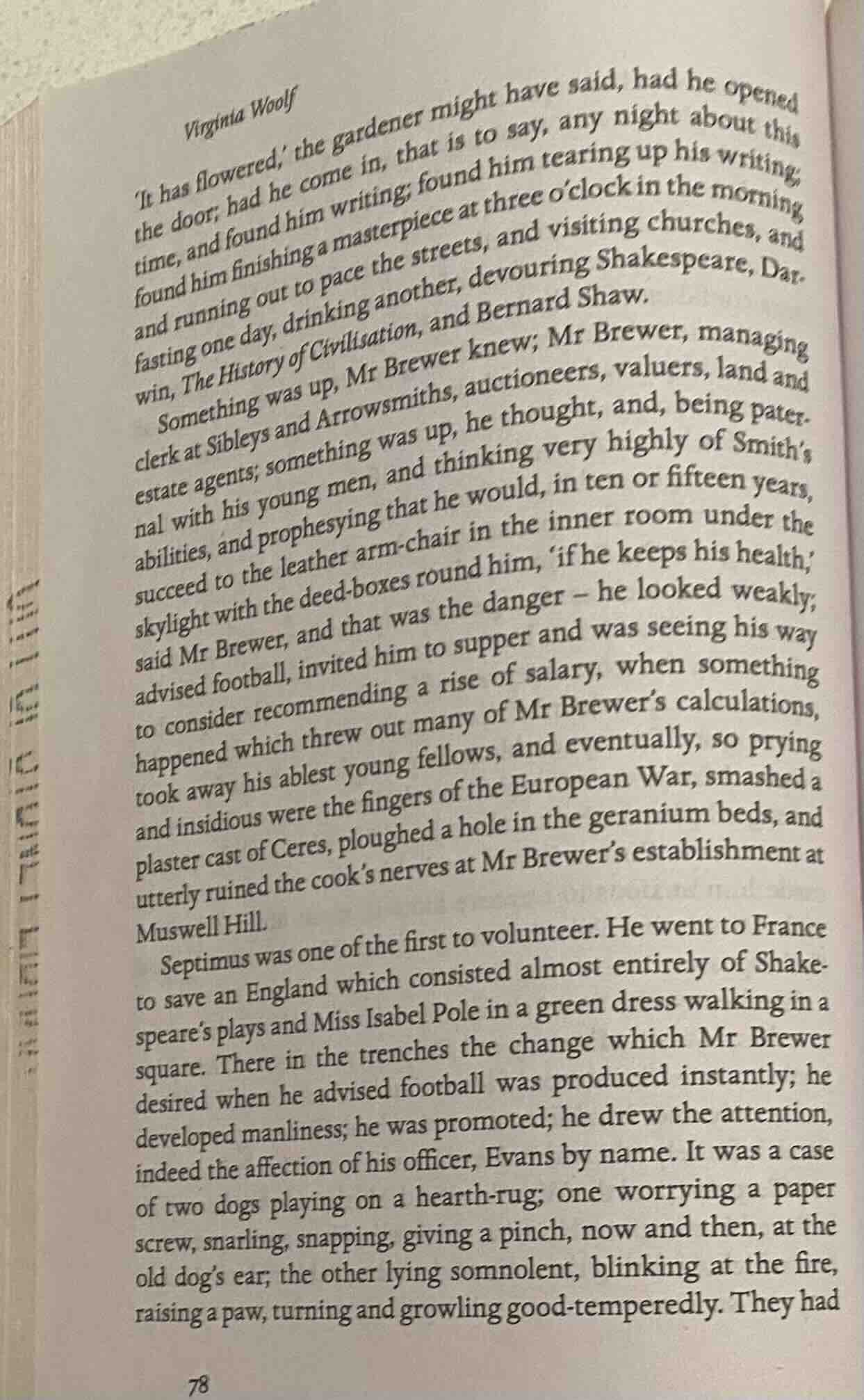
Reading the first couple of pages, when upper-class Clarissa Dalloway is out in the early morning shopping for flowers and enjoying the life of the London streets, I couldn’t see much trauma. But then the scene broadens and darkens. By page 103, I’m now reading the book as mainly about aftermaths: Clarissa is recovering from an illness and enduring an unhappy marriage; the War and pandemic are still alive in collective memory; Peter Walsh, freshly returned from a decade in India, is still wounded by having been rejected by Clarissa many years earlier; returned soldier Septimus Smith is wandering London’s streets, hallucinating, suicidal, ‘shell-shocked’ and putting his Italian wife Lucrezia through hell. There’s plenty of trauma to go round.

I’m glad I’m reading this book just a few pages a day. It cries out for sharply focused reading, which I can just about sustain for three pages at a time. Read this way, the book is exhilarating. I had thought it was going to be the stream of consciousness of one upper-class Englishwoman. In fact there’s a whole array of characters, and the narrative voice flits among them. I say ‘flits’ because feels as if the narrator is an elf-like creature (I almost see her as Tinkerbell) who slips in and out of people’s minds, sometimes staying for barely a second, sometimes for several pages. Most of the characters are aristocrats of one sort or another, but not all. Lady Bruton’s maid Milly Brush has definite likes and dislikes as she stands impassively while her mistress entertains three gentlemen for lunch. One of those gentlemen is a bluff middle-class man with pretensions – he knows how to craft a publishable letter to The Times but believes women shouldn’t read Shakespeare for moral reasons. And Richard – Mr Dalloway – makes an appearance, buying flowers for Clarissa and resolving to tell her he loves her (which the reader knows is far too little, far too late). And so on. It’s much more complex, and funnier, than I expected.

Here’s page 78*:

And because it’s November**, here’s a verse drawn from it and the next page:

November Verse 1: Septimus Smith
He might have made a great accountant
but for Shakespeare, Keats and love
that set him scribbling with his fountain
pen all night. 'You need to tough-
en up, play football,' said his mentor.
War changed everything. He went to
fight in France and made a friend,
a cheerful manly friend, whose end
in Italy was sudden, brutal.
Mrs Woolf says War had taught
him not to feel, to set at nought
such loss. Sublime the total
calm he felt. But, come next year,
the sudden thunderclaps of fear.

I have written this blog post near what was once luxuriant wetland, in Gadigal and Wangal country, where I recently saw two rosellas (mulbirrang in Wiradjuri, I don’t know the Gadigal or Wangal name). I acknowledge Elders past and present of those clans, and welcome any First Nations readers.


My blogging practice is to focus on the page that coincides with my age, currently 78.
** Each November I aim to post 14 fourteen line stanzas on this blog (see here for an explanation, though that explanation incorrectly calls my verses sonnets)

Limbering up for November

As regular readers know, in November I set out to write fourteen 14-line poems. With November just over the horizon, I’ve been feeling the need to get in shape. So when, as I was heading for a seat at the back of a bus today, another passenger’s unexpected gesture handed me a chance to limber up a little. Here’s the result for your consideration:

To the man who gave me the finger on the 423

Is it my whiteness that offends you?
Class, entitlement, grey hair?
Not my t-shirt, glasses, sandshoe!
Why this cold, unyielding glare?
Do I remind you of some vicious
thief who stole your cold, delicious
breakfast plums? Or is it just
that one day we will both be dust?
Oh, was your gesture then fraternal:
This central thing is true, I’m sorry,
sit on this, memento mori.
Life is good but not eternal.
My blank gaze and hairless head
remind you: don’t forget the dead.

Montaigne progress report 9

Michel de Montaigne, The Complete Essays (Penguin Classics 1991, translated by M. A. Screech)
– part way through Book 3, essay 5, ‘On Some lines from Virgil’ to part way through Book 3, essay 10, ‘On restraining your will’

This post was due more than a week ago, but life in general made other plans for me. With a couple of lapses, though, I have consistently read four or five pages of Montaigne’s Essays each morning.

I won’t even try to summarise what I’ve read in the last six weeks. I’ll just mention that ‘On some lines from Virgil’ continued to be fascinating on the subject of sex and gender; in a piece with the innocuous title ‘On coaches’ Montaigne denounces the atrocities of the Spanish colonisation of Central and South America; in ‘On the disadvantages of high rank’ he pities those whose social position means no one will disagree with them, because they are deprived of the joys of conversation.

And then there’s ‘On vanity’, a long essay that made me fear age-related cognitive decline was catching up with me. As with many of the essays, ‘On some lines from Virgil’ being a prime example, this one’s title gives you no idea of its true subject. But in this case, I couldn’t tell if it even had a main subject. He writes about travel, about death (a lot about death), about how much he loves Rome. He explains why he’s glad he has no sons. He quotes at length from the document granting him Roman citizenship. He’s like a dog snapping – in slow motion – at whatever fly of an idea crosses his mental line of vision. But in the middle of it all, he has one of the passages that remind you that he is inventing the form of the personal essay – and k ows exactly what he’s doing:

There are works of Plutarch in which he forgets his theme, or in which the subject is treated only incidentally, since they are entirely padded out with extraneous matter … My God! what beauty there is in such flights of fancy and in such variation, especially when they appear fortuitous and casual. It is the undiligent reader who loses my subject, not I. In a corner somewhere you can always find a word or two on my topic, adequate despite being squeezed in tight. I change subject violently and chaotically. My pen and my mind both go a-roaming. If you do not want more dullness you must accept a touch of madness.

‘It is the undiligent reader who loses my subject, not I.’ I’ve been put in my place.

He defends his lack of coherence by applying to himself Plato’s description of a poet as someone who:

pours out in rapture, like the gargoyle of a fountain, all that comes to his lips, without weighing it or chewing it; from him there escape things of diverse hue, contrasting substance and jolting motion.

I don’t know that anyone seriously thinks that’s what poets do, but the idea that a reader needs to be ‘diligent’ to do justice to some writing has still got a lot of life in it, probably even more than it did in Montaigne’s day. He goes on to say he doesn’t stitch things together ‘for the benefit of weak and inattentive ears’:

Where is the author who would rather not be read at all than to be dozed through or dashed through? … If taking up books were to mean taking them in; if glancing at them were to mean seeing into them; and skipping through them to mean grasping them: then I would be wrong to make myself out to be quite so totally ignorant as I am. Since I cannot hold my reader’s attention by my weight, manco male [it is no bad thing] if I manage to do so by my muddle.

So, just as he’s getting tetchy with us for being lazy, he acknowledges that he’s a pretty lazy reader himself. And having claimed that his apparent incoherence is actually poetic brilliance, he now calls it a muddle.

Oh, and in the middle of all that charming back-and-forth between grumpiness and self-deprecation, there’s this lovely, enigmatic line:

Poetry is the original language of the gods.

I’m not sorry I gave up French Honours in 1968 because I found Montaigne almost as unreadable as Rabelais. I’m enjoying reading him now, in translation, much more than I possibly could have in the original when I was 22.


This blog post was written on Gadigal-Wangal land, where the days are getting hotter and more humid. I acknowledge the Elders past, present and emerging of Gadigal and Wangal of the Eora Nation.

November verse 14, 2024

I trawled through today’s text messages looking for a string of nine syllables that would work as the first line of an Onegin stanza.

I found my string in a Tai Chi group chat on WhatsApp. The full sentence is, ‘This exercise is very useful for people with constipation and bloating.’ For my purposes, the first five words of that sentence took on a life of their own..

Verse 14. This exercise is very useful
This exercise is very useful –
wrestling English into rhyme.
It keeps my mind, if not quite youthful,
not washed up before its time.
This versing is a lot like fishing:
drop a line and sit there wishing
for a bite, a rhyme, a thought,
an image begging to be caught,
and when one comes, when you can feel it,
play the line, go where it goes
(but take a walk, ’cos heaven knows
it leads somewhere but won’t reveal it
easily). Each time I find
some shiny moment from my mind.

And that’s my 14 stanzas for this November!

November verse 13, 2024

We’ve come late to The Bear on TV. I think we turned it on for a moment a couple of years ago, saw a lot of people shouting at each other and decided to give it a miss. But now we’ve just finished watching season 2 and are hooked.

Among its many joys is Jamie Lee Curtis as Donna, the main character’s off-the-rails mother. In the final episode of season 2, she has been invited to the ‘family and friends night’ of the new restaurant. Nerves are already stretched, and the prospect of Donna arriving drunk and ultra-disorderly adds an extra layer of dread.

I’m not giving anything away when I say that this extremely volatile character gave me the first line of today’s verse. I’ve wrenched the line from Donna’s context and let it play out in mine.

Verse 13: I don’t know how to say I’m sorry

I don’t know how to say I’m sorry.
The words come easy, and too much.
I'm sorry if I made you worry
when you kicked away my crutch
and sent me sprawling.1 In the water
I said sorry to the copper –
sorry that my wet arrest
made extra work.2 You may have guessed
nuns taught me acts of pure contrition 3
back when I was barely six
and what goes in at that age sticks.
To not say sorry meant perdition.
I often play the sorry card,
but say it from the heart? That’s hard.

1 An imaginary scenario.
2 A true story, see earlier blog post.
3 See here.

November verse 12, 2024

As I mentioned in my previous post, I spent the weekend at the Rising Tide People’s Blockade of the Newcastle coal port.

Then, I ducked the daunting task of writing a stanza beginning with ‘Water lapping on their doorsteps’, a line taken from Senator Mehreen Faruqi’s description of the drastic situation of Pacific Island nations. But the challenge refused to lie down and die, so here goes. It might be worth reminding you that Imhotep was a kind of deity of ancient Egypt who may have been believed to help control the flooding of the Nile; and that the Golden Soul is a ship that left Newcastle on the weekend bound for Japan with a load of coal. You probably don’t know that Mary McKillop, now a canonised saint, once placed a statue of Saint Joseph on the doorstep of her nuns’ residence, and floodwaters stopped just short of the statue.

Verse 12: Water lapping on their doorsteps

Water lapping on their doorsteps,
not a miracle in sight.
No hope will come from Nile's Imhotep,
none from praying day and night
to effigies of saints and fairies,
Hare Krishnas or Hail Marys,
even chanting 'No more coal'.
Great ships like the Golden Soul
still sail, indifferent as weather.
Science says we know what to do,
but who's in charge? Yes, you know who!
Still, let's paddle hell for leather,
do wise things and crazy stunts,
everything, everywhere all at once.

With any luck I’ll be back to domesticity tomorrow. Maybe something about our new EV?

November verse 11, 2024

I spent the weekend at the Rising Tide People’s Blockade of the coal port at Newcastle.

There were more than 5000 registered participants at the ‘protestival’ on shore, a beautifully organised event with a brilliantly diverse population, many of them in tents. Hundreds of small craft, mostly kayaks, paddled out onto the water and in spite of an impressive police presence – water police from Sydney, and squads of riot police in black, many wearing masks – at least one coal ship was turned back. There were about 170 arrests on the water, of which I was number 64. (According to the police, they had to pull 34 people out of the water: I was one, and I was in the water because of police action. Police had to help ten people to shore who were unable to get there unaided: what police don’t mention is that they had confiscated those people’s paddles.)

I kept my ears peeled for an opening line for a November stanza – that is to say, an iambic tetrameter ending in an unaccented syllable. At first I thought I had to take Senator Mehreen Faruqi’s description of the drastic situation of Pacific Island nations: ‘Water lapping on their doorsteps.’ I was searching around for rhymes for doorstep, and was thinking ‘Imhotep’ had possibilities, when I was returning from my post-arrest processing and a possibly drunk man in a bus stop muttered at me, ‘I hope you drown if you’re protesting.’ Delighted by this gift of a line I thanked him, completely without irony. The poem got completely out of hand right from the start.

Verse 11: I hope you drown if you're protesting

I hope you drown if you're protesting,
hope your voice dies in your throat,
I hope and pray that the arresting
coppers drop you off the boat.
May your chant of people power
getting stronger by the hour
echo down the halls of shame.
It's not your skin that's in the game.
Some of us have made a living
digging, carting, shipping coal.
A living? More! It shaped our souls.
Thatcher gave what you'd be giving.
You say you won't let ships pass.
I say shove that up your arse.

I do feel obliged to mention that everywhere in the Climate movement, people talk about the importance of a just transition to renewables. There’s a lot of disinformation around, but this man’s quiet bitterness was clearly heartfelt, came from a real place