Bête/beast du/of the marais/Camargue

Xavier-Marie Bonnot, The Beast of the Camargue (translation Ian Monk, Maclehose Press 2009)

Maybe I’m turning into a horrible person, because here’s yet another book I’ve laid aside, this time just before page 100. It was a big hit in France, so it might be that I’ve lost all sense of what makes a good read. But it’s a murder mystery, and very little had happened by the time I parted company from it – the body of an extremely rich man who has been missing for a fortnight or so has finally been found in a swamp, so it feels as if the story might be about to start. An unnamed man who is probably a psychopathic serial killer has made a couple of lacklustre appearances. There’s a cop with enough idiosyncrasies to make him interesting, a romance that will probably stay unconsummated, and a beautiful, rich widow with something she’s not telling. There are English-speaking tourists, wandering with their cameras through places where evil lurks. Oh, and there are hints that the evil might be in some way occult. In other words, it’s familiar territory, and there evidently wasn’t enough in it to engage this reader.

Two things kept me reading even this long: the setting and the translation. The action takes place in parts of France I visited last year (as one of those gormless tourists), and I was hoping there would be pleasure in revisiting them – but the sense of place, it turns out, isn’t very strong. I was fascinated by the translation. When Gregory Rabassa was working on his translation of A Hundred Years of Solitude, an interviewer asked him if he knew enough Spanish for the task. He answered, ‘The question isn’t whether I know enough Spanish, the question is do I know enough English.’ I have no doubt that Ian Monk’s French was well up to the challenge of translating this book, much much better than mine I expect, but his English is disconcertingly uncomfortable in its own skin. A quick google just now turned up this sentence from the original:

‘Sortez du problème, les gars. Allez fourrer votre nez là où personne n’irait jamais le fourrer.’

As luck would have it, I knew where to find the English version (on page 83):

‘Move outside the problem, lads. Go and stick your nose where no one else would stick it.’

The French, advice that a wise old cop once gave our hero, looks to be casual speech, but the English is oddly stilted. Sortir is ordinary language for leaving or going out (of something), but who says, Move outside (something)? And how could anyone else stick the lads’ nose anywhere? How about:

Step outside of the problem, lads. Stick your nose in places where no one else would think of sticking theirs.

That’s just nit-picking, of course. My eye glided over that sentence when I read it in context. I noticed its awkwardness now because it’s the only sentence from the book I’ve seen the French for, so it’s the one I was stuck with to consider here. But the cumulative effect of such small misfires is both fascinating (as in, I’d love to study this closely because it shows a lot about language) and unpleasant (as in, I keep being jolted ever so slightly out of the world of the story).

Actually, I think Ian Monk is probably a very good translator. I spent maybe ten minutes playing around with that one sentence. He had to earn a living. Translators aren’t exactly paid at merchant banker rates, and you do what you can in the time you’ve got.

Anyhow, Commandant Michel de Palma may be the French reading public’s equivalent of John Rebus, but he couldn’t keep me reading past page 98.

NSWPLA shortlist

Last Tuesday the Children’s Book Council of Australia announced the short list for their Books of the Year Awards. I’ve only read one of the titles (Ursula Dubosarsky and Andrew Joyner’s lovely The Terrible Plop), but I applauded a couple of inclusions in their Notables Books list that didn’t get shortlisted (mainly Cassandra Golds’s The Museum of Mary Child and the latest of Jackie French and Peter Sheehan’s Australian history titles, Weevils, War and Wallabies: 1920–1945).

Today I turned up at the Mint in Macquarie Street for the announcement of the short list for the NSW Premier’s Literary Awards, hoping I’d have read more of the books and be able to applaud more of the nominees. I was also looking forward to clapping eyes on our newish premier in person. I did see the premier, but it turns out I haven’t read many of the books. It was a pleasant event all the same.

The short lists are already up on the PLA website, and the announcement was being tweeted by my friend misrule and the person next to her (who is paid to tweet), so I’m not exactly breaking news here.

Kristina Keneally was taller than I expected, and not so different in person from her on-screen appearance: poised, slightly awkward, with a sweet smile and a lively manner. She announced the short list with a PowerPoint  presentation, which I’ve just realised is a way of making a personal appearance approximate to television. There was none of Frank Sartor’s teasing of authors for being too shy to put their hands up – that may have been embarrassing, even painful, but it was personal. None of Nathan Rees fanboy enthusiasm about ‘talking to David [Malouf]’ or phoning Christos Tsiolkas. No devil-may-care quoting from Stalin, in the Carr tradition. CK made jokes (‘bribing the judges is not allowed’) and personal comments  about not being the most literate person in the Keneally family (her uncle by marriage is Tom Keneally), but it was all from the script. It was a good script, mind you, and included an honorable mention of Patricia Wrightson. The one moment of clear humanity was when Kristina stumbled over Justine Larbalestier’s surname, and apologised to Justine (who I believe is in New York just now). We all sat in the Mint theatrette and applauded quietly at the end – the shortlisted authors didn’t get to stand and be recognised, there was no partisan applause for individuals.

The food was good, and the mood was light and friendly.

The short list itself?

I haven’t read any of the books on the Patricia Wrightson (for children’s literature), Ethel Turner (for young people’s literature), Douglas Stewart (for non-fiction), Glenda Adams (for new writing), Kenneth Slessor (for poetry) or Literary Scholarship (no famous name yet attached) prizes, though there are books on all those lists I’d love to read, and some are already on my shelves waiting for their time to come.

The Script Writing Award list is stunning. I’ve seen four of the six. Misrule took a break from tweeting to tell me Tangle is on Foxtel and that I’d hate it. I missed Fairweather Man, but it sounds great. I haven’t blogged about East West 101, but I love it. I’ve added links to my offhand blogged remarks on the others:

Jane Campion, Bright Star
Kristen Dunphy and Michael Miller, East West 101: Episode 13
Adam Elliot, Mary and Max
Fiona Seres, Tangle: Episode 1, Yellow Amendments
Aviva Ziegler and Veronica Fury, Fairweather Man
Warwick Thornton, Samson and Delilah (also here)

Of the two works listed for the Community Relations Commission Award, I’ve read and loved the first, and look longingly at the second:

Dr Abbas El Zein – Leave to Remain: A Memoir
Dr Tim Soutphommasane – Reclaiming Patriotism: Nation-Building for Australian Progressives

I’d done OK on the Christina Stead Prize too, with three books read, two on the to-be-read list and strong opinions on all five:

J.M. Coetzee, Summertime
Richard Flanagan, Wanting
Cate Kennedy, The World Beneath
Steven Lang, 88 Lines about 44 Women
David Malouf, Ransom
Craig Silvey, Jasper Jones

Now I’m wondering if I can manage to read Cate Kennedy’s, David Malouf’s and Steven Lang’s books in time to cast a vote in the People’s Choice Award.

Adamson’s best of 2009

Robert Adamson, The Best Australian Poems 2009 (Black Inc 2009)

This is an excellent anthology. In fact, in the context of previous years’ round-ups, both from Black Inc and UQP, it’s a strong contender for Best of the Best. It includes a wonderful range of poetic styles and modes and subjects – incomprehensible post-modern stuff, impassioned story-telling, linguistic virtuosity, delicate lyric. There’s Clive James‘s assured iambic pentameter, Pam Brown‘s asthmatically short lines, Ali Cobby Eckermann‘s lines you might need to know didgeridoo breathing to recite adequately. In the introduction, Robert Adamson talks about his solution to the difficulty of reducing his short list to fit the space available – he persuaded Black Inc to give him more space. I’m glad he did, and that he kept commentary, analysis and explanation to a bare minimum. He does offer this gem of commentary:

People ask me, why are so many bird poems being written and published? I have a theory: we miss having poets among us who can imagine that a soul can ‘clap its hands and sing, and louder sing’, that we need to acknowledge visitations by intense psychological presences, and that birds are the closes things we have, more or less, to angels.

Perhaps that’s mainly a clue as to how to read his own poems, but it’s an interesting general thought as well.

I’m not going to try to name the poems I liked best.  My copy has far too many page-corners turned down for that.

As I was reading this anthology, my Art-Student Companion, as part of her preparation for an assignment on Australian Federation, was reading The Sentimental Nation by John Hirst, and kept regaling me with interesting bits about the major role poetry played – poetry, he says, is ‘the best guide to the ideas and ideals that inspired the movement’ for Federation, and again: ‘The nation was born in a festival of poetry.’ Well, even though poetry festivals rarely make the news pages these days, to judge by this book poems are still looking for words for what inspires and ails us as a nation and a species. But now, instead of writing bush ballads or ponderous and forgettable sonnets, they tell about Iraq, global warming, the ills of capitalism, but they tell it slant. There are any number of examples, but I’ll just mention Luke Davies’ ‘Maldon, 991 AD’ which ends:

oooooooooooo I felt an outsider
to laughter. Out there the Vikings sang,
that was more like it, something eerie
to get spooked about, distracted by:
and the world so tenderly
unveiling its final unveiling.

I was also struck by the sense of community among the poets, particularly as shown in the number of poems honouring those who have died: Dorothy Porter (‘Word‘ by Martin Harrison), but also John Forbes (‘Letter to John Forbes‘ by Laurie Duggan, Jan McKemmish (Pam Brown’s ‘Blue Glow‘), Francis Webb (‘Reading Francis Webb‘, by Philip Salom [the link is to a PDF]) and Bruce Beaver (a couple of mentions, but mainly Peter Rose’s beautiful imitation, ‘Morbid Transfers‘).

Buying this book in March felt a little bit silly, like buying hot cross buns in July, but it turns out it’s not a seasonal thing at all. It’s an anthology that I’m sure I’ll go back to.

Footnote: One of my wise younger relatives recently chided me for reading while walking: ‘It’s as bad as walking around with those things in your ears, Jonathan,’ she said (by which you can she’s not so very young). ‘You have to let the world in.’ She may be right in general. But sometimes reading while walking is a way of letting in both world and poetry. The other morning I was throwing the ball for Nessie at the bottom of the hill and noticed that the longish grass was pearled with dew so that previous walkers both human and canine had left tracks of darker green, and the rosellas wouldn’t shut about something. I realised it must have rained quietly in the night. The next words I read were these, from Sarah Day’s ‘A Dry Winter: Some Observations About Rain‘:

… an elemental transition from dry to damp.
Listen, you can hardly hear its outward breath

on the tin roof. In the morning,
grass and earth are wet and everything

but the mercuric globe in the nasturtium leaf
is translucent.

I don’t know anything about nasturtiums, but the rest could have been a condensation from my surroundings. (The whole poem is lovely, by the way.)

Added later: Tara Mokhtari on the Overland blog has a completely different view. She does identify herself as a ‘shunned poet’.

Fun with the Crowds

We went this morning to what we’re told these days is even more popular with Australians than the beach or the footie – the art gallery. Specifically, we went to the Art Gallery of New South Wales for the equivalent of a Grand Final, The Archibald Prize. We bought our concession tickets (I’m a senior, my companion a student) and joined the milling crowd. I liked the winning portrait of Tim Minchin (Penny didn’t). I lay on the floor to get a proper look at the distorted figure in The Alternative Ambassadors (which really ought to have been hung at the top of a staircase, or at least had a comfortable cloth on the floor beside it): ‘It’s a baby,’ I said to those who were too restrained to emulate me, ‘or perhaps a foetus.’ ‘A foetus, definitely,’ said a young woman who was flexible enough to have had a proper look without actually lying down.

In the People’s Choice I voted for Apple Yin’s ‘Previous Life‘, a portrait of a Melbourne personality as a beggar on the Silk Road in a past life. I wondered how Robert Hannaford’s magisterial portrait of Malcolm Fraser would have turned out if give a past life treatment? A Renaissance cardinal, perhaps, or a noble prisoner in the Tower of London?

There were lots of lovely things in the Wynne, including some austere Aboriginal works. I liked the winner, and was glad that among all those huge canvases it was the three smallest works that won the Archibald, the Wynne and the watercolour prizes. The Sulman mostly left me bemused, as it often does. If a work of art is supposed to be something you can look at for a long time and over a long period and still find fresh (and I know that’s a big ‘if’), how come a one-note joke won the Sulman? (You understand I speak as one who knows very little about art, and would generally recommend you listen to the brilliant Imants Tillers, this year’s Sulman judge, rather than me, on such matters, but I really don’t get it.)

We walked the length of the city, chatting happily, arguing with John McDonald in his absence, to Haymarket where we had a most satisfactory yum cha in the vast Marigold, apparently in the company of everyone who wasn’t actually at an art gallery.

Easter, the festival of the changing season, and this year also of putting the clocks back, draws to a close. I hope you’ve had a good one too.

Patricia Wrightson and Chinese poetry

This blog post is the love child of two recent ones.

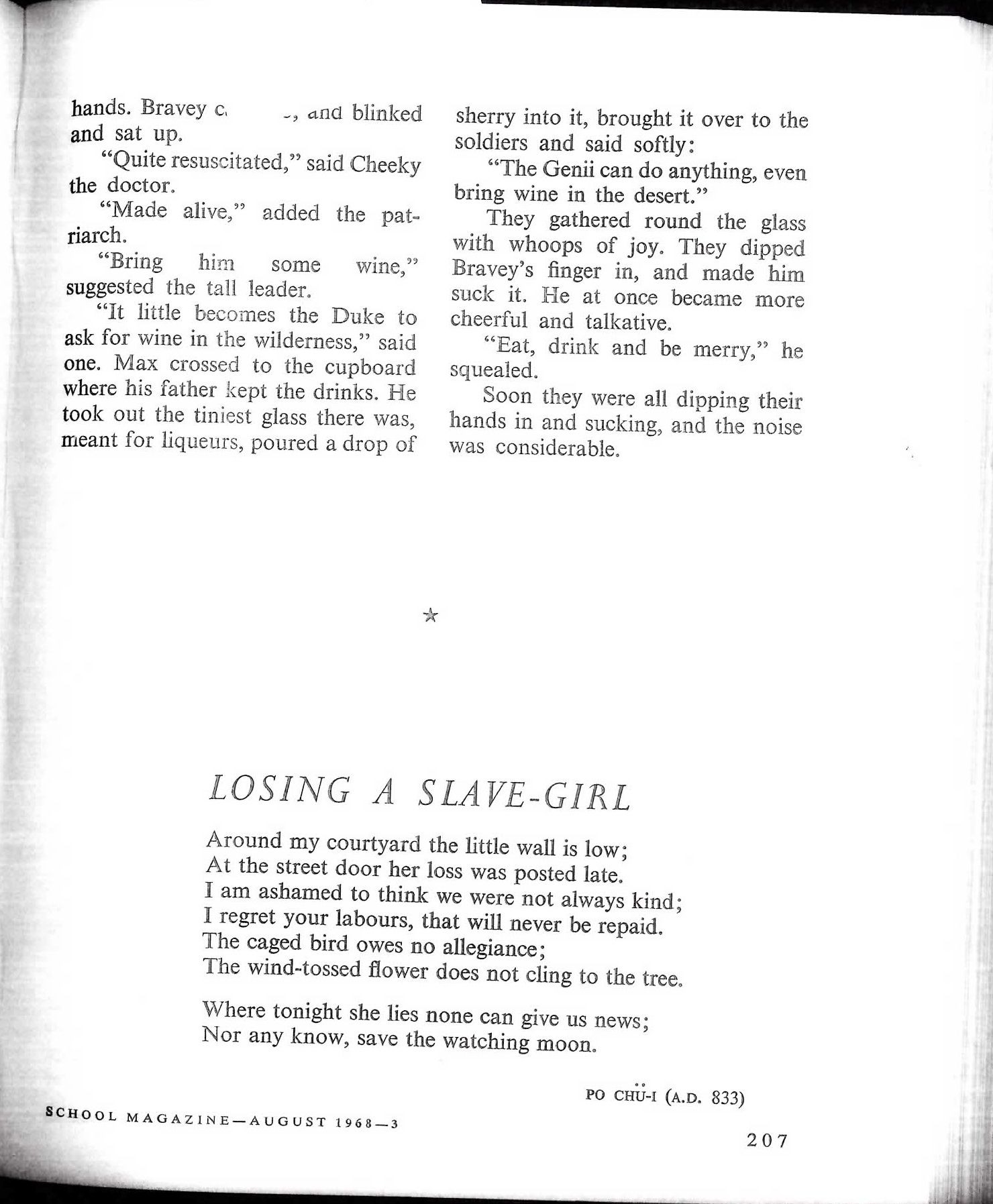
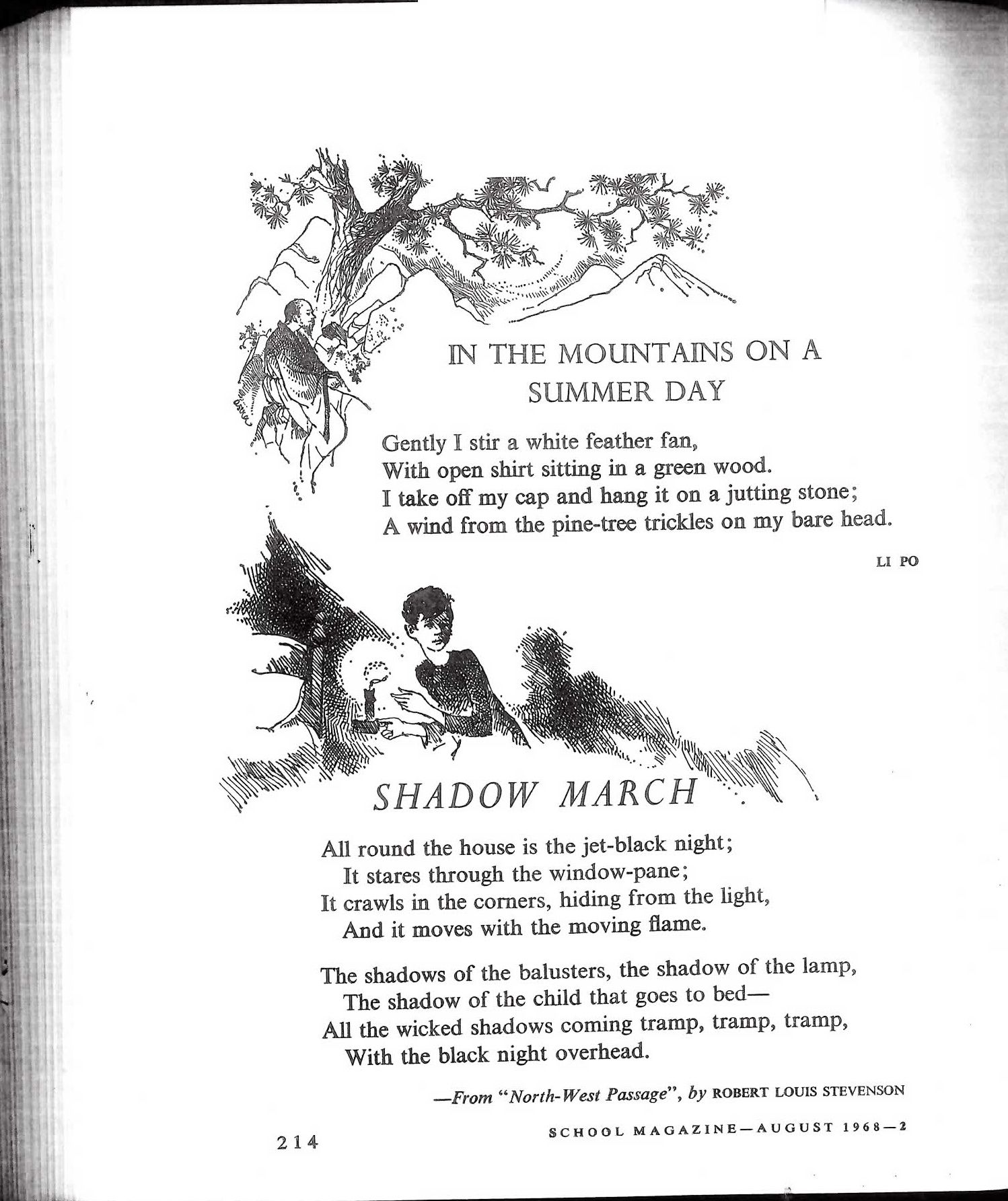
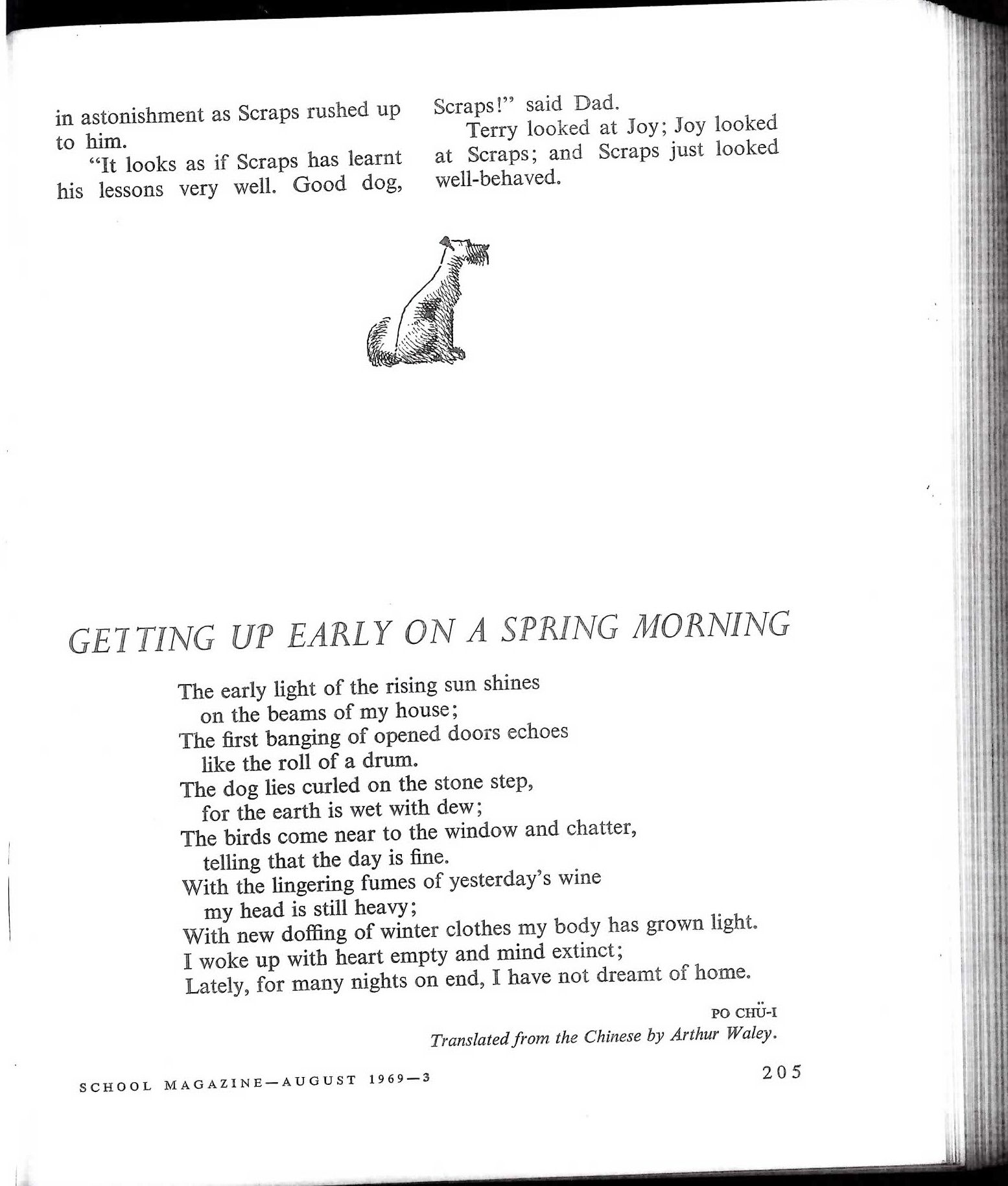
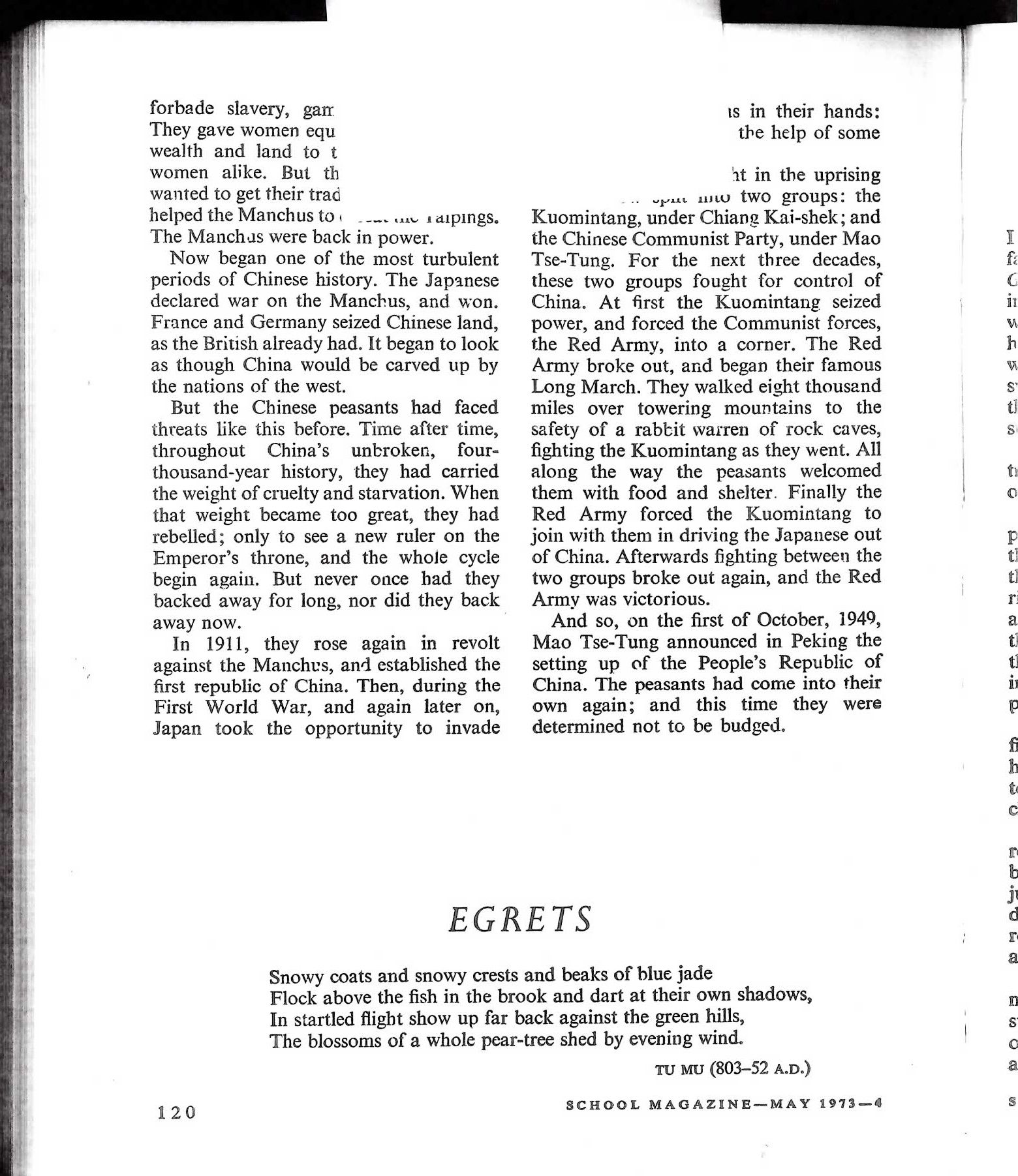
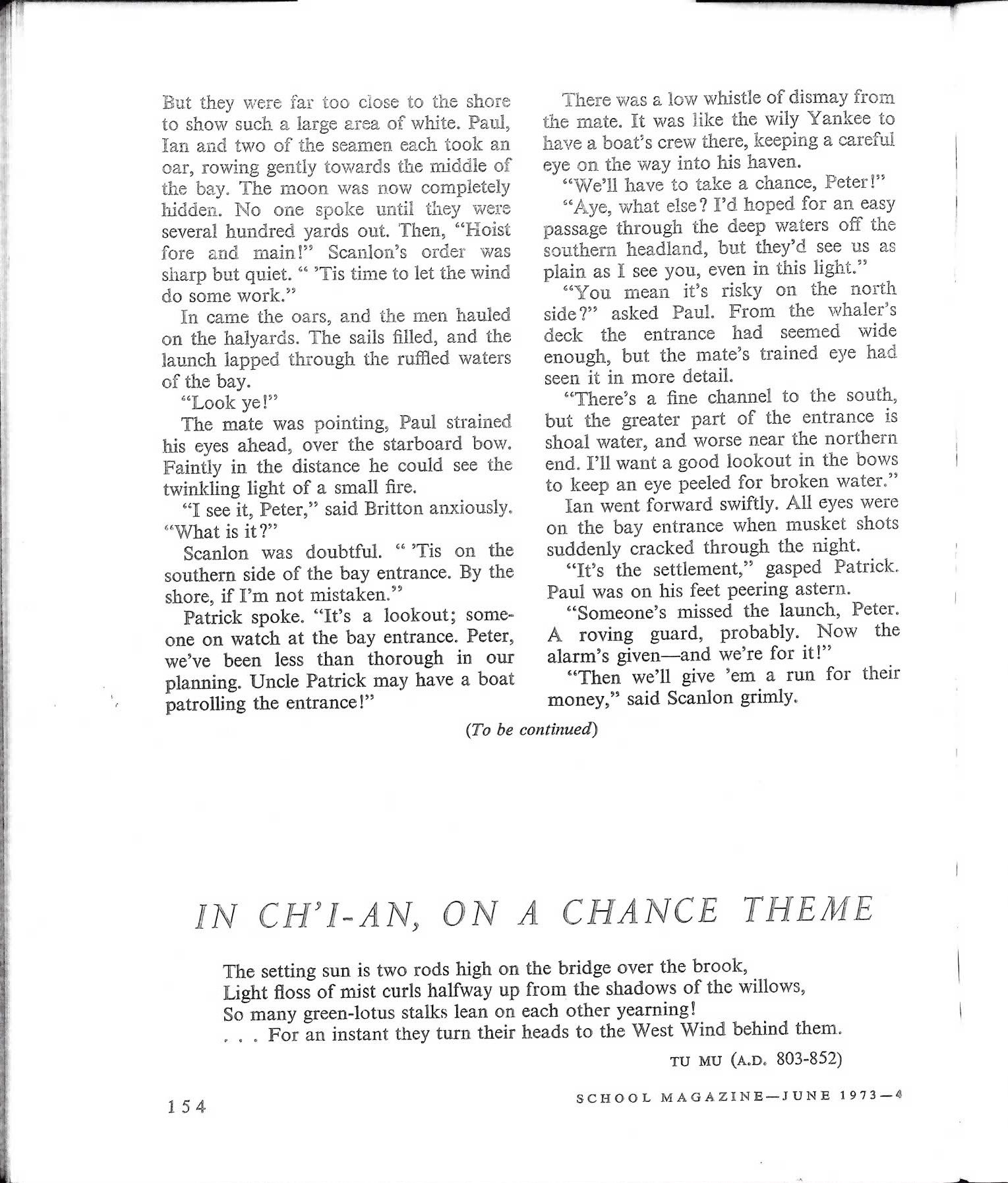
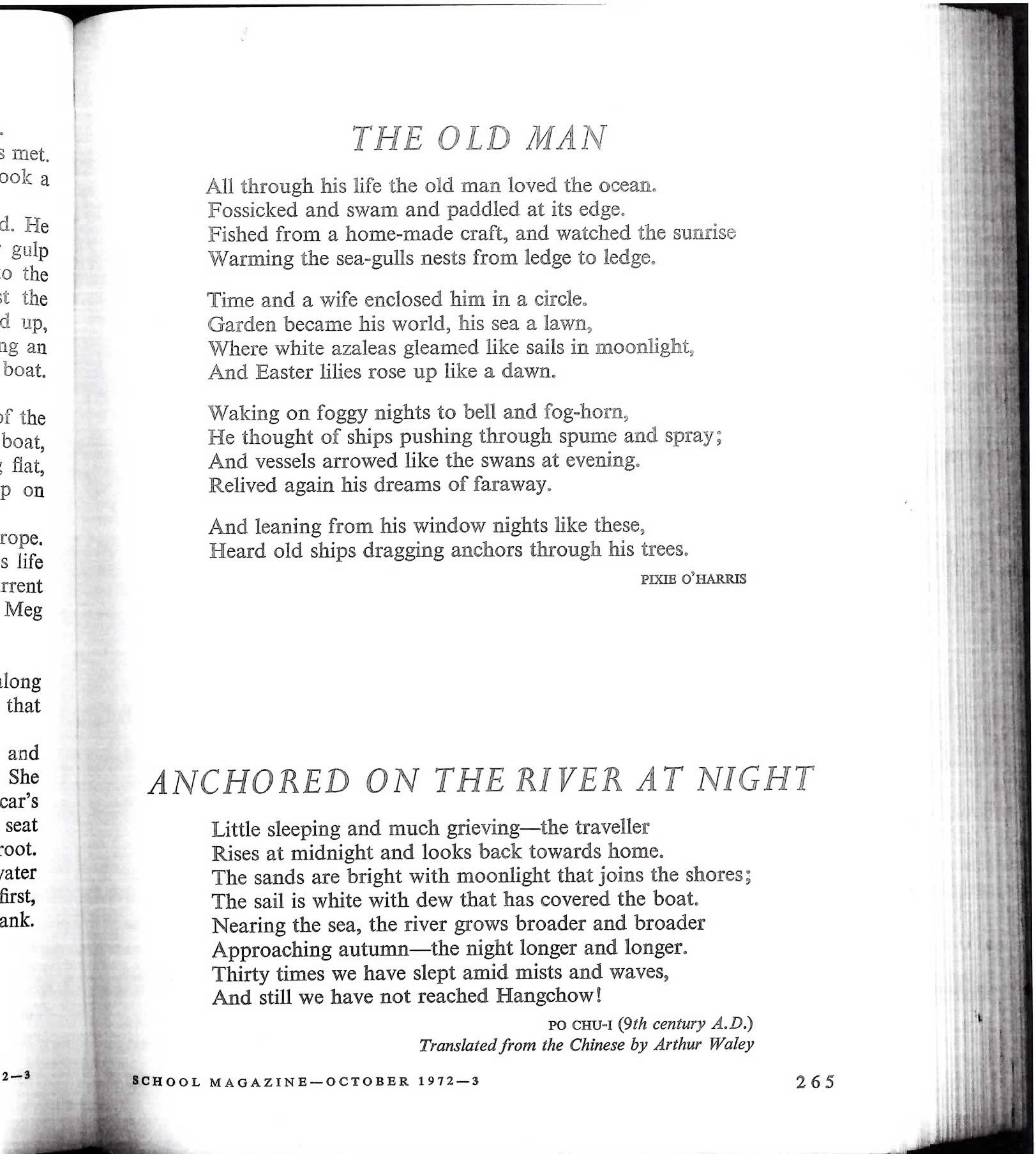
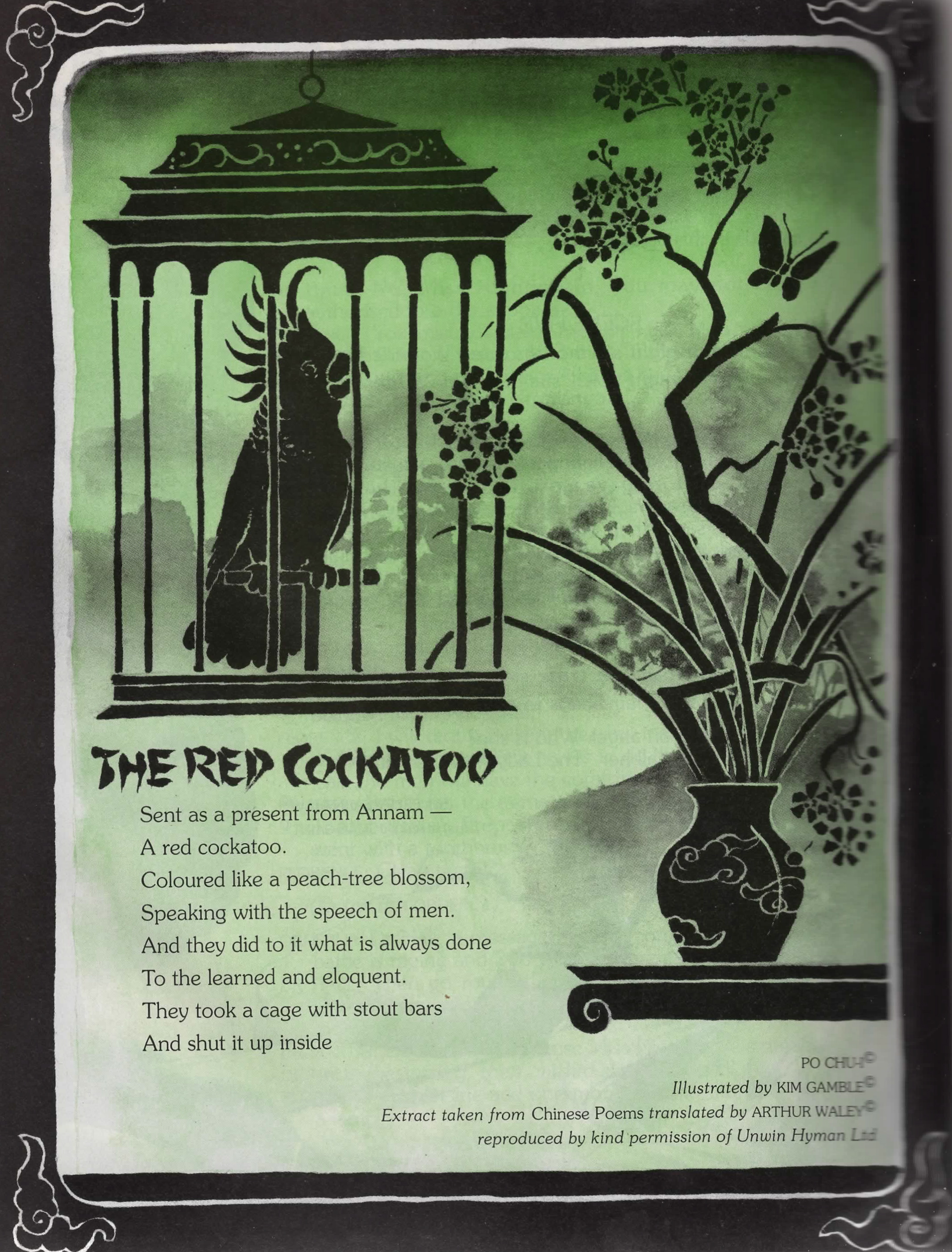
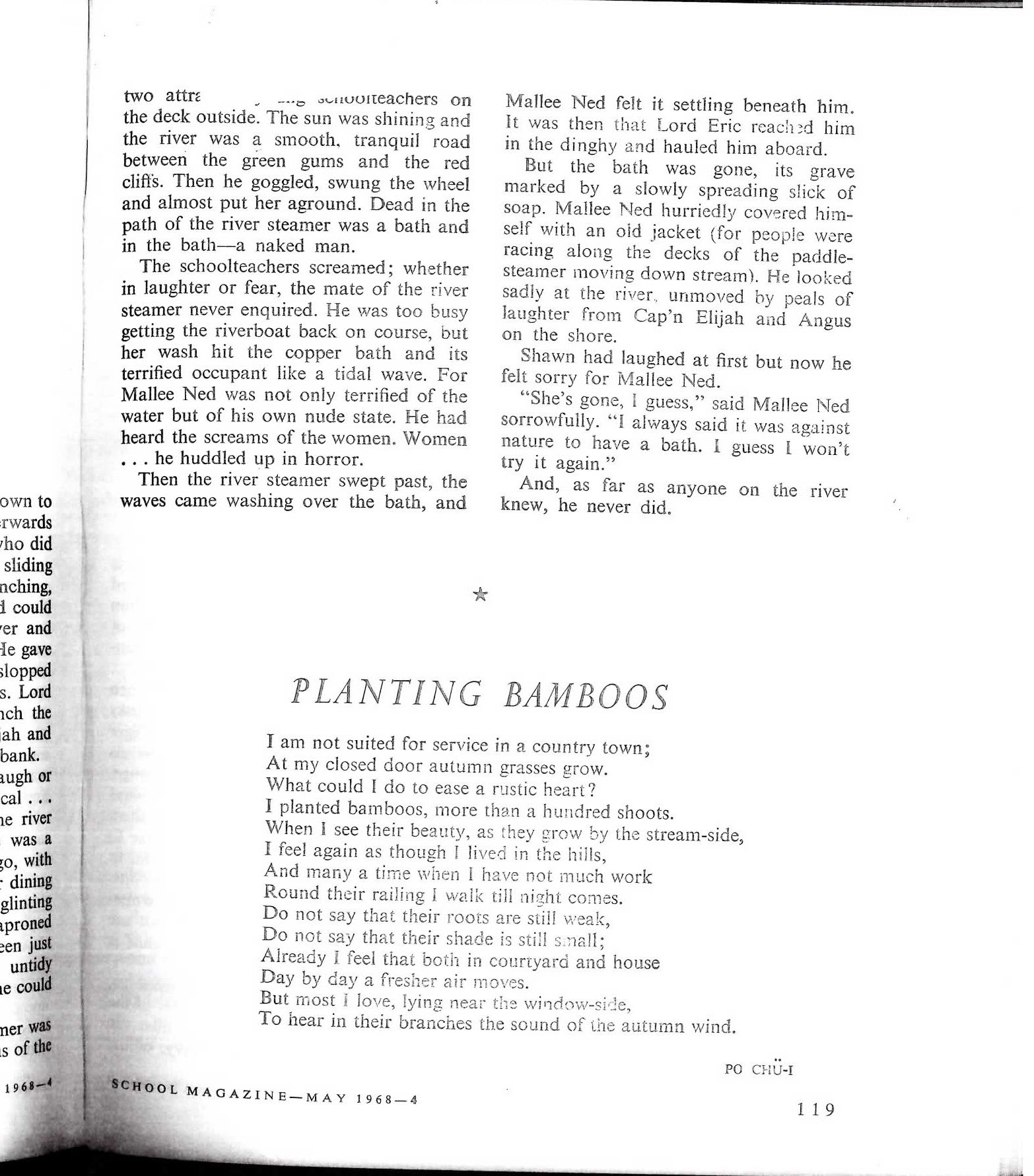
Patricia Wrightson was on the editorial staff of the School Magazine from the mid 1960s and was its editor for pretty much the whole 1970s. My acquaintance with Chinese poetry prior to reading J P Seaton’s anthology came largely from poems published in the magazine during those years. None of the poems I could lay hands on were published in the anthology. I think they are all translated by Arthur Waley. They all stand on their own merits, not sending the reader off in search of that which they have translated (not, as I was saying when blogging about the anthology, that there would be anything wrong with that – in fact, from some points of view, a translation should make a reader go searching for the original).

Click on the thumbnails to read the poems and see a little of their contexts in the magazine: Robert Louis Stevenson, Pixie O’Harris, a story about a dog, a Pauline Clarke serialisation, a historical article. The illustration of Li Po’ s ‘In the Mountains on a Summer’s Day’ is by the great Astra Lãcis. The last one, illustrated by Kim Gamble, was published in my day, but I found the poem in back copies from Patricia’s era.

Imants Tillers and watercolour

It’s Art Month in Sydney, and because I now live with an art student (yes, I’ve ditched the anxious Consultant and now cohabit with a cheerful Arty Type), we thought we’d better squeeze an art excursion into our busy schedule before the month was over. So yesterday we set out to hear Imants Tillers in conversation with Edmund Capon at the Roslyn Oxley Gallery.

We arrived nearly an hour early, so went for a stroll up the hill looking for diversion. We found it in spades, in the form of an exhibition at the Wagner Gallery of watercolours from the Australian, English and Scottish Watercolour Institutes. We were just in time for a talk and demonstration by Rob Candy, who it turns out leads tours to China for watercolourists (just $4925 for 16 days all included). Sadly we had to leave as he was beginning to pencil in his composition, but we were there long enough to get a delightful glimpse of the international siblinghood of watercolour devotees.

Back at the bottom of the hill, Tillers and Capon’s conversation had already started when we arrived. It was an animated forty minutes or so, ranging over Tillers’ reading (Heidegger, Thomas Bernhard, etc), artists he admired (De Chirico, and many Australian artists none of whom I’d heard of except Emily Kame Kngwarreye), and the work on display. Each of his works comprises a number of small abutting canvases – he doesn’t sign them, but every small canvas has a number on the back, now up to something like 80 000 I think he said. Tillers spoke very interestingly about his use words in his images – quoting Ezra Pound, Tomas Bernhardt, Virgil (though he didn’t mention him, he’s the source of ‘lacrimae rerum / tears of things’, prominent on the canvas next to me). One of the large works is about to be donated to the Art Gallery of NSW, to Capon’s manifest delight: it had been commissioned by a grazier who thought it might help in the protest movement against a wind farm proposed a particularly beautiful part of New South Wales – gifting it to the AGNSW was part of the plan. (Capon: ‘Wind farms are such ugly things.’ Tillers: ‘I think there’s definitely a place for them, but some landscapes should be declared part of the national heritage.’) They discussed the difference that Tillers’ move to Cooma had made to his art – he had discovered that outside the cities Australia has a huge vast landscape. (Capon said that the work had very little sense of place in it, which may be true of Tillers’ earlier work, but I would have thought was dead wrong about these images.) They talked about Appropriation, which apparently was big and shocking in the 80s, though now everyone does it. They wondered why it is so hard for Australian art to take up space in the international arena: Tillers made a bit of a splash in the US in the 80s, he said; Capon lamented that only Indigenous Australians got much of a look-in, not that he begrudged it them. (Tillers: But you have to hand it to Aboriginal artists. Aborigines are 1.5 percent of the population and they have produced this glorious work out of all proportion.)

After the talking we got to look at the work, which is wonderful. Penny said in the car on the way home, apparently a propos of nothing, ‘You don’t hear the word sublime much any more, do you?’ It probably does apply here. The big paintings that most moved me were Blossoming 17 (which quotes Virgil and Pound to great effect)and The Beech Forest. And there are a couple of smaller works that perform breathtaking appropriations from Emily Kame Kngwarreye. The images on the web don’t begin to give an idea of the complex layering, the interplay of text and image, text as image etc, but here’s one of the Emilys.

The text reads:
Around the border in blue: A THROW OF THE DICE / WILL NEVER  / ABOLISH / CHANCE
Bottom right in small yellow letters: FOR YEARS NOW
Scattered over the painting, in large, mostly yellow block letters: I CLOSE MY EYES / THE  PATH OF LUCK  / UTOPIA / ANMATYERRE / ALAWARRE / DELMORE DOWNS / ARRERNTE /ALICE SPRINGS / ENTRY / AS IF

If you get a chance to see this exhibition, whether you live with an art student or not, I recommend you take it. It closes on 1 April.

Shambhala Chinese Poetry

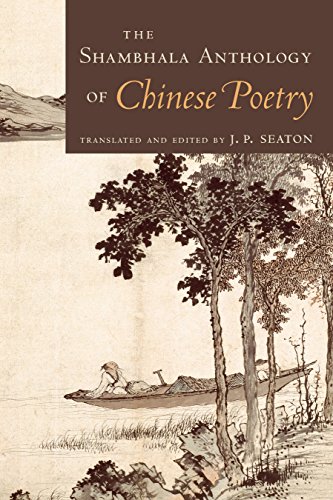
J P Seaton (editor, & translator of most poems), The Shambhala Anthology of Chinese Poetry (Shambhala 2006)

This was a present for my 60th birthday. I was delighted to receive it but obviously, given that I’m now 63, I was slow to actually read it. Seymour Glass’s passion for Chinese poetry and wisdom is what provided the necessary extra spur (I mean, who was that poet who wanted to be a dead cat? And why?).

The anthology opened a space in my head. It didn’t answer the question about the dead cat (the dead cat poem is absent), but it raised many more. It covers 3000 years of Chinese poetry in 246 pages, including notes. It would hardly be fair to expect more than a taster. What’s more, it would be unrealistic for someone as ignorant of Chinese history and culture as I am to expect more than broad-brush help with interpretation. Despite J P Seaton’s lucid introduction and notes, I confess that many if not most of the poems eluded my grasp – all those proper names and elliptical allusions to Taoist, Buddhist and Confucian traditions amounted to little more than mystifying clutter to my uneducated brain. I could appreciate some lines, like Li I’s wonderfully cinematic

Three hundred thousand men, among these rocks,
this once, as one, together turn: gaze on the moon.

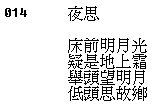
I was moved by some whole poems. But all too often I felt as if I was reading a coded message or a paraphrase, missing the actual poetry, roughly an equivalent of ‘Will I compare you to a day in summer? / You are prettier and cooler: / Strong winds rustle May’s lovely blossoms, etc). Once I caught myself thinking, ‘I hope I get to read that poem one day.’ It became obvious to me that if I am to understand and enjoy this poetry I need to devote a lot more time to it. And maybe I will one day. For now I’ve decided to play around in one poem, ‘Thoughts of a Quiet Night’ by Li Po (701–762). I went searching and found an image of the actual poem, on the China the Beautiful site:

That’s 20 characters. On the Poetry Kit site, Li Po’s biographer An-Lee Chang Williams gives a literal one-word-per-character version:

Bed  fore  bright  moon  light
Doubt  is  ground-on  frost
Raise(d)  head   gaze  clear  moon
Dropp(ed)  head  reminisce  home  country

It’s starkly obvious that a translation has to do more than give such a word-for-word rendering. (Incidentally, I notice that even here, if my copied image is correct, the same character has been rendered as ‘bright’ in line 1 and ‘clear’ in line 3.) In his introduction, J P Seaton discusses the visual qualities of the Chinese:  the first line ‘contains among its five characters a moon (the pictograph for moon) and two more moons, one in the compound ideograph bright and another shining dimly and insistently out of the character for the preposition before.’ He comments, ‘The writing system lets Li Po literally fill his little poem with moonlight.’ He doesn’t mention the difficulty of reproducing the musical effects of a tonal language, or the complexities of navigating the distance between the two grammar systems, or what to do about deeply ingrained terms of reference or understandings of poetic form (though he does discuss form elsewhere).

Translating  a poem from Chinese to English will probably never be straightforward. The sound and look of the words cannot be decanted unchanged from one language to the other. From one point of view all a reader can expect is an honest paraphrase. But when you paraphrase a poem, you’ve lost the poetry, so perhaps one ought to hope for a little more: perhaps a poem in English that corresponds as closely as possible to the original, which means taking liberties. On page 90 of this anthology, the poem becomes:

Before the bed, bright moonlight.
I took it for frost on the ground.
I raised my head to dream upon that moon,
then bowed my head, lost, in thoughts of home.

So much has, perhaps inevitably, been lost, and if An-Lee Chang Williams’s list of words is correct, so much has been added.

China the Beautiful and the An-Lee Chang interview give more than a dozen translations between them. And I just found more. Seeing all these attempts to translate 20 words gives a fascinating glimpse of the art of translation and the nature of poetic composition. It also allows for a deeper grasp of this particular poem, as one person after another tries to capture it in all its suggestive particularity. Here’s An-Lee Chang Williams, who inserts less than J P Seaton (she offers us no emotional guidance as Seaton does with ‘dream’ and ‘lost’, but interestingly changes tense from past to present) without being any more lossy (it’s interesting that both of them have avoided the repetition of ‘bright moon’ in line 3 of  the Chinese):

Bright moonlight by my bed:
First I thought it was ground frost.
I gaze up at the moon,
Bow my head, remembering my homeland.

And here, at the further extreme of adding stuff, is L Cranmer-Byng’s art song version from the early 20th century:

Athwart the bed
I watch the moonbeams cast a trail
So bright, so cold, so frail,
That for a space it gleams
Like hoarfrost on the margin of my dreams.
I raise my head,
The splendid moon I see;
Then droop my head,
And sink to dreams of thee –
My father land, of thee!

And how about this, by someone whose name I can’t read, which goes too far on its own merry way to be called a translation as such, but which brings out a meaning of that ‘dropped’ in line 4 that none of the others seemed to notice or even allow:

A splash of white on my bedroom floor. Hoarfrost?
I raise my eyes to the moon, the same moon.
As scenes long past come to mind, my eyes fall again
on the splash of white, and my heart aches for home.

The very first poem in the book is from at least the fourth century BCE. J P Seaton describes it as ‘certainly an honourable expression  of the ideals of democracy as well as a perennial feminist one’. I don’t read it that way at all, but I agree that it captures something profound:

The Peasant’s Song

Sunups, we get to work;
Sundowns, we get our rest.
Dig wells and drink,
plough fields, to eat:
what has some ’emperor’
to do with us?

Now that’s a poem I’d like to read when I have the time.

Fortuitously, this quote from Jorge Luis Borges turned up in my RSS reader while I was drafting this entry:

Not knowing Greek and Arabic allowed me to read, so to speak, the Odyssey and The Thousand and One Nights in many different versions, so that this poverty also brought me a kind of richness.

(From Fernando Sorrentino’s Seven Conversations with Jorge Luis Borges via The Literary Saloon)

Note: I’ve Australianised the spelling in the quoted passages.

xkcd knows about my dreams

Patricia Wrightson has died

There’s a tiny piece by Rosemary Sorenson in the Australian, but so far the death of Patricia Wrightson this week has gone unremarked in the media.

When I became editor of The School Magazine in the 1980s, I was awed by the knowledge that I was stepping into her shoes. As I understand her work, her central concern was with the disjunction for settler-society between on one hand the experience of living in Australia and on the other having a children’s fairy-tale heritage deeply rooted in European landscapes and histories. In books like The Nargun and the Stars and A Little Fear she set out to create fairy stories that were grounded in the Australian reality. She drew on Aboriginal motifs and, I heard her say in a lecture, was meticulous in consulting Aboriginal friends. I think most people these days would see the project as a noble dead end, smacking too much of appropriation. Certainly in my last months at the magazine, a reasonably ignorant education department functionary was at pains to explain to me that the Aboriginal stories of  ‘Judith Wrightson’ were not politically acceptable.

There will be much discussion of Patricia Wrightson and her work on the Internet over the next couple of weeks. ALA Connect, for example, is inviting people to post comments. I happen to have a photocopy of a wonderful letter she wrote in 1974 to a school principal, which I reproduce here for your pleasure and edification:

Dear Mr XXXXX

Thank you for your letter of July 11th regarding the phrase ‘wipe your bottom’ in the June issue of School Magazine Part 2.

I am sorry you found this homely phrase objectionable. It must be pointless to indicate that it was written by one of our leading poets and writers who is now Chairman of the Literature Board; or to ask whether ‘smack your bottom’ or ‘wipe your nose’ would have been so offensive; or to ask for a clear explanation of what is offensive in the phrase. I can only say that we cannot possibly undertake not to be offensive.

We continually offend. We offend by failing to keep in touch with the fast-moving world of young readers and by being too contemporary; by a rigid adherence to syntax and formal style, and by our disregard of them. Our verse is both too classic and too unclassic. We offend by speaking with respect of the church and the theory of evolution; the plight of captive nations and the achievements of communist countries; Anzac Day and the laws relating to Aborigines. We can only follow our usual policy of holding a balance between  these things while still aiming for honesty and life.

As to your use of School Magazine in the future, that is always a matter for your decision. Withholding the magazine from children is another matter. It is produced for the children, and those who wish to read it are entitled to receive it.

Yours faithfully

Mrs Patricia Wrightson
Editor
School Magazine

She was not a woman to mess with. At a children’s literature conference in the USA in the mid 1980s, a children’s librarian told me with awe about a lecture by Patricia: ‘She was a very wise and challenging lecturer, but at the same time as easy and comfortable as an old boot.’ As this letter demonstrates, she could also sink the boot when necessary. I never met her. I don’t know anything about the circumstances of her death. I mourn her passing.

The Alphabet of Light and Dark

Danielle Wood, The Alphabet of Light and Dark (Allen & Unwin 2006)

I’m sorry, this book and I just didn’t hit it off, though we both tried. At page 50, the thing that had most engaged my mind was worry over whether the verb ‘propelled’ can be used as a synonym of ‘towed’, or whether the thing propelling has to be pushing from behind. There’s also a use of ‘eke’ that stirred me emotionally. I did read on, but stopped at page 152, just short of half way. Perhaps I’ll come back to it when I’m in a different mood – a mood where I’m not wanting story. I’m not saying there’s anything wrong with the book, just that I wasn’t drawn to it. I’m not even close to the irritation inspired by the last Tasmanian novel I failed to finish.

For the record, here’s the last paragraph I read, not a straw that broke the camel’s back, just the innocent paragraph that happened to be there when the light rail pulled in to Rozelle Bay station:

But now the night is clear, and quiet again, and the only sound is the faint zinging of the fluorescent tube of light uncovered on the ceiling. Essie’s hands are hot and red in the suds of the dishwashing water, and she can feel the two glasses of red wine in her blood. The light inside the room makes the kitchen windowpane a black mirror. Essie’s face swims over the surface of it. But it is only a version of her face. There is no colour, no texture – it is simplified down to bone structure and smooth, unmarked planes of skin. It’s like a photographic negative. Not truly her face, just a blueprint for it. Invisible beyond the window is the cape, and beyond that, the ocean breathing out and in, out and in.

This really was the last paragraph I read, so in effect I’m quoting at random rather than because it’s a good example of something. Its inelegances are by no means typical, but it does happen to exemplify the way reflection (in this case literal) and beautiful but slightly dubious description constantly take precedence over story-telling. (Too often it’s too much like having a story teller interrupt herself to say, “Ohh look at that pretty thing!’ The thing may be pretty, but we want the story.) There’s no forward impetus. I’d enjoyed a lot of the book – Bruny Island is now permanently in my mind as a beautiful place –  but I felt no wrench when I closed it.