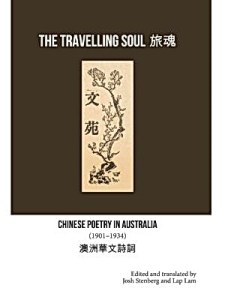
This book is part of the Opening the Multilingual Archive of Australia project, based at the University of Sydney. According to the project’s website:
Opening the Multilingual Archive of Australia brings together historical materials from national and international collections in languages other than English. We seek to rethink and enlarge narratives about Australia that come solely from English-language sources, by showing modern Australia to be a complex multilingual creation.
According to its introduction, the book offers a small selection from the substantial body of verse in Chinese produced in Australia in the first third of the 20th century. There are 41 poems and a prose record of an excursion to Taronga zoo, all given in the original Chinese with an English translation and brief notes on the poems and, where possible, on the authors.
Mostly they are occasional poems – written to mark the arrival or departure of a friend or colleague, or to record an event of some sort. They also reflect on the political situation in China, and the experience of being Chinese in Australia. They come from sources such as Sydney’s Chinese Republic News and Tung Wah Times. Collectively, they give a sense of an active transient community of literate Chinese in this country.
An editorial decision was made by the translators not to attempt to reproduce the poetic forms of the poems. For a reader who can’t read Chinese then, the book bears witness to the existence of these poems while offering only shadow of the actual poetry. Here’s a taste:
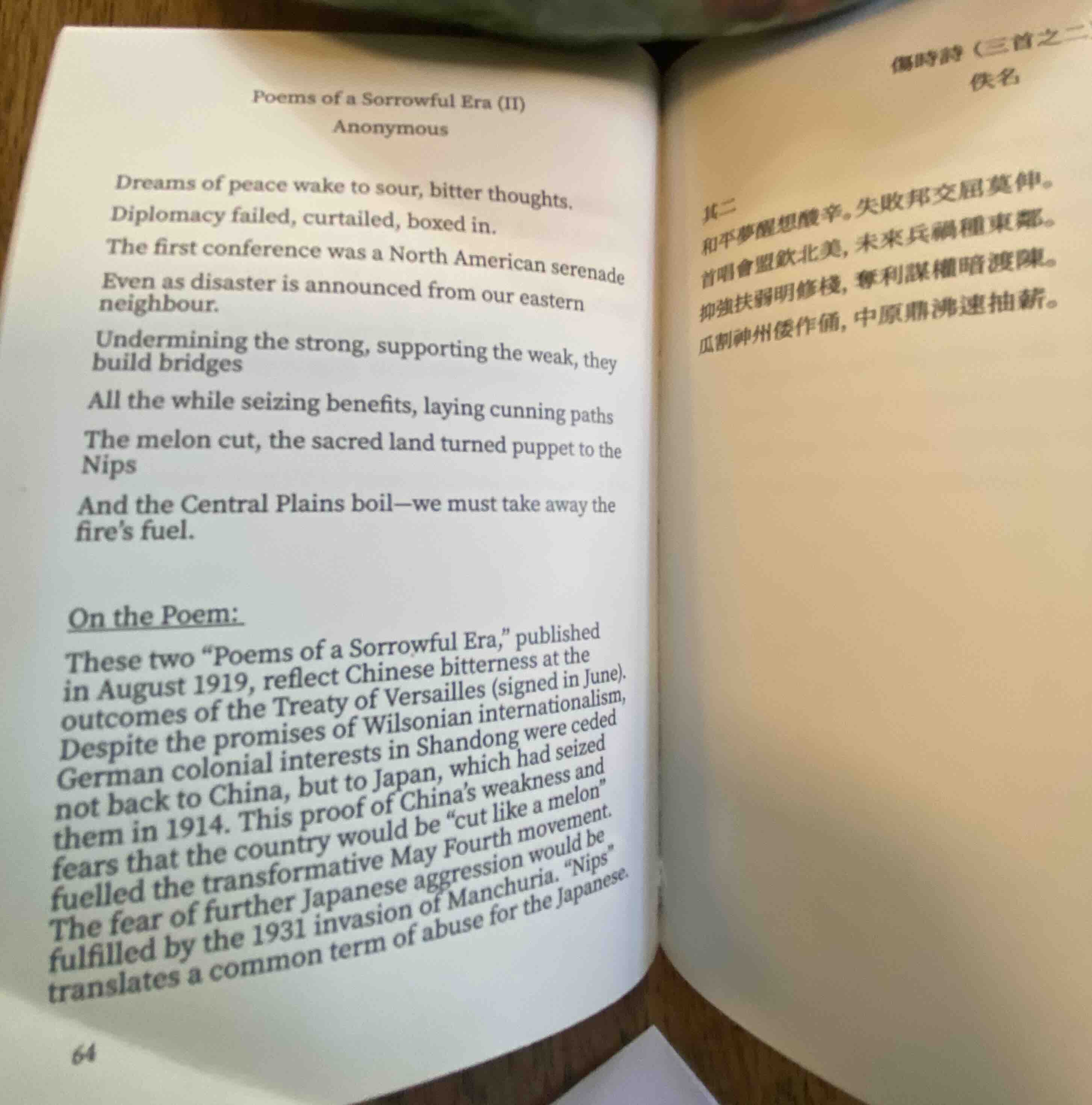
There is nothing in the poem to indicate that it was written in Australia, but an endnote informs us that it was published in the Chinese Republic News on 9 August 1919. Unlike most of the poems in the book, it was anonymous, and there is no note from the author. The editors’ note, which refers to it and the poem on the next spread, gives us a glimpse of a community living in Australia but alive to a Chinese national point of view.
The Chinese, on the right, clearly conforms to a strict poetic form. There are four lines, each consisting of two parts made up of eight characters. With that in mind, I go back to what at first seems to be straightforward English prose on the left, and see that it actually consists of four couplets.
This makes me itch to do a version that reads more like poetry. Here’s a go:
We dreamed of peace and wake to sorrow.
Talks have failed, packed up and gone.
POTUS sang a sweet love song.
Disaster from the east tomorrow.

Bridge builder, Robin Hood,
pocket-liner, power-grabber,
split our melon, feed the robber.
Our plains blaze. We must gather wood.
I’m not saying that the editors / translators should have done anything differently, let alone anything as rinky-dink as that. It’s just that while I appreciated the historical, sociological interest of the book, I wished I could have a greater sense of the poetry.
I am an Australian man of settler heritage. I live and blog on Gadigal and Wangal land, and gratefully acknowledge their Elders past and present, I welcome any First Nations readers and commenters.
This was a present for my 60th birthday. I was delighted to receive it but obviously, given that I’m now 63, I was slow to actually read it. Seymour Glass’s passion for Chinese poetry and wisdom is what provided the necessary extra spur (I mean, who was that poet who wanted to be a dead cat? And why?).
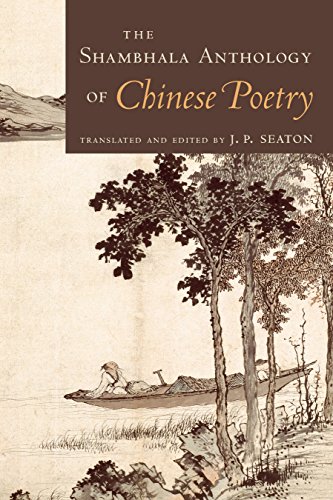
The anthology opened a space in my head. It didn’t answer the question about the dead cat (the dead cat poem is absent), but it raised many more. It covers 3000 years of Chinese poetry in 246 pages, including notes. It would hardly be fair to expect more than a taster. What’s more, it would be unrealistic for someone as ignorant of Chinese history and culture as I am to expect more than broad-brush help with interpretation. Despite J P Seaton’s lucid introduction and notes, I confess that many if not most of the poems eluded my grasp – all those proper names and elliptical allusions to Taoist, Buddhist and Confucian traditions amounted to little more than mystifying clutter to my uneducated brain. I could appreciate some lines, like Li I’s wonderfully cinematic
Three hundred thousand men, among these rocks, this once, as one, together turn: gaze on the moon.
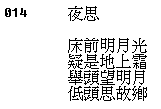
I was moved by some whole poems. But all too often I felt as if I was reading a coded message or a paraphrase, missing the actual poetry, roughly an equivalent of ‘Will I compare you to a day in summer? / You are prettier and cooler: / Strong winds rustle May’s lovely blossoms, etc). Once I caught myself thinking, ‘I hope I get to read that poem one day.’ It became obvious to me that if I am to understand and enjoy this poetry I need to devote a lot more time to it. And maybe I will one day. For now I’ve decided to play around in one poem, ‘Thoughts of a Quiet Night’ by Li Po (701–762). I went searching and found an image of the actual poem, on the China the Beautiful site:
That’s 20 characters. On the Poetry Kit site, Li Po’s biographer An-Lee Chang Williams gives a literal one-word-per-character version:
Bed fore bright moon light Doubt is ground-on frost Raise(d) head gaze clear moon Dropp(ed) head reminisce home country
It’s starkly obvious that a translation has to do more than give such a word-for-word rendering. (Incidentally, I notice that even here, if my copied image is correct, the same character has been rendered as ‘bright’ in line 1 and ‘clear’ in line 3.) In his introduction, J P Seaton discusses the visual qualities of the Chinese: the first line ‘contains among its five characters a moon (the pictograph for moon) and two more moons, one in the compound ideograph bright and another shining dimly and insistently out of the character for the preposition before.’ He comments, ‘The writing system lets Li Po literally fill his little poem with moonlight.’ He doesn’t mention the difficulty of reproducing the musical effects of a tonal language, or the complexities of navigating the distance between the two grammar systems, or what to do about deeply ingrained terms of reference or understandings of poetic form (though he does discuss form elsewhere).
Translating a poem from Chinese to English will probably never be straightforward. The sound and look of the words cannot be decanted unchanged from one language to the other. From one point of view all a reader can expect is an honest paraphrase. But when you paraphrase a poem, you’ve lost the poetry, so perhaps one ought to hope for a little more: perhaps a poem in English that corresponds as closely as possible to the original, which means taking liberties. On page 90 of this anthology, the poem becomes:
Before the bed, bright moonlight. I took it for frost on the ground. I raised my head to dream upon that moon, then bowed my head, lost, in thoughts of home.
So much has, perhaps inevitably, been lost, and if An-Lee Chang Williams’s list of words is correct, so much has been added.
China the Beautiful and the An-Lee Chang interview give more than a dozen translations between them. And I just found more. Seeing all these attempts to translate 20 words gives a fascinating glimpse of the art of translation and the nature of poetic composition. It also allows for a deeper grasp of this particular poem, as one person after another tries to capture it in all its suggestive particularity. Here’s An-Lee Chang Williams, who inserts less than J P Seaton (she offers us no emotional guidance as Seaton does with ‘dream’ and ‘lost’, but interestingly changes tense from past to present) without being any more lossy (it’s interesting that both of them have avoided the repetition of ‘bright moon’ in line 3 of the Chinese):
Bright moonlight by my bed: First I thought it was ground frost. I gaze up at the moon, Bow my head, remembering my homeland.
And here, at the further extreme of adding stuff, is L Cranmer-Byng’s art song version from the early 20th century:
Athwart the bed I watch the moonbeams cast a trail So bright, so cold, so frail, That for a space it gleams Like hoarfrost on the margin of my dreams. I raise my head, The splendid moon I see; Then droop my head, And sink to dreams of thee – My father land, of thee!
And how about this, by someone whose name I can’t read, which goes too far on its own merry way to be called a translation as such, but which brings out a meaning of that ‘dropped’ in line 4 that none of the others seemed to notice or even allow:
A splash of white on my bedroom floor. Hoarfrost? I raise my eyes to the moon, the same moon. As scenes long past come to mind, my eyes fall again on the splash of white, and my heart aches for home.
The very first poem in the book is from at least the fourth century BCE. J P Seaton describes it as ‘certainly an honourable expression of the ideals of democracy as well as a perennial feminist one’. I don’t read it that way at all, but I agree that it captures something profound:
The Peasant’s Song
Sunups, we get to work; Sundowns, we get our rest. Dig wells and drink, plough fields, to eat: what has some ’emperor’ to do with us?
Now that’s a poem I’d like to read when I have the time.
Fortuitously, this quote from Jorge Luis Borges turned up in my RSS reader while I was drafting this entry:
Not knowing Greek and Arabic allowed me to read, so to speak, the Odyssey and The Thousand and One Nights in many different versions, so that this poverty also brought me a kind of richness.