
Josh Stenberg & Lap Lam, editors and translators, The Travelling Soul: Chinese Poetry in Australia (1931–1934) (Flying Islands 2026)
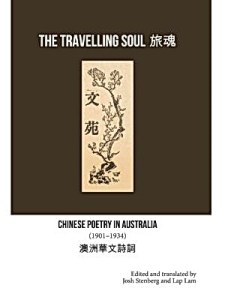
This book is part of the Opening the Multilingual Archive of Australia project, based at the University of Sydney. According to the project’s website:
Opening the Multilingual Archive of Australia brings together historical materials from national and international collections in languages other than English. We seek to rethink and enlarge narratives about Australia that come solely from English-language sources, by showing modern Australia to be a complex multilingual creation.
According to its introduction, the book offers a small selection from the substantial body of verse in Chinese produced in Australia in the first third of the 20th century. There are 41 poems and a prose record of an excursion to Taronga zoo, all given in the original Chinese with an English translation and brief notes on the poems and, where possible, on the authors.
Mostly they are occasional poems – written to mark the arrival or departure of a friend or colleague, or to record an event of some sort. They also reflect on the political situation in China, and the experience of being Chinese in Australia. They come from sources such as Sydney’s Chinese Republic News and Tung Wah Times. Collectively, they give a sense of an active transient community of literate Chinese in this country.
An editorial decision was made by the translators not to attempt to reproduce the poetic forms of the poems. For a reader who can’t read Chinese then, the book bears witness to the existence of these poems while offering only shadow of the actual poetry. Here’s a taste:
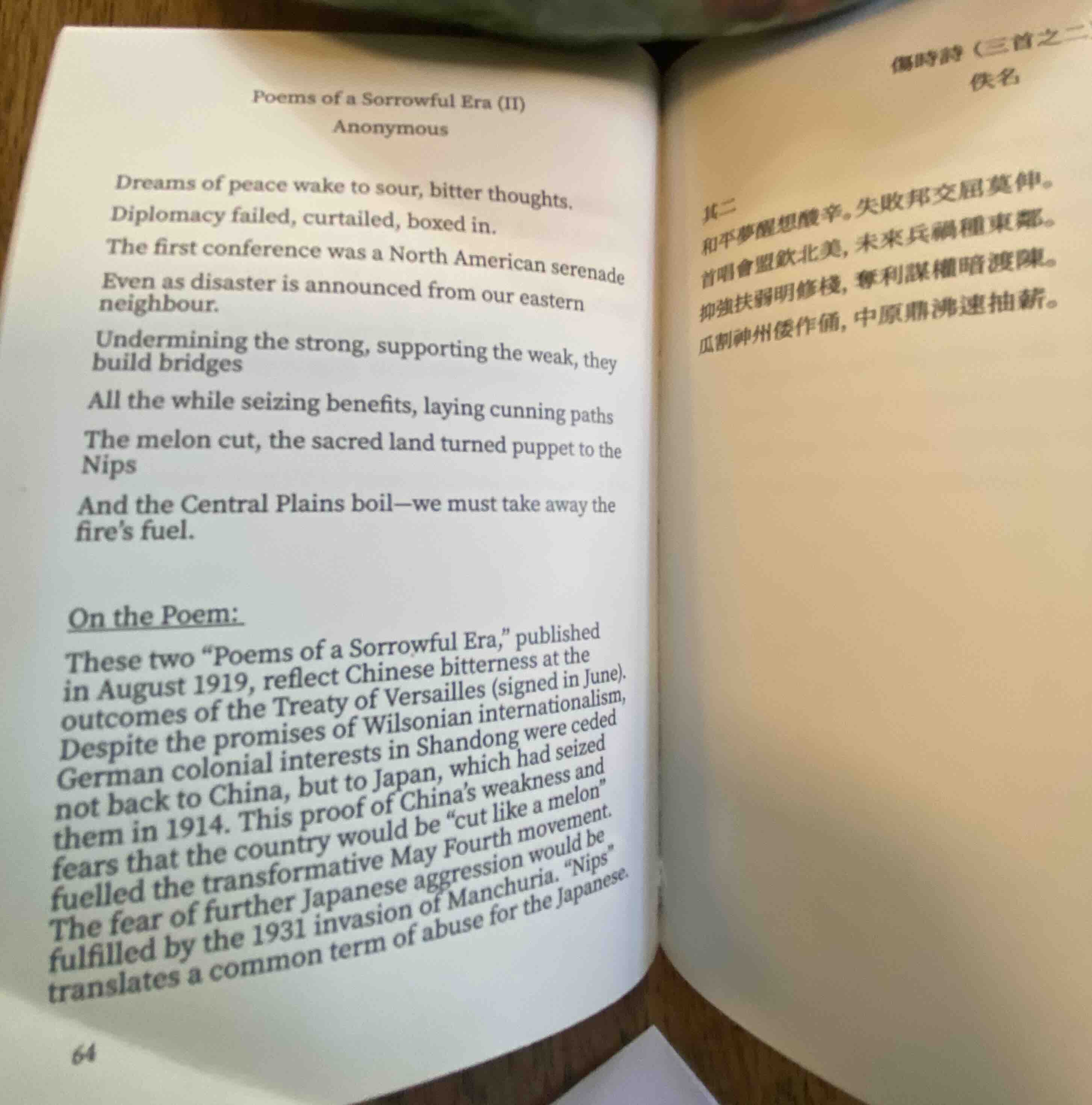
There is nothing in the poem to indicate that it was written in Australia, but an endnote informs us that it was published in the Chinese Republic News on 9 August 1919. Unlike most of the poems in the book, it was anonymous, and there is no note from the author. The editors’ note, which refers to it and the poem on the next spread, gives us a glimpse of a community living in Australia but alive to a Chinese national point of view.
The Chinese, on the right, clearly conforms to a strict poetic form. There are four lines, each consisting of two parts made up of eight characters. With that in mind, I go back to what at first seems to be straightforward English prose on the left, and see that it actually consists of four couplets.
This makes me itch to do a version that reads more like poetry. Here’s a go:
We dreamed of peace and wake to sorrow.
Talks have failed, packed up and gone.
POTUS sang a sweet love song.
Disaster from the east tomorrow.

Bridge builder, Robin Hood,
pocket-liner, power-grabber,
split our melon, feed the robber.
Our plains blaze. We must gather wood.
I’m not saying that the editors / translators should have done anything differently, let alone anything as rinky-dink as that. It’s just that while I appreciated the historical, sociological interest of the book, I wished I could have a greater sense of the poetry.
I am an Australian man of settler heritage. I live and blog on Gadigal and Wangal land, and gratefully acknowledge their Elders past and present, I welcome any First Nations readers and commenters.


