Waleed Aly on conservatism

Waleed Aly, What’s Right: The future of conservatism in Australia (Quarterly Essay 37)
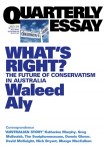
In the 1950s my parents subscribed to The Saturday Evening Post. I habitually started reading it from the back, because there were no cartoons in the front half. There are no cartoons at all in Quarterly Essay, but I usually start up the back here too, because that’s where I find responses to the previous issue, in this case 30 pages about Mungo MacCallum’s essay on Kevin Rudd, Australian Story. Katharine Murphy, national affairs correspondent for the Age, wins the Me Fail I Fly ‘I Wish I’d Said That’ Award for this:

The problem with Mungo is you can’t read anything he writes without feeling the need to agree with it on the spot, and wish you’d written it yourself. Reading Mungo is like resisting the pull of a great seducer.

That’s so much more grown-up and articulate than my own post-reading ‘Hmmm … But I enjoyed the ride.‘ Indeed the opening sentence of Mungo’s response to the correspondence does command assent:

The most interesting thing about all the correspondence my essay has provoked is the hugely different ways in which different people see Kevin Rudd.

[Editor Chris Feik and his Board apparently agree that the multiplicity of views on Kevin is interesting: QE 38 promises to give us yet another essay on the man, this time by David Marr.]

He then goes on to characterise each of the respondents: one ‘presents the standard view from the Right’, another is ‘a Labor insider’, a third speaks ‘from his position on the ideological Left’. This mode of analysis is fortuitously held up to a harsh light on page 1 of Waleed Aly’s essay, which of course I read after Mungo’s page 140. According to Aly, the terms Left and Right, ‘in spite of their ubiquity … are utterly meaningless and should be abandoned by anyone interested in having a substantial political conversation.’ The great seducer interrupted in flagrante?

Waleed Aly’s rejection of Left and Right as terms for political debate is not of course in response to Mungo MacCallum’s use of them. As he says:

For a long time I have been intrigued by the fact that I find myself in agreement with much conservative political philosophy, yet in consistent disagreement with politicians and commentators who call themselves conservatives.

The essay sets out to reclaim the ground currently occupied, one might say infested, though Waleed Ly is far too polite and reasonable to put it like that, by  neo-liberals and neo-conservatives. These politicians and commentators, he argues, have moved a long way from the conservative philosophy first articulated by Burke, and are in fact progressives in the sense that they are committed to moving towards an ideal world, albeit one from which most people who actually think of themselves as progressives would recoil in horror. I won’t try to summarise the argument. Much of it might be either glaringly obvious or obviously specious to anyone who has studied political philosophy, but to the general reader (that’s me!) it’s an education, and a pleasurable one.

Aly does a job in this essay that has needed doing for some time. He exposes the contradictions and fallacies in the utterances of the likes of John Howard, Tony Abbott, Nick Minchin or Kevin Andrews, but from a conservative perspective. He hoists them, as it were, on what they claim to be their own petard. ‘The conservative, ‘ he writes for example,

would certainly not run immigration at record levels (as the Howard government did) and then lecture its migrant population on what their values should be. That is especially true when it is done pursuant to a neo-liberal plan, where individuals are encouraged to use their mobility for entrepreneurial reasons, not cultural ones. The conservative takes the world as it is, not as she or he wishes it to be. And it is a world in which pluralisms in culture, politics and identity within a society are an inescapable and irreversible fact of life.

After taking his scalpel to the neo’s on multiculturalism, he moves on to the climate change ‘debate’, which he describes as ‘a fight to the political death’:

Of course, it is possible that climate-change activists are motivated more by their ideological commitments than by their trust in the scientific consensus. It is conceivable that staunch opponents of capitalism may leap on the opportunity climate change provides to argue for the destruction of the market’s political dominance. But it is also conceivable – and probably much more common – for climate-change believers to take their position based on trust in what they perceive to be conventional wisdom. Climate-change denialism on the part of non-scientists, by contrast, is always an ideological or an emotional process. The intellectual lengths required to sustain it are only feasible for those who have pre-existing reasons for wanting to deny it. That may be because its implications are devastating for one’s present livelihood – as might presently be true of certain farmers, or people working in high-emissions industries – in which case the response is probably emotional. Or it might be because it counters one’s deeply held views of the world, in which case the response is ideological.  … The simple fact is that neo-liberalism is incompatible with the politics of climate-change response. In order for neo-liberalism to be preserved, climate change must, in the first instance, be denied.

As you see, Waleed Aly is not a great seducer. He’s not out to win our assent by charm, or standover tactics, or appeals to team loyalty. On the contrary, he invites us to think with him.

It’s a quick read – just 105 pages. I recommend it.

Added on 30 March: Irfan Yusuf has an excellent review of this Quarterly Essay on New Matilda.
The Book Group and Peter Temple’s Truth

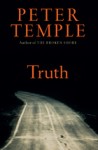
Peter Temple, Truth (Text Publishing 2009)

The Book Group decided we wanted a page turner for this meeting, and a couple of people were keen on Peter Temple’s Truth, the second of his detective novels. So Truth it was. Attempts to get it from the library made it pretty clear that other people were keen on it as well, and at least one of us, it turned out, had to go to the airport to buy a copy.

Here’s the first sentence:

On the Westgate Bridge, behind them a flat in Altona, a dead woman, a girl really, dirty hair, dyed red, pale roots, she was stabbed too many times to count, stomach, chest, back, face.

It takes a bit of work to figure out the internal relationships in this congeries of phrases. You may go down dead ends in which the flat in Altona is on the Westgate Bridge, or the girl was stabbed too many times to stomach, but once you’ve done the work the meaning is unambiguous:

[They were] on the Westgate Bridge. Behind them [in] a flat in Altona [was] a dead woman, a girl really, [her] dirty hair dyed red [with] pale roots[.] She was stabbed too many times to count, [in the] stomach, [the] chest, [the] back, [the] face.

In effect, then, the sentence gives fair warning that this won’t be a lazy read – there will be many sentences requiring at least a little backtracking if their meaning is to be extracted. But the difficulty is not arbitrary, representing as it does a particular laconic spoken English, the kind spoken by almost all the male characters and one or two of the females. The sentence also gives fair warning, amplified by the reference a couple of paragraphs later to the 1970 collapse of the Westgate bridge, that non-Melburnians and people who don’t know their Melbourne may have extra work to do in the comprehension stakes.

Having said that, Peter Temple’s Villani belongs to that distinguished international fraternity of ageing homicide detectives committed to bringing criminals to justice, at odds with their superiors, and in trouble with what’s left of their families: Rebus, Montalbano, Zen, Wallander, and now Villani, with his own distinctive line in introspective self-blame and self-criticism beneath a hardboiled surface, his own reluctant corruption. I enjoyed the book, much as I enjoy very good TV detective shows – I’d place it at the level of Silent Witness or NYPD Blue rather than up there with The Wire. On the whole, though, I think I prefer my television on the screen rather than in novel form, even when it’s as well written as this unarguably is.

My main difficulty was related to elliptical language. Not that it was difficult, because the difficulty, such as it was, was fun. But the speech patterns of most of the male characters tended to be indistinguishable from each other, so the characters themselves tended to blur. This didn’t matter very much until the perpetrators of the various crimes were revealed and the effect (for me at least) wasn’t much more specific than: ‘One of the characters did this crime, another did that one, and their reasons had to do with revenge or corruption or something of the sort.’ I’m happy to report that there was plenty to hold my interest on the way to that unsatisfactory destination: Villani’s relationships with his wife, his daughters, his father and brothers are as complex as anyone could wish – and if it wasn’t for the demands of the policier genre they might have been fleshed out to become fully three-dimensional; the language is full of delights as well as provocations; there are plenty of richly detailed observations of street life and the life of the mind (‘These thoughts had begun to come to Villani in the small moments of his life – at the traffic lights, in the haunted space before sleep, in the wet womb of the shower’ is a nice instance).

Just as I finished reading the book the long list for the Miles Franklin Award was announced. I’ll be surprised if Truth wins the award, but I haven’t read any of the other contenders.

I wrote the preceding paragraphs before the group met last night. There were only four of us. I don’t think it was lack of enthusiasm for the book that brought the numbers down – one man had a lecture, another’s plane from Brisbane was late, and so on. We had a pleasant discussion, mainly swapping Bits We’d Liked – one guy had jotted down clever bits of dialogue, and often as not someone else would be able to say what the next line was. We agreed there were longueurs. We agreed that it was a fine bit of genre writing (more confined by the requirements of genre than Shane Maloney’s novels, one guy thought). We reflected that none of us saw Melbourne as quite as grim as the book, though one guy told us of a Sydney experience involving four big policemen running onto the street in front of his car and pointing guns at the driver of the car next to him. We resonated with the awkwardness of the male characters in attempting to give and receive whatever it is one gives and receives in moments of great pain (though as I write that, I realise that I appreciated those moments cerebrally rather than responding to them emotionally).

And we talked about Djan Djan, Reinventing Knowledge, Mawson’s huts, the excellent food, how a career as an assistant director in the movies affects one’s reading habits, regulations for backyard ponds, etc etc etc.

The Happiness of Kati

Jane Vejjajiva, The Happiness of Kati (2003, translation by Prudence Borthwick, Atheneum 2006)

This book is a rarity: a children’s book written in Thai and translated into English. Perhaps that’s why it was recommended to me. It’s short, and I decided to read it as a gap-filler while waiting for another Book Group member to finish with my copy of Truth. This may not have been a mistake, but I do regret the disrespect: the book certainly wasn’t written to be a gap filler.

At the start of the book Kati is nine years old and living with her grandparents. Her parents are noticeably absent, and the absence of her mother is particularly stark because each of the first several short chapter headings has a subheading that mentions her. The first chapter, for instance, is ‘Pan and Spatula’ with a subheading, ‘Mother never promised to return.’ The chapter has quite a lot to say about the pan and spatula Grandmother uses to cook rice, but is silent about Mother. Just as one is beginning to think Mother must be dead, it turns out that she is very ill, and there’s the possibility of visiting her. It’s a very effective device – and the complete silence about Kati’s father, which lasts quite a bit longer, gains power from it.

I don’t think it’s too spoilerish to say that Kati’s mother has motor neurone disease (or amyotrophic lateral sclerosis, as it’s called in this US translation), and that she dies. I won’t go further into spoiler territory, except to say that if this were an Australian or US book, there would very probably be a big emotional death scene towards the end of the book, but here the death happens so quietly that I wasn’t sure it had happened until a couple of paragraphs later, and it comes at about two-thirds of the way through the book. This unexpected structure, as much as the unfamiliar food, plants and family relationships, made me aware I was engaging with a mind from a different culture. I enjoyed it and I’m glad it slipped through the net to reach English-speaking young people – though I notice that my copy was withdrawn from the Albany NY Public Library less than four years after publication without much wear and tear, suggesting that it didn’t reach very many of them.

Dungog

We drove up to Dungog on Saturday – Penny, her brother Chris and I – to visit a nonagenarian second cousin of theirs. We stayed at one of the Dungog Country Apartments, which was inexpensive (by Sydney standards), light and airy, with a roomy kitchen, pleasant furniture, a balcony with a view of the pub, and Norman Lindsay cheek by jowl with Norman Rockwell on the wall.

There was weather, so we didn’t go for the walk we’d planned on Saturday afternoon. And none of the town’s recommended eateries was open, so we ate some huge steaks at ‘the top pub’ (which must make the hotel opposite our apartment the bottom pub) before striding off to the James Theatre, Australia’s oldest still running purpose built cinema, just in time for the evening session of Flickerfest.

Flickerfest has been an annual event at Bondi for 19 years now, but I’ve never been to it. The prospect of several days of short movies just hasn’t had enough drawing power. In fact, just about the only short-film programs I’ve seen have been ones where a friend or offspring had made one of the films. But we were in Dungog, and apart from the trivia quiz at the Menshed and billiards and jukebok at the top pub there wasn’t a lot else on, so we were quite pleased that there is now a travelling, pocket-sized Flickerfest, that Dungog is among the 24 venues it visits around the country, and that Saturday was Dungog’s day.

I’m not a convert to short-film nights. Bring back the days when there was a short before the main feature, I say. In that context, almost any one of the films we saw – the Best of Australian Shorts – would have been perfectly adequate, and some would have been hard acts to follow. One, Miracle Fish by Luke Doolan, was not only nominated for an Academy Award this year but also was shot in the primary school my sons attended, so had a certain holding power (though it was far too long). Maziar Lahooti’s Crossroads stood out for me, partly for a beautiful moment of inarticulate masculinity after a display of heroic competence (that’s the second short film of his I’ve seen and loved), and Dominic Allen’s Two Men, all four minutes of it, is perfect – translating a 160-word piece by Kafka into Aboriginal English and setting it in a remote community with absolute sureness of touch.

The Dungog Film Festival is in May. For four days, as Penny’s second-cousin-once-removed told us on Sunday, black-clad movie lovers turn the main street of Dungog into little Newtown. It might be just the thing for disgruntled ex-Sydney Film Festival goers.

Haiti After Duvalier

Amy Wilentz, The Rainy Season: Haiti Since Duvalier (Simon and Schuster 1989, 1994)

When the recent earthquake struck Haiti, I’m sure I wasn’t the only one who was dismayed by the spectacle of poor Black people, sometimes visibly despairing, sometimes raging, being helped out by calm, compassionate Europeans and USers, usually accompanied by a narrative about Haiti’s lack of infrastructure and the international community’s concern – that is to say, a spectacle that seemed to confirm racist stereotypes: African heritage people emotional, dangerous, incompetent etc; European heritage people efficient, kind, well organised etc. I realised my ignorance about Haiti was vast: from Jared Diamond’s Collapse I knew that its part of the island of Hispaniola was an ecological disaster resulting from poverty and political corruption; on a good day I could have told you that Papa Doc and Baby Doc were vicious dictators named Duvalier; I was dimly aware that it was the home of voodoo, about which my main source of information was the novels of William Gibson and the obviously misleading zombies of popular culture. It wasn’t going to help the earthquake survivors, but I felt the need to do them the basic honour of finding out about them. This book was recommended by a friend.

Amy Wilentz, a New Yorker, first went to Haiti in 1986, as a journalist covering the last days of Jean-Claude Duvalier (Baby Doc) and his wife Michèle. She returned a number of times in the next couple of years and then moved there to live. The book traces events from the ousting of Jean-Claude to just before the elections in 1989: military coups, violent popular actions and non-violent demonstrations, two bogus elections, army-backed massacres, arson, random killings. It’s quite a story, with a great cast of characters: a Well Placed US Embassy Official (who gives Wilentz transparent disinformation), a senatorial candidate, a dark haired photographer (eye witness and near casualty of one of the massacres), and a host of Haitians: politicians, well off mulattoes, shanty-town dwellers, voodoo celebrants, artists, street children, and – who becomes the main protagonist – Jean-Bertrand Aristide. Aristide is a priest, a member of the Salesian order, who speaks out against oppression, becomes a figurehead for the  popular resistance, and survives a number of attempts to kill him, discredit him or send him into exile.

The 1994 edition – which is what I have read – includes a foreword that briefly covers the intervening four or five years: Haiti had had its first genuinely democratic elections, in which Aristide was elected president by a huge majority. Aristide had been ousted by yet another military coup, US-backed like its predecessors, and was the subject of CIA-assisted smears.  A quick look at Wikipedia tells me that the turbulence has continued.

Haiti was founded at the turn of the nineteenth century, the only nation to be born of a slave revolt and the first Black republic. Haitians fought off an invasion by Napoleon’s forces, and in effect saved North America from invasion, paving the way for the Louisiana Purchase. Not that this kindness has been acknowledged by the US: Haiti  was invaded and occupied by US forces from 1915 to 1937, and continues to be dependent on US aid, which of course comes with strings attached. Reading this book makes the ‘donor nations’ look a lot less benign.

Because Wilentz actually lived in Haiti for some time, and developed relationships there, she can give a richly detailed account of life there. There’s a beautiful passage on Aristide’s theology, for instance (‘I believe the Resurrection is an ongoing process … In order to continue being a force, [the Apostles] had to believe that Jesus, their leader, was still a force. … In order to survive the shock of Jesus’ death, they imagined him coming and eating with them, the simplest thing, you know, the simplest human act, breaking bread together’). The narrative is sprinkled with linguistic pleasures in the form of frequent snippets of Haitian Creole: Aristide’s nickname was Titid, as in petit Aristide; I enjoyed teasing out the French connection in sentences such as, Se lè koulèv mouri, ou konn longé-l, which translates to English as ‘Only when the serpent dies can you take its measure’, and which I had fun figuring out would translate into French as something like C’est quand le coulèvre mourit, on connaît longer-le. The countryside, and the weather, come alive in frequent passages like this:

Smoke ascended from lean-to kitchens along the way. A truck piled high with charcoal bags rumbled by, stirring up dust. A peasant sat on top of the grey load, holding his machete; a piece of plastic was wrapped around his head against the approaching rains. The road twisted on; for all my travelling, I had not left Papaye far behind. I passed down a hill and through a small stream, where a great white pig was lounging on a rock, waiting for rain. Farther on, more people seemed to be about. Peasant men were standing at their doors, while the women made smoke in the kitchen. Two boys squatted in a yard, playing marbles.

She’s been there, and she does a good job of taking us with her. The book is firmly located in a particular moment in Haiti’s history, and the author’s understanding of the meaning of things has been challenged by subsequent events – in a recent op-ed in the New York Times, she herself refers to Aristide’s own ‘little-d Duvalierist tendencies’ as having contributed to the destruction of his presidency. But it’s not dated. Wilentz’s attention to detail, to the textures and smells and rhythms of daily life in Haiti make engrossing and illuminating reading. That post-earthquake New York Times op-ed piece concludes with a passage that possesses those same qualities:

This is what I saw as I travell00ed around the country on foot and on motorbike a week after the quake struck: families and neighbourhood groups putting up shelters; people cooperating with aid organisations to get food for their flattened neighbourhoods; teacher’s assistants hired by parents in the newly built shantytowns to teach and amuse children whose schools fell down (about 300 teachers at a conference died during the earthquake when their meeting hall collapsed). Men working in teams to remove reusable construction materials from the wreckage. Women sweeping debris from the roads with their graceful, primitive brooms. Young people caring for the wounded in makeshift clinics. Maybe utter destruction concentrates the mind. In these conditions, do-it-yourself democracy simply works best. The quiet president, operating behind the scenes with the international community, instead of strutting before the foreign press and claiming he’ll fix everything, is perhaps at this moment not such a bad leader for Haitian democracy, after all.

When you stand in the rubble of Port-au-Prince – so recently an affecting and even a heart-tugging city that functioned on a complicated, hypercharged fuel of chaos, exposed wiring, pig slop, smog, gingerbread turrets, hot cooking oil, rum, cockfights and bougainvillea – you begin to see that Haiti’s soul resides in its people. Out of this horror, maybe they will finally be released. That is, if the rains or another quake doesn’t stop them in their tracks.

‘Haiti’s soul resides in its people.’ That might look like easy rhetoric in the pages of a newspaper, but it’s not a bad six-word summary of what The Rainy Season carefully, passionately, intelligently ends up saying.

[Note: I’ve Australianised the spelling in the quotes.]

Another fortuitous incident

From page 257 of Amy Wilentz’s book on Haiti, The Rainy Season (about which I’ll write more very soon):

When Duvalier fell, movements like Chavannes’, which had maintained a fairly low profile under Duvalier, burst out into the open and grew rapidly, only to discover that the network of power they thought had been undone by the Dechoukaj [literally ‘uprooting, as of a tree’, of the old regime] was still in place and ready to strike back at them when the time should prove fortuitous.

Amy Wilentz is no slouch as a writer. Her prose is finely tuned, her feel for language strong. The word as used here, as by any number of other thoughtful writers, just doesn’t mean – can’t mean – what the dictionary says it means: ‘happening by chance’. But I don’t recall seeing it used quite this way before, as a synonym for ‘opportune’.

This is why I’m fascinated by the word: it’s in such a state of flux that its meaning wanders all over the place: providential, lucky, opportune. It has an almost wild-card quality.

The Australia Pacific Triennial and other Brisbane things

It can’t be! Two full weeks since I blogged! I must have been busy.

On the weekend Penny and I went to Brisbane for my brother’s seventieth birthday party, and had a fabulous time renewing contact with my family: brother and sisters and their spouses, nieces and nephews, grand nephews and nieces, cousins, sundry dogs, as well as a number of my brother’s old friends I hadn’t seen since I was 13, who have grown astonishingly old. The highlight of the party was a video created by two of my brother’s children, featuring many interviews and greetings from Innisfail, and a performance of ‘Don’t Fence Me In’ (a song that featured in one of my brother’s colourful adolescent brushes with the law escapades) in which an extraordinary range of people each sang a single phrase.

On Saturday we went to the Queensland Art Gallery and the Gallery of Modern Art (Qag and Goma) to have a look at the Australia Pacific Triennial. Unlike the National Art Gallery current blockbuster, this fabulous exhibition was easy to get into and there was no admission charge. I say it was a fabulous exhibition, but in fact I only saw a tiny fraction of it. I spent most of my time in the galleries sitting with pen and pad sweating over a writing task with a tight deadline. This was an astonishingly pleasant experience. The galleries are high-ceilinged and full of natural light, and quiet exuberance of the punters made for a buoyant environment.

Really I only saw three pieces. The first was ‘In Flight‘ by Alfredo and Isabel Aqulizan. The artists are immigrants to Australia from the Philippines, this information may have influenced my response to their work: it’s a huge pile of recycling material, that is to say junk, reminiscent of those vast garbage heaps near Manila, but rising from it are not toxic fumes or scavenging birds but a host of model aeroplanes made by young people in a series of workshops before the exhibition. The planes – zappy little plastic creations, shaggy monsters, a couple of balloons, flappable egg-cartons, brightly coloured paddlepop sticks bound into shapes that might be aerodynamic in another universe – adorn the wall near the garbage pile, hang from the ceiling  above it, and then lead the viewer down the nearby corridor to the exit that leads to the main exhibition in the Goma building. Around the base of the pile the creativity continues, as my phone bears witness:

I also spent time in front of Reuben Paterson’s eight-metre-sqare ‘Whakapapa: Get Down on Your Knees‘. The image at the link give you no idea of the effect of the work, especially its effect on little girls. The whole vast surface of the painting is done with glitter, which clearly hit a significant nerve. One little girl in particular – I’d guess she was five or six years old – tried to take a photo. She laughed with delight for a full minute as she tried to get far enough away to fit the whole image into her viewfinder (unsuccessfully, thanks to a facing wall).

And then there was ‘Lightning for Neda‘  by Iranian artist Monir Shahroudy Farmanfarmaian. Again, the link gives only a faint indication of the work itself. It’s an intricate mosaic – or rather six of them, each three metres tall by two metres wide – made of slivers of mirrored glass, not a piece of art that conceals the amount of work that has gone into its making. As I sat pen in hand, I felt I was beginning to know the work by seeing it interact with scores of people, remarkably free of the solemnity that often prevails in galleries, but there was an awful lot of awe just the same. Only one child couldn’t resist touching, and I wished I was her (at least, I wished I was her until her father moved in on her).

It’s a great way to see art: to sit with it while the world goes by, see it reflected in a dozen faces, watch how people respond with their hands and bodies, hear the words it draws from them. Interestingly each of these works, as well as others I saw more cursorily, was accessible to young people. Children seemed to feel at home in these galleries, or on a fun outing, and that’s surely to everyone’s benefit.

Added later:

Here are a couple more photos, these ones taken by Penny (yes the Qag and the Goma allow photos, though not flashes):

This slideshow requires JavaScript.

Love, Squalor and Seymour’s introductory exit

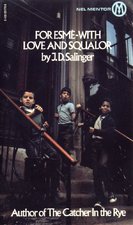
J D Salinger, For Esmé – With Love and Squalor (1953, New English Library 1978)

I read this at least partly because I wanted to learn more about the Glass family, particularly Seymour Glass’s suicide. The suicide is there, of course, in the first story in this collection, ‘A Perfect Day for Bananafish’, also Salinger’s first published story. It’s a good story, full of charm and then of shocking enigma, but there’s nothing to indicate that the author would still be probing the repercussions for the Glass family a decade later (not to mention possible further Glass Family fictions yet to be discovered … I live in hope). Boo Boo, the older of the two girls in the family, makes an appearance in ‘Down at the Dinghy’. And Buddy, the family’s self-appointed chronicler who is in danger of vanishing into his own parentheses in ‘Seymour: An Introduction’, plays a central role in the title story (at least, I assume Staff-Sergeant X is Buddy, even though I may be the only person in the world to have done so). In each of these stories, the adult Glass has a conversation with a child, and these playfully smart-alecky conversations are what lift the book above standard albeit ultra-sophisticated New Yorker fare. Boo Boo could be a forerunner of the mother in Maurice Sendak’s sublime The Sign on Rosie’s Door.  Buddy’s conversation with thirteen-year-old Esmé and her follow-up letter are surely meant to be read in counterpoint to Seymour’s chat with the little girl Sybil. The latter is either a farewell to all things lovely or a cryptic explanation of his suicide, while the former has a deeply healing effect: one brother dies, the other lives. (Incidentally, I doubt if either of these stories could have been written nowadays: in the late 40s the general reader wasn’t expected to see every man as a potential child-rapist.)

Two non-Glass stories stand out for me, both with child protagonists: ‘The Laughing Man’ and ‘Teddy’. ‘Teddy’ is genuinely shocking.

Incidentally, it occurs to me that my lack of enthusiasm for The Hurt Locker may have something to do with the fact that I saw it in the middle of reading this book. It was awfully hard to see the movie as anything other than an adrenaline pumper with pretensions when I had Staff-Sergeant (Buddy?) X’s shaking hands fresh in my mind.

I know this is racist, but …*

A little after 7 o’clock this morning I was up the street buying carrots for our breakfast juice.

‘How are you?’ I asked, as the owner weighed the carrots.

‘Good so far,’ he said.

‘Too early in the day for things to have gone too wrong?’

And we were launched into a conversation about things that can go wrong in a small supermarket like his. In particular, he said, it can be five minutes from closing time and a couple of drunks will come in and wreck the place, or steal something. But thieves are a big problem at any time of the day. (This is Annandale, remember, whose public schools’ rankings on the Sydney Morning Herald’s League Table established it as a nice middle class suburb.) Talking about ways of dealing with thieves, he said, with an apologetic shrug:

I know this is racist, but they’re mostly Australian1, and Australians think you should do things by the rules. So when I catch them they expect me to call the police. Then the police take twenty minutes to come, and the thieves just swear at me and walk away. But I don’t give a f*** about the rules, I push them to the ground and search them, then I tell them to get out of my shop and not come back.

You can’t do that with women, of course, especially if you’ve seen them put stuff down the front of their jeans, and the ‘girls’ who work behind the tills won’t do it because they shrink from violence. He does ban people from the shop if he checks the CCTV after their visit and sees that they’ve lifted something – he’ll walk up to them out in the street, tell them they’ve been sprung, and warn them off. He’ll also send a copy of their image to his brother-in-law who has a shop down the road.

(I forgot to mention, the shopkeeper is originally from Lebanon, and I expect he has an Australian passport.)

* My blog had a huge surge of hits when I gave a post a provocatively sexist-sounding title a while back, so I’m experimenting to see if racism has the same pulling power.
1 He probably would have said ‘Skips’ if we knew each other better, but we both knew who he meant by Australians.

American Rust

Philipp Meyer, American Rust (Allen & Unwin 2009)

This is another Book Club book I approached with caution. At last year’s Sydney Writers Festival, Philipp Meyer read from it  in a sleep-inducing incantatory manner that I think of as peculiarly US-literary and which made the book singularly unattractive – at least it did to me. But in the spirit of challenging my own prejudgments, I chose it as one of my take-homes at our last Book Club meeting, and eventually opened it up. (Can you tell the next meeting of the Book Club is approaching, when I’ll have to return these books, and that I’d be embarrassed to admit to not having read them?)

This one confounded my negativity. The book is beautifully written and has a plot that, thriller-like, gathers momentum to a nailbiting last 20 pages. It’s set in Buell, town in Pennsylvania, on the banks of the  Mon River, and the place is probably the single most strongly realised character of a strong cast. Factories have closed down years before the action of the book, and the town, like all its neighbouring towns, is in a bad way. There’s little to keep people there except loyalty to each other and to the place itself. The decaying buildings of the abandoned enterprises are in stark contrast to the natural beauty of the countryside.

The plot traces the repercussions of a killing: a young man kills a homeless man to save his best friend from serious harm, and the ripples spread from the two young men, the sister and father of one of them, the mother of the other and the local police chief, who is in love with the mother. Each of the six main characters sees himself or herself as in some way responsible for the death, and each of them has a point. This is deftly done: despite the terrible sense that these working-class communities have been abandoned by the forces of capitalism and government and left to increasing dysfunction, violence, drugs, despair, these are still deeply moral characters. Good people do terrible things in this book, and we come to realise that none of the people who do terrible things in it are simply evil.

There are some longueurs (it may have been one of them that Philipp Meyer chose to read at the SWF), and some darlings that perhaps should have been murdered, but the characters ring true and are never patronised, the many-stranded action makes the book hard to put down, and in the end some kind of dignity, if not happiness, is salvaged from the mess.

For Book Club purposes, I’m giving it 4 1/2 out of 5.