Notes from an Exhibition

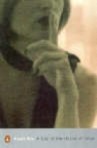
Patrick Gale, Notes from an Exhibition (2007, Harper Perennial 2008)

Consensus at the Book Club was that this is excellent. Penny brought it home as part of her swag and urged me to read it. Since she also sounded as if the book made her yearn to become a Quaker, and went to the Glebe Library to borrow every Patrick Gale novel she could find to take away on our current holiday, I understood her to be strongly recommending the book. Resistance was useless. I agree – it’s a wonderful read.

Far too many novels, even very good ones, have me at least occasionally counting how many pages I am from the end. Not this one. It reminded me of the two-laughs-a-page rule that a comic novelist friend of mine swears by – any fewer than that you’re losing the reader, he says. Notes from an Exhibition isn’t a comic novel, but it manages at least two flashes of something a page. If the descriptions of Quaker practice and ethos don’t hold you, there’s the engrossing web of relationships of a family whose mother is diagnosied as bipolar. If that’s not enough, there are engrossing accounts of an abstract painter’s creative process. There’s a steady progress towards the heart of a mystery, and a sense from early on that we’ll get the detail of a family tragedy before the last page. The narrative shifts among at least half a dozen convincing points of view and back and forth in time, so that the story emerges with four-dimensional solidity. There are sharply visualised minor characters, some of them trailing hints of complex, heart-wrenching narratives of their own. I wish I’d got to the final chapter before my other Book Group’s evening on erotica, because it includes a lovely account of a teenage boy’s first sexual encounter: a straightforward narrative, with the emotional meanings front and centre.

As you can probably tell, I’ve joined the consensus.

Patrick Gale was on Radio National’s Book Show in February, and among other things it was heartening to hear him defend his main character against Ramona Koval’s charge of being a terrible mother.
From the bush

Sent from my phone

07062009001

From the beach

06062009

Picture book for grown ups

Jenny Joseph and Pythia Ashton-Jewell (illustrator),  Warning : When I am an old woman I shall wear purple (poem © 1962, this edition Souvenir Press 1997)

0285634119I was mooching a book from someone in England, and they wanted me to take more than one book to make it worth their while. They had this illustrated Warning on their inventory. It’s a poem I’ve seen on feminist fridges for more than 30 years, so I added it to my list. I had it in mind to give to someone as a gift, but by the time it arrived – by surface mail – yesterday I’d forgotten who. So I gave it to the self-described poetry loather I live with.

She read it, said it had more in it than she remembered, and read it to me. Helped by the layout – one or occasionally two lines a page – she read it beautifully, slowly, thoughtfully. I vaguely remember reading somewhere that Jenny Joseph has said she wishes she’d never written the bl*dy thing. Certainly she’s famous for issuing take-down notices when her many fans put it up on their sites without thinking to ask. But it’s a good poem.

There’s a lot to be said for publishing poems with illustration. This is something I had used to agonise over when publishing a children’s magazine. By presenting poems with illustration were we straitening the readers’ responses, telling them how to read the poem rather than giving the words free play? It made the page more inviting, but at what expense?

I’ve had a couple of experiences recently that make me think there should be much more of it.

When Carol Ann Duffy was recently appointed Poet Laureate, I came across an animation of  one of her poems, and though I found the animation not at all to my taste, or a fair reflection of the poem, it slowed my reading down, and let the poem sink in – it’s a good poem. I’ve just found it on YouTube.

A couple of years ago, I was very taken with the Poetry Foundation’s sadly brief series Poem as Comic Strip, which similarly slowed the brain down to receptive speed. I particularly liked the Emily Dickinson–Gabrielle Bell page (this link is to a 580k PDF). See what you think.

Getting used to WordPress

I’m loving WordPress: all that information at one’s fingertips, the  list of automatically generated similar posts, the automatic snaring of possible spam etc etc. But there are one or two puzzling oddities. On my “Dashboard” I’m given a list of the links on my site that people have clicked on, and a list of the sites that have referred people here. Today the former list included three porn sites. I went through my site, including a look at the source code, and couldn’t find any such links here. And  the other list included referrals from a site that, when I went to it, was some kind of template, unreadable and containing no discernible link to me.

Oh well. I suppose some of it is my own fault somehow for using the word “er*t*c*” in not one but two titles. Mind you, that word has attracted very few searches and only one comment promoting steamy prose so far, so it doesn’t look like a disaster at all.

Erotica: the morning after

Having done a “before” post, I now feel obliged to do an “after”.

As it turned out we were all white, middle-aged, heterosexual and in long-term relationships. No one had much interest in discussing Anaïs Nin – most hadn’t been interested enough in Delta of Venus to read the whole thing, though one chap had read a second, similar collection of her dollar-a-page pieces, and another had read some of her diaries. Someone went to the trouble of saying he found some of it offensive. We decided she belonged to another era, and moved on. (Is there something of hers that you, dear reader, would recommend?)

It turned out that if I am timidly vanilla in my taste for erotica I was in a room of similarly minded souls. I did read the Kathryn Lomer poem, and people liked it. One of our number had assiduously ransacked his memory, the web (by googling “erotic poetry”) and the bookshelves at an auction down the road, and shared some gems he’s found. He read us a steamy encounter between Elizabeth Bennett and Darcy in Pride and Promiscuity : The Lost Sex Scenes of Jane Austen – we agreed that that’s probably a perfect read-aloud book for consenting adults. He played recordings of two marvellous poems, one from ancient Egypt and another incorporating a Native American story about a winged penis. He read, with some apologies, Charles Bukowski’s “Like a Flower in the Rain” (warning, that link includes anatomically correct four-letter words), in which one can only marvel at how one word can transform a poem. Someone mentioned the bath scene in The Reader. We talked a little about the early scenes in Silk.

We kept asking each other what makes something erotic rather than pornographic. Clearly our collective taste veered to the non-pornographic end of erotica. We agreed we like our erotica with a bit of wit, a lack of emphasis on the plumbing (though no aversion to it being named), a context, and a sense of minds being engaged.

Next meeting, Anna Karenina.

Fun Fearless Niece

My fabulous nieces turn up in the most unexpected places. One of them is in the shortlist for Cosmopolitan’s Fun Fearless Females 2009 awards. I’m not surprised to discover that I hadn’t heard of most of the other people on the short list. None of the bloggers, for example, have crossed my radar– I went for a look and understood why, but I won’t go on about that. My niece Paula is on the Authors shortlist – along with the formidable Chloe Hooper and a number of others who have been invisible to me until now, though I don’t expect my ignorance has caused them much heartache.

I cast my vote in a number of categories. Why don’t you go and cast yours? The good thing is you’re not restricted to the names they’ve listed. You can add your own. Perhaps there’ll be a write-in landslide for Lowitja O’Donoghue in the Inspirational Role Model category.

Erotica

Anaïs Nin, A Spy in the House of Love (©1954, Penguin 2001)
—-, Delta of Venus (©1969, Penguin 1978)
Alessandro Baricco, Silk (translated by Guido Waldman, The Harvill Press 1997)

Tonight at my book group (this is the all male one) we turn our collective attention to erotica. (Welcome everyone who found this entry via a google search.) A number of us had heard of Anaïs Nin, so we decided to go with a couple of her books, though there was an invitation to bring along a passage to read aloud from anywhere else. I’m posting this before the meeting.

810Of A Spy in the House of Love, the less said by me the better: not so much erotica as neurotica. The long, ecstatic paragraph near the start that ended ‘but only that one ritual, a joyous, joyous, joyous impaling of woman on a man’s sensual mast’ had me thinking that if that was erotica I’d happily do without it. Thankfully there were no recurrences.

Maybe I’m showing my age, but I can’t say I warmed to Delta of Venus, either, 0140184708which had lots of impaling. The most interesting thing about the book is probably the introductory pages, excerpts from Anaïs Nin’s 1940 diaries describing the way she and a swathe of her literary friends churned out erotica for a mysterious ‘Collector’ for a dollar a page.

Back in 1970 or so, there was a lot of anti-censorship activity in Sydney, including the publication of pornographic editions of student newspapers and “Porn Fests”, at which distinguished academics and undistinguished enthusiasts read rude bits from Henry Miller, Sam Shepard, John Wilmot second earl of Rochester, the Marquis de Sade and so on to crowded lecture theatres. It was all in a good cause – blows struck in the struggle for free speech – and some of it was funny, but overall it was squirm-making. Delta of Venus seems to me to belong in that context: it does contain some characters and narrative, but the ‘dirty bits’ are its raison d’être. Already dated in 1976 when Anaïs Nin decided to publish it, it reads as totally quaint now, quaint and vicious in its playing with paedophilia, incest, rape and so on. However, I did read it from cover to cover, so it clearly has titillation value. What I’ve realised is that if writing is to work as erotica for me, it needs to arise from a complex, recognisably human reality. Maybe we should have agreed to read Anaïs Nin’s diaries, where presumably she talks about more than who is doing what to whom with what.

1860462588I went to the theatre on Sunday with another group member, who was similarly unenthused by the Anaïs Nin books. Someone had recommended Silk to him, and he lent it to me with his recommendation. It’s a very short book, something of a fable about love and passion. Most of it is taken up with a slow-building sexual charge. Then there are a couple of explicit, erotic pages – which work because they’ve had 80 pages of build-up. Then the tale ends with a bitter-sweet twist that makes one want to re-read the erotic pages again …

At the moment I’m tossing up what read-aloud to take tonight: A D Hope’s ‘The Countess of Pembroke’s Dream’ perhaps, or Kathryn Lomer’s ‘Tentative love poem’, which begins:

Snow comes late; only the air
between our mouths is warm,
a microclimate in which whispered words
are storms building. Our skins catch

what little light is cast – mine reflects,
yours absorbs.

MCMLXN

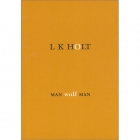
L K Holt, man wolf man (John Leonard Press 2007)

551c

man wolf man won the Kenneth Slessor Award this year. Whatever may be wrong with literary awards (promoting the view that art is a competition, for example), they do extend some readers’ range, mine included. How would I have picked this up if it hadn’t been singled out by the judging panel?  I’m glad I did pick it up.

Luke Davies is quoted on the publisher’s website as saying, ‘Holt’s is one of those voices that blast from the sky now and again, like a lightning bolt.’ To which I reply, ‘Fair enough.’ The writing in this book is sharp and playful and versatile and makes wonderful music. There are two long pieces, series of long sonnets (that is, sonnets with 18 lines – I don’t know if this is something L K Holt invented). One of them, ‘Unfinished Confession’,  starts out with almost A-D-Hopish gravitas, talking about an ancient pioneer of anatomical knowledge, then in the last lines of the first sonnet lurches into crude, impatient vernacular and reveals its totally contemporary subject, still serious, still – like much of A D Hope – rich in scientific reference and allusions to works of art, and preoccupied with sex, but very much its own thing. (I’m trying not to be spoilerish, and also keep my PG rating.) In the book as a whole, there are many delights in the patterning of language, many memorable lines.

The very first poem, ‘Man is Wolf to Man’, begins with a grim commonplace:

Until the consummation of things
man, wolf, man.

and goes on, elegantly, with a catalogue of horrors, ending:

Sometimes the enemy knocks before
entering. A baby is hidden in the drawer.

It seems to be saying that humans, or perhaps just men, are incorrigibly vicious to each other and that the best we can hope for is sometimes to protect something precious. I find this view of things repugnant, its pessimism in some way too easy (not the attribution of lupine viciousness, but the notion that it will be with us forever, that it cannot be effectively resisted). It’s a gauge of how good the book is that I intend to keep it, and reread it, and will seek out more of L K Holt’s work.

(An unsatisfactory explanation of the title of this post can be found in a post on my superseded blog, Family Life.)

Hard copy

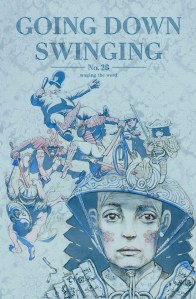
I was in Gleebooks this morning buying yet another copy of A Case of Exploding Mangoes, this one for a friend who has just gone into hospital for a longish stay, when I saw a stack of the new issue of Going Down Swinging:

GDS-FrontCover

Not only is it very beautiful, its contents include two poems by me. I didn’t buy a copy because I’ve pre-ordered six which I’ll pick up at a launch. But don’t let such considerations prevent you from splurging. There are a couple of hundred pages and a CD that feature stuff not by me, and my first quick impression is that it’s fabulous.