Journal Catch-up 23

Two more journals in my endless attempt to keep up to date!


Evelyn Araluen and Jonathan Dunk (editors), Overland 252 (Spring 2023)
(Some of the content is online at the Overland website – I’ve included links)
This Overland‘s editorial describes itself as a ‘second run’. The first run had reflected on the Voice referendum, but as publication came closer – in October last year – ‘the temptation to linger on the politics of symbolic recognition and constitutional reform seems a luxury in the face of escalating violence against Palestinians in Gaza and the West Bank’. With feet and throats sore from a solidarity march, the editors draw attention to an essay by Palestinian-Australian writer and historian Micaela Sahhar, ‘which reminds [them] of Overland‘s historic role in indexing Palestine’s survival and resistance’.

Quite apart from its serendipitous relevance, the essay, ‘An idiosyncratic archive: Overland 169 & the Wolstonecroft years‘, is a joy to read, as Sahhar revisits two copies of Overland she acquired in 2002 and 2004. She compares her reading of them then and now, talks of her relationships to people who appeared in them, and generally takes us on a journey into her mind. I love this passage – and so, I assume, do the editors:

As a journal at odds with the mainstream, Overland offered a younger version of me an intellectual place where radical thinking could reside, and a dawning awareness of a community I could take a place in. In this sense, Overland was the tangible expression of a counter to the indifference and invisibility of a young Palestinian woman, the significance of whose identity was rewritten just as she came of age at the time of a catastrophic intellectual nadir represented in 9/11; and a place of refusal against socio-political disengagement and apathy which have been the horsemen of these neo-liberal times.

The other stand-out essay is ‘The Disappearance of a.k.a. Victor Mature‘ by Vivian Blaxell, which ranges far and wide, high and low, into memoir and poetry appreciation, circling the subject of beauty. It’s a great read, from which I can’t resist quoting what may be the silliest paragraph, but one that made me laugh:

Australian English is wanton with beautiful. Beauty pops up in not the usual beautiful places there, thereby revealing the radical contingency of beauty itself, probably unintentionally: beautiful, Australians might say of a pork sausage, which seems a surprise at first until you realise that beauty does not exist before we say it exists, for beauty relies entirely on disclosure for its existence. That lucky sausage.

Other essays are a discussion by Peter D Mathews of Sophie Cunningham’s 2004 novel Geography and an idiosyncratic but fascinating essay by πO on concrete poetry in Australia and related matters.

There are five pieces of fiction and nine poems.

Of the poetry, ‘Balloch’ by Eileen Chong stands out for me. An apparently simple poem about a visit to a Scottish loch, it leaves an uncanny aftertaste that only gets richer with further readings.

The fiction covers a wide range, from a celebration of Rotuman culture (I had to look it up) by Dorell Ben to a fantasy of a catastrophic world post climate emergency by Jodie How, with a little social realism by Chloe Hillary and other pieces in between.


Alexandra Christie (editor), Heat Series 3 Nº 12 (Giramondo 2023)

This may be my last issue of Heat before my subscription expires. Despite having a selection of poems from Nam Le’s 36 Ways of Writing a Vietnamese Poem, a book I’m looking forward to, the journal is a bit of a fizzer for me, though the dominating US presence I’ve complained of in earlier issues is absent, and only one member of Heat‘s editorial advisory board gets a guernsey.

  • You can read Paddy O’Reilly’s ‘Redundant‘ on the Heat website. It’s an experimental prose piece in which the experiment seems to consist of not finishing sentences. See what you think.
  • Jordi Infeld’s ‘Poet’s Pocket’ would and indeed does pass for a short essay on sewing and related matters – just a footnote identifying one of its otherwise unremarkable phrases as a quote from Gertrude Stein’s Tender Buttons suggests deeper undercurrents.
  • ‘The Phoenix Apartment’ by Bella Li feels to me like notes towards a larger project.

Items from beyond the Anglosphere are ‘We Shall Be Monsters’, a meditation on Mary Shelley’s Frankenstein by Argentinian writer Esther Cross, translated by Alice Whitmore, and six terrific short poems by Iranian Maryam Nazarian, translated by Malaysia-based Arash Kohshsafa. Here’s the first and shortest of the poems, which does wonderful things with an echo of William Carlos Williams’s poem about the plums:

One
I've set the breakfast, the kisses, and the keys on the table.
Please, forgive me
if I find freedom more pleasant than your love.

The most interesting piece is Stephanie Radok’s ‘Inventory 2020’, an impressionistic chronicle of a working artist’s life, made up of mostly very short entries. It reminded me of the late Antigone Kefala’s journals in the way it combined observations of the passing moment with considered reflections and descriptions of the artist’s process. As 2020 was a year when the even tenor of our lives was disrupted by Covid, a narrative emerges. Here’s the entry for 23 February, on page 77*:

23. What you thought was passing/casual was your life. And a particular red purple near a blue hillside that seemed to reflect you.

As for Nam Le’s poems, they seem to be part of a larger whole. I’ll wait for the book.


* My blogging practice for some time has been to focus arbitrarily on the page of a book or journal that coincides with my age.
Sydney Writers’ Festival 2024: My day one

The Sydney Writers’ Festival is always one of my annual highlights. I’m off to a very quiet start this year, just one session today in the smallish Gallery Room at the State Library. And then nothing until Friday.

12.30: And the Award Goes To …

The Festival website invites us to:

be among the first to hear from some of the winners of the 2024 NSW Premier’s Literary Awards, in a discussion covering the impact that awards can have on a writer’s career.

We did get to hear from three of the winners: Ali Cobby Eckermann (She Is the Earth), Helena Fox (The Quiet and the Loud) and Christine Keneally (Ghosts of the Orphanage). But the conversation wasn’t about the awards’ impacts. From my point of view, it was a lot more interesting than that. What follows is the best I can glean from my mostly illegible notes aided by my unreliable memory.

Bernadette Brennan, senior judge of the awards, kicked off the conversation by saying that though the three award-winning books were in different genres – a verse novel, a thoroughly researched piece of non-fiction, and a novel – they all dealt with intergenerational trauma with an emphasis on the vulnerability of children, and they all found ways of pointing to healing. That set the agenda for what followed.

Ali Cobby Eckermann spoke first, and did her best to follow the brief of the program notes. Her first verse novel, Ruby Moonlight, was written in the context of the Howard government’s Intervention in he Northern Territory. The awards it received enabled her to leave her home with her Yankunytjatjara family, go south and buy a house which she set up as a writers’ retreat. When she unexpectedly received a Windham-Campbell Literature Prize (link is to the Wikipedia entry on that prize) her life was turned upside down again. When she came to write She Is the Earth, she was very alone. But she drew on her Yankunytjatjara grannies – though they had passed, she imagined them as creating a safe place for her to create.

Helena Fox spoke in fairly abstract terms of having endured trauma as a child and an adult, and said she saw herself as opening a space where her young readers could see that it is possible to speak of hard things. Among the loud things like abuse, you have a right to be alone, quiet, to ground yourself.

Christine Keneally’s book is about terrible things done to children, focusing on the testimony of survivors from an orphanage in Vermont. Its seed was planted when she ‘wandered into a room’ at a conference in Brisbane where people were talking about the extreme difficulty of finding any record of their early childhood. She discovered the unfolding story of abuse in orphanages in Australia. She reasoned that similar things must have happened in the USA. She discovered that indeed they had, but there the only redress survivors had was through litigation, which was often a damaging process in itself. As she found and interviewed survivors, she saw what a powerful antidote talking is. She realised the importance of bearing witness – and that is what the book seeks to do.

Some snippets from the conversation that followed:

Ali Cobby Eckermann:
‘It shits me that you have to forgive everyone to heal yourself.
‘Poetry can change the dialogue about trauma away from trauma itself to something like regeneration or repair. It can turn something painful into beauty.’

Helene Fox:
How can you heal if you can’t share?

Christine Keneally:
I spoke to people who had been married for 30 years but hadn’t told their spouses about their lives. Sometimes I was the first person they told their story to.

There was a time for questions, but no one raised their hand. I’d love to know what contact Christine Keneally has had with the Lost Generations people in Australia. If I wasn’t so shy and needing to get home, I would have stopped to ask if she knew about Bryan Hartas’s autobiography Hard As (link to my blog post) and the work people like my niece Edwina Shaw have been doing helping members of the Lost Generations to tell their stories.

On my way out I heard one of the few men in the audience mutter to another, ‘What a miserable lot!’ That’s not at all how I saw it, but I guess there weren’t a lot of laughs.

I bought a copy of She Is the Earth.

2024 NSW Premier’s Literary Awards night

The NSW Premier’s Literary Awards, as we are often reminded, are Australia’s richest and longest running state-based literary awards. This year, in a break with tradition, I didn’t do a blog post when the shortlist was announced. I was happy to read a consolidated list on Lisa Hill’s blog at this link.

At that time, had read two of the Christina Stead Prize contenders. I’d seen two of the plays shortlisted for the Nick Enright Prize. I did better on the Betty Roland Prize, having seen seen three of the movies. I had read none of the poetry, none of the children’s or young people’s books, none of the non-fiction. And it turns out I have read or seen none of the winners.

Last night, the awards ceremony was live streamed. I was busy with family, so tuned in late. It’s all on YouTube and you can even watch it here, The actual video begins at 8 minutes, 40 seconds with the Welcome to Country by Uncle Brendan Kerin from the Metropolitan Lands Council, who reminds us that we have a shared history, and manages to make comedy out of his experience as a member of the Stolen Generations. After introductory speeches from librarians and the Minister for Arts, the presentation of awards by the senior judge, Bernadette Brennan, begins at 40 minutes. The video is worth watching as – in the midst of much charming humility and gratitude – person after person refers to the unfolding disaster in Gaza, explicitly or implicitly responding to recent media attacks on the judging panel.

The winners (with links to the judges’ comments):

UTS Glenda Adam’s Award for New Writing (at 40 minutes)

Anam, André Dao

Multicultural NSW Award (at 43 minutes)

Stay for Dinner, Sandhya Parappukkaaran and Michelle Pereira

Indigenous Writers’ Prize (at 48 minutes)

She Is the Earth, Ali Cobby Eckermann

Nick Enright Prize for Playwriting (at 52 minutes)

Sex Magick, Nicholas Brown (Griffin Theatre Company & Currency Press)

Betty Roland Prize for Scriptwriting (at 56 minutes)

Safe Home, Episode 1, Anna Barnes

NSW Premier’s Translation Prize (at minutes)

Patricia Wrightson Prize for Children’s Literature (at 60 minutes)

Paradise Sands: A Story of Enchantment, Levi Pinfold

Ethel Turner Prize for Young People’s Literature (at 1 hour, 2 minutes)

The Quiet and the Loud, Helena Fox

Kenneth Slessor Prize for Poetry (at 1 hour, 6 minutes)

Riverbed Sky Songs, Tae Rose Wae

Douglas Stewart Prize for Non-fiction (at 1 hour, 10 minutes)

Ghosts of the Orphanage: A Story of Mysterious Deaths, A Conspiracy of Silence, and a Search for Justice, Christine Keneally

Christina Stead Prize for Fiction (at 1 hour, 13 minutes)

    The Sitter, Angela O’Keeffe

    The People’s Choice Award (at 1 hour, 16 minutes)

    The God of No Good, Sita Walker

    Book of the Year (at 1 hour, 20 minutes)

    She Is the Earth, Ali Cobby Eckermann

    The presentations ended, as they began, with eloquent words about the lasting impact of the Stolen Generations.

    There was no special award this year.

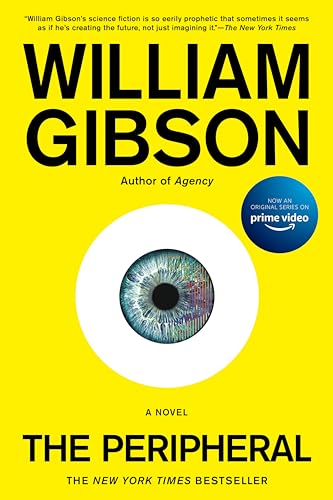
    William Gibson’s Peripheral

    William Gibson, The Peripheral (Berkly 2014)

    I picked up The Peripheral in a street library soon after I finished reading and blogging about its sequel, Agency, nearly four years ago. Since then, it has been my TBR shelf as a treat for a rainy day. Its time has now come.

    There’s a peculiar challenge in writing about it. Possibly the main thing I enjoyed about it is that a lot of the time the reader has no idea what’s actually happening. You’re not even sure what some words mean, or what the characters are not saying. Explanations do come, eventually, but there’s a delicious disorientation as AI devices and other technical marvels multiply, we only half-see crucial incidents, cultural events are described from the point of view of someone who knows a lot more about the background than the reader does. The action takes place in two unspecified future time periods that interpenetrate in often unclear ways. However serious the issues may be – and there’s a plausible version of how the global emergency will develop – there’s a pervasive sense of play. If I summarise the plot, or even the set-up, I’ll be depriving you of that experience.

    My first idea was to write about first two short chapters – all the chapters are short – but then I thought, oh what the heck, I’ll skip straight to page 77* to give you a taste, and let the spoilers fall where they will.

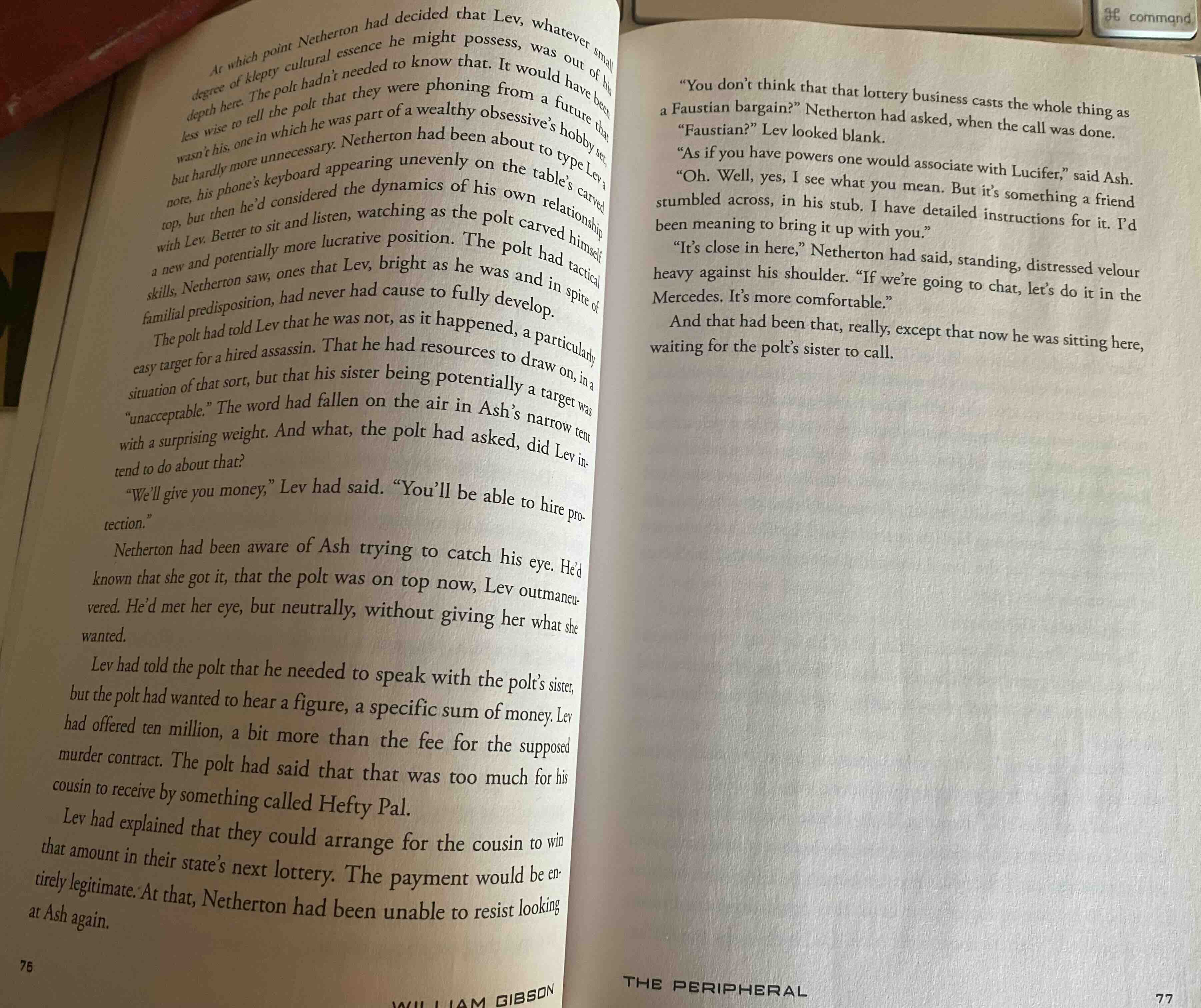
    Lev had told the polt that he needed to speak with the polt’s sister, but the polt had wanted to hear a figure, a specific sum of money. Lev had offered ten million, a bit more than the fee for the supposed murder contract. The polt had said that that was too much for his cousin to receive by something called Hefty Pal.
    Lev had explained that they could arrange for the cousin to win that amount in their state’s next lottery. The payment would be entirely legitimate.

    Gibson has a gift for coining terms. ‘Cyberspace’ is his invention. Of The Peripheral‘s many coinages, three appear in this short passage: ‘polt’, ‘Hefty Pal’ and ‘stub’. They each have the virtue of suggesting their origins if not their precise meanings. A polt, derived from poltergeist, is a person who is bodily in one place and/or time, but is somehow seeing and acting in another time. (A peripheral is a human-looking artefact, that can be the host to a polt.) Hefty is a mega corporation of which Hefty Pal, as in PayPal, is a subsidiary. A ‘stub’, known more formally as a ‘continuum’, is a key invention of the book, something that readers and half the characters come to understand only gradually. All I’ll say here is that it is something that results from people going back to an earlier time and changing that time’s future.

    There are three characters in this scene: Lev, the son of a fabulously wealthy Russian gangster capitalist, whose hobby involves mucking about with the past (stubs/continua are his playthings); Ash, a tech wiz who makes it happen for him (among other distinguishing features, she has tattoos of animals that move around on her skin, often glimpsed running for cover when someone tries to look at them); and Wilf Netterton, put-upon publicist, from whose point of view the story is told in alternate chapters. Page 77 is at the end of a Wilf chapter.

    Three more characters are referred to. ‘The polt’ is Burton, a battered veteran in Netterton’s past / our future (though that way of describing things isn’t quite accurate). ‘The polt’s sister’ is Flynne, a gamer in a small US town who is the focus of the non-Wilf chapters. Burton and – on one fateful occasion – Flynne have been employed as polts by Lev under the impression they were testing a computer game. The main narrative is set in motion by Flynne’s witnessing what may be a murder. ‘The cousin’ is Leon, one of their tribe of loyal family members.

    At that, Netherton had been unable to resist looking at Ash again.
    ‘You don’t think that that lottery business casts the whole thing as a Faustian bargain?’ Netherton had asked, when the call was done.
    ‘Faustian?’ Lev looked blank.
    ‘As if you have powers one would associate with Lucifer,’ said Ash.
    ‘Oh. Well, yes, I see what you mean. But it’s something a friend stumbled across, in his stub. I have detailed instructions for it. I’d been meaning to bring it up with you.’

    Tiny moments like this give the book its rich texture. There’s the complicity between WIlf and Ash, two underlings who have cultural memories, unlike their rich and powerful employer. (Similarly in the earlier paragraph, it’s fun that Hefty Pal is something in the reader’s future and Flynne’s present that has been forgotten in Wilf’s time.) Like the implied reference to poltergeists, the mention of Faust reminds us that even though the narrative is presented as a tale of high tech, AI and nanotechnology, it often has the feel of demonic possession and fairytale magic. (If you’ve read Gibson’s Sprawl trilogy – Neuromancer (1984), Count Zero (1986) and Mona Lisa Overdrive (1988) – you’ll remember the prominence there of the legba of Voodoo.)

    And that had been that, really, except that now he was sitting there, waiting for the polt’s sister to call

    That’s the first hint of the almost-romance that is to almost-blossom between these characters who can only spend time together by means of weird time travel mediated by a peripheral in one direction and an odd little children’s toy in the other.

    Now I’m tempted to reread Agency. I remember that it was also gleefully inventive and similarly had two interrelating times. I’m pretty sure that some of the distant future characters are in both books, but my memory is dim. William Gibson is anything but dim.


    I wrote this blog post on the unceded land of the Gadigal and Wangal clans of the Eora Nation, not far from where what we now call the Cooks River has been cared for by Elders for many millennia. The weather has just turned cold, but spider webs are still proliferating.


    * My blogging practice is to focus arbitrarily on the page of a book that coincides with my age, currently page 77. For The Peripheral, I’ve included a little from page 76 as well.

    Ivy Ireland’s Tide

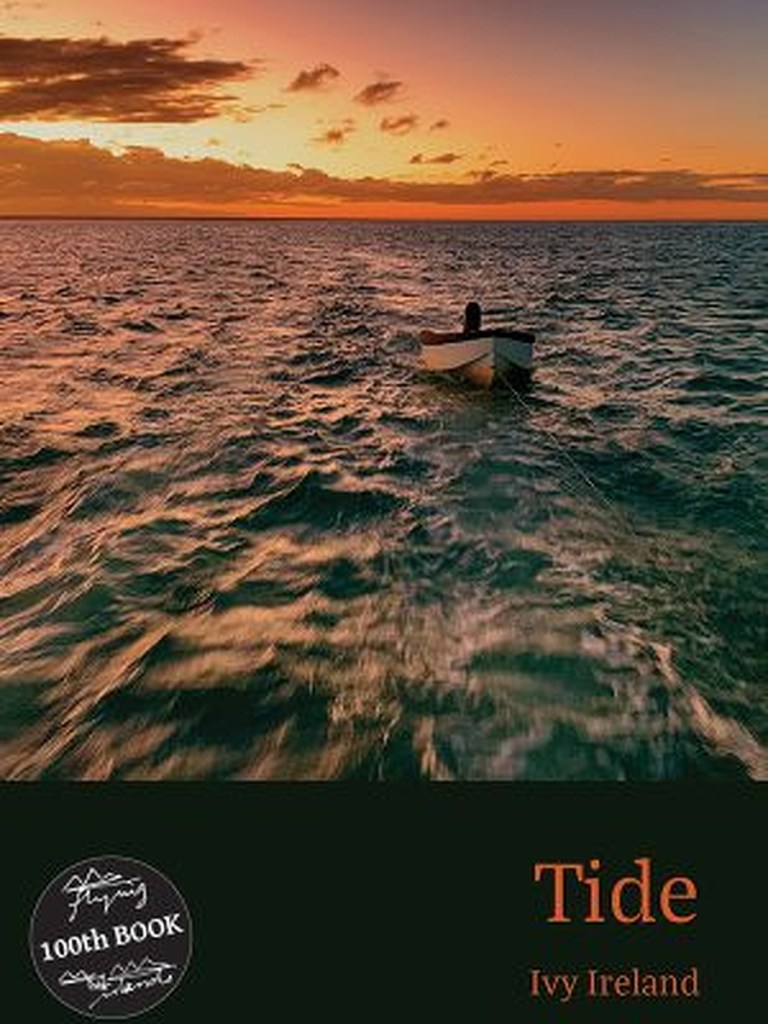
    Ivy Ireland, Tide (Flying Island Books 2024)

    Tide may seem like a quietly generic title for a book, especially one that has a number of poems about the sea, but a laconic note on sources suggests a dark subtext:

    The title of this book, Tide, and the title of the poem, ‘A Shallow Boat’, are both taken from Alfred, Lord Tennyson’s poem ‘The Lady of Shalott’ (1832) with the necessary reverence.

    I decided to read the Tennyson poem. I’m pretty sure I hadn’t read it before, but many of its lines (‘the mirror cracked from side to side’, ‘The curse is come upon me’) were familiar, probably from young Dorothy Hewett’s romanticism as recorded in her autobiography, Wild Card. Certainly Ivy Ireland’s compressed, science-related poems, with close observations of the real world, are not at all like Tennyson’s flowery, relentlessly rhyming lines. The word ‘tide’ occurs only once:

    For ere she reach'd upon the tide
    The first house by the water-side,
    Singing in her song she died,
    The Lady of Shalott.

    The note on sources, then, leads one to expect something death-related: the tide is metaphorical, bearing us inexorably away. The book only partly meets that expectation. There’s a lot of life here, and not much death.

    The book is divided into four sections of unequal length named for tidal phases: ‘Ebb’, ‘Low’, ‘Flood’, and ‘High’. If I had to pick favourites, I’d say I enjoyed the poems in ‘Low’ most: in ‘Lake Poet’, in the context of the climate emergency (not explicitly named, but definitely there in my mind) the lake is less a thing of sublime beauty than a place that will hold the poet to account, as opposed to the city, where ‘nobody has to answer for anything; in ‘Cane Toad’, the poet and her young daughter encounter some teenagers on Valentine’s Day:

    She asks me,
    of all people,
    if they are going to marry,
    those beatified ones,
    out decking each other in posies
    in the quiet toilet paper aisle.

    ‘Killing Plovers’ is a yarn about family life that takes on a fable-like quality about humans’ relations to other animals; ‘The Birth of the Universe’ is a wonderful poem about a) the Big Bang and b) giving birth.

    The section ‘Flood’ comprises six prose poems, including ‘I Am John Is Dead’, long enough to be called a short story, about a young woman’s encounter with a New Age guru in the outback, which accurately describes itself as ‘like a Jim Jarmusch film’.

    Page 47* is the title page for the book’s final section, ‘High’. The section includes just one poem, ‘A Shallow Boat’, in which the narrator with one other person goes sailing off the Queensland coast. Since the note on sources mentions this poem, I looked at the Tennyson poem again, and found:

    In the stormy east-wind straining,
    The pale yellow woods were waning,
    The broad stream in his banks complaining,
    Heavily the low sky raining
    Over tower'd Camelot;
    Outside the isle a shallow boat
    Beneath a willow lay afloat,
    Below the carven stern she wrote,
    The Lady of Shalott.

    This is the boat on which the Lady of Shalott floated to her doom.

    Happily, the speaker of Ivy Ireland’s sailing excursion survives, having had a very nice time, even if it is sometimes scary and perhaps humiliating as she feels her incompetence.

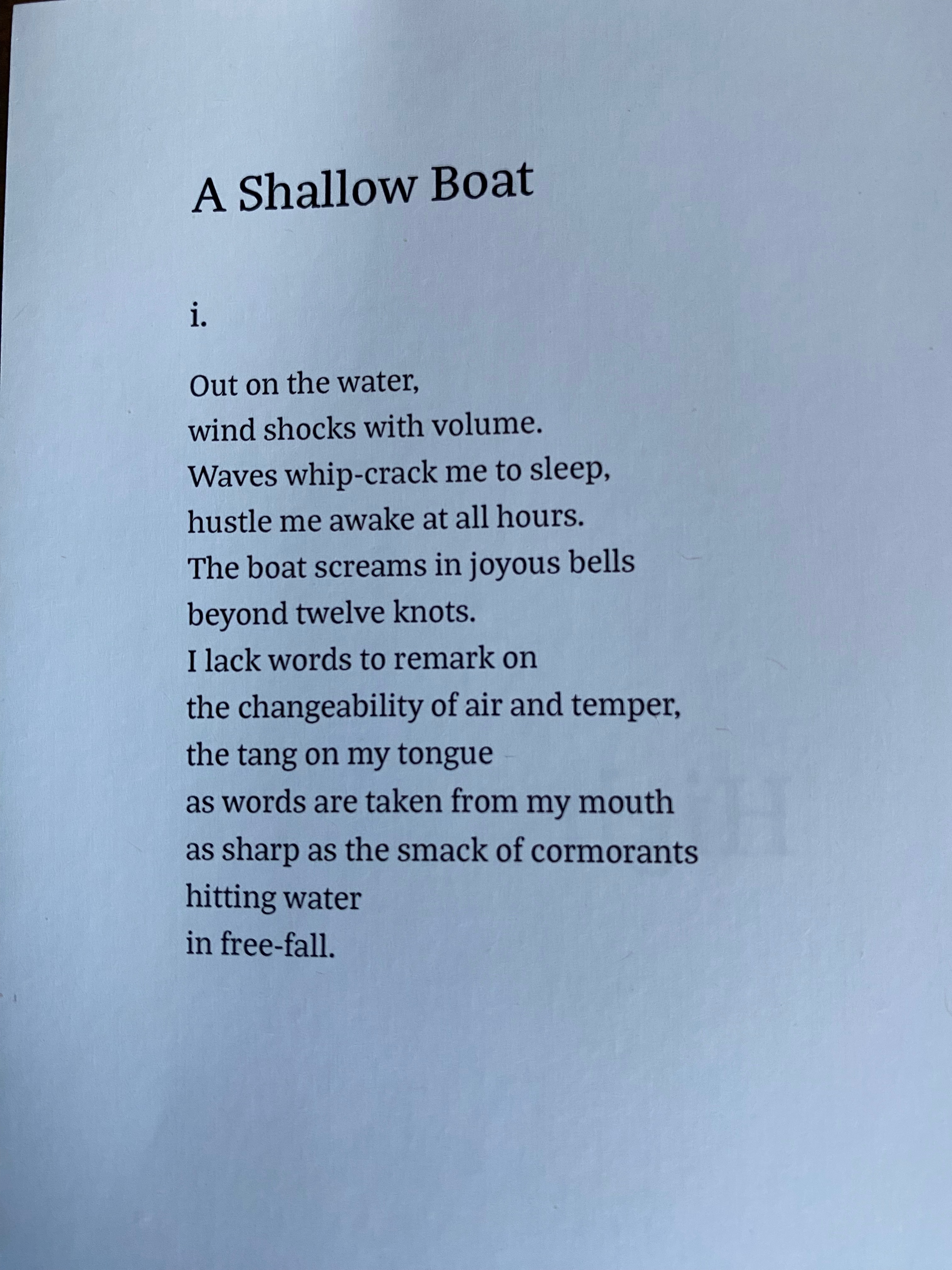
    Here’s the first of the poem’s 12 parts, from page 48:

    A Shallow Boat

    1.

    Out on the water,
    wind shocks with volume.
    Waves whip-crack me to sleep,
    hustle me awake at all hours.
    The boat screams in joyous bells
    beyond twelve knots.
    I lack words to remark on
    the changeability of air and temper,
    the tang on my tongue
    as words are taken from my mouth
    as sharp as the smack of cormorants
    hitting water
    in free-fall.

    All I really want to say about this is that I love it. I have no desire to go sailing. I breathe a guilty sigh of relief when I realise that the Emerging Artist gets seasick very easily, so is unlikely to be urging me to do it. But I love it as evoked in this poem.

    The poem is almost a sonnet. The first six lines describe the wind, the waves, the sounds of the boat. Then there’s a turn, and in the next five lines the poet tries and fails to articulate a response. Then there’s a three-line equivalent to a sonnet’s final couplet – rather than a witty encapsulation of what has gone before, here it’s the cormorants, ostensibly a metaphor for the poet’s speechlessness but actually just there, smacking the water.

    Every verb, every adjective, every noun is carrying its share of the meaning-load, and the sound design is wonderful. The echoing Ws bind the lines together, with a little respite for Ts (‘temper’, ‘tang’, ‘tongue’, ‘taken’, and then ‘cormorants’) in lines 8 to 11. Back to W and then the Fs in the last line introduce a new, final sound.

    The Tennysonian hints of doom may be realised in later parts of the poem, as in these chillingly succinct lines from part viii:

    There's a point 
    where climate emergency,
    once witnessed,
    ticks over from
    possible to inevitable;
    anything else is inconceivable.

    But that’s context rather than substance. The joy in this poem, as in the whole book, is in celebrating engagement with the natural world, vulnerable, dangerous, fragile, awesome, beautiful, breathtaking (sometimes literally). From section ix:

    Orange shifts over the horizon, and here we are: 
    alive, while countless others are not.
    Who am I to deserve daybreak. This happening here,
    sea eagle fishing beside the boat,
    sea turtle snorting to the surface. What's it for,
    to be so honoured.

    I wrote this blog post on land of the Gadigal and Wangal clans of the Eora Nation. I’m posting it on a day that has shifted from bright blue sky to heavy downpour within hours. From my window I can see wet gum leaves reflecting the afternoon sunlight as they have been witnessed by First nations peoples here for tens of thousands of years.


    * My blogging practice for some time has been to focus arbitrarily on the page of a book that coincides with my age. A focus on just one page seems to me to be almost necessary with books of poetry, where the parts are so often greater than the whole. As Tide has fewer than 77 pages, so I’m focusing instead on my birth year, ’47.

    The Essays of Montaigne, progress report 2

    Michel de Montaigne, The Complete Essays (Penguin Classics 1991, translated by M. A. Screech) Book 1, from part way through Essay 26, ‘On educating children’, to Essay 41, ‘On not sharing one’s fame’

    I’m enjoying my morning read of Montaigne, now at the end of my second month.

    As expected, his name has cropped up elsewhere. The time I noticed was on Waleed Aly and Scott Stephens’s podcast The Minefield, when talking about the recent stabbings in Sydney. Scott referred to the essay that M. A. Screech translates as ‘On Affectionate Relationships’ to illustrate something he was saying about grief.

    That essay was one I read this month. Though its discussion of grief is wonderful, the thing that stands out for me in it is his exalted notion of friendship. The meeting of souls that these days tends to be identified, hopefully, as part of romantic love he sees as quite distinct, and separate, from the love of spouse (he says ‘wife’) or children. Revisiting them now, I see that the paragraphs on grief are wonderful. For example:

    I drag wearily on. The very pleasures which are proffered me do not console me: they redouble my sorrow at his loss. In everything we were halves: I feel I am stealing his share from him. (Page 217)

    The essays I have just read are ‘Reflections upon Cicero’ and ‘On not sharing one’s fame’. I wish my Latin teachers could have told me about the Cicero one in high school: it would have made it much more fun to study that ‘Cui bono?’ speech if I’d known how Montaigne despised its author. Speaking of Cicero and Pliny the Younger, he writes:

    What surpasses all vulgarity of mind in people of such rank is to have sought to extract some major glory from chatter and verbiage, using to that end even private letters written to their friends; when some of their letters could not be sent as the occasion for them had lapsed they published them all the same, with the worthy excuse that they did not want to waste their long nights of toil! How becoming in two Roman consuls, sovereign governors of the commonwealth which was mistress of the world, to use their leisure to construct and nicely clap together some fair missive or other, in order to gain from it the reputation of having thoroughly mastered the language of their nanny! (Page 279)

    Then, wonderfully, two pages later in ‘On not sharing one’s fame’, in discussing the way ‘concern for reputation and glory’ is the most accepted and most universal of ‘all the lunacies in this world’ he writes this, without a trace of his earlier disparagement:

    For, as Cicero says, even those who fight it still want their books against it to bear their names in the title and hope to become famous for despising fame.

    But then, he regularly says that he has a poor memory.

    The very last thing I read this morning is a wonderful example of how Montaigne can surprise and delight (though it’s also an example of the violence that permeates Montaigne’s world). He has been piling on examples of people (all male) who have acted to enhance someone else’s fame and glory, often to the detriment of their own. Then, in the last couple of sentences he swerves off into a comic non sequitur:

    Somebody in my own time was criticised by the King for ‘laying hands on a clergyman’; he strongly and firmly denied it: all he had done was to thrash him and trample on him. (Page 289)


    This blog post, like most of mine, was written on Gadigal-Wangal land as the days grow shorter and spiderwebs multiply, even in the heavy rain. I acknowledge the Elders past, present and emerging of those Nations.

    The Book Group & Richard Flanagan’s Question 7, page 77

    Richard Flanagan, Question 7 (Knopf 2023)

    Before the meeting: Richard Flanagan is a giant of Australian literature. His non-fiction work has been transformative. He has won the Booker Prize and many other awards.

    Before this year, I had read one and a half of his novels and had no desire to read any more. My blog posts on The Unknown Terrorist and Wanting speak for themselves.

    So, bidden by the Book Group, I came to Question 7 bristling with prejudice.

    I was not encouraged by this passage on the second page:

    Sometimes I wonder why we keep returning to beginnings – why we seek the single thread we might pull to unravel the tapestry we call our life in the hope that behind it we will find the truth of why.
    But there is no truth. There is only why. And when we look closer we see that behind that why is just another tapestry.
    And behind it another, and another, until we arrive at oblivion.

    Oh really? Other opinions are available, but this struck me as the kind of thing Les Murray meant when he described another of Richard Flanagan’s books as ‘superficial, showy and pretentious’ (link here)?

    But what the Book Group wants, the Book Group gets … I read on.

    I found a lot to dislike. The whole Question 7 schtick struck me as ‘superficial, showy and pretentious’ (more about that later). There are a couple of pages that could have been written by a self-righteous teenager, denouncing Oxford holus bolus as misogynist, racist and imperialist; a sneer often hovers at the edge of Flanagan’s descriptions of other writers; there’s a muddled insistence that all time is now – a kind of mix-up of Kurt Vonnegut in The Sirens of Titan and co-opted Indigenous notions. Regularly, out of the blue, there will be a bit of ‘philosophising’ about the uselessness of words, or a portentous one-line paragraph: Chekhov’s non-sequitur, ‘Who loves longest?’ or the sub-Vonnegut refrain, ‘That’s life.’

    It could have been an engrossing book. There are powerful portraits of his grandmother, his mother and his father, and a gruelling, operatic account of near-death as a young adult. Above all, there’s the way Flanagan sets out to explore his own origins in the context of world history.

    His father was a prisoner of the Japanese in 1945 and would have died in the camp if not for the nuclear bombs dropped on Hiroshima and Nagasaki – Flanagan owes his existence to that massively destructive act.

    The book comes at that painful paradox from a number of angles: his father’s reminiscences of the camp; his own visit to its site, including an encounter with a former guard; stories about H. G. Wells, who coined the phrase ‘atom bomb’; the life of Leo Szilard, the scientist who first conceived of a chain reaction and after 1945 became a tireless campaigner for nuclear disarmament. It’s a fascinating tapestry of interlacing lives, thoughts and actions.

    Flanagan is a Tasmanian, so he also owes his existence to the genocidal dispossession of the First Nations of luwitja. (In one of the recurrences that the book delights in, H. G. Wells’s novel The War of the Worlds was inspired that history.) There are powerful passages about colonisation, which (to my mind) he undermines by describing the term settler colonial society as lazy thinking because it hides the inequalities on which what he calls ‘the new Martian world’ was built. His point is that many of the first non-Indigenous arrivals were convicts, suffering terribly under the British system – and among them he counts his forebears. IMHO, settler colonial society is a fine term: patriarchy doesn’t hide inequalities among men; capitalist society doesn’t hide inequalities in our current world. The fact that you suffer doesn’t change the fact that you play an oppressive role. Not that Flanagan denies that, but he want to make it clear that his people were primarily victims rather than perpetrators.

    But I’m getting irritated again.

    Page 77* does not show the book in its best light. It falls in the midst of an excursion into historical fiction involving H. G. Wells.

    The much younger Rebecca West has come into Wells’s life, and they are mutually entranced. After a first passionate kiss, he withdraws – not so much because he already has a wife and a mistress as because, according to Flanagan, she is too much his equal.

    All that is evidently true to the known facts. West and Wells’s relationship was to endure. She had a son with him and they remained friends until his death. But at page 77 that’s all in the future, and she is struggling with his rejection of her:

    Rebecca West, though, was not for defeat. For her, love and victory were synonyms. And she was not one for losing. She coupled audacity and ambition with an idea of stability she would forever after mistake older men as offering. She held herself to a high standard. She had written only a few months earlier how unrequited love was pathetic and undignified, adding as proof her contention that Christianity lacked dignity – and by implication was pathetic – not because Christ was crucified, but because his love for the world was unrequited. ‘A passion that fails to inspire passion,’ she wrote, ‘is defeated in the main object of its being.’

    Having dispensed with God, she wrote to Wells that she was going to kill herself after being rejected by him, that all she could do was love. She had tried to hack the overwhelming love she felt for him back to the little thing he seemed to want. But even that, she realised, was too much for him.

    Does that feel to you like a real person? Is it respectful of the historical Rebecca West? Does it use its sources fairly or even accurately? On the latter point, I looked up the essay it quotes (in The Freewoman, July 2012). It’s a brilliantly witty takedown of a book of literary history, in which the reference to Christ is cheeky, but not dismissive and not meant to prove anything. Flanagan is being snide, and not pretending otherwise. His Rebecca West is basically a comic character.

    But what is she doing in this book at all? Maybe she’s there to establish that Wells was a truly complex, flawed human being (‘flawed’, to be specific, means physically ugly and using high-sounding ideals of free love to justify his promiscuity). It also serves the purpose of having a strong female presence in the historical part of the novel, which is otherwise full of men. This particular passage may owe something to her reference to Jesus echoing a repeated line in Flanagan’s The Unknown Terrorist: ‘the innocent heart of Jesus could never have enough of human love.’

    The West–Wells story also, confusingly I think, seems to relate to the book’s title. That title is a riff on an early Chekhov short story, ‘Questions Posed by a Mad Mathematician’, an absurd parody of a mathematics quiz. The seventh quiz item starts with trains leaving stations at various times and ends with the non-sequitur question, ‘Who loves longer, a man or a woman?’ Because it’s posed as a question about gender, the Wells–West story (the only romance in the book) seems to hark back to it, but I think now probably not, as the version of the question that pops like a refrain, is simply, ‘Who loves longer?’ (Incidentally, the only version of Chekhov’s story I could find online, at this link, translates the question as, ‘Who is capable of loving?’ I’d be interested to know if the gendered version of the question is more a product of the gendered nature of the Russian language than of Chekhov’s intention.)

    In the rest of the page, we follow the West-resistant Wells to Switzerland:

    Wells arrived at his mistress’s magnificent Swiss retreat with his two sons and half a suitcase of scientific reprints concerning the recent discoveries about radium – discoveries that, he told Little e, as he called the diminutive Elizabeth, pleasantly took his mind as far away as laudanum once had Samuel Taylor Coleridge’s and which would form the basis of the novel he would write – the story of man summoning a power equivalent to the sun.

    Wells runs from West to write the novel that is his reason for being in this book. It’s The World Set Free, in which he will coin the term ‘atom bomb’ and imagine with amazing accuracy the devastation such a bomb was to create. (I’m depending on Flanagan’s description. The novel is available at Project Gutenberg for the truly dedicated.)

    Presumably the real-life Wells is being cited here, but what sense does it make to say that his lifelong interest in science was like a drug? In the immediate context, the implication seems to be that his interest in radioactivity is a distraction from the emotional turmoil associated with with Rebecca West. Am I wrong to read this as a sneer?

    So, I look forward to having the virtues of the book made clear to me by people who have not been blinded by their own grumpiness.

    After the meeting: After a wonderfully eclectic dinner over which we had exchanged important information about dumplings and life in general, we had one of the most interesting and spirited Book Group discussions ever.

    Evidently it’s a love-it-or-hate-it book, and we were fairly evenly divided.

    One man had hated the Wells-West thread so much that he re-read the book leaving it out, only to discover that he still hated the book, and spent days trying to figure out why. As I understand it, he realised that he regularly came up against a closing off of possibilities – just as Flanagan proclaimed he was opening up to complexity he would shut things down with a piece of certainty.

    Another, on the contrary, read the book as an anti-narrative. Those shutting-down moments were a way of frustrating our quest for simple answers in an impossibly complex world. It’s important that Question 7 is about love, because all through the book there’s a dreadful intertwining of love and brutality.

    Where some felt Flanagan was arrogant and withheld, others read him as exposing his own vulnerability. One loved the Rebecca West story; another loathed it. One read out a passage he particularly loved eliciting sympathetic nods from some and groans from others. Some felt that the book spoke directly to their own experience as colonial settlers, others not so much. I had to admit that I had got fixated on the things that annoyed me, and disregarded things that otherwise would have fed my soul.

    None of us had previously heard of Leo Szilard. One of us said he now has Family Matters, by Flanagan’s brother Martin, on his to-be-read list, as a supplement to Richard’s account of his parents.

    It was amazing! I don’t think anyone left feeling bruised. For myself, I intend to reread the book. But not for a while.


    * My blogging practice for some time has been to focus arbitrarily on the page of a book that coincides with my age. Surprisingly, this page often reveals interesting things about the book as a whole.

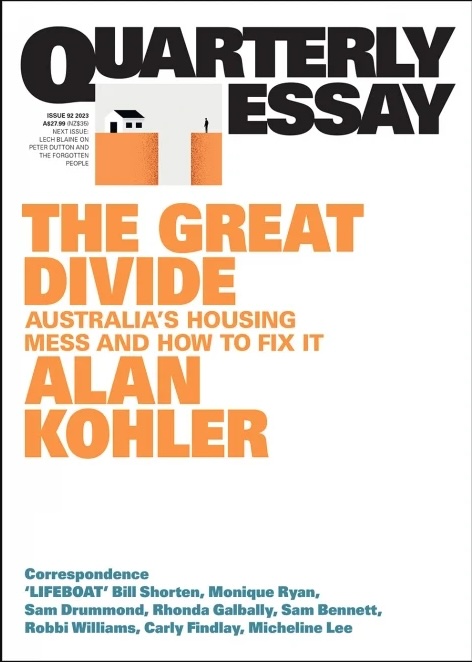
    Alan Kohler’s Great Divide

    Alan Kohler, The Great Divide: Australia’s Housing Mess and How to Fix It (Quarterly Essay 92, 2023) – plus correspondence in Quarterly Essay 93

    Alan Kohler appears regularly on the ABC News, the genial presenter of largely incomprehensible finance updates. He usually flashes up a chart or two, giving the impression he’s doing it for his own amusement as much as our enlightenment, and then signs off, ‘And that’s finance.’

    This Quarterly Essay has some of that trademark geniality, and it has graphs, but it’s a long way from incomprehensible. As someone who is near-illiterate about economics, I found it wonderfully instructive about the background and causes of the current housing crisis, and while his proposed solutions seem unlikely to be implemented I could follow their logic.

    The key issue is probably obvious, but it’s a joy to see it named so clearly:

    The houses we live in the places we call home and bring up our families in, have been turned into speculative investment assets by fifty years of government policy failure. (Page 3)

    The notion of a home as investment goes back further than 50 years, as the essay describes, but as with so many of the ills of contemporary Australia, it got a big boost under the prime ministership of John Howard. Then, around the turn of the century, three main things pushed up demand for housing and consequently the price:

    A sharp life in immigration that increased the number of people needing a place to live; capital ganis tax breaks and negative gearing, which represent a $96 billion per year subsidy for buying houses;and federal first home buyer grants, which represent a $1.5 billion direct addition to house prices each year. (Page 7)

    Add into the mix the conflicting concerns of the three different levels of government, particularly the stalemate that results when state governments push for medium density housing in areas where local governments insist on restrictive zoning regulations.

    On the reluctance of politicians to do something about the cost of housing, Alan Kohler quotes John Howard’s bon mot (or mauvais mot if you like): ‘No one came up to me to complain about the increase in the value of their home.’ A sizeable portion of the electorate – home owners and many aspiring home owners – have a vested interest in having prices continue to increase.

    Kohler expands lucidly on all these matters, and goes on to propose solutions: of course, to increase the supply of housing, for which he makes a number of suggesrtions; ‘a big investment in trains designed to at least double, preferably triple, the commutable distance from the capital cities and industrial inner suburbs where people work’; ‘reducing demand by restricting negative gearing and increasing capital gains tax’, which ‘should happen, but probably won’t; ‘increasing the supply of medium density in existing suburbs through better zoning and planning’ (which is ‘still more talk than action’); and more abstractly, for government to set an ‘affordability target’, to reduce the ratio of house prices to wages.

    On page 77*, Kohler expands on that last proposal:

    House prices need to stay put for a while and allow incomes to catch up. Average weekly earnings are currently rising at about 4 per cent a year. For the national median house price [at time of writing the essay] of $740,668 to be 3.5 times income, the average wage would have to be $210,000, more than double what it is now. At 4 per cent growth in incomes per year, that would take about eighteen years.
    The only time house prices remained unchanged for that long was from 1930 to 1949 – that is, during the Great Depression and the period of price controls in the war. Even after the recessions of 1982 and 1991, it took less than half that long for prices to start rising again.
    So fifteen to twenty years of static house prices would be unprecedented, but that sort of time frame might also get Australians out of the habit of thinking that house prices always rise and that housing is the best way to build wealth. And if housing affordability is to be properly dealt with, we have to change that mindset, because house prices won’t stop rising at twice the rate of incomes unless we stop expecting them to.


    Alan Kohler’s 86-page essay generated more than 50 pages of correspondence in the next Quarterly Essay (Lech Blaine’s Bad Cop: Peter Dutton’s Strongman Politics). The correspondents range from qualified approval, such as Joseph Walker’s description of the essay as ‘sober, necessary and broadly correct in its conclusions’ to this scathing ‘stay-in-your-lane’ dismissal by Peter Tulip, chief economist at the Liberal-Party aligned Centre for Independent Studies:

    Public discussion of housing policy suffers from undisciplined eclecticism. Too many commentators provide long, unstructured lists of multiple causes or conclude that the truth lies between competing explanations. This muddle reflects an inability or an unwillingness to distinguish the important from the unimportant. Alan Kohler’s Great Divide and the accompanying media coverage are examples.

    There’s a lot of robust discussion, which (did I mention that I’m ignorant about economics) I can only watch in dismay. Everyone agrees that there is a problem – that, as Kohler says in the essay, ‘the high price of housing is undermining social cohesion and the proper functioning of the economy and the nation.’ And it’s heartening to see so many people who have invested so much thinking and action in the issue. I’ll give Alan Kohler the last word (it is the last paragraph of his gracious Response to Correspondence):

    The process of researching this subject and then engaging with responses to my essay has confirmed that this is a subject about which a lot of people have been thinking deeply and expertly for a long time, and Australia is well served by them. It’s just a pity they are not listened to more. We are less well served by the politicians and bureaucrats whose job it is to do something about it.


    My fairly arbitrary blogging practice is to focus on the page of a book that coincides with my age. This page often reveals interesting things about the book as a whole.

    The Book Club and Paul Murray’s Bee Sting

    Paul Murray, The Bee Sting (Hamish Hamilton 2023)

    Before the meeting: Grandparenting during school holidays has left me with very little time to write about The Bee Sting before the Book Club meets, so this may be sketchy.

    I loved it. It’s a beautifully written Irish novel, a family saga in which each chapter focuses on a family member in rotation, with a couple of other characters taking a chapter each. A teenage girl, Cass, can’t wait to leave her tiny village behind and go to University in Dublin with her unreliable best friend. Her younger brother, PJ, is in a world of trouble at school. Their father, Dickie, is in much worse trouble as his Volkwagen dealership, inherited from his tough-man father, is falling on hard times, and – as we discover – that’s the least of his worries. Their mother, Imelda, formerly a stunning beauty, is bitterly discontented. There’s adultery, blackmail, teenage alcoholism, survivalist adventures in the woods, small-town scandal-mongering, a malign version of the Terence Stamp character in Pasolini’s Teorema, and a final chapter that feels like a version of the opening of Act Two of Sondheim’s Into the Woods

    A friend of mine who worked as an assistant director on TV says he usually has to read a novel twice: the first time he is in professional mode, taking note of the locations; only on the second reading can he attend to characters and plot. I’m pretty sure he would love his first read of The Bee Sting. The locations are brilliantly realised: a shed in the woods that is in turn a place for young people to hang out, a site of sexual danger, a survivalist project, a place for a secret stash, and the focus of the book’s final movement; the prestigious but grungy ‘Rooms’ at Trinity College; the elegant, dilapidated family home; the contrasting house where Imelda grew up; some new project homes that have been left unfinished when the Celtic Tiger failed.

    What kept me in thrall, though, was the way characters’ back stories unfold like petals on a surprising flower, involving among other things the tragic death of Dickie’s elder brother (a local sports hero who had been engaged to Imelda and who was, we believe, the apple of his father’s eye), a car accident that injured Dickie in his days at Trinity College, and the titular bee sting that meant Imelda’s face remained hidden under her veil at her wedding.

    The story of the bee sting turns out to be just that: a story. And the same goes for almost every story from the family’s past.

    Rather than saying any more about the book in general, I want to focus on one moment. It involves a minor character named Willie. As a young man at Trinity he embodies the brilliantly witty, ironic, flamboyant element of university life that intimidates and entrances young Dickie fresh from small-town life. When Dickie leaves university after his brother’s death, Willie disappears from the book, only to turn up much later to give a talk that Cass attends almost by accident. The talk goes for roughly five pages, and is a brilliant example of a scene that does many things at once: it brings us up to date with WIllie’s life, showing him to us in a new light; it gives his perspective on a key incident that until now we have only seen from Dickie’s point of view; it moves Cass along decisively on her trajectory; it brings to the fore the book’s preoccupation with climate change and – possibly – allows the author to put an argument that’s dear to his heart. At least, it spoke to me as if from his heart:

    Here’s a little from toward the end the speech:

    Togetherness is crucial, if we’re to tackle something as total as climate change. Banging your own little drum, demanding everyone look at your mask, be it a consumer status symbol or one of sexuality or race or religious belief or whatever else, that will do no good. Division will do no good. You may gain some attention for your particular subgroup, there may even be minor accommodations made. But you are moving the deckchairs on a sinking ship, diversity deckchairs. Global apocalypse is not interested in your identity politics or who you pray to or what side of the border you live on. Cis, trans, black, white, scientist, artist, basketball player, priest – every stripe of person, every colour and creed, we are all going to be hit by this hammer. And that is another fact that unites us. We are all alive together in this sliver of time in which the human race decides whether or not it will come to an end.

    I just love that. The fact that a few pages later a young character characterises the speech as loathsome fascist rhetoric only deepens my awe for Paul Murray’s story-telling.

    After the Meeting: The Bee Sting shared our agenda with Jenny Erpenbeck’s Kairos (link is to my blog post). We generally liked this book much more than the other, though more than one thought it was a good yarn but not much more than that. The Emerging Artist and I definitely liked the book more than everyone else.

    One person singled out Willie’s speech, though for a very different reason from me. She saw it as symptomatic of the way the book is contrived, its world kept deliberately narrow. Why bring that character back in? she asked. I don’t see that as a problem – it’s not even up there with Dickensian coincidences – Ireland has a small population, and the same people will keep on turning up.

    We tended to agree that there were longueurs and improbabilities when Dickie, PJ and another man go on their survivalist project.

    Spoilerphobia stops me from airing one genuinely puzzling thing that occurred to me during the discussion. But two, and only two, of the characters have names that seem to mock aspects of their story – not so much them, as perhaps one of the Club members thought, as the act of creating their story.

    When someone said that the book would make an interesting TV series, there was general assent.

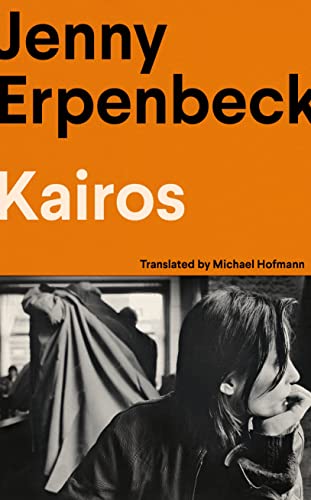
    Jenny Erpenbeck’s Kairos and the Book Club

    Jenny Erpenbeck, Kairos (translated by Michael Hofmann, Granta 2023)

    Before the meeting: The Emerging Artist read this book before I did. She hated it, couldn’t finish it, and threatened to divorce me if I ended up liking it. Though I wouldn’t say I absolutely loved the first 166 pages, by page 167 (of 292) I was pretty sure our relationship was safe.

    In a prologue, the book’s narrator, Katharine, learns that a former lover has died. She is unable to attend his funeral as she has promised, but soon after the funeral two boxes of material are delivered to her door by a weeping woman. Here’s how she describes the project that becomes this book:

    Kairos, the god of fortunate moments, is supposed to have a lock of hair on his forehead, which is the only way of grasping hold of him. Because once the god has slipped past on his winged feet, the back of his head is sleek and hairless, nowhere to grab hold of. Was it a fortunate moment, then, when she, just nineteen, first met Hans? One day in early November, she sits down on the floor and prepares herself to sift – sheet by sheet, folder by folder – through the contents of the first box, then the second.

    What follows, based on the contents of those boxes plus a suitcase of Katharina’s own memorabilia, is the story of her relationship with Hans, a married man who is ten years older than her father, 51 to her 19. Two things inclined my expectations against the Emerging Artist’s distaste. First, the set-up linked nicely to other recent reading – mainly Annie Ernaux’s The Young Man (link is to my blog post), a memoir of a relationship between the author and a much younger man. Second, it’s set in East Germany in the 1980s in the prelude and aftermath of the fall of the Berlin Wall, so I thought (correctly) that the book would capture something of the flavour of that time and place.

    The book starts with a cute meet in a downpour in Berlin in 1985. There’s a period of mutual bliss, which blossoms all too quickly into a physically and psychologically abusive nightmare, to which Katharina is inexplicably committed, so that by page 167 without any explanation she has evidently consented to being tied up and beaten with a belt, and later with a riding crop. Until that point, the historical context was enough to keep me afloat as a reader. The hideous mind games move up a notch as Hans convinces Katharina that she is cold, selfish and deceitful and sends her a series of cassettes detailing how terribly she has made him suffer. Instead of pulling the plug, she listens to the tapes, takes careful notes (hence the narrator’s ability to recall them even though he destroys each hour-long diatribe by taping the next one over it), and writes a self- abasing reply, thereby provoking another cassette.

    The hideous gaslighting continues for many pages. Several times the reader breathes a sigh of relief as it seems the relationship is finished, and then it’s on again with occasional moments of joy and endless rounds of blame and accusation on his part and wretched self-abasement on hers. Maybe its an allegory about East Germany, as Neel Mukherjee says on the back cover, but I can’t see it.

    I’m glad I persisted, because a) the worm does finally turn, if ever so slowly and slightly, and more importantly b) there are several wonderful pages about how the reunification of Germany was experienced by the Easties. Maybe for German readers the relationship between the central relationship and the historical moments would be clearer, but I couldn’t see it as more than a gruelling account of a vulnerable young woman being exploited by a self-obsessed and cruel much older man, with the broad sweep of history barely impinging on their lives until massive change happens all around them.

    Page 204: I usually blog about page 77. It would have been interesting to linger on that page in Kairos, where Katharina first visits the West, foreshadowing the final movement. But this time I want to give you a bit of page 204, which is the moment when I first began to hope for something other than abuse and submission, and catch a glimmer of the book’s intention to capture what it was like to have lived through first the Nazi and then East German Communist regimes. It’s the closest Hans comes to introspection:

    The abolition of a pitiless world through pitilessness. But when does the phase after begin? When is the moment to stop the killing? … To be arrested or to carry out arrests and believe in the cause, to be beaten or to beat and believe in the cause, to be betrayed or to betray and believe in the cause. What cause would ever again be great enough to unite victims and murderers in one heartbeat? That it would make victims out of murderers and murderers out of victims, until no one could tell any more which he was? Arrest and be arrested, beat and be beaten, betray and be betrayed, till hope, selflessness, sorrow, shame, guilt, and fear all make one indissoluble whole … And if beauty can only be bought with ugliness, and free existence with fear? Probably, Hans thinks, turning aside, and hearing Katharina mutter something incomprehensible in her sleep, that’s probably what it took to produce the deeper experience that you can see here in every woman, every man, every child even.

    After the meeting: After a pleasant meal of mussels and pasta, we dutifully turned to a discussion of the books (Paul Murray’s The Bee Sting was also on our agenda, blog post to follow). Only two of the five of us had finished the book. There was some discussion about whether Book Clunb members had an obligation to read the books. I think the position that ended up being accepted was that yes, they do, except if a book offends their value system intolerably. Kairos was such a case for at least one of last night’s non-completers.

    Generally we agreed that it was an awful read. I tried to argue that the final section, in which the Wall comes down, made the whole book worth reading, but I didn’t even convince myself. I also argued that the eerie lack of internality in the characters was not a bug but a feature: the narrator is reconstructing a painful episode from her youth, which she no longer understands or perhaps can’t bear to imagine herself back into. So she meticulously recreates a narrative from the documents, including details of places, times, food eaten, drinks drunk, transport caught, the content of cassette tapes and letters, and leaves it to the reader to imagine the emotional content beyond the broad outlines of ‘love’. I pretty much convinced myself that this was an accurate reading, but no one else bought it.

    We didn’t talk about the translation at all. I couldn’t help thinking, though, that the book would almost certainly speak more forcefully to German readers, not so much because of the language as because of their connection to the history.

    In short, not a recommended read.


    I wrote this post on Gadigal-Wangal land, not far from the Cooks River, in a place that was once wetland teeming with birdlife. I finished it after a long walk through Gadigal land to the waters of Sydney Harbour/Warrane on a beautiful autumn day. I want to acknowledge the people who have looked after this place for tens of thousands of years, their Elders past present and emerging.