Claudia Rankine’s Just Us

Claudia Rankine, Just Us: An American Conversation (Penguin 2021)
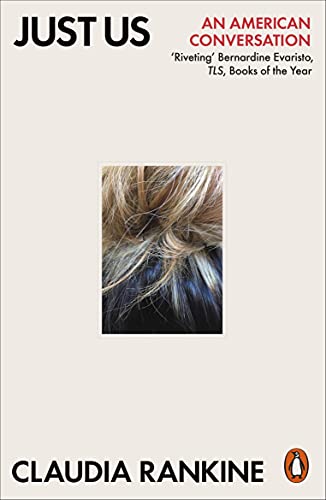
This is a wonderful book.

Note to Australian (and possibly other non-US) readers: Don’t be put off by the book’s self-description as ‘an American conversation’. It is deeply, intimately USian, but Claudia Rankine’s mind is to be learned from and loved by anyone with a heartbeat. The book’s central question is how people can reach for each other in human ways given the horrors of racism that divide us – and racism isn’t a uniquely US phenomenon.

Note to white readers, especially white male readers: Though these essays are mostly about racism as enacted and mistaken for reality, don’t read them in the spirit of self-lacerating virtue or grudging worthiness. They are exhilarating, challenging, inviting, occasionally funny. Almost every essay is written as part of a conversation. People quoted in the essays (including white men and white women) are given right of reply, adding unexpected perspectives and enriching the conversation wonderfully.

The title is a pun. The first of the book’s two epigraphs is a line from Richard Prior’s stand-up comedy:

You go down there looking for justice, that’s what you find, just us.

In its original context, which you can see on YouTube, the line could be paraphrased: you look for justice in the criminal justice system but all you find is the targeting of Black people. Rankine’s use implies an additional possible reading: If you want justice, you have to find a way to make us all part of one ‘us’.

The book’s 19 essays and two poems are mostly printed only on the right-hand page of each spread. The left-hand page is sometimes blank, but mostly carries ‘notes and sources’, or images, or fact-checks. When a piece of police brutality is discussed on the recto, the verso might show how it was captured on camera. A general assertion on the right is backed up by statistics on the left. And so on. It’s an inspired design concept.

The opening essay starts with the author preparing to teach a class on whiteness at Yale University. After discussing some of what she asks of her students, the essay takes an interesting turn:

I wondered what it would mean to ask random white men how they understood their privilege. I imagined myself – a middle-aged black woman – walking up to strangers to do so. Would they react as the police captain in Plainfield, Indiana, did when his female colleague told him during a diversity training session that he benefited from ‘white male privilege’? He became angry and accused her of using a racialised slur against him. (She was placed on paid administrative leave and a reprimand was placed in her file.) Would I, too, be accused? Would I hear myself asking about white male privilege and then watch white man after white man walk away as if I were mute? Would they think I worked for Trevor Noah, Stephen Colbert, or Chelsea Handler and just forgot my camera crew? The running comment in our current political climate is that we all need to converse with people we don’t normally speak to, and though my husband is white, I found myself falling into easy banter with all kinds of strangers except white men. They rarely sought me out to shoot the breeze, and I did not seek them out. Maybe it was time to engage.

(‘liminal spaces 1’, page 19)

So we follow her as she shies away from the challenge a number of times, before finally hitting paydirt. On the way, she slips in a quick introduction to Peggy McIntosh’s popularising of the term ‘white privilege’, noting in passing that she would have preferred ‘white living’ because ‘”privilege” suggested white dominance was tied to economics’. She seamlessly invokes other scholarly and non-scholarly writing (including some excruciating Twitter threads). We hardly notice that we’re being educated as the suspense builds, and as a white male reader I found I had a lot invested in the project as well.

That essay sets the tone. Rankine is after conversation, not confrontation. She aims not to provoke defensiveness or denial but to learn something.

The subject matter of the following essays include revelatory moments in ‘diversity training’ workshops, including the one referred to in the quote above; her marriage; a meditation on Woman with Arm Outstretched, an art photograph by Paul Graham; white supremacist assumptions in the education system, specifically at her daughter’s school; the way different white and black people remember a cross-burning incident in her college days; a dinner party where she gets to be the ‘angry Black woman’ for insisting on the primacy of racism as a factor in Trump’s election; how racism plays out against Latinx and Asian people; and a brilliant discussion prompted by the moment at an all-Black dinner party when a professor asks her what to tell her black female students who bleach their hair blond. The essay on hair has the distinction of being the only essay/conversation where the right-of-reply takes the wind out of Rankine’s sails, when one of the young women under discussion gets to speak.

This book is evidently the third in a trilogy of sorts. Where this book is mainly essays, the earlier two are a mix of poetry and videos, sharing the subtitle An American Lyric. I haven’t seen Don’t Let Me Be Lonely (2004), but I was completely enthralled by Citizen (2014, my blog post here), so I came to Just Us with high expectations. I was not disappointed. The book opens the world up to great possibilities.

To give Rankine the last word, here’s part of the left-hand-page commentary on the final spread:

A friend finished reading the final pages of Just Us and said flatly, there’s no strategy here. No? I asked. Her impatience had to do with a desire for a certain type of action. How to tell her, response is my strategy. …
For some of us, and I include myself here, remaining in the quotidian of disturbance is our way of staying honest until another strategy offers a new pathway, an as-yet-unimagined pathway that allows existing structures to stop replicating. Until then, to forfeit the ability to attempt again, to converse again, to speak with, to question, and to listen to, is to be complicit with the violence of an unchanging structure contending with the aliveness and constant movement of all of us.

And here are the final lines on the right-hand page:

What I know is that an inchoate desire for a future other than the one that seems to be forming our days brings me to a seat around any table to lean forward, to hear, to respond, to await response from any other.

Tell me something, one thing, the thing, tell me that thing.
The Iliad: Progress report 9

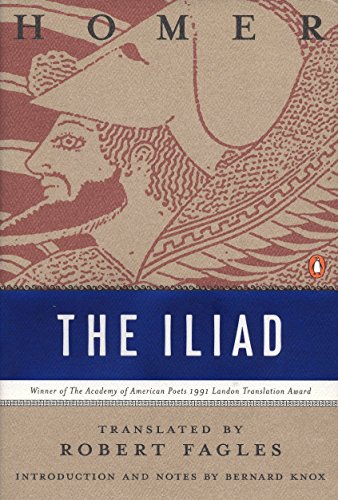
Homer, The Iliad (translated by Robert Fagles, ©1990, Penguin 1998)
Book 21 line 486 to Book 23 line 768

As I make my way through The Iliad, roughly 70 lines first thing each morning, I regularly encounter references to it in the rest of my day.

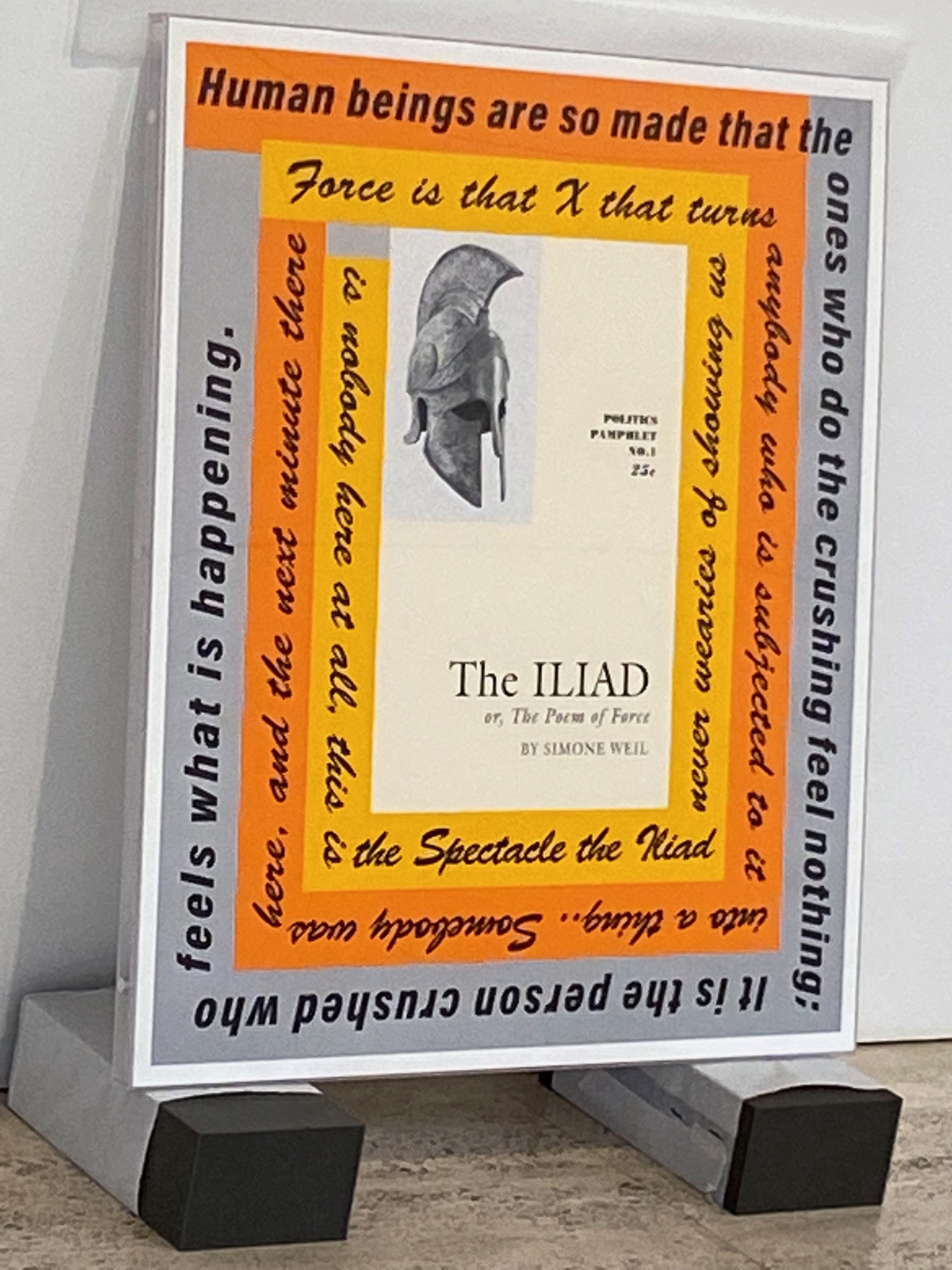
In my last progress report I quoted from Simone Weil’s 1939 essay, The Iliad, or The Poem of Force. Serendipity struck a couple of days later when, visiting the Queensland Art Gallery to see the wonderful Chiharu Shiota exhibition, I spotted a screen print waiting to be hung in a coming exhibition:

To save you the trouble of opening the image separately, the spiralling text is a quote from that same essay:

Human beings are so made that the ones who do the crushing feel nothing; it is the person crushed who feels what is happening. Force is that X that turns anybody who is subjected to it into a thing … Somebody was here, and the next minute there is nobody here at all, this is the Spectacle the Iliad never wearies of showing us.

The image is ‘Poem of Force’, one of a series of silkscreens in the Simone Weil Project by artists Janet Burchill and Janet McCamley. You can see a clean image of it here.

There has been some ludicrous comedy among the gods this month. Hera boxes Athena’s ears, and the latter runs to curl up weeping in the lap of Zeus. I tell you, after seeing the arbitrary, petty, infantile behaviour of the gods in this book, I’ve completely changed my attitude towards them.

But the main action has been the death of Hector, speared in the throat by Achilles. Hector dies a true hero’s death. He realises that his own heroics earlier have led to the deaths of many Trojans, and decides that the honourable thing to do is engage Achilles in personal combat, knowing the likely outcome. As Achilles approaches, Hector’s nerve fails and he runs, and the two run around the walls of Troy ‘endlessly as in a dream’. Then he stands to face Achilles once again. He offers a bargain: ‘If I kill you, I’ll ensure that your body is treated with full respect, and I ask you to do the same for me.’ Achilles, the embodiment of Simone Weil’s Force, refuses, and promises to leave Hector’s corpse to be eaten by dogs. At one stage he says, ‘I’d eat you raw.’ The gods step in for one last bit of disgusting cheatery, and Hector is slain.

Huge grief is unleashed among the Trojans. While I find it hard to read some of the Iliad‘s action scenes without a Marvel Universe version playing in my head, the scene where Andromache is interrupted at her embroidery and gives way to full-bodied lamentation completely transcends any such association. In particular, she wails for the fate of her son, who we met as a baby in Book 6:

The day that orphans a youngster cuts him off from friends. 
And he hangs his head low, humiliated in every way ... 
his cheeks stained with tears, and pressed by hunger 
the boy goes up to his father's old companions, 
tugging at one man's cloak, another's tunic, 
and some will pity him, true, 
and one will give him a little cup to drink,
enough to wet his lips, not quench his thirst.
But then some bully with both his parents living
beats him from the banquet, fists and abuses flying:
'You, get out – you've got no father feasting with us here!'
And the boy, sobbing, trails home to his widowed mother ...

Book 22 ends with her lament, and Book 23 turns to the grandiose ceremonies for Patroclus down by the Greek ships. It’s good to be reminded how deeply loved Patroclus was, and not just by Achilles, but the chariot race (mercifully conducted without godly interference) and then the bickering over prizes is a bit of an anticlimax. Where I left off this morning, two men were preparing to box, their eyes on a donkey-prize. It’s hard to credit that this book is the work of one writer.

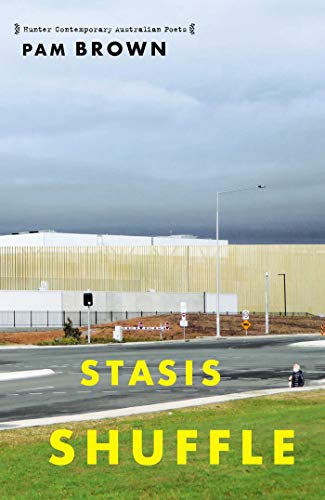
Pam Brown’s Stasis Shuffle

Pam Brown, Stasis Shuffle (Hunter Publishers 2021)

I had written quite a long draft about this book, and was despondent because it wasn’t going anywhere. Then I read this from one of its poems, ‘(all you can tweet)’:

life's more fun
---____---when you
---------don't know
what the hell
-you're doing

Sometimes it feels that way in Pam Brown’s poems – but not in a bad sense. I’m pretty sure she mostly has no idea where a poem is going to go when she starts it. But I took those lines as an instruction to myself: have fun with the poetry and stop wrestling with the task of describing it.

There’s a lot of fun to be had.

First, let me talk a little about the book’s naming conventions. The title of each of the book’s three sections, and every poem’s title is enclosed in brackets: so the first section title is ‘(one idea on each dragée)’, and I’ve already mentioned ‘(all you can tweet)’.

I don’t want to spoil your own fun in working these things out, but this is what I make of the brackets. I read them as signalling that there’s an arbitrariness to where one poem ends and the next begins. Not that they flow into one another so much as that each poem is made up of fragments which can take it on unexpected sidetracks, recursions, associative leaps, even just distractions, developing its field of meaning on the way. The book’s first poem, ‘(best before)’, describes itself as ‘slowly accreting’. It’s a process could go on indefinitely – but you have to stop sometime, imposing a metaphorical closing bracket.

The idea of a dragée is important. A note at the back of the book informs us that a dragée ‘is a bite-sized form of confectionery with a hard outer shell’ – often used for purposes other than consumption. The note mentions Mentos®. I went exploring and found that Mentos® dragées, which you and I would probably call lollies, sometimes come decorated with ’ementicons’. The accompanying slogan is ‘1 emoticon on each dragée’. (Click here for a short and mildly tedious video on the subject, and here for a slew of images). As I read it, PB has hijacked the phrase to describe her own poems, which are to be enjoyed like collections of small sweets, one more-or-less stand-alone chunk at a time, with a lone asterisk dividing the chunks from one another.

This isn’t a cheerful book. It starts out with a poem called ‘(best before)’ that is full of images of the end of usefulness, hospitalisation, the possible imminence of death, the absence of loved ones, a rodent, a general blanketing melancholia and lack of forward impetus. And it goes on from there.

But the gloom and melancholy don’t define it. At the launch of one of her books, Pam Brown’s reading was rendered almost inaudible by the football-watching cheers elsewhere in the launch venue. She commented that this was fitting for her poetry – it’s poetry that is full of distraction. It has mountain-goat agility, leaping from image to image, thought to thought, recollection to observation to self-questioning to mildly silly puns. To use a different image, it has bower-bird curiosity, picking up bright objects from the environment or from other people’s poetry and repurposing them.

It’s rich with references, some of which are partly explained in the notes up the back (like the Mentos®). Some of them can be googled, and I’ve learned about some odd corners of the universe by doing so. For example, ‘(best before)’ sent me off to discover the detail of the story of Robert Johnson at the crossroads). Others, if you don’t recognise them, you’ll just have to accept your non-knowingness. I’m a bit frustrated not to know who the title character from ‘(mme nhu)’ is, especially as she turns up in at least one other poem – I assume she’s not the first lady of Vietnam from the early 60s. But it doesn’t detract from my enjoyment of ‘(dingaling byways)’ that I can’t find anything online about the film named in these lines:

was
the limited theatre of thunder
---------the worst super8 film
--------------------------ever?------

I want to give you some examples of the lines that made me keep reading, and then rereading.

In ‘(best before)’, just as the poem is under way, the the poet’s critic-on-the-shoulder breaks in to question if it’s getting anywhere, and that interruption generates a lovely epic metaphor, which is then shrugged off:

the
it's-interesting
bla-bla

question is –

--is your slowly accreting poem
morphing into a larger cloud yet –

-a major poem
----ghosting in to sydney
--past the heads,
making its way to ashfield

--------darker & darker
birds swirling around in it -
------leaves
---------rubbish & debris
full of menace & meaning?

(what to answer –
----nup
-----or
-----I wish?)

---------*

A rare moment of autobiography in ‘(weevils)’:

you guess
----your gripes
are class-riddled –
-------------the déclassé
---------your cultural pretension

in the army
----where you're mostly from
rank masked class

This, from ‘(best before)’, captures a lot of Inner-West Sydney experience. It strikes a special chord for me – the landing planes fly even lower over my flat:

across the wetland
-a shirry whine

-------------big plane
gearing up for take off

warm winter night
all wrong

----you're not there
& that can be
------sad--- kind of

the roar of landing
--sounds like both
a blanket
---------& a shroud

Here’s a nice example of the bower-bird impulse, some gossip from the stars, in ‘(dingaling byways)’:

---------gina lollobrigida
----==----kept her films
------------in the fridge

solomon & sheba
next to dog food
beat the devil
with wilting celery

I hope the melancholy has lifted in the years since these poems were written. Failing that, I hope that this indispensable poet can continue to beat the devil, even if she feels she’s doing it with wilting celery.

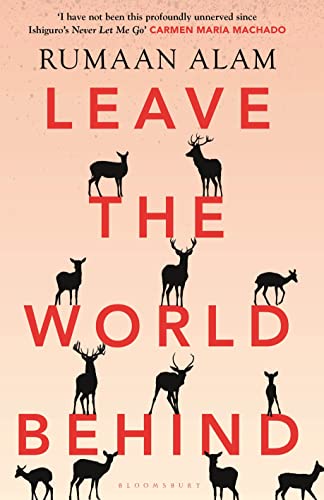
Rumaan Alam’s Leave the World Behind

Rumaan Alam, Leave the World Behind (Bloomsbury 2020)

Just a quick post about this one.

A white middle-class family from Brooklyn – father, mother, teenage boy and younger teenage girl – move into an isolated, luxurious AirBnB place on Long Island. (How do we know they’re white? There are a number of tells apart from their immersion in US materialism – they refer casually to slavery and the dispossession of Native Americans in ways that would be astonishing in the mouths of people of colour or Indigenous people.)

They stock up with luxury holiday supplies and are just settling in on the first night, revelling in the fantasy that this fancy place is theirs, enjoying the delicious discomfort of not being able to check work emails because they have no coverage or WiFi, and generally wallowing in the first night of their vacation while a storm rages outside, when a knock at the door strikes terror into their hearts.

Their visitors are an older African-American couple. We know they’re Black because we see them through the holidayers’ eyes, and that’s the first thing they see. Our heroes’ initial worry that this is some kind of home invasion are dispelled when they are told, and eventually believe, that the visitors are the respectable upper middle-class AirBnB hosts.

The terror never quite dissipates, but its focus shifts. The narrative proceeds painfully slowly. There are weird signs and omens – hundreds of deer in the woods, a dozen flamingoes in the swimming pool, an unexplained noise loud enough to crack the glass in windows. The characters spend most of the novel in various states of unknowing.

It’s like one of those horror movies where there’s a slow build-up until finally the horror is revealed – except in this case we don’t arrive at the inevitably disappointing moment where we see the horror face to face. It’s probably eccentric of me, but I think of Hart Crane’s novel The Red Badge of Courage, where the protagonist has no idea what’s going on in the war in general but can only see what’s going on in his immediate vicinity. In that case, the readers have a wider perspective because we know some of the history. In this one, the narrator breaks the fourth wall with increasing frequency to give broad-brushstroke information about what is happening back home in Brooklyn or somewhere in Florida. We still don’t know the exact nature of the disaster unfolding in the wider world, but we do know the cause of the mysterious noise and – the narrator seems to imply – if we’ve been paying attention to events in real life we should be able to guess what’s happening.

If The Red Badge of Courage is too far-fetched a comparison, how about Luis Buñuel’s The Exterminating Angel. In that movie, the guests can’t go home from a bourgeois dinner party. In this novel they could theoretically leave, and they make a number of sallies forth, but – no spoilers here – there’s an overwhelming sense that these six people are stuck with each other.

The opening pages moved almost unbearably slowly with their attention to the detail of the white mother’s shopping excursion. And once the full complement of characters is present, the conversation tends to repeat. But something in this obsessive listing of brand names and constant return to a handful of observations was generates a cumulative sense of dread, and for me at least it pays off brilliantly as things come closer to boiling point.

Once again, I’m grateful to our Book(-swapping) Club for taking me out of my comfort zone.

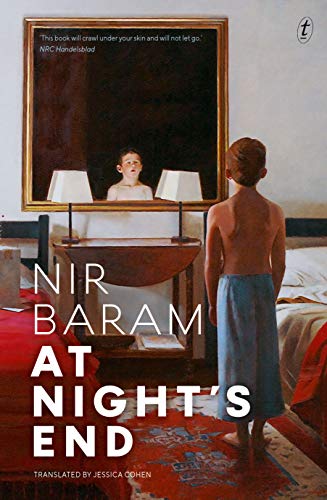
Nir Batram’s At Night’s End

Nir Baram, At Night’s End (2018, English translation by Jessica Cohen, Text Publishing 2021)

I may have missed the point of this book.

It begins with an Israeli novelist waking up in a hotel room in Mexico after appearing as a guest at a writers’ festival. He is disorientated, and decides to stay on in order to track down a young woman whom he blearily remembers saying something to him about the death of his best friend. The friend isn’t dead, or is he?

The following chapters take place by turns in three different time periods: the late 1980s, when the novelist and his friend are in elementary school, creating an elaborate fantasy world and dealing with a trio of bullies; the mid 1990s, when they are in their final year of school; and the present time, in Mexico. There are frequent flashbacks and forward projections in each of the time periods, complicated further by dream sequences, drugged states and possible psychotic episodes. The friendship hits on some hard times. The friend (I think) becomes deeply depressed and after being suicidal for years finally kills himself. The narrator does meet up with the young woman, but as far as I could tell he just gets very drunk and/or stoned with her and another poet. I don’t know if the friend dies before or after their meeting.

Though I spent most of the book in a state of disorientation, the problem wasn’t at the sentence level. The prose, in Jessica Cohen’s translation, is clear and flows easily. It’s just that I never did really get what happened between the two friends, either in the late 1980s, the mid 1990s, or whenever the friend finally died.

The back cover blurb quotes a review by in Haaretz: ‘One of the most intriguing writers in Israeli literature today.’ Yossi Sucary, the quoted reviewer, is probably more dependable than I am. I brought it home from the Book(-swapping) Club. I can’t say it was one of my more successful borrowings.

Ouyang Yu’s Terminally Poetic

Ouyang Yu, Terminally Poetic (Ginninderra Press 2022)

Every now and then someone on my Twitter feed shares an angry response to a rejection letter from a literary magazine. These responses generally assert that the rejecting editor is too stupid, racist, sexist, transphobic or something of the sort to have recognised the brilliance of the rejected work. In my time as editor of a children’s literary magazine, such responses were rare, but they certainly never made us think we might have been mistaken.

Here’s one editor’s take on such responses:

Much of Ouyang Yu’s Terminally Poetic could be read as making poetry out of that kind of letter. The persona in these poems rails against poets who are famous (Les Murray is singled out a couple of times), against the useless sadness of ancient Chinese poets, against editors who say they want to publish work that will sell, against editors who ask that a submission be accompanied by a stamped self-addressed envelope, against editors who are white or coloured, against the notion of revising poems, against literary prizes, against the dominance of white people in the Australian literary scene, against the intrinsic mediocrity of Australian poetry, against people who don’t pay him enough attention, against himself.

The poems were written over three decades. A couple of them self-identify as written in 2000; one calls for Australia to emulate the 2000 coup in Fiji; one (‘Temporarily Untitled’) starts with a bald account of a murder-suicide by a poet, who a little googling identifies as Chinese poet Gu Cheng in 1993, making it perhaps the earliest poem in the collection. It begins:

the news came that the poet died
he had killed his wife and hang himself on a tree outside the house

on an island not far from auckland
called something i can't remember at all

because it is difficult to pronounce

The offhand disrespect of these lines is all too typical of the book (the unconventional/incorrect ‘hang’ is less so). It may be a sign of youthful harshness, but as the poems are presented in alphabetical order of title – from ‘About poetry’ to ‘Written by one who doesn’t know how to write poetry’ – there’s no telling if there is any mellowing with age.

This is an unpleasant book. It means to be. It’s also an insider’s book. Even though the speaker of the poems positions himself as an outsider, his attention rarely moves out of the world of literature and publishing. It won the Judith Wright Calanthe Award for a Poetry Collection in the 2021 Queensland Literary Awards. I couldn’t find the judges’ comments online, and I’m curious about their choice.

When I blog about poetry collections it’s my practice to single out one poem for a closer look. Here’s one of the few poems in this book that isn’t about the poetry world:

(Maybe this appeals to me because I cherish childhood memories of coming home from a movie and peeing in the yard in the moonlight with my father and brothers while my mother and sisters took turns at the toilet inside.)

The heart of the poem is the moment when the speaker is taken by surprise by the moonlight and the edible-looking streetlights. I know hardly anything about classical Chinese poetry, but I understand that there are many poems about the moon and moonlight, including the one at this link by the great Li Bai. I can’t help but read Ouyang Yu’s poem in the context of that tradition.

But before we get to the moonlight, there’s ‘a long dream of dreaming of toilets’ in ‘the unconscious hours of the night’. It’s not just sleep, but unconsciousness. It’s not just a dream, but a dream of dreaming. He’s deep in the dream, dead to the world as we say. The syntax of what follows is muddled: read literally, the speaker is ‘turned away by closed doors or crowds of pissers’ after he gets up to relieve himself. This captures so well the muddled state of waking from a deep dream, especially perhaps a dream of pissing, the way the dream pulls you back to itself.

In the two middle stanzas, the speaker goes to the real toilet, and he momentarily forgets bodily functions because the moonlight is there. And then there are the streetlights, like juicy oranges, and the stirrings of some unnamed, hunger-like desire. In these stanzas he comes fully awake to the world in the silence of the night.

In Li Bai’s poem the speaker looks down to see the moonlight like frost on the ground, looks up at the moon, looks down again. This poem has a similar movement: the speaker looks down, metaphorically, at his bodily need; looks up at the moonlight and the streetlights; then looks down again, to pee (this poem definitely assumes a male body). Then there’s a moment’s reflection. Li Bai thinks of his homeland, evoking the yearning of nostalgia. In Ouyang Yu’s poem, ‘shiveringly’ refers to the cool of the night, but it also suggests an emotional moment. The final line, banal and bathetic at first glance, is just surprising enough to give the reader pause: what does it mean to wonder about life without toilets? I take it to be an oblique way (a very oblique way) of giving thanks for a tiny moment of appreciation of the beauty of the world, perhaps even of transcendence.

I haven’t read any other of Ouyang Yu’s many books of poetry. I hope they are full of such moments.


I am grateful to Ouyang Yu and Ginninderra Press for my copy of Terminally Poetic.

Two Flying Island pocket poets

The Flying Islands Poetry Community has been publishing pocket-sized poetry books (14 x 11 cm) for more than 10 years. According to its website:

The Flying Island Pocket Poets series originated as a simultaneous entity in Markwell, NSW and Macao, China, through the work of Professor Christopher (Kit) Kelen. Running since 2010 (in association with the Macao-based community publisher, ASM), Flying Islands has published more than eighty volumes, with authors from all over the world, but more from Australia and China than from anywhere else.

We can subscribe from within Australia for $120 to receive a year’s publications (details here). From the beginning of the series, the RRP for individual copies has been kept to A$10. But that’s not all. To quote the website again:

These books that magically appear out of pockets are part of a gift and exchange art-economy. They are our currency! 

Those aren’t just empty words. It was through versions of the gift and exchange art-economy that I found out about the Pocket Poets series, and came to possess, and read, two of these niftily designed books.


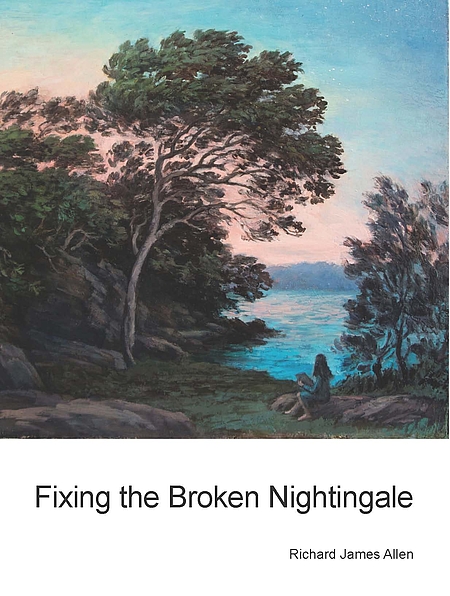
Richard James Allen, Fixing the Broken Nightingale (Flying Island Books 2013)

At a poetry reading in Sydney a couple of years ago, Richard James Allen read his poem ‘It’s Saturday night in almost any city in the world and’, and offered a prize for whoever could guess the city in which he wrote it. The audience called out the names of almost every city in the world, but I was the one who finally shouted, ‘Florence!’ and won the prize, Fixing the Broken Nightingale, which did seem to magically appear out of a pocket.

There’s a rich variety of poems in the book, ranging from straightforward love poems to poems that turn back on themselves like Escher drawings. There’s whimsy and melancholy, moments of ontological despair and intimations of mortality. The most striking poem is ’13 Acts of Unfulfilled Love’, which has some extraordinarily explicit sexual images, to arrive at this, in ‘ACT TWELVE‘:

These are my real thoughts,
not my dirty thoughts.
______________________ ____________This is my real love,
_________________________ ____________not my dirty love.
I am trying to live a real life,
not a dirty life.
_________________________And I'd like you there with me,
_____________________________in this soiled, holy world.

Kit Kelen, A Pocket Kit 2 (Flying Island Books 2015)

When I bought a copy of Kit Kelen’s Book of Mother at its launch in Sydney, neither of us had correct money. This little book materialised as if by magic to be my change.

It’s very different from Book of Mother and from other books of Kelen’s that I’ve read (blog posts here, here, here and here). As the title suggests, it’s a kind of sampling of his work, rather than a collection organised around a central subject or theme. A first Pocket Kit was published in 2011.

This is mostly a cheerful book. There are poems celebrating elements of Australian culture, like ‘Blokes’ (‘They know it’s bad luck to speak / when gesturing would do the trick’) and ‘shed’ (‘the peasant is the king here / where monarchs tinker with old crowns / no need for revolution’). The same ironic celebratory tone comes to bear on Macau where Kelen was a professor when this book was published, on his Hungarian heritage, on the prospect of having children, on the yellow umbrellas of Hong Kong in 2014.

My favourite in the book is ‘to tend’. If I remember correctly, Kelen like me had a Catholic childhood. This poem delicately addresses the question of what to do about the gap created when you stop believing. It starts:

to tend the gods as given, as found
new habits of homage are required

in word untamed, in sight unframed
paths to follow are so chosen,
by you, for you, willing, blind

go to the makers
not to the mockers
take the trouble to tell them apart

And ends:

go to the makers
never the mockers

tend to the habits of homage
you've found

Even though Kelen can begin a poem called ‘ancestor worship’ with ‘people smelt bad in the old times / they had bad teeth, they were stupid’ and can continue in that vein for 20 lines, he is certainly one of the makers, not one of the mockers.

Les Murray’s Continuous Creation

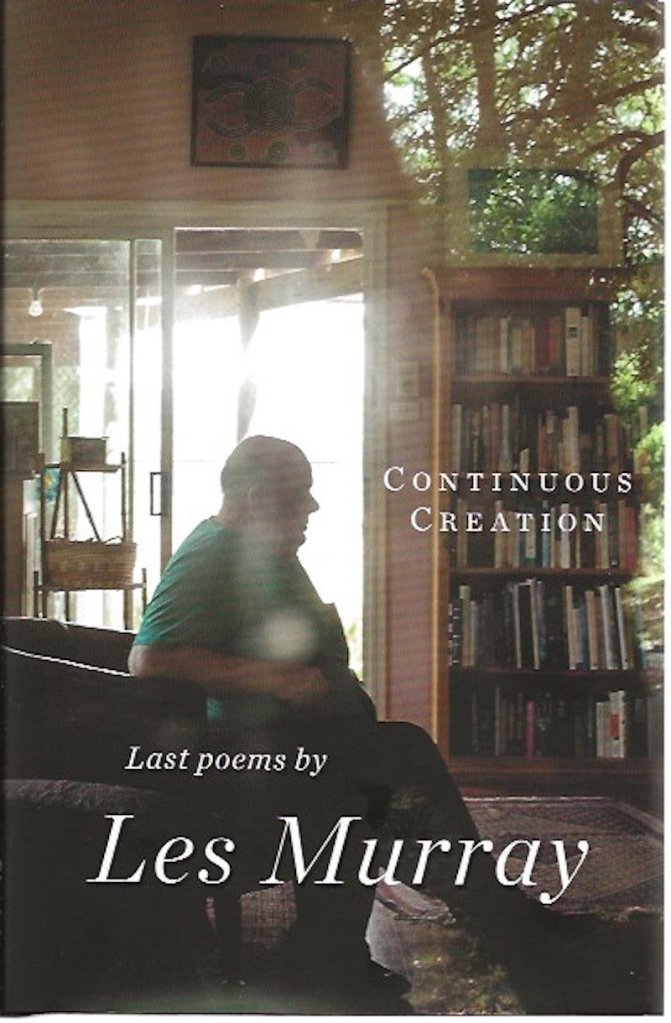
Les Murray, Continuous Creation: Last Poems (Black Inc 2022)

This beautifully designed book is a fitting way to honour the 2019 passing of a poet who loomed large in the Australian cultural landscape. The cover photograph is an inspired choice. Les Murray, seen in profile and lit from behind as if about to disappear from view, is alert and seems to be preparing to stand up. We see him through glass, so that the bookshelves, family photographs and artworks in the room blend with the bright green reflections of the outside world. Scholarship, engagement with the non-human natural world, his particular breathiness are all suggested. The photograph was taken by Murdoch press journalist Amos Aikman, while the book is published by Black Inc: Murray’s affiliation with political reaction hasn’t stopped the left-of-centre literary establishment from honouring him with this publication.

The poems are preceded by a Note on the Text by Jamie Grant: some time before he died, Murray told Grant that he had about two thirds of a book ready to go. After his death (longer than it would have been in the absence of a pandemic), Grant visited Murray’s home to find a folder of poems that had been typed by Murray’s wife Valerie, and a box filled with a jumble of handwritten poems, some of them in many versions. The contents of that folder and box, with some judicious choosing among versions in the latter, have become the contents of this book.

I’ve loved some of Murray’s poems since first hearing him read them in (I think) the early 1970s – ‘A Perfectly Ordinary Rainbow’, ‘The Buladelah-Taree Holiday Song Cycle’, the one about blowing up trees as young men, or the one about eating curry somewhere in Britain. I’m also a bit of a hater, starting with the ‘humorous’ homophobic quatrain he regularly read along with the ‘Rainbow’. I found much to love and hate in this book as well, though ‘love’ and ‘hate’ may be too strong in both cases. There’s nothing as brilliant as his most brilliant poems, and nothing as terrible as his most anti-modern barbs.

There are aphorisms (including the title poem), odd moments of Australian history and autobiography, pronouncements on culture and politics, descriptions of natural phenomena and works of art – all conveyed with Murray’s characteristic love of wordplay, often with elements of puzzle, and his terrific ability to make us see things. ‘A Friendship’ stands out as a straightforwardly affectionate elegy for Bob Ellis.

Here’s ‘Dateline’, one of the poems from the jumble in the box. (As always, I’m assuming permission to show the poem here, even in this poor quality phone photo, and will happily remove it if the copyright owners ask me to):

The first three stanzas include examples of Murray’s gift for visual metaphor. At different stages and from different points of view, the floodwaters are like old-time washerwomen, like a mirror, like windribbed parchment. Reading these, we know that the poet has looked with fresh eyes, and invite us to do likewise.

The opening stanza is strongly visual: trees and shrubs are dumped in the creek and swirled around like laundry, letting wrack dribble downstream like dirty suds. But the words bring more than the visual. Washerwomen, especially ‘old-time’ washerwomen, belong in Dickens or Wind in the Willows (Toad disguising himself is probably the first time I heard the word). That and the verb ‘souse’ identify the poem as ‘literary’, in the English tradition. This is worth saying because Murray has been called ‘the last of the Jindyworobaks’, meaning that he sets out to write in continuity with First Nations song and story. The label is at best only partly correct. (Incidentally, I expect if he’d had a chance to revise the poem further, Murray might have changed the second line to ‘floodwaters are sousing trees and shrubs’ so that the ‘their’ in line 4 would work syntactically.)

Paradoxically perhaps, the second stanza brings us closer to the action by pulling back from description. Watching the floods, who could avoid remembering the drought? Then, another visual effect: the rain isn’t just ‘refilling the land’ (what a lovely phrase). It sits on the roads, reflecting the sky.

Human effort gets its pages turned

This is the poem’s key line. In the short term, it means that effort earlier put towards dealing with drought must now be directed towards flood mitigation, relief and recovery: the humans aren’t the ones who determine where their effort needs to go. Before any wider implication can be absorbed, the stanza moves on to the striking image of towns blanked (not blanketed) in water. I’m pretty sure ‘windribbed’ is one of Murray’s inventions – beautifully capturing a metaphorical link between agitated floodwaters and ribbed fabric, which is then further complicated by calling it parchment.

Murray’s fascination with linguistics now swings into action:

We are hearing Tornado and Tsunami

at home, words unknown in teapot times.
Downpour and Inferno are states
that people drive between

‘Teapot times’: in the olden days when people around here (‘at home’) drank tea rather than coffee, and brewed it in pots, before teabags became all but universal. Back then, people in Murray country didn’t use words like ‘tornado’ or ‘tsunami’; now they are part of the language, and have assumed enough presence to require initial capital letters. The language has changed. And so has the reality: ‘Downpour’ and ‘Inferno’ may not be new words in quite the same way, but they too have taken on initial caps – they have grown from occasional events to states.

I read the reference to senators as one of Murray’s kneejerks attacks on politicians: the floods mean people lose their whitegoods, and somehow, by Murray’s anti-politician logic, they cast aside their political representatives as well.

The next lines are the reason I chose this poem to talk about:

Global warming's chiller winters
rule both hemispheres. Arizona snow golf,
Siberian wheat, English vineyards
stricken by blizzard in their chardonnay.

I may be confusing Murray with Clive James here, but I’m pretty sure both of them have been climate change deniers. Murray has certainly echoed some right-wing talking points about environmental issues. It may be of course that the oxymoronic ‘global warming’s chiller winters’ is meant to sound a note of scepticism, but that’s not how I read it. By the logic of this poem, we move from a page being turned on human effort, to new language being needed for new circumstances, to the naming of a general cause. Climate change is real, it rules the planet. The floodwaters in Murray country are part of the same general phenomenon as weather events in the US, Asia and Europe. Human effort is getting its pages turned in a big way: humans may see themselves as dominating the planet, but ultimately we are not calling the shots.

It’s hard not to read the final word of this stanza as carrying the ‘anti-elitist’ tone of much right-wing rhetoric: you know, the inner city types who drink their lattes and sip their chardonnays. Is there a slight hint that the arrogant are getting their comeuppance in these events? If so, does the opening image of the floodwater as washerwomen take on a deeper resonance? Is global warming a case of abused and despised nature rising up against human entitlement and privilege? And where does that leave the poet, that he can say ‘their’ rather than ‘our’?

If that was the end of the poem, it would be a satisfyingly unsettling whole, implicating the poem’s speaker in the current global disaster, while holding up to the light one of the ways we avoid facing the reality.

I’m not convinced that the last six lines, which fall after the page is turned, are part of the same poem. But it certainly reads as if Jamie Grant and the editors thought so. In that case, the poem veers off in a new direction, justified perhaps by the title ‘Dateline’: this is the kind of piling together of disparate issues that happens in a news bulletin. Climate warming is the main story, but meanwhile class discrimination continues, in sports and the arts, something curious happens in the Sahara, and there’s a snippet of good news involving a baby (something cute to end the bulletin with), even if it is against the background of that AIDS epidemic. And if the last couplet isn’t an alternative, preferable version of the preceding one, which would have been my editorial guess, it reiterates the exotic and good news – this time perhaps, thanks to the repetition, conveying a glimmer of hope.

Bernadine Evaristo’s Girl, Woman, Other

Bernadine Evaristo, Girl, Woman, Other (2019, Penguin 2020)

Frank Moorhouse described his early books as ‘discontinuous narratives’. They were collections of short stories whose characters and situations overlapped, but lacked a narrative through-line. In the half-century since those books were published, discontinuity has become much more commonplace in novels, and it’s probably only because Moorhouse recently died that Girl, Woman, Other put me in mind of his term.

The bulk of the book consists of four sets of three short stories. In each set the stories are about three women who are closely related (in one case, two women and a gender-nonspecific person who was assigned female at birth). The main characters are all Black (though some pass for white), and most of them are part of the LGBTQI+ community. They are mothers and daughters, lovers and friends, teacher and students, activists and cancel culture warriors, a playwright, a farmer, a merchant banker. The action mostly happens in England, in the context of feminist and Black liberation movements from the 1960s to the present day. Once you get used to the regular sudden changes in place, time, point of view and voice, the effect is exhilarating.

Of the final two chapters, the first provides a kind of narrative resolution when many of the characters turn up for an event foreshadowed in the first section. So technically the narrative isn’t totally discontinuous in Moorhouse’s sense, but the event is transparently a device to allow characters from different stories to run into each other rather than a real climax. The final section seems to go off in a whole new direction by telling the story of one of the book’s incidental white women characters, only to twist that story back into another narrative strand, to end with a moment that is no less emotionally satisfying for being utterly implausible.

I just read someone online saying they’d heard that ‘the text lacks punctuation’, so they chose to listen to it rather than read it. Well, I’m not saying they were wrong to listen, but the absence of quote marks and full stops – to be precise, the use of full stops only for the ends of sections – is not the annoyance you might expect. Evaristo uses line breaks as a form of punctuation: the meaning is always clear, there’s plenty of white space on the page, and the narrative flows beautifully. I for one was happily seduced.

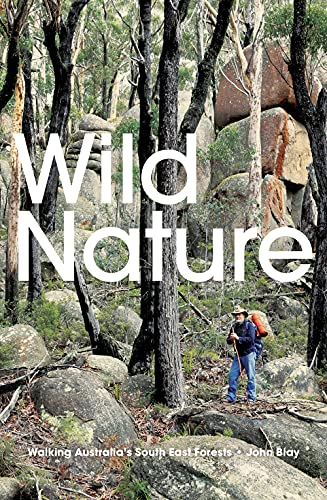
John Blay’s Wild Nature

John Blay, Wild Nature (NewSouth 2020)

When I read Peter Wohlleben’s The Hidden Life of Trees, in which sclerophyll forests might as well not exist, I yearned to read a book about the Australian bush. She who is known in this blog as the Emerging Artist had been urging me to read John Blay’s Wild Nature for more than a year. So, though I didn’t expect it to be an Australian extension of Wohlleben’s book, it pretty much leapt from the bookshelf into my waiting arms.

The book is made up of three major strands.

First, there’s the narrative through-line: the author’s account of an intrepid walk through Australia’s south-east forests, often following animal tracks and sometimes, memorably, forcing a way through thick vegetation by throwing his body against it. A woman named Jacqueline accompanies him on much of his journey. We never learn her second name and are left to deduce that she is his partner. The narrative is based closely on journals he kept on his walks.

Second, he gives a history of the ‘Forest Wars’, the bitter conflict between those who wanted to exploit the forests for timber and woodchips, and those who wanted to preserve it – with the Forestry Department, which once played a custodian role, at times coming down heavily – and, though Blay doesn’t ever say so, corruptly – against the ‘greenies’. This strand is the fruit of extensive work by Blay recording oral history from participants in both sides of the wars. Although his sympathies are clearly with the conservationists, he has warm, respectful relationships with people who have the industry’s interests at heart.

Third, he incorporates the fruits of research, including his broad botanical and ecological knowledge, and colonial and pre-settlement history. What Wohlleben calls the hidden life of trees is mentioned briefly, and at one stage Blay follows the path of early nineteenth-century shipwreck survivors, an episode explored in historian Mark McKenna’s From the Edge.

It’s a strange book. Too often, reading it is like going on a long bush walk with an enthusiastic guide who names every tree and bush you pass, except of course the reader can’t see them, so all we get is a list of botanical and geological names. I smiled ruefully when I read Blay’s comment on the shipwreck survivors’ account:

Without the on-ground knowledge of where they were from time to time, it would have made so little sense to those who seldom ventured into the outdoors that the long journey might as well have taken place on the moon.

(Page 263)

The slog is made worse by moments, all too frequent, that seem to have come straight from a journal and escaped the revising eye. This little passage is a good example:

All the tracks are treacherous bogs. Bandicoots have made trails in the wet earth. Across the heath, crimson bottlebrush and fairy fans glow brightest. Grevillea, bracelet honey-myrtle and banksia alike take the form of ground cover. A black snake suns itself on a sandstone pavement. The place is always full of surprises even as the landscape itself is surprising, it also has the potential to astonish.

(Page 111)

This list isn’t so bad – at least bottlebrush and grevillea are reasonably well known. But how did the triple tautology of that final sentence get past the copy editor?

So John Blay isn’t one of the great nature writers. But his enthusiasm for the south-east forest is infectious, and here are thrilling moments, of which two stand out for me.

In the first, he and Jacqueline come upon a grove of waratahs. Here is just part of the encounter:

In photographs the flowers seldom look as beautiful as they do in nature. They look too blue, too muted, grubby. Where is that red inner glow? How could they change like that? Photograph after photograph, they come back imperfect, in shades of dull murk, and each one makes me more determined to capture the flowers in their full crimson magnificence. In this heavily canopied forest the light changes subtly, as does the glow of the flowers. Their flashes can surround you like wildfires on a mountain. Any shards of sunlight cut through too brightly and wash out the subtleties. At times there is a halo miasma around the trees caused by the intensity of insect life attracted to the sweetness of the flowers; some insects are so tiny as to be visible only when the clouds of them are lit. One moth hovers, others strike at eccentric speeds, the native bees, wasps. All love the warmer morning air. As the heat increases, so do the insect numbers, until the dews dry and it gets hotter and just about all retire for a siesta.

(Page 167)

The other moment I want to mention takes the experience of reading the book onto a whole other level. On a spread toward the end there are two full-page maps of the area facing each other. One shows the forests of south-east Australia; the other the area burnt out by the bushfires of the 2019-20. The two areas are virtually the same. It’s like being hit over the head with a club: all of that wilderness we have been slogging through, the passionate object of John Blay’s attention, the bringer of aesthetic joy to Jacqueline, the terrain of the bitterly fought forest wars, all of it, has been ravaged by fire. As he tells us in the text, the heat from the fires has almost certainly damaged the complex underground web of fungus so necessary for the forest’s health. The scale of the disaster is close to unimaginable.

For all its faults, this book helps us to imagine it, helps to make the climate emergency viscerally real