Andrew Huntley died in June this year. In lieu of attending his funeral I broke my personal ban on Amazon and bought a copy of From Tradition, which he self-published in 2014. I’m sorry it was too late for my purchase to boost his finances or his morale.
We were friends in the early 1970s when we were both in our 20s. He was witty, warm and exuberant, a recent convert to Catholicism of the pre-Vatican-Two variety, and a keen astrologer. We liked each other. And I loved his poetry.
Lyrical Ballast was one of three slender, stapled books of poetry published by the Sydney University Arts Society in 1970. (The other two were Martin Johnston’s shadowmass and Terry Larsen’s Tar Flowers.) It’s largely nonsense poetry, and though it mostly hasn’t aged well its general benign silliness is charming, and disarming.
Two poems in this collection still give me pleasure. ‘A Paean: Australia’s Praise in Honour of the Makers of Sweat Poesy’ offers a deeply ironic picture of an Australia where poets have ultra-celebrity status that still rings true:
'Sing Huzzah for the poet!'
Cries each Australian Son,
As a poet passes down the street
'Huzzah!' cries everyone.
‘An Essay on Criticism’ (which I’ve uploaded elsewhere in this blog – link here) was Andrew’s contribution to the website commemorating the 30th anniversary of Martin Johnston’s death (link here). It’s a tragicomic love story and a celebration of non-academic approaches to poetry, which begins:
Maisie were a critical
Severe she wore her bun
She lecturing on literature was grim.
Arnold he be engineer
He's reading just for fun –
Maisie meaning all the world to him.
And it ends:
A poem can be way to make a friend.
Between Lyrical Ballast and From Tradition, Andrew published three other books: Lalai – Dreamtime, the script for Mike Edols’s 1972 short film of that name, a poetic rendering of a story ‘recounted by Sam Woolagoodjah, Elder of the Worora people, north-west Australia’ (the description is form the AustLit website); Minor Pageant (Island Press 1977); and The Stone Serpent Dreaming (Hale and Iremonger 1983). And he had a number of poems published over the years, mainly in politically conservative journals such as Quadrant and in conservative Catholic publications.
From Tradition is a beautifully produced hardback, containing 33 short poems, mostly sonnets that adhere rigorously to the demanding Petrarchan rhyme scheme (in case you’re interested, that’s abba abab cde cde), and one longer poem in blank verse. Almost every short poem asserts a traditional-to-reactionary Catholic position – on sex, feminism, grief, the afterlife, writing back to Yeats, Pound, Emily Brontë, Phillip Adams. The long poem, ‘The Plough & the Cross’, is a narrative telling of the poet’s conversion to Catholicism. The exuberant silliness of Andrew’s early poetry has evaporated, and the tone is generally combative – the speaker in most of the poems is fighting against modernity and holding fast to his commitment to the One True Church, and to God the Creator and, especially, Judge.
While I admire Andrew’s technical skill and his erudition, and respect his embattled integrity, I found the book uncongenial. I think that’s how he meant someone like me to find it.
Every now and then, the poetry allows a glimpse of a suffering human being under the carapace of Faith. Here’s an example:
Chasing Tolkien'And Rose drew him in, and set him
in his chair, and put little Elanor upon his lap.
He drew a deep breath. "Well, I'm back," he said.'
The Return of the King, J R R Tolkien
My time seemed flowing there – re-burgeoning –
I never knew how strongly years might stay:
Once more the final pages, – I could say
With Samwise, well, I'm back. Yet in my spring
There was no loving Rosie – none to bring
Her promise that all years would glide away,
Bearing a couple on their wedding day
That death alone could part .... come anything!
My Middle-earth, little but breaking's been,
And scattered flowerings of sadness sown;
With autumn silent now in loneliness:
Where haven has withdrawn from every scene,
And (on and on) mere roads to madness shown –
And time is past; and only God may bless.
As an evocation of misery finding comfort or hope in God, it’s a long way from George Herbert of Gerard Manly Hopkins, but it does pull at the heart.
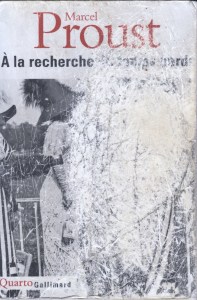
This is my thirteenth blog post about À la recherche du temps perdu: 1723 pages read and 677 to go! I’m bearing up much better than my copy of the book, as seen on the left. I mostly read my three pages in bed in the morning, so the damage has been caused by ordinary wear and tear, not by any gross mistreatment.
A lot happens in this month’s reading. Here are some highlights, not necessarily in order. The violinist Morel continues to be an opportunistic scoundrel. Marcel (as the narrator has now been named, twice) listens to the sounds of the street in the early morning (those are lovely pages). He contemplates sending a dairymaid on an errand but changes his mind. He watches Albertine as she sleeps, and creepily drapes her unconscious arm around his neck. He watches her wake up. He takes us through his own process of waking up from a dream. He ruminates on the relationship between love, obsession (not his word) and jealousy. He talks Albertine out of going somewhere where he fears she might meet other Lesbians, and then realises that he has let her go to a performance by a notorious Lesbian. He plays the piano. He opens Albertine’s chemise and looks at her naked body:
Les deux petits seins haut remontés étaient si ronds qu’ils avaient moins l’air de faire partie intégrante de son corps que d’y avoir mûri comme deux fruits ; et son ventre (dissimulant la place qui chez l’homme s’enlaidit comme du crampon resté fiché dans une statue descellée) se refermait, à la jonction des cuisses, par deux valves d’une courbe aussi assoupie, aussi reposante, aussi claustrale que celle de l’horizon quand le soleil a disparu.
(Page 1661)
This is about as erotic as La recherche gets. But wait, I asked, wasn’t Proust Gay, or at least bisexual? What weirdness is this about men’s bodies? I looked up Scott Moncrieff’s translation. And there it is:
Her two little upstanding breasts were so round that they seemed not so much to be an integral part of her body as to have ripened there like two pieces of fruit; and her belly (concealing the place where a man’s is marred as though by an iron clamp left sticking in a statue that has been taken down from its niche) was closed, at the junction of her thighs, by two valves of a curve as hushed, as reposeful, as cloistral as that of the horizon after the sun has set.
This translation even softens the meaning a bit – I would have thought s’enlaidit was ‘becomes ugly’ rather than ‘is marred’.
Increasingly I understand why, at the end of fifteen years, when Clive James had finished reading this work in French, he needed to read an English translation so he’d know what he’d read.
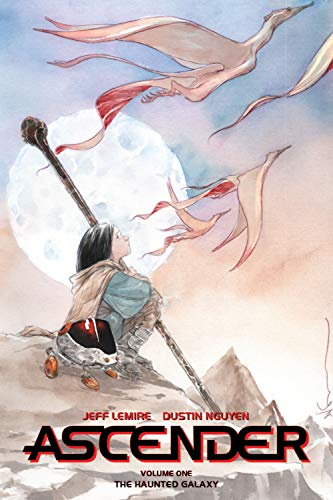
Jeff Lemire (writer), Andrea Sorrentino (artist) and Dave Stewart (colorist), Gideon Falls, Volume 4: The Pentoculus(Image Comics 2020, from issues 17–21 of the comic)
Having been given the first three books in this series for my birthday in March (blog post here), I’ve reciprocated by buying this as a late Father’s Day gift for my comic supplying son, who is also a father. Of course I had to read it first, even though it’s horror and not my cup of tea.
Because I am so much in alien territory, here’s a quote from a Goodreads review by an English Professor at the University of Illinois, who I assume is a knowledgeable fan of this kind of thing (link to the whole excellent and spoilerish review here):
It’s clear from my glance at the reviews that 1) everyone is intrigued enough to keep reading and 2) loves the art, but 3) doesn’t know what the Hell (pun intended) is going on. I find little hints in the text itself that seem to indicate writer Jeff Lemire acknowledges he feels our pain.
The artwork is extraordinary, I agree. I agree there’s a pun if you say ‘what the Hell’. I’m not sure everyone is intrigued enough to keep reading.
The story telling is assured, so assured that even as the action shifts in time and place from page to page, you can generally follow with a little increase in focus. But look, the blurb says that in this volume the mechanics of the Pentoculus are explained. Well, yes, but the explanation certainly left me not knowing what was going on. The Bishop from earlier volumes, who I was sure was evil, is probably a good guy. Other key characters have their identities change before our eyes – and theirs. I have to keep reminding myself that I’m supposed to find it weird that the young hero, if that’s what he is, wears a Covid-type mask. And the piles of bloody corpses continue to mount …
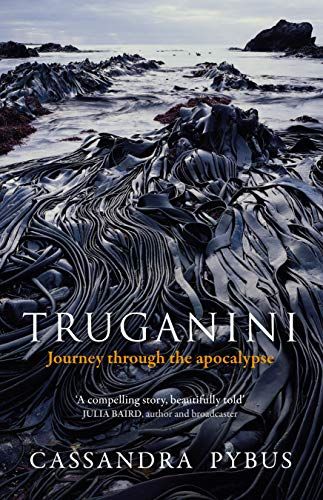
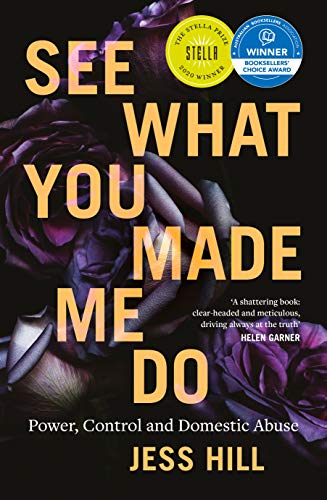
Before the meeting: It was my turn to choose the book. I was tossing up between Truganini, about which I’d heard a terrific podcast from the Sydney Writers’ Festival (here’s a link to my blog post), and See what You Made Me Do, the Stella Prize winner. When I put it to the group there was an overwhelming preference for Truganini’s journey through the apocalypse over Jess Hill’s exploration of abusive men. If we thought this would be less gruelling we were probably wrong.
Truganini is known to non-Indigenous Australian popular history as ‘the last Tasmanian’. That’s rubbish of course. There are still many Indigenous Tasmanians alive and kicking. But Truganini’s life is better documented than any of the survivors of genocide in Tasmania, and she has become, as Cassandra Pybus says in her Preface, ‘an international icon for extinction’. The mythologising began almost as soon as she died, and she has been seen ‘through the prism of colonial imperative: a rueful backward glance at the last tragic victim of an inexorable historical process’. In this book, Pybus sets out ‘to redirect the lens to find the woman behind the myth’.
Pybus’s main historical source is the writings of George Augustus Robinson. To quote the Preface again, ‘Truganini and her companions are only available to us through the gaze of pompous, partisan, acquisitive, self-aggrandising men who controlled and directed the context of what they described’. I’m grateful that Cassandra Pybus did the hard yakka of extracting a story line from such sources, reading them so we don’t have to.
In the 1820s, the Aboriginal clans of south-east Tasmania (Van Diemens Land as it then was, lutruwita before that) were all but wiped out by massacre and disease. Truganini belonged to the Nuenonne clan, whose country included Bruny Island. When George Augustus Robinson, fired by missionary fervour and ambition to be seen as a man of significance, set out to rescue the surviving First Nations people from the violence of the colony, Truganini, her father and some friends accepted his protection and became his guides and later his agents in persuading people from other clans to come under his protection.
For five years the band trudged through forests, over mountains, across streams. Truganini had terribly swollen legs, possibly as a result of syphilis she had contracted from sealers who had abducted her early in life, but she was an adept diver for seafood, and she and the other women in the group were the only ones who could swim, so were often called on to pull rafts across icy rivers. For the most part, Pybus tells the story straight without commenting, for instance, on the moral dilemmas involved in persuading resisting warriors to surrender to Robinson rather than face deadly violence elsewhere, as at the hands of John Batman, who emerges from these pages as a ruthless, brutal slaver.
The result of all these rounding-up missions is that, whatever promises Robinson might have made, people were sent to virtual island prisons, mainly on Flinders Island in the Bass Strait, where the death toll were horrifying. what started out as a ‘friendly mission’ became the coup de grâce of a genocidal program.
After being taken to Port Phillip on the mainland where Robinson hoped they might again play an intermediary role, Truganini and her companions were conclusively dumped by Robinson. He simply turned away from them and never mentioned them in his journals again.
Truganini and her companionos, including a husband and a close woman friend, were settled in Oyster Cover on the east coast of Tasmania, from where they would go on hunting excursions to Bruny Island and elsewhere. One by one, her companions died. With extraordinary restraint, Pybus simply tells us that their deaths were unrecorded. She doesn’t have to spell out the callous disregard of the colonial establishment. Truganini, the sole survivor, spent her last years in the care of John Dandridge and his wife (unnamed) in Hobart. Dandridge would take her across to Bruny Island, so that she could still walk in her own country. To the end, she cared for country, and slept on the floor rather than the coloniser’s bed.
For all the horrors that were inflicted on this extraordinary woman and her people, the one that comes across with most poignancy in this narrative comes right at the end. As people die, the scientific establishment waits like vultures for their skeletons. Graves are dug up, newly dead bodies are decapitated, collections of skulls are sent to England. Truganini expressed her terror at having this done to her own remains, and asked Dandridge to scatter her ashes in the channel between Bruny Island and the main island of Tasmania. But he died before her. Her body was buried, dug up and later exhibited in the Tasmanian Museum – until 1947! After a long legal battle by Tasmanian Aborigines, the museum allowed the skeleton to be cremated, and her ashes were scattered according to her wishes on 30 April 1976, a few days short of the centenary of her death.
And then there are the illustrations. Truganini, her warrior husband Wooredy, the great leader Mannalargenna and others challenge our gaze in portraits painted by Thomas Bock in 1835. There are photographs too, perhaps taken with ethnographic intentions, but when Truganini looks at you from a photo taken by Charles Woolley in 1866 (here’s a link), she isn’t offering herself as an object. At the Sydney Writers’ Festival, Jakelin Troy said, referring to the fact that Truganini walked about Bruny Island in old age:
I’m sure she was making the point that this was still her country and that she’s there, and even if they didn’t think deeply about the fact that it was her family’s country, I think that in reality you can’t avoid that that’s what it is.
It’s hard to look at Truganini in these portraits and not feel that she’s making a similar point: she is still herself, and even if the photographer, the curators, the scientists, the colonial historians don’t think deeply about the fact, she challenges us to acknowledge that she is a human being. As she tells us in a final chapter, Cassandra Pybus has reasons to take that challenge personally: her ancestor received a grant to part of Truganini’s country, and in her childhood she heard stories of the old Aboriginal woman who walked about the family’s property. This book is a powerful, humble and devastating response to the challenge.
After the meeting: We’re still meeting on zoom, probably not for the last time. This book generated a very interesting discussion among us white middle-aged and older men. Some were less enthusiastic about it than others. The negatives first.
One man had studied George Augustus Robinson on the 1980s, particularly the collection of his papers published in 1966, The Friendly Mission. He had approached this book with high hopes, but found that it didn’t add much by way of new perspectives or insights – despite its intention of focusing on Truganini, it largely stayed with Robinson.
Another, who read this just after Hilary Mantel’s The Mirror and the Light (my blog post here), was disappointed that neither Truganini nor Robinson, or really any of the other characters, emerged as fully rounded characters. There was precious little exploration of motivations or emotional responses. Maybe, he said, you can’t expect that of history: this might be excellent history but it’s not much chop as literature.
Someone who agreed with that latter point said that the question for him was, if that is so, then how come the book held his attention the whole time, when he usually gave up on history books after 15 pages? Someone said that the subject commands our attention, as this is a story that cuts through to our souls as settler Australians. I think that’s true, but I also think the book is well written, and the failure to flesh out the characters is a strength: Pybus doesn’t speculate or invent, but largely leaves us to join the dots. As someone said, it’s fairly clear that for Truganini and her companions, Robinson’s offer of protection was their best bet for survival.
Challenging the notion that the writing was generally flat and factual, someone read a short passage about Truganini’s father, Manganerer, who had encountered convict mutineers:
These men abducted his wife and sailed away with her to New Zealand, then on to Japan and China. Hastily constructing a sturdy ocean-going canoe, Manganerer had attempted to follow them but had been blown far out into the Southern Ocean. His son had died and he himself was half dead from dehydration when he was found by a whaling ship.
The tragedy was almost too much for this proud man to bear. He had endured the murder of his first wife and the abduction of his two older daughters by the intruders, and now they had taken his second wife. His only son was dead and his remaining daughter had abandoned him for the whaling station. His distress was compounded when he discovered that in his absence almost all of his clan had succumbed to disease, as had all but one of the people visiting from Port Davey, who were under his protection.
There was a moment’s silence on the zoom space. With such a litany of horrors – and this is early in the book, the worst devastation comes towards the end – there’s not a lot of need for further authorial commentary.
One man took up the cudgels on Robinson’s behalf. He said he felt protective of him. Yes, he took on the role of ‘Protector of Aborigines’ out of a kind of opportunism, and yes, his ventures finished off the ‘extirpation’ that the notorious Black Line failed to achieve. But he had a huge inner struggle. At some level he recognised and respected the humanity and the cultural strength of the people in his care (there are scenes in the book where he eats and sings and dances with them). But he was blinded by his belief system and could only at rare moments acknowledge what he was actually doing. And – I think I’m quoting correctly – isn’t that blindness something that we all have?
I don’t think it’s much of an exaggeration that the book had us staring into the abyss of our nation’s foundation story. Today, someone is offering to send us all bumper stickers in support of the Uluru Statement from the Heart.
The Colony won the Prime Minister’s Literary Award for non-fiction in 2010. You can read the judges’ comments at this link.
The book is nothing less than a rewriting of the origin story of New South Wales.
It’s been on my TBR shelf ever since I read Tom Griffiths’ account of it in The Art of Time Travel (my review here) four years ago. The delay is probably due to the sense instilled by my primary-school education that Australian history is either boring or hard to face, but if a similar whiff hangs around Australian history for you, I encourage you to plunge through it. The book is a marvel and a delicious treat for the mind. It will probably speak most directly to Sydney dwellers, as it bring to life the rich history of Warrane / Port Jackson / Sydney and the hinterland, but the tale it tells of colonisation and the wars of resistance is a powerful rewriting of received versions that will resonate much more widely.
Karskens engages with other influential writers about the beginning of the Sydney colony. In his hugely popular The Fatal Shore, Robert Hughes failed to recognise that many of his sources were written as polemic, exaggerating and inventing for political purposes, and took them at face value. Inga Clendinnen’s Dancing with Strangers downplays the figure of an armed soldier standing amid the early scenes of apparently friendly dancing. Kate Grenville’s The Secret River cherry picks incidents from different times and places and as a result distorts the historical reality. Keith Windschuttle: well, anyone who accepts official records as the only source of information about the past just isn’t a historian.
A number of the basic, emblematic ‘facts’ of my early education disappear like a magician’s coins. For example, everyone now knows that Blaxland, Lawson and Wentworth (remembered by the mnemonic LBW) weren’t the first to cross the Blue Mountains as we were taught. They followed the tracks made by First Nations people. But it turns out they weren’t even the first settlers to do it. That honour actually belongs to an ‘extraordinary convict explorer’, John Wilson/Bunboee, who lived with Aboriginal people for a couple of years, underwent ritual scarifying, and later – but 14 years before the LBW team – went on a journey over the mountains and reported back in detail to Governor Hunter.
The orgy on the arrival of the second fleet just didn’t happen. The holey dollar, which we loved as nine-year-olds, barely rates a mention; instead, there’s a brief discussion of the consequences of an early decision to have no money in the colony. The Rum Rebellion likewise fades into the background. James Ruse, touted as the colony’s first farmer, is demoted to a minor opportunist. Lachlan and Elizabeth Macquarie emerge as effective self-promoters, and so on.
Instead, we have a portrait of a town where naked First Peoples know everyone’s business and actively negotiate the terms of co-existence; where nowie, the tiny fishing craft of Eora women, dot the harbour for decades after the First fleet’s arrival; where what is now Hyde Park is the site of frequent ‘contests’ among Aboriginal men, probably payback sessions, treated as a spectator sport by settlers; where convicts live in neat cottages from which many ply a trade or conduct a business.
The big difference from the history I was taught is in the account of the First Nations people. Their dispossession and resistance replaces the ‘savage yoke’ borne by the convicts at the centre of the story. Like Inga Clendinnen, Karskens reads settler documents with an eye to what can be divined of Aboriginal perspectives. Her account of the violence and bloodshed on the Cumberland Plain doesn’t shy away from the word war, and she quotes contemporary documents using that word. This book leaves its readers in no doubt that at its heart the settlement of New South Wales was a genocidal project, acknowledged as such at the time in all but the actual word.
A number of Aboriginal men and women emerge from the pages as individuals, not least visually, in portraits that sit in counterpoint to the images meant to meet the needs of the curiosity-seekers back in England. Partly because I had a small hand in a children’s graphic novel in which he played a part (link here), I was struck by the representation of Bungaree. In the block of colour prints between pages 338 and 339, there’s Augustus Earle’s famous portrait showing him dressed in borrowed military gear, doffing his cap as he welcomes new arrivals to the settlement – an assertion of custodianship of the land that was tolerated because it was seen as vaguely comic (and Bungaree was by many accounts an accomplished comedian and mimic):
Augustus Earle, ‘Portrait of Bungaree, a native of Australia’ (National Library of Australia)
This is often paired with a later painting of him in a similar pose, but surrounded by evidence of his descent into alcoholism and misery. Instead of that painting, Grace Karskens gives us this, painted by a visitor who had less vested interest in the British colonisers’ point of view:
Russian visitor Pavel N Mikhailov’s portrait of Bungaree (Russian State Museum)
This is not a man who can be treated as an ethnographic curio. If he came onto your ship, even barefoot and wearing military cast-offs, and said, as he did regularly, ‘This is my shore,’ it would carry weight.
My copy of the book is bristling with Post-its, but I’ll leave it at that. If you live in Sydney, read it. It will change your sense of the place. I’ll give Grace Karskens the last word. This is from her Acknowledgements:
I hope this book will also be a gateway to the wider world of Sydney writing: it is in part a tribute, a celebration of the restless, exciting spirit of inquiry, the tireless work that Sydney scholars of all stripes and inclinations do, and the joys of discovery and of telling new stories as well as old ones.
The 2020 Sydney Writers’ Festival continues. I’ve just read that Michaela Maguire’s successor has been appointed. It’s Michael Williams, formerly of the Wheeler Centre in Melbourne, and the excellent facilitator of a number of sessions in this and previous years’ SWFs. He has big shoes to fill, but – to continue with an unfortunate metaphor – he has big feet.
So here are my notes on another five sessions from this years SWF, just less than a month from being current.
The main pleasure of this session is being read to – no doubt it would have been more pleasurable in person, but it’s still a joy as a podcast.
Laura Jean McKay starts out ‘perhaps controversially’ by reading a passage from near the end of her novel, The Animals in That Country, which features a viral infection (did I hear her say zoo flu?) that enables people to understand the language of animals.
Jo Lennan reads from her collection of short stories In the Time of Foxes featuring – you guessed it – foxes.
Veronica Sullivan from the Wheeler Centre then wrangles a conversation about the makings of their two very different books.
On Friday 15 March 2019, an Australian-born white supremacist entered two mosques in Christchurch, New Zealand and massacred 51 Muslims peacefully conducting their sacred Friday prayers.
In this podcast, four Muslim writers describe their responses to the massacre at the time and discuss what it means in terms of white supremacy and Islamophobia in Australia and Aotearoa/New Zealand.
Osman Faruqi, a journalist who currently hosts Schwartz Media’s 7am podcast, does a beautiful job in the chair. In his introduction he makes it personal: the anniversary would normally be a time for communal events that enable a degree of healing, but because of Covid-19 this is the first time he has had a opportunity for anything like a public coming-together on this terrible subject.
The other participants are a politician, a novelist and literary activist, a journalist, and an emerging fiction writer: Golriz Ghahraman, New Zealand Greens MP and author of a memoir, Know Your Place; Michael Mohammed Ahmad, who wrote The Tribe (my blog post here) and The Lebs; Ruby Hamad, author of White Tears/Brown Scars; and Naima Ibrahim, whose work has appeared in Sweatshop Women: Volume One.
None of the panellists were surprised by the Christchurch massacre. Perhaps Michael Mohammed Ahmad’s response was most striking. He said his first reaction was an intense sense of failure. In September 2001 he was 13 years old and made a decision to spend his life trying to make the Muslim community safe. When he heard the news from Christchurch, he wept long and hard. And none of them were persuaded that progress had been made against white supremacy and Islamophobia in the year since Christchurch.
Osman Faruqi brought the conversation back to the panellists’ writings. Someone quoted Edward Said’s observation in an interview that the whole long, glorious history of Arabic culture is generally rendered invisible in the education of young people in the West. Without that invisibility, the murderous Islamophobia we are seeing could never have flourished. Many artists from Muslim / Arab countries and cultures – including the ones on this panel – are working hard to remedy that situation by creating works that show Arabs / Muslims as complex, fully rounded human beings. The writers and some publishers are doing their work: we readers need to ours.
Tanya Talaga is an Anishinaabe and Polish Canadian journalist whose book, All Our Relations: Indigenous Trauma in the Shadow of Colonialism is the subject of this conversation with Kamilaroi woman and Sydney Morning Herald Indigenous affairs reporter Ella Archibald-Binge.
The book looks at the high youth suicide rates in Indigenous communities all over the world, and finds common elements in those communities. In the podcast, you can hear how the Canadian and Australian experiences echo each other with extraordinary precision. I expect it’s largely familiar territory for Indigenous listeners, but very much alive and challenging for non-Indigenous listeners like me.
Towards the end, Talaga quotes Martin Luther King Jr’s notion that there are two Americas, one full of innocence and joy where the children are happy and do well, and the other, the America of Indigenous and African-heritage people, where people live in poverty. He said then that legislation would make no difference ‘if the will of the majority doesn’t get behind it’. On the importance of education, Talaga said:
In Canada we have a culture of looking away. I’m gonna say it’s probably quite similar in Australia. Non-Indigenous Canada will say, ‘Oh that’s not our problem, that’s an Indigenous problem …’ We have two Canadas. We have a Canada for Indigenous people, and we have a Canada for non-Indigenous people, and that has to change, that whole thinking has to change. We have to find a way to bring that down and move forward together, and part of that is making sure we have an education system that teaches the true history of this country,
Asked if she felt hopeful, she echoed some of the parting words from the previous session:
I feel hopeful every time somebody reads a book by a First Nations author anywhere, anytime that somebody comes out to listen to a play or to see art or to listen to me speak, that is progress and that is hope, because people are learning, and people are changing, and people are waking up to ‘You know what? This isn’t the country of our parents. We can do better than they did, and we have to do better for all of our sakes, for all of our kids.’
Sophie McNeill is one of the many strong women journalists who have recently been lost to ABC listeners, though she resigned before the resent wave of sackings to work for Human Rights Watch. She has written a memoir, We Can’t Say We Didn’t Know, which as she says in this conversation isn’t so much a look behind the scenes at the life of a foreign correspondent as a report on the kinds of human reality that don’t make it into the news. In this session, she talks to Australia Director at Human Rights Watch Elaine Pearson who keeps responding ‘absolutely’ to Sophie’s observations about international injustices – which inadvertently creates the impression that she thinks Sophie is singing from the organisation’s songbook. In fact, she’s definitely singing her own song: the conversation is very personal and mercifully free of abstract preachifying.
Here’s a little taste, in an aside from tales of terrible suffering and extraordinary heroism:
People would always ask me, ‘How do you go from these countries that are war-torn, or where things are really tragic …’ I met my partner in Margaret River in Australia at a barbecue in 2007, and I spent quite a few years going back and forth between the Middle East and Australia, Margaret River even. People would ask, ‘How do you adjust between these different worlds?’ But what I find amazing is that everyone is actually the same everywhere I went. I never found it that different, whether I was at a barbecue in Margaret River or I was hanging out with Palestinian friends in Gaza or I was documenting the lives of Syrian refugees in a tent in a camp in Jordan. People are the same everywhere. When you spend time in these places that’s the main thing that comes to you: the similarities, not the differences.
This is a terrific conversation between two white liberal male writers.
George Packer describes himself as a failed novelist. He is an acclaimed essayist who writes regularly for The New Yorker and The Atlantic. His book that received most attention in this conversation is The Unwinding: An Inner History of the New America (2013), which he says is sometimes described as predicting the Trump phenomenon. He demurs, saying that like most pundits he thought Hillary Clinton would win the 2016 election, but the book did describe the state of affairs that made the Trump presidency possible.
His partner in this session, Don Watson, is himself no slouch as an essayist, and has clearly engaged with Packer’s writing over decades. In his opening remarks, he sets a context for the discussion by mentioning among others Tolstoy, Nabokov, Svetlana Alexievich, John McPhee (links are to my blog posts), and describes the USA as a nation where the written word has played a key role in its creation. He mentions the reverence for the writings of the Founding Fathers, and says, ‘You can still hear Milton in the cadences of the public language.’
George Packer takes the bait. Yes, that’s probably true, but there has always been a strong tradition of anti intellectualism in US culture. Donald Trump didn’t come out of the blue.
What follows is hugely listenable. Though they didn’t frame it like this, they go on to talk about a third strand of US cultural life, what Packer calls identity politics and ‘wokeness’, which has been part of the left ‘turning on itself just when power is in its grasp’. He speaks of writers who now spend most of their writing time on Twitter being performative rather than exploratory or reflective. Trump isn’t the whole problem. If he goes the temperature won’t come down immediately.
Here’s a taste:
The aesthetics of wokeness have not been explored enough, but I don’t think we’re going to look back and say that the woke aesthetic was a great moment in American art because the mindset and the values that animate it undermine the conditions for writing good work, for doing good work. Being true to oneself, being willing to stand alone, to go against the group, to go against the current of the times, being willing to use words that tell the truth but can also make people uncomfortable, being as vivid and clear and concrete as possible, for me these are the building blocks of good writing. They’re not everyone’s and there’s good writing that doesn’t necessarily follow those rules, but I worry that we’re going to trade goodness for beauty or beauty for goodness and maybe end up with neither one,
‘All Our Relations’ and ‘The Art of the Story’ are part of a series, Stories Worth Telling, a joint creation of the SWF and the Judith Neilson Institute for Journalism and Ideas. There are at least two more instalments in the series yet to be listened to and blogged, along with some novelists, journalists, essayists, possibly some wokeness, definitely plenty to think about, and additions to the TBR shelf.
I’m a fan of Ali Alizadeh’s writing – poetry, criticism and fiction. (You can see the many blog posts where I’ve mentioned him at least briefly here.) One of the things I like and admire is his, well, grumpy refusal to conform to expectations. At one Sydney Writers’ Festival when an audience member asked, one immigrant person of colour to another, about the difficulty of writing when one is from a marginalised group, he memorably replied: ‘If someone came here from Mars and looked at us, they’d say, “You all look the same to me. Get over it.”’
The grumpiness is well to the fore in Towards the End, at least on first reading. The title doesn’t refer to any individual’s imminent death, but towards an end much bigger than that. The world is in terrible shape, and this poetry doesn’t hold out much hope for it to survive as we know it, or waste a lot of time dressing its despair and rage in pretty tropes and figures.
The book opens glumly enough with ‘The Singer’, in which the speaker, caught in time between his father ‘crying out the lyrics of an old Persian dirge’ and his son ‘singing Humpty Dumpty, a melody / he screams out in the absence / of my song’, doesn’t sing but writes as a way of enacting ‘the presence of unsung words’. This is followed by a number of similarly dejected poems – regretting the way his once-revolutionary grandparents had become banal and dull when he knew them (‘Saga’); expressing disillusionment with poetry (‘Destinal’ and ‘Merri Creek’) and academia (‘Fred’, ‘The Academy’ and ‘Fetish Commodity’). I don’t want to give the wrong impression: glum is not the same as lifeless of humourless. In ‘Fred’, for instance, a bureaucrat is speaking about ‘desirable outcomes’ etc when the speaker’s thoughts drift off to another bald man. If we’re expecting the remembered contrast to be something from the poet’s Iranian past – a contrast he has drawn in earlier poems – it’s a bit of a jolt instead to have an image from a disssolute youth in Brisbane’s Fortitude Valley:
Fred, accountant by day, gothic masochist
in spiky dog collar and that
memorable leather underwear
The glumness takes on a broader scope with ‘Public Mourning’, where the speaker’s discontent with his academic employment (‘whoring my mind’) is juxtaposed with the news that a sheikh has drowned in a lake in Morocco (presumably Ahmed bin Zayed Al Nahyan in 2010). And from then on the book is mainly a multi-faceted conversation about what poetry can be in the age of late Capitalism, callous treatment of people seeking asylum, murderous family violence, commodification and worse of animals, consumerism, corporate activism and ‘the stinking, condemned / mausoleum of the American Dream’. Marx is quoted, and one poem (‘I ❤ (this) Life?’) reads as a quick rundown on parts of marxist economics. Theodor Adorno and Walter Benjamin have an argument (in ‘The Point’). Tony Abbott makes a brief appearance, in ‘Election Announced’, as ‘the Aussie theocrat / retributivist in speedos’ and ‘the odious Monk’.
Towards the end, there’s a move towards hope that somehow we will rise collectively against this dehumanising and destructive state of things, in the long poem (notice the question mark) ‘Hope?’. This is how that poem ends:
An event
looms on the horizon
____of our very greatest
____expectation. Don't be afraid
________ comrade. The Revolution
________ never ended. Were
________ the governor of our prison
________ to huff, open
________ fire __ at us, would we
____________ not
____________ come together
____________ again? I think
____________ we would. I think
____________ we will
____________ resume history.
____________ I think there's hope
Then, as a final moment of what might be nostalgia or maybe a gloriously defiant assertion against the odds, a new translation of the great left-wing anthem, ‘The Internationale’, all 12 verses.
It turns out, on second and subsequent readings, the poetry doesn’t seem so grumpy after all. It’s a mind at work, fighting for clarity and against demeaning structures of feeling, sometimes witty, often enraged, argumentative or didactic, but alive and refusing easy resolutions.
I’m grateful to the Giramondo Publishing Company for my copy of Towards the End.
When the Book Group met by zoom on 28 July, I had been away from home for a week or so, and my copy of the book had arrived after I left and was sitting in my mail box for five days, attracting the attention of snails. I had managed to read just five pages of a friend’s copy by the time we all logged in. I’m usually one of the swats who has read the whole book, so it was an interesting experience to come to the discussion in almost total ignorance.
At the meeting: We didn’t spend a lot of time catching up on one another’s lives, and spent no time at all eating and drinking. Once we’d managed to get ten of us on the screen (the sole absentee said he was too immersed in Hilary Mantel’s The Mirror and the Light to think about any other book), this book held our attention for pretty much the whole two hours.
Let’s see.
One chap said he found the book unreadable. He kept going back to his large-print library copy with good intentions and then falling asleep: he could tell that the young protagonist was enduring terrible things but just couldn’t feel anything for him or for any of the characters. When he said he gave up at about page 116, another chap said, ‘Ah well, I felt pretty much the same until page 108 and then it just took off.’ He then gave a spirited account of the book as a study in bad parenting: the protagonist, a young boy in Gaddafi’s Libya, feels a huge obligation to look after his mother, and for a child to feel that way his parents must have failed in their responsibilities. In this case, the mother was an alcoholic (in Muslim-dominant Libya!) and the father was some kind of half-baked revolutionary who went and got himself arrested and beaten up.
And we were off.
You can’t blame the parents when the society under Gaddafi was so dire. The book is a study in how an oppressive regime infiltrates and corrupts people’s minds and relationships, including those of parents and children. A good bit of the discussion was about how the boy exploits moments when he has the power to do harm, betraying in one example the only friend he has outside his family.
Someone who had read Hisham Matar’s The Return (which I also have – blog post at this link) spoke interestingly about the relationship between that memoir and this novel: the memoir deals with Matar’s permanent loss of his father by abduction when he was 19, and his attempt over years to find out what happened to him; the novel, written years earlier, returns the father, even though damaged, to a much younger son after just a few weeks, as if Matar wrote the novel to to explore what might have happened in his own life if things had gone differently.
After the meeting: I’d expected to sit in on the meeting, enjoy making contact, hear people’s news, laugh at their jokes, and then move on. I didn’t get much news, except that the window for commenting on the egregious plans for misspending billions of dollars on the Australian War Memorial was to close on 31 July, but the rest was as expected, except for the moving on: I decided that I had to read the book after all.
Life and other books got in the way but now at last I’ve read it, and even though the Group’s discussion had been full of spoilers, I was unprepared for the book’s the impact. It’s a tremendously powerful portrait of a woman’s experience of a virulent form of male domination, as seen through the eyes of her nine-year-old son Suleiman, who is in the process of being ‘trained’ to be such a man. True, she’s a terrible mother in many ways – but we discover that she was in effect trafficked by her family when she was fourteen years old, and got pregnant soon after as a result of marital rape, all socially condoned. Your heart breaks for the mother, the son and the father, all three.
Almost equally powerful is the account of what happened to dissidents under the Gaddafi regime, including Suleiman’s father and his friends. Confessions and executions are shown in television, and Hisham Matar doesn’t let us look away from the hideous emotional and physical detail. The nine year old sees and hears everything. He knows when he is being lied to, but understands very little of the politics. There’s a terrifying moment when he is about to give damning evidence of his father’s anti-Gaddafi activities to a manipulative member of the goon squad, oops, I mean the Revolutionary Committee, which creates a visceral sense of the deeply corrupting effects the regime has on even the most intimate relationships.
At a Sydney Writers Festival a couple of month’s after Donald Trump’s inauguration, Hisham Matar was on a panel entitled ‘Resist!’ with three US women writers. Referring his childhood years living under the Gaddafi regime, he said it was important to honour complexity, otherwise those who resist allow themselves to be defined by that which they are resisting. That could sound like a counsel of moderation. Among other things, this novel demonstrates that you can honour complexity, hate injustice with a passion, and write beautiful prose, all in the same book.
The Sydney Writers’ Festival didn’t happen this year, and it’s still happening now. I’ve now attended 30 sessions/podcasts, which is a lot more than I would have managed at an IRL festival. Here another five sessions featuring writers by whom I’ve never read a book, but who knows what the future may bring?
Julia Gillard is in conversation with journalist Jacqueline Maley. I’ve got nothing against events where Julia Gillard is the subject of uncritical feminist adulation, but I’m glad to report that this is not one of them. It’s part of JG’s promotional tour for Women and Leadership: Real Lives, Real Lessons, which she co-authored with development economist Ngozi Okonjo-Iweala.
The combination of Okonjo-Iweala’s scholarship and Gillard’s political heft gained access for extensive face-to-face interviews with an extraordinary cast of characters:
Ellen Johnson Sirleaf, President of Liberia from 2006 to 2018
Michelle Bachelet, President of Chile from 2006 to 2010 and again from 2014 to 2018
Joyce Banda, President of Malawi from 2012 to 2014
Erna Solberg, Prime Minister of Norway since 2013
Theresa May, who needs no description for my readers
Jacinda Ardern, likewise with knobs on
Christine Lagarde, President of the European Central Bank since November 2019, one of two interviewees who has not been a president or prime minister of a nation
Hillary Clinton, the other one who has never been president or prime minister, but was included for obvious reasons
Rather than giving the interviewees a chapter each, the book is structured around themes, and – according to this discussion – finds remarkable but not entirely unexpected similarities in the obstacles and difficulties faced by these women leaders in such a range of cultures, whether they are of the right or the left of politics.
Here’s a little from towards the end of the conversation:
I was conscious after I finished being prime minister that polls were showing that women were looking at my experiences and saying they were less likely to go into politics. So all of this work in the years since has been my answer to that. The message from me to those women and girls I want to be, ‘Go for it. Absolutely go for it. We need women in politics. If you’ve got a passion for change there’s no better way of pursuing it than politics. Get right in there.’ But I do feel I have to put the next sentence: ‘Get right in there, and understand it.’ This book with Ngozi is one attempt to help women understand what they’re likely to face. The more light that gets shone on those issues the more I hope that they shrivel and go away, but they’re only going to do that if we talk about them. You will see at the end of this book a message from me and Ngozi that says in capital letters, ‘GO FOR IT!’ and then we say, ‘Yes, we are shouting.’
It’s a great shame that Ngozi Okonjo-Iweala wasn’t part of this podcast. Her co-authorship of the book is fully acknowledged, and Gillard speaks of her with obvious affection and respect, but hers is a painful absence..
The subtitle of this session really says it all. On the internet no one can tell you’re a dog. Or a fantasist on a dating site. Or an authoritarian politician peddling nostalgia in place of policy.
Rebecca Giggs does a nice job of chairing this conversation with Stephanie Wood, author of the memoir Fake: A startling true story of love in a world of liars, cheats, narcissists, fantasists and phonies, and Soviet-born British journalist Peter Pomerantsev, author of This is Not Propaganda: Adventures in the war against reality. You can tell from those subtitles that the books cover ground that has become alarmingly familiar to us over recent decades.
Stephanie Woods tells an excruciating personal story of being taken in by a man on a dating site, made vulnerable to him by what Rebecca Griggs calls ‘patriarchal propaganda’. Peter Pomerantsev discusses the way political discourse has moved from Enlightenment values to dreams of restoring imagined past grandeurs. Even when the Soviets lied, they claimed to be about creating a better society. Now Putin, Trump and Bolsinaro, however different they may be in other respects, are all big on nostalgia.
It’s good to hear smart people coming to grips with one of the nightmares of our time.
A conversation about another nightmare of our times: racism and white supremacy
According to the Festival website:
In 2018, Layla F. Saad ran a 28-day Instagram challenge under the hashtag #MeAndWhiteSupremacy, designed to encourage those with white privilege to unflinchingly examine their complicity in upholding an oppressive power system. The challenge catalysed an awakening for thousands and led to the publication of Layla’s Me and White Supremacy, ‘an indispensable resource for white people who want to challenge white supremacy but don’t know where to begin’ (Robin DiAngelo, White Fragility).
In this session, Layla F. Saad talks to NITV’s Rachael Hocking. It’s a sign of our bruising times that a substantial part of the conversation at the beginning is devoted to the difficulties of being expected to do the emotional and intellectual labour of educating white people about racism, and settlers about Indigenous issues. They talked about ‘performative allyship’, which Layla F Saad described as a common though not necessarily the best first step; about ‘allyship fatigue’; about self care for activists; about the need to see the struggle against racism as something that takes longterm commitment, more than a single lifetime; about the white saviour syndrome; about the challenge of talking to one’s children about racism as the dominant paradigm of the world without implanting discouragement. Perhaps the heart of the talk is this:
The reason why we have the world that we have right now is that white people largely aren’t used to having conversations about race because white privilege means they do not have to.
This comment on the current upsurge of Black Live Matter activism struck home for me:
When this protest took off, it’s because of Black deaths. It’s taken off because it was captured on video … And the parading of Black trauma, the parading of Black deaths is what gets some white people to be able to open their eyes. And it’s like, ‘No you should care because our life matters. Our joy should matter to you, not just our pain. You shouldn’t have to see Black people dying again and again and again and again to think, “Hm, maybe I should learn about this, maybe I should think about this.”‘
The closest I’ve come to reading one of David Mitchell’s novels is enjoying his namesake’s performances on Would I Lie to You?
Here he talks to the wonderful Michael Williams from Melbourne’s Wheeler Centre, and it’s a lot of fun.
I loved the moment right at the beginning when Williams called Mitchell’s latest book, Utopia Avenue, a rip-snorter. Mitchell hadn’t heard the word and asked if it was a Australianism or a Williamsism. Brilliantly prompted, he talks about the book’s genesis and his process in a very alive way. For example, in developing one character, he says: ‘You use the cliche. You turn the cliche inside out, and then you work out how to make that a real character.’
The other moment that gave me particular joy was when Mitchell spoke of his invention, the Iwath. An Iwath (IWasThere) is the kind of detail from a scene you would only know if you had been there, or at least one that creates that illusion. To make fiction seem real, you need to include at least three Iwaths a page – any more than that and it starts to feel over-researched or over-detailed, any less and it feels like something taken from Wikipedia. (That’s from memory – I recommend listening to the whole conversation to get his exact meaning. He also talked about the encapsulator. This is a moment in a work of art that in some way contains the whole thing: the overture to an opera, a self-portrait included in the painting of a crowd scene; the Book of Psalms in the Bible. He gave examples from his own work, but they sailed right past me as an eavesdropper.
I imagine this witty conversation will give great pleasure to fans of David Mitchell and especially of this book. It’s also fun for people like me who know nothing.
A striking thing about this podcast is the shock of hearing the sounds of a live audience. It turns out it’s not from the Festival proper, but from an event at City Recital Hall on 2 March 2020, just before we all stopped going anywhere in groups.
Bart van Es, a professor of English at Oxford University, was born in the Netherlands. This book grew from his curiosity about photographs of a young woman who lived with his parents when they were young and had been estranged from the family for decades. She was Lien de Jong, a young Jewish girl whom his grandparents sheltered from the Nazis and who returned to live with the family after the war.
In this conversation with the fabulous Sarah Kanowski from ABC Radio’s Conversations, Bart van Es tells how he tracked Lien down. On first meeting, she grilled him abut his personal life, his beliefs, and his motives for seeking her out, and then decided on the spot to talk to him – he hadn’t even brought a notebook to that meeting, but they improvised and that was the start of many hours of conversation that gave him the basis for his book, The Cut Out Girl.
Two things stood out from the story he tells. One, horrifically, a family that played a key part in saving Lien from the Nazi were committed anti-semites in their own way, and while they were harbouring Lien they also subjected her to terrible privations and turned a blind eye to sexual abuse. Two, in writing this story, van Es had to face some very uncomfortable truths abut his own family, but in doing so he enabled some extraordinary healing to happen.
Laurie Duggan, Homer Street (Giramondo Poets 2020)
Homer Street‘s back cover tells us that Laurie Duggan is ‘celebrated for his acute observations of everyday life and his minimalist style’. If you understand everyday life to include engagement with works of art and connections with other poets, that’s a pretty full description of the poems in this book. All it leaves out is the pleasure offered to the reader on every page.
Each of the book’s three sections is made up of short poems, one as short as three words counting the title. The first set of poems are based in England where the poet lived for many years, the second are back in Melbourne and then Sydney, where he now lives, and the third are poems in response to works of visual art and sculpture. They include verbal snapshots, haikus and haiku-like poems, puns, evocations of places and moments, poems that read like a visual artist’s notes for a painting – all of them, with one exception, remarkable for their brevity. (The exception is ‘Six notes for John Forbes’, almost expansive enough to be called a letter, affectionately addressed to Duggan’s poet friend, who died in 1998.)
Duggan has two long-running sequences of poems on the go, ‘Blue Hills’, named for the ABC radio serial that ran from 1949 to 1976, and ‘Allotments’, probably named for those individual vegetable patches in English towns. Both series, the Australian and the English, have been gathered into books: The Collected Blue Hills by Puncher & Wattmann in 2012, and Allotments by Fewer and Fewer Press in 2011. Those collections, it turns out, weren’t definitive: both series live on in Homer Street, ‘Allotments 101–125’ and ‘Blue Hills 76–110’. There is a third sequence of short poems, ‘Homer Street’ – named for the street in an inner western suburb of Sydney, presumably Duggan’s current address. And I guess the book’s third section, ‘Afterimages’, could be seen as a fourth sequence, though it doesn’t have the same strong sense of place(s) as the others
In writing about these poems I decided to take my cue from the blurb, and googled (actually duck-duck-goed) minimalism and poetry. What I found on a Pen and the Pad was to the point:
Minimalist poetry does not rely on story or narrative; it is as concise as possible and seeks to convey meaning while eliminating any unnecessary words. Minimalist poems do not seek to set scenes, introduce characters or provide descriptions of specific actions or events.
The site goes on to talk about typographic devices and other things that aren’t so relevant, and the examples that it gives make minimalism seem, if not dull, then certainly a bit clever-dicky highbrow and esoteric. By contrast, Duggan’s poetry generally has a genial, inclusive feel. Even when I had to look things up, it felt more of a pleasure than a chore. For example, here’s a complete poem:
Arcimboldo
She's apples
Incomprehensible until you remember/discover that Arcimboldo is the 16th century Italian painter who did portraits made up of fruit and vegetables, this isn’t profound, but it’s fun, and companionable: reading it, you feel that you could have been with Duggan in a museum when he muttered this as an aside in front of a painting.
The book’s title – Homer Street – is itself a kind of minimalist poem. It could be every poet’s address, just down the road from where the playwrights live, on Shakespeare Avenue. And it reflects ironically on Duggan’s poetry: The Odyssey it’s not, though maybe, just maybe, ‘Blue Hills’ and ‘Allotments’ can be seen as developing an epic quality as they accumulate over the decades. Many drops to turn a mill.
Usually when I blog about poetry books I spend time on a single poem. Many of these poems relate to places near where I live. In fact, yesterday I drove the length of Homer Street and admired the view Duggan evokes. But I’ll choose elsewhere. The first poem in the book, ‘A Preface’, is not only a good example of a Duggan poem, it also reflects on the kind of poetry he writes.
I just love this. Perhaps unnecessarily, I’ll walk through my reading of it – though first I must mention how beautifully it sounds. There’s not a word or syllable out of place.
It’s certainly concise, and doesn’t waste any words giving context or explanation. Nine lines including the title. The first four lines, in two couplets, make a statement about American poetry; the next three lines quote an American on Duggan’s work; the last line is his response.
The title invites us to read the poem as an introduction to the book, an indication of what kind of poetry to expect.
The first line echoes the title of one of Walt Whitman’s best known poems. ‘Song of Myself’, Wikipedia tells us, ‘has been credited as “representing the core of Whitman’s poetic vision”.’ The opening couplet suggests that singing of oneself represents a core practice of ‘the Americans’, which in this context probably means specifically US poets, but perhaps something more general in US culture: the individual is paramount, and self-promotion is a necessary and pervasive virtue.
The beautiful double negative of the second couplet – ‘no sense / of insignificance’ – suggests a criticism. It’s one thing to be aware of one’s own significance. It’s quite another to have no sense of one’s own insignificance. This is wide open to interpretation. At least, that’s what I tell myself, but I can’t get past my own train of thought that it sets off: something in Australian culture, or at least the part of it where I live, tends to be self-effacing, self-mocking, self-deprecating. Last night on the TV news, for example, Mark Rapley, who had wrestled a great white shark to make it let go of his wife’s leg, made no claims to heroism: ‘When you see the mother of your child, and your support, everything that’s who you are, you just react.’ And there are hundreds of examples of firefighters who respond with similar ‘sense of insignificance’ when asked about heroic acts – not that their actions lack significance, but they deflect any attention to themselves. This quality could be called humility, or a sense of belonging to something bigger than oneself. It’s not always a positive thing – the ‘tall poppy syndrome’ is another aspect of the same thing. But it’s real, and ‘sense /of insignificance’ is a terrific way of describing it.
I read that second couplet as saying that, for good or ill, ‘the Americans’ lack a quality that, by implication, perhaps the speaker-poet possesses.
We then switch to the quote from ‘Basil’. I don’t suppose it matters who Basil is, beyond what we know and can deduce from the poem: he’s a man from Brooklyn, probably a poet, and his line ‘you’re not there’ is quoted as a response to what has just been said about US poets, presumably including him: We may go on about ourselves, but you’re not there in your poems at all.
And Duggan agrees. Or at least, the speaker of the poem does. It’s worth noticing the exact words. Not ‘I agree’, but the impersonal ‘he was right’. Right here in this poem, Basil’s description is accurate. And the same is true for almost everything in this book (‘Six notes for John Forbes’ is again an exception). Flipping through the pages, I see place after place where something is seen or heard, and the position or movement of the observer is to be deduced by a kind of triangulation. In ‘Allotment 110’ a track ‘marked / by broken branches / traverses Redhill Wood / to the pheasant farm’; ‘Blue Hills 77’ has ‘at night the clatter of freight trucks / on the Bankstown line’. Nowhere in the sequence ‘Homer Street’ are we told that the speaker/poet lives there. It’s like a person with camera: we see what the camera sees, and can tell where the photographer/cinematographer is, but never see the actual person.
‘A Preface’ holds up this quality as distinctively un-American, perhaps hinting that it’s distinctively Australian.
So who is ‘Basil’? In the age of Google and Duck Duck Go such questions can be answered. Searching Basil, poet, Brooklyn gave me Basil King (link is to his Wikipedia page), painter and poet, whose ongoing project Learning To Draw/A History, sounds eerily similar to Duggan’s long-term sequences, though King’s work, I gather, is telling his life story, very much songs of himself. An article by Laurie Duggan is cited on King’s Wikipedia page, and on King’s own website I discovered that King did the cover image for Duggan’s Allotments, which he reviewed, describing the poems beautifully:
Portable. Almost invisible. They reflect, replay, compress and then call a reader back to think again.
So Basil is a real person, a friend it would seem. The inclusion of the date clarifies that a real utterance is being remembered. ‘A Preface’ is, among other things, part of a friendship: two poets talking to each other about their work. If the line had gone, ‘said Basil King’, or even if there had been an explanatory note, the web-searching would have been marginally easier, but the tone of the poem would have changed: it would have become a learned allusion, or a bit of name-dropping, rather than a report on a conversation. And yet, for all that, Duggan isn’t there except as the recorder.
I first met Laurie Duggan’s poetry when I was a postgrad Eng Lit student at Sydney University in the early 1970s. His was an amiable, wry, self-deprecatory voice among the young poets who read to us in those heady days. I’ll spare you my own boomer recollections, but you might be interested to read Laurie’s, in his contribution to the webpage commemorating the thirtieth anniversary of the death of Martin Johnston, perhaps the most erudite of those young poets. Here’s a link to the webpage, and a link to Laurie’s contribution.
You might also be interested in my blog post about his New and Selected Poems 1971–1993 (at this link).
I am grateful to Giramondo Publishing for my complimentary copy of Homer Street.