Tag Archives: art

What do you want to do when you grow up? Create?

On the front page of today’s Sydney Morning Herald, there’s an article by Rachel Browne on a survey of 6200 children aged between 10 and 12 in 47 countries asking them what they want to do when they grow up. Cathy Wilcox’s cartoon gives the gist of the article – two white children are chatting: ‘Lots of kids in developing countries want to be doctors’ says one, and the other replies, ‘They don’t have the luxury of squandering their education on a sporting career!’

You have to read to the seventh paragraph to discover that, while ‘professional athlete is the highest ranked career choice for Australian children’, the second rank is ‘entertainer and professional artist or creative professional’. The latter is immediately dismissed by someone associated with the study as ‘probably influenced by popular TV shows’. Lisa Power’s article in the Telegraph, presumably based on the same press release, includes a table that seems to indicate that Rachel Browne got it wrong:

If you combine ‘Entertainer’ with ‘Artist/creative professional’ you get 26%. What’s that? More Australian children want a career in entertainment and the arts than in sport. But that doesn’t fit the media narrative, so let’s bury it.

Has it occurred to anyone else that our governments are willing to back young people’s sporting aspirations with millions of dollars, but leave their artistic aspirations unresourced so that for most of them it remains an unrealistic dream? It’s not just that winning gold at the Olympics is seen by the press and politicians as more important and newsworthy than making things ‘with which the soul of any witnessing human being can resonate and conceivably find comfort, catharsis, awakening, provocation, solidarity, beauty and, perhaps, enlightenment,’ as Clare Strahan put it recently on the Overland blog. Young people’s desires to do the latter must also be trivialised and marginalised. The current precipitate withdrawal of funding from fine arts education in TAFE is symptomatic. So is the Sydney Morning Herald‘s almost total silence about the cuts.

And now a quick sonnet:

Sonnet 8: To children who responded to a survey
We ask you what you want to do
and what you fear. It’s no surprise
if drought, rape, kidnap threaten you
you don’t desire a glittering prize
but want to build the general good,
to teach or heal. And in a land
where gold and silver most command
acclaim, of course it’s understood
your heart goes bling! Celebrity
can look like meaning when you’re ten.
The headlines mock you: Sport! again!
Oh child! child! We’ve corrupted thee!
They don’t hear that your brave young heart,
wants to make, give, create art.

Sonnet #7: Rally at the Gallery

On Friday evening the Francis Bacon exhibition officially opened at the Art Gallery of New South Wales. Premier Barry O’Farrell was to preside, on whose watch a number of gallery staff have been summarily sacked and fine arts courses in the TAFE (Technical and Further Education) system almost as summarily deprived of government funding, with devastating effect on the equitable provision of studio-based arts education in the state. A demonstration was called for, and happened. Maybe two hundred of us gathered outside the gallery with banners and art works, chanting and singing and staging a mock funeral, and handing leaflets to the invited guests. One bejewelled matron, when approached by the Art Student with a leaflet, told her imperiously to get a job.

In what looked like a display of political pusillanimity, the Premier didn’t risk having to face some of the people whose lives he has disrupted. George Souris, Minister for Arts and, among other things, Horse-Racing, did the honours instead. Invited guests were asked to turn their backs during his speech in solidarity with the sacked staff and stranded students. Evidently some did, and there was little if any applause. Outside, as he spoke, we chanted, ‘Save TAFE art’. Guests continued to arrive and I noticed that the man on the door was very quick to open the door for them and slow to close it after them, thereby ensuring, perhaps deliberately, that the door was open for as much of the speech as possible, allowing our uncouth ruckus to be heard inside.

This probably deserves more than a sonnet, but a sonnet is all I’ve got:

Sonnet 7: Rally at the Gallery
Swallows, bats and other pests
perform outside the gallery.
Some fly, some squeak, some accost guests
to talk about O’Farrell. He
was due to launch the Francis Bacon.
‘Barry, Barry, we’re not fakin’…’
‘We want to keep art education
for the future generation.’
”Oh, get a job.’ ‘Art is work.’
Don’t celebrate dead money-spinners,
snatching all funds from beginners.
No art, no soul. We’d go berserk!
Inside, poor Francis’ heads explode.
Bats claim the night on Gallery Road.

Edgar Alvarez, student, holds up his homage to Francis Bacon cum reproach to the O’Farrell government. The other feet belong to his brother.

Sonnet month is here again

It’s November! My self-imposed month of blogging in verse has arrived. To see previous years’ mixed bag of efforts, click here, or you can buy the vanity publication of all 28 sonnets, plus my versification of Alan Jones’s epic ‘apology’ press conference, ‘The Apology, or Manning Up’, here:

NsopI may not stick to sonnets this year, but for tradition’s sake, I’m still calling it Local Sonnet Rhyming Month – LoSoRhyMo (as distinct from the much more demanding NaNoWriMo.)

Because it’s the start November, it’s also the last days of Sculpture by the Sea at Bondi. First some snaps:

Sonnet 1: Sculpture by the Sea again
We hear of artists living hand
to mouth, yet paying vast commissions
if they exhibit on the sand
or rocks near Bondi. Yet their visions –
moulded, cast, carved, planted, hung –
transcend commerce. They give tongue
to joys and sorrow, shape to fear
and hope and meaning year by year.
Cord and bamboo help us grieve.
Plastic cutlery cries, ‘Think!’
Glass, stone and steel forms bid us drink
their beauty, help us to perceive
what lies around us, and within.
To rip them off must be a sin.

The handful of sculptures specifically alluded to are:

  • Cave Urban (NSW), Mengenang (Memory), an installation of 222 Balinese-style bird scarers, whose sound hung over the park midway along the exhibition walk
  • Roh Singh (Victoria), Spatial Memorial, a white cord strung at the height of the 11 March tsunami
  • Jane Gillings, Midden (photo above)
  • Too many pieces of stone, steel and glass to mention.

One last note: my companion pointed out to me that where it was indicated in the catalogue that an artist was trained at TAFE, the skill level was manifestly superior. Despite whatever the government’s advisers have been saying, there is a need for the skills taught in fine arts at TAFE.

Hungry for Art indeed

In case you haven’t heard, the New South Wales government is in the process of a vigorous attack on education in this state. Judith Ridge has posted passionately and lucidly on the subject at Misrule (full disclosure: she says some nice things about me at the link, in the middle of much else). If you haven’t been noticing the headlines, you can catch up here.

Amid the carnage:

On September 11 the NSW government announced that it would stop funding art education in TAFE, leaving 4000 students without access to finishing their courses in 2013. TAFE Art courses are the main provider of art education in NSW, with many prominent artists getting their first ‘hands on’ training in TAFE. The withdrawal of funding will mean that only the wealthy will be able to afford private art education and NSW will suddenly find it no longer has emerging artists with skills coming through.

That’s right, art education in TAFE will no longer be funded as of 1 January next year. No transition – just a short sharp shock. It’s anyone’s guess what that will mean for people who started a year or two ago confident that the NSW government would honour its implied contract, let alone the hundreds of artists who survive thanks to part time or casual teaching. TAFE is of course the poor relation in art education: when the National Art School boasts of its many illustrious alumni, for example, it rarely mentions that most of them attended when the NAS was actually East Sydney Tech, part of the TAFE system. So art is vulnerable because of course the contribution that artists make to society is routinely rendered invisible, and art teaching at TAFE is double vulnerable because it doesn’t have prestige at the big end of town.

There’s an online petition at CommunityRun, which is the source of the quote above. Do have a look and, if you agree with its gist, sign it. Students at a number of TAFEs are organising, including St George, Nepean, Goulburn, Moss Vale, Meadowbank and Wollongong so far.

The Hungry for Art Festival has hardly finished attracting hundreds of people to  The Gallery School at Meadowbank than the government announces it’s in effect closing the school down. (Because where will they find alternative funding in three months, and will the school still be public, affordable and accessible if they do?) The facebook page of FAIM (Fine Arts Inc Meadowbank) is humming.

As you might guess, the Art Student is in the thick of the campaign against the cuts. Among many other initiatives, it is the subject of the final printmaking project in her Advanced Diploma.

The project is inspired by the petition sent to the Pope by the House of Lords in 1530 pleading for the annulment of Henry VIII’s marriage to Catherine of Aragon. That petition was displayed in Lux in Arcana, the exhibition of material from the Vatican Archives that we were lucky enough to see in July. As well as signatures, the petition boasted the seals of about a hundred lords and bishops hanging on leather thongs. The effect is impressive, but also beautiful.

The Art Student hopes to attract a similar number of artists to sign a petition (wording similar to the one at CommunityRun) and carve a small soapstone block with a symbol representing themselves that can be printed in sealing wax and hung from the petition.  The art student will supply the soapstone, and the artists are welcome to keep the carving once the imprint has been made..

If you know any artists who might be interested, send them this way. My email is jonathan at shawryan dot id dot au.

LoSoRhyMo #4: Love and cash registers

There are so many possibilities for my fourth November sonnet. I’m resisting the obvious subject, a farewell to our weekend visitor, even though said visitor went so far as to compose a final couplet for me:

And now our Rita’s gone away
the world has gone all flat and grey.

I’m also resisting Sculpture by the Sea. It got a sonnet last year and this year I’m completely intimidated by Richard Tulloch’s beautiful blogging (that’s two separate links) about it.

Instead, here’s one about what we did last night:

Sonnet 4:
The AGNSW is
an auction house this rainy night
for things owned by the late Ann Lewis.
Six hundred people squeezed in tight
to bid on art from all her walls:
kitchen, bathroom, office, halls,
Riley, Kippel, Napagnardis,
Walpidi, Williams, packed like sardies.
This vast, exuberant collection
reduced to ‘dollars on the phone’,
or ‘absentee with me’ – soul’s flown.
That life of passionate connection
(HelicopterRosalie …)
here has its hammered exequy.

We were empowered to bid on two works on behalf of friends. Both were sold for three or four times our maximum. If there has been a slump in the art market recently, there was no sign of it last night. Perhaps people felt that Ann Lewis’s name added value, or perhaps they were being generous as a way of honouring her memory.

Talking about looking at painting about bombing Guernica

In my 20s, on my first trip overseas, Picasso’s Guernica and I happened to be in New York at the same time. It had a room to itself in the Museum of Modern Art. I wandered in and admired it with pretty much the same undifferentiated awe as I’d brought to pretty much everything else in MOMA. I suppose I was suffering a kind of low-grade colonial Stendhalism (you know, the condition where visitors to Florence grow faint from exposure to too much beauty). The only other person in the room, a young man about my own age, spoke: ‘I’ve been wanting to see this all my life. Isn’t it amazing?’ I thought he was some kind of weirdo, either that or an art student.

I saw Guernica again in Madrid five years ago, this time in the context of a major Picasso exhibition, and, having read Alice Miller’s essay on Picasso in The Untouched Key, I saw it a little better.

Last night the Art Student and I caught a bus to town to hear a Sydney Ideas talk by Professor Timothy J Clark, art historian from the University of York in England: ‘Looking again at Picasso’s Guernica‘. I came away feeling that when it comes to looking at something like this painting, I’m not much better than a day-old kitten.

As the fast-talking professor who introduced the speaker said, we mostly hear Picasso spoken of in connection with erotic adventures and high auction prices. CJ Clark’s interest lies elsewhere. Guernica, he said, is a history painting, already an anachronism when it was painted in 1937, but a history painting that refuses to die: it crops up again and again in anti-war demonstrations. A tapestry at the United Nations building was covered with black felt at the insistence of Colin Powell when the US was bombing civilians somewhere. How to account for its enduring power?

His stab at answering this question focused on Picasso’s relationship to space. Picasso for him, he said, ‘is a history painter’, and the main history he painted was ‘the end of room space’, that is the traditional subject of paintings – a space built for human habitation, with a roof, walls, furniture and perhaps a window looking out onto external space. That subject would seem to be a long way from Franco’s bombing of the historic Basque town of Guernica. Yet, as far as I could understand the argument, CJ Clarke was saying that the struggle to resolve issues of space – both room space and public space – is at the heart of the painting’s success. The painting was completed in five weeks from its inception, and Picasso spent just 26 days working on the canvas. His ‘muse and lover’ (Wikipedia’s description) Dora Maar took a series of photographs of the work in progress, of which Clarke used slides to take us through his argument: we looked at the way classic motifs were introduced and then obscured, at the importance of the sheer scale of the painting, at the role of geometry, etc etc. We didn’t touch on Alice Miller’s key (she locates the painting’s emotional force in its connection to major childhood trauma) and the erotics of the painting, we were told in an aside, is a story yet to be told.  That is to say, a lot was said about the painting, but there is so many more important things that can be said from so many other valid perspectives, so much more to be discovered in this one painting.

Such close looking may be commonplace for art students – for me it was breathtakingly interesting. I couldn’t see how, or even if, the discussion actually went any way towards explaining the painting’s enduring power, but I’ll leave that to people with better equipped eyes to answer.

Clarke’s next book is Picasso and Truth: From Cubism to Guernica. I expect it will be a good read.

Sydney Ideas: Gregory Crewsdon

Sydney Ideas is a program of public lectures presented each year by Sydney University. The Art Student* and I have attended sporadically, always to our benefit. Tim Flannery on global warming, Sara Roy on Palestine and Margaret Levi on trade unions and social justice in the US and Australia, for instance, stand out. All of those lectures were at the Seymour Centre, on the edge of the university’s sprawl. This year, the program seems to have migrated across City Road into the grounds of the University itself. On Friday night we went to see US photographer Gregory Crewsdon in the new Law School building. At least it’s new to me, and as I approached it from the west, I was gobsmacked by the way it opens out onto a view of Victoria Park and the city.

This was probably the best attended talk that we’ve been to in the series., possibly because it was co-hosted by the Power Institute and attracted Fine Art students, possibly because Gregory Crewsdon is a celebrity among those students. Certainly, it was a young crowd.

The talk was interesting, with slides of Crewsdon’s work and books on sale in the foyer. His photographs were described in the publicity for the talk as ‘disturbingly beautiful, large-scale, small-town American landscape narratives’. He chatted interestingly about them to an Art Professor and then answered questions. We left  half way through the inevitable question using words like eidos and had an animated conversation over dinner about artists and entitlement.

You see, ‘large-scale, small-town’ images require enormous resources in the making. Crewsdon started out with what he called a ‘renegade’ process. Without any kind of permit, but with the cooperation of the local people, he took images from a high crane of people doing odd things: laying turf in the main street, planting flowers like traffic calmers and so on. He moved on to creating works on sound stages, that had David Lynch or Hitchcock–like neurosis hovering in the frame. And then, he took ‘the work’ outside again, and here’s where questions of entitlement came up for us. To create the image he wants, he might need to have a house on fire – the local fire brigade supplies him with a dozen houses they are willing to burn down for his purposes. He needs snow but not enough has fallen, so he brings in a snow machine. To create a single image, he has a huge crew, including a Director of Photography. The ‘renegade’ work involved engagement with a community. Once he had official status and access to more resources (no one said where the money came from, but he is a professor at Yale), the process looks much more like big business – all the paraphernalia of a movie set. The Art Student and I had been listening earlier in the day to Naomi Klein’s TED talk about advanced capitalism’s reckless plundering of resources. It was hard not to see Crewsdon’s artistic process as part of that recklessness: ‘I want this image to show a certain psychological state of alienation, and I’ll do whatever I need to do to make it.’ Carbon footprint? Social impact? Cost–benefit ratio? Not relevant. I remember Richard Wherrett saying decades ago – yes, I am a Baby Boomer – that theatrical productions like Jesus Christ Superstar were of dubious morality because of the human cost of mounting them: more than one person died building the sets of the Sydney production. As far as I know no one has died for  a Gregory Crewsdon photograph, but houses have been destroyed in a nation where homelessness is a significant problem. But then, how do you calculate the cultural benefit created?

Sadly, the Art Student, for whom these concerns were most vividly in mind, was too cranky to put them as a question rather than an attack.
—–

* She insists that one journalist calling her an artist doesn’t change anything. She’s still a student, and arguably still in kindergarten.

A near immersive art experience

The one formerly known as the art student (TOFKATAS) and I are just back from a short weekend in Canberra – overnight in a wotif mystery hotel, and most of the rest of the time at the National Gallery.

The gallery’s new Aboriginal and Torres Strait Islander rooms are just fabulous, and I hope to spend a lot more time in them. From early Papunya boards to the work of urban Aboriginal artists, the collection is dizzyingly rich, and the presentation is superb. And occasionally it got personal. Tony Albert’s ‘Ash on Me‘, for one tiny example, consists of the words ‘Ash on me’ painted on the wall and, as you might not be able to tell from the photograph at the link,  decorated with actual ashtrays, most of them with images of Aboriginal faces or figures, some with Australian flora or fauna. It’s a powerful statement in anyone’s terms, but I was grabbed by the throat when I saw this on the S:

In  case you can’t see, it’s a kookaburra with the words ‘Innisfail Qld’. It was borne in on me that this was an object from my Innisfail childhood, that ashtrays just like these with cute, noble, comical or otherwise stereotyped Aboriginal figures were an unquestioned part of the world I grew up in. I was implicated.

We also spent time with James Turrell’s ‘skypace’ Within Without, which from the outside looks like an artificial grassy hill with a rock dome rising from the middle of it, approached by a path between expanses of water. Inside, it’s an ochre pyramid with a huge basalt stupa in the middle, surrounded by eerily turquoise water. The space is filled with the sound of water overflowing. You walk across a flat bridge to enter the stupa – around its inside wall is a bench that seats about 20 people. The bench, it turns out, is heated. There’s a large oculus (a word I know from the Pantheon in Rome) in the middle of the roof, and a patch of coloured stone in the middle of the floor. If I hadn’t been introduced to Turrell’s work on Naoshima in Japan a couple of years ago, I might have had a quick look and moved on, because nothing much was happening. But we sat for at least an hour, and watched the oculus as its patch of sky grew deeper and deeper blue until it was pitch black against the whiteness of the inner wall, which we gradually realised has its own light source, and wasn’t somehow trapping light from outside. The sky couldn’t really be as black as it looked to us, I thought, and announced that I was gong to take a stroll around the inside of the triangle. I walked out the door of the stupa and, looking up at the deep blue, starry sky, took a step to the right – up to my calves in now invisible water. Fully shamefaced, I went back to my place on the heated bench, took my shoes and socks off and endured the amiable mockery of what had become a small community of Turrellites.

If you’re in Canberra, I do recommend that you spend time in the Aboriginal and Torres Strait Islander Galleries, and that you let the James Turrell space work on you – but take seriously the signage saying that the work of art does not meet Australian Safety Standards for Buildings.

Goodbye Arthur Boothroyd

I posted about Arthur Boothroyd’s hundredth birthday last October. A lifelong friend of Arthur’s who lives in Switzerland just broke the news to me in a comment on that blog entry that Arthur has died. It happened on 10 February, and the funeral was last Tuesday, 15 February. I’m very sorry to have missed it. He was a gracious presence in Annandale, and created a good bit of the visual environment for generations of Australians.

In October I spent some hours in the State Library trying to get hold of some images of his work, and gave up in despair of ever mastering the necessary technology. This time, Google gave me this, from March 1950:

Described like this:

Now I have to stop calling her the Art Student

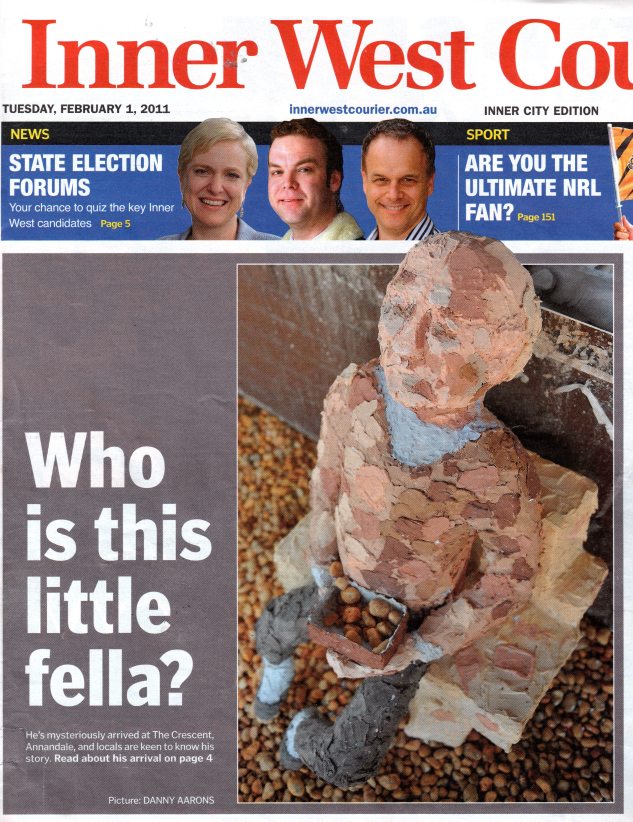
littlefella001.jpgToday’s Inner West Courier has the story and photo.