Tag Archives: Daniel Browning

Journal Catch-up 31: Overland 256

Evelyn Araluen and Jonathan Dunk (editors), Overland Nº 256 (Spring 2024)
(Links are to the online versions unless otherwise indicated.)
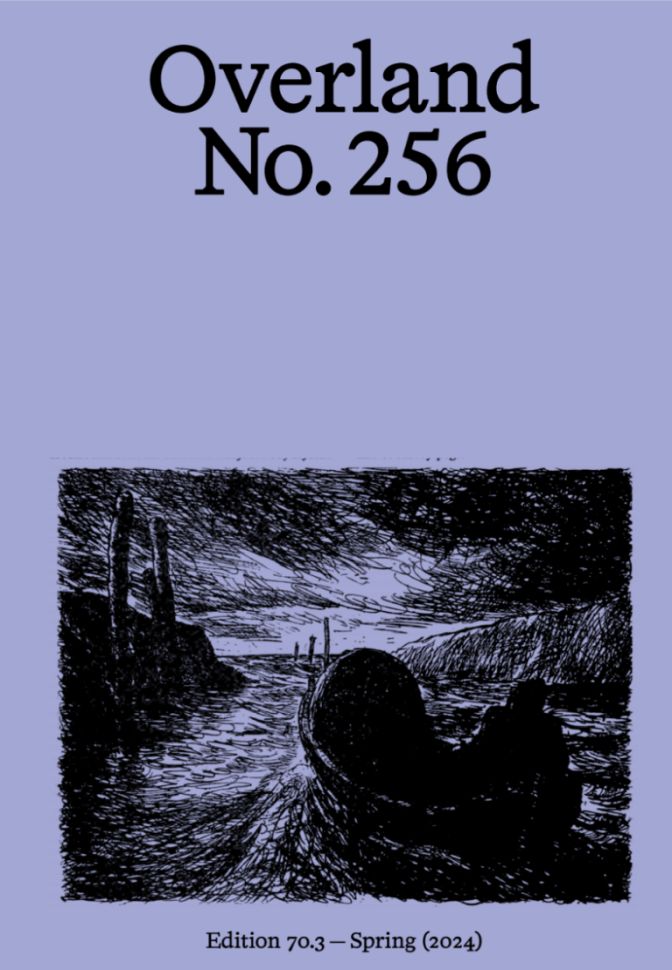
This is the third of four promised editions of Overland dedicated to commemorating its 70th year. In some ways it marks the end of an era as Toby Fitch, who has been poetry editor for a decade, breaks his silence with ‘A farewell and a poem from poetry editor Toby Fitch, 2015–2025‘, and resigns from the ‘simple work, of carving down a cornucopia of submissions into a small set menu for each issue’.

There is an element of nostalgia in the design and the illustrations reproduced from past issues – by artists including Fred Williams (from 1985), Ian Rankin (from 1987) and Richard Tipping (from 1993). The writing by contrast tends more to the urgent.

Plant hatred in our hearts‘ by Sarah Wehbe, ‘the child of refugees who are the children of refugees’, contextualises the current atrocities in Gaza by listing events reported from there in the first week of the writer’s life. The essay includes this, a reminder of Edward Said’s resonant statement that ‘Palestinians have been denied permission to narrate’:

The recent genocide in Gaza has planted hatred in the hearts of its survivors and onlookers, a painful wound so immense that it will continue to throb generations on. Plant hatred in our hearts and watch as hope and resilience grow in its place. Long after the rubble has settled and the refugees have dispersed across the world, we will share our stories. … We are here, we tell our stories, and as long as that is true, there is hope.

There’s a lot else besides. ‘Dust‘ by Lilli Hayes is a brief, harrowing first-hand account of the impact of asbestos-related mesothelioma on her family. In ‘Résonances‘, Daniel Browning – whose book of essays Close to the Subject won the 2024 Prime Minister’s Literary Award – writes about the work of Swiss–Haitian artist Sasha Huber, as seen through an Australian First Nations lens.

There is more poetry than usual (Toby is going out in a blaze of glory). There are some big names, but I’ll just mention ‘speed, a pastoral‘ by Ruby Connor, which has a subtitle ‘(After John Forbes)‘. It doesn’t feel very Forbes-ish to me, but it captures an episode in a young woman’s life in vivid, unpunctuated three-line stanzas.

My page 78* practice serves me well with this Overland. It falls in the middle of one of the three pieces selected by fiction editor Claire Corbett, the masterly ‘Daryl’s wombat farm‘ by Rowan MacDonald.
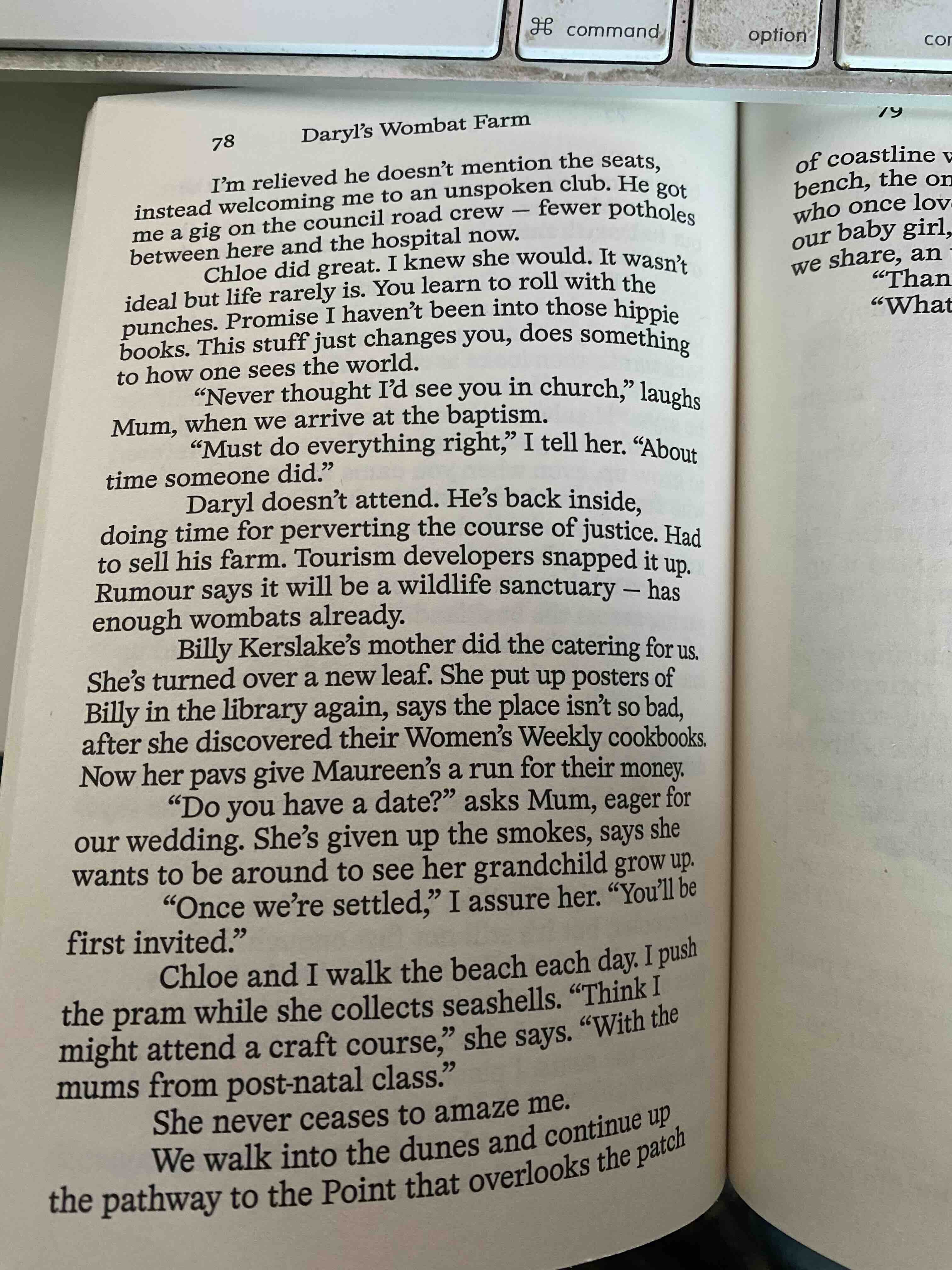
The image gives you an idea of the retro design – the chunky type face and larger font size, and the plain white, matt paper stock. I don’t necessarily prefer this to the modern design, but the larger font is a relief to my ageing eyes, and the poorer paper stock creates a companionable vibe rather than an austerely professional one.

I know I said there’s not much nostalgia in the writing in this Overland. I’ll now contradict myself. This story reminds me solid, social realist, working-class fiction that was a staple of Australian short fiction decades ago. I hasten to add that it does it in a good way.

At the start the narrator, wearing his girlfriend Chloe’s pink gumboots, is shovelling cube-shaped wombat poo. What grows from there is a portrait of a small, marginalised rural community filled with histories of violence, untimely death, ‘unspoken stories’, and a cast of characters who are known only by their first names and vague reference to their status, exploits or fates. Within that portrait is the sweet, elliptically told story of fatherhood.

When I say elliptically-told, I mean it sometimes take a bit of pleasurable work to figure out what’s going on. The beginning of page 78 is an example. The narrator has just returned Curly’s borrowed Skyline (a make of car – my four-year-old grandson would be ashamed of me that I had to look it up) with mess on the seats. Curly, who hasn’t been mentioned previously, doesn’t make a fuss about the mess. Instead he says, ‘Congrats, brother. You’re one of us now.’ Only as the first sentences of page 78 unreel, the reader understands. Curly has played a good role in the narrator’s life in other ways than lending the car, and his ‘one of us’ refers to fatherhood. The narrator has borrowed the car when Chloe was in labour, but didn’t make it to the hospital in time:

I’m relieved he doesn’t mention the seats, instead welcoming me to an unspoken club. He got me a gig on the council road crew — fewer potholes between here and the hospital now.

On the rest of the page, the aftermath of the birth plays out and a number of economically sketched subplots are resolved. The narrator catches himself voicing some of Chloe’s hippie-book-derived philosophy. He has an oblique conversation with his mother about breaking the pattern of neglect and abuse set by his father. Daryl of the wombat farm gets a degree of justice for his role in the narrator’s father’s death. The mother of a missing boy overcomes her dislike of libraries and education enough to put posters back up. Maureen, mentioned once before in connection with pavs, gets another mention. A wedding is mooted. And there’s a tiny, beautifully pitched conversation about the future.

Chloe did great. I knew she would. It wasn’t ideal but life rarely is. You learn to roll with the punches. Promise I haven’t been into those hippie books. This stuff just changes you, does something to how one sees the world.
Never thought I’d see you in church,’ laughs Mum, when we arrive at the baptism.
‘Must do everything right,’ I tell her. ‘About time someone did.’
Daryl doesn’t attend. He’s back inside, doing time for perverting the course of justice. Had to sell his farm. Tourism developers snapped it up. Rumour says it will be a wildlife sanctuary – has enough wombats already.
Billy Kerslake’s mother did the catering for us. She’s turned over a new leaf. She put up posters of Billy in the library again, says the place isn’t so bad, after she discovered their Women’s Weekly cookbooks. Now her pavs give Maureen’s a run for their money.
‘Do you have a date?’ asks Mum, eager for our wedding. She’s given up the smokes, says she wants to be around to see her grandchild grow up.
‘Once we’re settled,’ I assure her. ‘You’ll be first invited.’
Chloe and I walk the beach each day. I push the pram while she collects seashells. ‘Think I might attend a craft course,’ she says. ‘With the mums from post-natal class.’
She never ceases to amaze me.

The story could end there, really, but it continues for another 75 words, and concludes on an explicitly optimistic note that sings:

We hold our baby girl, smile in awe at this creation, the love we share, an unwritten future ahead.
‘Thank you,’ I say to Chloe.
‘What for?’ she laughs.

It’s a story that repays the closer attention that my page 78 practice requires.


I wrote this blog post on the land of the Wangal and Gadigal clans of the Eora nation. I gratefully acknowledge the Elders past and present who have cared for this beautiful country for millennia, and lived through extraordinary changes in the land and climate over that time.


My blogging practice is focus arbitrarily on the page of a book that coincides with my age, currently page 78.

Sydney Writers’ Festival 2025: My day one, part one

It’s raining in Sydney, but the Writers’ Festival shines on, apostrophe intact.

This year’s theme is ‘In This Together’. The Emerging Artist and I plan to take in about 17 sessions between us, mostly in it together. Given recent attacks elsewhere on speech about the genocide in Gaza, I will be disappointed but not surprised if some of our booked sessions are cancelled, but here’s hoping. 

22 May 1.00: Beyond the Self (link to come when podcast is released)

The Festival website description of this session begins:

Anchored in our human body, our experience of being in the world extends outwards from our sense of self.

Oh well, I thought, the program descriptions don’t usually determine the conversation.

The four panellists have written very different books, and come from very different contexts. What they have in common is that they are all First Nations people. The chair was Bardi Jawi man Bebe Oliver, who first came to prominence as WA Young Australian of the Year for his work as a classical pianist and composer has had several books of poetry published. Other panellists were Bundjalung and Kullilli man Daniel Browning who has worked as a journallist and broadcaster for many years, and has recently published Close to the Subject, a collection of personal essays; Kaurareg Aboriginal and Kalkalgal, Erubamle Torres Strait Islander man Thomas Mayo, who played a huge role in the Voice referendum and whose books, especially Always Was, Always Will Be: The Campaign for Justice and Recognition Continues, reflect his activism; and Yuwaalaraay woman Nardi Simpson, originally half of the singing duo Stiff Gins, and now author of Song of the Crocodile and The Belburd.

Nardi Simpson made a valiant attempt to tie the conversation back to the idea of bodies – go out from my body to yours when I sing for you, and when I write a book, these funny little squiggles on an oblong thing can make other people tingle. But mostly the yarning (as Bebe called it a number of times) ranged freely. All four panellists had interesting things to say, and they connected with each other, but I’m at a loss to summarise.

One theme that emerged for me was to do with aurality. Paradoxically, Daniel Browning said that for years he had sat in climate-controlled studios in the ABC talking to a microphone with little or no sense (and I may have added the ‘little or’ there) that there was anyone listening, whereas when he wrote an essay, he had an immediate sense that he was talking to someone. Spoken words are transient; written-down words have power. Nardi Simpson reported more or less the opposite: when you sing to an audience you’re right there with each other, but who knows what happens with a book? Thomas Mayo, likewise, said that he has come to love speaking to people (he did a lot of that, brilliantly, during the Voice Referendum campaign) – looking them in the eye, and if there’s a disagreement you can see it there. Nardi Simpson made explicit the underlying notion, that First Nations people come from an oral culture, and she and Daniel Browning told moving stories about audio versions of their books reaching people who wouldn’t otherwise have read them.

What all panellists agreed was that we are living in a time in this country when First Nations stories need to be told, and there is an audience for them. ‘If I/we don’t tell the stories, someone will say it didn’t happen.’

There was a brief conversation about the experience about being misunderstood, including very different feelings about the editing process. Nardi Simpson spoke directly to one of my current concerns when she said (and this is not an exact quote): ‘The book is there. Yuwaalaraay will find this in it.Aboriginal people will find this. Allies will find this. People who nothing about me or us will find this.’

2.00: Bringing the Past to Life (link to come when podcast is released)

The incomparable Kate Evans, co-presenter of The Bookshelf on ABC Radio National, did a lovely job managing this conversation about historical fiction with Emily Maguire whose latest book, on my To Be Read Soon list, is the novel Rapture, and Jock Serong, whose urban fairytale Cherrywood sounds terrific – I have seen a narration of its plot hold a seven-year-old spellbound.

Somehow a novel based on the 9th century CE legend of Pope Joan (or is it only a legend?) and one about a hotel in Fitzroy that lifts its skirts and wanders around the city made an excellent pairing. They both, it turns out, deal with institutions that have forgotten what they are here for. The Catholic Church in Maguire’s book is so concerned with its rituals and procedures that it has lost sight of its central mission. The corporate law firm in Cherrywood is hell bent on tracking down the wandering pub, but only one old man whom everyone ignores remembers why.

It was fun.


The Festival is happening on Gadigal land, I have written this on Gadigal and Wangal land. I acknowledge their Elders past present and emerging. As Bebe Oliver said in acknowledging country this afternoon, Always was, always will be Blak land.

Journal Catch-up 22

Two more journals in my endless attempt to keep up to date!


Evelyn Araluen and Jonathan Dunk (editors), Overland 251 (Winter 2023)
(Some of the content is online at the Overland website, and I’ve included links)

As always, this issue of Overland is full of good things. In particular, there’s ‘Close to the subject‘ by Bundjalung and Kullilli journalist Daniel Browning, whose mellifluous voice is familiar to me from his stint as presenter of ABC’s Awaye. The book Close to the Subject was published by Magabala Books in 2023. On the strength of this essay, it’s worth reading. Of his time as a journalist for the ABC, Browning writes:

My stories are always collaborative, and I try to produce content that represents not simply the who, what and why — but the cultural context in which these dialogues take place. I no longer excise myself from my stories, as I used to do (although I always insist that my team practise a simple rule: you are always the least important person in the room). … [The kind of journalism I practise] is one which embeds my blackfella subjectivity. It centres my own story, but only to make clear that I am in relationship with the person I am conversing with. By establishing my own credentials, I am drawing a reflexive enclosing circle around the conversation – its cultural context.

(page 51)

There are a other excellent articles on First Nations Issues from Barry Corr and Hana Pera Aoke, essays on literary matters, and a heart-wrenching episode of World War Two history from Bill Gammage.

The poetry section is wonderfully rich. I’ll just mention ‘Nothing out of the ordinary‘ by Heather Taylor-Johnson. The speaker of the poem lists any number of extraordinary adventures – mainly involving skydiving – that, she says, never happened. The negative is clearly ironic in some way, and you live with the tension of that until the very last line. It wasn’t until I heard Heather Taylor-Johnson read the poem at an Avant-Gaga evening at Sappho’s cafe that I realised with full force that (excuse the spoiler) the poem is an elegy.

Of the stories, ‘The expectations of sparrows’ by Jane Downing (which the website has tagged ‘online soon’) stands out. Its opening sentence, ‘Mavis was contemplating death,’ led me to expect one more story about a young woman suffering from depression as a result of chaotic sexual experiences or worse. But no! Mavis is in a cemetery when a pimply young man approaches her with a proposition involving his desecrating some graves and the two of them sharing the reward when she dobs him in. It’s a tale centred on a solid ethical dilemma, with some finely judged twists.


Alexandra Christie (editor), Heat Series 3 Nº 11 (Giramondo 2023)

I’m not getting on well with Heat. According to its website, it has always aimed to ‘publish innovative Australian and international writers of the highest standard’. The current issue accordingly includes work by two Australian writers and two international writers. So far so good. But look a bit closer and see that of the Australian writers one is listed as a publisher of Heat, and the other is on the editorial advisory board, while one of the ‘international’ writers and both translators live in the USA. Is all excellence, one wonders, to be found within the Heat family or imported from the USA? Must all translations into English include words like ‘faucet’ and ‘gotten’?

Evelyn Juers’ ‘Totality in Wallal. Woolf in Yorkshire. Einstein in Scharbeutz.’ is the high point of the issue, an essay on biography as a form, full of fascinating details from the lives and influence of its subjects. I enjoyed the three prose poems (flash fictions?) from Suneeta Peres da Costa, and the excerpt from Sara Mesa’s novel Un Amor, translated by Katie Whittemore, delivers a terrific final twist that made me almost forgive its leaking faucet. (The excerpt is on the Heat website.)


I hope to be less grumpy in my next journal catch-up.

SWF 2020 Day One

This year, because of viral matters, the Sydney Writers’ Festival has gone virtual. According to its website, more than 50 re-imagined sessions from the 2020 program will be presented as podcasts over the next few months. I don’t usually blog about podcasts, but since I’ve been blogging about the Sydney Writers’ Festival for 16 years off and mostly on, why not? I’ve made a monetary donation to help the festival through this crisis (and you can too, at this link). Here’s my bloggetary one, hopefully the first of several.

The first six podcasts were uploaded last Friday, all excellent. Here they are in my listening order, plus an earlier one that’s technically part of the Festival. The titles of the sessions here are linked to the Festival website where you can find the podcast..

Alison Whittaker: Opening Night Address: Alison Whittaker, described on the Festival website as ‘Gomeroi poet, essayist and legal scholar’, evoked the isolated condition in which she recorded her talk. She said her brief included a request to avoid talking about Covid-19 if it was possible, but she couldn’t find a way to avoid it. The theme of the Festival is Almost Midnight: she suggested that it’s now a minute past midnight, that we are living in apocalyptic times, but that First Nations Peoples have been doing that for 250 years. It’s a salutary talk, in which Whittaker pays tribute to many other First Nations writers who were scheduled to appear at the Festival.

Ann Patchett and Kevin Wilson: A Conversation with Friends: A free-ranging conversations between two US writers. Wilson first met Pratchett when he was beginning his postgraduate studies. She asked him to look after her dog for a time, and in that time she kept giving him books to read, which they would discuss, and it sounds as if they’ve been talking about the books they read ever since. It’s a warm, entertaining conversation with a lot of insight into how each of them approaches writing. I haven’t read any of his books, and just two of hers., but both were equally interesting to me.

Rebecca Giggs: Fathoms: I knew nothing about Rebecca Giggs’s book Fathom: The World in the Whale before listening to this. Nor had I heard of Sweaty City, an independent magazine about climate change and urban ecology, whose co-founding editor Angus Dalton is her interlocutor on this podcast. I learnt a lot about whales that I didn’t know I wanted to know. For example parts of whales’ bodies were used to make things and perform functions that are now being made or done using plastics, so the reason for the wholesale slaughter of whales in the nineteenth and early twentieth centuries; but now, in a terrible irony, many whales are dying because of the plastic that is polluting the oceans and ending up in their intestines.

Jess Hill: See What You Made Me Do: Jess Hill’s book about domestic and family violence won this year’s Stella Prize. Before listening to this I thought I might make myself read it in order to Be Good. It turns out that when Jess Hill was commissioned to write a long article on the subject many years ago she accepted without a lot of enthusiasm, but felt that she couldn’t let ‘the sisterhood’ down. As I listened to her describe in this conversation with fellow feminist writer and journalist Georgie Dent how her enthusiasm for the subject grew with her understanding of its complexity, I was similarly enthused. This is a terrific conversation.

Miranda Tapsell: Top End Girl: Miranda Tapsell talks with Daniel Browning from the ABC’s Awaye! about her memoir Top End Girl. Another terrific conversation. Mind you, I’d be delighted to listen to Miranda Tapsell talk about anything or nothing for as long as she wanted. How does a 31 year old women get to write a memoir? She says it’s because when she read memoirs by, for example, Judi Dench or Michael Caine, she was struck by how they struggled to remember details of their youth, so she decided to write about her youth while it was still fresh in her mind. But that’s just a typical bit of charming self-deprecation: in the course of the conversation, it turns out that the book is also something of a manifesto (DB’s term) for diversity of representation and acknowledgement of the presence of Aboriginal people in all aspects of the arts, in particular film. They discussed the movie Top End Wedding, and the process of getting cultural permissions. I especially loved that at the very end, Browning asked about the episode of Get Krack!n when she and Nakkiah Lui took over the stage, and she spoke of the huge privilege she was given there of speaking in a ‘raw, unfiltered’ way while also exercising her ‘comedy chops’ to the full. That was one of my Great Moments of Television, and I was delighted to hear that they both thought so too.

Return of the Sweatshop Women: Sweatshop is a Western Sydney Literacy Movement. Its Sweatshop Women is an anthology of short stories, essays and poems produced entirely by women of colour. This podcast, shorter than the others, consists of readings by five of its contributors: Phoebe Grainer, Sara Saleh, Sydnye Allen, Janette Chen and Maryam Azam. One of the joys of the Festival is being read to, and another is hearing from voices that are usually marginalised if not completely silenced. This podcast provides both joys. The readings are introduced by Winnie Dunn, general manager of Sweatshop.

If I was attending this Festival at somewhere like the Carriageworks (currently in dire straits thanks to governments’ decision that the arts aren’t eligible for Covid–related help) or Walsh Bay (currently being ‘redeveloped’), I’d be in the company of hundreds of other silver heads, and I’d skip more sessions than I attended. So I have any misgivings about not listening to Malcolm Turnbull in Conversation with Annabel Crabb, but there’s the link of you’re interested. (Full disclosure: I did listen to the first 20 minutes of this conversation, and MT’s urbanity and AC’s apparently genuine affection for him are seductive.)

I miss those hundreds of other bodies, the unexpected questions at the end of sessions, the catching up with old friends, Gleebooks’s groaning trestles, the coming out blinking into the sunlight after being taken to a whole new view of things. But in the absence of all that, I’m grateful for the existence of podcasts.