Tag Archives: editing

By Swapna Dutta

My friend Swapna Dutta is a writer, translator and editor, mainly of children’s literature, who lives in Bangalore, in southern India. The School Magazine published some of her stories when I was editor, and she and I have kept in touch over the intervening years. Swapna mentioned in a recent email that she had translated a children’s book, The Arakiel Diamond, from Bengali into English, and asked if I’d like a copy. Of course I was interested, and a couple of days later it arrived in my letter box, with three other books. It’s been a treat and an education to read all four.


Swapna Dutta and Geeta Vadhera, The Sun Fairies (National Book Trust, India 1994, 2001)
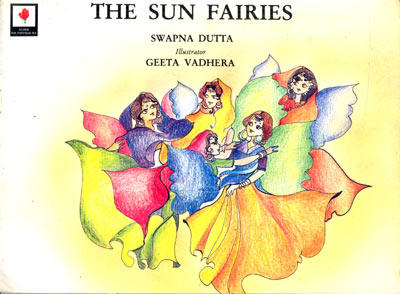
The Sun Fairies is a tiny picture book that plays around with science and fantasy. That is to say, it’s a fanciful account of the origin of clouds – some fairies who live in the sun build castles in the sky so it won’t be so bare and empty – that ends up being a decorative but accurate account of how the water cycle works: the cloud castles are made from water, air and dust, and when they get too heavy they fall to the earth as water. The fairies have discovered ‘a never-ending game’. The illustrations, by Geeta Vadhera, are fabulous. I see from the Internet that Ms Vadhera has gone on to international renown. This may be her only children’s book.


Swapna Dutta, Plays from India, illustrated by Baraan Ijlal (Rupa & Co 2003)
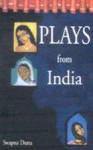
In some ways each of the other books is a work of translation. In Plays from India three episodes from Indian history are shaped into dramas suitable for performance by school students. In my ignorance I don’t know whether the stories would be familiar to most Indian students, so I can’t tell whether the history or the theatre is the main point. I was interested in both.


Swapna Dutta, Folk Tales of West Bengal , illustrated by Neeta Gangopadhya (Children’s Book Trust 2009)
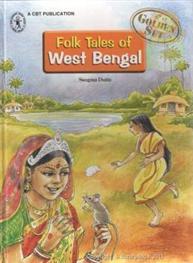
Folk Tales of West Bengal retells sixteen tales. Swapna has an article at papertigers from which I learned that what the Grimms were for Germany, and Moe & Asbjørnsen for Norway, the imposingly named Dakshinaranjan Mitra-Mazumdar was for what is now Bangladesh and West Bengal. At least some of the tales here were collected by him in the first decades of last century. Unsurprisingly to anyone who has entered the woods of Re-enchantment, there’s a lot in these stories that’s familiar to a reader brought up on European-origin fairy stories: kings and princesses, talking animals, metamorphoses, riddles, lost and found children, supernatural beings who reward the humble and punish the greedy. There’s also a lot that’s different: the heroine of the first story, for instance, is not a seventh child but a seventh wife. This blending of familiar and unfamiliar makes for a delightful read.


Sucitrā Bhaṭṭācārya, The Arakiel Diamond, translated by Swapna Dutta and illustrated by Agantuk (Ponytale Books 2011)
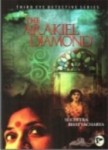
The Arakiel Diamond is the only book in my swag that is not Swapna’s original work. It’s a detective story for young readers, one of a series featuring a Bengali housewife and her niece. A wealthy man dies. His most precious possession, the eponymous diamond, has gone missing, and almost everyone in his household – and there are many – has had motive and opportunity to steal it. The plot has exactly the twists you’d expect, but the detectives’ relationship and the details of their domestic life are well captured, and I learned a lot about the Armenian community in Calcutta, in a way that reminds me of grown-up detective writers (Sarah Paretsky comes to mind) who take us to a new subculture in each novel.


The four books had me reflecting on multiculturalism in children’s literature. We make fun of the way US children’s publishers, apparently believing that their intended readers would shrink from anything not immediately recognisable as of the US, re-edit books from elsewhere in the English-speaking world to remove unsightly exotica. They don’t just want a world where British characters spend dollars and cents, or Australians walk on a pavement, weird as such a world might be. I remember hearing of a New Zealand novel whose publisher suggested the book’s Maori issues might be more accessible to US children if the setting was changed to California – that author held firm and the book still found readers, even got made into a movie.

I wish now to acknowledge that I’m a bit of a kettle to the US publishers’ pot. Though I enjoyed the slight cultural disorientation I felt as I read these books, I caught myself thinking young readers would be put off by it. To make the books accessible to Australian 11-year olds, the unexamined internal argument went, you’d have to do something about lakh and crorelunghi, salwar shameez and rakhi, not to mention the nitty-gritties of the game of chess or a casual use of thrice in conversation. On reflection, I think that argument profoundly misunderstands how young people read. The only thing that universally distinguishes young from adult readers is that the young ones are younger. One result of this is that they know they don’t know everything about the world, and mostly when they read there are words they don’t recognise but have to guess from the context. (I loved and understood pulverise and invulnerable in Superman comics long before I could define them.) So you might not know what a lunghi is, but the context tells you it’s an article of clothing, and there’s even an illustration to help. Likewise, lakh and crore are obviously big numbers, and that’s all you need to know. As I remember back to my own childhood reading, I think such things would have added spice to the book: if I was young now, I might even have fun googling them. As for nitty-gritties and thrice, I do think we can trust young readers to recognise when a word or a turn of phrase belongs to a different place. (Both my sons say zed in spite of seeing quite a lot of Sesame Street when young.)
Heat death … resurrection not ruled out *UPDATED*

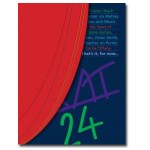
Ivor Indyk (ed.), Heat 24: That’s it, for now … (Giramondo January 2011)

After 14 years, Heat is to appear no more in book form. In this final issue Ivor Indyk, the editor and publisher, departs from his usual practice and speaks to us, explaining the reasons for his decision and sketching some possibilities for an electronic afterlife. (He spoke again to Ramona Koval on the Book Show.) The sad economic reality is that as a 240 page book, Heat is a monster to produce several times a year and then to distribute and warehouse. The community of people who are glad of its existence is much larger than the journal’s market – the people who buy it, and so contribute to its viability. As I’ve subscribed for ten years and written blog entries (I don’t really think of them as reviews), I have a twinge of smug virtue mixed with my sorrow: like, ‘It’s not my fault!’ I don’t know that I’ve ever felt part of a Heat community – too middlebrow, too whitebread, too shy – but it hasn’t been a purely economic relationship. I’ll miss this regular dose of austere high culture, and emergent/experimental/cosmopolitan writing.

Some of the culture in this final issue is incontestably high. Adrian Martin’s article, ‘Devastation’, after a wonderful anecdote about a working class man’s response to Terence Davies’ Distant Voices, Still Lives, goes on to discuss the films of Maurice Pialat. I’m a keen and frequent filmgoer, but I had to check with Google to be sure the article wasn’t a spoof and Pialat a comic invention – an archetypally grim French auteur whom Martin praises for daring to have sitting and standing characters in the same shot, and compares to a number of other auteurs I hadn’t heard of. It’s not a spoof: it’s the kind of article that sheds enough light on its subject to reveal the dark vastness of its reader’s ignorance. By way of  contrast, Andrew Riemer’s brilliantly erudite ‘Four Glimpses of the Zeitgeist’ takes one gently by the hand and illuminates a web of connections joining Freud, Mahler, Riemer’s ancestors, conductor Bruno Walter, His Master’s Voice records, Hitler, playwright Thomas Bernhard and others, all converging in a Viennese theatre in 2010. Jeffrey Poacher’s reflection on the poetry of Peter Porter , who died last year, is likewise kind to general readers without, I hope, boring those who know Porter’s poetry well.

Cosmopolitanism is alive and well, particularly n Andreas Campomar’s ‘Uruguay Made Me’, a discussion of Eduardo Galeano in the context of his native Uruguay that makes me want – need – to read Galeano.

There’s plenty of emerging/experimental work too, mainly in the poetry. I was happy to see two typographically adventurous poems by Patrick Jones, who commented critically on this blog a while back.

But I don’t want to get hung up on classification. There’s a terrific poem by Adam Aitken dedicated to Susan Schultz – both Adam and Susan have graced my comments section recently. Ali Alizadeh and Jennifer Maiden are in fine form. Alan Wearne does some Gilbertian editorialising on the current move to form an Australian peak industry body for poetry. Amanda Simons interviews Antigone Kefala on her writing practice: Kefala says that, for her, writing and speaking are two completely different forms, and it’s delightful to encounter the conversational Antigone here alongside two characteristically non-conversational poems (there’s that austere high culture again).

I was struck by two examples of things a book you hold in your hand can do that a boundless (the word is from Ivor Indyk’s editorial) electronic creation can’t. In Nicolas José’s ‘What Love Tells Me’ a recently widowed man and his young son attend a performance of Mahler’s Third Symphony where the ‘blasting and pummelling and smashing’ music opens them up to emotional resolution and communication. The story is moving in its own right, but it gains an extra fizz from the fact that 150 pages earlier Andrew Riemer has been telling us something of what Mahler’s music (though not this precise symphony) meant at the time it was written. In my mind at least, that mental connection is made possible by the weight of the book in my hand

The other moment is a theatrical coup in Gillian Mears’ ‘Fairy Death’. This memoir begins with a title page: a right-hand page that’s blank except for the title and a brief note on the author. When you turn over, expecting the story to begin on the verso, you find instead a striking image of what seems to be a dress-shop mannequin with a crack or join around its middle, arranged on a bed and photographed from above. The figure’s face makes you realise that it’s actually a live, extraordinarily thin woman, that what looked like a join is a string tied around her waist and attached to what you now recognise as a red balloon in the photo’s foreground. The photo, taken by Vincent Lord Long, is of the author, and her mannequin-like thinness is the result of advanced multiple sclerosis. The article is in part an account of how it came to be taken. Though the memoir is astonishingly powerful, addressing (with what in another context would be Way Too Much Information) the effects of MS on the author’s sexuality, the act of turning the first page onto that image creates extraordinary poignancy – which I don’t believe could happen in an electronic form.

One perhaps minor advantage of ceasing to exist as a physical object is that proofreading and even copy editing can continue after publication. Heat 24 is far from egregious in that department – apart from a miniscule (which is a special case as the Microsoft spellchecker ignorantly allows it), I was plunged into confusion and irritation by only one editing error, which I won’t bore you with. It looks as if the presumably underpaid copy editor had enough time and/or other resource to do an excellent job on this issue, so he can go out with his head held high.

Just to be half clever, here’s the last stanza of John Shaw Neilson’s ‘The Poor Poor Country’, slightly altered:

The New Year came with Heat and thirst and the little lakes were low,
The blue cranes were my nearest friends and I mourned to see them go;
I watched their wings so long until I only saw the sky,
Down in that poor country no pauper was I.

Update 1 March 2011:

Over at Adam in (), Adam Aitken was kind enough to link to this page, and he asked me a question. I tried three times to respond in his comments section but for some reason my comments wouldn’t stick, so I’ll have go here.

Adam:

Jonathan, I don’t know why you see yourself as “whitebread”. Are HEAT writers “brownbread”? I won’t miss the so-called austerity of HEAT, as I feel on the contrary that HEAT would sometimes verge on the too rich, too dense side of things (by virtue of each issue being such a fat book).

Well, Adam, I’m not sure where I picked up the term ‘whitebread’, but my (now former) suburb, Annandale, got described that way by some of my more hip friends. They meant that the people of the suburb were the kind who ate only white, preferably sliced and packaged bread, remaining ignorant of or uninterested in the existence of pumpernickel, sourdough, ciabatta and challah, let alone pita, roti and naan. So my implication was Heat writers (and anyone else who belongs to its community) can come from anywhere in that vast world of different breads (quite a few of which are actually white, come to think of it).  I have never read an issue of Heat without having my horizons extended, and I was amusing myself by saying that in a self-deprecatory way.

I agree with you on the richness and density of Heat. It’s been admirably austere in the sense that it would never have given us a review of the latest Oprah recommendation or blockbuster movie, and in a different way I’ve thought of Ivor Indyk’s editorial silence as austere. In this final issue he speaks to us, but presents it as asking our indulgence. I for one would have happily indulged him in this way many times over.

End of update

Heat 23, Overland 200 and Asia LR 17

The ‘dead white male’ critique of Western Civ […] did not lead, as many of us had hoped, to a new internationalism, but rather to a new form of nationalism that emphasised hyphenated Americans. Chinese-Americans and Chicanos were now part of  the intellectual universe, which was fine as far as it went, but Chinese and Mexicans were still excluded. Multiculturalism was, and is, not very multicultural at all.
(Eliot Weinberger, ‘The Post-National Writer’ in Oranges and Peanuts for Sale)

I’ve just read three literary journals whose roots lie respectively in a rejection of Australian xenophobia, in Communism with its commitment to internationalism and in a mission to publish Asian writing in English. Although we don’t do hyphens in quite the same way as the US, it seems reasonable to see how these journals stack up against Weinberger’s complaint.
***

Ivor Indyk (editor), Heat 23: Two to Go (September 2010)

This issue of Heat is atypical in not including any work in translation. Multicultural themes are addressed, but very little attention is paid to the world beyond our shores. There’s not even any travel writing, unless you count Vanessa Berry’s ‘Dark Tourism: Three Graveyard Tales’, in which the author visits two graves and strolls in a London cemetery (in a piece that might have been more accurately titled ‘Mildly Crepuscular Travels with my Mum’).

Turkish born, ethnically Greek Melburnian Dmetri Kakmi’s ‘Salam Cafe and the Great Burqa Debate’ might seem to fit Weinberger’s description of Clayton’s multiculturalism pretty well – a non-Muslim man joins the argument about what Muslim women should or shouldn’t be allowed or made to wear. But he puts the lie to that pigeonholing by acting as a conduit for Muslim points of view, drawing on his childhood memories of Turkey and his time as a student in Istanbul, and discussing burqa-related artworks by Muslims Shadi Ghadirian (a woman) and Kader Attia (a man, whose ‘Kasbah’ was shown in this year’s Sydney Biennale).

Weinberger’s aspersions might also seem to apply to Michael Mohammed Ahmad’s story, ‘The Hat Dance’, the piece that comes closest to the kind of hyphenation he dislikes. But this account of a dust-up in an extended family living in Western Sydney is so gloriously exuberant only some kind of Diversity Bean-counter could fail to relish it.

Of course, Heat doesn’t claim to fill a hypothetical Diversity Quota in every issue, and there’s no reason it should. Its characteristic approach to fostering diversity is by presenting crosscultural encounters, an approach I’m fairly sure Weinberger would approve of. Kakmi’s piece is an example of that approach. So is Michael Atherton’s portrait of Harry (christened Charalambos) Vatiliotis, who lives in the Sydney suburb of Croydon and makes classical violins in the manner of Stradivere, each one a unique work of art. Cassi Plate quotes from letters of Costas Tachtis, Greek novelist who lived for some years in Australia, and his friend Carl Plate, an Australian artist: ‘The letters,’ she writes, ‘take us into a cosmopolitan world within the heart of what is often assumed to be parochial 1950s Sydney.’ Maybe cosmopolitanism is a better word than diversity for the thing that Heat does so well.

Cosmopolitanism can incorporate voices from elsewhere, and also bring a sharp eye to bear on the local, as Peter Doyle’s fascinating ‘Bashful City: Sydney’s Covert Criminality‘ does to photographs from the archives of Sydney’s Justice and Police Museum.  It can also include intensely place-specific writing like  Mark Tredinnick’s review of  Judith Beveridge’s most recent book of poetry, in which, incidentally, he compares her to a shark and a Philip Marlowe thug, and convincingly means both as compliments.

I do worry about Heat‘s copy editing and proof reading. There’s curiousity, practicing (though correct Australian usage practises elsewhere), an umbilical chord. Someone is heard cluttering in his garage. In Robert Adamson’s delicately poised ‘The Coriander Fields of Long Bay Penitentiary’, a with is repeated over a line break – I know it’s poetry, but that’s just a mistake. One article has this near the beginning: ‘It is one of the great dividers between the civilised among us: those of impeccable taste.’ I wasn’t interested enough in the article’s subject – taxidermy – to endure whatever came after that.
****

Jeff* Sparrow (editor), Overland 200 (Spring 2010)

The first issues of Overland, published in 1954,carried the slogan ‘Temper democratic; Bias, Australian’, hardly a promise of cultural diversity or cosmopolitanism. But as a project of the mainly Communist Realist Writers’ Group, the journal had a commitment to internationalism. Surprisingly, there’s not a lot of that in this anniversary issue, unless you count a deference to Europe and the US. Not that there’s necessarily anything wrong with that: for instance, Alison Croggon’s ‘How Australian Is It?‘ talks with her characteristic clarity and generosity about the way much of our theatre has opened out to the world, freed from constricting preoccupations with national identity but distinctively Australian all the same. On the other hand, when Clive Hamilton characterises the Australian as an agent of ‘the Republicans’ war on climate science’, he implies – perhaps intentionally – that in this matter Australia is humiliatingly no more than an arena in which US battles are being fought. There’s a fair whack of ‘theory’**, enough to create a gnawing sense of Australia as a site for the application of theory developed elsewhere – no sign of Raewyn Connell’s Southern Theory here. (The most theory-rich piece, Alwyn Crawford’s ‘Permanent Daylight‘, which deals with the intimate connection between capitalism and anorexia, is nevertheless compelling reading because of a ballast of passionate personal testimony.) Christos Tsiolkas is the Literary Big Gun of this issue, with a short story about the market in European art, but I found it unreadable (that is to say, I couldn’t tell what the story was trying to do, whether it was a spoof or something else very dull). There’s no non-European voice, and little interest in non-European culture: one piece, by a non-Muslim, quoting no Muslim voices, uses the Western burqa debate as a springboard for theoretical reflections on the visibility or otherwise of women in the West; Jacinda Woodhead gives us an attractive profile of Melbourne rapper-comedians Fear of a Brown Planet (there’s a wonderful YouTube clip of one of them here); Kabul is mentioned in one article, but it’s in a quote from an organisation aimed at creating a market for US cosmetics there.

So Weinberger’s kind of internationalism isn’t overwhelmingly evident in Overland. The three outstanding pieces, in fact, aren’t even particularly multicultural. Chris Graham does a demolition job on Noel Pearson in ‘Telling whites what they want to hear‘. Graphic novelist Bruce Mutard re-tells a story from Overland 1: the story is ‘Nine O’clock Finish’ by John Morrison, a marvellous socialist realist writer, and the resulting 8-page comic is to weep. Janette Turner Hospital’s short story ‘Weird People’ is a tour de force centred on the captain of a tourist boat that takes mainly US tourists out to look at humpback whales off the coast of New South Wales – I suppose it could be read as a protest against our cultural client-state identity.

In Overland, though less so than in Heat, proofreading is a worry: ‘haute bourgeois’, the Communications Minster, and at least one article written in an academic style that apparently defeated all attempts to wrangle it into English.

* In a classic example of Mruphy’s law, when I first put this up, I misspelled Mr Sparrow’s first name – immediately after whingeing about someone else’s poor copy editing. I’ve fixed it now
**  Writers referred to include Ariel Levy (North American liberal feminist), Nina Power (British philosopher and feminist), Mark Fisher (British cultural theorist), Guy Debord (French theorist), Sheila Rowbotham (British feminist historian), Edward Said (the exception that tests the rule and finds that it holds up), Naomi Baron (US linguistics professor).

****

Stephen McCarty(editor), Asia Literary Review 17 ([Northern] Autumn 2010)

It’s a telling confirmation of Weinberger’s generalisation that the ALR’s web page header reads ‘Asia Literary Review – Asian American writing’, apparently promising US-ers that they can read it without danger of encountering anything genuinely foreign. Happily, it’s a false promise.

From the beginning, there’s no doubt that we’ve left the leisurely contemplation of anti-grand abstractions far behind. US-expat journalist Robbie Corey Boulet kicks off with a report on the first case tried – in 2009! –  by the tribunal set up to deal with ‘those most responsible’ for the crimes of the Pol Pot regime. Itself a fine combination of court-reporting, historical background and interviews with people still looking for answers about their murdered relatives, it is followed a few items later by a suite of poems by Peauladd Huy whose parents were murdered by that regime and who now lives in the USA. And it finds a grim echo at the end of the journal, in an excerpt from Frank Dikötter’s Mao’s Great Famine, which draws on archival sources to explore the terror and violence of the Great Leap Forward (‘at least 45 million people worked, starved or beaten to death’). There are other pairings, including a story and a photo essay about floods in the Philippines. A good bit of the ALR probably amounts to armchair dark tourism – much stronger medicine than the piece wearing that label in Heat.  The one actual piece of travel writing – about Mount Merapi, a Javan volcano –  has enough disastrous loss of life for the darkest tourist sensibilities.

There aren’t many laughs, but there’s plenty of wit and imagination: ‘Youth-in-Asia‘,  a story set in Korea by Canadian Ron Schafrick, delivers on its punning title; Priya Basil’s ‘Losing Their Religion‘ is a quietly entertaining memoir of religious conversion and un-conversion that spans three continents; GB Prabhat’s ‘The Silencer‘ gives us a clever inversion of  celebrity stalking.

There is no Australian presence, apart from two full-page ads, for the Melbourne Writers Festival (featuring a Hokusai wave) and Heat (‘Australia’s only international literary journal’) respectively.  Insert your own ironic comment.

One sentence leaps out to meet my eye.  Jonathan Watts, an English journalist, moved from Korea to Beijing in 2003. His interviewer James Kidd tells us:

The signs of conspicuous pollution made an immediate impression: a keen runner, Watts found himself wheezing after a short jog; a father, he was alarmed when his two daughters were not allowed outside during breaks at their Beijing school. It was China that taught him to fear for the future of the planet.

I’m not sure I can afford to keep up my subscriptions to all three of these journals. I was thinking of letting my subscription to Asia Literary Review lapse – but it’s teaching me to think in terms of the whole planet

Not a grocer’s apostrophe in sight

Have a look at this sign in a cake shop in Norton Street Plaza, Leichhardt. Sam Cavallaro probably feels he has crafted a memorable slogan. Clearly he has saved quite a bit of money by not employing a copy writer or an editor. What I love is the way it refuses to yield up a clear meaning. The dollar may lose its value with inflation, but these cakes are good even when they’re stale? No, that can’t be it. Perhaps: our cakes may seem expensive, but you’ll stop worrying about the cost when you actually eat them? But surely that isn’t it either. I know we’re not meant to scrutinise it like this, but honestly it’s not derision I feel but a kind of awe at its koan-ishness.

Heat 22: The Persistent Rabbit

Ivor Indyk (Ed), Heat 22: The persistent rabbit (Giramondo May 2010)

This issue of Heat has much that is wonderful. The title, following tradition, is a phrase chosen apparently at random from the contents, in this case from πO’s exuberant nonsense poem ‘Rabbit Proof Fence’:

The average person blinksoooo22 rabbits a minute.
Burke & Wills went into the desertoooowith a dozen rabbits
Obsession isooooa persistent rabbit.
The causes of a rabbitooooaren't clear.

Perhaps Ivor Indyk, the editor, is quietly suggesting that the seemingly  miraculous persistence of Heat owes not a little to obsession.

I understand Heat to be about diversity, about presenting a version of literary Australia that is open to the whole planet. It often includes, for instance, travel writing, translated pieces, news from abroad, and fiction, essays or images that grow from places where cultures intersect. In this issue there are examples of each of these – respectively, Barbara Brooks’s self-styled fictional memoir ‘Lost in the House’ (which powerfully combines tales of travel, dementia, memory and intergenerational relationships); Stuart Cooke’s ‘Two Mapuche Poets’ (the Mapuche people are indigenous to parts of Chile and Argentina); Priya Basil’s ‘My Home is Our Castle’ (about a communal housing project that won a major architecture prize in Berlin last year); Michelle Moo’s colonial historical fiction, ‘New Gold Mountain’ (white women and Chinese men on the Australian goldfields); Barry Hill’s ‘Ezra Pound: The tragic orientalist’; and the centre section of art by Guan Wei, ‘Longevity for Beginners’. (The last three provide a nice example of the kind of counterpoint that Edward Said recommended.)

Apart from Barbara Brooks’s memoir three pieces stood out for me.

Brendan Ryan (whose book of poetry, Why I Am Not a Farmer, I am now actively seeking) has a gripping personal essay on the 1983 Ash Wednesday fires in western Victoria, which is enough by itself to justify the price of the journal. Sadly, not even part of it is up on the Heat website.

Lee Kofman’s essay, ‘Revisiting the Geography of My Body’, just as gripping and as intensely personal, includes incidental elements of a migration story, but is mainly about scars, particularly scars on a woman’s body, and their almost complete absence from literature and visual arts: wounds, scars as something to be healed, scars on men (she doesn’t have to mention Coriolanus), but scars as such, particularly on a woman’s body, reside ‘outside the linguistic and public realm’. By sheer chance, I happened to walk past this piece of graffiti in Newtown just as I finished reading the essay. I hope Ms Kofman would enjoy it:

I said I wouldn’t whinge any more about proofing errors in this Heat, but there is one good old-fashioned belly laugh in this essay. The pursuit of bodily perfection, it tells us, ‘can be traced back to Pluto’s ideal of human beauty as the “natural”, unmarked body’. Roman myth, presumably, rather than Disney.

Of the poetry, Kate Middleton’s poems on a Hansel and Gretel theme stand out for me. They are billed as excerpts from Where Dingoes Tread. I look forward to seeing the whole thing:

Remember when hunger
was simple?
ooooooooooooThere was nothing
and we ate nothing. Then plenty returned
and I turned
to austerity.

Why, how or what?

This is the last of these posts for a while, I promise. Mireille Juchau isn’t an easy writer, but she is rewarding. ‘Habitat Group’, her story in the current Heat, compresses a great complexity of relationships into an astonishingly small span. But it  begins:

Josie looks out from the treehouse, across the roofs and conifer spires to the grand home hovering in shreds of fog. Through its high window she sees a framed picture changing form – now a plane of radium green, now a dappled mercury lake. Pain knives her belly.

Why knives rather than the accepted usage, knifes? I can’t think of a reason why someone would make that choice deliberately, unless perhaps to say subliminally about spelling conventions what a recent commenter here said explicitly about syntax: ‘your correct syntax is […] synthetic and immutable and already outmoded.’ I don’t believe this story is intended to make any such statement, even though there’s a tremour a couple of pages later. There is no why, no meaning-making intent.

How did it happen? None of three spellcheckers easily available to me rejects knifes (though WordPress rejects both gages and pavo). It could be a typo, as v is very close to  f on the qwerty keyboard. It could be a moment’s inattention on the writer’s part or a product of an education that didn’t insist on relentlessly testing spelling, backed up by similar moments of inattention or educational deficits in the copy editor and everyone else who read the text on the way to publication. However, it’s almost certainly accidental, and accidents will always happen.

What effect does it have? It’s immediate effect on me is to throw me into proofreader mode, so unless I lay the book aside and come back to it with a fresh mind in a couple of days, I read on, distracted by every instance where I would have made a different judgment on the commas. Fourteen pages later, for example, in John Mateer’s poem, ‘Pieta’, a prostitute smiles ‘discretely’ at her customer, and I’m irritated that my first response is to think it’s a misspelling – when in fact it’s a finely judged and unusual use of the word. This immediate effect is what prompts me to blog about these things. But there are other, more serious effects, of which three come to mind. First, Heat is a serious, often groundbreaking literary journal, and the routine occurrence of these and less obvious errors makes it look amateurish and second rate. Second, these errors are likely to spread confusion among young readers. I realise this is not as big a deal as it would be in a children’s magazine, but it is still a consideration. Third, they contribute to a general falling off of precision in the use of language and in thinking, of which it is a symptom.

Haven’t I got better things to do with my time, you might ask, than blog about other people’s spelling mistakes? Well, yes, I have. I will pass over any remaining errors of the sort in this issue of Heat in silence. The silence will also apply to eccentric, inconsistent and North American use of commas and other punctuation. Sydney is hosting the Biennale, the Writers Festival and – soon – Vivid. I’m sure I’ll find something to write about there.

Another tiny adventure in reading

At the risk of making it absolutely clear that I’m a total pain in the neck, here’s another little confused-reader moment. John Bryson’s essay, ‘Panama, a Pantomime‘, in the current issue of Heat, is structured as a conversation a Panamanian bar in 1990. This is our introduction to the bar:

The place is well known to cab drivers as El Parvo Real on Calle 51, set between the hotels and office blocks of Via Espana and the classy condominiums of Campo Alegre. But to those inside the bar it is called the Royal Peacock.

My knowledge of Spanish is minuscule, but it was enough to set me wondering just what point was being made here. Parvo has something to do with smallness; real means royal. Perhaps the taxi drivers nicknamed the place because it was tiny but opulent.  But wait, pavo (in Latin) means peacock. I looked it up, and sure enough the Spanish for peacock is pavo real. So perhaps the taxidrivers here represent the Spanish-speaking majority of Panamanians, the Parvo is a misspelling, and the point of the two different names is that those inside the bar are English speakers. The next sentences remove all doubt:

A barmaid pulls brown ale from the keg. Ayrshire roses stands in a window vase, and someone can tell you the result of the soccer draw between Crystal palace and Manchester United.

The bar is a haven for the British/English, then. But what about that misspelling? Is it a subtlety – those English speakers, including the narrator, know the bar’s Spanish name only from the taxi drivers (possibly the only Spanish speakers they deal with) and disdain to read the name as written over the door. If so, this single misplaced r sends ripples through the whole story: we no longer take the narrator’s voice to be that of the author; the conversation in the pub, an effective device for conveying some of the complexities of the 1989 US invasion of Panama, now resonates with the silence of the absent, disdained majority population, and the essay invites us to be wary of the point of view of the wealthy expat characters, as well as that of the narrator and his excursions into history.

Or is it just a slip of the pen that slipped through the editorial net? Given the gage/gauge slip a few pages earlier, this seems the most likely reading. But it makes me sad.

Is it just me?

How do you respond when you read the following? It’s wrenched out of context here, but I’ve tried to include enough so you have a sense of what’s going on.

Susan, Bessie calls out, Susan, the plums are spoiling and splitting and there’s flies all over. […]

The only gauges in the district says Stan. Stan has his eye on the girl; the bench lined with jars, the plums in pails repelling the water. They are barely outlined in the dark kitchen, Stan and the Dimboola girl, Stan and Susan.

Never mind the idiosyncratic punctuation, how about them gauges? I’m genuinely interested. Did you:

a) Take it in your stride, thinking something like, ‘I have no idea what gauges he’s talking about, maybe he’s got railways or shotguns on his mind and we’ll find out about it in a minute’?

b) Read as a child reads, accept that there are some things you won’t understand in any piece of writing, and move on?

c) Worry at it for a bit, realise Stan is talking about the plums and referring obliquely to Susan as the only available female in the district, and think in passing that the author can’t spell.

d) Same as c), but wonder if perhaps the author got it right only to have the copy editor introduce the confusing error?

e) Understand the meaning and read on without breaking stride, perhaps unaware that a gage is a plum and a gauge is something to do with measurement, or possessed of an enviable ability to read with the working assumption that the words as written may occasionally be mere approximations of the words intended?

See, what I don’t know is how atypical my response is. I was somewhere between c and d, and the whole story (‘New Gold Mountain’ by Michelle Moo in Heat Nº 22 – it’s a good story) ground momentarily to a halt.

Treason on the Airwaves

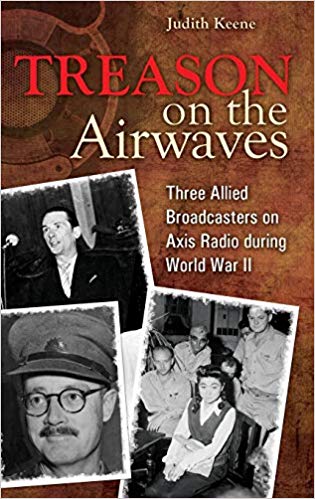
Judith Keene, Treason on the Airwaves: Three Allied broadcasters on Axis radio during World War II (Praeger 2009)

An Englishman, an Australian and an American walk into a courtroom … It could be the start of a joke, but in this case it’s a fascinating study of three very different people who were charged with treason for their activities as radio broadcasters for the Axis powers, and the three very different ways their nations dealt with them. The subjects are John Amery, whose broadcasts for the Nazis included nasty anti-Jewish rants, Charles Cousens, who broadcast for the Japanese and expected (in vain) his Australian listeners to discern deeply embedded messages that would help in the war effort, and Iva Toguri, one of the 50 000 (yes, so many!) nisei trapped in Japan in 1941, who broadcast as Orphan Ann but was tried as Tokyo Rose.

Judith Keene says in her introduction that ‘the big patterns of history are made up of a great many micro-histories, individual stories, writ small and smaller’. The stories of individuals accused of treason must be one set of micro-histories that tests the big patterns: much as we might want the famous footage of the man dancing in Martin Place to represent the whole meaning of the Victory in the Pacific for Australians, there was a lot more going on than that. Along with the sheer joy that the War was over, in Australia as in Britain and the USA there was also quite a bit of racism-inflected vindictiveness around, for which these treason trials provided a conduit.

All three stories are fascinating, but Iva Toguri’s fills me with almost evangelical zeal. She was born in the USA, and was a cheerful, outgoing child and adolescence. Like many nisei, she identified as American, and her parents organised to send her to stay with relatives in Japan so she could learn Japanese language and culture properly. After the attack on Pearl Harbor, she refused to renounce her US citizenship and, cut off from her parents as a source of funds, found what work she could in a Tokyo where her US status was certainly not an advantage. As a typist in Radio Tokyo, where her fluency in English was valued, she took pity on the wretched US and Australian POWs, slipping them food and blankets at some risk to herself, and because she had a rich deep voice was soon invited across to be an announcer on Zero Hour, a program beamed out to Allied troops in the Pacific, consisting mainly of popular US music. Cutting a long story short, at the end of the war, while thousands of nisei who had renounced their US citizenship were readmitted to the US without question, at the prompting of the 1946 equivalents of today’s shock jocks, she was arrested, tried for treason in a process that was later shown to be unambiguously corrupt, imprisoned for decades, further harassed and humiliated on her release and then pardoned. Someone ought to make a movie about her. (And having written that last sentence I went googling and found that there is a movie in the works, to be directed by Frank ‘Shawshank Redemption‘ Darabont from a screenplay by Christopher Hampton.)

Judith is a friend of mine, so I might not have mentioned this next thing if Richard Walsh hadn’t done so at the launch in April: the book is dreadfully edited, to the point that the regular bloopers become a significant distraction. In the very first paragraph of the introduction, a punctuation error renders the second sentence close to nonsensical. ‘Grey’s Elergy‘ (two spelling errors) and ‘the dye was conclusively caste’ (two spelling errors and a redundancy) are not atypical. I’m very glad that Praeger Press of Connecticut published the book, but anyone who commits their manuscript to them should be warned that the detail of your text is not in safe hands. Anyone who wants to know what a line editor does will find this book instructive: the things that make it hard to read are the things an editor would have fixed. However, I recommend that you treat the frequent blemishes as you would mosquitoes on a bushwalk: irritating, but not enough to make you turn back.

Recent journals (2) – Overland 197

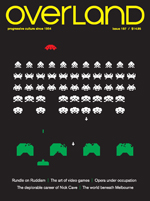
Jeff Sparrow (ed), Overland issue 197 (OL Society December 2009)

overland 197I initially intended to write a single post about the three journals that arrived in my letterbox this month, but after rabbiting on about Heat at such length I decided I’d better split them up.

In a world where passionate anti-Communist Robert Manne  has been described as a preeminent lefty, there’s clearly a crying need for Overland, whose Communist Party origins flutter from its masthead in the slogan, ‘Progressive Culture since 1954’ (and smirk on the back cover in a quote from The Australian describing it as ‘loopy-Left’). Even before the recent online Subscriberthon I’d been thinking of subscribing – I loved (and blogged about) the biography of Guido Baracchi, Communism: a Love Story, written by current editor, Jeff Sparrow, and I have been a freeloader (ie, online reader) for some time.

After the mainly elevated austerity of Heat, Overland‘s direct speech is refreshing. You won’t find essays here that begin as dauntingly as ‘It was while reading Jean-Paul Sartre’s monumental study of Flaubert, The Family Idiot, that I fell into an “epileptiform” state’ or ‘I have long associated landscape with passion and solace, and with the urge to record it’. Instead, we get ‘Last Sunday I went to church to be with my father, to say goodbye,’ or ‘Sometimes in life you get lucky.’ Not that the Overland pieces lack heft. The former introduces ‘My Father’s Body‘, Francesca Rendle-Short’s moving and, for my money, profound essay on her relationship with her father who has Alzheimer’s. The latter leads in to Fiona Capp’s ‘The Lost Garden‘, an extract from her My Blood’s Country, which promises to demonstrate Judith Wright’s continuing relevance (‘These hills and valleys were – not mine, but me …’).

There is some engaging fiction, some punchy argument (a trenchant go at Nick Cave, who is a closed book to me so I don’t mind one way or the other), short reviews, engaging essays (Sophie Cunningham, just popping over from Meanjin, visits the drains of Melbourne; Thomas Rye visits an island in Arnhem Land), a swathe of poems. There’s nothing I recognise as loopy-Left, though there are two very interesting articles – one on Ruddism and the other on education as export and its relationship to border control –  written in learned-Left language that makes for hard going (‘The CFMEU and other Left trade unionists wish to increase control of the borders of their labour markets at the point of intersection with the borders of the nation, and definitions of “Australians”‘).

The whole content is available online. I’ve linked to the articles I particularly liked.
—–
I’ve been lamenting the frequent copy-edit and/or proofing mistakes in Heat for a while. I kept my carping eye peeled for Overland as well. Interestingly enough, although Overland doesn’t include a credit for a copy editor (as Heat does), it doesn’t have anything like the same incidence of irritating and sometimes perplexing mis-edits and typos. There is a spot where lay and laid are used in place of lie and lay , but as this happens consistently over a number of paragraphs I’m willing to put it down to a difference of opinion (in which, of course, they are completely wrong!) rather than sloppiness or ignorance.