Tag Archives: Eileen Chong

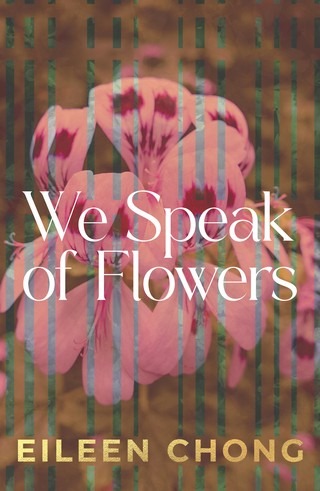
Eileen Chong’s We Speak of Flowers

Eileen Chong, We Speak of Flowers (UQP 2025)
The author’s note at the start of this book begins:

We Speak of Flowers is a book-length poem in 101 fragments that can be read in any order. Each reading will construct the poem anew, and the shifting juxtapositions will give rise to innumerable permutations of the poem.

Considered as a book-length poem, the book is an elegy for the poet’s beloved grandmother. It also deals with other losses, especially those that come with being a member of the Chinese diaspora (and within that, of Hakka, Hokkien and Peranakan heritage). The dedication reads, ‘A poem for my ancestors’. But this isn’t a book with tunnel vision: there are Covid poems, childhood recollections, observations of life in Sydney, travels, meditations on artworks, and – as you expect if you’ve read any of Eileen Chong’s previous five collections – plenty of food. Images from Buddhist funerary rituals recur, and the clicking of mah jong tiles is heard more than once.

The author’s note goes on to explain that in Buddhist belief, the soul of a person who has died is reborn after 100 days, so the hundredth day ‘marks the end of the formal process of grieving the dead’. The 101st poem/fragment marks the moment of the soul’s reincarnation. The end is also a beginning. The invitation to read in any order implies that the grieving can begin and end with any one of the 101 fragments. Contrary to popular oversimplifications of Elisabeth Kübler-Ross‘s thinking, grieving is not a linear process. At the Gleebooks launch earlier this year, Eileen described the book as a choose-your-own-grief-adventure.

This sets up us for a tremendously complex – and engrossing – reading experience. I’ll limit this blog post to beginnings and endings.

In the book’s order, Fragment 1 consists of just two lines spaced widely apart on the page: ‘a singular, cracked voice // words matter, can still rise –’. In context this is the moment when a person caught in the intensity of immediate bereavement realises that they can still speak/write, and so the process of grieving can begin. It’s a perfect place for the larger poem to start. Fragment 101 begins, ‘And what did you leave me / in the end?’ I won’t quote the rest of it, just say that it brings the sequence to a perfect, heartbreaking end.

Though I found Eileen’s order very satisfying, I obediently ran the numbers 1 to 101 through a randomising program, and followed the resulting order for my second and subsequent readings.

In this order, the larger poem begins with Fragment 19:
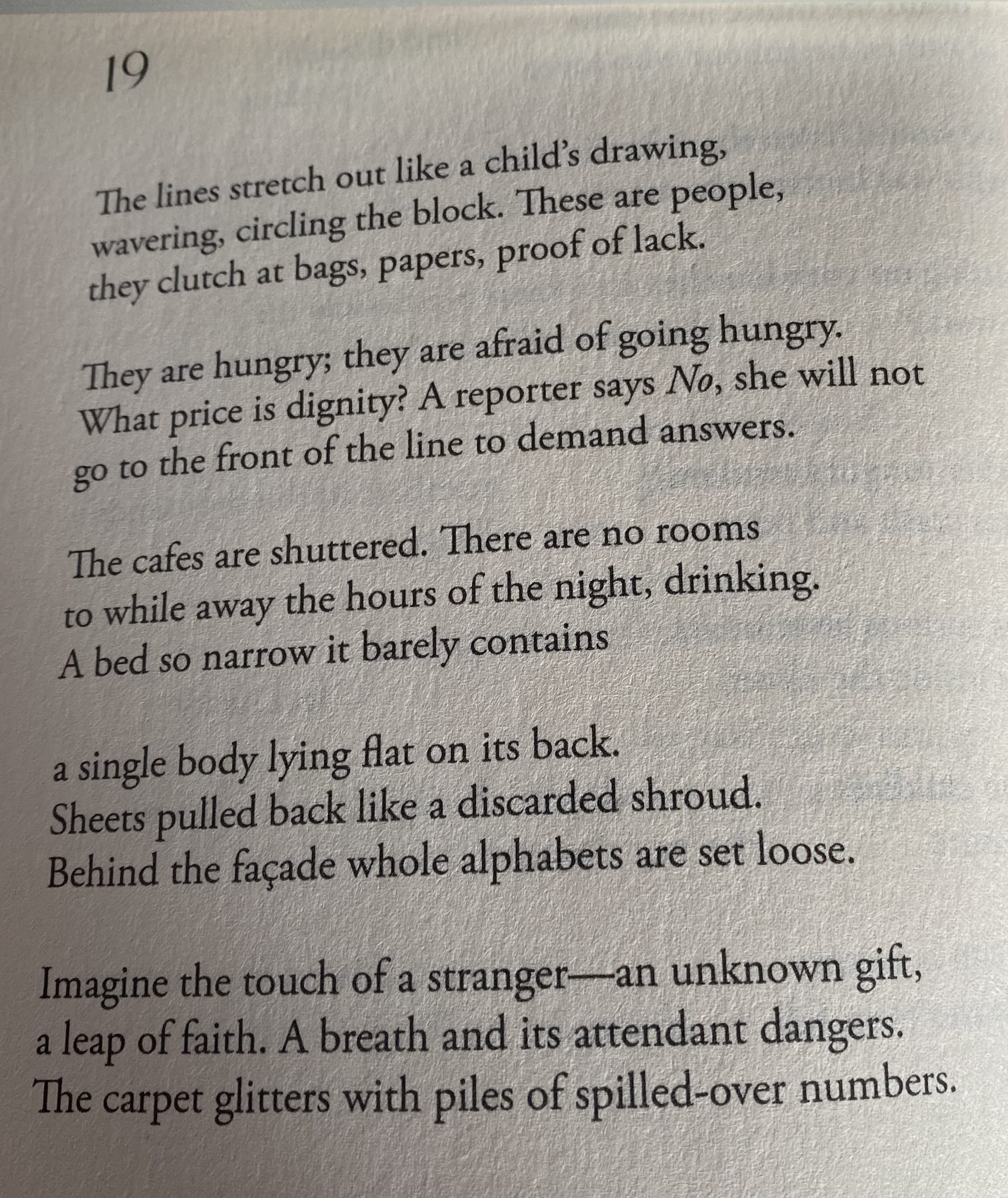
The poem consists of five three-line stanzas (triplets), a form this poet uses often. And as in many of her poems, there are some brilliant line breaks. One of several Covid poems, it captures a moment in our shared history. Beginning with a striking image of queues – for Centrelink, perhaps, or at a testing station – it goes on to evoke the loneliness, underlying dread and obsession with statistics that characterised lockdown days for many of us. I love this:

Imagine the touch of a stranger – an unknown gift,
a leap of faith. A breath and its attendant dangers.

What oft was thought but ne’er so well expressed!

The fragment works brilliantly as the beginning of the larger poem. We learn later that the poet’s grandmother died when Covid restrictions were in place, and the poet and her Sydney-based parents weren’t unable to attend the Singapore funeral. So this poem establishes the setting for the main story. And there’s something else:

Sheets pulled back like a discarded shroud.

The image suggests a resurrection – that waking and getting out of bed, perhaps after an illness, is to have avoided death. But it also reminds us that not everyone has avoided it, foreshadowing the overarching theme of bereavement.

In my ordering the poet’s grandmother doesn’t appear until the third poem (Fragment 72), where she is very much alive at the mah jong table:

She pulls a tile and runs her thumb
along its underside, over its carved
indentations.

My randomised sequence ends with Fragment 69:
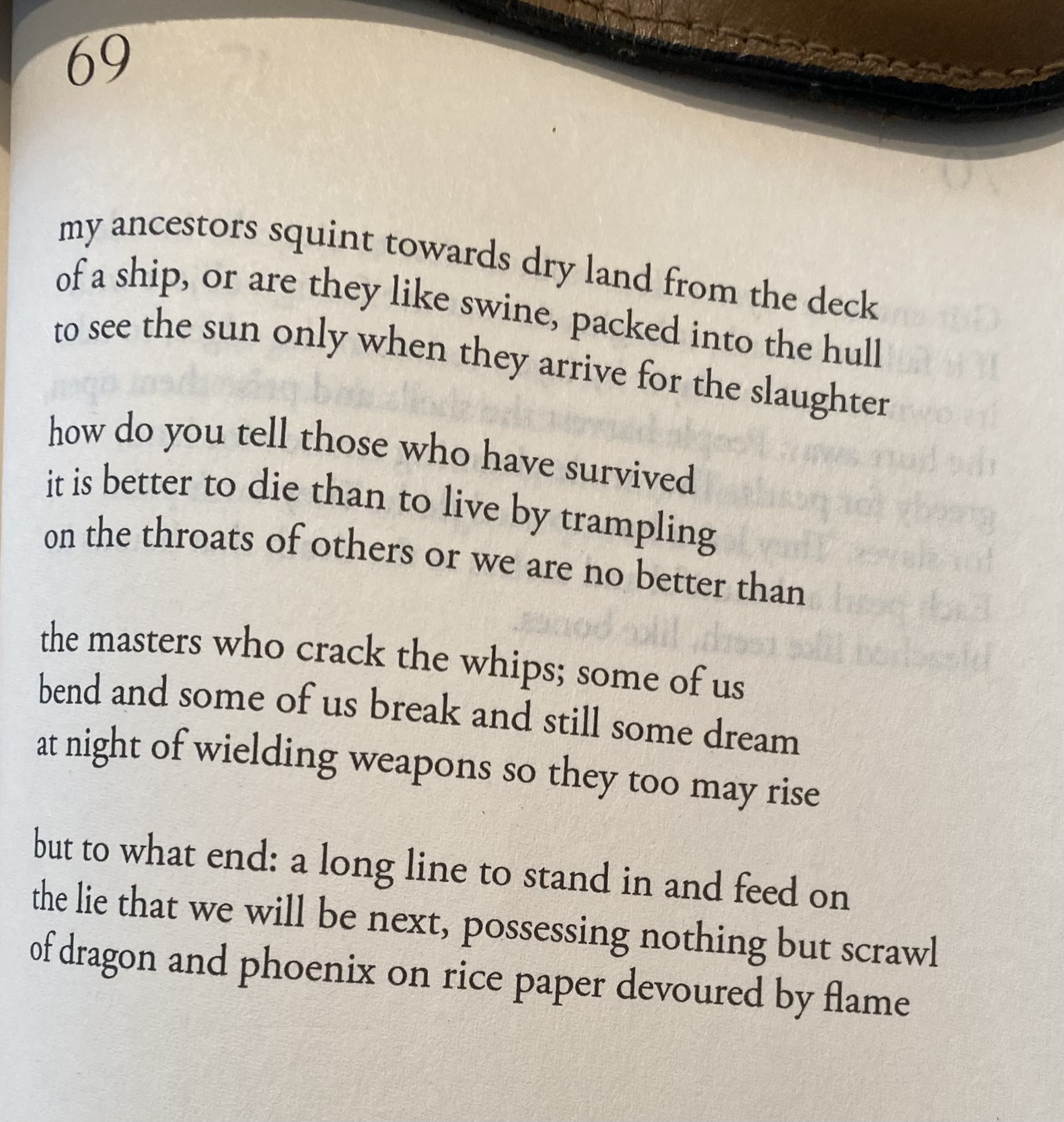
This is one of Eileen’s many poems exploring her family history and heritage. As often happens with these poems, I find myself thinking about my own very different heritage, but with a powerful sense of what is in common. When I blogged about her ‘Burning Rice’ (here), for instance, I brooded on the role of sugar in my life as the son of a sugar farmer. My forebears came to this country, some ‘squinting towards dry land from the deck / of a ship’, some as convicts ‘packed into the hull’. I guess that’s a way of saying that while the poem has specific historical references (about which I am vague), it somehow – as good poems do – makes a bridge to other, different experiences. This isn’t closed-off identity poetry. The ethical questions it poses aren’t just for people of Hokkien heritage.

I keep wanting the first line of the second triplet to be, ‘How dare you tell …’ That is, I want the lines to challenge anyone who passes judgment on survivors. But the actual words, ‘How do you tell …’, appear to endorse the stark ethical principle that it is better to die than to live by oppressing other people. Lines 4 to 7 ask how to communicate that principle to people who have made the choice to live in those circumstances. The question is left hanging and the poem moves on: in response to oppression, there are just three options: to bend, to break or to plot rebellion. The final triplet arrives at what is surely a doctrine of despair: no matter what we do we all end up dead. The dragon and the phoenix, traditionally paired in Chinese art and literature to represent harmony and prosperity, are possessed only as scrawled images on paper, and that paper will burn in a funeral ceremony.

How does this fragment function as the final moment in this longer poem?

Astonishingly well, as it turns out. For one thing, the image of standing in line occurs in both first and last poems. In Fragment 19, people line up around the block clutching at ‘bags, papers, proof of lack’, hoping for something. In Fragment 69, standing in line becomes a metaphor for a doomed aspirational life. We will never reach the front of the queue – it’s a ‘lie that we will be next’ – and what we possess is ‘nothing but scrawl’, paper ideals that will be destroyed at the funeral.

This fragment doesn’t end the sequence with the notion of rebirth or transcendence, but with resignation to the finality of death. The ship has reached its harbour. The funerary papers have been burned. There’s nothing left but profound sorrow.

At the launch, Eileen said, ‘I’m really a cheerful person.’ And I don’t want this blog post give the impression that We Speak of Flowers is a gloomy book. On the contrary, it deals with grief, it refuses to idealise or prettify its subject, but it’s still full of colour and light and the magic of language. Maybe I can leave you with the final couplet of Fragment 34 – which in my randomised order is Nº 78, the number that I usually blog about:

death in the afternoon
wild plants still flower

I wrote this blog post on land of the Gadigal and Wangal clans of the Eora Nation, where the earth’s processes are asserting themselves in heavy downpours followed by brilliant blue skies. I acknowledge the hundred of generations of past Elders, and present Elders, of both countries, never ceded.
Journal Catch-up 24

As I have mentioned before, I once had a substantial collection of Meanjins. I parted company with them in the course of moving house, probably forty years ago or so, and I haven’t kept up with Meanjin‘s changing identity since. In 2021 I toyed with the idea of resubscribing, but I may have been daunted by the sheer size of each issue. I have now bitten the bullet.


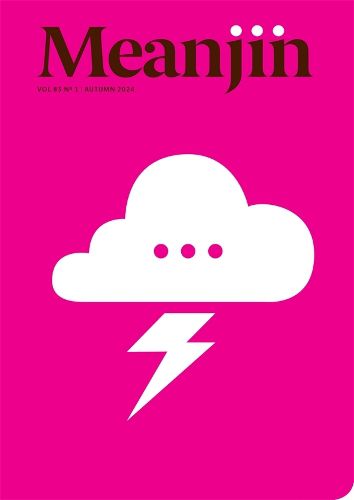
Esther Anatolitis (ediitor), Meanjin Vol 83 Nº 1 (Autumn 2024)
(links are to the Meanjin website: some but not all of them are available to non-subscribers)

This issue is a doozie!

It’s as engaged with current social and political issues as Overland. There are a number of essays on aspects of the Israeli invasion of Gaza, including Sarah M Saleh’s brilliant argument for the importance of Palestinian solidarity movements to the political wellbeing of Australia as a whole. There’s a concise summary article by father and daughter team Stephen Charles and Lucy Hamilton on the role of lies and disinformation in the Voice referendum. There’s a portrait by Jack Nicholls of eco-warrior CoCo Violet. There’s Amy Remeikis on the significance of the (first) Bruce Lehrmann rape case. And more.

It’s as culturally diverse as Heat in its heyday. Editor Esther Anatolitis (Σταθία Ανατολίτη) interviews Peter Polites. André Dao gives the 2023 State of the (Writing) Nation Oration. And more.

It’s as academically challenging as Southerly. See Dan Disney’s esoteric discussion of a Korean verse form and the fraughtness (impossibility?) of translating it, or imitating it, without subsuming it into the linguistic dominance of the English language; or Ianto Ware’s account of the challenges he fac ed in writing about his mother’s life and death.

First Nations writing has a strong presence. Among other things, ‘Ilkakelheme akngakelheme—resisting assimilation‘, a powerful essay by Theresa Penangke Alice, has pride of place before the contents page, and the new poetry editor is Wiradjuri woman Janine Leane.

I learned a lot – from Renata Grossi about the law concerning wills and what happens when they are contested; from Tom Doig about the long shadow of the 2014 Hazelwood disaster; from Marcus Westbury about the possibilities of something like a Universal Basic Income.

There are memoirs, including a brief snippet by Clare Wright, which starts out from an elaborate piece of costumery in the Powerhouse Museum and takes the reader to an unexpected ugly teenage encounter.

There are book reviews, and poetry. I was delighted to read, ‘Thread‘ a new poem by Eileen Chong. Two very different poems, ‘Oomarri—coming home‘ by Traudl Tan with Kwini Elder Ambrose Mungala Chalarimeri, and ‘Dreaming in Bourke‘ Paul Magee, talk to each other across the pages about the importance of country for First Nations people.

I picked up a couple of new words. My favourite is::

  • pipikism, a term coined by Philip Roth, who defined it as ‘the antitragic force that deconsequentalises everything – farcicalises everything, trivialises everything, superficialises everything’. Naomi Klein revisits the term in Doppelganger, her book reviewed in this Meanjin by Sam Elkin.

I’ll give the last word of this post to Peter Polities, whose words on page 77* in some ways speak to the journal as a whole:

I remember when I was in art school … this guy said to me: ‘I’m not political.’ And I was like: What did you say?!?’ I was just so shocked the first time I heard it, but then by the second time, I was so sarcastic: I said, ‘Yeah, what’s political about making goods for a luxury market?’ So this is what these kids wanted to be: to create work that you hang above a fucking couch for rich people. My interest in art is as a site for intervention, a site for politics, and culture is one of the most political things that we have.


I finished writing this blog post in stunningly beautiful Kuku Yalanji country, to the tune of parrots, curlews and the calls of other birds I don’t recognise.


* My blogging practice for some time has been to focus arbitrarily on the page of a book or journal that coincides with my age.

Journal Catch-up 23

Two more journals in my endless attempt to keep up to date!


Evelyn Araluen and Jonathan Dunk (editors), Overland 252 (Spring 2023)
(Some of the content is online at the Overland website – I’ve included links)

This Overland‘s editorial describes itself as a ‘second run’. The first run had reflected on the Voice referendum, but as publication came closer – in October last year – ‘the temptation to linger on the politics of symbolic recognition and constitutional reform seems a luxury in the face of escalating violence against Palestinians in Gaza and the West Bank’. With feet and throats sore from a solidarity march, the editors draw attention to an essay by Palestinian-Australian writer and historian Micaela Sahhar, ‘which reminds [them] of Overland‘s historic role in indexing Palestine’s survival and resistance’.

Quite apart from its serendipitous relevance, the essay, ‘An idiosyncratic archive: Overland 169 & the Wolstonecroft years‘, is a joy to read, as Sahhar revisits two copies of Overland she acquired in 2002 and 2004. She compares her reading of them then and now, talks of her relationships to people who appeared in them, and generally takes us on a journey into her mind. I love this passage – and so, I assume, do the editors:

As a journal at odds with the mainstream, Overland offered a younger version of me an intellectual place where radical thinking could reside, and a dawning awareness of a community I could take a place in. In this sense, Overland was the tangible expression of a counter to the indifference and invisibility of a young Palestinian woman, the significance of whose identity was rewritten just as she came of age at the time of a catastrophic intellectual nadir represented in 9/11; and a place of refusal against socio-political disengagement and apathy which have been the horsemen of these neo-liberal times.

The other stand-out essay is ‘The Disappearance of a.k.a. Victor Mature‘ by Vivian Blaxell, which ranges far and wide, high and low, into memoir and poetry appreciation, circling the subject of beauty. It’s a great read, from which I can’t resist quoting what may be the silliest paragraph, but one that made me laugh:

Australian English is wanton with beautiful. Beauty pops up in not the usual beautiful places there, thereby revealing the radical contingency of beauty itself, probably unintentionally: beautiful, Australians might say of a pork sausage, which seems a surprise at first until you realise that beauty does not exist before we say it exists, for beauty relies entirely on disclosure for its existence. That lucky sausage.

Other essays are a discussion by Peter D Mathews of Sophie Cunningham’s 2004 novel Geography and an idiosyncratic but fascinating essay by πO on concrete poetry in Australia and related matters.

There are five pieces of fiction and nine poems.

Of the poetry, ‘Balloch’ by Eileen Chong stands out for me. An apparently simple poem about a visit to a Scottish loch, it leaves an uncanny aftertaste that only gets richer with further readings.

The fiction covers a wide range, from a celebration of Rotuman culture (I had to look it up) by Dorell Ben to a fantasy of a catastrophic world post climate emergency by Jodie How, with a little social realism by Chloe Hillary and other pieces in between.


Alexandra Christie (editor), Heat Series 3 Nº 12 (Giramondo 2023)

This may be my last issue of Heat before my subscription expires. Despite having a selection of poems from Nam Le’s 36 Ways of Writing a Vietnamese Poem, a book I’m looking forward to, the journal is a bit of a fizzer for me, though the dominating US presence I’ve complained of in earlier issues is absent, and only one member of Heat‘s editorial advisory board gets a guernsey.

  • You can read Paddy O’Reilly’s ‘Redundant‘ on the Heat website. It’s an experimental prose piece in which the experiment seems to consist of not finishing sentences. See what you think.
  • Jordi Infeld’s ‘Poet’s Pocket’ would and indeed does pass for a short essay on sewing and related matters – just a footnote identifying one of its otherwise unremarkable phrases as a quote from Gertrude Stein’s Tender Buttons suggests deeper undercurrents.
  • ‘The Phoenix Apartment’ by Bella Li feels to me like notes towards a larger project.

Items from beyond the Anglosphere are ‘We Shall Be Monsters’, a meditation on Mary Shelley’s Frankenstein by Argentinian writer Esther Cross, translated by Alice Whitmore, and six terrific short poems by Iranian Maryam Nazarian, translated by Malaysia-based Arash Kohshsafa. Here’s the first and shortest of the poems, which does wonderful things with an echo of William Carlos Williams’s poem about the plums:

One
I've set the breakfast, the kisses, and the keys on the table.
Please, forgive me
if I find freedom more pleasant than your love.

The most interesting piece is Stephanie Radok’s ‘Inventory 2020’, an impressionistic chronicle of a working artist’s life, made up of mostly very short entries. It reminded me of the late Antigone Kefala’s journals in the way it combined observations of the passing moment with considered reflections and descriptions of the artist’s process. As 2020 was a year when the even tenor of our lives was disrupted by Covid, a narrative emerges. Here’s the entry for 23 February, on page 77*:

23. What you thought was passing/casual was your life. And a particular red purple near a blue hillside that seemed to reflect you.

As for Nam Le’s poems, they seem to be part of a larger whole. I’ll wait for the book.


* My blogging practice for some time has been to focus arbitrarily on the page of a book or journal that coincides with my age.

Kim Cheng Boey’s Singer

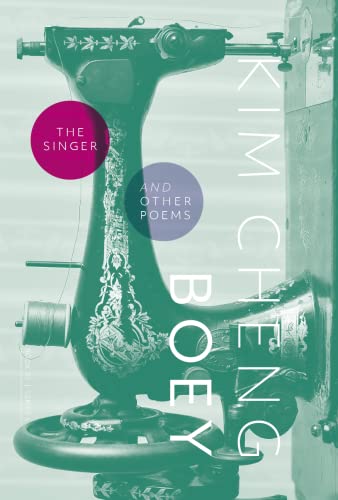
Kim Cheng Boey, The Singer (Cordite Press 2022)

There’s so much to love in this book.

I was inclined to love it sight unseen. I’ve been delighted by Kim Cheng Boey’s readings in past years when the Sydney Writers’ Festival had room for local poets. He co-edited (with Michelle Cahill and Adam Aitken) the excellent 2013 anthology, Contemporary Asian Australian Poets. He has written insightful reviews of one of my favourite poets, Eileen Chong, and had a walk-on role in one of her poems. This is the first of his books that I have read.

When I got my copy direct from Cordite Press – I tried at least three bookshops – I loved it for the cover alone. You expect the title The Singer to refer to the poet, perhaps in an attention-seeking way, but then you tilt the book and see the cover image clearly: it’s a Singer sewing machine. (My mother didn’t call her labour-saving devices the washing machine, the vacuum cleaner or the sewing machine, but the Hoover, the Electrolux and the Singer.) It’s a brilliant title: yes, poetry is like song, but it’s also craft.

And page by page, I kept on falling in love. There’s a Preface in which Kim Cheng writes of the different ‘weight’ of his poetry-making over time:

When I was younger, poetry carried me posthaste, high on the fuel of experience and freshness of thought, from initial impulse to final form. In middle age the roles are reversed – I am the mule, the porter, learning the weight and heft of the poem so I can carry it long-distance – over months and often years.

‘Perhaps,’ he continues, ‘the change occurred the moment I became a migrant.’ He migrated to Australia from his native Singapore in his early 30s, in 1997. Since then he has continued to take part in Singapore’s literary and cultural life as well as that of his adopted home. The book’s three parts can be read as tracing this geographical movement over time. The first, ‘Little India Dreaming’, has five long prose poems full of the smells and sights and sounds of a remembered Singapore childhood, including the title poem. Here’s a small extract to give you a feel for it:

You almost pray to the Singer, its dark cast-iron hull, to 
carry your mother's song. You pray for the treadle to 
stir, for the finished dress to be unstitched, its seams 
unpicked so the dress can materialise again from the 
chalk outline. You take the birthday outfit out of the 
wardrobe of forgetting and become the five-year-old 
wearing your mother's love.

The second section, ‘The Middle Distance’, is introduced with a quote from Louis Mac Neice, ‘This middle stretch / Of life is bad for poets.’ Each of its five poems is set in places other than Asia or Australia., and it’s tempting to see an unsettled, midlife quality to them.

The seven poems of the third section, ‘Sydney Dreaming’ – to simplify appallingly – lay claim to Australia as a place that can be called home.

My arbitrary blogging practice of looking at page 76 has once again given me a gift. That page occurs near the end of the book, in ‘Sydney Dreaming’, the title poem of the third section.

I love this poem (I know I’m using that word a lot, but it can’t be helped). In it the speaker walks around inner suburbs of Sydney, haunted by the tales and memories of other cities and ghosts of Sydney past. If it was terrible, banal rubbish, I might still have loved it because I have walked every step that the poem follows. I too lament the disappearance of second-hand book shops in Pitt Street. I know the painted up man with the didgeridoo in the Central tunnel, as well as the old Chinese man ‘scraping a dirge on his erdu’. Chinatown, Broadway, Glebe Point Road, Gleebooks, all lovingly named and recognisable. Then Darlinghurst Road, the wall, the Holocaust Museum, Macleay Street. The poem made me want to go for a long walk.

And it’s a terrific poem. Here are a couple of stanzas from page 76 – the walk down to Woolloomooloo from Kings Cross:

You follow the bend and the view opens to the ivory cusps 
of the Opera House and the dark arch of the bridge over the silver-glazed
azure scroll of the harbour, the sky burnished gold in the last exhalations of the sun.

Soon the flying fox formations will rise from hangars of Moreton Bay figs
in the Botanic Garden, and weave arabesques around the halo 
of the spanning arches of the Coathanger. You remember seeing this even
before you arrived, memory in the image, image in memory,

the sky and the harbour dyed incarnadine in the first postcard 
you ever received from a childhood friend settled in a new life

Notice that it’s in the second person: ‘You follow the bend.’ The poem’s speaker isn’t just telling the reader about a walk he has taken, he is inviting us to walk with him – which is especially effective for readers who have in fact walked in those places. The long lines have a leisurely, strolling feel: no hurry, no need to reach any rhyming points or keep to any metric timetable. The conversational tone and language creates a companionable feel.

Then the register shifts, as the poem enters its final movement.

You follow the bend and the language opens to ‘ivory cusps’ and ‘silver-glazed azure’ and ‘burnished gold’ and ‘exhalations of the sun’. That’s such a Sydney moment – any Sydneysider arriving at Circular Quay train station will have had their phone-absorption interrupted by the exclamations of tourists seeing the Bridge–Harbour–Opera House scene for the first time. Rounding that bend in Woolloomooloo has a similar breathtaking effect, and the language responds.

Then two things happen. First, the speaker asserts that he belongs here by looking forward in time: he knows that the flying foxes will soon fill the sky and enjoys anticipating the spectacle (still with the elevated language, ‘arabesques’ and ‘spanning arches’). Second, he knows that he hasn’t always belonged, and memory asserts itself. He had seen this sight in a postcard long before seeing the actual thing. I’m reminded of those passages in Proust about how the reality inevitably falls short of the anticipated image. That’s not how it is here, but there’s a strange unreality nonetheless – ‘memory in the image, image in memory’ – the present moment is a palimpsest. The whole poem revolves around that interplay of past, present, anticipated future and imagination. The whole walk is experienced as a palimpsest.

I’m restraining myself from quoting the lines that come next, because it’s getting close to the poem’s stunning conclusion, and even with poetry spoilers are an issue. Enough to say that the Bridge is transformed effortlessly from that spectacular postcard image to a terrific metaphor for the poet’s status in the midst of an ever-changing life of exile, belonging, and longing.

As a footnote: the title ‘Sydney Dreaming’ might be a worry. I don’t read it as claiming any of the First Nations meaning of the word ‘Dreaming’. In the course of his walk, the poet-flâneur passes a number of First Nations people: the man in the Central tunnel, and a real or imagined group of dancers in Woolloomooloo. The latter are mentioned after the speaker has been lost ‘in a dream of home, almost’: his dream is definitely lower case, and carefully distinct from that other, deeper, ancestral Dreaming.

The Singer won the Kenneth Slessor Prize for Poetry earlier this year (click here for the judges’ comments). Maybe it’s so hard to find in the bookshops because it sells out as soon as it hits the shelves. I hope so. Anyhow, especially but not only if you live in Sydney or are part of a Chinese diaspora, see if you can get hold of it. Did I mention that I love it?

Journal Catch-up 16

I’m perpetually behind in my journal reading. Let’s see if my new approach of focusing on page 75 works for journals as well as for books.


Alexandra Christie (editor), Heat Series 3 Nº 4 (Giramondo 2022)

I’m glad Heat is back, and I love the slender elegance of Series 3, but this issue didn’t thrill me. More than the three previous issues, it feels like a sampler: a selection of pieces that are short enough not to be a bother if not to your taste, but to make you want more if they are.

I’m sorry to say that most of them weren’t to my taste this time. In the show-me-more category were:

  • Nine pages of gorgeous photographs from the series ‘Trees and Fences’ by Yanni Florence 
  • Four poems by each of Ella Jeffery and Ella Skilbeck-Porter
  • Amy Leach’s celebration of the unpredictable, ‘Amen to Nonsense’, which is available online.

Page 75 falls part way into the Amy Leach piece. On this page the writer is imagining that the present moment is already in the distant past:

Presidents had succeeded presidents, screeds had succeeded screeds, people trying their damnedest had given way to other people trying their damnedest. Some things are up for grabs, like jobs and dollars and votes, and are worth trying one’s damnedest for, and some things are not, like time and the moon and the stars. The Bible was always saying to ‘lift up your eyes’, maybe because when we lifted our eyes we remembered that not everything was up for grabs. (When they named ages they usually named them after grabbable things, like iron, stone, bronze, information, etc., not ungrabbable things like the moon and the stars.)

This interplay of whimsy and metaphysics moves on to musings on reincarnation, the importance of the notes not played in music, astronomy, and more, arriving at a reformulation of Keats: ‘”Beauty is Nonsense, Nonsense beauty.”– that is all / Ye know on earth, and all ye need to know.’ It’s fun and thought-provoking. Sadly, it’s followed by several pages of, well, tediously quirky Glossary. It did leave me wondering about Heat‘s editorial policy: assuming that there are plenty of Australians writing essays at least as interesting as this, why give valuable space to someone with no perceivable Australian connection, whose work, according to her brief bio, is already available in Best American Essays and similar places? Having said that, I’m looking forward to the article by the German writer Jenny Erpenbeck in issue Nº 5.


Evelyn Araluen and Jonathan Dunk (editors), Overland 246 (Autumn 2022)
(Much of the content is online at overland.org.au, and I’ve included links)

The lead essay in this Overland is ‘That’s what drives us to fight’: labour, wilderness and the environment in Australia‘ by Jeff Sparrow. It’s a solid, possibly old-fashioned Marxist account of the relationship between settlers and First Nations people in Australia. It starts with the way some environmentalist rhetoric about preserving ‘wilderness’ erases First Nations history and the resulting question, ‘How can we defend the natural world, while still recognising Indigenous history?’ and proceeds to a discussion of the frontier wars that I can’t recommend strongly enough as a supplement to Rachel Perkins’s epochal television series, The Australian Wars.

There’s a lot else, including two short stories: ‘Home sweet slaughterhouse‘ a interesting take by Greg Page on the defacement of colonial statuary; and ‘New face in the fight against poverty‘ a futuristic satire of brand philanthropy by Andy McQuestin.

Page 75 is the tail end of a 13-page section given over to competition results. The section begins with ‘The labeller‘ by Saraid Taylor, a story of unprincipled opportunism in elite sports, which won the Neilma Sidney Short Story Prize. (The runners-up are on the Overland web site, here and here.) The Judith Wright Poetry Prize 2021 follows, first with the generous and lucid Judges Report by Toby Fitch, Keri Glastonbury and Grace Yee, then the winner, an excellent prose poem by Ender Başkan titled ‘are you ready poem’, and the two runners-up, one of which, on Page 75, is ‘stones‘ by Lily Rupcic, described well by the judges as ‘a condensed evocation of a mother’s illness and despair’. In the context of a journal most of whose contents have the feel of a battlefield, these sixteen lines offer a still, jewel-like reminder of basic human courage and connection.


Melissa Hardie and Kate Lilley (special issue editors), Southerly 79.3: The Way We Live Now (2022)

Described in the editors’ introduction as a ‘collection of pandemic inspired and pandemic-adjacent writing’, this is a digital issue, available free to download or read online – or, if you’re even more luddite than I am, to print off and read on paper.

It’s a rich 160+ pages, with 30 poems, three short stories, five review articles, and 10 pieces collected under the general heading ‘Essays and Memoirs’. Listed among the poetry on the Contents page is ‘Lost Matchstick Sonnets’, a series of clever and beautiful photos by Catherine Vidler featuring 14 wooden matches – the cover image on the left is part of the series.

Strikingly, all but one of the prose pieces, excluding reviews, were by women or gender non-conforming people.

As usual with me and Southerly, I skimmed some pieces: two pieces in dauntingly academic language, most of the reviews, some poems. If you want to dip in (remember, it’s free to access or download), you’re very likely to find something to delight or enlighten. To name a random few:

  • Claire Aman, ‘If There Are Zebra Finches’ (joint winner of the 2019 David Harold Tribe Award for Fiction), a clear, resonant short story set in an Australian desert
  • Sophia Small, ‘To Autumn Again’, which starts with a group of high school students laughing at extreme emotion in a movie they are being shown at school, and then claws back the ground for intense emotion
  • Eileen Chong, ‘Reason’, a starling evocation of a parent-child relationship over time, in a very few lines
  • Toby Fitch, ‘New Chronic Logics’, complex evocation of lockdown
  • Kate Lilley, ‘Commons, a kind of love poem
  • Beth Spencer, ‘chronic kitty covid city’, a lockdown poem that’s both funny and true (of many of us)
  • Alison Whittaker, ‘the poets are about to lie to you’, a terrific poem about responses to Covid lockdowns, excellent because one suspects that Whittaker is one of the lying poets as well as their denouncer.

Page 75 falls in the middle of the reviews section, on the final page of Vanessa Berry’s ‘From Catastrophe’, a review of Danielle Celermajer’s Summertime, a memoir of the bushfires of 2019–2020. .

Summertime is among those works of environmental life writing that expands the personal across time and space, where the writer is at once the perceiver of her thoughts and world, and a figure through which the reader can access collective feeling, knowledge and accountability. From the experience of the fire summer it sets out a generous and unflinching philosophy, unfolding from the most urgent question of our time: how to sustain life and future for all beings on this earth?

This has the opacity of much academic writing – I don’t know what it means, for example to expand the personal across time and space, though I’m pretty sure I would if I was well enough read in current academic writing – but the second sentence in that quote brings into sharp focus one key element of the way we live now, the challenge created by the climate emergency, and which most of us spend most of our time trying to ignore.

A tiny personal complaint: on page 144 the first name of Indigenous artist Jonathan Jones is misspelled. On behalf of all Jonathans I plead for special attention from proofreaders.

Journal Catch-up 15

Here I am once again with two journals, each of which has produced another issue after the one I’m writing about.


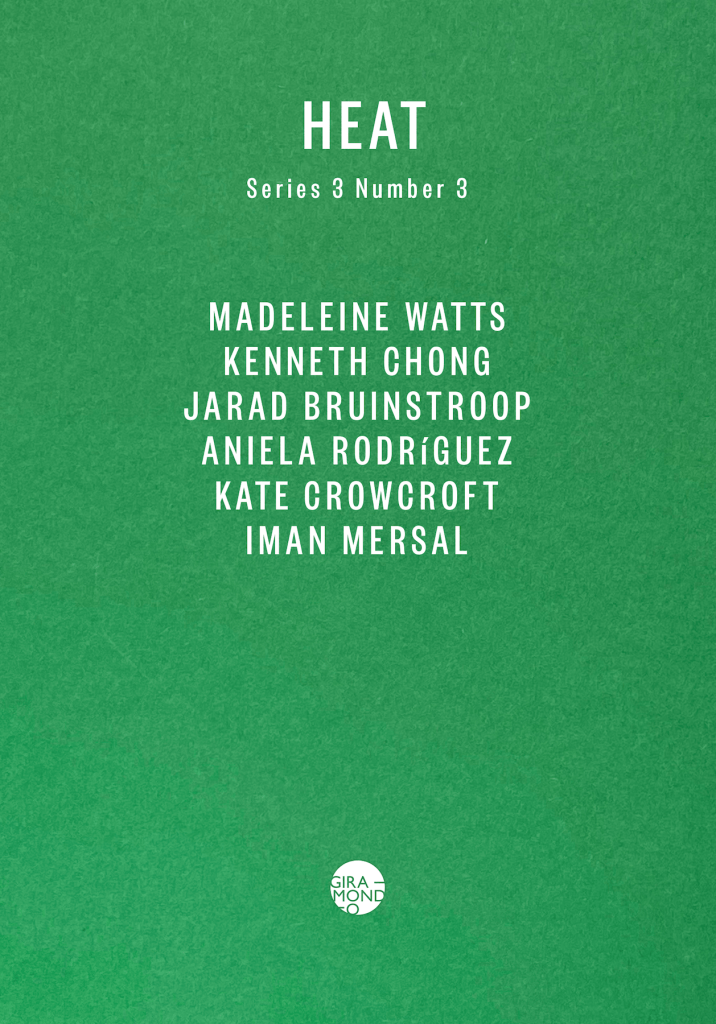
Alexandra Christie (editor), Heat Series 3 Nº 3 (Giramondo 2022)

I’ve just read a tweet quoting Helen Garner about Heat series three:

So slender and elegant, nothing wasted, nothing grandiose – and beautiful work.

Beautifully said!

The third issue is true to Heat‘s original goal to publish culturally diverse voices. It has a bit of a theme going:

  • ‘Australian Capital Territory’, a short story by Madeleine Watts, in which a man and a woman search in and around Canberra for somewhere to have sex, and finally succeed in a manner that is most satisfactory to them, the watching kangaroos and the reader. So, sex.
  • Small Talk’ by Kenneth Chong, a very different short fiction, presented as a kind of abstract memoir, about a young man of faith dealing with troubling issues. So, sex and religion
  • ‘Cain’s Feast’, a short story by Mexican writer Aniela Rodríguez, translated by Elizabeth Bryer, in which a young woman is seduced by a priest and a young man takes revenge. So, sex, religion and violence
  • Tongue Broken‘ by Kate Crowcroft, not so much an essay as a collection of disparate thing connected with the author’s research on the tongue (she has completed a PhD and has a book coming out on the subject). It does one of my least favourite things, presents a word’s etymology as if it offers a kind of magical access to the word’s inner meaning. But the rest is variously lively, unexpected and informative. Also: religion and violence
  • Five terrific poems by each of Jarad Bruinstroop and Iman Mersal, the latter translated from Arabic by Robyn Creswell. Discreet sex, but no violence.

Evelyn Araluen and Jonathan Dunk (editors), Overland 245 (Summer 2021)
(Much of the content is online at overland.org.au, and I’ve included links)

Overland is always so full of interesting things that I can’t possibly name every item. Here are some things that stand out for me in this issue

Of the articles, one or two of which are too academic for my blood, the two that stand out for me are:

  • Perpetrators‘ by Rachael Hambleton, about her complex relationship with her father, who spent much of his life in prison. The essay expands into profound reflections on grief, punishment, the prison system and intergenerational trauma.
  • What lies beyond the vortex‘ by Mauricio Rivera Ramirez, which focuses on the novel La vorágine (1924) by José Eustasio Rivera. Though the subject may seems unpromisingly niche to a general reader, it includes fascinating insights into the colonial rubber trade in Latin America.

I’m often intimidated by the poetry section in Overland, edited by the marvellous Toby Fitch. I mostly enjoy the poetry but have no idea how to talk about it. In this issue, I was delighted to find a poem by Eileen Chong, ‘Dream kitchen’ (sadly not on the Overland website at the time of writing), which narrates a dream of the poet’s grandmother’s kitchen with wonderful surrealist gusto and ends in an echo of classic Chinese poetry:

_______________________-____I knew it was only a dream,
because I was in my bed, alone. I was far from her, and home.

There are three excellent short stories:

  • The first to lose‘ by Hop Dac, a story of Vietnamese-Australian family life
  • Machine works‘ by Jordon Conway, a brilliant sketch of work, class, relationships and integrity in the context of forklifts, lathes and vehicle repair.
  • Fontanelle‘ by Sarah Walker, an excellent companion piece to ‘Machine works’, a semi-futuristic piece about the work conditions of long-distance truck-drivers.

Then, tucked away up the back, there are the 2020 Emerging Older Poets Mentorship (one poem) and the five poems shortlisted for the 2020 Oodgeroo Noonuccal Indigenous Poetry Prize, including Claire G Coleman’s witty ‘Blame Ireland’ and the prize winner, ‘Choice cuts‘ by Mykaela Saunders, a long, fiercely anguished meditation on the commodification of Indigenous culture:

–how to hold onto my integrity
when cold neoliberal logic drills into me
and the colonial vacuum sucks the marrow from me as fodder

Next time: Heat 3, Overland 246, an issue of Australian Poetry, and – if I can overcome my reluctance to read journals online – Southerly 79:3.

Journal Blitz 8b

So much to read, so little time. So many journals, so few subs, and still I can’t keep up.


Evelyn Araluen and Jonathan Dunk (editors), Overland 238 (Autumn 2020)

Published more than a year ago, this is the first issue of Overland edited by Evelyn Araluen and Jonathan Dunk. The new editors swept in not so much with a new broom as with a sandblaster. The regular columns are gone; issues are themed (though judging from a quick look ahead this change only lasted three episodes); and there’s a bold new feel to the design.

It may be part of the new approach, or perhaps it’s teething problems, but I found some of the articles in this issue hard gong to the point of being unreadable. Some dispense with sentences as we have known them. Others disappear unapologetically down etymological and literary-history rabbitholes. Yet others drop unexplained references to – I assume – French theorists, with no apparent purpose other than to discourage non-insiders. I tried, I really did, and I’m pretty sure I missed out on some terrific insights, but I just couldn’t finish a number of them. And that’s before I got to John Kinsella’s sequence of poems, ‘Ode to the defenceless: from hypotaxis to parataxis‘, whose prolix obscurity lives up to the promise of its title. I’m not completely sure that some kind of complex leg-pulling isn’t involved, as in the infamous Sokal affair.

This was all the more disappointing because the journal kicks off with a genuinely interesting piece, Toby Fitch’s obituary for British revolutionary socialist poet Sean Bonney (1969–2019), ‘Our Death: Aspects of the radical in Sean Bonney’s last book of poems‘. Toby describes Bonney as having ‘a performative ethics of scathing animosity and nihilistic humour’, and gives the reader plenty of what is needed to grasp the two poems by Bonney that follow his article.

Of the other articles, I want to mention ‘Welcome to the Nakba: notes from the epicentre of an apocalypse‘ by Micaela Sahhar – nakba is Arabic for ‘catastrophe’ and usually refers to the dispossession of Palestinians in the founding of the Israeli state. Writing in the aftermath of the 2019–2020 bushfires, Sahhar offers a startling perspective on Australia’s challenges:

Dear settler-Australia, your Nakba has arrived. Don’t feel helpless, powerless, frustrated, and above all, don’t pray for a miracle. I can tell you from the other side that it will never arrive. It’s time to tackle the structures you made, the structures that will ruin us all.

Poetry and fiction are still a major presence in the new-look journal, and this issue, like its predecessors, includes the results of literary competitions.

The Neilma Sidney Short Story Prize, judged by Joshua Mostafa, Margo Lanagan and Hannah Kent, was won by ‘The Houseguest‘ by Jenah Shaw, a story that captures brilliantly the uneasy situation of a young person who has left home in the country to stay with a family in a big city.

The Judith Wright Poetry Prize had three winners, published here with notes from the judges – Michael Farrell, Toby Fitch and Ellen van Neerven, had three winners. Each of these excellent poems left me bemused more than anything else.

Then there are four short stories, which arrive like a reward for persevering: ‘Creek jumping‘ by Cade Turner-Mann, a tiny moment in a rural community that reflects and resists the impact of environmental degradation and colonisation; ‘Mermaid‘ by Gareth Hipwell, a borderline science fiction tale of eco-guilt; ‘Pinches‘ by Emily Barber, an abject tale of sexism; and ‘Urban gods‘ by Cherry Zheng, which could be a starting sketch for a dark fantasy/sci-fi television series.


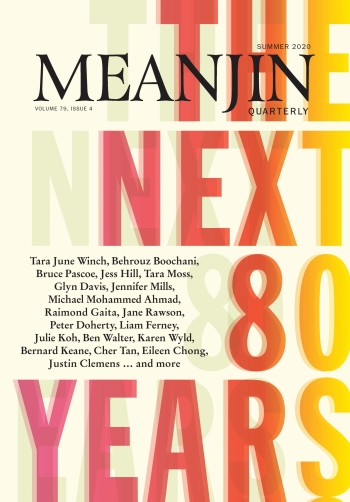
Jonathan Green (editor), Meanjin Quarterly: The next 80 years, Volume 79 Issue 4 (Summer 2020)

Far from being a new broom, this issue of Meanjin celebrates its continuity with the journal’s past 80 years, reproducing Clem Christensen’s first editorial and featuring short pieces from each of his ten successors in the editorial chair. A powerful narrative emerges of a publication that has managed to survive and thrive in the face of serious challenges, and that has transformed itself many times over to meet the changing times.

Then there’s a stellar line-up of writers, many of them responding to the ‘Next 80 Years’ theme.

Some I need only name for you to get a whiff of their excellence, and timeliness:

  • An email dialogue about time and memory between Behrouz Boochani and Tara June Winch, apparently an excerpt from an ongoing conversation between these two writers
  • An article from Jess Hill on police responses to domestic abuse call-outs – following up a chapter in See What You Made Me Do
  • A scathing piece about the tree-hating official response to the bushfires, by Bruce Pascoe
  • An even more scathing piece by Michael Mohammed Ahmed about White victimhood (starting with the observation that though people complain that it’s racist to name their Whiteness, it was White people who invented the term)
  • A wide-ranging and lucidly angry piece by Raimond Gaita on moral philosophy vs economics in the context of Covid-19.

And that’s only part of it. Of the remaining articles, the standouts for me are ‘Consider The Library’ by Justine Hyde, a wonderful account of the changing roles of public libraries in Australia and elsewhere, including their potential contributions to averting climate catastrophe; ‘More Than Opening The Door’ by Sam Van Zweden, which advocates for inclusion of people with disabilities in Australian literary life, arguing in particular that if a publication commissions a piece on, say, mental health issues from someone who is drawing on their own experience, then the publication needs to consider having a duty of care to the writer; ‘Heading to Somewhere Important’ by Martin Langford, a brief account of the changing face of Australian poetry over the last 80 years – an impossible task acquitted with grace; and Nicola Redhouse’s ‘Future Tense’, which engages with Shoshana Zuboff’s The Age of Surveillance Capitalism, in ways that are probably crucial to making that ‘intimidatingly thick opus’ as accessible and influential as we all need it to be.

Scattered like jewels through the pages are poems from David Brooks, Kim Cheng Boey, Eileen Chong, Sarah Day, Jill Jones, David McCooey, and more. If you count two pieces labelled ‘memoir’ that look back from the year 2200, there are six short stories, which project a range of pretty depressing futures. My pick of them would be Tara Moss’s The Immortality Project, where being able bodied is seen as indicating deficiency, and uploading one’s consciousness to Another Place leads to an interesting twist on the expected outcome.

Decades ago, I was a keen subscriber to Meanjin, and in my mid twenties I bought a swag of back copies (from Kylie Tennant, as it happens, whom her husband L C Rodd described to me over the phone as ‘an extinct volcano of Australian literature’). I loved my collection and browsed in it often, but sold it and let my sub lapse when space and time shrank around me with parenthood and a job that required a lot of reading. When I considered resubscribing some time ago, I was deterred by the tiny type – as noted on my blog, here. Someone gave me this issue as a Christmas present, and it seems very likely that I’ll resubscribe.


Eileen Chong’s Thousand Crimson Blooms

Eileen Chong, A Thousand Crimson Blooms (UQP 2021)

Someone* said recently that the work of a poet isn’t just to write poetry. Poets also teach, mentor, encourage other poets, edit, proselytise for poetry … and the list went on. At the launch of A Thousand Crimson Blooms last month it was clear that by this criterion Eileen Chong is a real poet. I chatted with an emerging poet who has won prizes and attributes it to her inspiration and mentorship. Three other poets, all women of colour, read at the launch, and each testified to Eileen’s kindness, collegiality and solidarity.

The poems in A Thousand Crimson Blooms bear strong testimony to the poet as embedded in a community of poets and other artists. Many of the poems carry epigraphs, and we are given meticulous notes referring us to their sources – most of which are other poems, and at least one is a quote from a conversation with another poet. Sometimes the notes give us web addresses where we can see images of works that inspired a poem.

The sense of connectedness goes further. A central feature of this book, as in Eileen Chong’s previous collections, is the sense of living heritage, in birthplace (her own Singapore and her husband’s Scotland), in family (especially her mother and grandmother), in food (maybe not as much as in earlier books, but this is still poetry that makes you hungry), in language (a number of poems make play with the components of Chinese ideograms), and always in poetic tradition.

This connectedness and rootedness provide a sustaining background in poetry that mostly deals with personal pain: bereavement, sexual abuse, illness and surgery, involuntary childlessness, the challenges of migration.

This is a terrific book. I learned a lot, I cried, I laughed, I was confronted. Only a couple of times I was mystified. More than a couple of times I was surprised by the twist of a last line. I was sent down interesting rabbit holes, and found myself reflecting deeply on my own life. Eileen Chong reads her own work beautifully: you can hear her, among other places, when/if the Sydney Writers’ Festival release a podcast of the session that included her – The Unacknowledged Legislators.

There are so many poems I’d like to spend time with here. There are powerful poems about loss that it would feel almost indecent to write about in this necessarily abbreviated way. There’s ‘Making Sense’, whose beginning sheds light on the poems in general:

I tell my students:
poetry is a way to make sense 
of what you fear. 

I sing to them of 
blackbirds. I read my poems 
aloud

There’s ‘Spring Festival’, which includes similarly suggestive lines:

My husband reminds me I write poems 
in threes: three lines, three pathways.
One for the old life, one for the new 

and one for the hours 
I do not notice as they pass.

There’s the ‘The Hymen Diaries’, each of whose four parts responds to a work of art (see mention of rabbit holes above). There’s ‘Child’, whose subtitle, After Andy Kissane’s ‘Joy and a Fibro Shack’, offers generous possibilities for a ‘compare and contrast’ kind of discussion – and many poems like that.

I’ve picked the title poem, ‘A Thousand Crimson Blooms’, mainly because before spending this time with it I didn’t understand how it hung together, starting with what feels like kindergarten innocence and ending with lacerating pain. You can see an earlier version of the poem with a slightly different title on the Peril magazine website (here). Here’s the poem as it appears in the book:

To start with the epigraph: I haven’t read the poem it comes from, ‘Don’t Trample This Flower’ by Bing Xin, but I have learned that Bing Xin was a prolific Chinese woman writer of the 20th century, many of whose works were written for young readers (Wikipedia entry here). These lines are a straightforward call to pay attention to something that is beautiful, easily overlooked and vulnerable.

There’s a smooth transition to the opening lines of the poem. Like the epigraph, they address children/little ones: having looked, now, let’s draw. We’re in a domestic or classroom setting; the voice is that of an adult – a teacher or parent? – addressing small children, possibly in a rural environment. The third line’s invocation of the daily cycle of time has a traditional Chinese feel. It reminds me of the ancient poem, ‘The Peasant’s Song’, that begins, ‘Sun up, work / sundown, rest.’ (That’s Ezra Pound’s translation, in his Canto XLIV.) It’s a benign opening, and my fridge door is covered with just the kind of artworks that the little ones might create. (I should mention to anyone who’s just visiting the blog that I have a three-year-old granddaughter who loves to put pencil/crayon/brush to paper.)

The next three lines could be summarised as detailing the process of drawing the dog and rooster, and the children’s focused, unblinking attention to the task. But the language alerts us that something may be slightly off. ‘Let’s shape their bodies with our hands’ may be just an odd way of describing the movement of hands holding pencils, but it feels a little more dominating. Maybe we’ve moved on from drawing to shaping in clay. The second line takes us a step further with the hint of violence in ‘gouge’. The adult speaker has taken us quite a way from paying close attention to something vulnerable to something on the edge of cruelty, even if it is only cruelty to the paper. In the third line, as I read it, the ‘little ones’ speak. The ‘lidless eyes’ suggests a kind of forced, sustained attention that is far from the relaxed, open regard of the epigraph. That there are a hundred eyes suggests that the context has moved from the intimate to the institutional. I have to admit that on first reading I resisted this darkening mood, but once seen I can’t unsee it, and it refers to a common phenomenon. The late artist Kim Gamble, for example, used to lament the way education put a damper on creativity: that children who draw and paint beautifully in Year 1 of school are generally creating cliché images with no spark of originality by the time they are in Year 3.

I’m generally sceptical of poets who talk about the crucial importance of punctuation and spacing, but I think it’s interesting that where the Peril version has a simple paragraph space before the next stanza, this version has an asterisk. The poet wants to be clear that there’s a substantial break. The stanzas change here too, from three-liners to four-liners, but it’s the asterisk that most clearly signals a gear-change.

Sure enough, there’s now a radical change in tone. The benign teacher/parent has been superseded by a harsh authoritarian voice. If the earlier stanzas were in a small, friendly kindergarten classroom, this is now a disciplined, bullying high-school class, perhaps a laboratory, where there is no room for emotion or vulnerability. Science experiments using test tubes and bunsen burners become metaphors, or maybe metonyms, for the harm done to people in such an impersonal environment. (I don’t think there’s an implication that science is necessarily that way, but the reference to glass and fire do conjure up a chemistry lab in my mind.)

The final stanza follows another leap – in time, in setting, in scale. The speakers are the bullied ones, and the 50 people of the second stanza have grown to be a thousand. Blue-and-white vases are traditional Chinese creations, vulnerable like the flower of the epigraph, emblematic of a long history of artisanal skill and creativity (of the kind that produces gasps on Antiques Roadshow). We have been prepared for their appearance by the echo of traditional Chinese poetry in the first stanza. They are broken, with violence that parallels the breaking of the benign teacher-child relationship of the earlier stanzas. ‘They’ is undefined. If I stick with the classroom reading, they are a particular kind of educator, and in making us do the kind of ‘creativity’ that the curriculum requires, they not only take us away from our innate creative impulses, they make us tread all over them.

The second last line takes us back to the flower of the epigraph, only now the flower is not ‘by your feet’, but part of oneself. It is our blood, our suffering, that now produces the flower, that becomes the subject of art. Creativity and pain are now closely linked.

The final line takes a step back. I can best say how I read it by attempting a paraphrase: In our present wounded condition, any attempt to make art must find a deep connection to tradition or some other form of community, if it is to have any vitality. Of course, it doesn’t refer only to the making of art: I think of the importance that First Nations elders place on connection to culture as a means to youth suicide prevention.

Now that I’ve understood how the poem coheres, it hasn’t quite finished with me (and perhaps never will have). The reading that I’ve sketched so far is loosely tethered to my own life experience. But that reading can expand. The poem could be read as a meditation on part of Bing Xin’s life story: I only know the Wikipedia version, and haven’t read any of her poetry, but she was denounced during the Cultural Revolution, a time when blue-and-white vases were quite literally being smashed.

The poem can be read as a response to a work of art: it was initially written on commission as a response to The Masks of Me, a mixed media installation by Vipoo Srivilasa consisting of ‘a group of small masks that celebrate cultural differences and diversity’. You can see the artwork and the artist’s statement on the Peril magazine site, at this link. Actually, I can’t see this reading at all.

Since it has given its title to this book, the poem can be read as referring to the collection of poems. Many of these poems are indeed filled with pain, unflinchingly named, but what makes them readable – more than just readable, deeply satisfying – is their rootedness. This poem itself is an example of that. The classical references, the restrained language, the way the images are allowed to do their own work on the reader, the formal neatness: all these are a kind of rootedness that let the poem flower.


* Sorry, I don’t remember who said it. I think it was on Al Filreis’s PoemTalk podcast.


A Thousand Crimson Blooms is the ninth book I’ve read for the Australian Women Writers Challenge 2021.

SWF 2021 Sunday

Sunday was another beautiful late autumn day in Sydney, and another day of challenge and delight at the Sydney Writers’ Festival. Evidently one of our ideologically driven weeklies ran a piece online saying the Festival was extremely ‘woke’, which is apparently a bad thing. I don’t know about woke but, as someone who nods off whenever I’m in a dark room, I was kept awake almost without fail. (The one fail was inevitable, in the after-lunch slot when I would have slept through an announcement that I’d been granted the gifts of immortality and eternal youth.)


10.30: Land of Plenty

This panel addressed environmental issues about Australia from a range of perspectives. Philip Clark of ABC Radio’s Nightlife did a beautiful job as moderator, giving each of the panellists in turn a prompt or two to talk about their work, and managing some elegant segues. The panellists did their bit to make it all cohere by referring to one another’s work. (How much better these panels work when the panellists have read one another’s work!)

Rebecca Giggs, whose Fathoms sounds like a fascinating book about whales, said that whales are a Trojan horse for a conversation about other animals’ relationships to humans. She described a moment when she was close enough to a whale that she could see its eye focusing on her – and only to learn a little later that whales are extremely short-sighted and there as no way that that whale could have actually seen her. What is actually there isn’t what we want to think is there,

Bruce Pascoe, author of Dark Emu and co-author of Loving Country (about which more later) spoke about the difference between Indigenous and Western capitalist ways of relating to the land. Echoing Rebecca Giggs’s story of the whale’s eye, he said, ‘We look at animals and want to be friends with them, but as soon as a capitalist wants to be your friend …’ He begged us to take seriously the possibility of a reciprocal relationship with animals. Something terrible happened to humans, he said, when the combination of Christianity and capitalism happened. I think he has a book coming on the subject.

Victor Steffensen is a Tagalaka man from far north Queensland, author of Fire Country. Someone from my family had the privilege of doing some video work with Victor some years ago, and his stories from that time have given me a deep respect for Victor and his work in ‘using traditional knowledge for environmental wellbeing’, as the Festival site puts it. In this panel, he took off from Bruce Pascoe’s call for reciprocity with other animals, and spoke of relating to fire as a friend and not as something to fear. It’s about reading country, listening to landscape. His project of recording traditional knowledge that is in danger of being lost is not to archive it but to get it back into people, ‘to young fellas and then to the broader community’.

Richard Beasley, senior counsel assisting for the Murray-Darling Basin Royal Commission and author of  Dead in the Water about that catastrophe, said that the situation in the Murray-darling Basin had got so bad that ‘even John Howard’ did something about it. Howard’s legislation included clauses to the effect that whatever was done needed to be science-based. But then the lobbyists went to town, and in response to their pressure, politicians insisted that reports from the CSIRO were altered to suit the big capitalists’ agenda. His lawyerly rage was palpable.

There was a good question (a rarity at this Festival), about grounds for hope:

  • Rebecca Giggs: Thee’s hope. But you don’t get to be hopeful until you make yourself useful in some way – whatever your situation and abilities allow.
  • Bruce Pascoe: I have to think we can do it differently. We have to give our grandchildren a chance, not treat them with contempt. We need love of country, not nationalism.
  • Victor Steffensen: Language is important. [Sadly what I wrote from the rest of what he said was illegible. I think it was an elegant version of ‘Action is also important.’]
  • Richard Beasley: I’m a lawyer. I don’t know how to challenge any of this by law.

12 o’clock: Sarah Dingle & Kaya Wilson

We hadn’t booked this session in advance, but faced with a gap of a couple of hours, we spent one of our Covid Discover vouchers to buy rush tickets. Kaya Wilson, whose book As Beautiful As Any Other has the subtitle A memoir of my body, is a tsunami scientist and a trans man. Sarah Dingle, author of Brave New Humans: The Dirty Reality of Donor Conception is a donor-conceived person. Their conversation was aided and abetted by Maeve Marsden, host of Queerstories who was also donor conceived, though not anonymously through the fertility industry as Sarah was.

Sarah’s revelations about the fertility industry were nothing short of shocking. Not only is it monumentally unregulated, but records that might have allowed people to know what had happened to a particular donor’s sperm, even anonymously, have at least sometimes been deliberately destroyed. Couples using donated sperm have been systematically encouraged to lie to their children about their origins, leaving them unaware of any genetic predispositions to disease, let alone possible incest.

What Kaya told us about the systemic treatment of trans people was just as shocking. He said that he tended to keep his scientific life and his trans life separate. ‘In some ways they hate each other.’ But he has a chapter in his book that tries to reconcile them. The scientific literature, like legislation about, for instance, changing one’s ‘sex marker’ on a birth certificate, is shot through with assumptions that bear not relation to the reality of trans experience.

Both people spoke of the joy of finding themselves to be members of communities they weren’t aware of when young. When asked what they read for relief, both named writers I’ve loved: Sarah chose Terry Pratchett; Kaya chose Ocean Vuong, On Earth We Are Briefly Gorgeous.


2.30: Bruce Pascoe & Vicky Shukuroglou

Loving Country: A Guide to Sacred Australia was an initiative of Hardie Grant Publishers, who approached Bruce Pascoe suggesting a follow-up to Marcia Langton’s guide to Indigenous Australia, Welcome to Country. Pascoe joined forces with Vicky Shukuroglou, a non-Indigenous woman born in Cyprus, who took the photographs and also contributed to the writing. The Festival website says that the book ‘offers a new way to explore and fall in love with Australia by seeing it through an Indigenous lens’. Daniel Browning, host of ABC Radio National’s Awaye, chaired this conversation.

Again, we were called on to love this country. The thing I loved about the session was the way the two authors could disagree. Bruce Pascoe, speaking of the horrendous bushfires last year, said that the disrespect for Country shown by authorities afterwards was in some ways worse than the fires themselves. We meekly accept the terrible destruction of heritage in the Juukan Gorge. We have to rebel as a people, he said, meaning all of us, not just First Nations people. Vicky Shukuroglou argued against the idea of rebellion, and spoke of the importance of conversations and of love: ‘If we’re going to talk about marginalisation, we first need to look at our humanity.’ From where I was sitting it didn’t look as if the two things were incompatible, but I was struck by the way as a non-Indigenous woman she was secure enough in their friendship and working partnership to challenge an Indigenous man. I would have liked to know more about what she had done to achieve that confidence.

The book, Pascoe said, is about how to restrain human go and let Country have a voice, He got Vicky to tell a story about a sick echidna that, without her realising it, had come to know and trust her, as a result – she thinks – of her being still around it over time.

We don’t need a black armband.
We just need to know the facts.
This is the country that invented society, bread and the Richmond Football Club.


4.30 pm The Unacknowledged Legislators

This was a great way to end my festival. (The Emerging Artist’s festival ended with the previous session: she thinks poetry and she don’t like each other.) Seven poets read to us, hosted elegantly by ‘writer, poet, essayist and proud descendant of the Yorta Yorta’, Declan Fry. Here they are, in order of appearance.

Eileen Chong, whose poetry my regular readers will know I adore. She read five poems from A Thousand Crimson Blooms, which I’ll be blogging about soon. I was glad to hear her read the three part poem, ‘The Hymen Diaries’ after I had spent some time with it and checked out the artworks it refers to.

Maxine Beneba Clarke, poet laureate of the Saturday Paper, read three poems. I won’t report what they were because i wasn’t sure I heard their names correctly. One of them began, ‘When I say I don’t want to become my mother,’ and went on brilliantly to challenge the internalised sexism of that sentiment.

Ellen van Neerven read three poems from Throat (my blog post here), including ‘Treaty of shared power’ and ‘Such a sad sight’. The first-named is a play on the relationship between the writer of a poem and its reader that worked beautifully in this context.

Erik Jensen, reading to an audience for the first time, read six short poems from his first book of poetry, I said the sea was folded, a book that, he told us, is about falling in love and learning to be in love. He then read a poem by Kate Jennings, who has just died (this was how I heard the news) – and wept as he read it. He wasn’t teh only one to shed a tear.

Felicity Plunkett followed that hard act, reading four short poems from her 2020 collection, A Kinder Sea. The first, ‘Trash Vortex’, whose name tells you a lot, may be the kind of poem that Evelyn Araluen had in mind when she said artists have a responsibility to address the world’s urgent issues.

Omar Sakr read three poems, ‘Birthday’, Self-portrait as poetry defending itself’ and ‘Every Day’. This is the first time I’ve heard or read any of his poetry. I hope it won’ be the last.

Alison Whittaker, Gomeroi woman and a crowd favourite, read a piece that depended on knowledge of and (I think) contempt for ASMR, not that there’s anything wrong with such poems. She reminded us of the tragic reality of Black Deaths in custody and read a poem consisting of anodyne found phrases from court proceedings.


And my 2021 Sydney Writers’ Festival was over. There were at least four moments when someone on stage paid tribute to a parent in the audience or, in one case, on stage with them (I’d left my run too late to see Norman and Jonathan Swan, and I probably missed other trans-generational moments). I didn’t see any of the international guests who attended on screen. It was a thrill to hear such a diversity of First Nations voices. I came home with a swag of books and a list for borrowing from the library. Hats off to Michael Williams and his team for making this happen in the flesh, and making sense of the slogan Within Reach: a living demonstration that the famous cultural cringe, while it may not be dead, has not much reason to live.

SWF 2020, Post 5

One of my favourite poets, Eileen Chong, has been mounting a formidable campaign against racism in Australian literature. She’s been tweeting up a powerful, deeply considered storm as @EileenChongPoet, and some of the storm has been captured as a single article on the Meanjin website (link here). Among other things, Eileen tweeted:

I call on you, literary festivals, to examine your commitment to diversity, inclusion, equity. I call on you to ensure these festivals for writers & readers are safe spaces for our reading & writing community. I call on you to step up, to acknowledge you have this responsibility.

I don’t know what processes the Sydney Writers’ Festival has in place, but so far the 2020 festival seems to be doing OK on the diversity front. We’ve had a white man who wrote about India in conversation with a woman from India; a white woman who wrote about Truganini in conversation with a Ngarigu woman; and a number of other Indigenous people and people targeted or marginalised by racism speaking about their own work, interviewing others, and chairing sessions. In this batch, my fifth, two of the five sessions are all white (though one of the white people, being Irish, would have been classed otherwise 150 years ago in the USA), one is mixed, two feature people of Asian, Pacific and African heritage, and questions of racism and diversity are at the heart of several of the sessions.

Paul Kelly: Love Is Strong As Death 24 Jun

In 2019 singer-songwriter Paul Kelly published an anthology of other people’s poetry, Love Is Strong As Death. At the start of this podcast, Tony Birch asks him about his early introduction to poetry. He talks about the Christian Brothers introducing him to Shakespeare (Macbeth has everything for 15 year old boys, violence, sex, revenge …) and Gerard Manly Hopkins (‘The Christian Brothers loved Hopkins, who was a Catholic priest’), and about the way his family would have get-togethers where everyone did an ‘item’, and items ranged from a niece tying a knot in a snake lolly using only her tongue to someone reciting a poem. Tony Birch said, ‘The Christian Brothers gave you Gerard Manly Hopkins. They gave me corporal punishment.’ ‘Oh well,’ Paul Kelly and I replied in unison, ‘they gave me that too.’

I was taken back to Brother Paulinus, a Marist Brother, using the dreaded cane to conduct the combined 4th and 5th grade in a recitation of Henry Lawson’s ‘The Teams’, a poem I still love; Brother Wright, a Christian Brother, entertaining a class of 15 year olds in the last week of the school year by reading the whole of Macbeth, doing the voices, for one period each day; and my mother cheerfully reciting the opening lines of Francis Thomson’s ‘The Hound of Heaven‘ at the drop of a hat. So I knew something of what Paul Kelly was talking about.

They talked about specific poems, including Archie Roach’s ‘They Took the Children Away‘, for which Paul broke his rule of not including song lyrics, and poems by Ali Cobby Eckermann, Kev Carmody, Seamus Heaney, Paula Meehan, Eavan Boland. Bruce Dawe was one of the few poets mentioned who was neither First Nations Australian nor Irish.

The conversation sent me off to discover or revisit the poems that inspired their enthusiasm and love. The links in that last paragraph are to the text of the poems they discussed (except I couldn’t find Ali Cobby Eckermann’s ‘Canoe’ online).


Kawai Strong Washburn: Sharks in the Time of Saviours 29 Jun 2020

Western Sydney writers are a big presence at this festival. In this session, Winnie Dunn, general manager of Sweatshop, talks to Kawai Strong Washburn about his debut novel, Sharks in the Time of Saviours. True to form, I haven’t read any books by either writer.

The interview, recorded when demonstrations against racism and genocide in the US and around the world were in full flight, is a very interesting conversation about many aspects of racism, though not without reference to the novel’s strong anti-colonial theme. Strong Washburn, now living in the US, has one parent of African ancestry and one white, and was born and raised in Hawai’i, which as he says was colonised by the US, making him part of the coloniser group. Adding to the complexity, he was lived closely with an Indigenous Hawai’ian community as a child. When Winnie Dunn asks the awkward question of whether he has the right to tell the story of Hawai’ian characters, the conversation is as carefully nuanced and respectful as anyone could wish.

I learned a lot about Hula – or at least I learned that there’s a lot I don’t know. The ‘hula girl’ image is a trivialisation of a powerful tradition, an ‘extractive male-driven fantasy’. The word ‘extractive’ used in this way is new to me, and very eloquent.


Lisa Taddeo: Three Women 1 Jul 2020

Lisa Taddeo’s work of narrative non-fiction, Three Women, does, as they say, a deep dive into the lives, including the sex lives, of three women in the USA. This conversation with the Wheeler Centre’s Sophie Black talks about the immersive process of interviewing the women, and perhaps even more interestingly about their reactions to the book. The picture that emerges of Taddeo’s relationship with her three subjects is fascinating, and implicitly raises very important questions about the responsibility of a writer, or any artist, to the people they write or make art about.

Lisa Taddeo mentions in passing, that a grand total of seven men have read this best-selling book, so even allowing for that being an exaggeration, I’m not alone in not having read it. Maybe I should suggest it for my all-male book group. I’ll certainly keep my eyes open for the television series currently in preparation.


Golriz Ghahraman: Know Your Place 6 July 2020

Golriz Ghahraman, Iranian-born member of the New Zealand parliament, here talks to Roanna Golsalves who is one of our great literary interviewers. She sets up the conversation with characteristic generosity:

As I read your book, Know Your Place, I was moved to tears by some of the horrific abuse you have had to face in your life as a politician but also moved to tears by the way you write about loss and hope and transformation … It’s a timely account of how one woman navigates public life while also speaking to the broader issues that we all have to navigate in this world, and you do this in a nuanced, polyphonic way through the stories and voices of so many others woven in with your own story, which makes for compelling reading.

In this delightful chat, Golriz cheerfully subverts a number of memes in western culture that can be harmful: the grateful immigrant, the good refugee (‘Look, this refugee went on to get a Masters Degree in International Law, so it was a good thing to take her in’), the perpetual victim. Talking about her maiden speech in parliament (which is on YouTube here – listen through to where she thanks ‘a very large, loud white boy’), she said, ‘Everybody should sit down and think about what they would write in a 15 minute maiden speech.’

They discuss a line from US public intellectual Cornell West: ‘Never forget that justice is what love looks like in public.’ And though in her maiden speech Golriz laughs when she quotes it, ‘That’s not me, that’s Cornell West,’ she comes across in this conversation as someone who has made that her motto.

I love the bit where Golriz talks about her reaction when she first came to New Zealand and saw people walking about barefoot. So much poverty! And meanwhile the barefoot people wanted to know if she had electricity back in Iran.


Remembering Clive James 8 July 2020

Clive James died in November last year, and it would have been odd for the Sydney Writers’ Festival not to mark the occasion. It may be a missed opportunity not to have included in this celebration of the man and his multifaceted work some participants who were excluded from his genial regard: climate change activists, for example. But I guess that’s for another occasion.

Participants are Irish poet Paul Muldoon, Peter Goldsworthy whose writing life is almost as multifaceted as James’s, Richard Glover whose Flesh Wounds could be seen as his own version of Unreliable Memoirs, Kathy Lette, carrying the torch for womankind, and Trent Dalton who along with James himself finally stops me from saying I haven’t read books by anyone taking part in this festival.

The session is good fun, if at times given to hyperbole and strained phrase-making. There are some sweet anecdotes, some quoted wit and analysis of that wit, some reading from James’s emails and poems (‘Japanese Maple‘ and ‘The Book of My Enemy Has Been Remaindered‘), and part of the dunnyman incident from Unreliable Memoirs.