Tag Archives: Jon Sopel

Sydney Writers’ Festival 2026: My Day Three, part 2

Poetry may fill a room at the Carriageworks, but when you get a panel of pundits talking politics, you have to go big. The Sydney Town Hall was packed for both these sessions, one looking at the state of Australia, the other the USA and therefore the planet.

3.15: Barrie Cassidy and Friends: State of the Nation

This session, a kind of spin-off from the TV show The Insiders, is now a regular at the SWF. It may not be as pleasurable as the now defunct Big Read, where a string of writers entertained the audience by reading to us. But there is pleasure in hearing well-informed, thoughtful people talk to each other about the state of politics.

The host was veteran journalist and panel discussion host, Barrie Cassidy. His fans are clearly legion. In the past his panels have been criticised for the absence of people of colour. This year Waleed Aly (who has also garnered a fan base through TV’s The Project and radio show/podcast The Minefield), broke that barrier. Amy Remeikis, who has also built a following from her TV appearances on the now defunct The Drum, improved the visuals of the occasion by sporting a brilliantly coloured flowing garment. Nikki Savva, acerbic chronicler of the conservative side of Australian politics, added a modest touch of colour with a red jacket, while the men were thoroughly drab. Sean Kelly, known to me from his regular writing for The Monthly and most recently a Quarterly Essay (my blog post here), completed the line-up.

The conversation ranged intelligently over the current political landscape.

The apparent collapse of the Liberal Party and virtual extinction of the National Party loomed large. Amy Remeikis preened just a little, saying that she had predicted it, then explained that as a’geriatric millennial’ she understood all too clearly the deep unpoopularity of their policies, especially but not only on housing. Waleed Aly said that for a long time the Nationals had coasted along because they ‘had no natural predators’. But now One Nation has turned up as a party of grievance and put an end to their easy ride. Sean Kelly said the issue isn’t just the rise fo One Nation, but a general volatility in the Australian electorate: One Nation rose from 6 percent to 40 percent of the vote in 20 months; the independent teals took votes from the major parties on the right in the other direction. Someone listed all the functions of the president of the Liberal Party and observed that incoming president Tony Abbott ticks none of the boxes.

Waleed Aly spoke eloquently in defence of the recent budget. Someone said it was bad news for Labor that the Coalition broadly approved of their increase in the capital gains tax – Labor needed a fight to define themselves, but the Coalition have chosen a different tack. The panellists generally agreed that the Murdoch empire’s response to the budget amounted to asking us to pity the poor billionaires.

I enjoyed the discussion, liked all the participants, and came away none the wiser really, but that says more about me than about the panel.

5.30 The World According to Trump

As someone pointed out, this was a panel of non-USers talking about US politics. They were: Canadian David Moscrop, author of Too Dumb for Democracy, who says that Trump has turned him into a reluctant nationalist; Jon Sopel, British journalist who lived in the USA for eight years; Nick Bryant, also British, who hosts a weekly program on the ABC and has written books with titles like When America Stopped Being Great; and facilitator Amelia Lester, deputy editor of the US journal Foreign Policy, who I believe lives in Sydney. (No people of colour – a rarity at this festival.)

Starting from the question, ‘What is it that makes us so interested in Trump, when there are many other erratic, dangerous autocrats in the world?’ the conversation ranged widely and interestingly, from David Moscrop’ rejection of a can of gravy (a can of gravy) because it was made in the US, to John Sopel letting himself off the leash in a diatribe about Trump’s gangsterism and corruption.

Nick Bryant said that when you ‘excavate’ US history you realise that Trump isn’t an aberration, but the product of a strand that has been there from the start. Jon Sopel spoke of Trump’s brilliance at reading the mood of the country and appealing to its demons. (Obama appealed to its better angels.)

I learned just how entwined with the US Canada is – industrially, politically, culturally and militarily. The US defence plan in case of missile attack from over the Arctic is to knock any missiles out of the sky – above their obliging northern neighbour. Trump’s imposition of tariffs and rhetoric about a takeover creates for Canadians in general a visceral sense of having been punched in the face by a neighbour.

It got very gloomy, especially on the subject of allies’ failure to deal with Trump and Trumpism. But the session finished with a call from David Moscrop for a revitalisation of democracy with things that have been shown to work, of which the only one I noted down was citizen’s assemblies.

Oh, and then a little note, right at the end from either the Canadian or one of the Britishers, about how Australian electoral system has got so much right: compulsory voting, the independent electoral commission, and (to a burst of applause) the democracy sausage. Nick Bryant ended the panel by quoting David Malouf’s phrase, ‘citizenship lightly but seriously assumed’.


The Sydney Writers’ Festival took place on the beautiful land of Gadigal of teh Eora Nation. I have written this blog post on Gadigal and Wangal land, a coiuple of kilometres down the hill. I acknowledge their Elders past and present, and welcome First Nations readers of this blog.

Sydney Writers’ Festival 2026: My Day One, part 1

The Sydney writers’ Festival is one of the highlights of my year. The venue, the Carriageworks, is a comfortable 40 minute walk from home. Though there are fewer free events than there used to be, the trade-off for the extra expense is the absence of huge queues with the prospect of a terrible seat, or no seat at all.

When I walked into Carriageworks early on Thursday afternoon I spotted volumes of Tony Abbott’s Australia: A History piled right next to Randa Abdel-Fattah’s Discipline on the Gleebooks tables. I had arrived.

I got to my first session with minutes to spare, though because of problems with the sound system the session started late, so I had time to catch my breath.

1 pm: Holding Up the Mirror

This was a panel of three Jews reflecting on the current rise of anti-semitism in Australia, with Avril Alba, professor of Holocaust Studies and Jewish Civilisation at the University of Sydney, as a restrained, non-interventionist facilitator.

Lee Kofman, with flaming hair and a strong Russian/Ukrainian accent, appeared on this blog years ago for an essay about scars on women’s bodies (link here), which I mention only because she said that before Hamas’s 7 October massacre in Israel and the Israeli government’s horrific response, she wrote about personal things, including women’s issues and migrants’ concerns, but since then, and especially since the mass shooting at Bondi last December, she has been driven to write about Jewish issues.

Michael Visontay interviewed Ittay Flescher on a feed from Israel at last year’s festival (blog post here). This year he speaks for himself. He writes for the Jewish Independent – and says that the main effect that the Gaza genocide and Bondi murders have had on his writing is that he recognises more than ever the importance of being precise. In any conversation, with Jews and non-Jews alike, he feels the question before anyone says a word: where do you stand in relation to what’s happening in Palestine–Israel?

Jon Sopel, an English journalist, quoted Jonathan Miller’s quip that he wasn’t a Jew, but Jew-ish. (He mis-attributed the line to the very Jewish Woody Allen.) He was just finishing his book about returning to the UK after eight years in the USA when 7th October happened, and he realised he had to address anti-semitism and his own identity as a Jew.

The conversation ranged over a lot of hot-button topics. Is anti-Zionism antisemitic? Is the left’s wholehearted support of Palestinians tainted with antisemitism? Would people talk of a Blak person’s experience of ‘real or perceived racism’ as they talk of a Jew’s experience of ‘real or perceived antisemitism’? To what extent have concerns about anti-semitism led to a shutting down of free speech? What does it mean that in some places the extreme right have taken up anti-antisemitism?

All three panellists said they abhorred Netanyahu’s war on Gaza. None of them is actively religious. Antisemitism is viscerally important to all of them.

John Sopel, perhaps because he had more distance from recent horrific killings in Sydney, was able to offer a little historical perspective. He spoke of the way Sephardic Jews were mainly assimilated in Britain, and then in the early 20th century Ashkenazi Jews began to arrive, fleeing Russian pogroms. Institutions were established to help the newcomers assimilate. Lee said, correctly, that historically there hasn’t been safety in assimilation, but I would have loved someone to talk about the similar project of assimilation in Australia. (I believe, for instance that rabbis in the early 1900s wore Roman collars, so that Judaism presented itself as another denomination, rather than a whole other religion.) I guess that’s another subject.

My companion and I came away with a lot to talk about, but talking had to wait, because the session finished late and our next one was well under way when we shuffled as undisruptively as possible into our seats.

2 pm: Tayari Jones: Kin

Tayari Jones, African American novelist, was in conversation with Shankari Chandran. I haven’t read anything by either author, but I loved this conversation.

Tayari Jones’s most recent novel is Kin. Her previous one, An American Marriage (2018), was a critical and popular success, but then in May 2020 George Floyd was murdered and she found she couldn’t write. Until then she had thought writer’s block was an invented excuse for laziness, but faced with this harsh reminder of the depth of racism in her country she was overwhelmed with a sense of the futility of writing fiction. After a time, she realised that though a book could not put out a fire, ‘a book was what I had.’ At which Shankari Shadran exclaimed, ‘I think there are a lot of writers in this room who needed to hear that!’

It was an interesting conversation. Jones spoke of her childhood in Atlanta, Georgia, where the majority of the population is Black. She didn’t encounter white racism as a major thing when she was young: class was much more visible to her. There was a serial killer who preyed on children: in another part of the USA the press would have described his victims as Black children, but in Atlanta they were described as poor, or at least that’s how young Tayari saw it.

Among other things, Jones said that she was inspired by one of the slogans on the wall of her school – perhaps the Benjamin Elija Mays High School. The quote, roughly from Robert Browning’s poem ‘Andrea del Sarto’: ‘Your reach should exceed your grasp.’ This, she said, has stayed with her, reminding her not to settle into a rut. It occurs to me it’s a good thing for me to bear in mind as a reader as well, in two ways: first, not to shy away from difficult texts (see my future blog post on Jill Jones’s How to Emerge, with which I am currently struggling); and second, to appreciate when a piece of writing is ambitious in a good way even if it doesn’t quite pull it off.

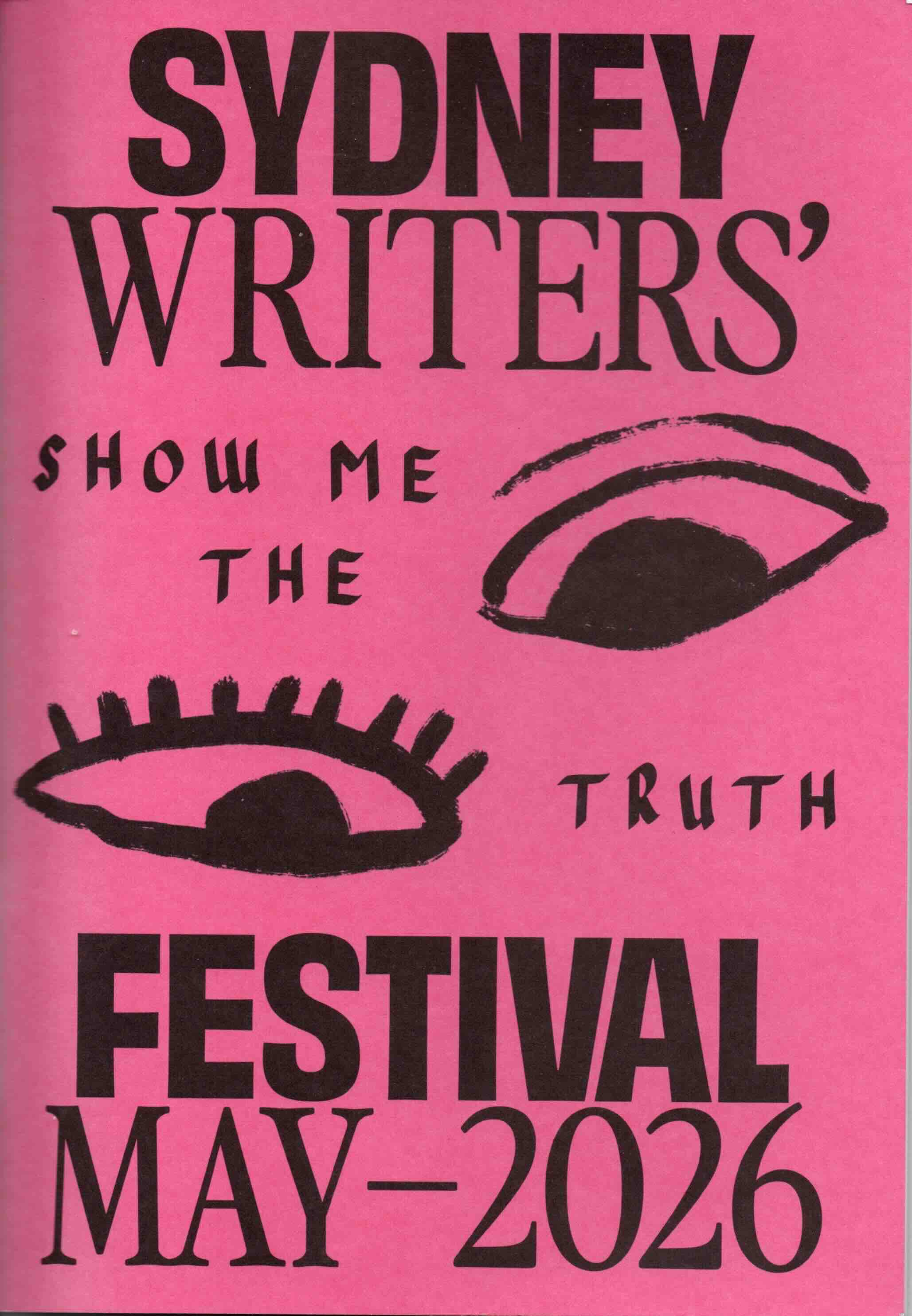
I’m writing this when the festival is over. It’s interesting to note that both these sessions dealt with the way terrible events had a dramatic impact on a writer’s practice. This turned out to be a recurring topic. The festival’s motto, ‘Show me the truth,’ could easily have been swapped for, ‘What the heck just happened?’


The Sydney Writers’ Festival is happening on unceded Gadigal land. I have written this blog post on Gadigal and Wangal land. I acknowledge their Elders past and present, and welcome First Nations readers of this blog.