Monthly Archives: Jun 2026

Reading with the Grandies 36: Tui T. Sutherland’s darkstalker, the graphic novel

Tui T. Sutherland, Darkstalker: The Graphic Novel (adapted by Barry Deutsch & Rachel Swirsky, art by Jake Parker, colorist Maarta Laiho, Graphix Press 2025)

Tui T. Sutherland’s Wings of Fire series continues to dominate my granddaughter’s reading. When I asked her about a character in The Lost Continent, the second book in the series I’ve read, she handed me the comics version of Darkstalker, a stand-alone novel, saying that it would explain the background. She was right.

The action of Darkstalker takes place two thousand years before the main series. It answers my questions about the nature of Clearsight, the dragon venerated almost as a god in The Lost Continent. I’m guessing from its final image that the character Darkstalker emerges as a major villain in the series. This is his origin story: a tale of love and ambition, of good intentions leading to terrible deeds, of epic battles and bloody assassinations. It includes a scene that resembles the Blood Wedding from Game of Thrones. There’s a magical device that could be a satirical take on Donald Trump’s golden dome. At the heart of the narrative are challenging ethical issues.

For what it’s worth, I would recommend the prose novels rather than the comics. I found the art in this book generally unattractive compared to that in The Lost Prophecy (different artist, same colorist). To my eye, the many characters aren’t different enough from each other – I suppose there’s only so much you can do with dragon faces and bodies. But the story is gripping, and ends in a satisfying cliffhanger.

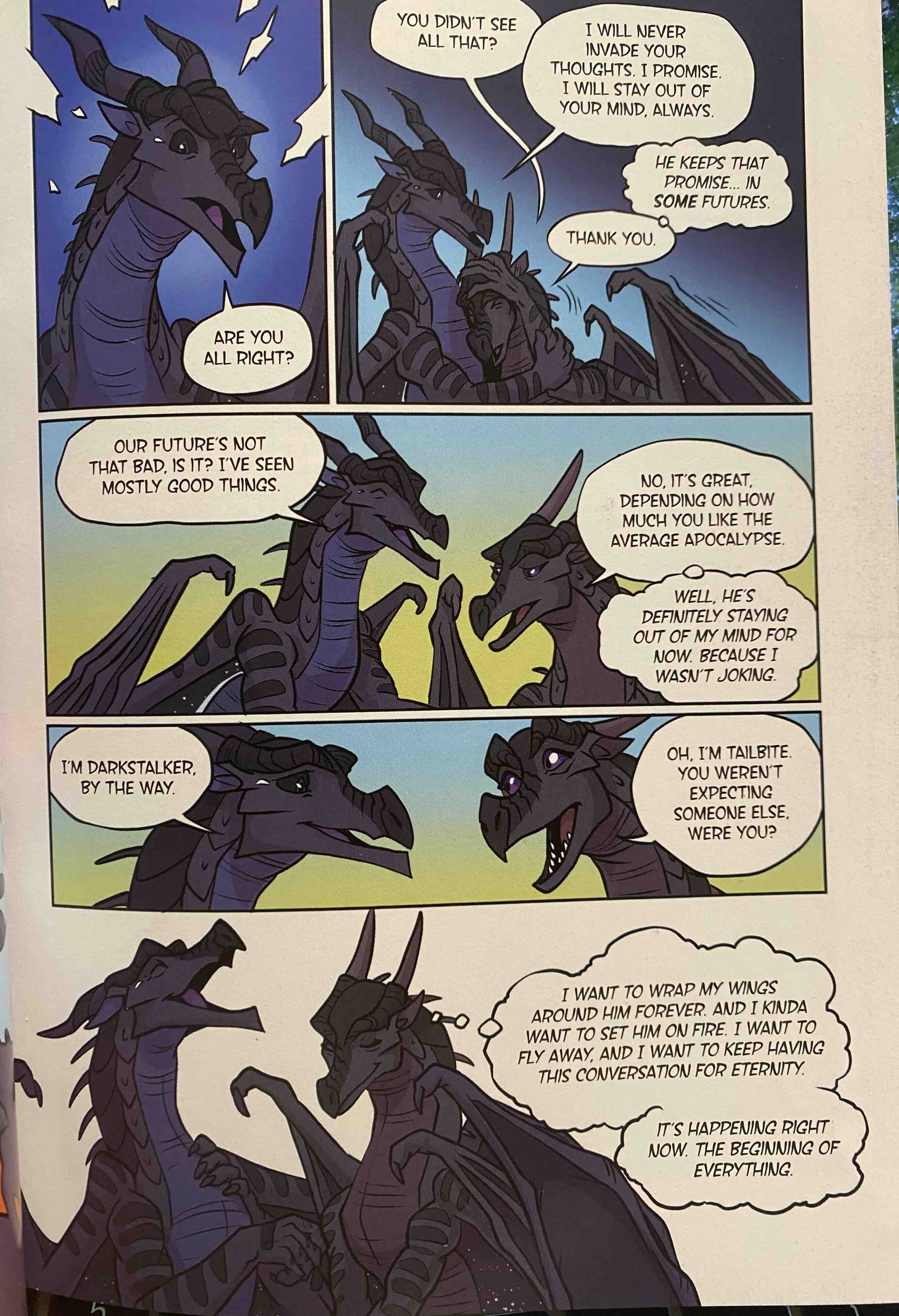
Page 79* illustrates both my dissatisfaction with the art and my enjoyment of the complexity:

These two characters are Darkstalker (on the left, with crooked horns) and Clearsight. They are both animuses (or is it animi? a question raised by the characters, not me), that is to say, they both have magical powers. Clearsight is a seer, who can see many versions of the future with remarkable clarity, and is acutely aware that a decision made in the present determines which of many futures will come to pass. Darkstalker has the most powerful magic of any living dragon. They have just met for the first time, though because of their remarkable powers it’s as if they know each other intimately from their intense future relationship. On page 77 Darkstalker takes one of Clearsight’s claws/hands in his, and page 78 shows us the kaleidoscopic visions this produces in her mind – a smattering of blood, images of grief, tenderness, pride, a scroll and a bracelet whose meaning will be made clear later …

On this page, we realise that Darkstalker has not seen the visions, and he promises in gentlemanly manner that he will never read Clearsight’s mind. Only then do they introduce themselves. Clearsight can say her name is Tailbite because she knows that he knows that she knows he was expecting her. It’s love at first sight, but that sight has been preceded by detailed visions of each other. Clearsight’s thought bubbles in the final frame might be read as expressing pure romantic love, but there’s terror there as well: ‘I want to fly away and I want to keep having this conversation for eternity’. This moment of first meeting is filled with joy. But Clearsight knows how many ways and how terribly things could go dark. Well, reader, they do go very dark, and she was right to want to hold onto this moment. People coming to this after reading books in the series published before it will know that already, so the moment is charged with tragic irony.

From the little joke about the plural of animus to the complex play with what the ability to read minds and see the future can do to relationships, this is a book that treats its young readers with respect. The popularity of the series is comforting evidence that young people’s attention spans may not be as monstrously shortened as we some people fear.

Also, I enjoyed this story a lot.


I am a man of settler heritage who has been alive for almost a third of the time elapsed since Arthur Phillip claimed this continent for the British crown. I wrote this blog post on the land of Gadigal and Wangal of the Eora Nation. I acknowledge their Elders past and present and welcome any First Nations readers of the blog.


My blogging practice is to focus on the page that coincides with my age, currently 79.
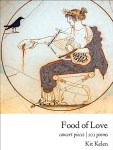
Maria Reva’s Endling and the book club

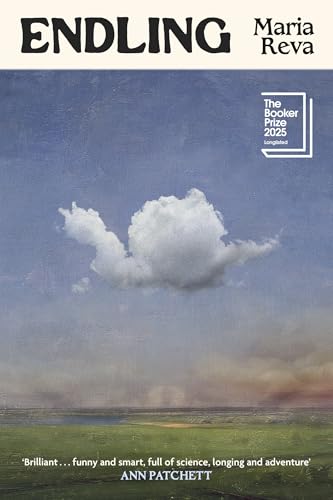
Maria Reva, Endling (Virago 2025)

An endling is the last surviving individual of a species. Famous ones were Benjamin the Tasmanian tiger, and Martha the passenger pigeon. The species facing extinction in Maria Reva’s novel are less impressive than thylacines or pigeons: they are snails. The central character, Yeva, is a Ukrainian woman who has made it her life mission to find individuals from endangered snail species, keep them alive in her laboratory–van, find mates for them, and with any luck release the results of their pairings back into the wild. As other sources of funding have dried up – because who cares about snails going extinct? – she funds her project by joining a ‘romance tour’. Men, mainly from the USA, come to Ukraine in search of wives and a bridal agency rounds up women who are desperate or foolish enough to let themselves be put on offer. Our heroine has no intention of marrying one of the men, but their compulsory gifts have become her source of funding.

The first chapter of Endling is all about the snails – how richly varied in their behaviours, mating habits and generally lifestyles. One snail in particular, whom she names Lefty, has a shell that spirals to the left, severely limiting its chances of finding a mate. Yeva’s snail obsession comes to make complete sense to us. We understand how death after death, extinction after extinction, takes its toll. Yeva sinks into a deep depression and decides to end her life. It’s a grim, compelling stand-alone short story.

But another of the ‘brides’ has also joined the agency with complex ulterior motives. She has a plan to kidnap a hundred of the ‘bachelors’ and expose the horrors of the bride trade, and she wants Yeva’s help. And chapter two sets a whole new direction.

Things proceed pretty much as you would expect: there are obstacles, unexpected changes of plan, oddly comic missteps, and the van full of kidnapped bachelors sets off on some half-arsed plan to expose the marriage trade. Then there’s an explosion. Russia invades Ukraine and the novel comes to a sudden halt. There’s an interim as the author scrambles to get back on her feet. I loved the scrambling, but don’t want to say too much more because the surprise of how the disruption plays out is a big part of the sometimes grim pleasure of the book. I was enjoying the more or less conventional story-telling in the first part of the book, so was relieved that the story does continue, transformed. Lefty survives to play a key role in a climactic scene involving terrible violence, unlikely romance, and what seems to be the author giving instructions to a character over the phone.

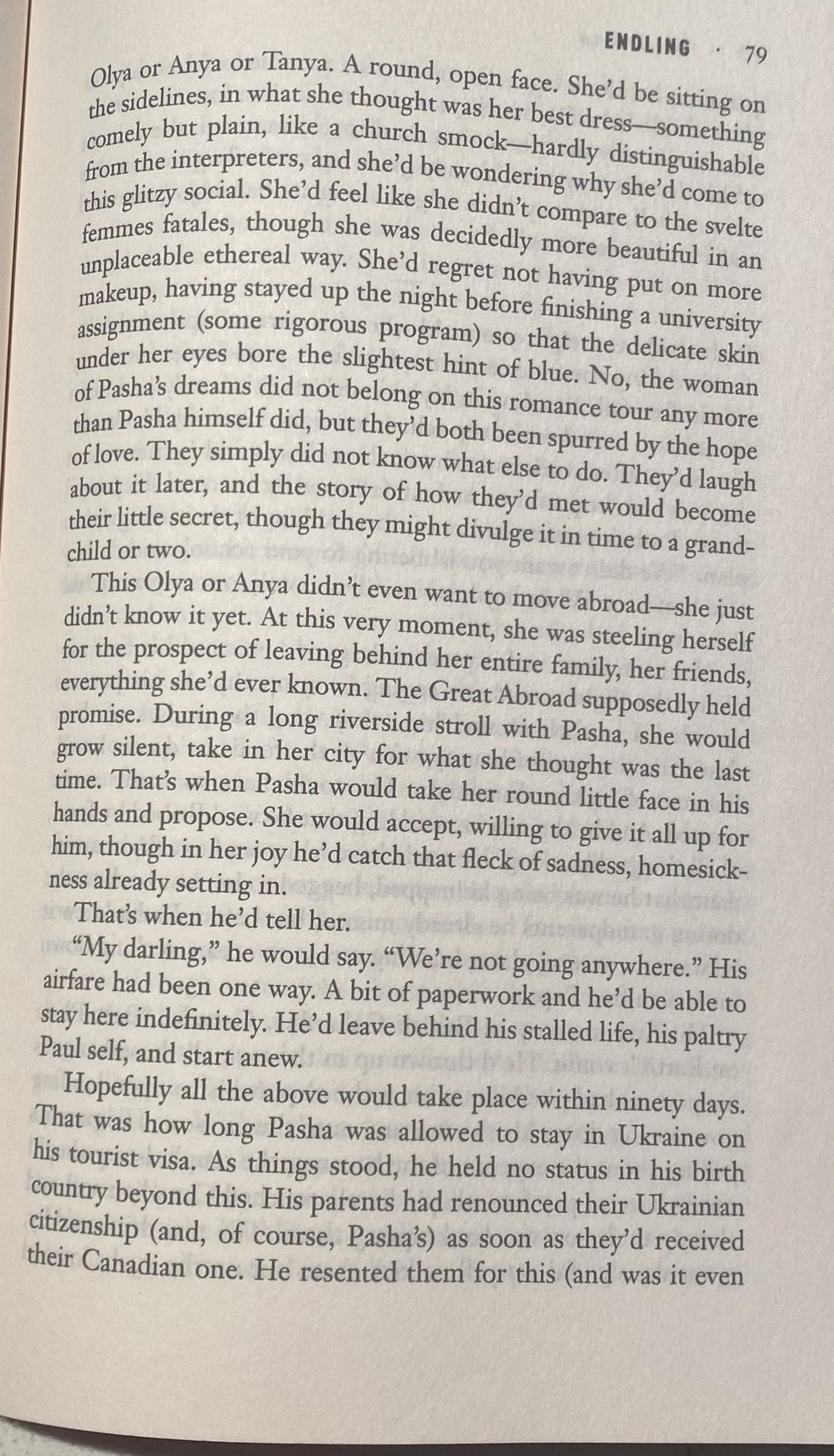
Page 79* is all about Pasha, the only one of the ‘bachelors’ to be treated sympathetically. Like Maria Reva, he is Ukrainian-Canadian. His parents were immigrants who did everything they could to assimilate, and part of his motive for coming to Ukraine has been to reclaim his Ukrainian identity. Here he is imagining the woman he wants to meet on the romance tour:

She’d be sitting on the sidelines, in what she thought was her best dress – something comely but plain, like a church smock – hardly distinguishable from the interpreters, and she’d be wondering why she’d come to this glitzy social. She’d feel like she didn’t compare to the svelte femmes fatales, though she was decidedly more beautiful in an unplaceable ethereal way. She’d regret not having put on more makeup, having stayed up the night before finishing a university assignment (some rigorous program) so that the delicate skin under her eyes bore the slightest hint of blue. No, the woman of Pasha’s dreams did not belong on this romance tour any more than Pasha himself did, but they’d both been spurred by the hope of love. They simply did not know what else to do.

We’re being played with there. The woman in Pasha’s hopelessly romantic fantasy is described in a way that could apply to Yeva, and more unlikely matches have occurred in fiction. But everything in my readerly soul rebelled at the thought of Pasha and Yeva pairing up to live happily ever after. At the same time, I so wanted him to find happiness: he’s naive, but his heart is in the right place, and his yearning to be part of Ukraine is genuine. I won’t tell you what happens, but I don’t think it’s a spoiler to say that in this book that focuses on a handful of fabulously unconventional female characters, the last couple of pages belong to him.

The meeting: We had three books on our agenda. Along with Endling there was Maria Reva’s Endling and On Not Climbing Mountains by Claire Thomas (see here).

I probably shouldn’t have been surprised, but I was, that one person hated this book and one didn’t finish it. They found the disruption of the form self-indulgent and tedious. When I mentioned the passage that Maria Reva had read out at the Sydney Writers’ Festival, which I found hilarious, they screwed up their noses and said that was exactly the kind of thing they hated. One of them liked the snails, but found the romance tours story repetitive and then improbable. Oh well, as my high-school Latin teacher used to say, de gustibus non est disputandum.

The three of us who did enjoy the book, really enjoyed it. One said it was bonkers, a good thing.


One of the unrelated joys of the evening was a reading-aloud of Evelyn Araluen’s poem ‘Acknowledgement of Cuntery’. I will make my acknowledgement anyhow. The Book Club’s five members are all of settler heritage. We met on the beautiful, unceded land of Gadigal and Wangal of the Eora Nation, which is also where I have written this blog post. I gratefully acknowledge the Elders past and present who have cared for this beautiful country for millennia, and welcome any First Nations readers of this blog.


My blogging practice is to focus on the page that coincides with my age, currently 79.
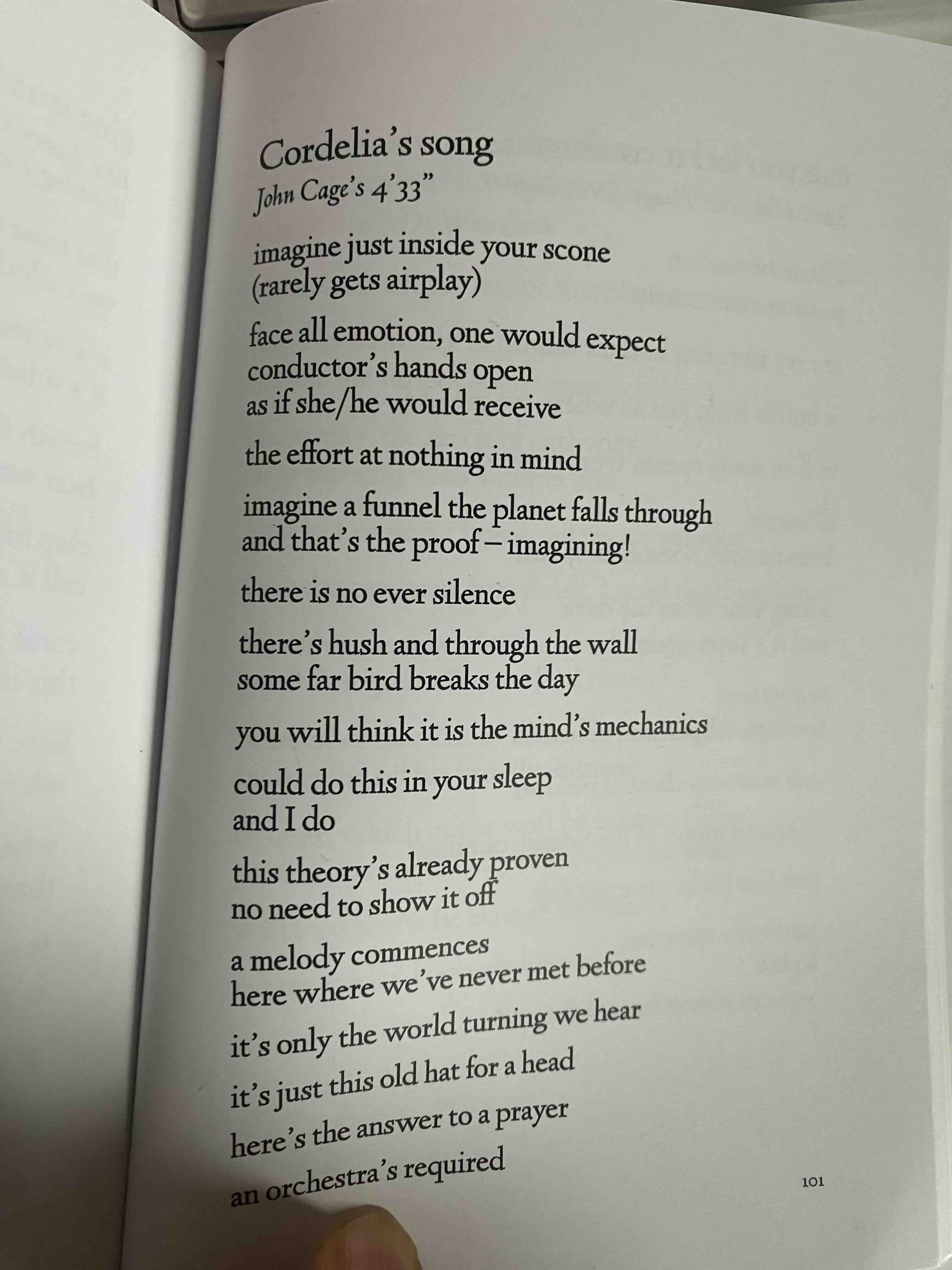
How to End a Story, report 1

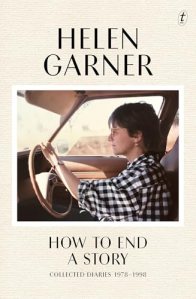
Helen Garner, How to End a Story: Collected Diaries 1978–1998 (Text Publishing 2025)
– pages 1 to 193.

Someone at the recent Sydney Writers’ Festival said that we ought to stretch our attention spans by reading for twenty minutes at a time – or it may have been by reading twenty pages at one sitting. That’s probably good advice, but I’ve now been reading just five pages of Helen Garner’s diaries every morning for a little over a month, and I’m convinced this is the best way to read them.

I expected the experience to be similar to reading Seamus Heaney’s letters in the same way (first of several blog posts here). But a diary entry is a different beast from a letter, even one written to an intimate friend. Garner is not concerned to present an acceptable face or to spare people’s feelings. I expect she has done some sparing in the editing – by anonymising most people, and probably by cutting some entries – but this is not a public face on display.

The diaries were, however, meant to be well written, to wrangle her observations and reflections into precise words. Nearly two-thirds of the way in the first volume, Yellow Notebook, narrative threads have emerged. Her second marriage, to a man identified only as ‘F’, has come to an end after a long period of bitter rows, and she is coming to terms with her new unpartnered life. Her first novel, Monkey Grip, won a prize on the first page, in 1978. Now, in 1986, she seems to go to a lot of writers’ festivals where people are all too happy to give their opinions about The Children’s Bach (1984) and sometimes mistake her for a staff member. A film she wrote the script for goes to Cannes – she doesn’t name the film (it was Two Friends, directed by Gillian Armstrong) or say any more about it. There’s a thread to do with religion: she senses the approach of what she calls ‘The Mighty Force’, and the thread has peaked in a brief entry (on page 185): ‘ I dread having to become a Christian.’ Perhaps related to that is her deep friendship with ‘J’, transparently Tim Winton (they laugh at gossips who assume they’re sleeping together).

I won’t be surprised if some time in the next decade or so an annotated edition of the diaries appears with notes identifying people and places, and elaborating on contexts. Without that apparatus, it’s like reading the ghost of an autobiography – tantalising, but still oddy satisfying.

There are dreams, conversations, snippets from her reading and film-going, lovely moments with her daughter and sister, irritating moments with various men, deft little pen portraits both physical and psychological, and entries that amount to prose poems.

There’s is a recurring fascination with murder, especially child murder. Several gruesome news items make their way into the diary, and then in 1985 she attends her first trial. Here she is talking to the father of a murdered girl:

I asked him if I could come to the trial.
‘Why do you want to?’
‘First because I thought you might like people to be with you. And second because I’m curious.’
The real truth would be in reverse order. In fact the real truth is part 2. The first is cosmetic, though it is true also, in another way.

How could she have known that this interest would lead to her brilliant non-fiction books Joe Cinque’s Consolation (2004) and This House of Grief (2014), both published well after the end date of these collected diaries.

In today’s reading there’s a long, gruesome account of a visit to the dentist, a number of notes on possible books and stories to write, comments on movies (Visconti’s Bellissima) and books (she reads surreptitiously from a novel about a sadomasochistic affair at Readings book shop), snippets from conversations, descriptions of nature, quotes from a reader and a critic. Here’s a sample just from these five pages:

A micro-fiction:

At the school concert a girl’s proud father says, ‘I love you!’ and squeezes her in his arms. She shrieks, ‘Ewww,YUCK!’ and fights to break free. He grips tighter with a demonic grin

A delicious name-drop (‘the law student’ is her lodger):

Raymond Carver called collect when I wasn’t home, and the law student, confused, caused him to hang up.

A neighbourly conversation:

Out near the rubbish bins I ask my neighbour if she knows anything about Melanie Klein. ‘I absolutely detest psychoanalysis,’ she snaps. I bet you do. Look at your life.

A gruesome moment observed:

Outside the post office the dog shat out a tapeworm. It trailed behind her and I had to put my foot on it to snap it off.

A tiny addition to the underlying narrative:

Spring comes. People fall in love – or they will, when the sunny breezes blow and exams are soon and cafe tables are put out on the pavements. Will I? I can’t imagine who with?

I’m so glad she decided to publish these diaries. I’m pretty sure I’m also glad I’m not ‘the neighbour’, ‘the law student’ or even the ‘proud father’.


I am a man of settler heritage who has been alive for almost a third of the time since Arthur Phillip raised his flag on the shores of Warrane. I wrote this blog post on the land of Gadigal and Wangal of the Eora Nation. I acknowledge their Elders past and present and welcome any First Nations readers.

Hannah Kent’s Always Home, Always Homesick at the book club

Hannah Kent, Always Home, Always Homesick (Picador Australia 2025)

Before the meeting: You don’t have to have read Hannah Kent’s first novel, Burial Rites (my blog post here), to enjoy Always Home, Always Homesick, but having read it had me loving this book. It’s a memoir about Kent’s love affair with Iceland, beginning with a period she spent there in her teens as an exchange student. It’s also about the making of that first novel – the landscape and history that inspired it, the persistence and serendipity of research, the critical reception, and especially the way it was received in Iceland.

Soon after I finished reading my library copy, I visited the Queensland Gallery of Modern Art to see the Olafur Eliasson exhibition, Presence. Although the most striking works there are installations that play with light in miraculous ways, there are also many photos of Icelandic landscapes – treeless, austere, other-worldly. These works formed a magnificent accompaniment to Hannah Kent’s loving descriptions.

Of course, it’s not all about the book and the landscape. Relationships are important. An Icelandic family weren’t originally meant to be her hosts but stepped in when they saw she was less than happy. They became like a second family for her, and over the years since that original visit they have stayed in her life. The language casts a spell on her; the weirdness of day–night cycles so close to the pole fascinates, and of course there’s food, which brings me to page 79*.

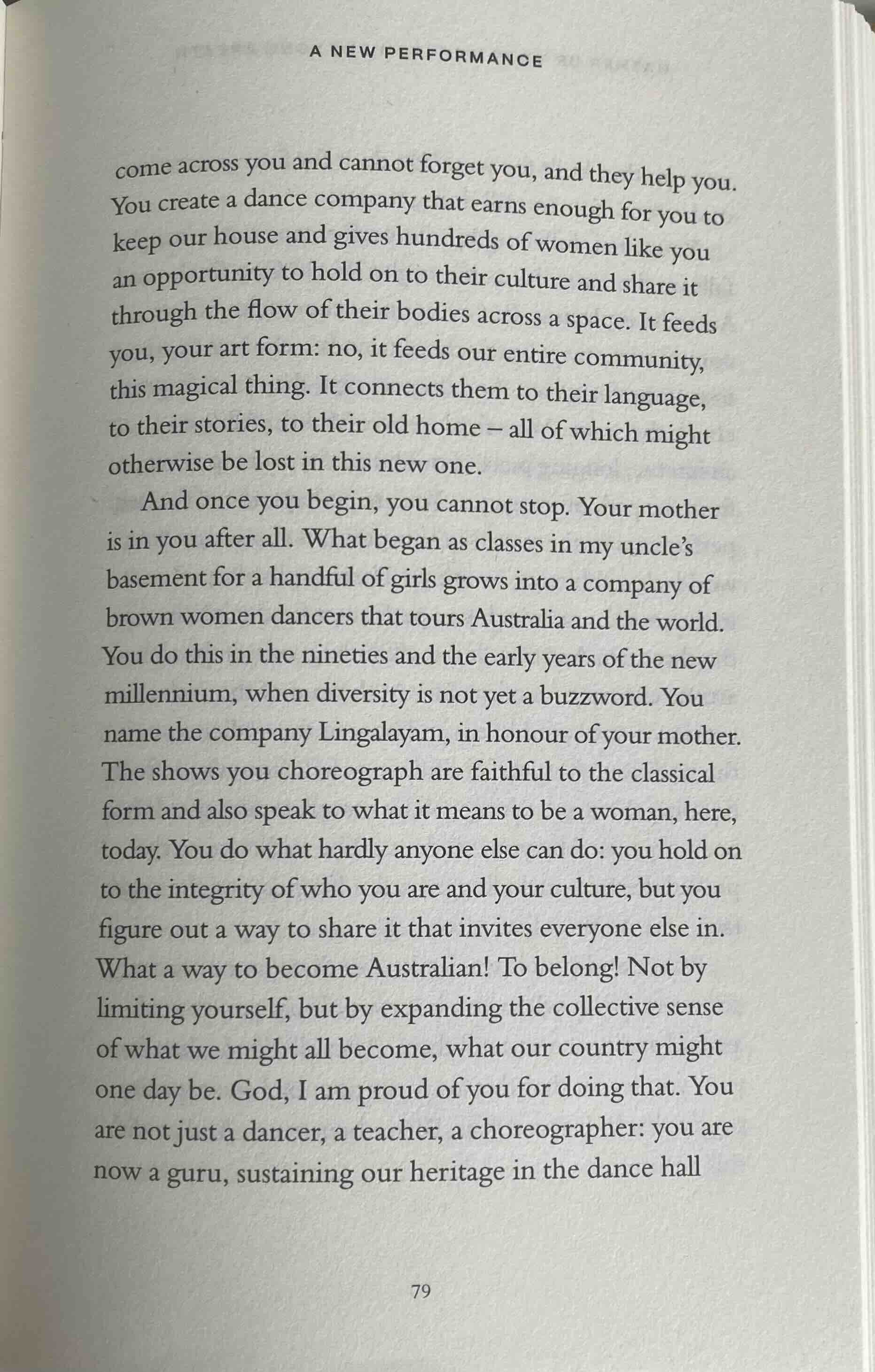
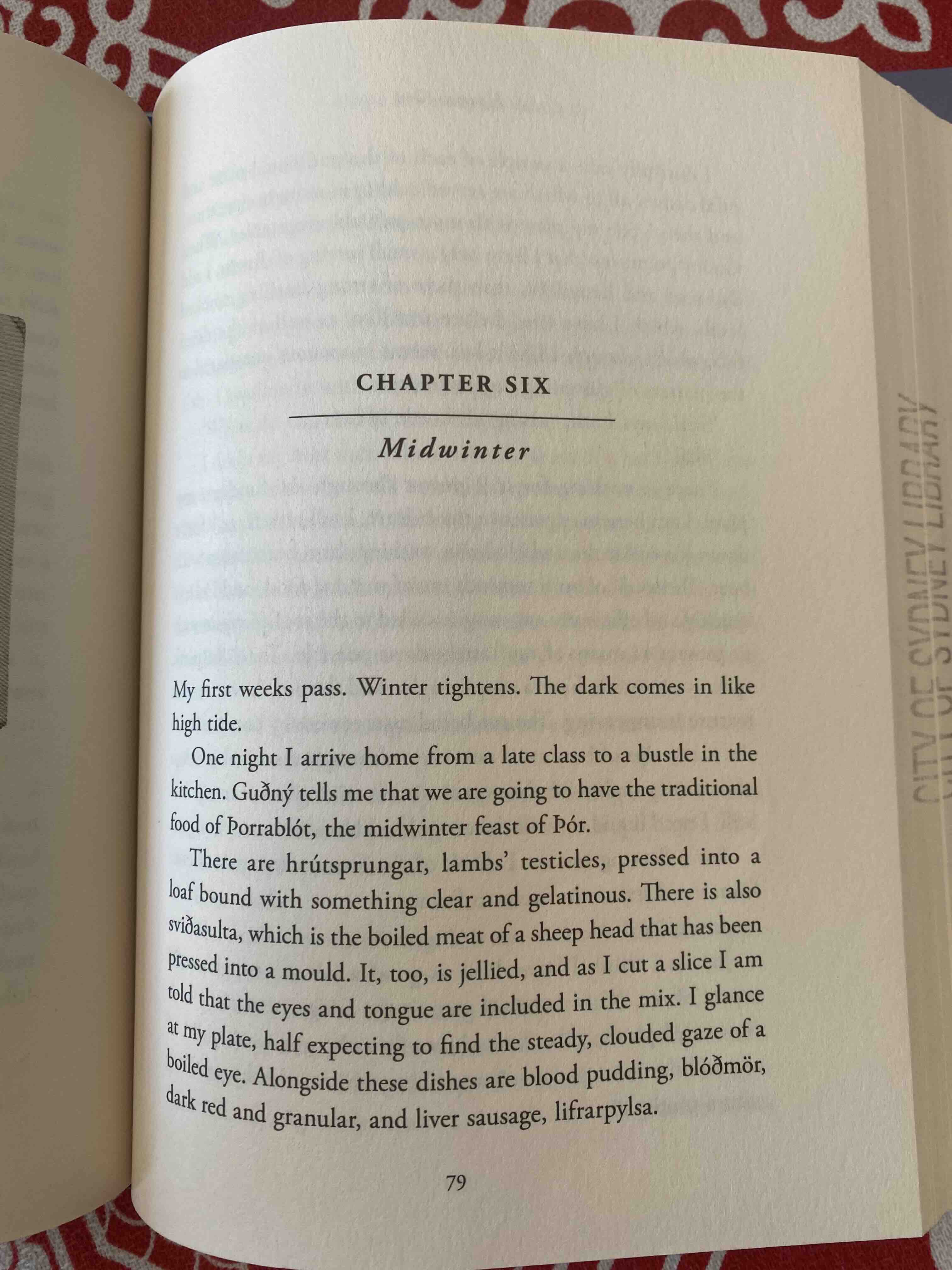
At this stage of the book, teenage Hannah is still finding her way in Iceland, staying with a taciturn family who make her feel strangely isolated. If I had picked the book up in a shop and read this page, I’m pretty sure I would have bought it:

The traditional midwinter feast:

There are hrútsprungar, lambs’ testicles, pressed into a loaf bound with something clear and gelatinous. There is also sviasulta, which is the boiled meat of a sheep head that has been pressed into a mould. It, too, is jellied, and as I cut a slice 1 am told that the eyes and tongue are included in the mix. I glance at my plate, half expecting to find the steady, clouded gaze of a boiled eye. Alongside these dishes are blood pudding, blóğmör, dark red and granular, and liver sausage, lifrarpylsa.

Yum!

After the meeting: We had three books on our agenda. Along with Always Home, Always Homesick there was Maria Reva’s Endling and On Not Climbing Mountains by Claire Thomas.

I found the first five pages of the Claire Thomas book deeply unpromising and gave up on it. Only two of the five of us had read it: they loved it and made us non-finishers regret our life choices.

But we all enjoyed Always Home, Always Homesick. We admired young Hannah Kent’s courage in going to the ends of the earth as a teenager. We commented on the evocation of place and though none of us were inspired to visit Iceland, we were reminded of other examples of its austere beauty.

Someone pointed out that there was very little if anything about Hannah Kent’s relationships with people of her own age group in Iceland. The difficulty involved in attending school where only Icelandic was spoken is mentioned, but the social difficulties are passed over in virtual silence.

People who hadn’t read Burial Rites apparently enjoyed the book as much as those who had.


The Book Club’s five members are all of settler heritage. We met on the beautiful, unceded land of Gadigal and Wangal of the Eora Nation, which is also where I have written this blog post. I gratefully acknowledge the Elders past and present who have cared for this country for millennia, and welcome any First Nations readers of this blog.


My blogging practice is to focus on the page that coincides with my age, currently 79.
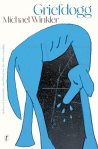
Edwina Shaw’s Dear Madman

Edwina Shaw, Dear Madman (AndAlso Press 2026)

Revisionist exploration of family lore is a rich vein of story telling. As one of many examples, Tasma Walton’s novel I Am Nannertgarrook grew from that kind of impulse, and it’s part of the truth-telling project that stems from the Uluru Statement from the Heart. Dear Madman doesn’t deal with First Nations issues, but it is a gripping addition to the genre, and it also deals in truth-telling.

Edwina Shaw’s great-aunt, her maternal grandmother’s sister, was murdered as a small child. The murder was part of family lore, a historic family tragedy, a scary tale told to children by a loving grandmother. The book is part memoir – how the story featured in the lives of Edwina and her family, and how she scoured newspaper accounts, prison records, the murderer’s mental health files and more, to find a fuller story. And it’s part novel: alternating chapters take us into the life of the early 20th century family and, most grippingly, into the murderer’s mind.

Edwina is my niece, and I have been privileged to see the book in a number of drafts, so I should leave it to others to discuss it in detail. I’ll just say that it’s a white-knuckle tale of suspense and a marvellous achievement of empathy. It’s a family history, a True Crime essay, a horror story, a dark and violent version of A B Facey’s A Fortunate Life, a hard but rewarding read.

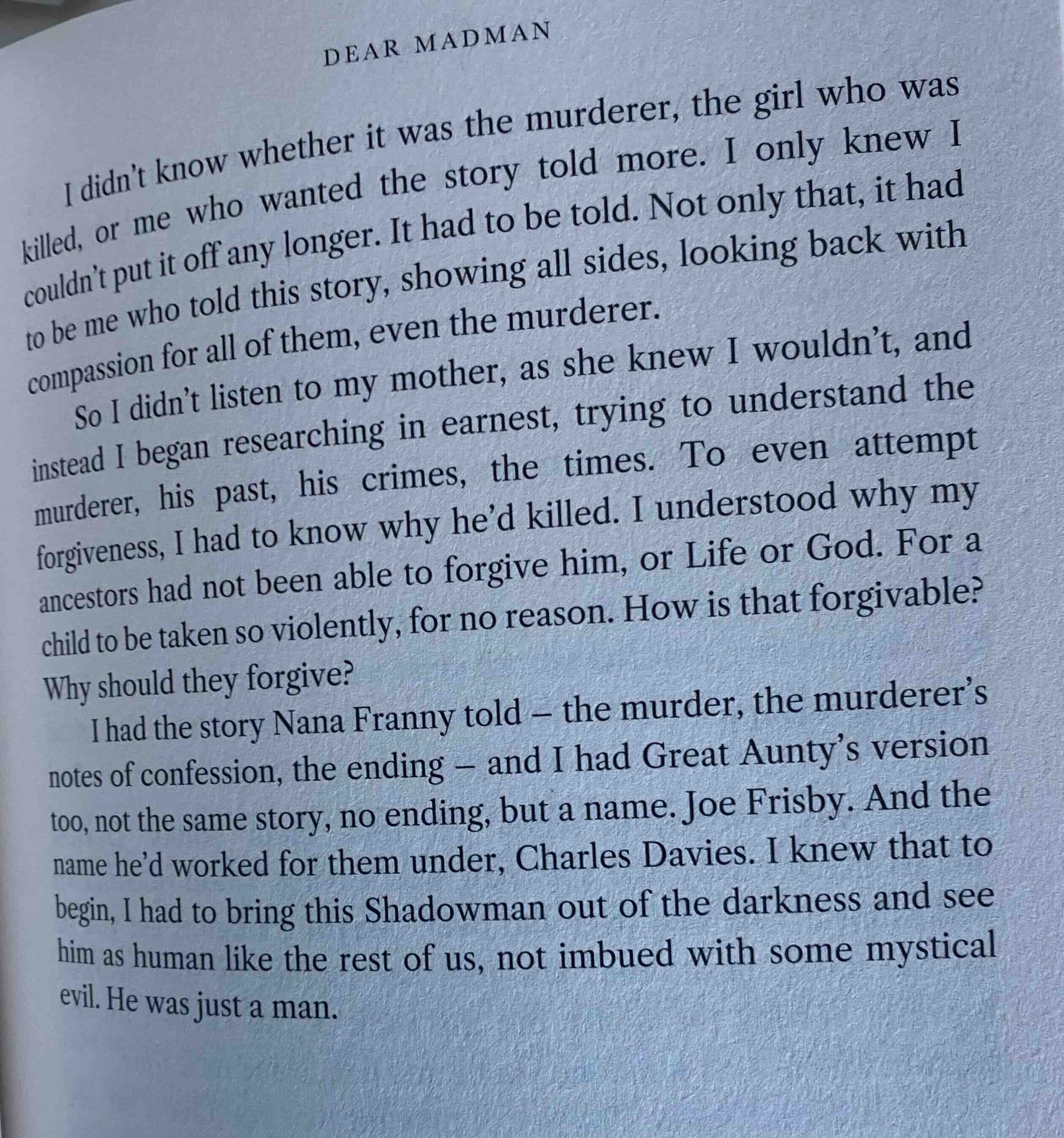
Page 79* is in one of the sections where the author speaks about her task:

I didn’t know whether it was the murderer, the girl who was killed, or me who wanted the story told more. I only knew I couldn’t put it off any longer. It had to be told. Not only that, it had to be me who told this story, showing all sides, looking back with compassion for all of them, even the murderer.
… I began researching in earnest, trying to understand the murderer, his past, his crimes, the times. To even attempt forgiveness, I had to know why he’d killed. I understood why my ancestors had not been able to forgive him, or Life or God. For a child to be taken so violently, for no reason. How is that forgivable?
Why should they forgive?
I had the story Nana Franny told – the murder, the murderer’s notes of confession, the ending – and I had Great Aunty’s version too, not the same story, no ending, but a name. Joe Frisby. And the name he’d worked for them under, Charles Davies. I knew that to begin, I had to bring this Shadowman out of the darkness and see him as human like the rest of us, not imbued with some mystical evil. He was just a man.

It’s rare that a book includes such a neat statement of its goals. Maybe it’s an underlying goal of all good story telling – to have compassion for all one’s characters. And maybe the extent to which that’s achieved is a test of all serious story telling. I think this book does it in spades.

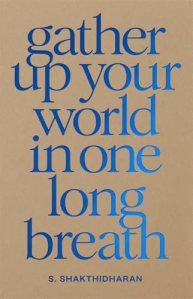
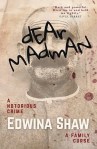
Without being too spoilerish: the cover image is the photo of the murderer taken on his admission to Goodna Mental Asylum ten years after the murder, which Edwina found very late in the research process, after reading about him, having conversations with him on car journeys, meeting some of his descendants, and imagining her way into his mind. In some ways, the appearance of this photo is the moment in the book when he becomes ‘just a man’. Here’s Edwina’s description of it:

Joe’s forehead is deeply creased, and his moustache, huge and grey, is hiding his lips. Above the collar of his rough cotton uniform, you can make out the scar across his neck from where he slit his own throat, but there’s also a softness about the image that makes him look like an old Labrador. His eyes, dark and bright and mad, are looking up with hope as if he’s glimpsing God. He seems happy to me, though others don’t see it.
I propped up his photo as I wrote on, but when it came to the murder scene, I had to turn the picture face down.

I’m one proud uncle (on the murderless paternal side).


I am an Australian man of settler heritage. I’ve written this blog post on the land of Gadigal and Wangal of the Eora Nation. I acknowledge Elders past and present of those clans, and welcome any First Nations readers and commenters.


My blogging practice is to focus on the page that coincides with my age, currently 79.
Sydney Writers’ Festival 2026: My Day Four

I don’t know how it happened but my only event on the festival’s final day this year was the closing address. Happily, it was at Carriageworks, so didn’t involve a trek to the city. Incidentally, speaking of treks to the city, I’ve been told that since the festival moved from Walsh Bay on the Harbour to Carriageworks on the edge of Newtown, historically home to a large Aboriginal community, the demographics of festival attendees has changed. Now the vast majority are from the Inner West, and very few from the Northern Suburbs or even the East. For the benefit of readers unfamiliar with Sydney’s social geography, this means that broadly speaking the sympathies of the audience skew to the left. (Tony Abbott’s book sold well, all the same.)

Anyhow, I went to 5.45 pm: Closing Address: A Braver Australia.

As in the last couple of years, the closing address was actually a series of six addresses. I don’t imagine that the speakers got together and planned anything, but their takes on the notion of bravery had a huge amount of overlap.

After introductory remarks by the chair of the Festival and its artistic Driector, in which all the necessary thankyous were made, Sisonke Msimang stepped into the role of host. ‘My father was a freedome fighter,’she said by way of positioning herself in relation to the evening’s topic, ‘and my mother was an accountant.’ Her father’s advice was, ‘Don’t start trouble, but if trouble comes to you, finish it.’ We have got plenty of bullies making trouble right now, and it’s time to be brave.

And then the speakers proper.

Amy Remeikis, so strikingly dressed on the Barrie Cassidy and Friends panel, outdid herself in a splendid green frock with huge puffy sleeves falling from her shoulders. She gave an impassioned speech: We have been trained to expect little of our politicians. We’re letting them sleepwalk us off a cliff. It’s time to hold them accountable. She called on us to do the decent thing, the kind thing, the community-responsible thing, and ended to enthusiastic applause: ‘Let’s pull our nickers up!’

Tony Birch struck a different note. Quietly taking the stage, he spoke of the importance of those who have gone before us, who have been our mentors, and talked about Jack Charles as such a person. (If you don’t know who Jack Charles was, I recommend his Wikipedia page.) In prison after years on the edge of society, Jack discovered the pottery wheel and realised you can make something through gentleness. He became a much loved actor, story-teller, and mentor to young Aboriginal men. Tony Birch ended with a story from the set of a verbatim theatre project in Melbourne. The white actor Robert Menzies asked Charles, ‘What is sovereignty?’ I understood him to mean specifically Aboriginal sovereignty. Here’s what I managed to write down of Charles’s reply: ‘Sovereignty is within me. My sovereignty is only as strong as my responsibility. That responsibility extends to all people in my country.’

Amy Thunig-McGregor was next. She picked up Sisonke’s father’s advice. As a child she was told, ‘Don’t hit first, but you are to hit back.’ She focused on the way the important community dimension of media and story consumption is being actively smothered. Not so long ago, we saw diversity of beliefs and opinions play out, not as debate or rage, but as part of being with each other. Now our media consumption is being weaponised against us. ‘Hard yarns can be had,’ she said, ‘and change can be made.’

Jack Toohey, activist and writer of Better Things Are Possible, came to the podium with his face largely obscured by a peaked cap. ‘I’ve got a wedgie, Amy,’ he said. ‘Does that count?’ He told his story of being at the Sydney Town Hall protest against Israeli President Isaac Herzog’s visit earlier this year. The unprovoked police violence, defended later by the Premier, is symptomatic, he said. We might not always be the targets of state violence, but this doesn’t mean the state is on our side. It’s there to defend power and profit, not people and the planet. He too spoke of the importance of connection: disconnection is how the system works. Solutions to our current problems aren’t to be found in parliament. (I understood him to mean that it’s not enough to vote for someone and feel you’ve done your bit.) We have to connect.

Shankari Chandran said when she was asked to give an address, she did what she always does, wrote five thousand words. (She’s a lawyer.) They were good words and we would have enjoyed them, but then she decided something more personal was needed: ‘What do I need to change about myself in order to be brave?’ And she too spoke about the need for connection and difficult conversations. Bravery is required in places of disagreement, she said. A braver Australia will not be built by louder argument. Listening, really listening, communicating in order to be hear rather than to win – this needs to happen. It might be slow, relentless, exhausting, but it is necessary.

And Ben Quilty was the last speaker. He half apologised for being an artist speaking at a writers’ festival, but gave a fine speech anyhow. He had recently realised that priorities matter. Money can be found for sport – 23 billion dollars for Olympics by some counts. It can be found for Canberra’s War Memorial, the biggest in the world. But not so for art, including literature. To judge by its effects, the priorities for much public spending is to distract and deflect. (I’ve been reading John McDonald’s substack Everything the art world doesn’t want you to know, and though he talks about vast amounts of money that nominally go to art, I think he would agree with Quilty’s point about priorities.) We need art and writing that address the realities that we face, and that takes bravery.

And with that multivocal call for connection, real conversation, respect and accountability, the festival was over. We all went home with our nickers pulled up, at least a little.

I had a thought as I was writing these reports. David Malouf, a wonderful and much loved poet, novelist and essay writer, died recently, and his passing was mentioned a couple of times – at the NSW Literary Awards and in the session on The World According to Trump. How good it would have been to have a whole session to honour him: perhaps a number of people reading favourite poens or passages from this work. Maybe in planning future festivals it wouldn’t be too ghoulish to schedule an In Memoriam session, whose specifics could be organised at the last minute depending on who, if anyone, should die.


The Sydney Writers’ Festival took place on the beautiful land of Gadigal of the Eora Nation. I have written this blog post on Gadigal and Wangal land, a couple of kilometres down the hill. I acknowledge their Elders past and present, and welcome First Nations readers of this blog.

Sydney Writers’ Festival 2026: My Day Three, part 2

Poetry may fill a room at the Carriageworks, but when you get a panel of pundits talking politics, you have to go big. The Sydney Town Hall was packed for both these sessions, one looking at the state of Australia, the other the USA and therefore the planet.

3.15: Barrie Cassidy and Friends: State of the Nation

This session, a kind of spin-off from the TV show The Insiders, is now a regular at the SWF. It may not be as pleasurable as the now defunct Big Read, where a string of writers entertained the audience by reading to us. But there is pleasure in hearing well-informed, thoughtful people talk to each other about the state of politics.

The host was veteran journalist and panel discussion host, Barrie Cassidy. His fans are clearly legion. In the past his panels have been criticised for the absence of people of colour. This year Waleed Aly (who has also garnered a fan base through TV’s The Project and radio show/podcast The Minefield), broke that barrier. Amy Remeikis, who has also built a following from her TV appearances on the now defunct The Drum, improved the visuals of the occasion by sporting a brilliantly coloured flowing garment. Nikki Savva, acerbic chronicler of the conservative side of Australian politics, added a modest touch of colour with a red jacket, while the men were thoroughly drab. Sean Kelly, known to me from his regular writing for The Monthly and most recently a Quarterly Essay (my blog post here), completed the line-up.

The conversation ranged intelligently over the current political landscape.

The apparent collapse of the Liberal Party and virtual extinction of the National Party loomed large. Amy Remeikis preened just a little, saying that she had predicted it, then explained that as a’geriatric millennial’ she understood all too clearly the deep unpoopularity of their policies, especially but not only on housing. Waleed Aly said that for a long time the Nationals had coasted along because they ‘had no natural predators’. But now One Nation has turned up as a party of grievance and put an end to their easy ride. Sean Kelly said the issue isn’t just the rise fo One Nation, but a general volatility in the Australian electorate: One Nation rose from 6 percent to 40 percent of the vote in 20 months; the independent teals took votes from the major parties on the right in the other direction. Someone listed all the functions of the president of the Liberal Party and observed that incoming president Tony Abbott ticks none of the boxes.

Waleed Aly spoke eloquently in defence of the recent budget. Someone said it was bad news for Labor that the Coalition broadly approved of their increase in the capital gains tax – Labor needed a fight to define themselves, but the Coalition have chosen a different tack. The panellists generally agreed that the Murdoch empire’s response to the budget amounted to asking us to pity the poor billionaires.

I enjoyed the discussion, liked all the participants, and came away none the wiser really, but that says more about me than about the panel.

5.30 The World According to Trump

As someone pointed out, this was a panel of non-USers talking about US politics. They were: Canadian David Moscrop, author of Too Dumb for Democracy, who says that Trump has turned him into a reluctant nationalist; Jon Sopel, British journalist who lived in the USA for eight years; Nick Bryant, also British, who hosts a weekly program on the ABC and has written books with titles like When America Stopped Being Great; and facilitator Amelia Lester, deputy editor of the US journal Foreign Policy, who I believe lives in Sydney. (No people of colour – a rarity at this festival.)

Starting from the question, ‘What is it that makes us so interested in Trump, when there are many other erratic, dangerous autocrats in the world?’ the conversation ranged widely and interestingly, from David Moscrop’ rejection of a can of gravy (a can of gravy) because it was made in the US, to John Sopel letting himself off the leash in a diatribe about Trump’s gangsterism and corruption.

Nick Bryant said that when you ‘excavate’ US history you realise that Trump isn’t an aberration, but the product of a strand that has been there from the start. Jon Sopel spoke of Trump’s brilliance at reading the mood of the country and appealing to its demons. (Obama appealed to its better angels.)

I learned just how entwined with the US Canada is – industrially, politically, culturally and militarily. The US defence plan in case of missile attack from over the Arctic is to knock any missiles out of the sky – above their obliging northern neighbour. Trump’s imposition of tariffs and rhetoric about a takeover creates for Canadians in general a visceral sense of having been punched in the face by a neighbour.

It got very gloomy, especially on the subject of allies’ failure to deal with Trump and Trumpism. But the session finished with a call from David Moscrop for a revitalisation of democracy with things that have been shown to work, of which the only one I noted down was citizen’s assemblies.

Oh, and then a little note, right at the end from either the Canadian or one of the Britishers, about how Australian electoral system has got so much right: compulsory voting, the independent electoral commission, and (to a burst of applause) the democracy sausage. Nick Bryant ended the panel by quoting David Malouf’s phrase, ‘citizenship lightly but seriously assumed’.


The Sydney Writers’ Festival took place on the beautiful land of Gadigal of teh Eora Nation. I have written this blog post on Gadigal and Wangal land, a coiuple of kilometres down the hill. I acknowledge their Elders past and present, and welcome First Nations readers of this blog.