
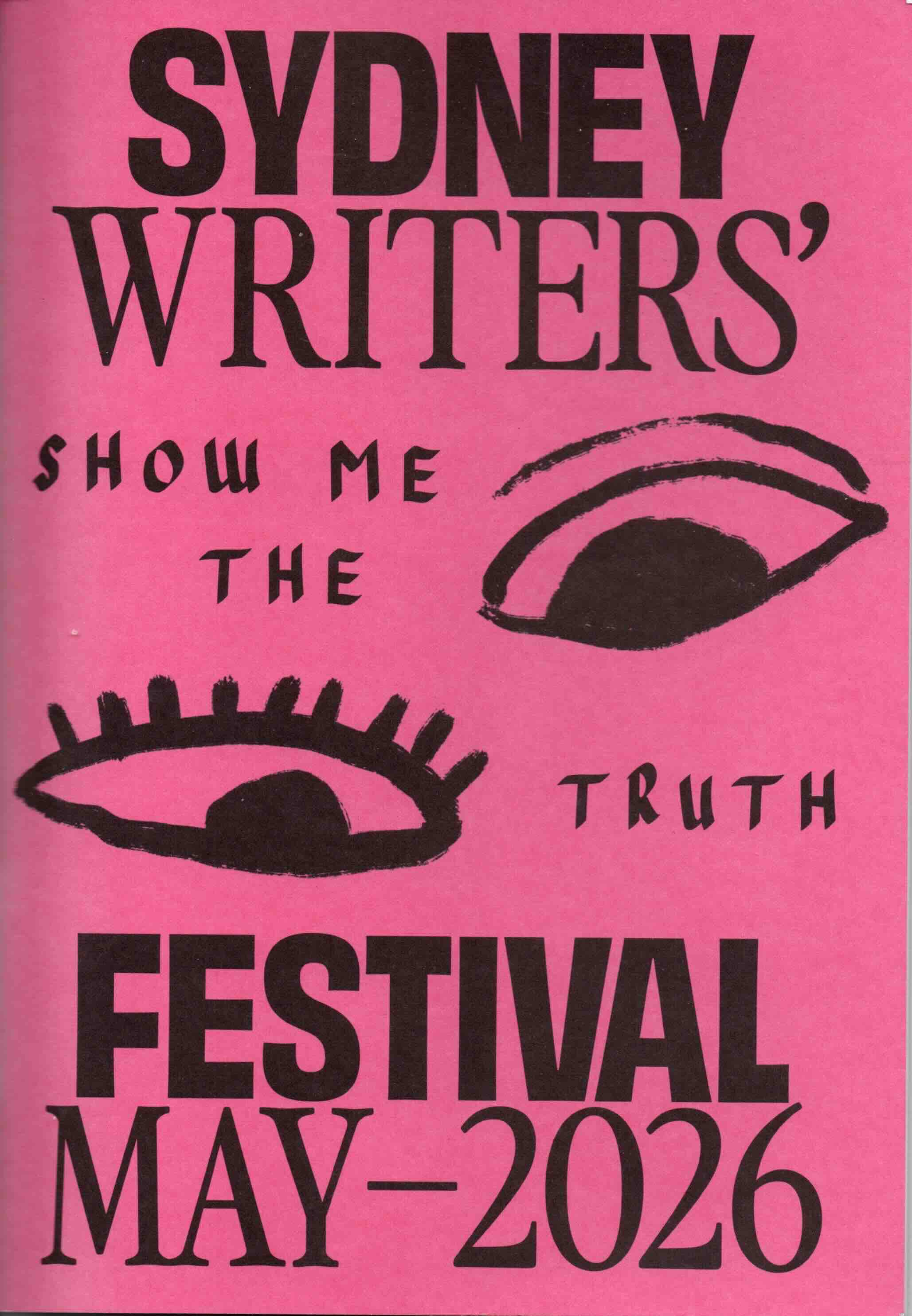
I don’t know how it happened but my only event on the festival’s final day this year was the closing address. Happily, it was at Carriageworks, so didn’t involve a trek to the city. Incidentally, speaking of treks to the city, I’ve been told that since the festival moved from Walsh Bay on the Harbour to Carriageworks on the edge of Newtown, historically home to a large Aboriginal community, the demographics of festival attendees has changed. Now the vast majority are from the Inner West, and very few from the Northern Suburbs or even the East. For the benefit of readers unfamiliar with Sydney’s social geography, this means that broadly speaking the sympathies of the audience skew to the left. (Tony Abbott’s book sold well, all the same.)
Anyhow, I went to 5.45 pm: Closing Address: A Braver Australia.
As in the last couple of years, the closing address was actually a series of six addresses. I don’t imagine that the speakers got together and planned anything, but their takes on the notion of bravery had a huge amount of overlap.
After introductory remarks by the chair of the Festival and its artistic Driector, in which all the necessary thankyous were made, Sisonke Msimang stepped into the role of host. ‘My father was a freedome fighter,’she said by way of positioning herself in relation to the evening’s topic, ‘and my mother was an accountant.’ Her father’s advice was, ‘Don’t start trouble, but if trouble comes to you, finish it.’ We have got plenty of bullies making trouble right now, and it’s time to be brave.
And then the speakers proper.
Amy Remeikis, so strikingly dressed on the Barrie Cassidy and Friends panel, outdid herself in a splendid green frock with huge puffy sleeves falling from her shoulders. She gave an impassioned speech: We have been trained to expect little of our politicians. We’re letting them sleepwalk us off a cliff. It’s time to hold them accountable. She called on us to do the decent thing, the kind thing, the community-responsible thing, and ended to enthusiastic applause: ‘Let’s pull our nickers up!’
Tony Birch struck a different note. Quietly taking the stage, he spoke of the importance of those who have gone before us, who have been our mentors, and talked about Jack Charles as such a person. (If you don’t know who Jack Charles was, I recommend his Wikipedia page.) In prison after years on the edge of society, Jack discovered the pottery wheel and realised you can make something through gentleness. He became a much loved actor, story-teller, and mentor to young Aboriginal men. Tony Birch ended with a story from the set of a verbatim theatre project in Melbourne. The white actor Robert Menzies asked Charles, ‘What is sovereignty?’ I understood him to mean specifically Aboriginal sovereignty. Here’s what I managed to write down of Charles’s reply: ‘Sovereignty is within me. My sovereignty is only as strong as my responsibility. That responsibility extends to all people in my country.’
Amy Thunig-McGregor was next. She picked up Sisonke’s father’s advice. As a child she was told, ‘Don’t hit first, but you are to hit back.’ She focused on the way the important community dimension of media and story consumption is being actively smothered. Not so long ago, we saw diversity of beliefs and opinions play out, not as debate or rage, but as part of being with each other. Now our media consumption is being weaponised against us. ‘Hard yarns can be had,’ she said, ‘and change can be made.’
Jack Toohey, activist and writer of Better Things Are Possible, came to the podium with his face largely obscured by a peaked cap. ‘I’ve got a wedgie, Amy,’ he said. ‘Does that count?’ He told his story of being at the Sydney Town Hall protest against Israeli President Isaac Herzog’s visit earlier this year. The unprovoked police violence, defended later by the Premier, is symptomatic, he said. We might not always be the targets of state violence, but this doesn’t mean the state is on our side. It’s there to defend power and profit, not people and the planet. He too spoke of the importance of connection: disconnection is how the system works. Solutions to our current problems aren’t to be found in parliament. (I understood him to mean that it’s not enough to vote for someone and feel you’ve done your bit.) We have to connect.
Shankari Chandran said when she was asked to give an address, she did what she always does, wrote five thousand words. (She’s a lawyer.) They were good words and we would have enjoyed them, but then she decided something more personal was needed: ‘What do I need to change about myself in order to be brave?’ And she too spoke about the need for connection and difficult conversations. Bravery is required in places of disagreement, she said. A braver Australia will not be built by louder argument. Listening, really listening, communicating in order to be hear rather than to win – this needs to happen. It might be slow, relentless, exhausting, but it is necessary.
And Ben Quilty was the last speaker. He half apologised for being an artist speaking at a writers’ festival, but gave a fine speech anyhow. He had recently realised that priorities matter. Money can be found for sport – 23 billion dollars for Olympics by some counts. It can be found for Canberra’s War Memorial, the biggest in the world. But not so for art, including literature. To judge by its effects, the priorities for much public spending is to distract and deflect. (I’ve been reading John McDonald’s substack Everything the art world doesn’t want you to know, and though he talks about vast amounts of money that nominally go to art, I think he would agree with Quilty’s point about priorities.) We need art and writing that address the realities that we face, and that takes bravery.
And with that multivocal call for connection, real conversation, respect and accountability, the festival was over. We all went home with our nickers pulled up, at least a little.
I had a thought as I was writing these reports. David Malouf, a wonderful and much loved poet, novelist and essay writer, died recently, and his passing was mentioned a couple of times – at the NSW Literary Awards and in the session on The World According to Trump. How good it would have been to have a whole session to honour him: perhaps a number of people reading favourite poens or passages from this work. Maybe in planning future festivals it wouldn’t be too ghoulish to schedule an In Memoriam session, whose specifics could be organised at the last minute depending on who, if anyone, should die.
The Sydney Writers’ Festival took place on the beautiful land of Gadigal of the Eora Nation. I have written this blog post on Gadigal and Wangal land, a couple of kilometres down the hill. I acknowledge their Elders past and present, and welcome First Nations readers of this blog.


