Tag Archives: Maria Reva

Maria Reva’s Endling and the book club

Maria Reva, Endling (Virago 2025)
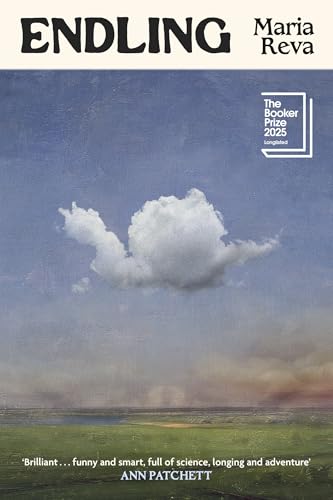
An endling is the last surviving individual of a species. Famous ones were Benjamin the Tasmanian tiger, and Martha the passenger pigeon. The species facing extinction in Maria Reva’s novel are less impressive than thylacines or pigeons: they are snails. The central character, Yeva, is a Ukrainian woman who has made it her life mission to find individuals from endangered snail species, keep them alive in her laboratory–van, find mates for them, and with any luck release the results of their pairings back into the wild. As other sources of funding have dried up – because who cares about snails going extinct? – she funds her project by joining a ‘romance tour’. Men, mainly from the USA, come to Ukraine in search of wives and a bridal agency rounds up women who are desperate or foolish enough to let themselves be put on offer. Our heroine has no intention of marrying one of the men, but their compulsory gifts have become her source of funding.

The first chapter of Endling is all about the snails – how richly varied in their behaviours, mating habits and generally lifestyles. One snail in particular, whom she names Lefty, has a shell that spirals to the left, severely limiting its chances of finding a mate. Yeva’s snail obsession comes to make complete sense to us. We understand how death after death, extinction after extinction, takes its toll. Yeva sinks into a deep depression and decides to end her life. It’s a grim, compelling stand-alone short story.

But another of the ‘brides’ has also joined the agency with complex ulterior motives. She has a plan to kidnap a hundred of the ‘bachelors’ and expose the horrors of the bride trade, and she wants Yeva’s help. And chapter two sets a whole new direction.

Things proceed pretty much as you would expect: there are obstacles, unexpected changes of plan, oddly comic missteps, and the van full of kidnapped bachelors sets off on some half-arsed plan to expose the marriage trade. Then there’s an explosion. Russia invades Ukraine and the novel comes to a sudden halt. There’s an interim as the author scrambles to get back on her feet. I loved the scrambling, but don’t want to say too much more because the surprise of how the disruption plays out is a big part of the sometimes grim pleasure of the book. I was enjoying the more or less conventional story-telling in the first part of the book, so was relieved that the story does continue, transformed. Lefty survives to play a key role in a climactic scene involving terrible violence, unlikely romance, and what seems to be the author giving instructions to a character over the phone.

Page 79* is all about Pasha, the only one of the ‘bachelors’ to be treated sympathetically. Like Maria Reva, he is Ukrainian-Canadian. His parents were immigrants who did everything they could to assimilate, and part of his motive for coming to Ukraine has been to reclaim his Ukrainian identity. Here he is imagining the woman he wants to meet on the romance tour:
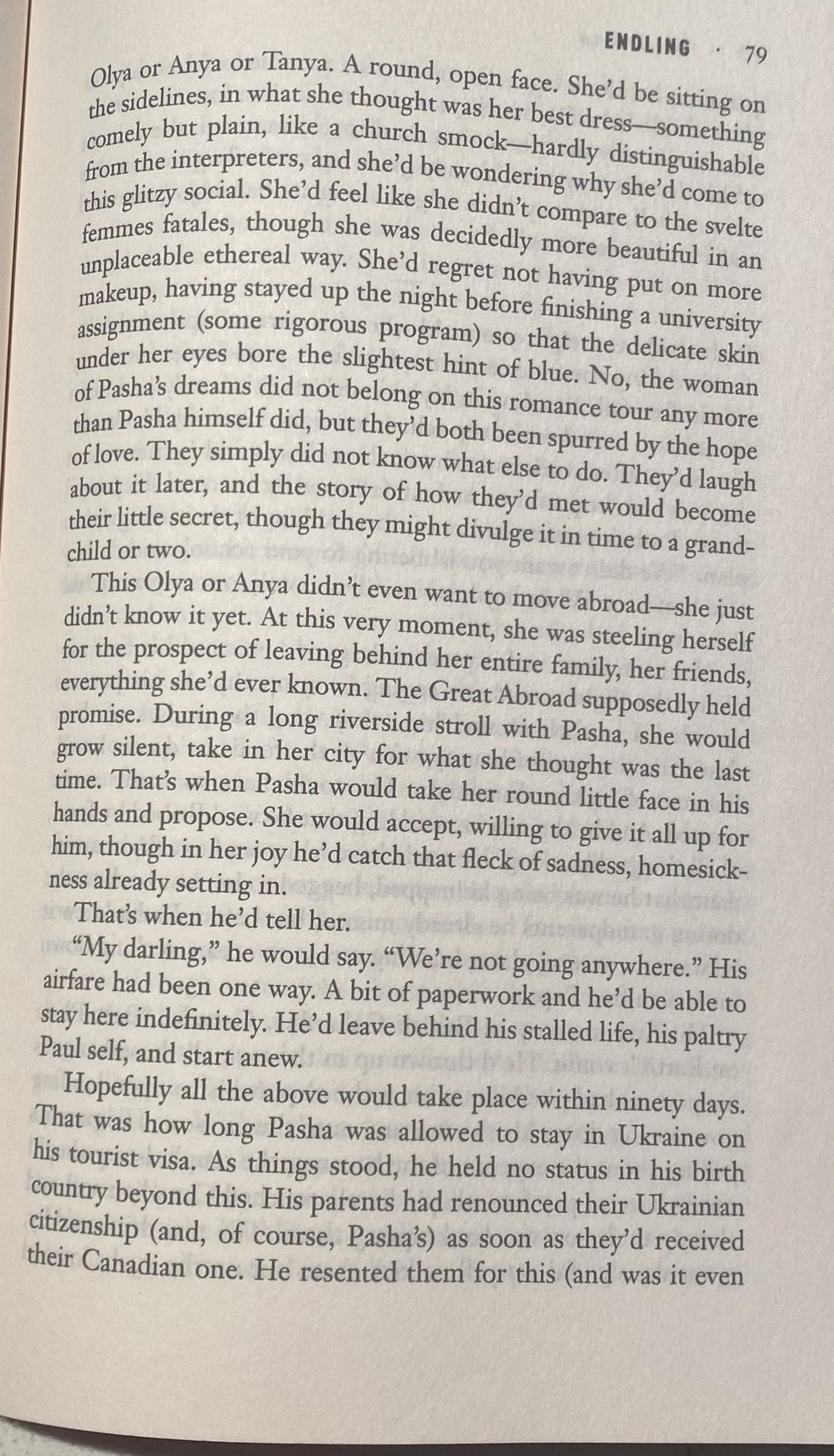
She’d be sitting on the sidelines, in what she thought was her best dress – something comely but plain, like a church smock – hardly distinguishable from the interpreters, and she’d be wondering why she’d come to this glitzy social. She’d feel like she didn’t compare to the svelte femmes fatales, though she was decidedly more beautiful in an unplaceable ethereal way. She’d regret not having put on more makeup, having stayed up the night before finishing a university assignment (some rigorous program) so that the delicate skin under her eyes bore the slightest hint of blue. No, the woman of Pasha’s dreams did not belong on this romance tour any more than Pasha himself did, but they’d both been spurred by the hope of love. They simply did not know what else to do.

We’re being played with there. The woman in Pasha’s hopelessly romantic fantasy is described in a way that could apply to Yeva, and more unlikely matches have occurred in fiction. But everything in my readerly soul rebelled at the thought of Pasha and Yeva pairing up to live happily ever after. At the same time, I so wanted him to find happiness: he’s naive, but his heart is in the right place, and his yearning to be part of Ukraine is genuine. I won’t tell you what happens, but I don’t think it’s a spoiler to say that in this book that focuses on a handful of fabulously unconventional female characters, the last couple of pages belong to him.

The meeting: We had three books on our agenda. Along with Endling there was Maria Reva’s Endling and On Not Climbing Mountains by Claire Thomas (see here).

I probably shouldn’t have been surprised, but I was, that one person hated this book and one didn’t finish it. They found the disruption of the form self-indulgent and tedious. When I mentioned the passage that Maria Reva had read out at the Sydney Writers’ Festival, which I found hilarious, they screwed up their noses and said that was exactly the kind of thing they hated. One of them liked the snails, but found the romance tours story repetitive and then improbable. Oh well, as my high-school Latin teacher used to say, de gustibus non est disputandum.

The three of us who did enjoy the book, really enjoyed it. One said it was bonkers, a good thing.


One of the unrelated joys of the evening was a reading-aloud of Evelyn Araluen’s poem ‘Acknowledgement of Cuntery’. I will make my acknowledgement anyhow. The Book Club’s five members are all of settler heritage. We met on the beautiful, unceded land of Gadigal and Wangal of the Eora Nation, which is also where I have written this blog post. I gratefully acknowledge the Elders past and present who have cared for this beautiful country for millennia, and welcome any First Nations readers of this blog.


My blogging practice is to focus on the page that coincides with my age, currently 79.
Sydney Writers’ Festival 2026: My Day Three, part 1

Saturday was my busiest day at the Festival. I had four sessions booked and then was given tickets to a fifth. There were three writer-in-conversation sessions and two panels about current politics. This post is about the former.

10 am Amitav Ghosh in Conversation (podcast here)

Amitov Ghosh was ‘in conversation’ with Michael Williams.

Michael Williams set up the conversation by suggesting that Amitav Ghosh had a kind of double vision: on the one hand he is a journalist with a PhD in social anthropology and a commitment to knowledge; on the other he writes fiction that involves ghosts and other supernatural phenomena. After Ghosh’s initial smiling response that writers are not normal people, the conversation expanded to take in elements of his biography, the genesis of his novels (including the brilliant Ibis trilogy, which wasn’t originally intended to be about the opium trade, but the facts got in the way of the other story), his love of travel, the absurdity of colonialist thinking, the British Empire as the world’s second narco state, the importance of Indigenous knowledge systems, and at last his most recent novel Ghost Eye.

I could have listened to him for hours. Here are some highlights:

  • A British reviewer of his first novel, The Circle of Reason (1988), commented that poor benighted third worlders could only write about politics, they had no inner life. Ghosh laughed and said, ‘Look at the United States now. They’re experiencing what we did then.’
  • Ronald Ross was a British doctor who was awarded the Nobel Proze in 1902 for discovering the malaria parasite. When Ghosh read his case notes, he found that all his major findings were in fact made by his Indian servants – who were given no credit.
  • He spoke about language in the Ibis trilogy. In colonial India, there were many Englishes. The multi-ethnic ship crews, the English colonisers who adopted Hindi words, etc. He said of those glorious passages where the language goes wild, that they don’t advance the story: Language is like white noise sometimes, its purpose is not to convey meaning but to establish the context in a kind of background hum. He referred us to Melville in Moby Dick for a similar use of language.
  • He mentioned his non-fiction book addressing climate change, The Great Derangement, which he wrote after the Ibis trilogy. I hadn’t heard of this book, and wonder of Ian MacEwan’s use of the phrase in his future-looking-back novel What We Can Know owes something to Ghosh.
  • In Western thought the world has come to be regarded as a machine whose function is to have goods extracted from it. We badly need to pay attention to First Nations / traditional ways of knowing, where teh world has not been desacralised. This is happening to some extent – he gave the example of the Wanganui River in Aotearoa/New Zealand being acknowledged as having legal personhood. But mining Indigenous cultures for their knowledge can be another form of extraction. The knowledge can’t really be separated from the stories by which it is communicated.
  • In the same reasonable tone, he told us that he doesn’t believe in reincarnation, but numerous studies in India and elsewhere have recorded phenomena which can only be explained by the existence of past lives: children suddenly recite long passages of classic books they can’t have read, etc.

I felt like we were in the presence of a great mind, who manages to communicate important, difficult ideas with an extraordinary lightness of touch and generosity of spirit, and also enjoys stirring the pot a bit.

We had a cup of tea with a friend, and a bite to eat, then off to Track 8, where train carriages were once built:

1.00: Melissa Lucashenko: A Writing Life

Winnie Dunn, author of Dirt Poor Islanders and an important part of the Western Sydney literary movement, was on stage with Melissa Lukashenko. As the session got under way, Melissa called out to people up the back to come and fill empty seats down the front – eventually people bowed to her benign authority and the front rows, perhaps reserved for celebrities who didn’t show, were filled.

The reason for the pairing of these two writers soon became apparent: Melissa lived for some time on Tonga, and Winnie is the first Tongan Australian writer to have a novel published. There was a relaxed vibe between the two of them: Winnie maybe not all that experienced at interviewing in front of a big, mainly white audience, and Melissa seeming competely comfortable in her own skin, right from that early moment when she beckoned us closer.

Melissa was there partly to promote her most recent publication, Not Quite White, a collection of essays, and she read beautifully from two of its essays. But the guts of the conversation was the story of her writing life.

Some highlights:

  • At a time of her life when she was newly divorced and living poor, she earned a living by driving an Uber and wrote her fifth novel, Mullumbimby, in her spare time. By the time it was published she was tossing up whether to go (back) to a life of crime [my brackets represent her smiling retraction of the word]. Then it won some significant awards and she was out of the poverty trap.
  • The story that’s allowed about Aboriginal people has shifted enormously in thirty years. When she wrote Too Much Lip, which also won substantial prizes, she feared that she would be attacked for its portrayal of family sexual violence, but she felt it had to be written – partly because of her activism with Sisters Inside. It turned out the attack didn’t come.
  • Asked how she found the voice for the main character in Too Much Lip, she said that character was written in anser to the question, ‘Who might I have become if I hadn’t gone to uni?’
  • Asked what she wanted from white readers, she said, ‘Stop the deficit narrative!’ (This was a nice echo of Amitav Ghosh’s mockery of the assumption of white superiority.)
  • On awards culture, she said that when her first novel, Steam Pigs, was short listed for a number of prizes, she had no idea what it meant. She kind of thought, ‘Oh well, you publish a novel, and then it gets listed for prizes.’ What mattered to her, then and now, is the response from readers, especially Aboriginal readers and family.
  • Advice to new writers: Have a second job!
  • When Winnie Dunn asked how she approached community responsibilities in her writing, she turned the question back on the questioner, ‘How do you do it?’ This came across as a real question, and Winnie Dunn took it that way and spoke eloquently of her own writing about and for the Tongan community. Melissa did say that when she writes she always has the voices of a couple of Elders in her head, especially one scathing old man. Sadly, she didn’t elaborate.

There were a couple more sessions, to be discussed in my next post, and then, after dark, with a ticket I had been given unexpectedly:

8.00: Maria Reva: Endling

Literary critic Beejay Silcox was on stage with Maria Reva, Ukrainian Canadian author of Endling, a book that I have read for the Book Club and enjoyed enormously. The book is about snails, the trade in brides in Ukraine, the Ukrainian war, and the impossibility of writing a novel about all that.

There were some nice moments of comedy. When Beejay spelled out her understanding of how metaphors worked in the novel. Maria said, ‘You should have written it!’ This became a running joke, I’m not sure at whose expense.

They discussed the process of writing the novel, which felt oddly like a synopsis of the novel itself, though its most splendid twists and turns were not revealed.

The novel started from an article about a scientist in Hawaii who had a project of saving snail species from extinction. And it also started out as a novel about ‘romance tours’ in Ukraine, where men from the USA come on tours wth the aim of finding a wife. Maria Reva found a way of combining these two themes and was feeling pleased with her plot-making abilities, as three of the young women from the romance tour kidnap a van-load of bachelors. Then Russia invaded Ukraine and she couldn’t see the point of the novel any more. She gave up on it and wrote the draft of something completely different – that went nowhere. Then came the moment of decision: ‘If the genre was imploding on me, I would take the reader down with me.’

She read a passage from the novel which, she said, was mostly verbatim from actual email correspondence, in which a journal editor wanted her to write what, in order to make the connection to the two other speakers today, I’ll call a ‘deficit model’ account of the Canadian Ukrainian community’s response to Russia’s invasion. It was funny when I read it a couple of weeks ago. It’s much funnier when you know it really happened! Maria Reva was clearly enjoying her revenge.

There was a lot more. I’ll mention just two things. One, the structure of the novel was inspired by the movie Everything Everywhere All at Once. I knew it was familiar from somewhere! Two, the book started out being about women’s oppression in Ukraine, but once the war started, Maria Reva forgot about gender and the question became, ‘How do different minds cope with the cataclysm?’

My companion had read one book from Ukraine, ‘the one about tractors’. I had also read one, the one about bees. This was a whole other version of Ukraine and Ukrainians.

And so to bed.