Tag Archives: Micaela Sahhar

Journal Catch-up 26: Meanjin Winter 2024, and November verse 6

Esther Anatolitis (ediitor), Meanjin Vol 83 Nº 2 (Winter 2024)
(links are to the Meanjin website: some but not all of them are available to non-subscribers)
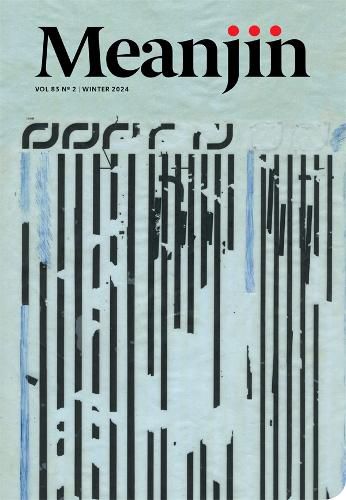
This Meanjin is incredibly rich and varied. I’ve carried it in my backpack for weeks, mostly reading a single article or story at a time when on public transport, in waiting rooms or queues, or occasionally – as in the days before podcasts – while walking. I have learned about:

Click on any link in that list, and you may find something instructive, challenging, entertaining or all three.

As the child of a farmer in North Queensland, where Mamu land has never been ceded and sugarcane monoculture has not been kind to the land, I was particularly moved by Katherine Wilson’s brief memoir about regenerative farming and collaboration with traditional owners, ‘Our Bog Paddock’s Understory‘.

I also want to mention ‘We, small heroes‘ by Micaela Sahhar, a short reflection on what it means in the current era that Palestinian culture has hospitality as a core value.

Of the four excellent pieces of fiction, Katerina Gibson’s ‘Something Dormant‘ stands out as a complex story of young, unrequited love remembered, with an environmental twist.

One of the joys of this Meanjin is the way its nine poems are spread throughout, so each one comes as a pleasant surprise among the prose. Having just this morning read an editorial on ‘eco-poetry’ in the Guardian (poetry ‘cannot ignore global heating’), I’ll single out Caitlin Maling’s ‘Ordinary Disaster‘, a chillingly affectless account of a mass dying of fish among coral in Western Australia.

It’s my blogging custom to focus on page 77. In November, I try to include a verse stanza in each blog post. Page 77 in this issue is part of a fascinating interview with architecture critic Naomi Stead (link here). The phrase that gives me my opening line comes from this paragraph:

I don’t want to be the schoolmarm, but if people understand more about the built environment – how it’s procured, how it comes into being, how it’s not an accident, how there’s almost nothing in our cities that is not deliberately designed – then they can begin to see the role that they themselves could play. I mean we should expect more, we should demand more of our cities and buildings and built environment, but we can only do that with a degree of knowledge and education about how this came to be, and what could be.

Rather than enlarge on Professor Stead’s point, my little verse follows where the phrase takes it. That and the plane that flew over our flat as I typed the first full stop.

November verse 6: We should demand more of our cities
We should demand more of our cities.
Not more aircraft overhead.
No more oh-dears, what-a-pities –
Packer's Pecker, Jeff's Shed.
Perhaps less civil inattention,
less of what's too gross to mention,
neighbours partying till four,
Mormons knocking on the door.

Demand more? Let me try. O Sydney,
Demand more? Let me try.
O Sydney,
give me silence, show me stars,
let me breathe air free from tars.
So many things I'd have you give me.
Make your waters clear again,
and some day soon please change your name

I wrote this blog post on Gade / Wane, not far from Warrane, which some people want to give its name to the whole of Sydney. I acknowledge the Gadigal and Wangal Elders past present and emerging, and gratrefully acknowldge their care for this land for millennia.
Journal Catch-up 23

Two more journals in my endless attempt to keep up to date!


Evelyn Araluen and Jonathan Dunk (editors), Overland 252 (Spring 2023)
(Some of the content is online at the Overland website – I’ve included links)

This Overland‘s editorial describes itself as a ‘second run’. The first run had reflected on the Voice referendum, but as publication came closer – in October last year – ‘the temptation to linger on the politics of symbolic recognition and constitutional reform seems a luxury in the face of escalating violence against Palestinians in Gaza and the West Bank’. With feet and throats sore from a solidarity march, the editors draw attention to an essay by Palestinian-Australian writer and historian Micaela Sahhar, ‘which reminds [them] of Overland‘s historic role in indexing Palestine’s survival and resistance’.

Quite apart from its serendipitous relevance, the essay, ‘An idiosyncratic archive: Overland 169 & the Wolstonecroft years‘, is a joy to read, as Sahhar revisits two copies of Overland she acquired in 2002 and 2004. She compares her reading of them then and now, talks of her relationships to people who appeared in them, and generally takes us on a journey into her mind. I love this passage – and so, I assume, do the editors:

As a journal at odds with the mainstream, Overland offered a younger version of me an intellectual place where radical thinking could reside, and a dawning awareness of a community I could take a place in. In this sense, Overland was the tangible expression of a counter to the indifference and invisibility of a young Palestinian woman, the significance of whose identity was rewritten just as she came of age at the time of a catastrophic intellectual nadir represented in 9/11; and a place of refusal against socio-political disengagement and apathy which have been the horsemen of these neo-liberal times.

The other stand-out essay is ‘The Disappearance of a.k.a. Victor Mature‘ by Vivian Blaxell, which ranges far and wide, high and low, into memoir and poetry appreciation, circling the subject of beauty. It’s a great read, from which I can’t resist quoting what may be the silliest paragraph, but one that made me laugh:

Australian English is wanton with beautiful. Beauty pops up in not the usual beautiful places there, thereby revealing the radical contingency of beauty itself, probably unintentionally: beautiful, Australians might say of a pork sausage, which seems a surprise at first until you realise that beauty does not exist before we say it exists, for beauty relies entirely on disclosure for its existence. That lucky sausage.

Other essays are a discussion by Peter D Mathews of Sophie Cunningham’s 2004 novel Geography and an idiosyncratic but fascinating essay by πO on concrete poetry in Australia and related matters.

There are five pieces of fiction and nine poems.

Of the poetry, ‘Balloch’ by Eileen Chong stands out for me. An apparently simple poem about a visit to a Scottish loch, it leaves an uncanny aftertaste that only gets richer with further readings.

The fiction covers a wide range, from a celebration of Rotuman culture (I had to look it up) by Dorell Ben to a fantasy of a catastrophic world post climate emergency by Jodie How, with a little social realism by Chloe Hillary and other pieces in between.


Alexandra Christie (editor), Heat Series 3 Nº 12 (Giramondo 2023)

This may be my last issue of Heat before my subscription expires. Despite having a selection of poems from Nam Le’s 36 Ways of Writing a Vietnamese Poem, a book I’m looking forward to, the journal is a bit of a fizzer for me, though the dominating US presence I’ve complained of in earlier issues is absent, and only one member of Heat‘s editorial advisory board gets a guernsey.

  • You can read Paddy O’Reilly’s ‘Redundant‘ on the Heat website. It’s an experimental prose piece in which the experiment seems to consist of not finishing sentences. See what you think.
  • Jordi Infeld’s ‘Poet’s Pocket’ would and indeed does pass for a short essay on sewing and related matters – just a footnote identifying one of its otherwise unremarkable phrases as a quote from Gertrude Stein’s Tender Buttons suggests deeper undercurrents.
  • ‘The Phoenix Apartment’ by Bella Li feels to me like notes towards a larger project.

Items from beyond the Anglosphere are ‘We Shall Be Monsters’, a meditation on Mary Shelley’s Frankenstein by Argentinian writer Esther Cross, translated by Alice Whitmore, and six terrific short poems by Iranian Maryam Nazarian, translated by Malaysia-based Arash Kohshsafa. Here’s the first and shortest of the poems, which does wonderful things with an echo of William Carlos Williams’s poem about the plums:

One
I've set the breakfast, the kisses, and the keys on the table.
Please, forgive me
if I find freedom more pleasant than your love.

The most interesting piece is Stephanie Radok’s ‘Inventory 2020’, an impressionistic chronicle of a working artist’s life, made up of mostly very short entries. It reminded me of the late Antigone Kefala’s journals in the way it combined observations of the passing moment with considered reflections and descriptions of the artist’s process. As 2020 was a year when the even tenor of our lives was disrupted by Covid, a narrative emerges. Here’s the entry for 23 February, on page 77*:

23. What you thought was passing/casual was your life. And a particular red purple near a blue hillside that seemed to reflect you.

As for Nam Le’s poems, they seem to be part of a larger whole. I’ll wait for the book.


* My blogging practice for some time has been to focus arbitrarily on the page of a book or journal that coincides with my age.

Journal Blitz 8b

So much to read, so little time. So many journals, so few subs, and still I can’t keep up.


Evelyn Araluen and Jonathan Dunk (editors), Overland 238 (Autumn 2020)

Published more than a year ago, this is the first issue of Overland edited by Evelyn Araluen and Jonathan Dunk. The new editors swept in not so much with a new broom as with a sandblaster. The regular columns are gone; issues are themed (though judging from a quick look ahead this change only lasted three episodes); and there’s a bold new feel to the design.

It may be part of the new approach, or perhaps it’s teething problems, but I found some of the articles in this issue hard gong to the point of being unreadable. Some dispense with sentences as we have known them. Others disappear unapologetically down etymological and literary-history rabbitholes. Yet others drop unexplained references to – I assume – French theorists, with no apparent purpose other than to discourage non-insiders. I tried, I really did, and I’m pretty sure I missed out on some terrific insights, but I just couldn’t finish a number of them. And that’s before I got to John Kinsella’s sequence of poems, ‘Ode to the defenceless: from hypotaxis to parataxis‘, whose prolix obscurity lives up to the promise of its title. I’m not completely sure that some kind of complex leg-pulling isn’t involved, as in the infamous Sokal affair.

This was all the more disappointing because the journal kicks off with a genuinely interesting piece, Toby Fitch’s obituary for British revolutionary socialist poet Sean Bonney (1969–2019), ‘Our Death: Aspects of the radical in Sean Bonney’s last book of poems‘. Toby describes Bonney as having ‘a performative ethics of scathing animosity and nihilistic humour’, and gives the reader plenty of what is needed to grasp the two poems by Bonney that follow his article.

Of the other articles, I want to mention ‘Welcome to the Nakba: notes from the epicentre of an apocalypse‘ by Micaela Sahhar – nakba is Arabic for ‘catastrophe’ and usually refers to the dispossession of Palestinians in the founding of the Israeli state. Writing in the aftermath of the 2019–2020 bushfires, Sahhar offers a startling perspective on Australia’s challenges:

Dear settler-Australia, your Nakba has arrived. Don’t feel helpless, powerless, frustrated, and above all, don’t pray for a miracle. I can tell you from the other side that it will never arrive. It’s time to tackle the structures you made, the structures that will ruin us all.

Poetry and fiction are still a major presence in the new-look journal, and this issue, like its predecessors, includes the results of literary competitions.

The Neilma Sidney Short Story Prize, judged by Joshua Mostafa, Margo Lanagan and Hannah Kent, was won by ‘The Houseguest‘ by Jenah Shaw, a story that captures brilliantly the uneasy situation of a young person who has left home in the country to stay with a family in a big city.

The Judith Wright Poetry Prize had three winners, published here with notes from the judges – Michael Farrell, Toby Fitch and Ellen van Neerven, had three winners. Each of these excellent poems left me bemused more than anything else.

Then there are four short stories, which arrive like a reward for persevering: ‘Creek jumping‘ by Cade Turner-Mann, a tiny moment in a rural community that reflects and resists the impact of environmental degradation and colonisation; ‘Mermaid‘ by Gareth Hipwell, a borderline science fiction tale of eco-guilt; ‘Pinches‘ by Emily Barber, an abject tale of sexism; and ‘Urban gods‘ by Cherry Zheng, which could be a starting sketch for a dark fantasy/sci-fi television series.


Jonathan Green (editor), Meanjin Quarterly: The next 80 years, Volume 79 Issue 4 (Summer 2020)

Far from being a new broom, this issue of Meanjin celebrates its continuity with the journal’s past 80 years, reproducing Clem Christensen’s first editorial and featuring short pieces from each of his ten successors in the editorial chair. A powerful narrative emerges of a publication that has managed to survive and thrive in the face of serious challenges, and that has transformed itself many times over to meet the changing times.

Then there’s a stellar line-up of writers, many of them responding to the ‘Next 80 Years’ theme.

Some I need only name for you to get a whiff of their excellence, and timeliness:

  • An email dialogue about time and memory between Behrouz Boochani and Tara June Winch, apparently an excerpt from an ongoing conversation between these two writers
  • An article from Jess Hill on police responses to domestic abuse call-outs – following up a chapter in See What You Made Me Do
  • A scathing piece about the tree-hating official response to the bushfires, by Bruce Pascoe
  • An even more scathing piece by Michael Mohammed Ahmed about White victimhood (starting with the observation that though people complain that it’s racist to name their Whiteness, it was White people who invented the term)
  • A wide-ranging and lucidly angry piece by Raimond Gaita on moral philosophy vs economics in the context of Covid-19.

And that’s only part of it. Of the remaining articles, the standouts for me are ‘Consider The Library’ by Justine Hyde, a wonderful account of the changing roles of public libraries in Australia and elsewhere, including their potential contributions to averting climate catastrophe; ‘More Than Opening The Door’ by Sam Van Zweden, which advocates for inclusion of people with disabilities in Australian literary life, arguing in particular that if a publication commissions a piece on, say, mental health issues from someone who is drawing on their own experience, then the publication needs to consider having a duty of care to the writer; ‘Heading to Somewhere Important’ by Martin Langford, a brief account of the changing face of Australian poetry over the last 80 years – an impossible task acquitted with grace; and Nicola Redhouse’s ‘Future Tense’, which engages with Shoshana Zuboff’s The Age of Surveillance Capitalism, in ways that are probably crucial to making that ‘intimidatingly thick opus’ as accessible and influential as we all need it to be.

Scattered like jewels through the pages are poems from David Brooks, Kim Cheng Boey, Eileen Chong, Sarah Day, Jill Jones, David McCooey, and more. If you count two pieces labelled ‘memoir’ that look back from the year 2200, there are six short stories, which project a range of pretty depressing futures. My pick of them would be Tara Moss’s The Immortality Project, where being able bodied is seen as indicating deficiency, and uploading one’s consciousness to Another Place leads to an interesting twist on the expected outcome.

Decades ago, I was a keen subscriber to Meanjin, and in my mid twenties I bought a swag of back copies (from Kylie Tennant, as it happens, whom her husband L C Rodd described to me over the phone as ‘an extinct volcano of Australian literature’). I loved my collection and browsed in it often, but sold it and let my sub lapse when space and time shrank around me with parenthood and a job that required a lot of reading. When I considered resubscribing some time ago, I was deterred by the tiny type – as noted on my blog, here. Someone gave me this issue as a Christmas present, and it seems very likely that I’ll resubscribe.