Tag Archives: Nam Le

2025 NSW [Premier’s] Literary Awards night

I almost missed the NSW Premier’s Literary Awards this year. I missed the announcement of the short lists altogether, and only realised that the awards were last night because the Sydney Writers’ Festival is about to start and I think of the NSWPLAs as the first cab off the festival rank.

Here I am making up for the omission. Sadly I’ve read only one of the books, and seen a production of only one script, none of the winners.

Last night, the awards ceremony was live streamed. As always on a Monday, I was busy being grandfather, so I tuned in late. It’s all on YouTube and you can even watch it by clicking the image below. The ceremony begins with didjeridoo and Welcome to Country by Uncle Brendan Kerin, who spoke eloquently about the meaning of the word ‘Country’ in this context. After introductory speeches from librarians and politicians, the presentation of awards by Senior Judge Bernadette Brennan and Library Chair Bob Debus begins at about 29 minutes.

Here are the shortlists in the order of announcements, with links to the judges’ comments. The winners are first in each list, in bold:

UTS Glenda Adam’s Award for New Writing ($10,000)

Dr Tracy Westerman appeared on video, speaking from Perth: ‘As someone who doesn’t consider themselves to be a real writer, as a kid from the Pilbara who had a pretty unorthodox education through distance education, being awarded for my writing feels, frankly, a little bit surreal.’ She went on to talk about mental wellbeing: it ‘should never be just for the privileged, and Jilya sheds light on the reality that it continues to be … because of a one-size-fits-all, monocultural approach to mental health.’

Multicultural NSW Award ($30,000)

Nam Le, also on video, spoke against a background of a bookshelf piled high with books. He thanked many people and dedicated the award to his father, who ‘has been an engine of multiculturalism in this country’.

Indigenous Writers’ Prize ($30,000)

Lorraine Coppin, CEO of Juluwarlu Group, also spoke on video. She and her husband have spent years documenting Yindjibarndi stories – the graphic novel format is a way of making the history accessible to young people.

Nick Enright Prize for Playwriting ($30,000)

Glenn Shea appeared in person! He is a member of the Stolen Generations. The play’s story comes from community. The question it asks is how do we plant seeds for our young people to shift and shape their decision-making about work lives and community. He shouted out La Mama theatre among many others.

Betty Roland Prize for Scriptwriting ($30,000)

Charles Williams was also in the room. He started out with a remark that must have struck a chord with many people in the movie industry: ‘I usually identify as a director more than as a writer, but I spend a lot of my life writing and not much directing.’ He quoted Charlie Kaufman: ‘A writer is someone for whom writing is harder than it is for other people,’ and noted in passing that Kaufman stole the line from Thomas Mann.

Patricia Wrightson Prize for Children’s Literature ($30,000)

Katrina Nannestad thanked all the right people, but in particular her mother, whose story is in the book.

Ethel Turner Prize for Young People’s Literature ($30,000)

Emma Lord said among other things that everything she writes is for her daughter, even though she is too young for the books. She acknowledged the courage of her publishers who accepted a book with a pandemic in it during a pandemic. Following a developing theme of the evening, she said her mother shared the award.

Translation Prize ($30,000)

Elizabeth Bryer accepted by video. She said she had decided to wind back her translation practice because she couldn’t see a way to make it viable. This award changes that, and means she can take on a project she had been thinking about – to set up a mentorship wth an emerging translator who is a person of colour or a heritage speaker.

Kenneth Slessor Prize for Poetry ($30,000)

Hasib Hourani described rock flight as intended to explore both historical and speculative acts of liberation in Palestine. ‘Throwing a rock is one kind of protest. A book is another.’

Douglas Stewart Prize for Non-fiction ($40, 000)

James Bradley revealed that winners had been instructed to speak for less than a minute. Among the many thankyous, he thanked Ashley Hay who read every draft. With a nod to W. H. Auden, he said that though it seems like books don’t make anything happen, his experience with this book has shown that this isn’t actually the case: ‘Books change minds, and by changing minds they can change the world, and at the moment that matters more than it has ever mattered before.’

Christina Stead Prize for Fiction ($40,000)

Fiona McFarlane is on the road, so Alex Craig from her publishers Allen & Unwin read a speech on her behalf.

The University of Sydney People’s Choice Award ($10,000)

The Lasting Harm, Lucia Osborne-Crowley (Allen & Unwin)

Lucia Osborne-Crowley was another video appearance. Before she made the necessary thankyous she noted the importance of writers speaking up for Palestinians who are being subjected to genocide and war crimes. She thanked the survivor community who voted for her – the book is for and about and by survivors of sexual violence and child sexual violence.

Special Award

This award went to Liminal. The award was accepted by founding editor Leah Jing McIntosh. Evidently aware than many people watching the awards or reading about them might not have herd of Liminal, she began by explaining that it is ‘a project driven by the desire to make visible the unacknowledged structures of racism that so dehumanise all of us.’ She went on, ‘We work towards new ways of thinking, of seeing, of being in the world. That is to say, we work together towards a better future. We know we cannot do it alone.’

Book of the Year ($10,000)

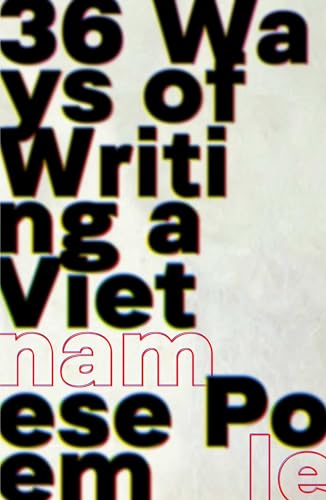
36 Ways of Writing a Vietnamese Poem, Nam Le (Scribner Australia). Ben Ball from Scribner Australia read a speech written by Nam Le. He expanded on his earlier dedication to his father, and spoke interestingly and powerfully about multiculturalism. I won’t try to summarise his speech here out of respect for his intellectual property. I hope it’s published somewhere. At heart it was a warning against complacency.

The twin shadows of Gaza and Trump were never far from the stage, and repudiations of all they stood for were frequent. And what a reading list has emerged from the evening, even if only of the winners.

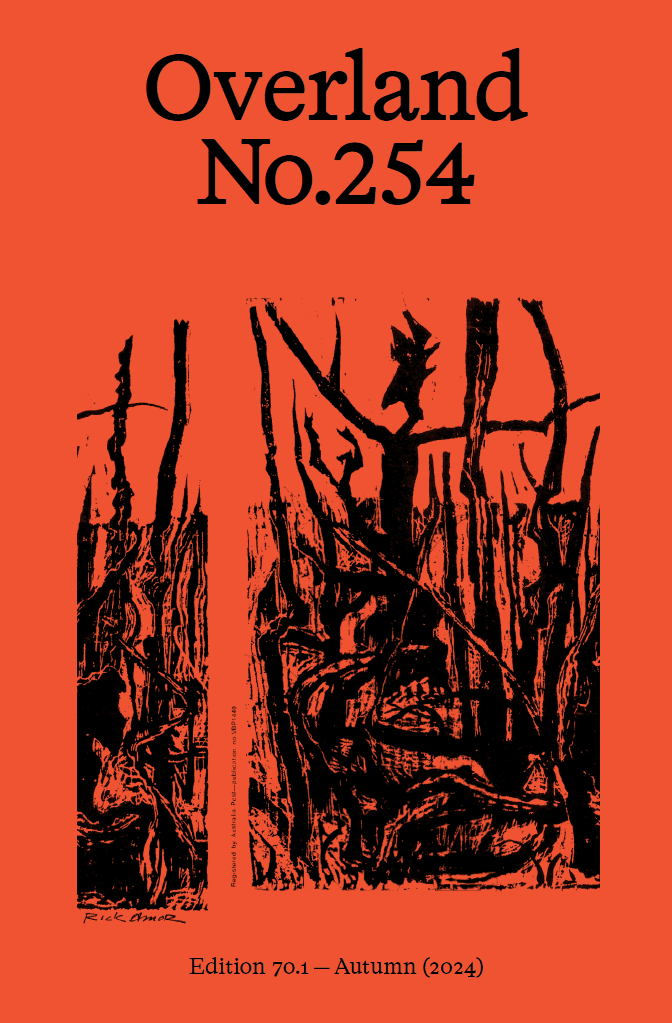
Journal Catch-up 27: Overland Nº254

Evelyn Araluen and Jonathan Dunk (editors), Overland Nº 254 (Summer 2023)
(Only the editorial is online at the time of writing – so I haven’t included links, sorry!)

The first thing you notice about this issue of Overland is its design – an austere black and red cover and monochrome throughout, a smaller format, and surely the paper stock is cheaper than we’ve become used to. Could this be a sign of a funding crisis?

Of course there may be a funding crisis – this is an Australian literary journal after all. But there’s a definite retro aesthetic to the new look. Editors Evelyn Araluen and Jonathan Dunk call it an ‘archivally informed design’, and explain that it’s the first of four issues to mark Overland‘s seventieth year of publication. The internal illustrations are all from the archives, and include stunning ink drawings by Noel Counihan from the 1970s and Rick Amor from the late 80s and early 90s. Fabulously, page 128 features a Bruce Petty cartoon from 1976.

The nostalgia stops with the look. The words are all 2024.

I recommend the whole issue, but want to single out two articles that make me sorry so little of this content has made it to Overland‘s website. They are ‘“A State of Waste”: Myall Creek, the Sydney Herald and the Foundations of Australian Capitalism’ by Jeff Sparrow, and the anonymous essay, ‘Writing after … October 7’.

I’ve recently read how the 16th century Papal ‘Doctrine of Discovery’ (Wikipedia entry here) was explicitly invoked to justify dispossession and genocide of Indigenous people in the Americas and elsewhere well into the 19th century. Jeff Sparrow’s magisterial essay offers a very different account of how similar acts were justified in Australia. It’s a clear and cogent history of how the closing of the commons in 18th century Britain led to a new understanding of ‘ownership’ of land, which was applied ruthlessly by the settlers in Australia. The content may not be startlingly new, but Sparrow’s copious quotation from the Sydney Herald in the first part of the 19th century is, for me at least, revelatory. It’s not that the way First Nations people related to the land was strange to the settlers. It was all too familiar:

Like the British commoners, Indigenous people clearly did ‘make use’ of the land. They lived in a use-value society, tending their country to encourage the animals and plants they required. The Herald, however, understood ‘productivity’ in capitalist terms, with use values significant only insofar as they generated profit. (Page 67)

The essay spells out the way this thinking leads shockingly, but logically to the minds of the Sydney Herald editors, to justification of massacres.

What can I say? If you get a chance, read this essay.

The author of the other stand-out essay is a person of Arab background, writing in the context of conversations with Arab and Palestinian friends who work in academic or cultural contexts. They describe how they have always held in their mind the history of Palestine as ‘a bustling site of plurality and coexistence’. The establishment of the state of Israel in the nakba put an end to that condition but it has remained as a vision of possibility.

Jews worldwide were shaken by the visceral hatred shown for them in the Hamas attacks on 7 October last year. Palestinians and Arabs have been no less shaken by the hatred and disregard for them that subsequent events have demonstrated. The multi-religious and plural world of pre-1948 is now unthinkable. ‘We had not realised until this carnage started,’ the author writes, ‘how dehumanised Palestinians and Arabs are in the eyes of most Israelis.

There’s more. Back here, well-intended and well-informed colleagues have been carefully ‘balanced’ when discussing the situation of Palestinians in Israel, in large part because of not wanting to be seen as antisemitic. The author and friends have believed that if a point came when Israel unleashed its full fury on Palestinians their colleagues would take a stand. But it has happened, and many have not changed their stance:

It is not hyperbole to say we are grieving as we watch our kin annihilated on an hourly basis … We feel neglected, betrayed and discarded. We have always stood in solidarity with the causes these colleagues are most passionate about because those causes are ours too. Why isn’t Palestine their cause? (Page 49)

There’s another fine Palestine-related essay – providing devastating perspective on the brouhaha over three actors wearing a keffiyah at a preview of The Seagull in Sydney last year. But it’s the anonymous writer’s cry from the heart that strikes home.

There’s poetry – including the winners of the 2023 Judith Wright Poetry Prize and an excerpt from Nam Le’s 36 Ways of Writing a Vietnamese Poem.

There are short stories, of which my favourite is ‘Who Rattles the Night’ by Annie Zhang, a comic ghost story that won the Neilma Sidney Fiction Prize.


I finished writing this blog post in the land of the Bidjigal and Gadigal clans of the Eora nation, overlooking the ocean and surrounded by birdsong. I gratefully acknowledge the Elders past and present who have cared for this beautiful country for millennia.

The Essays of Montaigne, progress report 4

Michel de Montaigne, The Complete Essays (Penguin Classics 1991, translated by M. A. Screech)
from Book 2 Essay 7, ‘On rewards for honour’ to part way through Book 2 Essay 12, “An apology for Raymond Sebond’

Three months in and I’m loving my morning chats with Montaigne. Not so much a progress report this month, as I’m poised to fly to warmer climes any second and am squeezing this post in among house-cleaning and similar chores.

Usually as I make my way through these essays I ignore the notes and references, as I’m not making a study of Montaigne, just reading him and living with my sometime incomprehension. For the current essay, ‘ An Apology for Raymond Sebond’, I read 24 pages of M. A. Screech’s introduction to the book, and listened to a podcast from David Runciman’s ‘Past Present Future’ series (a fascinating account of the essay, which you can find here).

It’s a serious argument, tackling the relationship between revealed truth as understood in 16th century Christianity and knowledge that can be acquired by observation and reason. It’s serious, and intricate. In the passages I’ve just been reading, which is all I’m going to talk about here, it’s something else.

In this part of the essay, Montaigne is arguing against human exceptionalism. Animals (he doesn’t quite bring himself to say ‘other animals’) give signs of being able to reason, to be loyal, seek justice, have compassion, grieve, do basic arithmetic, follow the movements of the stars. In many ways, we learn from the animals, even while we believe ourselves to be infinitely superior. He notes in passing that ‘you can see some male animals falling for males of their own kind’. He tells the story that I know as ‘Androcles and the lion’ in some detail, calling the human character ‘Androdes’. He piles on example after example – mostly from antiquity and in particular Plutarch.

For the sake of his argument, just a couple of examples would have been enough, but Montaigne is like a child in a lolly shop: there are so many stories old and new, verifiable and fantastical, it’s as if he can’t bear to leave any of them out. Today’s reading ends with this (on page 534):

As for greatness of spirit, it would be hard to express it more clearly than that great dog did which was sent to King Alexander from India. It was first presented with a stag, next with a boar, then with a bear: it did not deign to come out and fight them, but as soon as it saw a lion it leaped to its feet, clearly showing that it thought such an animal was indeed worthy of the privilege of fighting against it.

Montaigne had fought in battle, and the religious wars of the 16th century were raging around him as he wrote the Essays. His casual acceptance of violence, as in this paragraph, is one of the places where we feel how different his times were from ours. But his insistence at such length on the dignity of animals has a surprisingly modern feel.

Ok, that’s all I have time for. I have a plane to catch and warmer climes to visit.


This blog post, was written on Gadigal-Wangal land in between bouts of heavy rain, which enables the ibises and magpies in the park across the road to have a great time fossicking in the soft soil. I acknowledge the Elders past, present and emerging of the Gadigal and Wangal Nations.

The Essays of Montaigne, progress report 3

Michel de Montaigne, The Complete Essays (Penguin Classics 1991, translated by M. A. Screech) from Book 1 Essay 42, ‘On the inequality there is between us’, to Book 2 Essay 7, ‘On rewards for honour’

Three months in and I’m coming to love my morning chat with Montaigne.

I was delighted to hear an echo of his voice in a session at the recent Sydney Writers’ Festival. In conversation with Felicity Plunkett (my blog post here), the poet Nam Le was struggling to describe the complex way his mind works. According to my scribbled notes, he said:

Any attribute you can attribute to yourself, the opposite can also be yours.

That morning, I had been reading Montaigne’s Book 2, Essay 1, ‘On the inconstancy of our actions’, which begins:

Those who strive to account for a man’s deeds are never more bewildered than when they try to knit them into one whole and to show them under one light, since they commonly contradict each other in so odd a fashion that it seems impossible that they should all come out of the same shop.

I don’t know if Nam Le had Montaigne even at the back of his mind, but it’s fascinating to find in Montaigne, roughly Shakespeare’s contemporary, such a pre-echo of a 21st century way of seeing things. Fascinating, but not an isolated moment. His reflections on public life, oratory, warfare, frugality, education, suicide and so on often seem tailor-made for quotation in a discussion of anything from the US ex-president to drone warfare or the culture wars. He can be horribly sexist, and his class material is also horrible; but he’s often hard to take to task, because he’s likely to disagree with himself in the next paragraph.

At four pages a day, some essays extend over several mornings. I can see one coming over the horizon that will last me nearly a month. Mostly I ignore M A Creech’s prefatory notes, but sometimes I depend on them to make sense of an argument. Sometimes Montaigne piles up the anecdotes – drawing on ancient writers, recent history, contemporary gossip and personal experience – to such an extent that I lose track of his argument, and suspect he has lost track of it himself. Some of the anecdotes are bizarre in the extreme, especially when he is reporting on sexual or dietary habits of ‘exotic’ peoples.

I’m being fairly lazy in my reading. Whenever Montaigne quotes a line or two of poetry, usually in Latin, but sometimes in Old French or other languages, I skip straight to the translation provided by Mr Screech. I know I’m missing one of the pleasures of these texts, but it’s a pleasure that demands too much work for me (and, I expect, most 21st century readers).

One of the pleasures that is still alive and well is the constant delight of watching Montaigne’s mind chase after whatever rabbit catches his eye while he’s doing something else. This morning I read the essay, ‘On rewards for honour’, a short argument against adding a monetary or other material component to an award for valour, which morphs briefly into a reflection on why ‘valour’ is seen to be mostly a martial virtue when true valour in non-military circles is so much harder to achieve, and then ends in a sentence or two wondering at the way ‘virtue’ means different things for men and women, finishing up with a jokey note which, if he had continued his thoughtful wanderings, might have led in a proto-feminist direction:

Our passion, our feverish concern, for the chastity of women results in une bonne femme (‘a good woman’), and une femme d’honneur, ou de vertu (‘a woman of honour or of virtue’) in reality meaning for us a chaste woman – as though, in order to bind them to that duty, we neglected all the rest and gave them free rein for any other fault, striking a bargain to get them to give up that one.

‘On practice’, the longer essay that precedes ‘On rewards for honour’, is an even better example of the way Montaigne’s mind moves in unexpected directions. It turns out to be about death – which, he says, is the one thing you can’t get better at by practice. Or is it? The tone changes abruptly as he tells of a horrific near-death experience of his own, including a detailed account of the aftermath as he regained consciousness, pain, and memory. Then: ‘The account of so unimportant an event is pointless but for the instruction I drew from it: for in truth, to inure yourself to death, all you have to do it draw nigh to it.’ But that’s not the final swerve of the essay. It turns to the question of talking and writing about oneself, but first there’s this brief description – one of many – of what he is trying to do (essaying) in the essays:

Here you have not my teaching but my study: the lesson is not for others; it is for me. Yet, for all that, you should not be ungrateful to me for publishing it. What helps me can perhaps help somebody else.
Meanwhile I am not spoiling anything: I am only using what is mine. And if I play the fool it is at my own expense and does no harm to anybody.

I just read on Wikipedia that William Hazlitt described Montaigne as ‘the first who had the courage to say as an author what he felt as a man’. I’m loving his courage, and his humility, in putting his own experience and his own thinking out there for all the world to read.


This blog post, was written on Gadigal-Wangal land as the nights start earlier, spiderwebs multiply, and the rain buckets down. I acknowledge the Elders past, present and emerging of those Nations, and would love to hear from any First Nations people reading this blog.

Sydney Writers’ Festival 2024: My day two

After just one session on Tuesday and nothing on Wednesday or Thursday, Friday was all systems go for me at the SWF, with five sessions, starting at noon and ending just after 7 in the evening. Please excuse the length of this post.


12 pm: The Gift of Greek Myth

I first heard Kate Forsyth talk back in the day when she mainly wrote for children (starting with Dragonclaw in 1997). More recently she has appeared on radio and podcasts as a writer of historical fiction. She has always been good value on fairytales and myth. In this session she chatted with playwright Tom Wright about her most recent book, Psykhe.

If Psykhe is as interesting as this talk, then it’s a brilliant novel. Here are some scraps I gleaned.

Kate Forsyth describes herself as playing in the borderland between myth and history. She is concerned to reclaim ancient stories from their patriarchal interpretations. Fairytales, she says, are myths drained of their sacred meanings, because they are mostly concerned with women’s issues.

In this book, the dividing line between gods and humans is porous. It tells the story of Psyche/Anima and Cupid/Eros/Amor as a historical fiction – Psyche becomes Psykhe and Amor becomes Ambrose.

I’m not sure how much of this is from the original myth and how much from the novel, but here’s a broad plot outline: Venus’ son Ambrose falls in love with Psykhe, a human woman; he keeps her in luxury in his palace, but as a prisoner; he comes to her bed every night, where she is not permitted to see his face. One night as he is sleeping, she looks at him by the light of a candle, and spills wax on him. For the first time he feels pain, and flees. Having broken free of her imprisoned state, she now can love him, and goes searching for him.

Forsyth says this is the only ancient myth that is gynocentric – woman-centred. Whereas in androcentric myths the hero breaks, kills, and conquers (and, I’d add, rescues), in gynocentric myths the female protagonist sets about healing, repair and recovery. This story is about the importance of consent, the transformative potential of pain, the need for love to be more than physical (the reductiveness of that is mine, not Kate Forsyth’s or Tom Wright’s).

Kate Forsyth has a lovely phrase for her creative process. She says she spends a lot of time ‘daydreaming a story to life’. In this talk, she allowed us to witness part of that daydreaming.  


2 pm: Abdulrazak Gurnah: Afterlives

I’ve read and loved two of Abdulrazak Gurnah’s ten novels, Gravel Heart and Afterlives.

This urbane and amiable session focused on Afterlives. Gurnah kicked it off with a reading. Though he read beautifully, it was a strange passage for the occasion as very little happens in it: there is a boat and a harbour town, the sun sets, the main character has trouble sleeping because of unspecified pain. This from a book where there is so much wonderfully dramatic or tender writing he could have picked (see my blog post for an example).

Sisonke Msimang, his interlocutor, asked the pertinent question: why this passage? He said it was the first part of the book that he actually wrote. He knew that Hamza had been wounded and was returning to his childhood home after fighting for the Germans in World War One: what came before and after that was yet to be imagined.

After that insight into the book’s origins, we learned that Gurnah had wanted to write about the German schutztruppe for a long time. (Not quite right to call them ‘the German schutztruppe‘, he said, as only the officers were German, the troops were African.) He had known from his childhood about the ferocity of these soldiers, who fought for the colonisers – his grandfather (or more precisely his mother’s uncle) had been one of them. But when he got to the UK and had access to books, he found that there was nothing written about the way Africans were drawn into the wars between the colonising European nations. He had intended his fourth novel, Paradise (1994), to be on the subject, but he realised then that he didn’t know enough to write about it. It was nearly two decades before the time was right.

A question animating the book is: Why did people join a force that was going to end up dominating them/Why fight in a war that will determining who will be your coloniser? ‘That’s how we put the question now,’ he said. The book offers no simple answer, but a lot of what the two speakers had to say echoed what I have heard and read about the Queensland Native Police: apart from the attraction of being part of a new, powerful force, or various kinds of of coercion, it’s important to remember that people didn’t think of themselves as African, any more than the Germans and French identified each other primarily as fellow-Europeans: many of the African nations had been at war with one another for centuries.

The conversation roamed over the more personal elements of the book. These are the things that Gurnah says he likes writing about most – the everyday, the interior, the domestic, the intimate – and it’s them that gives the book its power as it tackles broader issues. All of this brought the pleasures of the book back to me – I hope it inspires people who haven’t read it to pick it up.

One final question from Sisonke Msimang: Was he expecting the Nobel Prize? Writers don’t work with the hope of winning the Nobel Prize, he said. They’re in for a hard time it they do. And he did a quick impersonation of someone responding to the phone from the Nobel Committee by exclaiming, ‘Well, at last!’


3 pm: Nam Le: 36 Ways of Writing a Vietnamese Poem

This wasn’t a session for the faint-hearted. Felicity Plunkett, herself a poet, set the ball rolling with an opaque quote from ‘On the line’, an essay by Kasim Ali, and things only got more erudite, recondite, convoluted and polysyllabic from there.

When someone at a session later in the day half apologised for the comparatively straightforward terms ‘methodological’ and ‘epistemological’ by adding ‘as we’d say in the academy’, I realised retrospectively that this conversation was being conducted as if in a specialist academic context.

For instance: ‘The line can put things into differences of ordinality … You can have a chiasm … ‘ I managed to note down terms like ‘autofictive’, ‘metafictive’, ‘preambular’, ‘the trauma plot’ (which is ‘too easy’). All of this has meaning, but I found it impossible to keep up.

What emerged is that Nam Le’s poems are ‘destabilising, elliptical, constantly questioning’. ‘How is it possible to say anything at all,’ he asked at one stage,’without being undermined by your own self-consciousness?’

There was a lot of talk of violence, which may or may not have a technical meaning. I think Nam Le was joking when he asked, ‘What is more violent than meiosis?’ (Meiosis is the process by which cells split.)

As a counterbalance, Le read four poems to us – or more accurately he read four parts of what Plunkett said is the long poem that constitutes the book 30 Ways of Writing a Vietnamese Poem. It was wonderful to hear his performances. The one with which he wound up the session, a lullaby with the title ‘Matri-Immigral’, was all anyone could have hoped for.

That broke through my exasperation with the session’s obscurity and recursiveness and convinced me to buy a copy of the book.


4 pm: Feminist Firebrands

Each of the day’s earlier sessions featured one author talking to one other person about one book. This session was a panel of three plus a facilitator.

A panel is a hard gig: you run the risk of only half-hearing each of the participants, and hearing no one’s thinking in depth. If the subject is books, you can get some idea of whose writing you might want to follow up, but this panel barely mentioned the participants’ books. All the same, it worked.

Hannah Ferguson, who is in her late 20s, abandoned her law career soon after graduating and is now a podcaster and person in charge of something on the internet called Cheek. Sisonke Msimang, among other things, writes a regular column in the Guardian offering wisdom about racism and related issues. Jennifer Robinson has offered legal advice in high profile cases of alleged sexual abuse. Jo Dyer, among other things former CEO of the SWF, facilitated.

The conversation revolved around issues raised by the Brittany Higgins and Bruce Lehrmann court cases, the allegations of historic rape against Christian Porter, Grace Tame’s advocacy, a little of Amber Heard’s case against Johnny Depp, and a sulphurous whiff of Donald Trump. That is, the way the criminal justice system here, but also in the USA and Britain, treats women, specifically when they allege sexual abuse or rape. And not just the criminal justice system, but the media and the culture generally.

The first thing that struck me was the stark contrast with Nam Le’s approach. Here there was no uncertainty, no self-undermining, no painful self-consciousness. Everyone spoke forcefully, definitely, and – alas for my note-taking – fast. I couldn’t possibly give a decent summary, but here are some gems:

Jo Dyer on recent news about the Queensland police force: ‘How many bad apples do you have to have before you cut down the f*ing orchard?’

Hannah Ferguson (I think): ‘Men are 230 times more likely to be raped than to be falsely accused of rape.’

Hanna again, on the ‘If you don’t know, say no’ slogan: ‘Everything I do is to fight the notion that you should back off if something is hard.’

Jennifer Robinson: Only 2% of rape cases arrive at a guilty verdict, but the current defamation laws in Australia mean that only those 2% of survivors can talk about their experience without being sued. A not guilty verdict in a rape case does not mean that the woman lied.

All the panellists agreed that it is important to have conversation about these issues. I think it’s right to say they all felt that it was a mistake to pile on Scott Morrison for framing his empathy for sexual assault victims as resulting from his wife asking how he would feel if it was his daughter. The conversation is important, and it doesn’t move things forward to attack imperfect contributions that are still in a good direction.

I learned about the ‘Man or Bear’ meme on Tik-Tok. Women are asked if they would rather be alone in a cave with a man or a bear. A typical witty answer is: ‘The bear, because at least I know what it would do.’ There was some dark humour about how some men have responded – one teenage boy asked (the question I’m embarrassed to say came immediately to my mind), ‘What kind of bear?’


An hour’s break to attend to bodily needs and get from Newtown to the City, and then off to:

6pm: Richard Flanagan and Anna Funder on Writing

Given that Richard Flanagan was scathing about writers’ festivals in Question 7 (a book I didn’t warm to), it’s interesting that he still agrees to appear at them. I came to this session mainly for Anna Funder. The Emerging Artist read quite a lot of Wifedom to me last year.

Clare Wright was in the chair. As a historian, she was interested in the way both books move around in genres, part history, part novel, part memoir, part autofiction. Both writers resisted any attempt to classify, saying they had followed where the books took them. Funder, for example, said she wasn’t writing autofiction in the parts of Wifedom when she wrote about her own life: it was a device to bring the questions about how women were seen in her subject’s time into focus.

Richard Flanagan was entertaining. My impression is that he came armed with a number of set pieces. He told us, for instance, that the history of publishing in Australia differs from the history in Britain and the USA in that key roles have been played by strong, intelligent women. He didn’t mention the fabled Bea Davis, but he named others, including the woman who had edited both books featured in the session: he asked her to stand up to take a round of applause, and though I couldn’t see her from my seat up in the gods she apparently complied, I can only imagine how reluctantly. Later he told his version of the story of being mistaken for a different writer in a signing queue – he duly signed the proffered book as Bryce Courtney.

In the long and interesting conversation, Clare Wright asked Flanagan two questions about Question 7 that touched directly on my issues with the book. Did he introduce Rebecca West as a way of countering the all-male patriarchal narrative of the origins of the atom bomb? Nothing so programmatic, he said, and went on to talk about how remarkable Rebecca West was. Then he reminded us that for the last 20 years or so women’s writing has been front and centre in western literature, so our collective sense of history has changed – so not programmatic, but responding to the zeitgeist. Wright framed the other question by asking him to read a short passage (sadly, this was the only reading in the session) describing the bomb being dropped on Hiroshima. As a historian, she was not interested, as he first thought, in whether he had got the number of people killed right, but the origins of his image of survivors walking the streets calling for their mothers, juxtaposed poignantly with the fact that plane that dropped the bomb, Enola Gay, had been named after a crew member’s mother. He was able to say that both those images came from historical records.

Wifedom has 400 endnotes: ‘If you want to destroy patriarchy you have to have endnotes.’

The patriarchal manifestation she attacks in the book is the erasure from history of George Orwell’s wife, Eileen O’Shaughnessy by Orwell’s many biographers. She had a number of Eileen’s letters and some few other sources, so she had to resort to ‘making shit up’, to use the words Clare Wright put in her mouth. The made-up bits are clearly indicated in the book, being set to a narrower width. Before she made this controversial decision, the writing was flat and dead on the page. Her writing about her own status as wife played a similar role.


And so out into the crowds in George Street, possibly there for the Vivid Festival, to dinner and eventually home.

Journal Catch-up 23

Two more journals in my endless attempt to keep up to date!


Evelyn Araluen and Jonathan Dunk (editors), Overland 252 (Spring 2023)
(Some of the content is online at the Overland website – I’ve included links)

This Overland‘s editorial describes itself as a ‘second run’. The first run had reflected on the Voice referendum, but as publication came closer – in October last year – ‘the temptation to linger on the politics of symbolic recognition and constitutional reform seems a luxury in the face of escalating violence against Palestinians in Gaza and the West Bank’. With feet and throats sore from a solidarity march, the editors draw attention to an essay by Palestinian-Australian writer and historian Micaela Sahhar, ‘which reminds [them] of Overland‘s historic role in indexing Palestine’s survival and resistance’.

Quite apart from its serendipitous relevance, the essay, ‘An idiosyncratic archive: Overland 169 & the Wolstonecroft years‘, is a joy to read, as Sahhar revisits two copies of Overland she acquired in 2002 and 2004. She compares her reading of them then and now, talks of her relationships to people who appeared in them, and generally takes us on a journey into her mind. I love this passage – and so, I assume, do the editors:

As a journal at odds with the mainstream, Overland offered a younger version of me an intellectual place where radical thinking could reside, and a dawning awareness of a community I could take a place in. In this sense, Overland was the tangible expression of a counter to the indifference and invisibility of a young Palestinian woman, the significance of whose identity was rewritten just as she came of age at the time of a catastrophic intellectual nadir represented in 9/11; and a place of refusal against socio-political disengagement and apathy which have been the horsemen of these neo-liberal times.

The other stand-out essay is ‘The Disappearance of a.k.a. Victor Mature‘ by Vivian Blaxell, which ranges far and wide, high and low, into memoir and poetry appreciation, circling the subject of beauty. It’s a great read, from which I can’t resist quoting what may be the silliest paragraph, but one that made me laugh:

Australian English is wanton with beautiful. Beauty pops up in not the usual beautiful places there, thereby revealing the radical contingency of beauty itself, probably unintentionally: beautiful, Australians might say of a pork sausage, which seems a surprise at first until you realise that beauty does not exist before we say it exists, for beauty relies entirely on disclosure for its existence. That lucky sausage.

Other essays are a discussion by Peter D Mathews of Sophie Cunningham’s 2004 novel Geography and an idiosyncratic but fascinating essay by πO on concrete poetry in Australia and related matters.

There are five pieces of fiction and nine poems.

Of the poetry, ‘Balloch’ by Eileen Chong stands out for me. An apparently simple poem about a visit to a Scottish loch, it leaves an uncanny aftertaste that only gets richer with further readings.

The fiction covers a wide range, from a celebration of Rotuman culture (I had to look it up) by Dorell Ben to a fantasy of a catastrophic world post climate emergency by Jodie How, with a little social realism by Chloe Hillary and other pieces in between.


Alexandra Christie (editor), Heat Series 3 Nº 12 (Giramondo 2023)

This may be my last issue of Heat before my subscription expires. Despite having a selection of poems from Nam Le’s 36 Ways of Writing a Vietnamese Poem, a book I’m looking forward to, the journal is a bit of a fizzer for me, though the dominating US presence I’ve complained of in earlier issues is absent, and only one member of Heat‘s editorial advisory board gets a guernsey.

  • You can read Paddy O’Reilly’s ‘Redundant‘ on the Heat website. It’s an experimental prose piece in which the experiment seems to consist of not finishing sentences. See what you think.
  • Jordi Infeld’s ‘Poet’s Pocket’ would and indeed does pass for a short essay on sewing and related matters – just a footnote identifying one of its otherwise unremarkable phrases as a quote from Gertrude Stein’s Tender Buttons suggests deeper undercurrents.
  • ‘The Phoenix Apartment’ by Bella Li feels to me like notes towards a larger project.

Items from beyond the Anglosphere are ‘We Shall Be Monsters’, a meditation on Mary Shelley’s Frankenstein by Argentinian writer Esther Cross, translated by Alice Whitmore, and six terrific short poems by Iranian Maryam Nazarian, translated by Malaysia-based Arash Kohshsafa. Here’s the first and shortest of the poems, which does wonderful things with an echo of William Carlos Williams’s poem about the plums:

One
I've set the breakfast, the kisses, and the keys on the table.
Please, forgive me
if I find freedom more pleasant than your love.

The most interesting piece is Stephanie Radok’s ‘Inventory 2020’, an impressionistic chronicle of a working artist’s life, made up of mostly very short entries. It reminded me of the late Antigone Kefala’s journals in the way it combined observations of the passing moment with considered reflections and descriptions of the artist’s process. As 2020 was a year when the even tenor of our lives was disrupted by Covid, a narrative emerges. Here’s the entry for 23 February, on page 77*:

23. What you thought was passing/casual was your life. And a particular red purple near a blue hillside that seemed to reflect you.

As for Nam Le’s poems, they seem to be part of a larger whole. I’ll wait for the book.


* My blogging practice for some time has been to focus arbitrarily on the page of a book or journal that coincides with my age.

NSWPLA Dinner [2009]

[Retrieved from 18 May 2009]

Tonight writers, translators, illustrators, publishers, agents and fans put on their glad rags and turned up for a glittering evening in the Art Gallery. The occasion was the annual NSW Premier’s Literary Awards dinner. This year’s dinner cost $15 more than last year’s.

In previous years the dinner has been organised by staff of the Ministry of Arts. This year it was in the hands of the Department of Arts, Sport and Recreation. The transition was seamless, though there was a slightly awkward moment when the Department’s Director General, who was our MC, said we were doing very well for an arts event and only running half an hour late. There was no hiss of indrawn breath, but I did think it indicated she was much more familiar with sporting events than with arty ones, where my experience has been there is an obsession with punctuality. And at times, as she urged us to resume our seats after a break, her tone was reminiscent of what one would hear over the loudspeaker at, say, a netball tournament. But these were amusing foibles that in no way took away from the pleasure of the evening.

Nathan Rees, more famous for his stint as a garbo and for having inherited a train wreck of a government than for his Eng Lit Hons degree and likeability, gave the impression that he was much happier here than in the bearpit of politics. In his welcome (which followed Aunty Sylvia Scott’s Welcome to Country, in which she said, ‘Your books let me travel’), he spoke of his own passion for books, and told us that some left him cold, surely a mark of a genuine book lover. And he said, interestingly, ‘The examined life is only ever the turn of a page away.’

This was the thirtieth year of the awards, and there was slightly more reminiscence than usual. Neville Wran, the first Premier of the Literary Awards, was there and gave a brief talk on their genesis. Success has many parents, he reminded us, but failure is always an orphan. Of the many people who have claimed m/paternity of these awards, he assured us in his ruined voice, the one who could truly claim parenthood was his wife Jill, who insisted that Sydney should have a writers’ festival distinguished by literary awards. He mentioned the legendary Night of the Bread Rolls in 1985 when the guest speaker Morris West was pelted with bakery products. I’d heard that it was because he droned on. One of my dinner companions was there on that night, and he assured us that it was because the literary types were envious of Morris West’s best-seller status.

Marieke Hardy, of Reasons You Will Hate Me, gave the Address, with a tattoo on each shoulder and a large red flower behind one ear. She spoke of Twitter and quoted Stephen Fry to good effect. In the past, I’ve referred to these dinners as the Oscars of the introverted. Marieke went several steps better and, referring to booklovers out and proud, called it ‘our Mardi Gras’.

As in past years, it’s my pleasure to list the winners with random observations:

The UTS Prize for new writing: Nam Le, The Boat
There’s no short list for this prize, so the announcement was a bit of a surprise. It’s a wonderful book. The award was accepted by Nam Le’s publisher, who read out a short speech Nam had sent him from Italy.

The Gleebooks Prize for an outstanding book of critical writing: David Love, Unfinished Business: Paul Keating’s interrupted revolution
Nathan ‘s script described this as an accessible account of important economic matters. I’m afraid I didn’t understand a word of the brief acceptance speech after the initial ‘This is one for the true believers!’

The Community Relations Commission Award : Eric Richards, Destination Australia: migration to Australia since 1901
Eric Richards spoke of how Australia’s immigration program has been an outstanding success, yet has been and is still a cause of widespread anxiety. He was expecting the book to provoke ‘historical warfare’, but so far there has been none.

The Translation Prize and PEN Trophy: David Colmer
He seems to be a nice man – he translates from Dutch.

The Play Award: Daniel Keene, The Serpent’s Teeth
I saw the STC production of these plays, and was less than impressed by the production, though the plays as written seemed to be marvellous. I approve.

The Script Writing Award: Louis Nowra and Rachel Perkins and Beck Cole, First Australians
In announcing this prize the Premier said, quite rightly, that it was hard to go past this show, but then he went and spoiled the moment by feminising Mr Nowra’s first name. When Rachel Perkins took the mike she pointed out the error. Our Nathan looked suitably abashed, and Louis clearly couldn’t help himself: ‘How long do you plan to stay in government?’ he asked, trying to make it sound good-natured. Ow!

The Kenneth Slessor Prize for a book of poems or for a single poem of substantial length published in book form: LK Holt, Man Wolf Man
Possibly intimidated by the compere’s reminders of the importance of being brief, LK Holt simply thanked her publisher and took her prize. She did stand at the microphone long enough to enable those of us close enough to read the enigmatic tattoo on her left shoulder: ‘MCMLXN’.

The Ethel Turner Prize for a work written for young people of secondary school level: Michelle Cooper, A Brief History of Montmaray
At this stage I began to feel very under-read.

The Patricia Wrightson Prize for a work for children up to secondary school level: Ursula Dubosarsky & Tohby Riddle, The Word Spy
And then I started to feel like an insider again. Tohby and Ursula have both worked at The School Magazine. I read this book in its first incarnations as a series of columns in the magazine, and I was sitting at the same table as both of them – along with two other generations of Ursula’s family and Tohby’s wife Sally. This is the fifth gong Ursula has collected from NSW Premiers. Though it’s no longer a gong.: to mark the 30th anniversary, a new trophy has been created, by Dinosaur Designs: a hefty, transparent, book-shaped objet.

The Douglas Stewart Prize for a prose work other than a work of fiction: Chloe Hooper, The Tall Man: Death and Life on Palm Island
I’ve read this too, and think it deserves any prize anyone chooses to give it.

The Christina Stead Prize for a book of fiction: Joan London,The Good Parents
I haven’t read this, but it’s been very well reviewed in my house. Joan London gave a sweet speech, acknowledging , among other things, her debt to her children.

The People’s Choice Award: Steve Toltz, A Fraction of the Whole
I hadn’t voted, because I’d only read two of the books, and this wasn’t one of the ones I’d read. The same man who had accepted Nam Le’s award accepted this one, but Steve Toltz, who couldn’t be there, hadn’t tweeted him anything to say, so he just looked pleased.

Book of the Year: Nam Le, The Boat
Then the poor guy had to get up for the third time, and gave us the second half of Nam Le’s emailed acceptance speech, in which he thanked his readers, ‘both professional and normal’. As one who used to be a professional reader who is striving for normality, I loved this.

The Special Award: Katharine Brisbane
Katharine was my first employer, when she was Managing Editor at Currency Press, and I couldn’t be more pleased at her receiving this recognition. She adlibbed an elegant speech about the importance of recognising achievement in the arts. She has received a number of awards in her time, she said, but this is the first one to come with money attached. She closed by saying that she too had been there in 1985. ‘We pelted Morris West with bread rolls because he warned us that we had to be prepared for bad things. The Baader Meinhofs were in the news, and he was warning us against terrorism. We thought he was ridiculous, but he was right.’

And then it was all over bar the networking …

… and the journey home. As I was walking back towards the city from the Art Gallery, I drew alongside a rough looking man going in the same direction. He said hello and asked how the evening had gone. ‘We’re homeless, you see, we sleep just beside the porch there.’ We chatted for a couple of minutes. He told me who had won the People’s Choice at the Archibald. I tried to tell him about the Literary Awards, but I think he still thought I’d been at something to do with paintings. As we parted, he said, in an eerie echo of Nathan Rees’s comment about the examined life: ‘People don’t realise it, but you’re always just one step away from the gutter,’ and we wished each other good night and good luck.