Tag Archives: Novel

The Book Club at Christine Dwyer Hickey’s Narrow Land

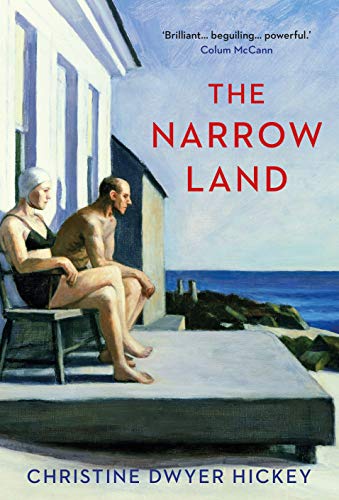
Christine Dwyer Hickey, The Narrow Land (Atlantic 2019)

The cover of The Narrow Land features Edward Hopper’s painting Sea Watchers (1952). The back cover tells us the book is about a ten-year-old boy who forms an unlikely friendship with ‘the artists Jo and Edward Hopper’. But nowhere in the narrative itself are we told the names of the two artists, even though many of the man’s paintings are lovingly described and even a reader as ignorant about US art as I am could recognise some of them (admittedly with help from Duck Duck Go) as Hoppers. Nor is there an afterword or acknowledgement to clarify the story’s relationship to historical fact.

I don’t know what to make of that, since it looks as if a significant dimension of the book is a fictional depiction of Hopper’s practice and the Hopper marriage. In particular, to judge from Josephine Hopper’s Wikipedia entry, it’s likely that the narrative draws on her copious journals recording her bitterness and their stormy quarrels. The character’s journals are mentioned, but Josephine Hopper’s are not.

The Hoppers-not-Hoppers, she in her sixties and he quite a bit older, have a terrible relationship. They are at their Cape Cod house for the summer in the early 1950s. He is stuck, searching for inspiration. She lives in his shadow, resents his failure to support her work, nags at him to get on with his own, is hyper-alert to possibilities that he will be attracted to other women, and relentlessly picks fights with him. He is relentless right back at her. They’re not people you want to be around.

Ten-year-old Michael comes into their lives. He is a German war orphan, possibly Jewish, brought to the US and adopted by a working-class couple in New York, spending the summer with a benefactor who is the artists’ neighbour.

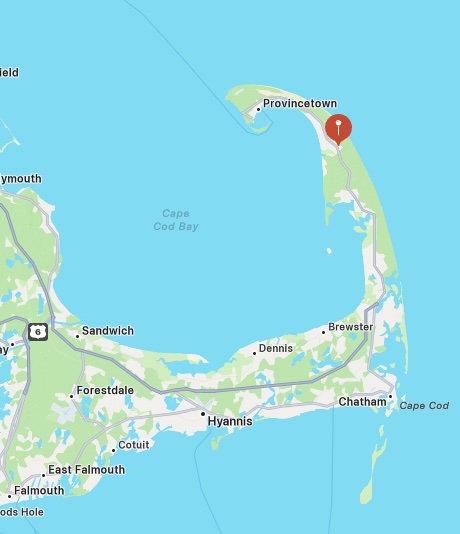
Relationships develop among these characters, including Michael’s complex host family. The narrow land of the title refers literally to Cape Cod, as in this map. It also refers, I think, to the narrowness of a non-combatant USer’s world-view: Michael’s hosts are unable to imagine the magnitude of what he has endured (which he experiences now as nightmarish flashes of memory). The narrowness is also there in the constrictions that society places on the artist, and the claustrophobia that ‘Mrs Aitch’ rails against in her marriage. Perhaps it refers also to the limits imposed on people’s lives in the wake of the Second World War – partners, parents and siblings are still being mourned, and returned soldiers wander through the narrative like wraiths.

For the most part, this isn’t a pleasant read. I found Mrs Aitch especially painful – like Pansy in Mike Leigh’s Hard Truths, her bitterness is unremitting, but she lacks Pansy’s biting wit. Unlike Pansy though, she finds temporary relief in connection with children – Michael and his obnoxious host Richie – where we get to see her in a more positive light. Also unlike Pansy, she has a moment when her intolerant discontent saves the day.

Having just described Richie as obnoxious, I feel obliged to say that even though almost all of the characters are unlikeable, most of them have moments when we see an underlying pain. We come to see Richie in particular as tragic.

Page 78* turns out to be a good example of my pervasive frustration. It’s near the start of the novel’s second section, titled ‘Venus’, in which we realise that ‘he’ – Hopper-not-Hopper – is searching for a woman he glimpsed the previous summer, as he feels that she will inspire him now. (Spoilerish note: he does find her, but it doesn’t work.) On this page he remembers the day that he found her:

She was standing in the doorway of a house, a man standing on the threshold, maybe leaving or maybe hoping to get inside.
He’d driven by and pulled in further along the street. Then he walked back past the house. There had been a bush by the gate, tangled and dried up from the heat, a lawn, yellowed by neglect and the ravages of a long summer.

There’s a description of her clothes and a snippet of overheard conversation, then:

He had walked on for a couple of minutes. then crossed the road to return on the opposite side, his head tilted as if he were searching for the number of a door. As he came closer to the house, he saw her lift her hands and put them under her hair, which was a whiter shade of blonde. Then she flipped it all up, holding it for a few seconds to the back of her head. He could see the damp patches of sweat stamped into her armpits and the outline of her long neck, the soft curve where it joined her shoulders. She dropped her hair and her face lifted upwards. The blue blouse. The light on her face. He couldn’t figure out if it was pouring into her or pouring out of her. He thought she looked sanctified. Then he thought she looked the opposite.

He rushes home and drags out his easel:

He laid it down: the street, the house, the figure of the girl in the doorway, the figure of the man alongside it with one foot on the step, the lawn, the gate, the tangled bush.

This is emphatically an account of a particular artist’s creative process. It’s as if the novelist sets out to imagine for us how Edward Hopper created one of his paintings, but then – for legal reasons, perhaps, or from simple respect for the unknowability of the real man – pulls back from acknowledging that that’s what she’s doing. The understated eroticism here plays nicely into the portrait of the artist’s marriage: his wife (never named) realises that she is not the model for the woman in the painting, and is furious.

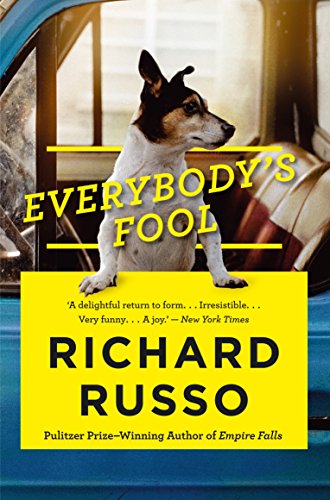
On the way to the meeting: We read The Narrow Land along with Richard Russo’s Everybody’s Fool. Just before the meeting I’m noting some things the books have in common:

  • they both have dogs that make a mess of cars – the disgustingly incontinent Rub in Everybody’s Fool, and Buster in this book who leaves a car ‘looking like a feathered nest’
  • characters read books: Sully in Everybody’s Fool remembers as a boy reading the beginning of a book we recognise as David Copperfield (Dickens), and discarding it; Michael in this book reads The Red Pony (Steinbeck) and Tom Sawyer (Twain) and takes them in his stride
  • Class looms large: when Michael’s working-class foster parents turn up we suddenly feel grounded in honest relationships; when Sully’s son turns up in the other book, we’re away with the abstractions of middle-class life.

After the meeting: The books had to compete with the pope’s funeral on the TV, but we still had an interesting conversation.

I think we were all a bit perplexed by A Narrow Land – not quite sure where its focus is. The person who had first proposed it, an artist herself, kicked the conversation off by saying that she was disappointed the book had so little to say about Hopper’s process, and in a way we circled around that central absence for the rest of our conversation.

One other person shared my unease about the relationship between the fictional characters and the historical persons. Others had no problem with it, and I still find it hard to say precisely what my problem is. Our host produced a hefty volume of Hopper’s work and we tried to pin down the paintings he works on in the book. No one claimed to have enjoyed the book unreservedly, though I think we all found some joy, or at least pleasure, in it. No one was much interested in trying to compare the two books.


We met on the land of the Bidjigal and Gadigal clans of the Eora nation, overlooking the ocean. I wrote the blog post on Wangal and Gadigal land. I gratefully acknowledge the Elders past and present who have cared for this beautiful country for millennia.

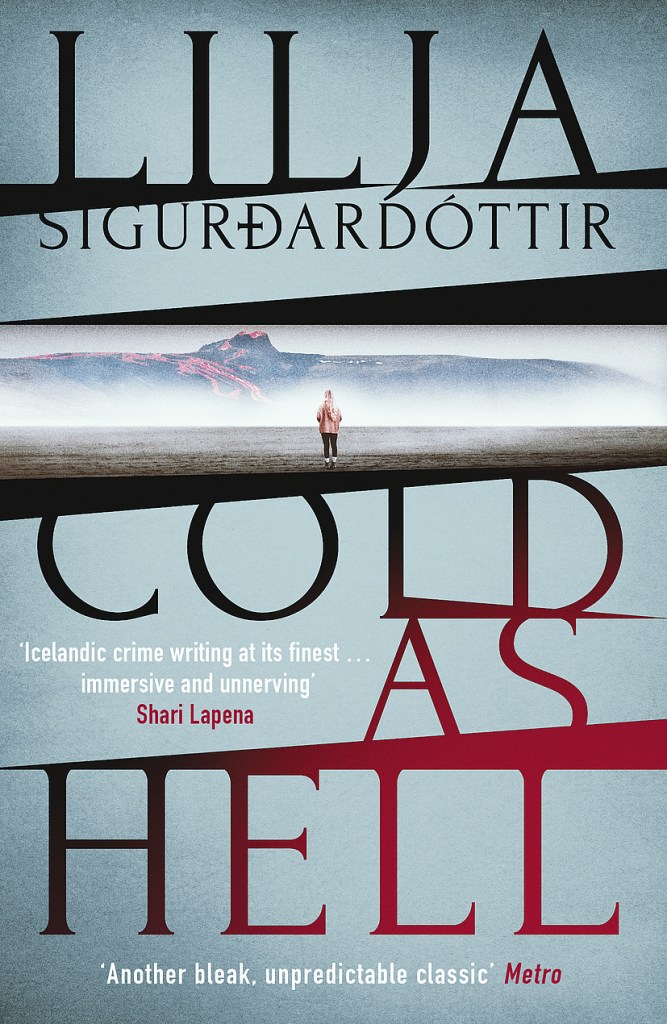
Listening to the Twits, Cold as Hell

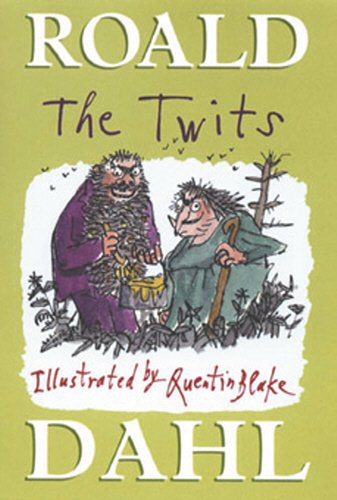
Roald Dahl, The Twits (1980)
Lilja  Sigurðardóttir, translator Quentin Bates, Cold as Hell (2022)

I spent the Easter weekend with family at Bawley Point on the south coast of New South Wales. The Emerging Artist and I drove there from Sydney with two grandchildren aged 4 and 7, and came home alone. On the way down we had a great time playing Car Bingo on sheets designed by the EA, and when the excitement of seeing the umpteenth cow had waned we listened on Audible to The Twits. On the way back, without grandchildren, we listened to the rest of Cold as Hell, which we had begun on a previous trip.


When I was first interviewed for a job at The School Magazine, Australia’s venerable literary journal for children, I was asked to name some children’s books that I enjoyed. Among others, I mentioned The Twits and The BFG, both by Roald Dahl. Kath Hawke, the magazine’s editor, raised a belligerent eyebrow. ‘Oh, you like them, do you?’ she asked, and went on to talk about the relish with which both books describe people humiliating and physically hurting each other. I scoffed at such concerns, identified with the relish, and didn’t get the job. (I was, however, placed on an eligibility list and eventually spent nearly two decades working there.)

Hearing The Twits again 40 decades later, I sympathise more with Kath’s view. Two repulsive individuals play mean tricks on each other and torment birds and animals in their power. The animals and birds take an appropriate revenge. End of story. It was refreshing once, and maybe still is for young people, especially those for whom ‘poo poo’ is a dependably witty response to almost anything. Maybe I’m just being all 21st century, but while I find the description of Mr Twit gleefully disgusting, I wonder if that of Mrs Twit isn’t marred by an extra layer of visceral misogyny.


According to an online bookseller juggernaut Cold as Hell is the first book in ‘an addictive, nerve-shattering new series’.

Áróra Jónsdóttir, a twenty-something freelance financial investigator, flies to her native Iceland to check on her sister Ísafold. Ísafold has been in an abusive relationship and the two sisters have recently fallen out. Áróra soon realises that Ísafold hasn’t just been avoiding her, but has disappeared.

What can I say? Iceland is cold. Áróra uncovers some financial skulduggery when on a break from searching for Ísafold. There’s a weird character called Grimur (I think), an African refugee named Omar, a police detective who is some kind of uncle to Áróra. Áróra’s mother flies in from London to share the anxiety. There’s a little bit of sex and a little bit of violence. It all turns out pretty much as you’d expect, with a slight twist, as you’d expect.

It felt like a novel equivalent of Nordic Noir TV, and given that The Áróra Investigations is a series, it may turn up soon on content-hungry streaming. It passed the time pleasantly enough, but my nerves weren’t shattered and I’m not addicted.


We listened to these books while travelling through Dharawal country. I have written the blog post on the land of Gadigal and Wangal of the Eora nation. I gratefully acknowledge Elders past and present, and thank them for their custodianship of these lands over millennia.

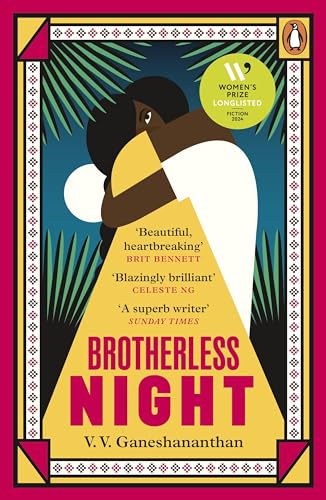
V. V. Ganeshananthan’s Brotherless Night

V. V. Ganeshananthan, Brotherless Night (Penguin 2024)

The main character and narrator of Brotherless Night, Sashi to her friends, is a young Tamil woman who is studying to become a doctor in the city of Jaffna in northern Sri Lanka. She lives through the beginnings of the civil war in the 1980s. Her beloved eldest brother is killed in the anti-Tamil riots of 1983 – the riots that are made so vividly present in S. Shakthidharan’s play Counting and Cracking. Two more brothers join the Tamil Tigers (the Liberation Tigers of Tamil Eelam), and K, a man she has loved since childhood, becomes a celebrated hero and martyr among the Tigers.

Sashi herself is caught between an oppressive government army and a ‘liberation’ force that ruthlessly kills many of the people they claim to be defending. Sashi deplores the tactics of the Tigers, but she works for them in a secret clinic, patching up wounded cadres and civilian casualties, and she can never renounce her love for her brothers and K.

In a pivotal sequence, K comes out of hiding to ask Sashi for her support in a dangerous undertaking: to do so will align her publicly with ‘the movement’, which would grievously misrepresent her sympathies, but not to do it would be to betray a childhood friend. I think of E. M. Forster’s much quoted line: ‘If I had to choose between betraying my country and betraying my friend, I hope I should have the guts to betray my country.’ But Sashi’s choice is not as simple as that.

As she ponders the dilemma, there’s this line (on page 238):

Before there was a movement there were six children on a lane.

It is her loyalty to the vision of themselves as children that is at the heart of the book – that is, her loyalty to a basic shared humanity, and to telling the truth from that place.

It’s a terrific story. I was invested in the characters and sorry to put the book down. Part of its strength is the way it reaches out from its fictional world to highlight elements of actual reality. I can think of three ways.

First, other texts are referred to and integrated into the narrative. The books that Sashi and her brothers read might make an interesting reading list, but most strikingly Sashi and her Anatomy professor start a book group for woman at the university, and at their first meeting they discuss Feminism and Nationalism in the Third World, a real book by Sri Lankan author Kumari Jayawardena. In lesser hands this might have felt like analysis being shoehorned into the narrative, but we share the young women’s intellectual excitement, and their sense of peril as no one can be sure things won’t be reported back to the Tigers, with potentially dire consequences.

Second, there are elements of roman à clef. The salient features of K’s life and especially death, for instance, align closely with those of Tiger leader Theelipan.(Don’t look up this link if you want to avoid spoilers.) One of the book’s epigraphs – ‘There is no life for me apart from my people.’ – signals another real-life equivalent. It’s from Rajani Thiranagama (Wikipedia page here), a human rights activist who was once a member of the Tigers but became critical of them and was eventually believed to be murdered by them. She is the model for Sashi’s Anatomy professor, and the last third of the book features a fictional version of her real-life project of gathering evidence of atrocities committed by Tigers, Indians and Sri Lankan military.

The third way may be peculiar to me.

A young woman has been viciously assaulted by an Indian soldier – nominally there as part of a peace-keeping force. Sashi treats her injuries, and she returns later in a different, devastatingly vengeful role. This young woman’s name, Priya, rang a bell for me, and for no reason I could pinpoint I felt a particular investment in her story. Then I remembered the source of the bell: Priya Nadesalingam, the subject of a huge amount of press in Australia in 2023 (here’s one link in case you need reminding). That Priya, who had sought asylum in Australia with her husband Nades Murugappan and their two daughters, had become part of the community in the tiny Queensland town of Biloela. After a dawn raid, they came close to being deported and sent back to Sri Lanka. There was a huge public outcry and, long story short, the family are now living in Biloela on permanent visas.

The two Priyas have very different stories, but the coincidence of names brings home to me with tremendous force the horrific broader reality behind the bloodless statements about refugees made by politicians in Australia (and I assume elsewhere in the West).

The book doesn’t preach or lecture, but it brings a deeper understanding, not only of the struggle for Tamil independence in Sri Lanka, but of resistance movements generally. It makes me want to be a better person living in a kinder country with broader horizons.


I wrote this blog post on the land of Gadigal and Wangal of the Eora nation. I acknowledge their Elders past present and emerging, and gratefully acknowledge their care for this land for millennia, as well as the generosity I have personally experienced from First Nations people all my life.

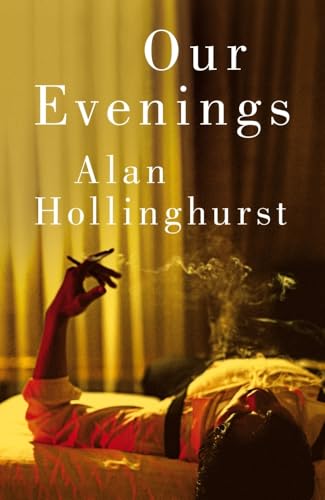
The Book Club, Alan Hollinghurst and Our Evenings

Alan Hollinghurst, Our Evenings (Picador 2024)

Before the meeting: About five decades ago I had to write an Eng Lit essay on Gerard Manly Hopkins’s sonnet ‘Spelt from Sybil’s Leaves’. It’s a poem that cries out to be read aloud, and on a weekend away at a beach house with friends, I found an out-of-the-way spot where I could perform the poem over and over for my own ears. It turned out that my secluded corner was actually an amplifying booth, and my sonorous renditions were heard by everyone in the house. Someone finally came and pleaded with me to stop. Embarrassment aside, I still love the poem.

So I took it as a personal gift to me when the poem is being recited, unannounced and unexplained, at the start of Chapter 15 of Our Evenings:

‘Earnest,’ I said, ‘earthless … equal … attuneable …’ Stella peered at me, tongue on lip, daring me.
‘… vaulty …’ she said.
… vaulty, voluminous … stupendous Evening strains to be time’s vast –’ (now we chanted it together) ‘womb-of-all – home-of-all – hearse-of-all NIGHT!’
‘I bet you can’t go on.’

If I hadn’t been loving the book before then, I would have been hooked.

As it happens, I was enjoying the book. The hero-narrator David Win, son of an English mother and a Burmese father he has never known, was given a scholarship to attend a prestigious boarding school, and at the start of Chapter 15 he’s studying at Oxford. The novel traces his development into a successful actor, his crushes, affairs and finally marriage with men, and his arrival at a reasonably contented late middle age (as we in our late 70s refer to the 60s).

The phrase that gives the novel its title occurs when David is in his last year at the boarding school. He is taken under the wing of Mr Hudson, his English teacher. They listen to classical music together late in the evening. These quiet times have an intimate, erotic charge, but though other boys leap to crude conclusions, ‘nothing ever “happened”, as they say’. Among the pieces they listen to is the first movement of Janáček’s ‘On an Overgrown Path’, which has its own title, ‘Our Evenings’. (You can hear it played by Rudolf Firkusny in 1986 at this link.)

The piece seemed simple and songlike, but the modulations in it made you wonder, and an agitated figure broke in higher up and then, like the scratch on the record, disappeared and left you with the song in a further change of mood, which didn’t quite replace the first one but seemed to cast the shadow of experience over it – what, I couldn’t say, but I felt it. I had no idea what we were listening to or how long it was going on – there was a very quiet passage when the agitated figure came back, but subdued and dreamlike, a trance of sadness and beauty, and soon after that the piece ended without any fuss. I glanced at Mr Hudson, but he was staring at the fire too, and then he jumped up and said, ‘Shall we hear it again?’

Apart from being an instance of the way other works – plays, poems, pieces of music – move the narrative along, this passage is a nice example of the way David as narrator shows rather than tells. ‘I couldn’t say, but I felt it.’ He never says in so many words that he has a crush on Mr Hudson, or that he believes it to be reciprocated, but in little moments like this – in Mr Hudson jumping up and suggesting a replay – readers can draw their own conclusions.

The description of Janáček’s music could be applied to the novel itself: ‘subdued and dreamlike, a trance of sadness and beauty’ occasionally interrupted by an ‘agitated figure’. The prose is elegant and unruffled, and most of the terrible things that happen – AIDS, Brexit, Covid – are offstage. David as boy, adolescent and man is unfailingly polite and helpful – we are usually left to imagine what feelings he is covering up, even perhaps from himself. He regularly encounters ‘agitated figures’ in the form of racism, but mostly it’s of the raised eyebrow or muttered phrase, micro-aggressive variety. An African-heritage lover says, ‘You’re not even Black!’ Likewise the homophobia he encounters is subtle – when he comes out to his mother and her female friend, their response is more or less, ‘Well, that’s been obvious for a long time!’ Class plays a role –  David’s patrons, whom he loves to the end – are like Proust’s aristocrats in their unfailing graciousness and generosity, and the sense that nothing really touches them. The mystery of his father remains a mystery, though late in life he receives some vague information. As in real life, many mysteries remain mysterious.

I suppose sex itself might count as an ‘agitated figure’. There’s quite a lot of it but, though it’s not coy, very little is explicit. I remember only two moments when sexual body parts are named, one involving a kind rejection, the other the beginning of a solid relationship. Neither is the slightest bit prurient.

The last 10 pages depart from the mainly ‘subdued and dreamlike’ narrative in a way that came as a surprise to me, and casts a brilliant light back over the preceding pages.

After the meeting: At the Book Club, we usually have two books under discussion at each meeting. This time, there was just the one, but everyone had to report on the book they’d scored in our Kris Kringle at last meeting. So our discussion, which followed and preceded convivial conversation about other things, began with enticing rundowns of books by Bernhard Schlink, Jock Serong, Robbie Arnott and Niamh Mulvey, and an unenticing rundown of one other.

Of Our Evenings, we had a very interesting discussion. I probably liked the book most, but no one hated it. The only strong difference was about the last ten pages, which I felt gave shape and significance to the whole thing and most others experienced as a lame and unnecessary framing device. It would be too spoilerish to present the arguments here. I’ll just state the obvious: they’re entitled to their opinions, but they’re wrong.

One person had an interesting take on the title. It captured the way the book, for her, is like a series of conversations you might have in a quiet evening at home: meandering, pleasant, amiable recollections and reflections, without drama or much significance. (If that’s so, I hope I said at the time, there’s always an awareness of terrible things happening in the outside world, of which many of the tiny things that come up in those conversations are micro-effects.)

David Win as narrator and hero provoked interesting conversation, which I’ll try to summarise. He is an outsider because of racism, class and sexuality, not necessarily in that order. As an outsider, his main way of being in the world is to aim to fill other people’s expectations – to act out the scripts he is given. It’s not insignificant that he’s an actor. He rarely takes the initiative, and there’s a way he doesn’t seem to know who he is. Not just as narrator, but also as character, he doesn’t have access to his own inner life. The narrative restraint about sex, which is not so in Hollinghurst’s other books that people had read, may be part of this. I read out the only passage in the book that mentions hard-ons, and people laughed (but not at all derisively). It’s as if in this book explicit sex is a relief from always having to decode what is being communicated in tight-lipped upper-class British dialogue (see Mr Hudson’s ‘Shall we hear it again?’ above).

We discussed other characters that I didn’t mention in the first part of this blog, especially a Boris Johnsonesque blustering bully, .

Less centrally, some took an almost anthropological interest in the portrayal of Gay male relationships – and it’s true that Hollinghurst gives meticulous detail on how people make their desires known. One person felt that (minor spoiler alert) having the David’s mother become a Lesbian was just laying on the Gayness too thick. Another, on the contrary, was impressed and delighted by the nuanced portrayal of middle-class, middle-aged, post-heterosexual-marriage Lesbianism.

We didn’t discuss the Hopkins poem, the Janáček music, or the plays – notably by Racine and Ben Jonson – that turn up in the narration.

Mint-flavoured Turkish delight was on offer. Only two of us tried it. I was the only one to finish my piece. I don’t recommend it. I do recommend the book.


Our Book Club met on unceded land of the Gadigal and Wangal clans of the Eora Nation. I acknowledge the Elders past and present. I hope that our conversation was in some way in continuity with yarns that have been happening on this land for tens of thousands of years.

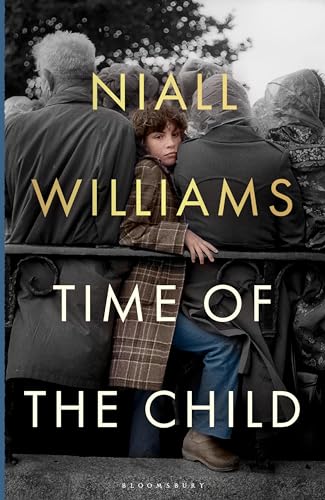
Niall Williams’s Time of the Child and the book group

Niall Williams, Time of the Child (Bloomsbury 2024)

Before the meeting: As I was reading the first couple of chapters of this book, I had ringing in my ears something that a Book Group member had said about a different book, perhaps one of Niall Williams’s earlier novels, A History of the Rain or This Is Happiness: ‘It’s a beautifully written Irish novel, but I’m not sure the world needs yet another beautifully written Irish novel.’

The first chapters, in fact almost the first half of the book, are brilliant descriptions of life in 1962 in the fictional West Ireland village of Faha, the village we know from those previous books. The rain is still incessant and the village still slowly sinking into the river. The heart broken in This Is Happiness is still broken. Life is still dominated by the Catholic Church. Gossip is still the lifeblood of the community. Most houses now have electricity.

The first chapter begins with a wonderful setpiece, a parish Mass where the beloved parish priest stalls mid-sermon in the first major sign of dementia. Things are seen from the point of view of Jack Troy, the village’s general practitioner whose face and manner give away nothing of his inner feelings as his role in the community means he must always be available, including to people who will never ask for a doctor’s attention on their own behalf. After Sunday Mass he is regularly approached by people who indicate with a nod and a wink that his services are needed at such and such a house.

The second chapter revolves around another magnificent setpiece: the Christmas fair in which farmers bring their cattle to town to sell, and hawkers and traders come from elsewhere. Here, twelve-year-old Jude Quinlan, son of a drunkard farmer, carries the narrative burden.

Through both of these chapters, we are teased by hints that something big is going to happen. It’s as if the narrator is saying to his readers, ‘Yes yes, I know you’re here for a story, but first let me tell you about the place it happened in and the people who live there.’ At the end of the second chapter, more than a third of the way into the narrative, there’s this:

But it was here, at the back wall of the church in the village of Faha, on the night of the Christmas Fair 1962, that Jude Quinlan found the child.

Ah! The titular child has arrived! Then the third chapter continues to tease us. It takes us back a couple of days in the life of Ronnie Troy, Jack’s long-suffering dutiful daughter. After 16 pages in which we come to know and (speaking at least for myself) love her, she responds to a late-night knock on the door and at last the story begins.

Given that it happens so late in the book, I’m reluctant to say much more about it, except that though my Group member may be right that the world doesn’t need another book like this, I certainly do. Maybe it’s because I spent my 1950s childhood as part of the Irish diaspora in north Queensland, and I respond with little gasps of recognition to little throwaway lines about the Sacred Heart, the ‘Hail Holy Queen’, the smiling pope, or to the way the priest says Mass with his back to the church while the congregation’s more or less devout members goes about their own business. That is to say, maybe there’s a hefty dose of nostalgia in my response to the book. But if so, that nostalgia serves a serious purpose.

This is a time and place when the Church dominated Irish society. It was the time of the Magdalen laundries, covered-up clerical sexual abuse of children, pitiless laws against abortion and condemnation of most forms of birth control. None of this is foregrounded in the book, but oppressive Church–State authority looms large, mostly unspoken, over the second half of the book. On the one hand, a handful of people sinking to their knees to say the Rosary can be an exhilarating manifestation of something fine beyond words (though Niall Williams finds the words); on the other a priest with a form letter mouths deadly phrases like ‘For his own good’ and ‘Preserving his dignity’.

Just as much as, say, Sebastian Barry’s Old God’s Time or Claire Keegan’s Small Things Like These, this book is about decent humanity – individuals and communities – resisting the monolithic, repressive authority of Church and State. Like them, it revels in musical language. More than them it’s funny. I did cry, twice, but I laughed a lot.

Page 77* includes a micro example of the resistance. In the absence of a fairground, Faha’s monthly fair is a chaotic mess, and the church gates, ‘with their splayed look of welcome in the centre of the village’, are a main centre of trade. The curate, Father Coffey, representing the Church’s authority, asks the farmers not to stand their cattle there:

As it happened, the curate’s appeal fell on deaf ears, but he took some satisfaction when he was able to negotiate a treaty whereby Mick Lynch promised a rope corridor to let the daily Mass-goers through. As a goodwill gesture, Lynch said, the farmers would take their dung with them when they left, which Father Coffey reported back to the Canon, unaware it was a joke until the older priest put the hand across his laugh to stop his teeth flying.

With such jokes, in which the older priest colludes, the people of Faha keep the authority of the Church in its place.

Most of page 77 is taken up wth one of Niall Williams’s bravura character sketches:

Mick Lynch had the walk of a man who owned his own bull. Short and broad, he carried a blackthorn, wore a frieze coat and low hat with red feather in the band. That hat never came off his head outside of church. He wore it at the counter in Ryan’s, in the spartan confines of his iron bed, and when he went to wring the necks of geese. From victories in cards or trade, Lynch took a deal of pleasure. With a contrary nature, his cheeks were where the most of his hair grew, furred sideburns made key-shaped by the shaving of his chin which gave him a jailor’s look. Lynch had the reputation of being what Faha called a right cool man, a designation that pre-dated refrigeration, meant he could not be hurried or ruffled, and once, when asked by a dealer, ‘What are you looking for in a horse, boss?’ had delivered the incontestable answer, ‘Leg in each corner.’ He had not married. For women he hadn’t the handbook, he said, and children nothing but hosts to headlice and worms.

Remember, nothing has really happened in this book so far. That is, we’re a quarter of the way into it but we haven’t yet had what the movies call the inciting incident. But the narrator refuses to be hurried. There is too much to enjoy at any moment in the life of Faha, so though this is Mick Lynch’s only appearance, we’re going to take a moment, just for the fun of it, to savour him. I especially like that ‘outside of church’: whatever else he may be or do, it wouldn’t occur to Mick Lynch to defy the custom of men going bare-headed in church.


After the meeting: Unusually, this book was the subject of quite a lot of WhatsApp discussion before the meeting, mainly from people who couldn’t make it on the night. A number of us had wept, prompting one to ask whether we were ‘silly old men getting emotional about a baby and family relationships’. He who had made the remark about beautifully written Irish novels confounded my expectations by loving tis one, and wrote a thoughtful email on the theme of ‘the soul’. Another sounded a mildly dissenting note, having read only 80 percent and found it slow going; he reacted against the religion’s hold on people, and used the word ‘silly’ about a main character’s attempt to take charge of the situation (all of which are completely reasonable responses). Yet another quoted a number of favourite passages, and said he loved the way Catholicism co-existed with pishogues, which he noted was an excellent new word to him (as it is to me – definition at this link if you’re interested).

On the night there were just five of us. Among other things, we ate baked potatoes. Almost as soon as we arrived, those of us with Catholic backgrounds – a slim majority – were reminiscing about, of all things, our Confirmations. Not directly on topic, but certainly book-adjacent. We had an animated discussion. More than one said that the book took its own sweet time to get to the point – one said he almost stopped reading, but others (me included) thought it was a feature rather than a bug. Someone quoted a passage to the effect that Irish story-telling never goes in a straight line.

Someone said, on WhatsApp and then again on the night, that the book was an Irish Catholic equivalent to Marilynne Robinson’s Home. I don’t quite see that, though it’s an interesting thought. I had a go at articulating some of what I see the book as saying about Catholicism in Ireland then and now – which I won’t go into here because it would be spoilerish.

Interestingly, no one thought to say out loud that this is a Christmas story, even a kind of second-coming story. And, though someone had looked up Niall Williams on the internet, no one wondered aloud if he became a grandfather somewhere on the way to writing this book.

As for the rest of the conversation, I can’t do better than quote (with permission) from one chap’s report on WhatsApp. Conversation ranged, he wrote:

from John Cage and the Necks to motor bike accidents, playing golf, Parkinson’s disease and then the realities of being Bilbo Baggins.


I wrote this blog post on land of the Gadigal and Wangal clans of the Eora Nation. I was born in MaMu country, though as a small child I was confused about whether I lived there or in ‘Erin’s green valleys’. I acknowledge the Elders past and present of both countries, never ceded.


My blogging practice is focus arbitrarily on the page of a book that coincides with my age, currently page 77.

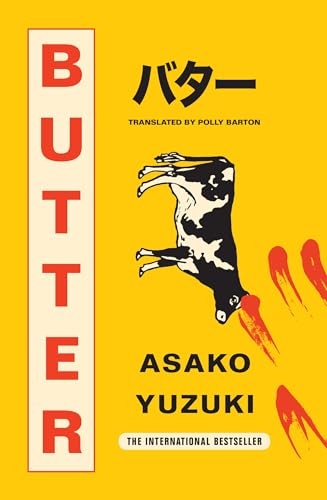
Asako Yuzuki’s Butter

Asako Yuzuki, Butter (2018, translation by Polly Barton, 4th Estate 2024)

This was my end-of-year gift from the Book Club. It is probably an excellent book about misogyny in Japanese culture, with sharp satiric assaults on attitudes to food, with extra piquancy derived from its claim to be based on a true-crime story. It was evidently a huge success in Japanese and this English translation by Polly Barton has been reviewed enthusiastically.

The protagonist, Kira, is an ambitious young woman journalist working on a sensationalist magazine. In searching for a career-defining scoop she becomes enthralled by Manako Kajii, a woman who defies the social norms of slender femininity and is currently in prison for having killed a number of elderly men, after winning their hearts by cooking luxurious food for them. Manako introduces Kira, who until now has survived on a spartan, negligent diet, to the joy of butter – cooking with it and eating the results.

My guess is that the key to enjoying the book is to read it fast, and I’m a slow reader. The themes are real and interesting: feminism versus feminine wiles; social norms versus desire; career ambition versus enjoyment of life. But I struggled with it, and gave up soon after my obligatory 77 pages.

It may well be that Polly Barton has reproduced the feel of the original Japanese, but the best way I can describe my response to the book’s language is to say that it reads like the kind of English you find in school students’ translations. The information is all there, but in the process of capturing it, the student forgets to pay attention to the natural rhythms and sequencing of English prose. That’s fine if you’re a teacher correcting someone’s homework, but if you’re reading a novel, it keeps yanking you out of the story.

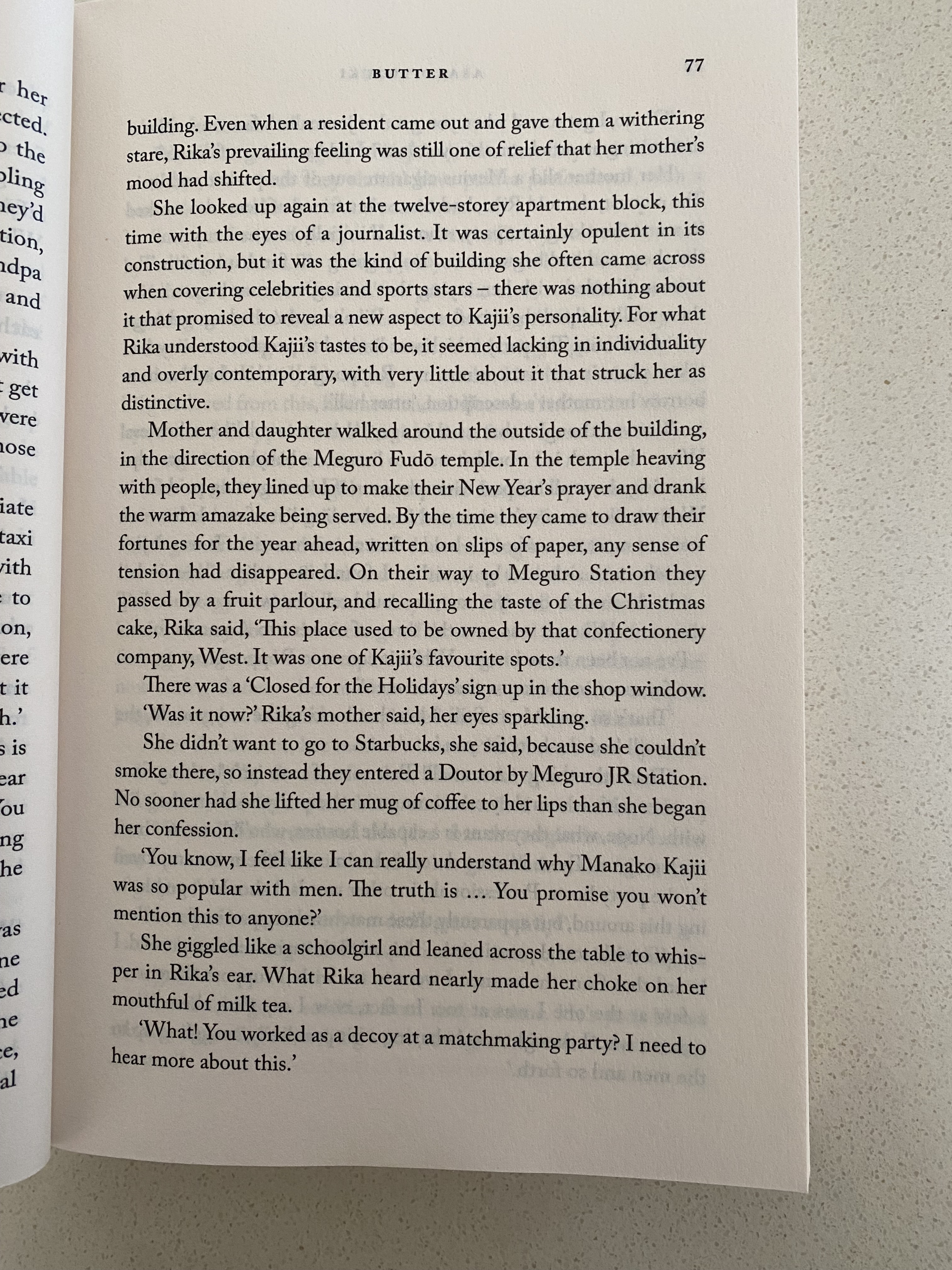
I don’t want to spoil anyone’s enjoyment, but I’ll try to articulate why I find the book such a slog. Page 77* isn’t particularly egregious, but it offers a number of examples. Rika is on an outing with her mother, partly to cheer her up, and partly with the undeclared intention of having a look at Kajii’s apartment. Rika’s mother becomes high-spirited as they inspect the building that has been ‘making a splash in the news’.

I’ll just talk about the beginning and ending of the page, but you can enlarge the image to read it in full:

The first sentence:

Even when a resident came out and gave them a withering stare, Rika’s prevailing feeling was still one of relief that her mother’s mood had shifted.

There’s nothing glaringly wrong with that, but a close look reveals a number of tiny problems contributing to the cumulative awkwardness.

To my ear, the phrase ‘even when’ suggests an extreme event of some kind, and it takes a microsecond to realise that this is something quite undramatic: a resident comes out of the building and gives the pair a withering look. For another microsecond, I wonder why the resident would pay them any attention at all. They’re just two women in a public street. And it’s not just a look, but a stare! How does Rika know that this more or less abstract person is a resident? Moving on, the awkward phrase ‘prevailing feeling’ suggests, if anything, that Rika is experiencing complex emotions, but that suggestion goes nowhere. ‘One of relief’ is clutter – why not just ‘relief’?

One last thing: the word ‘still’, which if you read this sentence without context is completely innocuous. But it’s another example of a micro-interruption to the narrative flow. This is the first time we’ve been told that Rika is feeling relieved. The reader (or at least this one) has to do a quick calculation: oh yes, Rika’s mother’s mood has lifted so of course it was implied that Rika felt relief, so now we’re being told that that relief has survived. This is a recurrent quirk: we’re told that something has happened, rather than seeing it happen.

I can enjoy a text that demands work of me, but these extra little bits of readerly labour bring no joy.

I won’t take you laboriously through the whole page, though I can’t resist mentioning the phrase, ‘In the temple heaving with people’. The meaning is clear, but it doesn’t quite feel like English.

At the end of the page, Rika and her mother are having a coffee (in a Doutor, which Rika’s mother prefers to Starbucks because Starbucks doesn’t allow smoking – in the kind of culture-specific moment that I confess to enjoying).

No sooner had she lifted her mug of coffee to her lips than she began her confession.
‘You know, I feel like I can really understand why Manako Kajii was so popular with men. The truth is … You promise you won’t mention this to anyone?’
She giggled like a schoolgirl and leaned across the table to whisper in Rika’s ear. What Rika heard nearly made her choke on her mouthful of milk tea.
‘What! You worked as a decoy at a matchmaking party? I need to hear more about this.’

Again, these are tiny things, but they accumulate. ‘No sooner than’ is just slightly wrong: can you begin to talk at the moment you lift a mug of coffee to your lips? Specifying a mouthful of tea is unnecessary and creates another of those micro-pauses: I suppose it’s technically possible to choke on a mouthful of liquid, but the term ‘mouthful’ suggests that it’s still in the mouth and more likely to cause spluttering. Having the reader learn what the mother says only when Rika repeats it is an unnecessary and (to me) annoying complication.

Your mileage may vary, and I hope it does. If you want a completely different take on the book, I recommend Theresa Smith Writes.


I wrote this blog post on land of the Gadigal and Wangal clans of the Eora Nation. I happily acknowledge their Elders past and present for caring for this land for many thousands of years.


My blogging practice is to focus arbitrarily on the page of a book that coincides with my age, currently 77.

Yael van der Wouden’s Safekeep at the book club

Yael van der Wouden, The Safekeep (Viking 2024)

Before the meeting: As I mentioned in my post about Lai Wen’s Tiananmen Square, this book has a general strategy in common with a number of other books I’ve read recently – a personal relationship as way of drawing the reader into a big public event.

In this case the personal relationship is sexual. At times I felt like averting my eyes, as if I was intruding on intensely intimate moments.

The book is told from the point of view of a woman who lives alone in the house she has kind-of inherited from her parents in postwar Netherlands. Her brother actually owns of the house but lets her live in it. The story kicks off when he pressures her to allow his girlfriend to stay with her while he goes away for work. The two women are very prickly with each other at first: the owner is prim and obsessive about neatness, and her begrudged guest is an apparently easygoing woman of the world. Bit by bit we realise that the narrator is constantly aware of the other woman’s bodily presence, and eventually the dam breaks and there are many pages of enthusiastic sex.

There are hints along the way that something else is going on. In the book’s very first paragraph, for instance, the uptight host finds a ceramic shard buried in the cottage garden. She recognises a piece from her mother’s precious dinner set, but has no memory of any of those plates ever having been broken. This is the first of a number of hints that there is something about the house that has never been acknowledged. More telling perhaps are childhood memories of strangers knocking at the door and her mother ignoring them.

I guess I knew from the beginning roughty where things were going, and even during the scenes of passion I kept waiting for the other shoe to drop. It does drop, most satisfactorily.

I loved this book.

After the meeting: I wasn’t alone in loving it.

This book group, the majority of whose members are Lesbian, has long had a rule that no Lesbian books were allowed unless the Lesbianism was incidental to the plot. Well, this book smashed that rule to bits, but it did it with such grace and integrity and good writing that not even the Chief Rulemaker minded.

Though we all loved the book, we spent some time discussing the ending. Was it too neat, too quickly achieved, too much out of character? It’s hard to blog about endings but I don’t think I’m giving too much away if I say that two possibilities were raised in defence: first, it’s like the endings to Shakespeare’s comedies – you’re not meant to think this could really have happened but it’s satisfying to imagine it as a kind of justice; second, the apparent change of personality involved could be accounted for by the transformative power of the passionate sexual experience – certainly it was transformative, and maybe even more so than obvious. If you’ve read the book, you’ll have opinions of your own.


The Book Club met on Gadigal land, and I wrote the blog post on land of Gadigal and Wangal of the Eora Nation, land that has never been ceded. I acknowledge the Elders past and present who have cared for this land for millennia.

Lai Wen’s Tiananmen Square at the book club

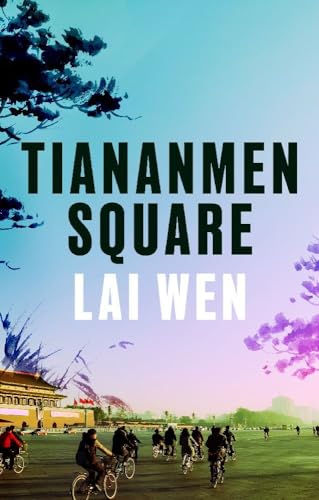
Lai Wen, Tiananmen Square (Swift Press 2024)

Before the meeting: On page 411 of this novel, the narrator-protagonist, a student at Beijing University, posts an application for an exchange program at a Canadian university. She goes to one of the bars on campus, and then:

The enormity of what I had done began to sink in.

A few pages later, sensations flash across her mind ‘like lightening’, and a few pages further on there is a lake, where a turquoise glow

expanded outward as far as the eye could see, and beyond, the tawny ridges of ochre mountains were flushed at their foothills with dark streaks of wild grass and moss.

The fact that I am brought up short by such moments (enormity is something big and horrible, not something like a major life decision; lightning is what flashes; if the water goes as far as the eye can see, how can you describe what can be seen beyond it?) may say more about me than about the book, but I’m pretty sure if I’d been gripped by the narrative I wouldn’t have noticed them.

If the pseudonymous author is who she says she is, this is an autobiographically inflected story of a young woman caught up in the student uprising in China in 1989. As such, it commands respect.

By coincidence, it shares something of a strategy with three other books I have read recently, telling a story with a tight focus on relationships and then widening out into a huge public event or issue. Kairos by Jenny Erpenbeck is a tales of a toxic relationship between an older man and a young woman that culminates in the fall of the Berlin Wall. The Song of Achilles by Madeline Miller is an adolescent boy-boy love story that becomes a retelling of The Iliad. The Safekeep by Yael van der Wouden (blog post coming soon) is a steamy Lesbian romance that turns out to be about what happens to property confiscated from Jews in the Netherlands under Nazi occupation.

In this book, the personal story lacks a clear or interesting focus. The death of a beloved grandmother, an embittered mother, a pallid teenage sex life (though the first unsatisfactory moment of sexual intimacy is vividly realised), and quirky university encounters all compete for attention. And the otherwise powerful Tiananmen Square narrative is undermined by giving the final moment to a twist that’s silly, and not in a good way.

I am glad I’ve read the book. It’s an important story. It’s just that at the sentence level, which is where I mostly live in books, it trudges.

After the meeting: We discussed this book along with The Safekeep. It was the Book Club’s celebratory end-of-year meeting with exchange of gifts in a restaurant, so discussion of the books was perhaps less extensive than usual.

All but one of us had read the whole book, and given that our meeting had been postponed twice because of illnesses, it was clear that it was lack of interest rather than lack of time that had led to the one non-completion. Generally, the completers all agreed that it was too long – it would have been a better book without a lot of the earlier family stories. Not everyone was convinced by the implied eye-witness status of the author – that claim is undermined by what looks like an arbitrary and ahistorical invention at the very end (and who knows, but we might yet be proved wrong in judging the final moment that way).

The book’s strongest advocate felt (if I remember correctly) that the complex mundaneness of the family story and the story of teenage emotional entanglements was the book’s strength: it took the events of Tiananmen Square in 1989 away from the abstract an showed them irrupting onto the lives of otherwise ordinary people. While others agreed that that’s how the book works, they (we!) felt that the narrator was peripheral to those big events, so her account of them doesn’t add substantially to what we already know from other sources.

We enjoyed The Safekeep a lot more.

Rodney Hall’s Vortex

Rodney Hall, Vortex (Picador 2024)

I haven’t read anything by Rodney Hall since the early 70s, and then it was just one book of poetry and one novella. Since then he has had thirteen more novels published, as well as ten more poetry collections, a collection of short fictions, two biographies – and non-fiction, an opera libretto and radio plays (not an exhaustive list), not to mention that he has won any number of prestigious prizes and accolades.

So it may be because I’m coming late to his writing that Vortex had me feeling off kilter pretty much from start to finish. On any page there’s something to enjoy, appreciate, puzzle over or be wowed by. But I don’t think I ever had a sense of the book as a whole.

There’s Brisbane in 1954: the Queen’s visit, a spectacular water-weed infestation, an exhibition of Tollund Man in the museum, a cyclone, the aftermath of the US army’s stay there in World War Two, the beginnings of ASIO domestic spying. Vladimir Petrov makes a cameo appearance. Entertaining endnotes underline the historicity of some of these features and events, even while asserting that the book is fiction.

And there’s 1954 beyond Brisbane: the Mau Mau in Kenya, the Royal Charter for North Borneo, the battle of Dien Bien Phu in Vietnam, and a boatload of refugees.

There’s Compton Gillespie, a young, bookish working-class teenager who befriends Beckmann, a German man, formerly a member of the Hitler Youth, possibly homosexual, who dances with women for money. Any sexual tension in the novel is between these characters.

There’s Paloma, a Spanish countess who presides over a table of European migrants and refugees at the Colony Club, where the conversation is witty, urbane, and mildly satirical of the host culture.

Paloma’s husband, a crude member of the public service with aspirations to gentility, is involved in cloak and dagger intrigue with the Americans while playing some kind of role in making sure the Queen’s visit goes well.

Vassily Bogdanovich Hmelnitsky, ‘thirty years a homeless vagrant’, wanders the streets of Brisbane.

There are flash-forwards. John Howard’s ‘We will decide’ speech, or near enough, turns up in the dialogue. Scott Morrison is a mysterious presence in someone’s dream.

These narrative strands intersect: the boy takes a photo of the countess; the vagrant takes shelter in the Colony Club during a downpour; the queen speaks to the boy’s mother on her hospital visit. And there’s a fairly improbable tying up of at least some threads at the end. But it’s hard for the mind to find purchase.

And maybe that’s the point. Apart from the first, each chapter and subsection of a chapter begins in mid-sentence without a capital letter: ‘or how to kill so much time?’ (Chapter 2); ‘and because none of Professor Antal Bródy’s three doctorates is recognized by the University of Queensland’ (Chapter 3); ‘because the night is warm and splendid with stars’ (Chapter 6); and so on. Similarly, they all (including the final one) end mid-sentence and without a full stop. There’s a constant sense that we aren’t getting the full story: we are seeing and hearing only moments from a great, complex, uncontainable whole.

The received version of 1950s Australia is that it was boring, monocultural, conformist. This book challenges that view. Its sympathetic characters are all in one way or another non-conformist and questioning, and its Brisbane is part of the great movement of people around the globe that began after World War Two and continues until now. I think that’s the vortex of the title. Here’s a paragraph from page 230:

from an observation balloon the vast seething mass of displaced persons is caught and processed by still photographs. From a thousand feet up an aerial platform provides intelligence pinpointing any breakouts in the movement of the desperate massed figures below. Unseen analysts make their scrupulous adjustments

This paragraph is typically complex.

First, it wrenches our attention from its immediate context, in which Beckmann is being challenged about his relationship with Compton, to the general question of refugees. There’s a suggestion that the same thing happens at different scales: Beckmann’s roommate questions him, the unseen analysts do their work. This movement from Brisbane to international scenes happens regularly in the novel.

Second, it draws attention to the time-specific nature of the book: in 2024, readers are used to surveillance – in 1954, this paragraph insists, it was already a thing, but it was much more primitive, depending on still photographs rather than video streams, and observation balloons rather than satellites or even spy planes.

Third – and this is how I first read it – it suggests something about the book itself. Its true subject is ‘the vast seething mass of displaced persons’, but it captures and processes it, not by still photographs, but by word sketches, anecdotes, scraps of dialogue, fractures narrative arcs. It does it, not from a distance of a thousand feet, but in close-up, paying attention to the details of people’s lives.

I can see that, and respect it, but in the reading I was mostly unengaged.

The Book Group and Samantha Harvey’s Orbital

Samantha Harvey, Orbital (2023)

Before the meeting: We picked this book as our next title the day before it won the Booker Prize. Smart us!

Four men and two women on a space station orbit the Earth sixteen times in twenty-four hours. They eat, they monitor experiments with plants and mice, they do strenuous exercise to counteract the bodily effects of living in low-gravity, they maintain their environment and monitor their own vital signs, they report back to ground control, they exchange messages and images with their loved ones at home, they occasionally have weirdly unreal conversations with complete strangers on Earth, and they look out with wonder at the planet below them and at the vastness of space.

That’s the plot.

A writer less sure of herself might have developed a plot where the relationships among the travellers create conflict or titillation. There would be plenty of possibilities in the crew consisting of two Russian men, an Irish woman, a Japanese woman, a Christian man from the USA, and a Latino man with connections in the Philippines. But the subject of this novel is the humans’ relationship to the planet, and beyond that to the universe, from a perspective that makes the conflicts that dominate human life in general seem absurd.

At the front of the book there’s a diagram showing the pathway of the spacecraft’s orbit over the day. The craft flies / falls in a straight line, but the rotation of the planet beneath it means that it crisscrosses the land and ocean below. I kept flipping back to the diagram as chapter by chapter, one for each of the sixteen Earth orbits in the day, describes in lyrical language what can be seen below.

This book is ideal for my blogging practice of singling out a particular page, currently page 77, because though there is a narrative of sorts it’s not the kind that means one has to be wary about spoilers. Part of what makes this book a worthy winner of the Booker is its brilliance at the sentence level.

Page 77 is in the chapter ‘Orbit 8, ascending’. Though the craft is over the south-west of the USA, the narrative departs, as it does occasionally, from what lies below to describe what is happening on the other side of the planet:

Over there, in tomorrow, the typhoon summons winds of a hundred and eighty miles per hour. It’s rampaging through the Mariana Islands. The sea levels off the islands’ coasts have already risen with the expansion of the warmer water, and now, where the winds push the sea toward the westward edges of its basin, the sea rises more and a five-metre storm surge engulfs the inlands of Tinian and Saipan. It’s as though the islands are hit with cluster bombs – windows blown out, walls buckling, furniture flying, trees splicing.

There follows a little more description of the typhoon from a meteorological perspective. Its growth is the book’s one central narrative thread. In later chapters, the crew see it as spectacle – contrasted with the terrifying reality on land, especially as it affects a poor family who once offered hospitality to one of them.

But for now, the daily routine asserts itself:

The crew go on with the last of their tasks. Anton eats an energy bar to fight off late afternoon drowsiness. Shaun removes the four fasteners on the bracket of the smoke detector that needs replacing. Chie inspects the bacteria filters. Their path now ups and overs and exits America where the Atlantic is ancient, the placid silver-grey of a dug-up brooch. Calm suffuses this hemisphere. And with no ceremony they complete another lap of the lonely planet. They top out some three hundred miles off the Irish coast.

And then there’s this:

ln passing through the lab, Nell looks out and sees the promise of Europe on the watery horizon. She feels somehow speechless. Speechless at the fact of her loved ones being down there on that stately and resplendent sphere, as if she’s just discovered they’ve been living all along in the palace of a king or queen. People live there, she thinks. I live there. This seems improbable to her today.

This intermingling of more or less objective observations of the Earth as seen from orbit, the daily routines of life in the space station, moments of lyrical reflection is maintained, with miraculous poise, through the whole book.

The meeting: We’ve been calling our bring-a-plate meetings gentlemen’s picnics. This one was an actual picnic, in Bicentennial Park on the shores of Blackwattle Bay, Gadigal land. Pavlova, quiche, dumplings, barbecued sausages eaten to a backdrop of birdsong and practising dragon boats beneath a three-quarter moon. We were interrupted briefly by what seemed to be a gay bashing – eight men of certain ages tried to look imposing as we lumbered towards the scene, but it seemed to vanish before we reached it. We conferred with a couple of men who were dossing down in the Esther Abrahams pavilion, and with a cluster of hefty teenage boys, and decided there was nothing further any of us could do.

It was our final meeting for the year, so we swapped gift-wrapped books (I scored a Zadie Smith) and most of us read a poem: David Malouf, Robert Frost, me and John Levy (it was unclear whether I’d broken a rule by reading one of my own, but it was excused because my poem was there to illuminate John’s), Brecht, James Baldwin.

In the middle of this mostly joyous occasion, we managed to talk about the book. The first thing said could have been a paraphrase of my fourth paragraph above: what a relief that Samantha Harvey didn’t go down the track of having big conflicts among the crew. My sense is that everyone enjoyed the book a lot.

We reminded each other of ‘good bits’: the lab mice learning to live in low gravity, the tear drop that has to be caught and disposed of because free-floating liquid can’t be tolerated, the nose pressed against a stomach as two characters squeeze past each other … Someone mentioned what should have been obvious: though the crew sees sixteen sunrises, they all happen on the same day – I took that in my stride while reading the book, but when it’s put like that it leaves me gasping.

One person found a lot of the book tedious and repetitive, but later, driving in the car, he realised that the repetition was partly the point, these people were caught in a continuous loop.

The closest we came to disagreement was when someone said the absence of ordinary, everyday irritations and conflicts among the crew strained his credulity. In real life, people living together in such close quarters would inevitably grate on each other at best. Two arguments were offered to counter this view. First, on the level of verisimilitude, the crew are disciplined – they can live with an itch in a space suit for hours without scratching, surely they can put personal irritations aside. Second, yes it’s unrealistic, but to pay attention to such matters would have cluttered the book or even taken it to a different, less interesting place. (One of us has spent some months in a hut in the Antarctic, so could vouch for the likelihood of conflict – though he was the one who argued most strongly that these are disciplined space travellers.)

It was a terrific end to another Book Group year.

Photo by Steve Kennedy, used with permission