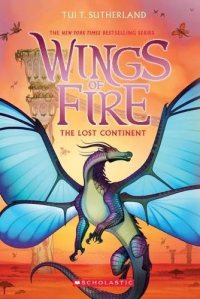
Tui T. Sutherland, The Lost Continent (Book Eleven of the Wings of Fire series, Scholastic Press 2019)
My granddaughter is an obsessive reader, possibly even more so that I was at her age. She reads a lot of comics, often called ‘graphic novels’ to claim a vague respectability, but mostly of a kind that I find hard to take or even fake an interest in: baby sitters, schoolgirl politics, etc. But one series that takes a lot of her time, reading and rereading, and then rereading in apparently random order, is Tui T. Sutherland’s Wings of Fire series. First the comic versions and then the original proper-novel versions of the ones that haven’t been made into comics yet.
I did read the first of the Wings of Fire graphic novels, The Dragonet Prophecy, eighteen months ago. Recently when my granddaughter spontaneously offered to lend me The Lost Continent, how could I say no? It’s the eleventh novel in the series but, she said, it is the first in a whole new story arc (not her exact words – she is after all only eight). When I’d finished it she told me that her reason for letting me read it was that she wanted someone to talk to about the world of the novels. My motive for accepting was to be a decent grandfather and provide her with some company in her reading life.
Virtuous motivation aside, I have to report that I loved this book and am tempted to sign up for the rest of the series. In a prologue, a dragon called Clearsight arrives on a continent that’s far from her home. Chapter One takes up the story two thousand years later when Clearsight is revered as a prophet who is responsible for all that is good in the society. There are three main tribes of dragons on this continent: SilkWings, HiveWings and LeafWings. There has been a huge war. According to the official account, the vicious LeafWings were wiped out by heroic HiveWings (with a red flag to readers of all ages: trees were also wiped out). The SilkWings, forever indebted to their saviours, are pretty much a slave species. Ruling the whole society is Queen Wasp.
Blue, the main character, is a young SilkWing whose wings haven’t come in yet. He believes that all is well. He accepts as simple facts of life that he and his kind have to pass through checkpoints constantly and must never meet the eyes of a HiveWing. But when his older sister Luna’s butterfly-like metamorphosis is brutally interrupted by HiveWing soldiers he has a rude awakening, the seeds of a revolutionary spirit are sown, and adventures ensue.
(Yes, there are words like metamorphosis. Also inexorable. This series doesn’t insult its readers’ intelligence.)
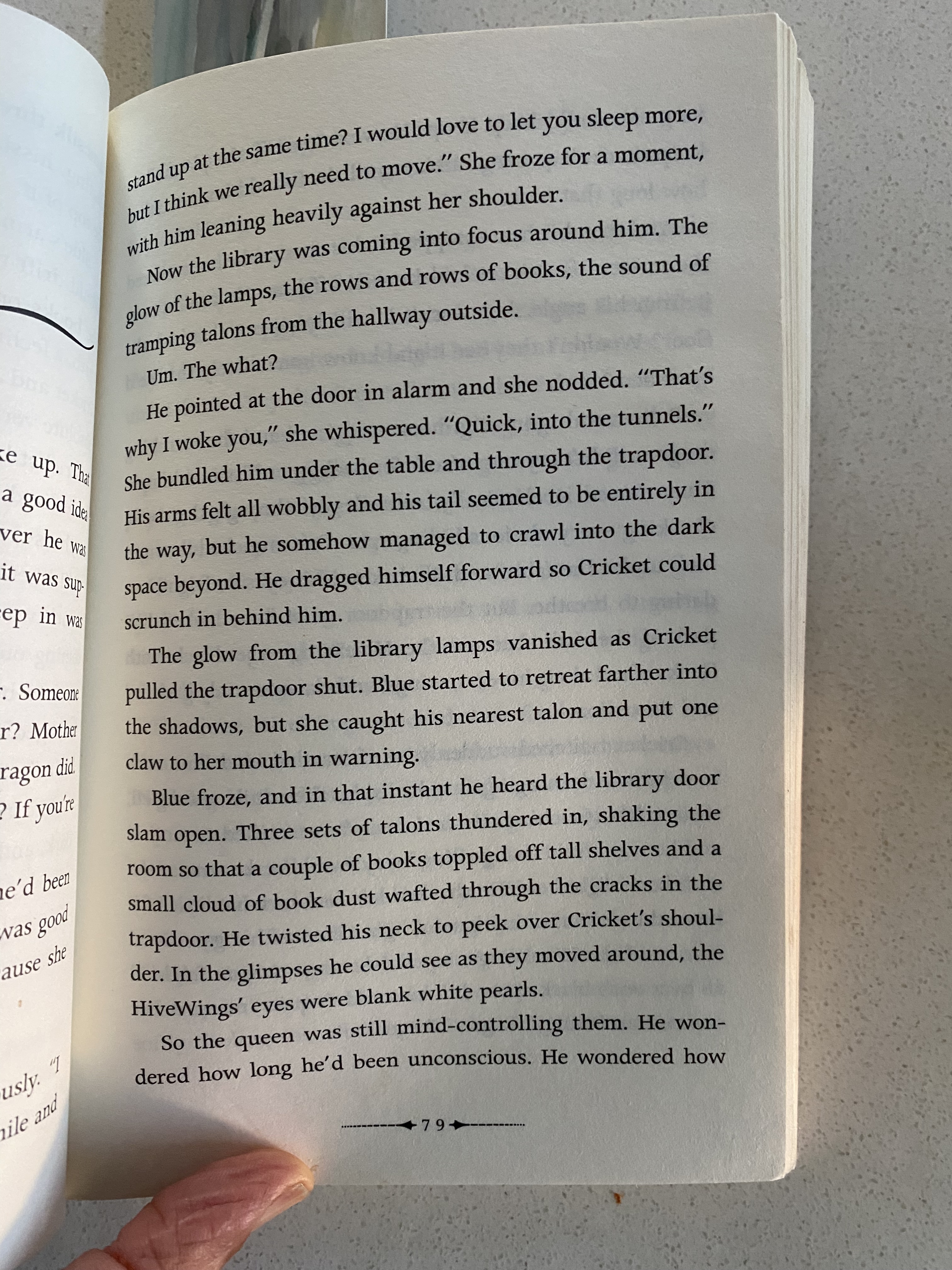
On page 79* Blue has hidden from a host of HiveWings and has met someone we know from the first moment will be the love of his life, a HiveWing named Cricket. Where all the others of her kind can be mind-controlled by Queen Wasp (who Blue now realises is not a benevolent ruler), Cricket somehow remains untouched, and she has helped him to hide in the hive’s library. At the start of this page she wakes him from an exhausted sleep.
What can I say about this? The story rattles along. We never forget that the characters are dragons (‘the sound of tramping talons’, ‘his tail seemed to be entirely in the way’, she ‘put one claw to her mouth in warning’). The queen’s mind-control is vividly, and creepily, conveyed in the image of eyes as ‘blank white pearls’.
As far as I can tell from a quick web search, the books have been extremely popular and, in spite of fostering discussion of subjects including vegetarianism, pacifism, slavery, authoritarian modes of government, internalised oppression, they don’t seem to have fallen foul of book-banners. Maybe it’s because it’s only dragons.
I don’t plan to go back to the previous 10 books, but my granddaughter has lent me the comic version of Darkstalker, a stand-alone that gives some of the back story. Both duty and desire urge me to read it.
I am a man of settler heritage who has been alive for almost a third of the time elapsed since Arthur Phillip claimed this continent for the British crown. I wrote this blog post on the land of Gadigal and Wangal of the Eora Nation. I acknowledge their Elders past and present and welcome any First Nations readers of the blog.
* My blogging practice is to focus on the page that coincides with my age, currently 79.
Niall Williams, The Fall of Light (Picador 2001, Picador ebook 2010)
Before the meeting: The group has previously enjoyed three Niall Williams novels (my blog posts here, here, and here). This month’s chooser decided that we couldn’t have enough of this good thing.
The other novels have been set in the fictional Irish town of Faha. In so far as this one centres on a particular place, it is the real-life Scattery Island in the estuary of the Shannon River, though the action also wanders over three continents. According to a foreword, the novel is a family story that has passed down through generations, embellished on the way.
The story unfolds in 19th century Ireland. In the context of longstanding, brutal English occupation and the devastating potato famine, we follow the travails and adventures of the Foleys. First Emer the mother leaves. Then her husband Francis and their four sons set out across the width of Ireland, on what they see as an epic quest, seeking a new life in the West, in Galway. First Francis is swept away by a river in flood. Then the brothers are separated. Tomas the eldest falls catastrophically in love and flees for his life with his beloved. Of the next two brothers, twins, Finan finds his way to Africa, and Finbar becomes the leader of a community of Gypsies. The youngest brother, with the deeply Irish name Teige, has an uncanny facility with horses that opens possibilities for him. It’s all told in wonderfully musical prose with a touch of what you could call Celtic magic realism.
The family is dispersed – to Africa, to continental Europe, and to North America. The book is most vibrantly alive in the Irish sections. Finan’s life in Africa is told briefly at third hand. Finbar’s adventures with the Gypsies (probably not what they’d be called if the book were written now) left me unconvinced, though there are some wonderful moments, of which my favourite occurs when Finbar, who has waited outside the caravan where his partner was in labour, calls out, ‘How is my son?’ The midwife replies:
‘Your son has no penis.’ She watched as all the fathers’ heads came up and their eyes opened and their mouths dropped and there was a kind of moan that passed among them like a wind. ‘No penis! But two heads!’ she shouted, and bought her hands up to the sunken sides of her leathery face and leaned back and hooted a kind of hoo-hoo of owl-like laughter to the astonishment of all.
When I told a version of that to my grandchildren they were quick to guess that there were twin girls.
Two sons end up in North America. The westward trek in the USA, paralleling the one in Ireland, is a different kind of desolation – a solitary Meek’s Cutoff. But, like the Gypsy story, these sections lack the Irish sections’ vivid sense of place and I was always glad when the narrative returned to Ireland.
Though I infinitely prefer to read books in hard copy, I had to content myself this time with an ebook from the library. Where page 79* falls depends on your settings, but in my reading it occurs at about the one-third point. Francis and Teige, father and son, have been reunited against all odds. (You might have guessed that the shape of the story is separation and then arduously achieved, partial reunion.) After some time together Teige tells Francis that he has done what they all set out to do in the first place – he has seen the sea, and gone into it, even though he was afraid of its wildness. The father says he was ‘right to try it and keep well out of it’:
Another pause, then Teige added: ‘I didn’t though.’ ‘You didn’t?’ The pony flicked her head. Her tail swished. The boy looked at her a moment and felt his father’s eyes upon him. ‘No,’ he said, ‘I still went in, three times.’ The father said nothing then. He sat there and the emotions he held made his lips quiver. He blinked. Dark clouds moved across the sky. The night fell and the stars came and went and wheeled above them and each lay down to the slender hope of their dreams.
This kind of interplay between understated dialogue, big emotions and romantic descriptions, all framed in a mild mockery, is one of the joys of the book. ‘The father said nothing then.’ We have followed Francis’s narrow escape from drowning, so know what lies behind his quivering lips and blink. Maybe the dark clouds and the stars are there to mark the passage of time, but they are also a way of showing the thing that can’t be said by these inarticulate characters: for Francis, the realisation that his son has dared to go into the ocean marks a great shift in his own emotional state. It lends strength to ‘the slender hope’ of his dreams.
You might wonder what that pony is doing there, flicking her head and swishing her tail. Teige has calmed her down and ridden her in a race for the Gypsies, after which she has become his steadfast companion. He is forever moving close to nervous horses, stroking them and speaking to them in language that isn’t quite words, calming them and coaxing them to do what their owners require. It’s an almost magical power that places him at the emotional heart of the book.
This stage of the narrative is a journey. Francis is looking for what will come to be known as Scattery Island – monks who saved him from drowning have given him directions. Both he and Teige are seeking the other sons and their mother.
Still on page 79:
The following day when they were passing a cottage a cry stopped them. The cottage was not unlike others, a small building of dark stone with crooked windows and a door open to the road even in that February. The cry was that of a woman, it came from the garden beyond. The Foleys stopped, the pony flicked her ears. Then Francis called out. There was no response and Francis looked to Teige who slid down the pony. Together they walked in around the cottage and found in a small garden a woman of fifty years trying to pull up from the earthen ridges the fallen body of her husband.
The landscape they travel through is full of suffering and death. Mostly there’s a generosity of spirit among the sufferers. Here Francis and Teige don’t hesitate before they stop to help, and in the nature of fairy tales – or family stories that have been polished and decorated by generations of telling – when they help this couple and their children they gain information that leads them forward dramatically in their quest.
I’ve mentioned Scattery Island a couple of times. The real-life island at the mouth of the Shannon River is better known as Inis Cathaigh (the link is to its Wikipedia page). It became a place of safety for a community of pilots during the Great Famine. How Francis and the other Foleys relate to that actual history is a beautiful invention.
The meeting: We met, unusually, in a pub. It was a beautiful space, though noisy, which made it hard to maintain a single conversation, even with the music turned down. we displaced a women’s baseball team (‘We don’t usually come to the pub on a Tuesday night in our uniforms’) and were displaced in turn by a group of young women toting laptops.
We had a terrific discussion of the book.
A number of us confessed that they had come to the book reluctantly. We’ve read three of his books already. Do we have to read one more? For some, it came alive when the famine appeared. For others, it was the language from the very beginning. I don’t think anyone wasn’t won over completely.
To generalise, we were all willing to forgive its faults because the story rattles along brilliantly, and the writing is wonderful. We differed on what the faults were. One man couldn’t bear the unrealistic elements of the romance between Teige and a wealthy Englishwoman – others (me included) were charmed by its improbabilities. Some loved the sequence where all the Gypsy women give birth on the same day, whereas other (me included) were irritated by the artifice. We were all, I think, unenthusiastic about the North American sections, and even more so by the almost perfunctory treatment of the brother who goes to Africa.
Someone pointed out that it’s a book about men, that the women aren’t fully developed characters. (This observation casts an interesting light on the midwife’s joke I quoted above – the character’s assumption that a baby is a sly indication that the narration knows its male-centredness leaves out a lot.)
At the end of the book, the narrator reveals that Teige is his ancestor. Some of us took this to be an authorial statement – and an explanation for why the narrative is less ‘tight’ than other Williams novels: this is a version of his own family story, so was obliged to go where the actual history had gone, even if fancifully. I’m inclined to think the narrator is separate from the author.
Someone observed that the book is suffused with love, especially love among the Foley men. we agreed that this is true of the book, and it led to a number of us telling stories about their siblings, mainly brothers. There was a theme of connections being lost or broken and re-established after a period. I didn’t realise it at the time, but this was an astonishing echo of the book’s shape.
One question remained unresolved. How do you pronounce ‘Teige’. Everyone except me rhyme it with ‘intrigue’. I hear it as ‘tyke’ but with a soft end. Opinions welcome in the comments.
The Book Group members are all men of settler heritage. We met on Gadigal land. I wrote this blog post on the land of Gadigal and Wangal of the Eora Nation. I acknowledge Elders past and present and welcome any First Nations readers of the blog.
* My blogging practice is focus arbitrarily on the page of a book that coincides with my age, currently page 79.
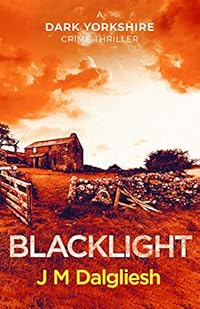
J. M. Dalgliesh, Divided House and Blacklight (both independently published 2018), 2019 audiobook narrated by Greg Patmore
On long car trips, I used to read while the not-yet–Emerging Artist drove. Now, my vocal cords have lost stamina, we have fallen back on audiobooks. For our recent trip to Brisbane, we picked the first instalment of the Dark Yorkshire series – three novels in all. We managed to listen to two of them. We were under the vague impression that we were about to listen to some P. D. James novels featuring her detective Adam Dalgleish. We were wrong.
J. M. (not Adam) Dalgliesh is evidently one of the top ten best-selling authors on Amazon, and Dark Yorkshire was his first, extremely popular series.
In the first book, Divided House, Detective Inspector Nathaniel Caslin has to deal with dead bodies, a cyber-pornography set-up, corrupt colleagues, distrust from his superiors based on past honourable rule-bending, a curmudgeonly inability to deal with digital media (which makes it a surprise to learn he is only in his thirties), a marriage that is falling apart, and all the tropes of a good crime thriller.
This is the kind of storytelling that is consumed rather than engaged with in any reciprocal way. These days I consume it almost exclusively on screen, and mostly the small screen.
The plot is a bit too convoluted for my travel-weary attention span. Award-winning narrator Greg Patmore does a fine job for the most part, though I would have preferred that he didn’t try so hard to give each of the many characters a different voice, especially the women. It seemed that he was focusing on the women characters’ femininity at the expense of other qualities, by speaking in almost-falsetto. I occasionally had to remind myself that the woman character Caslin finds himself attracted to isn’t written as trans – she just sounds that way.
Caslin is also the hero of the second book, Blacklight. This time he’s dealing with a serial killer, and/or MI5. Not my favourite story type. But he does have a female partner, and once I accepted Greg Patmore’s version of a woman policeman’s voice, her bristly relationship with Caslin added some humour to proceedings.
J. M. Dalgliesh’s website has this to say about his books:
Penned in the style of crime thrillers with a touch of Scandinavian noir, readers who enjoy dark atmospheric mysteries will find his books a must-read.
If you can ignore the image of penned readers conjured up by the syntax of that quote, then these books may be for you.
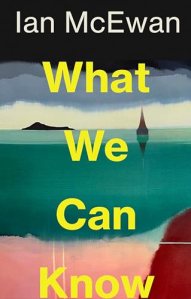
Before the meeting: I heard Ian McEwan talking about this novel on David Runciman’s Past Present Future podcast a while back (at this link). Well, not so much about this novel as about what it’s like to be contemplating one’s own death at a time when the future of the world as we know it is in doubt. How will the people of the future regard us who were alive at this critical moment in human history? That question, he said, was the genesis of the novel.
What We Can Know is set in Britain long after our time, which is known in that future as the Derangement. In 2042 there has been an Inundation caused by the melting ice caps, and a nuclear winter created by international war has put an end to global warming. Britain is now an archipelago. North America is the domain of lawless warlords. Nigeria has become the preserver of electronic connectivity. Life is simpler and more difficult, but there are still academics, and there is a vast trove of records preserved from our time.
The central characters of the novel specialise in the literature of a period that overlaps our present moment. Their students revolt, seeing such studies as irrelevant to the needs of the times, and regarding literature produced by the generations who allowed such catastrophic events as beneath contempt.
That all works well. The physical environment is always interesting, even for a reader like me who has little knowledge of British geography, and so can’t appreciate the specifics of boat trips from island to island. However, I was far from engrossed by the central narrative thread, which concerns the main character’s search for a long lost poem, written in 2014 but never published. He hunts through the vast reservoir of data, and pieces together a picture of the dinner party when a distinguished poet read the poem aloud and presented it to his wife on a vellum scroll tied up with a bow. The story is told and retold from many points of view, becoming in my experience increasingly tedious, until there is a final telling that may amount to a revelation, but by that time I was well beyond caring.
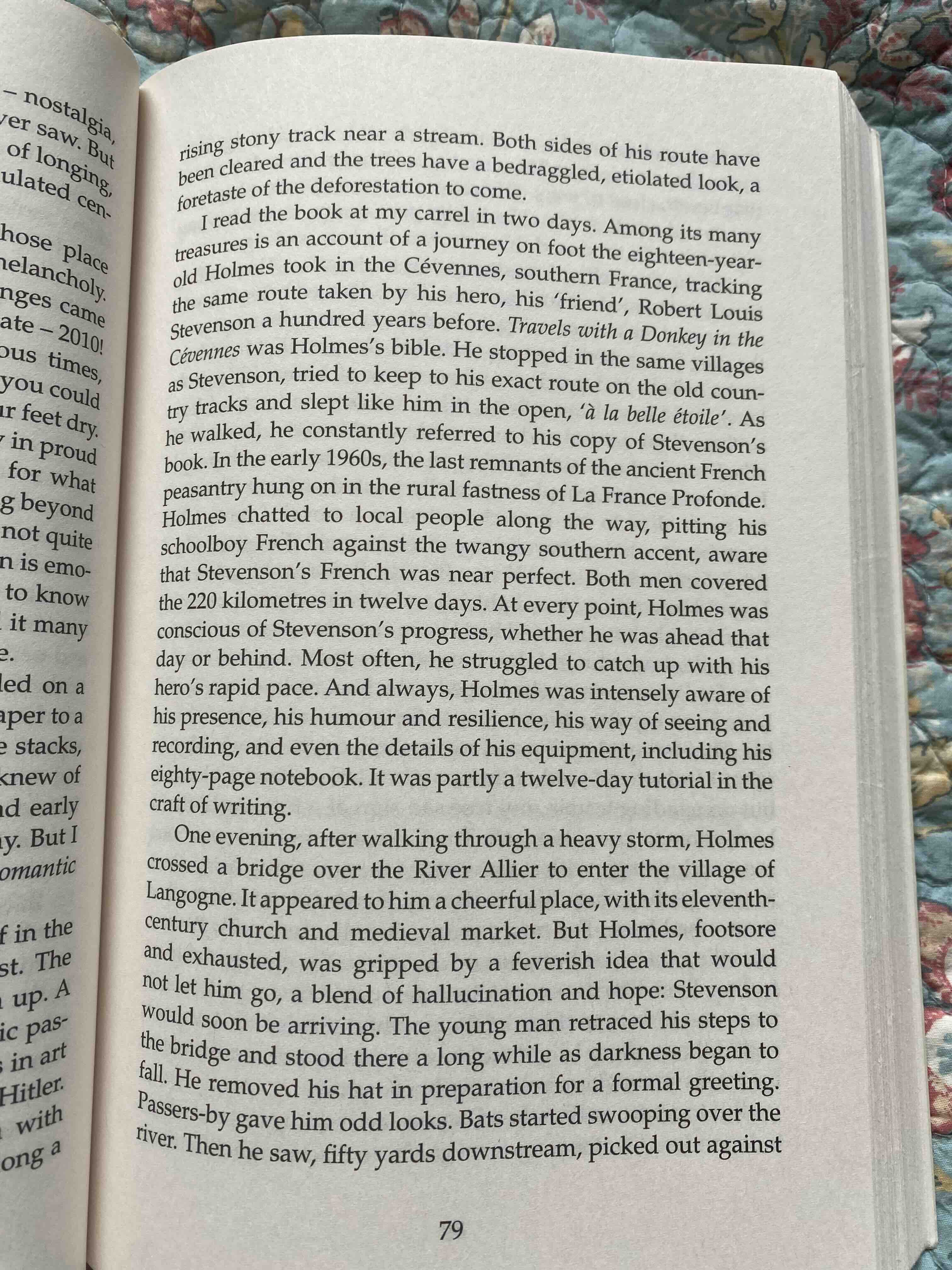
Page 79*, taken in isolation, isn’t much to write home about, though it’s a nice example of the novel’s intertextuality. It’s a summary of part of an actual book published in 1985, Footsteps: Adventures of a Romantic Biographer by Richard Holmes, which has a minimalist Wikipedia page at this link.
Among its many treasures is an account of a journey on foot the eighteen-year-old Holmes took in the Cévennes, southern France, tracking the same route taken by his hero, his ‘friend’, Robert Louis Stevenson a hundred years before. Travels with a Donkey in the Cévennes was Holmes’s bible. He stopped in the same villages as Stevenson, tried to keep to his exact route on the old country tracks and slept like him in the open, ‘à la belle étoile‘. As he walked, he constantly referred to his copy of Stevenson’s book. In the early 1960s, the last remnants of the ancient French peasantry hung on in the rural fastness of La France Profonde.
And so on. I was interested enough in the description of Holmes’s book because I’d enjoyed the 2020 film Antoinette dans les Cévennes, which also traces the route taken by the young Robert Louis Stevenson in the 1870s.
You won’t be surprised to learn that the passage’s context makes it something more than a schoolboy summary. The narrator had come across Holmes’s book when he was a 22 year old student who hadn’t yet settled on a subject for his doctorate. He had ‘eased the hundred-year-old hardback from its shelf’ as a delicate remnant from a past era, and tells us about it now because it contains one of the ‘most exquisitely evoked descriptions’ of a longing for ‘what was never known and is lost’ – the emotion that is the central driver of his academic research and of his quest as narrated in the first half of this book. The world before one was born in what was never known, and its loss is intensified for those who live after the Inundation
Most of page 79 leads up to that ‘exquisitely evoked description’. Then, at the bottom of the page, Holmes is standing at a bridge in the village of Langogne in a semi-hallucinatory state hoping that Stevenson, long dead, would soon be arriving:
Then he saw, fifty yards downstream, picked out against the fading gleam of the western sky, the old ruined bridge into town, the one his dear Stevenson would have crossed. Holmes was bereft, close to tears. ‘There was no way of following him, no way of meeting him. His bridge was down. It was beyond my reach over time, and this ruin was the true, sad sign.’
The narrator draws out the meaning of this:
The collapsed bridge downstream and the man crossing it a hundred years before represent the past from which I too am excluded, the past that from here seems whole and precious, when many of humanity’s problems could have been solved.
But, though Stevenson’s bridge was down, the country he had walked was substantially unchanged in Holmes’s time. In the narrator’s present time, all that land is lost, under water.
And that is the chord that vibrates through the novel. I the reader am living in the time that the character sees as ‘whole and precious’. Logically I can see that the book should have me on an edge – a prolonged moment of appreciating the world I live in, preemptively mourning its loss, and resolving to do what I can to protect and defend it. Whether the failure is mine or the novel’s, it didn’t have that effect on me.
When – spoiler alert – the second half of the novel has a different narrator, in a different time period, that driving emotion fades into a distant background, and the book, in my opinion, becomes a much more commonplace affair.
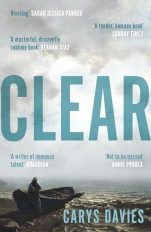
The meeting: We read What We Can Know in tandem with Carys Davies’s Clear. Like that book, it evoked widely divergent responses. In this case I was the Most Negative, and she who had been Most Negative for Clear enjoyed this one as a satisfying holiday read.
For some the world-building amounted to thinly disguised lecturing about climate change. Others felt there wasn’t enough of it – and I guess I’m in that camp: I would happily have stayed in that future, wandering beyond the confines of university scholarly life. Where my engagement as a reader was fading by the end of the first part and died irretrievably when the narrator and time frame changed, that was where others felt the book finally came alive. I think there were two people (out of five) who were there for both parts. (My interest had died to such an extent that I had to be reminded of the key revelation in the second part.)
I think the key thing that worked for others and not for me is announced in the book’s title. Appropriately enough, the title is hard to remember: I keep misremembering it as ‘All We Can Know’ or ‘All That You Know’ and I keep thinking of Keats – ‘That is all / Ye know on earth and all ye need to know.’ So What We Can Know: the book is about knowledge, specifically historical knowledge. The academics of the future can sift through the mountains of detailed electronic and other documentation of our times but what goes unrecorded will remain unknown, and if the records of significant truth aren’t found then that truth remains unknown.
I’m sailing very close to spoilerish now, but the book’s central search for a lost poem, reputedly a masterpiece, turns out to be wrong-headed. A different document, found thanks to ingenious deciphering of clues in the archive, transforms the meaning of events as they were known up to that point. For some readers, perhaps for most, this is deeply satisfying. It might, I concede ruefully, be a matter of attention span.
The Book Club’s five members are all of settler heritage. Our combined ages add up to many more years than have passed since Arthur Phillip claimed this continent for the British Crown. We met on Gadigal land, and I wrote the blog post on Wangal and Gadigal land. I gratefully acknowledge the Elders past and present who have cared for this beautiful country for millennia, and welcome any First Nations readers of this blog.
* My blogging practice is to focus on the page that coincides with my age, currently 79.
Before the meeting: On a remote island to the north of Scotland, the population has shrunk to just one man, plus a cow and a number of domestic animals. The man, Ivar, is the sole surviving speaker of the island’s language. The island is owned by a wealthy mainlander, and this is 1843, during the time of the Clearances, when tenants all over Scotland were evicted to make way for more profitable sheep. An idealistic clergyman, John Ferguson, an impoverished member of the newly formed Free Scottish Church, agrees to take on the errand of travelling to Ivar’s island to prepare him for his removal. The errand turns out not to be all that simple: John Ferguson (he is always referred to by both names) has a near-fatal fall, Ivar tends him, and as he recovers they learn to speak each other’s language.
I love this book. It’s a story well told, with genuine suspense (what will become of the gun that John Ferguson brings with him to the island?) and an implausible final twist that I found delightful. What I especially love is its resonance with Australian history. As the relationship between the two men develops and Ivar shares his knowledge of knowledge of language and place with John Ferguson, I am reminded insistently of the relationship in the early settlement of Sydney between Lieutenant Dawes and the young Cammeraygal women Patyegarang – as fictionalised by Kate Grenville in The Lieutenant and explored by Ross Gibson in 26 Views of the Starburst World (links are to my blog posts – if you’ve got time to spare I recommend the comments on the second one for some splendidly irrelevant Canadian humour). There is a similar sense of a small piece of light against the gathering gloom of genocide and language extinction.
It’s a short novel, and page 78* comes just after the halfway mark. Perhaps it marks a turning point:
It’s two weeks since John Ferguson has been dropped off on the island and fallen from some rocks. He is recovering well in Ivar’s hut and the language lessons are well under way:
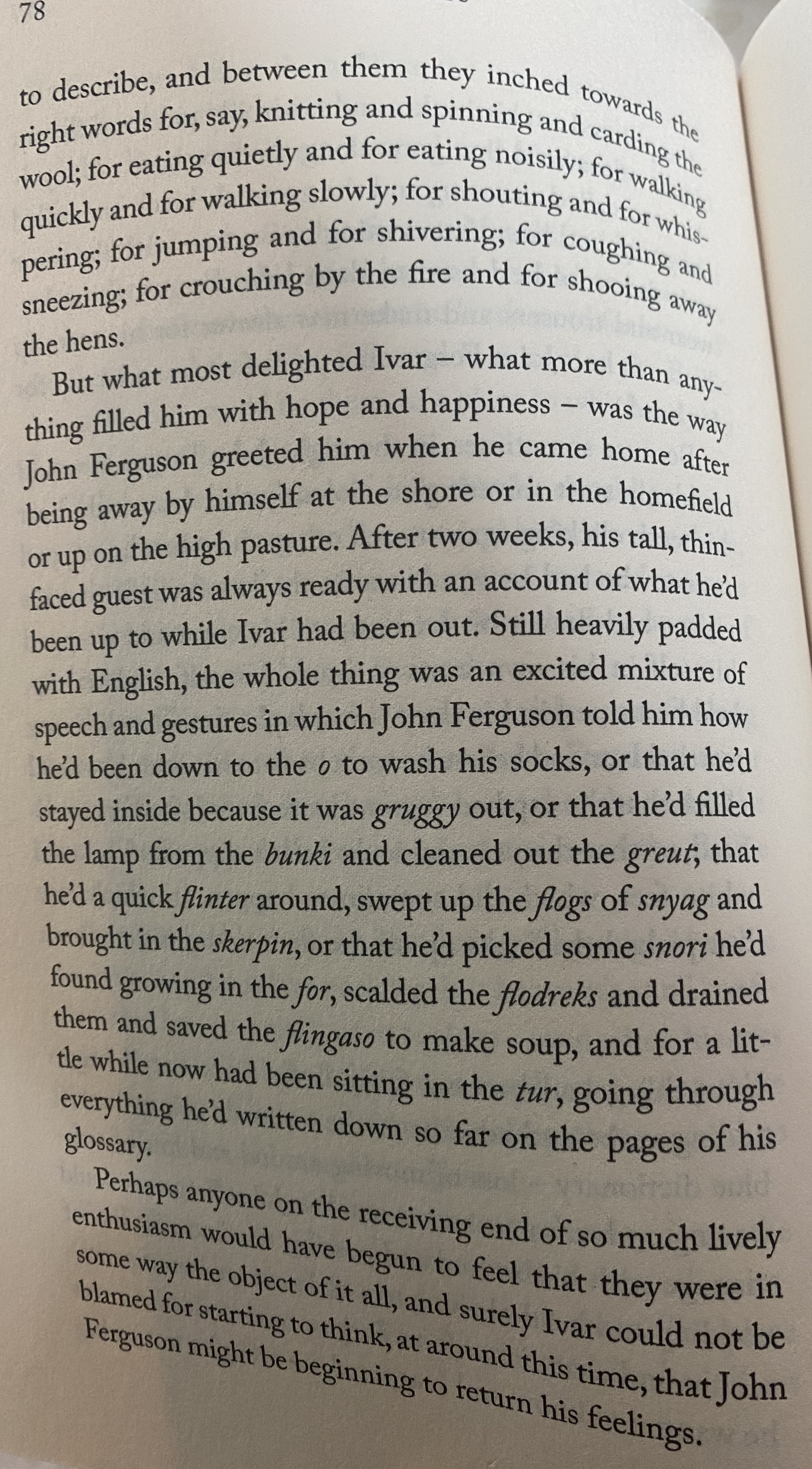
John Ferguson mimed what it was he wanted to know, and Ivar acted out what he was trying to describe, and between them they inched towards the right words for, say, knitting and spinning and carding the wool; for eating quietly and for eating noisily; for walking quickly and for walking slowly; for shouting and for whispering; for jumping and for shivering; for coughing and sneezing; for crouching by the fire and for shooing away the hens.
In the next paragraph, the reader is drawn into the process, as words from Ivar’s language are incorporated into the text:
Still heavily padded with English, the whole thing was an excited mixture of speech and gestures in which John Ferguson told him how he’d been down to the o to wash his socks, or that he’d stayed inside because it was gruggy out, or that he’d filled the lamp from the bunki and cleaned out the greut; that he’d a quick flinter around, swept up the flogs of snyag and brought in the skerpin, or that he’d picked some snori he’d found growing in the for, scalded the flodreks and drained them and saved the flingaso to make soup, and for a little while now had been sitting in the tur, going through everything he’d written down so far on the pages of his glossary.
I so appreciate Carys Davies’ good judgement in not giving us footnotes. They are absolutely not necessary – we are allowed to have a faint taste of learning the language by immersion. An interested reader, as I definitely am, can turn to the Author’s Note to find that, unsurprisingly, Ivar’s language is not Carys Davies’ invention. It is a version of Norn, now extinct but once spoken on the islands of Orkney and Shetland – and on Ivar’s fictional island which lies further north than either of those. The Author’s Note includes a glossary, including all the words in italics/purple on page 78 – flodreks, for example, are ‘limpets’ and flingaso is ‘water in which limpets have been scalded’.
Beneath this excited learning to communicate, and in the process learning about Ivar’s solitary way of life, there is a dark undercurrent. Over this idyllic scene there lies the shadow of John Ferguson’s mission. John Ferguson has allowed himself to forget about it for now, and Ivar is blissfully unaware of it. John Ferguson has been warned that Ivar, generally ‘placid and obedient’, was also large and strong and might not take kindly to being uprooted.
Perhaps anyone on the receiving end of so much lively enthusiasm would have begun to feel that they were in some way the object of it all, and surely Ivar could not be blamed for starting to think, at around this time, that John Ferguson might be beginning to return his feelings.
Just as, with genocide looming in Sydney, Lieutenant Dawes and Patyegarang developed an intimate relationship, so here Ivar has a growing emotional attachment to the messenger of his eviction. And at this point in the novel who can say if he’s right about John Ferguson returning his feelings? Certainly not the oblivious clergyman.
After the meeting: Astonishingly, while everyone agreed that the writing was excellent there were sharply divergent views about this book. The most negative version was that the book is completely silly. Nothing made sense: why did the owners need Ivar off the island, why had he stayed there in the first place, how unlikely is it that a clergyman would have taken on such an errand, how boring is all that stuff about language, how ho-hum is the inexorable movement towards the two men having sex, how implausible is the sex when it finally happens, and above all who would ever buy the final resolution? All of these questions could be answered satisfactorily by those of us who enjoyed the book, but our answers cut very little mustard. Mind you, I don’t think anyone saw the final resolution as completely realistic (see how careful I’m being about spoilers!): the difference is that some of us didn’t mind, and even enjoyed the improbability.
The Most Negative didn’t feel, as others of us did, an underlying dread: as the two men are building mutual trust and affection, we know that the moment will come when John Ferguson will have to reveal his true mission. And we know there is a concealed gun. Ivar has a secret ass well, so the elements were in place for an explosive climax. The book delivers that climax, but clearly not in ways that satisfied all readers.
I was pretty much alone in having loved the language lessons. But I think the world of the island felt real and substantial to us all, was in fact the book’s saving grace, even for the MN.
We read this book along with Ian MacEwan’s What We Can Know, which also prompted very different responses. Both books have islands and difficult sea voyages in small vessels.
I am a man of settler heritage who has been alive for almost a third of the time that has elapsed since Arthur Phillip claimed this continent for the British crown. The book club met on Gadigal land, and I wrote this blog post on the land of Gadigal and Wangal of the Eora Nation, where the nights are lasting longer and small lizards seem to be everywhere. I acknowledge the Elders past and present of all those clans and welcome any First Nations readers of the blog.
* My blogging practice is to focus on the page that coincides with my age, which was 78 when I wrote that part of this blog post.
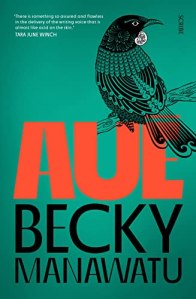
According to the book’s extensive glossary of Māori terms, Auē means ‘to cry, howl, wail’. Alternatively it is an ‘interjection showing distress’. This novel can be read as one long cry of distress for people, both Māori and Pākehā, male and female, young and old, in marginalised communities in New Zealand/Aotearoa. It’s a cry that has been heard around the world. According to Wikipedia, the first edition, published by independent publisher Mākaro Press in 2019, had a print run of 500 copies. It went on to win a number of prizes, was a best seller in New Zealand, and has been translated into several languages. The 2022 Scribe edition, which is what I have read, is published in the UK, the US and Australia.
Like many contemporary novels, Auē has a number of story lines with no obvious connection. It begins with young Ārama (Ari), who has recently lost his parents in an event whose specifics are revealed only in the last pages. Abandoned by his older brother who sets off on a quest of his own, he is left in the care of an aunt and her violently abusive white husband. The glimmer of hope in his new life is the friendship of a girl neighbour, Beth, whose farmer father Tom Aitken is a benevolent adult presence.
In a separate narrative strand, in chapters mainly labelled ‘Jade and Toko’, two young adult Māori women are caught up with thuggish men. Under cover of attending family funeral commitments, they escape to have fun together and have moments of romance – Jade with Toko, a gorgeous, guitar-playing man who is courageous, kind and protective. Things go well for a time, but there’s a terrible violent turn.
As the relationship between the two narratives is revealed, a complex picture emerges of family tragedy. There’s something of the feel of a quality TV series to the book, though it is much better written than that might seem to imply.
Page 79* is in one of Ārama’s chapters. A sleepover at the dairy has been planned.
[For those who don’t know, in New Zealand a dairy is what in Australia would be called a milk bar – a shop that sells sweets and ice creams among other things. Short rant: When I worked in children’s literature it was often remarked that US publishers of Australian and New Zealand books would routinely ask for terms to be Americanised, as if US children had to be protected from knowing that elsewhere people named the world differently. One of the charms of this book is that local idioms have not been removed. There are many Māori words, most of which are included in the glossary at the back of the book, but words like ‘dairy’ and ‘pottle’ are allowed to stand without explanation, and I rejoice. End of rant.]
Aunt Kath has cancelled the sleepover after being beaten by Uncle Stu, her husband. Ari has overheard the violence and is terrified. On page 79 Tom Aitken is stepping into the breach and having Ari at his place for the night.
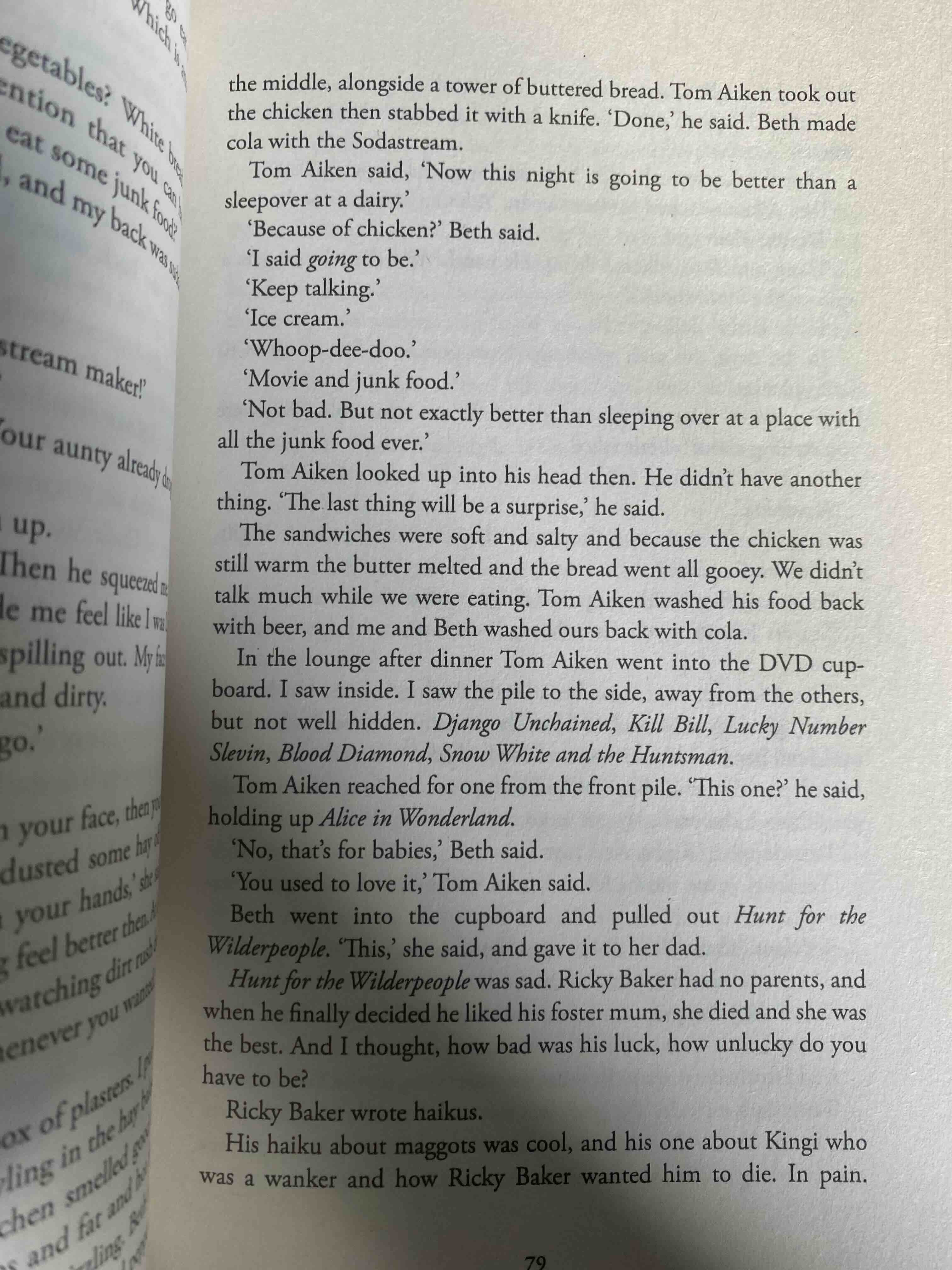
Without my rule of 79, I wouldn’t have chosen this page to illustrate what is most compelling about the book. It’s an uneventful scene of a man and two children having a meal together. All the same it gives an idea of some of the qualities of the writing. In context it’s an oasis of normality, where Beth can be a little bit cheeky, and a little bit self-assertive without bringing disaster on themselves. The only violence here is against a cooked chicken:
Tom Aiken took out the chicken then stabbed it with a knife. ‘Done,’ he said. Beth made cola with the Sodastream. Tom Aiken said, ‘Now this night is going to be better than a sleepover at a dairy.’ ‘Because of chicken?’ Beth said. ‘I said going to be.’ ‘Keep talking’ ‘Ice cream.’ ‘Whoop-dee-doo.’ ‘Movie and junk food.’ ‘Not bad. But not exactly better than sleeping over at a place with all the junk food ever.’
The wider themes are suggested by what Ari glimpses in the DVD cupboard – perhaps, it’s subliminally suggested, this book has something in common with violent Hollywood.
In the lounge after dinner Tom Aiken went into the DVD cupboard. I saw inside. I saw the pile to the side, away from the others, but not well hidden. Django Unchained, Kill Bill, Lucky Number Slevin, Blood Diamond, Snow White and the Huntsman.
There’s a knowingness as if the author is talking to us over Ari’s shoulder. I confess that while reading this book I thought often about K, a member of my Book Group, who says he dislikes narratives that simulate a child’s voice. Auē is definitely not a book for child readers, but the Ārama chapters are narrated by the 11 years old boy at the heart of the story, and the faux-naïf voice had me understanding irritates K. (I’ve recently reread The God of Small Things, much of which is from the point of view of the girl Rahel, and the contrast couldn’t be starker: children aren’t just adults with less complex syntax.) Ari and Beth are wonderful characters, who play at being Django and Doc from the Tarantino movie. But their complexity doesn’t carry over to Ari’s narrative voice.
Beth went into the cupboard and pulled out Hunt for the Wilderpeople. ‘This,’ she said, and gave it to her dad. Hunt for the Wilderpeople was sad. Ricky Baker had no parents, and when he finally decided he liked his foster mum, she died and she was the best. And I thought, how bad was his luck, how unlucky do you have to be? Ricky Baker wrote haikus. His haiku about maggots was cool, and his one about Kingi who was a wanker and how Ricky Baker wanted him to die. In pain. Which I thought was a pretty bad thing to admit to.
Ari’s simple declarative statements about the movie are other examples of the kind of simplified language I mean. There’s a little more talking over Ari’s shoulder. Taika Waititi’s Hunt for the Wilderpeople isn’t a random choice of a movie for the three of them to watch. It has a slightly laborious meta function – the novel is naming a work that it can be linked to.
Ricky Baker’s haiku in the movie give rise to a nice moment on the next page where elements of the plot are condensed into two haiku. The first, by Beth:
Stu-art John-son you
are the ug-li-est farm-er
hope cows shit on you
After that has evoked pretend disapproval from her father, it’s Ari’s turn:
Tau-ki-ri wrote me
a let-ter and it said he's
on his way home-home.
At this point of the novel, about the one-quarter mark, that’s the two points of suspense: will the little family be reunited? and will violence against women and children be brought to an end? And you know, I wasn’t any doubt about the answers.
I am a man of settler heritage who has been alive for almost a third of the time that has elapsed since Arthur Phillip claimed this continent for the British crown. I wrote this blog post on the land of Gadigal and Wangal, where the nights are lating longer and small lizards seem to be everywhere. I acknowledge their Elders past and present and welcome any First Nations readers of the blog
* My blogging practice is to focus on the page that coincides with my age, currently 79.
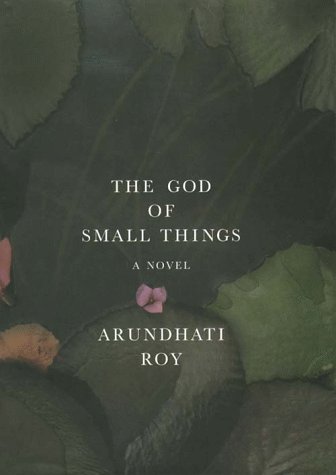
Arundhati Roy, The God of Small Things (Flamingo 1997)
Before the meeting: After Arundhati Roy’s memoir Mother Mary Comes to Me gave us so much pleasure last month, this month’s Chooser met with general approval when he picked the novel that made her famous.
I first read The God of Small Things before I started blogging. Apart from a general sense of having enjoyed it, I retained just one image, of a group of policemen marching in long grass. It turns out that the image comes towards the end of the book, on page 304:
A posse of Touchable Policemen crossed the Meenachal river, sluggish and swollen with recent rain, and picked their way through the wet undergrowth, the clink of handcuffs in someone’s heavy pocket. Their wide khaki shorts were rigid with starch, and bobbed over the tall grass like a row of stiff skirts, quite independent of the limbs that moved inside them.
There’s so much of the book in those two sentences. The starched shorts, so vividly present and so rich with metaphorical meaning; the initial capitals ‘Touchable Policemen’ marking a childlike personification of key concepts; the river, the undergrowth and the tall grass as part of the physical environment that is such a force in the book. Above all, the complex tone is characteristic: the soldiers are almost comic, puppet-like, yet the reader knows that they are about to do terrible things.
The rest of the book was fresh and new to me. It’s the story of twins Estha and Rahel, their mother Ammu (whose divorced status was scandalous in the mid 1960s, in the Syrian Christian community of their small village in Kerala), and their extended family: Ammu’s brother Chacko, her blind mother Mammachi, and Baby Kochamma. (The text is scattered with Malayalam words, only sometimes translated. I understood ‘Kochamma’ to mean ‘Auntie’, and a quick websearch just now gave ‘a woman who is to be respected like a mother’.) In spite of her cuddly name, Baby Kochamma is a nasty piece of work, disappointed in love by a priest when she was young, and now bitter, moralistic and vindictive. Chacko’s divorced wife, an Englishwoman, comes to visit with her daughter Sophie Mol (‘Mol’ means something like ‘daughter’), who is about the same age as Estha and Rahel.
We know from the beginning that there is to be a disaster. The narrative takes place in at least three time frames: before the disaster, the disaster, and a couple of decades after the disaster. We see Sophie Mol’s funeral before we know who she is, and there are plenty of hints of the other terrible incident – which isn’t revealed until the final pages, just after the scene with the starched shorts.
There’s another moment that has idiosyncratic resonance for me. There are a three or four guava trees on streets near my home. I recently went scrounging and picked from the trees and from the footpaths enough ripe and slightly bruised fruit to make a delicious jar of jam. The unusable fruit on the ground, and there was a lot of it, was a disgusting mess. So it was a personal pleasure when a day or so later, on page 205, Rahel and Estha approach the hut of Velutha, a servant whom they love:
Velutha wasn’t home. <snip> But someone was. A man’s voice floated out from inside and echoed around the clearing, making him sound lonely. The voice shouted the same thing, over and over again, and each time it climbed into a higher, more hysterical register. lt was an appeal to an over-ripe guava threatening to fall from its tree and make a mess on the ground.
Pa pera-pera-pera-perakka (Mr gugga-gug-gug-guava), Ende parambil thooralley (Don’t shit here in my compound). Chetende parambil thoorikko (You can shit next door in my brother’s compound), Pa pera-pera-pera-perakka (Mr gugga-gug-gug-guava.)
Exactly what I want to sing to the guavas of Enmore.
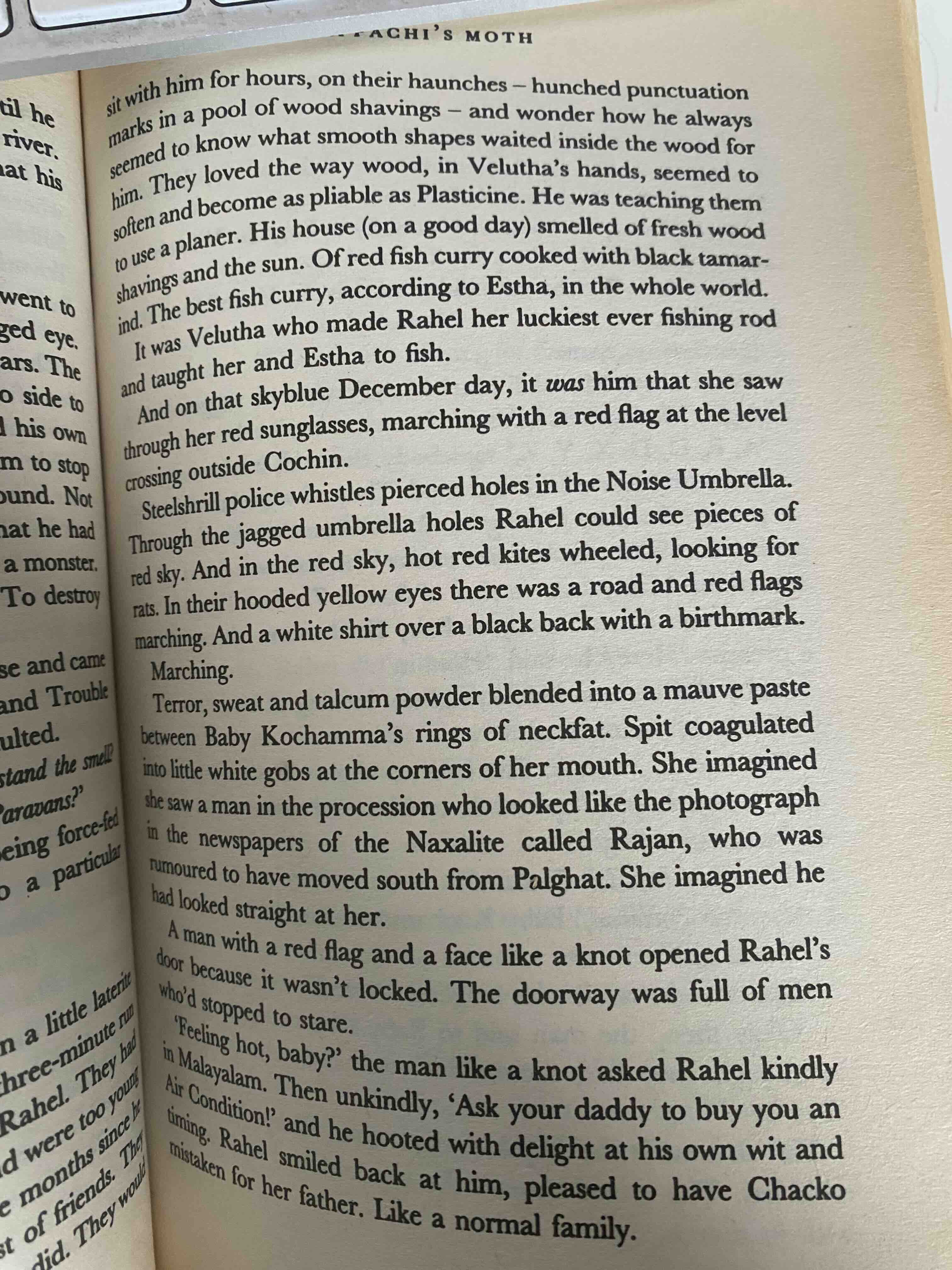
This is a book that cries out for quotation. You can feel Arundhati Roy’s glee as she comes up with similes, malapropisms and mondegreens, little asides, big digressions, wonderful descriptions of people. Page 79* is a good example. As it happens, it starts with Velutha and moves on to Baby Kochamma.
The family are driving to the nearest sizeable town, Cochin, to see The Sound of Music. It’s a long drive, interspersed with flashbacks, flashforwards and songs from the show. At page 78, already running late, they are held up by a demonstration – the street is full of workers, possibly including some Naxalites (the ‘extremists’ who Arundhati Roy was to spend time with in the jungle some decades later), carrying the red flag of Communism. The adults in the car have complex responses. Baby Kochamma is unequivocally on the side of capitalism; Chacko, though he effectively owns a pickle factory, identifies as a Marxist and theoretically is on the side of the workers; the twins’ mother says nothing, but later we realise that she has fellow feeling with the demonstrators. Rahel thinks she sees Velutha – as a former Untouchable, he usually goes shirtless, but the man Rahel sees is wearing a white shirt and waves a red flag.
Though we have met Velutha previously in stories of Ammu’s childhood, it’s here that we learn who he is from the twins’ point of view:
They would sit with him for hours, on their haunches – hunched punctuation marks in a pool of wood shavings – and wonder how he always seemed to know what smooth shapes waited inside the wood for him. They loved the way wood, in Velutha’s hands, seemed to soften and become as pliable as Plasticine. He was teaching them to use a planer. His house (on a good day) smelled of fresh wood shavings and the sun. Of red fish curry cooked with black tamarind. The best fish curry, according to Estha, in the whole world. It was Velutha who made Rahel her luckiest ever fishing rod and taught her and Estha to fish. And on that skyblue December day, it was him that she saw through her red sunglasses, marching with a red flag at the level crossing outside Cochin.
Then there’s a characteristic switch in perspective. The omniscient narrator steps in with a premonition. Rahel’s red-tinted glasses fill the world with the colour of danger. Birds of prey wheel above the demonstration, and Velutha’s black back with its distinctive leaf-shaped birthmark becomes a potential target:
Rahel could see pieces of red sky. And in the red sky, hot red kites wheeled, looking for rats. In their hooded yellow eyes there was a road and red flags marching. And a white shirt over a black back with a birthmark. Marching.
Then the point of view comes right down to a close-up, and some characteristically tactile description. Where Rahel sees a friendly figure in the crows, Baby sees a threat:
Terror, sweat and talcum powder blended into a mauve paste between Baby Kochamma’s rings of neckfat. Spit coagulated into little white gobs at the corners of her mouth. She imagined she saw a man in the procession who looked like the photograph in the newspapers of the Naxalite called Rajan, who was rumoured to have moved south from Palghat. She imagined he had looked straight at her.
I love the final paragraph on the page. Rahel the child is aware that the man with ‘a face like a knot’ means to be unkind, but her preoccupations seize on his unintended normalising of her family.
A man with a red flag and a face like a knot opened Rahel’s door because it wasn’t locked. The doorway was full of men who’d stopped to stare. ‘Feeling hot, baby?’ the man like a knot asked Rahel kindly in Malayalam. Then unkindly, ‘Ask your daddy to buy you an Air Condition!’ and he hooted with delight at his own wit and timing. Rahel smiled back at him, pleased to have Chacko mistaken for her father. Like a normal family
I can’t say I know a lot about India. I’ve never been to Kerala. But at a railway station in Rajasthan, men did stop to stare unblinkingly at the young women in our group. It didn’t feel particularly aggressive or even deliberately impolite. We put it down to cultural difference. That experience helps me to visualise what Arundhati Roy is describing here, and to understand why Rahel isn’t particularly disturbed.
On the next page, the man with the flag turns his attention to Baby Kochamma and speaks to her in English, justifying her terror. But that’s another story, of the many told in this marvellous book.
The meeting: There were seven of us and as always we ate well and enjoyed each other’s company. We spoke as little as possible about Donald Trump, Iran, Israel, fuel and the tendency among younger generations to identify with self-diagnosed mental illness or neurodivergence. We gave passing glances to recent theatre and film pleasures, and to bodily pains, including severe side effects from statins that two of us have experienced, and the satisfaction of a third who convinced his specialist not to prescribe them for him.
One person had said on the WhatsApp group that he’d reach the halfway point of the book and was going to give up. I replied on the group that I loved the book and was looking forward to an interesting conversation – but it turned out that he had read the wrong Arundhati Roy book, The Ministry of Utmost Happiness. He said at the meeting that there are some wonderful passages in it, but he found it very hard going.
Another person had read the right book in the 1990s and hadn’t been inclined to reread it. I don’t think this was from active dislike. As the single parent of a teenager, and the only one at the meeting still in full-time employment, I imagine he doesn’t have a lot of time for reading, let alone rereading.
One person was about halfway through the book, but intending to read the rest and not touchy about spoilers. I’m starting to think it would be good to have a designated non-finisher for every meeting. The non-finisher could then ask questions that lead the rest of the group to think about how things fit together. In this case, there’s a scene where Estha, the boy twin, is sexually molested. Our non-finisher wanted to know if this had a lasting effect on him as it seemed at the time that life just carried on. I replied blithely that it was a bit of a red herring – we were tempted to read this incident as explaining why the Estha we see many years later has become an alienated mute, but the real cause is the much worse incident that happens at the book’s climax. I was gently corrected: Estha’s terror of the incident being repeated set off a chain of events that leads to the climactic incident.
Of the other four, one had read the book reluctantly – feeling that he might have had enough Indian novels for a while (cue a brief digression as we enthused that Amitav Ghosh is scheduled to come to the Sydney Writers’ Festival in May), and it took a while but after the halfway point, once all the characters had been introduced and the plot got moving, the book won him over completely. We generally agreed that it was a bit of a struggle in the first half to keep track of the complex set of relationships. The time shifts, especially in the first half, were often confusing. It’s a book, someone said, that needs to be read in reasonably long sessions – not ten minutes at a time before you go to sleep at night. Nods all round.
Someone else said that when he was struggling with the language he read a passage out to his partner to see if she could make head or tail of it. When he heard the words aloud he realised they were crystal clear. From then on, he slowed down, letting the language play on his inner ear, and enjoyed the experience. (Sadly, he couldn’t find the passage to read it to us.) Conversation hovered around this: not universally seen as a virtue, the book is peppered with writerly quirks, turns of phrase or eccentric punctuation that draw attention to themselves and pull the reader out of the story for a moment. A young writer flexing her muscles, I think someone said. And why not? someone may have said back.
We left our host with the washing up and dispersed into a clear, warm, early Autumn night.
I am a man of settler heritage who has been alive for almost a third of the time that has elapsed since Arthur Phillip claimed this continent for the British crown. The Book Group met on Gadigal land. I wrote this blog post on the land of Gadigal and Wangal, where yesterday’s sudden downpours show no sign of recurring today. I acknowledge Elders past and present and welcome any First Nations readers of the blog.
* My blogging practice is to focus on the page that coincides with my age, currently 79.
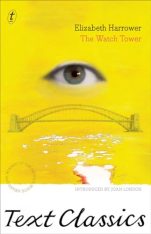
Elizabeth Harrower, The Watch Tower (1966. Text Classics 1996)
Before the meeting: I’m sticking to my resolve to write only about page 78*.
If you want a brief, thoughtful discussion of this book and its place in Elizabeth Harrower’s life work, there are plenty around. I recommend Kerryn Goldsworthy’s review, published in the Australian Book Review in 2012 (at this link). I particularly like this:
It is an accomplished and sophisticated novel of great power and intensity, but, as with most good psychological realism, the reader approaches the final pages with a sensation of exhausted, bruised relief.
It turns out that focusing on page 78 means paying attention to something I saw as of secondary interest on first reading.
This page features the book’s villain, Felix Shaw. (Sadly Elizabeth Harrower seems to have it in for Shaw men: a number of her villains have our family name.) For most of the book its main characters, Laura and Clare Vaizey, abandoned by their mother, live under Felix’s thrall, Laura as his much younger wife and Clare initially as a teenage girl in his care. There’s no romance, no love, and Felix is a misogynist in the full sense of the word – he actually hates women, and constantly torments, abuses and emotionally manipulates the two under his control.
Most of the book focuses on the sisters’ wretched servitude and isolation, but the moments when we see Felix apart from them, like this one, are interesting to revisit. Here he is giving a lift in his battered old car to a former business partner, Peter Trotter, one of a string of younger men whom Felix befriends, entering into financial dealings that invariably end up with him losing money and them leaving him in their dust as their enterprises flourish.
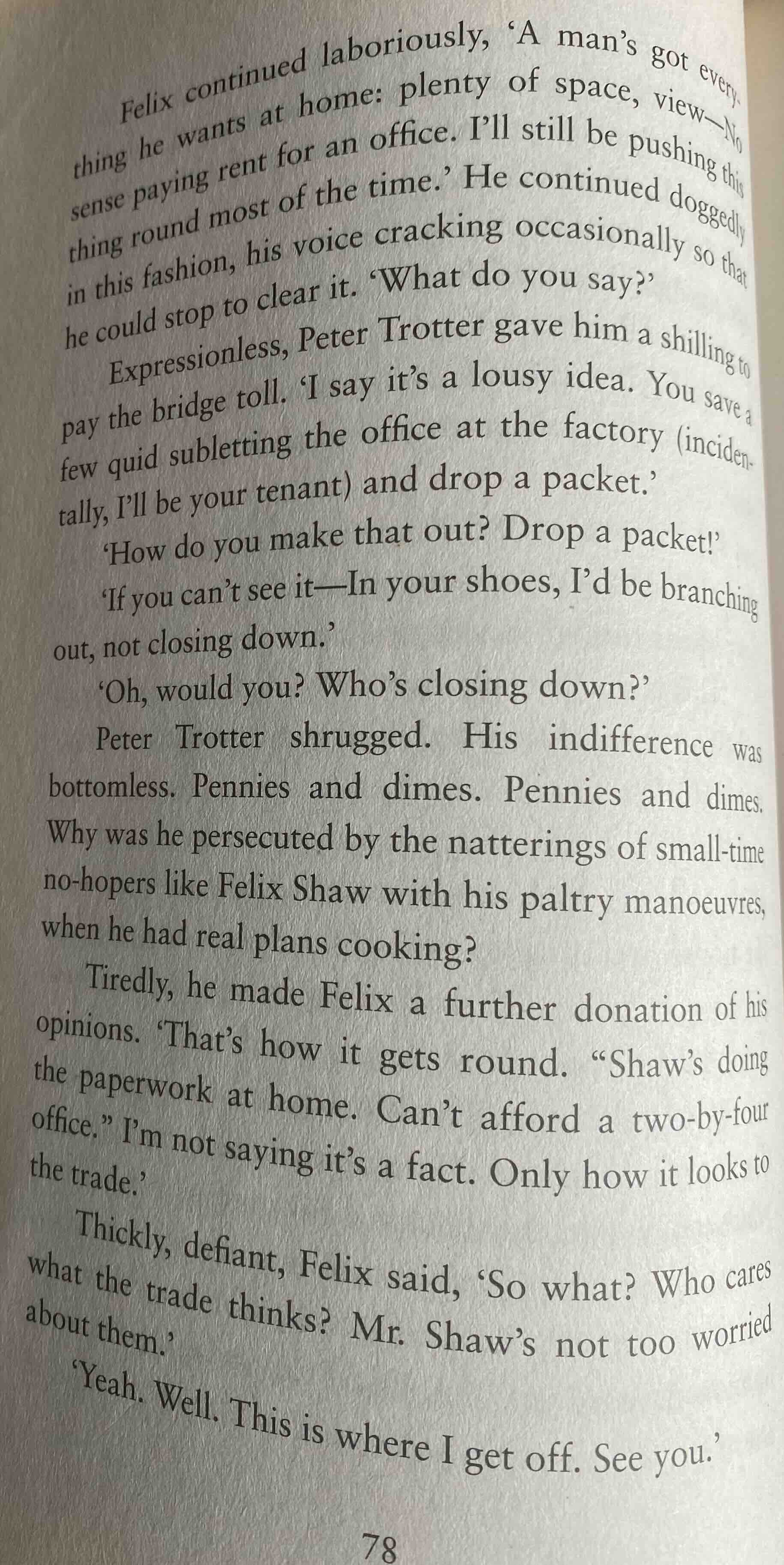
Felix has just explained that he is moving his office from his factory to his home. At least part of his reason, we know, is to intensify what we would now call his coercive control over his young wife. After a bit of bluster, typical rationalisation of a self-destructive action motivated by weird spite, he asks Peter Trotter’s opinion. There is a minutely observed moment of the kind Elizabeth Harrower is celebrated for.
Expressionless, Peter Trotter gave him a shilling to pay the bridge toll.
‘Expressionless’ does so much work there. Even while Felix is pretending that all is well, there is this wordless abject moment when he accepts the other man’s contemptuous financial help. Then Peter offers what the reader knows is a sensible perspective, but which falls on resolutely deaf ears, while illustrating Elizabeth Harrower’s gift for vernacular dialogue:
‘I say it’s a lousy idea. You save a few quid subletting the office at the factory (incidentally, I’ll be your tenant) and drop a packet.’ ‘How do you make that out? Drop a packet!’ ‘If you can’t see it – In your shoes, I’d be branching out, not closing down.’ ‘Oh, would you? Who’s closing down?’ Peter Trotter shrugged. His indifference was bottomless. Pennies and dimes. Pennies and dimes. Why was he persecuted by the natterings of small-time no-hopers like Felix Shaw with his paltry manoeuvres, when he had real plans cooking? Tiredly, he made Felix a further donation of his opinions. ‘That’s how it gets round. “Shaw’s doing the paperwork at home. Can’t afford a two-by-four office.” I’m not saying it’s a fact. Only how it looks to the trade.’ Thickly, defiant, Felix said, ‘So what? Who cares what the trade thinks? Mr Shaw’s not too worried about them.’ ‘Yeah. Well. This is where I get off. See you.’
And that is the end of a relationship.
This page repays a close look. Felix’s reference to himself in the third person makes me realise that Harrower’s depiction of a self-involved, wildly irrational man with bombastic self-belief and demand for absolute loyalty from those he sees as his subjects is alarmingly relevant to the mid 2020s. But it also, surprisingly to me, evokes the reader’s pity for Felix: this man we experience mainly as a controlling monster is, from another perspective, a small time no-hoper with paltry manoeuvres. This pity is dangerous: though she doesn’t use such terms, Laura, terribly abused and exploited, also sees that Felix is a small-time no-hoper, a man whose sometimes alcohol-fuelled violence is born out of deep self-hatred and lack of self-confidence, and her pity for him (she does use that word) is part of what binds her to stay with him.
None of Felix’s attempts to manipulate young men into dependency succeed because on the whole men aren’t vulnerable economically and socially the way young women are in that era. Towards the end of the book, a young male employee named Bernard collapses at work and Felix ‘kindly’ takes him into his home. At last, a vulnerable man to join his toxic household! He deploys the same emotional blackmail and bewildering switches of mood to exert control over Bernard as he has used successfully on Laura, and through Laura on Clare. There’s genuine, chilling suspense: will Bernard succumb or will he escape, taking one or both of the women with him to freedom?
Evidently publicity for the first edition used the word ‘homosexual’. I didn’t pick up any hint that Felix’s yearning for young men was knowingly sexual. But there is something forlorn in the way Felix yearns for friendship with them and in his violent rages at home when they go their indifferent way.
After the meeting: There were five of us. Three had read the whole book, one had reached the 57 percent mark on her kindle, and the fifth – who was the only one to read Joan London’s introduction to the Text Classics edition – hadn’t got that far. None of us found it a pleasant read, but the conversation was interesting.
S– saw Felix as a cipher for coercive control, and admired the way the novel was an early describer of that phenomenon, about which we know so much more now. She hadn’t read Susan Wyndham’s biography of Elizabeth Harrower, which was also prescribed reading for this meeting, and was curious to know how much the book reflected Harrower’s lived experience – it was hard to believe that she didn’t have first-hand knowledge. (A couple of us were able to satisfy her curiosity.) I would have agreed about Felix as cipher if I hadn’t lingered on page 78. I think there was more to him than that, but it’s true that the narration never takes us inside Felix’s consciousness – we see mainly the chaotic vindictiveness of his behaviour.
K– thought the book was not only painful to read but was badly written. (Gasps all round!) In her view, Elizabeth Harrower’s reputation as a great Australian novelist came mainly from her friendships with members of the Australian literary pantheon – Kylie Tennant, Judah Waten, Shirley Hazzard, Christina Stead, Patrick White. (But that’s getting ahead to the discussion of the biography.)
I talked about two moments that produced a frisson in me. The first was the chilling moment when Laura, the older sister and wife of Felix, transitions from being Clare’s ally in victimhood to being his agent in cajoling/coercing her to bend to his will. I thought this was a richly complex turn in the narrative. Others just didn’t buy it. The second was when (possible spoiler alert), starting the book’s final movement, Clare decides to give up the week escape she had been planning in order to care for the ailing Bernard. The profound ambiguity of this moment made the book come alive for me: Clare sees herself as being able for the first time to make a difference to someone else’s life, and is decides to do it with a sense of elation; but the reader sees that for years she has been coerced into putting her own needs aside to attend to Felix’s whims, and it’s simply impossible to tell whether what she sees as her new dignity isn’t a variation on the servitude she has been enduring. In my reading the remaining pages are animated by that ambiguity, and the resolution (no spoilers this time) is perfect. S– thought there was no ambiguity at all: she was just falling into the same trap with a new man.
The conversation moved on to Susan Wyndham’s Elizabeth Harrower: The Woman in the Watch Tower, about which I will blog next.
The Book Club met on the land of the Bidjigal and Gadigal clans of the Eora nation, overlooking the ocean. I wrote the blog post on Wangal and Gadigal land sheltering from unusual summer heat. I gratefully acknowledge the Elders past and present who have cared for this beautiful country for millennia, and welcome any First Nations readers of this blog.
* My blogging practice is to focus on the page that coincides with my age, currently 78.
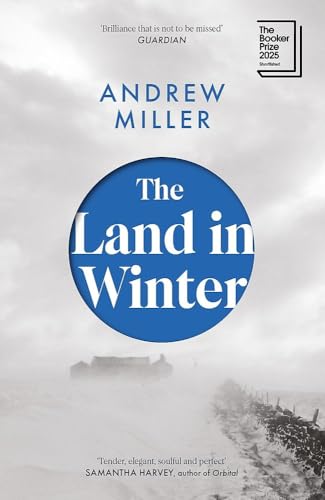
Before the meeting:The Land in Winter was shortlisted for the 2025 Booker Prize. The judges described it like this:
In the depths of Britain’s coldest winter, two neighbouring women forge a friendship in the countryside. It’s 1962 and they have both just become pregnant. Around them, the men are struggling <snip>. As a winter storm wreaks havoc on their lives, these characters become pivotal figures in a community precariously balanced between history and future <snip>. In beautifully atmospheric prose, Andrew Miller brings suspense and mystery to this seemingly inconsequential chapter in British history.
For me the one word that stands out from that is ‘inconsequential’. I never got on the book’s wavelength. I couldn’t find any reason to be interested in the characters, and couldn’t tell why the author was interested in them. Adultery, mental illness, patriarchy, the lingering effects of World War Two, the shady world of strip clubs and escort agencies, organised crime lurking in the background, a nuanced play of class, a solid evocation of a snowbound English countryside: there’s plenty there, but I mostly failed to care or be amused. Nobody is happy, everybody has a complicated past, terrible things happen to each of the main characters, some expected, some self-inflicted, some as arbitrary as a car accident. The prose is fine, but I would describe it as functional rather than atmospheric. The book doesn’t sing.
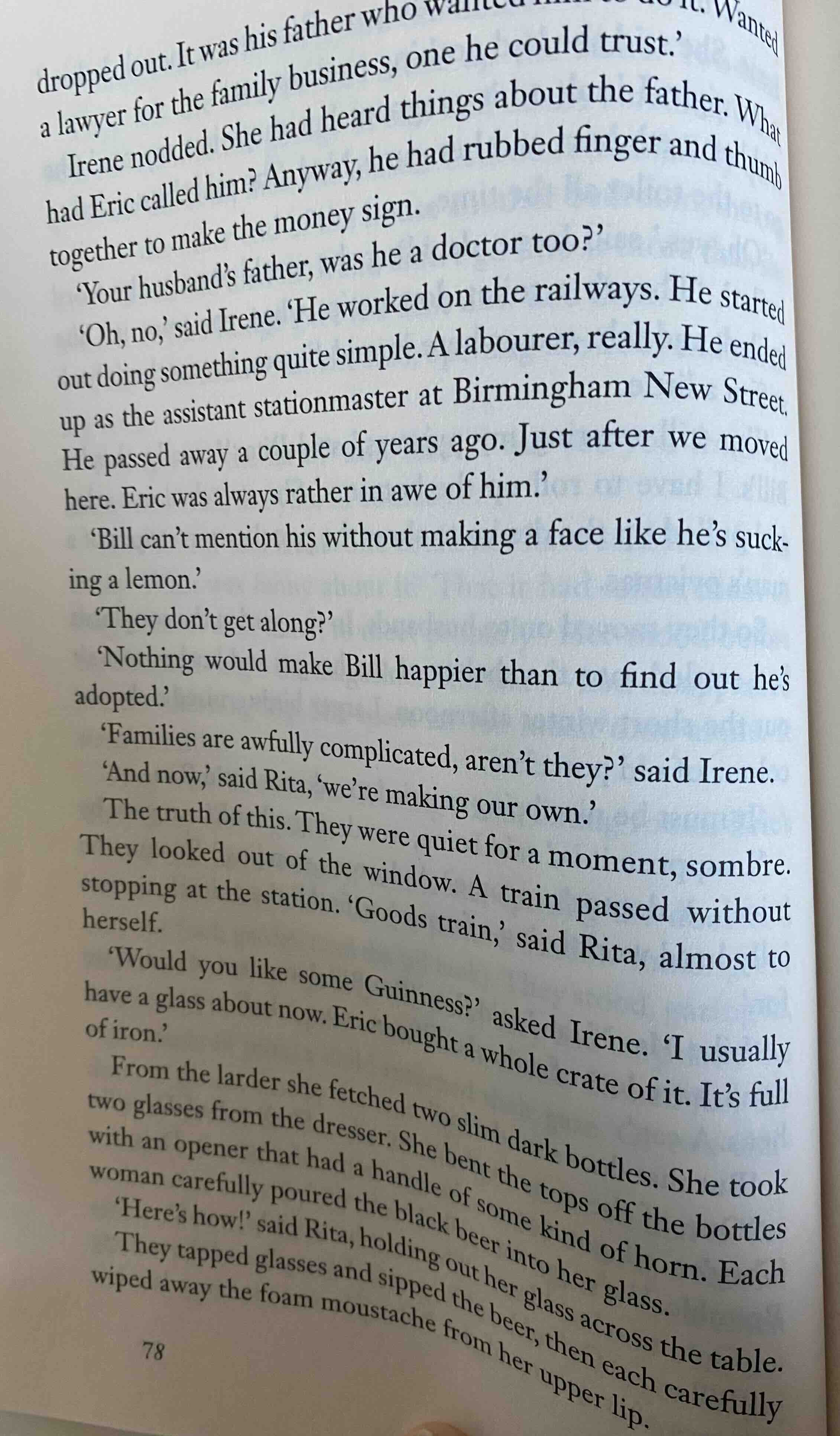
Page 78* occurs in chapter 7. The ‘two neighbouring women’, Rita and Irene, have met for the first time when Rita has brought eggs from her farm as a gift to Irene, the doctor’s wife.
As the women converse, they fill each other in on their husbands’ backgrounds. That is to say, this is mainly a page of exposition. But then, a lot of the book feels to me like exposition.
‘Bill was at Oxford,’ said Rita, as if that explained the naming of cows after queens of the Nile. ‘He was studying law but dropped out. It was his father who wanted him to do it. Wanted a lawyer for the family business, one he could trust.’ Irene nodded. She had heard things about the father. What had Eric called him? Anyway, he had rubbed finger and thumb together to make the money sign. <snip> ‘Bill can’t mention his [father] without making a face like he’s sucking a lemon.’ ‘They don’t get along?’ ‘Nothing would make Bill happier than to find out he’s adopted.’
In the midst of that background briefing, one detail stands out. Irene’s doctor husband ‘had rubbed finger and thumb together to make a money sign’. So Bill’s father, we understand, is a Jew. There’s more about that later when we meet Bill’s family, but the antisemitism of Eric’s remembered gesture never leads to anything. This did make me wonder if the narrative was seeded with many such signals that I missed. A character will see an unexplained light in the distance, and there are moments of surreal weirdness, but the narrative closes over them and it’s as if they were never there.
After their expository chat, the two women – both newly pregnant – move on.
‘Would you like some Guinness?’ asked Irene. ‘I usually have a glass about now. Eric bought a whole crate of it. It’s full of iron.’ From the larder she fetched two slim dark bottles. She took two glasses from the dresser. She bent the tops off the bottles with an opener that had a handle of some kind of horn. Each woman carefully poured the black beer into her glass. ‘Here’s how!’ said Rita, holding out her glass across the table. They tapped glasses and sipped the beer, then each carefully wiped away the foam moustache from her upper lip.
Ah, thinks the reader, Andrew Miller has done his research. Way back then in 1962, not only did women drink alcohol when they were pregnant, but doctors as likely as not recommended that they drink stout as an iron supplement. It may be that the horn handle of the bottle opener and the slim bottles are period details. That would explain the slightly laboured feel of the writing, detail apparently for detail’s sake.
You might think that page 78 is unrepresentative of the book as a whole. Or it might whet your appetite for more. But to my mind it’s dull, expository, laboured, and as such typical of the whole book.
For Andrew Miller’s sake, I’m glad that my view seems to be in the minority.
After the meeting: My view was broadly shared by the entire Book Group. After exchanging end-of-year book gifts (I scored Clear by Carys Davies), and enjoying the first parts of an excellent meal in a Manly restaurant, we had a generally unenthusiastic conversation about the book. The most memorable contribution came from someone who said she hadn’t reached the good bits. “What?’ someone said, ‘you didn’t read the whole thing?’ ‘Yes, I did,’ she said, ‘but when I said how boring it was S– told me it got better, and I was still waiting for tht to happen when I reached the end.’
We all agreed that the bitter winter was brillintly evoked. Someone thought the quality of the prose was a kind of correlative of that confining weather. We hunted around for why it has been so well received by critics. Maybe you had to be English, someone said. Maybe there’s a lot of subtlety, especially about class, that went right over our collective head.
There was so much else to talk about. So we did, and enjoyed the rest of our meal.
The Book Group met on Gayamagal land, and I have written this blog post on the land of Gadigal and Wangal of the Eora nation. I acknowledge Elders past and present of those clans, and welcome any First Nations readers.
* My blogging practice is to focus on the page that coincides with my age, currently 78.
László Krasznahorkai, The Melancholy of Resistance (1989, translated by George Szirtes, published by Tuskar Rocks Press 2000)
Before the meeting: László Krasznahorkai won the 2025 Nobel Prize in Literature. The Melancholy of Resistance (Hungarian title Az ellenállás melankóliája) was his second novel. Written as the Communist regime was collapsing in Hungary in 1989, it centres around an outbreak of senseless mass violence in a small Hungarian town. In real life, happily, the transition from Communism to a version of democracy was peaceful, but the book’s nightmarish vision and weird allegorical tale resonate far beyond its immediate political context.
One thing was clear to me as I read: this book, with its absence of paragraph breaks, long internal monologues about, for example, esoteric musicology, a key character who remains unseen and unheard except for weird chirping sounds, and many story lines that peter out or are resolved with a throwaway comment in the middle of something else, could never be made into a film. I was wrong. In 2000 (the year this translation was published), Béla Tarr adapted it in Werckmeister Harmonies, which has been called ‘one of the major achievements of twenty-first-century cinema’ (an impressive accolade, even if it was written in the YouTube comments section).
I haven’t seen the film, but I can’t think of a better way to convey the feel of the book than to show you its trailer:
There you have it: the young, naive idealist who may well be the idiot people think he is; the old, disillusioned musicologist; the corpse of a huge whale wheeled into town; the ominously silent crowds of men; the awful mob violence; the invading military (though I don’t remember a helicopter in the book). Some elements are missing, though I expect they’re in the movie itself: a mysterious character known as the Prince, two children caught in the crossfire, and the key roles of two women. Nor do the streets of the movie seem quite as covered in frozen garbage as those of the novel.
The book’s most striking feature is absence of paragraph breaks and the predominance of long sentences. The sight of page after page of uninterrupted text is intimidating at first, and it’s annoying having to hunt around if you lose your place, but the effect on the page, as I imagine it is on the screen, is a dreamlike flow. And George Szirtes’ has translated the Hungarian into extraordinarily smooth English that enhances that effect. This isn’t Proust, where the sentences turn in on themselves, clauses nesting within clauses, with a hypnotic, introspective effect. Here the effect is more propulsive – the long sentences sweep you on. And they work brilliantly in a book where characters are always in motion (even if sometimes the motion is mental). They walk, stumble, run errands, occasionally waddle, stalk, pursue, flee, but always move.
It’s as if the characters can’t stop for breath, so the text has to hold out for as long as it can without a full stop, and even longer for a bit of white space.
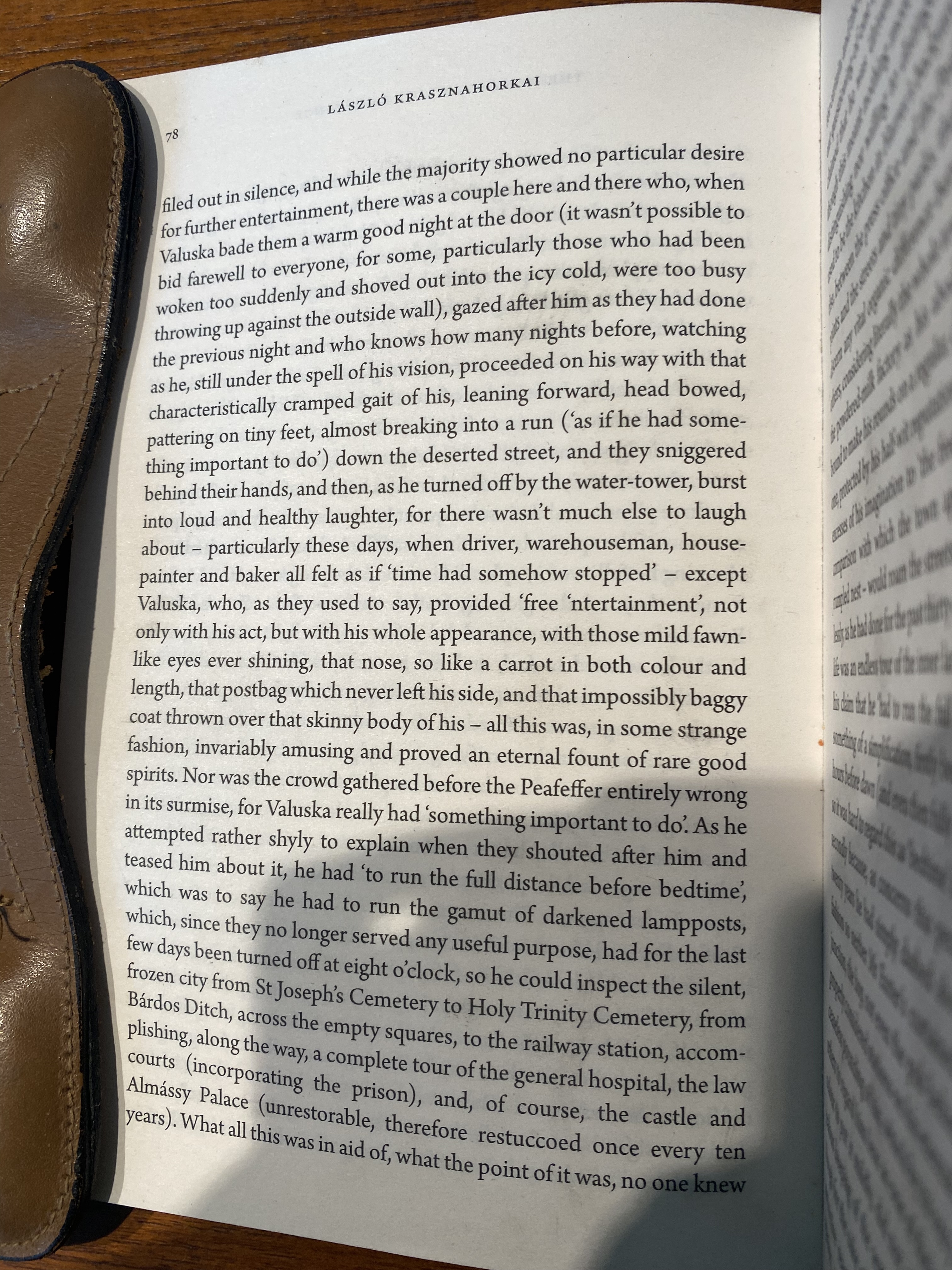
Page 78* occurs partway through the third paragraph/section, which unfolds from the point of view of Valuska, a kind of holy idiot and easily the book’s most sympathetic character. Valuska has been introduced doing his nightly routine at closing time in the Peafeffer tavern, in which he demonstrates the mechanics of a solar eclipse, deploying three paralytic drunks to represent the sun, the moon and the earth. His attempt to communicate the awe-inspiring order of the cosmos is tolerated by the drinkers as a way to delay closing time. At the top of this page, the evening is over and they walk out into the cold night:
The first thing to note about this page is that, counting the sentence that started on the previous page, there are just three sentences. The middle one is quite short: at 20 words it may be the shortest in the book, but is otherwise unremarkable. The others are typical of the book.
It would please my inner 11-year old Queenslander to analyse one of them – identify the main clause and the subsidiary clauses, and the nature of the subsidiary clauses. It probably wouldn’t be very entertaining for my readers, so I’ll limit myself to noting that the basic structure of this:
So they filed out in silence, and while the majority showed no particular desire for further entertainment, there was a couple here and there who, when Valuska bade them a warm good night at the door (it wasn’t possible to bid farewell to everyone, for some, particularly those who had been woken too suddenly and shoved out into the icy cold, were too busy throwing up against the outside wall), gazed after him as they had done the previous night and who knows how many nights before watching as he, still under the spell of his vision, proceeded on his way with that characteristically cramped gait of his, leaning forward, head bowed, puttering on tiny feet, almost breaking into a run (‘as if he had something important to do’) down the deserted street, and they sniggered behind their hands, and then, as he turned of by the water-tower, burst into loud and healthy laughter, for there wasn’t much else to laugh about – particularly these days, when driver, warehouseman, house-painter and baker all felt as if ‘time had somehow stopped’ – except Valuska, who, as they used to say, provided ‘free ’ntertainment’, not only with his act, but with his whole appearance, with those mild fawn-like eyes ever shining, that nose, so like a carrot in both colour and length, that postbag which never left his side, and that impossibly baggy coat thrown over that skinny body of his – all this was, in some strange fashion, invariably amusing and proved an eternal fount of rare good spirits
is five linked principal clauses:
So they filed out, and a couple gazed after him, and they sniggered, and then burst into laughter, for there wasn’t much else to laugh about.
That skeleton is adorned with images of the bitter cold, vaguely comic drinkers throwing up, descriptions of Valuska, an explanation of what they found amusing about him, and a reminder of the drinkers’ wider context – ‘driver, warehouseman, house painter and baker’.
Valuska stands out: time has ‘somehow stopped’ for the town in general, but he is fascinated by the continuous movement of the heavenly bodies and is himself always on the move. That stopped-ness comes into focus in chilling scenes in which the town square is full of motionless men, all as if waiting for something. And when they move, the effect is shocking, violent.
I don’t know that I’d recommend the book, but I enjoyed it, and it has stayed hauntingly in my mind. It makes many other books feel like plodding reportage.
After the meeting: This was one of the best meetings of the book group ever. We exchanged gifts – everyone was supposed to bring a book from their shelves, though the book I received (a Gary Disher title) is in suspiciously mint condition. Some of us read poems – by Adrian Mitchell, Mary Oliver, Simon Armitage and Robert Gray. We reminisced about the group’s history and argued about how firmly fixed our list of dates for the year should be. We shared stories of courage and shame. We ate well. We enjoyed the early summer evening. And we had a wonderfully animated discussion of the book.
Three out of eight of us had read the whole thing. A number of others were well under way and intend to finish it. Everyone had something to say. Here are some of my highlights.
I was reading Mrs Dalloway a couple of pages a day alongside of The Melancholy of Resistance, and felt strongly that the books spoke to each other but couldn’t say how. When someone mentioned the way the narrative focus transfers from one character to the next at the end of each section, I realised this is one of the similarities: where Virginia Woolf’s narrator slips from one character’s mind to another sometimes several times on a single page, Krasznahorkai’s narrator does a similar thing, but on a much wider arc.
One man read the book not realising it was more than 30 years old, and the political dimensions of it seemed right up to date. I don’t know if he mentioned the MAGA riots in January 2020, but they certainly seemed relevant.
Someone said it was hard to resist a book where a character spends four pages trying to work out the physics of hammering a nail while repeatedly hitting himself on the thumb. And then, having solved the problem by acting without thinking about it, he is told by his cleaning lady that he’s done it all wrong. Our group member who has been studying philosophy told us that this is even funnier when you know that one of Heidegger’s most famous passages involves a hammer. (That person’s favourite moment is Mr Eszter’s seemingly interminable rumination about the pointlessness of the diatonic scale (at least that’s what I think it’s about) – which was my second least favourite moment.)
Contrary to my own response, one man felt the book was intensely cinematic. And as we talked it was clear that it’s full of memorable scenes. We reminded each other of the scene where Valuska demonstrates the mechanics of an eclipse, the interrogation scene, the force with which Mrs Eszter’s hand comes down on Valuska’s shoulder to stop him from speaking, the horriific scene where the mob runs riot in the hospital, the brilliantly evoked streets full of frozen garbage, and more.
At heart, one man said, it’s a love story between Mr Eszter, an intellectual who has given up any hope that thinking could be of value, and naive, well-meaning Valuska.
And that’s a wrap for the Book Group for 2025.
The Book Group met on Gadigal land, and I have written this blog post on the land of Gadigal and Wangal of the Eora nation. I acknowledge Elders past and present of those clans, and welcome any First Nations readers.
* My blogging practice is to focus on the page that coincides with my age, currently 78.