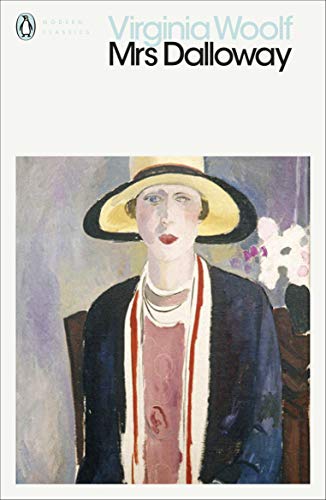
Virginia Woolf, Mrs Dalloway (1925, Penguin Classics 2020) from page 103 to end
As I expected, it took me just two months to read Mrs Dalloway three pages a day. If you haven’t read it, I recommend doing it slowly in just this way: three pages at a time seems to be just about perfect.
The book looks for the person behind the public-facing name Mrs Dalloway, to create a kind of literary cubist portrait: beneath the skin of the upper-crust English lady whose life centres on giving parties for the right people are the remains of a glorious, multi-faceted creature who once lived with grace and passion. We see her from many angles, through the eyes of her husband (who barely sees her), her daughter, a resentful working class history teacher, a maid, a man whose proposal of marriage she rejected in spite of their mutual passion, a woman who was also drawn to her when young, an older aristocratic woman of the type played so splendidly by Maggie Smith, and more
In one way the book is about the disappointment of youthful hopes and expectations. For example, Sally Seton, who once ran naked down the corridors of an country mansion, is now Lady something or other with six sons and insists that she is completely happy. Clarissa herself is married to Richard who is at best a mediocre politician. Peter Walsh, her former suitor, has spent most of his life in India, unhappily married and now caught up in an awkward affair. And quite unconnected to Clarissa until the final pages is Septimus Smith, a soldier returned from the trenches of the ‘Great War’ with what we would now call PTSD. He is haunted by the image of a friend who was killed in the War, and in the end (spoiler alert, but the book is a hundred years old after all) kills himself in desperation. When Clarissa learns of his death, she is playing hostess at her party, to which the whole book has been building. Suddenly she is alone and grapples with thoughts of her own mortality.
I came to the book expecting it to be difficult and a bit airy-fairy. Maybe it is both. The English class system is rock solid in its pages, and though Clarissa is criticised as a snob, the basic viewpoint of the novel can’t be entirely absolved of that charge. But I wasn’t prepared for how much pleasure there is in the way the narrative glides among different points of view, for the almost Whitmanesque celebration of city life, for its laugh-out-loud moments, or, in the end, for the pervading sense pathos in a society and individual souls who have survived the momentous events of a World War and a pandemic. I wasn’t prepared for just how much, sentence by sentence and page by page, I enjoyed it.
it’s hard to pluck a passage out of context, but here is a bit I love. Peter Walsh is watching Clarissa as she escorts the Prime Minister from the party:
And now Clarissa escorted her Prime Minister down the room, prancing, sparkling, with the stateliness of her grey hair. She wore ear-rings, and a silver-green mermaid’s dress. Lolloping on the waves and braiding her tresses she seemed, having that gift still; to be; to exist; to sum it all up in the moment as she passed; turned, caught her scarf in some other woman’s dress, unhitched it, laughed, all with the most perfect ease and air of a creature floating in its element. But age had brushed her; even as a mermaid might behold in her glass the setting sun on some very clear evening over the waves. There was a breath of tenderness; her severity, her prudery, her woodenness were all warmed through now, and she had about her as she said goodbye to the thick gold-laced man who was doing his best, and good luck to him, to look important, an inexpressible dignity; an exquisite cordiality; as if she wished the whole world well, and must now, being on the very verge and rim of things, take her leave. So she made him think. (But he was not in love.)
Yeah, right! He wasn’t in love!
Maybe I should give To the Lighthouse a go.
I have written this blog post in Gadigal and Wangal country. I acknowledge Elders past and present of those clans, and welcome any First Nations readers.
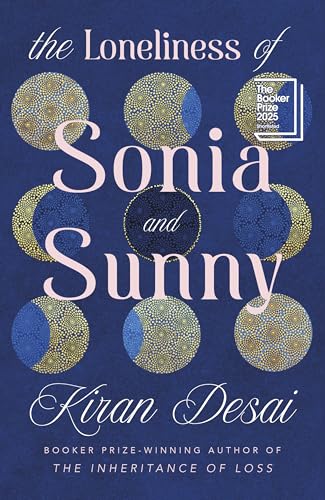
Before the meeting: This is a massive family saga that spans three continents, a romance, an Indian–US comedy of manners, and a magic-realist tale (though Sonia, a writer, is critical of that term).
All of the principal characters are caught, one way or another, in a tangle of Indian and US culture. The central difference, gestured towards in the book’s title, is the contrast between US individualism and Indian sense of belonging to a family and a community: loneliness and embeddedness, self-determination and obligation. When this plays out in comic mode, it works brilliantly. In the Indian scenes, again and again, someone is asked in shocked tones why they are alone.
As you’d expect from the title, the central narrative strand is a romance. True to the form of the romcom (no spoiler really) the protagonists Sonia and Sunny have sex at almost exactly the midpoint and then are separated, seemingly irretrievably. Integral to the romcom are family intrigue, corruption, violent murder, and a dispersed conversation about arranged marriage. I loved all that.
There’s another story jostling for the centre. This begins with an unconvincing episode of coercive control and develops into a kind of ghost story that more or less centres on a mystic talisman that Sonia has inherited from her grandfather. A European painter who has held Sonia in his thrall steals the talisman and makes it central to his art (yes, appropriation!). I found this strand unconvincing at the level of character, but there’s an interesting reflexivity to it as the artist keeps telling Sonia, an aspiring novelist, what she should and should not write: we are clearly being invited to read this book as a repudiation of his advice.
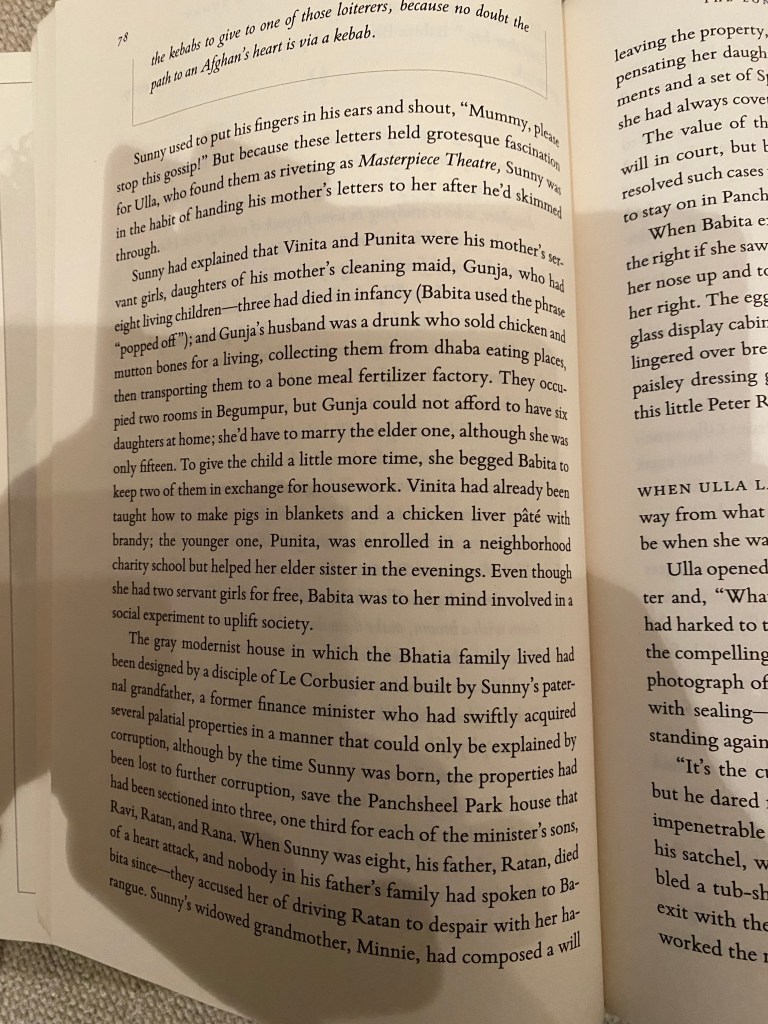
Page 78* is early in the book, part of Sunny’s narrative. He is a young man living in New York City in the late 1990s with Ulla, a white US woman. He’s intent on making it in the USA as a journalist, and embarrassed by his mother’s insistent claims on him. He can barely read her long letters (‘Mummy, please stop this gossip!’), and on this page he explains the context of one of them to Ulla (and, incidentally, to the reader):
One tiny thing I’ll mention in passing. The bottom paragraph describes Sunny’s family home as a ‘gray modernist house … designed by a disciple of Le Corbusier’. So much information is conveyed in those few words. First, the family comes from wealth. Second, they are to some degree westernised – their house is modernist. Third, the fact that the architect was a disciple rather than Le Corbusier himself suggests something about the limitations on the aspirations of colonised elites. And fourth, ‘gray’ is an example of the the North American spelling conventions used throughout (‘neighborhood’ later in the paragraph is another): that these spellings persist in the UK edition is not a mistake, but an enactment at the micro level of the way US culture has come to dominate the book’s westernised Indian characters.
Before that, there’s a paragraph of raw exposition:
Sunny had explained that Vinita and Punita were his mother’s servant girls, daughters of his mother’s cleaning maid, Gunja, who had eight living children – three had died in infancy (Babita used the phrase “popped off”); and Gunja’s husband was a drunk who sold chicken and mutton bones for a living, collecting them from dhaba eating places, then transporting them to a bone meal fertilizer tactory. They occupied two rooms in Begumpur, but Gunja could not afford to have six daughters at home; she’d have to marry the elder one, although she was only fifteen. To give the child a little more time, she begged Babita to keep two of them in exchange for housework. <snip> Even though she had two servant girls for free, Babita was to her mind involved in a social experiment to uplift society.
The fate of Vinita and Punita, known collectively as Vini-Puti, is to be significant much later in the book. But because it’s November*, rather than discuss further, here’s a little verse:
November verse 5:
So much in his mother's letter
needs to be explained. Just who
is Vini-Puti? Who is Ratty?
What's this kebab how-de-do?
Gunja, mother of six daughters,
trains two up to follow orders,
flee the confines of the slum,
work for free for Sunny's mum,
cook liver pâté soaked in brandy.
This is tragic seen up close:
the mum's small gain, the girls' great loss.
But this ain't Hamlet, this is Sunny.
Vini-Puti serve their turn
like Rosencrantz and Guildenstern.
After the meeting: We discussed The Loneliness of Sonia and Sunny along with Arundhati Roy’s Mother Mary Comes to Me. I was astonished when the discussion of this book kicked off with one person saying she hated it and gave up at the 40 percent mark (she’s a Kindle reader). Nothing happened, she said. And that included Sonia’s harrowing emotional enthralment to the bizarrely irrational western artist. Probably needless to say, others disagreed.
Of the three of us (out of five) who had read the whole book, I liked it the best. For all three of us the first 40 percent (I make that about 260 pages) was what we enjoyed most. We had different versions of why it became less enjoyable: perhaps there’s a forced assertion of Indian ways of story-telling, a cultural repudiation of the western mode of the earlier parts; perhaps the talismanic object is too sketchily realised to carry as much narrative weight as seems to be intended; perhaps the book is just too long.
I persist in my opinion, shared by one other Clubbie, that it was a good idea to pair this with Mother Mary Comes to Me. Both books have domineering, eccentric mothers. The protagonists in both are secular Indians appalled at the rise of Hindu nationalism and the BJP – the Demolition of the Babri Masjid mosque looms in the background. Both explore myriad ways in which cultural differences can be negotiated by people from a globally non-dominant culture. Both have main female characters steeped in classic English literature.
We had an excellent dinner, including a dessert that fell flat on the floor when it was taken from the oven, but was delicious anyhow.
The group met on the land of Gadigal of the Eora Nation, and I have written this blog post on the land of Gadigal and Wangal. I acknowledge Elders past and present of all those clans, and welcome any First Nations readers.
* My blogging practice is to focus on the page that coincides with my age, currently 78, and in November I write fourteen 14-line stanzas in the month. which means incorporating one into most blog posts.
Virginia Woolf, Mrs Dalloway (1925, Penguin Classics 2020)
Since taking nearly two years to read Proust’s À la recherche du temps perdu six years ago, I’ve had a classic slow-read on the go most of the time. When I’ve embarked on one of these slow-reads I regularly come across mentions of the book elsewhere. It’s like that with my current project, Mrs Dalloway.
Of all Woolf’s novels, Mrs Dalloway is the one most often read as semi-autobiographical and as a reckoning with unresolved trauma: of England’s in the wake of the first world war, and in the novelist’s own life. <big snip> Woolf has long been a lodestar for writers grappling with trauma – in their lives, and on the page, especially women writers.
Reading the first couple of pages, when upper-class Clarissa Dalloway is out in the early morning shopping for flowers and enjoying the life of the London streets, I couldn’t see much trauma. But then the scene broadens and darkens. By page 103, I’m now reading the book as mainly about aftermaths: Clarissa is recovering from an illness and enduring an unhappy marriage; the War and pandemic are still alive in collective memory; Peter Walsh, freshly returned from a decade in India, is still wounded by having been rejected by Clarissa many years earlier; returned soldier Septimus Smith is wandering London’s streets, hallucinating, suicidal, ‘shell-shocked’ and putting his Italian wife Lucrezia through hell. There’s plenty of trauma to go round.
I’m glad I’m reading this book just a few pages a day. It cries out for sharply focused reading, which I can just about sustain for three pages at a time. Read this way, the book is exhilarating. I had thought it was going to be the stream of consciousness of one upper-class Englishwoman. In fact there’s a whole array of characters, and the narrative voice flits among them. I say ‘flits’ because feels as if the narrator is an elf-like creature (I almost see her as Tinkerbell) who slips in and out of people’s minds, sometimes staying for barely a second, sometimes for several pages. Most of the characters are aristocrats of one sort or another, but not all. Lady Bruton’s maid Milly Brush has definite likes and dislikes as she stands impassively while her mistress entertains three gentlemen for lunch. One of those gentlemen is a bluff middle-class man with pretensions – he knows how to craft a publishable letter to The Times but believes women shouldn’t read Shakespeare for moral reasons. And Richard – Mr Dalloway – makes an appearance, buying flowers for Clarissa and resolving to tell her he loves her (which the reader knows is far too little, far too late). And so on. It’s much more complex, and funnier, than I expected.
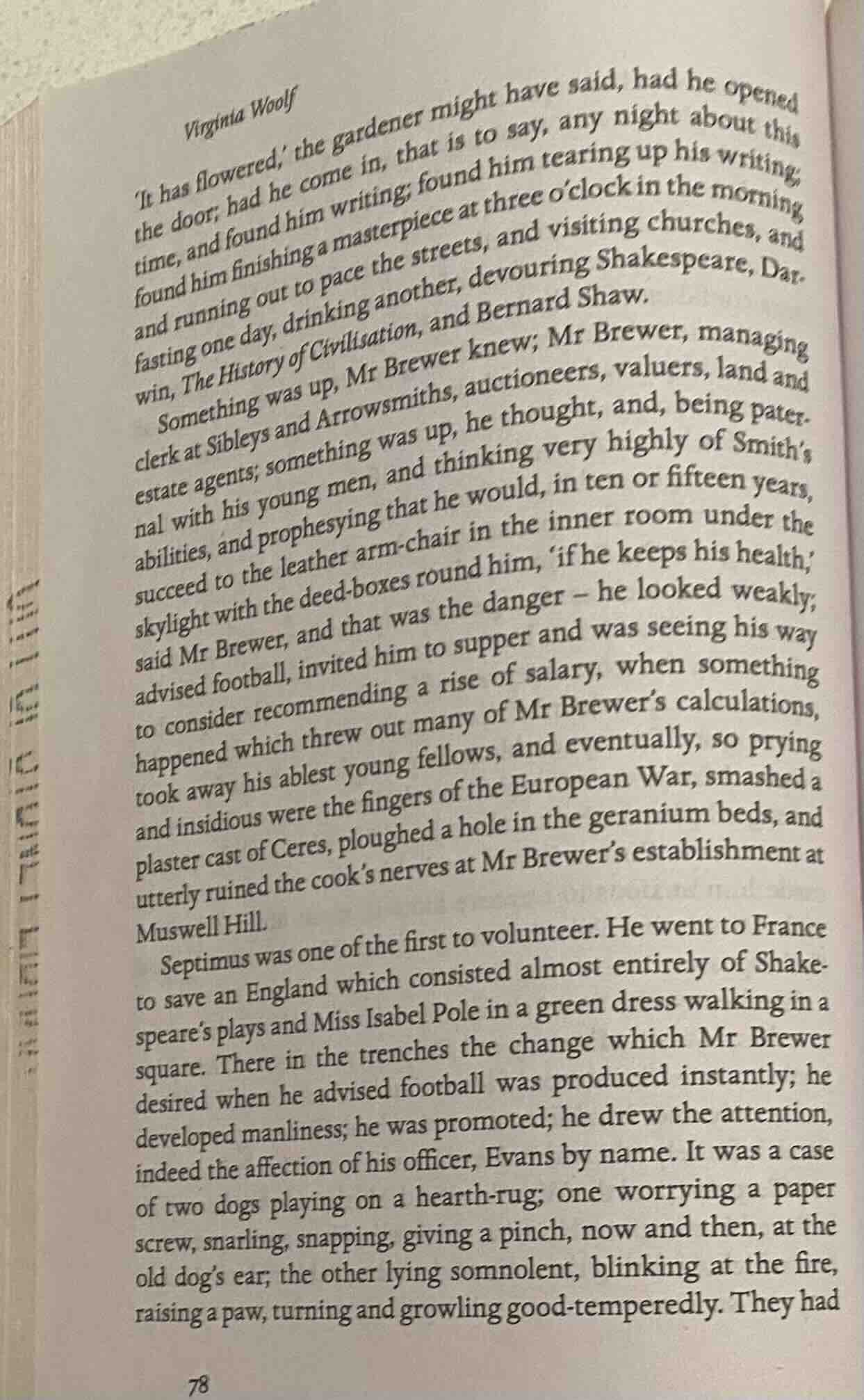
Here’s page 78*:
And because it’s November**, here’s a verse drawn from it and the next page:
November Verse 1:Septimus Smith He might have made a great accountant but for Shakespeare, Keats and love that set him scribbling with his fountain pen all night. 'You need to tough- en up, play football,' said his mentor. War changed everything. He went to fight in France and made a friend, a cheerful manly friend, whose end in Italy was sudden, brutal. Mrs Woolf says War had taught him not to feel, to set at nought such loss. Sublime the total calm he felt. But, come next year, the sudden thunderclaps of fear.
I have written this blog post near what was once luxuriant wetland, in Gadigal and Wangal country, where I recently saw two rosellas (mulbirrang in Wiradjuri, I don’t know the Gadigal or Wangal name). I acknowledge Elders past and present of those clans, and welcome any First Nations readers.
* My blogging practice is to focus on the page that coincides with my age, currently 78. ** Each November I aim to post 14 fourteen line stanzas on this blog (see here for an explanation, though that explanation incorrectly calls my verses sonnets)
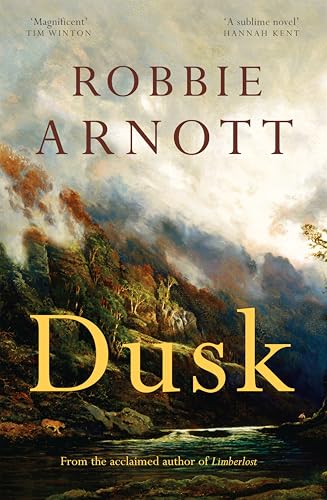
Before the meeting: we had enjoyed Robbie Arnott’s previous novel, Limberlost, so Dusk was a promising choice.
It’s set in a place very like nineteenth century Tasmania. Iris and Floyd Renshaw, the twin children of notorious outlaws, travel to the highlands and aim to kill a puma named Dusk that has been ravaging the region, killing livestock and people. A bounty has been offered by the graziers, and the twins see it as a chance to move away from their life at the margins. The story of their encounters with graziers and other hunters, and with a community of people who lived there before the settlers arrived, is full of elegant twists and moral dilemmas. There are moments of sheer horror, and moments of great tenderness. The writing is consistently vivid – you can tell that Robbie Arnott has visited the landscape even while he adds surreal elements like giant bones protruding from the ground; and the twins’ physical ordeals are viscerally real.
Even as I recognised all these qualities, I had trouble engaging. From about page 100, when the twins and their companions come close to Dusk, I started to care, and where a couple of pages are blacked out after a dramatic moment, what might have seemed a bit of cleverdickery had me on the edge of my seat. But then I got lost again and the final pages left me, as the song says, wondering why.
At page 78*, the twins have just arrived in a small town full of men who are hunting the killer beast. She – Dusk, the puma – has killed the son of a wealthy grazier, whom the twins have encountered grieving extravagantly in the street. For the first time since they came to the highlands, Iris finds herself confronting what they may be up against, ‘the probability of being ripped into death, faster than blinking’. Now, ‘starkly aware of the softness of her flesh, the smallness of her body, the stumbling clumsiness of her humanity’, she encounters for the second time Patrick Lees, a man who stands out from the crowd of hunters. On page 77 he has proposed that the twins join him to help track down the beast. Floyd, characteristically, stays more or less silent.
‘So you are chasing the bounty,’ said Iris, annoyance bending her voice. Lees contemplated his pipe before slipping it back between his lips and speaking around it. ‘Maybe I’m just endlessly curious.’ Iris clenched her teeth, holding her irritation in. Floyd kept rubbing his chin, seeming to take in Lees’ words without making any effort to respond. All of it was maddening to Iris – Floyd’s stupid performance, the sudden appearance of Patrick Lees, the unmoored feeling she had while being near him, his casual offer, his playful duplicity – and she wanted to get away from both of them and from herself, so she tugged at the collar of her coat and touched her hat. ‘We’ll think about it.’ Lees nodded. ‘Of course.’ He indicated a lemon-gold building that rose above the stable. ‘I’m staying at the inn. I’ll be leaving at first light.’ Another little smile. ‘I hope to see you then.’
They left Patrick Lees breathing smoke at the plains and walked back through the stable to the street.
The main thing on display in this passage is Robbie Arnott’s deft use of tropes from romance novels. Iris is irritated by a suave, superior man, while having an ‘unmoored feeling’ while she’s near him. It’s no spoiler that Iris can’t resist the offer to go on the hunt with him, or that they do spend a night together. But as in the romance genre, there is every indication here that Lees is a cad: his little smile is surely a red flag, and while Iris may be uneasy, the reader can be reasonably certain that someone who breathes smoke is dangerous. You leave this page with a subliminal sense that Lees may not be just a romance-genre cad, but a horror-genre monster.
There’s a lot to admire in this book. There’s a lot to discuss. The surreal elements of the landscape read as both hamfisted metaphor and strategy for including First Nations characters who won’t be mistaken for actual palawa. But I was unconvinced. Even the basic set-up didn’t work for me, even if someone were to tell me that pumas were once introduced to Tasmania / lutruwita. I enjoyed some parts but never got on its wavelength
After the meeting: I couldn’t go to this meeting, and though I missed the people, I wasn’t sorry not to discuss the book. The WhatsApp report painted a picture of a very convivial evening, where everyone liked the book, some more than others. Evidently one person liked it more as the evening wore on – maybe I would have joined him in that movement. Maybe not.
I have written this blog post near what was once luxuriant wetland, in Gadigal and Wangal country. I acknowledge Elders past and present of those clans, and welcome any First Nations readers.
* My blogging practice is to focus on the page that coincides with my age, currently 78.
Virginia Woolf, Mrs Dalloway (1925, Penguin Classics 2020)
I was listening to Christopher Lydon’s Open Source podcast when he interviewed Merve Emre, editor of The Annotated Mrs. Dalloway (Ms Emre is from the US, so her book adds a period to the novel’s name). Their enthusiasm for Woolf’s book made me realise it would be ideal one of my slow reads of the classics.
My introduction to the book was Stephen Daldry’s movie The Hours, which is based on Michael Cunningham’s novel of the same name and stars Nicole Kidman with a prosthetic nose. I’ve vaguely wanted to read Mrs Dalloway ever since, but been just as vaguely reluctant because of a general impression that the writing was beautiful but difficult.
So here goes. At three pages a day, it will probably take about two months. I don’t intend to delve into annotations and footnotes. Mercifully the copy I have from the library doesn’t have a learned introduction. Bearing in mind someone’s description of a classic as a work you cannot encounter for the first time, I’ll inevitably bring preconceptions to it, but I’ll try to read it as if it’s just a novel.
At this stage, six pages in, I’m loving it. I’m also glad I’m reading a few pages at a time, because – so far at least – I’d hate to be rushing it.
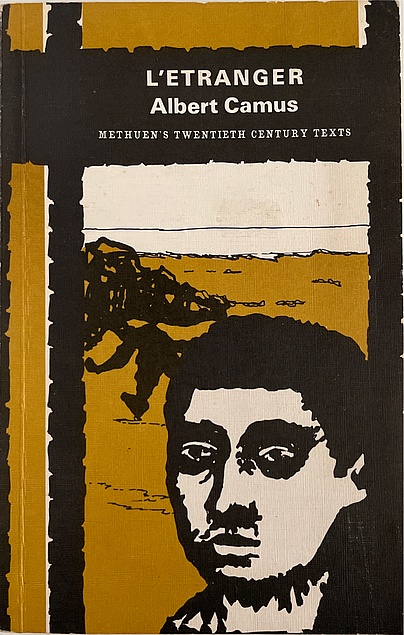
Albert Camus, L’étranger (1942, Methuen Educational 1970)
A month ago I announced that I was resuming my practice of reading a couple of pages from a classic text first thing each morning, starting with Camus’ L’étranger. The first book I did this with was Marcel Proust’s À la recherche du temps perdu, which took nearly two years. L’étranger has taken a single month.
In some ways, Camus is the anti-Proust. Look at their first sentences. Proust’s vast novel opens with his narrator yearning for his mother to come and say goodnight and then, famously, goes on marathons of introspection; Camus’ Meursault doesn’t make a big deal of his relationship with his mother, he resolutely refuses to perform emotions, and in the end pays a significant price for it. Here are their opening sentences:
Proust: Longtemps je me suis couché de bonne heure. (A long time ago I went to bed early.)
Camus: Aujourd’hui, maman est morte. (Today Mum died.)
It’s not hard to imagine that Camus had Proust’s work in mind, and deliberately did the opposite.
L’étranger is a classic, so I came to it already knowing a version of the plot. Meursault, a white man living in Algeria, shoots an Arab and when put on trial is unable to give a reason for doing it. In the trial much is made of the fact that he didn’t weep or give any sign of emotional upset at his mother’s death just a day earlier, and he is sentenced to death.
What surprised me on actually reading the text is that the murder isn’t completely arbitrary. Somehow I’d got the idea that he just pushes the man off a moving train, but it’s much more complex than that: in fact the shooting is the culmination of a series of encounters.
For me, more shocking than the murder, and more shocking than the fact that Meursault doesn’t weep at his mother’s vigil and funeral, is the way he takes it in his stride when his neighbour brutally beats a woman, and goes on an outing with the neighbour the next day as if nothing has happened.
Meursault’s lack of emotion is mystifying. We don’t like him, or empathise with him, but when his defence lawyer asks the court if he is being condemned to death for killing a man or for not weeping at his mother’s funeral we know that he’s naming something real.
I might have thought this was unrealistic, an existentialist fable, but the memory of Lindy Chamberlain told me otherwise. If not in the courtroom (and that’s debatable), then certainly in the press, she was widely condemned for not having what was deemed an appropriate display of emotion when her baby daughter went missing. Camus would have understood.
In the final moments of the book, when Meursault faces the prospect of the guillotine, he has a conversation with the prison chaplain. After Meursault has monosyllabically rejected the chaplain’s attempts to discuss the after-life, the priest says Meursault has a blind heart, and promises to pray for him. Meursault snaps. His deadpan manner is shattered, and leaping about with rage and joy he declares that nothing matters, that there is no meaning to life. In my reading the key moment comes after the outburst, when calm has been restored:
Comme si cette grande colère m’avait purgé du mal, vidé d’espoir, devant cette nuit chargée de signes et d’étoiles, je m’ouvrais pour la première fois à la tendre indifférence du monde. [As if that great burst of anger had purged me of evil, emptied me of hope, faced with this night laden with signs and stars, I opened myself for the first time to the tender indifference of the world.]
‘The tender indifference of the world’. The absence of hope does not necessarily produce despair, but an openness to reality. And then, in case we feel that we can welcome Meursault back into the fold of people who behave ‘properly’, his final wish is that there will be a good crowd at his execution who will greet him with cries of hate – that way he will feel less alone.
I have no idea what it would have been like to read this as part of high school French. Would it have vanished from memory as surely as the book we did study, of which I remember only the title, Le drôle. The internet reveals that that is a 1933 children’s book, written by François Mauriac. I suspect that all the two books have in common is that they were written in French by Nobel laureates. Times change, probably for the better.
Be warned: the back cover blurb of this novel reveals something that the novel itself only begins to hint at at about the midpoint. Luckily I didn’t read the blurb until after I’d reached that hint – but thanks a lot, Jonathan Cape!
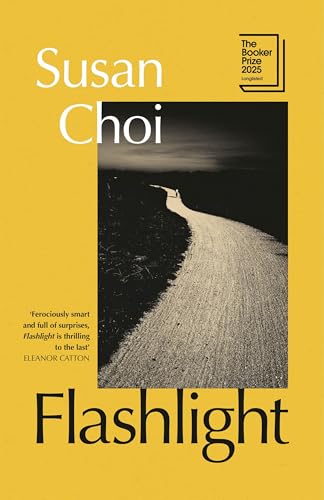
Before the meeting: I’ll avoid spoilers here, and just say the novel becomes something quite different from what you might expect from the first hundred pages or so. But when you go back and reread the start, you find that the writer has played fair. Sharper and better-informed minds than mine may well have understood the broad shape of the story from the beginning.
As in many novels these days, each chapter takes up the story from the point of view of a different character.
There’s Louisa, whom we first meet as an intelligent, uncooperative child in a therapy session: she has lost her father, presumed drowned, a loss that hangs over the whole book.
Seok, Louisa’s father, was born in Japan just before World War 2 to Korean parents. When the war ends he is shocked to discover that he isn’t in fact Japanese. His parents emigrate to North Korea, but he refuses to join them and goes instead to the USA where, now known as Serk, he gets a job at a provincial college, marries, has a daughter (Louisa) and lives as much of the American dream as is allowed to a Korean green card holder in the 1960s and 1970s.
Serk’s white wife, Anne, escapes from the thrall of a charismatic religious leader, garners an education by doing secretarial work for a literary scholar, and marries Serk. She’s dramatically unhappy in the marriage, especially when she accompanies him on a temporary posting in Japan. By the time of his disappearance at the beach, she is almost completely disabled by alienation from Japanese society and what turns out to be multiple sclerosis.
As well as those three main characters, there’s Tobias, Anne’s child by the charismatic religious leader, whom she gave up to be adopted at birth. He comes back into her life as a troubled teenager and continues to play a role over the decades. And one other character, a South Korean named Ji-hoon, has a chapter to himself late in the book.
So it’s a family story, and the family is fractious. Mother and daughter don’t have a single conversation over the decades that remains affectionate or even cordial for more than a minute. Before he disappears, Seok/Serk is abrasive both to his family and to pretty much anyone who tries to get close to him, especially other Koreans. Tobias is charming and kind, but loopy. And, the miracle of it, we like and care about them all as one small family being crushed under the weight of geopolitics.
Page 78* is in one of Serk’s chapters.
A lot is happening on this page. Serk meditates on his connection with his daughter, on her brilliance and creativity. He briefly acknowledges to himself that his bursts of rage are beyond his control.
Only five and six years old when she’d created these things; her mind was always at work, it amazed him. He was trying to make her a present as well, and nights he didn’t feel compelled to leave the house, blown on a gust that he couldn’t control, he worked on the gift in their basement, and entered a rare sort of peace from using only his hands, not his mind.
And he tackles correspondence with his sister Soonja, the only family member who has stayed in Japan. In a typically tangential way the narrative acknowledges the racism in the background of the action that happens in the USA (there is racism in Japan too, similarly backgrounded for the most part).
He had a letter in progress that he extracted, as well as the series of received letters. It bothered him that their glaringly foreign airmail sheets, outweighed by their numerous conspicuous stamps, arrived so often at his office, despite such exoticism being, as he knew, almost expected of him, as the only foreigner on the permanent teaching staff. That he was using his college letterhead and not an airmail sheet himself was pure vanity for which he’d pay with the stamps.
Then we are shown a little of the content of the correspondence. Here, late at night and alone, he is able to engage with his Korean life, of which his US family and colleagues are completely unaware.
Running his eyes over his characters, he read, where he’d left off, ‘I cannot even begin to consider this without having confirmation in hand,’ and then he had to go back to the most recent letter to refamiliarise himself with Soonja’s latest equivocation. Or perhaps it was confusion, or ill-founded conviction, or just a function of her wretched written Japanese, arrested at the level of a child; she’d never had a scientific mind in the first place, her emotionalism often caused her to misrepresent supposition as fact, and being obliged to write him in her poor Japanese because his written Korean was undeniably worse likely added resentment to the other counterfactual tendencies in her personality; they might have last seen each other almost twenty years before, but he was still her elder brother. He still remembered all her shortcomings.
‘The permits are certain, the time is not certain, it cannot be made certain until you because for just a short length so you are the problem as I said in my letter before. Should I tell our parents you say NO?’
If that doesn’t make sense to you out of context, be reassured. It’s close to incomprehensible when you do have the full context. Later, Serk meets up with Soonja in person, but we never get a clear idea of what she is asking of him. What we know is that Seok, now Serk, feels a tremendous gravitational pull of eldest-son responsibility for his family, and that he resists this pull. We can’t tell what it is that they want from him. Around about this page, I started to wonder if he didn’t drown a year or so after this scene, but somehow deserted his beloved Louisa to go to North Korea. (That’s not a spoiler, I’m not saying if I was right, just that there’s a growing sense of unease about what happened.)
After the meeting: We all enjoyed this novel. Its acknowledgements list fifteen books about Koreans in Japan and the historical events that impinge on Serk and his families. Some of us had never heard of these events (I’m in that group). Others knew of them, and so weren’t completely surprised by the revelation that arrives soon after the halfway mark. One person thought they were urban myths but she was reassured when we looked up Wikipedia.
The discussion brought to light a feature of the book that I hadn’t focused on: many narrative strands are simply not resolved. For instance, there is one other Asian staff member at Serk’s college, known as Tom. He is also Korean, though Serk does his best to keep him at arm’s length and at one stage has a blazing row with him when he believes, wrongly, that he is a North Korean sympathiser. Tom disappears and soon after so does his distraught wife. We never learn what happened to them. For another instance, Louisa as a young adult marries a young man she meets on a bus – he is unwashed and smelly, and we understand that she finds this comforting because in that way he is similar to her older half-brother Tobias who was kind to her after Serk’s disappearance. She marries him, and then he pretty much disappears from the story except as an offstage character – wealthy, entitled and abusive (though we don’t learn any details). Another: when she’s old and living as a grumpy isolate in a community of old people, Anne develops a relationship with a man named Walter. The beginnings of this connection are beautifully realised as Walter is cheerfully unfazed by Anne’s prickliness. But then, as years pass with the turn of a page, he’s not there any more. As someone pointed out, given that the book’s central event is a disappearance, it’s only right that there are many subsidiary vanishings.
Perhaps related to that, one person felt that the shift of narrative focus with each new chapter was frustrating. Balls were left in the air and by the time we came back to that person the balls had landed and the person’s life had moved on. I certainly felt a kind of whiplash, especially in the final third, when time passes quickly, but I wasn’t frustrated so much as energised.
We discussed this book along with Michelle Johnston’s The Revisionists. Both books deal with significant historical events of the past half century. Reading The Revisionists I felt like a FIFO western observer. Flashlight is more like a deeply intimate conversation.
The group met on the land of Gadigal and Wangal of the Eora Nation, where I have also written this blog post. I was born on MaMu land, and spent formative years on the Gundungurra and D’harawal land. I acknowledge Elders past and present of all those clans, and welcome any First Nations readers.
* My blogging practice is to focus on the page that coincides with my age, currently 78.
Before the meeting: Michelle Johnston’s day job is in emergency medicine. According to a 2023 interview on ABC Perth, she had written a draft of this novel when she decided that she had to go to Dagestan, a small republic in south of Russia where most of the novel’s action takes place, because ‘if you’re going to write somebody else’s story, you’ve got to respect it by going there and trying to understand it from the ground level up’. It was risky – DFAT advised against going and the Smart Traveller website warned of possible terrorist attacks – but she went out of dedication to the integrity of her writing, and in fact ‘had the most beautiful trip’.
The novel’s main character, Christine Campbell, doesn’t have such a beautiful trip, though the book captures the physical beauty of the place and the wonderful hospitality of its people. Christine is a journalist. Disenchanted with what Western Australia has to offer including an implausible level of sexism in Perth’s newsroom, she decides to travel to Dagestan to join Frankie, her best friend from schooldays who is a doctor working in a clinic in a tiny village there. Christine is there to help – she organises supplies and teaches first aid to local women – but she harbours an ambition to publish a groundbreaking piece of journalism about the possible outbreak of war.
It’s an odd set-up. We know from the beginning that Christine’s ambitions outstrip her abilities, and that her journalistic ethics are shaky. She intuits that the women of the village know that war is coming, but she can’t get them to say it outright. In fact everyone knows there’s a serious risk of war. It’s 1999: the war in neighbouring Chechnya ended in 1996, armed Islamist groups are forming everywhere, Russia is determined to fight them off, and the place, as Christine keeps saying, is a ‘tinderbox’. But she’s determined to write a feminist-leaning piece in which she gives voice to the women of the village saying what she just knows they would say if only they would say it. Her article will be titled ‘The Cassandras of the Caucasus’, because she believes the classical allusion will lend it class. (And the samples we see of her over-egged writing are consonant with that kind of thinking.) Frankie hints that she might expose the women to the danger of reprisals. She meets a famous journalist who gives her some Journalism 101 advice that seems to be news to her: if you’re out to get information from people, tell them up front that you’re a journalist.
The book opens in Manhattan 25 years later, in 2023, with Christine watching a TV documentary about herself and the one article that made her famous. A little later, Frankie turns up at her door, and challenges her about the untruths she told in the documentary and in the famous article. As the book proceeds, alternating between the two time periods, we learn the full story of how the article came to be written, and the fate of the Dagestan village. Revelation follows revelation. Christine’s ethics are a lot worse than shaky.
The book tackles important subjects: journalist ethics, the nature of memory, the role of ‘helpful’ but insensitive Westerners, the question of who owns a story. There’s a strong sense of place, not only in the austere beauty of Dagestan, but also in London where Christine and her friends have a brief respite, and Manhattan where she spends more than two decades in guilt, luxury and inertia.There’s a tumultuous affair with a man that we know is up to something, and a painfully real portrait of an unhappy marriage
On the strength of all that, you’d think I would have been engrossed. But I struggled with it, and it’s not easy to say why. It turns out that a close-ish look at page 78* suggests a possible reason.
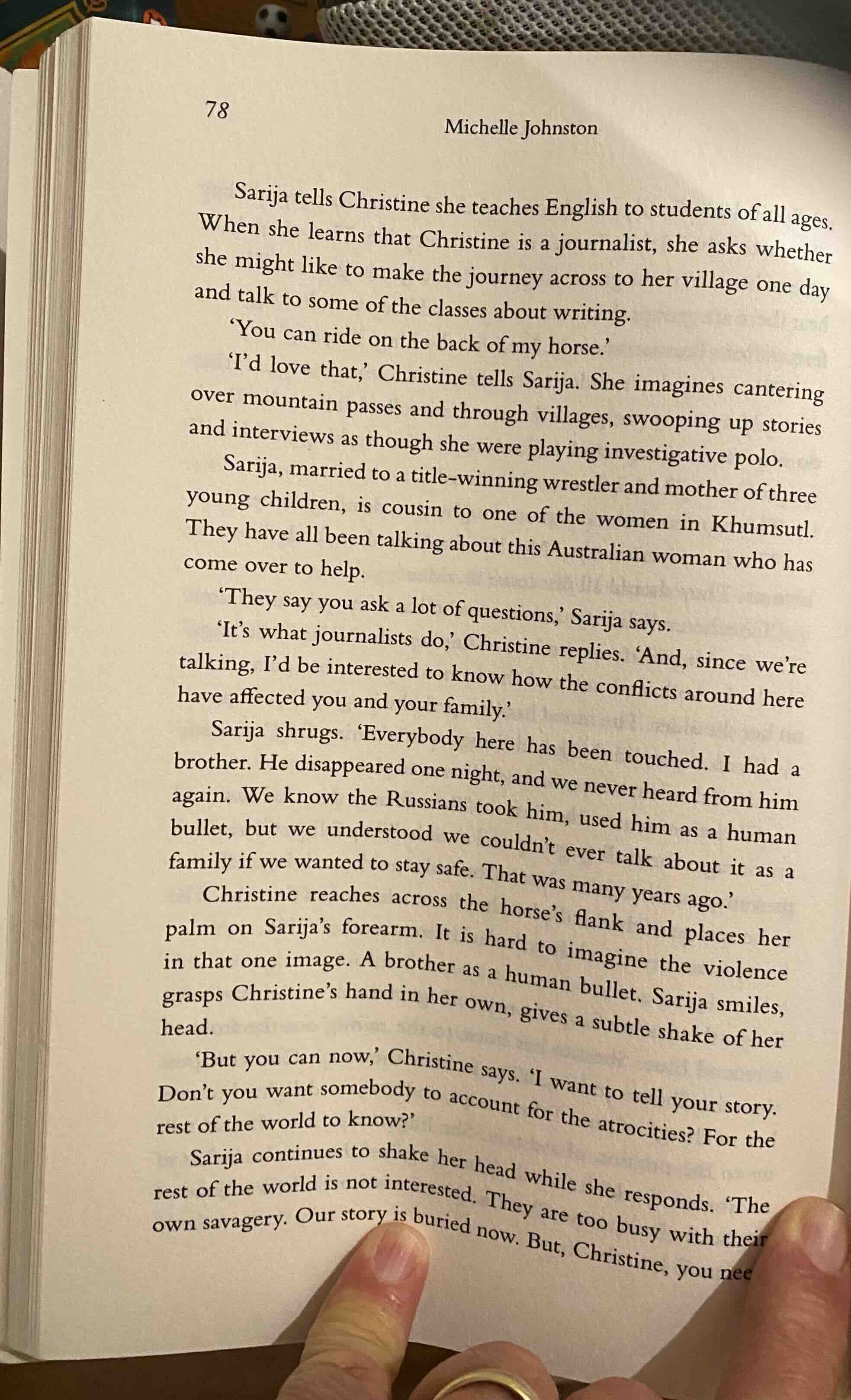
Sarija is a teacher of English from a nearby village who has attended Christine’s first-aid classes, and even acted as her assistant. Here, the two women are chatting, leaning against the dusty haunches of Sarija’s horse. Sarija suggests that Christine might visit her village to talk to her students about writing:
‘You can ride on the back of my horse.’ ‘I’d love that,’ Christine tells Sarija. She imagines cantering over mountain passes and through villages, swooping up stories and interviews as though she were playing investigative polo.
This is an example of many similar moments. I would have said it hits a false note: why would Christine, formerly Crystal from the WA wheat belt, think of polo? Surely the forced simile is an awkward writerly intrusion? On rereading, I see it differently. What’s happening is that the narrative voice, while technically telling the story from Christine’s point of view, looking over her shoulder as it were, actually undermines her, mocks her as callow, exploitative, self-serving, in effect accusing Christine of thinking of her journalistic quest as a jolly sporting venture.
There are more examples even in this one page of dialogue.
‘They say you ask a lot of questions,’ Sarija says. ‘It’s what journalists do,’ Christine replies. ‘And, since we’re talking, I’d be interested to know how the conflicts around here have affected you and your family.’
This is a woman who has been uncomplainingly lugging boxes around the clinic, winning the trust of the local women as she teaches them first aid. As soon as she thinks of herself as a journalist she becomes patronising (‘It’s what journalists do’) and would-be exploitative (‘Since we’re talking…’).
Sarija opens up to her anyway. Again, Christine makes a small gesture of sympathy, but her mind goes to the juicy turn of phrase:
It is hard to imagine the violence in that one image. A brother as a human bullet.
‘I want to tell your story. Don’t you want somebody to account for the atrocities? For the rest of the world to know?’ Sarija continues to shake her head while she responds. ‘The rest of the world is not interested. They are too busy with their own savagery. Our story is buried now. But, Christine, you need to know this: you don’t find answers here by asking questions.’ She pauses. ‘You find the answers by being quiet.’
To which this reader, led by the narrative voice, wants to shout, ‘Yair, Christine. Be quiet.’
Later, when Christine is frustrated at the lack of usable quotes from the women, she thinks back to this conversation and sees Sarija as her likeliest source of good copy. There may be some truth to this portrait of journalism in the field, but when she’s being a journalist Christine is almost completely unlikeable. Later, when she manages an interview with a self-styled warlord, she castigates herself for doing something terrible with what she has been told. The narrative voice holds back from condemning her, so even when she’s hard on herself, she is seen to be missing the point. She does commit one major journalistic sin, and in that case goes from self-deception about the gravity of her offence to wallowing in shame and remorse.
Though Christine goes on to make amends in some respects, I get the impression that Michelle Johnston doesn’t like her main character – and that makes a book hard to read.
Other people like this book a lot more than I do. Lisa Hill’s review is definitely worth reading.
Just before the meeting: We read two books at each meeting of the Book Club. The Revisionists was paired with Susan Choi’s Flashlight, and the comparison wasn’t kind to The Revisionists. For just one thing, both books deal with terrible historical events. In her acknowledgements, Susan Choi lists fifteen books of fiction and non-fiction about her subject so the reader can check how closely her fiction sticks to known facts. Michelle Johnston tells us nothing about her sources. This might not have mattered, but when there is an unreliable central character, it would be good to know if two atrocities in particular were invented for the horror of it or were documented events.
After the meeting: We were pretty unanimous in not caring for this book. Not everyone agreed that the author didn’t like her central character – what I saw as criticism of her as callow and exploitative, others saw as ironic highlighting of her naivety. But none of us much liked her anyway. One person went so far as to say the book shouldn’t have been published. Someone who has visited New York City quite a lot was exasperated that when Christine decides to sell a Rothko that has come into her possession, she takes it to a local gallery. ‘I’m sorry,’ she said, ‘if you have a Rothko to sell you go uptown to Christie’s or Sotheby’s.’ Rookie error, I guess.
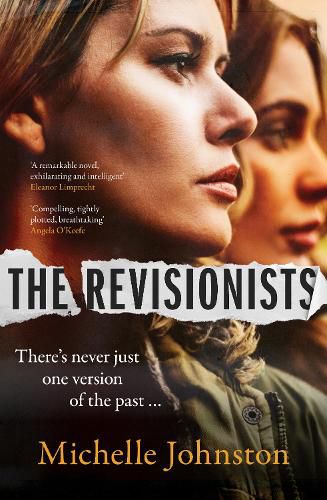
We pondered the meaning of the book’s title. Perhaps it refers to the way Christine altered some key facts in her famous article. Perhaps it highlights an otherwise inconsequential moment in the last pages when Frankie and Christine realise they have completely different memories of how Christine came to be in Dagestan. We also pondered the meaning of the cover image: two women in profile, both with the abstracted air of models. None of us could see how it related to the actual novel.
On the other hand we had culturally eclectic creations from Tokyo Lamington for dessert, and Flashlight (blog post to come) is an excellent book that provoked interesting conversation.
The group met on the land of Gadigal and Wangal of the Eora Nation, where I have also written this blog post. The days are getting longer, and warmer, and I’ve been encountering a beautiful, satiny crow near my home. I acknowledge Elders past and present, and welcome any First Nations readers.
* My blogging practice is to focus on the page that coincides with my age, currently 78.
Before the meeting: As a boy I read a lot of British crime fiction. When I was 13, I put a brown paper cover on the conveniently-sized novel I had to read for school (Booran by M. J. Unwin – trigger warning for 1950s colonialist attitudes), then transferred the cover to book after book by Agatha Christie and Ngaio Marsh over the course of the year. My parents were impressed that I appeared to read Booran so many times. For my father’s birthday in April, I gave him a pile of ten pre-read paperbacks, and for Christmas another twenty. It didn’t occur to me that my pretence might be transparent.
This means that on the cusp of teenagehood I read enough ‘cosy mysteries’ to last a lifetime. I can still enjoy the odd Agatha Christie on TV or at the movies, but I have no desire to reread the books. Not even The Murder of Roger Ackroyd.
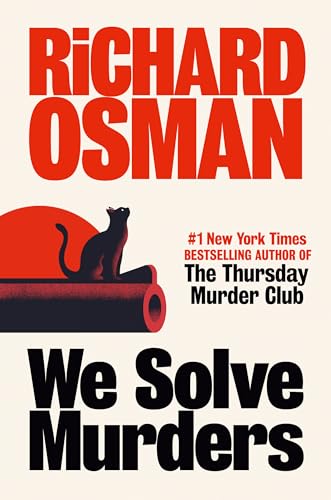
Reading We Solve Murders felt like an enforced return to that territory. It’s a cosy mystery mixed with a comedy action thriller, written with amiable wit in elegant prose, with a plot that features many exotic locales, influencers being murdered and a villain who uses generative AI to disguise their identity. (Incidentally, it’s a bold move in a genre novel written in the style of a friendly English gentleman to have the villain’s chapters preceded by a Chat GPT prompt to render text ‘in the style of a friendly English gentleman’. I can’t be the only one to think Richard Osman is having a little joke at his own expense.)
This is explicitly intended to be the first book in a series, like Osman’s first series The Thursday Murder Club, and we can probably expect a TV movie, hopefully less mediocre than the recent TMC movie. There are moments where I would laugh if I saw them on screen. Just one example, from page 244. Amy, the hard-boiled heroine is talking to Nelson, who may be about to kill her:
‘It’s just you don’t seem like an assassin?’ says Amy. ‘And I know a lot of assassins.’ ‘I am not an assassin,’ says Nelson, his tone very reasonable. ‘I’m just, you know, a regular criminal and politician.’
Boom tish!
The story rattles along at a good pace. The characters are an amusingly diverse bunch of types. There are twists and turns and plenty of travel. It is what it is and it’s terrific at it. I was entertained, but it took many more hours than a movie would.
After the meeting: It was a small group, not for lack of interest in the book but because of family birthdays, travel commitments, viruses – and our current policy of sticking to our designated dates no matter what. Not for us the practice of that group who don’t decide on a date until everyone has read the book. Still, the four of us enjoyed each other’s company until well after my watch announced it was my bedtime. Among many things, including the colourful career of one us, we did talk about the book.
One chap put it nicely: Richard Osman works in popular entertainment, having devised and presented a number of successful game shows. He knows what works with audiences and has brought that knowledge to the new (to him) field of novel writing. I’m pretty sure someone said that there’s a big overlap between his target readership and people who go on cruises. (We had an interesting digression into the sociology of cruise ships.)
When it was observed that when Australian comics try to replicate those British game shows they don’t always come up with a winner, we realised that their Englishness is at the heart of their charm. And that is also true of this book. Our one English-born and bred group member spoke eloquently on this point. There’s a character who can be relied on to give details of which roads he takes to get from one village to another: this, our group member assured us, has the ring of authenticity. The book is firmly rooted in a particular place – a village in the New Forest. Another chap who lived for some time in an English village testified that, just as in the book, in a two-pub village most pub-goers were loyal to one establishment and wouldn’t dream of visiting the other. What I read as cosiness is also a celebration of something distinctively English. And they did say ‘English’, not ‘British’.
Someone asked, ‘Did you laugh?’ No one said yes. On the page, the book is often funny but not laugh-out-loud. We shared stories of books that did make us laugh out loud – a Georgette Heyer regency romance and the The Traveller’s Tool by Sir Les Patterson were mentioned. (There was another interesting digression about Barrie Humphries.) But we had a sense that a movie, or preferably a TV series, might be on the way.
One of the non-attendees summed it up well in a WhatsApp post: ‘No thinking, just chorkling. The goodies win / the baddies get their come-uppence. Very English.’
The Book Group met, and I wrote this blog post, on the land of Gadigal and Wangal of the Eora Nation as the days are growing suddenly warmer. I acknowledge Elders past and present, and welcome any First Nations readers.
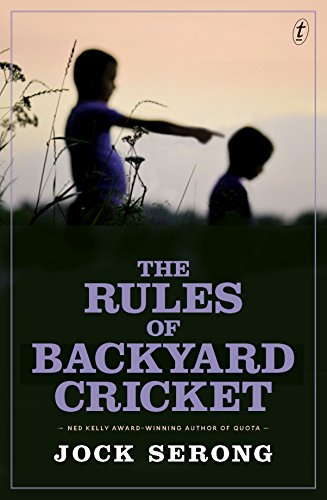
I was given The Rules of Backyard Cricket as a gift some years ago. Friends had told me it was excellent, but I knew nothing about it. The cover illustration, which shows two small boys in silhouette, one of them pretending to shoot the other in the back of the head, suggested that it might be less benign than the ‘Cricket’ episode of Bluey.
The opening chapters have a lot in common with that episode. Two brothers in the suburbs spend endless hours playing cricket with makeshift equipment and their own idiosyncratic rules. Like Bluey‘s Rusty they become excellent and go on to bat for Australia.
But that’s where the similarity ends: the brothers, Darren and Wally Keefe, are locked in vicious mutual combat even while their brotherly bond is strong, which puts the book in a long tradition of stories about quarrelling brothers: think Cain and Abel, Jacob and Esau, Romulus and Remus, William and Harry. As they come to prominence in the cricketing world, Darren, the younger brother, attracts headlines for his off-pitch misbehaviour with drugs and chaotic relationships, and a terrible hand injury excludes him from cricketing heights. Wally becomes captain of the Australian team and can be depended on to present the ideal face of professional sport, though his personal life suffers under the strain. They typecast themselves: ‘Wally as responsible, grave: a leader. [Darren] a force of nature: a talented freak with no mooring.’ (Page 73)
In the background is the world of organised crime, match-fixing and corruption – embodied in Craig, their friend from teenage years who now lives a shadowy criminal life. Also in the background is their single mother, whose unfailing belief in both of them has been crucial to their success, and their long-suffering women partners, where I choose the word ‘suffering’ deliberately.
At the start of the novel, Darren is locked in the boot of a car, on the way to an unknown destination where, he assumes, he is about to be killed. He’s not sure who is going to kill him or why, and as he tries to work his way free he thinks back over his life, and in so doing narrates the book. Each chapter begins with a brief report on what’s happening in that boot, a device that both reassures readers that the story is something other than a biography of two fictional sportsmen, and challenges us to spot the moment when Darren falls foul of someone murderous.
I’m not a cricket fan, but I can follow a conversation about it (unlike the AFL in Helen Garner’s The Season). I loved the descriptions of cricket matches here – the fast bowling, the sledging, the many technicalities. Some readers will need to skim those bits. I’m with them in not getting most of the references to famous cricketers, but it didn’t worry me.
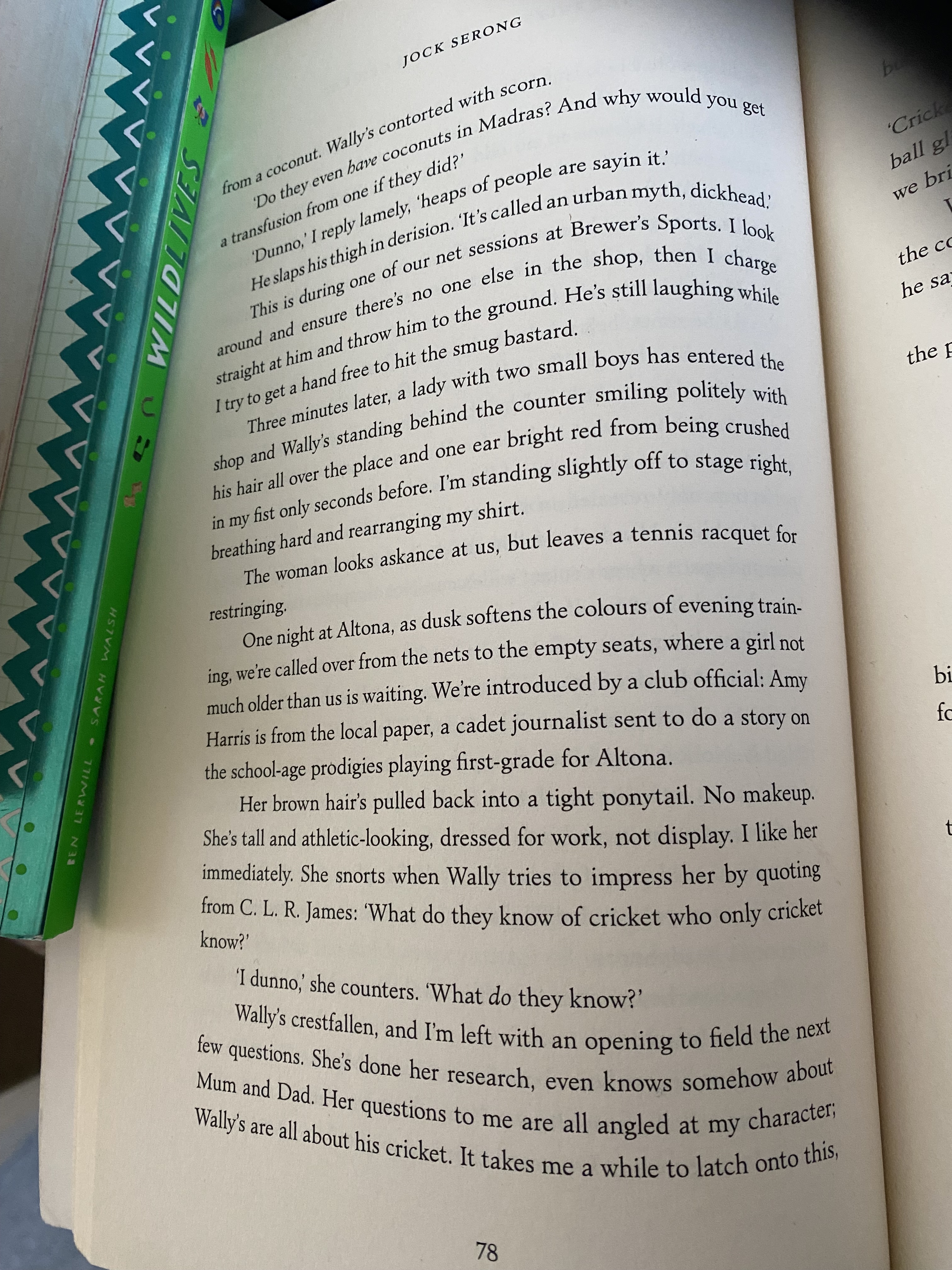
On page 78*, about a quarter into the book, the teenaged brothers have recently moved out of home. Wally is being recognised as a cricketer of ‘phenomenal self discipline’ but, according to Darren, when they play in the back yard he’s still ‘vengeful, savage and petulant’. They are in a sports-gear shop where Wally has a job, and where Darren visits to play with the cricket gear.
Two things happen on this page, one to do with the boys’ relationship and the other introducing a character who will play a crucial role. First, Wally sneers at Darren for believing an improbable story about a Test cricketer being given a transfusion ‘from a coconut’:
I look around and ensure there’s no one else in the shop, then I charge straight at him and throw him to the ground. He’s still laughing while I try to get a hand free to hit the smug bastard. Three minutes later, a lady with two small boys has entered the shop and Wally’s standing behind the counter smiling politely with his hair all over the place and one ear bright red from being crushed in my fist only seconds before. I’m standing slightly off to stage right, breathing hard and rearranging my shirt. The woman looks askance at us, but leaves a tennis racquet for restringing.
There’s comedy in the way the brothers fight compulsively like much younger children. But there’s something unnerving about the way Wally laughs and recovers quickly to present a polite face to the world. By referencing stage directions – ‘slightly off to stage right’ – Darren invites us to visualise the scene: one brother stands centre stage as far as the world is concerned, while the other is a dishevelled and disreputable support actor. This is the story as seen by the latter, and the scene is emblematic of their relationship.
Then:
One night at Altona, as dusk softens the colours of evening training, were called over from the nets to the empty seats, where a girl not much older than us is waiting. We’re introduced by a club official: Amy Harris is from the local paper, a cadet journalist sent to do a story on the school-age prodigies playing first-grade for Altona. Her brown hair’s pulled back into a tight ponytail. No makeup. She’s tall and athletic-looking, dressed for work, not display. I like her immediately. She snorts when Wally tries to impress her by quoting from C. L. R. James: ‘What do they know of cricket who only cricket know?’ ‘I dunno,’ she counters. ‘What do they know?’ Wally’s crestfallen, and I’m left with an opening to field the next few questions. She’s done her research, even knows somehow about Mum and Dad. Her questions to me are all angled at my character; Wally’s are all about his cricket. It takes me a while to latch onto this, but like an idiot I play extravagantly into her hands.
Darren’s extravagance gives Amy her headline when he says that he and Wally bring people what they want from cricket now, drama and action: ‘Bradman is dead.’ It’s one of Darren’s rare victories in their lifelong rivalry – and like all his victories it’s a bit on the nose.
If you don’t know who Bradman was, you’d be pretty lost in this book. But you don’t necessarily have to know about C. L. R. James. In fact, it feels as if Jock Serong is speaking directly here, as it seems unlikely that Darren would have read the work of Trinidadian Marxist intellectual C. L. R. James, even if he had heard James’s riff on Kipling’s, ‘What do they know of England who only England know?’ Whether Amy knows where the quote comes from doesn’t matter. She sees it for what it is, a bit of misjudged pretension on Wally’s part. She’s out for a juicy headline. She’ll continue to be out for juicy stories for the rest of the book.
Like the fighting between the brothers, the headlines get darker as time goes by. So yes, the book is about cricket – backyard, community, state, international test and one-day varieties. It’s also about the corrupting effects of capitalism on sport, about masculinity toxic and otherwise, about the damaging effects of celebrity, about the role of the media. And it moves at a ripping pace.
I wrote the blog post on the land of Gadigal and Wangal of the Eora Nation where the days may be be growing warmer and lorikeets are starting to make their presence known. I acknowledge Elders past and present, and welcome any First Nations readers.
* My blogging practice is to focus on the page that coincides with my age, currently 78.