Tag Archives: Novel

Madeline Miller’s Song of Achilles and November verse 2

Madeline Miller, The Song of Achilles (HarperCollins 2011)

The first half of The Song of Achilles is in effect a Young Adult boy-meets-boy love story, as the demigod Achilles befriends our narrator Patroclus, one of his father’s many foster-sons. The friendship becomes increasingly steamy until, while the language remains as chaste as anyone could wish, the two teenage boys find rapture in each other’s arms and are soon tacitly acknowledged as a couple. ‘Patroclus is my sworn companion,’ Achilles announces at a state occasion. ‘His place is beside me.’ This is against the will of Achilles’ goddess mother, Thetis.

Most of my readers won’t need to be told that Patroclus and Achilles are key characters from The Iliad, and that the emotional heart of that epic is Achilles deep love of Patroclus and his inconsolable grief when Patroclus is killed. This novel is mainly back story. The explicit sex isn’t so much a departure from the original as a confirmation.

At about the halfway point, after spending years being trained by the centaur Chiron and an episode in which Achilles hides out dressed as a girl, the two young men arrive with the vast Greek war force at the beach near Troy. Achilles is now acclaimed as the greatest of the Greek warriors, and the second half of the book is a completely engrossing retelling of The Iliad.


Because it’s November*, I won’t linger on page 77, when teenaged Patroclus wakes up in bed next to Achilles in Chiron’s cave. Instead, I have gone to page one, and read until I came to a potential first line for an Onegin stanza. The book begins with Patroclus’ mentally incompetent mother and his own physical ineptitude (the only element in Madeline Miller’s telling that conflicts with my own reading of The Iliad – it had never occurred to me that Patroclus was less than formidable). Patroclus’ first glimpse of Achilles is when Patroclus is five years old. Achilles is among the youngest boys who compete in games hosted by Patroclus’ royal father and, being a demigod, he wins. This is in spite of being easily the youngest competitor: ‘He is shorter than the others, and still plump with childhood in a way they are not.’

In the book, this last sentence signifies that Achilles is gifted well beyond his years. When I nicked part of it for my first line, my mind went somewhere completely different, to a memory from 60+ years ago.

Verse 1: Nudgee College, 1961–1962
He is shorter than the others,
thinner too, not seen as cool.
We've all been sent here from our mothers,
to this Christian boarding school,
sons of far-flung Queensland farmers,
just four hundred teenage charmers:
ten grown men. It's no surprise
that kindness doesn't rule our days.
His nakedness provokes derision,
soapsuds sprinkled in his sheets
cause eczema, and laughter greets
his asthma. Here's my shamed admission:
terrified, I turn my back
glad it's not me they attack.

OK, maybe tomorrow will get cheerful.

Added later: Inspired by the online course in Modern and Contemporary American Poetry (ModPo) I’m currently doing, here’s a chance-based/ procedural poem created from The Song of Achilles. It begins with the book’s first word beginning with A, which is followed by the first word after that to begin with B, and so on. It took 52 pages to get to ‘Zeus’.

A built ceremony
did eye forward
glints.
He is jest kneeling
looked man
not one present quieted
raised
said things
upbringing vividness
when exile you Zeus

I wrote this blog post in Gadigal Wangal country, and am posting it as lorikeets shout to each other about the rain that is about to come down. I acknowledge Elders past, present and emerging for their continuing custodianship of this land, over which their sovereignty has never been ceded.


For the last 14 years, I have challenging myself to write fourteen 14-line poems during November. The poem may be inspired by a book I’m blogging about, or may be connected to it by the vaguest of tangents, as here.

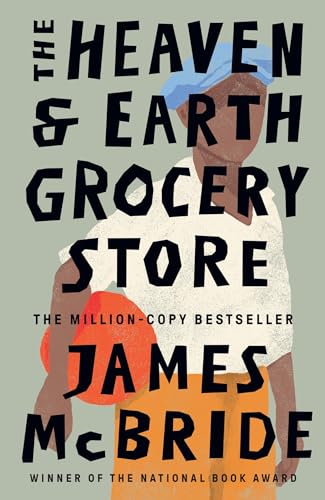
The Book Club at James McBride’s Heaven and Earth Grocery Store

James McBride, The Heaven and Earth Grocery Store (Weidenfeld & Nicolson 2023)

Before the meeting: Though this is the first book by James McBride that I have read, he has featured in this blog before, as the author of The Good Lord Bird, one of the Emerging Artist’s best five books of 2014 (link here). That book won the USA’s National Book Award. According to his Wikipedia entry, The Color of Water, a 1995 book about McBride’s African American and Jewish family history and his relationship with his white mother, is widely regarded as an American classic.

The Heaven and Earth Grocery Store is his sixth novel, set in 1925, mainly in Chicken Hill, a ‘ramshackle neighbourhood’ of the Pennsylvania city of Pottstown (Pottstown exists in real life; Chicken Hill not so much as far as I can tell). The store of the title is run by Chona, a Jewish woman, whose husband Moshe runs a neighbourhood theatre. As most of the Jews leave Chicken Hill for more salubrious neighbourhoods, Chona and Moshe remain and, swimming against the tide of their times, continue to serve and welcome the presence of their African American neighbours (always ‘Negroes’ in this book). At the heart of the book is a celebration of friendship and alliance between Jews and Blacks, plus a significant Italian or two.

The book runs to 381 pages, so page 77* occurs at about the one-fifth point. If a conventionally structured Heaven and Earth Grocery Store film were to be made, I imagine that the events on this page would come much earlier, at the 10 percent mark, when the Inciting Incident is due. The set-up has been established: a death has been foreshadowed; we’ve met Moshe and Shona and the main African American couple, Addie and Nate, who work in the shop and the theatre respectively; we’ve seen the theatre and the grocery store in action; we know the story of Chona’s chronic illness and disability; we’ve met the book’s villain, Doc Roberts, who comes from ‘good white Presbyterian stock’ and marches every year with the Ku Klux Klan. It’s time for the first turning point.

Nate has told Moshe about his ten-year-old nephew, Dodo, who recently started working in the theatre. He was made deaf by an accident, and his mother has died.

Nate’s brow furrowed and his old hands moved up and down the broom handle slowly. He said softly, ‘Me and my wife’s got him.’

Moshe looked down at the floor a moment, embarrassed. It rarely occurred to him that he and Nate shared one commonality. Neither of their wives could bear children. They had worked in the theater all day side by side for twelve years but rarely discussed their wives or matters of home.

Their relationship is already changed by this conversation. The distance imposed by their histories is being bridged. The rest of the conversation introduces the book’s main external action.

‘Well, I think that’s fine,’ Moshe said. ‘You can run things as you like.’

Nate’s brow furrowed. ‘A man from the state come to the house last week. Says he’s gonna carry Dodo off to a special school over in Spring City. Dodo don’t wanna go to no special school. He’s all right here with us.’

Moshe’s heart quickened. He felt a request coming, but Nate continued. ‘The man says he’s coming back to fetch him next week. I’m wondering if you might let me slip Dodo into the theater here tonight, just for a few days till the man goes away. The boy’s quiet. Can’t hear nothing. Won’t be scared or make no noise. He can work good, clean up and so forth.’

‘For how long?

‘Just a couple of days till the man’s gone.’

Knowing where this passage occurs in the book, you would almost certainly guess – correctly – that those few days will expand, and the small favour will balloon into something that changes all their lives. As it turns out, when Moshe tells Chona the situation, she insists that they take Dodo into their own home, and he becomes a much loved member of their family until, in spite of their careful strategies to keep him hidden from the authorities, he is taken from them to a ‘special school’, which is in fact a prison-like institution for people deemed insane. Doc Roberts is key to that removal.

The second half of the book is given over to plans to free Dodo. Relationships between Jews, Blacks and poor Whites flourish. Nate’s back story emerges from the shadows and the man who we first meet as the genial, ageing employee shows a dark side that leads to the book’s one shocking moment – shocking because the reader, or at least this one, cheers on a terrible act of violence.

Doc Roberts and his ilk are embodiments of callous, racist, antisemitic hypocrisy and not much else. There’s a subplot to do with water supply to the synagogue that had me wondering why it was there at all until at the very end it joins the main plot to lead to the death mentioned on the first page. (Not really a spoiler.)

The meeting: We discussed this book along with Elif Shafak’s There Are Rivers in the Sky. We seem to be developing a tradition in the Book Club of having a dedicated nay-sayer at each meeting. This month’s nay-sayer said she had had read this one first, and felt it was built from hackneyed tropes with nothing fresh to offer. Then she read There Are Rivers in the Sky, and revised her view upwards. Our non-finisher had the reverse view – based on a small taste of each book, this one was much less gripping.

Such faint praise aside, we had an animated discussion. One person’s bug turned out to be another’s feature. For example, Chona’s neighbour Bernice was once her best friend but they have been estranged for decades, yet when she asks for help in concealing Dodo from the authorities, Bernice is willing to put herself on the line. One person saw this as inconsistency in the character; another saw it as reflecting the nature of the community – solidarity trumping personal animosity.

There’s a sequence in which two young disabled men – one deaf and the other with severe cerebral palsy – work out a way to communicate. ‘Unbelievable!’ someone said. ‘But brilliant!’ someone else replied. It turned out they both meant pretty much the same thing.


Our Book Club meets on the land of Gadigal and Bidjigal, looking out over the ocean. I wrote this blog post further inland in Gadigal Wangal country, where I am priivileged to live. I acknowledge Elders past and present for their continuing custodianship of this land.


My usual blogging practice is to focus on the page that coincides with my age, currently 77. Sometimes, as here, it’s a crucial page.

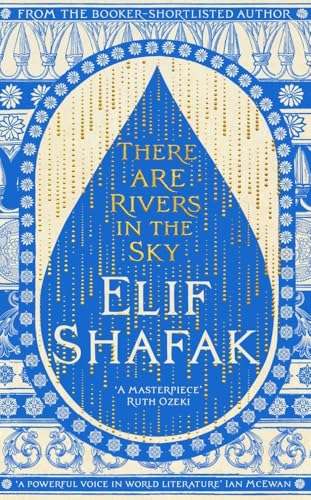
There Are Rivers in the Sky, Elif Shafak and the Book Club

Elif Shafak, There Are Rivers in the Sky (Penguin 2024)

Before the meeting: I’m glad I read this novel. I am much better informed now on the history of the Yazidi people, and about the unearthing of the Epic of Gilgamesh in the mid 19th century.

After a short opening chapter featuring the tyrant Ashurbanipal in ancient Nineveh, the narrative follows three distinct threads, which remain separate until the final, very short chapter.

There’s Arthur, full name Arthur King of the Sewers and Slums, a fanciful version of the amazing George Smith who decoded the cuneiform script of ancient Mesopotamia, translated the Epic of Gilgamesh and travelled to Nineveh in the mid 19th century. There’s Narin, nine years old at the start, living in south-east Turkey in 2014, child of a shrinking and beleaguered Yazidi family. And there’s Zaleekhah, a 30-something hydrologist in the throes of a break-up in 2018, who we first see renting a houseboat on the Thames.

A number of motifs occur in each of the stories, so that they resonate with each other even there is no evident narrative connection: images of lamassus, the protective spirits of ancient Nineveh who have bearded human heads and lions’ bodies; pieces of lapis lazuli; cuneiform script, on clay tablets or in tattoos; references to The Epic of Gilgamesh; and above all water. The book begins:

Later, when the storm has passed, everyone will talk about the destruction it left behind, though no one, not even the king himself, will remember that it al began with a single raindrop.

That raindrop has no causal impact on events, but the identical drop, having lain dormant in the water table, floated in the ocean, wafted about in clouds, turns up again at crucial moments of each narrative, as a snowflake or ocean spray or another raindrop. That conceit, and the way the narrative frequently pauses for mini-lectures – on hidden rivers, the industrial revolution, Yazidi culture, Napoleonic archaeology, etc etc – meant I spent a lot of time being irritated. The fourth wall is forever being broken, either by a mention of water (at least four times there are sweating necks, or a character introduces herself by saying her name is short for an Irish word for water) or by what reads like a piece of undigested research.

Page 77*, it turns out, has some fine examples. Zahleekha has just stepped into her houseboat for the first time. First there’s the water, with heavy-handed metaphorical significance. She drinks a mug of water ‘in one draught’, and:

It tastes earthy and slightly metallic, with an aftertaste of iron. The flavour has less to do with its intrinsic qualities than with its biophysical environment, the set of conditions that brought it about. Water hardens in adverse circumstances, not unlike the human heart.

Then comes the lecture, preceded by a moment of backstory:

Out of nowhere a memory surfaces – the words Uncle Malek uttered the day she had graduated from university with honours. I’m so proud of you, habibti. I want you to be very successful. Remember, people like us cannot afford to fail.

‘People like us’ … immigrants, exiles, refugees, newcomers, outsiders … Too many words for a shared, recognisable sentiment that, no matter how often described, remains largely undefined.

Children of uprooted parents are born into the memory tribe. Both their present and their future are forever shaped by their ancestral past, regardless of whether they have any knowledge of it. If they flourish and prosper, their achievements will be attributed to a whole community; and, in the same way, their failures will be chalked up to something bigger and older than themselves, be it family, religion or ethnicity.

Then, after a little more along the same lines, Zahleekhah sits down and after a moment starts to cry. But rather than allow the reader space for empathy, the narrator sweeps in with her insistence on water as ubiquitous and rich with symbolic meanings:

A tear falls on the back of her hand. Lacrimal fluid, composed of intricate patterns of crystallised salt invisible to the eye. This drop, water from her own body, containing a trace of her DNA, was a snowflake once upon a time or a wisp of steam, perhaps here or many kilometres away, repeatedly mutating from liquid to solid to vapour and back again, yet retaining its molecular essence. It remained hidden under the fossil-filled earth for tens if not thousands of years, climbed up to the skies and returned to earth in mist, fog, monsoon or hailstorm, perpetually displaced and re-located. Water is the consummate immigrant, trapped in transit, never able to settle.

Again, I’m glad I read this book. But I was annoyed a lot of the time while reading it.

After the meeting: We read There Are Rivers in the Sky along with The Heaven and Earth Grocery Store by James McBride. There were five of us, well-fed by the time we got to the books. We began with confessions: only one person hadn’t read either book, and she had read ‘about 35%’ of this one. She spoke eloquently about what she liked in what she had read – mainly the evocation of polluted, foul-smelling mid-19th century London – which makes me think it’s probably a good idea to have someone in any group who hasn’t finished the book.

Of those who had read to the end, we had a range of responses. One enjoyed it, only peripherally put off by the telling-not-showing and heavy-handed deployment of the leitmotifs. Onehad been enthusiastic abut the book because she hoped it would have interesting things to say about Gilgamesh and appreciated much about it, but was disappointed and disliked being lectured at. And the other just found the book tedious, would rather have read a non-fiction treatment of the history and persecution of the Yazidi, couldn’t feel any of the characters as more than made-up figures to allow the plot to move. And there was me (see above).

We all agreed that the most interesting thing in the book was the character of Arthur. Born in abject poverty, his photographic memory and a series of Dickensian coincidences (one of them featuring Charles Dickens) led him to interesting places, and fixation on a book about Nineveh as a way of dealing with the pain of brutal beating led to a grand obsession that gave The Epic of Gilgamesh to the modern world. I now want to find out more about the real-world George Smith, but I’m very happy to have Arthur in my mental world as distinct from him.


I wrote this blog post in Gadigal Wangal country, in a place where wetlands have been drained, but the river is recovering health, is home to a marvellous variety of birds, and is a great place for catch and release fishing (one day the fish may be edible again). I acknowledge Elders past, present and emerging for their continuing custodianship of this land.


My blogging practice is to focus on the page that coincides with my age, currently 77.

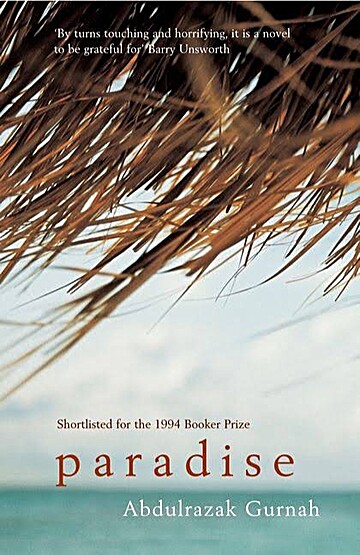
Abdulrazak Gurnah’s Paradise and the Book Club

Abdulrazak Gurnah, Paradise (©1994, Bloomsbury 2004)

Abdulrazak Gurnah, winner of the Nobel Prize in Literature in 2021, was a wonderfully urbane guest at this year’s Sydney Writers’ Festival. In the session I attended he spoke mainly about his 2021 novel, Afterlives, but talked a lot about that book’s relationship with the much earlier Paradise. (Added much later: you can listen to the podcast of the conversation at this link.)

We read Afterlives a while ago in my all-male Book Group, and had a wonderful discussion of it. Now my predominantly female Book Club is tackling the earlier novel.

Before the meeting: Paradise is a long way from languishing in the shadow of Afterlives. Its action unfolds in the same part of East Africa, beginning a couple of decades earlier, in the years leading up to the First World War.

The book begins with a boy named Yusuf looking forward to receiving a customary gift of money from Uncle Aziz when Aziz’s brief visit comes to an end. There is no gift, and instead the boy is taken away with the uncle. Then he realises that he is not going back to his family and soon learns that he has been given to Aziz, who is not actually his uncle, as surety against his father’s debts. He has become little more than a slave in the merchant’s household.

The story unfold from there. There’s adventure, involving an arduous, perilous expedition into the unknown. There’s romance, where intimate moments, perhaps even a kiss, may be snatched in dark corners of a walled garden. There’s a gallery of rich, exuberant characters – Khalil, an older boy in a similar state of bondage to Yusuf; an older woman, infatuated by Yusuf’s beauty, who harasses him to the amusement of onlookers; an ancient gardener who long ago refused his freedom when actual slavery was abolished; a formidable, scarred man who organises Aziz’s trade expeditions and has a reputation as a sexual predator on young men; Aziz himself, a formidable commercial operator who remains calm in the most extreme situations.

Meanwhile, European powers are colonising East Africa. They are mostly peripheral, offscreen characters who threaten to destroy the whole world experienced by the main characters. German soldiers appear twice, once at roughly the midpoint and then again at the very end. Both times they function as a deus ex machina: the first time their unexpected arrival saves Aziz and his expedition, including Yusuf, from a vengeful tribal chief, but the incident leaves a nasty sense of something unresolved; the second time they provide the book’s final moment, which left me staring into space for a long time.

The book was only transated into Swahili – the official language along with English of Gurnah’s home nation Tanzania (known as Zanzibar back then) – after he was awarded the Nobel Prize.

After the meeting: At this meeting we discussed Annie Ernaux’s Une femme / A Woman’s Story along with Paradise, an odd pairing which meant we had two quite separate discussions.

All but one of us enjoyed this book a lot, and the dissenting voice meant we had an interesting conversation. The main character, she said, is completely passive: things just happen to him, one after another, and especially on the gruelling trade expedition that takes up a good slab of the book the bad things are repetitive. The book only becomes interesting once Yusuf is back in town and a powerful woman, in a complex way, is lusting after him. Though others were able to point out that Yusuf was constantly taking initiatives – a surreptitious excursion to town just for fun, offering unauthorised help to the ancient gardener, etc – I was struck by the similarity of this observation to what someone in my other Book Group said about the main character in Afterlives: because of the constraints on the characters, they don’t have the space to attend to their inner lives. When I tried to articulate this thought, someone said something beautifully concise and wise about the way trauma can alienate a young person from their own experience. Sadly I didn’t write it down, but to my mind it captured beautifully the way Yusuf does indeed move from one thing to the next, having no real say about the direction of his life, and no ability to form coherent thoughts about it.

I realised in the course of the discussion that the story is full of references to Joseph / Yusuf in the Hebrew Bible and the Quran, in particular the episode of Potiphar’s wife / Zuleikha. I just read a version of the Quran story on Wikipedia, and the parallels are even closer than I thought. It makes me wonder what other references may be hovering around this eminently readable tale. Joseph Conrad’s Heart of Darkness comes to mind. (Gurnah’s Gravel Heart includes a retelling of Shakespeare’s Measure for Measure, set in modern East Africa.)

We discussed the final paragraph, which I’d love to expand on here but, unlike some surprise revelations (see my blog post on Wole Soyinka’s Chronicles from the Land of the Happiest People on Earth, coming in a month or so), it really is a surprise.

Being of a certain age, we said goodnight a little after 10 o’clock.


I wrote this blog post in Gadigal Wangal country, where it is my great joy to live. In particular right now the days are getting warmer, the sun is rising earlier and setting later, and whenever I walk out my door I see tiny lizards scurrying for cover. I acknowledge Elders past, present and emerging for their continuing custodianship of this land.

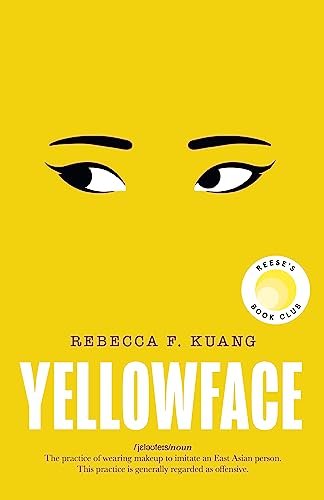
Rebecca F. Kuang’s Yellowface and the book group

Rebecca F. Kuang, Yellowface (The Borough Press 2023)

Before the meeting: It’s a thing: books – and movies – that deal with questions of authorship. The protagonist of Siri Hustvedt’s The Blazing World (2014) presents a young male artist as the creator of her sculptures. In Cord Jefferson’s movie American Fiction (2023, based on Percival Everett’s Erasure (2001), which I haven’t read), an African-American novelist writes a trashy novel full of the stereotypes he despises, and presents its author as a fugitive from justice. I won’t do a spoiler on Björn Runge’s movie The Wife (2017, based on a 2003 novel by Meg Wolitzer). In Caledonian Road, Campbell Flynn knocks off a self-help book for men and has a photogenic young actor pose as the author. And that’s just some relatively recent ones that come to mind.

Yellowface is an entertaining addition to that list.

June Hayward, a young white woman whose first novel has done poorly, has an uneasy friendship with Chinese-American Athena Liu, a fabulously successful one-book novelist. When Athena dies suddenly with June as the only witness, June gets hold of her unfinished manuscript, which deals with aspects of Chinese immigrant life in North America. She sets about editing the manuscript and completing the story, telling herself that she is doing it to honour Athena. She gradually comes to think of the novel as primarily her own work and sends it to her agent over her name.

The novel is a publishing sensation and, without actually claiming Chinese heritage, June allows herself to be seen as Chinese. Her Hippie parents had given her ‘Song’ as a middle name, so – she rationalises – it’s not actually lying when she adopts the Chinese-sounding pen name of June Song and lets people make their own assumptions. Anyhow, Athena’s research consisted of extracting stories from other people, so they were already stolen property. And other rationalisations.

Needless to say, things go very wrong. Right up until the last movement I was having a great time. There’s a marvellous scene where June is invited to do a reading to a local Chinese community, where her hosts – including one elderly man whose experiences are similar to those narrated in the novel – are genuinely shocked when they realise she is not Chinese, but remain icily courteous. Social media users are infinitely less restrained.

We see it all from June’s point of view. We sorta-kinda believe the stories she tells herself, and even when she crosses the line into outright deception, we sympathise – until we don’t. June may acknowledge that she hasn’t been completely honest, but she continues to see herself as the victim of unfair attacks until the end of the book. But somewhere along the line, and I imagine the precise point differs from reader to reader, she loses our allegiance. So at the end, where she comes up with a way to redeem herself in the eyes of the publishing and reading world, we are led to believe that it will probably work, but are disgusted by a world where that is the case.

It’s cleverly done. The introduction of some unconvincing horror tropes spoiled the big climax, but I can forgive that.

Page 77* is a nice example of one of the strengths of the book. If you’re going to write a satire of identity politics in the publishing industry, you’d better make your version of the industry seem real. Kuang does that. June’s conversations with her agent and editor, her meeting with the marketing executives, the closing of ranks among authors, followed by the shunning once the scandal becomes too much: all feel real. The description of publication day on page 77 is surely taken from life:

Months become weeks become days, and then the book is out.
Last time, I learned the hard way that for most writers, the day your book goes on sale is a day of abject disappointment. The week beforehand feels like it should be the countdown to something grand, that there will be fanfare and immediate critical acclaim, that your book will skyrocket to the top of all the sales rankings and stay there. But in truth, it’s all a massive letdown. It’s fun to walk into bookstores and see your name on the shelves, that’s true (unless you’re not a major front-list release, and your book is buried in between other titles without so much as a face out, or even worse, not even carried by most stores). But other than that, there’s no immediate feedback. The people who bought the book haven’t had time to finish reading it yet. Most sales happen in preorders, so there’s no real movement on Amazon or Goodreads or any of the other sites you’ve been checking like a maniac the whole month prior.

According to Wikipedia, Rebecca F. Kuang’s first novel, The Poppy War, was a big success, but I am pretty confident that its 22-year-old author had exactly such a ‘day of abject disappointment’.

After the meeting: As usual, our meeting was convivial, and people had a range of responses. I was a bit of an outlier in feeling generally positive about the book, but I wasn’t the only one to derive at least mild enjoyment from the meta stuff: the Asian woman writing in the first person as a white woman pretending to be Asian. Someone wondered out loud how James would have been received if the author was revealed to be white, Helen Demidenko/Darville/Dale and The Hand the Signed the Paper was mentioned. But I don’t think anyone else just enjoyed Yellowface as a light satirical tale.

At least one other chap couldn’t for the life of him see what there was to enjoy. From memory, he was something like, ‘Yes, I get what you’re saying about identity politics and the publishing industry, and maybe even that there’s satire happening, but it’s not funny, there are no real characters, and nothing interesting happens. June, the protagonist, doesn’t develop and we don’t learn anything about her beyond the superficial.’

There were a number of positions in between. The extreme implausibility of the big climactic scene was something we could all agree on. Someone said that the effect staged there would have taken the resources of a Taylor Swift concert to pull off. I couldn’t disagree.

But we had an excellent time together, enjoyed the food and the fleeting visit from a teenager who lives in the flat, shared stories (including some tales of school reunions, of which the outstanding one was the 40th reunion of a former Australian Prime Minister who had been bullied at school and continued to be bullied 40 years later), laughed a lot, had peanut-flavoured ice cream, and didn’t feel at all competitive with (something I found out about recently) the all-male Book Group that has been meeting for 25 years in Melbourne.


I pressed ‘Publish’ for this blog post on Gundungurra land, where the creeks are flowing and the air grows cold as soon as the sun goes down. I read the book on Gadigal Wangal land, and brooded on it in Yidinji country and the many lands I have flown over or driven through in the meantime. I acknowledge the Elders past and present who have cared for these lands for millennia, and continue to do so.


My blogging practice is to focus on the page of a book or journal that coincides with my age, which currently is 77.

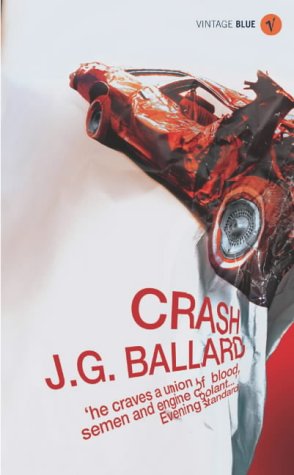
J. G Ballard’s Crash

J. G. Ballard, Crash (© 1973, Vintage Books 2005)

tl;dr: Yuk!

Having seen Crash on Tim Walters’ list of must-read science fiction / fantasy novels about 15 years ago, I got hold of a copy via Bookmooch, and it has been sitting on my To Be Read shelf ever since. I knew a David Cronenberg movie was based on it, and that it was about car accident survivors who share a sexual fetish for cars and car crashes.

Not an attractive proposition. But it’s a slim paperback, so I overrode my reluctance and packed it to read on the plane on my recent trip.

The Vintage Books edition has an Introduction written by J. G. Ballard in 1995, which includes this:

Throughout Crash I have used the car not only as a sexual image, but as a total metaphor for man’s life in today’s society. As such the novel has a political role quite apart from its sexual content, but I would still like to think that Crash is the first pornographic novel based on technology.

If pornography is something that feels you leaving just a bit less than fully human, he succeeds. If it’s something that makes you feel sexy, not so much. I’m a long way from being a connoisseur of porn, but the book this reminded me of was the one in the podcast My Dad Wrote a Porno. It has the same obsession with genitalia and sex-related bodily fluids – which in this book means pretty much all bodily fluids – but it’s not funny, even unintentionally. The patriarchal world view is overwhelming, and the sex is somehow tangled up with, or smeared or squirted on, car dashboards, crumpled metal, and terribly scarred bodies. The book is not for the faint-hearted, and I include myself in that category. In case that makes it sound titillating, I should add that it’s not for the easily ignored either: it goes on and on with unerotic sex scenes that are described in clinical, mechanical language (I won’t inflict examples on you) but still manage to be anatomically/mechanically confusing..

It’s not that I was clutching my pearls. I read the whole thing in the hope that it would deliver on the ‘total metaphor for man’s life’ etc. There’s a whiff of a promise that it would shed light on our society’s widespread fascination with car crashes, or the frisson produced by famous road deaths (Jane Mansfield, Albert Camus and James Dean are mentioned). But no more than a whiff. The opening paragraph foreshadows a near escape by ‘the film actress Elizabeth Taylor’ (whose Cleopatra appeared in the year the book was published), but she pretty much remains an abstraction.

Suffice to say I’m not rushing out to see the movie.


I wrote this blog post on the unceded land of the Gadigal and Wangal clans of the Eora Nation, where the earth has been reshaped over the last century to accommodate the needs of motor vehicles. I acknowledge their Elders past and present, with gratitude for their care of the land over millennia, and hope that the rest of us can learn from them in time.

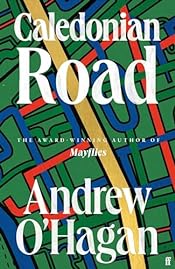
Andrew O’Hagan on Caledonian Road with the book club

Andrew O’Hagan, Caledonian Road (Faber 2024)

Before the meeting: Caledonian Road has a brilliant epigraph from Robert Louis Stevenson’s 1881 essay about ageing, ‘Aes Triplex’:

After a certain distance, every step we take in life we find the ice growing thinner and thinner below our feet, and all around us and behind us we see our contemporaries going through.

This quote struck a powerful chord with me, as the ice is definitely growing thinner below my feet, and I’m seeing my contemporaries ‘going through’ with increasing frequency.

Disappointingly, however, the book isn’t about courage and resilience in the face of ageing. It’s both more ambitious and less engaging than that.

Caledonian Road is a portrait of modern Britain, where criminality and corruption are the order of the day, and complicity is universal. Ranging from a Russian oligarch to a bystander at a backstreet knifing, with a distinguished art critic, a number of parliamentarians and a huge cast of characters in between, no one in the book can claim complete innocence.

The book’s first sentence introduces the main character and hints broadly at what is to happen:

Tall and sharp at fifty-two, Campbell Flynn was a tinderbox in a Savile Row suit, a man who believed his childhood was so far behind him that all its threats had vanished.

Campbell is a successful academic and art critic who dabbles in writing copy for fashion shows. He has written an essay that aims to puncture the complacency of the art world. He’s also dashed off a self-help book called Why Men Cry in Cars for which he plans to hire a handsome young actor to claim authorship and do signing tours. In the year covered Caledonian Road – in four parts named for the seasons, plus a fifth part titled ‘Realisation’ – his plans go (predictably) awry, and his own complacency is shattered. He falls under the spell of a young black student, Milo, who challenges his liberal world view and introduces him to the dubious pleasures of the dark web. Campbell’s comfortable life unravels and all around him and Milo as the outright and criminality of their friends, families and associates is laid bare.

The narrative takes us into many corners of UK society – a private gentlemen’s club, the tiny front parlour of a bereaved working class Scotswoman, a disastrous fashion shoot, a marijuana farm, a lorry full of illegal immigrants, the office of a tabloid newspaper. And weaponised social media is everywhere.

If it was a television series, I’m pretty sure I’d be addicted. As a novel, it’s not my cup of tea. There are many wonderful things in it, but the narrative just doesn’t sing, at least not to me. For instance, this is the opening of Chapter 10, which was a turning point, not in the plot, but in my non-enjoyment:

When he wasn’t in the country or at their mansion in Holland Park, the Duke was often at his old bachelor set at Albany, Piccadilly. His rooms were halfway down the rope-walk, opposite Admiral FitzRoy’s storm barometer, which that day indicated a fair wind. For some time there had been work going on above him, an ‘Oedipal struggle’, the porter said, between the young playboy Ralph Trench and his father, the decorator Hartley Trench, who had made his name, and his family ill, via a lifetime’s association with Sibyl Colefax and the Prince of Wales.

The Duke is one of the book’s main characters, but no one else in that paragraph is ever mentioned again. For an ignorant colonial commoner like me, none of the named places, things or people means anything. Google isn’t much help with Admiral Fitzroy and his storm barometer; I’m guessing the Trenches are inventions; for those in the know there’s probably a witty observation about fashion or the lifestyles of the rich and famous in the mention of Sybil Colefax and the prince. It feels as if Andrew O’Hagan worked hard at getting the details right here. And that’s so for the whole book – details for fashionistas, marijuana growers, people-smugglers and art dealers as much as for the aristocracy. And it feels like work for the reader too, with too little pleasure or enlightenment to show for it.

Andrew O’Hagan spoke with Richard Fidler about Caledonian Road at the Melbourne Writers Festival (here’s a link). He talked an excellent book.

After the meeting: We discussed the book along with Daniel Mason’s North Woods. We found a lot more to talk about in this one.

Someone brought along a book on Joan Eardley, one of whose paintings hangs in Campbell Flynn’s house. We found a painting that most fitted the description in the book, and were reminded of a feature of Flynn’s character that I’ve omitted in the earlier parts of this post: his childhood was in a poor part of Scotland, and he occasionally reflected on the disparity between his present comfort and past deprivation.

I read out the passage about Admiral FitzRoy’s storm barometer. Possibly in response to that, someone said they had read somewhere that London is a character in the book. Maybe so, was my thought, if you already know London.

Someone recognised a syndrome (my word) in Campbell’s relationship with Milo: an ageing academic who feels his grip on the zeitgeist loosening sees the prospect for continuing relevance in latching on to a student and, under the appearance of supporting the student, in effect plagiarises their work. In Campbell’s case, he employs Milo as his research assistant for a significant public lecture and, though like much else in the book this is never quite explicit, Milo in effect writes the lecture for him. When one or two scholars from outside Campbell’s comfortable British liberal arts environment dismiss the lecture as derivative, the narrator leaves it to the reader to judge whether this is just academic snark or whether something substantial is being said. We know that Milo is waging a kind of guerrilla class warfare as a hacker; is he also doing it by messing with Campbell academically?

We argued abut Campbell’s financial worries. Though his psychiatrist wife and he live pretty luxuriously, he considers himself to be in trouble – but won’t tell her about. Some of us believed he really was in trouble. Others thought it was all in his mind. Typically, the narrative voice leaves it up to the reader to figure it out.

I think we generally agreed that there is too much happening in the book. Things just happen, mostly offstage, and the action moves on. Things are generally treated superficially, so that there only a couple of moments, involving minor characters, where real emotion is being captured. In particular, the treatment of the younger characters – Campbell’s DJ son, the profligate son of the Russian oligarch, the Black gang members – is unconvincing.

This is the Book Club where we used to just swap books, with no more than 30 consecutive seconds of discussion allowed on any book. We’ve now met five times and are getting the hang of the Club’s new incarnation. Astonishingly, Trump and Biden hardly got a mention until quite late in the evening, when one who may or may not have inside knowledge predicted that Biden would withdraw from the race on Monday our time. She was right.

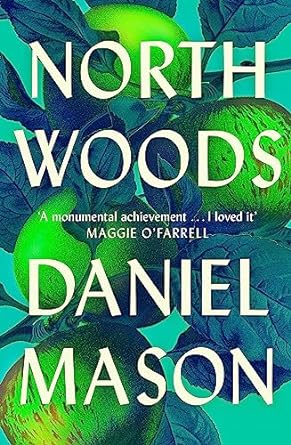
Daniel Mason’s North Woods and the book club

Daniel Mason, North Woods (John Murray 2023)

Before the meeting: If my experience is anything to go by, your heart may sink as you read the first pages of North Woods. It looks as if it’s going to be one of those historical novels written in a strained imitation of late 17th century semi-literate English. But be of good cheer – the passionate young couple who have fled into the forest from a Puritan settlement in Western Massachusetts don’t last long: the book is about the place they flee to. Each chapter moves to a new set of characters, descended from or otherwise related to the previous set, and we move through the decades and centuries up to the indefinite future of the final chapter.

It’s almost, but not quite, a collection of short stories in different modes, set in different time periods. There are ghost stories, stories of unrequited love, a tragic gay story, family sagas, a psychological horror story. There’s a persistent attention to what happens to the woods in question as an area is cleared for an apple orchard, which is turn is partly destroyed then overgrown, as various blights and diseases wipe out some of the splendid native species. Between the chapters there are sections that are presented as found documents: a story written in the margins of a family Bible, a True Crime article from the 1950s, a speech written for a local amateur historical society meeting. There are ballads written by one set of characters (which I found mostly unreadable), and photographs of the woods in its many stages.

Yes, it’s a terrifically inventive work, with US history of the last three hundred years as its backdrop.

But, well, meh!

I’m mostly left cold. It mostly feels like a writerly exercise with no deeper necessity. That would be fine if it was fun, but it’s not fun. What may be meant as magic realism just feels contrived and arbitrary. Lyrical descriptions of natural processes are laboured – more than anything, they made me want to reread Richard Powers’ Overstory (link to my blog post). Because nothing outweighed it, what might have been a niggle at the back of my mind became a constant unease: First Nations people are only glancingly present and mostly consigned to the unknowable past; tribal names are mentioned a number of times with due respect, and a wise Elder makes an appearance in an early chapter, but that’s it. I don’t know that a similar book could be written in Australia, possibly because colonisation is so much more recent here. For this Australian reader, this virtual absence meant the book felt hollow at its heart.

After the meeting: We discussed this book along with Andrew O’Hagan’s Caledonian Road. That book took up most of the discussion time, though it’s probably true that the excellent Indian meal and catch-up conversation took up more than both combined.

I think there was a consensus that the book worked as a collection of short stories. The over-all concept was impressive but didn’t quite come off, and the ghost stories worked least well of all. Someone else mentioned the Richard Powers novel as a comparison that didn’t reflect well on this book. The stories / chapters that received most honourable mentions were a long interstitial piece, the Johnny-Appleseed-like memoir of the man who planted the orchard, and Chapter Three, in which his daughters Alice and Mary are inseparable, until they’re not, with a creepy Gothic twist at the end.


I wrote this blog post on the unceded land of the Gadigal and Wangal clans of the Eora Nation, which has seen many changes in the last 236 years, but has never ceased being cared for by these First Nations people. I am very happy to acknowledge their elders past and present.

Percival Everett, James and the book group

Percival Everett, James (Pan Macmillan Australia 2024)

Before the meeting: Mark Twain’s Adventures of Huckleberry Finn is one of those books that, even if you haven’t actually read it, you probably feel as if you have. Though it’s set in the south of the USA during the time of slavery, it was published in 1884, two decades after slavery was abolished. It’s an adventure story. A prefatory note warns the reader not to look for a motive, a moral or a plot. But the warning is obviously ironic. Huck, a white boy, teams up with Jim, a man escaping from slavery, on a raft trip down the Mississippi and, though the book is much praised for other elements such as its portrayal of the great Mississippi River and its breakthrough use of US vernacular English, it’s Huck’s moral growth, his coming to recognise Jim’s humanness and the evils of slavery that account for the book’s status as a Great American Novel.

But …

As African-American voices – voices of people whose lives are still deeply affected by the legacy of slavery – have made themselves heard, the book has met with controversy. I first met the negative case in Julius Lester’s Falling Pieces of the Broken Sky, in which one essay begins, ‘I am grateful that among the indignities inflicted on me in childhood I escaped Adventures of Huckleberry Finn.’ Inspired by Lisa Hill in the comments section on my post about that book (yes, there are places where it’s safe to read the comments!), I searched for the article to refresh my memory and found a version at this link. Lester is scathing, describing the book’s world as the ‘all-too-familiar one of white fantasy in which blacks have all the humanity of Cabbage Patch dolls’. There’s a lot more if you’re interested.

Percival Everett’s James tackles Huck Finn in a different way, less scathing but even more radical in its project of restoring humanity to the character Jim. It’s a novel in its own right, which I imagine you could read without reference to Twain’s. But you’d miss a lot of the pleasure and insight it has to offer.

James tells the story from Jim’s point of view, including a number of episodes where Jim and Huck are separated. It keeps much of the adventure and the humour of the original, but it opens out to the visceral horrors of slavery. In particular Twain’s final section in which Huck and Tom Sawyer hatch a plot to free Jim is replaced by darker, and also more joyful and just as improbable actions in which Jim takes things into his own hands.

But just as important as the changes in the story are the changes in tone. Beginning with the book’s title, dignity is restored to Jim. He is still called by the diminutive in most of the narrative, but we know that’s not all of him. In a key device, whenever enslaved characters talk to each other out of earshot of whites, they speak a form of standard English, returning to ‘slave talk’ – Sho nuff, Massah, etc – if they think they’ll be overheard. It’s not realistic: there’s no way enslaved people in the American South in the mid 19th century spoke standard 21st century English, but it’s an inspired bit of comedy that works to undo the othering of the enslaved.

As it happens, page 77* is a nice example of how James writes back to Huckleberry Finn.

In Mark Twain’s narrative, Huck and Jim have been separated by a near disaster. When Huck regains the relative safety of the raft he finds Jim in an exhausted sleep, and decides to play a trick on him. He tells Jim nothing untoward has happened, that it has all been a dream. Jim believes him, and sets about interpreting the dream – only to have Huck point to some damage on the raft that proves the incident really happened. Huck, who is the narrator, asks teasingly what these things stand for:

He looked at me steady without ever smiling, and says:
‘What do dey stan’ for? I’se gwyne to tell you. When I got all wore out wid work, en wid de callin’ for you, en went to sleep, my heart wuz mos’ broke bekase you wuz los’, en I didn’ k’yer no’ mo’ what become er me en de raf’. En when I wake up en fine you back agin, all safe en soun’, de tears come, en I could a got down on my knees en kiss yo’ foot, I’s so thankful. En all you wuz thinkin’ ’bout wuz how you could make a fool uv ole Jim wid a lie. Dat truck dah is trash; en trash is what people is dat puts dirt on de head er dey fren’s en makes ’em ashamed.’
Then he got up slow and walked to the wigwam, and went in there without saying anything but that. But that was enough. It made me feel so mean I could almost kissed his foot to get him to take it back.
It was fifteen minutes before I could work myself up to go and humble myself to a nigger; but I done it, and I warn’t ever sorry for it afterwards, neither.

It’s a milestone in Huck’s journey to realising that Jim is fully human, and is often quoted as one of the most moving passages in the book.

Here’s the equivalent in James, beginning with Jim playing along with Huck’s childish trick:

‘Lawdy, Lawd, Lawd,’ I said. ‘Sho was a scary dream.’
Huck started laughing. He pointed at me and laughed harder.
‘You mean you was pullin’ on my leg?’ I said. He was enjoying himself and that was all right with me. It always made life easier when white folks could laugh at a poor slave now and again.
‘I had you goin’,’ Huck said.
I acted like he’d hurt my feelings. White people love feeling guilty.
‘I’m sorry, Jim. I just thought it was funny,’ he said.
‘Yeah, it be funny, Huck, sho nuff funny.’ I pushed out my lower lip a bit, an expression I displayed only for white people.
‘I din’t mean to hurt you none.’
It could have been my turn to experience a bit of guilt, having toyed with the boy’s feelings, and he being too young to actually understand the problem with his behaviour, but I chose not to. When you are a slave, you claim choice where you can.

So much is happening here. Jim is no longer a gullible fool. He’s an adult, adept at playing the role assigned to him by slavery while holding firm to his own reality. Huck’s great moral turning point is just another example of the psychology of members of the oppressor group who want to see themselves as virtuous: ‘White people love feeling guilty.’ But as an adult he is acutely aware that Huck is a child. When he chooses not to ‘experience a bit of guilt’ he’s departing from his usual protective attitude. Despite what he says, he clearly does feel guilty – and needs to justify his behaviour. Like a true adult, though, he doesn’t argue that he was just giving as good as he’d got, tit for tat, ‘He started it’. He acknowledges that he was acting within their other opprsssor–oppressed relationship. ‘When you are a slave, you claim choice where you can.’ It’s a complex moment, that foreshadows the way we come to see Jim and Huck not so much as slave and slaver as adult and child.

Jim, soon to call himself James, gets to dispense some rough justice in the course of the book, but his relationship with Huck develops in benign and interesting ways, with a twist that is signalled early, guessable, and very satisfying.

After the meeting: We had a fabulous meal, over which discussion ranged from the recent State of Origin match to the question of whether as a man of a certain age one should step off the footpath when an oncoming group of young people acts as if you’re invisible.

I was probably the most familiar with Huckleberry Finn, and no one else was all that interested in the relationship between the two books. My impression is that reading with that relationship in mind meant that I enjoyed it more – I didn’t just forgive what others saw as the faults of the book but saw them as features. For example, a number of chaps commented that there was a series of incidents and events rather than a character-driven plot. That’s definitely an issue for James as a stand-alone novel, but I just accepted it as integral to the basic project of writing back to Huck Finn. Similarly, the number of coincidences that allow Jim and Huck to get back together after their separations is irksome, or possibly laughable, unless you take them in your stride as echoing nineteenth century conventions. Most interestingly, the ‘twist’ (sorry, I won’t be spoileristically specific) feels implausible. Sure, but it’s profoundly satisfying as a symbolic statement.

But it wasn’t a disagreement. We reminded each other of ‘good bits’: the time Jim spends with a minstrel group, as a Black man pretending to be a white man pretending to be a Black man; a horrific scene when a man who is being savagely flogged mouths the word ‘Run!’ to someone he sees to be at risk Mostly, we enjoyed the book as a good yarn – down the river then a u-turn back up, as someone said.


I wrote this blog post on the unceded land of the Gadigal and Wangal clans of the Eora Nation, not far from where what we now call the Cooks River has been cared for by Elders for millennia. As I finished it, the shortest day of the year was nearly here, and the ground was sodden from abundant rain.


* My blogging practice is to focus arbitrarily on the page of a book that coincides with my age, currently 77.

William Gibson’s Peripheral

William Gibson, The Peripheral (Berkly 2014)

I picked up The Peripheral in a street library soon after I finished reading and blogging about its sequel, Agency, nearly four years ago. Since then, it has been my TBR shelf as a treat for a rainy day. Its time has now come.

There’s a peculiar challenge in writing about it. Possibly the main thing I enjoyed about it is that a lot of the time the reader has no idea what’s actually happening. You’re not even sure what some words mean, or what the characters are not saying. Explanations do come, eventually, but there’s a delicious disorientation as AI devices and other technical marvels multiply, we only half-see crucial incidents, cultural events are described from the point of view of someone who knows a lot more about the background than the reader does. The action takes place in two unspecified future time periods that interpenetrate in often unclear ways. However serious the issues may be – and there’s a plausible version of how the global emergency will develop – there’s a pervasive sense of play. If I summarise the plot, or even the set-up, I’ll be depriving you of that experience.

My first idea was to write about first two short chapters – all the chapters are short – but then I thought, oh what the heck, I’ll skip straight to page 77* to give you a taste, and let the spoilers fall where they will.

Lev had told the polt that he needed to speak with the polt’s sister, but the polt had wanted to hear a figure, a specific sum of money. Lev had offered ten million, a bit more than the fee for the supposed murder contract. The polt had said that that was too much for his cousin to receive by something called Hefty Pal.
Lev had explained that they could arrange for the cousin to win that amount in their state’s next lottery. The payment would be entirely legitimate.

Gibson has a gift for coining terms. ‘Cyberspace’ is his invention. Of The Peripheral‘s many coinages, three appear in this short passage: ‘polt’, ‘Hefty Pal’ and ‘stub’. They each have the virtue of suggesting their origins if not their precise meanings. A polt, derived from poltergeist, is a person who is bodily in one place and/or time, but is somehow seeing and acting in another time. (A peripheral is a human-looking artefact, that can be the host to a polt.) Hefty is a mega corporation of which Hefty Pal, as in PayPal, is a subsidiary. A ‘stub’, known more formally as a ‘continuum’, is a key invention of the book, something that readers and half the characters come to understand only gradually. All I’ll say here is that it is something that results from people going back to an earlier time and changing that time’s future.

There are three characters in this scene: Lev, the son of a fabulously wealthy Russian gangster capitalist, whose hobby involves mucking about with the past (stubs/continua are his playthings); Ash, a tech wiz who makes it happen for him (among other distinguishing features, she has tattoos of animals that move around on her skin, often glimpsed running for cover when someone tries to look at them); and Wilf Netterton, put-upon publicist, from whose point of view the story is told in alternate chapters. Page 77 is at the end of a Wilf chapter.

Three more characters are referred to. ‘The polt’ is Burton, a battered veteran in Netterton’s past / our future (though that way of describing things isn’t quite accurate). ‘The polt’s sister’ is Flynne, a gamer in a small US town who is the focus of the non-Wilf chapters. Burton and – on one fateful occasion – Flynne have been employed as polts by Lev under the impression they were testing a computer game. The main narrative is set in motion by Flynne’s witnessing what may be a murder. ‘The cousin’ is Leon, one of their tribe of loyal family members.

At that, Netherton had been unable to resist looking at Ash again.
‘You don’t think that that lottery business casts the whole thing as a Faustian bargain?’ Netherton had asked, when the call was done.
‘Faustian?’ Lev looked blank.
‘As if you have powers one would associate with Lucifer,’ said Ash.
‘Oh. Well, yes, I see what you mean. But it’s something a friend stumbled across, in his stub. I have detailed instructions for it. I’d been meaning to bring it up with you.’

Tiny moments like this give the book its rich texture. There’s the complicity between WIlf and Ash, two underlings who have cultural memories, unlike their rich and powerful employer. (Similarly in the earlier paragraph, it’s fun that Hefty Pal is something in the reader’s future and Flynne’s present that has been forgotten in Wilf’s time.) Like the implied reference to poltergeists, the mention of Faust reminds us that even though the narrative is presented as a tale of high tech, AI and nanotechnology, it often has the feel of demonic possession and fairytale magic. (If you’ve read Gibson’s Sprawl trilogy – Neuromancer (1984), Count Zero (1986) and Mona Lisa Overdrive (1988) – you’ll remember the prominence there of the legba of Voodoo.)

And that had been that, really, except that now he was sitting there, waiting for the polt’s sister to call

That’s the first hint of the almost-romance that is to almost-blossom between these characters who can only spend time together by means of weird time travel mediated by a peripheral in one direction and an odd little children’s toy in the other.

Now I’m tempted to reread Agency. I remember that it was also gleefully inventive and similarly had two interrelating times. I’m pretty sure that some of the distant future characters are in both books, but my memory is dim. William Gibson is anything but dim.


I wrote this blog post on the unceded land of the Gadigal and Wangal clans of the Eora Nation, not far from where what we now call the Cooks River has been cared for by Elders for many millennia. The weather has just turned cold, but spider webs are still proliferating.


* My blogging practice is to focus arbitrarily on the page of a book that coincides with my age, currently page 77. For The Peripheral, I’ve included a little from page 76 as well.