Tag Archives: NSWPLA

2025 NSW [Premier’s] Literary Awards night

I almost missed the NSW Premier’s Literary Awards this year. I missed the announcement of the short lists altogether, and only realised that the awards were last night because the Sydney Writers’ Festival is about to start and I think of the NSWPLAs as the first cab off the festival rank.

Here I am making up for the omission. Sadly I’ve read only one of the books, and seen a production of only one script, none of the winners.

Last night, the awards ceremony was live streamed. As always on a Monday, I was busy being grandfather, so I tuned in late. It’s all on YouTube and you can even watch it by clicking the image below. The ceremony begins with didjeridoo and Welcome to Country by Uncle Brendan Kerin, who spoke eloquently about the meaning of the word ‘Country’ in this context. After introductory speeches from librarians and politicians, the presentation of awards by Senior Judge Bernadette Brennan and Library Chair Bob Debus begins at about 29 minutes.

Here are the shortlists in the order of announcements, with links to the judges’ comments. The winners are first in each list, in bold:

UTS Glenda Adam’s Award for New Writing ($10,000)

Dr Tracy Westerman appeared on video, speaking from Perth: ‘As someone who doesn’t consider themselves to be a real writer, as a kid from the Pilbara who had a pretty unorthodox education through distance education, being awarded for my writing feels, frankly, a little bit surreal.’ She went on to talk about mental wellbeing: it ‘should never be just for the privileged, and Jilya sheds light on the reality that it continues to be … because of a one-size-fits-all, monocultural approach to mental health.’

Multicultural NSW Award ($30,000)

Nam Le, also on video, spoke against a background of a bookshelf piled high with books. He thanked many people and dedicated the award to his father, who ‘has been an engine of multiculturalism in this country’.

Indigenous Writers’ Prize ($30,000)

Lorraine Coppin, CEO of Juluwarlu Group, also spoke on video. She and her husband have spent years documenting Yindjibarndi stories – the graphic novel format is a way of making the history accessible to young people.

Nick Enright Prize for Playwriting ($30,000)

Glenn Shea appeared in person! He is a member of the Stolen Generations. The play’s story comes from community. The question it asks is how do we plant seeds for our young people to shift and shape their decision-making about work lives and community. He shouted out La Mama theatre among many others.

Betty Roland Prize for Scriptwriting ($30,000)

Charles Williams was also in the room. He started out with a remark that must have struck a chord with many people in the movie industry: ‘I usually identify as a director more than as a writer, but I spend a lot of my life writing and not much directing.’ He quoted Charlie Kaufman: ‘A writer is someone for whom writing is harder than it is for other people,’ and noted in passing that Kaufman stole the line from Thomas Mann.

Patricia Wrightson Prize for Children’s Literature ($30,000)

Katrina Nannestad thanked all the right people, but in particular her mother, whose story is in the book.

Ethel Turner Prize for Young People’s Literature ($30,000)

Emma Lord said among other things that everything she writes is for her daughter, even though she is too young for the books. She acknowledged the courage of her publishers who accepted a book with a pandemic in it during a pandemic. Following a developing theme of the evening, she said her mother shared the award.

Translation Prize ($30,000)

Elizabeth Bryer accepted by video. She said she had decided to wind back her translation practice because she couldn’t see a way to make it viable. This award changes that, and means she can take on a project she had been thinking about – to set up a mentorship wth an emerging translator who is a person of colour or a heritage speaker.

Kenneth Slessor Prize for Poetry ($30,000)

Hasib Hourani described rock flight as intended to explore both historical and speculative acts of liberation in Palestine. ‘Throwing a rock is one kind of protest. A book is another.’

Douglas Stewart Prize for Non-fiction ($40, 000)

James Bradley revealed that winners had been instructed to speak for less than a minute. Among the many thankyous, he thanked Ashley Hay who read every draft. With a nod to W. H. Auden, he said that though it seems like books don’t make anything happen, his experience with this book has shown that this isn’t actually the case: ‘Books change minds, and by changing minds they can change the world, and at the moment that matters more than it has ever mattered before.’

Christina Stead Prize for Fiction ($40,000)

Fiona McFarlane is on the road, so Alex Craig from her publishers Allen & Unwin read a speech on her behalf.

The University of Sydney People’s Choice Award ($10,000)

The Lasting Harm, Lucia Osborne-Crowley (Allen & Unwin)

Lucia Osborne-Crowley was another video appearance. Before she made the necessary thankyous she noted the importance of writers speaking up for Palestinians who are being subjected to genocide and war crimes. She thanked the survivor community who voted for her – the book is for and about and by survivors of sexual violence and child sexual violence.

Special Award

This award went to Liminal. The award was accepted by founding editor Leah Jing McIntosh. Evidently aware than many people watching the awards or reading about them might not have herd of Liminal, she began by explaining that it is ‘a project driven by the desire to make visible the unacknowledged structures of racism that so dehumanise all of us.’ She went on, ‘We work towards new ways of thinking, of seeing, of being in the world. That is to say, we work together towards a better future. We know we cannot do it alone.’

Book of the Year ($10,000)

36 Ways of Writing a Vietnamese Poem, Nam Le (Scribner Australia). Ben Ball from Scribner Australia read a speech written by Nam Le. He expanded on his earlier dedication to his father, and spoke interestingly and powerfully about multiculturalism. I won’t try to summarise his speech here out of respect for his intellectual property. I hope it’s published somewhere. At heart it was a warning against complacency.

The twin shadows of Gaza and Trump were never far from the stage, and repudiations of all they stood for were frequent. And what a reading list has emerged from the evening, even if only of the winners.
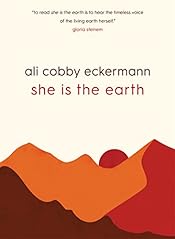
Ali Cobby Eckermann, She Is the Earth

Ali Cobby Eckermann, She Is the Earth: a verse novel (Magabala Books 2023)

Ali Cobby Eckermann is a Yankunytjatjara woman. Her mother and grandmother were taken from their families when very young as part of the government policy. She herself was also taken. Raised by a loving German-heritage family, she found her way back to her First Nations family as an adult, after years of searching.

I first met her poetry in Black Inc’s Best Australian Poems 2009, edited by the late Bob Adamson. In his introduction, Adamson said of her wonderful dramatic monologue ‘Intervention Pay Back’ that it made ‘a new shift in what a poem might say or be’. You can read it in the Cordite Review at this link. Two poems by her, also dramatic monologues, were included in the special Australian issue of the Chicago-based Poetry journal in May 2016. They can be read on the Poetry Foundation website: ‘Black Deaths in Custody’ here and ‘Thunder Raining Poison’ (on the effects of the Maralinga atomic tests on traditional APY lands ) here.

I haven’t read her memoir, Too Afraid to Cry (Ilura Press 2013), or her first verse novel, His Father’s Eyes (OUP 2011). But I can tell you that her second verse novel, Ruby Moonlight (Magabala Books 2012), which deals with the aftermath of massacre, is brilliant (my blog post here). Of her verse I have read the chapbook Kami (Vagabond Books 2010) and Inside My Mother (Giramondo 2015, my blog post here), which are both filled with the intensities of re-uniting with her Yankunytjatjara kin and culture, and the loss of her birth mother soon after finding her.

All of this work has enormous power, and has garnered many awards in Australia and elsewhere.

She Is the Earth, which arrived eight years after her previous book, is a different kind of writing.

It’s described on the title page as a verse novel. There are no characters apart from an unnamed narrator, and no clear events apart from her meandering through an Australian landscape. Any movement is internal. But the book is meant to be read as a single text rather than a collection of short, untitled poems.

At first, I thought it was an imagined story of pre-birth existence, in which the narrator moves towards being born, taking on substance in the world. But that didn’t seem to work and in the end, I gave up on trying to find a narrative, and just went with the flow.

The flow is far from terrible, and the language is never less than gripping, but I don’t know what to say about the book as a whole. I can refer you to better minds than mine.

Here is part of what the judges had to say when the book won the Indigenous Writers’ Prize at the 2024 NSW Premier’s Literary Awards (go to this link for their full comments):

Ali Cobby Eckermann writes in a poetics of self-emergence in which the spectral is made solid through an eloquent economy of language and lifeforms. Each word of this verse novel is deeply considered and rich with meaning, forming as a whole a narrative which is sometimes gentle and sometimes sharp, both beautiful and terrible, and always profound in its exploration of healing, hope and the earth. Each word reads as a gift to the reader.

I recommend Aidan Coleman’s review in The Conversation (at this link). He discusses the book as an example of minimalism, and says interesting things about its recurring images, and even about the developing narrative:

The speaker in these poems is both child and mother, pupil and teacher. References to children and motherhood abound. Initial images of disconnection, anxiety and trauma give way, in later sections, to wholeness and calm.

But the journey is not linear: hope is present from the earliest sections and trauma haunts the closing pages. Healing is presented as an ongoing process that is projected beyond the poem.

[Added later in response to Kim’s comment: Kim on reading Matters had a very different, and more attuned response than mine. You can read her blog post at this link.

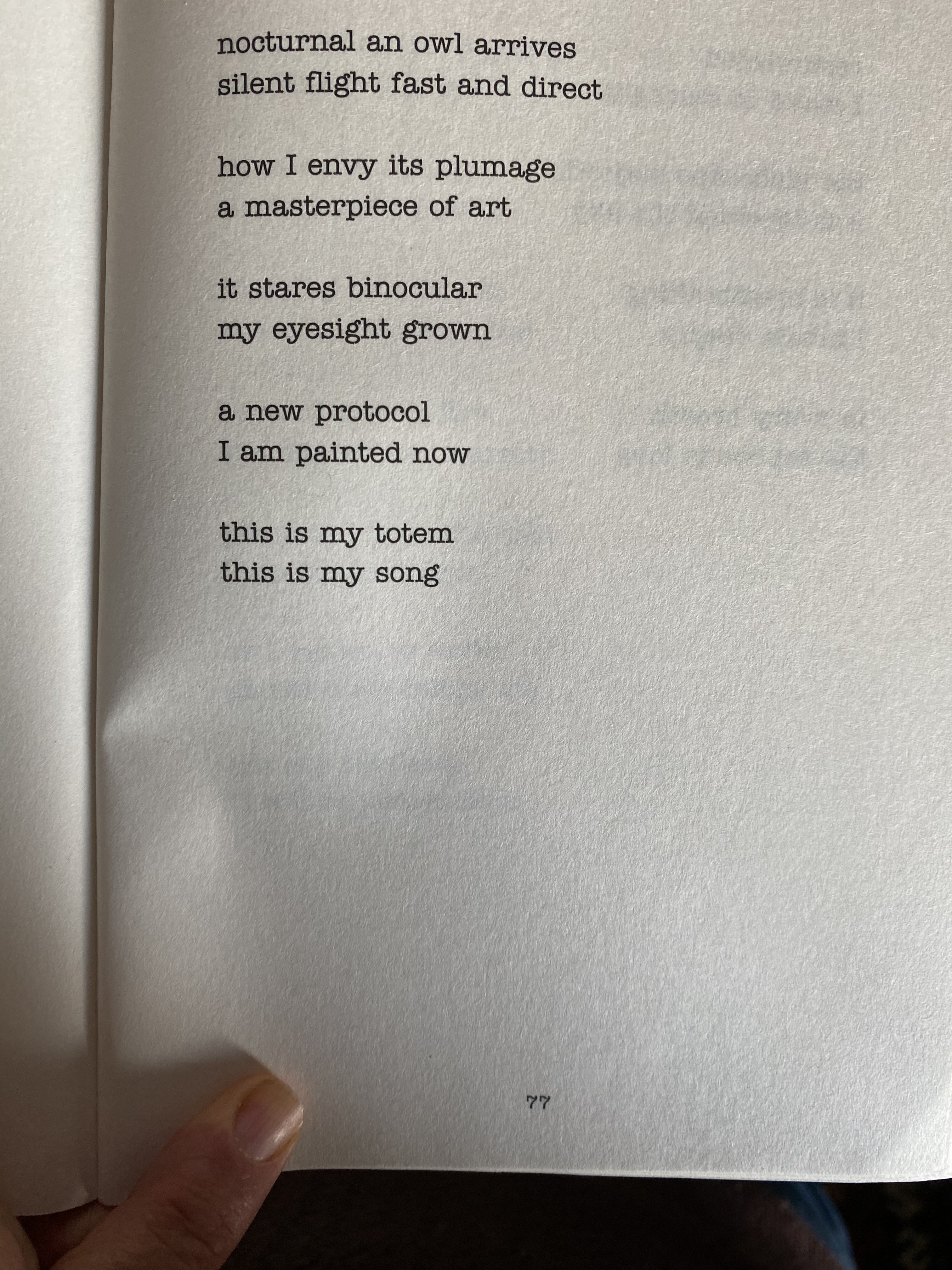
Page 77* occurs toward the end – there are 90 pages in the book. Piggybacking on Aidan Coleman’s reading, I can see it as a moment of consolidation, of identity firming up in the landscape:

The pleasure of these lines doesn’t depend on their function in the broader narrative. The owl arrives; the narrator admires it; their eyes meet, and there is a moment of identification with the bird; the ‘masterpiece of art’ of the bird’s plumage somehow transfers so that the narrator is painted. The final couplet pulls all that together.

In the wider scheme, that last couplet resolves more than the preceding eight lines. Up to now, the narrator has been full of yearning and unease. Here she seems to find peace:

this is my totem 
this is my song

‘Totem’ takes the hint of identification in the comparison of eyes a step further. There’s something about finding a place of belonging, of deep affinity, of being at home in the world. Once that’s found, there’s the possibility of singing, of having one’s own song.

The first word on the next page is ‘resurrected’, and a couple of pages further on my favourite lines in the book:

I am a solo candle
inside a chandelier

this is the wisdom
I need to succeed.

I still can’t say I understand what’s going on at any given moment in this book. But maybe that’s OK.


I wrote this blog post in Gadigal Wangal country, where it is my great joy to live. I acknowledge Elders past, present and emerging for their continuing custodianship of this land.


* My blogging practice, especially with books of poetry, is to focus on the page that coincides with my age, currently 77.

Sydney Writers’ Festival 2024: My day one

The Sydney Writers’ Festival is always one of my annual highlights. I’m off to a very quiet start this year, just one session today in the smallish Gallery Room at the State Library. And then nothing until Friday.

12.30: And the Award Goes To …

The Festival website invites us to:

be among the first to hear from some of the winners of the 2024 NSW Premier’s Literary Awards, in a discussion covering the impact that awards can have on a writer’s career.

We did get to hear from three of the winners: Ali Cobby Eckermann (She Is the Earth), Helena Fox (The Quiet and the Loud) and Christine Keneally (Ghosts of the Orphanage). But the conversation wasn’t about the awards’ impacts. From my point of view, it was a lot more interesting than that. What follows is the best I can glean from my mostly illegible notes aided by my unreliable memory.

Bernadette Brennan, senior judge of the awards, kicked off the conversation by saying that though the three award-winning books were in different genres – a verse novel, a thoroughly researched piece of non-fiction, and a novel – they all dealt with intergenerational trauma with an emphasis on the vulnerability of children, and they all found ways of pointing to healing. That set the agenda for what followed.

Ali Cobby Eckermann spoke first, and did her best to follow the brief of the program notes. Her first verse novel, Ruby Moonlight, was written in the context of the Howard government’s Intervention in he Northern Territory. The awards it received enabled her to leave her home with her Yankunytjatjara family, go south and buy a house which she set up as a writers’ retreat. When she unexpectedly received a Windham-Campbell Literature Prize (link is to the Wikipedia entry on that prize) her life was turned upside down again. When she came to write She Is the Earth, she was very alone. But she drew on her Yankunytjatjara grannies – though they had passed, she imagined them as creating a safe place for her to create.

Helena Fox spoke in fairly abstract terms of having endured trauma as a child and an adult, and said she saw herself as opening a space where her young readers could see that it is possible to speak of hard things. Among the loud things like abuse, you have a right to be alone, quiet, to ground yourself.

Christine Keneally’s book is about terrible things done to children, focusing on the testimony of survivors from an orphanage in Vermont. Its seed was planted when she ‘wandered into a room’ at a conference in Brisbane where people were talking about the extreme difficulty of finding any record of their early childhood. She discovered the unfolding story of abuse in orphanages in Australia. She reasoned that similar things must have happened in the USA. She discovered that indeed they had, but there the only redress survivors had was through litigation, which was often a damaging process in itself. As she found and interviewed survivors, she saw what a powerful antidote talking is. She realised the importance of bearing witness – and that is what the book seeks to do.

Some snippets from the conversation that followed:

Ali Cobby Eckermann:
‘It shits me that you have to forgive everyone to heal yourself.
‘Poetry can change the dialogue about trauma away from trauma itself to something like regeneration or repair. It can turn something painful into beauty.’

Helene Fox:
How can you heal if you can’t share?

Christine Keneally:
I spoke to people who had been married for 30 years but hadn’t told their spouses about their lives. Sometimes I was the first person they told their story to.

There was a time for questions, but no one raised their hand. I’d love to know what contact Christine Keneally has had with the Lost Generations people in Australia. If I wasn’t so shy and needing to get home, I would have stopped to ask if she knew about Bryan Hartas’s autobiography Hard As (link to my blog post) and the work people like my niece Edwina Shaw have been doing helping members of the Lost Generations to tell their stories.

On my way out I heard one of the few men in the audience mutter to another, ‘What a miserable lot!’ That’s not at all how I saw it, but I guess there weren’t a lot of laughs.

I bought a copy of She Is the Earth.

2024 NSW Premier’s Literary Awards night

The NSW Premier’s Literary Awards, as we are often reminded, are Australia’s richest and longest running state-based literary awards. This year, in a break with tradition, I didn’t do a blog post when the shortlist was announced. I was happy to read a consolidated list on Lisa Hill’s blog at this link.

At that time, had read two of the Christina Stead Prize contenders. I’d seen two of the plays shortlisted for the Nick Enright Prize. I did better on the Betty Roland Prize, having seen seen three of the movies. I had read none of the poetry, none of the children’s or young people’s books, none of the non-fiction. And it turns out I have read or seen none of the winners.

Last night, the awards ceremony was live streamed. I was busy with family, so tuned in late. It’s all on YouTube and you can even watch it here, The actual video begins at 8 minutes, 40 seconds with the Welcome to Country by Uncle Brendan Kerin from the Metropolitan Lands Council, who reminds us that we have a shared history, and manages to make comedy out of his experience as a member of the Stolen Generations. After introductory speeches from librarians and the Minister for Arts, the presentation of awards by the senior judge, Bernadette Brennan, begins at 40 minutes. The video is worth watching as – in the midst of much charming humility and gratitude – person after person refers to the unfolding disaster in Gaza, explicitly or implicitly responding to recent media attacks on the judging panel.

The winners (with links to the judges’ comments):

UTS Glenda Adam’s Award for New Writing (at 40 minutes)

Anam, André Dao

Multicultural NSW Award (at 43 minutes)

Stay for Dinner, Sandhya Parappukkaaran and Michelle Pereira

Indigenous Writers’ Prize (at 48 minutes)

She Is the Earth, Ali Cobby Eckermann

Nick Enright Prize for Playwriting (at 52 minutes)

Sex Magick, Nicholas Brown (Griffin Theatre Company & Currency Press)

Betty Roland Prize for Scriptwriting (at 56 minutes)

Safe Home, Episode 1, Anna Barnes

NSW Premier’s Translation Prize (at minutes)

Patricia Wrightson Prize for Children’s Literature (at 60 minutes)

Paradise Sands: A Story of Enchantment, Levi Pinfold

Ethel Turner Prize for Young People’s Literature (at 1 hour, 2 minutes)

The Quiet and the Loud, Helena Fox

Kenneth Slessor Prize for Poetry (at 1 hour, 6 minutes)

Riverbed Sky Songs, Tae Rose Wae

Douglas Stewart Prize for Non-fiction (at 1 hour, 10 minutes)

Ghosts of the Orphanage: A Story of Mysterious Deaths, A Conspiracy of Silence, and a Search for Justice, Christine Keneally

Christina Stead Prize for Fiction (at 1 hour, 13 minutes)

    The Sitter, Angela O’Keeffe

    The People’s Choice Award (at 1 hour, 16 minutes)

    The God of No Good, Sita Walker

    Book of the Year (at 1 hour, 20 minutes)

    She Is the Earth, Ali Cobby Eckermann

    The presentations ended, as they began, with eloquent words about the lasting impact of the Stolen Generations.

    There was no special award this year.

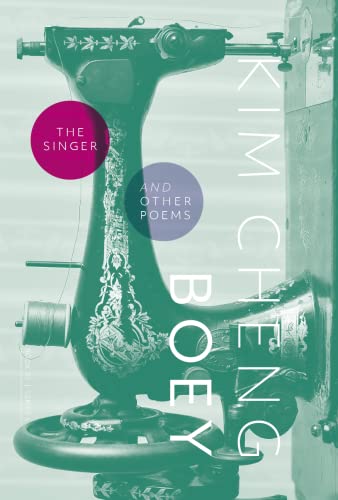
    Kim Cheng Boey’s Singer

    Kim Cheng Boey, The Singer (Cordite Press 2022)

    There’s so much to love in this book.

    I was inclined to love it sight unseen. I’ve been delighted by Kim Cheng Boey’s readings in past years when the Sydney Writers’ Festival had room for local poets. He co-edited (with Michelle Cahill and Adam Aitken) the excellent 2013 anthology, Contemporary Asian Australian Poets. He has written insightful reviews of one of my favourite poets, Eileen Chong, and had a walk-on role in one of her poems. This is the first of his books that I have read.

    When I got my copy direct from Cordite Press – I tried at least three bookshops – I loved it for the cover alone. You expect the title The Singer to refer to the poet, perhaps in an attention-seeking way, but then you tilt the book and see the cover image clearly: it’s a Singer sewing machine. (My mother didn’t call her labour-saving devices the washing machine, the vacuum cleaner or the sewing machine, but the Hoover, the Electrolux and the Singer.) It’s a brilliant title: yes, poetry is like song, but it’s also craft.

    And page by page, I kept on falling in love. There’s a Preface in which Kim Cheng writes of the different ‘weight’ of his poetry-making over time:

    When I was younger, poetry carried me posthaste, high on the fuel of experience and freshness of thought, from initial impulse to final form. In middle age the roles are reversed – I am the mule, the porter, learning the weight and heft of the poem so I can carry it long-distance – over months and often years.

    ‘Perhaps,’ he continues, ‘the change occurred the moment I became a migrant.’ He migrated to Australia from his native Singapore in his early 30s, in 1997. Since then he has continued to take part in Singapore’s literary and cultural life as well as that of his adopted home. The book’s three parts can be read as tracing this geographical movement over time. The first, ‘Little India Dreaming’, has five long prose poems full of the smells and sights and sounds of a remembered Singapore childhood, including the title poem. Here’s a small extract to give you a feel for it:

    You almost pray to the Singer, its dark cast-iron hull, to 
    carry your mother's song. You pray for the treadle to 
    stir, for the finished dress to be unstitched, its seams 
    unpicked so the dress can materialise again from the 
    chalk outline. You take the birthday outfit out of the 
    wardrobe of forgetting and become the five-year-old 
    wearing your mother's love.

    The second section, ‘The Middle Distance’, is introduced with a quote from Louis Mac Neice, ‘This middle stretch / Of life is bad for poets.’ Each of its five poems is set in places other than Asia or Australia., and it’s tempting to see an unsettled, midlife quality to them.

    The seven poems of the third section, ‘Sydney Dreaming’ – to simplify appallingly – lay claim to Australia as a place that can be called home.

    My arbitrary blogging practice of looking at page 76 has once again given me a gift. That page occurs near the end of the book, in ‘Sydney Dreaming’, the title poem of the third section.

    I love this poem (I know I’m using that word a lot, but it can’t be helped). In it the speaker walks around inner suburbs of Sydney, haunted by the tales and memories of other cities and ghosts of Sydney past. If it was terrible, banal rubbish, I might still have loved it because I have walked every step that the poem follows. I too lament the disappearance of second-hand book shops in Pitt Street. I know the painted up man with the didgeridoo in the Central tunnel, as well as the old Chinese man ‘scraping a dirge on his erdu’. Chinatown, Broadway, Glebe Point Road, Gleebooks, all lovingly named and recognisable. Then Darlinghurst Road, the wall, the Holocaust Museum, Macleay Street. The poem made me want to go for a long walk.

    And it’s a terrific poem. Here are a couple of stanzas from page 76 – the walk down to Woolloomooloo from Kings Cross:

    You follow the bend and the view opens to the ivory cusps 
    of the Opera House and the dark arch of the bridge over the silver-glazed
    azure scroll of the harbour, the sky burnished gold in the last exhalations of the sun.
    
    Soon the flying fox formations will rise from hangars of Moreton Bay figs
    in the Botanic Garden, and weave arabesques around the halo 
    of the spanning arches of the Coathanger. You remember seeing this even
    before you arrived, memory in the image, image in memory,
    
    the sky and the harbour dyed incarnadine in the first postcard 
    you ever received from a childhood friend settled in a new life

    Notice that it’s in the second person: ‘You follow the bend.’ The poem’s speaker isn’t just telling the reader about a walk he has taken, he is inviting us to walk with him – which is especially effective for readers who have in fact walked in those places. The long lines have a leisurely, strolling feel: no hurry, no need to reach any rhyming points or keep to any metric timetable. The conversational tone and language creates a companionable feel.

    Then the register shifts, as the poem enters its final movement.

    You follow the bend and the language opens to ‘ivory cusps’ and ‘silver-glazed azure’ and ‘burnished gold’ and ‘exhalations of the sun’. That’s such a Sydney moment – any Sydneysider arriving at Circular Quay train station will have had their phone-absorption interrupted by the exclamations of tourists seeing the Bridge–Harbour–Opera House scene for the first time. Rounding that bend in Woolloomooloo has a similar breathtaking effect, and the language responds.

    Then two things happen. First, the speaker asserts that he belongs here by looking forward in time: he knows that the flying foxes will soon fill the sky and enjoys anticipating the spectacle (still with the elevated language, ‘arabesques’ and ‘spanning arches’). Second, he knows that he hasn’t always belonged, and memory asserts itself. He had seen this sight in a postcard long before seeing the actual thing. I’m reminded of those passages in Proust about how the reality inevitably falls short of the anticipated image. That’s not how it is here, but there’s a strange unreality nonetheless – ‘memory in the image, image in memory’ – the present moment is a palimpsest. The whole poem revolves around that interplay of past, present, anticipated future and imagination. The whole walk is experienced as a palimpsest.

    I’m restraining myself from quoting the lines that come next, because it’s getting close to the poem’s stunning conclusion, and even with poetry spoilers are an issue. Enough to say that the Bridge is transformed effortlessly from that spectacular postcard image to a terrific metaphor for the poet’s status in the midst of an ever-changing life of exile, belonging, and longing.

    As a footnote: the title ‘Sydney Dreaming’ might be a worry. I don’t read it as claiming any of the First Nations meaning of the word ‘Dreaming’. In the course of his walk, the poet-flâneur passes a number of First Nations people: the man in the Central tunnel, and a real or imagined group of dancers in Woolloomooloo. The latter are mentioned after the speaker has been lost ‘in a dream of home, almost’: his dream is definitely lower case, and carefully distinct from that other, deeper, ancestral Dreaming.

    The Singer won the Kenneth Slessor Prize for Poetry earlier this year (click here for the judges’ comments). Maybe it’s so hard to find in the bookshops because it sells out as soon as it hits the shelves. I hope so. Anyhow, especially but not only if you live in Sydney or are part of a Chinese diaspora, see if you can get hold of it. Did I mention that I love it?

    2023 NSW Premier’s Literary Awards night

    Tonight, the New South Wales Premier’s Literature Awards were announced at an event livestreamed from the State Library of NSW. I missed the start but got to see two of Debra Dank’s four acceptance speeches, and Sara Mansour and Bilal Hafda accepting the Special Award on behalf of Bankstown Poetry Slam (Bilal’s hands were a joy to watch). It’s been a while since a Premier has actually presented the awards – Chris Minns may be the first to do it since Christina Keneally in 2011. The recording is on YouTube, and I can think of worse ways to spend a couple of hours if you’re interested in Australian literary culture.

    The winners (with links to the judges’ comments):

    UTS Glenda Adam’s Award for New Writing: We Come With This Place, DEBRA DANK (Echo Publishing)

    Indigenous Writers’ Prize: We Come With This Place, DEBRA DANK (Echo Publishing)

    Multicultural NSW Award: The Eulogy, JACKIE BAILEY (Hardie Grant)

    Nick Enright Prize for Playwriting: Whitefella Yella Tree, DYLAN VAN DEN BERG (Griffin Theatre Company/ Currency Press)

    Betty Roland Prize for Scriptwriting: Blaze, DEL KATHRYN BARTON and HUNA AMWEERO (Causeway Films)

    NSW Premier’s Translation Prize: People from Bloomington, BUDI DARMA, translated from Indonesian by TIFFANY TSAO (Penguin Classics)

    Ethel Turner Prize for Young People’s Literature: The Upwelling, LYSTRA ROSE (Hachette Australia)

    Patricia Wrightson Prize for Children’s Literature: The First Scientists: Deadly Inventions and Innovations from Australia’s First Peoples, COREY TUTT and BLAK DOUGLAS (Hardie Grant)

    Kenneth Slessor Prize for Poetry: The Singer and Other Poems, KIM CHENG BOEY (Cordite Books)

    Douglas Stewart Prize for Non-fiction: We Come With This Place, DEBRA DANK (Echo Publishing)

    Christina Stead Prize for Fiction: Women I Know, KATERINA GIBSON (Scribner)

    The People’s Choice Award: Every Version of You, GRACE CHAN (Affirm Press)

    The Special Award: Bankstown Poetry Slam

    Book of the Year: We Come With This Place, DEBRA DANK (Echo Publishing)

    The evening ended with a bunch of flowers to Jane McCredie, Senior Judge, to mark her final year in that role.

    I have read exactly none of the winning books, plays or TV shows, but I am a huge fan of the Bankstown Poetry Slam and couldn’t be more delighted by that award.

    2023 NSW Premier’s Literary Awards

    Who knows who will be Premier at the awards ceremony in May, but the shortlist was announced on 1 March while Dom Perrottet is still in the offices. The list can be bit hard to read on the State Library site. Here it is in one quick look, with links to the judges comments.

    Christina Stead Prize

    UTS Glenda Adam’s Award for New Writing

    Douglas Stewart Prize for Non-fiction

    Kenneth Slessor Prize for Poetry

    Patricia Wrightson Prize for Children’s Literature

    Ethel Turner Prize for Young People’s Literature

    Nick Enright Prize for Playwriting

    Betty Roland Prize for Scriptwriting

    Multicultural NSW Award

    NSW Premier’s Translation Prize

    Indigenous Writers’ Prize

    The winners are announced on 22 May. With any luck there will be a break from recent practice and the Premier, whoever it is, will make the presentations.

    I’m in no position to predict winners, having read or seen very few of the shortlisted titles, loved some, found one mediocre and one unreadable. All the same, I’d happily risk a large sum on The Australian Wars for the Betty Roland, and a moderate amount on Jaguar for the Kenneth Slessor. It will be interesting to see what happens if Anonymous wins the Translation Prize. Whatever, that’s an impressive list for anyone stuck for something to read.

    Dinner in the Strangers’ Dining Room

    [I originally put up this post in my old blog on 23 May 2005, but didn’t retrieve it when I moved to the WordPress platform. I’m republishing it now mainly because I’m about to write something about Ruby Langford Ginibi’s Haunted by the Past. The post also has a sadly ironic note from John Hughes, and a reminder that the late George Pell was on the nose in some quarters well before the child sexual abuse revelations. It’s also a reminder that the NSW Premier’s Literary Awards used to be presented at a slap-up dinner.]

    Tonight the NSW Premier’s Literary Awards were announced at the traditional dinner in the Strangers’ Dining Room in Parliament House. I had been planning to go with my friend Moira, but she was ill, so after some phoning around I found a most satisfactory replacement in my young neighbour and budding writer Jack.

    It was a fabulous evening, full of talk – speeches, conversation, argument – and celebrity spotting. Premier Bob Carr sang the praises of his Premier’s Reading Challenge, then undercut this necessary self-promotion by remarking that it was nice to be able to impose one’s values ‘in the nicest Stalinist way’ and going on to riff on the idea of flying banners all over Sydney’s bearing the Stalinist slogan: ‘Life has become better, comrades. Life has become merrier.’

    The address for the evening was to be given by Amanda Lohrey, but she had been incapacitated by a fall, and her speech was read to us (with passion) by Susan Ryan. It was an apologia for secular liberal democracy, framed as a response to some remarks by Sydney’s Catholic cardinal George Pell. Where he had said that secular liberal democracy was empty of values, she argued that on the contrary it thrives on diversity and so is full. The speech did have the feel of an essay looking for a place to be aired rather than an address tailor-made for the occasion. But it was excellent to be reminded that the frisson of irritation that remarks like the Cardinal’s inspire in me can be the occasion for careful thought. (The phrase ‘to we liberal democrats’ did occur in the speech as given. I didn’t get hold of a written copy, so I won’t hold that syntactical atrocity against Ms Lohrey: it may have been Ms Ryan hyper-correcting her. I’m sorry to report, though, that I did not detect a shocked collective intake of breath from the audience.)

    I was sitting at an awe-inspiring table. Apart from Jack and me and two other ancillary men, there were Nette Hilton, Wendy Michaels, Julie Janson and Ruby Langford Ginibi. Nette, Wendy and Julie were judges. Ruby, it turned out, received the special award, given each year as a kind of lifetime achievement award. I was sitting next to Ruby, and can report that she stays on message: she takes very seriously her calling to educate whitefellas about Aboriginal history, and she was full of information (about the two Aboriginal bowlers who dismissed Don Bradman for a duck; about the rolling back of Aboriginal education under the Howard government; about John Howard’s motives for refusing to apologise for the stolen generations; about the devastating and ongoing consequences of Aboriginal dispossession). She was also very funny, and I got to feel a little special because it fell to me to help her get various things – the envelope containing her speech, her glasses, a little photo album – out of the bag on the back of her wheelchair.

    And as for the prizes, I was struck by the humility of most of the recipients. By that I mean that they gave the impression that their subject was more important than they were.

    Gillian Cowlishaw, wispy grey-haired author of Blackfellas White fellas and the hidden injuries of race told of a conversation with two Aboriginal women in Burke:

    Gillian’s friend: She wants to tape us for her book.
    Sister of Gillian’s friend: If she want to tape me she’ll have to f***in’ pay me.
    Gillian: If you want me to tape you, you’ll have to f***in’ pay me.
    Gillian’s friend: Well, at least she’s learned the language.

    Tony Kevin, awarded for A Certain Maritime Incident: the sinking of SIEV X, referred us to the web site on the subject and predicted that one day someone from Australia’s security institutions would break ranks and tell the truth about what happened: and only then would we know if what he has written is true or false. How’s that for humble?

    Katherine Thomson, given a prize for her play Harbour, spoke about the waterfront skulduggery of not so long ago, and reminded us, as we hardly need reminding, that our industrial relations troubles are far from over. (I’m remembering the last moments of Bertolt Brecht’s play, The Resistible Rise of Arturo Ui: ‘Although the world stood up and stopped the bastard, the bitch that bore him is in heat again.’) She told a funny story: when she first approached the Maritime Union of Australia to research the play, she went with an open mind and told them so. She was introduced to one group of wharfies like this:

    This is Katherine. She’s writing a play about Patrick’s. It’s not necessarily going to be on our side, but that’s OK, because if it isn’t we know where she lives.

    John Hughes, gonged for The Idea of Home: autobiographical essays, placed his book in relation to the Demidenko fake, and the way it did the dirty on, among other things, real stories of migration. He attributed his ability to complete it (at the rate of 20 pages a year) to the persistent encouragement he received from other people, especially Ivor Indyk.

    Sherryl Clark, recognised for her verse novel for young readers, Farm Kid, used her moment at the mike to remind us of the tragedy unwinding in the country as the current drought continues.

    Samuel Wagan Watson, who won the poetry award and the Book of the Year award for  Smoke Encrypted Whispers, was modest in a different way. He said among other things that knowing he’s won the award but not being able to tell anyone made him look constipated to his friends; that writing poetry is a tough game – ‘Before I got published, you know, I used to be white.’

    Steven Herrick (please note the spelling – we got it wrong in the magazine recently), receiving his second award, this time for By the River, showed us the medal and said that when he shows his other one to school students, there’s always someone who points out that it’s silver. In trying to convince them that he’s not a loser, he tells them that the premier gave him $15 000 as well as the medal. So, he said, when he leaves, his audience is probably left with the impression that he is a loser and Bob Carr is very rich.

    Tim Winton, whose excellent The Turning was the only prize-winning book I’ve read, was brief, said with obviously genuine discomfort that he felt he had robbed the other writers on the shortlist of something, and then thanked many people, including, with a nod towards Amanda Lohrey’s speech, ‘the loyal, dogged, civilian reader’.

    And on top of all that, I caught up ever so briefly with a number of friends, and did a little professional fence-mending, possibly some bridge-building. It was a terrific night. Jack said he had a good time too.

    Posted: Mon – May 23, 2005 at 05:57 PM

    NSW Premier’s Literary Awards shortlist

    The NSW Premier’s Literary Awards were first presented in 1979 when Neville Wran was Premier, and his ten successors have kept them up. I’ve been following the awards since Bob Carr’s day – eight premiers ago – and even been to some award night dinners, and a couple of the recent more parsimonious events. This year’s shortlist has been announced, and can be read on the State Library website with some clicking back and forth. As a public service to my handfuls of readers, here’s the list on one screen (links take you direct to the judges’ comments on Library’s website, plus in a very few cases to my blog posts). It’s a huge reading list. Please give your pick in the comments.

    Christina Stead Prize for Fiction

    Highly commended

    UTS Glenda Adams Award for New Writing

    Highly commended

    Douglas Stewart Prize for Non-Fiction

    Kenneth Slessor Prize for Poetry

    Highly commended

    Patricia Wrightson Prize for Children’s Literature

    • Philip Bunting, Me, Microbes and I (Hardie Grant Children’s Publishing)
    • Peter Carnavas, My Brother Ben (University of Queensland Press)
    • Christopher Cheng, Stephen Michael King, Bear and Rat (Penguin Random House Australia)
    • Karen Foxlee, Dragon Skin (Allen & Unwin)
    • Morris Gleitzman, Always (Penguin Random House Australia)
    • Kirli Saunders, Bindi (Magabala Books)

    Highly commended

    Ethel Turner Prize for Young People’s Literature

    Highly commended

    Nick Enright Prize for Playwriting

    • Kodie Bedford, Cursed! (Belvoir Street Theatre) – my blogpost here
    • James Elazzi, Queen Fatima (National Theatre of Parramatta/Australian Plays Transform)
    • Eliaas Jamieson Brown, Green Park (Griffin Theatre Company)
    • Finegan Kruckemeyer, Hibernation (State Theatre Company of South Australia/Currency Press)
    • Kirsty Marillier, Orange Thrower (Griffin Theatre Company and National Theatre of Parramatta/Currency Press)
    • Ian Michael, Chris Isaacs, York (Black Swan State Theatre Company)

    Betty Roland Prize for Scriptwriting

    Multicultural NSW Award

    Highly commended

    Indigenous Writers’ Prize

    Highly commended

    Thee’s no shortlist for the People’s Choice Award, the Book of the Year, or the possible surprise of the evening, the Special Award

    NSW Premier’s Literary Awards Night 2021

    For the second year in a row, the NSW Premier’s Literary Awards Night has been an online event. I was one of 65 people watching it at the beginning, an audience that grew to 68 near the end. Not exactly the Oscars.

    Here’s how it went:

    After a number of introductory speeches – by State Librarian John Vallance who quoted Aristotle in the State Library’s Shakespeare Room, Wiradjuri woman Yvonne Weldon who welcomed us to Gadigal land, President of the Library Council of NSW George Souris, Minister for the Arts Don Harwin who promoted the government’s support for literature, Premier Gladys Berejiklian who came out as a passionate reader. We then went on to the winners, presented by John Vallance except where I note otherwise:

    Multicultural NSW Award presented by Joseph La Posta, CEO of Multicultural NSW: Throat, Ellen van Neerven (UQP) – my blog post here. Ellen van Neerven skyped in. ‘This book has been more than just a book. It has been a chance to write alongside my mum among others …’

    NSW Premier’s Translation Prize (awarded every second year) also presented by Joseph La Posta, to two winners: Imminence by Marian Dimópoulos, translated by Alice Whitmore (Giramondo) and Autumn Manuscripts, Tasos Leivaditis, translated by N. N. Trakakis (Smokestack Books). Both spoke beautifully; Nick quoted a poem.

    Nick Enright Prize for Playwriting: Milk, Dylan van den Berg (The Street Theatre). In true theatre style, the winner thanked many many people, including ‘the Mob’ in the ACT.

    Betty Roland Prize for Scriptwriting: Freeman, Laurence Billiet (General Strike and Matchbox Pictures). Laurence Billiet acknowledged her subject, Kathy Freeman. The novel was made during the Melbourne lockdown, ‘or should I say the Melbourne lockdowns’.

    Patricia Wrightson Prize for Children’s Literature: The Grandest Bookshop in the World, Amelia Mellor (Affirm Press). ‘I was a broke student when I started writing this book.’ She thanked libraries for making the book possible.

    Ethel Turner Prize for Young People’s Literature: The End of the World is Bigger than Love, Davina Bell (Text). ‘I am honoured and humbled and genuinely shocked.’ Among other people, she singled out her editor to thank.

    Kenneth Slessor Prize for Poetry: Ellen van Neerven again.

    Douglas Stewart Prize for Non-Fiction: The Warrior, the Voyager, and the Artist: Three Lives in an Age of Empire, Kate Fullagar (Yale University Press). Thanked the army of scholars who helped her write it. ‘I will donate some of the prize money to two scholarly organisations.’ One is a Cherokee organisation. The other is Pacifika Student Organisation.

    UTS Glenda Adams Award for New Writing: Cherry Beach, Laura McPhee-Browne (Text). Interestingly, she thanked the judges by their first names. Her editor also got a big plug.

    People’s Choice Award: The Dictionary of Lost Words, Pip Williams. when she has enjoyed a book she goes to the acknowledgements page and offers up a silent prayer of thanks to the author.

    Christina Stead Prize for Fiction: A Room Made of Leaves, Kate Grenville (Text Publishing). ‘There is no best book, but the judges had to pick one, so thank you.’ She thanked the descendants of John and Elizabeth Macarthur for their generosity in depositing papers in the State Library, and spoke of Elizabeth Macarthur as a foremother.

    Book of the Year, presented by the senior judge, Jane McCredie: Throat, Ellen van Neerven (UQP). They were stuck for words on their second prize, and even more so here. [Added later: But they did manage one glowing sentence: ‘It gives me a boost to continue doing what I’m attempting to do, which is to write as gently and as considerately as possible.’]

    The Special Award: Melina Marchetta. Wow, and also Yay! Usually this prize goes to someone who is nearing the end of a career, possibly with death around the corner. Hopefully, Melina Marchetta has many years of creativity and literacy activism ahead of her. She spoke of how stories came into her life around a table during meals, and she wishes she could be with us in person. ‘I feel so much pride that I wrote my first novel on Gadigal land.’ And she expressed gratitude to her family who allowed her – ‘I don’t know if they allowed me, but I did it anyhow’ – to use their stories. She dedicated the award to her daughter.

    That was it.

    You can watch the whole ceremony at: