Tag Archives: NSWPLA

NSW Premier’s Literary Awards night, 2015

The New South Wales Premier’s Literary Awards were presented last night at the State Library. At one stage I thought I might be able to go as a handbag, but it turned out handbags had to pay their own way, so you won’t see a pic of me in cocktail attire on Twitter. But speaking of Twitter, it’s now possible to participate in such events by proxy and non-simultaneously. Here’s my version of the evening.

The earliest interesting tweet was from someone worrying about the dress code. I could have told her not to worry. This is an event for writers, and though some of the pics that began to appear at hashtag  at about 6 o’clock were decidedly glam, there were plenty to put the worrier’s mind at ease.

Uncle Allan Madden did the welcome to Country, playwright Ross Mueller delivered the Address (in which, as well as saying some wise things about the arts he made an AFL joke or two and commented, amicably I hope, on recent events to do with literary awards in Queensland), Acting Premier and Arts Minister Troy Brampton spoke briefly, so did Richard Neville the Mitchell Librarian, and the show was on the road.

John George Ajaka, NSW Minister for Multiculturalism, announced the winner of the biennial Prize for Translation and the inaugural NSW Early Career Translator Prize. Brian Nelson won the former, and Lilit Zelukin the latter. Few if any other literary awards include prizes for translation, so these are a win for all translators.

Multicultural NSW Award. I saw Donna Abela’s Jump for Jordan at the Griffin Theatre Company last year with the wonderful Alice Ansara, and would have been happy to see it win. The winner, Black and Proud: The story of an AFL photo by Matthew Klugman and Gary Osmond, is a book I hope to read.

Of the Nick Enright Prize for Playwriting shortlist I’d only seen Brothers Wreck by Jada Alberts, featuring Hunter Page-Lochard’s terrifying performance of a young man on the edge of self-destruction, at Belvoir. The smart money was on Tom Wright’s Black Diggers, about World War One’s Aboriginal soldiers. The smart money had it right.

The Betty Roland Prize for Scriptwriting was taken out by The Babadook by Jennifer Kent. I’m glad on two counts: it’s good to see a genre piece being gonged, and this film in particular has been much more honoured abroad than at home. Jennifer Kent’s acceptance remarks were recorded on Twitter as mentioning the joys of libraries.

The Patricia Wrightson Prize for Children’s Literature was shared by Tamsin Janu’s Figgy in the World and Catherine Norton’s Crossing, both published by Scholastic Omnibus.

The Ethel Turner Prize for Young Adult Literature went to The Cracks in the Kingdom by Jaclyn Moriarty, who shared some letters from her readers..

(At about this point in the evening, the ABC Book Club’s Twitter account decided that the embargo was lifted and revealed the remaining winners. This would have been the moment to lay bets on David Williamson.)

The favourite for the Kenneth Slessor Prize for Poetry was surely David Malouf’s  Earth Hour, which happens to be the only shortlisted book I’d read. It won. David was described on Twitter as ‘wonderful’, ‘amazing’ and an ‘Australian icon’. A text sent to me from the room described him as ‘ever gracious and lovely’.

How do people possibly choose among the range of books shortlisted for the Douglas Stewart Prize for Non-Fiction? Intimate memoir, passionate court reporting, grand history, cultural essays: it’s a lot harder than apples vs oranges. However, choose the judges did, and gave the gong to Don Watson’s The Bush. In accepting the prize he said, no doubt with his usual gloomy demeanour: ‘You need encouragement when you’re young, but also when you’re old.’

The UTS Glenda Adams Award for New Writing: I’ve just finished reading Omar Musa’s Here Come the Dogs (blog post to come after the book group meets) and was backing it to win. The actual winner, An Elegant Young Man by Luke Carman, is a worthy recipient of whom I am a fan, though I expect the judges did some soul searching when they realised he was the only white man on the shortlist. Omar Musa congratulated Luke on Twitter within minutes.

The Christina Stead Prize for Fiction, generally regarded as the big prize of the night, went to The Snow Kimono by Mark Henshaw, who compared writing a novel to running a marathon.

The special award was given to David Williamson. The State Library’s tweeter described his work as laconic. Is that the sound of pedants writhing? Laconic or not, the tall man is giving his prize money to the Ensemble Theatre to ensure the production of new Australian work. [Later: My mistake. The tweet in question said iconic, not laconic. I’m not sure how DW is iconic, but that description fits him better than the other.]

The book of the year went to Don Watson for The Bush, who Twitter said was dumbstruck.

Voting for the People’s Choice Prize, which is restricted to the grown-up novels – so Helen Garner and Biff Ward aren’t in the running – closes at midnight on Thursday. The prize will be announced on Friday.

So there you have it. Congratulations all round. People in the room acknowledged the Auslan signers. I acknowledge the tweeters. It was almost like being there.

NSW Premier’s Literary Awards Shortlist announced

A bit late for anyone who wants to read the whole short list before the winners are announced next month, but the (very long) short list for the NSW Premier’s Literary Awards has been announced. You can see the full list with judges’ comments on a pdf press release from the State Library.

Here’s most of it – all except the translator – with links to my blog posts on the few I’ve read, all of which have me nodding my head in agreement with the judges. (Maybe it will take grandchildren to bring me back up to date on children’s lit.)

Christina Stead Prize for Fiction
Only the Animals, Ceridwen Dovey (Penguin Australia)
In Certain Circles, Elizabeth Harrower (Text Publishing)
Golden Boys, Sonya Hartnett (Penguin Australia)
The Snow Kimono, Mark Henshaw (Text Publishing)
The Golden Age, Joan London (Random House Australia)
A Million Windows, Gerald Murnane (Giramondo Publishing)

UTS Glenda Adams Award for New Writing
The Tribe, Michael Mohammed Ahmad (Giramondo Publishing)
Foreign Soil, Maxine Beneba Clarke (Hachette Australia)
The Strays, Emily Bitto (Affirm Press)
An Elegant Young Man, Luke Carman (Giramondo Publishing)
Here Come the Dogs, Omar Musa (Penguin Australia)
Heat and Light, Ellen van Neerven (University of Queensland Press)

Douglas Stewart Prize for Non‐fiction
The Europeans in Australia, Alan Atkinson (NewSouth)
Citizen Emperor: Napoleon in Power 1799‐1815, Philip Dwyer (Bloomsbury)
This House of Grief, Helen Garner (Text Publishing)
The Reef: A Passionate History, Iain McCalman (Penguin Books Australia)
In My Mother’s Hands, Biff Ward (Allen & Unwin)
The Bush, Don Watson (Penguin Books Australia)

Kenneth Slessor Prize for Poetry
A Vicious Example, Michael Aiken (Grand Parade)
Devadetta’s Poems, Judith Beveridge (Giramondo)
Kin, Anne Elvey (Five Islands Press)
Wild, Libby Hart (Pitt Street Poetry)
Unbelievers, or The Moor, John Mateer (Giramondo)
Earth Hour, David Malouf (University of Queensland Press)

Patricia Wrightson Prize for Children’s Literature
The First Voyage, Allan Baillie (Puffin Books)
Rivertime, Trace Balla (Allen & Unwin)
Figgy in the World, Tamsin Janu (Omnibus/Scholastic Australia)
The Duck and the Darklings, Glenda Millard & Stephen Michael King (Allen & Unwin)
Crossing, Catherine Norton (Omnibus/Scholastic Australia)
The Adventures of Sir Roderick the Not‐Very Brave, James O’Loghlin (Pan Macmillan Australia)

Ethel Turner Prize for Young Adult’s Literature
Book of Days, K.A. Barker (Pan Macmillan Australian)
The Road to Gundagai, Jackie French (HarperCollins Publishers)
Are You Seeing Me? Darren Groth (Random House Australia)
Razorhurst, Justine Larbalestier (Allen & Unwin)
The Cracks in the Kingdom, Jaclyn Moriarty (Pan Macmillan Australia)
Cracked, Clare Strahan (Allen & Unwin)

Betty Roland Prize for Scriptwriting
The Code Episode 1, Shelley Birse (Playmaker Media)
Upper Middle Bogan Season 1, Episode 8: The Nationals, Robyn Butler and Wayne Hope (Gristmill)
The Babadook, Jennifer Kent (Causeway)
Fell, Natasha Pincus Story by Kasimir Burgess and Natasha Pincus. (Felix Media)
Please Like Me Season 2, Episode 7: Scroggin, Josh Thomas
Once My Mother, Sophia Turkiewicz (Change Focus Media)

Nick Enright Prize for Playwriting
Brothers Wreck, Jada Alberts (Currency Press)
The Sublime, Brendan Cowell (Melbourne Theatre Company)
Jasper Jones, Kate Mulvany (adapted from a novel by Craig Silvey) (Barking Gecko Theatre Company)
The Trouble with Harry, Lachlan Philpott (TheatreofplucK Belfast/MKA New Writing Theatre)
Kryptonite, Sue Smith (The Sydney Theatre Company)
Black Diggers, Tom Wright (Queensland Theatre Company)

Community Relations Commission for Multicultural NSW
Jump for Jordan, Donna Abela (Griffin Theatre Company)
Black and Proud: The story of an AFL photo, Matthew Klugman and Gary Osmond (NewSouth Publishing)
Refugees, Jane McAdam and Fiona Chong (UNSW Press)
I, Migrant: A Comedian’s Journey from Karachi to the Outback, Sami Shah (Allen & Unwin)
The Tainted Trial of Farah Jama, Julie Szego (Wild Dingo Press)
Once My Mother, Sophia Turkiewicz (Change Focus Media)

Congratulations and good luck to all of them, and may the judges’ eyes and brains enjoy a rest.

NSW Premier’s Literary Awards night

Last year I didn’t attend the New South Wales Premier’s Literary Awards Dinner because it cost too much. Tonight’s presentation was a lot cheaper, being not a dinner but a cocktail event. But for the first time in many years I had read almost none of the short-listed books, so decided it didn’t make sense to attend.

However, I’m loath to let the occasion go completely unremarked in this blog, so here I am, reporting from afar.

For a moment it looked as if the event itself was superfluous. This tweet appeared almost two hours before the doors of the Library opened:

Was it a hoax, or a leak? The link was dead. I stayed tuned to Twitter. Once Ross Grayson Bell had delivered the address and a couple of tweeters had found each other, the announcements came thick and fast.

Hakan Harman announced the joint winners of the Community Relations Commission for a Multicultural NSW Award as The Secret River, Andrew Bovell’s play based on Kate Grenville’s book, and Questions of Travel by Michelle de Kretser. I’ve wanted to see/read both.

Of the Nick Enright Prize for Playwriting shortlist I’d only seen Medea, Anne-Louise Sarks and Kate Mulvany, but didn’t expect it to win, though glad it was shortlisted. Van Badham’s Muff won. I haven’t seen it, but if the play is as good as her MCing of the March in May in Belmore Park yesterday it definitely deserves the prize.

I’d seen four of the six shows on the Betty Roland Prize for Scriptwriting list. My money was on Kim Mordaunt’s The Rocket, though it would have been nice to see A Moody Christmas score a victory for comic writing. Devil’s Dust by Kris Mrksa won, completely appropriate for a prize named after old Com Betty Roland.

The Patricia Wrightson Prize for Children’s Literature list included some familiar names. It was won by The Girl Who Brought Mischief by Katrina Nannestad, which I haven’t read.

The Ethel Turner Prize for Young People’s Literature went to Zac and Mia by Amanda Betts.

The Kenneth Slessor Prize for Poetry went to Novelties by Fiona Hile, who will be reading at Sydney University on Wednesday.

None of the subjects addressed in the Douglas Stewart Prize for Non-Fiction list grabbed me by the throat: a 50 year old mystery death, a larrikin cricketer, an actor’s memoir, a ‘horrible history’ for grown-ups, a bit of war history, and – the one I would have chosen on the basis of the subject alone – the excavation of a dark family past. So I was glad when Boy, Lost: A Family Memoir by Kristina Olsson shared the award with Rendezvous with Destiny (the one about war and diplomacy) by Michael Fullilove.

UTS Glenda Adams Award for New Writing: Though I’d read none of the listed books, I had extra-literary reasons to cheer for one of them. It didn’t win. The Night Guest by Fiona McFarlane took home the bacon. I look forward to reading it, as well as the other.

The pre-emptive tweet had taken much of the suspense out of the next couple of awards (whatever wins the novel prize is generally reported as having scooped the pool, even if it’s not book of the year).

Michelle de Kretser’s Questions of Travel, which has been beckoning from my bedroom bookshelf for months, won the Christina Stead Prize for Fiction, but not the People’s Choice, which went to The Railwayman’s Wife by Ashley Hay. It did win Book of the Year, so Michelle de Kretser took home three prizes. It couldn’t happen to a nicer person.

The special award went to Rodney Hall. I love this award, because every year someone who has worked long and hard and generously in literature is honoured. This one continues that tradition. According to the tweeters he gave a rousing and topical speech in defence of funding for the arts.

And in less than two hours it was all over till next year.

NSWPLA Dinner: I wasn’t there

Just in case anyone was wondering after my post deliberating whether to shell out $150 for the pleasure of attending and blogging the presentation dinner for the NSW Premier’s Literary Awards: I didn’t shell out.

I thought I might storify the event from afar, and went so far as to register on the storify site and explore how to do it. But apart from a couple of images of the fabulously lit-up Mitchell Library reading room, and the relaying of this solitary comment by a winner

the tweeters confined themselves pretty much to telling us who won what. I couldn’t even tell if David Ireland, recipient of the special award, was there.*

Today’s newspapers didn’t give us much colour and movement either. The Sydney Morning Herald printed an abridged and edited version of Kathryn Heyman’s address, and a piece by Susan Wyndham listing the winners, with some detail about the Book of the Year, Ali Cobby Eckermann’s Ruby Moonlight. (That’s the only one of the prize-winners I’ve read. It’s a brilliant book.) Stephen Romei in the Australian focused on David Ireland, who it turns out wasn’t there, but wrote a ‘typically idiosyncratic acceptance speech’ which was read out by his agent.

Did George Souris keep up tradition by mispronouncing at least one person’s name? Did any prize-winner except Tim Soutphommasane say anything memorable? What was idiosyncratic about David Ireland’s speech? Was the food OK? Did everyone behave themselves? We may never know.

* But if you’re interested, the State Library of NSW did storify the event, here.

NSW Premier’s Literary Awards 2013

The 2012 NSW Premier’s Literary Awards Dinner  seems like just last week, yet it was actually last week that this year’s short list was announced. The list is up on the web site of the State Library, which now administers the awards.

I’ve read one of the novels with my book group (less than enthusiastic blog post here) and liked the look of another one so much I gave it to someone twice – for Christmas and then for her birthday. I haven’t read any of the non-fiction, though I have bought a copy of one. I’ve read one of the poetry books (here) and enjoyed being read to by a number of the other listed poets. Regretfully I’ve read only one of the books for children or young people (which I loved, here). I’ve seen a production of one of the playscripts (here) and one of the TV scripts (here). I haven’t read any of the ‘multicultural’ titles.

Today I received an email invitation to the Awards Dinner. Should I buy a ticket? It costs as much as about 15 nights at the movies or two cheap seats at the Opera – nearly half as much as one of the flash seats for Carmen on the Harbour. Last year I had a horse in the race, if a book by a niece counts as a horse, and the cost was immaterial. This year …?

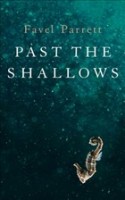
Favel Parrett’s Past the Shallows

Favel Parrett, Past the Shallows (Hachette Australia 2011)

1psI had three compelling reasons for fast-tracking Past the Shallows to the top of my TBR pile. Favel Parrett is a friend of my novelist niece, Edwina Shaw, and Edwina gave me the book as a Christmas present (‘Read it and weep,’ she said). I met Favel at the NSW Premier’s Literary Awards dinner last year, for this book was shortlisted, and was charmed. And I’ve recently signed up with the Australian Women Writers Challenge to read a certain quota of AWWs in 2013. And there was an additional softener: it’s short.

awwbadge_2013 The book tells the story of three brothers and their father, who makes a marginal living as a dubiously legal abalone fisherman in southern Tasmania. The action unfolds in the long shadow cast by the death of the boys’ mother in a car accident some years earlier, and is seen in alternating chapters through the eyes of the two younger brothers, Miles and Harry. It’s Tim Winton territory: brothers growing up with the splendour and terror of the sea, in a family racked by emotional turmoil. Maybe I shouldn’t put the mockers on a young writer by saying so out loud, but I found the people and the world of this novel more convincing, more demanding of my compassion, than I ever have Winton’s; and the writing is more direct, draws attention to itself less, and allows for broader sympathies. The father is violent, irrational and dangerous, but neither the boys nor we lose sight of the grinding forces and bitter blows that have made him that way. The ocean is a place of pleasure and exhilarating challenge – Miles goes surfing with the eldest brother, Joe, while Harry hunts for treasures in the tidewrack. But it’s also the site of hardship, as in Miles’s exhausting work on his father’s abalone boat, and terror, especially in a climactic storm scene. You could probably read the book as a meditation on the ocean, with the human story there just to keep us reading: Favel Parrett writes about surfing, seamanship and heavy seas with a kind restrained precision that manages to suggest, and – very occasionally – explicitly invoke something like awe.

I haven’t mentioned the boys’ ages. It’s a measure of the book’s fineness that we’re not told how old they are until maybe halfway into the story. Instead, we’re left to work it out for ourselves from their preoccupations, their different strategies or dealing with the poverty and neglect, and their different degrees of vulnerability and protectiveness, innocence and savvy, openness and quiet desperation.

Terrible things happen in this story, and there are a number of revelations about terrible things in the past, but for me the book’s emotional power doesn’t lie there so much as in the brothers’ mutual tenderness, and even then not so much in the big moments – which are operatic in scale, but not overblown in the telling – as in tiny, poignant gestures.

My copy has half a dozen stickers on the cover boasting of prizes and shortlistings. I concur with all those judging panels. It also has pages of notes up the back for book groups. I didn’t read them: does anyone really want to have a questionnaire waiting for them when they emerge back into the shallows from deeps like this?

NSWPLA and NSWPHA Dinner

I didn’t expect to attend a NSW Premier’s Literary Awards Dinner this year. For a while back there it looked as if the awards might go the way of the Queensland equivalent, but the Liberal Party-approved panel’s unpublished report must have come down in favour of continuation, because here they were again last night, six months late, run by the State Library rather than the Arts NSW, charging $200 [but see Judith Ridge’s comment] for a book to be considered, and sharing the evening with the History Awards, but alive and kicking. And pretty special for me, because I got to go as my niece’s date, my niece being Edwina Shaw, whose novel Thrill Seekers was shortlisted for the UTS Glenda Adams Award for New Writing.

The dinner was held in the magnificent reading room of the Mitchell Library. Not everyone approved of the venue – I was in the Research Library in the morning when a woman complained very loudly that she had driven the four hours from Ulladulla only to find the Mitchell’s doors were closed for the day so it could be converted into a banquet hall. She must have been placated somehow because she stopped yelling, but there were other problems. None of the shortlisted books were on sale – Gleebooks had a table at this event for years [but see Judith Ridge’s comment], as the Library has its own shop, which wasn’t about to stay open late just for us. And library acoustics aren’t designed for such carryings-on: the reverberation in the vast, high-ceilinged room made a lot of what was said at the mike unintelligible at the back of the room. But those are quibbles. It’s a great room with happy memories for a good proportion of the guests.

Aunty Norma Ingram welcomed us to country, inviting us all to become custodians of the land.

Peter Berner was the MC. He did OK, but organisers please note: the MC of an event like this needs to be literate enough to pronounce Christina Stead’s surname correctly.

The Premier didn’t show up. Perhaps he was put off by the chance of unpleasantness in response to his current attack on arts education. The awards were presented by a trio of Ministers, one of whom read out a message from the Premier saying, among other things, that art in all its forms is essential to our society’s wellbeing. But this was a night for celebrating the bits that aren’t under threat, not for rudely calling on people to put their money where their mouths are.

The Special Award, sometimes known as the kiss of death because of the fate met by many of its recipients soon after the award, went to Clive James – whose elegant acceptance speech read to us by Stephen Romei necessarily referred to his possibly imminent death. He spoke of his affection for New South Wales, of his young sense that Kogarah was the Paris of South Sydney, and his regret that he is very unlikely ever to visit here again. He also said some modest things about what he hoped he had contributed.

After a starter of oyster, scampi tail and ocean trout, the history awards:

NSW Community and Regional History Award: Deborah Beck, Set in Stone: A History of the Cellblock Theatre
The writer told us that the book started life as a Master’s thesis, and paid brief homage to the hundreds of women who were incarcerated in early colonial times in the Cellblock Theatre, now part of the National Art School.

Multimedia History Prize: Catherine Freyne and Phillip Ulman,  Tit for Tat: The Story of Sandra Willson
This was an ABC Radio National Hindsight program about a woman who killed her abusive husband and received  lot of media – and wall art – attention some decades back. Phillip Ulman stood silently beside Catherine Freyne, who urged those of us who enjoyed programs like Hindsight to write objecting to the recent cuts.

Young People’s History Prize: Stephanie Owen Reeder, Amazing Grace: An Adventure at Sea
This book won against much publicised Ahn Do on being a refugee (The Little Refugee) and much revered Nadia Wheatley on more than a hundred Indigenous childhoods (Playground). It not only tells the story of young Grace Bussell’s heroic rescue of shipwreck survivors but, according to the evening’s program, it introduces young readers to the ‘basic precepts of historical scholarship’. It also looks like fun.

General History Prize: Tim Bonyhady, Good Living Street: The Fortunes of My Viennese Family
A member my book group rhapsodised about this book recently, comparing it favourably to The Hare with Amber Eyes. It’s a family history, and in accepting the award Bonyhady told us it had been a big week for his family because the lives of his two young relatives with disabilities would be greatly improved by the National Disability Insurance Scheme introduced by the Gillard government.

Australian History Prize: Russell McGregor, Indifferent Inclusion: Aboriginal People and the Australian Nation
This looks like another one for the To Be Read pile. Russell McGregor acknowledged Henry Reynolds and Tim Rowse as mentors.

After a break for the entrée, a creation in watermelon, bocconcini and tapenade, it was on to the literary awards:

The Community Relations Commission Award: Tim Bonyhady was called to the podium again for Good Living Street, but he’d given his speech, and just thanked everyone, looking slightly stunned.

The newly named Nick Enright Prize for Drama was shared between Vanessa Bates for Porn.Cake. and Joanna Murray-Smith for The Gift. Perhaps this made up to some extent for the prize not having been given two years ago.
Joanna Murray-Smith said she learned her sense of structure from the Henry Lawson stories her father read to her at bedtime. As her father was Stephen Murray-Smith, founding editor of Overland, she thereby managed to accept the government’s money while politely distancing herself from its politics. She lamented that her play hadn’t been seen in Sydney and struck an odd note by suggesting that the Mitchell Library and a similarly impressive building in Melbourne may have been the beginning of the Sydney–Melbourne rivalry: I wonder if any Sydney writers accepting awards in Melbourne feel similarly compelled to compete. Vanessa Bates couldn’t be here, so her husband accepted her award, with his smart phone videoing everything, perhaps sending it all to her live.

The also newly named Betty Roland Prize for Scriptwriting (and I pause to applaud this conservative government for honouring an old Communist in this way): Peter Duncan, Rake (Episode 1): R v Murray
Peter Duncan gets my Speech of the Night Award. He began by telling the junior minister who gave him the award that he was disappointed not to be receiving it from Barry O’Farrell himself, because he had wanted to congratulate Barry on the way his haircut had improved since winning the election. At that point we all became aware that Peter Duncan’s haircut bears a strong resemblance to the Premier’s as it once was. He then moved on to congratulate the Premier for instituting a careful reassessment of the Literary Awards and deciding to persevere with them. He expressed his deep appreciation of this support for the arts. (No one shouted anything about TAFE art education from the floor. See note above about this being an evening to celebrate the bits that aren’t under threat.)

The Patricia Wrightson Prize for Children’s Literature: Kate Constable, Crow Country (Allen & Unwin)
I hadn’t read anything on this shortlist, I’m embarrassed to confess. It looks like a good book, a time-slip exploration of Australian history.

The Ethel Turner Prize for Young People’s Literature: Penni Russon, Only Ever Always (Allen & Unwin)
Again, I hadn’t read any of the shortlist. But Bill Condon and Ursula Dubosarsky were on it, so this must be pretty good! Penni Russon’s brief speech referred to the famous esprit de corps of Young Adult writers: ‘You guys are my people.’

There was break for the main course to be served, and for about half the audience go wander and schmooze. I had the duck, the two vegetarians on our table were served a very fancy looking construction, only a little late. Then onward ever onward.

The Kenneth Slessor Prize for Poetry: Gig Ryan, New and Selected Poems
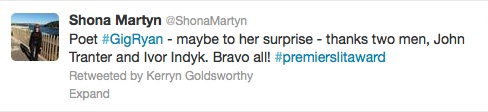
Again, I hadn’t read any of the shortlisted books, but wasn’t surprised that Gig Ryan won, as this is something of a retrospective collection. She speaks rapidly and her speech was completely unintelligible from where I was  sitting (like some of her poetry). However, someone tweeted a comment that got laughs from the front of the room:
tweet

The Douglas Stewart Prize for Non-fiction: Mark McKenna, An Eye for Eternity: The Life of Manning Clark
Another lefty takes the government’s money, and a good thing too.

The UTS Glenda Adams Award for New Writing: Rohan Wilson, The Roving Party (Allen & Unwin)
I know nothing about this book. Rohan Wilson is in Japan just now. His agent told us that when she asked him for an acceptance speech ‘just in case’, he emailed back, ‘No way I’ll win – look at the calibre of the others.’ The three writers on my table who were in competition with him seemed to think it was a fine that it had won:

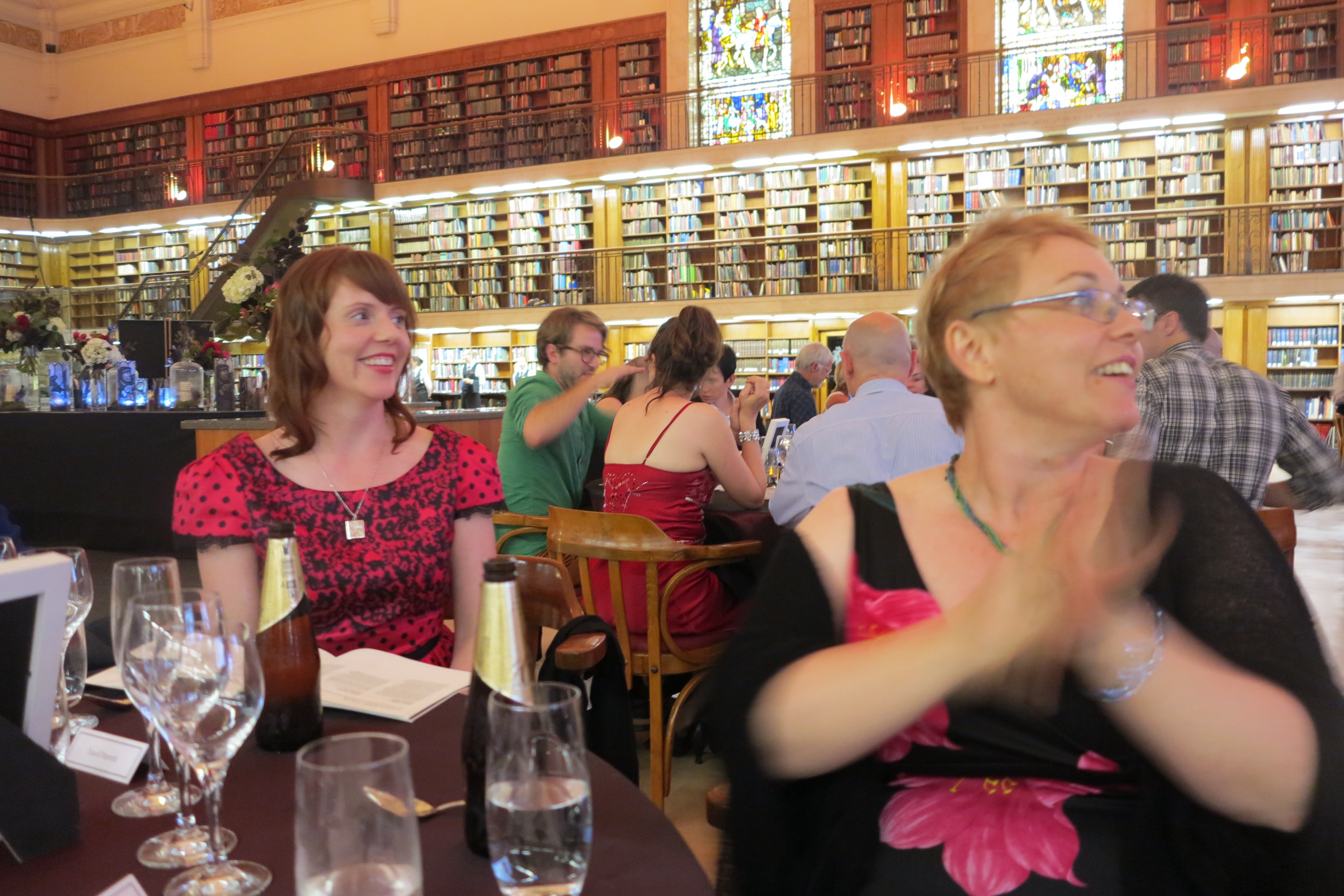
Favel Parrett and Edwina Shaw respond to not winning the UTS Glenda Adams Award for New Writing

Favel Parrett and Edwina Shaw respond to not winning the UTS Glenda Adams Award for New Writing

The Christina Stead Prize for Fiction was almost an anti-climax. It went to Kim Scott for That Deadman Dance. We had a small bet going on my table, and I won hundred of cents. Kim Scott’s agent accepted on his behalf.

There was dessert, layered chocolate and coffee cake, then:

The People’s Choice Award, for which voting finished the night before, went to Gail Jones for Five Bells. She was astonished, genuinely I think, and touched that her book about Sydney as an outsider should be acknowledged like this. I haven’t read the book yet, but I’m also a bit astonished, because what I have read of her prose is not an easy read.

Book of the Year: Kim Scott, That Deadman Dance. No surprise there!

No surprise, either, that the award to Clive James overshadowed all the others in the newspaper reports.

I believe that the judging panel for next years literary awards has had its first meeting. The dinner will move back to the Monday of the week of the Writers’ Festival, where it belongs.

Added later: Edwina has blogged about the evening.

NSW Premier’s Literary Awards 2012

The shortlists for the NSW Premier’s Literary and History Awards were announced today, and the awards dinner will be on 30 November. I’ve been a fan of these awards for years, but this year it’s personal. My fabulous niece, Edwina Shaw, is in incredibly distinguished company on the UTS Glenda Adams Award for New Writing, for her novel Thrill Seekers. Much snoopy dancing and weeping for joy has ensued.

I couldn’t find the lists on the site of the State Library, which is administering the awards this year. The Sydney Morning Herald has them, here.

Apart from Edwina’s book, I’ve read two of the novels (blog posts here and here) and one of the non-fiction works (here), all with my book group. I’ve read one of the multicultural titles (here), and none of the poetry books, the children’s books or the ‘young people’s literature’. I’ve seen two of the three scripts (episodes of Rake and East West 101) and have no desire to see the third (Snowtown).

The Premier’s History Awards usually happen at a different time of year, but because of a general overhaul (not, Barry be thanked, a cancellation as in Queensland), the two lots of awards are happening at the same time for just this year. I haven’t read anything on the History Awards shortlists, though I do have one book beside the bed.

Added on 6 November: The shortlists are now up on the State Library web site, here and here. There are instructions there for how to vote in the People’s Choice Award.

SWF 2112: Tabloid – David McKnight on Rupert Murdoch

The Sydney Writers’ Festival has started. In recent years I’ve been kicking my festival off by attending the Premier’s Literary Awards dinner on the Monday night, and it’s been a great way of getting momentum up. This year, the dinner – if there is one – will be in November, so I began with a visit to the State Library on this cold cold night to hear David McKnight talk about Rupert Murdoch in a conversation with Jonathan Holmes. It was good to see Mr Media Watch in person, and David McKnight has read and watched an awful lot of a certain kind of journalism so the rest of us don’t have to. And written a book, Rupert Murdoch: An Investigation of Political Power.

My pick for quote of the evening was David McKnight on the anti-elite ideology pushed by Murdoch and his allies: ‘A librarian living on a pension is a member of the elite if she has liberal views, and Rupert Murdoch is not. It’s a beautiful move ideologically.’

In the Q&A, someone remarked that the  Australian‘s columnists seem to have contempt for their readers, considering them incapable of rational thought. Jonathan Holmes said something to the effect that the columnists see themselves as speaking to the concerns of those readers, echoing and amplifying their anxieties and prejudices; if they have contempt, it is for people like the questioner, who is clearly one of the ‘elite’.

No one asked David McKnight if he there was anything he admired about Rupert Murdoch, but he told us anyway, saying that he had prepared the answer and in all his presentation about the man no one had ever asked the question: he has never heard him be racist, and he seems to be a genuine believer in free speech, as he has never sued anyone, or even threatened to sue them, for libel.

It was like a top level Gleebooks evening – which would cost maybe $5 and  be free to Gleeclub members. I don’t know if either of the presenters was paid for his appearance, but each of the mainly silvery heads at tonight’s sold out event  paid $20. I guess the money went to a good cause.

Andy Kissane’s Out to Lunch

Andy Kissane, Out to Lunch (Puncher & Wattman 2009)

Continuing on my advance reading for the NSW Premier’s Literary Awards: here’s another title from the shortlist.

This book’s cover, featuring an electric plug that looks more North American than Australian, led me to expect some kind of postmodern smart-arsery that would speak to a placeless, hip readership. Then ‘The Earlwood–Bardwell Park Song Cycle’ on the contents page seemed to promise more smart-arsery, this time taking the mickey out of Les Murray’s ‘Taree–Buladelah Holiday Song Cycle’. I was prepared, one way and/or the other, to be alienated, left out in the cold, feeling like I was too just old for this world.

It didn’t happen like that at all. After being tantalised by Anna Kerdijk Nicholson’s poetry and wrestling with Francis Webb’s, I took to Andy Kissane’s like a duck, or perhaps a horse, to water. The first poem, ‘Loaves and Days’, describes a baker at work; the second, ‘Bus Ride with Grey Owl and Dancing Woman’ has a woman dancing on a bus to the music from her Walkman while the poet reads Native American poems at the back of the bus. There are poems about surfing, about the death of friends, about the joys of fatherhood, about visiting friends and family in Melbourne, about adolescent ideals (what does happen to them?). The poems are mostly conversational – no extreme compression of language or dense metaphor, none of the quality I think the blurbs mean when they say poems are permeable or unfenced (something like,’Here are the words, you make the meaning’). Some are pleasantly silly – ‘The Humble Sausage’, for instance is a collection of short pieces having fun with famous lines (‘I wandered lonely as a sausage / Without a slice of bread …’). Some celebrate quotidian joys:

My daughter runs ahead, hair flying out behind her
like the tail of a beloved horse – an appaloosa

mare or brindle stallion – her hoofs kicking
up sand as she jumps the creek and canters
towards the rocks.

As for ‘The Earlwood–Bardwell Park Song Cycle’, there’s nothing smart-arse or mickey-taking about it, though it’s not without humour. In fact, I just checked and found that Les Murray included a section of it in his Best Australian Poems 2005. And it’s deeply deeply rooted in a place that isn’t far from places I know well myself. Let me quote the ending, because it’s lovely, and also because it mentions my new home suburb:

 _________________The moon rises over the hills
of Marrickville, the moon of workers and mystics, the moon
of the tax return and the tax refund, the cadmium yellow moon
of homework and tears at bedtime. The moon of the coming
election, of palm tree and  hoop pine, of all things passed and yet
to pass. Swaying peacefully in the water until a fish jumps
and the globe breaks, before forming again – the full moon
hanging in the dark sky and floating in the dark water.

Paradoxically, the book’s final section, the source of its title, is the one that appealed least to me. The poet has lunch with a series of literary figures – Osip Mandelstam, Atticus Finch, Raskolnikov, and so on – and tells about them in poems with a studiedly dashed-off feel. It’s a nice idea, one that makes me itch to give it a go for my own amusement – just imagine lunch with one of Marilynne Robinson’s patriarchs, or Sam Pollitt, or for that matter Henny Pollitt! But compared to the rest of the book they feel (to me – I may be missing something) so light as to be hardly there at all.