Tag Archives: poetry

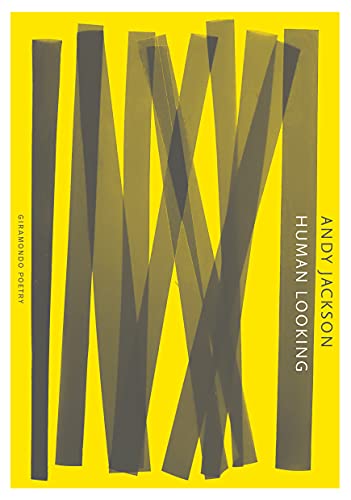
Andy Jackson, Human Looking

Andy Jackson, Human Looking (Giramondo 2021)
Human Looking has changed the way I see the world. More accurately, it has changed the way I experience myself as a body among other bodies in the world.

Trying to describe it, I can’t do better than the Author Note that came with my review copy:

There are two ways of saying ‘human looking’: one with a hyphen, the other with a comma. In other words these poems are about how we judge others to be human yet not-quite-human. They’re also about the humanness of the gaze, the vulnerability of the person doing the looking …

Since puberty, I’ve live with a visible disability, and have had to carry around the weight of other people’s looking. Wrestling with this is Sisyphean; simply putting it down isn’t an option. In a sense, this is my fifth poetry collection about deformity and the fault-lines of human community, though I’ve never written poems quite like this.

There are poems about Andy Jackson’s own experience with the medical profession, and his own experience of ‘other people’s looking’. There are poems about many people whose bodies fall outside the normal, through birth, accident or human intervention: conjoined twins, people with BID (Body Identity Integrity Disorder – you can look it up if you’re interested), pillow angels (you can look them up too), injured soldiers, images from ‘museums of deformity’.

A number of poems engage with other works of art. ‘Song not for you’ responds to Rainer Maria Rilke’s ‘Song of the Dwarf’; ‘No Lament’ is a sonnet replying to Judith Beveridge’s sonnet ‘Quasimodo’s Lament’. ‘Not a performance’ is a response to a self-mutilating performance work by Mike Parr. There are responses to painter Francis Bacon, and Joel Peter Wilkin’s photograph ‘Art Deco Lamp, New Mexico’ (again, you can look it up, but I recommend that you read Andy Jackson’s poem ‘Light which acts as a mask’, at this link, if you do). ‘In Itself’ is a homage to actor Javier Botet, who has the same genetic condition as Andy Jackson, Marfan’s Syndrome.

Many poems make creative and/or destructive use of other texts. The first poem in the book, ‘Operations’, comprises words and phrases from Jackson’s own childhood medical file. ‘Borne away by distance’ is an erasure poem taken from the last chapter of Mary Shelley’s Frankenstein. ‘Unhomely’ creates an extraordinary synergy by having alternate lines taken from ‘The Handicapped’, an essay by Randolph Bourne published in 1911.

My usual practice when blogging about poetry books is to look closely at one poem. Here, I want to discuss ‘The Change Room’, which is possibly the most straightforward, least confronting poem in the book. You might say I’ve picked it because it lets me stay in my able-bodied comfort zone, and you could be right, but it’s also the poem that surprised me most, perhaps for that very reason. You can read it in Cordite Poetry Review, 4 May 2016, at this link. I’m assuming approval from Andy Jackson and Giramondo to quote it in full:

The change room

This morning, walking almost naked
from the change room towards the outdoor heated pool, 
I become that man again, unsettling

shape to be explained.
Such questions aren't asked to my face. Children
don't mean anything by it, supposedly, so I 

shouldn't feel as I do, 
as my bones crouch into an old shame I thought
I'd left behind. Chlorine prickling 

my nostrils, a stranger 
compliments me on my tattoos and shows me hers – 
a dove in flight over a green peace sign – 

as if the canvas was unremarkable.
She turns and limps away, 
and something makes a moment of sense.

I lower myself into our element 
and swim, naturally
asymmetrical and buoyant. Quite some time 

later, showering, the man beside me 
is keen to chat – how many laps we've each done, 
how long I've lived in this town, the deep 

need for movement. 
Speaking, our bodies become solid.

In a seamless narrative told in eight short stanzas, three strangers initiate encounters with the poem’s speaker. It may feel like a casual anecdote, but every word counts.

The first line, ‘This morning, walking almost naked’, raises questions: why almost naked? where were you? where were you going? The questions are answered right after the line break, but they have been raised. The phrase ‘almost naked’ isn’t necessary as information. If someone is walking from the change room to go for a swim, it goes without saying that they’re in a state of undress. So the first line makes sure that the reader has the speaker’s body in mind, which prepares us for what happens next.

When ‘the change room’ is first mentioned it doesn’t feel as if it’s carrying any non-literal weight. But a slight shift in its meaning comes with the third line: ‘I become …’ Without disrupting the conversational surface, the change room has taken on a metaphorical dimension: it’s not just a place where the speaker has changed his clothes; it has changed him by exposing his body to an othering gaze, articulated in a child’s question, which we assume to be something like, ‘Mummy, what’s wrong with that man?’

‘Such questions aren’t asked to my face.’ That’s the key to this encounter: it’s not person to person, but person to person-seen-as-thing. The poem pulls back from blaming the child, but can’t shake off the hurt of being objectified. When a girl shouted a racial slur at Adam Goodes on the football field, the same line of logic applied: she didn’t mean any harm, so it’s wrong to be hurt by it. But the impact is there regardless of intention, and the word ‘supposedly’ leaves the question of blamelessness open. An ‘old shame’, from a history of encountering such attitudes, is felt in the body (‘my bones crouch’), and is compounded by the thought that I / shouldn’t feel as I do’, and anyway it’s something he thought he’d outgrown. So much complexity is contained in these few lines.

As the whiff of chlorine calls us back to the present enterprise, the swim, there’s a second encounter – the kind of inconsequential encounter I’ve been documenting in my 500 people posts. The other person is introduced as an abstraction, ‘a stranger’. We learn details one at a time – first her gender, then her tattoos and by implication perhaps something of her anti-war, pro-environment politics, and finally her limp. The three lines of this conversation raise questions: isn’t it a bit odd for a stranger to approach you at the pool and chat about your tattoos? what is going on that she shows her own ‘as if the canvas was unremarkable’? She is putting her attention to the speaker’s body and drawing his attention to hers, but in a way that seems to assume that the skin and bodies aren’t of much interest. It’s not exactly a denial of the body, but it’s the opposite of ogling. It’s also, crucially, an opposite to the gaze of the first encounter.

Only when she walks away, and we see that she limps, ‘something makes a moment of sense’. Along with the speaker, we understand that she has been acting on the basis of shared disabled status – an equivalent, perhaps, of the ‘nod’ that brown and black writers describe – but he hasn’t understood the nod until she walks away.

This is the only stanza (apart from the final one) that ends with a full stop. Elsewhere the transition between stanzas is, to use a key word from earlier in the poem, unsettling. The lack of carry-over here suggests that something has been resolved.

The sixth stanza is a moment of respite, the swim. Here too the language is alive with possibility. Water is ‘our element’. I once met a man whose PhD thesis was on the use of pronouns in political speech, in particular we, us and our. He would love this our. It most obviously refers to the speaker and the ‘stranger’: he has accepted the fellowship she offered. In water their various asymmetries can be natural. But water is also everyone’s element, including the child and parent from the start of the poem. The ‘our’ here is an assertion of common humanity. Asymmetrical bodies are also natural, and no less buoyant than symmetrical ones.

In the third encounter two men are showering, possibly completely naked – at least that’s how it would be at my local pool – and they chat, unselfconsciously, about what they have in common. They have swum in the same pool, they live in the same town, and moving to a slightly more philosophical and self-disclosing level, they share a ‘deep / need for movement’.

Though I find the last line – ‘Speaking, our bodies become solid’ – completely satisfying, I have trouble saying why. The earlier encounters focus each in its own way on the speaker’s body as different. The man in the shower, ‘keen to chat’, isn’t interested in that difference at all. It’s not that he’s strenuously ignoring it, he’s just not interested at that moment. Paradoxically, not paying attention to the difference enables the speaker (who we can assume reciprocates the chat, as he probably doesn’t in the earlier encounters) to think in terms of ‘our bodies’. Here, in this moment, he is not that man, nor a member of a particular group, but an embodied human talking to another embodied human. The line contains an echo of a powerful moment in the Catholic Latin Mass, when the priest would genuflect as he intoned, ‘Et verbum caro factum est‘ / ‘And the word became flesh.’

Speaking can rob us of our humanity, can express solidarity, can affirm that same humanity. The humble change room has become a metaphor for a place where transformation is possible.

I am grateful to Giramondo for my complimentary copy.
The Prelude Progress Report 3

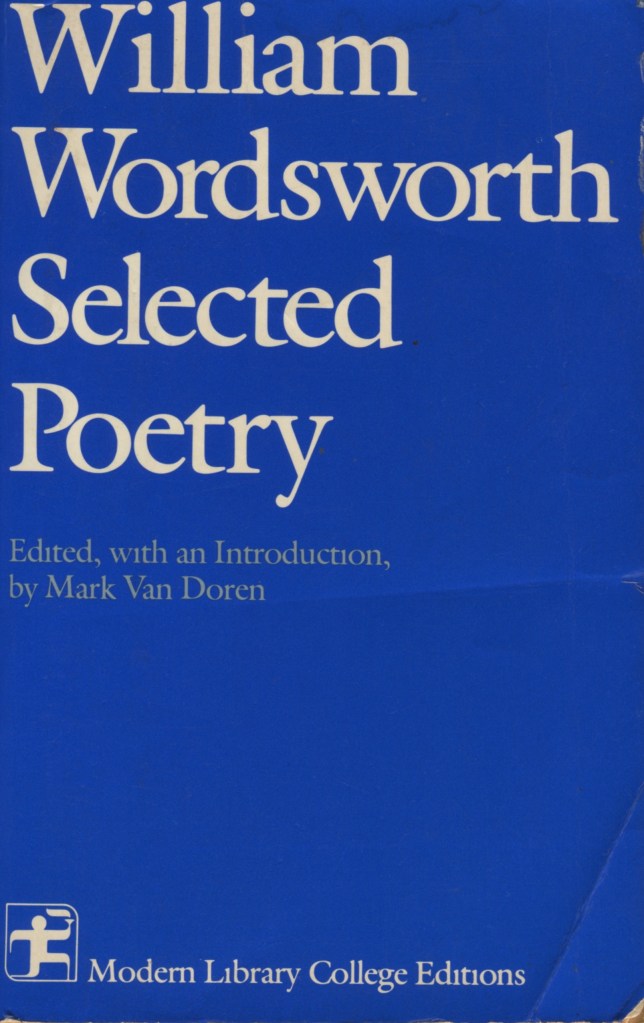
William Wordsworth, ‘The Prelude, or, Growth of a Poet’s Mind’, in William Wordsworth Selected Poetry, edited, with an Introduction, by Mark Van Doren (Modern Library College Edition 1950), Book Seventh line 619 to Book Eleventh line 152.

After averaging 70 lines a day for three months now, I’m past the three-quarter mark in ‘The Prelude’, still surprised by the joy of it. Most of this month’s reading has been about Wordsworth’s response to the French Revolution.

Book Eighth, subtitled ‘Retrospect – Love of Nature Leading to Love of Man’, revisits his childhood in the Lake District and his early time in London. There’s a wonderful set piece describing a country fair at the start of this Book, and there are some descriptions of shepherds at work which I suppose could be read as treating those working men as picturesque features of the landscape, but they reminded me of James Rebanks’s A Shepherd’s Life in their appreciation of the difficulty of that work. He goes back over his time in Cambridge and in London, looking at these times with more mature eyes. This section is sometimes a bit opaque and abstract, but it’s fascinating as an account of a young man finding his way in an increasingly complex and morally compromised world.

Books Ninth, Tenth and Eleventh are a revelation to me. I don’t think I’m the only person who has thought of Wordsworth as the ‘Daffodils’ guy, or – slightly more seriously – the guy who wrote some great sonnets and the Lucy poems. That’s what it meant to be a Romantic. I suppose I’d vaguely heard about his sympathy for the French Revolution, but when I ‘did’ him at university in the early 1970s there was no hint that that sympathy had anything to do with his poetry. But of course the Romantics weren’t wafty, apolitical nature-lovers: Byron went off to fight in Greece, Blake railed against the human damage caused by industrialisation, and Wordsworth as a young man was hugely invested in the French Revolution, appalled that England sent young men to do battle against the revolutionaries, horrified at the Terror, and overcome by relief at Robespierre’s death.

Mind you, one line from ‘The Prelude’ did emerge into the general culture in the 70s. I don’t remember whether it was referring to the ‘alternative society’, women’s liberation, or opposition to the US-led war in Vietnam, but someone quoted these lines (Book Eleventh, lines 108–109) that struck a strong chord with me:

Bliss was it in that dawn to be alive,
But to be young was very Heaven!

What follows makes it clear that he’s not talking about a dawn of affluence or a youth of indulgence, but a revolutionary dawn. Then there are these wonderful lines:

Why should I not confess that Earth was then 
To me, what an inheritance, new-fallen 
Seems, when the first time visited, to one 
Who thither comes to find in it his home? 
He walks about and looks upon the spot 
With cordial transport, moulds it and remoulds
And is half-pleased with things that are amiss
’T will be such joy to see them disappear.

I imagine these lines resonate with many in younger generations just now who are challenging rigidities around gender, race and other identities.

That’s pretty much where my reading is up to: the world is on the brink of miraculous transformation. I do hope we’re not being set up for disillusionment.

The Prelude Progress Report 2

William Wordsworth, ‘The Prelude, or, Growth of a Poet’s Mind’, in William Wordsworth Selected Poetry, edited, with an Introduction, by Mark Van Doren (Modern Library College Edition 1950), Book Fourth line 339 to Book Seventh line 618.

I’ve now been reading ‘The Prelude’ for two months, 70 lines first thing in the morning every day except one, when an an early doctor’s appointment messed things up.

It has been a pleasurable enterprise – nothing like a dose of beautifully crafted language to start a day well. The first four books dealt with Wordsworth’s childhood, his school days, his time at Cambridge, and a summer vacation from Cambridge. At the end of Book Fourth, after pages about the pleasures of summer holidays, these lines struck a chord when read during our Covid lockdown:

When from our better selves we have too long
Been parted by the hurrying world, and droop,
Sick of its business, of its pleasures tired,
How gracious, how benign, is Solitude;
How potent a mere image of her sway;
Most potent when impressed upon the mind
With an appropriate human centre—hermit,
Deep in the bosom of the wilderness;
Votary (in vast cathedral, where no foot
Is treading, where no other face is seen)
Kneeling at prayers; or watchman on the top
Of lighthouse, beaten by Atlantic waves

The next three books – Fifth, Sixth and most of Seventh – are handily titled ‘Books’, ‘Cambridge and the Alps’, and ‘Residence in London’. He constantly plays off the natural and rural worlds against the urban, busy or frivolous world. There are some satirical passages, but the best bits are the ones that celebrate the beauties of the natural world or works of the imagination. When he was about 20, he took time off from Cambridge for an epic walk across France to the Alps early in the French Revolution: Book Sixth documents the joy that filled the countryside at that time, and leads to some wonderful passages about the Alps.

And now, he’s in London, enjoying the theatre, including music hall, and being less than impressed by the way language is wielded in parliament (‘Words follow words; sense seems to follow sense’), in the pulpit, and all around him (‘Lies to the ear, and lies to every sense’). But he is struck by ‘individual sights / Of courage, or integrity, or truth / Or tenderness’, and my reading this morning finished with such a sight – a working man sitting in the sun with a sickly baby on his knee:

Of those who passed, and me who looked at him,
He took no heed; but in his brawny arms
(The Artificer was to the elbow bare,
And from his work this moment had been stolen)
He held the child, and, bending over it,
As if he were afraid both of the sun
And of the air, which he had come to seek,
Eyed the poor babe with love unutterable

Toby Fitch’s Sydney Spleen

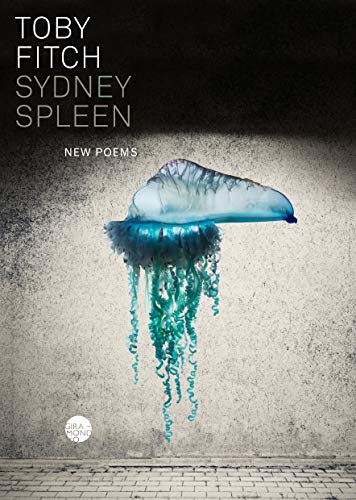
Toby Fitch, Sydney Spleen (Giramondo 2021)

There are four poems with the title ‘Spleen’ in Charles Baudelaire’s Les fleurs du mal (1857). Toby Fitch’s Sydney Spleen is roughly structured around those poems – its first three sections begin with his version of one, and the third section finishes with his version, or perhaps his re-imagining, of the fourth.

The translations are a long way from word-for-word French-to-English transcriptions. Only the first of the four preserves Baudelaire’s conventional line-by-line layout, but even in it the Fitch version moves the action from Paris to Sydney, and in its final couplet, rather than two court cards muttering sinisterly about their defunct loves, the looming climate catastrophe disinters ‘whole centuries of fear’. On close reading, though, these versions are astonishingly true to the originals – recreations of the same mood of disgusted melancholy in a different cultural, geographical and ecological context. (I have had quite a bit of nerdy fun comparing these versions with other more conventional ones. If you’re also inclined that way, you can find Baudelaire’s first ‘Spleen’ and a handful of English translations at fleursdumal.org. The Fitch version is online here.)

In the rest of the book, poem after poem vents its spleen on this city and this country, articulating – to quote the excellent back-cover blurb – ‘the causes of our doom and gloom: corporate rapacity, climate change, disaster capitalism, the plague, neo-colonialism, fake news, fascism’. They do it with gusto, with dazzling wordplay, and with the engagement of a parent of small children and owner of an ailing small black dog.

I’m not a critic or a scholar. Mostly, I read poetry for pleasure, and even though in a number of the poems in this book I have no grasp of their organising principles or structures, there is almost always something to give pleasure. I feel a little the way I did on first hearing Bob Dylan’s ‘Sad Eyed Lady of the Lowlands’ or ‘Desolation Row’ – the words have a magic that doesn’t depend on me understanding them. For example this, from ‘New Work Metaphorics’ (page 19), which seems to be the inspiration for the book’s cover:

I've got over 73
tabs open in my hot
skull right now, one of which
on death-cult capitalism says, There
are more important things than living and
I agree with the whole of my man-o'-war
heart still beating its stung drum.
Skeletal, diaphanous, I am
traversed by grace,
a windowpane

The image of multiple open tabs in one’s hot skull is fabulous. I don’t understand that man-o’-war image, but I love it.

There are poems that play around with the n + 7 game invented by the Oulipo poets in the 1960s – you take a passage and replace every noun with the one that comes seven after it in the dictionary. A pretty soulless activity you might think, but when you do it to a certain kind of public utterance, and tweak it a little, the results can be savage, as in this mangled mash-up of Scott Morrison’s ‘I will burn for you’ and ‘This is coal’ speeches (in ‘Captain’s Cull’):

I will burnish for you every deadbeat, 
every single deadline, so you can achieve
your amnesties, your assemblies, your destinations.
That is what's at the torch of my aid. 
And this is coalface. Don't be afraid. Don't 
be scared. An ideological, pathological 
feedback of coastline won't hurt you.

There are poems that use homophones to similar effect, like this, from ‘The Last few Budgets in a Nutshell’:

Wort I'm swaying is, Barry, the primonastery
has my combpleat confit dense. It's imply
inTrumpting bracket creep and I tink the sir plus
is a goner schtick. HoWeber the diss royalty of sum
has been outray juice.

So many levels of splenetic wonderfulness in ‘the sir plus is a goner schtick’!

There are found poems, including one that claims to have been copied verbatim from the label on a bottle of water, and others that play around with found texts. There are prose poems that may be accounts of dreams, especially a sequence titled ‘Pandemicondensation’. And there are poems that take us on a ride through conversations with the poet’s young daughters, online idiocies, dire environmental news, encounters with the police, and more, all tossed in together but somehow making a whole.

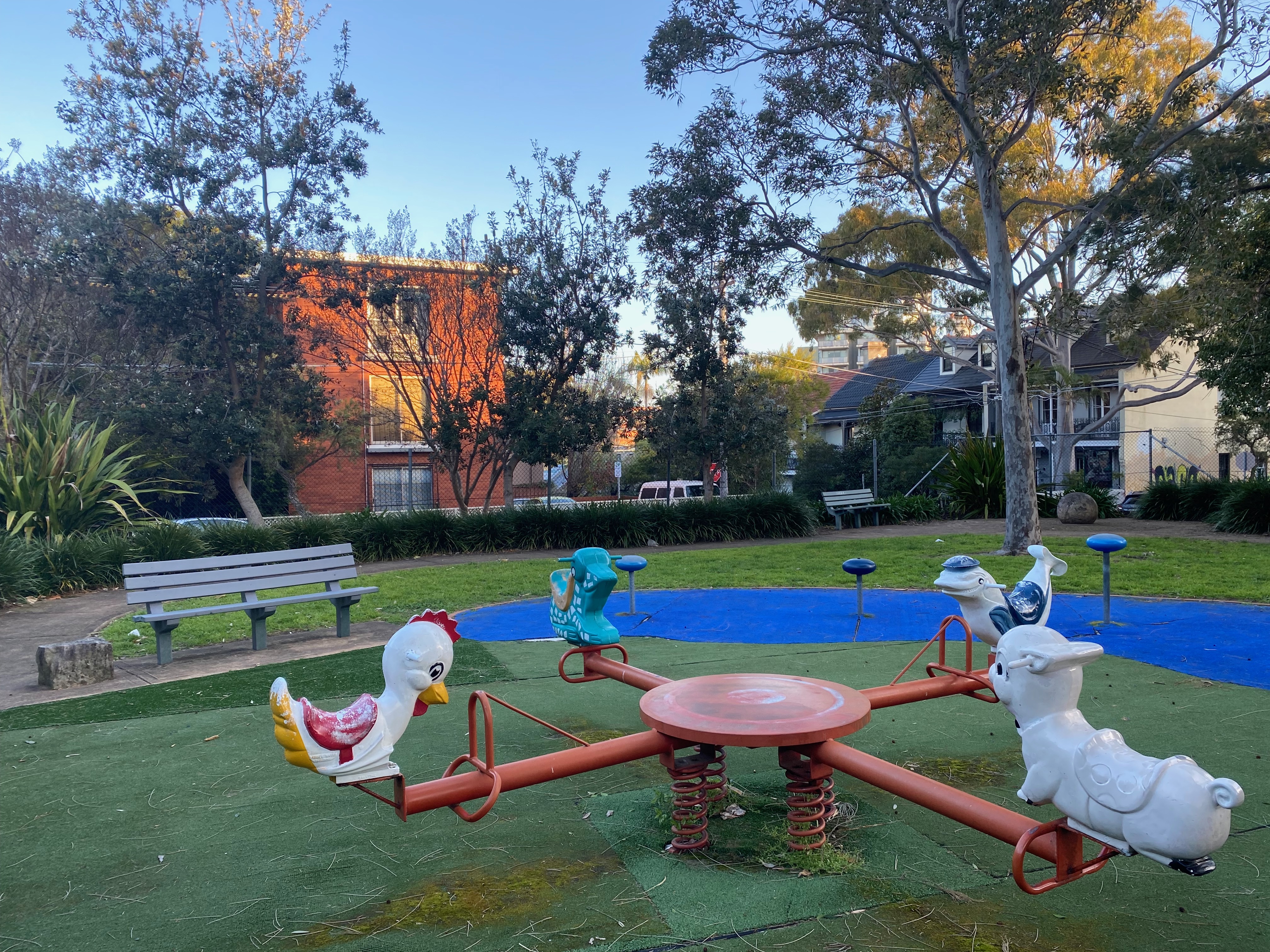
The part of the book I really love is the fourth section, a single prose poem in 25 parts called ‘Morning Walks in a Time of Plague’. It’s exactly what the title says. The poet goes for a morning walk during Covid lockdown with his partner, their two young daughters and their little black dog. In the first eight parts they go to the lovingly evoked ‘chicken park’. I’ve been to that park with a little girl more than once, and am delighted that it has been immortalised. Here it is:

In the rest of the poem, they go to Camperdown Cemetery, whose celebration in verse I’ve already blogged about (here).

Both these places come wonderfully alive in what purport to be – and I believe mostly are – straightforward accounts of daily visits to these locations. Sometimes the adults join the girls’ imaginative play, which mostly involves unicorns, or alicorns to be precise. Occasionally they yell at them. Sometimes they get lost in their phones, reading news about the pandemic or plague-related texts from Boccaccio, Defoe, Camus and contemporary scholars, the latter via Twitter. The narrator is aware that the late John Forbes lived nearby (I’m guessing it was in the sunlit brick building in the photo above), and quotes lines from his poetry. The two imaginative worlds co-exist easily with the natural world of high winds, dropping pine cones and orgiastic lorikeets. Once the poem moves to the cemetery, the context broadens out to include precolonial and colonial history, as well as a pervasive sense of mortality, and, oh, a hint of Lovecraftian horror. All this happens in unforced prose narrative, so that one barely notices the dark, melancholy undertow: the dog’s body is failing, the girls have little accidents, there are countless tales of the buried dead, they come across a dead bee, and all the time the pandemic looms just outside the poem’s frame.

It’s hard to find a short passage that conveys the pleasure that this poem gives, but here’s an attempt, from the 17th part, featuring the poet’s daughters Evie and Tilda:

Once we reach a clearing, Evie spots an alicorn flock in the 
sky. They eat the belly-sized candlenut leaves we offer them.

When we reach the other swamp mahogany, in the 
northwest, it's clear the lorikeets are coming and going 
between the two, raucously. The tree's thick chunky brown 
bark looks super tough but up close is pliant, squidgy.

Tilda needs to do a 'bush wee', which ends up going down 
the backs of her legs into her gumboots.

On the way home Evie finds a feather which I decide is
from a pigeon, though she says it has too much shine.

In the back alleys we meet, perched on a back gate, a black-
and-white cat adept at keeping his distance from our loose 
hands. 

It is forbidden to spit on cats in plague-time, writes Camus.

See what I mean? This is funny, affectionate, and melancholy all at once. The play between adult and children is fresh and respectful. There are notes on nature and some acute social observation – the cats of Newtown are notoriously self-possessed. These paragraphs quote The Plague, feature My Little Pony figures, and arguably allude to Bluey. With apparent effortlessness, they invite us into an intimate world. The tiny hints of something being amiss, in the description of the tree’s bark and the trouble with Tilda’s wee, are unstrained, and we could almost forget there’s a pandemic on, but the cat sets off an association that reveals the pandemic is always hovering in the poet/father’s mind.


For quite a few years now I’ve enjoyed the fruits of Toby Fitch’s labours as organiser and MC of poetry readings, editor and critic. I’ve heard him read, I’ve read a number of his poems in journals, and I’ve tagged him in this blog a number of times (here’s a link). I used to see his distinctive unruly head of hair behind a stroller in the local park (not the chicken park) accompanied by the small black dog. But though he has had seven books of poetry published, Sydney Spleen is the first I’ve read. I’m very grateful to Giramondo for my review copy.

The Prelude Progress Report 1

William Wordsworth, ‘The Prelude, or, Growth of a Poet’s Mind’, in William Wordsworth Selected Poetry, edited, with an Introduction, by Mark Van Doren (Modern Library College Edition 1950), Book First to Book Fourth, line 338.

I’m a month into reading a little of ‘The Prelude’ first thing in the morning, averaging 70 lines a day, now nearing the end of the fourth of 14 ‘books’

Wordsworth began writing the poem in 1799, when he was in his late 20s, and worked on it all his life. It wasn’t published until 1850, soon after his death that year. His own account of the poem’s origins, in the preface to another of his long poems, ‘The Excursion’, includes this:

Several years ago, when the Author retired to his native mountains with the hope of being enabled to construct a literary work that might live, it was a reasonable thing that he should take a review of his own mind, and examine how far Nature and Education had qualified him for such an employment.

As subsidiary to this preparation, he undertook to record, in verse, the origin and progress of his own powers, as far as he was acquainted with them.

(From Wikisource)

So ‘The Prelude’ was intended not so much to stand in its own right, or even to stand as a preparation for a truly great poem, but as subsidiary to that preparation. Which sounds a lot as if he was managing expectations.

The poem itself begins with a seductively straightforward narrative of a time away from the pressures of life in the city – the early 19th century equivalent of a cyber-break. On the first page, my attention was snagged by these lines (13-17):

The earth is all before me. With a heart
Joyous, nor scared at its own liberty,
I look about; and should the chosen guide
Be nothing better than a wandering cloud,
I cannot miss my way.

It’s hard to miss the echo of the last lines of Milton’s Paradise Lost:

The world was all before them, where to choose
Their place of rest, and Providence their guide:
They hand in hand, with wand'ring steps and slow,
Through Eden took their solitary way.

Wordsworth’s echoes imply, cheekily, that his poem aims to take up where Milton’s left off: where Adam and Eve had Providence he has liberty (and though it doesn’t rate an initial cap here, it does a few lines later); his solitude is joyously chosen where theirs was imposed as punishment; and where their wandering is sorrowful and tentative, his is leisurely and unafraid. The poem itself invites us to keep our expectations high.

After that, I haven’t been struck by any strong allusions. There are line that reminds me of the kind of balance and order that I dimly remember being characteristic of non-Romantic poets like Pope, and I can easily get fascinated by the way he pauses in midline and has the sentences flow over the line breaks.

I’m glad I’ve chosen to read just a small amount each day. Mostly I’m carried along by the narrative and his reflections, though sometimes I have to slow right down and reread some lines. I’m always left wanting more, and I never get to the stage where I’m lulled into a kind of trance by the music of the iambic pentameters, not that there’d be anything wrong with that.

Every day’s reading has been pleasurable. In what I imagine is a common experience, I find the poem stirs memories of my own childhood. Not that a North Queensland sugar farm on a hill overlooking the North Johnstone river, with Mount Bartle Frere to the north like a blue cardboard cut-out, has much in common with the humble cottages, the crags and lakes and mist of England’s Lake District. But things are stirred anyhow.

One place where our childhoods echoed each other pretty directly is where the poem celebrates indoor childhood activities. My two sisters and I used to play cards for days on end on the floor of our veranda while tropical rain pelted against the louvres. According to family lore my youngest sister learned arithmetic adding up matches in those early poker games. Here’s Wordsworth on card games:

Oh, with what echoes on the board they fell!
Ironic diamonds,—clubs, hearts, diamonds, spades,
A congregation piteously akin!
Cheap matter offered they to boyish wit,
Those sooty knaves, precipitated down
With scoffs and taunts, like Vulcan out of heaven:
The paramount ace, a moon in her eclipse,
Queens gleaming through their splendour's last decay,
And monarchs surly at the wrongs sustained
By royal visages. Meanwhile abroad
Incessant rain was falling.

So. nearing the end of Book 4, we’ve had his childhood among the beauties and occasional terrors of the Lake District (‘Fair seed-time had my soul’), in company and solitude, his time among the distractions of Cambridge (‘I was the Dreamer, they the Dream’), and his return home on vacation. There’s a wonderful description of the restorative power of a bush walk (‘and restoration came / Like an intruder knocking at the door / Of unacknowledged weariness’), and an epiphany when, returning home in the dawn light after a night of ‘dancing, gaiety, and mirth’ he is overwhelmed by the beauty of the world and: ‘I made no vows, but vows / Were then made for me’.

This morning, bringing a nice roundness to this blog post, I read another reminder that Wordsworth had the great epics somewhere in the background, a lovely example of what I dimly remember from school is called a Homeric simile. The opening ‘As one who’ signals that we’re reading a simile, but it takes 15 lines before we know that the lovingly-described process of looking over the side of a boat is being compared to the exercise of memory:

As one who hangs down-bending from the side
Of a slow-moving boat, upon the breast
Of a still water, solacing himself
With such discoveries as his eye can make
Beneath him in the bottom of the deep,
Sees many beauteous sights – weeds, fishes, flowers,
Grots, pebbles, roots of trees, and fancies more,
Yet often is perplexed and cannot part
The shadow from the substance, rocks and sky,
Mountains and clouds, reflected in the depth
Of the clear flood, from things which there abide
In their true dwelling; now is crossed by gleam
Of his own image, by a sun-beam now,
And wavering motions sent he knows not whence,
Impediments that make his task more sweet;
Such pleasant office have we long pursued
Incumbent o'er the surface of past time
With like success, nor often have appeared
Shapes fairer or less doubtfully discerned
Than these to which the Tale, indulgent Friend!
Would now direct thy notice.

‘Incumbent o’er the surface of past time’ – shades of Proust, though Proust never acknowledges how much of what he remembers is actually projection!

After Proust, the Prelude?

Now that I’ve finished reading À la recherche du temps perdu, there’s an odd gap in my mornings. (I am aware of the irony of having Proust as part of a daily habit, given how much he had to say about the opposition between habit and full consciousness, but reading a couple of pages of his work was a habit all the same.) I want to take on something else.

A conversation last week with a 40ish friend helped me to think about criteria for the next reading project. My friend was raised without religious instruction and, realising that this had left a huge gap in his cultural knowledge, he had decided to read the Bible. Most of the way through Genesis he was disappointed, not only by the tedious begats, but by what he felt was poor storytelling. He singled out the story of Abraham’s interrupted sacrifice of Isaac as particularly nonsensical. I realised that those stories – Adam and Eve; Noah; Lot’s wife; Abraham, Sara and the angel; Isaac, Leah and Rachel; David dancing naked before the Ark of the Covenant – would seem very different if read cursorily for the first time rather than received with the force of canonicality (if that’s a word) behind them. I want to spend a couple of minutes each morning engaging with a substantial work of literature, not rushing it, not studying it, but letting each small portion settle for a day before I take on the next one.

Homer came to mind: I know people who have spent years reading the Iliad and the Odyssey as a group project. Or James Joyce: all those Bloomsday celebrations can’t be for nothing, and Finnegan’s Wake is at least as daunting as À la recherche. Byron’s Don Juan. The Epic of Gilgamesh. The Aeneid (though I did that, 20 lines a day, in my mid 20s, so it would be a repeat). Middlemarch (another repeat, but why not take it slow?).The Divina Commedia in Italian. Das Kapital (but not in German). It’s a long list of contenders.

Don’t ask me why because I don’t know, but I’ve decided to read Wordsworth’s ‘The Prelude’. In my time at Sydney University, the emphasis was on close reading. I’m grateful for what I learned in that way, but it meant that we got to read an excerpt from this long poem without being told anything about the poem itself, or encouraged to find out about it for ourselves. In fact, I didn’t know until I looked up the Wikipedia entry just now that Wordsworth began working on it in his late 20s and continued to do so all his life; that it was intended as the introduction to an epic, The Recluse, which he never finished. I believe that the version I’m about to read was published posthumously in 1850, the year Wordsworth died. I don’t expect references to it to crop up in movies, other poems, newspaper articles, the way references to Proust have in the last 22 months, and I’m not ruling out the possibility of abandoning ship, but I’ll start tomorrow morning, a page of blank verse a day, and I’ll blog about how it’s going in a month.

Evelyn Araluen’s Dropbear

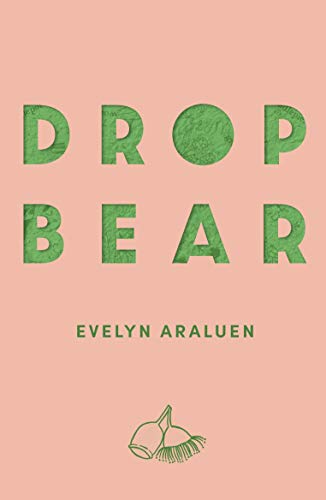
Evelyn Araluen, Dropbear (University of Queensland Press 2021)

This is a formidable book. I’d heard Evelyn Araluen read some of its poems, which she always does with a slight, dangerous smile, and was looking forward to reading them. The smile is mostly still in evidence, but the danger doesn’t feel slight. What’s endangered is any hope of emerging with Australian settler colonialist assumptions intact, or at least untroubled. In the book’s generous notes, Araluen spells out her understanding

that the material and political reality of the colonial past which Indigenous peoples inherit is also a literary one. Our resistance, therefore, must also be literary.

(page 99)

What looks like an elegantly designed slim volume of poems is actually a piece of incendiary resistance to colonial attempts at genocide and erasure, from May Gibbs’s cute bush creatures to perfunctory or self-serving acknowledgements of country, by way of a whole gallery of settler-Australian poets and poetic tropes. There are rage-fuelled mash-ups taken from widely read, familiar texts; poems whose ideal readers have PhDs in critical theory or contemporary poetics; and longer prose poems that could just as easily be categorised as essays and short stories. There are poems that turn their gaze away from the colonisers and dwell on family and the natural world.

In her conversation with Tony Birch at the Sydney Writers’ Festival My blog post is at this link), Araluen said. ‘This is not a cancel culture book.’ And that’s an important point to make. ‘For the parents’, one of the longer pieces, is in part an expression of gratitude and appreciation for her parents who read May Gibbs to her and her siblings, which when she first ‘discovered theory’ she thought meant they were ‘losing to the settlers’:

While my siblings and I consumed those stories, we were
never taught to settle for them. My parents ever pretended 
these books could truly know country or culture or 
me – but they had both come from circumstances in which 
literacy and the access it affords was never a given. They just 
wanted me to be able to read.

The acts of resistance in this book are not rants against an easily demonised foe. They involve the poet’s own inner wrestles, and bring a finely tuned, disciplined intelligence to bear on issues that lie at the heart of Australian culture. The book isn’t an easy read, especially for old white men, but it’s not hostile. Speaking as an old white man I felt it as a bracing invitation and a forthright offer of guidance and even help.

Added later: There’s an excellent discussion of Dropbear by Jeanine Leane in Sydney Review of Books, at this link. Here’s a taste:

Dropbear is blunt, biting and beautifully crafted. Although it is those things, it is more than the sum of those things. It’s a radical and timely affront to the history, the myths, the gossip and the stereotypes that still confront us all as the Country’s First Peoples.

Dropbear is the tenth book I’ve read for the Australian Women Writers Challenge 2021.

Eileen Chong’s Thousand Crimson Blooms

Eileen Chong, A Thousand Crimson Blooms (UQP 2021)

Someone* said recently that the work of a poet isn’t just to write poetry. Poets also teach, mentor, encourage other poets, edit, proselytise for poetry … and the list went on. At the launch of A Thousand Crimson Blooms last month it was clear that by this criterion Eileen Chong is a real poet. I chatted with an emerging poet who has won prizes and attributes it to her inspiration and mentorship. Three other poets, all women of colour, read at the launch, and each testified to Eileen’s kindness, collegiality and solidarity.

The poems in A Thousand Crimson Blooms bear strong testimony to the poet as embedded in a community of poets and other artists. Many of the poems carry epigraphs, and we are given meticulous notes referring us to their sources – most of which are other poems, and at least one is a quote from a conversation with another poet. Sometimes the notes give us web addresses where we can see images of works that inspired a poem.

The sense of connectedness goes further. A central feature of this book, as in Eileen Chong’s previous collections, is the sense of living heritage, in birthplace (her own Singapore and her husband’s Scotland), in family (especially her mother and grandmother), in food (maybe not as much as in earlier books, but this is still poetry that makes you hungry), in language (a number of poems make play with the components of Chinese ideograms), and always in poetic tradition.

This connectedness and rootedness provide a sustaining background in poetry that mostly deals with personal pain: bereavement, sexual abuse, illness and surgery, involuntary childlessness, the challenges of migration.

This is a terrific book. I learned a lot, I cried, I laughed, I was confronted. Only a couple of times I was mystified. More than a couple of times I was surprised by the twist of a last line. I was sent down interesting rabbit holes, and found myself reflecting deeply on my own life. Eileen Chong reads her own work beautifully: you can hear her, among other places, when/if the Sydney Writers’ Festival release a podcast of the session that included her – The Unacknowledged Legislators.

There are so many poems I’d like to spend time with here. There are powerful poems about loss that it would feel almost indecent to write about in this necessarily abbreviated way. There’s ‘Making Sense’, whose beginning sheds light on the poems in general:

I tell my students:
poetry is a way to make sense 
of what you fear. 

I sing to them of 
blackbirds. I read my poems 
aloud

There’s ‘Spring Festival’, which includes similarly suggestive lines:

My husband reminds me I write poems 
in threes: three lines, three pathways.
One for the old life, one for the new 

and one for the hours 
I do not notice as they pass.

There’s the ‘The Hymen Diaries’, each of whose four parts responds to a work of art (see mention of rabbit holes above). There’s ‘Child’, whose subtitle, After Andy Kissane’s ‘Joy and a Fibro Shack’, offers generous possibilities for a ‘compare and contrast’ kind of discussion – and many poems like that.

I’ve picked the title poem, ‘A Thousand Crimson Blooms’, mainly because before spending this time with it I didn’t understand how it hung together, starting with what feels like kindergarten innocence and ending with lacerating pain. You can see an earlier version of the poem with a slightly different title on the Peril magazine website (here). Here’s the poem as it appears in the book:

To start with the epigraph: I haven’t read the poem it comes from, ‘Don’t Trample This Flower’ by Bing Xin, but I have learned that Bing Xin was a prolific Chinese woman writer of the 20th century, many of whose works were written for young readers (Wikipedia entry here). These lines are a straightforward call to pay attention to something that is beautiful, easily overlooked and vulnerable.

There’s a smooth transition to the opening lines of the poem. Like the epigraph, they address children/little ones: having looked, now, let’s draw. We’re in a domestic or classroom setting; the voice is that of an adult – a teacher or parent? – addressing small children, possibly in a rural environment. The third line’s invocation of the daily cycle of time has a traditional Chinese feel. It reminds me of the ancient poem, ‘The Peasant’s Song’, that begins, ‘Sun up, work / sundown, rest.’ (That’s Ezra Pound’s translation, in his Canto XLIV.) It’s a benign opening, and my fridge door is covered with just the kind of artworks that the little ones might create. (I should mention to anyone who’s just visiting the blog that I have a three-year-old granddaughter who loves to put pencil/crayon/brush to paper.)

The next three lines could be summarised as detailing the process of drawing the dog and rooster, and the children’s focused, unblinking attention to the task. But the language alerts us that something may be slightly off. ‘Let’s shape their bodies with our hands’ may be just an odd way of describing the movement of hands holding pencils, but it feels a little more dominating. Maybe we’ve moved on from drawing to shaping in clay. The second line takes us a step further with the hint of violence in ‘gouge’. The adult speaker has taken us quite a way from paying close attention to something vulnerable to something on the edge of cruelty, even if it is only cruelty to the paper. In the third line, as I read it, the ‘little ones’ speak. The ‘lidless eyes’ suggests a kind of forced, sustained attention that is far from the relaxed, open regard of the epigraph. That there are a hundred eyes suggests that the context has moved from the intimate to the institutional. I have to admit that on first reading I resisted this darkening mood, but once seen I can’t unsee it, and it refers to a common phenomenon. The late artist Kim Gamble, for example, used to lament the way education put a damper on creativity: that children who draw and paint beautifully in Year 1 of school are generally creating cliché images with no spark of originality by the time they are in Year 3.

I’m generally sceptical of poets who talk about the crucial importance of punctuation and spacing, but I think it’s interesting that where the Peril version has a simple paragraph space before the next stanza, this version has an asterisk. The poet wants to be clear that there’s a substantial break. The stanzas change here too, from three-liners to four-liners, but it’s the asterisk that most clearly signals a gear-change.

Sure enough, there’s now a radical change in tone. The benign teacher/parent has been superseded by a harsh authoritarian voice. If the earlier stanzas were in a small, friendly kindergarten classroom, this is now a disciplined, bullying high-school class, perhaps a laboratory, where there is no room for emotion or vulnerability. Science experiments using test tubes and bunsen burners become metaphors, or maybe metonyms, for the harm done to people in such an impersonal environment. (I don’t think there’s an implication that science is necessarily that way, but the reference to glass and fire do conjure up a chemistry lab in my mind.)

The final stanza follows another leap – in time, in setting, in scale. The speakers are the bullied ones, and the 50 people of the second stanza have grown to be a thousand. Blue-and-white vases are traditional Chinese creations, vulnerable like the flower of the epigraph, emblematic of a long history of artisanal skill and creativity (of the kind that produces gasps on Antiques Roadshow). We have been prepared for their appearance by the echo of traditional Chinese poetry in the first stanza. They are broken, with violence that parallels the breaking of the benign teacher-child relationship of the earlier stanzas. ‘They’ is undefined. If I stick with the classroom reading, they are a particular kind of educator, and in making us do the kind of ‘creativity’ that the curriculum requires, they not only take us away from our innate creative impulses, they make us tread all over them.

The second last line takes us back to the flower of the epigraph, only now the flower is not ‘by your feet’, but part of oneself. It is our blood, our suffering, that now produces the flower, that becomes the subject of art. Creativity and pain are now closely linked.

The final line takes a step back. I can best say how I read it by attempting a paraphrase: In our present wounded condition, any attempt to make art must find a deep connection to tradition or some other form of community, if it is to have any vitality. Of course, it doesn’t refer only to the making of art: I think of the importance that First Nations elders place on connection to culture as a means to youth suicide prevention.

Now that I’ve understood how the poem coheres, it hasn’t quite finished with me (and perhaps never will have). The reading that I’ve sketched so far is loosely tethered to my own life experience. But that reading can expand. The poem could be read as a meditation on part of Bing Xin’s life story: I only know the Wikipedia version, and haven’t read any of her poetry, but she was denounced during the Cultural Revolution, a time when blue-and-white vases were quite literally being smashed.

The poem can be read as a response to a work of art: it was initially written on commission as a response to The Masks of Me, a mixed media installation by Vipoo Srivilasa consisting of ‘a group of small masks that celebrate cultural differences and diversity’. You can see the artwork and the artist’s statement on the Peril magazine site, at this link. Actually, I can’t see this reading at all.

Since it has given its title to this book, the poem can be read as referring to the collection of poems. Many of these poems are indeed filled with pain, unflinchingly named, but what makes them readable – more than just readable, deeply satisfying – is their rootedness. This poem itself is an example of that. The classical references, the restrained language, the way the images are allowed to do their own work on the reader, the formal neatness: all these are a kind of rootedness that let the poem flower.


* Sorry, I don’t remember who said it. I think it was on Al Filreis’s PoemTalk podcast.


A Thousand Crimson Blooms is the ninth book I’ve read for the Australian Women Writers Challenge 2021.

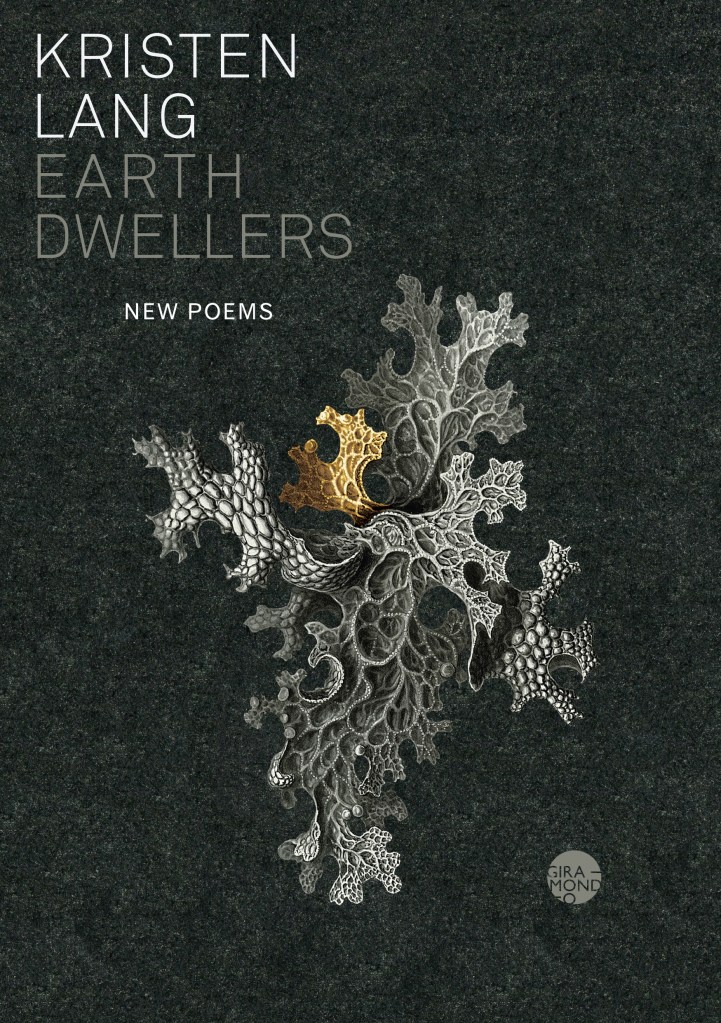
Kristen Lang’s Earth Dwellers

Kristen Lang, Earth Dwellers (Giramondo 2021)

I started reading Earth Dwellers when coming up for air during the horror stories of Jess Hill’s See What You Made Me Do. and then again during those in Colum McCann’s Apeirogon. Each of those books included its own relief from the horrors – one by cool-headed analytic journalism, the other by an intriguing structure and a seemingly inexhaustible capacity for digression – but I can’t begin to tell you what a relief Kristen Lang’s poetry was, what balm for the soul, right from the dedication:

For the wombats and the slime moulds ...

And for all who work to protect the entanglement, the networks of lives, billions of years in the making, by which the earth is more than stone.

These poems take us away from the troubled world of humans harming humans to intense, specific, tactile engagement with the non-human world. They take us to the tops of mountains, in Kristen Lang’s home state Tasmania and in the Himalayas; they take us on bush walks and visits to the ocean; to caves and the stars. They deal with the sublime and the intimate, sometimes in the same brief poem. They grieve and rage for the damage being inflicted on the planet by human activity, but always with a deep love and respect for this world. In these poems, the non-human world isn’t there as a metaphor or a mood indicator: there’s a consistently humble attempt to be present, to be aware of being part of it all: ‘We were never alone’ is how she puts it in ‘Wading with horseshoe crabs’.

As usual, I want to talk about just one poem. I’m picking ‘A small child finds a ladybird’:

(page 62)

This poem must surely strike a chord with anyone who has spent attentive time with a small child. Certainly I’ve been privy to many moments like this one, and felt a similar appreciative, possibly envious, awe at the intensity of a child’s gaze.

‘A small child finds a ladybird’ may be the only poem in this collection that focuses on a human character. Other poems have people in them, but they are companions to the speaker, neither addressed nor looked at directly, experiencing, observing, and being part of the natural world along with her. Here, it’s as if the poem’s speaker takes a step back, to observe the person experiencing, observing and being part of something.

The title of the poem sets up a strong mental image. A web image search on “small child ladybug” (‘-bug’ rather than ‘-bird’ in deference to US cultural dominance) gets you a cartload of cuteness, much of it cloying. That might be attractive to some readers but, for me and probably you, it establishes a central challenge for the poem: how to put words to that image that don’t regurgitate the pre-digested cutesyness. You might say that that’s a version of the central challenge for any poem, something to do with T S Eliot’s ‘tradition and the individual talent’, and I wouldn’t argue. This one meets the challenge like this in its opening lines:

Her squat-bodied
walk
crumbles under her –

Three things snag my attention: the words ‘squat-bodied’ and ‘crumbles’, and the way ‘walk’ has a line to itself. each of these things is sightly jarring, but if you hover over them you discover how well they communicate: the shape of a toddler, the kind of attention a toddler brings to the act of walking, and what happens when that attention goes elsewhere. It’s the walk that crumbles, not the child herself. This poem observes the child with the same precision that other poems in the book observe a platypus or floating filaments of gum blossom. If the reader wants to go down the cuteness path, the poem won’t stop them, but nor does it require them to go there.

In the next nine lines, the child is absorbed in the ladybird. She doesn’t simply have it on her fingertip. She is ‘all’ there with it. She hasn’t just stumbled when she sees the insect, she has taken on its qualities: the fall is red/ and black-spotted’. The way ‘fall’ has a line to itself, and gets extra emphasis from its rhyme with ‘all’ in line 4, prepares us for that interesting word ‘crux’ – as in crucial. This crumbled walk, this fall, hasn’t been an accident: it’s as if the rest of the day has been moving towards this crucial moment, and will emanate from it. ‘Bug-eyed’ takes on a richer meaning in this context: not just wide-eyed, but with eyes filled with the fascinating bug.

And then there’s ‘We’ – the poem’s speaker and us, the readers. We’re behind her, at a distance from the ladybird. And the last three lines are the second reason I wanted to write about this poem: it’s a kind of ars poetica. The wish expressed here, to have

________ even
half
of her gaze

is what Kristen Lang’s poems in general strive for. I know that as a reader I sometimes (often?) miss the metaphorical dimensions of poetry. So when someone writes that the world is grey in the moonlight, I take them at their word and have to be told if they’re talking about a terrible betrayal. But I don’t think I’m missing that kind of thing in these poems. In these poems, a mountain is a mountain, an iceberg an iceberg, a ladybird a ladybird. And there’s something profound in that


Earth Dwellers is the fifth book I’ve read for the Australian Women Writers Challenge 2021. I’m grateful to Giramondo for my copy.

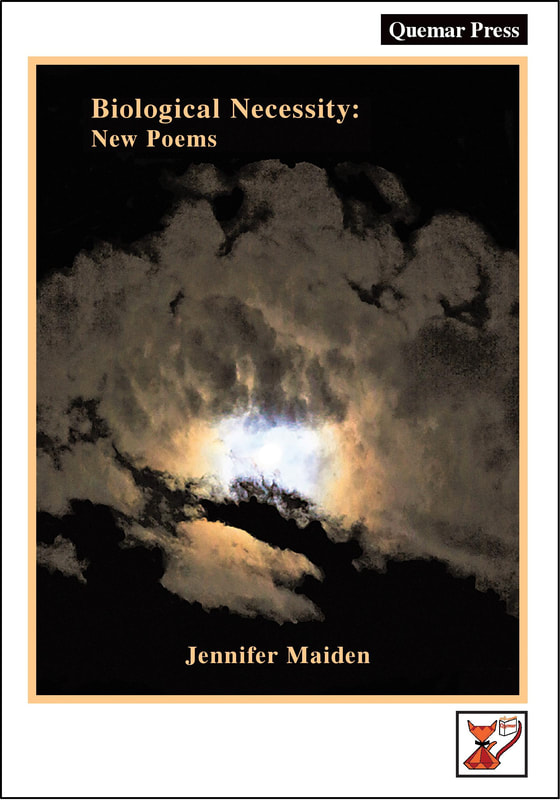
Jennifer Maiden’s Biological Necessity

Jennifer Maiden, Biological Necessity (Quemar Press 2021)

For some time now, Jennifer Maiden has produced new poetry collections almost as regularly as the earth revolves around the sun. Giramondo published five books between 2010 and 2017, handsomely designed by Harry Williamson. Since then Quemar Press, the publishing company created and run by Maiden’s daughter Katharine Margot Toohey, has published a collection of her poetry at the beginning of each year (as well as Selected Poems 2017–2018, a number of novels and two other slim non-poetry books authored or co-authored by Maiden). Biological Necessity is the fourth new collection.

I look forward to each new book in much the way I’ve looked forward to each new season of, say, Call My Agent.

I want to know what happens next in a number of continuing narratives. Maiden’s fictional characters George Jeffreys and Clare Collins continue to turn up in international hotspots – in Biological Necessity, they spend time in Covid quarantine at Darling Harbour, and they talk to Donald Trump by Skype on 2020 election night (in a poem published online before the votes were counted). Her versions of real people living and dead continue to chat with each other, at least one person in each chat having just woken up as if a switch has turned them on in the poet’s inner mind – here Eleanor Roosevelt’s ambivalence about Hillary Clinton reaches a kind of peak in her 17th poem; and Gore Vidal continues to hover around Julian Assange. Maiden’s incarnation of the Carina Galaxy as a sixties bombshell, last seen several books ago, makes a repeat appearance.

Surrounding the narratives, a sprawling, multi-faceted conversation has continued over the years, a conversation largely about politics and abuses of power. There are Diary Poems, which usually include ‘Uses of … ‘ in the title: in this book, poems meditate on the uses of biological necessity (Aneurin Bevan said that socialism was a biological necessity), indigo (the colour), Sacha Baron Cohen (for his performance in The Trial of the Chicago 7) and Finnegans Wake. In them, and in Maiden’s poems generally, there’s a quality of heightened chattiness: a subject is announced in the opening lines, and is reflected on; then, sometimes as if distracted by a random association, the poem veers off, and perhaps veers off again, always to interesting places, sometimes to recondite ones such as, in this book, Bolivian elections or Andean mountain cats; those different veerings crisscross one another, and – to mix my metaphors – weave something new. I love this process; it’s like listening to someone’s mind doing the basic work of thinking, meditatively and associatively.

The poems/conversation/meditations generally deal with topics more usually found in op-ed journalism: Julian Assange, Ghislaine Maxwell, Donald Trump, Greta Thunberg, Syria, Covid–19, the CIA, right-wing cultural machinations. But it wouldn’t do them justice to read them as op-eds cut up to look like verse, with an occasional rhyme for good measure. We don’t read them so much to find out what Jennifer Maiden thinks, or to learn about the world (though they often send me searching the web), or to debate a position, but rather to enjoy the carefully-crafted illusion that we are listening to the poet in the act of thinking.

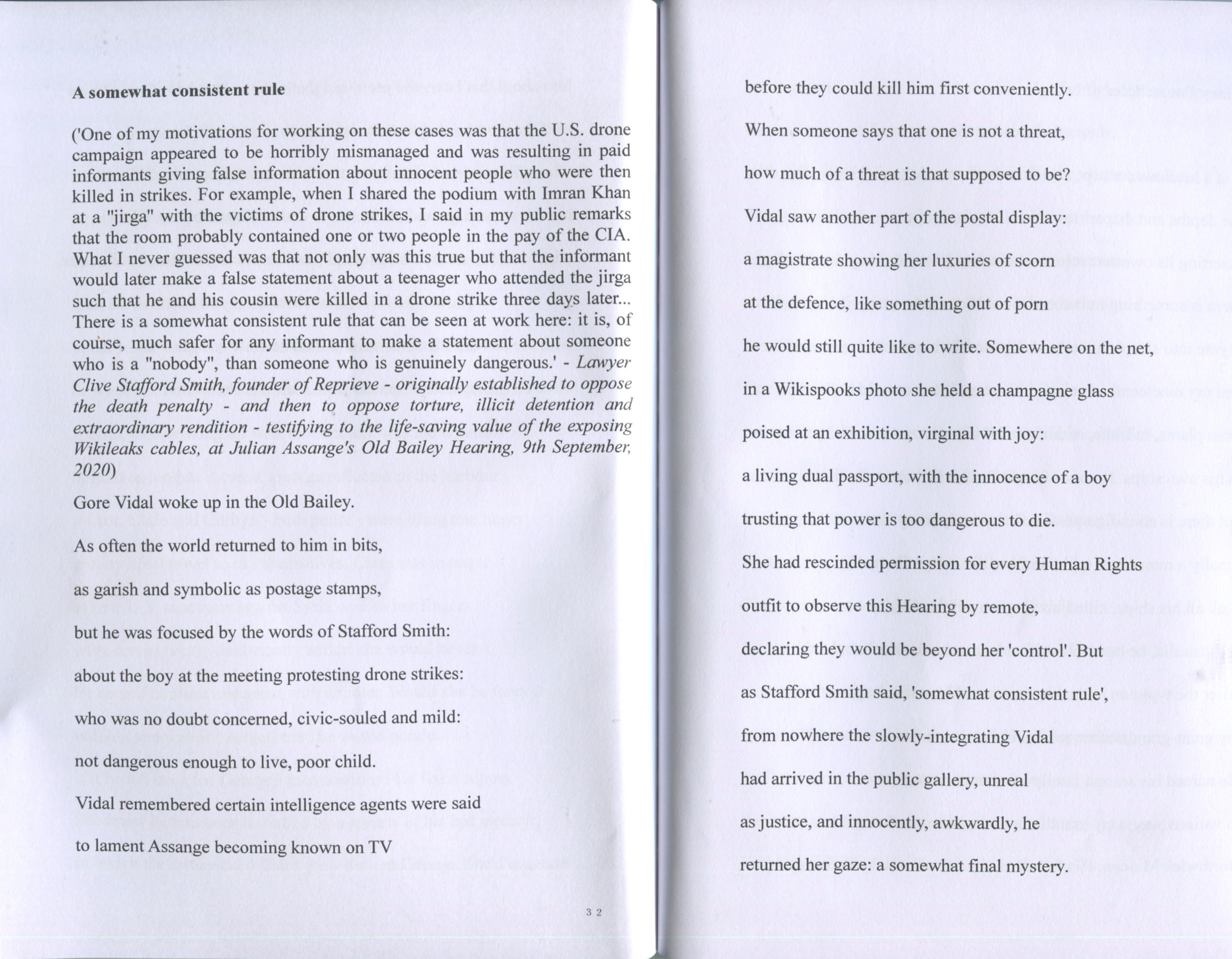
Usually when I write about a book of poetry I focus on a single poem. So hard to choose! ‘After the Volcano’, which revolves around a poem by Martin Johnston that Jennifer Maiden read at a zoom event, which I attended, marking the 30th anniversary of Martin’s death? One of the excellent Covid poems? ‘The Watchchain’, on a family story of a watchchain made from a dead woman’s hair? I ended up choosing ‘A somewhat consistent rule’, because it’s one of the shortest in the book, and can be captured in a single scan. (If you can’t read it easily here, you can find it on page 39 of the pdf sampler from this book on the Quemar website.)

Text can be seen at page 39 of https://quemarpress.weebly.com/uploads/8/6/1/4/86149566/biological_necessity_jennifer_maiden_sampler_28_2_21.pdf

We know from the prose introduction – unusually long and informative for a Jennifer Maiden poem – that this is one of her poems inspired by the travails of Julian Assange, of which the short lyric ‘My Heart Has an Embassy‘ is perhaps the best known. The quote is from Clive Stafford Smith’s official witness statement at the Assange hearing in September 2020, which is available as a PDF at this link (see paragraph 86). It not only announces the poem’s context, but also identifies the ‘rule’ of the title: it could almost stand alone as a found poem. In reading this poem, it’s important to note that the statement was read aloud in court.

I don’t know how this poem would work for a reader unfamiliar with Jennifer Maiden’s work. I read it as part of a web of poems that relate to each other in form and content. The first line places it in a long series of Maiden’s poems that open with someone waking up, all the way back to when it was always George Jeffreys waking up to see George W Bush on television obsessing about Iraq. Specifically, it’s at least the fifth poem, and not the last, in which Gore Vidal wakes up. He is Maiden’s main conduit for engaging with Assange (along with Diana Spencer and Emma Goldman in previous poems). He’s not a completely arbitrary choice: Assange was clutching a book by Vidal when he was dragged out of the Ecuadorian embassy in April 2019, which led to Vidal feeling ‘quite possessive of his reader’ (‘Resistance’, The Espionage Act, page 6).

The next two lines mark a departure in the ‘woke up’ poems. Vidal doesn’t simply snap awake as in these poems previously, but the waking process continues for the whole poem: ‘the world returned to him in bits’, and the lines that follow show us the bits. (As my regular readers know, I’m currently reading À la recherche du temps perdu, and am reminded that Proust’s narrator takes several pages to describe such a bit-by-bit waking up.) Not yet fully awake, Vidal finds a focus in the words of Stafford Smith about the boy

who was no doubt concerned, civic-souled and mild:
not dangerous enough to live, poor child.

It’s worth noticing the deliberate use of rhyme. In ‘mild’ / ‘child’, and later in ‘scorn’ / ‘porn’, ‘joy’ / ‘boy’, and ‘awkwardly, he’ / ‘mystery’, there’s a whiff of, say, Alexander Pope’s classic rhyming couplets:

Heav'n from all creatures hides the book of fate,
All but the page prescrib'd, their present state

Maiden’s couplets don’t aspire to that magisterial authority. They don’t scan beautifully like Pope’s, but the rhyme does suggest a connection to that tradition, in which the poet casts a withering eye on hypocrisy and pretension.

The next three lines, in a characteristic Maiden move, invoke insider gossip about public events. I assume that Jennifer Maiden, who lives in Western Sydney, doesn’t have much access to US intelligence agents, so what Vidal remembers hearing is probably as much an invention as the awakening Vidal himself. But it’s plausible, and here the ‘TV’ / ‘conveniently’ rhyme adds a hint of dark comedy.

Vidal’s focus on ‘the words of Stafford Smith’ ends with the chilling general implication that being seen as harmless, far from meaning one will be ignored, might actually be a threat.

Then the poem veers. In nine or ten lines, Vidal pictures, one of the postage-stamp images that he wakes to, the magistrate hearing Assange’s case.

a magistrate showing her luxuries of scorn
at the defence, like something out of porn
he would still quite like to write.

In real life this is Vanessa Baraitser. I found this description by John Pilger:

Her face was a progression of sneers and imperious indifference; she addressed Julian with an arrogance that reminded me of a magistrate presiding over apartheid South Africa’s Race Classification Board …

When [Julian Assange] spoke truth and when his barrister spoke, Baraitser contrived boredom; when the prosecuting barrister spoke, she was attentive. She had nothing to do; it was demonstrably preordained. In the table in front of us were a handful of American officials, whose directions to the prosecutor were carried by his junior; back and forth this young woman went, delivering instructions.

The judge watched this outrage without a comment.

(At https://wikispooks.com/wiki/Vanessa_Baraitser)

‘Luxuries of scorn’ isn’t too bad a summing-up. ‘Porn’ in the next line isn’t an arbitrary rhyme: it’s Gore Vidal who is seeing these things, and though I don’t know if he write any porn, he was interested in sexuality as much as in politics.

I found the photo of Baraitser poised at an exhibition with a champagne glass as described in the next lines. It’s here if you’re interested, but it doesn’t add a lot. The word image is strong enough. The next lines do a lot of work:

________________________ virginal with joy:
a living dual passport, with the innocence of a boy
trusting that power is too dangerous to die

‘Virginal with joy’ contrasts with Vidal’s associating the magistrate’s manner with porn. The use of passport as a metaphor for two-facedness reminds even those of us who haven’t followed Assange’s trials closely that passports and citizenship have been an issue. The phrase ‘too dangerous to die’ echoes ‘not dangerous enough to live’ from earlier in the poem. The magistrate has dual identities, on the one hand an innocent viewer of art ‘poised at an exhibition’ and on the other an agent of oppression (hinting at one of Maiden’s themes that reactionary forces manipulate art and literature for political ends); innocence and trust are attributed to her, but rendered nastily ironic by the phrase ‘of a boy’, recalling the boy who was killed by forces that the magistrate is at least indirectly abetting.

The next lines – ‘She had rescinded permission …’ – refer to her action that’s on the public record, but the poem is doing more than simply stating the facts. The scare quotes around ‘control’, taken together with ‘remote, are a nod and a wink towards the deadly drones that are the background to the hearing and to the poem. without any big display, the found language of the court is being harnessed to remind us that the courtroom procedures are intimately connected to murder by drone in Afghanistan.

I had trouble parsing the final five lines:

____________________________________ But
as Stafford Smith said, 'somewhat consistent rule', 
from nowhere the slowly-integrating Vidal
had arrived in the public gallery, unreal
as justice, and innocently, awkwardly, he
returned her gaze: a somewhat final mystery.

Once I realised that ‘as Stafford Smith said’ means not, ‘in agreement with Stafford Smith,’ but, ‘at the moment when Stafford Smith was saying,’ the penny dropped. Stafford Smith’s witness statement isn’t a document being recalled here, but the spoken background to the poem’s action. At the beginning, when Gore Vidal ‘was focused by the words of Stafford Smith’, he was waking up, bit by bit, to the sound of Stafford Smith’ evidence, and hearing the story of the boy killed by drones is what makes him fully present ‘from nowhere’. The poem’s action is the imaginary Gore Vidal’s coming to full wakefulness.

‘Unreal as justice’: yes, the poem is saying, this Gore Vidal is imaginary, coming ‘from nowhere’, but so is any justice that Assange will receive in this court. Innocence and awkwardness aren’t words that have often been applied to Gore Vidal, one of last century’s most wickedly sophisticated writers, but even he must experience that first moment of wakefulness as an awkward freshness. His sharp intelligence meets the gaze of the morally compromised magistrate. Vidal becomes fully present, the poem’s perspective on this judge in this trial solidifies, becomes ‘somewhat final’. As for ‘mystery’, it’s a satisfying rhyme for ‘awkwardly, he’, and reminds us that Gore Vidal, like the other people who wake up in Maiden’s poems, isn’t simply a mouthpiece for the poet’s views: there’s a mysterious process by which these imagined figures come from somewhere (‘from nowhere’, perhaps) to help her, and us, think. Not What Would Jesus Do? but what Would Gore Vidal Think?


Biological Necessity is the third book I’ve read for the Australian Women Writers Challenge 2021.