Tag Archives: poetry

Adam Aitken’s Revenants

Adam Aitken, Revenants (Giramondo 2022)
The poems in Revenants trace the geographic shifts in the poet’s life – there’s a narrative thread, not so much autobiographical as autobio-geographical. As Aitken says in a note on the Giramondo website, the book begins:

with my father’s description of his flat in Hong Kong in the 1950s. I then explore my own experiences in Hawai’i and Malaysia, where I worked in 2010. A few poems recall inner city Sydney in the eighties. By the end of the book the reader enters the world of a village in France where I have lived recently.

The places are encountered through a number of lenses: family history (drawing on some of the same letters as Aitken’s 2016 book about his parents’ youth, One Hundred Letters Home), military and political history (as in a brace of found poems based on a Malay phrasebook for British colonial administrators), art (ranging from Javanese artist Raden Saleh (1811–1880) and Claude Monet to Hawai’i Five-O), literature (Somerset Maugham, Stendhal, William Carlos Williams, John Berryman), and of course direct personal experience – childhood memories (including ‘Class Portrait’, on a school photo taken when Aitken was eight or nine), scenes from inner city life in the 1980s, traveller’s tales with some overlap to the 2011 chapbook Tonto’s Revenge, scenes from rural France in a similar vein to the poems in Archipelago, place-influenced dreams, and more. [The links in this paragraph are to my relevant blog posts.]

When I blog about a book of poetry, I try to talk about one poem in some detail. I’d love to walk you through the wonderful ‘Notes on the River’, a poem in 14 parts about the Tonlé Sap River in Cambodia that is rich with vivid snapshots of river life. But that is far too long for a blog post.

‘Martial Sarit Cleans Up Bangkok, 1959’ suits my purposes. It’s short, just 22 lines:

The poem can be enjoyed even if, like me, you know virtually nothing about Thai history. It’s in three parts. The first two stanzas offer images of westerners living comfortably and possibly corruptly in an Asian environment. The next four stanzas convey the event named in the poem’s title. The final two stanzas resolve the relationship between the first two parts: newspaper censorship means the people in the first two stanzas can remain unaware of what is happening around them. It’s a deft and unsettling evocation of the relationship between West and East, and more specifically between expats/tourists/farangs and locals. The poem is remarkable for its calm restraint: no adverbs, no emotive adjectives, no editorialising. It makes me think of Matthew Arnold’s notion that the aim of the writer is to see life steadily and see it whole.

Having responded to the poem from a position of ignorance, I read around it – as many of Aitken’s poems gently invite one to do.

Martial Sarit Cleans Up Bangkok, 1959

The title, as expected, refers to an actual episode in Thai history. Field Marshall Sarit Thanarat staged a coup in 1957 supported by the US military, became Prime Minister in 1959, and held that position until his death in 1963. Ironically, my main source of information about the ‘clean-up’ is the English-language newspaper named later in the poem, the Bangkok Post. Its website has a timeline, which features Sarit’s banning of opium in July 1959 as a key historical event, and quotes him: ‘The day marks a new era in Thailand’s social history. From this day, we can proudly claim that we are a civilised people.’ The timeline links to a photo of a huge pile of opium pipes being smashed by men in uniform, in preparation for being bonfired. (Incidentally, the title includes a quiet, almost invisible pun on Marshall/martial.)

At a corner table at the Hoi Tien Lao
my father dines
with a better class of ladies
who use spoon and fork

The opening stanza situates the poet in relation to the historical event. This isn’t a moment chosen at random, but part of Aitken’s ongoing poetic exploration of his family history. His father was a farang, we know from elsewhere that his mother is Thai, and that he was born in 1960, a year after the action of this poem. This scene may not be from his parents’ courtship, but it could be. The present tense (‘dines’ and ‘use’) signals that the poem’s point of view is right there in the midst of things, not in some remote future.

I found an article describing the life of the farangs in Bangkok in the mid 1950s that spells out the elements so deftly evoked in the poem’s opening lines. (The article’s nostalgic history makes an interesting contrast to the poem’s cool immediacy.) The Hoi Tien Lao was one of the restaurants they frequented in Chinatown, with a nightclub above it, and not all the Thai ladies they associated with were ‘a better class’, if you understand that as referring to morality. Anyhow, the fourth line of the stanza undermines that reading of ‘better’: the ladies are a better class because they have adopted western table manners – a white supremacist viewpoint is invoked with sly irony.

Club members hold court
and a French count is flogging US Army
surplus penicillin.

These lines sketch the privileged, opportunistic world of European and US (and Australian) expats, echoing any number of stories of black markets in antibiotics in postwar Europe and Asia – The Third Man comes to my mind.

From now to the end of the poem, there are no full sentences. The effect is of a series of stills or film clips, rather than a sustained narrative.

In Chinatown
the addicts rounded up,
led away enchained,
their pipes bonfired.

The scene shifts to the events referred to in the title. This crackdown on addicts was what gained the headlines. Not as extreme as Rodrigo Duterte’s more recent encouragement of Filipinos to kill addicts, this round-up could be seen as a benign act. The poem quietly begs to differ with its brutal verbs, ’rounded up’ and ‘enchained’.

Children running through the streets
naked no more.

Squatting to eat banned.
Calligraphy in Chinese
banned.
Bare breasts banned.

From what I can tell from my limited research, Sarit’s ‘cleaning-up’ project was intended to make Bangkok a more modern, ‘clean’ city. No one could object to children being clothed, and for a country that has been dubbed ‘the brothel of Asia’, surely the banning of bare breasts is a good thing? But the repetition of the word ‘banned’, and its standing on a line to itself, draw attention to the means of making these changes. Why ban squatting to eat, or calligraphy in Chinese? More in sorrow than in anger, the poem laments the imposition of order, perhaps by force as in the chaining of addicts, and with it the partial elimination of a local culture, an enforced turn towards the West, as the ‘better class of ladies’ have already done.

For weeks on end
more white space
in the Bangkok Post

The Bangkok Post was, and may still be, the main English-language newspaper in Thailand. One imagines westerners in their hotel rooms, flipping through the newspaper, noticing blank spots, and wondering more or less idly what has been censored. Perhaps Aitken’s father mentioned doing just that in his letters home.

as if none of this
had ever happened.

The final couplet can be read simply as tying a neat bow to finish off the poem. Rather than one more image, it presents a kind of summarising abstraction. And its syntax moves away from present tense to place the events, and their erasure, firmly in the past, implying that now, at least in principle, the full story can be told.

What makes the poem hit home for me is the personal resonance in the last lines. It’s not just that the ‘clean-up’ events were invisible the English-speakers in Bangkok back then. They have been invisible in the received version of the poet’s family story. The poem results from a probing of that story. The apparent neatness of the conclusion actually poses a question: what to do with the knowledge that one’s parent/forebear was on the wrong side of history, or at best an oblivious bystander?

My own paternal great-grandfather came to Australia from Yorkshire in the 1870s and set about farming sugar in south-east Queensland. I’ve found quite a lot about him on Trove. It’s very likely that indentured South Sea Islanders worked on his farm, but so far I’ve seen nothing but white space about that in the newspapers of the time. In ways I can’t articulate, this poem helps me to face what that says about my own place the world.


I am grateful to the Giramondo Publishing Company for my copy of this excellent book.
Jennifer Maiden’s Ox in Metal

Jennifer Maiden, Ox in Metal: New Poems (Quemar Press 2022)

In her essay, ‘The Political Poem’ in Fishing for Lightning (my review here), Sarah Holland-Batt says that lasting political poems are notoriously difficult to write, in part because of ‘the question of how to transform rage into poetry’. She names three Australian poets who manage to pull it off: Barry Hill, the late JS Harry, and Jennifer Maiden.

In Ox in Metal, her fifth book of new poems from Quemar Press in as many years, Jennifer Maiden pulls off the difficult trick once again.

These lines, from ‘There seems an easiness’ in this book, relate interestingly to Holland-Batt’s generalisation:

is here, but how? A recent ABR review of my last book says 
I avoid buttonholing the reader by using experienced 
techniques. I thought: I learned them over half a century, 
more to make fear bearable for both of us,
__________________________________ you and I, 
not buttonholing, clutching the cliff-edge,
turquoise sharp mountains in mist beneath

I read buttonholing as meaning the kind of verse that doesn’t manage to stay interesting once its immediate occasion is past, something more than an op-ed piece with added line breaks (not that there’s anything wrong with that). Maiden identifies two things: ‘experienced / techniques’ and an underlying emotional impulse.

The review by Rose Lucas referred to in the poem (at this link) speaks of ‘familiar Maiden strategies’ (rather than techniques) as moderating the ‘pent-up urgency of political imperative’, which isn’t a bad description of what happens in many of the poems.

Chief among Maiden’s strategies/techniques is the use of fictional characters as means to exploring ideas. In a signature opening to a Maiden poem, a historical or literary personage wakes up in the presence of a current political figure who has some connection to him or her: in Ox in Metal, Gore Vidal is paired with Julian Assange who was reading one of his books when arrested; Malcolm Turnbull chats with his relative Angela Lansbury playing Jessica Fletcher; Eleanor Roosevelt broods about Hillary Clinton; and in an interesting variation Maiden herself meets the lunar zodiac’s emblem of 2021, the metal ox. Since their first verse appearance in Friendly Fire (Giramondo 2005), her characters George Jeffries and Clare Collins have turned up in political hotspots in more than 40 poems: here they skype with a deputy leader of the Taliban and Joe Biden (though not in the same poem). There are other creations, including a cute little marsupial named Brookings after the Brookings Institute and the Honourable Carina Monckton, a kind of incarnation of the Carina Galaxy.

A main consequence of all this inventiveness is that when Maiden’s poems assert political views that many would see as contrarian or extreme leftwing*, they don’t harangue readers, or try to persuade us. The lines I quoted above speak, not of the rage that Sarah Holland-Batt sees as needing to be transformed, but of a fear that the poet assumes she shares with her imagined reader. The poetry’s motor isn’t political urgency or the need to vent emotion, but the attempt to make terror bearable, for the reader as well as the poet.


As well as the fictional creations, there are what have been called her weaving poems which bring together seemingly disparate elements – a passing remark by another poet, an item from the headlines, a memory of her daughter’s childhood. These poems are like sculptures created from found objects. An example in Ox in Metal is ‘It can’t be easy, being Tabaqui’, which picks up a quote from Vladimir Putin, finds some Kipling in it, makes connections to a recent biography of Paul Robeson and then-current Australian headline news. It’s a challenging poem to read at this time, as Vladimir Putin’s invasion of Ukraine continues to horrify and terrify the world, but here goes.

From Ox in Metal (e-book, Quemar Press 2022)

The opening quote is from Vladimir Putin’s address on 21 April 2021 to the Russian Federal Assembly, a combined gathering of members of the Federation Council (Senators), the State Duma (Parliamentarians), Cabinet ministers, Regional Governors, representatives of selected State Departments, Agencies and the media. In the address as a whole (online here), Putin positions himself as defender of a beleaguered Russia, and we now can see that he was laying the grounds for his invasion of Ukraine nine months later. The claims he was making have been fairly throughly debunked, for example at this link.

Maiden singles out a moment when Putin refers to Rudyard Kipling’s The Jungle Book (which you can read at this link). The quotation is almost a found poem in itself, juxtaposing Putin the ruthless imperialist with Kipling, spokesman of the British Empire. I wonder if Maiden considered writing a poem that began ‘Rudyard Kipling woke up in the Kremlin, next to Vladimir Putin’. As a reminder: Tabaqui the jackal is the contemptibly devious offsider to Shere Khan the tiger, deadly enemy of the wolves who adopted Mowgli the book’s hero. Tabaqui’s propensity for rabid rages, mentioned in the poem, comes from Kipling. The Seeonee Pack, named by Maiden but not by Putin, are the wolves, and include Grey Brother, who kills Tabaqui. In the speech, Putin fairly explicitly casts the USA, or perhaps NATO, as Shere Khan.

The context of the quote is less charming, and is not irrelevant to a reading of the poem. Here is the next paragraph:

We really want to maintain good relations with all those engaged in international communication, including, by the way, those with whom we have not been getting along lately, to put it mildly. We really do not want to burn bridges. But if someone mistakes our good intentions for indifference or weakness and intends to burn or even blow up these bridges, they must know that Russia’s response will be asymmetrical, swift and tough.

He was definitely casting himself as the wolf.

Having unsettled the reader by quoting, without disclaimer, one of the nastiest political leaders of our time (it might even have been less unsettling to quote that Serbian butcher who was a Shakespeare scholar), the poem proper begins.

The opening lines make a complete break from Putin, and take a while to get to Kipling:

An Australian biographer of Robeson innocently undermined him 
with a bulging pocketful of CIA pathologies, summed it up:
'It can't have been easy, being Paul Robeson' but as an
alternative to coming up like thunder
how easy is it to be a jackal?

This offers a case of a virtuous figure (Paul Robeson) harassed by a smaller one (the biographer) doing the work of a big enemy (the CIA), a version of the Wolf pack–Tabaqui–Shere Khan diagram. ‘Coming up like thunder’, a phrase that seems made for Robeson, comes from a different Kipling work, his poem ‘Mandalay‘. The word ‘innocently’ suggests that the biographer is a useful idiot, doing the CIA’s propaganda work without realising it – but the suggestion hovers that literary biographers (and by extension reviewers, critics and dare I say bloggers) can be like jackals, opportunistic scavengers on other people’s creativity who wittingly or unwittingly serve the interests of political players.

It doesn’t take much research to identify the book in question as Jeff Sparrow’s No Way but This: In Search of Paul Robeson (Scribe 2017). Judging by the reviews, I’m confident that Sparrow would vigorously challenge the assertion that he undermined Robeson, and that Robeson’s ‘pathologies’ are CIA inventions. But we can agree to suspend judgement, and read on.

The word but occurs three times in this poem, each time signalling a pivot: here, it’s a pivot from Robeson to those who would attack him and his ilk.

how easy is it to be a jackal? Pity jackals. All children have been 
Tabaqui, lying for scraps from any father or mother,
living off scraps allowed him by Shere Khan, or the wolves
of the Seeonee Pack, and at last killed by Grey Brother.
It can't be easy, being Tabaqui. 

‘Pity jackals’ shifts the tone: it suggests that it’s important to pay attention to people who curry favour with powerful entities, and do their bidding, even to have sympathy for them. The next line suggests that the roots of such behaviour may lie in the universal childhood experience of dependency, lying as a developmental stage. The next lines slide to a slightly different take, suggesting that children who read The Jungle Book will identify with Tabaqui – will have been him in imagination, similarly to the way we are every character in our dreams.

Now for the only time the verse refers explicitly to Putin’s address:

It can't be easy, being Tabaqui. Putin was perhaps
thinking foremost of the Ukraine's build-up of troops,
or the put-down violent putsch in Belarus,

There’s no ‘perhaps’ about it (perhaps may well be there for the sale of the almost-rhyme with troops., which in turn chimes with Belarus). Putin was explicit: he was spinning the build-up in Ukraine as a potential attack on Russia, and threatening a response that would be ‘asymmetrical, swift and tough’: in the light of recent events he could have added ‘unprovoked’. This is the most unsettling moment in the poem, as it makes no attempt to distance itself from Putin’s point of view. If written today, reference to ‘the Ukraine’ would signify agreement with Putin that Ukraine is not a separate nation. Is Maiden here playing Tabaqui to Putin’s Shere Khan?

That’s not how I read it. Elsewhere, Maiden often quotes and even portrays sympathetically people whose politics she loathes – Tony Abbott and Donald Trump come to mind. Putin has a point when he says that NATO is hostile to him, even if he doesn’t acknowledge that they may have good reason. But to quote him like this doesn’t imply agreement, and the poem can’t fairly be accused of endorsing military action Putin took long after the poem was written.

The next lines, beginning with the poem’s second but, move away from Putin to the more general phenomenon that is the poem’s real subject:

but jackals are prone to rabies and zigzag insane
in a way even feared by the Beloved King:

The first of these lines is from the The Jungle Book‘s account of jackals. There is no Beloved King in that book, at least not by name. The gist is clear enough. Once you unleash Tabaqui, even in a poem, you can’t tell what it will do.

in a way even feared by the Beloved King: Shere Khan 
might in Australia have wanted famished Morrison
to cancel a couple of contracts with China, and academic 
agreements with Syria or Iran, in puzzled Victoria,

It’s reasonable to take Shere Khan as signifying the USA here, as in Putin’s speech. I found an ABC story about Prime Minister Scott Morrison’s cancelling contracts. It’s dated 22 April 2021 (link here), the day after Putin’s address to the General Assembly. So this example of a Tabaqui doing the bidding of a Shere Khan is in effect a piece of synchronicity, suggesting that examples could be multiplied endlessly. Then there’s the third but:

but one is compelled to look in shadows and be sorry
for mottled bundles of bravado and ingrained hunger
alternately huddling and howling.

Again, the poem turns away from particular actions: one is compelled (by what? a need to move from particular cases to an underlying phenomenon?) to pay attention to the Tabaquis, and in these lines the poem lands. Former Prime Minister John w Howard could evoke the myth of the Wild West and describe himself as the US’s deputy sheriff, and George W Bush could evoke the other US myth of the superhero and call Howard a man of steel. Maiden, leapfrogging on Putin, reaches further back to Kipling for a powerful alternative image of the relationship. The lines had me imagining Scott Morrison in camouflage gear, and sure enough I found a photo of him three years ago as almost literally ‘a mottled bundle of bravado’, here.

alternately huddling and howling. All children have been 
Tabaqui, lying for scraps from any father or mother,

These repeated lines now carry a little more weight, perhaps a suggestion of forgiveness, but really they are softening the reader up for the chilling final line:

and it isn't for the tiger the wolves come.

That gets me every time. Reading it in March 2022, on the 19th day of Russia’s brutal invasion of Ukraine it’s hard to get beyond that reference. In that context, apart from the putrid implication that Ukraine somehow provoked the attack, the line implies Putin and his wolves are pretty cowardly in attacking Ukraine rather than going after the real tiger enemy, the USA. But the poem has explicitly moved away from the Russia/Ukraine relationship, so the line is even more chillingly open-ended. Perhaps China will be a wolf for ‘famished Morrison’ and Australia with him. But the reference doesn’t need to be tied down. The poem is about a general syndrome, and the dangers it points to, at geopolitical or interpersonal levels, are real.

So the poem does indeed take us, as the lines I quoted near the start of this blog post suggest, to fear.


* Examples abound in Ox in Metal. Maiden reminds us that on the day of the celebrated misogyny speech Julia Gillard’s government reduced support for single mothers (‘Diary Poem: Uses of Iron Ladies’); she characterises the White Helmets in Syria as a false flag terrorist operation (‘Death-Wish Moths’); she reminds us that ‘Menzies made up the South Vietnamese invitation’ (‘There Seems an Easiness’); she describes the leaks of the Pandora, Panama and Paradise Papers as ‘a CIA self-amusing / parody of Wikileaks’ (‘Pandora and her Sisters’); she describes Joe Biden as ‘dreamy with dementia’ (‘The peace prize’); one of her characters notes that US drones and aircraft have killed many women and children in Afghanistan (‘Clare, George and Abdul Ghani Baradar’); another asserts that ‘most of the almost two hundred dead / at the airport in Kabul were shot / by naive young America soldiers’.

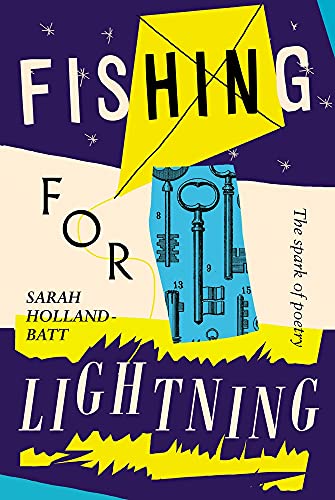
Sarah Holland-Batt’s Fishing for Lightning

Sarah Holland-Batt, Fishing for Lightning: The spark of poetry (UQP 2021)

Between March 2020 and March 2021 Sarah Holland-Batt had a weekly column about poetry in the Weekend Australian. Each column focused on a recent book of poetry, all but two of them Australian, and was accompanied by a poem from that book. University of Queensland Press has done a great favour to those of us who don’t read The Australian by collecting those columns into this richly engaging book. Here’s how Holland-Batt describes the book:

I offer some suggestions about how to learn to pay attention to poetry and what poets do. In these essays, I am writing for readers who are out of touch with poetry, or who want to learn more about it, and even those who think they hate it, as well as for those who have already found a place for poetry in their lives. Some of these essays focus on opening up and demystifying poetic forms – the elegy, the ode, the sonnet, the villanelle – while others focus on poetic style and techniques. Many also offer some historical context. Poetry is, after all, an ancient art so durable and powerful that it has lasted millennia. Much of what poets do today still connects to prehistoric poetry that was sung and spoken prior to the invention of the written word; where I can, I illuminate those historical links.

That’s pretty much a perfect description. Sarah Holland-Batt has racked up an impressive list of awards and honours as a poet herself and she’s an Associate Professor of Creative Writing at QUT. While these essays benefit from her broad knowledge of poetry and her love for it, they don’t patronise their readers or leave them eavesdropping at the door of a closed shop conversation – both things that tend to happen in critical writing about contemporary poetry.

Take, for example, the essay first published on 11 July 2020, ‘The Sonnet Sequence: On Keri Glastonbury’, which begins:

In the winter of 1962, stoked by amphetamines, the American poet Ted Berrigan compulsively wandered the streets of Manhattan at all hours, and began writing his first book, The Sonnets: a book length sequence that sings up New York’s Lower East Side in all its grimy, fast-and-loose glory.

The essay spends a lively page on The Sonnets, its role in Berrigan’s subsequent career as a poet, and its status as ‘a touchstone of a poetic generation’. Having deftly evoked this precedent (no need to belabour us with the history of sonnet sequences from Petrarch to Christina Rossetti), it spends roughly two pages on general description of Keri Glastonbury’s Newcastle Sonnets, and rounds off with a page-long reading of one poem, ‘The Pink Flamingo (of Trespass)’: how it exemplifies the preceding generalities, how it is an exception, and how the poem itself works. It ends with an observation that arises from this close (but not too close?) reading:

Like many of the poems in Newcastle Sonnets it leaves you both with the feeling of having been let in on a joke by an insider, but also left slightly on the outer too: like Newcastle itself, as Glastonbury suggests, this is both a comfortable and disorienting place to be.

By the time we reach the poem itself, we are well equipped to read – and enjoy – it.

I picked this essay because I blogged about Newcastle Sonnets (here), and the comparison is instructive. While I hope I communicated my enjoyment of the book, most of my blog post was taken up with its difficulty, with my own sense of being an outsider. Reading Sarah Holland-Batt – on this poem and on any number of others – I realise (again, at last) that reading poetry isn’t about nailing down a clear meaning: not quite understanding, or even being mystified, can be part of the enjoyment.

Anyhow, I can endorse Holland-Batt’s own sentiments: whether you are out of touch with poetry, or want to learn more about it, or think you hate it, or have already found a place for it in your life, I’m pretty sure you could find some joy and light in this book.

Added later: I have one major discontent with the book, namely that there doesn’t appear to be a sequel in the works. I’m pretty sure another 50 new poetry books would be there for the SHB treatment if she were up to it. She could ‘do’ Jennifer Maiden, Adam Aitken, Kit Kelen, Pam Brown, Ouyang Yu … to name just the poets near the top of my To Be Read/To Be Blogged pile.

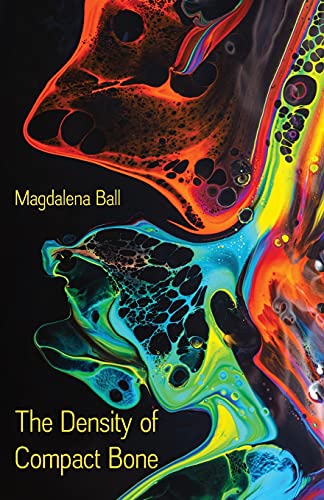
Magdalena Ball’s Density of Compact Bone

Magdalena Ball, The Density of Compact Bone (Ginninderra Press 2021)

Magdalena Ball was raised in New York city and now lives on Awabakal land in New South Wales. She runs the formidable review website Compulsive Reader and, if the poems in this book can be relied on, she rolls in the dirt when no one’s looking. She brings tremendous erudition to bear on intensely personal, bodily experience. She finds resilience in Jewish family history, and looks unflinchingly at the climate emergency. Her poems cast their net wide in the cosmos and bring tiny, meaningful things to light. There are riddles that, as far as I can tell, have no answers; there are love songs, laments, cries of pain, excursions into quantum physics and meditations on the nature of time. That is to say, this book is quite a ride.

It’s in four sections, each with a dominant mode or theme. The first, ‘The Age of Waste’, addresses the climate emergency, with poems about endlings (animals that are the last of their species) and ‘the Sixth Mass Extinction’. It’s waste as in ‘laying waste’, devastation. The prose poem, ‘Earth Scars’, for example, includes this:

Is it easier if it's random? If there was nothing we could have
done? I could be there, first in the queue, taking the hit for our
planet

The second section, ‘The Stronger the Entanglement the More Warped Space Is’, lives up to the complexity of that heading, with poems that don’t disappoint expectations roused by titles like ‘Time Is Not’, ‘Tomorrow’s Box Is Quantum’ and ‘Fermat in Wonderland’. That last one begins ‘I have no time / for rabbit holes’, which is delightfully ironic given the number of potential rabbit holes to be found in this section: I went googling (actually duck-duck-going) Cooper pairs and phase transition, for example, and struggled to remember what I’ve gleaned about Schrödinger’s box, wormholes and the properties of quarks.

The third section’s title, ‘Chronon’, seems to promise more of the same: according to Wikipedia, a chronon is ‘a proposed quantum of time, that is, a discrete and indivisible “unit” of time as part of a hypothesis that proposes that time is not continuous’. Happily (or not, depending on how much you enjoy being tantalised by advanced physics and philosophy), though this section deals with time and memory, it does so in a much more accessible, personal and emotionally engaging manner. The intimidatingly titled ‘Noumena Phenomena’ for example, addresses someone, possibly a close relative, who is living with dementia:

You smile
at everyone every day
the Buddha you never were
dispensing joy in coconut confetti
as we move in closer
circling round the gravity
of the hearth you continue
to keep
in your head.

The fourth section – ‘The River will Wash Us All Down’ – continues the personal note, with some wonderful poems dealing with love and complex relationships, and also returns to the global concerns of the first section. The context thickens and darkens with the cataclysmic bushfires of the 2019–2020 summer and the Covid pandemic.

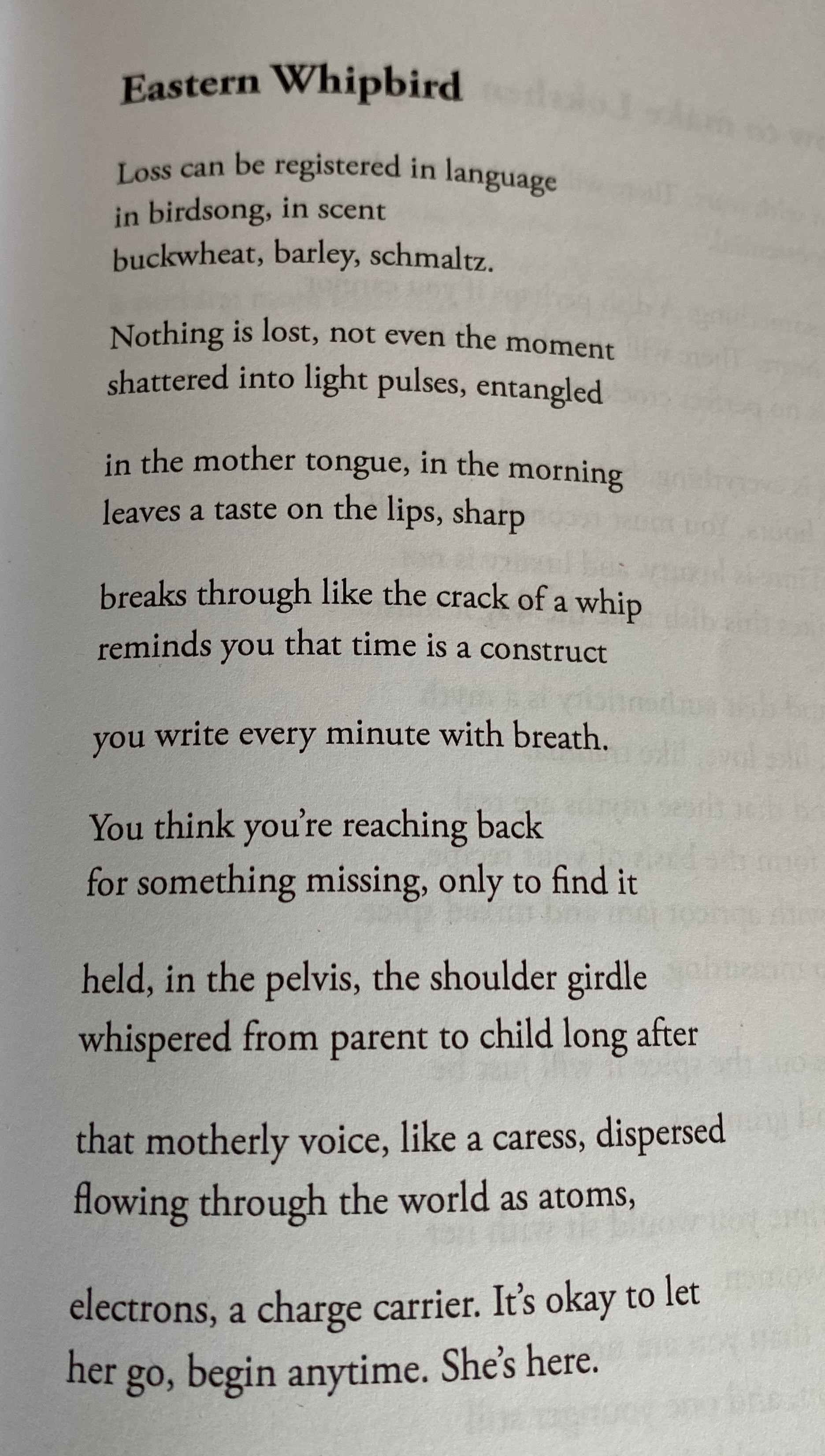
Many of these poems grapple with the notion of time. ‘Time Is Not’, for example, has the lines, ‘Change is real / but time is not.’ ‘How to Make Lokshen Kugel says: ‘Understand that authenticity is a myth / like time, like love, like trauma. / Understand that these myths are real / and must form the basis of your recipe’. ‘Eastern Whipbird’, the first poem in the ‘Chronon’ section, is probably richer when read in the context of those other poems, but read in isolation it’s still very rich:

(Page 51)

The title might lead you to expect a description of a bird. If so, prepare to be disappointed. The whipbird is there, but never mentioned explicitly. The first three lines announce the subject:

Loss can be registered in language
in birdsong, in scent
buckwheat, barley, schmaltz.

It’s as if the first line responds to the question, ‘How do we register loss?’ It’s fairly abstract. ‘Birdsong’ in the second line suggests that the actual prompt for the poem may not have been the abstract question but a surge of emotion triggered by a birdcall (the whipbird of the title, perhaps). It could just as easily have been a ‘scent’ that did the triggering. Then the third line (line breaks are important here) narrows the focus. Birdsong and scent could remind anyone of anything, but these three things are connected with cooking, in particular, in the case of ‘schmaltz’, with Ashkenazi Jewish cuisine.

Nothing is lost, not even the moment
shattered into light pulses, entangled

in the mother tongue, in the morning
leaves a taste on the lips, sharp

breaks through like the crack of a whip 
reminds you that time is a construct

These three couplets seem at first to contradict the first trio, denying that loss is real. But they don’t so much contradict the opening statement as reframe it. Rather than register the loss, we become aware of the persistence of that which is lost. People who have migrated and been obliged to take on a new language often report that hearing their mother tongue spoken brings back the emotions of their childhood: the lost moments are entangled in the language, become as present as a taste on the lips. Notice the subtle way that first cooking is evoked and then the word ‘mother’ turns up. we are being prepared for something. Coming back to the immediate prompt, something, we’re not told what, is made present by the call of a whipbird. This leads to the assertion that ‘time is a construct’. The poem has the task of clarifying that assertion.

you write every minute with breath.

This carries a particular kind of weight as the poem’s only stand-alone line. It justifies that weight as a six-word explanation of the idea that time is a construct. We don’t just experience time passively, but our breath, metaphor for human spirit, creates it like a poem.

You think you're reaching back
for something missing, only to find it

held, in the pelvis, the shoulder girdle  

These lines return to the opening paradox: we register loss in a number of ways, but nothing is lost. A personal pronoun appears for the first time: not ‘I’ or ‘We’ but ‘You’. The reader is being challenged to test the poem against his (in my case) own experience. It’s true that when it comes to memory of something lost, I think I’m reaching back. It’s also true that when I remember, say, how my mother put her face up to be kissed by one of us kids, something registers (that word again) in my body. I wouldn’t say it’s in the pelvis or the shoulder girdle, but it could have been. I get the point.

whispered from parent to child long after

that motherly voice, like a caress, dispersed
flowing through the world as atoms,
electrons, a charge carrier. 

Now the kind of loss we’re talking about is in clear focus. The thing that ‘you’ (definitely the poet now) find somewhere in your body is a mother’s whisper. Here Magdalena Ball’s scientific bent comes beautifully into play. It’s not that the actual mother or her actual voice still exist on some spiritual, other-worldly plane. She and the air that carried her voice have been dispersed into their constituent atoms – and again a paradox: the notion that we are immersed in a flow of atoms and electrons that may once have been part of our loved ones’ body and breath carries a charge, a charge that we invent. (I think of the Sweet Honey in the Rock song, ‘Breaths‘: ‘Those who have died … are in the rustling trees … in the groaning woods … in the crying grass … in the moaning rocks.’)

_________________________It's okay to let
her go, begin anytime. She's here.

I was completely unprepared for the emotional punch of this. There’s so much intellectual complexity and then this simple, profound statement. It may be eccentric of me, but I think of the moment in the movie Truly Madly Deeply when the Juliet Stephenson character finally lets the ghost of her husband go. Begin anytime – we don’t have to be passive around time, wait for time the great healer to help us overcome our grief. In some important sense time is our creation. And there’s another paradox, or a restatement of the same one: in the act of letting go, we understand that memory exists in our bodies. ‘She’s here.’


I am grateful to the author and Ginninderra Press for my complimentary copy..

November verse 1.5: Erasure

This year I plan to add to my November exercises some excursions into poetic forms like erasure, cento, n+7, homophony (if that’s a good word for what Toby Fitch does), and others as I think of them. My idea is to make something from the day’s newspaper as source text.

I’m kicking off today with an erasure poem. Here’s one description of erasure poetry, from the poets.org website.

Erasure poetry, also known as blackout poetry, is a form of found poetry wherein a poet takes an existing text and erases, blacks out, or otherwise obscures a large portion of the text, creating a wholly new work from what remains.

You can read more about it, with links to ‘seminal’ works, here. Andy Jackson”s ‘borne away by distance’ is a fine example I have encountered recently (online here).

Here’s my offering, from page 1, column 5 of today’s Sydney Morning Herald.

Or, to type it out and give it a title:

Virtue
________++++++_________Glad
____________________secret
______++_________grace
___________duties, 
________+++++__honest
________+++++__dog.

The  _dependent ____mission
 gains
________++++++____trust or
 courage
________+__Wag   Wag .

Make of it what you will. I love it.

Brendan Ryan on the Lowlands of Moyne

Brendan Ryan, The Lowlands of Moyne (Walleah Press 2019)

I just read on Twitter that Brendan Ryan has been called ‘a poet of the cow pats’. The poems in this book may not celebrate cow manure as much as Ryan’s earlier ones, but they return to the apparently inexhaustible well of his childhood and adolescence in a large Catholic family on a dairy farm in rural Victoria.

I’ve just reread my three earlier blog posts about Brendan Ryan’s poetry, and it seems that anything I say about this book will be repeating myself. It’s not the poems: they’re fresh and full of discoveries, hugely satisfying. I have trouble finding fresh ways to express my love for them. So here are some samples from previous blog posts.

On Why I Am Not a Farmer:

Brendan Ryan’s poetry in this book is spattered with the shit and blood of work on a dairy farm … My high school Latin teacher said you could tell Virgil was a city man because in the Georgics he speaks of cow manure as disgusting. Brendan Ryan may well be citified, but he doesn’t shrink fastidiously from the details of labour on the family farm. He’s not whingeing. He has no obvious chip on his shoulder. And there’s no self-pity … There is nostalgia perhaps, but it’s not so much a vague yearning for a lost home, as an ache to integrate, to come to terms with experience.

On Paddock in his Head:

Most of the poems here are shot through with … Catholic sensibility: a sense of the holy unceremoniously embedded in the mundane, messy, painful, occasionally joyful, often strenuous, mostly inarticulate everyday life on a small dairy farm in rural Victoria – and in the farm escaped from, remembered, missed, revisited. It’s sacramental but not at all solemn, in fact not at all pious. There are hints of the Benedictine motto laborare est orare, but without religion.

On Travelling through the Family:

Brendan Ryan’s poetry is deeply rooted in place, specifically in what this book calls blister country, in western Victoria. The three books of his that I’ve read return again and again to his early life on a dairy farm, and to what it means to live away from it as an adult. Or they revisit it, even if only to drive through. It’s a rich vein that yields poetry about natural and human landscapes, about cattle and working with cattle, about living in a big Catholic family in a rural community, about masculinity as a son, a brother and a father, about memory and meaning, the powerful interplay of place and identity.

Some poems in The Lowlands of Moyne move away from the farm district. ‘Lajamanu’, ‘Ampilatwatja’ and ‘Home’ go to remote communities in the Northern Territory. ‘The things they carry’, ‘Coconut workers’ and ‘Brick kiln workers’ go to south-east Asia. There are elegies for friends who have died. There are poems that deal obliquely with the headlines: George Pell (‘of a time that haunts / like a rash, of looking the other way’) is on the car radio in ‘Driving to Debating’; ‘Comfort’ has fun with the coincidence that the main detective and his wife in Midsomer Murders are named Barnaby and Joyce (‘Barnaby will be my moral guide’); ‘Intentionality’ celebrates tiny moments of suburban life while Scott Morrison replaces Malcolm Turnbull as Prime Minister.

But the subjects of most of the poems are vivid memories of life and work on the farm, of family and community past and present. Where they are not the direct subject, they provide a vantage point from which to understand and respond to the world. Nothing feels arbitrary or ‘Literary’, everything seems to come from a deeply felt, deeply integrated place.

For example, from page 55:

 When she lowers her nuzzle to the clover / the post chafes her neck, swings against her shoulder./ No more than a wooden spacer tied to a loop /of cyclone wire strung around her neck. /She wears her post as a cross, bears its weight /its annoying shape for the days needed /to corral wayward heifer. /Aversion therapy, designed to stop her twisting /through fences, the lone heifer who discards /the herd to freely wander. The same process /we use to justify drowning kittens in a hessian bag, /whacking crippled calves on the head with an axe /watching the cattle buyer jab an electric prodder /into cows reluctant to climb into the darkness /of a cattle truck. In moments such as these /we separate ourselves from the animals, /realise who we are to detach ourselves /from the fear of the cow we are selling. /Like chaining a dog or dehorning a bull /our aim is to contain something wild, /rebellious, a heifer who will twist her neck /to pull at rye grass on the neighbour's boundary, /her fence post bowing the barbed wire /before she pulls back, snickets of orange fur snagging. /She learns to wear her post /as a sailor wears an albatross. /Other heifers /keep their distance, shun her affliction. /Eeach time she shakes her head at flies /the post knocks against her side like a voice /reminding her to pause before fences.

The word ‘wearing’ in the title sets up a kind of riddle, which is soon resolved, as we are told that the fence post is a kind of neckwear. The first seven lines focus on the young cow’s discomfort and annoyance. The tone is sympathetic, even affectionate. ‘She bears its weight like a cross’ beautifully clarifies the visual image and invokes religious iconography of Jesus on the road to Calvary. But before the reader can leap to an animal-liberationist sense of outrage, the fence post is described as an ‘annoying shape’: the heifer isn’t so much a sacrificial victim as a thwarted rebel, or even a free spirit lumbered with an irritating impediment.

Lines seven to 10 explain the rationale for the fence post: it stops her from wandering away from the herd by making it impossible to go ‘twisting / through fences’.

In a surprising shift in tone, lines 10 to 20 invoke many other ways that humans (‘we’) treat animals in utilitarian ways. The actions listed are harsh, but not wantonly cruel. Interestingly enough, the list starts with the most shocking: the killing of kittens and crippled calves, both of which are arguably horrible necessities. The electric prodder here is used to direct the cows, like a hi-tech whip. Bulls are dehorned to prevent damage in the herd. These actions are dictated by the logic of farming: using the animals for human purposes. We aren’t taken to the hideous, late-capitalism end of the spectrum: no animals dying of heat exhaustion on ships, no featherless cage chickens who never see daylight, not even the actual slaughter of beef cattle with a different kind of electric ‘prodder’.

As I may have mentioned once or twice on this blog, I grew up on a sugar farm in North Queensland. We had a small herd of cattle, which I had a fair bit to do with until I went off to boarding school at 13. I don’t remember us ever doing this to a heifer, or whacking a crippled calf on the head, or even dehorning a bull. But I have certainly chained a dog, I remember vividly the sound of kittens purring in a hessian bag as it was dropped into the river, and I helped in some gruesome births and deaths. So I easily find myself included in the ‘we’ at line 11, which is probably not the case for some readers. These lines aren’t a call to arms against animal cruelty so much as a reflection on the mental ‘process’ (line 10) that has us as farmers (and others) imposing our will on animals. The heart of the poem lies in the lines:

_______-______In moments such as these 
we separate ourselves from the animals, 
realise who we are to detach ourselves 

Many of us are thinking a lot these days about the disastrous results of humans, specifically humans of colonising and capitalist societies, believing we are separate from the rest of nature, seeing it as there simply to be exploited. Here in this gently comic image of an irritated heifer, Brendan Ryan asks us to notice it again with him, and asks if at some level it’s a matter of realising ‘who we are’ – what it means to be human.

In the remaining lines, we are back wth the heifer. The thing is, after centuries of breeding to fit human purposes, domesticated animals still have wills of their own. Our aim is still ‘to contain something wild, / rebellious’. Far from being a passive object of the farmers’ treatment, the heifer still twists through the fence, resists, and finally submits. The fence post, earlier compared to a cross, is now compared to an albatross, which sends me off to Coleridge’s Rime of the Ancient Mariner, especially this:

Instead of the cross, the Albatross
About my neck was hung. 

It’s kind of pretty that the heifer and the Ancient Mariner both progress from wearing a cross to wearing an albatross, from a symbol of supreme sacrifice to a punishment for wrongdoing. But even though the other heifers shun her, our sympathies are definitely with the rebel – it’s hard to think of her as an actual wrongdoer. (I’m reminded of the mixture of sympathy and ruthlessness I used to feel when we put a ‘cone of shame’ on our dog to stop her from biting a sore patch on her rump.)

The last three lines are interestingly anticlimactic. Having delved a little into the deeper implications of the heifer’s treatment, the poem comes back to the observable reality. The heifer carries on, just a little more thoughtful than before. This is ordinary, the poem seems to say; if there’s something amiss here, it’s deeply ingrained in a way of doing things, and we may just have to live with moral complexity.

You might like to find a metaphorical resonance in the poem. Is it perhaps talking about the way we are all constrained by the profit-orientated society we live in. Do we accept with an irritated shrug the limits imposed our wild natures? My two bob’s worth: sometimes a heifer is just a heifer, and that’s enough for me.

The Prelude Progress Report 4

William Wordsworth, ‘The Prelude, or, Growth of a Poet’s Mind’, in William Wordsworth Selected Poetry, edited, with an Introduction, by Mark Van Doren (Modern Library College Edition 1950), Book Eleventh, line 152 to end Book Fourteenth

Last month, I read the Books of ‘The Prelude’ that told of youthful enthusiasm and hope for social change, and ended my blog post with the hope that we weren’t being set up for disillusionment.

Wordsworth’s youthful enthusiasm was stirred by the French Revolution. Then came the Terror and the British war backing the ancien régime. The French moved on from a war of self-defence to ‘one of conquest, losing sight of all / Which they had struggled for’. The rest of Wordsworth’s story is how his faith in humanity reeled from this blow, and after some setbacks was gradually restored in a new, deeper, more mature form.

I’ve read many exhilarating passages this month, and quite a few moments of serendipity, that is, moments when Wordsworth seemed to be commenting on the news of my day. For example, a journalist (I think it was Katharine Murphy in The Guardian) wrote about Prime Minister Scott Morrison’s pragmatism, saying that he responded to events rather than acting on principle. Shortly after reading that, I came on Wordsworth’s use of the same word – ‘events’ – when describing how he dealt with his disappointment with the French Revolution (Book Eleventh lines, 194–205):

____________________________⁠But when events
Brought less encouragement, and unto these
The immediate proof of principles no more
Could be entrusted, while the events themselves,
Worn out in greatness, stripped of novelty,
Less occupied the mind, and sentiments
Could through my understanding's natural growth
No longer keep their ground, by faith maintained
Of inward consciousness, and hope that laid
Her hand upon her object – evidence
Safer, of universal application, such
As could not be impeached, was sought elsewhere.

Sorry if that’s a bit dense. Basically, part of what it’s saying is that you’ve got a pretty feeble mind if events are your only guide to action: you need principles. He does go on to describe how for a time he became what we would call an ideologue. Opinions clung around his mind ‘as if they were its life, nay more, / The very being of the immortal soul’. Which speaks directly to a whole other part of current political debate (I’m looking at you, some parts of Twitter).

The subtitle of ‘The Prelude’ is ‘Growth of a Poet’s Mind’. Interestingly Wordsworth doesn’t mention the French mother of his child, or Mary Hutchinson, his wife and mother of four. He credits his sister Dorothy as a kind of muse and Samuel Taylor Coleridge as a beloved Friend: evidently sexual intimacy and married life weren’t crucial to his poetic development. His early encounters with nature in the Lake District, and later on his walking trip to the Alps and his climb of Mount Snowdon were crucial. His notion of ‘spots of time’, what later writers would call epiphanies, is wonderful, and it can’t be a coincidence that during the last couple of months, as I read 70 pages from this long poem each morning, I would often have tiny flashes of memory from my own early life: a particular guava tree, a walk along a beach, the sound of our old horse Jill galloping in the night …

Here’s how the poem ends, addressing to Coleridge his hope for what their poetry might achieve:

____________________________⁠what we have loved,
Others will love, and we will teach them how;
Instruct them how the mind of man becomes
A thousand times more beautiful than the earth
On which he dwells, above this frame of things
(Which, 'mid all revolution in the hopes
And fears of men, doth still remain unchanged)
In beauty exalted, as it is itself
Of quality and fabric more divine.

I’m so glad I’ve now read this poem. The only thing I’ve read that’s remotely like it is John Henry Newman’s Apologia Pro Vita Sua, which I read in my late teens. I could feel ‘The Prelude’ trying to reawaken that impressionable youth.

Andy Jackson, Human Looking

Andy Jackson, Human Looking (Giramondo 2021)

Human Looking has changed the way I see the world. More accurately, it has changed the way I experience myself as a body among other bodies in the world.

Trying to describe it, I can’t do better than the Author Note that came with my review copy:

There are two ways of saying ‘human looking’: one with a hyphen, the other with a comma. In other words these poems are about how we judge others to be human yet not-quite-human. They’re also about the humanness of the gaze, the vulnerability of the person doing the looking …

Since puberty, I’ve live with a visible disability, and have had to carry around the weight of other people’s looking. Wrestling with this is Sisyphean; simply putting it down isn’t an option. In a sense, this is my fifth poetry collection about deformity and the fault-lines of human community, though I’ve never written poems quite like this.

There are poems about Andy Jackson’s own experience with the medical profession, and his own experience of ‘other people’s looking’. There are poems about many people whose bodies fall outside the normal, through birth, accident or human intervention: conjoined twins, people with BID (Body Identity Integrity Disorder – you can look it up if you’re interested), pillow angels (you can look them up too), injured soldiers, images from ‘museums of deformity’.

A number of poems engage with other works of art. ‘Song not for you’ responds to Rainer Maria Rilke’s ‘Song of the Dwarf’; ‘No Lament’ is a sonnet replying to Judith Beveridge’s sonnet ‘Quasimodo’s Lament’. ‘Not a performance’ is a response to a self-mutilating performance work by Mike Parr. There are responses to painter Francis Bacon, and Joel Peter Wilkin’s photograph ‘Art Deco Lamp, New Mexico’ (again, you can look it up, but I recommend that you read Andy Jackson’s poem ‘Light which acts as a mask’, at this link, if you do). ‘In Itself’ is a homage to actor Javier Botet, who has the same genetic condition as Andy Jackson, Marfan’s Syndrome.

Many poems make creative and/or destructive use of other texts. The first poem in the book, ‘Operations’, comprises words and phrases from Jackson’s own childhood medical file. ‘Borne away by distance’ is an erasure poem taken from the last chapter of Mary Shelley’s Frankenstein. ‘Unhomely’ creates an extraordinary synergy by having alternate lines taken from ‘The Handicapped’, an essay by Randolph Bourne published in 1911.

My usual practice when blogging about poetry books is to look closely at one poem. Here, I want to discuss ‘The Change Room’, which is possibly the most straightforward, least confronting poem in the book. You might say I’ve picked it because it lets me stay in my able-bodied comfort zone, and you could be right, but it’s also the poem that surprised me most, perhaps for that very reason. You can read it in Cordite Poetry Review, 4 May 2016, at this link. I’m assuming approval from Andy Jackson and Giramondo to quote it in full:

The change room

This morning, walking almost naked
from the change room towards the outdoor heated pool, 
I become that man again, unsettling

shape to be explained.
Such questions aren't asked to my face. Children
don't mean anything by it, supposedly, so I 

shouldn't feel as I do, 
as my bones crouch into an old shame I thought
I'd left behind. Chlorine prickling 

my nostrils, a stranger 
compliments me on my tattoos and shows me hers – 
a dove in flight over a green peace sign – 

as if the canvas was unremarkable.
She turns and limps away, 
and something makes a moment of sense.

I lower myself into our element 
and swim, naturally
asymmetrical and buoyant. Quite some time 

later, showering, the man beside me 
is keen to chat – how many laps we've each done, 
how long I've lived in this town, the deep 

need for movement. 
Speaking, our bodies become solid.

In a seamless narrative told in eight short stanzas, three strangers initiate encounters with the poem’s speaker. It may feel like a casual anecdote, but every word counts.

The first line, ‘This morning, walking almost naked’, raises questions: why almost naked? where were you? where were you going? The questions are answered right after the line break, but they have been raised. The phrase ‘almost naked’ isn’t necessary as information. If someone is walking from the change room to go for a swim, it goes without saying that they’re in a state of undress. So the first line makes sure that the reader has the speaker’s body in mind, which prepares us for what happens next.

When ‘the change room’ is first mentioned it doesn’t feel as if it’s carrying any non-literal weight. But a slight shift in its meaning comes with the third line: ‘I become …’ Without disrupting the conversational surface, the change room has taken on a metaphorical dimension: it’s not just a place where the speaker has changed his clothes; it has changed him by exposing his body to an othering gaze, articulated in a child’s question, which we assume to be something like, ‘Mummy, what’s wrong with that man?’

‘Such questions aren’t asked to my face.’ That’s the key to this encounter: it’s not person to person, but person to person-seen-as-thing. The poem pulls back from blaming the child, but can’t shake off the hurt of being objectified. When a girl shouted a racial slur at Adam Goodes on the football field, the same line of logic applied: she didn’t mean any harm, so it’s wrong to be hurt by it. But the impact is there regardless of intention, and the word ‘supposedly’ leaves the question of blamelessness open. An ‘old shame’, from a history of encountering such attitudes, is felt in the body (‘my bones crouch’), and is compounded by the thought that I / shouldn’t feel as I do’, and anyway it’s something he thought he’d outgrown. So much complexity is contained in these few lines.

As the whiff of chlorine calls us back to the present enterprise, the swim, there’s a second encounter – the kind of inconsequential encounter I’ve been documenting in my 500 people posts. The other person is introduced as an abstraction, ‘a stranger’. We learn details one at a time – first her gender, then her tattoos and by implication perhaps something of her anti-war, pro-environment politics, and finally her limp. The three lines of this conversation raise questions: isn’t it a bit odd for a stranger to approach you at the pool and chat about your tattoos? what is going on that she shows her own ‘as if the canvas was unremarkable’? She is putting her attention to the speaker’s body and drawing his attention to hers, but in a way that seems to assume that the skin and bodies aren’t of much interest. It’s not exactly a denial of the body, but it’s the opposite of ogling. It’s also, crucially, an opposite to the gaze of the first encounter.

Only when she walks away, and we see that she limps, ‘something makes a moment of sense’. Along with the speaker, we understand that she has been acting on the basis of shared disabled status – an equivalent, perhaps, of the ‘nod’ that brown and black writers describe – but he hasn’t understood the nod until she walks away.

This is the only stanza (apart from the final one) that ends with a full stop. Elsewhere the transition between stanzas is, to use a key word from earlier in the poem, unsettling. The lack of carry-over here suggests that something has been resolved.

The sixth stanza is a moment of respite, the swim. Here too the language is alive with possibility. Water is ‘our element’. I once met a man whose PhD thesis was on the use of pronouns in political speech, in particular we, us and our. He would love this our. It most obviously refers to the speaker and the ‘stranger’: he has accepted the fellowship she offered. In water their various asymmetries can be natural. But water is also everyone’s element, including the child and parent from the start of the poem. The ‘our’ here is an assertion of common humanity. Asymmetrical bodies are also natural, and no less buoyant than symmetrical ones.

In the third encounter two men are showering, possibly completely naked – at least that’s how it would be at my local pool – and they chat, unselfconsciously, about what they have in common. They have swum in the same pool, they live in the same town, and moving to a slightly more philosophical and self-disclosing level, they share a ‘deep / need for movement’.

Though I find the last line – ‘Speaking, our bodies become solid’ – completely satisfying, I have trouble saying why. The earlier encounters focus each in its own way on the speaker’s body as different. The man in the shower, ‘keen to chat’, isn’t interested in that difference at all. It’s not that he’s strenuously ignoring it, he’s just not interested at that moment. Paradoxically, not paying attention to the difference enables the speaker (who we can assume reciprocates the chat, as he probably doesn’t in the earlier encounters) to think in terms of ‘our bodies’. Here, in this moment, he is not that man, nor a member of a particular group, but an embodied human talking to another embodied human. The line contains an echo of a powerful moment in the Catholic Latin Mass, when the priest would genuflect as he intoned, ‘Et verbum caro factum est‘ / ‘And the word became flesh.’

Speaking can rob us of our humanity, can express solidarity, can affirm that same humanity. The humble change room has become a metaphor for a place where transformation is possible.

I am grateful to Giramondo for my complimentary copy.

The Prelude Progress Report 3

William Wordsworth, ‘The Prelude, or, Growth of a Poet’s Mind’, in William Wordsworth Selected Poetry, edited, with an Introduction, by Mark Van Doren (Modern Library College Edition 1950), Book Seventh line 619 to Book Eleventh line 152.

After averaging 70 lines a day for three months now, I’m past the three-quarter mark in ‘The Prelude’, still surprised by the joy of it. Most of this month’s reading has been about Wordsworth’s response to the French Revolution.

Book Eighth, subtitled ‘Retrospect – Love of Nature Leading to Love of Man’, revisits his childhood in the Lake District and his early time in London. There’s a wonderful set piece describing a country fair at the start of this Book, and there are some descriptions of shepherds at work which I suppose could be read as treating those working men as picturesque features of the landscape, but they reminded me of James Rebanks’s A Shepherd’s Life in their appreciation of the difficulty of that work. He goes back over his time in Cambridge and in London, looking at these times with more mature eyes. This section is sometimes a bit opaque and abstract, but it’s fascinating as an account of a young man finding his way in an increasingly complex and morally compromised world.

Books Ninth, Tenth and Eleventh are a revelation to me. I don’t think I’m the only person who has thought of Wordsworth as the ‘Daffodils’ guy, or – slightly more seriously – the guy who wrote some great sonnets and the Lucy poems. That’s what it meant to be a Romantic. I suppose I’d vaguely heard about his sympathy for the French Revolution, but when I ‘did’ him at university in the early 1970s there was no hint that that sympathy had anything to do with his poetry. But of course the Romantics weren’t wafty, apolitical nature-lovers: Byron went off to fight in Greece, Blake railed against the human damage caused by industrialisation, and Wordsworth as a young man was hugely invested in the French Revolution, appalled that England sent young men to do battle against the revolutionaries, horrified at the Terror, and overcome by relief at Robespierre’s death.

Mind you, one line from ‘The Prelude’ did emerge into the general culture in the 70s. I don’t remember whether it was referring to the ‘alternative society’, women’s liberation, or opposition to the US-led war in Vietnam, but someone quoted these lines (Book Eleventh, lines 108–109) that struck a strong chord with me:

Bliss was it in that dawn to be alive,
But to be young was very Heaven!

What follows makes it clear that he’s not talking about a dawn of affluence or a youth of indulgence, but a revolutionary dawn. Then there are these wonderful lines:

Why should I not confess that Earth was then 
To me, what an inheritance, new-fallen 
Seems, when the first time visited, to one 
Who thither comes to find in it his home? 
He walks about and looks upon the spot 
With cordial transport, moulds it and remoulds
And is half-pleased with things that are amiss
’T will be such joy to see them disappear.

I imagine these lines resonate with many in younger generations just now who are challenging rigidities around gender, race and other identities.

That’s pretty much where my reading is up to: the world is on the brink of miraculous transformation. I do hope we’re not being set up for disillusionment.

The Prelude Progress Report 2

William Wordsworth, ‘The Prelude, or, Growth of a Poet’s Mind’, in William Wordsworth Selected Poetry, edited, with an Introduction, by Mark Van Doren (Modern Library College Edition 1950), Book Fourth line 339 to Book Seventh line 618.

I’ve now been reading ‘The Prelude’ for two months, 70 lines first thing in the morning every day except one, when an an early doctor’s appointment messed things up.

It has been a pleasurable enterprise – nothing like a dose of beautifully crafted language to start a day well. The first four books dealt with Wordsworth’s childhood, his school days, his time at Cambridge, and a summer vacation from Cambridge. At the end of Book Fourth, after pages about the pleasures of summer holidays, these lines struck a chord when read during our Covid lockdown:

When from our better selves we have too long
Been parted by the hurrying world, and droop,
Sick of its business, of its pleasures tired,
How gracious, how benign, is Solitude;
How potent a mere image of her sway;
Most potent when impressed upon the mind
With an appropriate human centre—hermit,
Deep in the bosom of the wilderness;
Votary (in vast cathedral, where no foot
Is treading, where no other face is seen)
Kneeling at prayers; or watchman on the top
Of lighthouse, beaten by Atlantic waves

The next three books – Fifth, Sixth and most of Seventh – are handily titled ‘Books’, ‘Cambridge and the Alps’, and ‘Residence in London’. He constantly plays off the natural and rural worlds against the urban, busy or frivolous world. There are some satirical passages, but the best bits are the ones that celebrate the beauties of the natural world or works of the imagination. When he was about 20, he took time off from Cambridge for an epic walk across France to the Alps early in the French Revolution: Book Sixth documents the joy that filled the countryside at that time, and leads to some wonderful passages about the Alps.

And now, he’s in London, enjoying the theatre, including music hall, and being less than impressed by the way language is wielded in parliament (‘Words follow words; sense seems to follow sense’), in the pulpit, and all around him (‘Lies to the ear, and lies to every sense’). But he is struck by ‘individual sights / Of courage, or integrity, or truth / Or tenderness’, and my reading this morning finished with such a sight – a working man sitting in the sun with a sickly baby on his knee:

Of those who passed, and me who looked at him,
He took no heed; but in his brawny arms
(The Artificer was to the elbow bare,
And from his work this moment had been stolen)
He held the child, and, bending over it,
As if he were afraid both of the sun
And of the air, which he had come to seek,
Eyed the poor babe with love unutterable