According to the ‘About the author’ note, Damien Becker’s poetry ‘draws on a lifetime of chronic illness, living with cystic fibrosis, and as a double lung transplant recipient’. The book isn’t anything like a novel in verse, but the poems are arranged to form a kind of narrative, so that the reader is invited into the world of children living with cystic fibrosis, where they attend the funerals of friends and are prepared for an early death themselves; into the social experience of living with cystic fibrosis as an adult; into hospital life; and in a wrenching series, into the story of a double lung transplant and its aftermath.
After my first read of the book, I looked up a cystic fibrosis website where I read a number of ‘transplant stories’. They tend to focus on the practicalities – how soon or late to apply for a transplant, how to prepare, what to expect physically and emotionally. They talk of the before–after difference and have a recurring theme of gratitude. What Damien Becker does is make rich, profoundly moving poetry about the experience. One of the book’s last poems ‘A Letter, Delivered on the Sydney Opera House Stage’, begins, ‘Dear daughter of my organ donor.’ He did indeed perform a version of it at the Australian Poetry Slam National Final at the Sydney Opera House in 2019:
If you’ve watched the video, you’ll agree that the last line – ‘The voice that will fill the air will be strong, and will be mine’ – works powerfully in a spoken-word poem, where the voice it names is the slightly laboured, vulnerable voice that we hear. It works just as powerfully on the page, where previous poems have made shown us the difficulty of breathing with lungs that desperately need replacing.
This is a book of poetry that opens doors in the mind and heart.
I am an Australian man of settler heritage. I’ve written this blog post on the land of Gadigal and Wangal of the Darug Nation. I acknowledge Elders past and present of those clans, and welcome any First Nations readers and commenters.
‘If music be the food of love, play on.’ Anyone who did the Queensland Junior exam in 1962 will recognise that as the opening line of Shakespeare’s Twelfth Night, which we read with commentary at least four times over the year. (Oddly, though I was in a class of 15 year old boys, I don’t remember any sniggering about the play’s gender-based comedy, but that’s another story.)
Each of the 101 poems in this pocket-sized book includes the name of a piece of music as a subtitle, and often the combination of title and subtitle could stand as a poem by itself. For example, ‘placating a serial killer / Rimsky-Korsakov’s “Scheherazade”’ or ‘we sing what the ghost sings / “Waltzing Matilda”’. Just the titles give joy. My favourite title-as-mini-poem is ‘trout as earworm / Schubert’s “The Trout”’.
Most of the music is classical, but the book casts a wide net – ‘The Teddy Bears’ Picnic’ and the theme tune from The White Lotus both get a guernsey.
What the poems do with their musical ‘sources’ varies widely. They might describe the music, as in the first line of ‘at the castle keep / Rimsky-Korsakov’s orchestration of Mussorgsky’s “Night on Bare Mountain”’ (page 38):
great insect or whirr of the orc hoard
They might enlarge on the music’s theme or narrative – as in ‘the cloud sorter’s dream / Joni Mitchell’s “Both Sides Now”’, or ‘numanah numananah and where are we now / Ron Grainer’s Dr Who theme’ (page 103):
someone must yet invent this planet

they have already in time to come
in time for supper sometimes
Some play with the associations the music has gathered over its lifetime – so Rossini’s Barber of Saville has inspired ‘on the occasion of Bugs Bunny’s 80th birthday’.
There’s nothing obvious or facile in the way the poetry does these things. At the book’s Sydney launch at the Addison Road Writers’ Festival last month, Peter Boyle described Kit Kelen’s poetry as ‘cubist’. Whether or not you know the relevant music, you have a sense that the poem is looking at it from a number of points of view – bouncing off it, coming back at another angle, sometimes going off and doing its own thing. This can make for difficulty, even incomprehensibility, but there’s pleasure in it.
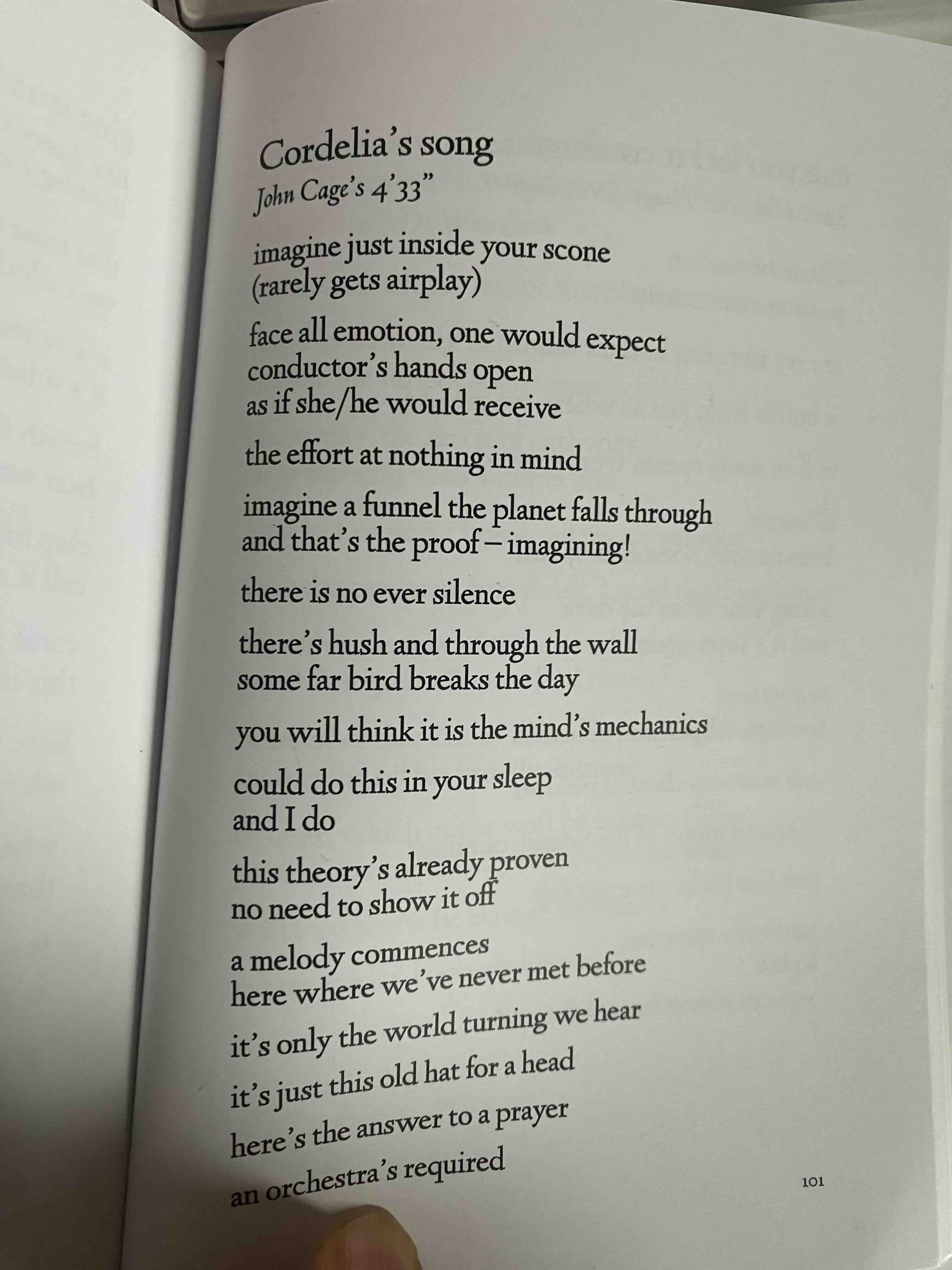
I usually single out one poem when I write about a poetry book. Here, rather than my arbitrary choice of page 79 (my age), I’m looking at page 101 (may I live so long): ‘Cordelia’s song / John Cage’s 4’33”’:
I love the pairing in the title. In case you need reminding, Cordelia is King Lear’s favourite daughter who, when asked what she can say about her love for him, replies, ‘Nothing, my lord.’ In case you also need reminding, the score John Cage’s ‘4’33″’ instructs the musicians not to play their instruments for 4 minutes and 33 seconds. They are two great Nothing moments, where the ‘nothing’ is rich – Cordelia will not speak because to do so would belittle her love; Cage, as I understand it, invites the audience to attend to the unscripted music of life itself.
The poem proceeds in the manner Kit Kelen has made his own. There are sentences whose subject is understood, and sentences that stop as soon as enough has been said for the reader to know (or guess, or invent) their endings. Syntax is just slightly out of kilter. Punctuation is scarce, which leads to teasing ambiguities. Language is made strange, but it stays friendly.
What I like most about the poem after a number of readings is the way its apparently fragmentary nature comes together into a deeply satisfying whole.
Take the first couplet:
imagine just inside your scone
(rarely gets airplay)
A prose paraphrase might be: ‘Imagine what’s going on inside your head, and only that. It’s something that you rarely pay attention to.’ But ‘scone’ is more interesting than ‘head’ – apart from the effect of its slangy informality, it implies the thinking mind as well as the physical head. And ‘airplay’ is more than attention: with Cage’s composition in mind, the word suggests that the piece allows what’s in your ‘scone’ to be heard as if in a concert: the random thoughts as well as the tinnitus (or whatever people who don’t have tinnitus hear in their ears).
The second triplet places us in the concert hall:
face all emotion, one would expect
conductor's hands open
as if she/he would receive
Well, not exactly in the concert hall. The book is dedicated ‘for everyone at ABC Classic FM, for all you have taught me over many years’. The dominant voice of the book isn’t that of a concert-gooer, but of a music-listener. This line implies that the poem’s speaker has not seen the piece performed. ‘One would expect…” The beautifully evoked image of the conductor about to begin has a mildly ironic flavour here.
We shift again in the next line, to an abstract reflection on the piece, placing it, perhaps, in the context of Eastern meditation practices:
the effort at nothing in mind
The next couplet takes another leap altogether, into pure, tantalising, paradoxical nonsense, about which I have nothing to say:
imagine a funnel the planet falls through
and that's the proof – imagining!
As I read it, the next few stanzas are versions of what goes through this listener’s mind during the piece. First, he realises that the absence of played music is not the same as silence, that there is never silence (the contorted syntax – ‘there is no ever’ – creating the effect of a thought being reshaped as it forms), that instead of silence there’s hush in which the sound of a distant bird can be herd, and the sound of what feels like your own brain at work:
there is no ever silence

there's hush and through the wall
some far bird breaks the day

you will think it is the mind's mechanics
As with any experimental art, derisory voices are heard, and responded to.
could do this in your sleep
and I do
This couplet reminds me of Alice Miller’s discussion of Picasso’s late paintings in her wonderful collection of essays on the role of trauma in creativity and destructiveness, The Untouched Key. People might look at those paintings and say, ‘A four year old could do this.’ Miller argues that it took genius create something with the simplicity that comes naturally to a four year old. Here, ‘You could do this in your sleep,’ is meant as a similar slur, but the response ‘and I do’ turns it into praise – the piece does something that most of us can only do when sleeping.
Then another resistant comment. Who hasn’t thought when faced with a piece of conceptual art, ‘I see the idea, I don’t need to see it played out’?
this theory's already proven
no need to show it off
In response, the poem takes off, with one couplet and four one-line stanzas, groping to put words to the experience of listening to Cage’s piece. It’s worth paying attention to pronouns. So far, there has been ‘one’, ‘you’ and ‘I’. Now it is ‘we’.
a melody commences
here where we’ve never met before

it’s only the world turning we hear

it’s just this old hat for a head

here’s the answer to a prayer
Each of those stanzas takes a different tack: perhaps it’s a pause at the start of something new; perhaps it’s a chance to think about our place in the cosmos; maybe it’s just something comfortable and undemanding (though ‘this old hat for a head’ refuses to be tied down to a specific neat meaning); perhaps it’s a quiet sense of spiritual presence. Maybe it’s all of those. Whatever:
an orchestra’s required
An orchestra and being part of an audience. It’s a lovely paradox: to be silent and imagine ‘just inside your scone’, an orchestra is required.
I’m reminded of a passage from David Malouf’s essay ‘Being There’, which could well have had Cage’s piece in mind:
All those elements of noise out of which organised sound arose – the street noises we have just stepped away from, voices in the foyer, the whispers and shuffling before the conductor is quite ready, the slight disturbance of the air that is created by 2000 men and women breathing, even the occasional cough, that substratum of undifferentiated sound against which made music has to assert itself, and against which we bring ourselves to attention. Somehow, to experience the fulness of what music offers we have all to be there. Presence is everything.
I think David Malouf would have enjoyed this poem.
I am a man of settler heritage who has been alive for almost a third of the time since Arthur Phillip raised his flag on the shores of Warrane. I wrote this blog post on the currently blue-skied land of Gadigal and Wangal of the Eora Nation. I acknowledge their Elders past and present and welcome any First Nations readers.
I know Toby Davidson mainly as a Francis Webb enthusiast. He did a beautiful job of editing the Collected Poems (UWA Publishing 2011) and has organised an annual Francis Webb reading for more than a decade.
Toby is also a poet in his own right. The Grand Reopening is his third collection. My blog post about his first, Beast Language, is at this link.
The Grand Reopening is a post-Covid-lockdown book. There are poems featuring haircuts, live-streamed funerals, the Great Resignation, ambivalence about going to the pub and the theatre. There are poems about crank conspiracies and an ‘Aussie Nazi’.
These poems are engaging, and they reward repeat reading, but the one that stands out has nothing to do with Covid. ‘His Blood Whisper Scolds the Deathless Intelligence’, a poem in sixteen parts, accounts for nearly half the book. It features Klippel-Trenaunay Syndrome (KPS), a rare congenital condition which, according to a helpful note:
affects limbs, especially legs, and is characterised by cutaneous capillary malformation (‘port wine stain’), higher temperature, variable or overgrown veins, tissue, bone and the internal sensation of pronounced or incompetent circulation.
The poem picks up on the word ‘pronounced’. Its speaker is a ‘slewed susurrus / spokeswhisperer / for the Syndrome’. The ‘Deathless Intelligence’ that it scolds is something like divine inspiration – creativity that comes and goes.
At the book’s launch last year, Toby Davidson said that he lives with KPS. So the poem’s narrative elements, mainly dealing with medical interventions and the experiences of ‘Child-He’, are autobiographical or at least autobiography-adjacent. It’s a portrait of the artist as a young man living with KPS, with the device of Syndrome-as-narrator allowing for distance and so reflection on meaning. In a back cover blurb, Kevin Hart says that this poem ‘enters the mind and heart and simply will not leave’. I agree.
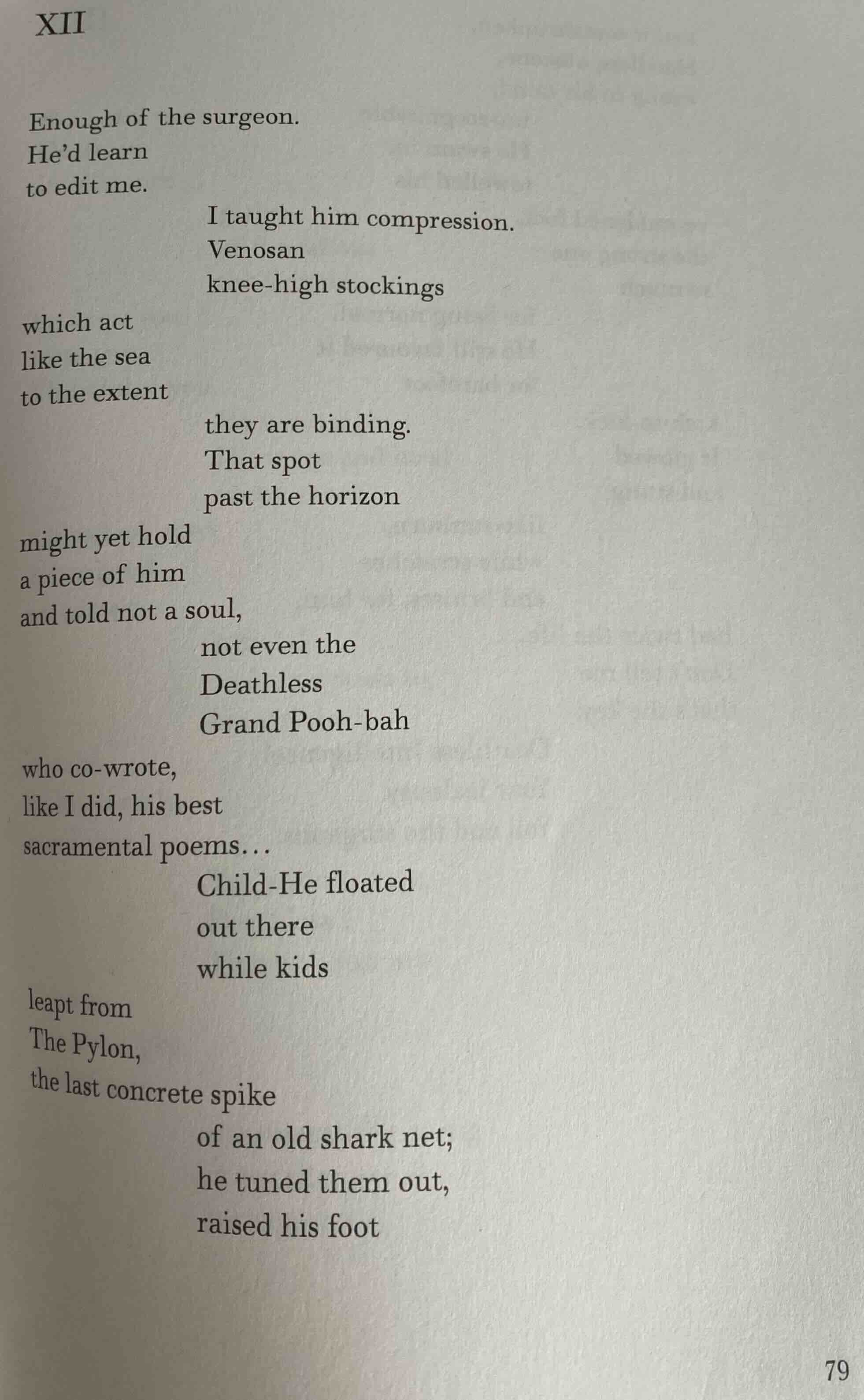
Page 79*, happily, falls in the middle of this wonderful long poem. It’s the first of Section XII’s two pages:
The first thing you’ll notice is the patterning of words on the page. The whole poem is structure this way: in stanzas made up of three short lines, with alternate stanzas indented. The effect is of a slow heartbeat, a hypnotic to-and-fro, an expectation of call-and-response that is never consistently met but never totally disappointed. It reminds me of the way religious communities recite the Psalms antiphonally: the sides of the chapel recite/chant alternate lines. On this page you can see the call and response pattern in pairings like: ‘he’d learn’ / ‘I taught’; ‘spot’ / ‘piece’; ‘not a soul’ / ‘not even’; ‘floated’ / ‘leapt’; then ‘leapt’ /’raised his foot’.
The overall narrative moves along in this poem. Where previous sections have dealt with diagnostic and other medical interventions, here the whisperer takes the credit for the un-intrusive, non-surgical intervention of compression. Venosan compression stockings (they exist, I looked them up) bring relief. Paradoxically, and antiphonally, the sea brings relief in its vastness – but the main narrative of this section is about the discovery that that relief is temporary. In an earlier section, Child-He realises he can be alone, unaccompanied by the Blood Whisper, only in his dreams. Here he goes swimming alone, telling no one. On the next page he looks at the foot raised at the end of this one:
and it was shrunken,
bloodless, obscene,
wrong in his mind
_____________unrecognisable.
The emotional impact of the incident is summed up in the lines:
so much
_____________for being normal
The narrative conveys with a gut-punch something of the emotional reality of growing up with a congenital condition. The poem has other interests as well. What to make of this?
_____________not even the
_____________Deathless
_____________Grand Pooh-bah
who co-wrote,
like I did, his best
sacramental poems...
(The Deathless Intelligence collects a number of nicknames. The Gilbertian ‘Deathless Poo-bah’ is as disrespectful as they get.)
The Blood Whisper’s assertion that it is co-author of ‘his poems’ is part of what makes the long poem so engrossing. It’s not a simple body–mind opposition. The poet has two co-authors. One is the Deathless Intelligence, something like the traditional concept of a Muse, or the Christian tradition’s divine inspiration. The poem reaches for an understanding of how the physical reality – in this case a syndrome affecting the circulation – can also contribute to the creative process.
I’m a long way from grasping this poem. I’ll keep coming back to it. I’d love to hear in the comments from anyone who has engaged with it.
But that’s all I’ve got time for now.
I am an Australian man of settler heritage. I’ve written this blog post on the land of Gadigal and Wangal of the Eora nation. I acknowledge Elders past and present of those clans, and welcome any First Nations readers.
Since 1972, Pam Brown has published 23 books of poetry and almost as many chapbooks (chapbooks are tiny books of poetry, mostly too small to be given an ISBN). She has won major prizes, been an editor including for Jacket and Overland, and is a generous reader of other people’s books.
I enjoy her poetry, but I’m perplexed when it comes to writing about it. Before sitting down to write about Text Thing, approximately her eighteenth book, I looked back over my blog to see what I’d already written. It turns out there’s quite a lot, much revealing the extent of my ignorance about contemporary poetry. If the spirit moves you to read them, here are links to my encounters with Selected Poems 1972–1981, True Thoughts (2008), Home by Dark (2013), Missing Up (2016) and Stasis Shuffle (2021).
There are plenty of places you can go for illuminating accounts of Brown’s poetry. I especially like her 2003 interview with John Kinsella in Jacket2 where he memorably suggests that she has created her own subculture. Among many interesting things in that interview, she says something that’s relevant to page 79* of this book. Referring to the way her poems often include the names of friends without explanation, Brown says:
The … thing is that they’re signifiers. And somehow it’s also a call for community. That sounds corny and old-fashioned but poetry is a marginal art and we’re like the black market of culture — it lends a freedom to do that… include real people, names…
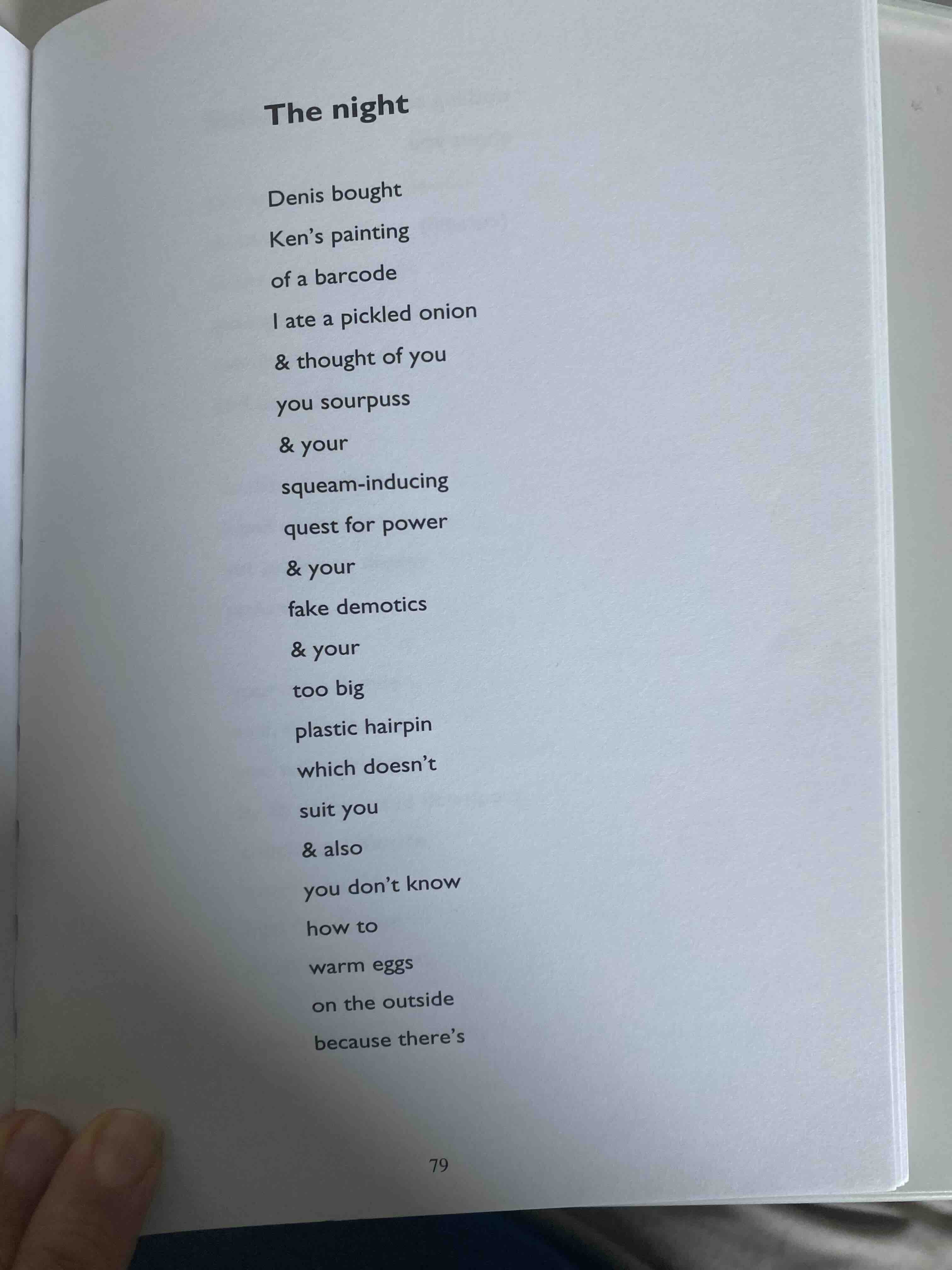
The poem that begins on page 79 is ‘The Night’:
And there are three lines over the page:
nothing cosy
about you.

(curses!)
This poem is uncharacteristically straightforward. Including the title, it consists of a single sentence whose syntax is almost simple enough to meet a primary schoolteacher’s specifications, followed by a one word exclamation. The poem’s speaker eats a pickled onion and is reminded of a friend (or perhaps a frenemy or a former lover?). She indulges in a little rant addressed to that person.
It makes me laugh and I’m not exactly sure how.
Maybe the poem invites me to imagine it being read by the person it’s addressed to. Would she/they (I’m assuming it’s not a man) be amused? Defensive? Dismissive? Retaliate in a poem of her own?
Having now read it a number of times, I realise that there’s quite a lot going on.
The night

Denis bought
Ken's painting
of a barcode
I ate a pickled onion
This opening clause sets the scene. I imagine the opening night of an art exhibition in a small gallery. Art is on sale and there are snacks, including pickled onions. ‘Ken’ is almost certainly Ken Bolton, poet and painter, named on the imprint page as the publisher of this book artist Ken Searle [see comment from Ken Bolton] . ‘Denis’ is probably a real person too, but his identity doesn’t matter, any more than that of the poem’s ‘you’ does. What does matter is that all four people in the poem – ‘I’, ‘you’, Ken and Denis – are on first-name terms, and seem to belong to some kind of creative community – perhaps Brown’s ‘black market of culture’. Only when I read the poem out loud (to the long-suffering Emerging Artist) did I realise that there’s a lovely contrast between the briefly mentioned masculine, transactional world of buying and selling where even the artwork is an emblem of commerce, and the feminine, relational world of the rest of the poem.
I ate a pickled onion
& thought of you
you sourpuss
Is it ridiculous of me to compare Brown’s pickled onion to Proust’s madeleine? Probably. But the taste of this pickled onion, like the smell of the madeleine, transports the poem’s speaker from the external world to the internal one of emotion-charged memory. The word ‘sourpuss’ explains the connection. Then there’s something disarming in the string of qualities, each introduced by an ampersand, with the attention-grabbing words ‘squeam’ (which Merriam-Webster says is a back formation from ‘squeamish’) and ‘demotics’ (which in this context I take to mean the adoption of working-class manners and language, like a recent Australian Prime Minister giving himself an Aussie-sounding nickname). There’s a nice comedy in the transition from criticising an off-putting quest for power and calculated manner to a silly schoolyard insult:
& your
squeam-inducing
quest for power
& your
fake demotics
& your
too big
plastic hairpin
which doesn't
suit you
You almost expect that to go ‘which doesn’t / suit you / anyway‘ with a teenage emphasis. The first two insults carry the ring of truth. The third reflects back on the speaker.
Learned people refer to Pam Brown’s gift for sprezzatura, a casual appearance that conceals the work that went into it. The veering off in the next line – the fifth to start with an ampersand – is a nice example. I can’t read the opening ‘& also’ without thinking of an angry teenager. Brown’s world of allusion is almost certainly more sophisticated than mine – but I think of Mary-Anne Fahy’s gum-chewing Kylie Mole from the 1990s. (Come to think of it, this book was published in 2002, so Kylie Mole may well have been in Brown’s mind.) So it feels like an easy, natural follow-on from the big plastic hairpin. Then, as if it’s a perfectly natural next step, the poem turns into an intimate attack:
& also
you don't know
how to
warm eggs
on the outside
Well, maybe it’s not explicitly intimate, but the lines do suggest a shared domesticity in the past. I’m not sure what it means to ‘warm eggs / on the outside’. This conjured in my mind in image of hands holding eggs gently, imparting body heat to them. Why anyone would want to do that, or why not knowing how to do it was a moral failure wasn’t immediately clear. Then I reflected that if you’re baking a cake, a pavlova, or even an omelette, it’s a good idea to let the eggs warm up for a while ‘on the outside’ of the fridge: so there’s a practical meaning. But – for me at least – the image of motherly, protective, feminine warmth persists. And that justifies the final twist of the knife:
because there's
nothing cosy
about you.
I’m not usually one to notice perfectly conventional punctuation, but I love that full stop at the end. Back in 2002, Millennials probably weren’t yet expressing horror at Boomers’ ending text messages with a full stop, which they saw as unreasonably aggressive. This one fits their reading perfectly.
The full stop may the end of the rant, but it’s not the end of the poem:
(curses!)
The exclamation is a response to everything that has gone before. I love how many ways it can be read: ‘(Did I really just say that?)’, ‘(Do I still have all these feelings about her?)’, ‘(I was having such a nice time before I bit that pickled onion!)’, ‘Why did I ever let her into my life?)’. Or: ‘(And now I hurl curses in your direction!)’, ‘(I’ll sum it all up in the one word!)’. Given that Pam Brown often quotes from other poets and popular culture, or even odd bits of graffiti or commercial copy, it doesn’t seem wrong to hear an echo of comics like Popeye here. No time at all on Google gave me an example.
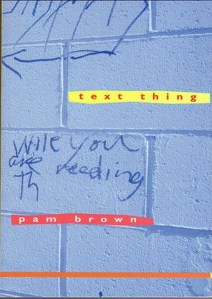
That’s just one poem. If I were to find a way that it’s representative of the whole book, I’d say it’s something about interruption. The cover illustration, attributed to Kurt Brereton, is of graffiti that reads ‘wile you are reeding th’. The book is full of interruptions, asides, distractions. ‘The Night’ can be read as being about one more distraction. But such a rich one!
I am a man of settler heritage who has been alive for almost a third of the time elapsed since Arthur Phillip claimed this continent for the British crown. I wrote this blog post on the land of Gadigal and Wangal of the Eora Nation. I acknowledge their Elders past and present and welcome any First Nations readers of the blog.
* My blogging practice is to focus on the page that coincides with my age, currently 79.
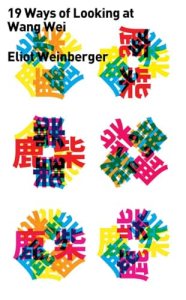
This book must be a classic work on translating poetry. Readers of this blog will know that occasionally I nerd out about translation. Well, Eliot Weinberger does it in spades, only he’s wittier, more erudite and generally much more illuminating.
The book looks at nearly 30 attempts to translate one four-line poem by the classic Chinese poet Wang Wei (c 700–761 CE), mostly into English. The poem is generally but not always, such is the nature of translation, known as ‘The Deer Park’.
Before looking at any of the attempts, there are three short sections presenting and discussing: the original, in Chinese characters, just five on each line; a transliteration into modern pinyin; and a character-by-character translation onto English. To give you some idea of the challenge facing the translator, here is the first line of the character-by-character translation:
Empty_ mountain(s)/hill(s) (negative)_ to see _ person/people
You can see that the possibilities are vast – and in discussing the different solutions, Weinberger has a lot of fun and at the same time gives an impressionistic account of the influence of Chinese and Japanese poetry on English language poetry in the last 100 years. He doesn’t mind taking on the Chinese language specialists who may know about the language but have no ear for poetry, and he doesn’t hold back with either praise or displeasure.
I’d written to this point when I remembered that I blogged about J. P. Seaton’s Shambhala Anthology of Chinese Poetry almost exactly 16 years ago, and did my own timid, partial, uneducated attempt at comparing versions – of a slightly longer poem by Li Po (701–762). If you’re interested, it’s at this link.
In short, I loved this book, and if you’re interested in Chinese poetry and /or translation in general, you will too. I’m very grateful to John Levy for mentioning it in the comments (at this link).
I’ll give the last word to Weinberger. At the end of the original essay – before Octavio Paz had contributed his learned Afterword, and before Weinberger’s account of a Furious Professor’s response – he writes:
The point is that translation is more than a leap from dictionary to dictionary; it is a reimagining of the poem. As such, every reading of every poem, regardless of language, is an act of translation: translation into the reader’s intellectual and emotional life. As no individual reader remains the same, each reading becomes a different – not merely another – reading. The same poem cannot be read twice.
I am an Australian-born man of settler heritage. I wrote this blog post on the land of Gadigal and Wangal of the Eora Nationa. I gratefully acknowledge the Elders past and present who have cared for this beautiful country for millennia, and welcome any First Nations readers of this blog.
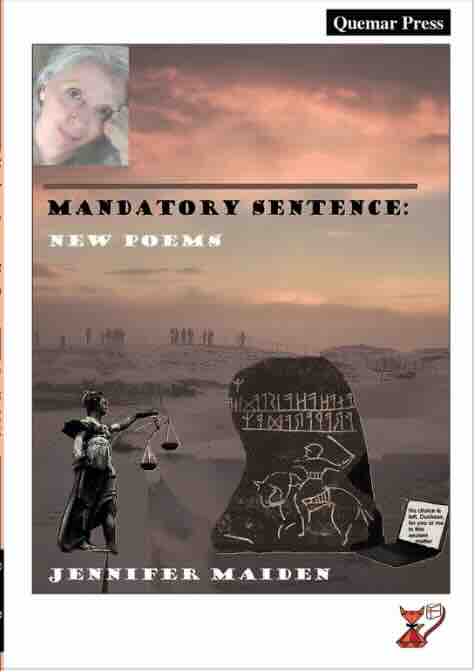
Mandatory Sentence is the latest in Jennifer Maiden’s continuing tightrope act of producing a book of poetry at the start of each year. As in previous years, most of its contents are in effect occasional poems, that is, poems written in response to breaking news – developments in the Gaza genocide, the demolition of the East Wing of the White House, Anthony Albanese’s visit to China, news about AI, and so on. Many of the poems feature fictional or historical characters responding to these events, sometimes in dialogue with current politicians.
If you’re new to Maiden’s poetry, you might need help with the characters who populate the book. George Jeffreys and Clare Collins, familiar from Maiden’s four novels and many poems, appear with their ever-increasing family that includes a son named Corbyn and a number of animals. There’s a weird, cuddly little creature named Brookings – named after the Brookings Institute and originally perhaps emblematic of what Maiden sees as that organisation’s deliberate naivety, but now taking on a life of its own. Dietrich Bonhoeffer, Eleanor Roosevelt and other make brief repeat appearances. Maiden’s daughter Katharine, has appeared in her mother’s poetry since The Winter Baby (1990) – as well as being the book’s publisher in real life.
I read Mandatory Sentence just after my first reading of Evelyn Araluen’s The Rot. They’re very different books, but they both respond with some immediacy to world events from a left / progressive perspective, so it’s not surprising that there are moments when they chime. One such moment is the opening of ‘Brooking Becomes a Bomb Bay Door’, which echoes that of Araluen’s ‘Uplock Actuator System’. For this blog post, I’ll stay there.
Both poems were evidently inspired by the same interview Richard Marles gave on the ABC in August last year – at this link – in which he asserted repeatedly that Australia does not supply weapons to Israel, but is ‘part of the F-35 process’. Neither poem is limited to satirising that assertion – the Shovel does that brilliantly, here. How they each make distinctive poetry from the material is interesting.
‘Uplock Actuator System’ begins:
We aren't sending weapons, they said,
just the only lock for the only door that
opens when they are fired from the air.
The poem progresses in nine three-line stanzas of almost intolerable intensity, evoking the suffering of Gaza and linking it to the ‘parallel occupation’ of Australia and the unwilling complicity of all of us. It ends with a call to engagement .
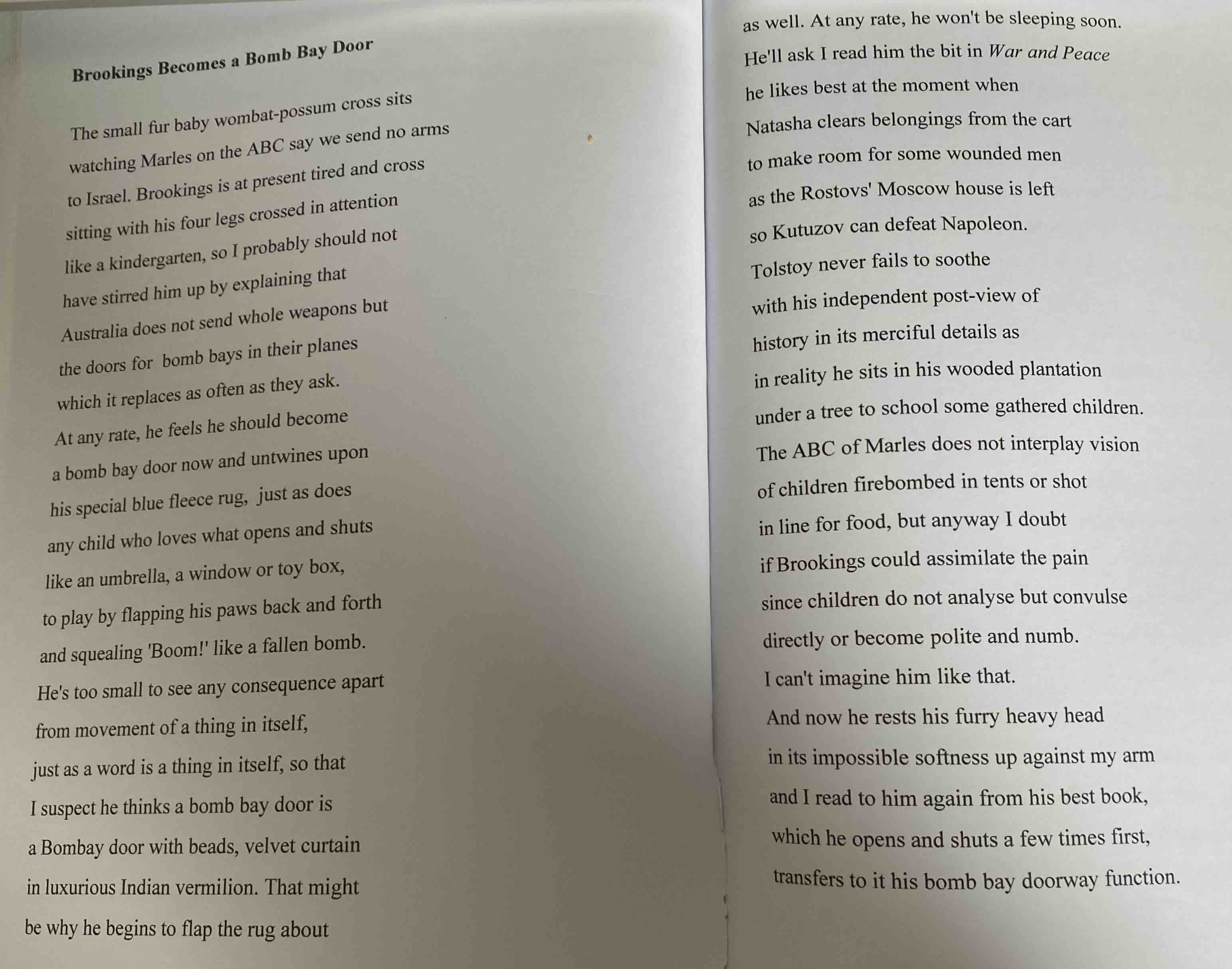
‘Brooking Becomes a Bomb Bay Door’ is by comparison laid-back and playful, adjectives I wouldn’t easily associate with Maiden’s political poems. You can hear her performing it, pretty much deadpan, at this link. Here’s how it appears in Mandatory Sentence:
It begins with the titular Brookings – a ‘small fur baby wombat-possum cross’ who could have come from a children’s cartoon – watching the television, cutely ‘like a kindergarten’. And there’s some almost silly play on words – the word ‘cross’ appears three times, each with a different meaning.
The small fur baby wombat-possum cross
sits watching Marles on the ABC say we send no arms
to Israel. Brookings is at present tired and cross
sitting with his four legs crossed in attention
like a kindergarten,
The adult shorthand – ‘Marles on the ABC’ – alerts us that this is not a cute and cuddly poem. Contemporary Australian readers will know that this is Richard Marles, Minister for Defence, and the context is Israel’s genocidal bombing of Gaza (the context has moved on since the book was published – but the poem’s concerns are still sharply relevant). The language of political denial-not-denial is skewered in just three lines.
like a kindergarten, so I probably should not
have stirred him up by explaining that
Australia does not send whole weapons but
the doors for bomb bays in their planes
which it replaces as often as they ask.
The poem’s central tension is set up: on one hand, there’s the innocent, naive, playful fantasy creature and on the other the poem’s speaker who is aware that the Australian government is complicit in terrible things.
For the next 14 lines, the rest of the first page, innocent Brookings plays. In the Brookings poems – this book also includes ‘Brookings Becomes a False Flag’ – it’s clear Maiden’s invented character is not simply a mouthpiece for the poet but has an independent imaginary existence. (This may not be obvious with other Maiden characters, but I think it’s always true – Maiden sets her imagined people/creatures up and is interested to see what they have to say – what, for instance, would Dietrich Bonhoeffer say to Kevin Rudd this time? Do I need to say that Bonhoeffer isn’t as cute as Brookings?)
Brookings’s metaphorical origins may be at work in the background, suggesting that liberal organisations like the Brookings Institution aren’t serious about addressing things like genocide. Nerdily, I went to the Institution’s website to see what it was up to at about the time this poem was published – and while it wasn’t playing at being a bomb bay door (or a Bombay door with beads and velvet curtain), it was hosting a discussion about the future of drone warfare (link here). Make of that what you will.
But the poem doesn’t mount an argument about the Brookings Institution. It just gives a picture of innocent, or at least oblivious, playfulness.
There’s a turn, and in the second part of the poem the narrative moves to bedtime, which is a pretext for introducing Tolstoy’s War and Peace. This might seem a bit forced, but if you can accept a ‘fur baby wombat-possum cross’ then why not also accept War and Peace as its ‘best book’?
Embarrassingly, I haven’t read War and Peace (though I saw the King Vidor movie on Super 8 in 1964 and fell in love with Audrey Hepburn). Other readers will know what specific bearing the scene from the novel has on the rest of the poem:
He’ll ask I read him the bit in War and Peace
he likes best at the moment when
Natasha clears belongings from the cart
to make room for some wounded men
as the Rostovs' Moscow house is left
so Kutuzov can defeat Napoleon.
But those of us who haven’t read the novel can still see/feel how it works in the poem.
The War and Peace moment is juxtaposed with the image of Tolstoy at the time when he wrote it:
Tolstoy never fails to soothe
with his independent post-view of
history in its merciful details as
in reality he sits in his wooded plantation
under a tree to school some gathered children.
As often happens with poems, it seems as if this one has gone wandering, from Marles to Brookings, to War and Peace, to Tolstoy sitting with children under a tree. Then the next couple of lines bring it home:
The ABC of Marles does not interplay vision
of children firebombed in tents or shot
in line for food
The poem has interplayed vision of Tolstoy schooling children in a safe ‘independent post-view of / history’ with a scene from his great novel. If tha ABC was to interplay vision of children with the Marles interview, those children would not be safely ‘post-history’ but concurrent with the interview, victims of atrocity. The tension in the opening lines between child-like naivety and a violent reality comes to a head here.
Incidentally, ‘the ABC of Marles’ seems at first to be a slightly odd way of saying ‘Marles on the Australian Broadcasting Corporation’, but it can also read, less oddly, as ‘the alphabet of Marles’ – that is, the evasive language Marles uses.
The poem doesn’t go to graphic description of the atrocities – it gives enough to let us know the heaviness that sits in the speaker.
But – and it’s an important question – what is a parent or quasi parent to do? The speaker allows Brookings to continue in ignorance, and the poem ends with the peaceful image of mother and not-quite-child at bedtime;
And now he rests his furry heavy head
in its impossible softness up against my arm
and I read to him again from his best book,
which he opens and shuts a few times first,
transfers to it his bomb bay doorway function
Just two things complicate the image and provoke further thought and feeling.
First, the word ‘impossible’ suggests that, just as any soothing Tolstoy has to offer is dubious because he was writing from a safe historical distance, so any comfort afforded by Brookings is illusory because he is after all an invention, an impossibility.
And second, the last line: what does it mean that the ‘bomb bay doorway function’ can be transferred to a book? What is released when a book ‘opens and shuts’? If you’ve read this far, you probably have as good an answer to that question as I have and together we could probably come up with better ones. I’m reminded of a long history of assertions of the power of the word. There’s the proverbial: ‘The Pen is Mightier than the Sword’, ‘You can kill a person but you can’t kill an idea,’ and so on. The idea seems to be everywhere just now that the narratives we tell are crucial: we can believe the story coming from the White House, or commit ouselves to a different story. That final image gestures towards this kind of thinking. Perhaps what is released in those last lines is the possibility of resistence.
It’s not a call to arms like Evelyn Araluen’s poem, but it is a call to think, to reject double-talk, maybe even to hope.
I am a man of settler heritage who has been alive for almost a third of the time that has elapsed since Arthur Phillip claimed this continent for the British crown. I wrote this blog post on the land of Gadigal and Wangal, where the nights are lating longer and small lizards seem to be everywhere. I acknowledge their Elders past and present and welcome any First Nations readers of the blog.
* When blogging about a book, I currently focus on page 79, which is my age. Mandatory Sentence has just 70 pages, so I gave myself permission to go with a whim.
Evelyn Araluen, The Rot (University of Queensland Press 2025)
This is a brilliant follow-up to Evelyn Araluen’s first book, Dropbear. It’s passionately raw, intellectually challenging, and full of rabbit-holes. Araluen says in her acknowledgements, ‘In most ways this is a book for girls.’ She goes on to say, ‘A girl is so many things. Everything, really.’ It’s pretty safe to say that I’m not a girl. But as an oldish man of settler heritage I was swept away.
Alison Croggon in the Guardian (at this link) called it ‘a hurricane of a book’ and says (among other things):
The Rot is an experiential plunge into the nightmare of the present moment, as seen through two centuries of colonisation on this continent. Dark though it is – as dark as our times – it is not hopeless. The book is dedicated to ‘my girls, and the world you will make’: Araluen looks to the ‘Long Future’, a term coined by the Unangax̂ scholar Professor Eve Tuck, for what can be imagined for those who survive colonisation – contingent and elusive as that future might be. At the core of this collection’s bitter truths beats a sublime tenderness.
[In case you need a footnote: Unangax̂ are the Indigenous people of the Aleutian islands. Some of the most powerful moments in Rot come when Araluen wrestles with the implications of Eve Tuck’s thinking. You don’t have to go down this tempting rabbit-hole to feel the full force of the poems.]
Araluen was recently interviewed by Sian Cain for the Guardian (at this link) when she won the 2026 Victorian Premier’s Literary Awards. Here’s a snippet:
She worked on The Rot ‘after work, after dinner, in the bath’ for months, though she now admits that such prolonged focus on such a traumatic subject was ‘irresponsible of me’. ‘I do not recommend drinking wine in the bath and listening to Mitski and crying and calling that a writing practice,’ she added. The Rot reflects ‘a really panicked, distressed window of a time that I hope we all look back on with horror and despair and a real sense of regret,’ Araluen said.
[Mitski, another of the book’s many potential rabbit-holes, is a Japanese-American singer whose music has been described as a ‘wry running commentary on twentysomething angst, raw desire, and often unrequited love’ (link to Wikipedia article here).]
These quotes give an idea of the book’s tone and its scope, though there’s a lot that they don’t mention. For instance, the genocide in Gaza is a pervasive presence. I recommend that you read both the review and the article in full – and then I hope you’ll decide to read the book.
There’s so much to take in, so much to say, such complexity and intensity to untangle, so many rabbit-holes to be profitably explored. I’ll just offer a small note, keeping to my resolve to focus on one page.
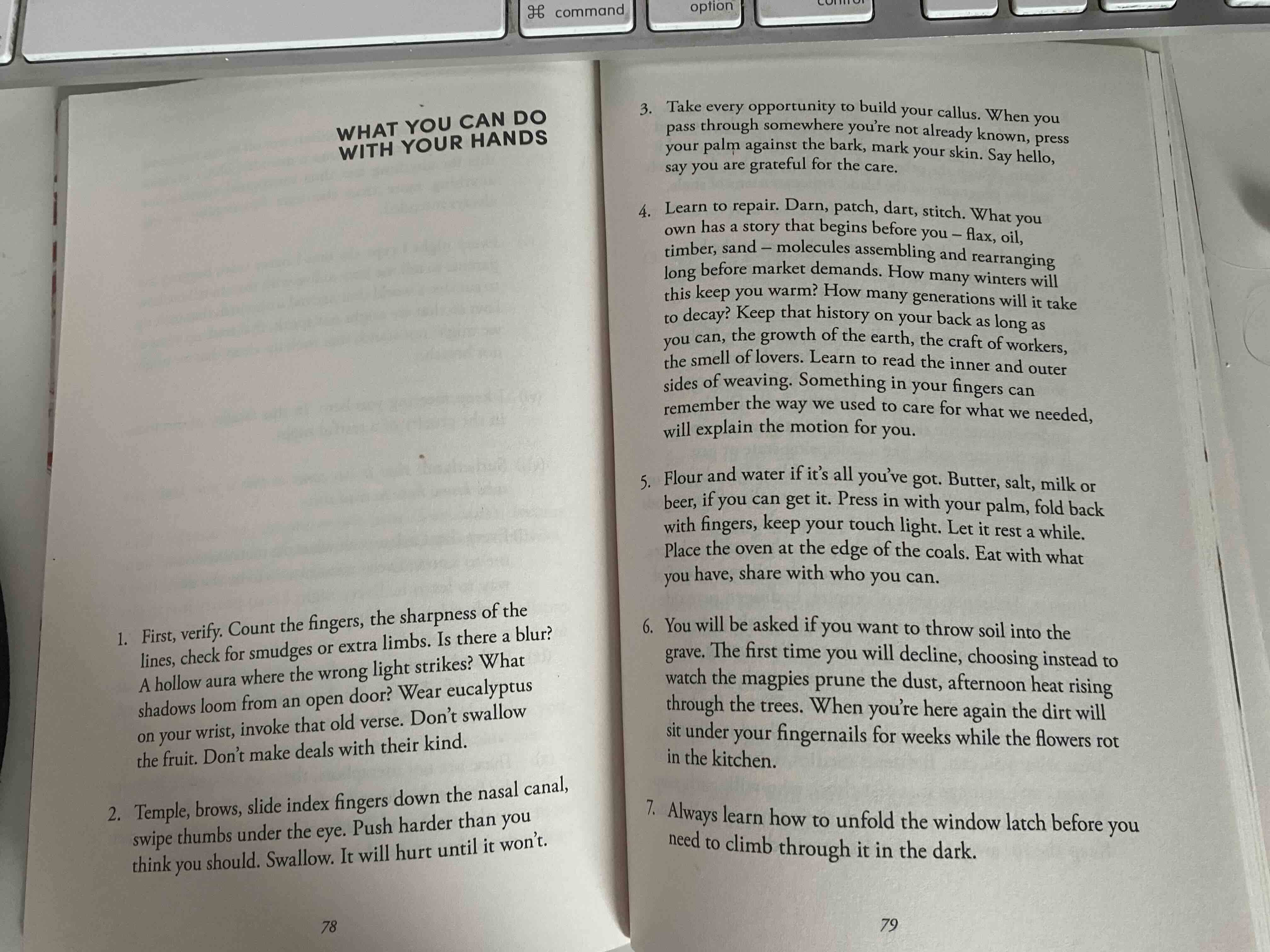
Page 78* is the beginning of ‘What You Can Do with Your Hands’:
Before looking at the poem itself, it’s worth considering it in context. It’s title suggests that it is a direct response to an earlier poem. ‘You’ (page 25) ends:
no less human than yourself. Around us the
world sways, sometimes crumbles. It's not that
you think you can change this, but you need
something to do with your hands.
The hands motif turns up again in ‘Analysis Act Three’ (page 76), which launches itself with a quote from J H Prynne (from his 2022 lecture ‘Mental Ears and Poetic Work‘, another potential rabbit-hole).
Prynne: no poet has or can have clean hands, because
clean hands are themselves a fundamental contradiction.
Clean hands do no worthwhile work.
Sections viii and ix have this: (Apologies, but my WordPress theme doesn’t allow me to include section numbers as they ought to appear.)
Every day I ask myself what the machine doesn't want
me to know. Every tomorrow will be the day I find a
way to learn it. Every night I read poetry just to give
my hands something to do.

Refusal, resistance, disavowal and survivance are
tenors of a liveable life. In action they are compromised,
bloody-handed, in the world and of it.
The book is full of theory, grief and rage. But the motif of hands beings it down to earth: thinking and feeling are not enough. We need to work, to engage. Reading poetry can be work. So are ‘refusal, resistance, disavowal and survivance’.
‘What You Can Do with Your Hands’ responds in the form of an instructional poem in 15 sections’. Page 78 has just the first two instructions:
First, verify. Count the fingers, the sharpness of the
lines, check for smudges or extra limbs. Is there a blur?
A hollow aura where the wrong light strikes? What
shadows loom from an open door? Wear eucalyptus
on your wrist, invoke that old verse. Don't swallow
the fruit. Don't make deals with their kind.

Temple, brows, slide index fingers down the nasal canal,
swipe thumbs under the eye. Push harder than you think you
should. Swallow. It will hurt until it won't.
A quick and dirty summary of these sections would be something like: first, pay attention to your actual hands, and second, use them to become aware of yourself as physically present.
But this is poetry. The words matter. And they introduce an element of the uncanny, something that disturbs the prose meaning. ‘Check for smudges,’ Ok. I can do that, and it is an injunction to self-reflection: smudges – of ink, dirt, foodstuff – will show what I’ve been doing. But ‘check for extra limbs’? The mind goes wandering, and who knows where? Then the questions about light and shade ask the reader to notice their actual context, recognise that they are in a place, in relationship to whatever creates a looming shadow. (In my case right now, the shadows on my hands are cast by light from an open window.)
‘Wear eucalyptus’: fair enough. But what is the old verse we are to invoke? I lay that aside as another of the book’s potential rabbit-holes. If you have an idea, please say in the comments.
‘Don’t swallow the fruit’: I read this as referring to the tale where a person taken to a fairy land must not eat anything if they want to avoid being trapped there forever. That and the final sentence, ‘Don’t make deals with their kind,’ are warnings to keep one’s own integrity against the tide of disinformation and distraction that we live in – ‘Don’t drink the kool aid.’ Already the poem has moved quite a way from literal hands.
The second section comes back to the literal. It insists that the reader notice they are a body: that they push hard to make contact with their own physical existence.
I won’t discuss the rest in detail – the remaining sections cover how to acknowledge place; how to repair; how to cook; how to throw soil into a grave. They cover self-defence, self-care, first-aid, violence, tenderness, and finally connection. Section by section, the instruction form opens up possibilities, creates small and large riddles, resonates. Even Section 12, the shortest, ‘Pick up your fucking litter,’ repays a moment’s attention: the tone shifts and the speaker of the poem becomes for a moment an irritable Auntie. But the comic irritation doesn’t detract from the importance of the advice. Section 14, the second shortest section, is, among other things, a gloss on Section 2: ‘Remove your grip from your own throat.’ It’s one thing to push hard with your thumbs under your eyes until it hurts; it’s a different thing altogether to do violence against yourself, to stifle your own voice. I love Section 15, but it’s against my religion to quote the final line of a poem.
Do read the book if you get a chance.
I wrote this blog post on the land of Gadigal and Wangal of the Eora Nation. I acknowledge Elders past and present, and welcome any First Nations readers.
* My blogging practice is to focus on the page that coincides with my age, currently 78.
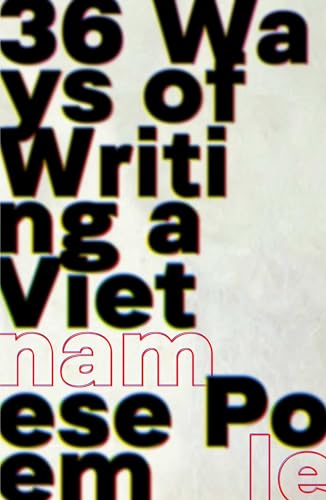
I know that I’ve read and enjoyed Nam Le’s first book, The Boat, but I don’t seem to have blogged about it. In one of its early stories, a character who fled from Vietnam with his family as a young child in a dangerously overcrowded boat is now an emerging writer. He resists pressure from all sides to write from within the Vietnamese refugee identity. After several other stories, the book ends with ‘The Boat’, a version of the story the character has been hassled to write. Resist as you may, the collection as a whole seems to say, in the end you will write the kind of thing that people demand from you.
This book of poetry plays with the same dilemma. Interestingly enough, in the acknowledgements, Nam Le thanks Nick Feik, ‘who for years gave my poems a home in The Monthly‘ and goes on, ‘Those poems are not in this book, but they paved the way for these.’ That is to say, Nam Le has not been condemned to write only ‘Vietnamese poems’. He has chosen this task. The poems explores identity, history (including colonial history), autobiography, family relationships. They are full of painful exploration and playful, formal adventure.
Each poem is numbered and named for its ‘way of writing’, beginning with ‘[1. Diasporic]’ and including poems named for their poetic form such as ‘[3. Ekphrastic]’, for their subject matter ‘[12. Communist]’, with puns on their content ‘[Dire critical]’, and so on. Many titles include the word ‘Violence’.
I can’t say that I found all the poems accessible. But I understood and enjoyed more of them than Nam Le’s session at the 2024 Sydney Writers’ Festival led me to expect (my blog post here). I love what J. M. Coetzee says on the back cover. To quote a little:
There is wit aplenty, of a dancing, ironic kind, but the fury and the bitterness that underlie 36 Ways come without disguise, as do its moments of aching love and loss.
The poem on page 47*, is ‘[26. Erasive]’. Normally, I’d photograph the spread where the poem appears and quote at least some of it, but in this case I’ll attempt a description instead.
Beneath the poem’s title is a subtitle in smaller all-caps type, ‘[ERASURE RHYMES WITH ASIA]‘. The rest of the spread consists of what appears to be 46 lines of prose, 23 on each page, that have been almost completely redacted – that is, the pages consist visually of two sets of 23 thick black lines.
There are 25 patches of un-erased text, each consisting of either a single letter or a pair of letters. They can be laboriously piece together to make two sentences:
Left-hand page: N o ar ch iv e is sa fe
Right-hand page: Bu t is t h i s a l l t h er e is to i t.
The hunt through the archives turns up something, but leaves so much unknown.
This is powerfully evocative – especially just now, when the US Department of Justice has released hundreds of pages of the Epstein files completely blacked out. History is written by the victors, and the archives are controlled by those in power.
In the book I hold in my hand, the erased text on the left hand page is just legible. At least, to my eyes it hovers on the threshold of legibility. With a little help and a lot of squinting, I can tell you that the deleted script begins:
Newspaper Articles Almanacs Treatises (Scientific, Political,
Anthropological. Ethnological), Expedition Reports Ships Logs
Royal Proclamations Acts of Parliament Papal Bulls and Breves
Vatican Decrees Edicts Encyclicals Jesuit Relations
and – I’m leaving out the intervening lines – ends:
White Papers Green Papers Letters Patent Land Grants Titles
Medical Records Inventories Accounts Patents Estimates
of Expense Reports Settlement Proposals Petitions Notice
Dictionaries (Bilingual, Trilingual) Treaties Confessions Poems
I’ve bolded the only letters in those lines that are left un-erased.
Many (most?) erasure poems work on a given text to comment on it in some way – like ‘Sacrificed on Altar of Vice’ by Brittany Bentley in a recent Meanjin, or my own little exercise in my blog post on David Adès’s The Heart’s Lush Gardens. That’s not what’s happening here.
Here the underlying text is a list, composed as part of the poem, of the kinds of documents one finds in an archive. The poem enacts the process of sifting through the archives to find information, encountering colonialist-bureaucratic ways of seeing, from property documentation to papal bulls (the infamous Doctrine of Discovery comes to mind). Then, just as one might be feeling a little smug because, after all, I am the kind of person who reads poems, the last almost-erased word is ‘Poems’. Nam Le does not exclude himself from complicity.
That’s the first page. On the second page the erased text is completely illegible. Erasure is complete: we can never know what is hidden from history.
The more I looked (literally) into this poem, the more I appreciated its ingenuity. More importantly, the more I fond myself responding to its emotional and intellectual charge: ‘Erasure rhymes with Asia.
I wrote this blog post on the land of Gadigal and Wangal of the Eora Nation. I acknowledge Elders past and present, and welcome any First Nations readers.
* My blogging practice is to focus on the page that coincides with my age, currently 78. When, as here, a book has fewer than 78 pages, I focus on page 47 (I was born in 1947).
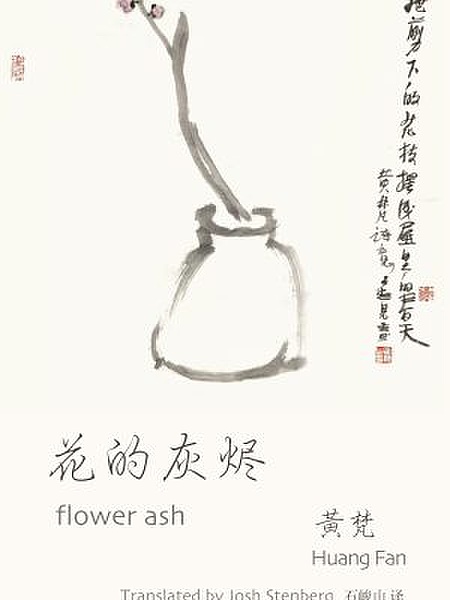
Huang Fan, Flower Ash (translated by Josh Stenberg, Flying Island Books 2024)
Huang Fan is a Nanjing-based poet and novelist who has received many awards and prizes in his homeland, and has been described as the Chinese mainland poet of most interest to Taiwanese readers. His work has been widely translated, including into English. Flower Ash is a wonderfully accessible introduction to his work.
The Flying Islands website (at this link) quotes US novelist Phillip Lopate::
In these powerful, exquisite poems, Huang Fan, a major Chinese poet, takes stock of his life from the vantage point of middle age, finding deep connections with nature, but also rueful solitude, memories of lostness, and a lingering sense of missed opportunities. These translations beautifully capture a threnody of wonder and sadness which is the poet’s singular achievement.
It’s a bilingual book. On each spread, Josh Stenberg’s English version is on the left and Huang Fan’s original Chinese on the right. Perhaps partly because of this, I was always aware, as I read, that the real poem, over there on the right, was inaccessible to me. (A bilingual reader would of course have a very different experience.)
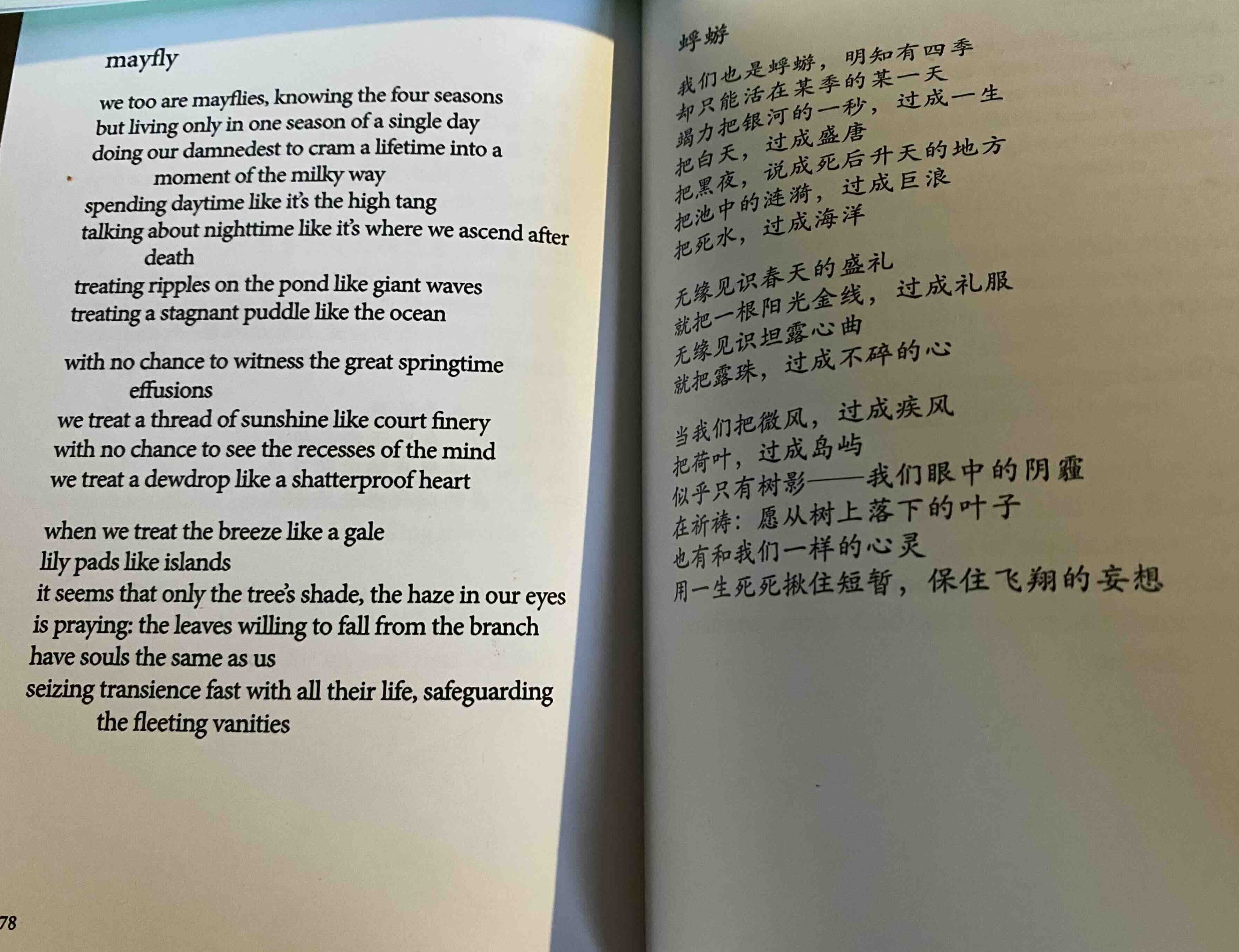
The poem ‘Mayfly’ on pages 78* and 79 is a good example:
Don’t you just wish you could read those beautiful lines of characters on the right-hand page?
The English, by contrast, feels unadorned. The first two lines lay out the poem’s central idea:
we too are mayflies, knowing the four seasons
but living only in one season of a single day
Mayflies live for a single day. From some perspectives, our lives are similarly short.
The following lines present different images to represent the same idea: a lifetime is ‘a moment of the milky way’, the High Tang period (the eighth century CE, a golden age of Chinese poetry) is just a day, what we see as an ocean is just a stagnant puddle. And so on. It’s hard to see that anything much is happening that isn’t already there in the first lines.
I think the problem is translation. Not that Josh Stenberg’s translation is inadequate, on the contrary. But translation itself is problematic. I suspect the music of the original, and the visual play that’s happening in the ideograms, are simply untranslatable, and what we get is like a musical score, or a choreographer’s notes.
But even given all that, the poem takes an interesting turn:
with no chance to see the recesses of the mind
we treat a dewdrop like a shatterproof heart
The imagery is no longer straightforward illustration of a straightforward idea. These lines open out to something deeper, less easily paraphrased. It’s no longer the perspective of deep time or deep space that is being evoked but the depths of the mind and the complexities of human emotion. If it mistaken to think of the dewdrop as a shatterproof heart, is there an implied heartbreak, an unfathomable sorrow – even ‘a threnody of wonder and sadness’?
After briefly returning to a catalogue of oppositions – breeze/gale, lily pads/islands – the poem lands on this:
it seems that only the trees shade, the haze in our eyes
is praying: the leaves willing to fall from the branch
have souls the same as us
seizing transience fast with all their life, safeguarding
------- the fleeting vanities
This doesn’t yield coherence easily. I confess I got some help – I went to Google translate, and found this:
It seems that there is only the shadow of the tree - the haze in our eyes
is praying: may the leaves falling from the trees
have the same heart as us
Use your life to hold on to the short-lived and keep
------- the delusion of flying
Again, the Chinese text is a closed book to me, but to my ignorant eye, and to my astonishment, the robot makes better sense than the award-winning human translator. Instead of ‘only the trees shade’, which makes no easy sense, the mechanical translation has ‘there is only the shadow of the tree’ – that is, we don’t see the real world, but something like the shadows in Plato’s cave. Instead of the leaves ‘willing to fall’, it is the speaker who wills –’may the leaves falling’: it’s not a description but a prayer (which follows on from ‘praying’ at the start of the line). And in the last line it’s no longer the leaves ‘seizing transience’, but the reader being urged to do so. What we experience may be ‘fleeting vanities’ (much more resonant than ‘delusions of flying’, even though the latter fits the idea of falling leaves better), but it’s what we have, and we (‘you’ in the robot’s translation, ‘the leaves’ in the human’s) need to seize it fast / hold onto it.
I didn’t set out to do this, but I seem to have taken a single poem and demonstrated that reading poems in translation is fraught.
I did enjoy the book, and am glad that Flying Islands regularly include Chinese–English bilingual books.
I wrote this blog post on the land of Gadigal and Wangal. I acknowledge Elders past and present of those clans, and welcome any First Nations readers.
* My blogging practice is to focus on the page that coincides with my age, currently 78.
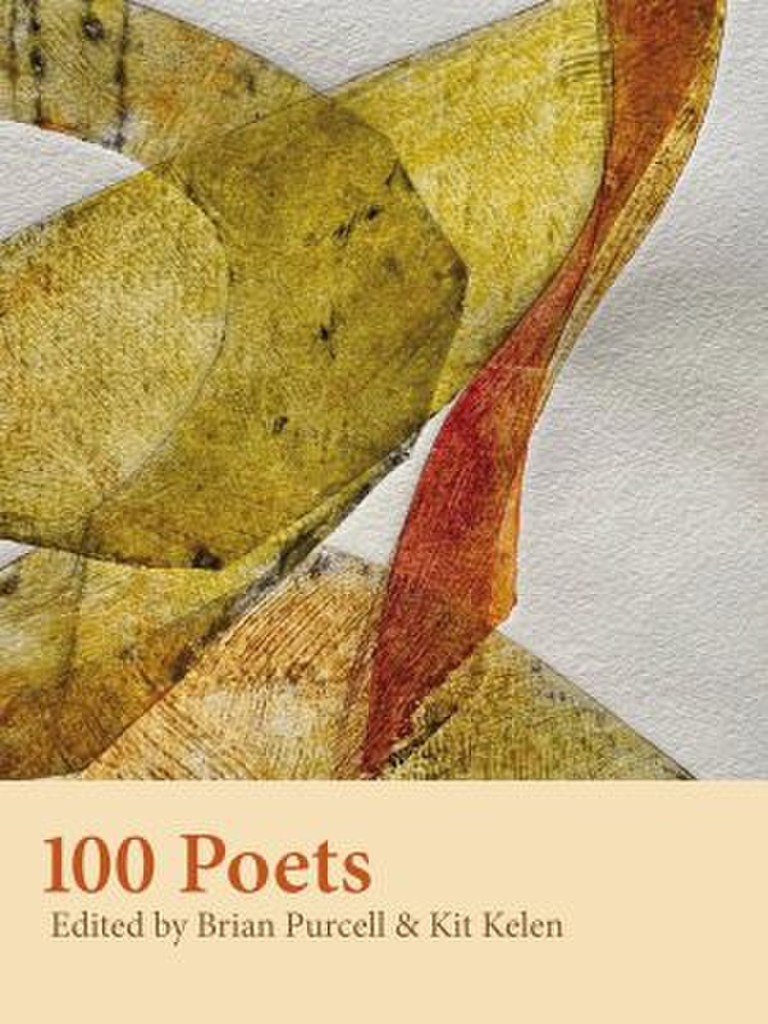
Most poetry anthologies are implicitly made up of poems that are ‘the best’ in some way or at least the editors’ favourites chosen from a much bigger field of lesser or less loved work. Though the editors of 100 Poets have necessarily been selective, the point here is not that these hundred poems are Winners. Instead, the book is offered as an introduction to a poetic community.
Flying Islands, the brainchild of Kit Kelen, is a non-profit publisher, and a community of poets and readers of poetry. Over the last decade and a half, they have published 100 pocket-sized books of poetry (I’ve read an enjouyed about 20). They have features award-winning poets, grumpy old poets who complain about the lack of recognition elsewhere, and brand new poets flexing their wings. They have included translation, mostly from Chinese to English or vice versa – Kit Kelen is an emeritus professor at Macao University, and Flying Islands has partnered with Macao-based community publisher ASM (the Association of Stories in Macao). They have had a wonderful variety of style, form, tone and subject matter. All of that is represented in 100 Poets.
This book, pocket-sized like the rest, is the hundredth in the series. Each of 100 poets previously published in the series has a single page – a couple of them fit two short poems onto their page, but none take more than a page. Not every notable Australian poet is represented here – there’s no David Malouf, Eileen Chong or John Kinsella, for instance, and not very much from the world of Spoken Word – but it’s hard to imagine a better introduction to the basic ecology of contemporary Australian poetry.
I was going to list the poets from the book who have appeared in this blog. It’s a long list, and not all of them are there because I read their Flying Islands publications. But it would just be a list of names with links. Instead, here is my favourite title, from Tricia Dearborn:
Perimenopause as a pitched battle between the iron supplements and the flooding
And, in keeping with the blog’s tradition, here’s the poem that appears on page 78, ‘The Sleepover’ by Gillian Swain, whose Flying Islands book is My Skin Its Own Sky (2019):
The first nine lines evoke a pleasant childhood memory. Even if, like me, you never slept over at a friend’s place when you were young, the details – the barbies, the giggling friends brushing their teeth together, the child bodies in adult-sized sleeping bags, the model aeroplanes on the friend’s ceiling – capture brilliantly thrilling combination of intimacy and strangeness that is a sleepover.
Lines 10 and 11 form a finely judged transition from that memory to the very different current situation. They move from the past to the present tense, and the child’s perspective carries over to the different reality – the bed that moves up and down already suggests a hospital, but is presented as a novelty:
like the way your bed moves up and down like
all the colours the flowers bring
And line 12 lands us firmly in the grim present.
to this grey room.
The person addressed in the first lines is now in a hospital bed.
The interplay of benign memory and grim present continues in the rest of the poem: the three friends once again enjoying each other’s presence long into the night. There is giggling again, and stories. The friendship is as alive as ever, but one of the three friends is dying.
The final lines hold this complex emotional reality in a neat paradox. The imminent death of a friend is not trivialised – but nor is the joy of friendship.
the wrong reasons and  tonight
your deathbed
is joyous.
The person I have known longest apart from my two sisters died early this year. Our childhood friendhsip wasn’t of the giggling, sleepover variety, but the last time I saw him we did pay more attention to what we enjoyed with and about each other than to what we all knew was coming. The poem resonates strongly for me.
Multiply that by 100 – or to be honest by maybe 75, because not every poem in the book sings to me – and you have quite an experience. I look forward to Flying Islands’ Second 100.
I finished this blog post on the land of Wandandian of the Yuin Nation, whose beaches are said to have the whitest sand on the planet. I acknowledge their Elders past and present, and welcome any First Nations readers.