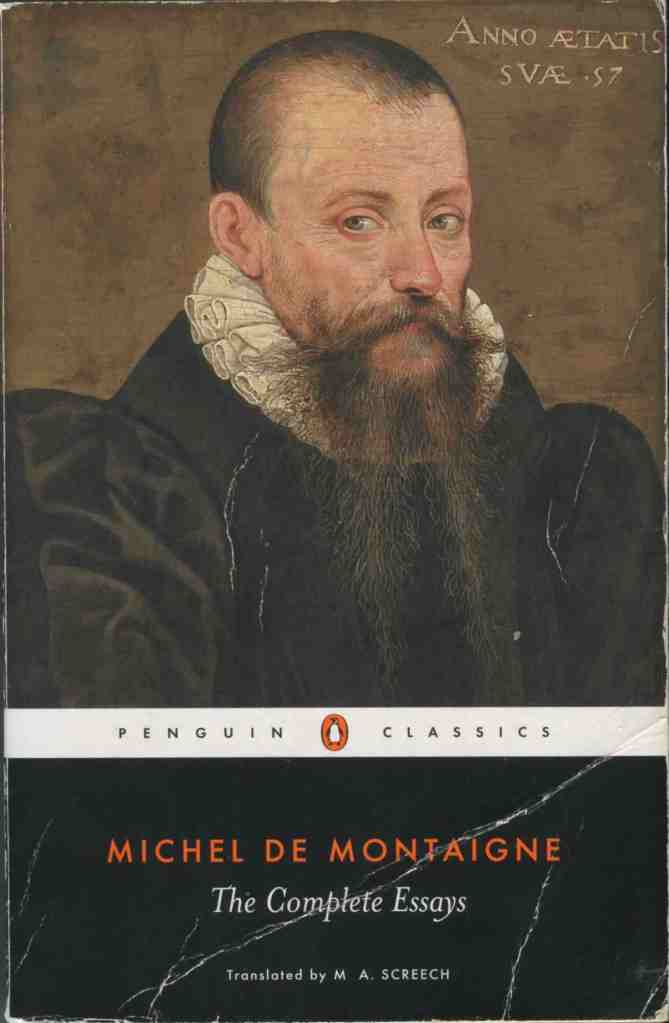
Michel de Montaigne, The Complete Essays (Penguin Classics 1991, translated by M. A. Screech) – part way through Book 2, essay 40, ‘On the resemblance of children to their fathers’ to part way through Book 3, essay 5, ‘On Some lines from Virgil’
Montaigne’s essays become even more interesting as he ages. By Book 3, he writes about his chronic pain from ‘the stone’ and, especially in the innocuously titled ‘On some lines from Virgil’, he does some spectacular writing about sexual politics.
I expect that whole books have been written about Montaigne and sex. I won’t try to untangle any of it here. I’ll just quote the paragraph from today’s reading that has given my poem its opening line. (For those who came in late, this November I’m writing at least 14 fourteen line poems, the first line of each coming from something I’ve heard or read that day.) The paragraph will give you just a glimpse of the complexity of Montaigne’s thought:
We do not weigh the vices fairly in our estimation. Both men and women are capable of hundreds of kinds of corrupt activities more damaging than lasciviousness and more disnatured. But we make things into vices and weigh them not according to their nature but our self-interest: that is why they take on so many unfair forms. The ferocity of men’s decrees about lasciviousness makes the devotion of women to it more vicious and ferocious than its characteristics warrant, and engages it in consequences which are worse than their cause.
I think he’s saying that making sexual behaviour a major criterion for a woman’s reputation is wrong; men make the rules that condemn women’s ‘immorality’; and the punishments are much worse than the so-called crimes. Further on in the essay he says that social expectations on women to be chaste are an intolerable burden.
I don’t know if he is putting a proto-feminist case, or arguing deviously that women should be more sexually available to men. Or both. Either way, it’s fascinating to have a voice from a very different epoch wrestling with questions that aren’t exactly resolved today.
But before I leave Montaigne for my own versification, I can’t resist quoting the final paragraph from Book 2, which follows some strong opinions about the medical profession, and rings out like a beacon of rationality for our times:
I do not loathe ideas which go against my own. I am so far from shying away when others’ judgements clash with mine … that, on the contrary, just as the most general style followed by Nature is variety – even more in minds than in bodies, since minds are of a more malleable substance capable of accepting more forms – I find it much rarer to see our humours and purposes coincide. In the whole world there has never been two identical opinions, any more than two identical hairs or seeds. Their most universal characteristic is diversity.
Yay Montaigne!
But on with my verse, which takes the phrase somewhere else altogether – and you can probably see the point when news from the USA knocked the poem off its tracks:
November verse 4: We do not weigh the vices fairly
We do not weigh the vices fairly,
thumb the scales to suit our whim:
I exaggerate, quite rarely –
you tell fibs – but look at him!
His lies destroy the trust that binds us,
lead us where no truth can find us.
Crowds have wisdom, mobs can rule,
electorates can play the fool.
He's murderous and self-regarding,
incoherent, vile, inane.
He once could boast a showman's brain,
but principles are for discarding.
Lord of Misrule, theatre's Vice:
How could you choose him once, then twice?
This blog post was written on Gadigal-Wangal land, where the tiny lizards are enjoying the beginning of hot weather, and jacarandas are the land’s most spectacular guests. I acknowledge the Elders past, present and emerging of Gadigal and Wangal of the Eora Nation.
Michel de Montaigne, The Complete Essays (Penguin Classics 1991, translated by M. A. Screech) – part way through Book 2, essay 17, ‘On presumption’ to part way through ‘On the resemblance of children to their fathers’
These aren’t so much progress reports as monthly snapshots from my reading of Montaigne’s Essays four or five pages a day. Last month I was part way though ‘On presumption’ and enjoying his unflattering self-portrait. That essay became even more fabulously self-deprecatory, including this (on page 730):
As for music, either vocal (for which my voice is quite unsuited) or instrumental, nobody could ever teach me anything. At dancing, tennis and wrestling I have never been able to acquire more than a slight, vulgar skill; and at swimming, fencing, vaulting and jumping, no skill at all. My hand is so clumsy that I cannot even read my own writing, so that I prefer to write things over again rather than to give myself the trouble of disentangling my scribbles. And my reading aloud is hardly better: I can feel myself boring my audience. That apart, I am quite a good scholar! I can never fold up a letter neatly, never sharpen a pen, never carve passably at table, nor put harness on horse, nor bear a hawk properly nor release it, nor address hounds, birds or horses.
Last month I snuck a look into the future and predicted that this month I would be writing about ‘Three good wives’. Fortunately I don’t have to spend time on that essay, as its version of a good wife is one who will kill herself when her husband dies. Did I mention that some of Montaigne’s views and attitudes can be pretty repulsive? The essay after that, ‘On the most excellent of men’, is hardly less repulsive: his three excellent men are Homer, Alexander the Great and Epaminondas, and in all three cases, including Homer, he seems to regard military skills as the main criterion for excellence. He also seems to take Alexander the Great’s PR at face value. (I shudder to think that essayists a thousand years from now will speak of Donald Trump as the greatest president ever.)
Today, however, I have started on the final essay of Book II, ‘On the resemblance of children to their fathers’, which is surely one of those that have endeared Montaigne to readers for nearly 500 years
Typically, the proclaimed subject of the essay is nowhere in sight in the first couple of pages. Instead, he reflects on the nature of his work and on changes that have happened in his life over the eight years he has been writing essays.
I think it’s true that Montaigne invented the essay form, and these paragraphs give a charming insight into how he went about it.
All the various pieces of this faggot are being bundled together on the understanding that I am only to set my hand to it in my own home and when I am oppressed by too lax an idleness. So it was assembled at intervals and at different periods, since I sometimes have occasion to be away from home for months on end. Moreover I never correct my first thoughts by second ones – well, except perhaps for the odd word, but to vary it, not to remove it. I want to show my humours as they develop, revealing each element as it is born. I could wish that I had begun earlier, especially tracing the progress of changes in me.
It’s probably that spontaneity and the possible vulnerability that goes with it, that makes the essays so alive even all these years later. Maybe I should be less judgemental about essays like the one on good wives – he may have thought differently on the subject on another day.
But that’s enough about the work. He needs to tell us about his health:
Since I began I have aged by some seven or eight years – not without some fresh gain, for those years have generously introduced me to colic paroxysms. Long commerce and acquaintance with the years rarely proceed without some such benefit I could wish that, of all those gifts which the years store up for those who haunt them, they could have chosen a present more acceptable to me, for they could not have given me anything that since childhood I have held in greater horror.
I’m roughly 30 years older than Montaigne was when he wrote that. Though I’m in reasonably good health, I recognise his impulse to tell the world about his bodily ills. As I turn the page, he moves on to one of his recurring topics: when it makes sense to kill oneself (see essay on good wives etcetera). Happily, he is leaning towards staying alive:
After about eighteen months in this distasteful state, I have already learnt how to get used to it. I have made a compact with the colical style of life; I can find sources of hope and consolation in it.
That’s a good thing for his readers, as there was a whole third book to come.
This blog post was written on Gadigal-Wangal land, where understandings of the universe beyond Montaigne’s imaginings were developed millennia before the Ancients he so loves. I acknowledge the Elders past, present and emerging of Gadigal and Wangal of the Eora Nation.
Michel de Montaigne, The Complete Essays (Penguin Classics 1991, translated by M. A. Screech) – end of Book 2 Essay 12, “An apology for Raymond Sebond’ to part way through Book 2, essay 17, ‘On presumption’
The month has flown by, and it’s time for another progress report on my project of reading Montaigne’s essays, four pages every morning. Two friends have sent me examples of Montaigne cropping up in their own reading: the first has just started reading Amor Towles’s A Gentleman in Moscow, and was reminded of my project when the confined Count finally gets to read Montaigne; the second forwarded me Nicholas Gruen’s weekly newsletter for the 18th of August, which includes Montaigne’s essay ‘On a Monstrous Child’. I’m not alone in reading him.
It’s taken much more than a month, but I’ve now finished ‘An Apology for Raymond Sebond’. Whether from shrinking attention span, lack of interest, or the nature of the essay itself, I happily confess that I had trouble following its argument. It went on and on, endlessly quoting ancient philosophers, repeating itself, and proclaiming radical scepticism. I thought it was about to discover the scientific method, but no, it seemed to end up saying you can’t trust reason or the senses, but – implied rather than stated outright – you can always trust the revealed Word of God. I’m glad that one is behind me.
Today I’m part way through ‘On Presumption’. Having discussed in the preceding essay the relative worthlessness of reputation (‘glory’) compared with actual virtue, in this one Montaigne begins by saying that one’s opinion of oneself is similar to glory – prone to wishful thinking and no real indicator of one’s real worth. He’s now in the middle of a generally unflattering – and I think intentionally funny – self-portrait. He loves poetry, but is a terrible poet. He loves fine writing but:
There is nothing fluent or polished about my language; it is rough and disdainful, with rhetorical arrangements which are free and undisciplined. And I like it that way, by inclination if not by judgement. But I fully realise that I sometimes let myself go too far in that direction, striving to avoid artificiality and affectation only to fall into them at the other extreme. … Even if I were to try to follow that other smooth-flowing well-ordered style I could never get there. (Page 725–726)
False modesty? Maybe not. It does read as a genuine attempt to describe his own writing.
Beauty, he says, is the ‘first sign of distinction among men’, and height is the only quality that determines manly beauty, but his own ‘build is a little below average’. In one of the passages that makes reading him such a pleasure, he lists the qualities that don’t count:
When a man is merely short, neither the breadth and smoothness of a forehead nor the soft white of an eye nor a medium nose nor the smallness of an ear or mouth nor the regularity or whiteness of teeth nor the smooth thickness of a beard, brown as the husk of a chestnut, nor curly hair nor the correct contour of a head nor freshness of hue nor a pleasing face nor a body without smell nor limbs justly proportioned can make him beautiful. (Page 729)
Having just told us that only height matters, he implies the counter argument: he’s at least a bit sorry that men who look good and don’t smell bad aren’t regarded as beautiful. Not that he attributes those qualities to himself. He says his build is ‘tough and thickset’ and describes (in Latin, possibly quoting someone) his bristly legs and tufty chest, etc.
So this isn’t so much a progress report as a snapshot of where I’m up to when the blog post falls due. I just flicked forward 120 pages to see that next time I may be talking about an essay entitled ‘On three good wives’!
This blog post was written on Gadigal-Wangal land, where understandings of the universe beyond Montaigne’s imaginings were developed millennia before the Ancients he discusses. The weather is warming up alarmingly early. I acknowledge the Elders past, present and emerging of the Gadigal and Wangal Nations,.
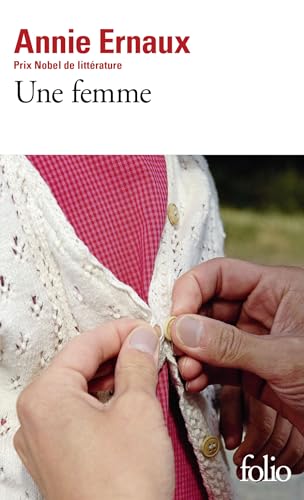
Annie Ernaux, Une femme (Editions Gallimard 1987) —–, A Woman’s Story (translated by Tanya Leslie 1991, Fitzcarraldo Editions 2024)
Before the meeting: The press release announcing that Annie Ernaux had won the Nobel Prize in Literature spoke of:
the courage and clinical acuity with which she uncovers the roots, estrangements and collective restraints of personal memory.
Every word of that is well chosen. Ernaux revisits her own life story in every book, pitting her ‘personal memory’ against what she finds in old photographs and diary entries, constantly questioning and challenging herself. She makes most other autobiographies / memoirs seem at least a little glib and self-serving.
I read Une femme / A Woman’s Story in both French and English. I could do this because it’s a short book – 60 pages in English, 95 in French. Apart from an opportunity to flex my rusty French, I was motivated by the way the English title departs from the original. Une femme is literally ‘A woman’. Calling it A Woman’s Story is a tiny change, but it significantly shifts the meaning. I wondered if similar shifts happened in the body of the book. (I think they do, and I apologise in advance for the way this blog post gets bogged down in the details of translation – fascinating to me, but maybe not to you!)
A Woman’s Story / Une femme does tell the story of a woman: Ernaux’s mother. But actually there are three stories. There’s Ernaux’s reconstruction of her mother’s life: her youth, her time as a shopkeeper in an impoverished part of France, her marriage, her ageing, and at last her dementia and death. There’s the story of Ernaux’s relationship with her, including the times that she lived with her and her family, and at the very end a brilliantly concise statement of what, after the initial intense grief, her mother’s death meant for her. And there’s the story of writing the book, begun in April 1986, very soon after her mother’s death, and finished in February the following year. This is a book in which une femme writes about une femme, and either could lay claim to the book’s French title.
I love this book. It reaches tendrils into parts of my own life that could do with a bit of ‘courage and clinical acuity’. I find Ernaux’s sheer dogged determination to find truthful words completely engrossing. In one of several moments when she steps in to tell us about the process of writing, she says:
When I speak of her, my first impulse is to ‘freeze’ her in a series of images unrelated to time – ‘she had a violent temper’, ‘she was intense in everything she did’ – and to recall random scenes in which she was present. This brings back only the fantasy woman, the one who has recently appeared in my dreams, alive once more, drifting ageless through a tense world reminiscent of psychological thrillers. I would also like to capture the real woman, the one who existed independently from me, born on the outskirts of a small Normandy town, and who died in the geriatric ward of a hospital in the suburbs of Paris. The more objective aspect of my writing will probably involve a cross between family history and sociology, reality and fiction [la jointure du familial et du social, du mythe et de l’histoire] … I would like to remain a cut below literature.
(Page 17)
That is to say, don’t look for fine writing here. Look for a serious attempt to see the reality of this woman’s life and how it was interwoven with Ernaux’s own.
My practice of looking at page 77 is a good way of giving you a flavour of the book, and of some of the issues that must have faced Tanya Leslie, the translator.
On page 77 of the French edition, page 51 of the English, it’s the early 1970s. Ernaux’s mother, now a widow, has sold her business and abandoned her life as a shopkeeper. She has moved to Annecy at the other end of France to live with Ernaux and her young family. She isn’t thrilled with her new life: she is no longer a significant part of a community. Her life has shrunk. ‘Now she felt she was a nobody’ / ‘Elle ne se sentait plus rien.’ She was proud of the life Annie had made for herself, but felt uneasy with the middle-class life that now surrounded her.
I ought to say that after my partner’s father died, her widowed mother became a much bigger presence in our lives, after a time spending a couple of nights a week living with us and then moving in full time. We didn’t have the class difference that Ernaux describes, but this page resonates powerfully, and I am in awe of the way the writing reaches for a deeply respectful understanding of the mother’s point of view:
Living with us was like living in a world that welcomed her and rejected her at the same time. One day she said angrily, ‘I don’t think I belong here.’
The transition from the generalised to the particular in those two sentences is typical Ernaux. In the French, it’s slightly different:
C’était vivre à l’intérieur d’un monde qui l’accueillait d’un côté et l’excluait d’un autre. Un jour, avec colère: « Je ne fais pas bien dans le tableau. »
There are three departures from a literal, word for word translation. First, there is no ‘us’: it’s all about the mother. Second, the English has tidied up the second sentence and given it a verb – ‘she said’ – which is not there in the French. There’s a lot of that in the book. The French text sometimes reads like quick notes: no need to spell out who was speaking etc. The English tidies it up, with the effect that what in French feels rough and raw becomes in English a more polished, considered text. And third, what the mother says has been softened: the tentativeness of ‘I don’t think’ is an insertion, where the French just has an angry statement of fact: ‘I don’t belong here.’
The rest of the page, in English:
And so she wouldn’t answer the phone when it rang next to her. If her son-in-law was watching football on television, she would make a point of knocking on the door before entering the living room. She was always asking for work – ‘Well, if there’s nothing to do, I might as well leave then’ – adding with a touch of irony, ‘After all, I’ve got to earn my keep!’ The two of us would argue about her attitude and I blamed her for deliberately humiliating herself. It took me a long time to realise that the feeling of unease my mother experienced in my own house was no different from what I had felt as a teenager when I was introduced to people ‘a cut above us’. (As if only the ‘lower classes’ suffered from inequalities which others choose to ignore.) I also realised that the cultural supremacy my husband and I enjoyed – reading Le Monde, listening to Bach – was distorted by my mother into a form of economic supremacy, based on the exploitation of labour: putting herself in the position of an employee was her way of rebelling.
And in French:
Donc elle ne répondait pas au téléphone quand il sonnait près d’elle, frappait d’une manière ostensible avant de pénétrer dans le salon où son gendre regardait un match à la télé, réclamait sans cesse du travail, « si on ne me donne rien à faire, je n’ai plus qu’a m’en aller» et, en riant à moitié, « il faut bien que je paye ma place!». Nous avions des scènes toutes les deux à propos de cette attitude, je lui reprochais de s’humilier exprès. J’ai mis longtemps à comprendre que ma mère ressentait dans ma propre maison le malaise qui avait été le mien, adolescente, dans les « milieux mieux que nous » (comme s’il n’était donné qu’aux « inférieurs » de souffrir de différences que les autres estiment sans importance). Et qu’en feignant de se considérer comme une employée, elle transformait instinctivement la domination cultureIle, réelle, de ses enfants lisant Le Monde ou écoutant Bach, en une domination économique, imaginaire, de patron à ouvrier: une façon de révolter.
You can see what the translator had to wrestle with. She breaks two long sentences into shorter ones. I can’t tell if this is her way of making the text more elegant, or if it’s a difference in the way the languages work. And domination must have given her nightmares: ‘supremacy’ isn’t a dictionary equivalent, but it’s surely eccentric to describe reading Le Monde as an act of domination. Yet maybe that eccentricity is exactly what Ernaux intended – certainly ‘economic supremacy’ makes less sense than ‘economic domination’.
This is one place where I was happy I had read the French as well as the English. I didn’t understand the bit in brackets about the ‘lower classes’ until I read the French, where, rather than the ‘others’ choosing to ignore inequalities, they consider some différences to be unimportant (and yes, différences translates as ‘differences’, no inequality necessarily implied). Le Monde is just a newspaper to Ernaux and her husband, and Bach is pleasant to listen to. For the mother, they are markers of cultural superiority. A smaller oddity of the translation is that whereas the French insists that the ‘cultural supremacy’ / domination culturelle is real (réelle) and that the ‘economic supremacy’ / domination économique is imaginary (imaginaire), the English lets the word ‘distorted’ carry that distinction. On top of that, leaving out the word instinctivement, it seems to me, makes the mother seem much more calculating, and perhaps makes Ernaux less patronising. I don’t think Ernaux wants to blame her mother, or spare herself, in this way.
After I’d written that last sentence I noticed a moment in the previous paragraph that struck a chord with me. One of the things Ernaux’s mother has to do to conform to the household’s lifestyle is, in English:
‘observing personal hygiene’ (blowing the boys’ noses on a clean handkerchief).
That’s unremarkable, just one more detail in the list of things she has to adapt to. The original French is:
avoir de l’« hygiène » (ne pas moucher les enfants avec son propre mouchoir).
A literal translation of the phrase in brackets is, ‘not to blow the children’s noses with her own handkerchief’. They say a translation can never be complete, but still I allow myself to mourn the loss of this tiny, graphic image of grandparent–grandchild intimacy forgone in the name of upward mobility, and lost to the English text for who knows what reason: perhaps handkerchiefs themselves are so repugnant to modern Anglo sensibilities that sharing them is unspeakable.
After the meeting: In the Book Club, we traditionally discuss two books. This book was paired with Abdulrazak Gurnah’s Paradise (linkto come added later). I think the reason for the pairing was that they’re both by Nobel laureates. At the start of our discussion, an astute person pointed out that they both feature shops (the mother’s shop in Ernaux’s book, and two different shops where Gurnah’s protagonist worked). That’s about where the similarities began and ended. Our evening – or at least that part of it not taken up with excellent food and even more excellent conversation about life, physical afflictions, travel plans and so on – was split neatly into two parts.
As you’d expect, my having read the book in both languages was met with eye rolls, but there was general recognition that the difference was substantial between blowing a child’s nose on a clean handkerchief and not blowing it on one’s own handkerchief.
We had a very interesting discussion of a passage where Ernaux describes her aim as to set aside her own emotional memories about her mother (how she felt when she was angry etc) and tell the story from her mother’s point of view, but says that she finds those emotions breaking through anyway. I think we agreed that this, far from being a failure, is one of the things that makes the book so rich.
One person out of the five of us didn’t care for the book. Reading it, she couldn’t see any reason why Annie Ernaux would have been given the Nobel. Those of us who had read a number of her books tried to articulate our reasons for holding her in high esteem, but maybe it’s a matter of taste. What I/we saw as minimalism, for example, she saw as sketchiness.
One person spoke of the way the book had inspired her to try to write about her own childhood, focusing on specifics rather than a broad narrative. The exercise had led to interesting insights into her early life. We had a brief but interesting conversation about how for ‘our generation’ in Australia (we range from a couple of weeks short of 70 to a couple of years beyond 80), as for Annie Ernaux, there was a shift in class – ‘upward mobility’ – that hadn’t been so widespread in previous generations. This shift was due in part to increased access to education – so we did the Australian equivalent of listening to Bach and reading Le Monde.
It might seem that that conversation was of the same order as travel plans and medical reports, but I think it’s a quality of Ernaux’s books – not just this one – that they prompt readers to reflect on their own lives.
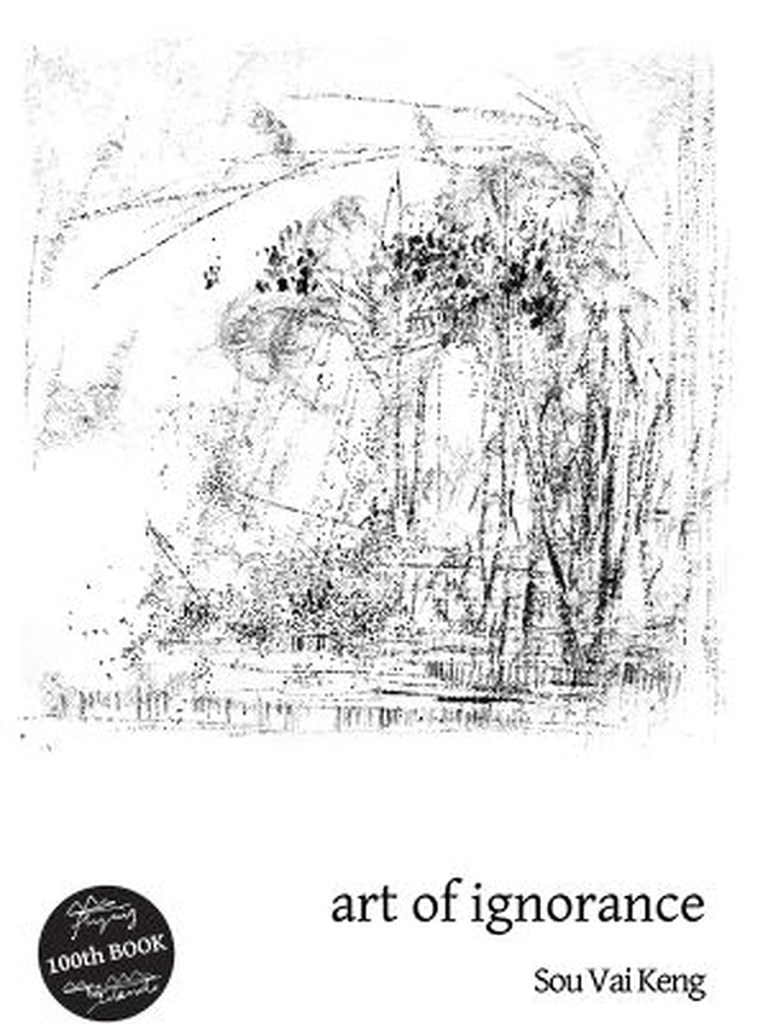
art of ignorance is the last of the small but substantial books I took with me on my recent fortnight in North Queensland. Like the others, it’s part of the Flying Island Pocket Poets series.
It’s a bilingual book – that is, each poem appears first in English then in Chinese. As there is no mention of a translator, I assume Sou Vai Keng wrote both versions. She also created the generous number of elegant drawings that intensify the book’s relaxed, contemplative feel.
A note tells us that all the poems were written in mountain areas in Germany and Switzerland between 2014 and 2018. Reading the book felt like sharing the experience of immersion in those mountains with someone with sharp eyes and a seriously playful mind – there’s not a lot of explicit description, things are seen in close-up, sometimes with a touch of surrealism, there are tiny fables and fantasies.
The opening line of the title poem could stand as an eight-word statement of the book’s prevailing mood:
the butterfly does not know the French call it papillon
Page 77* is a good example of how the book works: English on the left, Chinese on the right, with a delicate drawing in the middle (I’m sorry my tech skills aren’t up to showing the drawing without it being sliced in half by the gutter):
The poem starts with sweet whimsy:
she believes she is a tree
The rest of the first stanza elaborates: to be a tree is to ‘live on blessings from heaven’ in the form of rain and dew, and not to need anything else. A different poem might have mentioned roots and connection with other trees by way of the complex underground tangle of fungi. It might have mentioned birds’ nests, or arboreal animals, or fruits and flowers. But not this one. Here the character, like certain ascetics in the early Christian tradition, and in Chinese tradition as well I think, is opting out of active social life, choosing solitude and passivity in relation to a world she assumes to be benign.
But society intervenes. If she was ‘mean and nasty’, she could vanish, but her version of opting out is ‘a lovely idea’. It’s an idea that, by implication, the passers-by find attractive but not permitted. It’s ‘lunacy’. The poem is a parable of sorts, in which a character indulges for a moment a yearning to be stable and self-sufficient like a tree, only to be drawn back gently to the reality of human connectedness and instability:
out of sympathy and solidarity
people drag her away from where
trees stand firm and strong
and from now on she has to
roam and rove around
together with other
rootless nuts
The final word, far from offering a neat resolution of the poem’s conflict, raises more questions. What does it mean to equate humans with nuts? Nuts as opposed to sane, stable beings; nuts as fruits, insubstantial compared to the tree; nuts as bearing the possibility if one day taking root and developing into something more like trees? She is dragged away from her wistful belief, but at the very last moment the poem opens up to the possibility of her fantasy somehow becoming real.
It’s a fine example of the way Sou Vai Veng’s poem’s twist and turn beneath apparent simplicity. I enjoyed the book a lot.
I wrote this blog post in Gadigal Wangal country, as the days are warming up, the worms are fat and busy in the earth, the adolescent magpies are developing their adult colours. I acknowledge Elders past, present and emerging for their continuing custodianship of this land.
* My blogging practice, especially with books of poetry, is to focus on the page that coincides with my age, currently 77.
Michel de Montaigne, The Complete Essays (Penguin Classics 1991, translated by M. A. Screech) – part of Book 2 Essay 12, “An apology for Raymond Sebond’
Since my last Montaigne report, I’ve been faithful to my four pages of Montaigne each morning except for two breaks – one for a fortnight and the other just a weekend. The book is too heavy to take on a plane, and travel tends to disrupt routines like this one.
Five weeks ago, I had just started reading the longest essay in the collection, ‘An apology for Raymond Sebond’. Today I still have 60 odd pages of that essay to go. As I have only the vaguest idea of who Raymond Sebond was, or in what way Montaigne is attempting an apology, I’ll spare you any attempt at a summary, and just give a couple of snapshots.
Having declared himself to be a sceptic (as opposed to a dogmatist), Montaigne sets out to establish the limits of human reason. He piles on example after example of ancient philosophical versions of God, products of the ‘fierce desire to scan the divine through human eyes’. Arguing that if reason were able to determine the nature of God, then these versions would tend to some kind of agreement. Having established that this isn’t what happened, he (at least in M. A. Screech’s translation) drops his dignified mode of discourse altogether and exclaims:
So much din from so many philosophical brainboxes! Trust in your philosophy now! Boast that you are the one who has found the lucky bean in your festive pudding!
That’s on page 577. I’ve now reached page 625. In those 48 pages he has explored (and deplored) the limitations of reason in understanding even the world of nature or the human mind itself, and has been cheerfully insulting of many ancient writers whom he clearly admires enormously (including describing Plato as sometimes ‘silly’). Now he is going on about how philosophers can’t reach any agreement about the immortality or otherwise of the soul. He has reached the transmigration of souls:
the received opinion … that our souls, when they depart from us, go the rounds from one body to another, from a lion, say, to a horse; from a horse, to a king, ceaselessly driven from one abode to another.
And he’s having quite a lot of fun with it, citing the Epicureans’ objection:
What order could be maintained if the crowds of the dying proved greater than the number being born? The souls turned out of house and home would all be jostling each other, trying to be first to get into their new containers! They also ask how souls would spend their time while waiting for their new lodgings to be got ready.
Having added some lines of Latin poetry, he then goes on:
Others make our souls remain in the body after death, so as to animate the snakes, worms and other creatures which are said to be produced by spontaneous generation in our rotting flesh or even from our ashes.
In short, I’m enjoying this essay as a kind of romp in the history of philosophy. As a settled atheist who thinks my mind is a function of my body, I have a kind of museum-piece interest in a lot of the arguments. I was taught at school that until a certain point in European history people relied on the authority of, I think it was Aristotle, for their knowledge of the world. We knew from Aristotle how many teeth a human had, and only at a certain stage did it occur to people to look in each other’s mouths and count for themselves. As I read this essay, it feels as if I’m seeing that change happen before my very eyes, and it’s riveting. (Mind you, I think the essay itself is going to end with a declaration that Christian revelation is the ultimate source of Truth, but both things can be happening at once.)
To be continued.
This blog post was written on Gadigal-Wangal land, where understandings of the universe beyond Montaigne’s imaginings were developed millennia before the Ancients he discusses. It’s raining again, and my compost bin is alive with worms. I acknowledge the Elders past, present and emerging of the Gadigal and Wangal Nations,.
Michel de Montaigne, The Complete Essays (Penguin Classics 1991, translated by M. A. Screech) from Book 2 Essay 7, ‘On rewards for honour’ to part way through Book 2 Essay 12, “An apology for Raymond Sebond’
Three months in and I’m loving my morning chats with Montaigne. Not so much a progress report this month, as I’m poised to fly to warmer climes any second and am squeezing this post in among house-cleaning and similar chores.
Usually as I make my way through these essays I ignore the notes and references, as I’m not making a study of Montaigne, just reading him and living with my sometime incomprehension. For the current essay, ‘ An Apology for Raymond Sebond’, I read 24 pages of M. A. Screech’s introduction to the book, and listened to a podcast from David Runciman’s ‘Past Present Future’ series (a fascinating account of the essay, which you can find here).
It’s a serious argument, tackling the relationship between revealed truth as understood in 16th century Christianity and knowledge that can be acquired by observation and reason. It’s serious, and intricate. In the passages I’ve just been reading, which is all I’m going to talk about here, it’s something else.
In this part of the essay, Montaigne is arguing against human exceptionalism. Animals (he doesn’t quite bring himself to say ‘other animals’) give signs of being able to reason, to be loyal, seek justice, have compassion, grieve, do basic arithmetic, follow the movements of the stars. In many ways, we learn from the animals, even while we believe ourselves to be infinitely superior. He notes in passing that ‘you can see some male animals falling for males of their own kind’. He tells the story that I know as ‘Androcles and the lion’ in some detail, calling the human character ‘Androdes’. He piles on example after example – mostly from antiquity and in particular Plutarch.
For the sake of his argument, just a couple of examples would have been enough, but Montaigne is like a child in a lolly shop: there are so many stories old and new, verifiable and fantastical, it’s as if he can’t bear to leave any of them out. Today’s reading ends with this (on page 534):
As for greatness of spirit, it would be hard to express it more clearly than that great dog did which was sent to King Alexander from India. It was first presented with a stag, next with a boar, then with a bear: it did not deign to come out and fight them, but as soon as it saw a lion it leaped to its feet, clearly showing that it thought such an animal was indeed worthy of the privilege of fighting against it.
Montaigne had fought in battle, and the religious wars of the 16th century were raging around him as he wrote the Essays. His casual acceptance of violence, as in this paragraph, is one of the places where we feel how different his times were from ours. But his insistence at such length on the dignity of animals has a surprisingly modern feel.
Ok, that’s all I have time for. I have a plane to catch and warmer climes to visit.
This blog post, was written on Gadigal-Wangal land in between bouts of heavy rain, which enables the ibises and magpies in the park across the road to have a great time fossicking in the soft soil. I acknowledge the Elders past, present and emerging of the Gadigal and Wangal Nations.
Michel de Montaigne, The Complete Essays (Penguin Classics 1991, translated by M. A. Screech) from Book 1 Essay 42, ‘On the inequality there is between us’, to Book 2 Essay 7, ‘On rewards for honour’
Three months in and I’m coming to love my morning chat with Montaigne.
I was delighted to hear an echo of his voice in a session at the recent Sydney Writers’ Festival. In conversation with Felicity Plunkett (my blog post here), the poet Nam Le was struggling to describe the complex way his mind works. According to my scribbled notes, he said:
Any attribute you can attribute to yourself, the opposite can also be yours.
That morning, I had been reading Montaigne’s Book 2, Essay 1, ‘On the inconstancy of our actions’, which begins:
Those who strive to account for a man’s deeds are never more bewildered than when they try to knit them into one whole and to show them under one light, since they commonly contradict each other in so odd a fashion that it seems impossible that they should all come out of the same shop.
I don’t know if Nam Le had Montaigne even at the back of his mind, but it’s fascinating to find in Montaigne, roughly Shakespeare’s contemporary, such a pre-echo of a 21st century way of seeing things. Fascinating, but not an isolated moment. His reflections on public life, oratory, warfare, frugality, education, suicide and so on often seem tailor-made for quotation in a discussion of anything from the US ex-president to drone warfare or the culture wars. He can be horribly sexist, and his class material is also horrible; but he’s often hard to take to task, because he’s likely to disagree with himself in the next paragraph.
At four pages a day, some essays extend over several mornings. I can see one coming over the horizon that will last me nearly a month. Mostly I ignore M A Creech’s prefatory notes, but sometimes I depend on them to make sense of an argument. Sometimes Montaigne piles up the anecdotes – drawing on ancient writers, recent history, contemporary gossip and personal experience – to such an extent that I lose track of his argument, and suspect he has lost track of it himself. Some of the anecdotes are bizarre in the extreme, especially when he is reporting on sexual or dietary habits of ‘exotic’ peoples.
I’m being fairly lazy in my reading. Whenever Montaigne quotes a line or two of poetry, usually in Latin, but sometimes in Old French or other languages, I skip straight to the translation provided by Mr Screech. I know I’m missing one of the pleasures of these texts, but it’s a pleasure that demands too much work for me (and, I expect, most 21st century readers).
One of the pleasures that is still alive and well is the constant delight of watching Montaigne’s mind chase after whatever rabbit catches his eye while he’s doing something else. This morning I read the essay, ‘On rewards for honour’, a short argument against adding a monetary or other material component to an award for valour, which morphs briefly into a reflection on why ‘valour’ is seen to be mostly a martial virtue when true valour in non-military circles is so much harder to achieve, and then ends in a sentence or two wondering at the way ‘virtue’ means different things for men and women, finishing up with a jokey note which, if he had continued his thoughtful wanderings, might have led in a proto-feminist direction:
Our passion, our feverish concern, for the chastity of women results in une bonne femme (‘a good woman’), and une femme d’honneur, ou de vertu (‘a woman of honour or of virtue’) in reality meaning for us a chaste woman – as though, in order to bind them to that duty, we neglected all the rest and gave them free rein for any other fault, striking a bargain to get them to give up that one.
‘On practice’, the longer essay that precedes ‘On rewards for honour’, is an even better example of the way Montaigne’s mind moves in unexpected directions. It turns out to be about death – which, he says, is the one thing you can’t get better at by practice. Or is it? The tone changes abruptly as he tells of a horrific near-death experience of his own, including a detailed account of the aftermath as he regained consciousness, pain, and memory. Then: ‘The account of so unimportant an event is pointless but for the instruction I drew from it: for in truth, to inure yourself to death, all you have to do it draw nigh to it.’ But that’s not the final swerve of the essay. It turns to the question of talking and writing about oneself, but first there’s this brief description – one of many – of what he is trying to do (essaying) in the essays:
Here you have not my teaching but my study: the lesson is not for others; it is for me. Yet, for all that, you should not be ungrateful to me for publishing it. What helps me can perhaps help somebody else. Meanwhile I am not spoiling anything: I am only using what is mine. And if I play the fool it is at my own expense and does no harm to anybody.
I just read on Wikipedia that William Hazlitt described Montaigne as ‘the first who had the courage to say as an author what he felt as a man’. I’m loving his courage, and his humility, in putting his own experience and his own thinking out there for all the world to read.
This blog post, was written on Gadigal-Wangal land as the nights start earlier, spiderwebs multiply, and the rain buckets down. I acknowledge the Elders past, present and emerging of those Nations, and would love to hear from any First Nations people reading this blog.
Michel de Montaigne, The Complete Essays (Penguin Classics 1991, translated by M. A. Screech) Book 1, from part way through Essay 26, ‘On educating children’, to Essay 41, ‘On not sharing one’s fame’
I’m enjoying my morning read of Montaigne, now at the end of my second month.
As expected, his name has cropped up elsewhere. The time I noticed was on Waleed Aly and Scott Stephens’s podcast The Minefield, when talking about the recent stabbings in Sydney. Scott referred to the essay that M. A. Screech translates as ‘On Affectionate Relationships’ to illustrate something he was saying about grief.
That essay was one I read this month. Though its discussion of grief is wonderful, the thing that stands out for me in it is his exalted notion of friendship. The meeting of souls that these days tends to be identified, hopefully, as part of romantic love he sees as quite distinct, and separate, from the love of spouse (he says ‘wife’) or children. Revisiting them now, I see that the paragraphs on grief are wonderful. For example:
I drag wearily on. The very pleasures which are proffered me do not console me: they redouble my sorrow at his loss. In everything we were halves: I feel I am stealing his share from him. (Page 217)
The essays I have just read are ‘Reflections upon Cicero’ and ‘On not sharing one’s fame’. I wish my Latin teachers could have told me about the Cicero one in high school: it would have made it much more fun to study that ‘Cui bono?’ speech if I’d known how Montaigne despised its author. Speaking of Cicero and Pliny the Younger, he writes:
What surpasses all vulgarity of mind in people of such rank is to have sought to extract some major glory from chatter and verbiage, using to that end even private letters written to their friends; when some of their letters could not be sent as the occasion for them had lapsed they published them all the same, with the worthy excuse that they did not want to waste their long nights of toil! How becoming in two Roman consuls, sovereign governors of the commonwealth which was mistress of the world, to use their leisure to construct and nicely clap together some fair missive or other, in order to gain from it the reputation of having thoroughly mastered the language of their nanny! (Page 279)
Then, wonderfully, two pages later in ‘On not sharing one’s fame’, in discussing the way ‘concern for reputation and glory’ is the most accepted and most universal of ‘all the lunacies in this world’ he writes this, without a trace of his earlier disparagement:
For, as Cicero says, even those who fight it still want their books against it to bear their names in the title and hope to become famous for despising fame.
But then, he regularly says that he has a poor memory.
The very last thing I read this morning is a wonderful example of how Montaigne can surprise and delight (though it’s also an example of the violence that permeates Montaigne’s world). He has been piling on examples of people (all male) who have acted to enhance someone else’s fame and glory, often to the detriment of their own. Then, in the last couple of sentences he swerves off into a comic non sequitur:
Somebody in my own time was criticised by the King for ‘laying hands on a clergyman’; he strongly and firmly denied it: all he had done was to thrash him and trample on him. (Page 289)
This blog post, like most of mine, was written on Gadigal-Wangal land as the days grow shorter and spiderwebs multiply, even in the heavy rain. I acknowledge the Elders past, present and emerging of those Nations.
Jenny Erpenbeck, Kairos (translated by Michael Hofmann, Granta 2023)
Before the meeting: The Emerging Artist read this book before I did. She hated it, couldn’t finish it, and threatened to divorce me if I ended up liking it. Though I wouldn’t say I absolutely loved the first 166 pages, by page 167 (of 292) I was pretty sure our relationship was safe.
In a prologue, the book’s narrator, Katharine, learns that a former lover has died. She is unable to attend his funeral as she has promised, but soon after the funeral two boxes of material are delivered to her door by a weeping woman. Here’s how she describes the project that becomes this book:
Kairos, the god of fortunate moments, is supposed to have a lock of hair on his forehead, which is the only way of grasping hold of him. Because once the god has slipped past on his winged feet, the back of his head is sleek and hairless, nowhere to grab hold of. Was it a fortunate moment, then, when she, just nineteen, first met Hans? One day in early November, she sits down on the floor and prepares herself to sift – sheet by sheet, folder by folder – through the contents of the first box, then the second.
What follows, based on the contents of those boxes plus a suitcase of Katharina’s own memorabilia, is the story of her relationship with Hans, a married man who is ten years older than her father, 51 to her 19. Two things inclined my expectations against the Emerging Artist’s distaste. First, the set-up linked nicely to other recent reading – mainly Annie Ernaux’s The Young Man (link is to my blog post), a memoir of a relationship between the author and a much younger man. Second, it’s set in East Germany in the 1980s in the prelude and aftermath of the fall of the Berlin Wall, so I thought (correctly) that the book would capture something of the flavour of that time and place.
The book starts with a cute meet in a downpour in Berlin in 1985. There’s a period of mutual bliss, which blossoms all too quickly into a physically and psychologically abusive nightmare, to which Katharina is inexplicably committed, so that by page 167 without any explanation she has evidently consented to being tied up and beaten with a belt, and later with a riding crop. Until that point, the historical context was enough to keep me afloat as a reader. The hideous mind games move up a notch as Hans convinces Katharina that she is cold, selfish and deceitful and sends her a series of cassettes detailing how terribly she has made him suffer. Instead of pulling the plug, she listens to the tapes, takes careful notes (hence the narrator’s ability to recall them even though he destroys each hour-long diatribe by taping the next one over it), and writes a self- abasing reply, thereby provoking another cassette.
The hideous gaslighting continues for many pages. Several times the reader breathes a sigh of relief as it seems the relationship is finished, and then it’s on again with occasional moments of joy and endless rounds of blame and accusation on his part and wretched self-abasement on hers. Maybe its an allegory about East Germany, as Neel Mukherjee says on the back cover, but I can’t see it.
I’m glad I persisted, because a) the worm does finally turn, if ever so slowly and slightly, and more importantly b) there are several wonderful pages about how the reunification of Germany was experienced by the Easties. Maybe for German readers the relationship between the central relationship and the historical moments would be clearer, but I couldn’t see it as more than a gruelling account of a vulnerable young woman being exploited by a self-obsessed and cruel much older man, with the broad sweep of history barely impinging on their lives until massive change happens all around them.
Page 204: I usually blog about page 77. It would have been interesting to linger on that page in Kairos, where Katharina first visits the West, foreshadowing the final movement. But this time I want to give you a bit of page 204, which is the moment when I first began to hope for something other than abuse and submission, and catch a glimmer of the book’s intention to capture what it was like to have lived through first the Nazi and then East German Communist regimes. It’s the closest Hans comes to introspection:
The abolition of a pitiless world through pitilessness. But when does the phase after begin? When is the moment to stop the killing? … To be arrested or to carry out arrests and believe in the cause, to be beaten or to beat and believe in the cause, to be betrayed or to betray and believe in the cause. What cause would ever again be great enough to unite victims and murderers in one heartbeat? That it would make victims out of murderers and murderers out of victims, until no one could tell any more which he was? Arrest and be arrested, beat and be beaten, betray and be betrayed, till hope, selflessness, sorrow, shame, guilt, and fear all make one indissoluble whole … And if beauty can only be bought with ugliness, and free existence with fear? Probably, Hans thinks, turning aside, and hearing Katharina mutter something incomprehensible in her sleep, that’s probably what it took to produce the deeper experience that you can see here in every woman, every man, every child even.
After the meeting: After a pleasant meal of mussels and pasta, we dutifully turned to a discussion of the books (Paul Murray’s The Bee Sting was also on our agenda, blog post to follow). Only two of the five of us had finished the book. There was some discussion about whether Book Clunb members had an obligation to read the books. I think the position that ended up being accepted was that yes, they do, except if a book offends their value system intolerably. Kairos was such a case for at least one of last night’s non-completers.
Generally we agreed that it was an awful read. I tried to argue that the final section, in which the Wall comes down, made the whole book worth reading, but I didn’t even convince myself. I also argued that the eerie lack of internality in the characters was not a bug but a feature: the narrator is reconstructing a painful episode from her youth, which she no longer understands or perhaps can’t bear to imagine herself back into. So she meticulously recreates a narrative from the documents, including details of places, times, food eaten, drinks drunk, transport caught, the content of cassette tapes and letters, and leaves it to the reader to imagine the emotional content beyond the broad outlines of ‘love’. I pretty much convinced myself that this was an accurate reading, but no one else bought it.
We didn’t talk about the translation at all. I couldn’t help thinking, though, that the book would almost certainly speak more forcefully to German readers, not so much because of the language as because of their connection to the history.
In short, not a recommended read.
I wrote this post on Gadigal-Wangal land, not far from the Cooks River, in a place that was once wetland teeming with birdlife. I finished it after a long walk through Gadigal land to the waters of Sydney Harbour/Warrane on a beautiful autumn day. I want to acknowledge the people who have looked after this place for tens of thousands of years, their Elders past present and emerging.






 Me fail? I fly!